“Why Would We Waste A Seat On Your Kid?” Dad Said, Giving My Son’s Ticket To My Nephew’s Friend. It Was The $1,400 Game I Bought Tickets For. My Son Sat In The Car. I Said, “Got It.” At The Gate, Dad’s Scan Beeped Red. Then Mine Beeped Green. The Usher Looked At Dad And Said….
When my father looked at my twelve-year-old son outside Arrowhead Stadium and asked, “Why would we waste a seat on your kid?” he had no idea I had paid for every ticket in our family’s section. My sister had convinced him to give my son’s seat to her child’s friend because I refused to turn my nephew’s ridiculous party trick into a professional career. What happened at the stadium gate exposed months of manipulation, but the real betrayal was much bigger than one football ticket.
### Part 1
At 4:38 on a freezing Sunday afternoon, my father stood in the Arrowhead Stadium parking lot with a paper tray of nachos in one hand and looked straight past my twelve-year-old son as if Mason were an inconvenient piece of luggage. “Why would we waste a seat on your kid?” he said. “Cole’s friend will actually make the game fun for him.” For a second, all I heard was the wind pushing through the rows of parked cars, the distant roar from the stadium, and the crackle of the hand-warmer packet Mason was squeezing between his gloves. Then I looked at my father and realized he was completely serious.
Mason stood beside me in a red Chiefs hoodie, carrying the clear stadium bag we had packed together that morning. He had spent the entire drive talking about the game, the weather, and whether we would get there early enough to see warmups, but now his shoulders had pulled inward. “Mom,” he asked quietly, “am I not going?” My father, Harold, glanced toward my younger sister Tara instead of answering, and that tiny movement told me more than his words had. Tara was standing several feet away in a white puffer coat, staring down at her phone with the rigid concentration of someone pretending not to listen.
“I bought Mason’s ticket,” I said.
Dad exhaled like I was the difficult one. “You bought all the tickets.”
“Yes.”
“That’s not the point.”
Whenever someone says, “That’s not the point,” there is an excellent chance you have found the exact point. I’m Jenna Mercer, thirty-eight years old, Kansas City born and raised, and I work as a talent agent. My professional life involves contracts, negotiations, performers, producers, deadlines, egos, and grown adults explaining why obligations written in black ink somehow became optional the moment those obligations stopped benefiting them.
I looked at Tara. “Who exactly is getting Mason’s seat?”
She finally raised her eyes. “Ethan.”
“Who is Ethan?”
“Cole’s friend.”
Beside her stood my thirteen-year-old nephew, Cole, who looked as though he wanted to disappear into the asphalt. “Ethan’s really excited,” Tara added.
“I’m happy for Ethan.”
“Cole wanted someone his age here.”
“Mason is twelve.”
Tara’s expression tightened. “You know what I mean.”
I did not, and judging from Cole’s face, neither did he. Mason looked from me to his grandfather, waiting for someone to laugh and say this had all been a misunderstanding, but nobody did. Dad rubbed his forehead. “Jenna, please don’t turn this into some huge dramatic thing.”
“I’m asking whether the child whose ticket I purchased is going to the football game.”
Dad hesitated again.
That was clue number two.
Clue number one had arrived twenty minutes earlier at a gas station. Mason had gone inside to buy gum when my phone buzzed with a ticket notification saying one seat had been transferred out of the ticket group. I opened the app and stared at the screen: the exact seat I had assigned to Mason was now registered to someone named Ethan Parker. Because Dad had coordinated parking and tailgating, I had shared management access to the six tickets I had bought months ago for myself, Mason, my parents, Tara, and Cole.
I called Dad immediately. “What did you do?”
“What?”
“Mason’s ticket.”
There was a pause long enough to tell me he already knew.
“Oh. That.”
“That?”
“Tara thought it made more sense for Ethan to come.”
“Why?”
“Cole wanted somebody closer to his age.”
“Mason is his cousin.”
“Don’t twist this.”
“I’m reading the ticket transfer.”
Dad sighed, and then he said the sentence that had brought us to this parking lot confrontation. “Why would we waste a seat on your kid when Cole’s friend will actually make the day fun for him?”
I had gone very quiet.
“Jenna?”
“Got it.”
“Don’t be like that.”
“Like what?”
“You know.”
I ended the call before Mason came back to the car. He climbed into the passenger seat carrying gum and a blue sports drink, took one look at my face, and asked, “Grandpa?”
“Yep.”
“That didn’t sound like a good yep.”
“No,” I admitted. “It wasn’t.”
Before I started the engine, I called the ticket company. A woman named Rachel answered with the calm voice of someone who had spent the entire afternoon dealing with furious sports fans and no longer feared human emotion. She verified my identity, confirmed that I was the original purchaser, and asked whether I had authorized the transfer.
“No.”
“Would you like me to restore control of the ticket group to your account?”
“Yes.”
I heard several seconds of typing. “All right. Shared management access has been revoked. Any copies currently stored through that shared access will no longer scan unless you issue new tickets.”
I sat completely still. “All of them?”
“Yes.”
I looked through the windshield at the stadium rising beyond the parking lot.
“Rachel?”
“Yes?”
“I think you may have just saved Thanksgiving.”
She laughed. “I’m not sure I have that kind of authority.”
“You do now.”
I restored six tickets to my account. Then I sent one back to my mother. I sent one to Cole. I kept mine. I kept Mason’s.
I did not resend Dad’s.
I did not resend Tara’s.
And I most certainly did not send one to Ethan.
It wasn’t revenge.
I was a talent agent.
I preferred the term administrative restructuring.
Twenty minutes later, standing in front of Dad as he explained why my son’s place belonged to someone else, I finally understood that this had never been about a football game. Tara’s smug little smile confirmed it before anyone said another word.
This was punishment.
And I already knew exactly what she thought I was being punished for.
### Part 2
Six months earlier, my family had gathered at my parents’ house for Mom’s birthday, and Cole had made a dolphin noise with his armpit. That sentence sounds like the beginning of an embarrassing family anecdote because that is exactly what it should have remained. We were eating chocolate cake when he tucked one hand under his opposite arm, squeezed, and produced a high, squeaking sound that made Dad choke on his coffee.
Everyone laughed, including me. Cole grinned and did it again, this time longer, then bowed dramatically when Mason applauded. I remember saying, “That is disgusting,” while laughing hard enough that I nearly dropped my fork, and Cole took it exactly as intended. He was thirteen, he had discovered a stupid sound that made people laugh, and for about thirty seconds everyone behaved like a normal family.
Then Tara leaned forward.
“Do it again.”
Cole obeyed.
Tara’s eyes widened. “You hear that, right?”
I assumed she was joking. “Hear what?”
“The control.”
I looked at her. “He’s pushing air out of his armpit.”
“No, listen to the pitch.”
Cole squeaked again.
“That was longer,” Tara said.
“So?”
“So he can control it.”
Within forty-eight hours, my sister had created an entire social-media identity around her son’s armpit. She called the account Cole Makes Waves and described him as an emerging young sonic performer exploring human interpretations of marine communication. His first clip was Dolphin Greeting, followed by Angry Dolphin, Baby Dolphin, and one Cole titled Dolphin Who Just Saw Gas Prices, which I privately thought was the funniest because his facial expression was genuinely excellent.
Three weeks later, Tara called me while I was between client meetings. “I sent you Cole’s media kit.”
I stopped walking. “His what?”
“Check your email.”
A twelve-page PDF was waiting for me. The first page featured a black-and-white photograph of Cole standing beside a lake with his arms crossed like a musician about to announce a world tour. Another page described his work as existing at “the intersection of marine communication, physical performance, and experimental sound,” and another listed his influences as wildlife documentaries, comedy films, the ocean, and sound itself.
I closed the document.
Then I opened it again because sometimes the human brain requires a second viewing before accepting reality.
Tara called ten minutes later. “Well?”
“There are twelve pages.”
“I know.”
“You listed the ocean as an influence.”
“Jenna.”
“And sound itself.”
“Stop.”
“I’m trying.”
“You’re a talent agent. This is what you do.”
“What I do is represent professional performers.”
“This is performance.”
“Technically, yes.”
“Then represent him.”
I leaned back in my chair and stared through the glass wall of my office. At that time, I represented twenty-three working clients: actors, commercial performers, voice talent, comedians, one television host, and a man who made an impressive living narrating medical commercials with the concerned tone of someone personally worried about everyone’s cholesterol. My job was not to certify every unusual thing as a marketable career.
“Tara, Cole is funny,” I said. “He’s confident. He obviously enjoys performing.”
“So?”
“I do not have a professional market for dolphin noises made with an armpit.”
She actually gasped. “You represent voice actors.”
“With their voices.”
“It’s still sound.”
I pinched the bridge of my nose. “Who exactly do you expect me to call?”
“Disney?”
“For what?”
“A dolphin project.”
“Do you believe Disney maintains an emergency list of human armpits?”
She hung up.
I thought that would be the end.
Instead, it became a family campaign.
At Sunday dinner, Mom said, “Your sister feels you aren’t supporting Cole.”
“I went to his school play.”
“That’s different.”
“I bought forty dollars of wrapping paper from his fundraiser.”
“That’s different.”
“I watched every dolphin video.”
Dad looked up from his plate. “There are eight now.”
“Of course there are.”
Nobody asked whether Tara was supporting Mason’s interests with equal enthusiasm. Mason was quiet, patient, and obsessed with robotics. He could spend three hours building something without once asking whether anyone was watching him, which meant his achievements rarely generated the kind of noise Tara could turn into a family emergency.
Two weeks later, Mason competed in a regional robotics event after spending months building a machine that sorted colored blocks. My parents had promised to attend. At 8:14 that morning, Mom texted me: “Sorry, honey. Cole has a recording session.”
I stared at the message.
Recording session?
Tara had rented a podcast studio for ninety minutes so Cole could produce what she called his professional marine demo reel.
Mason’s robot placed third.
My parents watched Cole squeak into a microphone.
A few months later, Dad canceled on Mason’s birthday dinner thirty minutes before we left home because Tara had arranged an “industry showcase.” That showcase turned out to be beside the toppings bar at a frozen yogurt shop. A toddler started crying during Angry Dolphin, and Tara later described it as “strong audience engagement.”
I stopped arguing after that.
Not because I agreed.
Because Mason was noticing.
He never complained, which somehow made it worse. He would shrug when my parents missed something, say, “It’s okay,” and go back to whatever he was building. I kept telling myself that my parents loved him, that Tara’s obsession would burn itself out, and that eventually everyone would remember that children are supposed to have interests, not family-managed careers.
Then Tara tried to take a $1,400 football ticket away from him.
And standing outside Arrowhead Stadium, I finally understood that my refusal to represent Cole had somehow become permission to punish my son.
Tara crossed her arms and looked at me.
Dad lifted his phone.
“Everybody ready?” he asked.
I almost smiled.
Because they had no idea what was about to happen at the gate.
### Part 3
Ethan arrived five minutes later with his mother, wearing a Chiefs jersey and carrying an enormous foam finger. The poor kid looked genuinely thrilled, and the sight of him stripped away any temptation I might have had to make the situation ugly in front of him. He had no idea Tara had recruited him as a piece in some bizarre family argument involving football, professional representation, and a teenager’s armpit.
Dad clapped his hands. “Great. Everybody’s here.”
“Not everybody,” I said.
Mason was waiting in my warm car two rows over. I had told him I needed two minutes to handle something and promised I would come back. He had nodded, but I could tell he was trying very hard not to ask whether his grandfather had really given away his seat.
We walked toward the entrance.
Dad went first.
He held his phone beneath the scanner.
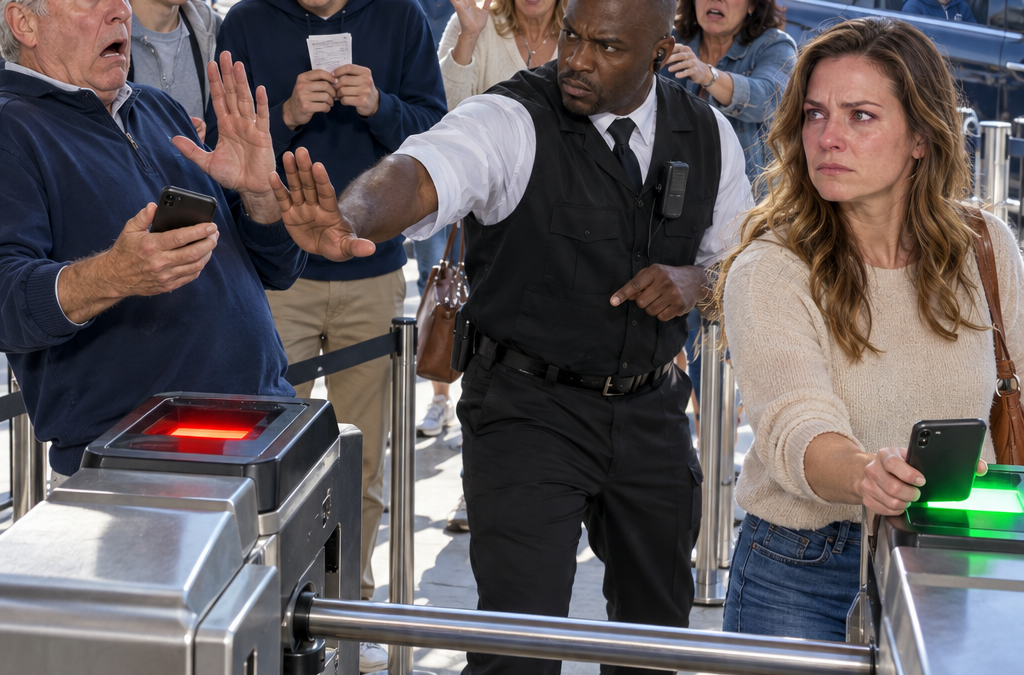
Beep.
Red.
The usher shook her head. “Try again, sir.”
He did.
Beep.
Red.
Dad frowned. “That’s strange.”
Tara stepped forward. “Try mine.”
Beep.
Red.
She stared at the screen.
Mom scanned next.
Beep.
Green.
The usher waved her through.
Cole scanned.
Green.
His eyebrows rose.
Then I scanned mine.
Green.
Dad slowly turned toward me.
“What’s happening?”
I said nothing.
The usher checked his screen. “Your ticket is no longer active, sir.”
“That’s impossible.”
“It appears it was canceled by the purchaser.”
Silence settled around us despite the thousands of people moving toward the stadium. Dad looked at me with the same expression I had seen dozens of times from producers who had suddenly discovered that verbal promises and signed contracts were not interchangeable things. Tara’s face tightened.
“Jenna.”
I met her eyes. “Tara.”
“What did you do?”
“I restored control of my tickets.”
“Your tickets?”
“Yes.”
Dad held up his phone. “You gave me this.”
“I gave Mason one, too.”
“That’s different.”
The usher’s expression changed slightly. She was trying not to react, but I could see that she had figured out there was a story happening in front of her.
Tara glanced toward the parking lot. “Where’s Mason?”
“In my car.”
Dad immediately seized on that. “See? He doesn’t even want to come.”
“He’s waiting for me.”
Tara lowered her voice. “Fine. Just transfer our tickets back.”
“No.”
Dad blinked. “What?”
“No.”
“We’re standing at the gate.”
“I noticed.”
“You’re seriously not letting your own father into the game?”
“You’re seriously asking me why I would waste a seat on you?”
The usher coughed into her glove.
I suspected it was covering a laugh.
Tara’s cheeks turned pink. “This is childish.”
Then Cole spoke.
“Mom.”
Something in his tone changed the air.
Tara looked sharply at him. “What?”
“I told you not to do this.”
Everyone stopped.
Dad looked from Cole to Tara. “Do what?”
Cole shoved his hands into his jacket pockets. “The whole Mason thing.”
Tara’s voice hardened. “Cole.”
“I didn’t ask Ethan to come.”
Ethan suddenly became fascinated by his foam finger.
I looked directly at Tara. “You said Cole wanted him here.”
She didn’t answer.
Cole continued, staring at the ground. “Mom said Aunt Jenna needed to learn a lesson.”
Dad’s head turned. “What lesson?”
“Cole,” Tara warned.
He looked miserable, but once a thirteen-year-old decides he has carried enough adult nonsense, there is not much anyone can do to stop him. “She said Aunt Jenna needed to know what it feels like when somebody doesn’t support her kid.”
My stomach went cold.
I already knew what was coming, but hearing it from Cole was different.
I looked at Tara. “You took my son’s ticket because I won’t represent Cole.”
“I didn’t take it.”
Dad looked at her. “You told me to transfer it.”
“I suggested it.”
“You gave me Ethan’s email address.”
“That doesn’t mean—”
Dad stared at her.
Even the usher looked impressed.
Tara folded her arms. “She has never taken Cole seriously.”
“I take Cole seriously.”
“No, you don’t.”
“I don’t take the armpit seriously.”
A man waiting behind us suddenly coughed.
Tara lowered her voice. “You laughed at his talent.”
“Everybody laughed. Cole was making people laugh.”
“It wasn’t supposed to be funny.”
I looked at my nephew.
Cole looked back.
Then he said very quietly, “I kind of thought it was.”
Tara turned toward him. “What?”
“The dolphin thing. I thought it was funny.”
“You love performing.”
“I like making people laugh.”
“Exactly.”
“But you made it weird.”
I pressed my lips together.
It was an extraordinary moment when a thirteen-year-old summarized six months of family conflict more accurately than every adult involved.
Tara stared at him. “How did I make it weird?”
Cole shrugged. “The practice schedule.”
Dad frowned. “What practice schedule?”
I slowly turned toward my sister.
Tara looked at Cole.
Cole looked at the gate.
“She made a spreadsheet.”
I closed my eyes.
Of course she had.
Dad asked, “A spreadsheet for what?”
“Practice.”
“Practicing what?”
Cole gave him an exhausted look. “My armpit.”
The man behind us laughed out loud.
Tara snapped, “It was about discipline.”
Cole continued. “Monday was pitch control.”
I bit the inside of my cheek.
“Tuesday was endurance.”
The usher turned away.
“Wednesday was emotional interpretation.”
I failed.
A laugh escaped me before I could stop it.
Tara glared. “This is exactly what I mean.”
“I’m sorry.”
“You’re not.”
“No.”
Cole added, “Thursday was aquatic improvisation.”
Dad stared at him. “What in God’s name is aquatic improvisation?”
Cole raised one arm.
Tara’s eyes widened. “Don’t.”
He squeezed.
A small sequence of squeaks came from under his jacket.
The usher bent forward and covered her face.
Dad stared at Cole.
“What did that mean?”
Cole answered seriously, “The dolphin is confused.”
Dad nodded slowly. “I understand him.”
Mom, already standing on the other side of the gate, burst out laughing.
Then Cole added something nobody expected.
“And my armpit hurts.”
Mom stopped laughing.
Dad stopped smiling.
I looked at Tara.
“What?” I asked.
And suddenly the joke wasn’t quite as funny anymore.
### Part 4
“My armpit hurts,” Cole repeated, pointing beneath his right arm as if he couldn’t believe we needed clarification. “I had to put an ice pack on it Wednesday.” Tara immediately interrupted him. “It was after a long practice session, and he’s exaggerating.”
Dad stared at her. “You made him practice long enough that he needed ice?”
“I didn’t make him.”
Cole looked at his mother. “You said I couldn’t use my tablet until I finished.”
“That’s parenting.”
“For dolphin noises?”
“It was about commitment.”
I leaned against the railing because I could feel another laugh threatening to escape, except this one had very little amusement in it. The absurdity had finally wrapped around itself and become sad. Tara had taken something her son enjoyed because it made people laugh, turned it into a schedule, a brand, a professional ambition, and eventually a weapon against my child.
Cole looked at her. “I told you yesterday I don’t want to do it anymore.”
Tara’s face changed. “You said you wanted to explore other sounds.”
“I said I wanted to try improv.”
“We talked about branching out.”
“Comedy improv.”
She blinked. “But we already have branding.”
That sentence nearly destroyed the remaining composure of everyone within hearing distance. Dad turned his face away. The usher covered her mouth. Even Mom, watching through the barrier, shook her head while laughing.
Cole looked exhausted. “Mom, I don’t want to be the dolphin kid forever.”
Tara seemed genuinely wounded. “You’re talented.”
“Maybe at other stuff.”
“We built all this.”
“You built it.”
That landed.
For months, I had thought Tara’s obsession was embarrassing, irritating, and occasionally hilarious. Standing there, watching Cole finally tell her the truth, I realized he had been trapped inside it too.
I straightened. “Cole, do you still want to see the game?”
He looked at me cautiously. “Yeah.”
“You’re not responsible for any of this. Go in with Grandma.”
His eyes widened. “Really?”
“Really.”
He stepped forward and hugged me hard enough to surprise me, then walked through the gate toward Mom. Tara watched him go with an expression that looked almost betrayed.
“What about me?” she asked.
“There are ticket windows.”
Her jaw dropped.
Dad stared at me. “Jenna.”
“There are ticket windows for you too.”
“You expect us to buy new tickets?”
“No. I expect you to make your own decisions with your own money.”
His face hardened. “I’m your father.”
“And Mason is my son.”
“That’s not the same.”
“You’re right. My obligation to protect my twelve-year-old is stronger than my obligation to protect a sixty-seven-year-old man from the consequences of taking something that wasn’t his.”
Dad went silent.
I continued before anyone could interrupt me. “You transferred a ticket I purchased for Mason without asking me. You expected him to sit in the parking lot while another child used his seat because Tara was angry that I wouldn’t turn Cole’s party trick into a career.”
Tara shook her head. “You don’t have to say it like that.”
“How should I say it?”
“His art.”
From the other side of the gate, Cole groaned. “Mom.”
Ethan’s mother had finally understood enough to look horrified. She touched her son’s shoulder and said quietly, “We’re going home.”
Tara turned. “He can still—”
“No,” Ethan’s mother said. “I think we’re good.”
I felt awful for them. Ethan had come expecting football and had instead received front-row seats to a family collapse before even entering the stadium.
I walked back to the car.
Mason looked up when I opened the door.
“So?”
I leaned against the roof. “Do you still want to see the Chiefs?”
His entire face changed. “Obviously.”
“Good answer.”
He hesitated. “What about Grandpa?”
“Grandpa is solving a problem Grandpa helped create.”
“What about Aunt Tara?”
“Same answer.”
He studied me for another second, then nodded.
Mason has always understood more than adults realize. I sometimes wondered whether being quiet had trained him to listen better than the rest of us.
We entered the stadium together. Mom and Cole were waiting inside, and Cole immediately apologized to Mason even though he had done nothing wrong.
“I didn’t know,” he said.
Mason shrugged. “It’s okay.”
“No, it’s not.”
They looked at each other.
Then Mason asked, “Does your armpit really hurt?”
Cole sighed. “Please don’t.”
That broke the tension.
My sixth ticket was still sitting unused in my account, so once we reached our seats, I texted Maya, my assistant.
“You busy?”
Three dots appeared.
“Define busy.”
“Want a free Chiefs ticket?”
Another pause.
“Who died?”
“Nobody. Long story. Dolphin related.”
Her reply came instantly.
“I’m putting on shoes.”
Maya arrived during the second quarter, carrying a pretzel and wearing the expression of a woman who had spent the entire drive preparing herself for nonsense. I gave her the shortest possible version while Mason and Cole watched the field.
She stared at me.
“So your sister retaliated against you because you refused to professionally manage her son’s armpit.”
“Yes.”
“And your father participated.”
“Yes.”
“And now they’re outside?”
“They bought their own seats.”
Maya nodded thoughtfully. “This may be the strongest argument for written contracts I have encountered in my entire career.”
Mason leaned across me. “Cole had to ice his armpit.”
Maya closed her eyes. “Please stop adding information. I need to survive the game.”
The Chiefs scored.
Mason jumped up screaming and high-fived Cole.
I watched the two boys celebrate together and felt something inside me unclench.
The children were fine with each other.
They always had been.
It was the adults who had turned one ridiculous noise into a family civil war.
But the game was not the end of it.
Three days later, Dad showed up at my house carrying coffee.
And my father only brought coffee when he knew he was wrong.
### Part 5
Dad sat at my kitchen table while my dog stared at him from across the room with the suspicious expression of a disappointed bank manager. He pushed one coffee toward me but didn’t touch his own. “I owe Mason an apology.”
“Yes.”
“And you.”
“Yes.”
He glanced up. “You could make this easier.”
“You didn’t make Sunday easier.”
“That’s fair.”
Silence settled between us. Outside, a lawn crew somewhere down the street sent the smell of cut grass through my slightly open window, and I remember noticing something ordinary about that because the last six months had made every family conversation feel like a negotiation conducted during a circus.
Dad rubbed both hands over his face. “Tara convinced me you were being cruel to Cole.”
“How?”
“She said you were refusing to help him because you were jealous.”
I stared at him.
“Jealous of what?”
Dad looked embarrassed.
“Say it.”
“No.”
“Dad.”
He sighed. “His talent.”
I slowly put my coffee down.
“Thank you.”
“Don’t enjoy this.”
“I’m fighting for my life.”
He almost smiled, but then his expression changed. “There’s more.”
Dad pulled out his phone and opened a message thread with Tara. He scrolled back several weeks before handing it to me.
Tara: Jenna needs to understand what it feels like when people don’t show up for your kid.
Dad: She goes to Cole’s family stuff.
Tara: That’s not the same as supporting his future.
Dad: She doesn’t represent children in that kind of work.
Tara: She represents performers.
Dad: Tara, this seems personal.
Tara: Because it is.
I scrolled farther.
Two days before the game:
Tara: If Mason doesn’t go, maybe Jenna finally understands.
Dad: That seems harsh.
Tara: It’s one game.
Dad: Jenna bought the tickets.
Tara: She can afford it.
I stared at those last four words.
There it was.
Not concern for Cole.
Not hurt feelings.
Not even the dolphin.
Entitlement.
Because I had built a successful career, Tara had quietly decided that access to that career belonged partly to her. My contacts were family resources. My time was family property. My judgment was acceptable only when it benefited her.
When I said no, she did not hear, “I don’t have a professional market for this.”
She heard, “You and your son are not important.”
Then she decided the appropriate response was to make my son feel unimportant too.
I handed Dad his phone. “And you went along with this.”
He stared at the coffee.
“I thought it would blow over.”
“You transferred the ticket.”
“I know.”
“From a twelve-year-old.”
“I know.”
“So Tara could punish me.”
“I know.”
“For refusing to professionally represent dolphin noises.”
Dad shut his eyes. “Please do not call it dolphin revenge.”
“I will call it dolphin revenge until my funeral.”
That got half a laugh from him, but I didn’t let it soften what needed to be said.
“You didn’t just make a mistake with a ticket. You chose Tara’s feelings over Mason’s dignity because Tara was louder.”
Dad looked at me.
I continued. “This has been happening for months. You missed his robotics competition for Cole’s recording session. You canceled his birthday dinner for a frozen-yogurt-shop showcase. Every time Mason gets pushed aside, you call it temporary, and every time Tara wants something, it becomes urgent.”
His face changed.
That was the first moment I saw him truly understand that Arrowhead had not been an isolated incident.
“He never said anything,” Dad whispered.
“Because he’s twelve. Because he loves you. Because children usually blame themselves before they blame the adults they trust.”
Dad looked toward the living room, where Mason’s backpack sat beside the couch.
“I didn’t think he noticed.”
“He notices everything.”
Dad sat quietly for a long time.
Then he asked, “Can I talk to him?”
“That depends on how.”
“What does that mean?”
“No excuses. No mentioning Tara. No saying you were confused. No telling him adults make mistakes like that somehow completes the apology.”
Dad nodded.
Mason came downstairs about twenty minutes later after I called him. He stopped when he saw his grandfather at the table, clearly unsure whether he was about to be asked to make Dad feel better.
Dad stood.
“Mason, I treated you unfairly. I gave away something that belonged to you because I let myself get pulled into an argument that had nothing to do with you. I’m sorry.”
Mason stared at him.
Dad waited.
Finally Mason said, “Okay.”
My father’s shoulders relaxed.
Then Mason added, “But if you steal one of my fries again, your ticket gets canceled.”
Dad blinked.
Mason made a scanner noise.
“Beep. Invalid.”
Dad laughed so hard he had to sit down.
That became their joke after that. Whenever Dad reached toward Mason’s food, Mason would make the scanner sound and Dad would immediately pull his hand back.
But Tara did not come to my house.
She did not apologize.
She did not call Mason.
Instead, two days later, Maya sent me a screenshot from Tara’s social media.
My sister had published a long post about gatekeeping in entertainment.
She didn’t use my name.
She didn’t need to.
And one sentence made it very clear the stadium had taught her absolutely nothing.
### Part 6
Tara’s post talked about “people in positions of access who only recognize conventional talent” and “family members who support children privately but refuse to open professional doors.” She described Cole as a young creative whose work had been mocked by people unwilling to challenge traditional definitions of performance. The post ended with a sentence about teaching children never to let gatekeepers determine their value.
Maya sent the screenshot with one message beneath it.
“The armpit has entered its independent era.”
I replied, “You’re fired.”
She wrote back, “Does severance include Chiefs tickets?”
I kept her.
What I did not do was respond to Tara publicly. I had spent enough years working around entertainment to understand that public arguments are rarely about resolution. They are performances for spectators.
So I stayed silent.
That irritated Tara more than any response could have.
For almost two weeks, she barely spoke to me. Mom tried twice to arrange what she called “a little family reset,” and both times I told her I was not interested in resetting anything that had not been repaired. Dad, to his credit, backed me.
“Tara needs to apologize to Mason,” he told Mom.
“I know,” Mom said.
“And Jenna.”
“I know.”
“And probably Cole.”
Mom sighed. “I know.”
Then one Thursday evening, Tara called.
Her voice was different.
Quieter.
“Cole quit.”
I put down the contract I had been reading. “Quit what?”
“The dolphin.”
I waited.
“He won’t do it anymore.”
“Okay.”
“You don’t sound surprised.”
“I’m not.”
Silence.
Then she said, “He wants to take improv classes.”
“That sounds good.”
“You think so?”
“Yes.”
Another pause.
“Was I ridiculous?”
There were moments in life when diplomacy arrived naturally.
This was not one of them.
“A little.”
“A little?”
“Do you want the sister answer or the agent answer?”
She groaned. “Agent.”
“You created a twelve-page media kit for a thirteen-year-old making noises with his armpit.”
Silence.
“You listed the ocean as a professional influence.”
“I was trying to make it sound serious.”
“You succeeded in making the ocean sound employed.”
A small laugh came through the phone.
It was the first time we had laughed together since before everything started.
Then Tara became quiet again. “I just wanted you to say he was special.”
That stopped me.
For months, I had assumed Tara wanted attention, access, maybe bragging rights. I had recognized her entitlement but not the fear hiding underneath it.
“What?”
“You spend your life deciding who has something,” she said. “Who belongs in a room. Who gets represented. Who gets introduced to somebody. I think I just wanted you to look at Cole and say he had something.”
“He does.”
“But you wouldn’t represent him.”
“Those are completely different things.”
“I know that now.”
I leaned back in my chair.
“Tara, Cole being special does not require my professional approval.”
“I know.”
“And you being a good mother does not require turning every funny thing he does into proof that he’s exceptional.”
She inhaled slowly.
“I know.”
I let the silence sit.
Then I said, “I wish you had figured that out before you involved Mason.”
“I know.”
“You hurt him.”
“I know.”
“You used Dad to do it.”
“I know.”
No defense.
No explanation.
That mattered.
But it did not erase what had happened.
“I’m not pretending Sunday didn’t happen,” I said.
“I’m not asking you to.”
“You should apologize to Mason.”
“I will.”
“Directly.”
“I will.”
“And if he doesn’t immediately forgive you, you live with that.”
There was another pause.
“Okay.”
Tara came over that weekend.
She did not bring gifts.
I appreciated that.
Adults sometimes try to turn apologies to children into transactions: candy, toys, money, anything easier than sitting in front of a kid and admitting you behaved badly.
Mason sat across from her at my kitchen table.
Tara folded her hands together.
“I was angry at your mom, and I used something that belonged to you to try to hurt her. That was wrong. You didn’t deserve it. I’m sorry.”
Mason looked at her for several seconds.
“Did you really make Cole practice his armpit?”
Tara closed her eyes.
I covered my mouth.
“Mason.”
“What?”
“That’s not the point.”
He looked at me.
Then his face changed.
We both realized what I had just said.
“That’s not the point,” he repeated.
I started laughing.
Tara groaned.
The tension broke, but Mason still did not rush across the table and hug her. He simply said, “Okay.”
And that was enough.
I did not force more.
Some wounds are not dramatic enough to require estrangement but are real enough to require new boundaries.
Tara learned that.
So did my parents.
Cole started improv classes two months later.
I went to his first showcase.
Not because I was scouting him.
Not because Tara asked me to.
I went because I was his aunt.
And halfway through the performance, Cole did something that made the entire room explode with laughter.
Something Tara had specifically begged him never to do again.
### Part 7
The improv showcase took place in a small black-box theater that smelled faintly of old curtains, dust, and burnt coffee from the lobby. About sixty folding chairs faced a bare stage, and Tara sat beside me twisting the program in her hands like Cole was about to perform at Carnegie Hall. “You’re here as his aunt,” she whispered before the lights dimmed.
“As his aunt.”
“Not evaluating.”
“Correct.”
“Not mentally making notes.”
I looked at her.
“Tara.”
“Right. Sorry.”
Cole was good.
Actually good.
Not polished, not professionally ready, and certainly not someone I would have thrown into auditions after six weeks of classes, but he had timing. More importantly, he listened to the other performers instead of waiting for his turn to be funny.
That is rarer than people think.
During one scene, another kid announced that he was the captain of a submarine surrounded by hostile sea creatures. Cole froze.
I knew immediately.
So did Tara.
“No,” she whispered.
Cole slowly raised his arm.
Tara’s head dropped into her hands.
One perfect squeak echoed through the theater.
The room erupted.
Cole didn’t repeat it.
He didn’t force it.
He used the sound once, exactly where it was funny, and moved on.
That was the difference.
Afterward, Tara and I waited near the lobby while Cole talked to his classmates. She looked at me.
“Well?”
I narrowed my eyes.
“As his aunt?”
She smiled. “As his aunt.”
“He was great.”
Her shoulders relaxed.
Then she hesitated.
“As an agent?”
I stared at her.
She raised both hands. “I’m kidding.”
“You’re learning.”
“So are you.”
I frowned. “What am I learning?”
“That you don’t always have to make that face.”
“What face?”
“The contract face.”
“I do not have a contract face.”
“You absolutely have a contract face.”
Cole joined us before I could respond.
“Did you see the dolphin?”
Tara pointed at him. “We had a conversation.”
“The audience liked it.”
“The audience does not have to live with you.”
He grinned.
For the first time in months, the joke belonged to him again.
That mattered.
Another important change happened quietly. My parents began showing up for Mason’s things without needing reminders.
Dad attended his next robotics event from beginning to end. When Cole had an improv rehearsal at the same time, Mom went there while Dad stayed with Mason, and nobody acted like choosing different events meant choosing different children.
It should have always been that simple.
Mason noticed.
He never gave a speech about it, but one afternoon after Dad left our house, he said, “Grandpa’s been better.”
“Yeah.”
“Do you think he felt bad about the game?”
“I think he understood the game wasn’t really the whole problem.”
Mason considered that.
“Good.”
Then he went back to building a motorized model bridge.
Children rarely need adults to be perfect.
They need adults to notice when they fail them and behave differently afterward.
Six months after the stadium incident, we gathered at my parents’ house for a cookout. Dad stood at the grill complaining about charcoal. Mom was making potato salad. Cole and Mason played basketball in the driveway.
Everything felt normal.
Not the old normal.
A better one.
A normal with rules.
Dad no longer controlled tickets I purchased.
Tara no longer sent me unsolicited media kits.
Cole had retired from professional marine performance.
Mostly.
At dinner, Dad reached toward Mason’s plate.
His fingers came within an inch of a French fry.
Mason looked at him.
“Beep.”
Dad froze.
“Invalid.”
Dad slowly withdrew his hand.
Everyone laughed.
Then Cole raised his arm.
Tara pointed at him. “Don’t.”
He squeaked once.
Mason answered with his own terrible attempt.
Cole squeaked again.
For thirty seconds, my nephew and my son conducted what sounded like a diplomatic negotiation between two injured dolphins.
Dad leaned toward me. “What are they doing?”
I took a sip of lemonade. “Marine relations.”
Across the table, Tara started laughing.
Then she stopped.
Her eyes narrowed slightly.
I recognized that look.
“No.”
She blinked. “I didn’t say anything.”
“You’re thinking about branding them as a duo.”
“I absolutely am not.”
“Tara.”
She looked offended. “I have changed.”
Cole squeaked.
Mason answered.
Tara whispered, “Although, hypothetically—”
“No.”
She laughed.
My phone buzzed on the table.
An email from a casting director.
I glanced at the screen.
Tara noticed immediately.
“Work?”
“Yes.”
“Anything for teenagers?”
I slowly turned my head.
She raised both hands. “Kidding.”
I put my phone facedown.
Beside me, Maya laughed.
Somewhere between the Chiefs game and that cookout, my assistant had become a regular guest at family gatherings. Dad claimed it was because she liked his grilling.
Maya claimed it was because my family generated better material than television.
“If you ever represent the dolphin,” she said, “I quit.”
Cole looked offended.
“I’m not a dolphin anymore.”
Maya nodded solemnly. “My apologies.”
“I’m an improviser.”
“Much more respectable.”
Cole thought about that.
Then he raised his arm.
Squeak.
Maya stared at me.
I shrugged. “Old habits.”
Everyone laughed.
But something was still missing.
Tara and I had repaired enough to sit at the same table.
Dad had apologized.
Mom had changed.
The boys were happy.
Still, I had not forgotten the moment my son stood in that parking lot and asked whether he was unwanted.
And before the summer ended, Mason finally told me what that moment had actually felt like.
### Part 8
Mason and I were driving home from a robotics workshop when he brought up Arrowhead without warning. The sky was turning orange behind the highway barriers, his backpack was on the floor between his shoes, and the car smelled faintly of the fries he had insisted on buying for the ride home. “Mom?”
“Yeah?”
“When Grandpa gave away my ticket, I thought it was because I was boring.”
The sentence hit me harder than every argument at the stadium.
I kept my eyes on the road.
“Why would you think that?”
He shrugged, looking out the window. “Everybody was always going to Cole’s stuff. His recordings and shows and whatever. Nobody really cared about my robot except you.”
My hands tightened around the steering wheel.
“That wasn’t because you were boring.”
“I know now.”
“But you didn’t then.”
“No.”
There are moments when being a parent means resisting the desperate urge to immediately repair something with words. I wanted to tell him he was brilliant, interesting, funny, kind, creative, and more important than any football game.
Instead, I asked, “What did you think when Grandpa said your seat would be wasted?”
Mason was quiet.
“I thought maybe he meant I would waste it because I wouldn’t be fun enough.”
I swallowed.
“That was never true.”
“I know.”
“You don’t have to say you know just to make me feel better.”
He looked at me then.
“I really know.”
“How?”
He smiled slightly. “Because Grandpa comes to robotics now, and he asks real questions instead of pretending to understand.”
I laughed despite myself.
“He definitely pretends.”
“He called a circuit board a computer pancake.”
“That sounds like him.”
Mason looked back out the window. “And Aunt Tara stopped acting like Cole has to be famous.”
“She’s trying.”
“Cole says she deleted the practice spreadsheet.”
“Good.”
“He said he might print it someday when he’s older and frame it.”
“That is exactly what he should do.”
Mason laughed.
Then he became serious again.
“I’m glad you canceled their tickets.”
“I canceled their access.”
“That sounds like something you say at work.”
“It does.”
“You were mad.”
“Very.”
“You didn’t yell.”
“I was too mad to yell.”
He nodded as though that made perfect sense.
When we reached home, Mason grabbed his backpack and started toward the door, then stopped.
“Mom?”
“Yeah?”
“Thanks for coming back to the car.”
That was all.
He went inside.
I stayed behind the wheel for another minute.
That was when I finally understood why the stadium incident had bothered me long after everyone had apologized. It had never been about getting even with Dad or Tara.
It had been about returning to the car.
My son had been sitting there wondering whether the adults in his family considered him disposable, and I had come back for him.
Everything else came afterward.
Tara and I never returned to exactly the relationship we had before, and I decided that was not necessarily a bad thing. Before Arrowhead, I had confused keeping the peace with having a healthy family.
Afterward, I stopped.
When Tara crossed a boundary, I said so.
When Mom tried to smooth over conflict before anyone had taken responsibility, I refused.
When Dad wanted access to something I had purchased, I kept control of it myself.
Nobody died.
Nobody became estranged forever.
Nobody needed a dramatic holiday reconciliation.
We simply learned that love without boundaries becomes entitlement very quickly.
Cole kept taking improv classes and got better. I attended his performances as his aunt, clapped harder than almost anybody, and never once offered to represent him.
Eventually he stopped asking.
That might have been the clearest sign of growth in the entire family.
One Saturday, months later, he came into my kitchen while I was making coffee.
“Aunt Jenna?”
“Yes?”
“If I ever actually want to act professionally, would you tell me the truth?”
“Always.”
“Even if I’m bad?”
“Especially if you’re bad.”
He nodded.
“That seems fair.”
Then he walked away.
No media kit.
No ocean listed as an influence.
No emergency calls to Disney.
Just a teenager asking an adult he trusted for honesty.
At the next family cookout, Dad reached toward Mason’s fries again.
Mason did not even look up.
“Beep.”
Dad immediately pulled his hand back.
“Invalid,” Mason added.
Cole produced the softest dolphin squeak I had ever heard.
Tara threw a napkin at him.
Maya leaned toward me. “Still no professional interest?”
I looked across the table.
Cole was laughing.
Mason was laughing.
Dad was pretending he had never wanted the fry.
Mom was shaking her head.
And Tara, for once, was not holding up her phone to record anything.
She was simply watching her son.
“No,” I told Maya.
“Good.”
“Why?”
“Because if you ever represent him, I’m demanding hazard pay.”
I smiled.
“Don’t worry. His current management already has a terrible reputation.”
Tara heard me.
“Excuse me?”
Cole squeaked again.
Mason answered.
Dad pointed between them. “See? There’s clearly a market.”
Every head turned toward him.
He immediately raised both hands.
“Kidding.”
We laughed.
The old version of my family would have called that proof that everything was back to normal.
It wasn’t.
It was better than normal.
Because nobody at that table believed my career belonged to them anymore. Nobody believed one child had to become smaller so another could feel special. Nobody believed forgiveness meant pretending the hurt had never happened.
Dad had learned that being a grandfather did not give him the right to redistribute what belonged to his grandson.
Tara had learned that supporting her child did not mean demanding that everyone else validate every dream she invented for him.
I had learned that keeping peace at my son’s expense was not peace.
And Mason had learned something I wished he had never needed to learn at twelve, but I was grateful he understood it anyway.
If somebody asks why they should “waste” a seat on you, the answer is not to prove you deserve the seat.
The answer is to stop giving that person control of the tickets.
THE END!