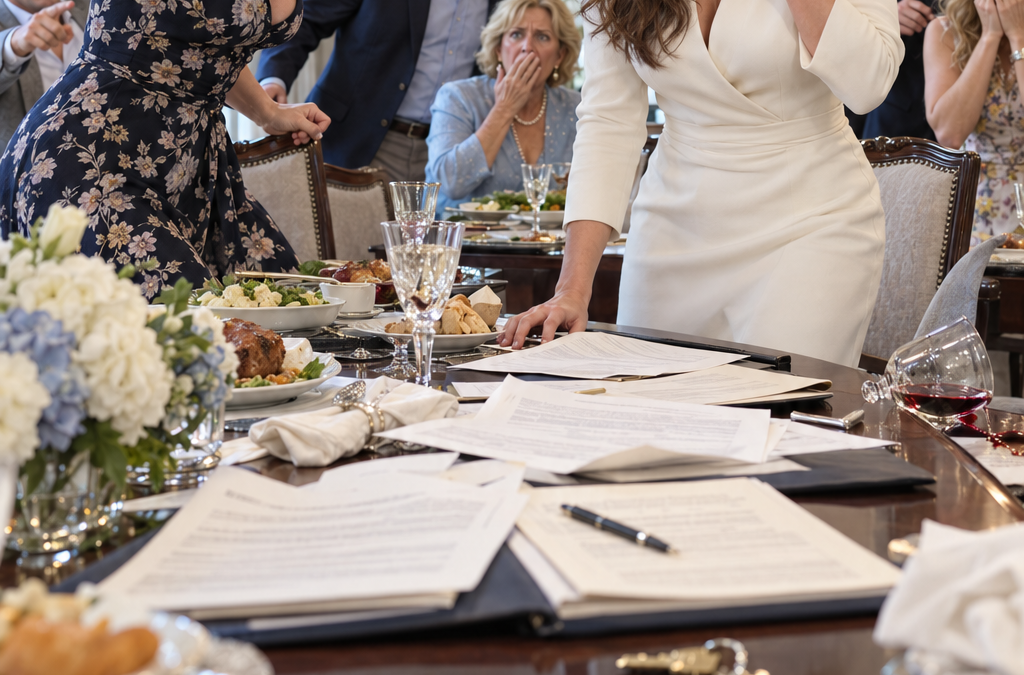
Dinner Turned Into A Battle The Moment I Brought Up The House Papers. My Sister Slapped Me And Roared, “Get Out—You Have No Claim Here!” I Wiped The Blood From My Lip And Said, “After Tonight… You’ll Wish You Never Said That.”
My sister slapped me across my grandparents’ dining table and screamed, “Get out of my house,” while our parents watched without lifting a finger. The problem was that the house had never belonged to her. It belonged to me. I walked outside with my cheek burning, drove away without arguing, and called an attorney before midnight. 7 days later, a certified envelope arrived at the house. Mom called me 47 times. On the last voicemail, she wasn’t angry anymore. She was begging.
### Part 1
My name is Claire Bennett, I’m 32, and the night my family finally taught me to stop hoping they would become different started with a pan of lasagna and my grandmother’s chipped blue serving dish. I had spent most of Saturday cooking in the kitchen of the old craftsman house my grandparents left me in Seattle, following Grandma Eleanor’s recipe closely enough that the smell of garlic, tomato, and browned cheese brought back memories I usually tried not to touch. Rain tapped against the windows, the dining room lamps cast warm circles across the oak table Grandpa Thomas had refinished himself, and for about 20 minutes I managed to convince myself that inviting my parents and younger sister to dinner had not been a terrible idea. I wanted one normal evening before we discussed the thing everyone had been avoiding: when they were going to move out.
The house had become complicated after my grandparents died 3 years earlier. Their will left the property solely to me, but because my parents had sold their previous condo and were “between plans,” I agreed to let Mom and Dad stay temporarily while they looked for something else. Then my sister, Erin, moved into the guest room after her latest business venture ran out of money, and temporary quietly turned into nearly 2 years. I still kept a small apartment near my office because the house had become impossible to work from, but I paid the property taxes, insurance, repairs, utilities that exceeded my parents’ contribution, and nearly $70,000 renovating the wiring, plumbing, roof, and kitchen.
Erin arrived 35 minutes late, dropping her purse onto Grandma’s antique sideboard as if she were entering a hotel suite. At 29, she had the polished look of someone who had learned that confidence could often substitute for results: expensive highlights, a cream coat she complained was ruined by the rain, and a phone that never left her hand. My mother, Diane, came in behind her carrying a grocery-store cheesecake, while my father, Mark, asked whether I still had the craft beer he liked before he had even removed his jacket. Nobody asked whether I needed help.
Dinner began with the usual safe subjects. Dad complained about traffic. Mom discussed someone from her book club. Erin scrolled through her phone while I told them that the financial-software company where I worked had approved an internal pilot for a budgeting tool I had designed. Mom smiled politely for perhaps 2 seconds before turning toward Erin. “Speaking of apps, sweetheart, how is PulsePoint going?”
I lowered my eyes to my plate. PulsePoint was Erin’s fitness platform, her fourth attempt at becoming the founder of what she liked to call “a disruptive lifestyle company.” It had burned through money from my parents, 2 private investors, and at least one business credit line, yet my parents still described every failure as proof that Erin was brave enough to dream big. “We’re restructuring,” she said, brushing hair from her shoulder. “The concept is strong. Investors are just terrified of female founders who know what they’re worth.”
“That’s their loss,” Dad said immediately.
I took a drink of water and said nothing. I had learned years earlier that defending reality at the Bennett dinner table was treated as a personal attack.
The conversation might have survived if Mom had not looked toward the renovated kitchen and said, “Erin was telling us how perfect this place would be once you finish everything.”
My fork stopped halfway to my mouth. “Perfect for what?”
“For the company,” Erin said. “The downstairs room could be a studio. I could use Grandpa’s workshop for equipment storage, and eventually we could convert the attic.”
I stared at her. “You’re talking about my house.”
Erin gave a tiny laugh. “Claire, you live in an apartment.”
“Because there are 3 people living here who were supposed to stay temporarily.”
Mom set down her napkin. “There’s no reason to make this unpleasant.”
“I’m not making it unpleasant. I’ve been asking for months what your plans are.”
Dad leaned back in his chair. “This was your grandparents’ family home. You act like a technicality makes you the only person who gets a say.”
“It isn’t a technicality,” I said. “The deed is in my name.”
Erin’s expression changed. The amused little smile disappeared, leaving something harder underneath. “You don’t even need this place.”
“That doesn’t make it yours.”
“I’m building something, Claire. You write code for somebody else.”
“My work pays my bills.”
“And there it is.” She pushed her chair back. “That superior thing you do.”
I laughed once because the accusation was so familiar. “I paid my own way through college after Mom and Dad used my college savings on your first business. I bought my own car. I paid for the repairs here. I have spent my entire adult life hearing that you need things more because I’m ‘fine.’ I’m done being punished for being responsible.”
Silence settled over the table. Mom’s face went stiff. Dad looked toward his beer instead of at me.
Erin stood. “You’ve always been jealous of me.”
I almost smiled. “Of what?”
That was the question that did it.
She came around the corner of the table so quickly that I barely registered the movement before her palm struck the side of my face. The crack seemed impossibly loud inside the dining room. My chair jolted backward, Grandma’s blue serving spoon hit the floor, and for a second I could hear nothing but the thin ringing in my right ear.
I looked at Mom.
Then Dad.
Neither moved.
“Erin,” I said quietly.
“Get out of my house.”
Even she seemed surprised by the words, but instead of taking them back, she grabbed my upper arm and shoved me toward the hallway. I caught myself against the wall, knocking one of Grandpa’s framed photographs crooked. Mom whispered, “Everyone needs to calm down,” as if she were observing strangers arguing in a grocery store.
I took my coat from the hook.
Erin followed me to the front door. “You heard me.”
I turned around. My cheek was hot, my heart pounding so violently that I could feel it in my throat. I wanted to scream that she was standing inside a house legally belonging to me, eating food I had cooked, demanding I leave property she had never paid a dollar to maintain.
Instead, I looked at my parents again.
Dad stared at the table.
Mom looked exhausted, as though my refusal to surrender were causing unnecessary inconvenience.
That hurt more than the slap.
I stepped onto the porch. Erin shut the door behind me, and a second later I heard the deadbolt turn.
For a long moment I stood beneath the porch light listening to rain strike the roof Grandma used to complain about every winter. Through the dining room window, I could see my family moving around inside. Mom picked up plates. Dad finished his beer. Erin returned to her seat.
They continued dinner.
I drove 6 blocks before pulling into the parking lot of a closed pharmacy because my hands were shaking too badly to keep going. My coworker and closest friend, Maya Chen, answered on the second ring.
“Claire?”
I tried to speak normally. “Do you still have the number for that property attorney you used last year?”
There was a pause. “What happened?”
I looked at my reflection in the rearview mirror. A red mark was already forming across my cheek.
“My family just made a mistake,” I said. “And I’m finally going to let them live with it.”
Before midnight, an attorney named Laura Kim had copies of the deed, the probate documents, and my grandparents’ will.
The next morning, she called me with one question.
“Claire,” she said, “why are you letting these people live in a house they have absolutely no ownership interest in?”
### Part 2
Laura’s question should have been simple, but I sat at my apartment kitchen counter staring at cold coffee for nearly a minute before I answered. “Because they’re my family” sounded pathetic after the previous night, yet it was the truth. My parents had spent my entire childhood teaching me that family meant absorbing inconvenience without keeping score, especially when Erin was the person benefiting. Somehow the rule never seemed to work in reverse.
Laura asked me to start from the beginning, so I told her about Grandma Eleanor and Grandpa Thomas. Their house had been the safest place in my childhood, a cedar-sided craftsman with squeaky stairs, rose bushes along the fence, and a basement workshop where Grandpa repaired radios for fun. Grandma had worked as a school librarian before retirement, Grandpa as an electrical engineer, and neither had much patience for dramatic people. When I was 12 and fascinated by computers, Grandpa found a discarded desktop at a university surplus sale, carried it home in pieces, and told me we would make it work together.
We did. That machine was how I learned my first lines of code.
At home, things were different. Erin was 3 years younger and possessed an instinct for attracting attention that I never developed. If I earned straight A’s, Dad nodded and said, “That’s our Claire.” If Erin brought home a B after failing half the semester, Mom ordered takeout to celebrate her improvement. When I needed $900 for a summer programming camp at 16, my parents said money was tight. Three weeks later they gave Erin nearly $2,000 for dance lessons because she had decided she might want to become a professional performer.
Grandma saw it.
She never encouraged me to resent Erin, but she refused to pretend the imbalance did not exist. One afternoon after my parents canceled a college tour because Erin had a weekend volleyball tournament, Grandma found me crying on the back porch. She sat beside me, handed me a glass of lemonade, and said, “Being the dependable child can become a trap if everyone starts believing dependable means disposable.”
I never forgot that sentence.
The worst example came when I was 18. My grandparents had contributed money to an education account for me over the years, and my parents controlled it until I started college. Two months before tuition was due, Dad admitted they had withdrawn most of it to help Erin launch a social-media project with 2 classmates. Erin was 15. The project lasted less than 6 months.
Mom called it an emergency family decision.
I called Grandma.
She was silent for a long time, then said, “Come over.”
My grandparents could not replace everything, and I refused when they offered more than they could comfortably afford, but they helped me find scholarships and gave me a place to study. I worked coffee-shop shifts in the morning, took freelance website jobs at night, and graduated with student loans and a computer-science degree. Erin attended 2 colleges without finishing either program, and my parents funded both.
Laura listened without interrupting.
“Did your grandparents know about the education account?”
“Yes.”
“And they still made a later will leaving this property entirely to you?”
“Yes.”
“Good.”
The word sounded clinical, but it changed something in my chest.
Laura explained that according to the probate documents, title had transferred to me after the estate closed. My parents and Erin had no ownership share, no tenancy agreement giving them permanent rights, and no evidence that I had promised them the property. Because they had lived there with my permission, however, she warned me not to treat them as trespassers or try to force them out myself. Washington housing law could be technical, and she wanted every step handled formally.
“That means no changing locks while they’re inside, no shutting off utilities, no threats,” she said. “We do this cleanly.”
“I don’t want revenge.”
Laura waited.
I touched my cheek.
“All right,” I said. “Maybe part of me does. But mostly I want my house back.”
“That,” she said, “I can help with.”
After the call, I opened an old folder on my laptop containing scans from the estate. Grandma’s will was only one piece. There were repair receipts, tax records, insurance documents, and photographs I had taken during renovations. I had replaced failing pipes, rewired half the second floor, restored the porch, repaired water damage behind the kitchen wall, and installed a security system Grandpa would have loved.
I had paid for all of it.
Around noon, Maya arrived carrying coffee and an ice pack. When she saw my cheek, her mouth tightened. “Please tell me you documented that.”
“I took pictures.”
“Police report?”
“I’m thinking about it.”
“Claire.”
“I know.”
She sat across from me. “You don’t have to turn this into some giant criminal case if you don’t want to. But document everything. People rewrite history when consequences show up.”
That sentence proved useful less than an hour later.
Mom texted me.
Last night got out of hand. Erin feels terrible, but you were provoking her. We need to sit down as a family and discuss a fair arrangement for the house.
I read it twice.
No apology.
No question about my face.
No acknowledgment that Erin had hit me.
Just a “fair arrangement.”
I showed Maya.
She looked at me for a long moment. “Save that.”
I did.
Then Dad texted.
Your mother is upset. Don’t make decisions while everyone is emotional.
I typed several responses and deleted each one. Finally I sent: I’ll contact you when I’m ready.
Erin did not apologize at all.
At 3:14 p.m., she sent a photograph.
It showed Grandpa’s basement workshop with exercise mats, lighting stands, a camera tripod, and boxes carrying the PulsePoint logo stacked against his workbench.
Underneath, she wrote: Finally turning this dead space into something useful.
My stomach dropped.
She had started converting the house into her company’s workspace.
I forwarded the photo to Laura.
Her reply arrived 5 minutes later.
Do not confront her. Save everything. We may have a bigger problem than simple occupancy.
That evening, I drove to the house but did not go inside. I parked half a block away and looked through the rain at the upstairs windows glowing amber behind Grandma’s curtains. A delivery van pulled up, and a man carried 4 large boxes to the porch.
Erin opened the door.
She signed for them.
The shipping labels had the PulsePoint name printed across the side.
For the first time, I wondered whether Erin merely wanted the house or had already started representing it as hers.
The next morning, Laura called.
“I found something,” she said. “I think you need to see it before you speak to your family again.”
### Part 3
Laura sent me a PDF while we were on the phone. It was a public filing connected to Erin’s company, nothing dramatic at first glance, but halfway through the investor materials was a sentence that made me sit upright: PulsePoint planned to establish its permanent headquarters in “a founder-controlled residential property in Seattle, eliminating commercial leasing costs during the company’s growth phase.” The address was not printed in the document, but the square footage, neighborhood, and description of the property matched my grandparents’ house.
“She told investors she controls my property?”
“She was careful with the language,” Laura said. “Founder-controlled can mean several things. But combined with those photos you sent me, I’d say she has been behaving as if she expects long-term use.”
I felt strangely calm. “My parents know.”
“You don’t know that.”
I thought about Mom asking whether I had updated the kitchen. Dad calling the house a family asset. Erin talking about converting the attic as if the decision had already been made.
“They know.”
Laura told me not to speculate in writing. Instead, we would build a record. She drafted a letter stating plainly that I was the sole owner, that no business use had been authorized, and that any representation suggesting Erin owned or controlled the property must stop immediately. She also prepared the first formal step toward ending my family’s permission to stay there, with enough notice to comply with the situation as she understood it.
Before she sent anything, however, I needed to retrieve documents and personal items still inside the house.
I asked Maya to come with me.
We went Thursday afternoon while Dad was at work and Mom was supposed to be at a medical appointment. I used my key on the back door and discovered it no longer worked.
I tried again.
Nothing.
Maya raised an eyebrow.
“They changed the lock.”
“Document it.”
I took a video showing the key, the door, and the date on my phone. Then I checked the side entrance. Same problem.
My pulse sped up, but this time anger came with clarity instead of panic.
“Don’t knock,” Maya said. “Call Laura.”
Laura told me to leave. “If they changed locks without your permission, that’s useful evidence. I don’t want a confrontation on the porch.”
We drove away.
Twenty minutes later, Mom called.
I answered through the car speakers.
“Were you just at the house?”
“Yes.”
“Why didn’t you tell us you were coming?”
I looked at Maya.
“Mom, why doesn’t my key work?”
A long silence followed.
“Erin had the locks upgraded.”
“Without asking me.”
“It was a security issue.”
“What security issue?”
“She has expensive equipment there now.”
The casualness nearly made me laugh.
“Her company equipment is a security issue, so she locked the homeowner out?”
“Claire, stop using that word like a weapon.”
“What word? Homeowner?”
Maya covered her mouth to hide a reaction.
Mom exhaled loudly. “This is exactly why we need to talk. You’re being so rigid.”
“I’ll communicate through my attorney for now.”
“Your attorney?”
The panic in her voice arrived before anger.
“What have you done?”
That question interested me.
Not what happened.
Not why do you need an attorney.
What have you done?
“Nothing yet,” I said.
I ended the call.
Back at my apartment, I began searching old family emails. My grandparents had not used cloud storage much, but I had archived years of messages after Grandma died because deleting them felt unbearable. Most were ordinary: recipes, birthday plans, photos of roses, reminders from Grandpa to update my operating system.
Then I found an email from 4 years earlier.
The subject was simply House.
Grandma had sent it to me but apparently never discussed it afterward.
Claire, your grandfather and I want you to understand that decisions we make in our estate plan are intentional. We have helped your father substantially during his adult life, including with housing, debts, and business expenses. If anyone later suggests we “forgot” someone or that our wishes were unclear, please remember we have had years to think about this.
I reread it until the words blurred.
Maya sat beside me.
“There’s more,” she said.
Grandma continued.
You are not responsible for balancing every decision your parents made between you and Erin. That is not a debt you owe. We trust you because you have never treated our home like money waiting to be divided.
I pressed my fingers against my lips.
There was no explosive family secret. No hidden crime. Just something almost more painful: my grandparents had seen the pattern clearly and anticipated exactly what was happening now.
I forwarded the email to Laura.
Her response came quickly.
Very helpful context. Preserve original copy.
That night, Dad called from a number I did not recognize. I almost ignored it, then answered.
“Claire.”
His voice was low.
“What?”
“Your mother told me you hired a lawyer.”
“I did.”
“This doesn’t need lawyers.”
“Erin hit me and locked me out of my own property.”
“She shouldn’t have hit you.”
It was the first time either parent had said it.
I waited for the rest.
“But you know how she gets when she feels cornered.”
There it was.
“I didn’t corner her, Dad.”
“You embarrassed her.”
“At dinner?”
“You attacked her business.”
“She claimed my house.”
He went quiet.
Then he said, “There are financial commitments you don’t understand.”
My grip tightened around the phone.
“What commitments?”
“Nothing you need to worry about.”
“You just told me there are financial commitments involving my house.”
“I didn’t say that.”
“You implied it.”
“Claire, listen to me. Erin needs stability for the next year. Maybe 18 months. Your mother and I thought if you were reasonable—”
“You made plans.”
Another silence.
“You made plans for my house without asking me.”
“We assumed family would come before paperwork.”
I closed my eyes.
For years, my parents had taken my restraint as consent. Every time I had yielded, they had interpreted it not as generosity but as confirmation that they were entitled to ask again.
“Dad?”
“Yes?”
“You need to start making different plans.”
I ended the call.
The following morning, I met Laura at her downtown office. She placed several pages in front of me, including a formal notice, a demand that the locks be restored or replacement keys provided, and instructions that no further business activity be conducted from the property without written authorization.
Then she slid one blank sheet across the table.
“What’s this?”
“Your decision.”
I looked up.
“You told me yesterday that you might eventually sell the house,” she said. “If that is what you truly want, we can begin preparing now. Quietly.”
My first instinct was no.
The house was Grandma’s roses. Grandpa’s workshop. Christmas mornings. Summer evenings on the porch. It was the only physical place in my childhood where I had never needed to compete for affection.
Then I remembered Erin saying, “Get out of my house.”
I remembered the deadbolt turning.
I remembered my parents continuing dinner.
“What would selling involve?” I asked.
Laura folded her hands.
And for the next hour, we began building the plan my family had never imagined I would have the nerve to use.
### Part 4
I did not decide to sell the house because Erin slapped me. That would have been satisfying to say, but it would not have been true. I decided to sell because the slap finally made me understand that keeping the house had become less about preserving my grandparents’ memory and more about preserving access for people who believed my ownership was temporary until they needed it badly enough.
Laura introduced me to a real-estate agent named Sofia Ramirez, who specialized in private listings and complicated family situations. Sofia did not stage the house or put a sign in the yard. Instead, she reviewed photographs from before my family filled the rooms with Erin’s equipment, studied the renovations I had completed, and brought in 3 qualified buyers who understood that possession would occur only after the occupants legally vacated.
The house was worth far more than my grandparents had ever imagined. Seattle’s market had changed dramatically, and the neighborhood had become desirable for families looking for older homes near good schools and transit. Sofia believed a realistic sale price was around $1.35 million depending on inspection issues.
The number made me uncomfortable.
Grandma and Grandpa had never treated the house as a fortune. It was simply where they lived.
Sofia seemed to read my face. “Selling doesn’t erase what happened there.”
“I know.”
“You can also decide not to.”
That mattered to me. Nobody was pushing.
I took 2 days.
Then I said yes.
The strongest offer came from Daniel and Grace Foster, a couple with 2 young daughters. Grace taught middle school science, Daniel worked as a physical therapist, and during the private showing arranged after Laura secured access, they spent more time asking about the garden than the kitchen counters. Their older daughter crouched beside Grandma’s rose bed and asked whether butterflies came in summer.
“They do,” I said.
The little girl smiled.
Something inside me loosened.
The Fosters offered $1.32 million with a reasonable inspection contingency and a closing timeline flexible enough to accommodate the occupancy issue. I accepted.
Only Maya, Laura, Sofia, and the buyers knew.
Meanwhile, my family reacted to Laura’s first letter as if I had declared war. Erin emailed 5 pages insisting she had “equitable family rights.” Mom sent me messages about loyalty. Dad left voicemails explaining that lawyers were expensive and I was wasting everyone’s money.
I did not respond directly.
Laura did.
The lock was changed back within 48 hours.
Erin’s business equipment stopped arriving.
Then Sofia’s photographer documented the property and condition of every room.
During that visit, I discovered something I had not expected.
Grandpa’s workshop had been almost completely dismantled.
His labeled drawers of resistors and old radio parts had been shoved into plastic bins. His workbench was covered with fitness bands and shipping labels. The wooden stool he built when I was 11 had been moved beneath a leaking basement window and warped along one side.
I stood there touching the cracked seat.
Erin walked downstairs behind me.
“You happy now?” she asked.
I turned around.
She had not apologized for hitting me.
Her expression suggested I was the person who had created the crisis.
“You moved his things.”
“It’s a basement.”
“It was Grandpa’s workshop.”
“He’s dead, Claire.”
The words landed with surgical precision.
Sofia stopped taking photographs.
Maya, who had insisted on accompanying me, stepped closer.
I stared at Erin.
She rolled her eyes. “Don’t do the wounded-orphan thing. We all lost them.”
“No,” I said softly. “We didn’t all value them the same way.”
Her face tightened. “There it is again. Saint Claire.”
“I’m not a saint.”
“Then stop acting like you deserve everything.”
I glanced around the basement.
For the first time, I saw the house without nostalgia.
I saw peeling paint I had not gotten around to fixing, boxes my parents had stacked against the furnace, scratches in the hardwood from Erin’s equipment, and family photographs turned facedown to make room for product samples. I realized I had been preserving a building for people who were stripping away everything I had wanted to preserve inside it.
“I don’t deserve everything,” I said. “I deserve what belongs to me.”
Erin laughed. “You think some piece of paper makes you powerful?”
“No.”
I looked at her.
“But it does make me the owner.”
We left without telling her about the sale.
The following Tuesday marked exactly 1 week after the dinner.
At 10:06 a.m., a courier delivered a certified envelope to the house.
Inside were Laura’s formal notices concerning the termination of my family’s right to remain, instructions about the timeline and legal process, a written prohibition against commercial use of the property, and notice that the house was under contract for sale.
Mom called me at 10:19.
Then 10:21.
10:24.
10:31.
By lunchtime, I had 18 missed calls.
By evening, 47.
I listened to only 3 voicemails.
The first was angry.
“Claire, call me immediately. You cannot sell this house out from under your own family.”
The second was frightened.
“Your father says there has to be a way to stop this.”
The third came at 8:42 p.m.
Mom was crying.
“Claire, please. Please call me. We made plans because we thought the house would stay in the family. Erin has obligations. Your father and I have obligations. If you sell now, everything falls apart.”
I sat on my sofa, phone in my hand.
There it was again.
Financial commitments.
I called Laura.
“Can they stop the sale?”
“Based on what we know, they do not own the property. They can create delays if they refuse to cooperate, but that’s why we are following the proper process.”
“My mother says they made financial plans around the house.”
“Did you authorize any?”
“No.”
“Then we need to find out what they did.”
At 9:17, Erin sent me the first message she had written since Laura became involved.
You have no idea what you’re doing.
A second message arrived.
Dad guaranteed my business loan because YOU said I could stay in the house.
I sat upright.
I had never said that.
Then she sent a screenshot from an email chain.
At the top was a message from my father to Erin’s lender.
Claire intends to keep the property in the family long term. Erin will continue operating from the residence while the company stabilizes.
My father had used my house to reassure someone financing Erin’s business.
And suddenly I understood why my parents were no longer merely angry.
They were scared.
### Part 5
The next morning, Laura told me the email did not magically give Erin rights to my house, but it explained the panic. Dad had apparently guaranteed part of Erin’s business debt personally, and he had described her housing and operating arrangement as stable without ever asking whether I agreed. The lender did not have a mortgage on my property, but my father had built financial assumptions around something he did not control.
“I want you to understand the distinction,” Laura said. “Their bad decision does not become your obligation simply because it creates consequences for them.”
I printed that sentence mentally and carried it with me for the next several weeks.
Mom demanded a family meeting.
I refused until Laura suggested there might be value in having one structured conversation with witnesses present. We met in a conference room at Laura’s office, not at the house. Maya sat beside me. Laura joined by video for the first 20 minutes to establish boundaries, then left us with an associate nearby.
Erin arrived wearing sunglasses even though it was raining.
Dad looked 10 years older.
Mom started crying before anyone sat down.
“How could you sell Grandma’s house?”
I almost admired the question.
“How could you plan Erin’s business around Grandma’s house without asking me?”
Dad rubbed his forehead. “We thought you understood.”
“Understood what?”
“That family property should help family.”
“It helped you. You’ve lived there for nearly 2 years.”
“We paid expenses.”
“You paid part of the utilities.”
Mom flinched.
Erin removed her sunglasses. “Congratulations, Claire. You’ve made your spreadsheet.”
“No. I made a record.”
“Oh, please.”
Laura’s associate looked toward her.
Erin lowered her voice.
Dad finally told me the truth. When PulsePoint hit cash problems 8 months earlier, he guaranteed a business credit line. He and Mom had also refinanced their own small rental property to inject money into Erin’s company. They believed the house would remain available to Erin for years, reducing her expenses enough to help the business recover.
“Why would you believe that?” I asked.
Mom looked down.
Because they had always believed I would give in.
Nobody said it.
Nobody needed to.
Erin leaned forward. “If I lose the operating address now, I lose the investor.”
“That is not my fault.”
“You knew I was struggling.”
“I knew you were staying in a guest room.”
“I was building a company.”
“In my grandparents’ house.”
“Our grandparents.”
“Yes.”
“So why do you get everything?”
The question hung in the room.
For years, I had asked myself the same thing, not about the house but about attention, money, excuses, second chances. Why did Erin always get more? Why did my parents treat my competence like a reason to invest less in me?
Now Erin was asking why I had received one thing she had not.
“Because Grandma and Grandpa chose me,” I said.
She went white with anger.
Mom whispered, “That was not fair.”
I turned toward her.
The sentence hurt more than I expected.
“You think the will was unfair?”
“They loved both of you.”
“I never said they didn’t.”
“But leaving the whole house to one grandchild created this.”
“No, Mom. Erin hitting me created this. Dad making promises involving my property created this. You watching her throw me out created this.”
Dad looked away.
I continued. “The will didn’t make you do any of those things.”
Erin stood.
“This is pointless.”
She grabbed her bag.
At the door, she turned toward me. “Don’t pretend this isn’t revenge.”
I considered denying it.
Instead I said, “Part of me is angry enough to enjoy telling you no. But if you had apologized that night, I still would have ended this arrangement. I should have done it a year ago.”
She left.
Mom began crying harder.
Dad stared at the table.
Then he said something I never expected.
“She’s right about one thing.”
I looked at him.
“We did assume you would let it go.”
Mom stopped crying.
Dad’s voice remained flat. “You always did.”
For a second, the room disappeared.
I was 16 again, being told Erin needed the money more.
18, discovering my college savings were gone.
25, lending Mom money for a repair while Erin vacationed in Cabo after her second startup failed.
29, agreeing my parents could stay at the house “for a few months.”
32, standing outside while the deadbolt turned.
Dad had finally admitted the entire family system in 6 words.
You always did.
I stood.
“Not anymore.”
After the meeting, things became uglier before they became quieter.
Erin hired an attorney who sent Laura a letter suggesting she might challenge the estate plan. Laura reviewed the probate history and responded that the applicable opportunity for a timely challenge had long since passed and that the documents contained extensive evidence of my grandparents’ intent. Erin’s attorney never filed the dramatic lawsuit she threatened online.
Instead, Erin started a social-media campaign.
She never used my full name, but relatives knew exactly who she meant. According to her version, a “greedy sibling” had manipulated elderly grandparents, stolen a family inheritance, and was now evicting aging parents to make a profit.
Aunts messaged me.
Cousins asked whether I could “just split the sale.”
One uncle told me blood was more important than money.
I answered exactly once.
I sent a short email to the relatives who contacted me. Attached were the relevant pages of the will, Grandma’s email explaining that the estate choices were intentional, and photographs of the renovations I had funded.
I did not insult Erin.
I did not defend my childhood.
I wrote one sentence.
I will not discuss this publicly, but I will not accept a false version of events privately either.
Most people stopped contacting me.
Then Aunt Susan, my mother’s older sister, called.
I nearly ignored it.
Instead, I answered.
“Claire,” she said, “there’s something about your grandparents’ decision your mother has never told you.”
My stomach tightened.
“What?”
“Your grandparents didn’t leave you that house only because you were close to them.”
She paused.
“They left it to you because years ago, your father already asked them to give it to Erin.”
### Part 6
Aunt Susan told me the conversation happened about 5 years before my grandparents died, when Erin was 24 and pursuing another business idea. Dad apparently suggested that Grandma and Grandpa put the house into a family trust that would eventually allow Erin to use or borrow against it. Grandpa refused immediately.
“How do you know?” I asked.
“I was there.”
Susan explained that Mom had invited her to dinner because she expected everyone to support the idea. Instead, Grandpa became furious. He said his home was not seed capital for Erin’s experiments and that my parents had spent years directing money toward one child while assuming the other would manage on her own.
“What did Grandma say?”
Susan sighed.
“She told your mother that if she kept treating your independence as permission to neglect you, she was going to lose you.”
I sat silently.
“She really said that?”
“Almost exactly.”
“Why didn’t anyone tell me?”
“Your grandmother didn’t want to turn you against your parents.”
The next afternoon, I went to the house with Laura’s permission and a neutral property representative to inventory items before my family moved. My parents were packing. Cardboard boxes lined the hallway, and the dining room table where Erin had hit me was buried beneath newspaper and dishes.
Mom barely looked at me.
Dad was in the garage.
Erin was gone.
I went upstairs to collect personal photographs and the last box of my grandmother’s papers. In the back of her bedroom closet sat a metal document case I had seen hundreds of times as a child. I assumed it held old insurance forms.
Inside were letters.
Most were ordinary financial records, but one envelope had my name written across it in Grandma’s handwriting.
Claire — if this becomes necessary.
My knees weakened.
I sat on the bedroom floor and opened it.
The letter was 3 pages.
Grandma began by telling me she hoped I would never need to read it. She wrote that she and Grandpa loved both granddaughters but had become worried about the pressure my parents were placing on them to structure their estate around Erin’s needs.
Then came a sentence that made me cover my mouth.
We are leaving the house to you not because Erin deserves nothing, but because you have been taught all your life to accept less.
I read it again.
And again.
Grandma wrote that she and Grandpa had already helped my parents financially over many years. They had covered a portion of Dad’s debts after a failed investment, contributed to a down payment when my parents were younger, paid medical expenses, and given money that eventually benefited both daughters.
They did not want their final major asset used to repeat the same pattern.
You have never asked us for this house, Grandma wrote. That is part of why we trust you with it.
At the end, she added:
If anyone tells you that keeping what we deliberately gave you is selfish, ask yourself whether they would say the same thing if Erin had received it.
I cried so hard I had to set the letter on the carpet to keep from damaging it.
A soft sound came from the doorway.
Mom stood there.
She had seen the envelope.
Her face changed.
“You found that.”
I wiped my cheeks. “You knew?”
She leaned against the frame.
“Your grandmother could be very judgmental.”
“That isn’t what I asked.”
“Yes.”
The word was almost inaudible.
“You knew she wrote this?”
“I knew there was a letter.”
“And you still told me the will was unfair.”
Mom closed her eyes.
“Claire, you have to understand how difficult Erin has always been.”
The absurdity of the sentence stopped my tears.
“Difficult?”
“She needs more.”
“No. She demands more.”
“She falls apart when she doesn’t get support.”
“And I don’t.”
Mom looked at me.
I stood.
“That’s the whole thing, isn’t it? Erin falls apart, so everyone rushes toward her. I keep standing, so everyone takes something else.”
“That isn’t fair.”
“It’s exactly what Grandma wrote.”
Mom’s eyes filled.
“We thought you could handle it.”
“I could.”
My voice shook now, but I did not lower it.
“I handled college after you spent my education money. I handled birthdays you forgot because Erin had a crisis. I handled paying bills while you invested in her ideas. I handled this house. I handled being slapped while you sat there.”
Mom looked toward the floor.
“And because I handled all of it, you decided I should keep handling more.”
She whispered, “I’m sorry.”
It was the first apology.
Once, that would have been enough to make me soften immediately.
Now I only felt tired.
“For which part?”
She could not answer.
I put Grandma’s letter back into the envelope.
The move-out process continued.
My parents found a 2-bedroom rental outside the city. It was smaller than they wanted but comfortable. Erin refused to live with them, claiming they were “choosing me” by leaving peacefully. For 2 weeks she bounced between a friend’s apartment and a hotel while trying to keep PulsePoint alive.
Three days before the agreed handover, the property representative found several of Grandma’s jewelry boxes missing from the inventory.
I called Mom.
She sounded genuinely confused.
Dad denied moving them.
I texted Erin.
No answer.
Laura sent a formal demand that property belonging to the estate or to me be returned.
The following morning, a cardboard box appeared outside my apartment door.
Inside were Grandma’s jewelry boxes.
Nothing was missing.
There was no note.
That afternoon, Erin called me for the first time since the family meeting.
I answered.
“You’re really going through with the sale.”
“Yes.”
“You’d rather strangers have the house.”
I looked at Grandma’s letter on my desk.
“I’d rather people who respect it live there.”
She laughed bitterly. “You always thought you were better than me.”
“No, Erin.”
I waited.
“I spent half my life thinking you were better than me because Mom and Dad acted like you were.”
Silence.
“That’s why this is so easy for you,” she said.
“What?”
“Destroying everyone.”
I felt something in me finally settle.
“I didn’t guarantee your loan.”
She said nothing.
“I didn’t tell investors you controlled the house.”
Nothing.
“I didn’t refinance Mom and Dad’s property. I didn’t change my locks. I didn’t hit anyone.”
Her breathing changed.
“You made choices,” I said. “So did they. I’m just not rescuing you from them.”
She hung up.
The next morning, the house was empty.
For the first time in almost 2 years, I unlocked the front door and heard nothing.
No television.
No boxes being dragged.
No Erin on a business call.
Just the old house settling around me.
I walked into the dining room and set Grandma’s blue serving dish in the center of the table.
Then I stood there alone and understood something I had not expected.
Winning did not feel like triumph.
It felt like silence.
And I was finally learning not to be afraid of it.
### Part 7
The sale closed 3 weeks later for $1.32 million.
After outstanding costs, taxes, commissions, legal expenses, and the money I set aside for long-term planning, I was left with enough to change my life but not enough to become the fantasy version of wealth my relatives imagined. I did not buy a sports car. I did not quit my job the next morning. I did not post photographs of champagne beside a giant check.
I sat in my apartment with Maya and ate Thai takeout.
“That’s it?” she asked, holding up a carton of noodles. “You just sold a million-dollar house and we’re eating pad see ew?”
“It’s very good pad see ew.”
“You’re impossible.”
We laughed until I cried.
The Fosters took possession on a Friday. Grace sent me one photograph, not of the kitchen or living room but of her daughters beside Grandma’s rose bushes wearing gardening gloves several sizes too large. The younger girl was holding a watering can with both hands.
Thank you for trusting us with this place, Grace wrote.
I saved the photograph.
Then I closed the message and went back to work.
My parents’ financial situation was difficult but not catastrophic in the dramatic way Erin had predicted. Dad’s guarantee on her business credit line became a problem when PulsePoint missed payments, and he and Mom eventually sold their small rental property to reduce debt. They downsized their lifestyle and moved permanently into the rental they had found during the house dispute.
No one became homeless.
No one starved.
They simply stopped living as though every bad financial decision could be solved by access to somebody else’s resources.
Erin’s company lasted another 4 months.
Without free operating space and with investors losing confidence, PulsePoint shut down. She sold equipment, negotiated debts with creditors, and eventually took a marketing job at a regional wellness company.
I heard this from Aunt Susan, not from Erin.
“She’s furious,” Susan told me.
“I’m sure.”
“But she has a job.”
“Good.”
Susan hesitated. “Your mother misses you.”
I stared through my office window at the gray Seattle afternoon.
“I miss parts of her too.”
“That’s not the same thing as wanting contact.”
“No.”
Susan did not pressure me.
That was why I continued talking to her.
Mom emailed several times over the next few months. Her messages evolved in stages.
First came justification.
We only wanted both our daughters secure.
Then bargaining.
Could we meet once, just you and me?
Then nostalgia.
I found pictures from your 10th birthday. You looked so happy.
Finally, one arrived with the subject line No excuses.
I waited 3 days before opening it.
Claire,
I have spent months trying to find a version of what happened that made me feel less ashamed. There isn’t one. Erin hit you and I stayed in my chair. You were standing in a house that belonged to you, and I still treated your ownership like a problem to negotiate. Your father and I kept asking you to give because you were the daughter who survived giving. I see how cruel that was now.
I stopped reading.
My chest hurt.
For years, I had imagined an apology that perfect.
I thought hearing it would unlock some hidden door and allow me to run back toward my mother without fear.
It didn’t.
I finished the email.
Mom did not ask me to forgive her. She said she hoped one day I might allow some form of contact, even if the relationship never returned to what it had been.
I did not answer.
Not because I wanted to punish her.
Because I did not know what I wanted.
There was a difference between forgiveness and access that nobody in my family had ever respected.
Meanwhile, I began changing my own life.
For years, I had been developing educational software in my spare time: a simple platform that taught budgeting and introductory coding through interactive projects. Grandma had loved the idea before she died, especially the possibility of making technology less intimidating for kids whose families could not afford expensive programs.
I used a portion of the sale proceeds to create a real business plan.
Not Erin’s style.
No dramatic launch party.
No borrowed office with neon signs.
No social-media countdown.
I kept my job while Maya and I worked evenings and weekends. We hired a freelance designer, interviewed teachers, tested lessons with an after-school program, and spent 6 months fixing problems nobody would ever see.
We called it Lantern.
The name came from Grandpa.
Whenever I became frustrated while learning to code, he used to say, “You don’t need to see the whole road. Build enough light for the next few feet.”
Our first school pilot was tiny.
Then another district asked for a demonstration.
Then a nonprofit contacted us.
I did not suddenly become famous or rich.
I became busy with something that belonged to me.
Six months after the house sold, I bought a modest 2-bedroom bungalow north of Seattle. It had a narrow yard, slightly uneven floors, and a kitchen much smaller than Grandma’s.
I loved it immediately.
Maya helped me paint.
Aunt Susan brought wine.
I planted 3 rose cuttings Grace Foster had allowed me to take from the old garden before closing.
On my first night there, I sat on the floor because my sofa had not arrived yet, eating pizza from the box while rain tapped against the window.
My phone buzzed.
It was Dad.
He had not contacted me directly since the move.
I stared at his name, then answered.
“Hi.”
“Claire.”
His voice sounded older.
We exchanged 20 seconds of awkward small talk.
Then he said, “Your mother showed me the email she sent.”
“Okay.”
“She meant it.”
“I believe her.”
Another silence.
“I should have stopped Erin that night.”
“Yes.”
“I should have stopped a lot of things before that.”
“Yes.”
He breathed out.
“I don’t know how to fix it.”
I looked around my new house.
“You don’t.”
He was quiet.
“That’s the point, Dad. Some things don’t get fixed. You learn from them, and you build whatever relationship is still possible afterward.”
“Is one possible?”
I thought about it.
“Not right now.”
His voice cracked slightly.
“All right.”
For once, he did not argue.
After we hung up, I expected guilt.
Instead I felt sad.
Sadness, I discovered, was easier to carry than resentment because sadness did not ask me to keep reopening the door.
A week later, Grace Foster emailed.
She wanted to know whether I would mind if they placed a small marker in the garden honoring Eleanor and Thomas Reed.
I stared at the screen for a long time.
Then I wrote back.
I think they would love that.
### Part 8
One year after the dinner, I drove past my grandparents’ old house for the first time since the Fosters moved in.
I had not planned it. I was returning from a meeting with a school district when traffic diverted me through the neighborhood, and suddenly the familiar cedar roof appeared between maple trees.
My first instinct was to turn away.
Then I slowed down.
The porch had been repainted. A child’s purple bicycle leaned against the railing. Someone had hung a wind chime near the front window, and the roses along the fence were blooming in thick red clusters.
Near the garden stood a small wooden sign.
Eleanor & Thomas’s Garden.
I pulled over half a block away.
For several minutes I simply sat in the car.
I expected grief.
Instead I remembered Grandma laughing because Grandpa had once planted tomatoes so close together that they grew into what she called “a vegetable traffic jam.” I remembered sitting on the porch with my first laptop balanced on my knees. I remembered Grandpa showing me how to solder 2 wires together and telling me the trick was not strength but patience.
The memories were still mine.
Selling the house had not sold them.
My phone vibrated.
Maya had sent a photograph from a school using Lantern. A group of students had completed one of our coding projects, and their teacher had written that a girl who previously refused to touch a computer had stayed after class to keep working.
I smiled.
Lantern was not a giant company. It employed 6 people, served several school programs, and was finally bringing in enough revenue that I had reduced my hours at my original job. Growth was slower than the startup stories Erin used to worship.
It was also real.
That evening, Aunt Susan came over for dinner.
We ate lasagna from Grandma’s recipe at my smaller dining table.
Halfway through the meal, Susan mentioned Mom.
“She started therapy.”
I looked up.
“Did she?”
“Your father goes sometimes too.”
I did not know what to say.
Susan took a sip of water. “I’m not telling you because I think you should call them.”
“I know.”
“They’re changing some things.”
“Good.”
And I meant it.
The strangest part of healing was learning that I could hope my parents became better people without volunteering to become the test case for whether they had.
Erin and I had not spoken in 10 months.
According to Susan, she still blamed me for the collapse of PulsePoint on bad days. On better days, she admitted the company had been failing long before the house became an issue. She kept her marketing job, moved into her own apartment, and had apparently stopped asking Mom and Dad for money.
I did not celebrate her difficulties.
I also did not rescue her from them.
Both were forms of freedom.
Two weeks later, I received a letter in the mail.
Not an email.
A real letter.
Erin’s handwriting was on the envelope.
I left it unopened on my desk for 4 days.
When I finally read it, the first line surprised me.
I’m not writing to ask you for anything.
She said therapy had been suggested to her too, though she had resisted. She admitted hitting me was wrong. She admitted changing the locks was wrong. She admitted she had treated the house like hers because Mom and Dad talked about it so often as a “family asset” that she eventually convinced herself ownership was just paperwork.
Then she wrote:
I still think Grandma and Grandpa choosing you hurt. I don’t know if I’ll ever be able to pretend it didn’t. But I also know I spent my whole life being handed things and calling it proof that I deserved them.
I put the letter down.
That sentence was the closest Erin had ever come to understanding what happened between us.
She ended by saying she did not expect forgiveness.
For 2 days, I debated whether to answer.
Finally, I did.
I wrote 4 sentences.
Erin,
I appreciate that you took responsibility for what happened. I’m glad you’re building your own life. I’m not ready to have a relationship with you, and I don’t know whether that will change. I wish you well.
I mailed it before I could revise it into something softer.
That was the old instinct: reduce the truth until nobody else felt uncomfortable.
I did not do that anymore.
Mom and Dad remained outside my daily life. Months after Dad’s call, I agreed to exchange occasional emails with them. Nothing more.
Mom once asked whether I could forgive her.
I answered carefully.
“I don’t spend my days angry at you anymore. If that’s forgiveness, then maybe I have. But forgiveness doesn’t mean we go back.”
She cried.
I did too.
We still did not go back.
There was nowhere worth going back to.
The version of our family I used to mourn had mostly existed in my imagination, a future where Mom finally noticed the difference in how she treated us, Dad finally defended me, Erin finally stopped competing for things that were already mine, and I finally became generous enough to earn the love I thought they were withholding.
The truth was simpler.
Love that had to be earned by surrendering yourself was not the kind of love I wanted anymore.
On the anniversary of Grandma’s death, the Fosters invited me to visit the garden.
I almost declined.
Then I went.
Grace met me at the gate. Her daughters were in the backyard chasing each other with bubble wands, and Daniel was grilling corn on the patio. The house looked different without looking wrong.
That surprised me most.
Different curtains.
Different furniture.
Children’s drawings on the refrigerator.
A row of muddy shoes near the back door.
Life.
Grace walked me toward the roses.
“We kept almost all of them,” she said. “I’m terrible at pruning, though.”
“Grandma was too.”
Grace laughed.
I knelt beside one of the older bushes and touched a flower.
For years, I had believed protecting my grandparents’ legacy meant protecting the building.
Now I understood.
Grandma protected me by leaving me a choice.
I protected myself by finally using it.
Before I left, Grace handed me a small box.
“We found this behind a shelf in the workshop.”
Inside was one of Grandpa’s old screwdrivers, the handle worn smooth from decades of use.
My throat tightened.
“He used this constantly.”
“Then it should be with you.”
I drove home with the screwdriver on the passenger seat.
That night, I placed it beside Grandma’s letter in the little office where Maya and I had built the first version of Lantern.
Outside, rain whispered against the roof.
My new roses were beginning to climb the fence.
I thought about the night Erin slapped me and ordered me out of my own house. At the time, I believed that moment shattered my family.
It didn’t.
It shattered my denial.
My family had spent years teaching me that love meant being the person who surrendered first. My grandparents had tried to teach me something else: generosity mattered only when it was chosen, boundaries were not cruelty, and surviving mistreatment did not create an obligation to keep accepting it.
I never reconciled with Erin in the way relatives once expected.
I never returned to Sunday dinners with my parents pretending everything had been repaired.
There was no dramatic reunion.
No tearful group hug.
No moment when everybody admitted I had been right and we became a perfect family.
There were only consequences, distance, a few sincere apologies, and new lives growing in the space where old expectations had finally collapsed.
That was enough.
Sometimes I still drive past the old neighborhood.
Sometimes I think about the dinner table, the sound of Erin’s hand hitting my face, and the deadbolt turning behind me.
But that is no longer the part I remember most clearly.
I remember standing outside in the rain and realizing that for the first time in my life, nobody could force me to surrender anything.
Not my house.
Not my future.
Not my dignity.
And especially not myself.
THE END!