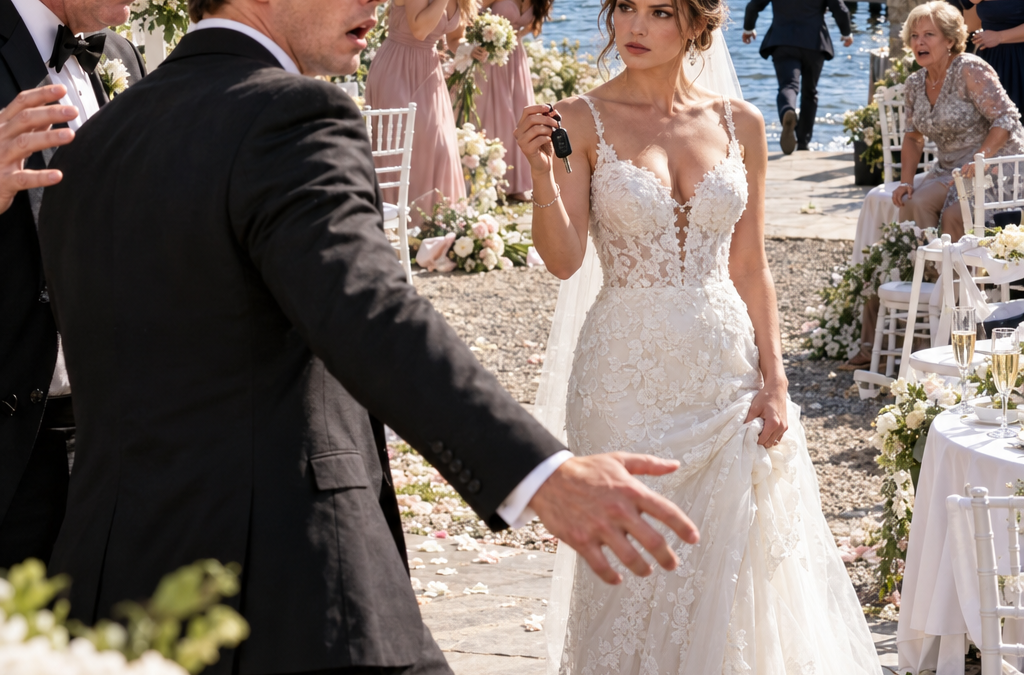
On My Wedding Day, My Brother Threw My Volkswagen Beetle Into A Lake. He Tossed Me The Keys And Laughed, “Go Park It Now, Sis.” Dad Burst Out Laughing. I Just Looked At Him And Asked, “Did You Check The Trunk First?” His Smile Vanished.
My brother pushed my late grandfather’s beloved Volkswagen Beetle into a lake on my wedding day, then tossed me the keys and laughed, “Go park it now, sis.” My father laughed with him while I stood there in my wedding dress, watching the last piece of Grandpa disappear beneath the water. I didn’t scream. I picked up the keys and asked, “Did you check the trunk first?” My brother went pale. Three hours later, a waterlogged metal box revealed why he had been so desperate to get that car away from me.
## Part 1
The first time I understood that my brother could hurt me without ever expecting consequences, I was 9 years old, standing in our kitchen with a ruined birthday cake in my hands. Derek had knocked it off the counter during an argument because he wanted the chocolate cake my mother had bought for him instead of the strawberry one she’d ordered for me. He was 13, old enough to know exactly what he’d done, but my father took one look at the frosting on the floor and started laughing. “Well, Avery, guess you should’ve stayed out of his way.”
My mother, Lisa Collins, handed me a roll of paper towels while Derek disappeared into the living room to watch television. I remember looking at the pink icing on my fingers and waiting for someone to tell him to apologize. Nobody did. Instead, Mom whispered, “Please don’t make this a bigger problem. Your brother gets upset easily, and you’re the reasonable one.” That sentence became the unofficial rule of our household, repeated whenever Derek took something, broke something, or embarrassed me in front of other people.
By the time I was 27, I had spent almost 2 decades being reasonable. I had given Derek my graduation money when he needed a security deposit, lent him my first car until he returned it with a damaged transmission, and covered a credit card payment he promised to reimburse within 2 weeks. My parents called these things the sacrifices families made for one another. Strangely, the sacrifices always traveled in the same direction.
Then I met Nathan Reed, and for the first time, somebody questioned the arrangement.
Nathan was an electrician who owned a small contracting business outside Columbus, Ohio. He wasn’t especially dramatic, which was one of the things I loved about him. When he disagreed with someone, he said so, and when someone treated him badly, he didn’t spend the next 3 days wondering how to make that person feel better.
We met at a neighborhood fundraiser where I was coordinating volunteers and he was repairing a faulty outdoor lighting system without charging anyone. I caught him kneeling beside an electrical box while everyone else enjoyed barbecue. When I asked whether he’d eaten anything, he grinned and said, “I’m waiting for somebody to bring me a plate and tell me I look heroic.”
I brought him a plate. He asked for my number. The rest happened slowly and comfortably, without the exhausting guessing games I’d mistaken for affection when I was younger.
About 6 months into our relationship, Derek borrowed $1,800 from me for equipment at his auto repair shop. He missed the first promised repayment date, then the second. When I mentioned it during Sunday dinner, Dad frowned and said, “Your brother’s trying to build something. Don’t punish him for having ambition.”
Nathan heard the entire conversation.
On our drive home, he asked, “Why is it your responsibility to fund his ambition?”
“Because he needs help.”
“And what happens when you need help?”
I didn’t have an answer.
There was one person who had been asking me that question long before Nathan came into my life.
My grandfather, George Collins.
Grandpa George lived in a weathered blue house on the outskirts of town, with a narrow gravel driveway and a detached garage that smelled permanently of motor oil, sawdust, and peppermint candies. He’d worked as a machinist for 42 years, raised 2 children, buried my grandmother, and developed the habit of saving almost everything because he believed most broken things deserved another chance.
His favorite possession was a white 1967 Volkswagen Beetle he’d bought used decades earlier.
To my father, it was a dusty old car taking up valuable garage space. To Derek, it was a joke. But to me, it was Saturday mornings with Grandpa, country music playing softly from a little radio, and the satisfaction of learning how machinery worked.
When I was 11, Grandpa taught me how to identify a socket wrench by size. At 13, I learned how to change spark plugs. By 16, I could recognize a problem with the engine just by listening to it idle.
Grandpa never mocked me when I made mistakes. He’d explain what went wrong, let me try again, and celebrate even the smallest improvement as though I’d rebuilt the entire car myself.
Derek visited the garage exactly once during those years. He glanced at the Beetle, called it a tin can, and asked Grandpa whether he’d finally sell the property after retiring.
Grandpa watched him drive away before saying, “Your brother spends an awful lot of time counting things that aren’t his.”
I laughed because I thought he was joking.
Now I wonder how much Grandpa already knew.
As he grew older, his hands began trembling, and the concrete garage floor became too hard on his knees. I started doing more of the work while he sat in a folding chair, guiding me through repairs. Eventually, our Saturdays included grocery shopping, doctor’s appointments, and long afternoons drinking iced tea on the porch.
I never thought of it as a burden.
After Grandma died, Grandpa’s house had become painfully quiet. Sometimes I’d find him sitting at the kitchen table, staring at the empty chair across from him. On those days, I stayed longer than I planned, even if all we did was watch old game shows and eat grilled cheese sandwiches.
Derek rarely visited unless he needed money.
My father wasn’t much different.
I discovered that one afternoon when I arrived unexpectedly and found Dad standing beside Grandpa’s kitchen counter with a stack of bank statements. Their voices were low, but I heard enough to understand they were arguing.
“You can’t keep pretending there isn’t a limit,” Grandpa said.
Dad noticed me in the doorway and immediately collected the papers.
“Just helping your grandfather organize a few things,” he said.
Grandpa looked tired.
Later, when I asked what the argument was about, he shook his head. “Nothing you need to carry, sweetheart.”
It was the first time I noticed that certain drawers in his desk were now locked.
Six months before he died, Grandpa called me on a Sunday morning and asked me to come over alone. When I arrived, the garage door was open, and the Beetle sat in a patch of pale sunlight. Grandpa was seated beside it with a manila folder in his lap.
“She’s yours now,” he said, holding out the keys.
I thought he meant I could borrow the car.
Then he handed me the folder.
Inside were the title, transfer documents, and registration paperwork, all legally completed in my name.
“Grandpa, I can’t take this.”
“You’ve been taking care of her for years.”
“But Dad—”
“Your father doesn’t decide what happens to my belongings.”
I’d never heard him speak so sharply.
He stood with some difficulty, walked to the front of the Beetle, and opened the luggage compartment beneath the hood. After moving the spare tire, he lifted a small concealed panel I hadn’t known existed.
Behind it sat a rectangular metal case with a rubber seal and 2 small latches.
“There’s something in there for you,” he said.
I reached for it, but he gently caught my wrist.
“Not today.”
“Why?”
“Because I want you to understand something before you read what’s inside.”
His hand trembled against mine.
“One day, somebody may tell you I didn’t know what I was doing when I gave you this car. They may tell you it belongs to somebody else. If that happens, open the case.”
I stared at him.
“Grandpa, what are you talking about?”
He looked toward the garage door, where the afternoon sunlight had begun slipping across the floor.
“I’m trying to make sure you have something nobody can talk you into giving away.”
He made me promise not to tell anyone about the compartment.
I promised.
At the time, I thought he was simply afraid Derek would demand a share of the car.
I didn’t know Grandpa had already arranged something much bigger, or that he’d spent the previous year quietly preparing for a confrontation he knew I would eventually face.
Five months later, he died.
And the first thing Derek asked after the funeral wasn’t how I was doing.
It was, “So, what happened to Grandpa’s car?”
## Part 2
The question came while we were cleaning out Grandpa’s house, 3 days after the funeral. Derek was leaning against the kitchen counter, eating crackers from a box we’d found in the pantry, while my father sorted through a stack of old utility bills. Outside, the sky was gray, and rain tapped against the kitchen window. I was carrying a cardboard box of Grandpa’s photographs when Derek asked who was getting the Beetle.
“Grandpa gave it to me,” I said.
Derek stopped chewing.
“What do you mean, gave it to you?”
“He transferred it before he died.”
Dad looked up. “When did this happen?”
“About 5 months ago.”
Neither of them spoke for several seconds.
Then Derek laughed.
“Seriously? He gave you the car and didn’t even tell us?”
“He told me.”
“That’s not what I meant.”
Dad asked to see the paperwork. I retrieved the folder from my purse and spread the documents across the kitchen table, where Grandpa had once helped me with algebra homework. Dad examined each page carefully, then passed them to Derek.
“It’s a completed transfer,” Dad said.
Derek slapped the folder onto the table.
“So she gets the car because she played mechanic with him?”
I felt something hot rise behind my eyes.
“I spent years with Grandpa because I loved him.”
“Congratulations. Apparently that paid pretty well.”
I wanted to tell him how many nights Grandpa had called because his arthritis was bothering him, how many appointments I’d rearranged my work schedule to attend, and how often he’d sat alone waiting for family members who never arrived.
Instead, I gathered the papers.
“This isn’t up for discussion.”
Mom later told me Derek was grieving and didn’t mean what he’d said.
That was the first time I seriously considered telling her that grief didn’t excuse cruelty.
But Grandpa had been buried only 3 days earlier, and I was too exhausted to fight.
For the next 2 years, I kept the Beetle in the garage of the little house I rented, maintaining it exactly as Grandpa had taught me. I polished the chrome, replaced worn rubber seals, and learned to tune the engine with the same careful patience he had shown me. When I drove it on warm afternoons, I’d sometimes reach toward the glove compartment expecting to find one of his peppermint candies.
Eventually, I started keeping a bag there myself.
Nathan proposed during a weekend trip to Hocking Hills.
We were standing beside a waterfall when he pulled a small ring box from his jacket. I laughed so hard I almost dropped my phone because he’d spent the previous hour pretending he wasn’t nervous, even though he’d been checking the same pocket every 5 minutes.
I said yes before he finished asking.
Our wedding plans were modest: an outdoor ceremony at Willow Creek Lodge, about 40 minutes from Columbus, followed by dinner in the restored barn on the property. We invited 86 guests, chose wildflowers instead of elaborate arrangements, and saved money wherever it made sense.
There was only one detail I refused to compromise on.
I wanted Grandpa’s Beetle to be our getaway car.
Nathan understood immediately.
“We’ll put flowers on the back bumper,” he suggested.
“No decorations on the paint.”
He grinned. “Yes, ma’am.”
I arranged to have the car inspected at Whitcomb Restoration, a reputable shop specializing in older European vehicles. The owner, Ed Whitcomb, had worked on the Beetle once before and remembered Grandpa.
“George kept better records than half the professional mechanics I know,” Ed said as he examined the service log.
He spent nearly an hour checking the engine and undercarriage before telling me the car was in excellent condition.
Then he asked an odd question.
“Your grandfather ever talk about where he got this particular Beetle?”
“He bought it used. Why?”
Ed ran his hand along the edge of the dashboard.
“Just curious. There’s some unusual original equipment on this one, and the documented history is better than most cars its age.”
I didn’t think much about it.
Classic cars had never been about money to me.
Meanwhile, Derek’s life was becoming complicated.
His repair shop, Collins Automotive, had been open for 4 years. He’d started with 2 employees, expanded too quickly, and begun accepting expensive restoration projects that seemed to sit unfinished for months. Whenever I visited, there were more cars waiting behind the building and fewer mechanics working inside.
At Sunday dinners, Dad spoke about Derek’s business as though it were a company on the verge of national expansion.
“He’s building something that could support the entire family,” Dad said once.
Derek nodded appreciatively.
I couldn’t resist asking, “Isn’t he still trying to hire a second full-time mechanic?”
Dad gave me a warning look.
Later, Mom pulled me into the hallway.
“You don’t have to embarrass your brother.”
“I asked a question.”
“You know how sensitive he is about the business.”
Apparently everyone was sensitive except me.
About 3 months before the wedding, Derek started asking questions about Grandpa’s estate.
He wanted to know whether the attorneys had found any additional investments, whether the house had sold for more than expected, and whether I had received anything besides the car.
I reminded him that Grandpa’s estate had already been settled.
He shrugged.
“People find forgotten accounts all the time.”
One evening, Nathan and I stopped by my parents’ house to return some borrowed folding chairs. Derek was in the garage with Dad, speaking angrily enough that we heard him through the half-open door.
“You said he’d help us,” Derek snapped.
Dad replied, “Not if you keep pushing like this.”
Nathan touched my elbow.
We both pretended not to hear when they emerged.
A week later, Dad called me and suggested that I consider selling the Beetle.
“There’s a growing market for old Volkswagens,” he said.
“I’m aware.”
“You could probably get decent money for it.”
“I’m not selling.”
He sighed.
“Avery, sentiment doesn’t pay bills.”
The remark bothered me for days, partly because I couldn’t understand whose bills he meant.
Mine were paid.
Nathan’s were paid.
And as far as I knew, Dad was comfortably retired after years of working as a regional sales manager.
I asked Mom whether something was wrong financially.
She assured me everything was fine.
“Your father just worries about everybody,” she said.
I accepted that explanation because accepting explanations was what I’d always done.
But the week before our wedding, Derek arrived at my house without calling.
He stood in the driveway staring at Grandpa’s Beetle.
“Still got the old thing, huh?”
“Yes.”
“You realize you’re letting it waste away sitting here?”
“I drive it regularly.”
He ran a finger over the polished front fender.
“Ever consider what happens if somebody damages it?”
The question made me uncomfortable.
“Why would you ask that?”
He shrugged.
“Cars get wrecked. Things happen.”
I told him to stop touching it.
For a moment, his expression hardened into something I couldn’t identify.
Then he smiled, asked whether I’d be inviting one of his shop employees to the wedding, and left.
That night, Nathan suggested moving the Beetle to his garage until the ceremony.
I told him Derek was just being Derek.
Nathan didn’t argue.
He simply said, “That’s exactly what worries me.”
Two days later, an unexpected visitor arrived at my parents’ house with an offer that would change everything.
And before he even told me his name, I noticed Derek watching his vehicle from the front window.
## Part 3
The man who stepped out of the dark blue SUV looked to be in his early 50s. He wore khaki pants, a navy polo shirt, and expensive-looking sunglasses, and he carried a thin leather folder beneath one arm. I was standing in my parents’ driveway checking the ribbon samples for our wedding decorations when he approached with a polite smile. “Are you Avery Collins? My name’s Caleb Morgan. Ed Whitcomb gave me your number, but I was already in the neighborhood and thought I’d stop by.”
I recognized the name immediately.
Ed had mentioned a collector who occasionally purchased rare, well-preserved Volkswagens.
“Did Ed tell you I’m not looking to sell?”
“He mentioned that.” Caleb glanced toward the Beetle. “Would you mind if I took a look anyway? I’ve been trying to find one with this particular combination of original features and documented ownership history.”
I hesitated, then agreed.
Caleb walked slowly around the car, inspecting the chrome, window seals, body panels, and wheels. He asked permission before opening anything and seemed genuinely interested when I explained the maintenance records Grandpa had kept. When I started the engine, Caleb listened without speaking, then asked me to shut it off so he could examine several identification numbers.
Behind us, Derek emerged from the house with a coffee mug in his hand.
“What’d we got here?” he asked.
“Mr. Morgan collects classic Volkswagens,” I explained.
Derek smiled.
“Well, you’ve come to the right place. I’m practically the family’s automotive expert.”
Caleb glanced at the spotless engine compartment.
“Someone has taken excellent care of this car.”
“That would be Avery,” Nathan said from the porch.
I’d barely noticed him coming outside.
Caleb nodded approvingly.
After almost 20 minutes, he closed his folder and looked directly at me.
“I’ll offer you $70,000 for it.”
Derek nearly dropped his coffee.
I laughed because I thought I’d misunderstood.
“Seventy thousand dollars?”
“Yes. Subject to final verification of a few details, but I’m prepared to put the offer in writing.”
He explained that the Beetle appeared to have unusual factory specifications, unusually complete service records, and a combination of original components that collectors valued. He didn’t claim it was the world’s rarest Volkswagen, only that finding another example in comparable condition could take years.
I looked at the car.
The white paint reflected the afternoon sunshine. Grandpa’s old parking permit was still tucked into the glove compartment, and there was a tiny scratch beside the driver’s door handle from the time I’d accidentally dropped a wrench.
“No, thank you,” I said.
Derek stared at me.
“What?”
“It’s not for sale.”
Caleb studied my face before offering slightly more.
I declined again.
“I’m getting married tomorrow,” I explained. “My grandfather won’t be there, but I’m leaving the ceremony in his car. I wouldn’t trade that for $70,000.”
Caleb smiled with something like understanding.
“Then I won’t keep pushing.”
He gave me his business card and said to contact him if I ever reconsidered.
Before leaving, he asked whether I’d mind if he emailed a formal estimate based on what he’d observed.
I agreed.
Derek waited until the SUV disappeared before turning on me.
“Are you out of your mind?”
“Excuse me?”
“Seventy thousand dollars, Avery. That’s real money.”
“I know what $70,000 is.”
“Then why did you say no?”
“Because I don’t want to sell Grandpa’s car.”
He stared at me as though I’d announced I was throwing cash into a fireplace.
Then his expression changed.
“Fine. Sell it and we’ll split the money.”
Nathan, standing beside me, went very still.
“Why would Avery split the money?” he asked.
Derek gave him an irritated glance.
“Family business, Nathan.”
“She’s my fiancée.”
“Exactly. You’re not a Collins yet.”
I felt my stomach tighten.
“Grandpa gave me the car, Derek. You know that.”
“He was our grandfather, not just yours.”
“That doesn’t make the car yours.”
Derek stepped closer.
“Thirty-five thousand each. You still get a fortune for something you didn’t even pay for.”
I shook my head.
“No.”
His voice rose.
“You’ve always been selfish when it counts.”
Nathan moved beside me, but I touched his hand to signal that I could handle this.
“I’m not selling the car,” I repeated.
Derek looked past me toward the Beetle.
For one disturbing moment, I saw the same expression he’d worn as a teenager whenever I refused to give him something.
The expression that meant he was deciding how to punish me.
That evening, Dad turned our rehearsal dinner into a family confrontation.
We were supposed to be discussing arrival times and seating arrangements. Instead, halfway through the meal, he set down his fork and announced that Derek had brought an important matter to his attention.
“Your brother says somebody offered you a substantial amount of money for George’s old car.”
I looked at Derek.
He was smiling into his water glass.
“Yes,” I said.
Dad nodded.
“Then I think it’s time to talk sensibly about what happens to it.”
“Nothing happens to it.”
“Avery, seventy thousand dollars could help this family enormously.”
“Which part of the family?”
Mom glanced anxiously toward the dining room doorway.
“Please don’t start.”
Dad continued.
“The car belonged to my father. Technically, it came from the Collins side of the family.”
“I’m a Collins.”
“You’re marrying Nathan tomorrow.”
The words landed harder than I expected.
I looked at him.
“Are you saying getting married makes me less Grandpa’s granddaughter?”
Dad sighed as though I were deliberately misunderstanding.
“You know what I mean.”
“No, Dad. I really don’t.”
Derek leaned back in his chair.
“Fine. If she’s so attached to it, let me have it. I’ll take care of the sale.”
I laughed once, without humor.
“You called it a tin can for 20 years.”
“And now I know what it’s worth.”
“That doesn’t give you ownership.”
Dad held out his hand.
“Give me the keys tonight. We’ll settle this after the wedding.”
“No.”
Nobody spoke.
Dad lowered his hand.
“What did you say?”
“I said no.”
I walked to my overnight bag, took out Grandpa’s folder, and placed the paperwork on the table. Dad examined the documents while Derek paced beside the window. My mother stood near the kitchen counter, twisting her wedding ring.
Finally, Dad pushed the folder back.
“The title is hers,” he admitted.
Derek slammed his palm against the table.
“Unbelievable. He gives her everything and leaves me with nothing.”
“You received money from Grandpa while he was alive,” I said.
His eyes narrowed.
“That was different.”
“How?”
“Because I needed it.”
I looked around the table, waiting for somebody to notice the absurdity.
Nobody did.
Derek grabbed his jacket.
“If that car matters more than your family, then don’t expect us to forget it.”
He left without saying goodbye.
The front door slammed so hard a picture frame tilted on the wall.
Mom began crying softly.
Dad accused me of making an already stressful week worse.
I gathered my documents and returned to the living room, where Nathan had been waiting with our wedding coordinator on speakerphone.
He took one look at me and ended the call.
“What happened?”
“Apparently my grandfather’s car is now a family emergency.”
Nathan listened while I explained.
Then he asked something I’d been avoiding.
“Do you think Derek might try to take it?”
“No. He doesn’t have the keys.”
“Are you sure?”
I thought about the spare key Dad kept in a kitchen drawer for emergencies. Grandpa had given it to him years before transferring the car to me, and Dad had never returned it.
I glanced toward the kitchen.
“I’m sure Dad wouldn’t let him.”
Nathan didn’t look reassured.
That night, I checked that my car insurance was current, took photographs of the Beetle, and placed Grandpa’s folder inside my wedding bag.
I also received an email from Caleb Morgan.
Attached was his signed preliminary offer for $70,000.
At the bottom was a sentence I didn’t understand until much later.
Please contact me before authorizing any third party to negotiate or transfer this vehicle.
I read it twice, wondered why he’d included that warning, and set my phone aside.
I was getting married in the morning.
I wanted one peaceful night.
But while I slept, my brother was already making plans for a car he didn’t own.
## Part 4
I woke at 6:14 a.m., 16 minutes before my alarm. Sunlight was coming through the curtains in my childhood bedroom, where my wedding dress hung from the closet door inside its protective garment bag. Downstairs, I could hear Mom moving dishes around and the faint sound of the coffee maker. For one brief moment, I forgot the argument and felt exactly how I’d imagined I would feel on my wedding morning: nervous, excited, and almost unbearably happy.
Then I looked through the window.
The driveway was empty.
Grandpa’s Beetle had been parked beside the garage the night before, washed and ready for the short drive to Willow Creek Lodge. I had planned to take it to the venue with the florist, who would attach the decorations after the ceremony. Now there was nothing in its place but a dark rectangle where the tires had protected the pavement from the morning dew.
I ran downstairs barefoot.
“Mom, where’s the Beetle?”
She was standing at the counter buttering toast.
Her hand stopped moving.
“Good morning, sweetheart.”
“Where’s my car?”
“Maybe your father moved it.”
I turned toward the garage.
Dad was sitting at the small kitchen table with his phone facedown beside his coffee.
“Dad?”
He didn’t look up.
“It’s your wedding day, Avery. Don’t start getting worked up.”
My chest tightened.
“Where is my car?”
He rubbed his forehead.
“Derek wanted to talk to you about it.”
“Where is it?”
“Avery, lower your voice.”
I crossed the kitchen and opened the drawer where Dad kept emergency keys.
The spare Volkswagen key was missing.
I turned back to him.
“You gave Derek the key?”
Dad exhaled sharply.
“He said he was going to take it somewhere safe until everybody calmed down.”
“Somewhere safe?”
“He thought you’d be more reasonable if you weren’t looking at it every minute.”
I could barely process what I was hearing.
“You helped him steal my car.”
Mom stepped between us.
“Nobody stole anything. It’s a family misunderstanding.”
“It’s legally my car.”
“We know that,” she said quickly. “But please, you’re getting married in a few hours. Don’t ruin everything over this.”
I stared at her.
She had said the same thing when I was 9 and Derek destroyed my birthday cake.
Don’t ruin everything.
As though the damage began when I objected.
I took out my phone and called Nathan.
He answered immediately.
“Good morning, future wife.”
I tried to speak, but my voice broke.
His tone changed.
“Avery? What’s wrong?”
“Derek took the Beetle.”
There was a moment of silence.
“I’m coming.”
He hung up before I could argue.
I went upstairs and began getting ready.
It made no practical sense, but I needed to keep moving. My makeup artist arrived at 7:30, found me sitting in front of the mirror with my phone clutched in both hands, and quietly asked whether I wanted her to continue.
“Yes,” I told her.
She worked carefully, pretending not to notice that I kept checking the driveway.
By 8:15, my hair was pinned, my dress was on, and Nathan was standing in the hallway despite our original plan not to see each other before the ceremony.
He looked at me for a long second.
Then he said, “You look beautiful.”
I started crying.
He stepped forward and held me gently, careful not to crush the dress.
“We’ll find the car,” he promised.
I wanted to believe him.
Dad was in the kitchen making increasingly frantic phone calls. Derek wasn’t answering any of them. When I demanded his location, Dad insisted he didn’t know.
At 8:43, his phone buzzed.
I watched him read the message.
The color left his face.
“What?” I asked.
He locked the screen.
“Nothing.”
“Dad.”
He swallowed.
“Derek’s at Lake Brier.”
I knew the place.
It was a public recreation area about 20 minutes away, with a boat launch, a fishing pier, and a gravel access road descending toward the water.
My stomach turned.
“Why would he take my car there?”
Dad stood up.
“Just stay here. I’ll handle it.”
I grabbed my wedding bag.
“No.”
Nathan was already reaching for his truck keys.
Mom hurried after us.
“You cannot go running around in your wedding dress!”
I stopped at the doorway.
“Then maybe somebody should’ve stopped Derek from taking my car.”
Nobody answered.
Nathan helped me climb into his truck, gathering the layers of my dress so the door wouldn’t catch the fabric. He called our wedding coordinator, Melanie, and explained that an emergency might delay the ceremony. He didn’t give her details, only asked her to keep the guests comfortable and make sure the photographer remained available.
I stared out the passenger window.
Every few minutes, I called Derek.
He ignored me.
When we reached the narrow road leading to Lake Brier, I spotted Dad’s SUV behind us. Apparently he’d decided to follow rather than wait at home.
Nathan slowed near the boat launch.
There were tire marks in the gravel.
Fresh ones.
I noticed them because Grandpa had taught me to pay attention to details when something mechanical went wrong.
A pair of parallel grooves continued down the sloped concrete toward the water.
Then I saw the white roof.
At first, my brain refused to identify what I was looking at.
The Beetle sat at an angle near the edge of the lake, already partially submerged. Its front end was deeper in the water, and little waves lapped against the driver’s side window. One windshield wiper stuck awkwardly upward, as though somebody had raised a hand asking for help.
Nathan stopped the truck.
I opened the door before he could reach me.
“Avery, wait.”
I ran.
The gravel caught beneath my shoes, and the hem of my wedding dress dragged across the dirt. My veil slipped from my hair as I reached the water’s edge.
Derek was standing near the boat launch with his arms folded.
He wasn’t frightened.
He wasn’t trying to call a recovery service.
He was smiling.
“What did you do?” I whispered.
He shrugged.
“You kept saying it was your car.”
I looked at the sinking Beetle.
“Get it out.”
“Can’t.”
“Derek, get it out!”
He tilted his head.
“Maybe you should’ve listened when Dad told you to share.”
I felt the blood rushing in my ears.
Grandpa’s hands on the steering wheel.
Grandpa laughing when I confused the tools.
Grandpa sitting beside me on the garage floor, telling me that patience could fix almost anything.
All of it was sitting in that water.
“You did this because I wouldn’t sell it?”
Derek’s smile widened.
“You made your choice, sis.”
He reached into his pocket.
For one second, I thought he was finally going to call somebody for help.
Instead, he tossed the keys.
They landed in the mud beside my dress.
“Go park it now.”
Behind me, Dad had just stepped out of his SUV.
He looked at the car, looked at Derek, and let out a short, disbelieving laugh.
“You idiot,” he said, almost affectionately.
Derek laughed too.
Something inside me became terribly quiet.
I bent down, picked up the muddy keys, and wrapped my fingers around them.
I thought about Grandpa’s sealed metal case, hidden behind the spare tire in the Beetle’s front compartment.
For the first time since he’d shown it to me, I understood that his warning hadn’t been about somebody asking for the car.
It had been about somebody refusing to accept no.
I looked directly at Derek.
“Did you check the trunk first?”
His laughter stopped.
He glanced toward the lake.
“What?”
“Before you put my car in the water, did you check the trunk?”
Dad stopped smiling.
Derek’s eyes moved from my face to the submerged front end of the Beetle.
“What’s in there?”
I didn’t answer.
I took out my phone.
And while Derek started demanding to know what Grandpa had left behind, I called for a recovery truck and then the sheriff’s office.
## Part 5
The emergency dispatcher asked me whether anyone was injured. I looked at my brother, who was pacing beside the boat launch, and my father, who was trying to convince Nathan to stop me from calling the police. “No one’s hurt,” I said, surprised by how steady my voice sounded. “But my brother took my car without permission and deliberately put it into a lake. I need to report it, and I need someone to document the scene before it’s moved.”
The dispatcher asked for our location and told us a deputy was on the way.
Derek heard enough to understand what I’d done.
“You called the cops on me?”
I ended the call.
“Yes.”
His face turned red.
“Are you serious? Over a car?”
Nathan stepped between us when Derek moved closer.
“You need to give her some space.”
“Stay out of this,” Derek snapped.
Nathan didn’t raise his voice.
“No.”
Dad came toward me, holding both hands out as though he were calming a frightened animal.
“Avery, sweetheart, let’s not make this worse.”
I looked at the Volkswagen.
The water had risen above the front windows.
“Tell me how much worse it needs to get before someone in this family thinks what Derek did was wrong.”
Dad glanced at the car, then away.
“He was angry. He wasn’t thinking.”
“He drove my car here, put it in the lake, and waited for me to see it.”
Dad had no answer.
Twenty minutes later, a sheriff’s deputy arrived. Deputy Erin Walsh was a woman in her 40s with short brown hair and a calm, businesslike manner. She listened to my explanation, examined my ownership documents, and asked Derek to describe what happened.
Derek immediately claimed the car had rolled into the water accidentally.
“Must’ve slipped out of gear,” he said.
Deputy Walsh looked toward the boat launch.
“Were you driving it?”
“Not exactly.”
“Then how did it get down there?”
He shifted his weight.
“I moved it. I was going to bring it back.”
She wrote something in her notebook.
“Did the owner give you permission to use the vehicle?”
Derek looked at Dad.
Dad said nothing.
“No,” Derek admitted.
Nathan showed the deputy the photographs I’d taken of the tire marks, the submerged vehicle, and the keys lying in the mud. I’d also managed to record part of Derek’s confrontation on my phone after arriving, including his statement that I had made my choice.
Deputy Walsh listened without commenting.
She explained that the incident would be documented, that retrieving the car safely was the immediate priority, and that any criminal charges would require further investigation.
Derek seemed almost relieved when she didn’t arrest him on the spot.
He smiled faintly at Dad.
I recognized that smile.
It was the expression of someone who believed consequences were negotiable.
The recovery truck arrived just before 10 a.m.
Its driver, a broad-shouldered man named Paul, inspected the slope and explained that the vehicle would need to be winched out carefully to avoid causing additional damage. He arranged for a second operator to assist, then attached the recovery equipment while we stood behind the safety barriers the deputy had established.
I watched the process in silence.
When the Beetle finally emerged, water poured from the doors, windows, and front luggage compartment. The paint was streaked with mud, the bumper was bent, and one headlight had cracked. Lake weeds hung from the wheel wells.
I hadn’t cried while Derek taunted me.
I hadn’t cried when Dad defended him.
But seeing Grandpa’s car hanging helplessly from the recovery equipment broke something in me.
Nathan caught me when my knees weakened.
“I’ve got you,” he whispered.
I buried my face against his jacket.
All I could think about was how carefully Grandpa had polished that car every spring, how he’d taught me to wipe the chrome with a soft cloth, and how proud he’d been when I replaced its worn seats.
When Paul lowered the Beetle onto the flatbed, I walked toward it.
The front compartment was packed with silt and water. The spare tire had shifted, and part of the interior trim had come loose.
But the hidden panel was still there.
I asked Paul for permission to inspect it.
He handed me a pair of work gloves.
Nathan held a flashlight while I reached beneath the displaced spare tire and felt along the narrow metal seam Grandpa had shown me.
The panel resisted at first.
Then it opened.
Behind it was the rectangular case.
Mud covered the exterior, but the latches were intact.
I lifted it carefully.
Derek saw the case and immediately approached.
“What is that?”
I ignored him.
“Avery, I’m talking to you.”
Dad followed, his eyes fixed on the box.
“Where did you find that?”
“Grandpa put it there.”
Dad’s expression changed.
“What did George put in that car?”
I looked at him.
“You don’t know?”
He didn’t answer.
Deputy Walsh was standing nearby, finishing her report. I asked her to witness the opening because I wanted a clear record of where the case had been found and what it contained.
She agreed to photograph it and note the circumstances, while explaining that she couldn’t determine the legal significance of any documents.
Nathan brought a clean towel from his truck.
I wiped the mud from the case and opened the latches.
Inside, everything was dry.
The rubber seal had held.
There were 3 envelopes, a slim binder, and a small photograph of Grandpa sitting beside the Beetle when he was much younger.
The first envelope had my name written across the front.
I recognized his handwriting instantly.
My hands began shaking.
I opened it.
My dearest Avery,
If you’re reading this, something has happened that made you question whether I truly wanted you to have my car. I hope I’m wrong about that day ever coming.
I swallowed hard.
I gave you the Beetle because you loved it when everyone else thought it was worthless. You learned to care for it without expecting anything in return. That matters more to me than you will ever know.
I paused when the words blurred.
Nathan gently touched my back.
I continued.
I have watched you give up things your entire life to keep other people comfortable. I’ve seen you apologize when you’ve done nothing wrong and pay for mistakes you didn’t make. I wish I had challenged that sooner.
Below that was the sentence I would remember for the rest of my life.
I chose you because you were the only one who loved me before you knew there was anything to inherit.
I pressed the letter against my chest.
Grandpa knew.
He’d seen what happened at family dinners.
He’d noticed when Derek took things from me, when Dad dismissed my complaints, and when Mom urged me to keep quiet.
And he’d wanted me to stop.
Underneath the letter was a second envelope containing copies of legal documents.
The first page identified a trust established by Grandpa several years earlier.
I recognized my name.
I didn’t recognize the amount listed in the accompanying financial statement.
I read it twice.
Then a third time.
Nathan leaned closer.
“Avery?”
I showed him the document.
His eyes widened.
Grandpa had established a substantial investment trust for my benefit, separate from the Beetle and his ordinary estate. The financial statement in the case was several years old, but even then the trust’s assets had been worth more than $400,000.
I could hardly comprehend it.
The money didn’t feel real.
All I could see was Grandpa at the kitchen table, carefully writing my name on an envelope.
Then I heard Dad behind me.
“What trust?”
I turned.
He was staring at the documents.
And suddenly I remembered the argument I’d overheard years earlier, when Grandpa had told him there was a limit.
I looked at the remaining envelope.
Across the front, Grandpa had written 4 words.
For when they ask.
Inside were photocopies of bank records, canceled checks, and a handwritten accounting sheet.
I turned the first page.
At the top was Derek’s name.
Underneath it were years of payments Grandpa had made to support my brother’s business.
The total was staggering.
But the final entry wasn’t a payment.
It was a note dated only 8 months before Grandpa’s death.
Mark says Derek needs the money urgently. I’ve told them both this is the last time.
I looked up at my father.
His face had gone gray.
“Dad,” I asked, “what exactly did you and Derek need Grandpa’s money for?”
## Part 6
Dad stared at the pages for so long that I wondered whether he was going to pretend he couldn’t read them. Behind us, the recovery crew was securing Grandpa’s damaged Beetle to the flatbed, and somebody’s boat motor hummed across the far side of the lake. My wedding dress was streaked with mud, my hair was coming loose, and the ceremony we’d spent 11 months planning was supposed to begin in less than 2 hours. Yet for the first time that morning, I wasn’t thinking about the wedding.
I was thinking about a stack of checks.
Grandpa’s records showed that he’d given Derek money repeatedly over a period of 7 years. Some payments were relatively small, covering equipment purchases and overdue bills. Others were enormous, including a $45,000 transfer shortly after Derek opened Collins Automotive and another $28,000 payment the following year.
In total, Grandpa had provided more than $130,000.
I had known about some of the early assistance.
I hadn’t known how much it added up to.
And I certainly hadn’t known that Dad had personally guaranteed several of Derek’s business debts.
“Is this why you wanted me to sell the car?” I asked.
Dad glanced at Nathan, then at Deputy Walsh.
“This isn’t something we need to discuss in public.”
“Did you tell Derek to take it?”
“No.”
“Did you give him the spare key?”
Dad hesitated.
“Yes.”
“Did you know he was going to put it in the lake?”
“No. I swear I didn’t.”
I studied his face.
I believed he hadn’t expected Derek to destroy the Beetle.
That didn’t mean he was innocent.
“You knew he was taking it without my permission.”
Dad rubbed a hand over his mouth.
“I thought if we got through the wedding, everybody could sit down and work out an arrangement.”
“An arrangement where I give you my car?”
“An arrangement where nobody loses.”
I looked at the ruined Beetle.
“Seems like somebody already lost.”
Derek stepped forward.
“Can we stop acting like Grandpa was some kind of saint? He helped me because he believed in my business.”
I held up the accounting sheet.
“Then why did he write that he wasn’t giving you anything else?”
Derek’s jaw tightened.
“Because he was getting old and suspicious.”
The words made my stomach turn.
Grandpa had spent his last years trying to remain independent despite his declining health. He’d worried about forgetting appointments and losing track of ordinary details, but I’d never known him to be careless with numbers.
He balanced his checkbook every Sunday.
Derek knew that.
Dad knew it too.
And I was beginning to understand why Grandpa had completed the Beetle’s transfer before his death.
I slid the documents back into the case.
“We’re done talking about this here.”
Derek pointed at the box.
“Hold on. If there’s money in there, we need to talk about how it’s divided.”
I stared at him.
“You just destroyed my car.”
“That doesn’t change the fact that we’re family.”
“No,” I said. “It changes how much access you get to me.”
For once, Dad didn’t intervene.
Deputy Walsh finished gathering statements and gave me the incident number. She advised me to preserve all photographs, communications, ownership records, and estimates, and to contact my insurance company promptly.
I thanked her.
Then I asked Paul to take the Beetle directly to Whitcomb Restoration instead of a general storage yard.
He agreed.
As the flatbed pulled away, Nathan took my hand.
“Melanie’s been calling,” he said gently.
My wedding.
I’d almost forgotten.
I checked my phone.
There were 14 missed calls, 9 text messages, and a photograph from my best friend, Brooke, showing the ceremony chairs arranged beneath the old oak tree at Willow Creek Lodge.
The flowers were ready.
The guests were arriving.
And Nathan was standing beside me in a wrinkled shirt with muddy shoes, looking more concerned about me than about the wedding we’d spent thousands of dollars organizing.
“We can postpone,” he said.
I looked at him.
“Do you want to?”
“No. I want to marry you.”
“Then we’re getting married.”
His shoulders relaxed.
“Okay.”
I glanced toward Dad and Derek.
Neither had apologized.
Neither had asked whether I was all right.
Derek was staring at the departing recovery truck like he still expected somebody to announce that none of this would cost him anything.
I turned back to Nathan.
“But they’re not coming.”
He nodded.
“I’ll tell Melanie.”
Dad heard me.
“What do you mean we’re not coming?”
I faced him.
“You laughed when Derek threw my keys in the mud.”
“Avery, I was shocked.”
“You weren’t shocked enough to ask if I was okay.”
His face tightened.
“I’m your father.”
“I know.”
“You can’t just exclude me from your wedding.”
I looked down at the dress my mother had helped me choose.
For months, I’d imagined Dad walking me down the aisle while Mom cried happily from the front row.
Now I couldn’t bear the thought of either of them standing beside me.
“Watch me,” I said quietly.
Dad opened his mouth, but Nathan stepped forward.
“Mark, the conversation is over.”
We left them at the lake.
On the drive to the venue, I called Mom.
She answered immediately.
“Thank God. Your father said there was some trouble.”
“Derek put Grandpa’s car into the lake.”
Silence.
Then she whispered, “Is he okay?”
I closed my eyes.
She’d asked about Derek.
Not me.
“He’s fine, Mom.”
“Oh, thank goodness.”
“I’m not inviting him or Dad to the wedding anymore.”
Her tone changed.
“Avery, you’re upset. Don’t make permanent decisions when you’re emotional.”
“I’m not making a decision about a marriage, Mom. I’m deciding who gets to attend mine.”
She began crying.
“You’re tearing this family apart.”
I looked at Nathan driving beside me.
“No, Mom. I’m finally refusing to hold together something everyone else keeps breaking.”
I ended the call.
When we reached Willow Creek Lodge, Brooke was waiting outside with a garment bag, makeup supplies, and the determined expression of someone prepared to solve problems without asking whether they were inconvenient.
She took one look at me.
“Oh, Avery.”
I started crying again.
Brooke hugged me carefully, then ushered me into the bridal suite.
We had an hour before the rescheduled ceremony.
My stylist repaired my hair.
Brooke cleaned the mud from my shoes.
Melanie found a way to remove the worst stains from the hem of my dress and arranged for the photographer to take close-up portraits instead of full-length ones.
Nobody complained.
Nobody told me to stop being difficult.
For the first time in years, people simply helped.
At 1:25 p.m., I walked down the aisle alone.
Nathan was waiting beneath the oak tree, his eyes bright with tears.
When I reached him, he whispered, “You made it.”
I laughed softly.
“So did you.”
We said our vows in front of 79 guests.
The empty seats in the front row hurt more than I expected, but I didn’t regret the decision.
And when Nathan kissed me, I felt a kind of happiness that had nothing to do with whether my parents approved.
That evening, we danced beneath strands of white lights while the barn doors stood open to the summer air.
For several hours, I allowed myself to be a bride instead of a daughter defending her possessions.
Near the end of the reception, I checked my phone.
There was a message from an unfamiliar number.
It was Caleb Morgan.
I’m very sorry about what happened to the Beetle. I heard about the recovery from Ed Whitcomb. There’s something concerning about the inspection request I received before I visited your parents’ house. Please call me when you’re able.
I stared at the message.
I’d assumed Caleb was simply a collector who happened to hear about Grandpa’s car.
But now I wondered whether he’d been telling me only part of the story.
And whether Derek had started planning to take the Beetle long before the morning of my wedding.
## Part 7
We spent the first night of our marriage in a small hotel overlooking downtown Columbus. It wasn’t the honeymoon we’d originally planned, but neither Nathan nor I wanted to spend another minute explaining ourselves to relatives. We ordered room service, ate cheeseburgers in our wedding clothes, and sat beside the window watching headlights move along the highway below. At some point, Nathan reached across the table, took my hand, and asked, “Do you wish we’d done anything differently?”
I thought about the ceremony.
About walking down the aisle without my father.
About Mom’s unanswered calls.
About Grandpa’s Beetle being unloaded at Whitcomb Restoration instead of parked outside the reception hall.
“No,” I said.
Then I looked at my stained dress.
“Except maybe not wearing white to a lake.”
Nathan laughed.
It was the first time I’d heard him laugh freely all day.
The next morning, we canceled the longer portion of our honeymoon. We had planned 5 days in Michigan, but the insurance claim, police investigation, and documents from Grandpa’s case needed attention. Nathan insisted we could still go away later, and I knew he meant it.
I called Caleb Morgan after breakfast.
He answered on the second ring.
“Avery, I hope I’m not interrupting anything.”
“It’s okay. You said something about the inspection request.”
He hesitated.
“Yes. I wasn’t sure how to approach this, but after hearing what happened, I think you should know.”
Caleb explained that 2 weeks before he visited my parents’ house, he’d been contacted by a man claiming to represent the family that owned Grandpa’s Beetle.
The man said an elderly relative had left behind a valuable vintage Volkswagen and that the family wanted to determine whether selling it could settle an outstanding financial obligation.
“Who contacted you?” I asked.
“Your brother, Derek Collins.”
I gripped the phone.
Caleb continued.
“He told me the ownership paperwork was being finalized, and that there might be some disagreement within the family. I told him I would only negotiate with the registered owner.”
“Did he say I owned it?”
“Not initially.”
My stomach sank.
“When did you find out?”
“When I asked for the vehicle identification number and registration details. Mr. Collins couldn’t provide the title. He said his sister had the paperwork.”
I looked across the table at Nathan.
Caleb went on.
“That’s why I asked Ed Whitcomb whether the vehicle actually belonged to you. Ed confirmed you were the owner, and I contacted you directly.”
“So Derek already knew somebody might pay that much?”
“He knew it was potentially valuable. I don’t believe he knew my exact offer until I made it in front of you.”
I remembered Derek’s reaction in the driveway.
The dropped coffee mug.
The sudden interest.
The demand that we split the money.
The pieces were beginning to fit together.
“Why didn’t you tell me he’d contacted you?”
Caleb sounded genuinely uncomfortable.
“I considered it, but he described himself as a relative trying to help with a possible sale. Once I verified ownership, I assumed it was a family disagreement rather than anything improper. In hindsight, I should’ve been more direct.”
He offered to send me his emails with Derek and the notes from their conversations.
I thanked him.
When I ended the call, Nathan was watching me carefully.
“Derek arranged the whole visit,” I said.
Nathan leaned back.
“So the collector showing up wasn’t a coincidence.”
“No.”
“And your brother was already trying to sell a car you hadn’t agreed to sell.”
I nodded.
What troubled me most wasn’t the money.
It was the realization that Derek had begun making decisions about my property before he’d even asked me.
The $70,000 offer hadn’t created his sense of entitlement.
It had merely given him a number to attach to it.
Later that morning, I called an attorney recommended by one of Nathan’s longtime clients.
Her name was Rebecca Sloan, and she specialized in civil disputes and estate-related matters.
Rebecca listened patiently while I described the car, the trust documents, the confrontation at the lake, and Caleb’s emails.
Then she asked me a question.
“Have you shown anyone the original documents from your grandfather’s case?”
“Only Nathan and the deputy who documented the discovery.”
“Good. Don’t give the originals to anybody else until we can examine them.”
We arranged an appointment for Monday.
I spent the weekend organizing photographs, screenshots, repair records, and invoices.
The recovery bill alone was more than $2,000.
Whitcomb Restoration estimated that the engine, transmission, electrical system, brakes, and interior would all need extensive inspection and likely rebuilding.
Ed refused to promise that the car could be saved.
“Saltwater would’ve been worse,” he told me. “But freshwater can still do serious damage, especially if it sits in places we can’t reach.”
I asked whether he thought Grandpa would have considered it worth repairing.
Ed looked at the Beetle for a long moment.
“George would’ve been in here before sunrise taking everything apart.”
I smiled through tears.
“Yeah. He would.”
On Monday, Rebecca examined the contents of Grandpa’s case.
The trust documents were legitimate copies of a trust agreement naming me as its primary beneficiary. The named trustee was a professional fiduciary, Harold Benton, who had served as Grandpa’s financial adviser for years.
Rebecca explained that the financial statements were historical, and we would need to contact the trustee to understand the current value, administration, and distribution terms.
The documents also included a letter of instructions addressed to the trustee, asking him to contact me after Grandpa’s death. According to the correspondence in the file, Grandpa had later requested a delay in revealing the trust until a specified age, unless certain circumstances required earlier communication.
I had recently turned 27.
Rebecca frowned while examining a copy of the instructions.
“This should’ve triggered a review months ago.”
“Why didn’t anybody contact me?”
“We’ll find out.”
The answer came 2 days later.
Harold Benton had retired unexpectedly after a serious illness, and responsibility for several trust accounts had transferred to another firm. During that transition, notices relating to Grandpa’s trust had been sent to an outdated address.
The money had remained properly invested and accounted for.
No one had stolen it.
But the administrative confusion meant I hadn’t known what Grandpa had arranged.
When the new trustee confirmed the balance, I nearly dropped the phone.
The trust was worth approximately $486,000.
I sat in Rebecca’s office staring at the number.
For a moment, I imagined what I could do with it.
Pay off my student loans.
Buy a home with Nathan.
Stop worrying about emergency expenses.
But the emotion that overwhelmed me wasn’t excitement.
It was grief.
Grandpa had worked for decades, lived modestly, repaired instead of replacing things, and quietly built a financial safety net for me.
He hadn’t done it because I was special.
He’d done it because he’d noticed that the people who should have protected me often expected me to sacrifice my security for theirs.
Rebecca reviewed the remaining records.
She found another important detail.
Several of Grandpa’s transfers to Derek hadn’t been gifts.
They were documented loans, supported by signed repayment agreements.
The unpaid balance was substantial.
And the records showed that Dad had guaranteed part of that debt.
“Does that mean Derek owes the trust money?” I asked.
“Not automatically. We need to review the agreements, the estate administration, and whether any amounts were forgiven. But these documents could be important.”
I sat back.
For years, Derek had complained that Grandpa favored me.
He’d never mentioned that Grandpa had financed much of his business.
Rebecca made copies of the relevant pages and asked me not to discuss them with my family until she’d completed her review.
Then she turned to the car.
“There’s another issue we should address,” she said.
Caleb’s correspondence, my title documents, and the police report made it clear Derek had no ownership interest.
The insurance company had begun evaluating the claim, but intentional damage caused by a family member could create complications depending on coverage.
Rebecca recommended preserving every expense and obtaining a full independent appraisal.
She also explained that Derek could face civil liability regardless of how the criminal investigation proceeded.
I expected to feel satisfied.
Instead, I felt exhausted.
For 18 years, I’d been trained to solve Derek’s problems before they became anyone else’s.
Now those problems were becoming his.
That evening, Mom called.
I almost ignored the phone.
Then I answered.
“Avery, your brother says you’re hiring lawyers.”
“Yes.”
“He’s worried you’re going to ruin his business.”
I stared through the kitchen window.
“Mom, he put my car in a lake.”
“He knows he made a mistake.”
“A mistake is forgetting an appointment. He planned this.”
She began crying.
“Your father thinks you’re going too far.”
“Of course he does.”
Then Mom said something that made me stop breathing.
“Derek has people demanding money from him, Avery. Your father thought selling that car might give him enough to keep the shop open.”
I closed my eyes.
So that was it.
They hadn’t wanted the Beetle because it was a family heirloom.
They’d wanted to turn it into cash before Derek’s debts came due.
And my father had been helping them do it.
## Part 8
The first letter from Derek’s attorney arrived 11 days after my wedding. It claimed Derek had taken the Beetle because he believed he had permission from our father, and it described the incident at Lake Brier as an unfortunate accident during an emotionally charged family dispute. The letter offered a small contribution toward restoration costs in exchange for my agreement not to pursue additional civil claims. There was no apology, no acknowledgment of deliberate damage, and no explanation for why Derek had waited at the lake to throw me the keys.
Rebecca read it in silence.
Then she looked at me.
“Do you want to accept this?”
“No.”
She nodded.
“That’s what I expected, but it’s your decision.”
I had spent years believing that making peace meant accepting whatever terms Derek offered.
For once, I didn’t have to.
The next 4 months were difficult in ways I hadn’t anticipated.
Derek’s insurer disputed aspects of the claim. The restoration estimate increased when Ed discovered corrosion inside several electrical connections and damage to the engine components. An independent appraiser confirmed that the Beetle had significant collectible value before the incident, but also explained that a fully restored vehicle might still be worth less than an undamaged original.
The financial loss was real.
It wasn’t something a new paint job could erase.
Meanwhile, the sheriff’s investigation continued.
Deputy Walsh collected statements from Nathan, Dad, and a fisherman who had been near the boat launch that morning. The fisherman had seen Derek maneuver the Beetle down the ramp and step away before it entered the water.
That account contradicted Derek’s claim that the vehicle had accidentally rolled away while parked.
The video and photographs I’d saved provided additional evidence.
Derek eventually faced a criminal property-damage charge.
On Rebecca’s advice, I avoided discussing the details publicly while the case proceeded.
My parents weren’t so careful.
Mom told relatives I’d called the police on my own brother over a disagreement about an old car. Dad claimed Derek had been trying to teach me a lesson and things had gotten out of hand. Derek told people I’d discovered an inheritance and was using my newfound money to punish him.
Those stories reached me through cousins, friends, and former neighbors.
At first, I wanted to answer every accusation.
Then Nathan asked, “What would correcting them actually change?”
I thought about it.
Most of the people repeating the rumors already knew what Derek was like.
They weren’t confused.
They were uncomfortable watching him face consequences.
So I stopped explaining myself to anyone who demanded that I excuse what he’d done.
When relatives asked sincere questions, I answered them.
When they tried to negotiate forgiveness, I ended the conversation.
There was a difference, and I was finally learning it.
The deeper financial problems began surfacing that autumn.
Derek had been taking deposits for restoration jobs he couldn’t complete on schedule. Several customers had demanded refunds. His shop owed money to suppliers, and the landlord had threatened to terminate his lease.
Dad had been covering some of those expenses with personal savings.
He’d also borrowed against a home equity line of credit.
When Derek’s business accountant reviewed the records, it became clear that Collins Automotive had been operating at a loss for more than a year.
The $70,000 sale Derek had tried to arrange wouldn’t have saved the business.
It might have delayed the collapse.
But the money wouldn’t have belonged to him in the first place.
Grandpa’s loan records created another problem.
After reviewing the estate files, Rebecca determined that several obligations had been disclosed during probate, though some had been treated as doubtful of collection. Others had been partially forgiven through documented agreements.
The situation required careful accounting, not the immediate repayment Derek feared.
Even so, the documents undermined his claim that Grandpa had never helped him.
Grandpa had helped.
Again and again.
And when Derek had demanded more, Grandpa had finally said no.
That was the pattern I hadn’t understood until I saw everything laid out on paper.
My brother wasn’t angry because he’d been abandoned.
He was angry because he’d encountered a boundary.
At a settlement conference several months later, Derek finally sat across from me without Mom or Dad speaking for him.
He looked older.
The confident smile he wore at Lake Brier was gone, replaced by tired eyes and a nervous habit of rubbing his hands together.
His attorney presented a revised proposal.
Derek would be responsible for an agreed amount covering the recovery, restoration-related damage, and other documented losses, paid over time through an enforceable settlement agreement.
There were also separate criminal proceedings that the civil settlement did not control.
Derek stared at the table while Rebecca explained the terms.
Finally, he looked at me.
“Avery, I didn’t know about the trust.”
I waited.
“If I’d known Grandpa left you that kind of money, I never would’ve—”
He stopped.
For a moment, the room was perfectly silent.
I looked at him.
“Never would’ve what?”
He swallowed.
“Done something so stupid.”
I shook my head.
“You still don’t understand.”
His expression tightened.
“I’m sitting here agreeing to pay for everything. What else do you want?”
“I wanted you to leave my car alone.”
He looked away.
“I was angry.”
“You were angry because you couldn’t have something that belonged to me.”
He didn’t argue.
I took a slow breath.
“Whether Grandpa left me $10 or $10 million doesn’t change what you did. You didn’t know what was in that case. You thought you were destroying the only thing he left me, and you were happy about it.”
Derek’s face reddened.
“I wasn’t happy.”
I thought of him standing beside the water, laughing.
“Yes, you were.”
He lowered his eyes.
For once, I didn’t rescue him from the silence.
I signed the settlement only after Rebecca had reviewed the final language, including the payment schedule and enforcement provisions.
I didn’t forgive Derek.
I didn’t promise we’d talk again.
I simply stood, shook my attorney’s hand, and left.
The criminal case eventually concluded with Derek accepting responsibility under a plea agreement. The court imposed penalties and restitution obligations consistent with the disposition, separate from the civil arrangements.
His business closed before the end of the year.
Dad sold his fishing boat and downsized to a smaller house with Mom to manage the debts he’d accumulated while trying to keep Derek’s shop alive.
I didn’t celebrate any of that.
It was painful watching people I’d loved lose things.
But I no longer confused feeling sorry for someone with being responsible for saving them.
Mom wrote me a long letter that December.
She apologized for failing to protect me and admitted she’d spent years expecting me to be the easier child because confronting Derek frightened her.
She said she hoped we could rebuild our relationship.
I read it twice.
Then I placed it in a drawer.
I believed she regretted what had happened.
I wasn’t ready to trust that regret.
Dad sent a shorter message.
I miss my daughter.
I stared at those words for a long time.
Then I replied.
You had a daughter standing in front of you that morning. You chose to laugh with the person hurting her.
He never answered.
My life continued.
Nathan and I bought a small house with a detached garage and a maple tree in the backyard. I used part of Grandpa’s trust distribution to pay off my student loans, but kept most of the money invested after consulting an independent financial adviser.
I also began volunteering at a community automotive program, helping adults learn basic car maintenance and repairs.
The first time I showed someone how to change spark plugs, I heard Grandpa’s voice in my head.
Don’t just tell them how. Let them try.
One Saturday, a young woman in the program asked why I knew so much about an old Volkswagen.
I smiled.
“My grandfather taught me.”
She asked whether he was still around.
“No,” I said. “But some days it feels like he is.”
Through all of this, Ed Whitcomb kept working on the Beetle.
The restoration took 9 months.
He disassembled the engine, repaired the body, replaced water-damaged components, and salvaged as much original material as possible. He sent photographs as work progressed, always careful not to promise an exact completion date.
Then one spring morning, my phone rang.
It was Ed.
“Avery, I think it’s time you came down here.”
Nathan drove me to the shop that afternoon.
The big garage door was closed when we arrived.
Ed came outside, wiping his hands on a clean cloth.
“Before you see her,” he said, “I want you to understand something.”
My heart sank.
“What?”
“We saved as much as we could. She’s not exactly the same car she was before.”
I nodded.
“I know.”
He studied my face.
“But I think George would recognize her.”
Then he opened the garage door.
Grandpa’s Beetle sat beneath the bright shop lights.
The white paint gleamed.
The chrome reflected the concrete floor.
The familiar rounded headlights stared back at me, and the small scratch near the driver’s door handle was still there because Ed had remembered how much it meant to me.
I couldn’t speak.
Nathan put his arm around my shoulders.
Ed handed me the keys.
“Want to hear her run?”
My hands trembled as I opened the driver’s door.
The familiar smell of vinyl, metal, and old upholstery greeted me, mixed with the cleaner scent of newly restored components. I slid behind the wheel and rested my hands where Grandpa’s hands had rested thousands of times.
Then I noticed something on the passenger seat.
A small paper bag.
I opened it.
Peppermint candies.
I looked at Ed.
He smiled.
“Found one of the old wrappers tucked behind the dash. Figured your grandfather must’ve liked them.”
I started laughing and crying at the same time.
Nathan leaned through the open window.
“Ready?”
I nodded.
I turned the key.
The engine sputtered once, caught, and settled into that familiar steady sound I’d known since childhood.
For a few seconds, I was 11 again, sitting beside Grandpa in the garage while sunlight came through the dusty windows.
I could almost hear him telling me to listen carefully.
Engines tell you when something isn’t right, Avery. You just have to pay attention.
I sat there with tears running down my face.
I’d spent most of my life ignoring the warning signs in people because I was afraid of losing them.
Grandpa had noticed.
He’d tried to tell me.
And when he couldn’t protect me himself anymore, he’d left me something that would force me to understand.
Not the trust.
Not the valuable car.
The permission to say no.
A few weeks later, Nathan and I drove the Beetle to a quiet lakeside park about an hour from home.
Not Lake Brier.
I had no desire to return there.
This park had a narrow paved road, picnic tables beneath tall trees, and a small wooden pier stretching into the water.
We brought sandwiches and lemonade.
I parked beneath a maple tree, switched off the engine, and sat quietly for a moment.
Nathan reached over and squeezed my hand.
“What are you thinking about?”
I looked at the dashboard.
“Grandpa.”
Nathan smiled.
“Good things?”
“Mostly.”
We ate lunch on a bench overlooking the lake.
Nobody called asking for money.
Nobody demanded an apology.
Nobody reminded me that being part of a family meant surrendering something I loved.
The quiet felt strange at first.
Then it felt wonderful.
On our way home, Nathan offered to drive.
I shook my head.
“I’ve got it.”
He climbed into the passenger seat without arguing.
I started the engine and pulled onto the road, sunlight warming my hands on the steering wheel.
For most of my life, I’d believed that keeping my family meant giving everyone else whatever they wanted, even when it hurt me.
My brother thought he could destroy Grandpa’s car and teach me that lesson one final time.
Instead, his cruelty exposed years of greed, lies, and dependence that my grandfather had quietly tried to shield me from.
I hadn’t stopped loving my family overnight.
I’d simply stopped offering myself as the price of keeping them happy.
And as the Beetle carried Nathan and me toward home, I finally understood what Grandpa meant when he wrote his last words to me.
This time, Avery, keep what is yours.
I did.
THE END!