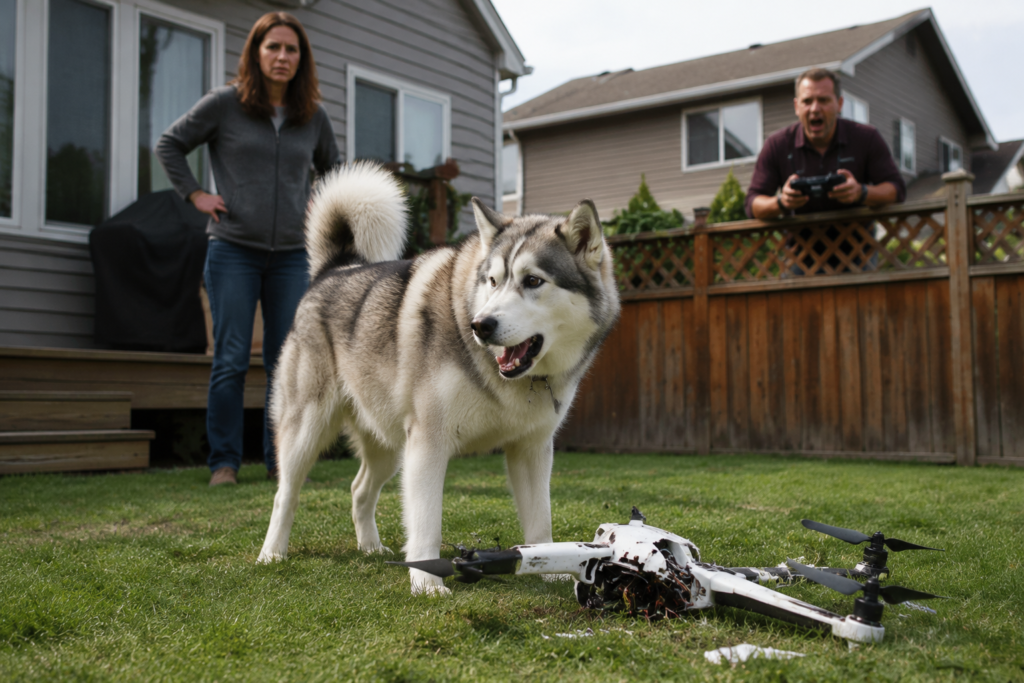
My neighbor believed that owning a drone made him the king of our neighborhood.
His name was Derek Collins, and when he bought his first expensive drone, I honestly thought it might be a harmless new hobby.
We’d lived next door to each other for almost four years. We weren’t friends, exactly, but we were friendly enough. We waved when we collected our mail. We exchanged a few words while mowing our lawns. Once, when a storm knocked a branch into his driveway, I’d helped him move it.
Derek was the sort of man who liked to talk about his purchases.
When he bought a new truck, everyone heard about the engine.
When he installed a television that covered half his living-room wall, he invited three neighbors over to admire it.
And when he bought a drone, he announced that he was going to become a professional aerial photographer.
“I’ve got the equipment now,” he told me one Saturday morning, holding up the controller. “People pay good money for this kind of footage.”
I smiled politely.
“Sounds interesting.”
He grinned.
“You should see what it can do.”
At the time, I had no idea how often I’d come to regret those words.
The first few weeks were tolerable.
Derek flew over the park, recorded sunsets, and took videos of the surrounding streets. Sometimes I saw the drone moving above the trees, its little lights blinking against the evening sky.
I didn’t mind.
People should be allowed to enjoy their hobbies. I’d never been the sort of person who complained about a neighbor’s harmless interests.
But gradually, Derek’s behavior changed.
He started hovering outside people’s windows.
He followed cars down the road, attempting to keep pace with them as if the neighborhood were his private racing circuit.
He buzzed the children riding bicycles near the sidewalk.
He flew low over the gardens where people were having dinner.
Whenever anyone complained, he laughed.
“It’s just a drone,” he’d say. “Relax.”
Then he began flying into my backyard.
My backyard was fenced, quiet, and private. It was where I spent my mornings drinking coffee, where I planted vegetables in the spring, and where my dog, Bear, liked to stretch out beneath the maple tree.
Bear was a seventy-pound Alaskan Malamute with a thick silver-and-white coat, a broad head, and the kind of deep, expressive eyes that made strangers stop to admire him.
He looked intimidating to people who didn’t know him.
In reality, Bear was a gentle giant.
He loved children. He loved snow. He loved stealing socks from the laundry basket and carrying them around as if he’d discovered buried treasure.
He was also terrified of the drone.
The first time Derek flew it low over our fence, Bear was lying in the grass.
The buzzing sound startled him. He jumped up, barked, and ran toward the back door.
I called him inside.
The drone circled the yard once, then rose above the fence.
I assumed Derek hadn’t realized how frightened the dog was.
The second time, Bear was drinking from his water bowl.
The drone descended over the fence, hovered above him, and then swooped low enough that Bear ducked and scrambled backward.
I ran outside.
“Derek! Bring that thing up!”
The drone rose.
Derek’s face appeared above the fence a few seconds later.
He was standing in his own yard, holding the controller.
“What?”
“Please don’t fly over my dog like that. You’re scaring him.”
Derek laughed.
“He’s a big dog. He’ll get over it.”
“He doesn’t understand what that thing is.”
“It’s not going to hurt him.”
“Then there’s no reason to fly it directly over his head.”
Derek shrugged.
“It’s a drone, not a missile.”
I stared at him.
“I’m asking you to stop flying it into my yard.”
He lifted the controller.
“Sure. Whatever.”
Then he walked away.
I believed him.
That was my first mistake.
Three days later, the drone returned.
I was sitting on the patio with a book when I heard the buzzing.
Bear was asleep near my chair.
The drone came over the fence, hovered above the grass, and dropped toward him.
Bear startled awake and bolted toward the house.
I stood so quickly that my chair fell backward.
“HEY!”
The drone climbed.
I saw Derek’s silhouette on the other side of the fence.
He was laughing.
Actually laughing.
I couldn’t believe it.
“What’s wrong with you?” I shouted.
He lowered the controller.
“Your dog needs to get used to things.”
“He’s in my fenced yard! Leave him alone!”
Derek grinned.
“Maybe train him better.”
I stood there shaking with anger while the drone disappeared over his roof.
That evening, Bear wouldn’t go into the backyard.
He stood at the sliding door, ears lowered, staring at the grass.
I opened the door and called him.
He looked at me.
Then he looked up at the sky.
And he stepped backward.
That was when I stopped thinking of Derek’s drone as an annoying hobby.
It had become a problem.
Not because I hated drones.
Not because I wanted to control what my neighbor did on his property.
But because a grown man had discovered that he could frighten an animal for his own amusement, and every time I asked him to stop, he treated my concern as another opportunity to laugh.
I tried speaking to him again.
I sent a polite text.
I asked him face-to-face.
I explained that Bear was frightened and that I was worried about an accident.
Derek responded with jokes, excuses, and the same dismissive smile.
Eventually, I called the police.
The officer who came to my house listened carefully. He spoke to Derek, who insisted that the drone was being operated legally and that I was exaggerating.
The officer explained that the situation involved several issues, including the drone’s operation, privacy concerns, and what local rules might apply.
But he couldn’t resolve everything that afternoon.
When the officer left, Derek stood beside his driveway and called across the lawn.
“Feel better now?”
I didn’t answer.
He raised the controller.
The drone lifted into the air.
And Bear ran into the house.
That night, I sat beside my dog on the living-room floor and stroked the thick fur behind his ears.
“It’s okay, buddy,” I whispered.
Bear rested his head on my knee.
I promised him I would protect him.
I didn’t know how I would do it.
I didn’t know what Derek would try next.
And I certainly didn’t know that his expensive drone, the very thing he used to make himself feel powerful, would eventually become the reason the entire neighborhood discovered who he really was.
Because Derek had a secret.
So did someone else on our street.
And the day those two secrets collided, the footage Derek had collected to impress his online followers would expose a truth that none of us had been prepared to see.
But the biggest surprise wouldn’t be that Derek finally faced consequences.
It would be the identity of the person who had been quietly documenting his behavior long before I ever called the police.
And why that person had been waiting for the right moment to speak.
PART 1: THE DOG WHO STOPPED GOING OUTSIDE
Before Derek bought the drone, Bear had a routine.
Every morning at six, he would wake me by nudging the bedroom door with his nose.
He never barked unless something genuinely worried him. Instead, he would push the door open just far enough to squeeze his enormous head through the gap, then stare at me with the patience of a retired schoolteacher waiting for a late student.
If I pretended to be asleep, he would sigh.
If I still didn’t move, he would place one enormous paw on the mattress.
That usually worked.
I’d put on my slippers, pull on a jacket, and let him into the backyard.
Bear would trot outside, sniff the fence posts, inspect the flower beds, and make a slow circuit of the yard as if he were conducting a security inspection.
Then he’d settle beneath the maple tree while I made coffee.
It was our quiet time.
I had bought my house eight years earlier, after my wife, Laura, passed away following a long illness. I wasn’t ready to leave the town where we’d built our life, but the house we’d shared felt too large without her.
My current home was smaller, with a manageable garden and a backyard that had enough space for Bear to run.
Laura had loved dogs.
She’d been the one who insisted we adopt Bear when he was a gangly, oversized puppy who couldn’t figure out how to climb the three steps leading onto our porch.
“Look at him,” she’d said the day we brought him home. “He’s going to be enormous.”
She’d been right.
Bear grew into a magnificent animal, but his personality never changed. He remained gentle, affectionate, and slightly ridiculous.
Laura used to say that Bear had the heart of a teddy bear and the coordination of a refrigerator.
After she died, I kept her old gardening gloves in a drawer beside the patio.
I couldn’t explain why.
They were worn, stained with soil, and too small for my hands.
But sometimes, when I was having a difficult day, I’d take them outside and remember Laura kneeling beside the flower beds, talking to Bear as though he understood every word.
The backyard was more than a yard to me.
It was where I’d learned to live alone.
It was where Bear had helped me survive the loneliest months of my life.
And it was where Derek’s drone slowly began taking away our peace.
At first, Bear reacted to the buzzing by looking up.
Then he began running toward the house whenever he heard anything resembling the sound.
A lawn mower could startle him.
A delivery truck passing the driveway could make him lift his head.
Once, a large fly became trapped against the window, and Bear spent several minutes watching it suspiciously before retreating to the hallway.
I took him to our veterinarian because I worried that something else might be wrong.
The veterinarian examined him and explained that repeated frightening experiences could cause an animal to become more anxious about sounds and situations associated with them.
She recommended giving Bear a calm, predictable environment and never forcing him to remain near something that frightened him.
“So keep him away from the drone,” she said.
“I’ve tried.”
“Then the person flying it needs to understand that his behavior is affecting your dog.”
I almost laughed.
I had tried explaining that to Derek six times.
The seventh conversation happened on a Sunday afternoon.
I was trimming the rose bushes when the buzzing started.
Bear was lying beside the patio.
I turned and saw the drone moving over the fence.
It hovered for a moment.
Then it descended.
“Not again!” I shouted.
Bear scrambled upright.
The drone dipped toward him.
Bear yelped and bolted for the sliding door.
I ran after him, but his paws slipped on the patio stones. He regained his footing and rushed inside.
The drone continued hovering above the grass.
I ran to the fence.
“Derek!”
He appeared in his backyard, controller in hand.
“What now?”
“Stop flying that thing over my dog!”
He glanced at the drone.
Then at me.
“He’s fine.”
“He just ran inside terrified!”
“Then let him stay inside.”
I stared at him.
“You think that’s an answer?”
Derek shrugged.
“Your yard isn’t a no-fly zone just because you’ve got a nervous dog.”
I felt anger rise so quickly that I had to pause before speaking.
“I am not asking you to stop using your drone. I’m asking you not to deliberately dive toward my dog in my fenced backyard.”
“I’m not diving toward him.”
“I watched you do it.”
“You’re being dramatic.”
Then he raised the controller slightly.
The drone climbed, turned, and disappeared behind his house.
Derek smiled.
“Maybe buy him some earplugs.”
He walked away.
I returned to the house.
Bear was standing in the hallway, trembling.
I crouched beside him.
“Come here, buddy.”
He approached slowly, pressed his head against my chest, and leaned his weight into me.
I wrapped my arms around his neck.
And for the first time, I felt something beyond anger.
I felt helpless.
I could install a taller fence.
I could keep Bear indoors.
I could spend money on equipment to reduce the noise.
I could call the police again.
But I couldn’t make Derek care.
And that was the part I struggled to accept.
Some people will stop doing something hurtful when they learn it causes pain.
Others will continue precisely because they have learned it causes pain.
Derek was beginning to look like the second kind.
The first unexpected witness
A few days later, I was bringing groceries inside when I heard someone call my name.
It was Mrs. Evelyn Parker from across the street.
She was seventy-four, a retired elementary school teacher, and one of the kindest people I’d ever met.
She had lived in the neighborhood for more than thirty years.
She knew who needed help with their rubbish bins, whose grandchildren were visiting, and which elderly residents needed their sidewalks cleared after a snowfall.
She also knew everybody’s business.
Not because she was nosy.
Because people trusted her.
“Can I ask you something?” she said.
“Of course.”
“Has Derek been flying that drone into your backyard?”
I set the grocery bag down.
“Yes.”
She looked toward his house.
“I thought so.”
“You’ve seen it?”
“More than once.”
She lowered her voice.
“He’s been flying it around my bedroom window, too.”
I felt a chill.
“What?”
“Last week, I was reading before bed. I heard that buzzing sound and looked up. There it was, right outside the window.”
“Did you speak to him?”
“I did.”
“What did he say?”
Evelyn’s expression tightened.
“He said he was testing the camera.”
I shook my head.
“That’s exactly what he told me.”
She looked at me for a long moment.
Then she said, “I think he enjoys making people uncomfortable.”
I didn’t know what to say.
Evelyn picked up one of my grocery bags.
“Come on. I’ll help you carry these inside.”
We walked to the kitchen together.
While she put a carton of milk on the counter, she glanced through the window toward the backyard.
“Poor Bear,” she said softly.
I looked at her.
“He won’t go outside without me anymore.”
“Then don’t let Derek convince you that you’re being unreasonable.”
Her words stayed with me long after she left.
Because until then, I had begun to wonder whether I was overreacting.
Derek had told me I was dramatic.
He’d told me to train my dog.
He’d laughed when I called the police.
After hearing the same dismissive comments enough times, even a reasonable person can begin to question their own judgment.
Evelyn’s reassurance helped.
But it also raised another question.
If Derek was doing this to me and to her, how many other people were being targeted?
The answer came two evenings later.
And it was much bigger than I expected.
PART 2: THE NEIGHBORHOOD THAT STARTED LOOKING UP
The first person to tell me about the drone near the children’s play area was Mark Benson, who lived three houses down.
Mark had two children, ages eight and eleven.
He was a quiet man who worked long hours as a mechanic and spent most weekends repairing things around his house.
We’d exchanged greetings for years, but we’d never had much reason to talk.
That changed when I found him standing near his driveway, watching Derek’s drone circle the street.
“Is that thing bothering you, too?” I asked.
Mark looked at me.
“You’ve had trouble with it?”
I told him about Bear.
He shook his head.
“My youngest thinks it’s funny until it gets close. Then he runs inside.”
“Have you spoken to Derek?”
“Twice.”
“And?”
Mark gave a tired laugh.
“He told me his drone was worth more than my car, so maybe I should keep my kids away from it.”
I stared at him.
“He actually said that?”
“Word for word.”
Mark crossed his arms.
“Last weekend, he tried to follow my car down the street. I was driving at the speed limit, and that thing kept appearing in the mirror. I pulled over because I was worried he’d cause a distraction or crash into something.”
“Did he stop?”
“No. He filmed me getting out of the car.”
Mark looked toward Derek’s house.
“Then he posted it online with a caption about an angry driver who couldn’t take a joke.”
My stomach tightened.
“Did you see the video?”
“Someone sent it to me.”
He showed me his phone.
There was Mark, standing beside his car, looking irritated and pointing toward the sky.
The clip had been edited to remove the part where Mark first pulled over and asked Derek to stop following him.
The caption read:
WHEN PEOPLE CAN’T HANDLE A LITTLE FUN.
Several commenters laughed.
One called Mark a miserable old man.
Another suggested he needed to relax.
I handed the phone back.
“That’s not the whole story.”
“No,” Mark said. “It isn’t.”
We stood in silence for a moment.
Then he asked, “Have you considered recording what he’s doing?”
“I have. But I don’t want to turn this into a war.”
Mark nodded.
“I understand. But if he keeps telling everyone we’re overreacting, we need some way to show what actually happened.”
He wasn’t wrong.
I had already begun documenting dates and times in a notebook. I’d written down each incident involving Bear, along with the conversations I’d had with Derek and the police.
But I hadn’t thought about how quickly a short video could distort the truth.
Derek controlled the footage.
He decided what people saw.
He decided what they didn’t see.
And because he posted the clips first, his version of events often became the version people believed.
That night, I began recording the incidents from my own property.
I didn’t trespass.
I didn’t interfere with the drone.
I simply documented what happened when it entered my backyard and frightened Bear.
The first recording showed the drone approaching the fence.
The second showed Bear retreating toward the house.
The third captured Derek laughing after I called out to him.
I saved the original files, noted the dates, and backed them up.
I wasn’t trying to humiliate Derek.
I wanted an accurate record.
A few days later, the drone appeared again.
This time, Bear was outside with me while I watered the garden.
The buzzing began behind the fence.
Bear looked up.
I immediately led him toward the house.
The drone crossed the fence before we reached the door.
It hovered above the grass.
Then it moved toward us.
I stepped between Bear and the drone, raised my hand, and shouted for Derek to bring it up.
The drone climbed away.
Bear rushed inside.
I remained on the patio, breathing hard.
Then I heard a voice from the neighboring yard.
“You’re making yourself look ridiculous.”
Derek was standing by his fence.
I looked at him.
“You flew that thing directly toward us.”
“I was filming the garden.”
“My dog was standing right there.”
“Then take him inside.”
I pointed toward the fence.
“You have an entire neighborhood to fly over. Why do you keep coming into my yard?”
He grinned.
“Because you make such a fuss.”
I stared at him.
He laughed.
And then he said something I would remember for a very long time.
“Honestly, your reactions are the best part.”
I felt the anger drain out of me.
Not because I wasn’t angry.
Because I finally understood.
This wasn’t a misunderstanding.
It wasn’t an innocent hobby that had accidentally frightened my dog.
Derek knew I was upset.
He knew Bear was frightened.
He knew other neighbors were uncomfortable.
And he’d just admitted that our reactions were part of his entertainment.
I went inside.
I saved the recording.
Then I called the non-emergency police number again.
The second police visit
The officer who came that afternoon was different from the first.
His name was Officer Ramirez.
He listened while I explained the situation, showed him the recordings, and described the repeated attempts I’d made to resolve it peacefully.
He watched the clip of the drone approaching Bear.
His expression tightened.
“How often does this happen?”
“Several times a week.”
“Have you kept a log?”
I showed him the notebook.
He read through it.
Then he asked whether Derek had threatened me directly.
“No. He mostly laughs and tells me I’m overreacting.”
Officer Ramirez nodded.
“That distinction matters, but repeated conduct can still be relevant. The exact options depend on local law and the circumstances. I’ll document what you’ve reported.”
“Can you make him stop?”
“I can’t promise that. There may be local rules or aviation regulations that apply, and the appropriate agency may need to review the footage. But we can document the pattern and explain what options are available.”
I appreciated his honesty.
He went next door and spoke with Derek.
I couldn’t hear their conversation, but I saw Derek gesturing toward the sky and shaking his head.
A few minutes later, Officer Ramirez returned.
“He says he’s operating the drone for recreational purposes and denies deliberately targeting your dog.”
“But I have the footage.”
“I’ve seen it. I’ll include that information in my report.”
He paused.
“If he continues, keep documenting the incidents and contact us when appropriate. Don’t confront him physically or attempt to interfere with the aircraft. That could create additional safety problems.”
I nodded.
Before he left, he gave me information about the relevant local reporting channels for drone-related concerns.
I thanked him.
For the first time in weeks, I felt that someone had taken the situation seriously.
Then Derek ruined it.
As Officer Ramirez walked toward his car, Derek stepped onto his porch and called across the lawn.
“Hope you’re happy now!”
The officer turned.
“Derek, that’s enough.”
Derek lifted both hands in mock surrender.
“I’m just talking to my neighbor.”
Officer Ramirez waited until Derek went back inside.
Then he looked at me.
“Keep your records. And if the behavior escalates, let us know.”
I nodded.
After he left, I went into the backyard.
Bear was standing behind the glass door.
I opened it.
He looked at the sky.
Then he looked at me.
He didn’t step outside.
I sat down beside him.
“You don’t have to,” I whispered.
He lowered himself onto the floor and rested his head on my leg.
That evening, I moved his water bowl into the laundry room so he wouldn’t need to cross the backyard to drink.
I began taking him for walks at quieter times of day.
I kept the curtains closed in the rooms facing Derek’s property.
I changed my routine around a man who had decided that other people’s discomfort was funny.
And every adjustment made me a little angrier.
Not because I wanted revenge.
Because I wanted my life back.
I wanted to sit outside with my coffee.
I wanted Bear to run beneath the maple tree.
I wanted Evelyn to read beside her bedroom window without wondering whether a camera was watching her.
I wanted Mark’s children to play outside without becoming the punchline of somebody else’s online video.
Those were not unreasonable wishes.
They were ordinary things.
And ordinary things shouldn’t require a fight.
But the neighborhood was changing.
People were beginning to talk.
A woman near the corner said she’d seen the drone hovering outside her kitchen window.
A retired couple reported that it had followed them while they walked their dog.
Another resident complained that Derek had filmed a family gathering and posted a clip without asking.
Individually, each incident seemed small enough for Derek to dismiss.
Together, they formed a pattern.
And while I was quietly collecting evidence of that pattern, Derek was collecting something else.
Followers.
His online account began attracting attention.
He posted aerial videos of the neighborhood, edited clips of people reacting to the drone, and jokes about people who supposedly couldn’t take criticism.
The more upset people became, the more he posted.
The more he posted, the more his followers encouraged him.
He began referring to our street as “the neighborhood of complainers.”
Then, one Friday evening, he posted a video that changed everything.
The clip showed the outside of my house.
The camera moved slowly over the roof, across the backyard, and toward the patio.
Then Bear appeared.
He was standing beside the sliding door.
The drone moved closer.
Bear backed away.
The clip ended with Derek laughing behind the camera.
The caption read:
BIG DOG. BIG ATTITUDE. TERRIFIED OF A LITTLE TECHNOLOGY.
I felt sick.
Thousands of people had watched the video.
Hundreds had commented.
Some thought it was funny.
Others criticized Derek.
A few expressed concern for the dog.
But the part that hurt most was a comment from someone I didn’t know:
Maybe the owner should train his dog instead of blaming the pilot.
I closed the application.
Then I walked into the living room and sat beside Bear.
He was sleeping with his head on Laura’s old gardening gloves, which I’d left on the coffee table after bringing them inside.
I stroked his fur.
“You’re not the problem,” I whispered.
Bear opened one eye.
His tail moved once against the carpet.
And I made a decision.
I would stop trying to persuade Derek to care.
I would stop arguing with his followers.
I would stop wondering whether I was being too sensitive.
Instead, I would document what happened, use the proper reporting channels, and let the evidence speak for itself.
I didn’t know it yet, but that decision would eventually bring an unexpected person to my front door.
Someone who had been watching Derek’s videos for a very different reason.
Someone who knew the drone wasn’t the only thing Derek had been using to watch our neighborhood.
And someone who would reveal that the most important evidence in this entire story wasn’t a video of my frightened dog.
It was a video Derek had never intended anyone to see.
PART 3: THE WOMAN WHO KNOCKED AT 9:17 P.M.
The knock came on a Tuesday evening.
It was 9:17 p.m., and I was in the kitchen washing Bear’s food bowl when someone tapped on the front door.
Bear lifted his head from his bed.
I dried my hands and checked the window.
A woman stood on the porch, holding a small handbag against her side. She appeared to be in her early forties, with dark hair pulled into a ponytail and the tired expression of someone who had spent too much time worrying about something she couldn’t control.
I opened the door but kept the screen closed.
“Can I help you?”
She glanced toward Derek’s house.
“My name is Natalie Brooks. I live on the next street.”
I’d seen her walking occasionally, but we had never spoken.
“All right.”
She took a breath.
“I saw the video Derek posted of your dog.”
My stomach tightened.
“I’m sorry.”
“Please don’t apologize. You didn’t do anything wrong.”
She looked uncomfortable, as though she’d rehearsed this conversation and was now struggling to say the words aloud.
“May I speak with you for a minute?”
I opened the screen.
“Of course.”
Natalie stepped inside.
Bear approached cautiously, sniffed her shoes, and then returned to his bed.
She watched him go.
“He’s beautiful.”
“Thank you.”
She glanced at the hallway.
“Is it all right if I explain why I’m here?”
“Please.”
Natalie sat at the kitchen table.
For a moment, she studied her hands.
Then she said, “Derek used to fly his drone near my house, too.”
I sighed.
“I’m beginning to think he flies it near everyone’s house.”
“Maybe. But my situation was a little different.”
She looked toward the window.
“Last summer, my father was staying with me. He had dementia, and some days he became confused about where he was. He liked sitting in the garden because it reminded him of the house where he grew up.”
I listened quietly.
“One afternoon, Derek flew the drone over the fence. Dad became frightened and went inside. A few minutes later, the drone came back.”
Natalie swallowed.
“Dad thought it was an animal. He started shouting at it. Derek filmed him.”
My stomach tightened.
“He posted the video?”
Natalie nodded.
“He called it a ‘confused old man versus the flying robot.’ People laughed. Someone recognized my father and sent me the link.”
She pressed her lips together.
“I asked Derek to remove it. I explained Dad’s condition. Derek said the video was already public and that I couldn’t control what people found funny.”
“What happened?”
“I reported it to the platform and requested removal. Eventually, the video disappeared, but not before several people downloaded it.”
She took a breath.
“My father died in January.”
“I’m so sorry.”
“Thank you.”
Natalie looked down at the table.
“I don’t want to make this about me. I just wanted you to know that you’re not imagining what’s happening.”
I felt something loosen in my chest.
For months, I’d been dealing with Derek’s behavior as though each incident were an isolated problem I had to solve alone.
Now I was hearing the same story from someone else.
“He keeps telling me I’m overreacting,” I said.
“He told me the same thing.”
“What did you do?”
“I stopped arguing with him.”
She gave a small, sad smile.
“Then I started saving copies of everything he posted that involved other people.”
I sat up straighter.
“You have copies?”
“Some. Not everything.”
She opened her handbag and removed a small notebook.
“I recorded dates, links, and the names of people who contacted me. I also saved screenshots of several videos.”
She hesitated.
“I didn’t know whether they’d ever be useful.”
I stared at the notebook.
“Why didn’t you tell anyone?”
“I did. I reported what happened, and I asked the platform to review the material. But I couldn’t make other people care about it.”
She looked toward Bear.
“Then I saw your video.”
I understood.
She hadn’t come because she wanted to join a neighborhood feud.
She’d come because she recognized a pattern.
And she was worried that Derek’s behavior was becoming more deliberate.
“There’s something else,” she said.
I waited.
“Have you ever noticed that Derek seems to know when people are going to be outside?”
I frowned.
“What do you mean?”
“He appears at the exact time someone is gardening, having dinner, or getting into a car. He seems to know when the children are playing. He knows when Evelyn opens her bedroom curtains.”
I considered the question.
Derek had always seemed to appear when I was outside with Bear.
I’d assumed it was coincidence.
Now I wasn’t so sure.
“Are you saying he’s watching us?”
“I’m saying I don’t know. But I’ve wondered whether he’s using something other than the drone to decide when to fly.”
The suggestion unsettled me.
I didn’t want to leap to conclusions.
Derek might simply have noticed people’s routines because he lived among us.
But Natalie had another reason for coming.
She reached into her bag and removed her phone.
“I found something in one of his public videos,” she said. “Something I think you should see.”
She opened a recording.
It showed Derek standing in his garage, talking about drone equipment.
Behind him, on a shelf, was a laptop displaying a grid of small images.
I leaned closer.
The images appeared to be photographs of houses.
Several showed backyards.
One showed Evelyn’s garden.
Another appeared to show Mark’s driveway.
And one showed my house.
My stomach tightened.
“Can you enlarge that?”
Natalie did.
The image became clearer.
It was my backyard, photographed from above.
Bear was lying beneath the maple tree.
The timestamp showed the image had been captured several minutes before Derek’s drone appeared in the video he’d posted.
I felt cold.
“Where did you get this?”
“It was part of a longer clip he uploaded. He deleted it later, but I saved a copy.”
I stared at the screen.
“Why would he have photographs of everyone’s houses?”
“I don’t know.”
“Could they be ordinary aerial photographs?”
“Some might be. But look at the filenames.”
She zoomed in.
The files were labeled with street names and dates.
One had my house number.
Another had Evelyn’s.
A third had the address of a home several streets away.
I felt a wave of unease.
There could be innocent explanations for some aerial images.
But there was no innocent reason to ignore the context: the repeated unwanted flights, the videos of frightened residents, and the way Derek seemed to use people’s reactions as entertainment.
I asked Natalie whether she’d sent the material to anyone.
“Not yet. I wanted to talk to you first.”
I nodded slowly.
“I appreciate that.”
She closed the recording.
“There’s one more thing.”
I waited.
“Two weeks ago, Derek came to my house and asked whether I’d be interested in helping him with a project.”
“What kind of project?”
“He said he wanted to make a documentary about neighborhood life. He offered to pay me to let him film my garden and some of the people who visited.”
I stared at her.
“What did you say?”
“I refused.”
“Did he explain why he wanted to film you?”
“He said people were fascinated by everyday life when it was captured from unusual angles.”
She shook her head.
“It sounded harmless at first. But then he asked whether I had access to the neighborhood’s private online group.”
I felt a chill.
“What did he want with that?”
“He said he wanted to identify interesting events to film.”
I looked at the notebook on the table.
The screenshots.
The dates.
The filenames.
The people.
Suddenly, Derek’s behavior seemed less like random mischief and more like a project with an audience.
I didn’t know what that project was.
I didn’t know whether the images were connected to anything beyond his online content.
But I knew I didn’t want to find out through another frightening incident involving Bear.
“I’ve already contacted the police twice,” I said. “They documented what happened, but they couldn’t promise to stop him.”
Natalie nodded.
“I think we need to make a more organized report. Not to exaggerate anything. Just to put the evidence together.”
I agreed.
We spent the next hour comparing dates and incidents.
I showed her my notebook.
She showed me the screenshots she’d preserved.
We wrote down which videos were publicly available, which had been removed, and which people might be able to confirm what had happened.
We didn’t make accusations we couldn’t support.
We didn’t speculate about motives.
We simply organized what we knew.
Before Natalie left, she stopped beside Bear’s bed.
He lifted his head.
She crouched and offered him her hand to sniff.
“You’re going to be okay, sweetheart,” she whispered.
Bear’s tail moved slowly.
When she stood, she looked at me.
“Don’t let Derek make you feel as though you’re the problem.”
“I won’t.”
She nodded.
Then she walked out into the night.
I locked the door behind her.
For several minutes, I stood in the hallway, listening to the quiet house.
I had spent months trying to solve the problem by persuading one unreasonable man to behave differently.
Now I had another option.
I could work with the people affected, preserve the evidence, and ask the appropriate authorities to review the complete picture.
I wasn’t interested in revenge.
I wanted Derek to stop.
I wanted Bear to feel safe.
I wanted my neighbors to stop looking over their shoulders whenever they heard a buzzing sound.
But I also wanted something else.
I wanted to understand why Derek seemed so determined to turn ordinary people into entertainment.
And the answer would come sooner than I expected.
Because two mornings later, Derek made a mistake.
A very public mistake.
One that involved a drone, a delivery truck, and a person who had absolutely no intention of becoming part of his online show.
PART 4: THE DAY DEREK WENT TOO FAR
The incident happened on a Thursday morning.
I was drinking coffee when I heard a sharp buzzing sound outside.
Bear was lying near the back door.
His ears rose immediately.
I walked to the window.
Derek’s drone was hovering above the road.
A delivery truck had stopped near Mark’s driveway.
The driver was carrying a package toward a house across the street when the drone moved toward him.
At first, I thought Derek was simply filming the truck.
Then the drone began following the driver.
It moved above his head as he walked.
The driver looked up, frowned, and changed direction.
The drone followed.
He stopped.
The drone hovered.
He waved it away.
The drone remained in place.
Finally, the driver put the package down, turned toward Derek’s house, and shouted something I couldn’t hear.
Derek laughed.
The driver picked up the package and continued toward the front door.
The drone swooped lower.
The driver flinched and stepped backward.
The package slipped from his hands.
It landed on the pavement.
I was already reaching for my phone.
The driver looked up at the drone again, then toward Derek’s property.
He appeared furious.
Derek stood near his driveway, controller in hand.
He was filming the entire exchange.
The driver picked up the package and walked toward him.
I couldn’t hear their conversation, but I saw the driver’s expression.
He was trying to explain something.
Derek kept smiling.
Then the driver pointed toward the road and walked away.
Derek immediately checked his phone.
A few minutes later, a new video appeared on his account.
The caption read:
DELIVERY DRIVER LOSES HIS MIND OVER A TOY.
The clip showed the driver shouting and gesturing.
It didn’t show the drone following him.
It didn’t show the package falling.
It didn’t show the driver trying to finish his work while being distracted by an aircraft.
It showed only the driver’s reaction.
I saved a copy of the public post and made a note of the time.
Then I called Mark.
“Did you see what happened outside your house?”
“I did,” he said. “The driver was trying to do his job.”
“Did you get any footage?”
“I have a doorbell camera. It might have captured part of it.”
I asked whether he would preserve the original recording.
He agreed.
Later that afternoon, Mark sent me a message.
His doorbell camera had captured the drone approaching the delivery driver.
It showed the driver looking up, stepping aside, and trying to continue toward the house.
The recording did not capture every part of the incident, but it showed enough to establish that the online clip had omitted important context.
Mark sent a copy to the delivery company’s customer service team and asked whether the driver could be informed that evidence existed in case he wished to make a report.
I sent the information to the appropriate reporting channel as well.
I didn’t know whether it would lead to any formal action.
I didn’t need to know.
The point was that the complete evidence existed.
Derek could edit his videos.
He couldn’t edit everybody else’s memories.
The meeting on the sidewalk
That evening, several neighbors gathered near Evelyn’s house.
Nobody had organized a formal meeting.
People had simply begun stopping to talk when they saw one another outside.
Evelyn brought a folding chair.
Mark brought his laptop.
Natalie brought her notebook.
I brought the recordings involving Bear.
For the first time, I saw the full extent of the problem.
One neighbor had a video of the drone hovering outside his kitchen window.
Another had a recording of Derek following his car.
A parent had saved a clip showing the drone moving low over the children’s play area.
Evelyn described what had happened outside her bedroom.
Natalie explained the videos she’d preserved.
Nobody was shouting.
Nobody was planning to damage Derek’s equipment or confront him as a group.
We were simply comparing our experiences.
And a clear pattern emerged.
Derek repeatedly operated his drone in ways that frightened or distracted people.
When they complained, he recorded their reactions.
Then he posted edited versions online, presenting their distress as entertainment.
Some of his followers laughed.
Others encouraged him.
The videos appeared to reward the behavior, making him more likely to repeat it.
“Why does he do this?” one neighbor asked.
Nobody had an answer.
Mark leaned back in his chair.
“Maybe he likes the attention.”
Natalie shook her head.
“I think he likes deciding what other people see.”
Evelyn looked at her.
“What do you mean?”
“He films someone reacting to something frightening, removes the part that explains why they’re frightened, and posts the reaction as if it came out of nowhere.”
She paused.
“He gets to make the other person look unreasonable.”
I thought about the video of Bear.
The camera had shown my dog retreating.
It hadn’t shown the drone descending toward him.
It hadn’t shown me calling for Derek to stop.
It hadn’t shown the weeks of conversations that came before it.
The clip had turned a frightened animal into a joke.
And me into an unreasonable neighbor.
Natalie was right.
Derek wasn’t merely collecting footage.
He was controlling the story.
“Then we need to tell the complete story,” I said.
Everyone looked at me.
I felt nervous.
I wasn’t used to speaking in front of a group.
But I’d spent too many months feeling helpless.
“We don’t need to attack him. We don’t need to post insults. We need to preserve the original recordings and make accurate reports. If there’s a rule he’s breaking, the right authority can determine that. If there isn’t, at least we’ll have a clear record of what’s happening.”
Mark nodded.
“Agreed.”
Evelyn smiled.
“That sounds sensible.”
We exchanged contact information.
We agreed not to share private footage publicly without the consent of the people involved.
We also agreed that anyone who experienced another incident should record the date, time, and circumstances, provided it could be done safely and lawfully.
It wasn’t dramatic.
There were no speeches.
Nobody raised a glass or declared victory.
But when we went home that evening, I felt less alone than I had in months.
For the first time, Derek wasn’t controlling the entire narrative.
We were building a factual record of our own.
And Derek had no idea how much that mattered.
The following Saturday, he posted another video.
This one showed the neighborhood from above.
He narrated it as though he were hosting a television program.
“Welcome back to the world’s most sensitive street,” he said. “Today, we’re checking in on the people who think the sky belongs to them.”
The camera moved over the houses.
It passed Evelyn’s garden.
It passed Mark’s driveway.
Then it moved toward my backyard.
I watched the recording on my phone.
Bear was inside with me, resting peacefully beside the sofa.
The drone hovered above the maple tree.
Derek’s voice continued.
“And here’s our favorite furry critic.”
The camera moved toward the back door.
I felt my jaw tighten.
Then something happened.
The drone suddenly changed direction.
It jerked sideways, rose sharply, and moved away from my house.
Derek’s narration stopped.
For a second, the footage showed only the sky and the tops of the trees.
Then the screen went black.
The video ended.
I watched it again.
The movement was unusual.
I couldn’t tell whether the drone had encountered a technical issue, a gust of wind, or something else.
I wasn’t going to guess.
But I noticed that Derek didn’t upload another video that day.
Nor did he fly the drone the following morning.
For the first time in months, our backyard was quiet.
Bear noticed.
He went outside with me at six.
He sniffed the fence posts.
He inspected the garden.
Then he walked beneath the maple tree and lay down in the grass.
I sat beside him with my coffee.
For twenty peaceful minutes, nothing buzzed overhead.
I thought perhaps the problem was finally ending.
I was wrong.
Because that afternoon, Derek knocked on my door.
And he wasn’t smiling.
PART 5: THE THREAT THAT CHANGED EVERYTHING
Derek stood on my porch with his phone in his hand.
His face was flushed.
“You need to tell your friends to stop spreading lies about me.”
I remained in the doorway.
“What lies?”
“You know exactly what I’m talking about.”
“I’ve reported what happened to the relevant authorities. I’ve kept records of the incidents involving my property and my dog.”
He shook his head.
“You people are trying to ruin my business.”
I stared at him.
“What business?”
“My photography business.”
“You told me you were making videos for fun.”
“That doesn’t mean I can’t monetize them.”
I took a breath.
“Derek, I don’t care whether you make money from aerial photography. I care that you keep flying over my dog and filming people who have asked you to stop.”
“I’m operating legally.”
“That isn’t for me to decide.”
He looked surprised.
I continued.
“If you’re complying with every applicable rule, then the appropriate authorities can determine that. But it doesn’t mean you have to keep targeting my backyard.”
He stepped closer to the door.
“Your dog is your responsibility.”
“Yes.”
“Then keep him inside.”
I stared at him.
“Bear has lived here for years. He has a fenced backyard. He should be able to use it without being frightened by someone deliberately flying a machine toward him.”
Derek laughed bitterly.
“You can’t prove I deliberately targeted him.”
I thought about the recordings.
The dates.
The conversations.
The video in which he’d admitted that my reactions were the best part.
I didn’t need to argue.
“I’ve kept the evidence,” I said.
His expression changed.
“You’ve been recording me?”
“I’ve documented incidents on my property.”
“That’s an invasion of my privacy!”
I almost laughed at the irony.
Instead, I remained calm.
“If you believe I’ve done something wrong, you can raise that concern through the appropriate channels.”
He stared at me.
Then he lowered his voice.
“You have no idea who you’re dealing with.”
I felt a chill, but I didn’t move.
“I’m not interested in dealing with you at all. I want you to leave my property and stop flying into my yard.”
He stood there for several seconds.
Then he smiled.
It wasn’t the cheerful grin he’d worn when he first bought the drone.
It was something colder.
“Fine,” he said. “We’ll see how long you keep that attitude.”
He turned and walked away.
I closed the door.
My heart was beating hard.
I wrote down what had happened and sent a factual account to my attorney.
Then I checked on Bear.
He was asleep on his bed.
I sat beside him and stroked his head.
“It’s okay,” I whispered.
But I didn’t feel okay.
Derek had stopped pretending that this was a misunderstanding.
He was angry because people had begun documenting his behavior.
He was worried about his online reputation.
And he appeared to believe that the neighborhood owed him silence.
I had no intention of giving him that.
Still, I was careful.
I didn’t confront him again.
I didn’t respond to his online insults.
I didn’t attempt to interfere with his drone.
I continued documenting incidents and following the advice I’d received.
For several days, nothing happened.
Then, on Wednesday morning, I received a message from Natalie.
Have you seen Derek’s latest video? Don’t watch it alone if you’re already upset. Call me first.
I immediately called her.
“What happened?”
She sounded shaken.
“He’s posted footage from the day he visited your house.”
My stomach tightened.
“The day he came to my door?”
“Yes. He filmed himself talking about how you’re supposedly organizing the neighborhood against him.”
I opened the application.
There was Derek, standing in his garage.
He was talking directly to the camera.
“Some people can’t handle being told no,” he said. “They think they can control what everyone else does. They complain to the police, gather their little groups, and try to destroy someone who’s just trying to make a living.”
I felt my hands tighten around the phone.
He never mentioned Bear.
He never mentioned the drone approaching my dog.
He never mentioned the repeated requests to stop.
Instead, he portrayed himself as a victim of an unreasonable neighborhood.
Then he said something that made me stop breathing for a moment.
“I’ve got footage of all of them. Every house. Every routine. Every time they come and go. People should be careful about making enemies of someone who sees everything.”
The video ended.
I stared at the screen.
I understood that he might have been exaggerating to sound intimidating.
I had no evidence that he was monitoring everyone as systematically as he claimed.
But the statement was disturbing.
I sent the link to my attorney and documented the date.
Then I contacted the relevant authorities to ask how the new footage should be submitted.
I also checked the locks on my doors.
Not because I believed Derek would necessarily do anything beyond his usual harassment.
Because I no longer wanted to dismiss warning signs merely because I couldn’t predict what they meant.
That evening, Bear refused to go outside.
I opened the back door.
He looked at the garden.
Then he turned away.
I sat on the floor beside him.
For months, I had told him that everything was fine.
I had tried to make the backyard feel safe again.
But the truth was that I couldn’t explain to a dog why a person kept frightening him.
I could only keep him close and do what I could to protect him.
I thought about Laura.
She had always believed that people revealed their character through the way they treated those who couldn’t fight back.
When we first adopted Bear, he was so small that he could sleep inside a laundry basket.
One afternoon, a visitor laughed when Bear hid behind my legs during a thunderstorm.
Laura had looked at the visitor and said, “Being frightened isn’t a character flaw.”
I remembered that sentence now.
Bear wasn’t weak because the drone scared him.
He wasn’t badly trained because he wanted to feel safe.
And I wasn’t unreasonable because I refused to accept another person’s cruelty as harmless entertainment.
I leaned against the wall.
“We’ll figure it out,” I whispered.
Bear rested his head on my knee.
And then my phone rang.
It was Officer Ramirez.
“Mr. Whitmore, we’ve received additional information concerning the drone incidents.”
I sat up.
“What kind of information?”
“We’re reviewing the material you’ve submitted, along with reports from other residents. I can’t discuss the details of any review, but I’d like to ask whether you’re available to provide a more complete statement.”
“Yes.”
He gave me an appointment time.
Before ending the call, he added, “Please continue to avoid direct confrontations. Let us know if there are new incidents, and don’t attempt to retrieve or interfere with the drone yourself.”
I promised I wouldn’t.
When I hung up, I sat quietly for a moment.
Things were moving.
Slowly.
Not dramatically.
But the evidence was being collected, and the complaints were no longer isolated.
Then, at 8:43 p.m., Natalie sent another message.
I found the original version of the video Derek posted about the delivery driver. There’s something in the background that doesn’t appear in his edited version.
I called her immediately.
“What did you find?”
She sent me the recording.
I watched it once.
Then I watched it again.
In the background, beyond the delivery truck, Derek’s garage door was open.
On a workbench sat a laptop.
The screen showed a map of our neighborhood.
Several locations were marked.
At first, I thought it might be a map used for ordinary flight planning.
Then I noticed that the marked locations appeared to correspond to the houses Derek had filmed most often.
A few were highlighted in red.
Beside one was a label I could just make out.
COMPLAINTS.
My heart began to race.
Natalie called me.
“I don’t know what it means,” she said. “It could be something innocent. But I think the authorities should see it.”
“I agree.”
I sent the recording to my attorney and followed his advice about submitting it through the proper channel.
I didn’t post it online.
I didn’t speculate about what the map meant.
I didn’t accuse Derek of a crime I couldn’t prove.
I simply preserved it.
But as I sat at my kitchen table, I couldn’t escape one question.
Why was Derek keeping track of the people who complained about him?
And what did he intend to do with that information?
I wouldn’t have to wait long for an answer.
Because the next morning, his drone disappeared.
And when Derek finally came outside to explain why, he wasn’t angry.
He was frightened.
PART 6: THE DRONE THAT NEVER CAME HOME
At 7:12 on Friday morning, I heard Derek shouting in his backyard.
It was the first time I’d heard him raise his voice without laughing afterward.
“Where is it?”
A door slammed.
Then came the sound of something being dragged across the garage floor.
I looked through the kitchen window.
Derek was standing beside his driveway, holding the controller.
He looked toward the trees, then toward the street, then back toward his house.
His drone was nowhere to be seen.
For several minutes, he walked around his property, checking the grass and looking beneath bushes.
Then he went inside.
I didn’t know what had happened.
I hadn’t seen anyone touch the drone.
I hadn’t heard a crash.
I wasn’t going to guess that someone had taken it or that it had been deliberately damaged.
I returned to my coffee.
Bear lay beside the back door.
For the first time in months, he wasn’t staring at the sky.
At eight, Derek came out again.
He was carrying his phone.
He walked up and down the driveway, speaking loudly enough for several neighbors to hear.
“Somebody knows something!”
Nobody answered.
He turned toward my house.
I remained inside.
A few minutes later, he posted a message on his social media account.
MY DRONE HAS DISAPPEARED. IF ANYONE HAS INFORMATION, CONTACT ME IMMEDIATELY. THIS IS NOT A JOKE.
I read the post.
Then I closed it.
I had no information about the missing drone.
I hadn’t touched it.
I hadn’t encouraged anyone else to touch it.
And I had no intention of becoming involved in an argument about something I knew nothing about.
That afternoon, Officer Ramirez called.
“Have you seen or heard anything concerning the missing drone?”
“No.”
“Has anyone approached you about it?”
“No.”
“All right. If that changes, please let us know.”
I asked whether the disappearance affected the existing complaints.
“Those are separate issues,” he said. “We’ll continue reviewing the information already submitted. The missing equipment is a matter we’ll assess based on the available evidence.”
I thanked him.
When I hung up, I felt relieved.
Not because I wanted Derek to lose his drone.
Because I wanted the conflict to end without anyone doing something reckless.
If the drone had been lost accidentally, I hoped he would recover it.
If someone had taken it, I hoped the matter would be resolved properly.
Whatever had happened, I didn’t want anyone getting hurt.
But later that evening, something strange occurred.
Evelyn came to my door.
She was carrying a small envelope.
“I think you should see this,” she said.
I invited her inside.
She sat at the kitchen table and placed the envelope in front of me.
“Someone left this in my mailbox.”
I opened it.
Inside was a printed photograph of Derek standing in his garage.
The image appeared to have been taken from across the street.
On the workbench behind him sat the laptop we’d seen in the earlier video.
There were no markings on the envelope.
No note.
No explanation.
I stared at the photograph.
“Who left it?”
“I don’t know.”
“Have you told the police?”
“Not yet. I wanted to ask you whether it meant anything to you.”
I studied the image.
The laptop screen was visible, but too small to read.
The garage door was open.
Derek was looking down at his controller.
The photograph could have been taken by anyone with a camera and a view of the garage.
It didn’t prove anything by itself.
But the anonymous delivery made me uncomfortable.
“I think we should document it and ask the police what to do,” I said.
Evelyn nodded.
“That’s what I thought.”
We photographed the envelope and the image.
Then she contacted the police and explained how she’d received it.
I did the same.
Neither of us tried to identify the sender.
Neither of us shared the photograph online.
We handed over the information and waited.
The following morning, Natalie called.
“I’ve been thinking about the drone,” she said.
“What about it?”
“Remember the video where it suddenly changed direction and the screen went black?”
“Yes.”
“I wondered whether the missing drone could be connected to whatever happened during that flight.”
I considered the possibility.
“Maybe. But we don’t know.”
“Exactly. I’m not saying anyone did anything. I’m saying the timing is strange.”
I agreed.
We decided not to speculate further.
If there was evidence of a connection, the appropriate authorities could investigate it.
For the first time since this entire situation began, I felt the temptation to become the sort of person Derek had accused me of being: someone who assumed the worst, built a story around incomplete information, and treated suspicion as proof.
I didn’t want that.
I wanted facts.
I wanted a fair resolution.
And I wanted Bear to be able to go outside again.
That afternoon, I opened the back door.
Bear stood in the hallway.
I stepped onto the patio and sat in my usual chair.
I waited.
For several minutes, he didn’t move.
Then he cautiously approached the threshold.
He looked at the sky.
He looked at me.
Finally, he stepped outside.
He sniffed the grass.
He walked to the maple tree.
Then he lay down.
I smiled.
It wasn’t a victory over Derek.
It was something much smaller and much more important.
My dog had taken a step toward feeling safe again.
I sat beside him and let the afternoon pass.
No drone appeared.
No one shouted.
No one laughed.
The garden was quiet.
And for the first time in months, I felt the familiar peace I’d thought was gone forever.
Then, just before sunset, my phone rang.
It was Officer Ramirez.
“Mr. Whitmore, I’d like to arrange a time to speak with you again.”
“Of course.”
“There has been a development concerning the material you and the other residents provided.”
I sat up.
“What kind of development?”
“I can’t discuss the details over the phone. But I want you to know that the recordings have helped establish a clearer timeline of the reported incidents.”
I felt my throat tighten.
“Does that mean something will finally happen?”
“It means the information is being reviewed. I don’t want to promise an outcome before the process is complete.”
I understood.
Before ending the call, he asked me to preserve the original files and avoid editing or reposting them.
I promised I would.
After the call, I went inside.
Bear followed me.
I fed him dinner, washed his bowl, and sat on the sofa.
Then I opened my email.
There was a message from Natalie.
She had received a reply from the delivery company.
The driver had confirmed the incident and provided his own account of what happened.
The company had also preserved the original complaint record and the information he’d supplied.
It was one more piece of evidence.
One more account that could be compared with Derek’s edited video.
I saved the email.
Then I turned off the television.
I thought about the neighborhood.
About Evelyn’s father.
About Mark’s children.
About the delivery driver trying to do his job.
About Bear, who had spent months afraid of his own backyard.
I thought about Derek, too.
I didn’t know what had happened to his drone.
I didn’t know whether he would ever acknowledge the harm he’d caused.
But I knew that the neighborhood had changed.
People were talking to one another.
They were preserving evidence.
They were reporting problems rather than suffering through them alone.
And they were learning that the truth didn’t belong exclusively to the person holding the camera.
Sometimes, the truth emerged only when everyone who had been filmed finally had the chance to speak.
That was the real turning point.
Not the missing drone.
Not the police visits.
Not the online arguments.
It was the moment we stopped allowing one person’s edited version of events to define the entire neighborhood.
But there was still one mystery left.
The photograph Evelyn had received.
The laptop in Derek’s garage.
The map with its unexplained labels.
And the question of why someone had quietly placed that image in her mailbox.
Three days later, the sender came forward.
And when we learned who it was, the story took a turn none of us had expected.
PART 7: THE PERSON WHO HAD BEEN WATCHING DEREK
The person who delivered the photograph wasn’t a neighbor.
It was a man named Peter Shaw, who worked as a technician for a company that serviced commercial camera equipment.
He lived several miles away and had no personal connection to Derek.
He contacted the police after hearing that residents had reported the drone incidents.
Peter explained that he’d been hired months earlier to help Derek troubleshoot an unrelated equipment problem.
During that visit, he had noticed several files on Derek’s laptop that appeared to contain images of residential properties.
Peter didn’t know what the files were for.
He didn’t accuse Derek of anything.
But after seeing a public video in which Derek joked about tracking people’s routines, Peter became concerned that the material might have been collected without the residents understanding how it was being used.
He had taken a photograph of the equipment setup during his service visit, as part of his ordinary work documentation.
Later, after seeing the neighborhood complaints discussed online, he decided the photograph might be relevant.
He didn’t know who should receive it, so he placed a copy in Evelyn’s mailbox because her address appeared in one of Derek’s public videos.
That was a mistake, he admitted.
He should have contacted the police directly.
But he explained that he hadn’t wanted to get involved in a dispute without knowing whether he was misinterpreting what he’d seen.
When officers contacted him, he provided the original photograph and explained the circumstances.
He also supplied the service record showing when he’d visited Derek’s garage.
That record helped establish when the photograph had been taken.
It didn’t prove what the files meant.
It didn’t establish that Derek had committed a crime.
But it provided another independent source of information for the authorities to evaluate.
When Natalie told me what had happened, I felt a strange mixture of relief and unease.
Relief, because the photograph had not been created as part of some secret plot by a neighbor.
Unease, because the existence of those files still needed an explanation.
For months, I’d thought the conflict was about a drone.
Now the question was broader.
What was Derek doing with the footage?
Why had he created a map of the neighborhood?
And why had he labeled some locations with the word complaints?
The answers came gradually.
A few weeks later, Derek’s online account went quiet.
His videos disappeared.
His profile stopped updating.
He no longer stood in the driveway talking about how much fun he was having.
We heard rumors, but nobody knew which ones were true.
Some people said he was selling his equipment.
Others said he had been advised to stop flying while the complaints were reviewed.
I didn’t repeat any of it.
I had learned that rumors could cause as much damage as edited videos.
If Derek wanted to explain himself, he could do so through the appropriate process.
Meanwhile, Bear began returning to his old routine.
He still startled at certain buzzing sounds.
But he started sleeping beneath the maple tree again.
He began bringing his favorite toy outside.
One morning, I watched him chase a fallen leaf across the lawn.
He leaped sideways, landed awkwardly, and looked around as if he expected someone to applaud.
I laughed.
It was the first genuine laugh I’d had in weeks.
“You’re ridiculous,” I told him.
Bear wagged his tail.
For a moment, I could almost hear Laura laughing beside me.
I sat on the patio and watched the morning light move across the garden.
I realized how much energy I’d spent worrying about Derek.
I’d let his behavior dominate my thoughts.
I’d changed my routines.
I’d lost sleep.
I’d started dreading the sound of a drone before I even knew whether it was nearby.
I couldn’t undo those months.
But I could stop allowing them to define the months ahead.
So I made a decision.
I would repair what I could.
I would keep the records in case they were needed.
I would continue cooperating with the authorities.
But I would also reclaim my ordinary life.
I planted new flowers.
I cleaned the patio.
I invited Evelyn over for tea.
I helped Mark repair a loose fence panel.
And I took Bear for longer walks.
Little by little, the neighborhood became familiar again.
Then, on a rainy Thursday afternoon, Officer Ramirez called.
“Mr. Whitmore, I wanted to update you on the status of the information you’ve provided.”
I sat down.
“All right.”
“The reports have been reviewed alongside the available footage and the information from the other residents. Some aspects are being referred to the relevant authorities for further assessment.”
“What does that mean?”
“It means the concerns are being handled through the appropriate channels. I can’t share details about any individual review, but your documentation has been useful.”
I thanked him.
Before hanging up, I asked one question.
“Can I expect the drone to return?”
“I can’t predict that. But if you experience another incident, continue documenting it and contact us as appropriate.”
I agreed.
When I put the phone down, I felt something I hadn’t felt in months.
Not triumph.
Not revenge.
Relief.
The situation wasn’t completely resolved, but I no longer felt that I was shouting into an empty room.
My neighbors had been heard.
The evidence had been preserved.
And Derek’s behavior was no longer being judged solely through the videos he chose to publish.
That evening, I sat beside Bear on the living-room floor.
I scratched behind his ears.
“You know something, buddy?”
He looked at me.
“I think we’re going to be okay.”
His tail thumped against the carpet.
Then he rolled onto his side, exposing his enormous belly, and demanded the only reward he truly cared about.
A belly rub.
I gave him one.
And for a while, the world felt simple again.
But the biggest twist in this story was still waiting.
Because the drone footage didn’t just reveal Derek’s behavior.
It also captured something in the background of one of his videos that had nothing to do with my dog, the neighborhood, or his online audience.
Something that had been happening on our street for months.
Something none of us had noticed.
And something that would eventually bring an unexpected visitor to my front door.
PART 8: THE FOOTAGE THAT REVEALED SOMETHING ELSE
The discovery came from Mark.
He called me one evening and asked whether I could come over.
“I think there’s something in one of the recordings you should see,” he said.
I brought my laptop.
When I arrived, Mark was sitting at his dining table with several files open on his screen.
“I was reviewing the footage from my doorbell camera,” he explained. “I wanted to make sure I’d preserved the original recordings in case they were needed.”
He opened a video from a Tuesday afternoon.
The image showed his driveway and part of the street.
Derek’s drone appeared briefly in the upper corner.
Then a delivery van pulled up.
A man stepped out, walked to a house several doors down, and left a package.
Nothing seemed unusual.
Mark opened another recording.
This one was from the following week.
The same van appeared.
The same man got out.
But this time, he didn’t carry a package.
He walked toward a car parked near the curb, spoke to someone inside, then returned to the van.
Mark opened a third recording.
Again, the van appeared.
Again, the man walked toward the same house.
“Do you know who that is?” I asked.
“No.”
“Could he be a delivery driver?”
“Possibly. But the timing is strange.”
Mark zoomed in on the recording.
The man’s face was too distant to identify confidently.
The vehicle’s markings were also unclear.
We didn’t know who he was or why he had visited.
Mark wasn’t suggesting that the man had done anything wrong.
He was simply trying to understand why the visits appeared repeatedly in the footage.
Then he opened a clip from Derek’s drone.
It showed the street from above.
The same vehicle was parked near the curb.
A timestamp appeared at the bottom.
The date matched one of Mark’s doorbell recordings.
I leaned forward.
“Where did you get that clip?”
“It’s one of the public videos Derek posted before he deleted his account. Someone saved a copy.”
Mark paused the footage.
“In the drone recording, look at the house across the street.”
I followed his finger.
A person was standing near a garage.
The image was blurry.
I couldn’t identify the person.
But I could see a second vehicle parked behind the house.
Mark compared the timestamps.
The drone video and the doorbell recording had been made within minutes of each other.
“Could Derek have been filming the street for some unrelated reason?” I asked.
“Absolutely.”
Mark closed the file.
“I don’t want to invent a mystery where there isn’t one. I just think the authorities should know that the footage may contain information beyond the drone incidents.”
I agreed.
We documented what we’d found and passed the material to the appropriate authorities.
We didn’t contact the people shown in the recordings.
We didn’t post anything online.
We didn’t accuse anyone of wrongdoing.
We left the interpretation to the people qualified to investigate.
For several days, nothing happened.
Then Natalie called.
“Have you heard from Evelyn?”
“No. Why?”
“Someone contacted her about the footage.”
I felt my stomach tighten.
“Who?”
“A representative from the relevant agency. They wanted to confirm the date on the photograph that had been left in her mailbox.”
I listened carefully.
“They didn’t tell her what they were investigating,” Natalie continued. “They just asked whether she still had the original envelope and whether she remembered when she’d received it.”
“Does she?”
“Yes.”
I was relieved.
The records had been preserved.
That was what mattered.
But the next part of Natalie’s message was unexpected.
“The person who contacted her also asked whether anyone in the neighborhood had experienced suspicious activity unrelated to the drone.”
I sat down.
“Unrelated how?”
“They didn’t specify.”
I thought about the repeated vehicle visits in Mark’s footage.
The map on Derek’s laptop.
The files containing photographs of residential properties.
The possibility that some of the footage might have captured events unrelated to the complaints.
I didn’t know whether any of those things were connected.
I didn’t want to jump to conclusions.
But I began to understand that a camera could record things its owner hadn’t intended to capture.
And sometimes, those unintended details mattered more than the footage itself.
A week later, an investigator contacted Mark and asked whether he could provide the original doorbell recordings.
Mark agreed.
He supplied the files without editing them.
I was asked to confirm the dates of the drone incidents involving Bear.
I provided my notebook and original recordings.
Evelyn provided the photograph and envelope.
Natalie supplied the saved public videos.
Everyone cooperated.
Then we waited.
During that time, Derek remained absent from the neighborhood’s online conversations.
His drone didn’t return.
His garage stayed closed.
Sometimes I saw him walking to his car, but he no longer called across the fence or laughed when he saw me.
I didn’t approach him.
I didn’t need an apology to move forward.
I needed the behavior to stop.
And, for the first time in months, it had.
One sunny morning, I opened the back door.
Bear stepped outside.
He sniffed the grass, walked toward the maple tree, and stretched his front legs.
Then he looked back at me.
I smiled.
“Go on, buddy.”
He trotted across the lawn.
I sat down with my coffee and watched him.
The garden was quiet.
The fence stood where it always had.
The maple tree cast a wide shadow over the grass.
For the first time in a long while, I wasn’t watching the sky.
I was watching my dog.
And that felt like getting my life back.
But the following week, the investigator called again.
This time, she asked whether I would be available for a meeting with several residents.
She couldn’t tell me exactly what would be discussed.
She simply said that the collected evidence had revealed a matter that required further clarification.
I agreed to attend.
I had no idea that the meeting would uncover the most unexpected part of the entire story.
Because the footage had captured more than Derek’s drone flights.
It had captured a moment that explained why he had been so determined to record our street.
And when we finally understood what that moment showed, the entire neighborhood went silent.
PART 9: THE SECRET IN THE BACKGROUND
The meeting took place in a small conference room at the local police station.
I arrived with Mark, Evelyn, and Natalie.
Officer Ramirez greeted us and introduced an investigator who had been reviewing the submitted footage.
She explained that the meeting was intended to clarify timelines and identify people or locations appearing in the recordings.
She reminded us that the presence of someone in a video did not establish wrongdoing.
We were there to provide information, not to decide anyone’s guilt.
I appreciated that.
For months, Derek had turned suspicion into entertainment.
I didn’t want to repeat that mistake.
The investigator opened a laptop and displayed several still images from the drone footage.
The first showed the street near Mark’s house.
The second showed a delivery van.
The third showed the garage of a house several doors away.
She asked whether anyone recognized the vehicle.
Mark said he had seen it before but couldn’t identify the owner.
Evelyn said she didn’t recognize it.
I didn’t either.
The investigator moved to the next image.
It showed a man standing near a side entrance to a house.
The picture was grainy.
His face wasn’t clearly visible.
“Does anyone recognize this individual?”
Nobody answered.
She displayed another image.
This one showed the same man walking toward a parked vehicle.
Then another.
The man was standing beside a garage, speaking to someone whose face was obscured by the angle.
The investigator paused.
“We’re not asking you to speculate about what these people were doing. We simply need to know whether any of you can identify them or provide context for the dates and locations.”
Mark shook his head.
“I can’t.”
Neither could I.
Then the investigator opened a longer video.
It was one of Derek’s public uploads, saved before the account went quiet.
The drone moved over the street.
Derek’s voice could be heard narrating the video.
He made a joke about the neighborhood’s complaints, then moved the camera toward a house near the end of the road.
For several seconds, the footage showed a driveway.
A car pulled in.
A man got out and walked toward the house.
Then the camera moved away.
The investigator paused the video.
“Do any of you know who lives at this address?”
Evelyn leaned forward.
“I do.”
Everyone looked at her.
She pointed at the screen.
“That’s the house where the elderly couple moved out last year.”
I remembered them.
Their names were Robert and Jean Miller.
They’d lived in the neighborhood for more than twenty years before moving closer to their daughter.
Their house had been empty for several months.
Then it was sold.
A new owner had moved in, but I hadn’t met them.
The investigator nodded.
“Thank you. That helps establish the location.”
She opened another file.
This time, the footage showed the same house at night.
A vehicle was parked in the driveway.
A person entered through the side door.
The recording was too distant to identify anyone.
The investigator asked whether we had any information about the new owner.
We didn’t.
She closed the video.
Then she explained that the footage was being reviewed alongside information from other sources.
She did not tell us that a crime had occurred.
She did not tell us that Derek was responsible for anything beyond the conduct already reported.
She simply asked us to preserve our records and contact the authorities if we remembered anything relevant.
The meeting ended.
We left the station in silence.
Outside, Mark turned to me.
“What do you think it means?”
“I don’t know.”
“Do you think Derek was watching that house?”
“I don’t know.”
I meant it.
The footage showed that his drone had passed over the property.
It didn’t establish why.
The vehicle might have been connected to ordinary activity.
The people might have had legitimate reasons to be there.
The only honest answer was that we didn’t know enough.
And I was determined not to turn uncertainty into another neighborhood rumor.
Over the next few weeks, we heard nothing further.
Derek eventually listed some of his equipment for sale.
He stopped posting videos.
His online account remained inactive.
The neighborhood gradually returned to normal.
Then, one morning, I received a letter.
It came in a plain envelope with no return address.
Inside was a handwritten note.
I’m sorry about what happened to Bear.
I read it twice.
There was no signature.
No explanation.
No request for forgiveness.
Just those six words.
I sat at the kitchen table, turning the paper over in my hands.
For a moment, I wondered whether Derek had written it.
Then I reminded myself that I had no way to know.
I placed the letter in the drawer with my other records.
I wasn’t going to guess at the sender’s identity.
I wasn’t going to treat an anonymous apology as proof that anything had changed.
But I appreciated the sentiment.
Because Bear had never deserved to be frightened.
That afternoon, I took him for a walk along the tree-lined path near the park.
He sniffed every lamppost.
He investigated a fallen branch.
He greeted a child who asked whether she could pet him.
And when we returned home, he walked into the backyard without hesitation.
I stood beside the door and watched him.
He was finally beginning to trust the world again.
I thought that might be the ending.
I thought Derek’s behavior had stopped, the evidence had been preserved, and the neighborhood could move on.
But two months later, I received a call that changed the meaning of everything we’d experienced.
It came from the investigator who had attended our meeting.
“Mr. Whitmore,” she said, “we’ve completed an additional review of the footage you and the other residents provided. There’s something we would like to explain to you.”
I sat down.
“All right.”
“Before we proceed, I want to emphasize that the footage does not establish that every person appearing in it did anything wrong. But one detail helped us identify a connection that wasn’t apparent at first.”
I waited.
“The vehicle shown in several of the recordings belonged to a contractor who had been visiting the vacant property.”
I thought about the Miller house.
“What kind of contractor?”
“Someone hired to assess and repair the property before its sale.”
I felt a wave of confusion.
“Is that unusual?”
“No. The visits themselves were not suspicious. What mattered was that one of the recordings captured a date and time that helped clarify a separate report.”
I held the phone tightly.
“What report?”
The investigator paused.
“I can’t share every detail. But I can tell you that the footage provided a useful lead in a matter unrelated to your dispute with the drone operator.”
I sat very still.
“Are you saying Derek’s drone helped you investigate something else?”
“I’m saying that footage from the neighborhood contributed to a broader review. I don’t want to overstate its significance or suggest that the drone operator knew what he had captured.”
I understood.
The footage might have been incidental.
Derek might not have realized what appeared in the background.
And the person who had been identified might have had an innocent explanation for being there.
Still, I couldn’t stop thinking about the strange irony.
Derek had used his drone to make people feel powerless.
He had filmed them when they were frightened, edited their reactions, and laughed at their attempts to make him stop.
But the same recordings had preserved details beyond his control.
They had created a record that could be examined by people who weren’t interested in his jokes or his followers.
They were interested in facts.
And facts did not care who held the camera.
PART 10: THE FINAL TWIST — THE MAN WHO THOUGHT HE WAS WATCHING EVERYONE
The final twist arrived on a quiet Monday morning.
I was sitting at the kitchen table when I received a call from Evelyn.
“Have you heard the news about Derek?”
I set down my coffee.
“What news?”
“He came by my house yesterday.”
My stomach tightened.
“What happened?”
“He apologized.”
I wasn’t expecting that.
“Really?”
“Yes. He said he wanted to make things right.”
I waited.
“He told me he’d been asked to stop certain activities while the complaints were being reviewed. He also said he’d been advised to remove videos involving other residents.”
I took a breath.
“Did he explain why he had been flying into our yards?”
“No.”
“Did he apologize to you for what happened with your father?”
Evelyn was quiet.
“He did.”
I leaned back.
“What did you say?”
“I told him I appreciated the apology, but that it didn’t change what happened.”
Her voice softened.
“I think he finally understands that other people’s homes aren’t props for his entertainment.”
I hoped she was right.
Later that afternoon, Mark called.
He had received a similar visit.
Derek had apologized for the video involving the delivery driver and acknowledged that he’d edited it in a way that left out important context.
Mark didn’t forgive him immediately.
But he accepted the apology.
“I don’t need to be his friend,” Mark told me. “I just want him to stop.”
I agreed.
That evening, Derek came to my house.
I was in the backyard with Bear when I heard the gatebell.
I brought Bear inside, then walked to the front door.
Derek stood on the porch without his controller.
He looked different.
Not physically.
He was still the same man who had once laughed when I asked him to stop frightening my dog.
But he seemed quieter.
More careful.
“Can we talk?” he asked.
I considered closing the door.
Part of me wanted to.
I’d spent months trying to get him to listen, and he had treated every request as a joke.
But I also wanted to hear what he had to say.
“All right.”
He looked at the floor.
“I owe you an apology.”
I said nothing.
“I shouldn’t have flown the drone over your dog.”
“No, you shouldn’t have.”
“I thought it was funny.”
I looked at him.
“Why?”
He swallowed.
“I don’t know. I liked the reactions. People getting angry gave me something to post. The more they reacted, the more attention I got.”
I felt a wave of sadness.
Not sympathy.
Sadness.
Because the explanation was so ordinary.
He had discovered that he could get attention by upsetting people.
And instead of asking himself whether he should stop, he’d asked himself how much further he could go.
“You knew Bear was frightened,” I said.
“Yes.”
“And you kept doing it.”
He nodded.
“I did.”
I looked toward the backyard.
“Do you understand what that did to him?”
Derek followed my gaze.
“No. Not completely.”
“Bear used to love going outside. He’d sleep under the tree while I drank my coffee. After you started flying that thing over him, he became afraid of his own backyard.”
Derek lowered his head.
“I didn’t think about it that way.”
“That’s the problem. You didn’t think about anyone but yourself.”
He didn’t argue.
For several seconds, we stood in silence.
Then he said, “I’m sorry.”
I believed that he was sorry in that moment.
But I also understood that an apology did not erase the consequences of his actions.
“I appreciate you saying that,” I replied. “But I need you to understand something. I don’t want another argument. I don’t want to keep reporting the same behavior. I don’t want you filming my house or my dog. I want you to leave our yard alone.”
“I will.”
“And if you use the drone again, I expect you to follow the applicable rules and respect people’s privacy.”
“I understand.”
I watched him for a moment.
Then I asked the question I’d wanted to ask since the beginning.
“Why did you think nobody could stop you?”
Derek looked genuinely uncomfortable.
“I thought that if I wasn’t breaking a specific rule, people couldn’t do anything about it.”
“That’s not the same as saying you should do it.”
He nodded.
“No. I suppose it isn’t.”
I stepped back from the doorway.
“All right, Derek.”
He looked up.
“Thank you for listening.”
I almost laughed.
For months, I’d been the one trying to get him to listen.
Now he was thanking me.
He walked down the steps.
I watched him return to his house.
Then I closed the door.
I didn’t feel triumphant.
I didn’t feel as though I’d won.
I felt tired.
And relieved.
Because for the first time in months, I had reason to believe the behavior might finally stop.
The final revelation
A week later, the investigator contacted me one last time.
She explained that the authorities had finished reviewing the material relevant to the neighborhood complaints and had referred the appropriate matters through the relevant channels.
She couldn’t disclose every detail, and she made it clear that the drone footage had not, by itself, established wrongdoing by every person or business shown in it.
But she wanted me to understand one thing.
The recordings had helped create a reliable timeline.
They had allowed investigators to compare edited public videos with original footage and other records.
And they had helped clarify a separate matter involving activity at the vacant property.
I asked whether Derek had known about that matter.
She said she couldn’t speculate about his knowledge or motives.
That was fair.
Then she said something I would remember for the rest of my life.
“The most useful evidence wasn’t necessarily the footage that attracted the most attention. It was the material that allowed us to verify what happened, when it happened, and what had been left out.”
I thought about Derek’s videos.
The frightened dog.
The delivery driver.
The angry neighbors.
The edited clips that made ordinary people look unreasonable.
And the original recordings that showed the missing context.
For months, Derek had believed that the person holding the camera controlled the truth.
He’d been wrong.
A camera can capture a moment.
It cannot explain every reason behind it.
An edited video can make someone look foolish.
It cannot erase what happened before the recording began.
And a person can spend a long time making other people feel powerless without realizing that the evidence they’re collecting may eventually tell a different story.
I thanked the investigator.
After we hung up, I walked into the backyard.
Bear was lying beneath the maple tree.
The afternoon sunlight fell across his silver coat.
He lifted his head when he heard me.
I sat beside him.
For several minutes, neither of us moved.
Then Bear rolled onto his back, stretched his legs into the air, and looked at me expectantly.
I laughed.
“You’re impossible.”
His tail thumped against the grass.
I scratched his belly.
And in that quiet moment, I realized that the most important part of the story had never been Derek’s drone.
It had been Bear.
The animal who had trusted me to protect him.
The dog who had once run into the house every time he heard a buzzing sound.
The companion who had stayed beside me through the lonely years after Laura died.
He had never understood the arguments, the complaints, the videos, or the neighborhood meetings.
He had only understood that something frightened him and that he wanted to feel safe again.
I couldn’t give him an explanation.
But I could give him his backyard back.
And that was enough.
EPILOGUE: THE LAST FLIGHT
Six months later, the maple tree was turning gold.
The air had become cool in the mornings, and Bear had returned to his old routine.
He woke me at six.
He inspected the fence.
He sniffed the flower beds.
Then he settled beneath the tree while I drank my coffee.
Derek still lived next door.
We weren’t friends.
We didn’t wave every morning or exchange stories over the fence.
But he stopped flying his drone into my backyard.
He stopped posting videos of residents without their permission.
And he stopped treating our neighborhood like a stage built for his amusement.
I heard that he had begun doing aerial photography for local businesses, focusing on properties and landscapes with the appropriate permissions.
I hoped he had learned something from what happened.
Not because I wanted him to suffer.
Because I wanted him to understand that a hobby stops being harmless when someone insists on enjoying it at another person’s expense.
Evelyn eventually opened her bedroom curtains again.
Mark’s children returned to playing outside without looking nervously toward the sky.
Natalie stopped carrying her notebook everywhere.
And Bear?
Bear rediscovered his love of the garden.
One Saturday morning, I found him digging beside the flower bed where Laura had planted lavender.
He had buried his favorite toy beneath the soil.
I stood with my hands on my hips.
“Bear. What have you done?”
He looked up at me, his nose covered in dirt.
Then he wagged his tail.
I couldn’t stay angry.
I knelt beside him and helped uncover the toy.
For a moment, I remembered Laura laughing in the same garden, years earlier, when Bear was still a puppy.
I wished she could have seen him now.
I wished she could have seen how the neighborhood had come together.
I wished she could have told me that everything would eventually feel ordinary again.
But life doesn’t always give us the people we want beside us.
Sometimes it gives us the people who show up when things become difficult.
Evelyn had shown up.
Mark had shown up.
Natalie had shown up.
And when I had felt most alone, they had reminded me that a person doesn’t have to fight every battle by themselves.
That afternoon, I sat beneath the maple tree with Bear beside me.
I thought about the months when I’d dreaded stepping into my own backyard.
I thought about the nights I’d lain awake wondering whether the buzzing would begin again.
I thought about the way Derek had laughed when I asked him to stop.
Then I looked at Bear.
He was asleep with his head resting against my leg.
His breathing was slow and peaceful.
The garden was quiet.
And I understood that the ending I wanted hadn’t arrived in the form of a dramatic confrontation or a public humiliation.
It had arrived in small things.
A dog sleeping peacefully beneath a tree.
A neighbor opening her curtains.
Children laughing in the street.
A delivery driver finishing his route without being turned into a joke.
A community learning that it could stand together without becoming cruel in return.
I had wanted Derek to face consequences.
But what I had really wanted was my life back.
And, at last, I had it.
Before I went inside, I took one final photograph.
Bear beneath the maple tree.
The golden leaves above him.
The fence in the background.
No drone.
No audience.
No caption designed to make someone else look foolish.
Just my dog, safe in his own backyard.
I printed the photograph and placed it on the mantel beside Laura’s picture.
Underneath it, I wrote a sentence I wished I’d understood from the beginning:
“The measure of a person isn’t what they can get away with. It’s what they choose not to do when they have the power to hurt someone.”
Bear’s tail thumped against the floor as I finished.
I smiled and scratched behind his ears.
“Come on, buddy. Let’s go inside.”
He stood, stretched, and followed me through the door.
And for the first time in a very long time, I closed it without looking up at the sky.
THE END.