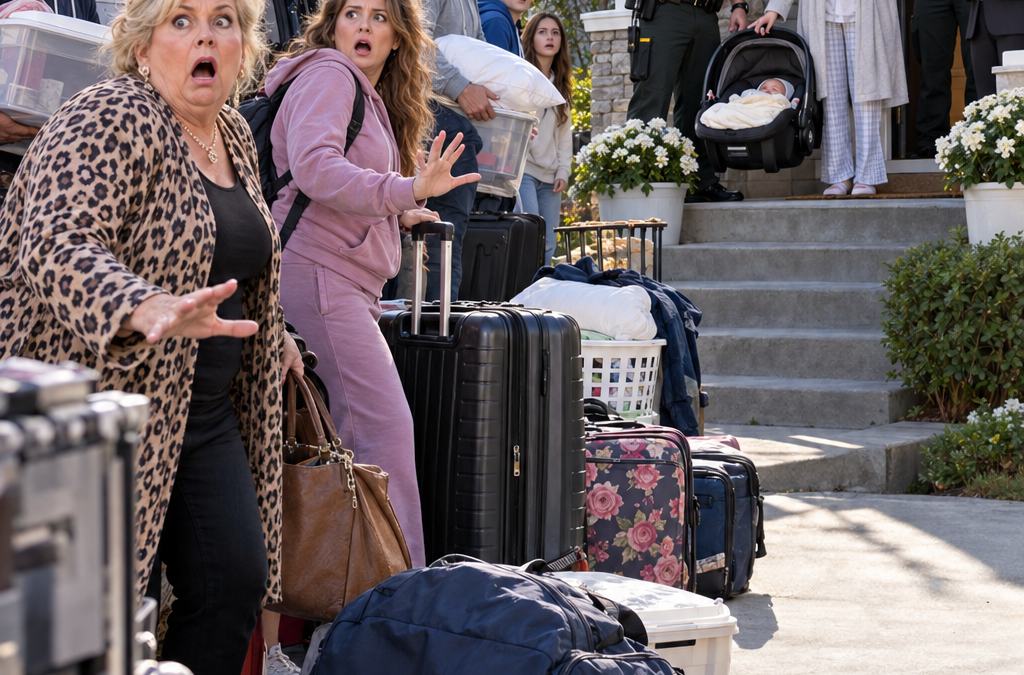
The Night I Brought My Newborn Home, Mom Called. “We’re Moving In Tomorrow. Your Sister’s Family Too—Seven Of Us. Don’t Like It? Leave.” I Looked At The Papers I’d Filed That Morning And Smiled. “Come Early.” They Pulled Up At Dawn. They Didn’t Know Who Was Waiting.
The night I brought my newborn daughter home, my mother called to tell me seven relatives were moving into the house the next morning and that my husband, my baby, and I could leave if we did not like it. I did not argue. I asked what time she planned to arrive. By sunrise, her moving trailer was climbing the hill—but my grandmother, whom my mother had quietly arranged to place in permanent care, was sitting on the porch with coffee, a lawyer, and one document my mother never expected to see.
Part 1
My name is Erin Walsh, and for most of my childhood, my greatest talent was making myself convenient. My older sister, Megan, needed piano lessons, dance uniforms, help with tuition, money for her wedding, and later help whenever her husband’s paycheck did not stretch far enough. I needed less, mostly because I learned early that asking for anything made my mother, Diane, look at me as if I had added another item to a grocery list she was already tired of carrying.
“You’re fine,” she would tell me.
Eventually, those two words became my assigned role.
We lived in a small Iowa river town where strangers knew what truck you drove before they knew your last name, and my mother understood reputation better than anyone. At Grace Lutheran, Diane Walsh was the woman who organized funeral meals, remembered widows’ birthdays, and slipped twenty-dollar bills into fundraising envelopes when people were watching. People called her generous, which was technically true, but generosity in our family always came with bookkeeping nobody else could see.
My grandmother Ruth lived alone in a white farmhouse on a hill overlooking the river. Grandpa Samuel had died when I was twenty, and after that I began spending more time with her, partly because I loved her and partly because Grandma Ruth was the only person in my family who never seemed disappointed that I did not require rescuing. She did not praise people much; she believed praise should be used like good vanilla, sparingly enough that you could taste it when it appeared.
Every morning before sunrise, she made coffee in an old stainless-steel percolator and worked the crossword at the kitchen table.
There were always two cups.
The second one originally belonged to my mother.
“Your mother used to come down before school,” Grandma told me once when I asked. “Five in the morning. Wouldn’t stop talking.”
“What happened?”
Grandma shrugged. “She stopped coming.”
She slid the untouched cup toward me.
I was fourteen. I drank coffee that tasted like burnt rope and pretended I liked it.
For the next thirteen years, I was the one who came in the morning.
By twenty-four, I worked for a small title company near the county courthouse, where my job involved studying deeds, liens, surveys, old mortgages, and the thousand quiet ways people misunderstood what they owned. My boss, Martin Hale, was a slow-talking attorney with suspenders, a bad knee, and a habit of setting documents on my desk without explanation because he believed people learned faster when forced to wonder what was wrong.
I became good at finding what was wrong.
That skill should have protected my family.
It did not.
Around the time I turned twenty-five, Grandma Ruth began forgetting things in the evening. She would ask where Grandpa was, confuse Tuesday with Sunday, or once call me by my mother’s name. But at five in the morning she remained herself—hair pinned up, newspaper folded, complaining about politicians and correcting my grammar before I finished my first cup.
My mother only visited Sunday evenings.
That mattered.
At six-thirty, when the western light came through the kitchen windows, Grandma was often tired and confused. Diane would stay thirty or forty minutes, then call me later.
“She didn’t know me again.”
I would say, “She was fine this morning.”
Mom would sigh.
“That isn’t how dementia works, Erin.”
I knew enough to know she was partly right. I also knew enough to notice she never came before breakfast.
Then my mother acquired power of attorney.
She brought the papers during one of Grandma’s bad evenings and explained that somebody needed authority to handle bills. Grandma signed. I was uneasy, but I told myself that legal authority was practical, that my mother was her daughter, and that suspicion was an ugly thing to carry into a family kitchen.
Months later, at my parents’ house, I saw Grandma’s checkbook sticking out of Mom’s purse.
The top check was payable to Megan.
$2,400.
Memo: temporary loan.
My grandmother’s signature had not been written by my grandmother. Diane had signed using her authority as agent.
I stared long enough for my father, Robert, to notice.
Dad had worked thirty-two years maintaining machinery at a meat-processing plant. He was not expressive, but he was observant; he could hear a bearing failing before anyone else knew the machine sounded different. He looked at the check, then at me.
For one moment I thought he would say something.
Instead, he walked back into the living room.
“Your sister’s behind on the SUV,” Mom said from the stove. “Grandma would want to help.”
I took a picture of the check.
Then I sat down and passed the potatoes.
That silence embarrassed me later.
At the time, it felt like survival.
The following summer, I married Caleb Sorensen, an HVAC technician who had first met Grandma while repairing the farmhouse furnace. He discovered her morning clarity by accident when he arrived shortly after five to finish a job before another service call.
Grandma gave him coffee before learning his name.
Twenty minutes later she asked him, “Are you going to marry Erin or am I wasting coffee on you?”
Caleb crawled out from beneath the floor register and looked at me.
“She seems pretty sharp.”
Nobody had ever said those words in front of me.
We married under the oak tree beside Grandma’s house.
During brunch, Grandma stood holding a coffee mug and gave the shortest wedding toast I have ever heard.
“I have two granddaughters,” she said. “This one comes in the morning.”
Then she sat down.
I did not understand how important that sentence was until years later.
When Grandma’s doctor eventually used the term sundowning, he explained what I had already witnessed: some people with cognitive decline function far better earlier in the day. Dr. Bennett told me he would trust Grandma with important decisions in the morning after proper evaluation, but not necessarily late in the afternoon.
I thought immediately about the power of attorney.
I did nothing.
That is the part of the story I wish I could rewrite.
Instead, life moved forward. I became pregnant. Megan’s husband, Scott, was laid off. My parents began talking vaguely about selling their house and “downsizing.” Fresh sheets appeared in two unused bedrooms at Grandma’s farmhouse.
I noticed everything.
I confronted nothing.
Then, when I was seven weeks pregnant, my mother arrived with another document.
She stood beside her running SUV in Grandma’s driveway holding a clipboard.
“It’s for respite care,” she said. “Just a family statement confirming Grandma shouldn’t be alone.”
I was sick, freezing, and late for work.
I signed without reading it.
Mom smiled.
“See? Easy.”
Eight months later, that signature came back into my life.
And by then, my mother had already sold her house.
Part 2
I found out about my parents’ sale at work.
Martin dropped a title file onto my desk one Tuesday morning and remained standing there, which was unusual enough to make me look up before opening it.
“What?” I asked.
“Read.”
The sellers were Robert and Diane Walsh.
Closing date: October 14.
I stared at my parents’ address.
Their house had been listed quietly, sold quickly, and was scheduled to change ownership the day before my baby’s due date.
Martin pulled out the chair beside my desk.
“You want Denise to handle it?”
“No.”
“You sure?”
“It’s a file.”
Martin watched me for another second.
“Files don’t have feelings.”
“I know.”
“Examiners do.”
Then he walked away.
I completed the title work professionally. No hidden lien. No disputed boundary. No judgment. My parents’ house was clean to sell, and on paper nothing about the transaction was my business.
At home, however, the timing bothered me.
By then Grandma Ruth had moved temporarily into Sunrise Harbor, an assisted-living facility about ten minutes outside town. My mother had arranged what she described as two weeks of respite care so I could deliver my baby without worrying about Grandma.
“You need rest,” she told me.
I had almost laughed.
At thirty-eight weeks pregnant, I had forgotten what rest was.
Still, two weeks seemed reasonable. I completed Grandma’s intake paperwork myself, listing my number as emergency contact because I was the person who knew her prescriptions, her doctors, and which mornings she would insist that institutional coffee violated basic human rights.
The morning I drove her there, Grandma was fully herself.
She carried her own overnight bag.
At the front desk she sniffed the air.
“That coffee has been punished.”
The receptionist laughed.
Grandma did not.
Before going inside, she turned to me.
“I’ll be home when you bring that baby back.”
I assumed she was comforting me.
Five days later, Sunrise Harbor called while I was at work.
The woman introduced herself as Patricia from the business office.
“Hi, Erin. I’m updating Ruth Bennett’s long-term residency file.”
I stopped typing.
“Her what?”
A pause.
“Long-term residency. Your mother completed the conversion request. Effective October fifteenth.”
My chair seemed to move underneath me.
“That’s not correct.”
“Oh.”
Keyboard clicking.
“Well, I have Diane listed as agent under power of attorney. She requested permanent placement when Ruth checked in.”
I grabbed a legal pad.
“When?”
“The fifteenth.”
Of course.
The day after my parents’ house closed.
The day my baby was due.
The day my parents would no longer have a home.
“What address did my mother give for herself after the fifteenth?”
More clicking.
Then Patricia read Grandma’s address.
The farmhouse.
I wrote everything down exactly as she said it.
Long-term placement.
Effective October 15.
Diane Walsh moving to Ruth Bennett residence.
Then Patricia mentioned the family statement supporting Grandma’s inability to live alone.
She emailed the paperwork.
My signature appeared at the bottom.
The document I had signed against my mother’s SUV eight months earlier had never been merely for temporary respite care. It was a broad statement declaring Grandma unsafe to live independently.
I sat staring at my own name.
I had helped build my mother’s case.
Across the office, someone laughed near the copier. A phone rang twice. Martin closed a file cabinet.
The ordinary sounds of work made the discovery worse.
I walked into Martin’s office and shut the door.
“I need you to represent Grandma.”
He leaned back.
“What happened?”
I told him about the sale, the permanent-placement form, the power of attorney, the check to Megan, and the strange conversations about bedrooms.
Martin did not interrupt.
When I finished, he asked, “What do you want?”
“I want Grandma to decide.”
“Good answer.”
“I want Dr. Bennett there when she decides.”
“Better answer.”
“And I don’t want to be in the room while you advise her.”
Martin nodded.
“Best answer.”
The next morning at five-thirty, we met at Sunrise Harbor.
Dr. Bennett arrived shortly after six.
Grandma Ruth was awake in a cardigan, solving yesterday’s crossword beside the window.
She looked at Martin.
“You did Samuel’s will.”
“Yes, ma’am.”
“You charged too much.”
Martin smiled.
“Probably.”
Dr. Bennett spent almost an hour evaluating her. Date. Location. Names. Recent events. Memory questions. Calculations. Judgment questions.
She knew my due date.
She knew Megan’s children’s names.
She knew who had won Sunday’s football game and complained that the quarterback was overpaid.
Finally Dr. Bennett looked at Martin.
“This is the Ruth I’ve been telling you about.”
Martin explained the power of attorney.
Grandma listened.
Then he explained the permanent placement arranged by my mother.
Her expression changed.
“She means to keep me here?”
“That appears to be the arrangement.”
“And live in my house?”
“Yes.”
Grandma stared out the window.
For a long moment, nobody spoke.
Then she asked the question that changed everything.
“If I die while I’m here, what happens to my house?”
Martin opened the copy of her old estate plan.
“Under your current documents, Diane ultimately controls most of the estate.”
Grandma nodded slowly.
“Then change it.”
Martin glanced toward me.
I stood.
“I’ll wait outside.”
Grandma reached for my wrist.
“Sit down.”
“I shouldn’t.”
“Why?”
“Because whatever you do has to be your decision.”
Her eyes softened.
“Kiddo.”
That one word nearly broke me.
Martin gently insisted I wait in the hallway anyway.
Two nurses witnessed the consultation. Dr. Bennett documented Grandma’s cognitive clarity that morning. Martin spoke with her privately about alternatives—not just leaving everything to me, but trustees, charitable gifts, equal distribution, life estates, and independent fiduciaries.
When I was invited back, Grandma had decided.
She revoked Diane’s power of attorney.
She appointed an independent professional as financial agent, with me as health-care backup.
Most importantly, she executed a deed preserving her lifetime right to live in the farmhouse and transferring ownership after her death to me.
Not because I asked.
Because she chose.
Before signing, she read every line.
When she reached the life-estate provision, she tapped the page.
“So I stay in my house until I’m finished.”
“Yes,” Martin said.
“And then Erin gets it.”
“Yes.”
Grandma signed.
Her hand did not shake.
Then she looked at me.
“You came in the morning.”
I lowered my face because suddenly I was crying.
“You always came in the morning,” she repeated.
Martin filed everything at the courthouse three days later.
I deliberately asked him not to do it immediately.
That decision has bothered me more than almost anything else.
I knew my mother had built her plans around October fifteenth. I also knew that if she discovered the new filing too early, she would tell everyone a different version before Grandma could speak for herself.
So I waited.
Then my daughter decided she was finished waiting for everybody.
My water broke three days before the due date.
By Wednesday morning, Clara Sorensen entered the world screaming as if personally offended by gravity.
Mom visited the hospital for twenty-three minutes.
She held Clara for less than one.
Her first real question was, “When are they releasing you?”
I answered, “Friday.”
Mom nodded.
Later, I realized she had asked the same question twice.
She needed to know whether I would be back at the farmhouse by Saturday.
Because Saturday was moving day.
Friday morning, from my hospital bed, I texted Martin.
File it.
An hour later he sent me a photograph of the courthouse stamp.
Recorded.
I stared at the purple ink while Clara slept beside me.
Something in my chest finally loosened.
My mother still thought she owned Saturday.
She had no idea Friday had changed everything.
Part 3
We brought Clara home shortly after noon.
The farmhouse smelled wrong.
Without Grandma there, nobody had made coffee for nearly two weeks, and the kitchen carried the stale chill of a place waiting for somebody to return.
Caleb placed Clara’s carrier on the kitchen table as carefully as if he were transporting explosives.
“You okay?”
“No.”
“Need anything?”
“About six hours of sleep and a different pelvis.”
He smiled.
That helped.
Martin had dropped off a manila envelope containing certified copies of the new documents. It sat in the middle of Grandma’s kitchen table underneath the hanging light.
I kept looking at it.
I did not open it.
We fed Clara. Caleb heated soup. I sat in Grandma’s chair because every other seat hurt in some new way the hospital pamphlets had failed to mention.
At nine-fifteen, my phone rang.
Mom.
I already knew.
I answered.
She did not say hello.
“We’re moving in tomorrow.”
Packing tape screeched somewhere behind her.
My hand tightened around the phone.
“Megan and Scott too,” she continued. “The kids will take the room over the porch. Megan and Scott can use the rear bedroom. Your dad and I will take the downstairs room.”
Grandma’s room.
Mom kept speaking.
“We’ve got most things boxed. Scott rented a trailer. We’ll be there around seven.”
I waited.
She finally seemed to notice my silence.
“This is temporary until everybody gets settled.”
“What about Grandma?”
Another stretch of packing tape.
“Erin.”
Just my name.
“She’s staying at Sunrise. She needs care.”
“Her respite ends Monday.”
“We changed the arrangement.”
We.
Not Grandma.
“We?”
“You know what I mean.”
From the living room, Clara made a tiny squeaking sound.
Mom did not ask about her.
Instead she said, “Caleb’s parents have that big place outside Eddyville.”
I almost admired the efficiency of it.
She had assigned us somewhere else to live without speaking to Caleb’s parents.
“You’ll be fine,” she said.
There it was.
The sentence of my childhood.
“You’re always fine.”
I looked at the envelope.
Then I asked, “What if we don’t want to leave?”
Mom became quiet.
Not hurt.
Annoyed.
“Erin, I have six people depending on me.”
“Seven, counting you.”
She exhaled.
“This isn’t the time to be difficult.”
Clara made another sound.
I could hear my pulse in my ears.
Mom’s voice hardened.
“Don’t like it? Leave.”
Something extraordinary happened then.
I smiled.
Not because I had won.
Not because the documents existed.
I smiled because for the first time I heard my mother without translating her.
There was no hidden affection underneath the sentence.
No complicated maternal intention.
No misunderstanding.
She needed the house.
She did not need me.
Those were separate facts.
For twenty-seven years, I had confused them.
“What time?” I asked.
“What?”
“What time are you coming?”
“Seven.”
“Come early.”
Silence.
My mother, who always had another sentence ready, had nothing.
Finally she said, “Fine.”
The call ended.
Caleb was standing in the doorway.
“How much did you hear?”
“Enough.”
I put the phone down.
“She told us to leave.”
Caleb glanced at the envelope.
“Do you want me to call Martin?”
“No.”
“Police?”
“No.”
“Your sister?”
“No.”
He waited.
I looked toward the dark window over the sink, where I could see my reflection holding my hospital bracelet against Grandma’s table.
“I need you awake before four.”
Caleb nodded.
That was one reason I married him.
He knew the difference between questions that helped and questions that merely delayed action.
That night, Clara woke every two hours.
Between feedings I replayed pieces of my life I had spent years minimizing: the wedding money that replaced my college savings, Grandma’s checkbook in Mom’s purse, Dad looking at the floor, the clipboard, the fresh sheets upstairs, the secretly sold house, the permanent-placement form.
Individually, each event had been explainable.
Together, they formed a pattern.
My mother did not improvise crises.
She built systems in which everybody else’s cooperation became inevitable.
Megan needed financial rescue.
Dad avoided conflict.
Grandma became confused at night.
I made room.
Mom had found a use for every weakness in the family.
Around two in the morning, Clara fell asleep against my chest.
I looked down at her tiny fist curled around my gown.
I thought about everything I had wanted from my mother.
I wanted her to stay at the hospital longer.
I wanted her to hold Clara like a baby instead of an obligation.
I wanted one phone call that began with “How are you?”
For years, those wants had felt reasonable enough to keep carrying.
At two-ten in the morning, I finally set them down.
Caleb slept on the floor beside the bassinet.
The farmhouse was silent except for the refrigerator.
This was my family.
Not the family I had spent years auditioning for.
The one sleeping badly in the next room.
At three-forty, Caleb got dressed.
“You sure?”
“Yes.”
He kissed Clara’s forehead.
Then mine.
“See you soon.”
His truck rolled down the hill in darkness.
I fed Clara again and walked the living room with her until she settled.
At four-fifty, I turned on the porch light.
Mom had always turned it off.
“Waste of electricity,” she used to say.
I left it burning.
Shortly after five, headlights climbed the hill.
Caleb’s truck stopped in front of the house.
He got out.
Then he opened the passenger door.
Grandma Ruth stepped onto the gravel wearing a wool coat over her nightgown, purse hooked over one arm.
She looked at me.
Then the porch light.
Then the house.
“Where’s my coffee pot?”
I laughed so hard my stitches hurt.
Grandma climbed the steps on her own.
Within five minutes the percolator was rattling.
Caleb explained that Sunrise had called Diane as the listed former responsible party before releasing Grandma.
“She didn’t answer.”
Grandma snorted.
“Diane hasn’t answered a telephone before nine in thirty years.”
The nurse had reviewed Dr. Bennett’s report and Grandma’s updated authority documents.
Grandma had signed herself out.
“I checked into respite care,” she said. “I wasn’t arrested.”
Then she went to Clara’s bassinet.
She stared down for a long time.
“That’s Samuel’s nose.”
“It is not.”
“It is.”
“Samuel was eighty when you showed me pictures.”
“He had a nose before that.”
Grandma washed her hands.
When she finally held Clara, her arms were completely steady.
Then she made two cups of coffee.
One for herself.
One for me.
We carried them outside.
By six-thirty, the neighborhood was waking.
At six-forty-two, a car towing a moving trailer turned onto the hill.
Grandma lifted her cup.
“They’re early.”
I looked toward the road.
“Mom likes schedules.”
Grandma took one slow sip.
“So do funerals.”
I stared at her.
“What?”
“Nothing, kiddo.”
Then my mother’s Buick entered the driveway.
And behind it came the trailer carrying everything she owned.
Part 4
My mother stepped out wearing a navy coat and the expression she used when arriving at church with a casserole.
Across the street, Mrs. Parker was walking her terrier. Mom noticed her immediately and waved.
“Morning, Elaine.”
Mrs. Parker did not wave back.
She was staring at our porch.
Mom followed her gaze.
Grandma Ruth sat beneath the porch light, wrapped in a blanket, coffee in hand.
The second cup rested beside her.
My mother stopped halfway up the walk.
For the first time that morning, confidence left her face.
“Mom?”
Grandma took another sip.
“You’re early, Diane.”
Megan climbed out of Scott’s truck holding their youngest son.
“Do we start unloading?”
Mom did not answer.
She walked toward Grandma.
“What are you doing here?”
“Drinking coffee.”
“You’re supposed to be at Sunrise.”
“I changed my mind.”
Mom’s eyes moved toward me.
“Erin, why did you bring her here?”
Before I could answer, Grandma said, “They called you before five.”
Mom blinked.
“What?”
“Sunrise. They called.”
Mom automatically reached for her phone.
The missed call was there.
Everyone saw the second she found it.
Then her church smile returned.
“She gets confused,” she said loudly enough for the driveway. “Especially in the mornings.”
I almost laughed.
Grandma’s eyebrows rose.
“Mornings?”
Mom stepped toward her.
“Come inside. You’re cold.”
“I know what day it is.”
“Mom—”
“October fifteenth.”
Scott lowered the box he was carrying.
Grandma continued.
“It’s Saturday. The Hawkeyes play at eleven. Your oldest grandson hates peas. Your son-in-law owes me twenty dollars from gin rummy.”
Scott cleared his throat.
“Twenty-five.”
Grandma pointed at him.
“See?”
Megan looked at me.
“What is happening?”
Mom reached toward Grandma’s arm.
That was when I moved.
“Don’t touch her.”
The words came out louder than I expected.
Mom froze.
I stepped onto the porch holding the envelope.
For several seconds, nobody moved.
Then I looked at Megan.
“Put the kids back in the truck.”
“Erin—”
“This isn’t for them.”
Something in my voice convinced her.
She guided the children back toward the vehicle.
Dad remained beside the trailer holding a cardboard box marked KITCHEN.
He stared at the ground.
I hated how familiar that posture looked.
“On Tuesday,” I said, “Grandma revoked your power of attorney.”
Mom stared at me.
“She couldn’t.”
“She did.”
“She isn’t competent.”
“Dr. Bennett examined her at six that morning.”
Mom’s face went pale.
I continued.
“Martin Hale represented her. I wasn’t present during their private consultation. Two nurses witnessed the execution. Dr. Bennett documented her capacity. The revocation was filed.”
Mom’s eyes dropped to the envelope.
“What else?”
She already knew there was more.
“Grandma changed the deed.”
Megan returned alone.
“What deed?”
“The farmhouse.”
Mom turned to her.
“Megan, stay out of this.”
“No.”
That single syllable sounded unfamiliar coming from my sister.
I removed a certified copy.
“Grandma retains the right to live here for the rest of her life. After that, the property transfers to me.”
Megan stared.
Mom laughed once.
It was not amusement.
“You manipulated her.”
“No.”
“You work with these people.”
“Yes.”
“You knew exactly what to do.”
“Yes.”
She seized on that.
“There. You admit it.”
“I knew exactly how to make sure she had an independent attorney, a medical evaluation, witnesses, and a private conversation without me in the room.”
Mom’s mouth tightened.
“She doesn’t know what she’s signing.”
A truck climbed the road behind them.
Martin parked at the curb and got out slowly.
He had promised to come only if necessary.
Apparently Grandma had texted him.
I looked at her.
She smiled into her coffee.
Martin approached the porch.
“Morning, Diane.”
Mom stared.
“You helped her do this?”
“I represented your mother.”
“She doesn’t know where she is.”
Martin removed his glasses.
“She knew exactly where she was during my consultation.”
“That proves nothing.”
Grandma stood.
Nobody offered to help.
She looked toward Megan.
“Megan Louise Walsh, born during the January ice storm. Your father missed the first twenty minutes because he parked on the wrong side of Mercy Hospital.”
Dad looked up.
Grandma pointed toward Scott.
“You married him at St. Mark’s. He cried harder than you did.”
Scott nodded carefully.
“Yes, ma’am.”
She looked at my mother.
“Diane Margaret Bennett Walsh. Born upstairs in the room over this porch. Seven pounds eleven ounces. Screamed until the nurse gave you back to me because your own mother was exhausted.”
Mom’s lips parted.
Grandma stepped closer.
“You told Sunrise I was staying permanently.”
Mom’s gaze flickered toward me.
Grandma noticed.
“You told them your new address would be this house.”
Megan’s head turned sharply.
“What?”
Mom looked at her.
“It was temporary.”
“You said Grandma wanted us here.”
“She needs help.”
“You said Erin agreed.”
That sentence hit harder than anything Mom had said.
Megan looked at me.
“You agreed, right?”
“No.”
Megan’s face collapsed slightly.
“You said Erin and Caleb were going to his parents’ place.”
Mom snapped, “Because that’s what makes sense.”
Megan stepped backward.
“You said she wanted space after the baby.”
“I was trying to keep everybody calm.”
“You told me not to call her.”
“Megan—”
“You told me she was hormonal and making everything difficult.”
Scott set his box on the grass.
Dad finally set his down too.
Grandma watched my mother.
“You planned this for months.”
Mom’s voice sharpened.
“Somebody had to plan something.”
There it was.
Not denial.
Justification.
“You weren’t safe alone.”
“I wasn’t alone.”
“Erin had a baby coming.”
“And that gave you my house?”
“You weren’t using half of it.”
Grandma looked at her for a long time.
Then she said something I will remember until I die.
“A house is not leftovers, Diane.”
Nobody spoke.
Mom’s face changed.
The polished expression disappeared.
Underneath was exhaustion.
Fear.
And anger.
“The new owners get our keys this afternoon,” she said. “We have nowhere to go.”
“I know,” I answered.
She stared at me.
“What?”
“I’ve known since August.”
That hurt her.
Not because I had betrayed her.
Because for once, information had existed outside her control.
Dad looked from me to Mom.
“August?”
She turned on him.
“Robert, not now.”
He shook his head.
“No. I think maybe now.”
Mom looked almost offended.
Dad pointed toward the trailer.
“You told me Ruth agreed.”
“I said it was handled.”
“That isn’t the same thing.”
Grandma sat down again.
Mom looked at me.
“You’d put your own parents on the street?”
I held out my hand.
“No.”
She glanced at it.
“I’m preventing you from putting Grandma out of her home.”
“Erin.”
“The spare key.”
Her fingers tightened around the key in her coat pocket.
Dad spoke quietly.
“Diane.”
She looked at him.
“Give her the key.”
Slowly, Mom placed it in my palm.
It was warm.
I closed my fingers around it.
Then I repeated the sentence she had given me the night before.
“This house already has people living in it.”
She knew what came next.
Her eyes narrowed.
I said it anyway.
“Don’t like it? Leave.”
Behind her, Scott started the truck.
The trailer began backing down the hill.
Part 5
My mother did not leave immediately.
That would have been easier.
She stood beside the Buick watching Scott reverse the trailer while Megan stared through the passenger window with both hands over her mouth. Dad remained near the porch steps, looking smaller than I had ever seen him.
Grandma turned to Caleb.
“Bring me that baby.”
The tension broke so suddenly that I almost laughed.
Caleb came outside carrying Clara.
Grandma held out both hands.
When Clara settled into her arms, morning light finally cleared the trees beyond the river.
My mother watched.
For one second, I thought she might cry.
Then she opened her car door.
“Robert.”
Dad did not move.
“Robert.”
He looked toward Grandma.
“I’m sorry, Ruth.”
Grandma adjusted Clara’s blanket.
“You knew.”
Dad flinched.
“Yes.”
“You always know after.”
That sentence landed somewhere deeper than shouting could have.
Dad walked toward the car.
By eight-thirty, my parents were gone.
Martin stayed for coffee.
Mrs. Parker eventually completed her dog walk, though I am certain the dog had forgotten why they were outside.
Small towns distribute information faster than internet connections. By lunchtime, half the congregation probably knew Diane Walsh had arrived with a moving trailer and left without unloading a single box.
I did not tell anyone.
I did not need to.
My parents rented a two-bedroom duplex near the highway.
Megan and Scott moved temporarily into an apartment owned by the church for families experiencing financial hardship. The irony was painful enough that I tried not to enjoy it.
For the first week, nobody called.
Then Dad phoned Sunday night at nine-fourteen.
I watched the screen.
For most of my life, I would have answered before the second ring.
This time I let it stop.
Caleb looked over from the couch.
“You okay?”
“Yes.”
And I was.
That surprised me.
Grandma resumed her morning routine immediately.
At five, coffee.
At five-ten, crossword.
At five-thirty, criticism of whoever had written the crossword.
She napped more than before and sometimes became disoriented after sunset, but the difference was that nobody used those evenings to redefine her mornings anymore.
We also changed practical things.
Martin arranged an independent financial manager.
I reviewed every bank record from the years Mom had controlled Grandma’s accounts.
What we found was not spectacular enough for a television crime show.
It was worse in a quieter way.
Checks to Megan.
Payments on my parents’ property taxes.
A refrigerator for my sister.
Repairs to Dad’s truck.
Cash withdrawals described as “family expenses.”
Nothing individually enormous.
Together, more than thirty-eight thousand dollars.
When Martin asked Grandma whether she wanted to pursue recovery, she became very still.
“Did Megan know?”
“Not always,” I said.
“What does that mean?”
“Some checks were clearly requested by her. Others were paid directly by Mom.”
Grandma tapped her pencil against the table.
“And Robert?”
“He benefited too.”
She looked tired.
“Everybody ate from the same plate.”
Eventually, Grandma authorized Martin to demand an accounting from my mother.
That action, more than losing access to the house, finally broke Mom’s control over the story.
She could explain a family disagreement.
She could explain an ungrateful daughter.
She could not easily explain financial records.
Mom hired an attorney.
Through him, she argued that every expenditure had benefited Grandma by supporting close relatives who might otherwise have needed Grandma’s help later.
Martin read that sentence aloud in his office.
Then he removed his glasses.
“That is creative.”
“Is it legal?”
“No.”
Grandma chose not to sue for every dollar.
She wanted repayment of the largest undocumented transfers and a signed settlement confirming Mom had no claim against the house or Grandma’s estate.
“Why not take everything back?” I asked.
Grandma looked at me.
“Because I want to spend my remaining years drinking coffee, not giving depositions.”
That was Grandma.
She did not confuse vengeance with victory.
Mom eventually agreed.
The settlement required her to repay $18,000 over three years.
Megan was stunned when she learned how much money had moved through Grandma’s account.
“I knew she helped us,” she told me on the phone. “I didn’t know it was like this.”
I believed her partly.
Not completely.
That distinction mattered.
Three Saturdays after moving day, someone knocked at seven in the morning.
Megan stood outside holding an apple pie wrapped in a dish towel.
No husband.
No children.
No moving boxes.
“I need to say something before I lose my nerve.”
I waited.
“I didn’t know Sunrise was permanent.”
She swallowed.
“I didn’t know Mom had already sold their house until two weeks before the move. She told me Grandma wanted everybody together and you were staying with Caleb’s parents because you needed help with the baby.”
“You never called.”
“I know.”
“You were going to move into the house without calling me.”
“I know.”
“You accepted that explanation because it was convenient.”
Her eyes filled.
“I know.”
That answer was better than an excuse.
Megan looked past me toward the kitchen.
“I don’t think I’ve ever seen Grandma in the morning.”
From behind me came Grandma’s voice.
“You going to stand there letting the heat out all day?”
Megan laughed through tears.
I stepped aside.
She entered.
Grandma did not hug her.
She pulled a third mug from the cupboard.
The chipped green one.
She poured coffee.
Megan sat across from her.
For several minutes, nobody talked.
Then Grandma pushed the crossword toward Megan.
“Seven letters. Means somebody who believes everything her mother tells her.”
Megan stared at the boxes.
“That is not seven letters.”
Grandma smiled.
“Good. You’re awake.”
I cut the pie.
That was not forgiveness.
It was breakfast.
Sometimes those are different things.
Through the front window, I noticed a car parked near the curb.
My mother’s Buick.
Engine running.
She remained behind the wheel.
Megan saw it too.
Neither of us went outside.
Mom waited eleven minutes.
Then drove away.
Part 6
My mother’s repayment checks began arriving every month.
They were always exact.
Five hundred dollars.
No note.
No apology.
The envelopes were addressed in Dad’s handwriting.
For the first year, that was the only regular contact.
Dad occasionally called during daylight after learning I no longer answered late-night family emergencies. Most conversations were short.
“How’s Clara?”
“Good.”
“How’s Ruth?”
“Good this morning.”
He always went quiet when I added those last two words.
One afternoon he asked whether he could visit Grandma.
“That’s her decision.”
“Can you ask?”
“No.”
Another silence.
“I understand.”
It was the first time in my life he had said those words without expecting me to fix the problem afterward.
He eventually came one Saturday at six-thirty in the morning.
Grandma made him coffee.
They sat on the porch.
I stayed inside with Clara.
Their conversation lasted almost two hours.
Dad cried once.
I know because I saw him wipe his face through the window.
When he left, I asked Grandma how it went.
She folded the crossword.
“He apologized.”
“Did you forgive him?”
She looked annoyed.
“Why does everybody think those things happen at the same time?”
I laughed.
“I don’t know.”
“He was sorry. I believe him.”
She paused.
“That’s enough for today.”
Mom did not come.
For months, I wondered whether she believed she was the victim.
Then Martin forwarded a letter from her attorney related to the financial settlement.
Mom had written a personal statement, apparently hoping it would reduce tension.
She described herself as the only responsible adult in a family unwilling to make difficult decisions.
She wrote that Grandma’s cognitive decline had forced her to “take charge.”
She described Megan’s financial troubles as urgent.
She described my pregnancy as evidence I could no longer provide proper care.
She described the farmhouse as “underutilized housing.”
That phrase stayed with me.
Underutilized housing.
Not Grandma’s home.
Not the kitchen where she had been married.
Not the porch where Grandpa had taught us to shell peas.
An asset.
A solution.
A thing waiting to be assigned.
I finally understood that my mother had not awakened one morning and decided to steal a house.
The house was merely the largest example of something she had always done.
She saw people’s boundaries as wasted space.
If you had money, somebody needed it more.
If you had a spare room, somebody should occupy it.
If you had time, somebody should claim it.
If you had silence, she would fill it with her version of events.
And if you resisted, you were selfish because she had already decided the resource was communal.
That realization changed how I raised Clara.
Not dramatically.
In tiny ways.
When she was two and did not want to hug somebody, I did not make her.
When she was four and hated dance class, we stopped going.
When she was five and wanted the blue cup instead of the yellow one, I sometimes said no because the blue cup was dirty—but I never pretended she had not asked.
It sounds ridiculous.
It was not.
Being heard is built from very small bricks.
Grandma lived well for three more years.
Her evenings became harder.
Sometimes she asked where Grandpa was.
Sometimes she believed I was Diane.
Once she accused Caleb of stealing the furnace.
He handled that beautifully.
“Ma’am, I installed the furnace.”
“That’s how you know where it is.”
“Fair.”
At sunrise, she usually returned.
Those mornings became sacred without anybody naming them that.
Megan started visiting once or twice a month.
Her children came too, but only early.
They learned Grandma’s good hours.
They learned not to correct every mistake later in the day.
Megan and I did not return to being close immediately.
There was too much history.
But something more honest grew in place of the old arrangement.
She stopped asking me for money.
I stopped assuming every request contained manipulation.
Scott found steady work with a farm-equipment distributor.
They rented a small house.
Eventually they bought one.
My parents stayed married.
Dad visited separately.
Mom remained active at church.
She finished repaying Grandma.
Occasionally, somebody from town would mention how “difficult” the situation had been for her.
I learned to say, “I’m sure it was.”
Then stop.
I no longer defended myself to people committed to hearing the story differently.
The last time Mom tried to pull me into the old rhythm happened when Clara was almost three.
She called at nine-thirty on a Wednesday night.
I answered because I thought something might have happened to Dad.
Instead she said, “Your sister told me you’re having Thanksgiving at Ruth’s.”
“Yes.”
“Nobody invited us.”
“That’s correct.”
Silence.
Then the familiar tone.
“After everything I’ve done for this family.”
I looked around the living room.
Caleb was assembling a toy kitchen.
Clara was asleep.
Grandma was upstairs.
“I’m not discussing this tonight.”
“You always run away when things get uncomfortable.”
That almost made me smile.
For twenty-seven years, I had stayed precisely because things were uncomfortable.
“Goodnight, Mom.”
“Erin—”
I hung up.
My hands did not shake.
That mattered more than I can explain.
Thanksgiving morning, Grandma sat at the kitchen table while Megan peeled potatoes and Caleb argued with a turkey.
Dad came for dessert after asking Grandma directly.
There was one empty chair.
Nobody mentioned it.
At five the next morning, I found Grandma already awake.
Two cups waited on the table.
She pushed one toward me.
“You know what your problem is, kiddo?”
“Several things come to mind.”
“You spent half your life thinking leaving a chair empty is mean.”
I looked at the empty chair beside us.
Grandma picked up her pencil.
“Sometimes it just means nobody sitting there has earned breakfast.”
Part 7
Grandma’s final winter was unusually mild.
She complained about that.
“December is supposed to hurt,” she said. “Otherwise January gets arrogant.”
By February she was sleeping more.
Dr. Bennett told us her heart was weakening.
Nothing dramatic.
No sudden catastrophe.
Just an old body beginning to close departments one at a time.
Grandma understood enough in the mornings to know.
She asked Martin to visit once more.
He came at six.
They reviewed her will, accounts, funeral instructions, and a handwritten list titled THINGS PEOPLE WILL ARGUE ABOUT AFTER I’M DEAD.
The list included Grandpa’s watch, the oak dining table, three quilts, and a cast-iron skillet Megan apparently wanted.
“Why the skillet?” I asked.
Megan shrugged.
“It cooks better at her house.”
Grandma pointed her pencil.
“That’s the stove.”
She left the skillet to Megan anyway.
She left Dad Grandpa’s watch.
She left my mother a box.
That worried me.
“What’s in it?”
“None of your business.”
“Fair.”
After Grandma died, I learned it contained old photographs and the original recipe card for my mother’s favorite birthday cake.
Nothing valuable.
Everything personal.
There was also a note.
I never read it.
Mom never told me what it said.
Grandma died in March.
I woke at five-twenty and smelled coffee.
That was unusual because I normally started the pot by then.
I went downstairs.
The percolator was already running.
Grandma’s chair was empty.
Her pencil rested on the open crossword.
I knew before I climbed the stairs.
She had gone down sometime before five, made coffee, opened the paper, then returned to bed.
She died beneath the quilt she had owned since Grandpa was alive.
Caleb found me sitting beside her.
I was holding her hand.
“She made coffee,” I said.
He nodded.
“Of course she did.”
At the funeral, the church was full.
Grandma had outlived most of her closest friends but apparently collected people the way some women collect porcelain.
Nurses came.
Neighbors came.
Martin sat near the front.
Dr. Bennett came straight from his clinic wearing a tie I had never seen.
Megan and her family sat with us.
Dad sat one row behind.
Mom arrived alone.
She chose the back pew.
I noticed.
I did not move her forward.
I did not ask her to leave.
For years I had imagined what I would feel seeing her after Grandma died.
Triumph?
Anger?
Vindication?
Mostly I felt tired.
During the reception, Caleb’s mother, Joanne, found me beside the coffee urn.
“Can I tell you something?”
“Sure.”
“I cried at your wedding because of Ruth’s toast.”
I smiled faintly.
“The morning thing?”
“Yes.”
Joanne squeezed my hand.
“She wasn’t talking about coffee.”
“I know.”
“No,” Joanne said. “I don’t think you did then.”
She was right.
Grandma had not merely meant I arrived early.
She meant I showed up while she was still herself.
I met her where she was strongest instead of where she was easiest to control.
My mother had built her authority around Grandma’s worst hours.
I had built my relationship around her best ones.
That difference was the whole story.
After the funeral, Mom approached me outside.
She looked older.
Not dramatically.
Just accurately.
“Thank you for not making me leave.”
I almost said, “It wasn’t my funeral.”
Instead I waited.
Mom looked toward the cemetery.
“I know what you think of me.”
“I don’t think about you as much as you imagine.”
That surprised both of us.
She nodded slowly.
“I was trying to keep everyone together.”
“No. You were trying to arrange everyone.”
Her mouth tightened.
I continued before courage disappeared.
“Those aren’t the same thing.”
She looked at me.
For a moment, I saw the mother I had spent years wanting.
Not loving.
Not apologetic.
Just vulnerable.
“I didn’t know what else to do.”
“You could have asked.”
“I knew what everybody would say.”
“That’s why you didn’t ask.”
She looked away.
There it was.
The hidden engine beneath everything.
Not greed alone.
Not cruelty alone.
Control.
Mom believed needing permission was a flaw in a plan.
“Do you hate me?” she asked.
“No.”
That answer seemed to hurt worse.
“I’m not ready to have a relationship with you.”
“How long?”
“I don’t know.”
“Months?”
“I don’t know.”
“Years?”
“Mom.”
She stopped.
I looked toward the church entrance where Clara was chasing Megan’s youngest son around a maple tree.
“I spent my whole childhood making room before anybody asked me to. I’m not doing that anymore.”
She nodded.
Then she walked to her car.
We did not hug.
There was no dramatic reconciliation.
Sometimes love does not return because somebody finally becomes sad enough.
Grandma’s estate settled quietly.
The farmhouse became mine outright.
The first morning after Martin confirmed everything was complete, I sat at the kitchen table staring at the deed.
Caleb came downstairs.
“How does it feel to own the place?”
I looked around.
The chipped cabinets.
The faded linoleum.
The coffee stain Grandma had refused to let anyone sand out of the table.
“I don’t think I do.”
Caleb poured coffee.
“What?”
“I think I’m just the person whose name is on the paper now.”
He smiled.
“That sounds healthier.”
Years earlier, my mother had believed the paper gave her the house.
Grandma taught me the opposite.
A deed tells the county who owns the property.
It cannot tell you who belongs there.
Part 8
Six years have passed since Grandma died.
Clara is nine now.
She has Caleb’s eyes, my habit of noticing everything, and Grandma Ruth’s absolute conviction that professional baseball managers require her advice.
She also sits in Grandma’s chair.
The first time she did it, I almost told her to move.
Then I stopped myself.
The chair was not a shrine.
Grandma would have hated that.
So Clara sat there eating cereal and solving crossword clues far above her grade level.
“Six letters,” I said one morning. “Means stubborn.”
“Strong-willed.”
“That is ten letters.”
“Still counts emotionally.”
Grandma would have loved her.
Megan and I have become something I never expected.
Friends.
Not best friends.
Not the sentimental kind who pretend childhood wounds disappeared because everybody got older.
We disagree.
We remember certain events differently.
Sometimes she still becomes defensive when Mom’s name comes up.
Sometimes I become harsher than necessary.
But she learned to ask instead of assume.
I learned that rebuilding trust does not require pretending betrayal never happened.
Scott still has Grandma’s cast-iron skillet.
Apparently it cooks perfectly on their stove.
Dad eventually left Mom.
Not because of the farmhouse.
At least not directly.
He told me the morning on the porch changed the way he saw thirty years of silence.
“I kept calling it staying out of things,” he said. “Mostly I was letting her do things I didn’t want blamed on me.”
He moved into a small apartment near the river.
He has dinner with us twice a month.
He apologizes less now, which is actually an improvement because he has started doing things differently instead.
Mom still lives in town.
We speak occasionally.
Birthdays.
Emergencies.
Once in a while, coffee in a public place.
She has never offered the kind of apology people like to write into endings.
No grand confession.
No admission that she intended to steal Grandma’s final years.
She still describes the situation as something that “got out of hand.”
I stopped correcting her.
Forgiveness, I discovered, is not the same thing as access.
I do not carry active anger toward my mother.
I also do not hand her keys.
Those truths coexist comfortably now.
The farmhouse changed.
We replaced the roof.
Caleb finally retired the furnace he had been threatening to replace since before we married.
We refinished the upstairs room over the porch.
For years I could still picture the twin beds with fresh sheets my mother had prepared for Megan’s children before anybody told me they were coming.
Eventually Clara claimed the room as an art studio.
Paint now covers one corner of the floor.
I considered cleaning it.
Then I remembered Grandma’s coffee stain downstairs.
Some marks deserve to remain because they prove somebody actually lived there.
The old porch light is still beside the door.
Caleb offered to install a more efficient fixture.
I refused.
That light became ridiculous family mythology.
Whenever Megan leaves after dinner, she points at it.
“Waste of electricity.”
I tell her to get off my property.
She laughs.
Last October, on the anniversary of the morning my mother arrived with the trailer, I woke before five.
I had no particular reason.
The house was dark.
Caleb slept upstairs.
Clara had kicked off her blankets again.
I came down and filled the percolator.
Yes, I still use it.
It is inefficient, loud, and produces coffee that would get a café shut down in several states.
I love it.
While it heated, I opened the front door and turned on the porch light.
The sky beyond the river was completely black.
For a moment, I saw the porch as it had been that morning.
Grandma in her wool coat.
Mom frozen on the steps.
Megan standing in the yard.
Dad holding that box.
Martin’s truck at the curb.
Seven people who believed the future had already been assigned to them.
What stays with me now is not the confrontation.
It is the coffee.
Before anyone arrived, Grandma poured two cups.
One for herself.
One for me.
She did not pour one for my mother.
For years I thought that was punishment.
Now I think it was simply accuracy.
You cannot reserve a chair forever for somebody who refuses to come.
That lesson changed more than my relationship with Mom.
I stopped chasing friends who only called when they needed something.
I stopped saying yes at work because I was afraid competence meant permanent availability.
I stopped teaching Clara that kindness required surrender.
Kindness can include boundaries.
Love can include locked doors.
Family can include people you would never trust with a spare key.
At five-fifteen, footsteps sounded behind me.
Clara entered the kitchen wearing pajamas covered in tiny planets.
“Why are you up?”
“I smelled coffee.”
“You’re nine.”
“I didn’t say I wanted any.”
She climbed into Grandma’s chair.
I slid the crossword toward her.
She studied the first clue.
“Five letters. Means a place where you belong.”
I looked at the boxes.
“Home.”
She wrote it in.
Then she looked toward the empty chair across from us.
“Who sits there?”
The question caught me.
For decades, that chair had carried too much history.
It had belonged to my mother.
Then me.
Then anyone Grandma chose to welcome.
I poured my coffee.
“Whoever comes in the morning.”
Clara nodded as if that made complete sense.
Maybe it did.
Outside, the porch light remained on while dawn slowly erased it.
The farmhouse belongs to me now according to the county recorder.
But Grandma was right about something she never actually needed to say aloud.
Ownership is the least important thing a house can give you.
A real home is the place where nobody gets to erase you because your needs are inconvenient.
It is where a child learns that her chair is hers until she chooses to give it up.
It is where an old woman gets to remain herself during the hours when she still knows who she is.
It is where a husband sleeps beside a bassinet because his wife needs him close.
It is where a sister may return, but only after learning to knock.
And sometimes it is where a mother remains outside—not because revenge requires it, but because belonging cannot be demanded by the person who spent years treating everybody else’s life like space she was entitled to organize.
Clara finished another clue.
The percolator clicked.
I poured one cup for myself.
Then, without thinking, I reached for a second mug.
I set it across the table.
Not for my mother.
Not for Grandma.
Not for anybody specific.
Just because somewhere along the way, the second cup had stopped being about waiting for the person who never came.
It became an invitation for the people who did.
Clara looked at it.
“Who’s that one for?”
I smiled.
“We’ll see who shows up.”
Then we went back to the crossword while the sun came over the river, exactly on time.
THE END!