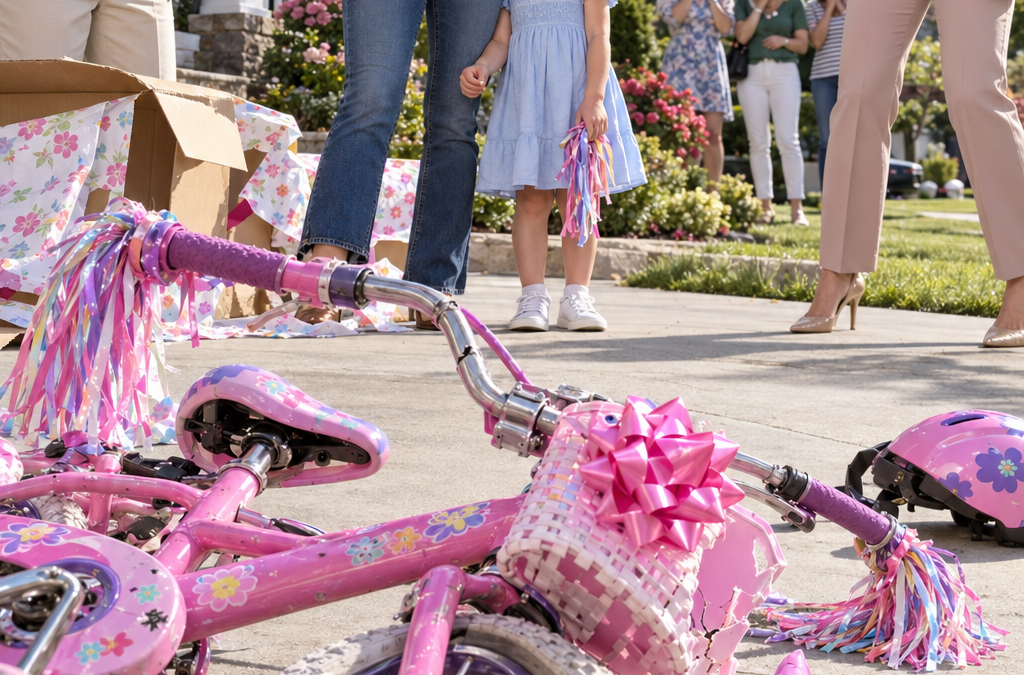
My Sister Smashed My 6-Year-Old Daughter’s New Bike With A Hammer, Right In Front Of Her Eyes. “That Should Be A Lesson For Her,” She Said. “You Shouldn’t Have Bought It For Her,” My Mom Added. I Didn’t Scream. I Just Smiled And Said One Sentence, And Their Faces Went Pale…
My sister took a hammer to a brand-new bicycle while my six-year-old daughter watched, and my mother calmly told me I had caused it. I didn’t yell. I told them who the bike actually belonged to, asked them to leave, and stopped paying the bills they had quietly made my responsibility for years. Three weeks later, after our family had chosen sides, my brother-in-law brought me a folder that explained why my sister had really been so desperate to make my daughter the villain.
Part 1
The first swing sounded worse than I expected. Metal doesn’t make the clean crack people imagine when it breaks; it groans, folds, and gives off a dull ringing sound that seems to hang in the air after the impact. My daughter Lily stood beside me in the driveway, her hands still raised from where she had been pointing out the silver streamers on the handlebars, and my younger sister Dana lifted the hammer again as if she were correcting a crooked nail instead of destroying a child’s bicycle. My mother, Helen, watched from beside the hydrangeas with her arms folded and said, “Maybe now she’ll learn.”
It was a bright Saturday afternoon in early May, warm enough that the neighborhood smelled like cut grass and charcoal grills. Ten minutes earlier, Lily had been bouncing through the kitchen because she thought the bike was hers, and I had let her believe it for the moment because Dana’s daughter, Sophie, had not arrived yet. The plan had been simple: Sophie would come over after lunch, Lily would roll the bicycle out from behind the garage, and we would surprise her together. Instead, Dana stared at the bike, decided what she thought it meant, walked through my unlocked back door, took a hammer from my husband Ben’s workbench, and came outside with a purpose that frightened me more than shouting would have.
“Dana,” I said after the second blow. My voice sounded strangely distant to me, the way your own voice does when you hear it on a recording. She swung again, catching the front wheel hard enough to bend the rim sideways, and Lily made a small sound behind me that I would remember much longer than the violence itself. It wasn’t a scream. It was the confused little breath of a child discovering that an adult she trusted could deliberately ruin something beautiful.
Dana lowered the hammer and looked directly at Lily. “That should be a lesson for you,” she said. “You don’t get rewarded after breaking someone else’s things.”
I understood then. Two weeks earlier, Sophie’s old bicycle had failed while the girls were riding near my mother’s house, and Dana had immediately blamed Lily because Lily happened to be standing beside it when the chain assembly collapsed. My mother had backed Dana before anyone examined the bike, just as she had backed Dana in nearly every argument we’d had since childhood, and although Ben later found an obvious manufacturing defect, neither woman had shown much interest in hearing that part. I had contacted the manufacturer myself, sent photographs, documented the defect, and persuaded them not only to replace the dangerous bicycle but to upgrade Sophie to the model she had been begging Dana for all spring.
I had planned to tell them that afternoon. I had the manufacturer’s email printed inside a folder on the kitchen counter, along with the replacement confirmation and a note I had helped Lily write for her cousin. For one foolish hour that morning, I had imagined Dana seeing the bike, realizing I had gone out of my way for her daughter, and understanding that Lily had never been responsible for the first bicycle breaking. I had even bought a silver bow.
My mother looked at me as if she expected an apology. “You shouldn’t have bought Lily a new one when Sophie’s is ruined,” she said. “You know how that looks.”
The old instinct arrived right on schedule. Explain yourself. Soften the room. Find the version of events that leaves Dana feeling protected, because if Dana is upset, everyone else must reorganize reality around her. I had spent most of my childhood doing exactly that, but I was forty-one now, standing in my own driveway with my own child trembling behind my leg, and something inside me went unexpectedly still.
I smiled.
Dana’s expression changed first. She knew my angry face, my tired face, my please-let-this-go face, but she had never seen me become calm while she was still expecting control. I looked at the twisted wheel, then at the little silver streamers trapped beneath it.
“That bike wasn’t for Lily,” I said. “It was for Sophie.”
The hammer slipped from Dana’s hand and hit the concrete.
My mother blinked. “What?”
“It was the replacement for Sophie’s defective bike,” I said. “I got the manufacturer to upgrade it because the defect could have hurt her. It arrived yesterday.”
Dana stared at the wreckage. The color drained from her face so quickly it was almost frightening.
“You’re lying.”
“No.”
“You bought that for Lily.”
“I didn’t.”
“You expect me to believe you bought my daughter a bike like that?”
“I don’t need you to believe me.” I nodded toward the house. “The email, shipping confirmation, and warranty paperwork are inside.”
My mother stepped forward. “Then this is just a misunderstanding.”
I looked at her. “A misunderstanding is bringing the wrong casserole to Thanksgiving. This was an adult woman taking a hammer to a bicycle in front of a six-year-old.”
Dana’s mouth tightened. “Don’t make this into something it isn’t.”
Lily’s fingers curled into the back of my shirt. That small movement finished whatever argument remained inside me.
“Leave,” I said.
Both women stared.
“Mara,” my mother said slowly, using the tone she had used when I was twelve and embarrassing her in public, “you are upset.”
“I’m actually not.”
“That’s ridiculous. Of course you are.”
“I’m done paying the price for Dana being upset.”
Ben appeared in the open garage doorway, wiping his hands on an old blue shop towel. He had been inside on a work call when the first blow landed, but his expression told me he had heard enough. He walked to my side, saw Lily’s face, then looked at Dana without raising his voice.
“Mara asked you to leave.”
My mother turned toward him. “Ben, talk some sense into your wife.”
“I think she’s making perfect sense.”
Dana’s shock hardened into anger. “Fine. Whatever. We’ll replace it.”
“No,” I said.
She gave a humorless laugh. “You just said it was Sophie’s.”
“It was. Before you destroyed it.”
“What do you want from me?”
“For you to leave my house.”
Dana looked from me to Ben, searching for the weak seam she could pry open. She had done that all her life—find the person most uncomfortable with conflict and make that discomfort work for her. But Ben opened the side gate and stood beside it without saying another word.
My mother tried one final time. “We’ll discuss this tomorrow.”
“There’s nothing to discuss tomorrow.”
“You don’t cut off family over a bicycle.”
I looked down at Lily.
“No,” I said. “You cut people off when they teach your child that love means standing still while someone hurts her.”
For the first time, my mother had no answer.
After they left, Lily stared at the mangled bicycle and whispered, “Mom, was Aunt Dana mad at me?”
I crouched until we were eye level. “She was angry, sweetheart. But being angry doesn’t make someone right.”
“Did I break Sophie’s other bike?”
“No.”
“Then why did she say I did?”
That question hurt more than the hammer.
“Because sometimes adults decide on a story before they know the truth.”
Lily considered this with the solemn seriousness six-year-olds bring to unfairness. Then she asked whether we could still get ice cream.
We did.
That evening, after Lily was asleep, I sat at our kitchen island with my laptop open and began removing my credit card from accounts I had been quietly paying for years: my mother’s electric bill, Dana’s cell phone, a grocery-delivery subscription, two streaming services, and the pharmacy account my mother had insisted was essential. I didn’t make an announcement. I didn’t send a warning.
I simply stopped.
At 9:17 p.m., my phone began vibrating.
Part 2
The first message came from my mother.
Your card was removed from the utility account. Fix it please.
The second came three minutes later.
Dana says her phone payment didn’t go through. What are you doing?
By ten o’clock, “please” had disappeared entirely. My mother called twice, Dana called four times, and then a family group chat I had muted months earlier began flashing across my screen with cousins and aunts asking whether everything was okay. Ben sat beside me on the couch reading a book he had stopped turning pages in twenty minutes earlier, and when my phone buzzed again, he reached over and flipped it face down.
“You don’t have to defend this tonight,” he said.
“I know.”
The strange thing was that I did know. For most of my life, knowing and acting had been separate things, like two towns connected by a road I was never quite brave enough to drive. I had known Dana was selfish, known my mother enabled her, known the money I sent had turned from help into expectation, but I kept telling myself that generosity was proof I had escaped the bitterness of our childhood.
When Dana was seven and I was nine, she threw my birthday cake onto the kitchen floor because my grandmother had bought me roller skates. My mother had made me apologize for “making Dana feel left out.” When we were teenagers, Dana borrowed my car without permission, scraped the passenger door against a concrete post, and cried until my mother convinced me not to tell our father because “she’s already upset enough.”
Those memories sounded ridiculous when listed one after another, which was probably why I had spent years avoiding the list.
By morning, the family group chat had a new version of what happened in my driveway. According to Dana, Lily had broken Sophie’s old bicycle, I had refused to replace it, then deliberately bought Lily the exact model Sophie wanted and displayed it when Dana came over. Dana admitted she had “lost her temper,” but the hammer had somehow become a momentary lapse after weeks of humiliation rather than an object she walked into my house to retrieve.
My mother added her own paragraph.
Mara has always had trouble understanding how her success affects other people. We love her, but sometimes she uses money to make people feel small.
I read it twice.
Ben looked over my shoulder. “That’s efficient.”
“What is?”
“She turned you paying their bills into evidence against you.”
I laughed once, but there was no humor in it.
A cousin named Rachel sent me a private message about an hour later. We hadn’t spoken in months.
I’m not taking sides, but is there another version of what happened?
I opened the security camera application on my phone.
We had installed cameras after three packages disappeared from our porch the previous Christmas. One faced the driveway. Until that morning, its most dramatic footage consisted of a raccoon dragging away an Amazon envelope and Ben chasing a trash can during a windstorm.
The Saturday recording was perfect.
Dana walked into frame empty-handed. Lily stood beside the bicycle talking. Dana left, disappeared into the garage, returned holding the hammer, and swung three times while my mother watched. The microphone even caught my mother saying, “Maybe now she’ll learn.”
I felt sick watching it.
Not vindicated. Sick.
Because Lily’s gasp sounded louder through headphones.
I downloaded the entire clip and posted it in the family group chat with one sentence.
That bicycle was the manufacturer’s replacement for Sophie. Dana destroyed her own daughter’s bike after blaming Lily for a defect the manufacturer confirmed.
Then I added screenshots of the replacement email.
I closed the app.
The explosion began almost immediately.
Rachel wrote, Oh my God.
My uncle Martin wrote, Helen, what on earth were you thinking?
Someone else asked whether Lily was okay. Another cousin simply posted, Dana???
My mother called.
I almost ignored it, but curiosity won.
“How could you post that?” she demanded.
No greeting. No denial.
“It happened.”
“That isn’t the point.”
“What is the point?”
“You humiliated your sister in front of the entire family.”
“She destroyed a child’s bicycle in front of the child.”
“You know Dana has been under stress.”
“So have air traffic controllers. They usually avoid hammers.”
“This isn’t funny.”
“I agree.”
My mother lowered her voice, which was always more dangerous than when she raised it. “You have always enjoyed being the reasonable one.”
The accusation caught me off guard.
“What does that mean?”
“It means you sit there with your education and your house and your calm voice and make everyone else look unstable.”
For a few seconds, I didn’t answer.
I had spent twenty years believing calmness was how I kept peace. Apparently, to my mother, calmness was another offense.
“What would you prefer?” I asked. “That I become unstable too?”
“I would prefer that you show some compassion.”
“For Dana?”
“For your family.”
“Lily is my family.”
She went quiet.
That silence told me more than anything she had said.
My mother eventually hung up after informing me that she “needed time to think about who I had become.” The sentence would once have ruined my week. Instead, I made pancakes with Lily and took her to a garden center where she picked purple petunias because she liked saying the word.
By Monday, the video had moved beyond the family chat.
Someone had screen-recorded it. A cousin forwarded it to a friend, the friend apparently shared it in a neighborhood Facebook group, and by lunchtime I was receiving messages from people I barely knew asking whether Dana had really smashed a bicycle intended for her own daughter.
Then Ryan called.
Dana’s husband and I had never been close. He was quiet, worked long hours managing a regional warehouse, and usually looked exhausted at family events even before anyone spoke to him. His name appeared on my screen at 4:32 p.m.
“Mara?”
“Hi, Ryan.”
“Is the video real?”
“Yes.”
A long breath came through the receiver.
“And the bike was for Sophie?”
“Yes.”
Another silence.
“I need to ask you something.”
His tone had changed.
“Okay.”
“How much money have you been giving Dana every month?”
The question felt unrelated enough that I almost laughed.
“What?”
“Please.”
I sat down.
“I don’t give Dana cash regularly. I pay a few things. Her phone. Sometimes groceries. Mom’s utilities. Medication.”
“How much?”
“I’d have to check.”
“Because Dana has been telling me you send your mother eighteen hundred dollars a month.”
I stared at the wall.
“I don’t.”
Ryan went quiet again.
Then he said, “That’s what I was afraid of.”
Part 3
Ryan came to my office the next afternoon carrying a gray accordion folder.
I worked for a mid-sized law firm in Richmond, mostly handling commercial contracts and risk disputes, and our conference rooms were designed to make people feel calm while discussing unpleasant things. Soft lighting, neutral walls, filtered water in glass bottles. Ryan sat across from me looking like he had not slept and pushed the folder across the table.
“I don’t know what belongs to what yet,” he said. “But I think you should see this.”
Inside were bank statements, credit card printouts, a handful of screenshots, and copies of transfers between accounts. Dana had not been receiving eighteen hundred dollars a month from me, but she had been telling Ryan that my financial support covered nearly that amount. The difference mattered because Ryan had been depositing money into an account Dana described as their “family emergency fund,” believing my contributions allowed them to save aggressively.
The account held less than three thousand dollars.
Ryan had expected nearly thirty thousand.
“Where did the money go?” I asked.
“That’s what I’m trying to figure out.”
He pointed to repeated payments made to a company called Northline Recovery Services. I recognized neither the company nor the amounts, but they appeared every month for almost two years. Four hundred here, seven hundred there, sometimes more.
“Collections?” I asked.
“Looks like it.”
“For what?”
He shook his head.
The next pages made my stomach tighten. Dana had also been sending money to my mother, not receiving it from her. Small transfers at first, then larger ones, usually within days of the payments Ryan thought were going into savings.
“You see why I’m confused?” he said.
I did.
Dana had spent years telling everyone I supported her because Ryan’s salary wasn’t enough. Ryan had apparently spent those same years believing my support allowed Dana to help my mother. Money moved in circles while each person heard a different explanation.
The hammer had not created the dishonesty.
It had cracked it open.
I leaned back in the chair. “Did you ask Dana?”
“She said it’s complicated.”
“That usually means yes.”
“She also said none of it matters because you’ll fix everything if it gets bad enough.”
That sentence landed in a place I wasn’t prepared for.
“What does that mean?”
“She said your mom has always told her that.”
I looked toward the window.
Traffic moved fourteen floors below us, normal people driving normal roads, and for one strange second I wanted to be any one of them.
Ryan rubbed his hands over his face. “Mara, did your parents ever have money set aside for you and Dana? College money? Inheritance? Anything like that?”
“My grandmother left us education accounts.”
His expression changed.
“How much?”
“I don’t know exactly. Mine covered part of college. Why?”
“Dana says you got hers.”
I stared at him.
“What?”
“She says your mom used Dana’s college account to help pay for your law school.”
“That didn’t happen.”
“You’re sure?”
“My law school was loans, scholarships, and misery.”
He almost smiled, but it disappeared quickly.
“Dana has been telling me since we got married that you became successful partly because the family sacrificed for you. She said that’s why you help financially now.”
I felt the old history rearranging itself inside my head.
My mother’s comments about obligation. Dana’s constant remarks that I “owed” the family. The way requests for money were never phrased as requests but corrections of some invisible imbalance.
I had assumed resentment came from simple jealousy.
What if Dana believed she had been robbed?
I called my father that evening.
My parents had divorced when I was twenty-eight, and my father, George, lived in Arizona with his second wife. He and I spoke every few months, politely, the way adults speak when both sides know they failed to build something closer.
He answered on the fourth ring.
“Mara? Everything okay?”
“I need to ask you about Grandma June’s education accounts.”
Silence.
That was enough.
“Dad?”
“What happened?”
“Just answer me.”
He sighed.
“Your grandmother left equal accounts.”
“I know.”
“No, I mean equal amounts. Same amount for each of you.”
“Okay.”
“Your mother was custodian while you were minors.”
My pulse began to beat harder.
“How much was in them?”
“At the beginning? Around forty-five thousand each.”
My throat tightened.
I had received roughly twenty-two thousand toward college.
“What happened to the rest?”
Another silence.
“Mara.”
“What happened?”
“Your mother borrowed against household money during the divorce years.”
“You were still married then.”
“We were having problems long before you knew.”
“That doesn’t answer me.”
“She used part of Dana’s account.”
“For me?”
“No.”
“Then for what?”
He exhaled slowly.
“For your mother’s business.”
I stood up from the kitchen table.
My mother had owned a home décor shop for four years when we were teenagers. She always described its failure as something my father caused by “refusing to believe in her.”
“How much?”
“Most of Dana’s account.”
I closed my eyes.
“And mine?”
“Some. Not as much.”
“Why did Dana think mine went to law school?”
“I don’t know.”
But I did.
My mother needed a story.
And she had chosen one where I was the beneficiary of Dana’s loss.
The next morning, I drove to the storage facility where I still kept two boxes of old college records. At the bottom of one, beneath tax forms and scholarship letters, I found a yellowed envelope from my grandmother’s estate attorney.
There were two statements inside.
Equal accounts.
Equal starting balances.
And a handwritten note from my grandmother addressed to my mother.
Helen, this money belongs to the girls. It is not yours to borrow.
I read the sentence three times.
Then I noticed something else.
Stapled behind the statement was a photocopy of a withdrawal authorization.
The signature at the bottom was my mother’s.
The listed purpose was not “business expenses.”
It said: Educational support for Mara Whitmore.
Part 4
For two days, I did nothing with the document.
That surprised Ben. He expected me to call my mother immediately, and under ordinary circumstances I probably would have. But I had spent enough time around contracts to know that the first explanation offered is rarely the whole explanation, especially when someone has had twenty years to rehearse it.
I requested archived records from the financial institution listed on the old statement.
Most documents that old had been purged, but the account had eventually been absorbed by a larger bank, and after several transfers and one patient employee who seemed to enjoy puzzles, I received copies of surviving transaction summaries. The records showed three large withdrawals from Dana’s education account during my senior year of high school and first year of college.
Every withdrawal listed me as the reason.
None of the money had gone to my school.
Instead, the funds had been deposited into a joint checking account held by my mother and a business entity called Willow & Pine Interiors.
My mother had written my name into the explanation field.
That detail bothered me more than the money.
She had not merely spent Dana’s education fund.
She had created paperwork that made it appear she spent it on me.
I called my father again.
“You knew.”
He didn’t deny it.
“I knew she used some of the money.”
“You knew my name was on the withdrawals?”
“No.”
“Did you ever ask?”
He was quiet.
“No.”
The answer was so ordinary that it hurt.
My father had not engineered the lie. He had simply been tired enough, angry enough, or detached enough to let my mother’s version become family history.
That afternoon, Ryan called again.
He had identified Northline Recovery Services. The payments were tied to a business debt in Dana’s name—a personal guarantee she had signed for a small online boutique she tried to start three years earlier.
I vaguely remembered the boutique. Dana sold children’s clothing for about nine months and then announced that online advertising costs had “made it impossible.”
Ryan had been told the business closed cleanly.
It had not.
Dana owed more than twenty-eight thousand dollars.
“Why didn’t she tell you?” I asked.
“I don’t know.”
“Yes, you do.”
He sighed.
“Because she thought I’d say no to more money.”
There it was.
The same family grammar.
No did not mean no.
No meant find another person.
Ryan had also found text messages between Dana and my mother discussing the debt. My mother repeatedly reassured her that I would eventually take care of it.
One message read: Mara always acts tough at first. Give her time.
Another said: If Sophie is involved, she’ll cave.
I had to stop reading.
My daughter’s name was not there, but I could suddenly see the mechanism clearly. Children, bills, health scares, guilt, old grievances—everything could become leverage if the goal was keeping me in the role my family had assigned.
Provider.
Fixer.
Villain whenever I stopped fixing.
Then Ryan showed me the message that tied the bicycle to something deeper.
Two days before Dana came to my house, my mother had written:
If Mara replaced Sophie’s bike herself, it proves she knows she owes you. Don’t let her turn it into some grand gesture for Lily.
Dana replied:
She always has to make Lily look better than Sophie.
My mother wrote:
Then stop letting her.
I stared at the screen.
“So she thought the replacement was for Lily before she even saw it,” I said.
Ryan nodded.
“And Mom encouraged her.”
“Yes.”
The hammer had not been spontaneous.
Maybe Dana had not planned specifically to destroy anything, but she had arrived expecting evidence for a story my mother had already helped write: Mara favors her own daughter, flaunts money, humiliates Dana, owes the family for old sacrifices.
The bicycle simply gave resentment something solid to hit.
I decided to confront my mother first.
Not at her house.
Not at mine.
I asked her to meet me at a quiet diner halfway between us on Thursday morning. She arrived twelve minutes late wearing sunglasses despite the cloudy weather and sat down as if granting me an audience.
“I hope this isn’t going to be another lecture,” she said.
I placed copies of the bank records on the table.
She did not touch them.
“What’s that?”
“Dana’s education account.”
Her face barely moved.
“What about it?”
“You withdrew money.”
“It was family money.”
“No. It was Dana’s.”
“You were children.”
“Grandma’s letter says otherwise.”
That made her look down.
I slid the withdrawal authorization forward.
Her expression finally changed.
“That’s old.”
“It has my name on it.”
“Mara—”
“You told Dana her college money paid for me.”
“I told her we all made sacrifices.”
“You wrote that the money was for my education when it went into your business account.”
People in nearby booths ate eggs and toast. A waitress poured coffee at the counter. The ordinary morning around us made the conversation feel even more unreal.
My mother lowered her voice.
“You have no idea what our finances were like then.”
“I understand being desperate.”
“No, you don’t.”
“I understand desperation. I don’t understand framing one daughter for money you took from the other.”
Her jaw tightened.
“I did not frame you.”
“What would you call it?”
“I was trying to hold the family together.”
“With Dana’s money.”
“With whatever resources we had.”
“And when the business failed?”
She looked toward the window.
“I was embarrassed.”
“So you let her believe I benefited.”
“She already resented you.”
The honesty of that sentence stunned me.
“So it was convenient.”
My mother’s eyes filled, but I did not feel the old reflex to rescue her.
“I made mistakes,” she said.
“You made a system.”
“That is cruel.”
“No. Cruel was teaching Dana that every disappointment in her life had my name on it.”
She stood abruptly.
“Your sister is falling apart.”
“Then help her without lying to her.”
“She could lose her marriage.”
“That would be because she lied to her husband.”
“She could lose custody time with Sophie.”
“That would be because she destroyed Sophie’s bicycle with a hammer in front of a child.”
“You always reduce everything to consequences.”
I looked at her.
“No, Mom. You spent my whole life removing consequences from Dana. I’m just refusing to carry them now.”
She grabbed her purse.
Before leaving, she said one last thing.
“You think this ends with you walking away?”
I thought it was a threat.
I was wrong.
It was a warning.
Part 5
Dana came to my office parking garage the following Monday.
I saw her leaning against my car before I reached it, arms folded, sunglasses pushed into her hair. She looked thinner than she had three weeks earlier, and for half a second I felt the familiar impulse to ask whether she had eaten.
Then she said, “You’ve been digging through my finances.”
The impulse vanished.
“Ryan showed me documents.”
“My documents.”
“Your husband’s documents too.”
“He had no right.”
“You lied to him.”
“That’s between us.”
“Then keep me out of the lies.”
She laughed sharply. “You’ve been in the middle of this since we were kids.”
I unlocked my car but didn’t open the door.
“I know what Mom did with your college account.”
Dana’s face changed.
“Good.”
“That money never paid for my law school.”
“Sure.”
“I have the records.”
“I don’t care about your paperwork.”
“You should.”
“Why? So you can prove you’re innocent again?”
The word again stopped me.
I looked at my sister—really looked at her—and realized she had spent decades experiencing my innocence as a threat. If I had not caused her disappointments, then someone else had. If I did not owe her, then all the things she had demanded from me became exactly what they were.
Demands.
“You believed it,” I said.
“That you got my money? Of course I believed it.”
“Why?”
“Because Mom told me.”
“And Dad?”
“Dad left.”
“He didn’t leave until we were adults.”
“He checked out long before that.”
She wasn’t wrong.
Dana stepped closer. “Do you know what it was like watching you go to college while Mom told me there wasn’t enough money? Watching you get internships and scholarships and then law school while I worked at a salon and everyone acted like I was lazy?”
“You dropped out after one semester.”
“Because I couldn’t afford it.”
“You could have applied for aid.”
“You always have an answer.”
“No, Dana. I have facts.”
“And facts are your weapon.”
I almost argued.
Then I stopped.
To Dana, facts probably did feel like weapons because our family had survived through stories. My mother created them, Dana believed them, my father avoided challenging them, and I kept paying money into them because generosity was easier than examining why everyone thought I owed a debt.
“I’m sorry Mom lied to you,” I said.
Dana looked startled.
“I’m sorry she spent your money. I’m sorry Dad didn’t protect it. And I’m sorry nobody told you the truth.”
Her eyes filled.
For one fragile second, I thought we might finally be talking as sisters instead of assigned roles.
Then she said, “So fix it.”
I felt something close quietly inside me.
“What?”
“You heard me.”
“Fix what?”
“The money.”
I stared at her.
“She took over forty thousand dollars from me.”
“Twenty years ago.”
“That doesn’t make it disappear.”
“No.”
“You’re a lawyer. You make more than all of us. You can afford to make this right.”
“Why would I make right something I didn’t do?”
“Because you benefited.”
“I didn’t.”
“You got the life I was supposed to have.”
There it was.
Not the account.
Not the bike.
My life itself had become stolen property in Dana’s mind.
“My marriage?” I asked. “My daughter? My career? Which part belongs to you?”
“Don’t twist my words.”
“I’m trying to understand them.”
“You always got everything.”
“No. I learned to stop expecting anyone else to rescue me.”
Dana flinched.
“That’s easy for you to say.”
“It wasn’t easy to do.”
She stepped back.
“You know what Sophie asked me yesterday?”
I waited.
“She asked why Aunt Mara doesn’t love us anymore.”
The manipulation was so familiar I almost admired its efficiency.
“Did you tell her I bought her a bicycle?”
Dana’s face hardened.
“That’s not the point.”
“It’s exactly the point.”
“You posted a video that humiliated her mother.”
“You humiliated yourself.”
“And now Ryan thinks I’m dangerous.”
“You took a hammer to a bicycle while a child stood beside it.”
“I would never hurt a child.”
“I believe you.”
That seemed to surprise her.
“But you wanted Lily scared,” I continued. “You wanted her to watch you destroy something because you thought fear would teach her a lesson.”
Dana said nothing.
“That matters.”
She looked away.
For the first time, I saw shame.
Not regret.
Shame.
There is a difference. Regret looks outward at harm. Shame looks inward at exposure.
She whispered, “Ryan wants me out of the house.”
I closed my eyes briefly.
“I’m sorry.”
“You did this.”
“No.”
“You posted the video.”
“You swung the hammer.”
Her mouth twisted.
“You’ve been waiting your whole life to say that.”
“No, Dana. I’ve been waiting my whole life for you to understand it.”
She left without another word.
Two weeks later, Ryan filed for a formal separation and requested temporary primary custody while Dana completed a court-ordered parenting assessment. He did not ask me to testify, and I did not volunteer, but the driveway video existed whether any of us wanted it to or not.
My mother blamed me publicly.
She told relatives I had “weaponized the legal system,” which was impressive considering I had not filed anything.
Then the consequences reached her too.
Without my credit card attached to her accounts and without Dana able to keep sending money, my mother missed two mortgage payments.
That was when my father called again.
“There’s something else,” he said.
I was beginning to hate those words.
“What?”
“When your mother’s business failed, the education accounts weren’t the only thing she used.”
My stomach tightened.
“What else?”
He paused.
“The house.”
“Her house?”
“The house she still lives in.”
“What about it?”
“She refinanced it years ago.”
“So?”
“So the loan wasn’t only in her name.”
I stopped breathing for a second.
“Whose name?”
He answered quietly.
“Yours.”
Part 6
I thought my father had to be mistaken.
I had never co-signed my mother’s mortgage. I had never sat in a bank office, never signed closing papers, never agreed to secure a loan against her home. Yet when I pulled my credit history, I found an old line of credit that had been opened when I was twenty-three.
I remembered it only after staring at the date.
My mother had asked me to sign “temporary paperwork” so she could consolidate household bills after the divorce became final. I was in my first year of law school, exhausted, living three states away, and I had signed documents she mailed to me without reading them carefully.
The irony was humiliating.
I had spent my career warning clients not to do exactly what I had done.
The line had later been modified into a secured home-equity arrangement tied to her property. My original signature had been carried through the restructuring because I remained listed as a co-borrower.
For almost eighteen years, my mother had made the payments.
Until now.
I called her lender and spent an afternoon being transferred between departments. By five o’clock, I understood the situation well enough to feel physically ill.
If my mother defaulted, my credit could be damaged.
Worse, the outstanding balance was far larger than I expected.
Nearly seventy thousand dollars.
Ben found me at the dining table with papers spread everywhere.
“How bad?”
“Bad enough.”
He sat across from me.
“Can you get out?”
“Maybe. Not cleanly.”
“What did the money pay for?”
“I don’t know yet.”
That answer lasted less than twenty-four hours.
My father still had a box of divorce records. He scanned several documents and emailed them to me, including old statements connected to the home-equity account.
Payments had gone to Willow & Pine Interiors.
Then to credit cards.
Then to Dana.
The pattern continued for years.
My mother had refinanced family debt, business losses, and Dana’s emergencies into one long chain, and my name had remained attached like a permanent financial safety net.
Suddenly her panic about my cutting off utilities made sense.
It had never been about electricity.
It was about the terrifying possibility that the person who had always absorbed instability might finally stop.
I hired an attorney.
Not because I couldn’t understand the documents, but because I was too close to them. Her name was Priya Shah, a former colleague who specialized in consumer finance disputes and had no patience for emotional mythology.
After reviewing everything, she said, “Your mother may not have forged the original loan, but the later modifications raise questions. At minimum, we need to determine what you actually authorized.”
“What happens to her?”
“That depends on what the lender finds.”
“I don’t want her homeless.”
Priya looked at me for a moment.
“That is a compassionate concern. It is not the same thing as accepting liability.”
The distinction stayed with me.
Compassion was not obedience.
Concern was not consent.
Love was not a signature.
When my mother received a notice from the lender requesting documentation, she drove to my house.
This time, the gate was locked.
She stood on the front porch ringing the bell until Ben answered through the camera.
“Mara needs to come outside.”
“She’s not discussing financial matters without her attorney.”
“My daughter does not need an attorney to speak to me.”
Ben looked at me through the kitchen window.
I shook my head.
My mother’s face on the monitor transformed from anger to disbelief.
“Tell her if she does this, I could lose my house.”
I pressed the intercom button.
“You should speak to your own lawyer, Mom.”
Her eyes snapped toward the camera.
“There you are.”
“Yes.”
“Open the door.”
“No.”
“You are really going to hide behind a locked door?”
“I’m setting a boundary.”
“I’m your mother.”
“I know.”
“I raised you.”
“I know.”
“I sacrificed for you.”
The old phrase.
The master key.
I felt my heart beat harder, but my voice remained level.
“You used Dana’s education fund for your business, wrote my name on the withdrawals, let her believe I took the money, and kept me financially attached to your house for eighteen years.”
“I was trying to survive.”
“And I’m allowed to survive too.”
Her face crumpled.
For a second, I saw not the manipulative mother of my childhood but a seventy-year-old woman terrified by consequences she had postponed for decades.
I did feel sorry for her.
That did not change my answer.
“Mara, please.”
There it was.
A real please this time.
“I’ll make sure you understand your options,” I said. “I will not take over the debt.”
“You can afford it.”
I closed my eyes.
Even now.
Even here.
The solution was still me.
“No.”
She stared at the camera for a long time.
Then she whispered, “Dana was right about you.”
Something inside me almost laughed.
“What did she say?”
“That eventually you choose yourself.”
I thought about Lily standing behind me in the driveway, learning what adults do when someone crosses a line.
“Yes,” I said.
“I finally did.”
My mother left.
Three days later, the lender sent Priya a packet containing the original modification documents.
One page carried a signature that looked like mine.
It wasn’t.
Part 7
The forged signature changed the situation completely.
Priya advised me not to speak to my mother directly, and for once I followed legal advice without trying to soften it for family. The lender opened a formal fraud review, temporarily froze collection activity connected to my credit, and requested handwriting samples and old correspondence.
I hated every minute of it.
People imagine vindication feels clean.
It doesn’t.
Sometimes being proven right means discovering that reality is worse than the accusation.
My mother hired an attorney and stopped calling.
Dana did not.
She sent long messages every few days, alternating between rage and nostalgia. One night she wrote about the blanket fort we built when we were eight and six, as though shared childhood memories were coupons that could be redeemed against adult harm.
Another night she wrote, Mom only did what she had to do.
I never answered.
Ryan moved into a rental house ten minutes from Sophie’s school. Dana received supervised visitation at first, then gradually expanded time after completing counseling and a parenting program. I was relieved for Sophie, who loved both parents and deserved adults more interested in helping her than winning.
Lily asked about Aunt Dana occasionally.
I kept my answers simple.
“She made some choices that weren’t safe or kind, and the adults are working on it.”
“Will we see her again?”
“I don’t know.”
“Do you hate her?”
That question took longer.
“No,” I said finally. “But you don’t have to hate someone to stay away from them.”
Lily accepted that far more easily than most adults would.
The lender’s investigation lasted four months.
They concluded that my signature had been improperly copied onto a loan modification twelve years earlier. My mother’s attorney eventually negotiated a restructuring that removed me entirely from the obligation in exchange for my mother selling the house within a specified period and using part of the proceeds to satisfy the secured debt.
She did not go to prison.
She did not become homeless.
The dramatic catastrophe she had predicted did not happen.
She moved into a two-bedroom condominium outside Charlottesville.
What happened instead was quieter.
She had to sell the house she had used for decades as proof that she had kept the family together.
My childhood bedroom disappeared into someone else’s renovation plans.
The dining room where Dana and I had learned to apologize for each other’s emotions became part of a real-estate listing with the words “excellent natural light.”
It felt strangely appropriate.
Before the closing, my mother mailed me a box.
Inside were photographs, my high-school yearbooks, a ceramic handprint I made in kindergarten, and several envelopes addressed to Dana and me.
One envelope contained a letter.
Mara,
I do not know whether you will believe me, but I never set out to hurt either of you. I was afraid all the time when you were growing up. Your father and I were unhappy. The business was failing. Money disappeared faster than I could replace it. You were strong, and Dana wasn’t, so I leaned on you because I thought you could carry more.
I stopped reading.
Ben sat beside me on the couch.
“You okay?”
“No.”
“Want me to finish it?”
I shook my head and continued.
I understand now that I made your strength into an excuse. I told myself Dana needed protection and you needed responsibility. Every year the difference grew. When I used her school money, I could not bear to tell her I had failed, so I let her believe the money had gone toward you. I thought resentment toward a successful sister would hurt her less than knowing her mother had spent it.
I put the page down.
That sentence contained the entire tragedy of my family.
My mother had chosen the pain she found easier to witness.
Not the pain that was true.
She continued.
I know saying I am sorry does not repair it. I am sorry anyway. I also know you may never trust me again. I hope Lily grows up knowing her mother protected her better than I protected either of you.
I cried then.
Not because I wanted reconciliation.
Because an apology can be real and still arrive too late to rebuild what was destroyed.
A month later, Dana asked to meet.
I almost refused.
Then I agreed to twenty minutes in a public park.
She looked different when she arrived. No dramatic sunglasses, no tight expression. Just jeans, a gray sweater, and tired eyes.
“I’m in therapy,” she said.
I nodded.
“Ryan told me I should stop telling people that like it’s an accomplishment.”
Despite myself, I smiled faintly.
“He might be right.”
Dana looked toward the playground.
“I watched the driveway video again.”
I said nothing.
“I kept watching me.”
Her voice broke.
“Then I watched Lily.”
That was new.
“I saw her move behind you.”
I swallowed.
“I scared her.”
“Yes.”
“I wanted to.”
The honesty shocked me.
Dana wiped her eyes.
“I didn’t want to hurt her physically. But I wanted her to feel bad. I wanted you to feel bad.”
“Why?”
“Because I thought you were showing off.”
“With a bike?”
“With everything.”
She looked at me.
“Your house. Ben. Lily. Your job. The way you never seem desperate.”
“I was desperate plenty of times.”
“I know that now.”
“No. You know I looked calm.”
She nodded.
“I’m sorry.”
I believed her.
That was the hardest part.
Because believing her did not mean trusting her.
“I accept that you’re sorry,” I said.
Her face lifted.
“But I’m not ready to have you in my life.”
The hope vanished.
“Mara—”
“No.”
“How long?”
“I don’t know.”
“Months?”
“I don’t know.”
“Years?”
“Maybe.”
Her eyes filled again.
“That feels like punishment.”
“It isn’t.”
“What is it then?”
“Distance.”
She looked down.
I stood.
“Our twenty minutes are up.”
She gave a broken laugh.
“You really timed it?”
“Yes.”
“That is such a you thing to do.”
For once, it didn’t sound like an insult.
Part 8
A year after the bicycle incident, Lily learned to ride without training wheels.
The bicycle was blue, not silver, and we bought it together at a local shop. She tested three models, rejected one because the bell sounded “too bossy,” and chose another because the grips had tiny stars molded into the rubber.
When she rode down our street for the first time without Ben holding the seat, I ran behind her until my lungs burned.
“I’m doing it!” she yelled.
“You’re doing it!”
Then she wobbled, corrected herself, and kept going.
I stood in the middle of the road laughing harder than the moment probably deserved.
Maybe that is what healing looks like sometimes.
Not a dramatic speech.
A child riding past the place where something frightening happened and creating a new memory over it.
My mother and I exchanged birthday cards.
That was all.
She sent Lily presents through the mail but never appeared at our house uninvited again. I sent photographs occasionally because I wanted my daughter to know her grandmother existed without teaching her that access had no conditions.
Dana and Ryan eventually divorced.
They settled into shared custody after nearly a year of assessments, counseling, and court hearings. Ryan kept Sophie’s school schedule stable, while Dana rented a small apartment nearby and found administrative work at a dental office after closing the last remains of her online business.
She paid her own debts.
Slowly.
Painfully.
Without me.
That mattered.
One afternoon, Ryan texted me a photograph of Sophie standing beside a purple bicycle.
Bought it herself with birthday money plus what Dana saved, he wrote.
I stared at the picture for a long time.
Sophie wore a helmet slightly too large for her head and looked enormously proud.
I did not buy that bicycle.
I did not negotiate for it.
I did not rescue anyone.
And the world kept turning.
That may sound like a small thing, but it changed something in me.
For years, my family had taught me that if I saw a problem and had the ability to fix it, then refusing to fix it was cruelty.
I finally understood the trap.
Capability is not obligation.
Dana contacted me rarely after our park meeting.
When she did, she kept the messages short.
Happy birthday.
Hope Lily’s first day of school went well.
Mom’s surgery went fine.
No guilt.
No demands.
No paragraphs about family loyalty.
Sixteen months after the incident, she mailed Lily a handwritten apology.
She sent it to me first and asked whether I thought Lily should see it.
That mattered too.
The letter did not mention stress, jealousy, our mother, money, misunderstanding, or “losing control.”
It said:
I broke something because I was angry, and I scared you. Adults are responsible for what they do when they are angry. You did not deserve that. I am sorry.
I let Lily read it.
She frowned for a while.
Then she asked, “Do I have to write back?”
“No.”
“Can I?”
“Yes.”
She drew a picture of a bicycle and wrote, I’m not scared anymore.
I cried in the laundry room where she couldn’t see me.
Not because everything was fixed.
It wasn’t.
Some relationships do not return to their old shape because their old shape was the problem.
My mother once told me that family meant forgiving people no matter what.
I think she confused forgiveness with continued access.
I no longer do.
I can understand why she lied about Dana’s education account.
I can understand how financial fear turned one bad decision into twenty years of secrecy.
I can even understand why Dana grew up believing my success was evidence of her deprivation.
Understanding is useful.
It gives pain edges.
It does not require you to invite the person holding the knife back into your kitchen.
Two years after the driveway incident, Ben and I hosted a small neighborhood barbecue.
Lily and Sophie were both there.
That decision took time.
Dana and I had met several more times in public places. She remained in therapy, stopped asking me for money, repaid a small amount she owed me without announcing it, and—most importantly—never asked me to forget what happened.
We were not close.
Maybe we never would be.
But when Ryan asked whether Sophie could attend Lily’s birthday gathering, I said yes.
The girls ran through the sprinkler for an hour and later rode bicycles in slow circles around the cul-de-sac.
Dana arrived near sunset to pick Sophie up.
She stayed at the curb.
I walked Sophie out.
For a moment, Dana and I stood ten feet apart while the girls argued cheerfully about whether they could have a sleepover someday.
Dana looked toward my driveway.
I knew what she was remembering.
So did she.
“I’m glad she rides,” Dana said quietly.
“Me too.”
She nodded.
No apology.
No demand.
No attempt to turn the moment into reconciliation.
Just a fact.
Then Sophie climbed into the car, and they left.
That night, after Lily went to bed, Ben and I sat on the porch with the last of the lemonade.
“You okay?” he asked.
I watched fireflies blink over the lawn.
“Yes.”
“Really?”
I thought about it.
“Yeah. Really.”
The bicycle incident had once felt like the worst thing my sister had ever done.
In the end, it became something stranger.
Her hammer broke a frame, but the sound traveled backward through our family history, striking every lie we had protected because truth seemed too inconvenient, too embarrassing, or too expensive.
It exposed my mother’s theft.
My father’s silence.
Dana’s resentment.
My own addiction to being useful.
And the quiet belief underneath all of it—that the most responsible person in a family should carry whatever everyone else refuses to hold.
I don’t believe that anymore.
When people ask whether I forgave my sister, I usually tell them the question is too simple.
I stopped wanting revenge.
I stopped needing her to suffer.
I stopped replaying the moment and imagining better lines I could have delivered.
If that is forgiveness, then perhaps I forgave her.
But I did not give her back the old version of me.
The woman who paid every bill.
Solved every emergency.
Accepted every accusation.
Explained every boundary.
That woman was gone.
My mother once said I had finally chosen myself.
At the time, she meant it as an accusation.
She was right.
I chose my daughter.
I chose my marriage.
I chose the truth.
And after spending most of my life believing those choices were selfish, I learned something my family should have taught me when I was a child.
Love is not proven by how much damage you are willing to absorb.
Sometimes love is the hand on the gate.
Sometimes it is the locked door.
Sometimes it is the word no.
And sometimes it is a little girl on a blue bicycle, racing down a sunlit street, knowing that if anyone ever tries to teach her fear and call it love, her mother will be standing there to tell her the difference.
THE END!