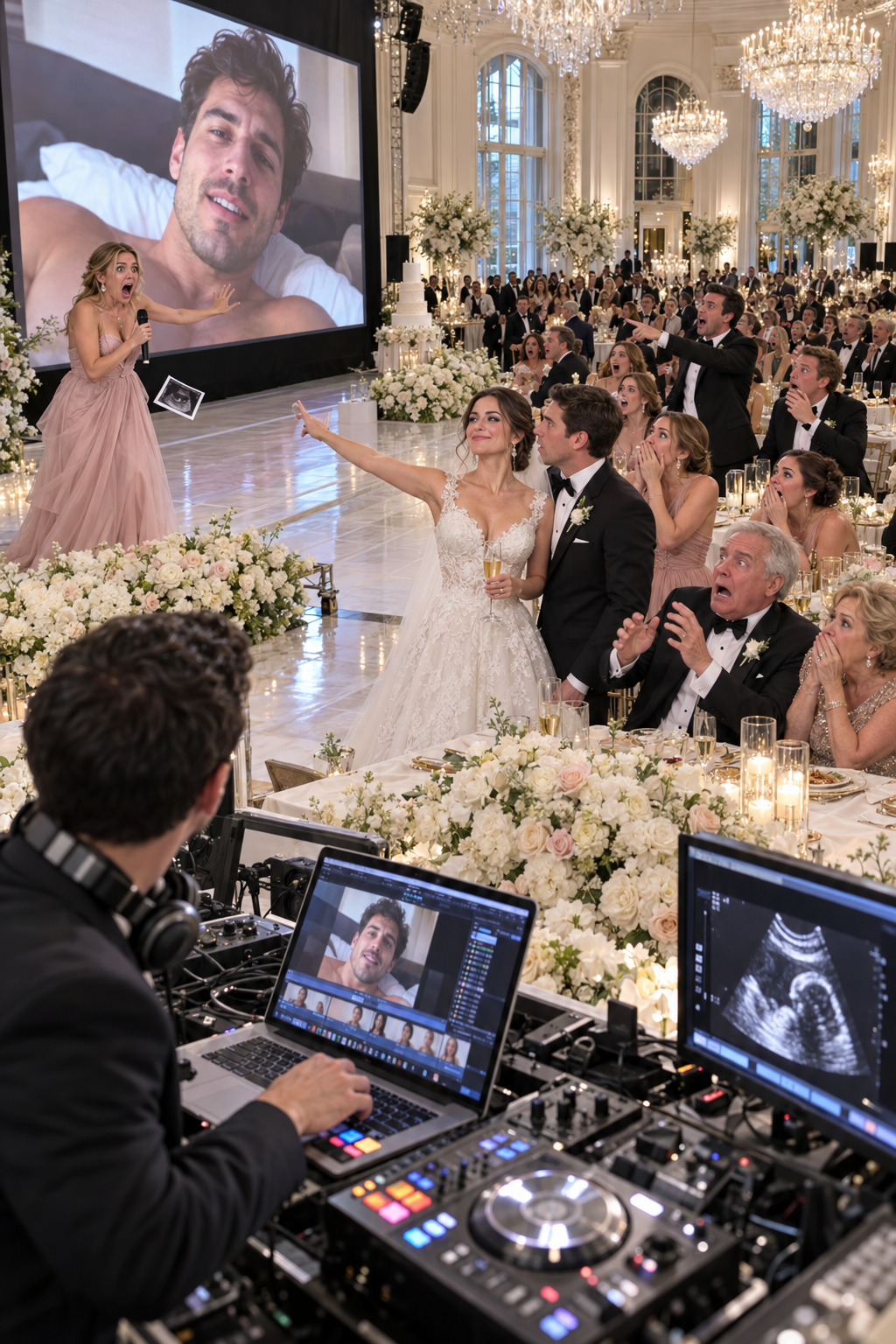
At My Wedding, My Sister Stole The Mic Mid-Toast To Announce, “I’m Twelve Weeks Pregnant!” She Projected Her Ultrasound Over Our Wedding Video. Dad Clapped, Mom Wept With Joy, And I Smiled For The Camera. Then I Told The DJ, “Play The Next Video.” Instantly, Her Lover’s Face Appeared On The Screen.
My younger sister stole the microphone at my wedding, replaced our proposal video with her ultrasound pictures, and announced she was twelve weeks pregnant while my parents applauded like she had just won an Olympic medal. I smiled, walked to the DJ booth, and quietly asked him to play the next file. Thirty seconds later, her secret lover filled the twenty-foot screen. I thought that was the end of the betrayal. Three weeks later, the venue manager emailed me an authorization form. My sister had not signed it. My mother had.
Part 1
My name is Natalie Mercer, I was twenty-nine when I got married, and I make my living doing high-end hair extensions outside Charlotte, North Carolina. People assume that means I spend my days chatting about celebrity breakups while gluing hair onto wealthy women, but the actual job requires patience, precision, and the ability to remain pleasant while someone tells you every intimate detail of her divorce with half her head clipped into sections. I had built my little studio from one rented chair, one rolling cart, and a maxed-out business credit card into a private salon suite with a waiting list. I was proud of it because no one in my family had built it for me.
My husband, Evan Cole, was thirty-one and worked as a project manager for a commercial HVAC company. He was the kind of man who could spend forty minutes comparing mortgage rates without losing the will to live, then come home and sit cross-legged on the floor feeding lettuce to our box turtle, Milton, as if Milton were a respected elder who deserved a formal dinner service. We had been together four years before Evan proposed during a chilly October weekend in the Blue Ridge Mountains. He had planned a sunrise overlook, packed coffee in a thermos, and forgotten the actual cups, so we drank directly from the lid while I cried into my scarf.
My first thought after saying yes was that I wanted to marry him immediately. My second was, God help me, Kelsey is going to find a way to make this about her. Kelsey was my twenty-six-year-old younger sister, and she had spent most of her life treating other people’s milestones as invitations to improvise. When I graduated high school, she fainted in the bleachers after skipping breakfast and drinking two giant iced coffees because she wanted to fit into platform shoes she had ordered one size too small; when I turned twenty-one, she arrived forty-five minutes late to my birthday dinner sobbing because a man she had been texting for four days liked another woman’s bikini picture. At my college graduation, she announced over appetizers that she was moving to Austin to become a “creative brand consultant,” then returned eleven days later because nobody had adequately warned her about traffic.
My parents, Diane and Robert, had always described Kelsey as sensitive. That was the family word for behavior that would have been called selfish in anyone else. If she forgot a birthday, she was overwhelmed; if she borrowed money and failed to repay it, she was going through something; if she screamed at someone in a restaurant, the waiter had probably embarrassed her first. I, meanwhile, had been called mature since I was twelve, which sounded like praise until I became old enough to understand it mostly meant, “Natalie will absorb the inconvenience.”
Kelsey had been married to Adam Pierce for almost two years when Evan and I got engaged. Adam sold orthopedic medical equipment, cared deeply about college football, and possessed the permanent careful expression of a man entering a room where a smoke detector had recently chirped. He was decent, funny in a quiet way, and so used to smoothing over Kelsey’s moods that I sometimes wondered whether he remembered marriage was supposed to contain two people. When we announced our engagement at my parents’ house, he hugged Evan, shook his hand, and immediately asked whether we needed help moving tables or hauling cases of wine.
Kelsey screamed, embraced me, admired my ring, and then asked when we were planning to get married. “Late October,” I said. She exhaled with visible relief and said, “Oh, thank God.” When I asked what that meant, she took a sip of pinot grigio and explained that summer weddings were sweaty and basic, as if my marriage had been scheduled primarily to avoid offending her seasonal aesthetic.
Wedding planning started peacefully enough. My best friend Jenna became my maid of honor because Jenna was an operations manager for a logistics company and could look at a disaster involving forty-seven chairs, a missing caterer, and a thunderstorm and calmly ask who had the master spreadsheet. Kelsey was a bridesmaid and sulked for a week after learning she would not be maid of honor, though she disguised this by repeatedly saying she was relieved because she had “too much going on creatively.” Jenna responded by assigning her exactly three responsibilities and emailing all three in writing.
The venue was a restored textile mill on the edge of downtown Charlotte, with exposed brick walls, tall arched windows, old timber beams, and an audiovisual system sophisticated enough to launch a small satellite. Evan and I planned a short reception film with childhood photos, road-trip videos, messages from friends, and footage of our engagement. My mother became obsessed with whether the napkins should be ivory or “warm pearl,” my father focused almost entirely on the bourbon package, and Kelsey spent several fittings complaining that the dusty-rose bridesmaid dress made her look “emotionally muted.” I remember thinking that if those were our biggest problems, I had somehow beaten the odds.
Then, about five months before the wedding, Kelsey started coming to my salon almost every Tuesday afternoon.
She never booked an appointment. She would simply appear with an iced coffee, drop herself into whichever chair was empty, and complain about Adam while I worked. “He is so predictable,” she told me one afternoon as I separated a client’s hair into clean sections. “He goes to work, comes home, watches football, pays the bills, asks what I want for dinner, and goes to sleep.”
My client looked at her in the mirror and said, “That sounds suspiciously like stability.”
Kelsey rolled her eyes. “You don’t understand. I feel invisible.”
That was the first afternoon she mentioned Chase Holloway.
Part 2
According to Kelsey, Chase worked at her fitness studio, though the definition of worked seemed flexible. He called himself a wellness entrepreneur, posted shirtless motivational videos, sold powdered supplements and branded water bottles online, and apparently had strong opinions about what he called “energetic compatibility.” Kelsey said he understood ambition in a way Adam did not. She also said Chase believed marriage should never restrict a person’s “authentic frequency,” which sounded impressive until you remembered this philosophy was coming from a man who filmed protein-shake reviews in his garage.
I told her exactly once that discussing her marriage with another man was a bad idea. “You are being judgmental,” she said, then asked whether I could install twenty-inch hand-tied extensions at my family rate. I refused the discount, which caused more outrage than the marriage advice. By the following month, Chase had become a recurring character in every conversation, always appearing in ways Kelsey insisted were coincidental.
They happened to attend the same outdoor concert. They happened to eat lunch together because he was helping her understand macronutrients. They happened to spend a Saturday on Lake Norman because a group from the gym had rented a pontoon boat, although the pictures showed Kelsey sitting beside him in every frame while Adam spent the day visiting his parents. When I asked why she was spending so much time with a man who openly criticized her husband, she accused me of being obsessed with her personal life.
Three months before my wedding, Jenna texted me a screenshot while I was mixing adhesive remover in the back room of my salon. The picture came from somebody else’s Instagram story at a rooftop bar in Charlotte, and Kelsey was visible in the background. Chase stood behind her with one hand spread across her waist, his body pressed against hers in a way no reasonable person would mistake for friendly. I stared at the image long enough that my phone dimmed.
I called Kelsey immediately. She denied everything before I had finished describing the picture, insisting it was a bad camera angle and that Chase had been drunk. “His hand was drunk?” I asked. “Natalie, stop making everything ugly,” she snapped, then hung up.
I almost called Adam. My thumb hovered over his name, and I wish I could tell you I chose courage. Instead, I chose convenience. We were eleven weeks from my wedding, my mother was already calling me twice a day about floral costs, and I desperately wanted one family event that did not revolve around Kelsey’s emotional emergency.
That decision would become one of the few parts of the story I genuinely regretted.
The next month, Kelsey’s lies became harder to ignore. She posted less, but unfamiliar photos kept appearing through mutual friends, always showing the same rooftop bars, brewery patios, and fitness events where Chase happened to be standing nearby. Adam grew quieter at family dinners. My father noticed nothing, my mother noticed everything and discussed none of it, which I would later realize was important.
Six weeks before the wedding, Adam called me for the first time in the seven years I had known him. Evan and I were on our couch assembling little cards with directions for out-of-town guests when my phone lit up. Adam asked whether Kelsey was with me at the salon because she had told him she was helping me package welcome bags.
I looked at Evan. He looked at me. Between us, Milton scraped slowly over a piece of slate inside his terrarium, apparently unaware that he was about to witness a moral failure.
“No,” I said. “She isn’t here.”
Adam was quiet for several seconds. “Okay. Thanks, Nat.”
He hung up without asking another question.
Two hours later, Kelsey called screaming. She demanded to know why I could not cover for her for a single evening and accused Adam of monitoring her like a prison guard. When I asked where she had actually been, she told me that was beside the point. “I’m your sister,” she said. “You’re supposed to have my back.”
“I do have your back,” I told her. “That doesn’t mean I become your alibi.”
She hung up again.
At Sunday dinner that week, Kelsey announced that she and Adam were merely having “communication issues.” My mother immediately said every marriage went through difficult seasons. Dad advised Adam to take Kelsey away somewhere romantic. Adam nodded politely, and Kelsey reached under the table and squeezed his hand with the tender expression of a woman who had not just demanded that her sister lie to him four days earlier.
After dinner, I helped Mom rinse plates. I asked whether she thought something was wrong with Kelsey’s marriage. Her hands stopped in the dishwater for half a second before she said, “Every marriage has private matters, Natalie.”
The answer bothered me because I had not asked about privacy. I had asked whether something was wrong.
Four weeks before the ceremony, Jenna met Evan and me at the venue to test the reception video. She had collected clips through a shared cloud folder, and while sorting the files, she accidentally synced an older camera-roll archive containing videos from a girls’ weekend months earlier. One thumbnail showed Kelsey laughing into a phone camera, visibly drunk.
Jenna lunged for the trackpad. “Oh, no.”
Evan said, “What?”
The clip started before she could stop it.
Kelsey grinned into the lens and announced that if she were not married, she would climb Chase “like a pine tree.” Women off-camera laughed. Then Kelsey leaned closer and added, “Honestly, being married hasn’t exactly stopped me.”
No one spoke.
Another clip began automatically.
This one had been filmed outside the rooftop bar from the Instagram screenshot. Kelsey and Chase stood near the railing, his hands around her waist. Then he kissed her, and she kissed him back with both hands on his face.
The room seemed to narrow around the laptop.
Jenna looked sick. “She sent those into our group chat when she was drunk. She made everybody promise to delete them.”
“You didn’t?”
“I have forty thousand photos on my phone. I don’t delete parking receipts.”
For once, Jenna’s digital hoarding had achieved moral significance.
The next morning, I called Kelsey and asked directly whether she was sleeping with Chase.
There was a long pause.
Then she laughed.
And that laugh told me more than any confession could have.
Part 3
Kelsey never admitted the affair outright. Instead, she said Adam had neglected her emotionally, that Chase made her feel alive, that marriage was complicated, and that my questions were “aggressive.” I told her I had seen the videos. The silence that followed was so complete I could hear the compressor kicking on in my salon’s mini refrigerator.
“You went through my private files?” she demanded.
“They were uploaded into the wedding folder.”
“That is a violation.”
“So is sleeping with somebody who isn’t your husband.”
Her breathing changed. I could hear the moment anger became calculation. I told her she had forty-eight hours to tell Adam herself or I would show him the videos.
She cried. Then she threatened not to come to the wedding. Then she accused Jenna of sabotaging her. Finally, she promised she would handle it privately and asked me not to destroy Adam two weeks before he had to stand in family wedding pictures.
I believed exactly none of her excuses, but I believed the promise enough to wait.
Two weeks before my wedding, our family gathered at my parents’ house for Sunday dinner. Halfway through mashed potatoes, Kelsey stood, tapped a butter knife against her water glass, and announced that she was pregnant. My mother screamed, my father knocked his fork onto the floor, and Adam sat frozen for perhaps two seconds before joy transformed his whole face.
“Are you serious?” he kept asking.
Kelsey nodded and cried while he wrapped his arms around her.
Then she looked at me.
It lasted less than a second, but there was nothing joyful in her expression. It was a warning.
I started counting backward.
After dinner, I cornered her in the laundry room and closed the door. “Is the baby Adam’s?”
She reacted as if I had accused her of poisoning a kindergarten class. “What kind of monster asks her pregnant sister that?”
“The kind who watched her pregnant sister kiss another man on video.”
Her face tightened. “Of course it’s Adam’s.”
“Then tell him about Chase tonight.”
Kelsey folded her arms. “Can you not let me have one good thing?”
I stared at her. “One good thing?”
“My pregnancy. My family. My moment.”
“You announced it two weeks before my wedding.”
“See? That’s exactly what I mean. Everything has to be about you because you’re getting married.”
For several seconds I genuinely wondered whether language had failed us.
When I stepped back into the hallway, my mother was standing near the kitchen entrance. I could not tell how much she had heard. Her eyes went briefly from me to Kelsey, who pushed past us without speaking.
Mom caught my wrist. “Don’t start anything tonight.”
That sentence stayed with me.
I told Evan everything after we returned home. He listened without interrupting, then said, “Adam deserves to know before Saturday.” I knew he was right, and I hated that being right did not make the decision easier.
Kelsey texted me Wednesday evening. She said she and Adam were “working through things privately” and begged me not to create a disaster before my wedding. She promised everything would be explained after our honeymoon.
Evan read the message and said, “That’s not an answer.”
“No.”
“Are you going to tell him?”
I looked at the wedding boxes covering our dining table, the place cards Jenna had alphabetized, the shoes I still needed to break in, the handwritten note I had planned to give Dad before he walked me down the aisle. I wish I could rewrite myself into a braver woman in that moment. I cannot.
“I’ll give her until Saturday morning,” I said.
Saturday morning arrived before my courage did.
The wedding itself was beautiful. My hair behaved perfectly, which mattered to me more than I will publicly admit, and Evan cried when I walked down the aisle. Dad squeezed my hand before giving me away, and Mom dabbed mascara from beneath her eyes before the ceremony had even started.
Kelsey acted flawlessly. She wore the dusty-rose dress, smiled in photographs, adjusted my veil once without complaining, and never mentioned her pregnancy. She was so calm that I briefly wondered whether she really had told Adam and they were keeping the rest private.
That hope lasted through dinner.
Jenna gave the first toast. Evan’s brother gave the second. Then the DJ, a nervous twenty-three-year-old named Tyler, handed me the microphone so I could thank our guests before the first dance.
I had nearly finished when Kelsey rose from the bridal-party table.
She approached me smiling.
For one absurd second, I thought she wanted a hug.
Instead, she took the microphone directly out of my hand.
“I promise this will only take a second,” she said to the room.
Under the table, Evan reached for my fingers.
Jenna muttered, “Absolutely not.”
Kelsey faced our one hundred and forty guests and said that because both families were gathered together, she and Adam had something wonderful to share. My mother made a high, breathless sound before the announcement had even happened.
That was strange.
Then Kelsey placed both hands over her stomach.
“Everyone,” she said, “I’m twelve weeks pregnant.”
The room exploded.
Dad jumped up clapping. Mom began openly sobbing. Adam hugged Kelsey while relatives cheered and someone struck a wineglass with a spoon.
I stood beside my husband at my own wedding and watched my sister receive an ovation.
Then Kelsey smiled toward the projection screen.
“And we brought the ultrasound pictures.”
That was when I understood this was not spontaneous.
Part 4
The proposal video disappeared mid-scene. One moment, the screen showed Evan kneeling beside a Blue Ridge overlook; the next, a black-and-white ultrasound filled the exposed brick wall. Tyler looked at me from the DJ booth with the horrified expression of someone who had been handed two conflicting evacuation orders.
Kelsey gestured impatiently for the next image.
Another ultrasound appeared.
Then another.
Mom was crying into a linen napkin. Dad had an arm around Adam’s shoulder. Guests turned their chairs toward the screen while I stood in several thousand dollars’ worth of ivory silk watching my wedding reception become a prenatal slideshow.
Jenna leaned toward me. “I played rugby in college. I could fall into her.”
I almost laughed.
Instead, I looked at the laptop beside Tyler and remembered the synced folder.
The videos were still there.
I lifted my train and walked toward the booth while Kelsey discussed possible baby names into my microphone. Tyler swallowed when I approached. “I’m really sorry, Mrs. Cole. Your sister said your mom had cleared the slideshow with the venue.”
I stopped.
“My mother?”
He pointed vaguely toward the screen. “That’s what they told us.”
I filed the sentence somewhere inside my head for later.
“Tyler,” I said, “play the next video file.”
His eyes widened. “The wedding montage?”
“The next video in that folder.”
He looked toward Evan. My new husband raised his champagne glass and gave one solemn nod.
Tyler pressed Enter.
The screen went black.
Kelsey laughed into the microphone. “Little technical glitch.”
Then Chase Holloway appeared twenty feet high.
The silence arrived so suddenly it felt physical.
On-screen, Chase stood beside Kelsey at the rooftop bar with his arm around her waist. He leaned down. She lifted both hands to his face.
They kissed.
Adam’s arms dropped from around her.
Dad stopped clapping.
Mom’s crying stopped in the middle of a breath.
At the bridal table, Jenna whispered, “There it is.”
The second clip started before anybody moved. Kelsey’s recorded voice blasted through the speakers, drunkenly announcing what she would do to Chase if she were not married. Laughter followed.
Then came her own recorded punchline.
“Being married hasn’t exactly stopped me.”
Kelsey spun toward the booth. “Turn it off!”
Tyler hit the space bar.
Unfortunately for Kelsey, this paused the screen on a close-up of Chase making a ridiculous puckered expression into the camera. He remained suspended above the room like a giant monument to bad decisions.
Adam looked at Kelsey.
“What is that?”
She pointed at me. “Natalie did this.”
Adam did not look away from her. “I can see Natalie. I’m asking about you.”
“It is old.”
Jenna cleared her throat.
Kelsey snapped, “Don’t.”
“Three months,” Jenna said. “Roughly.”
Mom rose from her chair. Her face was pale with fury, but astonishingly, she aimed that fury at me. “Natalie, how could you do this during your sister’s pregnancy announcement?”
I looked at her.
“During her what?”
Mom opened her mouth.
Nothing came out.
Beside me, Evan made a strangled noise and turned his face away.
Adam stepped toward Kelsey. “Were you sleeping with him?”
She started crying. Not the quiet kind. Kelsey cried with her whole body, shoulders shaking, hands over her face, words breaking apart between gasps about loneliness and confusion.
Adam’s expression barely changed.
Then he asked, “How far along did you say you were?”
“Twelve weeks.”
I watched his face.
The math reached him slowly.
“I was in Phoenix for twenty-one days.”
No one moved.
Adam stared at her. “I left August third. I came home August twenty-fourth.”
Kelsey immediately began explaining that pregnancy dating was not exact.
From a nearby table, my grandmother said, “It’s not that inexact.”
My cousin whispered, “Grandma.”
“I had four children.”
“Grandma.”
“I know how calendars work.”
Evan buried his face in his napkin.
That broke something in me. A tiny laugh escaped before I could stop it, and once it did, the entire scene became so absurd that I had to bite the inside of my cheek to keep from joining him.
Kelsey screamed that we were all disgusting and ran from the hall. Mom hurried after her. Dad started to follow, stopped, glanced at Adam, glanced at me, and turned toward the bar instead.
Adam remained standing beneath the enormous frozen face of Chase Holloway.
Eventually, he sat down at an empty table.
I went to him.
“I am sorry,” I said.
He looked up. His eyes were red.
“Did you know?”
There was no version of the truth that made me look good.
“About Chase? A few weeks.”
His mouth tightened.
“You should have told me.”
“I know.”
That hurt more than being shouted at.
Adam stood, shook Evan’s hand, congratulated us in a voice that sounded almost automatic, and left.
For five minutes, my reception was dead.
Then Evan picked up the abandoned microphone.
I grabbed his sleeve. “What are you doing?”
“Saving our wedding.”
He tapped the microphone.
“Well,” he said to the room, “that concludes the surprise daytime paternity hearing.”
Someone laughed.
Then another person did.
Evan continued. “The cake remains structurally intact. Natalie and I remain legally married. And the bar, I am pleased to report, is still open.”
The laughter spread.
The tension finally broke.
Music started. The cake came out. My eighty-two-year-old grandmother danced with my Uncle Frank, and Dad eventually joined them with a whiskey in his hand.
Around eleven, Mom returned alone.
She found me beside the coffee station.
“I hope you’re satisfied.”
“I married Evan today. So yes.”
“You humiliated your sister.”
“She took my microphone, replaced my wedding video with ultrasound pictures, and announced a pregnancy that may belong to another man.”
“You could have handled that privately.”
I looked toward the blank projection screen.
“So could she.”
Mom stared at me for several seconds, and something passed across her face that I could not identify.
Then she said something stranger than anger.
“You have no idea what you’ve done.”
At the time, I thought she meant to Kelsey.
Three weeks later, I learned she meant something else.
Part 5
The morning after the wedding, I woke beside my husband with forty-three notifications on my phone. Kelsey had blocked me on every social platform, unblocked me long enough to send a three-page message, then blocked me again. According to her, I was jealous of her pregnancy, resentful of her happiness, and responsible for destroying her marriage.
Evan read the message over my shoulder while drinking coffee. “Just to make sure I understand the jurisdictional argument,” he said, “she believes you ruined her pregnancy announcement at your wedding.”
“Correct.”
“Bold legal theory.”
Milton blinked from beneath his heat lamp.
Adam moved into a furnished apartment that weekend. He filed for divorce within two weeks and requested a paternity test after the baby’s birth. I called him once to apologize again for waiting to tell him about the affair, and unlike everyone else in my family, he did not pretend my mistake was something different.
“You were scared of the explosion,” he said.
“Yes.”
“I understand that.”
“But?”
“But I was living inside the explosion already.”
I carried that sentence for a long time.
My parents divided themselves in predictable ways. Dad called occasionally, usually while driving, because apparently emotional conversations became easier for him if interstate traffic was present. Mom stopped speaking to me except through messages asking whether I planned to apologize.
I refused.
Three weeks after the wedding, the venue manager emailed me about the final damage-deposit reconciliation. The message included several scanned forms from the event file, most of which I nearly deleted. One page was titled Audiovisual Content Authorization.
The form approved an outside slideshow to interrupt our wedding montage during the bride’s closing toast.
The signature at the bottom belonged to Diane Mercer.
My mother.
I read it three times.
Then I called Jenna.
She arrived at my house forty minutes later carrying takeout containers and the expression she normally reserved for warehouse inventory disasters. I placed the form on the kitchen island.
“Tell me I’m misreading this.”
She leaned over it.
“You are not.”
The request had been submitted four days before the wedding. It described Kelsey’s ultrasound presentation as a “family blessing announcement” and stated that the bride and groom had approved it.
Evan came home while we were still staring at the page.
He read it once and quietly said, “Your mother lied to the venue.”
The betrayal settled differently than Kelsey’s behavior had. Kelsey taking my microphone fit the person I had known my entire life; Mom secretly arranging the projector did not. She had not merely reacted badly after the fact.
She had helped plan it.
I drove to my parents’ house the next morning.
Dad’s truck was gone. Mom opened the door wearing yoga pants and an old college sweatshirt, looked at my face, and immediately knew why I was there.
“You got the form.”
Not “What form?”
That told me everything.
I walked past her into the kitchen.
“Why?”
Mom followed me. “Natalie, you need to understand—”
“No. Start with why.”
She sat at the kitchen table but I remained standing. She said Kelsey had been terrified that Adam might react badly to the pregnancy, and Mom believed announcing it around family would make the moment feel safer.
“Safer for whom?”
“For everybody.”
“Did you know about Chase?”
Her eyes dropped.
My stomach turned.
“Mom.”
“I knew Kelsey had made mistakes.”
That sentence changed the temperature in the room.
“How long?”
She rubbed both hands together. “She came to me in July.”
July.
Two months before the wedding.
Kelsey had confessed the affair to my mother before Jenna sent me the rooftop screenshot.
Mom knew.
She knew while telling me not to interfere. She knew while Adam sat at Sunday dinners believing his wife was simply stressed. She knew when Kelsey announced the pregnancy.
“Did you know the baby might not be Adam’s?”
Mom’s silence answered first.
Then she whispered, “There was uncertainty.”
I laughed once, but there was no humor in it.
“Uncertainty.”
“Kelsey was terrified.”
“So you helped her announce it in front of one hundred and forty people.”
Mom’s face hardened. “Adam loved her. I thought once he saw everyone celebrating, he would focus on the baby instead of the timeline.”
I actually stepped backward.
There it was.
The real plan.
The pregnancy announcement had not merely been about stealing attention.
It had been pressure.
Public joy. Grandparents crying. Relatives cheering. Adam standing in the middle of a room full of witnesses being congratulated before he had time to ask a single question.
Mom had helped construct the trap.
“That is disgusting,” I said.
She flinched.
“Don’t speak to me that way.”
“What word would you prefer?”
“We were trying to save a marriage.”
“No. You were trying to keep a scandal quiet.”
Her face changed.
That was how I knew I had finally said the right thing.
Part 6
Dad came home in the middle of our argument and found Mom crying at the table while I stood across the kitchen holding the audiovisual form. He looked from one of us to the other and asked what had happened. When I told him Mom had known about Chase since July, his face went still.
He had not known.
That mattered.
Mom immediately said she had kept it from him because he would have overreacted. Dad stared at her and asked whether by overreacted she meant he would have told Adam the truth.
She had no answer.
For the first time in my life, I watched my father refuse to smooth something over.
“You let me congratulate that boy,” he said. “You let me put my arm around him.”
Mom began explaining that she had been protecting Kelsey.
Dad interrupted her.
“From what? Consequences?”
The word landed hard.
Mom stood, grabbed her purse, and left the room.
Dad sat down slowly.
Then he told me something I had not known.
Kelsey’s affair was only the latest in a series of problems Mom had quietly managed for years. She had paid nearly seven thousand dollars of Kelsey’s credit-card debt before Kelsey’s wedding to Adam. She had covered a rent payment after the failed Austin move. She had once called an employer pretending Kelsey had a family emergency when Kelsey had actually missed work after staying out drinking.
Dad knew about some of it.
Not all.
“I kept telling myself she would grow out of it,” he said.
“She is twenty-six.”
“I know.”
“She is about to have a baby.”
“I know.”
His voice broke slightly on the second answer.
I realized then that my parents had divided the enabling between them. Mom actively rescued Kelsey. Dad avoided conflict and allowed the rescues to continue because confronting them would have required admitting what our family had become.
And I had played my own part.
I was the dependable daughter.
When Kelsey needed a ride, I drove. When she forgot Grandma’s birthday, I reminded her. When she told Adam she was helping me and he called, I felt guilty for refusing to lie instead of angry that she had used my name.
We had all been orbiting her chaos.
The wedding had simply forced the orbit to break.
A month later, another piece emerged during the divorce process. Adam discovered more than eighteen thousand dollars missing from their joint savings over the previous year. Some had gone toward Chase’s online wellness business, including advertising expenses, inventory, and a payment for a branding consultant.
Kelsey had described the transfers to Adam as home-renovation expenses.
When Dad told me, I sat silently in my salon office staring at the wall.
The affair had not been an impulsive mistake.
It had been a parallel life.
Kelsey had invested marital money into another man’s business while criticizing Adam for being boring because he went to work and paid their bills.
Mom still insisted none of that justified what I had done at the wedding.
Eventually, I stopped arguing.
I told her she was allowed to think I had handled the videos badly. I told her I agreed Adam deserved the truth sooner and that public exposure was not something I felt proud of.
Then I told her none of those facts changed what Kelsey had done or what Mom had helped arrange.
“I am not apologizing for uncovering a lie you were helping her maintain.”
Mom said, “Then I don’t know how this family heals.”
I replied, “Maybe it doesn’t heal into what it used to be.”
That frightened her more than anger.
Five months after the wedding, Kelsey gave birth to a healthy baby girl.
The paternity test came back three weeks later.
Chase was the biological father.
Adam called Dad directly and told him before the rest of us heard. He did not celebrate the result; there was nothing to celebrate. He had spent most of the pregnancy grieving a child he had briefly believed was his.
Chase responded badly.
His relationship with Kelsey had already deteriorated once the divorce became public and the financial questions started. Apparently, declarations about authentic frequency became less romantic when paired with child-support calculations.
Mom began spending nearly every day at Kelsey’s apartment.
Dad did not.
Their marriage grew colder.
Then, two months after the baby’s birth, Mom called me for the first time in weeks.
Her voice sounded careful.
“Kelsey is struggling.”
I waited.
“Day care is expensive.”
There it was.
Mom explained that Chase was behind on support, Kelsey was only working part-time, and the baby’s medical insurance had become complicated. She asked whether I could help temporarily because my salon was doing well.
For one strange second, I saw the entire family structure with perfect clarity.
Kelsey created the crisis.
Mom protected her from the consequences.
Dad stayed quiet.
And eventually somebody turned toward Natalie because Natalie was responsible.
“No,” I said.
Mom inhaled sharply.
“She is your sister.”
“Yes.”
“That baby is innocent.”
“Yes.”
“Then how can you say no?”
“Because helping a baby and becoming Kelsey’s financial backup plan are not the same thing.”
Mom accused me of punishing an infant.
I offered to buy diapers occasionally or contribute directly to an emergency pediatric expense if one arose. I would not pay Kelsey’s rent, cover her credit cards, fund legal bills, or replace money she had taken from Adam.
Mom went silent.
Then she said, “You’ve changed.”
She intended it as an accusation.
I took it as confirmation.
Part 7
The first year of my marriage was quieter than anyone expected after the way it began. Evan and I did normal married things: argued over whether the thermostat should be seventy or seventy-two, replaced a leaking dishwasher, hosted friends for dinner, and discovered that Milton had an irrational hatred of a decorative ceramic mushroom someone gave us as a housewarming gift. Ordinary life became precious to me because I finally understood how much of my childhood had been organized around anticipating someone else’s emergency.
My salon grew too. I hired another stylist, expanded into the neighboring suite, and learned that the ability to manage clients, payroll, inventory, and social media at the same time was far less exhausting when I was not also fielding family crises. For years, I had mistaken constant availability for love. Once I stopped, I had enough attention left for my own life.
Adam’s divorce became final nine months after the wedding. He sold the house, divided what remained after the missing funds were accounted for, and moved to Raleigh for a regional sales position. Before leaving, he met Evan and me for coffee.
He looked healthier.
Tired, but healthier.
I apologized again.
“I should have told you the minute I knew.”
He nodded. “Yes.”
I appreciated that he did not rush to absolve me.
Then he said, “But I also understand why you froze. Your whole family had trained you to treat telling the truth as the thing that causes the problem.”
That sentence stayed with me longer than almost anything else.
Kelsey contacted me occasionally through long emails. She never apologized for using my wedding reception. She did eventually admit that she had hoped announcing the pregnancy publicly would make Adam “emotionally commit” before doubts about the timeline surfaced.
Mom had suggested the slideshow.
Kelsey had chosen the timing.
They had discussed whether Adam might ask questions afterward.
Reading that email felt less like receiving new information and more like seeing the final puzzle pieces lock into place.
Kelsey insisted they had not intended to trap anyone. They had merely wanted to surround Adam with love during a complicated time.
I did not respond.
There are sentences so dishonest that replying only makes you part of the performance.
Dad changed more slowly.
For most of his life, he had survived our family by joking, changing subjects, and leaving difficult rooms. After the wedding, that strategy stopped working. Mom’s resentment toward him grew because he refused to contribute money whenever Kelsey asked.
One afternoon, he came to my salon carrying two coffees.
“I owe you an apology,” he said.
I expected him to mention applauding at the wedding.
Instead, he apologized for calling me easy.
I looked at him.
He explained that when we were children, he and Mom used to say Kelsey required more attention because she was difficult while Natalie was easy. “We thought we were complimenting you,” he said. “What we actually did was make you responsible for needing less.”
I had to turn my chair away for a moment because that apology reached somewhere deeper than I expected.
Dad and I rebuilt slowly.
Mom and I did not.
She still believed family meant access regardless of behavior. She invited Evan and me to holidays where Kelsey would be present without warning us, then acted wounded when we left.
After the second incident, I stopped attending.
Mom accused me of dividing the family.
I told her the family was already divided by choices I did not make.
When my first wedding anniversary approached, the venue sent a promotional email offering couples a discounted anniversary dinner. Evan read it aloud and asked whether I wanted to return.
“Absolutely not.”
“We could sit under the projector.”
“I married you once. I don’t need a reenactment.”
He grinned.
The photographer also contacted us because our album package included one large framed print we had never selected. We spent an evening scrolling through hundreds of images from the wedding.
There were beautiful photographs I had forgotten existed.
Dad walking me down the aisle.
Jenna adjusting my veil.
Evan wiping his eyes during our vows.
Grandma dancing with Uncle Frank.
Then we reached the photo.
It had been taken seconds after Kelsey announced her pregnancy.
Behind me, the room was chaos. Mom was crying. Dad was clapping. Adam was leaning toward Kelsey while she stood glowing beneath the projection screen.
And in the foreground, I sat beside Evan with my back straight and a champagne glass in my hand.
I was looking directly into the camera.
I looked calm.
Evan laughed softly.
“You look like you already know how the movie ends.”
“I didn’t.”
“Could’ve fooled me.”
I stared at the photograph for a long time.
What struck me was not anger.
It was how hard I had been working to remain acceptable while everyone around me behaved unacceptably.
I selected that picture for the frame.
Not because I was proud of what happened next.
Because I wanted to remember the last moment I believed keeping my composure meant keeping everyone else comfortable.
Part 8
Two years after my wedding, Kelsey and I were still not close.
I had met her daughter, Sophie, several times at events hosted by Dad. Sophie was bright, serious, and fascinated by Milton, who regarded all toddlers with deep suspicion. I never blamed her for the circumstances surrounding her birth, and I never wanted the adults’ mistakes turned into a family legend she would someday be forced to carry.
Kelsey, however, continued waiting for the apology she believed I owed her.
Eventually, she asked to meet at a coffee shop halfway between our homes.
I agreed.
She arrived twenty minutes late with Sophie asleep in a stroller and looked older than twenty-eight. Not ruined, not defeated, simply tired in the way people become tired when charm stops paying bills.
For several minutes, we discussed harmless things.
Then Kelsey said, “Mom thinks we should finally move on.”
“Mom thinks moving on means nobody talks about what happened.”
Kelsey looked down at her coffee.
“I know I shouldn’t have done the announcement at your wedding.”
It was the closest thing to an apology she had ever given me.
I waited.
“But playing those videos was cruel.”
“There it is.”
“I’m allowed to think that.”
“You are.”
She looked surprised.
I told her I had spent two years thinking about that night. If I could repeat it, I would tell Adam earlier. I would never again sit on information like that because I was afraid of family drama.
“But if you’re asking me to apologize for the fact that your affair was exposed,” I said, “I won’t.”
Her jaw tightened.
“You humiliated me.”
“You chose the audience.”
“Mom suggested the slideshow.”
“You agreed.”
Kelsey looked toward Sophie.
For the first time, she did not argue.
“I thought if Adam heard everyone cheering,” she said quietly, “he wouldn’t question it right away.”
There was the truth.
Small.
Ugly.
Finally spoken without decoration.
“Did you believe the baby might be his?”
She was silent.
“No.”
I had expected that answer for two years.
Hearing it still hurt.
“So you knew.”
“I was scared.”
“Adam was scared too. He just wasn’t given the truth.”
Kelsey wiped at one eye.
“I thought Chase loved me.”
Maybe he had, in whatever way he was capable of. Maybe she had loved him too. None of that changed what she did to Adam.
I told her I hoped she became a good mother.
I meant it.
I also told her we were not going back to the relationship we had before.
She asked whether I hated her.
“No.”
That seemed to surprise her more than anything.
“I just don’t trust you.”
Hate would have been easier.
Hate is hot. It wants arguments, apologies, revenge.
Distrust is quieter.
It simply locks the door.
Mom and I remained mostly distant. She sent birthday cards and occasional messages about Sophie. I answered politely when necessary.
Dad eventually moved into a small apartment after he and Mom separated. They did not divorce immediately, but after thirty-four years of marriage, he told me he could no longer pretend avoiding conflict was the same thing as keeping peace.
That saddened me.
It also made sense.
Consequences rarely stop with the person who creates them.
They travel along every relationship built to hide them.
My marriage to Evan survived its legendary opening night with surprisingly little damage. If anything, it made us suspicious of large projection screens and unusually good at talking about uncomfortable subjects before they grew teeth.
Our second anniversary was celebrated at home.
Evan cooked steaks on the patio. I made roasted potatoes. We opened a bottle of wine that Dad had given us and watched Milton spend fifteen determined minutes trying to climb onto a flat rock he could easily have walked around.
After dinner, Evan brought the framed wedding photograph from the living room.
He set it on the table.
“Why are you bringing her outside?”
“Her?”
“You call that picture ‘her’?”
“Absolutely. She has a presence.”
I looked at the younger version of myself sitting beneath the blurred lights of the reception hall.
Behind her was the moment my family cracked open.
At the time, I thought the worst thing that had happened was my sister stealing my wedding.
I was wrong.
The wedding merely exposed a system that had existed for years: Kelsey created chaos, Mom concealed it, Dad retreated from it, and I was expected to accommodate whatever remained.
The video did not destroy that system.
Their own choices did.
The affair produced the evidence.
The pregnancy created the timeline.
The public announcement created the question nobody could avoid.
Mom’s attempt to control the story produced a signed document proving she had participated.
Every consequence had grown from the lie before it.
That understanding is why I no longer feel triumphant when people hear the story and say Kelsey got what she deserved.
A marriage ended.
A child entered the world inside a mess she did not create.
My parents’ relationship fractured under truths they had postponed for decades.
Adam lost a future he briefly believed was his.
There were no winners.
But there was freedom.
Mine came when I finally stopped confusing forgiveness with restored access.
I can hope Kelsey raises Sophie well without trusting her with my private life. I can love my mother without allowing her to manage my marriage, money, or conscience. I can accept Dad’s apology without pretending his silence never hurt me.
And I can admit that I should have told Adam sooner without accepting responsibility for the affair itself.
Those distinctions saved me.
Our wedding album still sits on the bottom shelf of the living-room bookcase. The framed photograph remains beside Milton’s terrarium.
Every once in a while, a guest asks about it.
Evan usually tells them, “Long story.”
I say, “Very long.”
Milton says nothing.
He sits beneath his heat lamp with the same ancient, disappointed expression he has worn since the day we brought him home.
Sometimes I look at the photograph, then at him.
“You would have told Adam immediately, wouldn’t you?”
Milton blinks.
Evan always translates.
“He says yes.”
“Of course he does.”
“He’s very judgmental.”
“He’s usually right.”
The night of my wedding, I thought asking Tyler to play the next video was the most decisive thing I had ever done.
It wasn’t.
The most decisive thing came later.
It was learning that when someone builds their life around the assumption that you will always absorb the consequences, sometimes the clearest answer you can give them is not revenge, not another argument, and not even forgiveness.
It is simply this:
No more.
THE END!