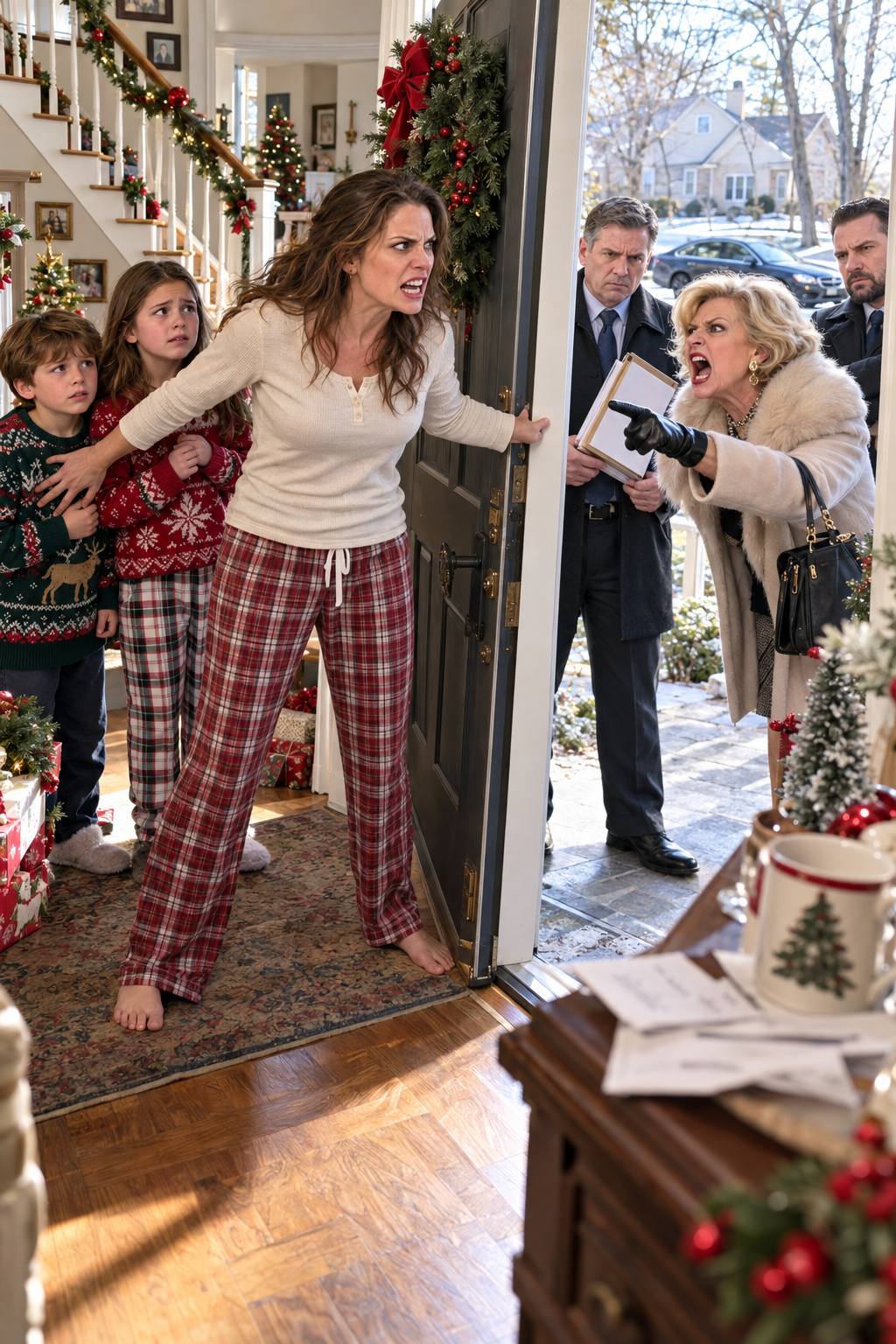
“When’s Christmas Dinner, Mom?” I Asked. “Oh Honey, We Already Ate.” My Sister Laughed In The Background. My Kids Were In Their Christmas Sweaters. A Week Later, Mom Called. “Property Taxes Are Due. We Need $5,200.” I Replied, “Oh Mom, I Already Spent It.” At 6 A.M., There Was A Knock. Mom Stood There With Two Men…
My mother told me Christmas dinner was already over while my two children stood by the front door in matching holiday sweaters, waiting to visit Grandma. I didn’t argue or cry; I fed them at home, then spent the $5,200 I had quietly saved for my mother’s property taxes. A week later, she arrived before sunrise with an auctioneer, a notary, and a document she expected me to sign without reading. By noon, I discovered Christmas had never been the real problem.
Part 1
By two o’clock on Christmas afternoon, every driveway on our block in Marshfield, Wisconsin, seemed to have an extra car in it except mine. I was standing in my kitchen with a casserole wrapped in a bath towel to keep it warm, checking my phone for a message from my mother while my eleven-year-old son, Noah, waited by the front door in a green sweater covered with reindeer. My eight-year-old daughter, Sophie, had been wearing her red Christmas-tree sweater since breakfast, and every time she moved, the tiny bell sewn near her shoulder gave a cheerful little jingle that was becoming harder for me to hear without feeling guilty. Mom had promised she would text the dinner time, so for hours I kept inventing reasons she hadn’t.
“Maybe Grandma’s ham is taking longer,” I told Sophie when she asked again. Noah came around the corner carrying the pie box and asked if he should put it in the minivan, but I told him not yet because the roads were icy and I didn’t want it sliding around before we knew when we were leaving. He nodded and set the pie carefully on the counter, then went back to the door without complaining. That was the first thing that bothered me, although I didn’t understand why until much later: he waited like someone accustomed to being told whether he was wanted.
At two fifteen, I finally called my mother. Evelyn Whitmore answered on the fourth ring, bright and casual, and behind her I could hear forks against plates, chairs scraping, several voices, and the ripping sound of what I thought was packing tape. “When’s Christmas dinner, Mom?” I asked, still holding the casserole against my hip. She paused just long enough for me to understand the answer before she gave it.
“Oh, Claire, honey, we already ate,” she said. “We did noon this year. It just worked better.”
I looked toward the hallway where Noah and Sophie were waiting. “You already ate?”
Before Mom could answer, I heard my younger sister Jenna laughing somewhere close to the phone. Nobody had told a joke, and the laugh didn’t sound surprised or embarrassed; it sounded like she had been waiting for me to ask exactly that question. My mother continued talking as if she were explaining that the grocery store had closed early, telling me everyone had been hungry and my aunt Carol had arrived ahead of schedule, while my daughter’s little bell jingled once in the hallway.
I could have demanded an explanation. I could have asked why Mom had specifically told me six days earlier that Noah and Sophie were invited, why she had promised to send the time, or why nobody had called when they sat down without us. Instead I looked at my children, swallowed whatever wanted to come out of me, and said, “Okay, Mom.”
I hung up before my voice changed. When I turned around, Noah was staring at my face with the serious expression he used when checking the score during a close Packers game, and Sophie was clutching the sleeves of her sweater in both fists. I found the smile I had been using in emergencies since my divorce and said, “Change of plans. We’re having Christmas here.”
Our half of the duplex didn’t have a dining room. We had a kitchen counter with three stools, so I put out three plates, lit a vanilla candle left over from a school fundraiser, and cut the casserole into neat squares as though I were serving a table full of company. Sophie asked if we could keep the candle burning through dinner, and Noah silently bent over, untied the shoes he had been wearing since noon, and lined them up beside the door.
Then he asked, “Was it us?”
I knew exactly what he meant. “No.”
“Did we do something?”
“Noah, absolutely not.”
I wanted to say more, but children shouldn’t have to inherit an adult’s interpretation of the people they love. So we ate, Sophie told a long story about a hamster someone in her class wanted, and I pretended I couldn’t see Noah glancing at my phone every time it lit up. That night Sophie asked to sleep in her Christmas sweater, bell and all, and I let her.
After they were asleep, I washed three plates and stood alone in the kitchen with my hands in warm dishwater. My phone stayed silent on the counter, and I realized the most natural thing in the world for me would have been to call my mother and ask what I had done wrong. That had been my position in our family for as long as I could remember: when something hurt, I asked what I had done, and afterward I usually paid for fixing it.
There was a drawer beside the stove where I kept envelopes for things that didn’t fit neatly into the monthly budget. In the back was a thick bank envelope marked “Mom—Taxes, January,” containing fifty-two hundred dollars I had accumulated twenty, fifty, and one hundred dollars at a time over the previous year. Every Friday after payroll cleared at work, I put something into that envelope before I spent money on myself.
To understand why, you have to understand the farmhouse.
I grew up twenty-five minutes outside Marshfield in a white two-story place with a machine shed, twelve acres of tired pasture, and a maple dining table that could be expanded with three leaves. My mother ruled that table the way some people run offices, deciding who sat where, who brought what, and which family problem could be discussed in front of company. My father, Paul Whitmore, repaired machinery at a cheese plant and preferred the shed, where he had an old workbench beneath a narrow window and a heavy steel vise bolted to one corner.
I was the responsible daughter. Jenna, six years younger, was “still finding herself” well into adulthood, which meant other people found whatever she lost and paid whatever she forgot. At twelve, I kept records for the eggs we sold to neighbors, and at seventeen, I was doing my parents’ checkbook because numbers made sense to me in a way people sometimes didn’t.
My mother loved telling relatives, “Claire’s the one I never have to worry about.”
It took me nearly forty years to understand that she wasn’t describing trust. She was describing usefulness.
Dad died suddenly in the fall of 2013. Five months later, an envelope from the bank revealed a second mortgage nobody knew about, partly from his medical bills and partly from money he had borrowed after Jenna walked away from a beauty salon lease she couldn’t afford. The bank wanted forty-six thousand dollars or it wanted the farmhouse.
My former husband, Eric, and I had forty-six thousand dollars. We had saved it over six years for the down payment on our first house, and I was seven months pregnant with Noah when Mom slid the bank notice across the maple table and said she had no idea what she was going to do. She never technically asked me for the money, which became important later because my mother was very good at arranging circumstances so that she never had to ask for anything directly.
Three weeks after Noah was born, Eric and I sat in a bank conference room while I wired away our house fund. The bank attorney turned several forms toward me and explained that because the payoff money came from me, the deed would be changed so my investment was protected. “You and your mother will both be owners,” he said.
Mom touched my wrist twice. “It’s just paperwork, Claire. The bank needs names on things.”
I signed where they pointed.
Eric waited until we were driving home before he said, “You realize that was our house.”
“We’ll save again,” I told him.
Neither of us knew then that the forty-six thousand dollars wouldn’t be the end of what I paid. What mattered was that a copy of that deed went into a file box in my closet, where it sat untouched for eleven years while my mother taught me exactly what she wanted me to believe my name meant.
It meant taxes.
It meant repairs.
It meant responsibility.
Apparently, it did not mean a place at Christmas dinner.
And that night, standing in my kitchen with fifty-two hundred dollars in my hand, I finally wondered what else I had misunderstood.
Part 2
Beginning the first January after the mortgage was cleared, I drove to the farmhouse with a cashier’s check for the property taxes. Mom would have county forms stacked neatly at my seat at the maple table, a pen placed across the top, and she would stand behind me while I signed wherever her finger landed. “Your name’s on the property too, honey,” she would say, but only when money was due.
Between Januaries, there was always another emergency. I paid for most of a new roof, then a furnace, then a well pump, then repairs to the machine shed after a storm peeled back part of the metal siding. Each time Mom promised she would “make it right once things settled down,” but things in my family had a strange way of settling only when someone else had already absorbed the cost.
Meanwhile, invitations became unpredictable. One Thanksgiving, Mom told me they were “keeping it small,” and two days later I saw a picture online of the dining table extended to its full length with more than a dozen people around it. One Easter, Jenna supposedly didn’t have room for us, and on Christmas when Noah was nine, Mom suggested we come the following afternoon because Christmas Day was “getting complicated.”
Noah saw a photograph from one of those gatherings while using my phone. He stared at it longer than a child should have to and asked, “Was everybody at Grandma’s?”
“It looks like it.”
He handed the phone back carefully. “Okay.”
I never confronted Mom. I sent cards, bought gifts, brought money in January, and told myself every family had awkward years. When Eric and I divorced, he said something in the parking lot outside our lawyer’s office that I dismissed because I was exhausted and angry.
“Your mother’s house is a bill with your name attached to it.”
I told him he didn’t understand my family. The sad part is that he understood it better than I did.
Six days before the Christmas my children were left dressed by the door, Mom called me unexpectedly. She talked about the weather, asked whether Sophie still liked horses, and then told me to come to the farmhouse alone on New Year’s Day because “all that county paperwork is easier without the kids running around.” Before I could think much about it, Jenna took the phone and joked, “You’re still bringing the check, right, payroll?”
I remember feeling something tighten at the back of my neck. Jenna could forget her own car registration until a police officer reminded her, yet she was suddenly tracking the property-tax deadline. Then Mom came back on the line and told me not to forget Christmas, that she wanted me and the kids there and would send the time, and the small suspicion disappeared because apparently I could still be bought with an invitation.
The night after Christmas, I took the tax envelope out of the drawer. I counted the fifty-two hundred dollars twice, laid the bills across my kitchen counter, and understood that for once I could choose what that money did. By the end of the week, every dollar was gone, but not one cent was wasted.
I paid off sixteen hundred dollars on the credit card I had used the previous year when I had come up short on Mom’s taxes. I put new brakes and four winter tires on the van after the mechanic showed me pads worn almost to nothing. I bought Noah a coat that reached his wrists, boots for both children, and the glasses Sophie had needed since October but which I had postponed because January was approaching.
Then I did something impractical.
We drove west to a furniture maker outside town who worked from a barn with no sign. In the center of his workshop stood an oak dining table with eight chairs, one of them slightly marked on the leg and discounted because of it. Sophie climbed onto a chair and asked why we needed eight seats when only three people lived in our house.
“Because someday we might want seven people over,” I said.
Noah ran his fingers under the tabletop. “Will it fit?”
“We’ll measure.”
“Why eight?”
I looked at both of them. “Because nobody who comes to our house is going to wonder whether there’s room.”
He didn’t say anything else, but he borrowed the carpenter’s tape measure before we left. When the table arrived, Noah measured our doorway himself and supervised the men bringing it inside as though he were managing construction. It barely fit between the kitchen and living room, but it was ours.
On New Year’s Day, instead of driving to Mom’s with a cashier’s check, I made pancakes for my children. Late that afternoon, my phone buzzed on the new table. The message from Mom contained no greeting.
Property taxes are due. We need $5,200.
I wrote a long answer first, explaining the tires and Sophie’s glasses. I erased it. I wrote another answer about two children standing in sweaters beside a door on Christmas Day, and that one was better but still sounded like I was applying for permission to be hurt.
Finally, I remembered exactly how Mom had told me Christmas dinner was over: sweetly, briefly, like a fact that required no discussion.
Oh, Mom. I already spent it.
I sent those six words and put the phone down.
Three dots appeared. They disappeared. Nothing followed.
At five thirty the next morning, my alarm went off for my first day back at work. At six, while I was making coffee in my robe, someone knocked three times on my front door.
My mother stood on the porch wearing her church coat.
There were two men with her.
The taller one removed his cap. “Claire Whitmore? Dean Holloway, Holloway Auction Service. Sorry about the hour.”
The other man carried a metal notary case.
I looked from them to Mom. “What is this?”
“The sale,” she said.
“What sale?”
“The farm. Ten tomorrow morning.” Her voice turned sharp before I had even processed the sentence. “You spent the taxes, Claire. Now I have no choice. This is what you’ve done.”
I looked beyond them toward the curb. Jenna’s SUV was sitting there with the engine running and its headlights off.
The auctioneer turned his clipboard toward me. The first two words at the top of the page were QUITCLAIM DEED.
Mom held out a pen. “You just need to take your name off. It’s paperwork.”
The sentence was eleven years old, and for the first time I heard how strange it sounded.
I looked at the notary. “What exactly would I be signing away?”
His eyes went briefly toward my mother before returning to me. “Your ownership interest in the property.”
Mom interrupted. “Which is nothing. Your name was only there because of the bank.”
I stared at her.
Nobody brings a notary to someone’s porch at six in the morning to remove something worth nothing.
“I’ll read it first,” I said.
Mom’s face changed. Not dramatically, but enough. I had spent my whole life watching that expression appear when someone else disappointed her; I had simply never been standing on the receiving end of it.
“The auction is tomorrow,” she said. “If you don’t sign, you can explain to the whole township why your mother lost her home.”
She turned and walked away.
The notary followed. Dean Holloway stayed behind long enough to hand me his business card.
“Whatever you decide,” he said quietly, “I need to hear it from you. Not from somebody speaking for you.”
Then he went down the steps.
I stood on my porch in slippers with the quitclaim deed folded in my hand. The cold went straight through my robe, but I barely noticed it because one thought had finally pushed past the guilt.
Auctions weren’t organized overnight.
If the sale was tomorrow morning, my mother had arranged it long before I spent that money.
Part 3
I called work and told my supervisor I needed another personal day. After taking Noah and Sophie next door to my neighbor, I pulled the old file box from the top shelf of my closet and found the papers from the bank eleven years earlier. The deed was exactly where I remembered putting it, behind tax records and a stack of Christmas-card address lists.
Two names were printed on it: Evelyn Whitmore and Claire Whitmore.
I had spent eleven years being told what that meant by the person who benefited most from my misunderstanding. That morning I decided I wanted to hear it from someone whose income did not depend on keeping me obedient.
The Wood County Register of Deeds office was nearly forty minutes away. During the drive, guilt kept producing questions faster than I could answer them: What if Mom really lost everything because I bought a table? What if fifty-two hundred dollars was the difference between security and disaster? What kind of daughter lets her widowed mother lose the house where she raised her?
Then the payroll part of my brain finally interrupted.
Nobody schedules an auction in eighteen hours.
I said it out loud because I needed to hear something objective. “The auction existed before my text.”
At the courthouse, I handed the clerk my copy of the deed and asked questions the same way I reconcile a bad payroll report: one line at a time. Was I currently listed on the property? Yes. In what capacity? Co-owner. What percentage? One half.
“Half?”
She glanced at the screen again. “Fifty percent.”
“Since when?”
“June 2014.”
I swallowed. “Can the other owner sell the real estate without me?”
The clerk folded her hands. “I can’t give you legal advice, but I can tell you what is recorded. There are two owners of record.”
She printed a certified copy, pressed a red seal into the corner, and slid it toward me. The fee was two dollars. I remember that because after spending more than a hundred thousand dollars on that property over eleven years, the truth cost less than a cup of coffee.
As I gathered the papers, I must have said something about my mother always calling my name a formality. The clerk looked over her glasses and said, “If somebody told you ownership mattered for taxes but not for anything else, I would ask why.”
Outside, I sat in the van until my breathing slowed. Relief came first, but anger followed so closely behind it that I couldn’t separate them. For eleven years, Mom had invoked ownership when a bill arrived and erased ownership when anything else was at stake.
On my way home, I stopped for gas. Beside the coffee station inside the convenience store was a community bulletin board covered with babysitting notices, snowplowing numbers, church dinners, and one bright yellow flyer.
WHITMORE FARMSTEAD AUCTION.
The photograph showed the farmhouse, machine shed, furniture, tools, and my father’s workbench positioned exactly where it had been since I was a child. Saturday, January 3, 10:00 A.M. Holloway Auction Service.
A teenage cashier noticed me reading it. “That one’s supposed to be huge. Everybody’s talking about it.”
I looked at the bottom of the flyer. In tiny print was the print-shop production date.
December 12.
Nearly two weeks before Christmas.
I pulled the flyer off the board and took it to the van. Mom had told me Christmas dinner was over on December 25. I had told her I spent the tax money on January 1. The auction had been printed on December 12.
My refusal had not caused the sale.
It had complicated it.
I called Aunt Carol from the parking lot. She was my mother’s older sister and had always been the closest thing our family possessed to an uncomfortable truth teller, although she usually waited until nobody could benefit from hearing the truth anymore. When she answered, I skipped hello.
“Why was the farm auction advertised on December twelfth?”
Silence.
“Carol.”
She exhaled slowly. “Claire, I told your mother I wasn’t getting in the middle.”
“You were at Christmas dinner.”
Another silence, worse than the first.
“Yes.”
“What were they celebrating?”
Carol’s voice dropped. “It was supposed to be a goodbye dinner for the house.”
I closed my eyes.
She told me the furniture had already been tagged with auction numbers. The ripping sound I heard on the phone had been tape being used on boxes and labels, and the reason the kitchen sounded unusually empty was that rugs, chairs, and several pieces of furniture had already been moved for the sale. Mom and Jenna had changed dinner to noon because they wanted everyone there early before neighbors started stopping by to look at auction items.
“Why wasn’t I told?”
“Jenna said the kids would ask questions.”
Of course they would. Noah would have noticed numbered stickers before he took off his coat.
“And me?”
Carol hesitated. “They knew you would ask harder ones.”
I pressed my forehead against the steering wheel. “What does the tax money have to do with any of this?”
“She was worried you might not bring it after Christmas.”
“Why would she think that?”
This time Carol’s answer came out almost as a whisper. “Because Jenna said leaving you out would probably make you pay faster.”
I lifted my head.
“What?”
“She said you always try to fix things when you think people are disappointed in you.”
The parking lot seemed suddenly too bright. Cars moved in and out of the pumps, people bought coffee, snowmelt dripped from the roof, and for everyone except me the day continued normally.
“Did Mom hear her say that?”
“Yes.”
“And she agreed?”
Carol took too long.
That was my answer.
I asked why nobody had warned me. She said what people say when they have watched something wrong for years and built a moral excuse around surviving it: “I have to live here too, Claire.”
I ended the call before I said something I couldn’t take back.
By noon, I was sitting across from a real-estate attorney named Rebecca Sloan in an office above a hardware store. She read the certified deed, the yellow auction flyer, and the quitclaim document Mom had brought to my porch. When she finished, she moved the quitclaim several inches away from the other papers.
“You own half the real estate,” she said. “Your mother cannot transfer clear title without your participation.”
“So I can stop the auction?”
“You can stop the real-estate portion. Personal property is different.”
I stared at the documents. “Then why did they still need me to pay the taxes?”
Rebecca tapped the quitclaim deed. “Because delinquent property taxes are normally cleared from sale proceeds. But if you brought cash first and then signed away your interest, the taxes would already be covered and the remaining proceeds could go to the sole owner.”
The room became very quiet.
New Year’s Day.
Come alone.
Bring the check.
Sign the county papers.
After eleven years of putting my name wherever Mom pointed, one additional page could have disappeared into that stack without me questioning it.
Rebecca leaned back. “How much money have you put into this property?”
“I don’t know.”
“You should.”
“Can I get it back?”
“I didn’t say that. I said you should know.”
She pulled a legal pad toward herself. “Because before tomorrow morning, you need to decide whether you want to block this sale or participate in it as what you actually are.”
“Which is?”
She looked directly at me.
“An owner.”
On the sidewalk afterward, my phone rang.
Jenna.
She didn’t bother saying hello.
“Just sign the paper, Claire. Mom is a wreck.”
I let her keep talking.
“I’ll make sure you get ten thousand from the sale.”
I nearly laughed, but the number bothered me too much.
“Ten thousand for half a farm?”
“Nobody’s getting rich. Mom needs somewhere smaller. One floor, no stairs.”
“Where?”
A pause.
“We’re looking.”
That pause was short enough to sound natural unless you had spent your career listening to people invent explanations for missing payroll numbers.
Then Jenna’s voice hardened. “Everybody is going to know what you’re doing to her.”
She hung up.
Five minutes later, a coworker sent me two screenshots from Jenna’s social-media page.
The first showed my text to Mom: Oh, Mom. I already spent it. Jenna had posted it publicly and written that I had blown my elderly mother’s tax money on furniture and was now refusing to let her sell the farm. There were more than a hundred comments beneath it.
The second screenshot was five days older than Christmas.
Jenna was smiling in front of a condominium beside a SOLD PENDING sign.
Her caption said:
My first home.
And suddenly I knew exactly where my mother’s farm money was supposed to go.
Part 4
The condominium listing was still visible online through the screenshots my coworker sent me. Two bedrooms, one level, no stairs, attached garage, asking price just under two hundred eighty thousand dollars. It matched Jenna’s description of the place Mom supposedly needed right down to the wording, except Jenna had called it “my first home.”
I knew roughly what the farmhouse might bring at auction. Subtract fees and taxes and half the proceeds would not buy that condo outright, but nearly all of the combined proceeds might. What I couldn’t understand yet was whether Mom knew Jenna intended to own the place herself or whether my sister had sold her a different version of the plan.
That evening, after the children ate, I cleared the new oak table and brought out eleven years of records. I keep financial documents longer than reasonable people do, partly because of my job and partly because numbers have always felt safer when they could be proven. Bank statements, credit-card records, cancelled checks, repair invoices, tax receipts, mortgage paperwork—I arranged everything chronologically and started adding.
The first number was forty-six thousand dollars, the money Eric and I had saved for our own home. Property taxes over eleven years added more than fifty thousand. The roof was almost ten, the furnace a little more than four, the well nearly three, and then came smaller repairs, insurance shortages, emergency plumbing, and the credit-card interest I had paid the previous year because I had borrowed money to make sure Mom’s taxes were on time.
The adding machine printed a long curling strip across the table.
$114,360.
I ran the numbers again.
$114,360.
For a few minutes I simply looked at the total. I wasn’t angry because I believed I was automatically entitled to recover every dollar; I was angry because I had treated every payment as evidence that I belonged to a family that was privately treating me as a funding mechanism.
Then I opened my phone calendar.
I went backward through birthdays, Thanksgivings, Easters, Christmases, and family weekends. Six major gatherings stood out because I had originally written them on the calendar and then changed or crossed them out after Mom told me plans had shifted.
I wrote the dates in a second column.
Next to each exclusion, I checked the financial records around it.
The pattern made my stomach turn.
Thanksgiving with “not enough space,” followed nine days later by the furnace emergency. Easter at Jenna’s “tiny apartment,” followed by the well repair. A family reunion I was told had been cancelled, followed less than two weeks later by Mom needing help with insurance and roofing expenses.
Christmas Day, children dressed and waiting.
One week later: Property taxes are due. We need $5,200.
For years I had imagined two separate problems. My family excluded me, which hurt, and my family relied on me financially, which was tiring. Jenna’s sentence to Carol connected them: she always pays fastest after she’s been left out.
It was not random cruelty followed by bad timing.
The hurt was part of the collection process.
Around ten, Sophie appeared in the dining room carrying her Christmas sweater. Her new glasses were slipping down her nose, and she pushed them up with one finger while looking at the adding-machine tape.
“What are you doing?”
“Grown-up math.”
“Is it bad?”
“Complicated.”
She climbed onto the chair across from me. “If we go to Grandma’s again, do I have to bring something?”
I stopped breathing for a second.
“What do you mean?”
“So she lets us come in.”
Children rarely describe a dysfunctional system with sophisticated vocabulary. They describe the rule they think they have observed.
“No,” I said. “You never have to bring anything so your family will let you in.”
She thought about it. “But you always bring money.”
That one hurt more.
I reached across the table and took her hand. “I used to think that was my job.”
“Is it?”
“No.”
Her expression relaxed as if we had solved something ordinary. She asked if she could wear the Christmas sweater to bed again, and I said yes.
After she left, I added one final entry to the second column.
Noah and Sophie—December 25—dressed, waiting by the door.
I stared at it until the page blurred.
Whatever happened at the auction could no longer be about proving something to Mom or taking revenge on Jenna. It had to be about ending a rule my children had already started learning: that belonging was conditional and someone in our household was responsible for paying the admission price.
My phone began buzzing around seven the next morning. Mom sent countdown messages saying the auctioneer needed paperwork by eight and warning that cancellation penalties would destroy her financially. Jenna sent a voicemail telling me that people in town were already talking and that if I embarrassed Mom publicly, I would “have to live with what everyone thought.”
The irony almost made me smile.
They had spent years depending on my fear of disappointing people. Now they were threatening me with the same thing at scale.
At nine fifteen that evening, someone knocked softly.
Mom stood alone on my porch wearing her old barn jacket instead of the church coat. In one hand she held another copy of the quitclaim deed, and in the other she carried a pen.
“Claire, honey.”
That word had disappeared on Christmas afternoon and returned only when a signature was needed.
“I’ve been thinking about Noah and Sophie,” she said. “I don’t want them remembering Christmas the way it happened.”
I didn’t answer.
“We can redo it Sunday. Just us. I kept gifts for them. We’ll use the dining table before everything changes.”
For one humiliating second, I wanted it.
Not the gifts or dinner. I wanted my mother to want my children at her table.
She must have seen something move in my face because she stepped closer. “Three places. Like old times.”
There had never been old times like that, but my body reacted before my memory did. My hands went warm, and I saw Sophie in her sweater, Noah at the door, the maple table expanded, my mother calling them in.
Then Mom laid the quitclaim on the porch railing.
“Sign tonight, and we can put all of this behind us.”
There it was.
Christmas had a price again.
Behind me, through the doorway, I could see our oak table and two washed Christmas sweaters drying across chair backs. I imagined Sophie growing up believing an invitation could be purchased, and Noah eventually learning to offer money before anyone had a chance to reject him.
Mom tapped the signature line.
I picked up the pen.
Her shoulders loosened.
I placed the tip against the paper, and for several seconds I let myself feel exactly how much I wanted what she was selling.
Then I capped the pen.
“My kids don’t buy their seats, Mom.”
The softness left her face.
“You’re really going to do this?”
“Yes.”
“Then tomorrow, don’t call yourself my daughter.”
I handed the pen back.
“I won’t argue with you.”
She went down the steps without saying goodbye. Through the window I watched her reach the curb, where Jenna’s SUV was waiting with its engine running.
Then the passenger door opened.
The notary stepped out to let her into the back.
My mother had offered my children a replacement Christmas while a notary waited in the car.
I stood there until they drove away.
Then I returned to the oak table and opened the folder Rebecca had prepared for me.
There were two documents inside.
One would stop the auction completely.
The other would let it happen under conditions my mother had never imagined I would understand.
I signed one.
Part 5
Saturday morning was still dark when I dropped Noah and Sophie at my coworker Melissa’s house. She opened the door wearing an apron and holding a spatula, took one look at my face, and said only, “Go. They’re making pancakes with me.”
I had considered bringing the children to the auction because part of me wanted witnesses I trusted, but I rejected the idea almost immediately. My mother and sister had made enough adults’ problems visible to them already. Whatever happened at the farmhouse would happen without my children standing by another door.
At seven forty, I called Dean Holloway. He answered on the first ring.
“I’m bringing signed instructions,” I said.
There was a pause. “Which instructions?”
“You’ll see.”
He met me at the machine-shed door before eight. Trucks were already turning into the driveway, and several men were examining equipment lined along the yard while women carried coffee into the shed. I handed Dean the folded document Rebecca had prepared.
He read the first page.
Then the second.
Then he started again.
“I’ll have to announce these terms before bidding on the real estate.”
“I know.”
“Your mother understands?”
“No.”
He studied me for a second. “All right.”
He folded the document and slipped it inside his coat.
With more than an hour before the sale, I walked around the property where I had grown up. The porch glider had a numbered sticker. So did Mom’s canning kettle, the old egg scale, Dad’s drill press, boxes of Christmas decorations, and a sled with my initials carved underneath by a thirteen-year-old version of me who thought ownership could be established by scratching letters into wood.
The maple dining table was not outside.
Mom had told the truth about keeping it.
Through the front window, I could see the Christmas tree still standing, but there were no presents beneath it. No gifts waiting for Noah or Sophie. Nothing resembling the replacement Christmas Mom had described on my porch.
I kept walking until I reached Dad’s workbench.
It sat against the rear wall of the machine shed beneath the same narrow window, the wood darkened by decades of oil and hands. Somebody had placed a sticker directly on the vise: LOT 114.
I put my palm on the bench.
For years I had blamed Dad a little for leaving the family financial mess behind him. Standing there, I remembered something else: the one time I had heard Mom praise me as “the responsible one” when I was twelve and balancing egg money, Dad had quietly told her, “Let Claire be a kid.”
He had not said enough. He had not protected me from the role she assigned me. But for one moment, at least, he had seen it.
By ten, more than a hundred people were packed into the shed. Folding chairs filled the center, people stood along the walls, and steam rose from paper cups near the coffee urn. Jenna was toward the back holding up her phone, recording the crowd.
Mom stood beside the auction block.
Dean leaned toward her and said something I couldn’t hear. She glanced toward the side door and found me.
Then she smiled.
The confidence in that smile told me she believed I had signed the quitclaim.
Dean checked his watch. Before he could take the microphone, Mom picked it up herself.
“I just want to say something before we start.”
The speakers squealed, then settled.
“I know there’s been confusion this week, but my daughter Claire did the right thing this morning.”
Heads turned toward me.
Somebody clapped.
Then someone else.
Mom lifted her hand in my direction as though I were a child receiving an award at church.
I didn’t move from the doorway.
“Oh, Mom,” I said, loud enough for the first several rows. “I signed. Just not your document.”
The clapping stopped unevenly.
Mom’s smile remained for perhaps two seconds longer, but her eyes moved toward Dean.
He reached inside his coat.
“What did she give you?” Mom asked.
Dean unfolded the papers and stepped to the microphone.
“Before bidding begins, I need to announce amended conditions for the real-estate sale.”
The shed became quiet.
“This property is owned jointly by Evelyn Whitmore and Claire Whitmore, each holding an equal recorded interest.”
A man near the back said, “Half?”
Dean continued.
“The real estate is being offered with the consent of both owners. After authorized expenses, outstanding property taxes, and closing costs are paid, net proceeds will be disbursed separately according to recorded ownership.”
Mom stared at me.
I had not stopped the auction.
I had joined it.
Rebecca had explained that blocking the sale might keep Mom tied to me financially for years. It might also let her continue telling everyone I had destroyed her only chance to downsize. So I chose the second document: consent to sell, conditioned upon transparent closing, independent title-company distribution, no transfer of my interest beforehand, and payment of my lawful share directly to me.
The consequences of Mom and Jenna’s plan would remain exactly where they had created them.
Jenna lowered her phone.
“You can’t do that.”
Dean looked at her. “She already did.”
“This is Mom’s house.”
I answered before I could stop myself. “Then why did you offer me ten thousand dollars for half of it?”
People turned toward Jenna.
She went pale.
“You spent the tax money on furniture,” she snapped. “Everybody knows that.”
There were murmurs because most people there had seen her post.
I could have explained the tires, the glasses, the credit card, or eleven years of payments. Instead I asked one question.
“Whose name is on the condo?”
Jenna stopped.
A man beside the coffee urn said, “What condo?”
No one answered.
Mom was still holding the microphone because she had taken it from Dean before the announcement and never put it down. I watched her look at Jenna, and Jenna look back at her.
Then Mom forgot the microphone was live.
“Half won’t be enough.”
Her voice rolled through the speakers.
Nobody moved.
She turned toward me. “That money is supposed to pay for the condo for Jenna and me. You have a house.”
I almost corrected her. I rented half a duplex.
But she continued.
“You have a job. You’ve always had a paycheck. Jenna has nothing.”
Jenna moved toward her. “Mom.”
“You told me she would sign.”
That sentence went through the speakers too.
The room changed.
You could feel the crowd rearranging the story they had been given: irresponsible daughter wastes elderly mother’s tax money, refuses to help, forces sale. Now the elderly mother herself was announcing that the auction had been planned to finance a condominium and that the supposedly irresponsible daughter had been expected to surrender half the property without compensation.
Jenna grabbed Mom’s sleeve.
“Stop talking.”
Mom jerked away from her.
“You said the deed didn’t matter. You said Claire never reads those things because she trusts me.”
Dean gently removed the microphone from Mom’s hand.
For the first time that morning, I looked directly at my sister.
Jenna’s face had the same expression mine must have worn when Mom told me Christmas dinner was already over.
The difference was that nobody had tricked her.
She had simply heard her own plan spoken aloud.
Dean unfolded another document.
“Mrs. Whitmore,” he said into the microphone, “you signed the auction agreement on December twelfth. Do you want me to proceed under today’s ownership terms, or announce cancellation under the contract provisions?”
December twelfth.
A few people murmured.
Everyone who had seen Jenna’s story now understood the auction had existed almost two weeks before Christmas and nearly three weeks before my text about spending the tax money.
Mom’s eyes went to Jenna.
Jenna leaned close and hissed, “Sell it.”
Mom stood there for several seconds.
Then she nodded once.
Dean put on his auctioneer’s cap.
His entire voice changed.
The bidding began.
Part 6
The farmhouse sold for two hundred ninety-six thousand dollars.
A young couple who lived two roads over won the final bid after several farmers and an investor dropped out. When Dean brought the gavel down, the sound was surprisingly small compared with everything it ended.
Mom remained beside the auction block through the bidding. Jenna disappeared outside before the final number, and when I saw her through the open shed door she was furiously typing on her phone. Aunt Carol stood near the rear wall holding her purse against her chest, watching the floor.
I felt no triumph.
Mostly I felt tired.
The personal-property auction continued afterward, but I walked through the yard one last time. I watched strangers inspect things I had known since childhood and discovered that memory and ownership were less connected than I had believed.
Dean caught me near the porch glider.
“Your attorney wrote clean terms.”
“She had to.”
He nodded. “Title company will handle distribution. Nobody will be handing one party the other party’s check.”
“Thank you.”
He touched the brim of his cap and returned to work.
I had nearly reached my van when Mom grabbed my wrist.
Her bare fingers were painfully cold.
“You sold your father’s house out from under me.”
I looked at her hand until she let go.
“Half,” I said.
“What?”
“That’s the word you’ve used every January for eleven years whenever the tax bill arrived. My name mattered then.”
Her face tightened.
“You know what I mean.”
“I finally do.”
She began crying, and seeing it still affected me. Conditioning doesn’t disappear because you discover it; the part of me trained to solve her distress immediately started producing solutions before I could stop it.
I could give her most of my share.
I could help with rent.
I could apologize.
Instead I put my hands into my coat pockets.
“I’m not taking anything the deed doesn’t give me, Mom. And I’m not giving anything away because you made me feel guilty.”
“You’ll regret this.”
“Maybe.”
“You won’t have a family.”
I looked back toward the shed.
“I have two children waiting for me.”
Her expression hardened again. Tears disappeared almost as quickly as they had arrived.
As I walked away, voices rose near Jenna’s SUV.
“What do you mean only your name?”
Mom.
I slowed without turning around.
“It was easier for financing,” Jenna said.
“That was my deposit.”
“Mom, please.”
“You told me the condo would be ours.”
“It was going to be ours.”
I almost laughed at the sentence because it was so familiar.
Paperwork.
Names.
Technicalities.
Things that supposedly meant nothing until they meant everything.
I kept walking.
When I picked up Noah and Sophie, Melissa had flour on her cheek and the kitchen looked as though a pancake had exploded. Sophie ran to me and immediately asked whether Grandma was okay. I told her Grandma was safe and that the farmhouse had been sold.
Noah watched me more carefully.
“Did you lose?”
Children reduce complicated things beautifully.
“No.”
“Did Grandma?”
I considered it.
“She sold something she planned to sell.”
He nodded as if that made sense.
That night we ate leftovers at the oak table. Nobody talked much about the auction, and I didn’t want them to. I asked Noah about a science project, Sophie complained that her glasses fogged whenever she came inside, and halfway through dinner I realized that normal conversation had become the thing I wanted most.
Over the next few days, the version of events circulating around town changed quickly.
Jenna deleted the post about me.
Several people had recorded Mom’s comments in the shed, and clips spread through local message threads faster than Jenna’s original accusation had. I never posted a response, partly because I didn’t need to and partly because I had spent too much of my life submitting evidence of my goodness to people who had already decided whether to believe me.
A card arrived from one of Mom’s church friends.
I spoke before I knew.
That was all it said.
I put it in a drawer.
The title company closed the real-estate sale thirty days later. Auction expenses, taxes, and closing costs came out first, which meant for the first time in eleven years, my mother and I effectively split a property-tax obligation instead of me carrying all of it. The remaining proceeds were divided according to title.
My check was $138,700.
Mom received essentially the same.
Jenna’s condo was supposed to close four days later.
It didn’t.
She could not qualify for the financing she had expected to use for the remaining balance. Worse, once Mom learned the purchase contract listed Jenna alone, she refused to put the entirety of her auction proceeds into a property where she would have no legal ownership.
Their deposit was lost.
Twelve thousand dollars.
Aunt Carol told me Mom had charged most of it to a credit card weeks before Christmas because everyone assumed I would sign the farm away, allowing the sale proceeds to cover everything. Now Mom had the same kind of revolving balance I had carried after borrowing money for her tax bill the year before.
I did not point out the symmetry.
Consequences are cleaner when nobody decorates them with a speech.
Mom moved into a one-bedroom apartment in Marshfield. Jenna stayed in her rental, and according to Carol they blamed each other so consistently that they stopped having dinner together by spring.
I heard the details because Carol occasionally called. I never asked for updates, but I also didn’t stop her when she offered them.
One evening she said, “Your mother misses the kids.”
I was washing dishes.
“I’m sure she does.”
“She talks about them.”
“Talking about missing children and treating them safely are different things.”
Carol became quiet.
“Do you think you’ll ever forgive her?”
I dried my hands.
“I’m not building my life around whether I forgive her.”
“That isn’t an answer.”
“It’s the only one I have.”
The truth was that I no longer experienced forgiveness as a door I was required to open for someone else. Maybe one day anger would disappear. Maybe I would remember Mom with compassion instead of bitterness.
But access to me and my children was not the prize she received if my emotions became peaceful.
Those were separate issues.
For the first time in my life, I could keep them separate.
Two months after the auction, I contacted a realtor.
I still had some debt and I refused to spend recklessly, so we looked at ordinary houses rather than dream houses. The children came with me, and Noah brought a tape measure.
At the fifth house, we walked into a modest dining room with a maple tree visible through the front window.
Noah measured the space.
Then he looked at me.
“The table fits.”
That was when I knew we were going to make an offer.
Part 7
The house cost one hundred eighty-nine thousand dollars.
It was a small three-bedroom place on the north side of Marshfield, built in the seventies, with brown kitchen cabinets, a furnace that sounded like a truck starting, and a narrow strip of backyard bordered by a chain-link fence. It was not impressive enough to make anybody jealous, which turned out to be one of the things I loved most about it.
I used part of the auction proceeds as a substantial down payment, kept an emergency fund, and paid off the remaining credit-card balance. For the first time since Noah was born, I made a major financial decision without calculating how much money I needed to reserve in case my mother called.
We received the keys in May.
The oak table moved in before the couch.
Noah had measured everything twice and stood in the dining room directing movers while Sophie ran circles around the chairs. With all eight seats pulled out, there was still enough room to walk behind them.
Sophie stopped beside me.
“Now it looks normal.”
I understood what she meant, although normal was not the word I would have used.
It looked available.
That summer brought small changes that would have seemed ridiculous to anyone outside our family. I stopped checking my phone every time it buzzed during dinner. I stopped keeping cash in an envelope labeled for someone else’s crisis.
When the van needed an unexpected repair, I paid for it without resenting the vehicle for stealing money from Mom’s next emergency.
Most importantly, I started telling the children the truth in age-appropriate pieces.
Not every truth.
They did not need the details about the condo, the public accusations, or the years of manipulation.
But when Noah asked why we did not visit Grandma anymore, I stopped saying everyone was “busy.”
“Grandma made some choices that hurt us,” I told them. “And she hasn’t shown me yet that she understands why those choices were wrong.”
Sophie asked, “Is she bad?”
“No.”
“Then why can’t we go?”
“Because people don’t have to be completely bad for something they’re doing to be unhealthy for us.”
Noah frowned. “So if she says sorry?”
“Sorry matters. What happens after sorry matters more.”
He seemed to accept that.
I was still learning it myself.
In June, Aunt Carol came by.
She stayed on the bottom porch step instead of coming inside and handed me a plain envelope with my name written in Mom’s handwriting. For a moment I considered refusing it, but avoiding a letter felt too much like letting the envelope control me from the outside.
I opened it.
The card contained one sentence.
I should have saved a place for you.
I read it twice.
There was no defense, no explanation, no request for money. No mention of the farm, Jenna, or the auction.
For several seconds I felt something inside me soften.
It would have been easier if the message meant nothing.
Instead it meant exactly enough.
I believed she regretted what happened, at least while writing that sentence. I also believed she had spent decades teaching me that my place in the family depended on what I carried in my hands when I arrived.
Both things could be true.
Carol shifted her weight.
“Do you want me to tell her anything?”
“Tell her I read it.”
“That’s all?”
“For now.”
She nodded.
As she turned away, I added, “Carol?”
She looked back.
“Why didn’t you ever say anything?”
Her face changed.
“I was scared of your mother.”
The answer surprised me because Carol was three years older than Mom and had always seemed tougher.
“She makes people feel like disagreeing with her is the same as betraying her,” Carol said. “After enough years, you start choosing peace even when it isn’t peace.”
I thought about Christmas dinner.
“You chose yourself.”
“Yes.”
“At my expense.”
Her eyes filled.
“Yes.”
It was the most useful apology she could have given me because she did not hide behind intention.
I did not tell her it was fine.
It hadn’t been.
But I invited her inside for coffee.
That distinction mattered to me.
By July, our life began to feel less like aftermath and more like ordinary life. Noah grew almost two inches and officially gave up on the reindeer sweater because the sleeves ended halfway down his forearms. Sophie refused to retire hers because she loved the bell.
At work, I received a promotion to payroll supervisor. The raise was modest, but when I signed the paperwork, I laughed because for years “you have a paycheck” had been used as an argument for why I could absorb more pain.
Now the paycheck belonged to my own future.
One afternoon, Jenna called from an unfamiliar number.
I almost didn’t answer.
“Claire.”
Her voice still carried the same sharpness it had at the auction, but something underneath it sounded exhausted.
“What do you need?”
“Nothing.”
I waited.
“Mom won’t talk to me.”
“I’m sorry to hear that.”
“You did this.”
There it was.
“No.”
“She thinks I tried to steal from her.”
“Did the condo contract have her name on it?”
Silence.
“It was easier to qualify without her.”
“That’s not what you told her.”
“I was going to add her later.”
I looked through the dining-room doorway at Sophie doing homework.
“Then you and Mom need to deal with that.”
“You made everybody think I’m some kind of criminal.”
“I never called you anything.”
“You asked about the condo in front of everyone.”
“You posted my private text in front of everyone first.”
Another silence.
Then she said something I had not expected.
“You always think you’re better than me.”
I almost defended myself.
Instead I asked, “When did I say that?”
“You don’t have to say it.”
“Jenna, I paid forty-six thousand dollars toward Dad’s debt partly because of your salon. I paid expenses on that property for eleven years. You planned to use my half of the sale toward a condo in your name, and when I didn’t cooperate, you publicly blamed me for an auction you arranged before Christmas.”
Her breathing changed.
“That isn’t me thinking I’m better than you. That is a list of things you did.”
“You have everything.”
“No. I work.”
“That’s what Mom always says.”
Something clicked into place.
Our mother had assigned both of us roles.
I was useful because I could carry things.
Jenna was protected because she supposedly couldn’t.
We had both learned the parts so well that Jenna interpreted responsibility as privilege, while I interpreted exploitation as love.
Understanding that made me less angry.
It did not make me more available.
“I hope you figure out what you want your life to look like,” I said.
“What does that mean?”
“It means I’m not financing it.”
She hung up.
I blocked the number.
For months I had wondered whether healing would feel dramatic.
It didn’t.
Sometimes it looked like sitting alone at the dining table after a difficult phone call, finishing a cup of coffee before it got cold, and realizing nobody was coming to take anything from me.
Part 8
The last Saturday in July, I worked until noon closing payroll and came home tired, carrying grocery bags and thinking only about taking off my shoes. As soon as I entered the kitchen, I saw writing on the refrigerator whiteboard in Sophie’s enormous block letters.
DINNER AT 5.
Underlined twice.
I heard voices in the dining room.
When I walked in, all eight places at the oak table were set.
Folded index cards stood in front of the plates with names written in markers: Noah, Sophie, me, Melissa, Melissa’s husband, and three neighbors from across the street who were at that moment walking up our driveway carrying bowls and foil-covered dishes.
Both my children were wearing their Christmas sweaters.
Noah’s sleeves had become so short they looked ridiculous, and Sophie’s face was flushed from the July heat, but neither of them seemed willing to change.
“What is happening?”
“Dinner,” Sophie said.
“I see that.”
Noah entered from the garage carrying two extra folding chairs even though we did not need them.
“Eight chairs,” he announced.
“We already have eight.”
“Backup.”
“For what?”
He shrugged. “People.”
That answer nearly undid me.
Sophie pointed toward the end of the table.
“You’re there.”
An index card leaned against the plate.
MOM.
I touched it with one finger.
“Who picked five o’clock?”
“We did,” Sophie said.
“Did you invite everybody yourselves?”
“Yes.”
“Did you ask whether there was room?”
She looked confused.
“We have chairs.”
Of course.
To her, in that moment, a chair was simply a chair.
Not evidence.
Not leverage.
Not something someone could withdraw to make you prove how much you wanted to belong.
The neighbors knocked.
Noah opened the door before I could.
People came inside carrying potato salad, lemonade, brownies, and a bowl of fruit. Melissa arrived last and immediately started laughing when she saw the Christmas sweaters.
“Your children have lost their minds.”
“It’s Christmas dinner,” Sophie announced.
“In July?”
“We missed the first one.”
The room went quiet for half a second.
I watched Melissa look at me.
Then she smiled at Sophie.
“Well, I brought brownies, so I guess I’m prepared.”
Nobody asked for details.
That was another kind of kindness I had learned to recognize.
We sat.
Conversation overlapped, plates moved in every direction, Noah argued with one of the neighbors about baseball, and Sophie rang her sweater bell every time she reached across the table. Halfway through dinner, somebody told a story I’ve forgotten and Sophie threw her head back laughing.
I had heard laughter from a family table on Christmas Day while standing in another house with nowhere to go.
This laughter belonged to us.
For a moment, I couldn’t swallow.
Melissa noticed.
“You okay?”
“Yes.”
I looked around the table.
“I really am.”
Later, after everyone left, I stood in the kitchen cleaning dishes while the children argued over who had invited more people. Sophie said three neighbors counted more than Melissa and her husband; Noah argued that he had carried two extra chairs, which should be worth points.
I let them argue.
There are childhood problems worth preserving.
Before bed, Noah stopped beside me.
“Are we doing this next Christmas?”
“What?”
“Inviting whoever we want.”
“Yes.”
“Grandma?”
I dried my hands slowly.
“If things change enough someday, we’ll talk about it.”
He nodded.
He did not plead.
He did not suggest we should give her another chance because she was family.
He trusted that belonging and boundaries could exist in the same house.
A week later, another envelope arrived from Mom.
This time it contained no apology.
It was a photograph.
Dad stood behind the old maple dining table sometime in the late nineties, wearing a flannel shirt and holding a serving spoon. I was maybe thirteen, sitting at one end with braces and terrible bangs, while six-year-old Jenna leaned against Mom.
On the back Mom had written:
I didn’t understand what I was teaching you.
I sat at my table for a long time.
Then I put the photograph beside her earlier card in the drawer where I kept the deed to my own house.
I did not call.
That choice bothered Aunt Carol more than it bothered me.
When we had coffee several weeks later, she said, “Your mother is trying.”
“I know.”
“Doesn’t that matter?”
“Yes.”
Carol waited.
I smiled a little.
“Something can matter without changing the answer.”
She considered that.
“I wish I’d learned that younger.”
“So do I.”
Mom sent birthday cards to Noah and Sophie. I returned the first gifts she mailed because I didn’t want objects creating a path around boundaries, but I let the children keep the cards.
They could love their grandmother.
They could miss her.
They did not have to pretend the past never happened in order to feel those things.
By autumn, I stopped hearing regular updates about Jenna.
Apparently she found a new job managing appointments at a dental office and started paying down some of her debt. Mom still lived in the apartment, and according to Carol the two of them had managed coffee together twice without arguing.
Good.
I meant that.
Their improvement did not require my participation.
The young couple who bought the farmhouse renovated the kitchen but kept the machine shed. Months after the auction, I ran into the husband at the grocery store and learned they had also bought Dad’s workbench during the personal-property sale.
“Still under that back window,” he said. “Too heavy to move.”
I laughed.
“That sounds right.”
For a second I pictured the bench exactly where it had always been, sun coming through the small window onto the vise. I had once believed healing required carrying every meaningful thing forward with me.
It didn’t.
Some things could stay where they belonged.
Christmas came again.
Our house smelled like ham and cinnamon rolls by noon. The oak table held eight place settings because that was how many chairs we owned, but we kept two folding chairs in the hall closet because Noah insisted backup seating was now family policy.
Melissa and her husband came.
Aunt Carol came.
Two neighbors came.
Noah invited a friend whose parents were visiting family out of state.
Nobody waited for an invitation time that never arrived because Sophie had written 4:30 on the whiteboard three days earlier and texted everyone herself.
At four twenty-five, she stood at the window.
“Someone’s early.”
“Let them in,” Noah said.
She opened the door.
That was it.
No weighing who deserved a chair.
No bill hidden under a plate.
No paperwork waiting after dessert.
After dinner, while everyone was talking over one another, I looked toward the drawer beside the stove.
For eleven years, a drawer like that had held an envelope with someone else’s name on it.
Now it held the deed to the home where my children slept.
One owner.
One mortgage I had chosen.
One table purchased with money I had finally stopped using to apologize for existing.
Mom’s cards were in there too.
I did not hate her.
That surprised me more than anything.
For years I thought the opposite of obedience would be rage, but it turned out to be something quieter.
Distance without guilt.
Compassion without surrender.
Memory without obligation.
A place at my table did not require me to reopen every door.
That evening, after everyone left, Sophie erased the dinner time from the whiteboard. She looked at the blank space for a second and wrote another message.
CHRISTMAS DINNER NEXT YEAR: OUR HOUSE.
Noah walked past, grabbed the marker, and added:
PLENTY OF CHAIRS.
I laughed so hard I had to lean against the counter.
Neither child understood why those four words hit me the way they did.
Maybe that meant I had succeeded.
They would grow up believing there was room.
They would invite people because they wanted them there, not because somebody had earned admission.
And if someone they loved tried to teach them otherwise, I hoped they would recognize the price before they spent eleven years paying it.
A seat you have to keep buying was never really yours.
Mine was.
I know because, for the first time in my life, nobody else had to tell me where to sit.
THE END!