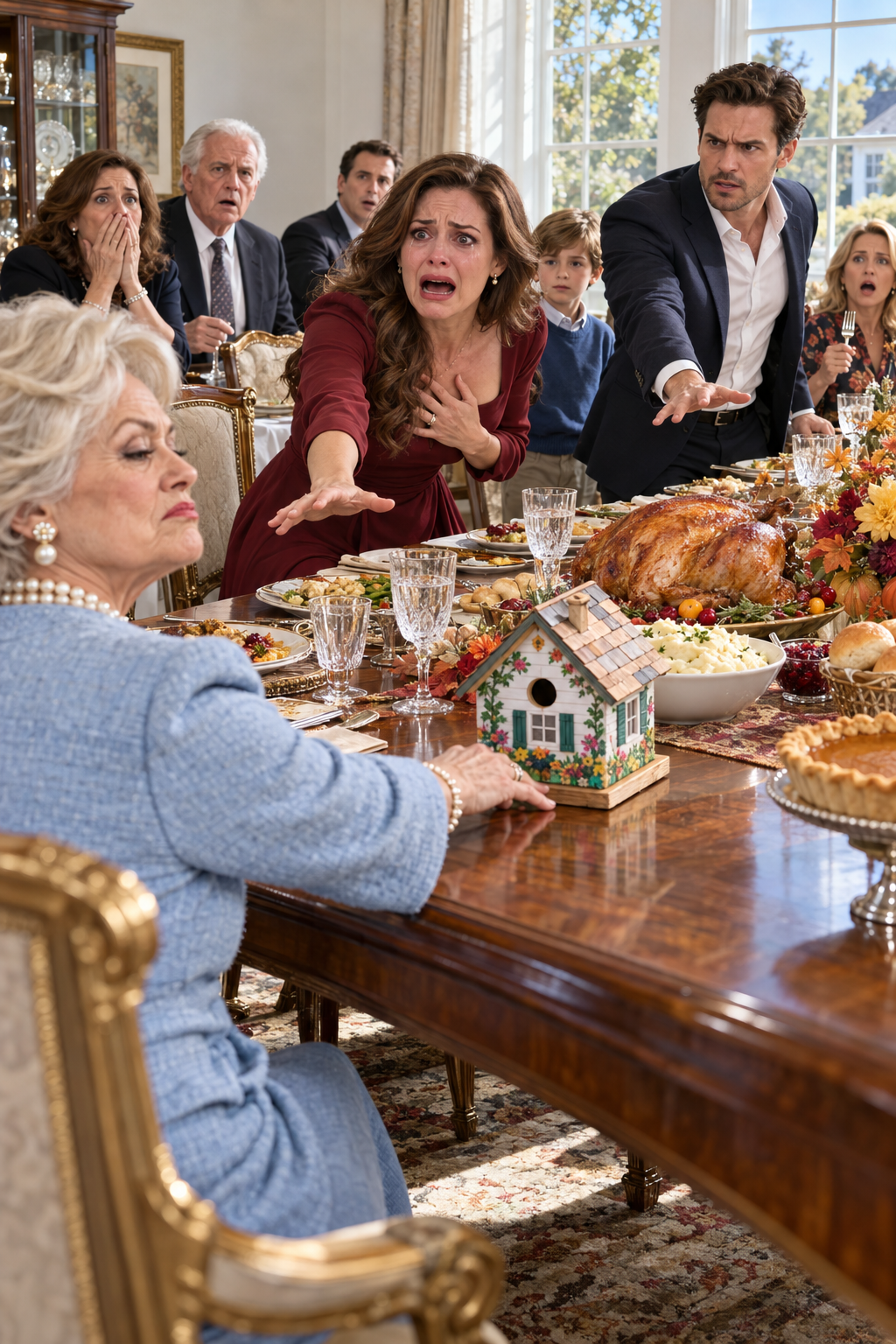
At Thanksgiving Dinner, My 8-Year-Old Son Gave My Mom A Birdhouse He Painted To Look Like Her House. She Handed It Back And Said, “Give It To Someone Who Wants it.” The Table Went Quiet. My Wife’s Eyes Filled Up. I Put Down My Fork And Said, “Say Goodbye To Grandma, Buddy. It’s The Last Time.” We Drove Home In Silence. 3 Weeks Later…
Three weeks after my mother humiliated my eight-year-old son at Thanksgiving, my sister pushed a property-transfer document across our mother’s kitchen table and demanded that I sign the house back to her. I told her I couldn’t. I’d sold it that morning. My mother called me cruel, my sister threatened legal action, and my husband stood beside me without saying a word. Then a folder slipped from my brother-in-law’s hands, revealing a plan that had been made months before Thanksgiving—and a future for my mother that nobody had bothered to tell her about.
## Part 1: The Thanksgiving Gift That Changed Everything I Believed About Family
My name is Mara Collins, I’m forty-five years old, and I teach construction trades at a public high school in Henderson, Kentucky. I’ve spent nineteen years showing teenagers how to make things with their hands, which means I’ve also spent nineteen years learning that the most important part of teaching isn’t explaining how something works. It’s recognizing when someone has put everything they have into a project and is waiting to find out whether anybody noticed. I understood that perfectly well in my classroom, but somehow, when it came to my own family, I kept forgetting it.
My husband, Matt, works as an equipment technician for a regional hospital, and we have one son, Eli, who turned eight that October. We spent almost a decade trying to have a child, and when Eli finally arrived, he seemed determined to make up for every quiet year we’d spent waiting. He talks while eating, while drawing, while brushing his teeth, and occasionally in his sleep, although Matt insists that last part comes from my side of the family. He can explain the differences between six kinds of woodpeckers but still forget where he left his sneakers twenty minutes earlier.
In early September, Eli announced that he wanted to make his grandmother something special for Thanksgiving. My mother, Beverly, was seventy-four and lived in a yellow ranch house on Sycamore Lane, the same house where my sister and I had grown up. Eli had decided to build her a birdhouse, but not an ordinary one with a triangular roof and a round opening. He wanted a miniature version of her actual home, down to the green shutters, the crooked mailbox, and the porch swing my father had installed thirty years earlier.
For the next two months, Eli spent nearly every Saturday morning in my garage workshop, standing on a wooden platform so he could reach the workbench. He measured photographs of the house, asked me to explain roof angles, and carefully sanded pieces of pine until their edges were smoother than anything my high school students usually submitted. Matt helped him paint the siding, though Eli insisted the yellow needed a little gray mixed into it because Grandma’s house looked different on cloudy days. His favorite detail was the porch swing, which he made from three tiny strips of wood suspended on lengths of silver jewelry wire.
One afternoon, I found him studying the little swing with his face inches from the workbench. When I asked what was wrong, he said, “Grandpa Warren used to sit there, right? I want Grandma to remember him when she sees it.” My father had died six years earlier, when Eli was still a toddler, but we’d told him so many stories about Warren Collins that he sometimes spoke about the man as though they’d spent whole summers fishing together. I kissed the top of his head and told him his grandfather would have loved the birdhouse, although I couldn’t have imagined how much that answer would matter later.
There were signs that my mother might not appreciate the gift, and I need to admit that now. She had missed Eli’s last three birthday parties, claiming that children’s voices gave her headaches, but she’d traveled to Indianapolis twice to watch my sister’s son play baseball. Her refrigerator displayed photographs of Nicole’s children, Wyatt and Clara, arranged in neat overlapping rows, while Eli’s school pictures remained in the envelopes I’d mailed. At Easter, she’d offered him fifty cents for every ten minutes he could sit without speaking, and when Matt objected, she said she was only teaching him manners.
I’d dismissed those incidents because I didn’t want to believe what they suggested. Beverly had always preferred my younger sister, Nicole, whose expensive clothes, polished manners, and impressive office job matched the life our mother liked to describe to strangers. I was the daughter who came home with sawdust in her hair, repaired the leaking kitchen faucet, and handled the household problems nobody else wanted. Somehow, I’d convinced myself that a grandmother might favor one daughter without letting that favoritism reach the grandchildren.
Thanksgiving arrived cold and bright, with frost still clinging to the grass when we pulled into Mom’s driveway. Nicole’s silver SUV was already parked beside Aaron’s pickup truck, and through the dining room window I could see her children sitting at the table with their phones. My mother opened the door wearing the pearl earrings Dad had given her on their twenty-fifth anniversary. She hugged Matt, touched Eli’s shoulder, and immediately asked whether we’d brought the sweet potato casserole.
Eli carried the wrapped birdhouse himself, refusing every offer of help. We’d used brown paper printed with little pumpkins, and he’d written “For Grandma, Love Eli” across the top in letters that leaned downhill. Inside, Nicole was busy photographing the hallway with her phone while Aaron stood in the back bedroom tapping a knuckle against the wall. When I asked what they were doing, Nicole said, “Just getting ideas for when Mom finally decides to update this place,” and changed the subject before I could ask another question.
Dinner proceeded with the ordinary tension I’d learned to mistake for family tradition. Mom complimented Nicole’s new haircut, asked Wyatt about baseball, and listened attentively while Clara described a school trip to Washington. When Eli started explaining how he’d found a caterpillar on our garage door, she interrupted to ask Matt whether the hospital was still hiring maintenance workers. I watched my son close his mouth, drink some water, and stare at his plate until the conversation moved somewhere he felt safe joining again.
He lasted until the plates were cleared before bringing his present from the living room. “Grandma, I made this for you,” he said, standing beside her chair with the package held carefully against his chest. “Mom helped with the cutting, and Dad helped paint, but I did most of the little parts myself.” Beverly looked at the package, sighed as though someone had given her another chore, and said, “Well, let’s see what all this fuss is about.”
Eli unwrapped it slowly, explaining each feature as the little house emerged. He showed her the crooked mailbox, the green shutters, the tiny porch railing, and finally the swing suspended beneath the roof. “That’s Grandpa’s swing,” he said proudly, pointing with one finger so he wouldn’t break it. “I made it move, see, and I thought you could hang it in the maple tree so the birds would have a house just like yours.”
My mother picked it up, turned it once, and examined the underside without smiling. Then she pushed it back into his hands and said, “Eli, I don’t need another thing cluttering up my yard, and I certainly don’t need something that attracts birds to the porch.” My son stood completely still, the birdhouse resting against his sweater, while she reached for her coffee cup. Then she glanced at me and added, “Mara, you really ought to teach him that not everybody wants to hear a twenty-minute explanation about everything.”
Nobody defended him. Nicole lowered her eyes toward her napkin, but I saw the small smile she tried to hide, while Aaron suddenly became fascinated with the leftover turkey. Matt’s hand tightened around mine beneath the table, and Eli looked at me with an expression I recognized from the classroom: the terrible uncertainty of a child wondering whether the thing he’d been proudest of was actually something shameful. I pushed my chair back, stood, and told him to put on his coat.
Mom looked offended before she even understood what was happening. “Don’t be ridiculous, Mara,” she said. “It’s Thanksgiving, and I haven’t done anything except tell the boy the truth.” I gathered our dishes into the kitchen, took Eli’s coat from the closet, and answered, “You didn’t have to love the gift, Mom, but you could have treated the person who made it like he mattered.” She rolled her eyes, and when I said we wouldn’t be returning for another holiday, she laughed.
We drove home without turning on the radio. Halfway there, Eli asked whether he’d talked too much, and Matt immediately told him that his excitement wasn’t something he needed to apologize for. Eli stared through the window at the lights coming on along the highway before asking a quieter question. “If Grandma doesn’t want the little house,” he said, “does that mean she doesn’t want me visiting the big one?”
I couldn’t answer without crying, so I concentrated on the road until we reached our driveway. That night, Eli placed the birdhouse on his dresser beside his favorite dinosaur and told us he’d keep it safe in case Grandma changed her mind. After he fell asleep, I sat at the kitchen table with Matt, looking at the property-tax statement I’d brought home from the mailbox that afternoon. It was addressed to me, as it had been every year since my father died, because the house where my mother had just humiliated my son wasn’t legally hers anymore.
## Part 2: The House I Saved and the Family Debt Nobody Acknowledged
To understand why that tax statement mattered, you have to understand what happened when my father died. Warren Collins worked for more than three decades maintaining machinery at a manufacturing plant along the Ohio River, and he believed a properly repaired object should last longer than the person who repaired it. He taught me to sharpen tools, fix broken cabinet hinges, and listen for trouble inside an engine before the warning light came on. What he never taught me was how to say no when somebody in the family asked for more than I could afford to give.
Dad died on a rainy Tuesday in March, six years before that Thanksgiving. The funeral was crowded with former coworkers, neighbors, church friends, and men who’d borrowed tools from him and forgotten to return them. Nicole arrived in a black designer coat, cried beautifully through the service, and left early because Wyatt had a baseball tournament that weekend. I stayed with Mom afterward, helping her sort insurance forms, pension statements, hospital bills, and the paperwork Dad kept in a metal filing cabinet beneath his desk.
That’s when I discovered the house was in serious financial trouble. There was a substantial mortgage balance, along with a second loan secured against the property, and the payment schedule was more than Mom could manage on her reduced household income. Dad had borrowed money years earlier to help pay for Nicole’s elaborate wedding, then borrowed again to contribute to the down payment on the house she and Aaron bought outside Evansville. He’d kept the loans current while he was alive, but his death left Mom facing payments she couldn’t sustain.
I remember spreading the statements across her kitchen table and asking why nobody had told me. Mom picked at the corner of a tissue and said, “Your father wanted Nicole to have a good start, and we figured you’d understand.” When I asked whether Nicole knew where the money came from, she said it didn’t matter because the wedding was over and the house had already been purchased. I called Nicole that evening, and she sounded genuinely irritated that I was bringing up financial arrangements she’d considered settled years before.
At the time, Matt and I had nearly ninety-five thousand dollars saved toward a larger home. Eli was two, our bungalow had one bathroom, and the tiny second bedroom barely accommodated his crib, a dresser, and a laundry basket. We’d been imagining a place with a backyard big enough for a swing set and a garage where I could build without moving the lawn mower first. Instead, after several conversations with a lender and a real-estate attorney, I used almost all that savings to purchase Mom’s house and clear the outstanding debt.
The final amount, including the required closing expenses, was just over ninety-one thousand dollars. Mom received independent advice, signed the deed herself, and agreed in writing that she could continue living there rent-free unless the arrangement was ended with proper notice. Our attorney, Susan Keene, insisted on explaining the agreement to Mom without me in the room so nobody could later claim she hadn’t understood what she was doing. When we finished, Mom hugged me in the driveway and told me Dad would have been grateful that I’d kept the family home.
For six years, I paid the property taxes, insurance, and major repair bills. I replaced a failing water heater, repaired the porch supports, and spent one miserable August weekend on the roof with two former students after a windstorm tore loose half the shingles. Nicole occasionally brought Mom flowers, took her out for lunch, or posted a photograph online calling her the strongest woman she knew. I didn’t mind the flowers, but I did notice that they always arrived after I’d finished something expensive.
Matt rarely complained, although the house caused arguments between us that I wasn’t proud of. When our own furnace needed replacing, we postponed it until we could afford a payment plan because I’d already spent that month’s extra money fixing Mom’s plumbing. When Eli asked why he couldn’t have the treehouse we’d talked about building, I told him we’d do it next summer, even though I knew next summer would bring another insurance premium and another stack of property expenses. Matt finally asked me one evening whether my mother had ever offered to pay even part of the taxes, and I changed the subject because I knew the answer.
There was another side to the arrangement that bothered me more as Eli grew older. Mom had begun describing the house as something I controlled rather than something I’d rescued, particularly when Nicole was visiting. Once, at a church picnic, I overheard her tell a neighbor that Mara handled the paperwork because Warren had always trusted her with financial details. That was true in the narrowest possible sense, but it left out the fact that I’d purchased the property with money our own family needed.
I had never corrected her publicly. It seemed petty to discuss mortgages beside a table of potato salad, and I believed that keeping Mom comfortable was more important than making sure everyone knew who paid for it. Nicole took advantage of that silence, occasionally suggesting that I should consult her before arranging repairs or changing anything in the house. She acted as though my ownership were a temporary administrative inconvenience rather than the legal result of a decision Mom had made with full knowledge.
Looking back, I can identify several moments when Nicole’s interest became something more calculating. That summer, she’d asked whether the house had ever been formally appraised and whether the property taxes were based on its current value. In October, Aaron mentioned that he’d been looking into what older houses in Mom’s neighborhood were selling for, then laughed when I asked why. On Thanksgiving morning, Nicole took pictures of the bedrooms, and Aaron knocked on walls while discussing how difficult it would be to remove one between the kitchen and dining room.
I hadn’t connected those details because I was concentrating on dinner and Eli’s present. Afterward, sitting beside Matt in our kitchen, I began remembering all of them in a different order. Nicole had once told me that a family home should eventually pass to the child who would make the best use of it, a strange remark considering she already lived in a four-bedroom house. When I’d asked what she meant, she’d simply said that Mom’s place had possibilities.
On Friday morning, Mom called before I left for school. She didn’t ask how Eli was feeling or whether he’d been upset by her rejection; she wanted to know when I intended to apologize for making her look bad in front of Nicole’s family. I explained that we wouldn’t be apologizing, and that Matt and I were taking a break from family gatherings until she could acknowledge how she’d treated Eli. She responded by reminding me that she was my mother and saying children needed correction before the world became too difficult for them.
I asked whether she had ever considered that Eli might someday stop wanting to visit her. She said, “He’ll get over it if you quit making such a production out of everything,” and ended the call before I could respond. During my second-period class, a student named Ryan spent fifteen minutes showing me the bookcase he’d designed for his younger sister, nervously explaining why the shelves weren’t perfectly even. I praised the care he’d put into the project and watched his shoulders straighten, then had to step into the supply room because I couldn’t stop thinking about Eli’s face at Thanksgiving.
Nicole called Saturday afternoon with a different argument. Mom was elderly, she said, and I was punishing her over something too small to remember a year from now. When I reminded Nicole that Eli had spent two months building the birdhouse, she replied that eight-year-olds were naturally dramatic and that Matt had probably encouraged him to take offense. I told her the conversation was over when she started criticizing my husband, but afterward I stood in the garage staring at my tools and realized that every explanation my family offered depended on Eli accepting humiliation quietly.
Sunday evening, Matt found me sitting on an overturned paint bucket with the house’s old closing documents spread across my workbench. He looked through them without touching anything and asked whether I was thinking about ending Mom’s living arrangement. I said I couldn’t imagine another ten years of keeping the house running while my child was treated like an unwanted guest inside it. Matt sat beside me for a long time before saying, “Then we need to decide what protecting our son actually requires, instead of waiting for your mother to become someone else.”
I remembered something a neighbor had said during the previous summer. Daniel Shaw, who lived two houses down from Mom with his wife, Tessa, and their son Milo, had mentioned that they hoped to buy a larger place in the neighborhood someday. He particularly loved Mom’s yard, with its mature maple tree and the old swing facing the street. On Monday morning, before my first class, I found his number in my phone and asked whether he and Tessa were still interested in buying a house.
Daniel went quiet for several seconds, then asked if I was talking about the yellow one on Sycamore Lane. I told him I was, but that I needed to speak with my attorney before making any promises. He said they’d already been discussing selling their small place and had a mortgage preapproval from their credit union. When I hung up, I understood that the decision I’d made to protect Eli could change far more than our holiday plans—and I was no longer certain my mother was the only person with plans for that house.
## Part 3: My Decision to Sell Exposed the First Cracks in Their Plan
Susan Keene remembered my mother’s property without needing to open the file. She remembered the afternoon Beverly had insisted on bringing homemade lemon cookies to the closing, the questions she’d asked about insurance, and her determination to remain in the house for as long as she wanted. Susan had insisted then, as she reminded me now, that the occupancy arrangement was not a lifetime right to the property. Still, she warned that ending it required careful notice, compliance with the applicable law, and enough time for Mom to make reasonable arrangements.
I explained what had happened at Thanksgiving, expecting Susan to tell me I was making an emotional decision about something far too important. Instead, she asked whether I’d been considering selling before the holiday and whether Matt understood the financial consequences. I admitted that we’d occasionally discussed selling because the maintenance costs were becoming difficult, but I hadn’t seriously entertained the idea until Eli came home believing his grandmother disliked him. Susan listened without offering approval, then told me something I wrote down afterward: “You can have a good reason for making a decision and still need to carry it out responsibly.”
That afternoon, I called Daniel and Tessa Shaw and arranged to meet them at their house. Their kitchen was cramped, with a washing machine visible through the doorway and school backpacks hanging from every available chair. Milo and Eli were in the living room constructing a complicated railway from wooden blocks, stopping occasionally to argue about whether a bridge could support two trains at once. Tessa explained that they’d wanted to stay on Sycamore Lane for years because Milo loved his school and the neighborhood felt like the place where they wanted him to grow up.
I’d obtained a recent market analysis before our meeting, and we discussed the house’s condition, necessary repairs, and a price of $174,000. Daniel didn’t negotiate aggressively, which made me respect him more, but he did ask whether Mom was aware that I planned to sell. I said she wasn’t yet, and explained that any agreement would include a possession date after the holidays, provided the occupancy was properly ended. Tessa looked worried for a moment, then said they didn’t want to take part in forcing an elderly woman out without adequate notice or alternatives.
Neither did I. I had no intention of arriving with a moving truck on Christmas Eve, nor was I interested in punishing Mom through homelessness or financial hardship. Susan helped me prepare a formal notice, confirmed the required procedure, and advised me to offer Mom information about available apartments without assuming that she would accept help. We scheduled the sale for December 18, with the Shaws agreeing to take possession on January 2 only if the property was legally vacant and the transaction could proceed as planned.
Before serving the notice, I called Mom and asked whether we could talk privately. She said Nicole was coming over later, so I would need to hurry, and that small detail irritated me more than it should have. For years, I’d been welcome whenever something needed fixing, but apparently a conversation about the home I’d purchased had to fit around my sister’s social calendar. I drove over with the documents in a folder and found Mom standing on the porch beneath the old swing, wearing a quilted housecoat and the expression she used when someone knocked during her favorite television program.
I told her plainly that I was selling the house and that her occupancy would end after the required notice period. She stared at the paper, then laughed as though I’d read her a joke from a newspaper. “You wouldn’t put your own mother out of the house your father loved,” she said, and I answered that I wasn’t asking her to leave immediately, but I would no longer own and maintain the property. She pushed the notice against my chest and declared that Nicole would never let me get away with it.
The words stayed with me as I drove home. She hadn’t said she would seek advice, find an apartment, or ask what the sale meant for her finances. Her first instinct was to invoke Nicole, as if my sister possessed some authority neither the deed nor the occupancy agreement gave her. That evening, Nicole called and accused me of taking advantage of Mom’s grief, a peculiar argument considering six years had passed since Dad’s death and Mom still attended church, traveled, managed her banking, and volunteered at the library.
I told Nicole she was welcome to invite Mom to live with her. She immediately said that wasn’t the point, then explained that Aaron worked from home, Wyatt needed a quiet place to study, and Clara couldn’t possibly share a bedroom. I reminded her that Mom could comfortably afford a one-bedroom apartment with her Social Security and Dad’s survivor benefits. Nicole responded that my financial calculations were nobody’s business, which seemed an odd position for someone insisting I continue paying another person’s household expenses.
Over the next week, Susan handled the paperwork while Daniel’s lender accelerated the appraisal and underwriting process. I agreed to a professional inspection and gave the Shaws access whenever the necessary notice could be arranged. Mom refused my calls but sent a text announcing that Christmas dinner would be at her house as usual, adding that Eli was welcome provided he could behave appropriately. Matt read the message over my shoulder and quietly asked whether she understood that there might not be another Christmas dinner in that dining room.
I replied that we wouldn’t be attending. Ten minutes later, Mom wrote that Nicole believed I was bluffing and would eventually calm down. I put the phone away because I could feel myself slipping into an old habit: wanting to explain the same facts until my mother finally admitted I was right. That evening, Eli asked whether Grandma would be sad to leave the yellow house, and I told him she probably would, because people can be hurt by consequences even when those consequences follow their own choices.
He considered that while arranging small wooden animals across the kitchen floor. “Are you selling it because she didn’t like my birdhouse?” he asked, and the directness of his question made me pause. I explained that I wasn’t selling a house because of a present; I was ending an arrangement that had become unhealthy for our family, and the birdhouse had helped me see that. He nodded without looking convinced, then asked whether I was going to make Grandma apologize.
I told him no. An apology forced out of someone who didn’t believe it would only teach him to accept the right words without the right behavior. I said Grandma was responsible for deciding whether she wanted a relationship with him, just as we were responsible for making sure he was treated respectfully. He thought about that for a moment and went back to his animals, but later Matt told me Eli had asked whether a person could love somebody and still not want to visit them.
The next afternoon, a strange text arrived from Aaron. We rarely communicated except about football scores or instructions for repairing something at Nicole’s house, yet he suddenly wanted to know who had handled the original closing when I bought Mom’s property. I asked why he needed that information, and he replied that he was checking something for Beverly. When I called Susan, she advised me not to discuss title details informally and assured me that the recorded deed clearly established my ownership.
That reassurance helped, but Aaron’s question unsettled me. Nicole had spent years acting uninterested in the legal arrangements surrounding the house, and now her husband was suddenly researching a transaction completed long ago. I wondered whether they intended to challenge the sale, and whether Mom had given them a version of events that made such a challenge seem reasonable. Whatever they were planning, it had started before I’d delivered the notice, and I was beginning to understand that Thanksgiving might have exposed a conflict already developing beneath the surface.
## Part 4: The Photographs and a Secret Will Revealed Who Expected to Profit
The inspection took place on a gray Friday afternoon, with cold wind pushing dead leaves across the driveway. Mom stood on the porch when I arrived, wearing her church coat and holding the door handle as though she could physically prevent the sale by refusing to move. The inspector, a broad-shouldered man named Curtis who had worked in the county for nearly thirty years, politely explained why he needed access. Mom told him the house wasn’t available, and he looked at me until I produced the purchase agreement and confirmed that I’d arranged the inspection with proper notice.
Inside, I followed Curtis through rooms that seemed smaller than they had when I was growing up. The kitchen still had the faded blue curtains Mom had sewn in the eighties, and the dining room still carried the faint smell of lemon furniture polish. Upstairs wasn’t a problem because the house had only one level, but Curtis found minor moisture damage beneath a bathroom window and an old electrical outlet that needed replacing. I agreed to address both issues before closing, relieved that the major systems were sound and the roof I’d helped install was holding up well.
While Curtis worked, Eli played with Milo in the Shaws’ yard. Mom watched the boys through the living room window, then closed the curtains when Eli noticed her and raised his hand. I saw the movement from the hallway and felt an unpleasant mixture of anger and embarrassment, the kind that comes when someone behaves so badly you wish you could explain it away before anybody else sees. Later, as we drove home, Eli asked why Grandma wouldn’t wave back, and I had to admit that I didn’t know.
He surprised me by saying he wasn’t angry anymore. “Milo says I can help him build a bird feeder when they move,” he explained, leaning against the seat belt. “He says he likes it when I tell him stuff because sometimes he doesn’t know the answers.” I smiled and asked whether the boys had decided where to hang it. Eli said they wanted the maple tree, the same tree he’d originally imagined for Grandma’s miniature house, and I suddenly understood how much he’d still been hoping she would change her mind.
That Sunday, Matt found something on Nicole’s social media page that stopped us both. It was a post dated November 30, three days after Thanksgiving, showing photographs of Mom’s hallway, bedrooms, bathroom, and porch. Beneath them, Nicole had written about exciting changes coming in the new year and how wonderful it would be to give her children a chance to grow up in the house where she’d spent her childhood. Dozens of relatives and family friends had congratulated her, apparently believing that Mom was giving her the property.
One woman from Mom’s church had written that Beverly must be thrilled to know the family home would stay with Nicole. Nicole had replied that the house was exactly where Dad would have wanted her children to grow up. Matt scrolled through the photographs and recognized several as the ones she’d been taking while we prepared Thanksgiving dinner. I remembered Aaron knocking on the back bedroom wall and Nicole mentioning that a bigger dining table would be necessary next year.
There was something almost unbearable about the timing. Eli had been carefully wrapping a miniature version of the house while my sister was apparently planning how her family would occupy the real one. Mom had watched both things happen under the same roof, and she’d treated my son’s offering as an inconvenience while encouraging Nicole’s expectations. I took screenshots of the post and comments, not because I wanted a public argument, but because I could already imagine the story changing once Nicole understood that the sale was real.
On Monday morning, I called Mom before school. I asked whether she had promised Nicole the house, and after a long silence, she admitted that she’d written a new will in September. She’d attended an inexpensive estate-planning workshop, filled out the forms, and left the house to Nicole because, in her words, “Your sister has children to think about.” When I reminded her that I had a child, too, she said Nicole had two children and needed more room.
I explained that she couldn’t leave Nicole something she didn’t own. Mom said she understood how the paperwork looked but believed there ought to be a way for the family to honor Dad’s intentions instead of hiding behind legal technicalities. I asked whether she’d told Nicole that the property belonged to me and that the original deed wasn’t temporary. She hesitated, then said she’d assumed I would eventually transfer it back once she felt financially secure.
That was the first time I’d heard such an explanation. When I purchased the house, we’d discussed her living there rent-free and my responsibility for maintaining it, but nobody had ever mentioned transferring ownership back. I reminded Mom that the agreement existed in writing and that she had never once asked about purchasing the property from me. She answered, “I didn’t think a daughter would need to be asked to do what’s right,” which told me we weren’t going to reach an understanding that morning.
After school, I stopped at Susan’s office with the screenshots and a copy of the will Mom had agreed to show me. Susan read it carefully and explained that the document could express my mother’s wishes, but it couldn’t transfer ownership of property she no longer held. She also warned that Nicole might try to make the situation look like an inheritance dispute rather than an ordinary sale by the recorded owner. I asked whether that was likely to succeed, and Susan said nothing we’d reviewed supported such a claim, although she wouldn’t promise that an angry relative couldn’t create trouble.
The legal answer was reassuring, but the emotional meaning was much harder to digest. Mom had accepted six years of financial security while privately imagining a future in which I’d hand everything back, allowing Nicole to inherit the property without paying for it. That arrangement would have left me responsible for the years of repairs and taxes while giving my sister the benefit of the house. It also meant Mom’s rejection of Eli’s gift had taken place after she’d already chosen which grandchildren she believed deserved the real home.
That evening, Nicole called with a tone so gentle I almost didn’t recognize her. She said we’d all become unnecessarily stubborn, that Mom was miserable, and that Christmas could still be wonderful if I stopped turning a small family disagreement into a financial dispute. Then she suggested a solution: transfer the house into Mom’s name, withdraw from the sale, and allow Beverly to decide what happened to it later. She described this as restoring harmony, though she sounded much more interested in the deed than in whether she’d hurt my son.
I asked what would happen if Mom’s will left the house to her. Nicole paused before saying that inheritance wasn’t something decent families discussed while their parents were alive. I reminded her that she had publicly announced plans to move her children into the house, and that photographs from Thanksgiving were still visible on her page. She replied that she was simply excited about the possibility of keeping Dad’s memory alive, then accused me of twisting her words because I was jealous of her relationship with Mom.
After the call, I went out to the garage and found Eli sanding a small wooden box he’d started for Matt. He was humming quietly, the concentration on his face reminding me of the weeks he’d spent making the birdhouse. I wondered how many afternoons I’d sacrificed with him because I was busy fixing something for a mother who would gladly have given the benefit of my labor to somebody else. Matt came outside and stood beside me, and for the first time, I admitted that I was afraid selling the house might not undo the years of damage.
The following morning, Susan forwarded an email from the title company confirming that the required documents were in order and the Shaws’ financing was on schedule. Closing was now three days away, and I was starting to feel the strange exhaustion that follows a decision you’ve postponed for years. Then Daniel called to ask whether I’d authorized a woman to photograph the house for a contractor’s remodeling estimate. I hadn’t, but he said Nicole had been standing in the driveway with a man carrying architectural drawings and telling him the property would soon be back in the family.
I called Nicole immediately, but she didn’t answer. Instead, Aaron sent a message saying they were only exploring their options and that I should think carefully before making an irreversible mistake. I looked at the signed purchase agreement on my desk and wondered how far they’d go to preserve a future that depended on taking something from me. By that evening, I knew the sale might end our financial relationship, but I no longer believed it would end the fight.
## Part 5: Three Weeks Later, My Sister Demanded a House Already Sold
The night before closing, I barely slept. Matt lay beside me listening to the rain against our bedroom window, occasionally reaching over to squeeze my hand when I shifted beneath the blankets. Around two in the morning, I admitted that part of me still wanted Mom to call and say she’d made a terrible mistake with Eli, even though that apology wouldn’t change the property transaction. Matt told me it was possible to grieve the mother I’d wanted while recognizing the limitations of the one I actually had.
At breakfast, Eli asked whether the yellow house would belong to Milo’s family before he returned to school after Christmas. I explained that the papers would be signed that morning, but Grandma would have time to move before the Shaws received the keys. He seemed relieved to hear that nobody would be packing on Christmas Day, then asked whether he could still visit the maple tree after Milo moved in. I told him the Shaws had already invited us over, and he smiled for the first time that morning.
The closing took place downtown in a narrow office with beige walls, framed photographs of old Henderson, and a coffee machine that produced something closer to warm brown water than actual coffee. Daniel and Tessa arrived carrying a folder full of documents and the nervous excitement of people about to take on the largest financial obligation of their lives. Tessa had brought a photograph of Milo standing beneath the maple tree when he was three, and she showed it to me while we waited for the closing agent. I looked at that picture longer than she probably expected, remembering the years when Eli and Milo had played beneath the same branches while the adults talked inside.
Signing the paperwork was less dramatic than I’d imagined. There were identification forms, tax documents, disclosures, lender instructions, and page after page requiring initials in places marked with little colored tabs. Nobody gave a speech or acknowledged that the transaction represented the end of a lifelong family arrangement. When the closing agent confirmed the sale was complete, Tessa covered her mouth and started crying, and Daniel thanked me with both hands wrapped around mine.
They asked whether I was sure I wouldn’t regret it. I told them I might regret some of the circumstances, but I didn’t regret selling to a family that genuinely wanted to live there. We confirmed the final arrangements for possession and agreed I’d return the following week to make sure the minor inspection repairs were completed. Before leaving, Tessa asked whether I’d be willing to show Milo how to maintain the porch swing, and I told her Dad would have liked knowing it would still be used.
The money from the sale went into the account Susan had advised me to use while we worked through the tax and financial implications. Matt and I planned to restore our depleted emergency savings, put money aside for Eli’s education, and finally consider buying a home that suited our own family. I didn’t feel rich sitting in my truck afterward, only relieved that a monthly responsibility I’d carried for years had finally reached its endpoint. The relief lasted until I saw four missed calls from Nicole and a message saying she and Mom needed to see me immediately.
I called Susan before driving to Sycamore Lane. She reminded me that the sale was complete, that Mom’s occupancy still had to be handled according to the established agreement, and that I shouldn’t sign or promise anything under pressure. I said I only intended to tell Mom the transaction had closed and make sure she understood her remaining options. Susan asked me to call if anyone threatened legal action, then wished me a peaceful Christmas with a tone that suggested she knew how unlikely that was.
Nicole’s SUV was parked in Mom’s driveway beside Aaron’s truck when I arrived. Through the kitchen window, I could see all three of them sitting at the table, with papers spread between the sugar bowl and a plate of untouched cookies. Mom opened the door but didn’t move aside immediately, forcing me to ask whether I could come in. She finally stepped back and said, “I hope you’ve had time to think about what you’re doing to this family.”
I followed her into the kitchen, where Nicole stood beside a chair and Aaron closed his laptop. On the table lay an ordinary-looking property-transfer form, a yellow legal pad covered in figures, and several documents held together with metal clips. Nicole pointed toward the empty chair across from her and said she’d spoken with someone who believed we could resolve everything without going to court. I remained standing and explained that the Shaws had purchased the house that morning.
Nicole stared at me as though I’d spoken in another language. “You actually went through with it?” she asked, and I told her the deed had been signed and the transaction completed. Mom gripped the back of her chair, while Aaron’s expression changed from irritation to something more worried. Nicole immediately said that no reputable title company would allow a daughter to dispose of her elderly mother’s home without asking questions.
I explained, again, that the house had legally belonged to me for six years. Aaron interrupted to say Mom had been grieving when she signed the original deed and might not have understood the consequences. I reminded him that an attorney had explained the arrangement independently, that the transaction had been recorded, and that Mom had never disputed my ownership while I was paying the taxes and repairs. Nicole shook her head and said ownership wasn’t the same thing as moral entitlement.
Then she pushed the transfer document toward me. She’d filled in Mom’s name as the recipient and mine as the person surrendering ownership, leaving only my signature and the execution details incomplete. “Three weeks ago, we were having a normal Thanksgiving,” she said, “and now you’re destroying everything because a little boy couldn’t handle being told no.” I looked at the paper, then at her, and explained that even if I’d wanted to sign it, I no longer owned the property.
Nicole insisted there must be a way to reverse the sale before the Shaws moved in. Aaron mentioned challenging the earlier transfer, suggesting improper influence and unfair financial advantage, but he became noticeably quieter when I told him Susan Keene had advised Mom during the original transaction. I asked what attorney had prepared the document on the kitchen table, and Nicole admitted she’d downloaded a template after consulting someone who handled estate paperwork. I suggested she have a qualified attorney review it before using it for anything else.
Mom finally spoke. “Your father would be ashamed to see his house handed over to strangers,” she said, looking toward the hallway where his photograph hung beside the thermostat. I wanted to tell her about the money he’d borrowed, the account we’d emptied, the weekends Matt had sacrificed, and the house our own son had never been able to have. Instead, I told her Dad had taught me that promises should mean something, and I’d honored my promise to keep her safe in that house for six years.
Nicole interrupted with a sharp laugh. She said I was exaggerating my generosity because I’d purchased a valuable property cheaply and was now profiting from its appreciation. I acknowledged that the house had increased in value, but reminded her that buying it had also meant carrying the financial risk, expenses, and responsibility for years. She replied that I’d never have gotten the opportunity if Mom hadn’t trusted me, as though the bank would have allowed us to replace its mortgage with Nicole’s good wishes.
I placed a folder on the table containing the apartment listings I’d researched with Susan’s help. They included several ground-floor units, one-bedroom apartments in a senior community, and a smaller independent-living development near Mom’s church. None required Mom to share a room or depend financially on anybody, and her monthly income would cover the rent and ordinary expenses. I offered to pay for a professional mover as a final courtesy, provided she agreed on a date and stopped involving Eli in the dispute.
Mom studied the listings without picking them up. “Nicole said I could stay with her while we sorted things out,” she murmured, turning toward my sister. Nicole’s face tightened, and she said that wasn’t exactly what they’d discussed because Aaron needed his home office and the children were accustomed to having separate rooms. Mom looked surprised and reminded Nicole that she’d talked about the family being together again in the yellow house. Nicole glanced at Aaron, who suddenly became very interested in the documents in front of him.
I asked Nicole where she’d expected Mom to live while her family occupied the three-bedroom ranch. She said they had been discussing several possibilities and that I was making everything unnecessarily complicated. Mom repeated that Nicole had promised they could all live together, and I could hear the first trace of fear beneath her irritation. Aaron shifted the thick folder he’d been holding and began straightening its contents against the edge of the table.
As he tapped the folder, a glossy pamphlet slipped free and slid across the tablecloth, landing beside Mom’s coffee cup. It showed a bright building surrounded by landscaped gardens, with an elderly woman smiling beside a nurse beneath the words “Riverbend Gardens Senior Living and Memory Support.” A handwritten note was attached to the cover, listing a January tour, an expected move-in date, and instructions about preparing the yellow house for sale. Mom picked it up, read the note twice, and asked Nicole a question that made the room go completely silent.
“Why does this say I’m going to memory care?”
## Part 6: The Hidden Retirement Plan Exposed My Sister’s Real Motive
Nicole reached for the brochure, but Mom pulled it away before her fingers touched the paper. She examined the glossy photographs of bright lounges, landscaped courtyards, and elderly residents sitting around tables, then turned to the printed description of the memory-support program. Her glasses had slipped halfway down her nose, and for a moment she looked less like the commanding woman who’d run every family holiday than someone who’d wandered into the wrong waiting room. “I don’t have trouble remembering things,” she said, quietly enough that I almost didn’t hear her.
Nicole immediately changed her voice. She began speaking slowly and gently, the way she’d spoken to Eli when he was younger and she wanted to stop him from asking questions. She explained that Riverbend Gardens offered several levels of accommodation, that the memory-support program was only one option, and that plenty of healthy older people chose to live there because they enjoyed having meals and transportation provided. When Mom asked why her name was written beside a January move-in date, Nicole said they’d only been researching possibilities.
Aaron tried to help by explaining that aging parents sometimes resisted necessary changes because they were attached to familiar surroundings. He said they didn’t want Beverly worrying about home repairs, property taxes, or what might happen if she fell while living alone. I looked directly at him and asked which of those expenses Mom had been responsible for during the previous six years. He stopped talking, and Nicole shot me a furious look because I’d taken away the explanation she’d been preparing.
Mom turned the brochure over and found another handwritten note attached to the back. Nicole had listed estimated sale proceeds, moving expenses, and a figure labeled “Remaining after facility deposit,” with several amounts circled in red. Beside the calculations was a reminder to speak with a real-estate agent about listing the property in March. I watched Mom compare those numbers with the transfer document lying near my elbow, and I could almost see her beginning to understand the sequence.
“Where would you and the children live?” she asked Nicole. My sister explained that she and Aaron had considered moving into the yellow house temporarily while they organized repairs and prepared it for sale. Mom repeated the word “temporarily,” then asked why Nicole’s social media announcement had said she intended to raise her children there. Nicole dismissed that as an expression of affection rather than a literal description of the arrangements.
It was Aaron who finally exposed the financial pressure behind the plan. Mom asked why there was a second set of calculations showing payments to a bank, and he admitted that he and Nicole were dealing with debts they’d expected to refinance the following year. Their first house had been sold, their current mortgage had become expensive after a refinancing decision, and Nicole’s salary was no longer covering the same household expenses it once had. They had counted on the yellow house becoming an asset they could eventually sell, using part of the proceeds for Mom’s care and the remainder to stabilize their own finances.
I asked whether Nicole had ever told Mom that the property wasn’t hers to bequeath. She snapped that everybody knew I held the title, but that families often found ways to transfer assets when circumstances changed. Mom looked between us, visibly struggling to reconcile the inheritance she’d promised with a sale she hadn’t been authorized to arrange. Then she asked Nicole whether the plan had always included moving her to Riverbend Gardens.
Nicole didn’t answer immediately, and I watched her glance at Aaron as though deciding which version would cause the least trouble. Finally, she said, “We thought you’d be happier somewhere with activities and people your own age, and we didn’t want you worrying about the house anymore.” Mom replied that she’d never asked to move and had spent the entire summer planning to repaint her kitchen. Nicole said they would have discussed everything before making a final decision, but the dates on the brochure made that assurance difficult to believe.
I noticed something else in the folder: a printed email from a local contractor dated the week before Thanksgiving. It contained an estimate for replacing the kitchen cabinets, widening a doorway, and removing the small wall between the dining room and back bedroom. Aaron had requested the estimate after describing himself as a future owner helping arrange renovations, although the document made no claim that any work had been authorized. Suddenly, the photographs, wall tapping, and remarks about a larger dining table fitted together with a clarity that left me feeling cold.
Nicole had been planning the home’s transformation while I was still paying to maintain it. She’d made assumptions about my willingness to transfer ownership, then built an entire financial strategy around those assumptions without ever asking me. She’d encouraged Mom to believe Nicole’s inheritance was secure because that belief made Mom easier to persuade. And when I refused, Nicole had tried to turn the argument into a story about a selfish daughter abandoning her elderly mother.
Mom looked down at the brochure again, running her thumb over the photograph of the building. “You said we’d have Sunday dinners together,” she told Nicole, and my sister answered that they still could, no matter where Mom lived. Mom asked whether Nicole had intended to give her a room in the house during renovations, or whether she’d planned for Mom to move directly into Riverbend Gardens. Nicole said it depended on the timing, which wasn’t an answer but revealed more than any direct admission might have done.
I expected Mom to shout. Instead, she placed the brochure on the table and asked Aaron whether he’d helped Nicole calculate how much money would remain after the senior-living expenses. He admitted he’d prepared a few estimates, though he insisted they were only preliminary. Mom stared at him for several seconds before saying she’d spent years describing Nicole as the daughter who was good with money, and she had never imagined that meant Nicole was counting money she didn’t own.
Nicole began crying, which was something she rarely did when she wasn’t certain people were watching. She said she was exhausted from worrying about the future and frightened that one unexpected expense could cost her family their home. She accused me of enjoying her difficulties because she’d always been the successful daughter, then reminded Mom that she’d spent countless hours visiting and helping with appointments. Mom responded that visits weren’t supposed to come with a plan for selling somebody else’s property.
I wanted to feel satisfied hearing her say it, but the truth was messier. My sister had treated my mother the way my mother had treated me: as somebody whose resources could be claimed in the name of family obligation. For six years, Mom had accepted my money while imagining Nicole would inherit the benefit, and Nicole had accepted Mom’s loyalty while making plans that left her with no real choice. I could see how both women had participated in the arrangement, even though only one of them had been aware of the final destination.
Mom stood and told Nicole and Aaron to leave. Nicole protested that she was only trying to help, but Mom repeated herself, pointing toward the kitchen doorway with a trembling hand. Aaron gathered his documents, leaving the brochure where it lay, while Nicole demanded to know what Mom expected her to do about their financial situation now. Mom replied, “You’ll have to figure it out the way Mara figured out how to keep me here.”
After their truck pulled away, Mom sat down slowly and stared at the apartment listings I’d brought. She seemed smaller than she had an hour earlier, though her expression remained stubborn when she finally looked up at me. “I didn’t know about the brochure,” she said, and I told her I believed that, but it didn’t erase the fact that she’d knowingly promised Nicole a house she didn’t own. She opened her mouth to object, then closed it again.
For a few minutes, neither of us spoke. The kitchen clock ticked loudly above the refrigerator, and outside, a delivery van passed with its tires hissing across the wet pavement. Mom asked whether I’d reconsider allowing her to stay if she found a way to put the property back in her name, and I told her the Shaws owned it now. She looked wounded by the answer, as though she was only just beginning to accept that the situation could no longer be repaired through another conversation.
Then she said something I wasn’t prepared for. “Nicole told me years ago that you wanted the deed because you were afraid I’d leave everything to her,” she admitted, looking down at her hands. “She said you were trying to make sure she couldn’t have the house after I died, and I suppose part of me believed it.” I asked why she’d never confronted me about that accusation when she knew I’d used our savings to pay off the mortgage, and she said nothing.
I understood then that my mother’s resentment hadn’t begun at Thanksgiving. It had been growing quietly for six years, nourished by Nicole’s suggestions and Mom’s unwillingness to acknowledge how dependent she’d become on the daughter she considered less successful. I could have spent another hour explaining what was wrong with her reasoning, but I’d already spent too much of my life arguing against stories she preferred to believe. I told her January 2 was still the possession date and that she needed to choose an apartment, then picked up my coat and left.
When I reached the porch, Mom called my name. I turned, expecting her to ask about Eli or perhaps acknowledge what she’d said to him at Thanksgiving. Instead, she asked whether I could still arrange the moving company because she didn’t know how she’d manage the heavy furniture alone. I told her I’d honor that offer if she confirmed the arrangements promptly, but as I walked to my truck, I knew the distance between us wasn’t going to disappear with a moving van.
## Part 7: The Family Stories Collapsed When the Truth Became Public
The first week after closing was quieter than I’d expected. Mom didn’t call, Nicole stopped posting photographs of the house, and Aaron’s only message came through Susan’s office, where he’d apparently asked whether there was any way to challenge the original deed. Susan responded with the transaction records, including the signed disclosures and documentation showing that Mom had received independent advice when she sold the property to me. Nothing further came from Aaron, and I began to suspect that the legal threats had always been intended to frighten me into surrendering something they couldn’t otherwise obtain.
What I hadn’t anticipated was the story circulating among Mom’s church friends. According to a woman named Grace Talbot, who had known our family for nearly thirty years, Mom had been telling people that I took control of her home while she was overwhelmed by Dad’s death. She’d apparently described the original purchase as an arrangement intended to protect the property temporarily, leaving people with the impression that I’d later refused to return what belonged to her. Several church members were now upset to hear that I’d sold the house and required my elderly mother to move after Christmas.
Grace called me on the Monday before the holiday. She was careful at first, asking how Mom was doing and whether I’d found her suitable accommodation, but eventually she admitted that people were concerned about the circumstances. I asked whether anyone had mentioned the mortgage Dad left behind, the money Nicole had received, or the agreement Mom had signed allowing her to live rent-free for six years. Grace went quiet, then said she’d never heard about any of those things.
I didn’t ask Grace to defend me or spread a different story. I explained the basic facts, offered to let her speak with Susan if Mom wished, and told her I didn’t want private financial documents passed around the church. Grace said she’d known Dad long enough to understand that he’d sometimes sacrificed more for Nicole than he should have, but she’d assumed Beverly was financially secure when he died. Before hanging up, she apologized for approaching me with an opinion formed without knowing what had happened.
Two days later, my aunt Lorraine called from Louisville. She’d heard about the sale through Nicole, who claimed I had become vindictive and was profiting from Mom’s vulnerability. I told Lorraine the same facts I’d given Grace, then explained that Mom had enough monthly income to pay for an apartment and had already received several suitable listings. Lorraine listened, sighed, and said, “Your father worried about this family depending too much on you, Mara. I wish he’d been willing to say it where everyone could hear.”
That sentence bothered me more than Nicole’s accusations. Dad had apparently recognized the imbalance while he was alive, but instead of changing it, he’d left me to handle the debts created by his decisions. I loved my father, and I still remembered the patience with which he’d taught me to hold a saw straight, but loving him didn’t require pretending he’d always acted wisely. For the first time, I allowed myself to admit that the family arrangement I’d inherited had been unfair long before my mother rejected Eli’s gift.
The financial consequences also reached my sister more quickly than I’d expected. Aaron eventually sent Matt a message explaining that he and Nicole were selling their expensive SUV and considering whether to downsize their house. They’d been depending on what they called a future family asset, though neither Nicole nor Mom had any legal claim to it. Matt read the message aloud while I was folding laundry, then asked whether I felt sorry for them.
I told him I felt sorry that their children might lose a home they loved because their parents had planned around money that wasn’t theirs. I didn’t feel responsible for solving that problem, and I wasn’t going to sacrifice Eli’s future to preserve Nicole’s expensive habits. Matt nodded, but he admitted he’d worried for years that another crisis would eventually bring Nicole back to our door asking for help. I told him the answer would be no, even if the request came wrapped in a story about helping Mom.
Mom found an apartment during the week between Christmas and New Year’s. It was a one-bedroom unit in a quiet senior building near her church, with a ground-floor entrance, a small patio, and a kitchen window overlooking a courtyard. She arranged the lease herself after touring it with Grace, who later told me Beverly had been surprised by how much she could afford without borrowing money from anyone. Mom called to say she’d signed the agreement and accepted my earlier offer to cover the movers.
I booked a local moving company for December 30 and paid the deposit. When I offered to take care of the inspection repairs before she left, Mom said Daniel Shaw had already arranged for the electrician to handle the outlet and that the bathroom window was being fixed the following morning. She sounded almost disappointed that I didn’t have more to do, and I realized how much of our relationship had consisted of me arriving with a toolbox whenever she called. Without that pattern, neither of us seemed to know what conversation was supposed to follow.
Christmas at our house was simple. Matt’s mother came over with homemade rolls, Eli decorated the table with pine branches, and we ate dinner beneath the paper snowflakes he’d taped to the dining room window. Our little bungalow felt crowded with four people around the table, and Matt had to move the bread basket every time someone reached for the gravy. Eli talked about migratory birds throughout most of the meal, and his grandmother listened closely enough to ask why some species traveled at night.
I watched him explain the answer with his hands, his whole face brightening as he searched for the right words. Nobody told him to hurry, lower his voice, or apologize for knowing something interesting. After dinner, Matt’s mother asked whether Eli would help her build a small planter for her back steps, and he immediately started discussing possible designs. I had to look away for a moment because the scene was so ordinary, and I’d spent so many years treating that kind of ordinary kindness as something my son needed to earn.
On December 30, the moving truck arrived at Mom’s house shortly after nine. She’d already packed most of her belongings, although several boxes remained open because she couldn’t decide which family photographs to take. Nicole didn’t come, but Aaron appeared briefly with two men from his office to help move a heavy dresser, then left before lunch. I didn’t visit that morning because Mom hadn’t asked me to be there, and Susan had advised that the handover should remain straightforward and properly documented.
I did call Daniel afterward to confirm that everything was proceeding smoothly. He said the movers had been respectful, Mom had collected her belongings, and the house was nearly empty except for a few items she’d decided to leave behind. He mentioned that she’d stood on the porch for a long time looking at the swing before finally getting into Grace’s car. I thanked him for making sure she hadn’t been rushed, then spent the next several minutes standing in my school workshop with the phone still in my hand.
On New Year’s Eve, Mom called. She said the apartment was comfortable, although the refrigerator sounded different and she couldn’t figure out how to adjust the thermostat without reading the manual. Normally, I would have offered to drive over and solve both problems, but I told her the building manager could show her how the controls worked. She asked whether I was really going to leave her to handle everything alone now, and I said I would help with genuine emergencies but wouldn’t return to being responsible for her daily life.
There was a long silence before she asked about Eli. I told her he was doing well and had spent the afternoon working on a new project with Matt. Mom said she’d been thinking about Thanksgiving and that perhaps she’d been a little too sharp with him. I told her she’d humiliated him in front of the family and had continued treating him as the problem afterward, and that describing herself as “a little sharp” wasn’t enough.
She became defensive, saying she couldn’t spend the rest of her life apologizing for every imperfect thing she’d ever said. I answered that nobody was asking her to apologize for everything, only to acknowledge one specific moment when she’d deliberately hurt a child who loved her. She said she’d have to think about it, and we ended the call without making plans to visit. It wasn’t the conversation I’d wanted, but it was the first time I could remember not chasing after her approval when she withdrew it.
Two days later, Daniel and Tessa collected their keys. I met them at the house for the final walk-through, checking the windows, garage, utility connections, and the repairs we’d agreed to complete. The kitchen looked strange without Mom’s magnets on the refrigerator or the crowded photographs above the telephone, but through the back window I could see Milo running across the yard with his arms spread wide. When Tessa thanked me again, I told her the house had been loved for a long time and hoped it would give her family good years.
Before leaving, I stepped onto the porch and rested my hand against Dad’s swing. Its wooden seat had been repainted several times, and one chain was beginning to rust, but the structure remained solid beneath my fingers. Daniel came outside and mentioned that he planned to replace both chains before the weather warmed. I offered to show him how Dad had reinforced the mounting brackets, then realized I was speaking about the house with something closer to affection than grief.
As I drove away, I passed Mom’s old mailbox for the last time as its owner. I thought about the years I’d spent believing that preserving the house was the same thing as preserving our family. The house was still standing, the swing was still on the porch, and another little boy was running through the yard. The part I’d finally stopped maintaining was the idea that love required me to accept whatever my mother and sister decided to take.
## Part 8: The Little Yellow Birdhouse Finally Found the Home It Deserved
The first time Eli asked to visit the yellow house after the Shaws moved in, I hesitated. We’d spent weeks trying to help him understand that Grandma’s behavior wasn’t a reflection of his worth, and I didn’t want a familiar place to reopen the hurt. But he explained that Milo had invited him over to build a bird feeder and that he wanted to see whether the maple tree was still big enough for two projects. Matt smiled and said that if there was one thing the tree could probably handle, it was another wooden structure designed by two imaginative eight-year-olds.
The following Saturday, we walked down Sycamore Lane carrying Eli’s toolbox. Milo met us in the driveway, waving so enthusiastically that his father had to remind him to watch for cars. Tessa was unpacking kitchen supplies when we entered, and the house smelled of fresh paint, cardboard, and the cinnamon muffins she’d baked that morning. The rooms looked unfamiliar without Mom’s heavy furniture, and for the first time I noticed how much sunlight reached the dining room when the old curtains were open.
Eli explored cautiously at first. He touched the doorframe where Dad had marked Nicole’s and my heights when we were children, then examined a corner of the living room where Milo planned to put his bookshelves. When Tessa asked whether he wanted to see his grandfather’s swing, he nodded and followed her onto the porch. Daniel had already replaced the old chains, and the seat moved silently when Eli tested it with one hand.
I watched my son sit there beside Milo, talking about how chains could rust and why stainless steel behaved differently from ordinary steel. He didn’t ask whether Grandma would be upset that someone else had repaired the swing, and he didn’t seem interested in discussing who used to own it. The boys were already planning how to build a feeder that squirrels couldn’t empty in a single afternoon. I realized Eli was beginning to see the house as a place connected to his friend instead of a place where he had once been rejected.
A few days later, he came downstairs carrying the yellow birdhouse. It had spent weeks on his dresser, occasionally moved aside for homework papers or stuffed animals but never placed in a closet. He set it on the kitchen table and asked whether Milo might like it for his new backyard. I told him he could give it away if he wanted, but reminded him how much time he’d spent making it and that he didn’t need to rush into deciding.
Eli studied the tiny green shutters and the porch swing he’d made from strips of wood. “I built it because I thought Grandma would like seeing her house,” he said, running one finger along the roof. “But it’s Milo’s house now, and he likes birds, and he’s going to be my friend even if Grandma doesn’t want to see me.” He looked up and asked whether giving it to Milo meant he’d done something wrong by making it for Grandma in the first place.
I sat beside him and told him absolutely not. I explained that making something with care is never embarrassing, even when the person receiving it doesn’t understand the work involved. People can appreciate the same gift differently, I said, and sometimes an object ends up meaning more in a new place than it did where we first intended it to go. Eli thought about that, then smiled and announced that Milo would probably need a lesson about cleaning birdhouses because he had a habit of forgetting chores.
We carried it to the Shaws’ house that afternoon. Milo reacted as though Eli had brought him something from a museum, examining each tiny window and the miniature swing while asking a dozen questions of his own. Daniel fetched a ladder, and the boys argued cheerfully about which branch would provide the best combination of shade, safety, and visibility from the kitchen window. After a brief discussion involving a sketch on the back of a grocery receipt, they chose a sturdy branch facing the porch.
I helped Daniel secure the birdhouse, checking the fasteners while he steadied the ladder. The little yellow structure looked almost impossibly small against the real house, but from the sidewalk its green shutters and miniature porch were clearly visible. Eli stood beside Milo studying it with the serious satisfaction of a builder inspecting completed work. When Milo thanked him, Eli shrugged and said, “I made it to look like this house, so I guess it finally got where it belongs.”
That evening, Matt found me sitting alone at the kitchen table. He asked whether I was sad, and I told him I was, although not in the way I’d expected. I was grieving the years when I’d taught myself to accept behavior I would never have tolerated toward one of my students, and the times I’d explained away Mom’s treatment of Eli because I wanted him to have a close relationship with his grandmother. Matt reminded me that we’d made changes as soon as we stopped denying what was happening, but I knew Eli had spent years trying to win affection that should never have depended on his performance.
In February, a handwritten letter arrived from Mom. She said the apartment was comfortable, that Grace had invited her to a weekly card game, and that she’d begun volunteering at the library again. She admitted that Nicole’s plans had frightened her, but she also wrote that she didn’t believe Nicole had meant to hurt anybody and hoped the family could eventually put everything behind them. At the bottom, she added that she’d been unfair to Eli at Thanksgiving and wished she’d handled his gift differently.
I read the letter twice before showing it to Matt. He asked whether I wanted to respond, and I told him I did, but I needed to be careful not to turn a partial acknowledgment into immediate permission to return to the old arrangement. I wrote back that I appreciated her finally recognizing she’d hurt Eli, but our family needed time and I wasn’t ready to resume visits. I also told her that Nicole’s treatment of Mom didn’t excuse the way she’d treated me, and that any future relationship would have to be built on something more substantial than pretending nothing had happened.
Mom didn’t answer. Nicole sent a brief holiday message in March asking whether we were seriously going to keep the family divided forever, but I didn’t respond because the question didn’t acknowledge any responsibility on her part. Through Lorraine, I learned that Nicole and Aaron had sold their SUV and refinanced some of their remaining debt, though the process had been unpleasant and required giving up plans for a costly kitchen renovation. Their children continued attending the same schools, and the crisis that Nicole had predicted would ruin their lives turned out to be something they could manage by changing their spending.
The sale changed things for us, too, though not overnight. Matt and I used part of the proceeds to rebuild our savings, and we began looking for a home with a larger workshop and a bedroom where Eli could finally fit a proper desk. We didn’t purchase anything that spring because I wanted to make sure we understood the financial consequences of the sale before taking on another mortgage. For the first time in years, however, our plans were shaped by what our own household needed rather than what Mom’s house might require next.
At school, I found myself becoming more patient with students who needed extra time to explain their work. I started inviting them to give short presentations about their projects, not because every bookshelf or cabinet deserved a speech, but because I wanted them to practice being proud of what they’d made. One afternoon, Ryan brought in photographs of the bookcase he’d finished for his younger sister, now filled with library books and a row of stuffed animals. Watching him describe how she’d arranged everything reminded me that the value of a handmade object often begins after the builder lets it go.
In April, Tessa sent me a photograph that made me stop in the middle of preparing dinner. A small brown wren was perched on the roof of Eli’s birdhouse, its head turned toward the camera, with a few pieces of nesting material visible through the opening. Tessa wrote that a pair had been visiting for several days and that Milo was keeping a notebook of their activities. I called Eli into the kitchen and watched him enlarge the photograph until the bird filled the screen.
He studied it for nearly a minute before announcing that the wren was probably inspecting the roof for leaks. Matt laughed and asked whether Eli thought he’d passed inspection. Eli said the roof had been built properly, but that he’d made the entrance slightly off-center because he’d wanted room for the tiny porch window. He explained that birds probably didn’t care about windows, then began wondering whether the nest would be warmer because of the paint he’d used.
I listened to him talk while Matt finished stirring the pasta, and there was something almost healing about how ordinary the evening felt. The birdhouse was being used, Eli was happy, and nobody in our kitchen considered his excitement an inconvenience. After dinner, he asked whether we could build something for our own yard, perhaps a small shelter for the birds that gathered around our back fence. I told him we could start drawing plans that weekend, and he immediately went looking for graph paper.
A few weeks later, Grace mentioned that Mom had driven past the old house several times. She said Beverly sometimes slowed near the maple tree, looking toward the porch and the little birdhouse hanging beyond it, but she’d never stopped or approached the Shaws. I wondered whether she recognized Eli’s handiwork and whether seeing it there reminded her of Thanksgiving. For a moment, I considered calling to tell her about the wrens, but I decided that Eli’s happiness didn’t need to become another opportunity for Mom to feel reassured about herself.
I didn’t hate my mother. I didn’t even hate Nicole, although I no longer trusted her and had no intention of giving her another opportunity to make decisions about my life. The truth was that I could understand some of the fears behind their choices: Mom’s discomfort with dependency, Nicole’s anxiety about money, and the way both women had learned to measure family loyalty by what they could persuade someone else to provide. Understanding those things didn’t mean I owed either of them access to my son, my finances, or the peace we’d finally begun to build.
By June, Matt and I had found a small piece of land on the edge of town that we were considering for a future home. It wasn’t extravagant, but there was room for a workshop, a garden, and a backyard where Eli could build whatever his imagination produced. We drove out one Saturday afternoon to walk the property, and Eli immediately began identifying trees, measuring distances with his steps, and explaining where he thought a bird feeder would attract the most visitors. Matt looked at me over our son’s head and smiled, knowing exactly what I was thinking.
For years, I’d believed that keeping the yellow house was the last important thing I could do for my father. I’d convinced myself that preserving its walls, roof, and porch swing would somehow preserve the kind of family he’d wanted us to be. But Dad had also taught me to recognize when a piece of wood was too badly damaged to carry weight safely, no matter how beautiful its grain looked from the outside. Sometimes the responsible thing wasn’t to keep repairing the same broken structure, but to stop trusting it with something precious.
That afternoon, Eli found a fallen branch and began dragging it toward the open field, explaining that he wanted to see whether it would work as a support for a future treehouse. I helped him carry it while Matt photographed the property from the road, and for a little while we worked without thinking about Mom, Nicole, or the house on Sycamore Lane. Eli eventually decided the branch was too weak for what he had in mind and left it beside the fence. Then he took my hand and started telling me about a better design.
I listened all the way back to the car.
And this time, I didn’t ask him to be quiet.
THE END!