My Brother’s New Girlfriend Came To Thanksgiving Wearing My Mother’s Necklace. The One We Buried Her In. I Didn’t Say A Word At The Table. I Went Out To The Porch And Called The Cemetery.
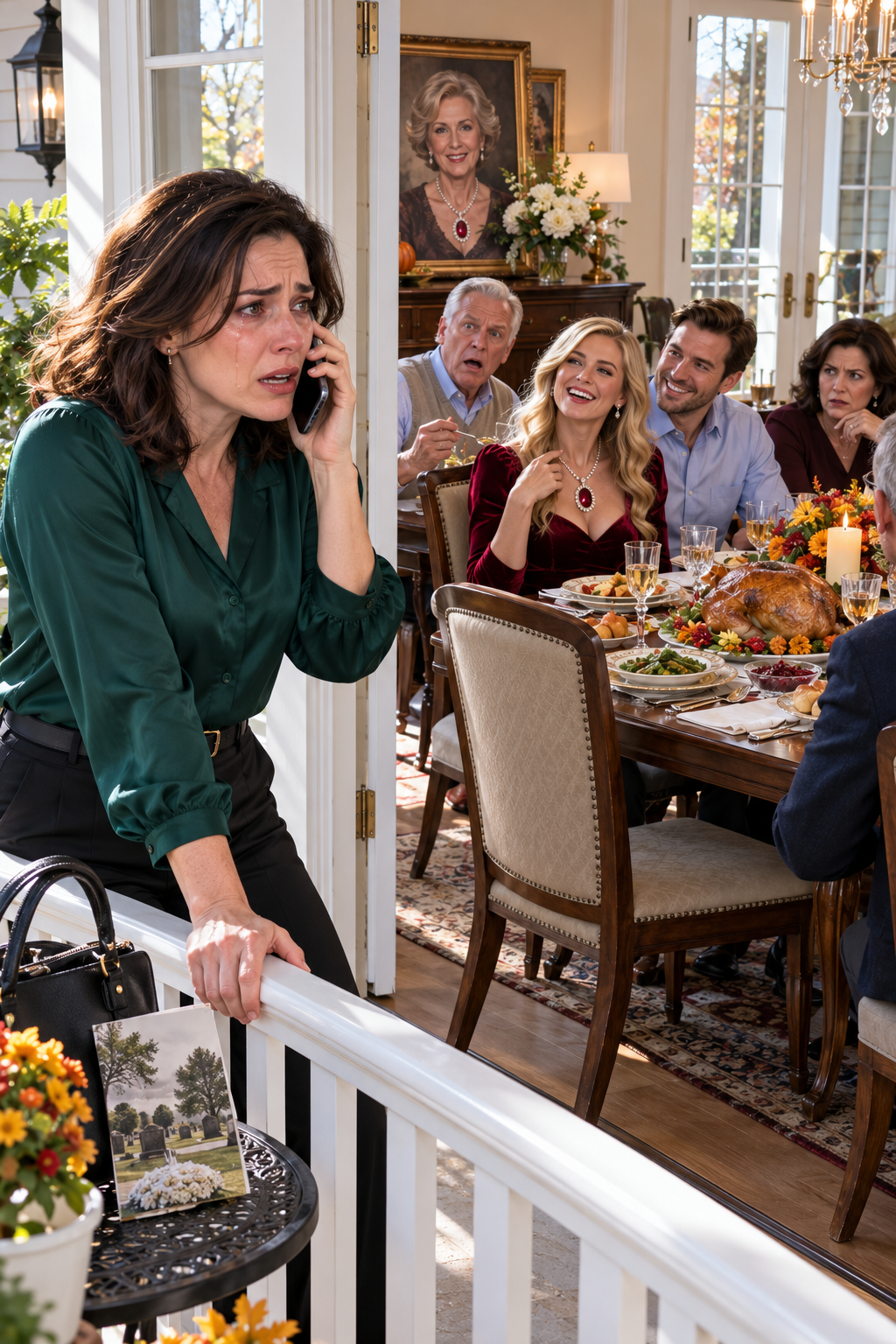
When my brother’s girlfriend leaned across our Thanksgiving table, I saw my mother’s gold locket swinging above the gravy. My mother had been buried wearing that necklace nine months earlier, and I had watched the funeral director close her casket. My brother smiled proudly while everyone else kept eating. I said nothing, stepped onto the porch, and called the cemetery. Four days later, a detective showed me a jewelry sale record dated after the funeral, and the address printed beside the seller’s name changed everything I believed about my mother’s final days.
Part 1
The first thing I noticed was the silver link. Not the oval gold locket itself, although I would have recognized its engraved face anywhere, but one pale spot near the clasp where somebody had repaired the chain with the wrong kind of solder. I knew that imperfection because I had made it myself, eighteen years earlier, standing at a workbench in my father’s garage with a magnifying glass balanced against a coffee can. Now it was hanging around the neck of my brother’s girlfriend, swaying gently as she reached for another dinner roll.
“These are wonderful, Mara,” Elodie said, smiling across my Thanksgiving table. “Did you make them from scratch?” I looked at her cream-colored sweater, at the gold resting just below her collarbone, and somehow managed to answer, “They’re frozen, actually. I just brushed butter over them.” My brother, Reid, laughed and told her that I could make something from a cardboard box taste homemade, while my aunt Bethany continued explaining why her cardiologist wanted her to stop eating so much salt.
Nobody noticed that I had stopped breathing normally. My mother, Sylvie Whitcomb, had been buried with that necklace on February 21, 2025, at Cedar Bluff Memorial Cemetery overlooking the Mississippi River. I had personally checked the clasp during her visitation because she had been very particular about it, and I remembered the cold shine of the chain against the blue fabric of her dress. Nine months later, the same necklace was sitting three feet away from me, around the neck of a woman who had never even met her.
I’m Mara Whitcomb, forty-two years old, divorced, and a tool-and-die maker at an agricultural equipment plant outside Dubuque, Iowa. I’ve spent nearly two decades measuring metal to tolerances most people can’t see without specialized equipment, and I’ve learned that tiny differences can tell you more than an object’s overall appearance. Reid is six years younger, works at a car dealership, and has been charming people out of being angry with him since he was old enough to speak. He had been dating Elodie Marsh for five months, and Thanksgiving was the first holiday she had spent with our family.
Our father, Caleb, died eleven years earlier after a heart attack in the driveway during a February snowstorm. Mom continued living in the little yellow house on the west side of town, keeping his fishing tackle in the basement and his favorite coffee mug beside the sink. She wasn’t sentimental about everything, but she never took off the locket he had bought her with his first steady paycheck in 1982. The back was engraved with their initials, S and C, and the year they got engaged.
When I was twenty-four, Mom caught the chain on a cabinet handle while unloading groceries, and it snapped so suddenly that the locket fell into a bag of potatoes. I repaired it using silver solder because that was what I had available, leaving one conspicuously pale link among the gold ones. I offered to have a jeweler redo it, but Mom touched the repair and shook her head. “Don’t you dare,” she said. “Now I have something from both you and your father on the same necklace.”
That was how she was about us. Reid could forget her birthday and arrive the next morning with grocery-store flowers, and she would light up as though he had brought her diamonds. I could spend an entire weekend fixing her furnace, replacing a faucet, and balancing her checkbook, and she would thank me by insisting I take home enough leftovers to feed a family of five. She loved us differently, but I had never doubted she loved us both.
Everything changed the previous October, when a routine medical appointment led to more tests and then a diagnosis that left us sitting in a hospital parking garage, unable to decide who should drive. Pancreatic cancer had already spread, and Mom declined so quickly that Christmas felt less like a holiday than an interruption between medical appointments. By January, a hospital bed stood in her living room beneath the window where she used to keep African violets. Reid visited when work allowed, and I slept on the couch most nights, waking whenever her breathing changed.
One evening, Mom asked me to open the locket. Inside were two tiny photographs: Dad at twenty-three, squinting in the summer sun, and a picture of Reid and me sitting on the back steps when he was a toddler and I was wearing an awful pink sweatshirt. She studied those pictures for a long time before telling me that she wanted to be buried wearing the necklace and her wedding band. “Your father gave me both,” she whispered. “I’d like to arrive wherever he is with them still on me.”
Reid was there when she repeated those wishes two days before she died. We held her hands and promised that nobody would remove either piece of jewelry, and afterward we cried in the laundry room because neither of us wanted her to hear us. At Baird Family Funeral Home, the owner, Lawrence Baird, listened carefully while we explained her instructions. He checked the box marked “Remain with deceased” on the arrangement form, wrote “Gold locket and wedding band” beside it, and assured us personally that everything would be handled exactly as requested.
The visitation was held on a Thursday evening, with snow gathering on the funeral home’s front steps. Mom wore her blue dress, her ring was on her left hand, and the locket rested in the center of her chest. I checked the pale link before the viewing began, then spent three hours greeting neighbors who told me stories about her that I had somehow never heard. When I returned from the lobby near closing time, Reid was alone beside the casket, head bowed, one hand resting on its polished edge.
I left him alone because grief makes people private in ways nobody can predict. Later that night, Mr. Baird gently suggested we go home and rest, promising that he would personally secure the casket before the burial. The following morning it was already sealed, supposedly because of the weather, and I swallowed my disappointment at not seeing Mom one last time. We buried her beside Dad while the wind threw snow against our faces.
Now Elodie was laughing at something Reid had said, and Mom’s necklace was swinging above my mother’s old serving platter. I asked where she had found it, keeping my voice as casual as I could. “Reid bought it for my birthday,” she said, touching it proudly. “He found it at a little resale shop across the river. Isn’t it beautiful?”
Then she opened it to show me the photographs she had placed inside. My father’s picture was gone, replaced by one of Reid wearing his dealership polo; the photograph of my brother and me had been replaced by Elodie smiling in sunglasses on a boat. She said it had been empty when Reid bought it, and I managed to tell her the pictures looked nice. When she leaned back, I excused myself and walked outside into the November cold.
I called Cedar Bluff Memorial Cemetery and reached the holiday answering service. After giving my mother’s name and burial date, I asked for an urgent return call regarding the condition of her grave. I stayed on the porch until my socks were damp and my toes hurt, staring at the headlights passing beyond the bare maple trees. Inside, people were eating pumpkin pie and arguing about football, as though the world hadn’t shifted beneath my feet.
The cemetery’s superintendent called the next morning. He checked the burial records, confirmed that Mom’s grave had never been reopened, and explained that any authorized removal would have required documentation. When I asked whether somebody could have disturbed it without permission, he said there were no reports of damage and offered to meet me at the gravesite. I thanked him, hung up, and sat motionless beside a cup of coffee that had gone cold.
The necklace hadn’t been taken from her grave. Someone had removed it before she was buried.
And the last time I had seen my brother alone, he had been standing beside our mother’s open casket.
Part 2
Reid came by Friday afternoon to collect the leftover pecan pie, looking tired but cheerful in his dealership jacket. I asked him to help me find something in the garage, and he followed me without suspicion, carrying a plastic container of pie under one arm. The place smelled of machine oil and cold concrete, and my old soldering iron still sat in a drawer beside the workbench. Seeing it made my stomach tighten.
“Where exactly did you buy Elodie’s necklace?” I asked. Reid frowned, then said it came from a pawn and resale shop in East Dubuque, the kind of place that sold everything from fishing rods to engagement rings. He remembered paying around three hundred and fifty dollars and said the owner had called it an antique. When I asked whether he had noticed the initials on the back, he shrugged and said old jewelry was supposed to have a history.
“Those are Mom and Dad’s initials,” I told him. “And the chain has the repair I made when I was twenty-four.” He gave a short, uncertain laugh, but I didn’t laugh with him. I described the silver link, the engraving, and the photographs that had originally been inside, watching his face as each detail settled. By the time I mentioned the ten minutes he had spent alone with Mom’s casket, his expression had changed completely.
“You think I stole it from her?” he asked. His voice sounded so wounded that I almost took the accusation back, but I needed him to answer. “I need to know how it got out of that funeral home,” I said. Reid stared at me, then slammed the pie container onto the workbench hard enough to crack the lid.
He told me that he had been alone with Mom because he couldn’t stop crying and didn’t want the funeral guests to see him. He reminded me that I had always been the responsible daughter, the one who handled bank statements and medical appointments, while everybody expected him to forget things. Then he said something I had never heard him say before: “You don’t understand how it feels to have someone love you your whole life and still believe you’re a disappointment.”
He knocked a metal tray of screws off the workbench while reaching for his keys. They scattered across the floor with a noise like handfuls of hail, and he walked out before I could answer him. I spent the next forty minutes picking them up, partly because I didn’t want to think and partly because every screw belonged somewhere. By the time I finished, I wasn’t sure whether I had confronted a thief or accused an innocent man of something unforgivable.
Elodie called that evening, crying so hard that I could barely understand her. Reid had come home, locked himself in their bedroom, and told her that I believed he had taken jewelry from his dead mother. She offered to bring me the necklace immediately, saying she didn’t want a gift that was hurting everyone. I asked her to remove it, put it in a clean box, and leave it untouched until I could speak to the authorities.
The next morning, I drove across the Julien Dubuque Bridge into Illinois. The resale shop was a narrow brick building between an auto repair business and a store advertising used appliances, with faded guitars hanging in its front window. Behind the counter stood a broad-shouldered man named Frank Deller, who listened without interrupting while I described the locket. He recognized it immediately and confirmed that my brother had purchased it in October.
When I asked who had sold it to him, Frank folded his arms. “I can’t release a seller’s personal information to you,” he explained. “We record identification for every transaction, and law enforcement can access those records, but I can’t just hand them over.” I told him my mother had been buried wearing that necklace in February, and his face lost its professional expression.
He looked toward the empty doorway behind me, then lowered his voice. “I’m going to tell you one thing, and I’d appreciate it if you didn’t ask me how I know.” I leaned across the counter, feeling my pulse in my throat. “Your brother didn’t sell it to us,” he said. “If what you’re telling me is true, you need to speak to a detective.”
On Monday, December 1, I took a personal day and went to the Dubuque Police Department. Detective Nina Ortega met me in a cramped interview room where a malfunctioning light hummed above the table, and I told her everything I knew. I brought copies of Mom’s funeral arrangements, an old photograph showing the locket, and pictures from the visitation in which the necklace was clearly visible. She listened carefully, occasionally asking me to repeat a date.
When I finished, she said there were several possible explanations, but the transaction record should establish where the necklace had entered the resale market. She contacted the shop, reviewed the information available to investigators, and asked me to remain while she worked through a few details. I sat beneath that flickering light thinking about Reid’s face in my garage. Almost an hour later, she returned holding a printed report.
The entry described an oval gold locket engraved with the initials S and C and the year 1982. It listed March 4, 2025, as the acquisition date, less than two weeks after Mom’s burial, and identified the seller by name and verified identification. I read the name twice before looking up at Detective Ortega, who was watching me with an expression I recognized from the hospice nurses. It was the look people wore when they were about to tell you something they knew would hurt.
Lawrence Baird.
The man who had promised to leave Mom’s jewelry untouched had sold her necklace for two hundred and sixty dollars. The address on the report belonged to the large house behind Baird Family Funeral Home. I remembered his gentle hand on my shoulder, his careful handwriting on the arrangement form, and the way he had assured me that my mother was in good hands.
I drove directly to Reid’s apartment. He opened the door looking as though he hadn’t slept, and before he could speak, I told him what the detective had found. He sat down on the arm of his couch and stared at the floor while I apologized, explaining that I had been wrong to accuse him. He didn’t immediately forgive me, and I didn’t expect him to.
“I bought it because I liked it,” he said eventually. “The engraving looked familiar, but I thought that was just because Mom had something like it.” He rubbed both hands over his face. “I gave our mother’s necklace to my girlfriend without knowing it was hers, Mara. I told Elodie it was probably somebody’s old anniversary present.” I sat beside him and watched a basketball game playing silently on his television, unable to find anything useful to say.
Elodie brought the locket to my house that evening in a white jewelry box lined with cotton. Before taking it to the detective, I opened it and touched the little silver link, remembering Mom telling me that she liked my imperfect repair better than a jeweler’s perfect one. Elodie stood quietly in my kitchen while I closed the lid and put it back in the box. She apologized again, and I told her she had done nothing wrong.
Detective Ortega later confirmed that Frank Deller remembered the transaction because of another item the seller had brought with him. Along with the necklace, Mr. Baird had offered a man’s gold wristwatch, claiming both pieces came from an elderly relative’s estate. Frank had declined to buy the watch after they disagreed over its value, and Baird had left with the watch still in his pocket. The detective said she intended to ask him about both items.
Two days later, she called after interviewing Mr. Baird. He admitted selling the locket but claimed our family had given him permission to remove the jewelry before burial. He suggested that grief made people forget conversations and that there must have been a misunderstanding about Mom’s wishes. When I heard that explanation, I opened the filing cabinet in my study and pulled out the folder containing every document from the funeral.
There it was, halfway down the second page: “Remain with deceased,” checked in black ink beside the words “Gold locket and wedding band.” Underneath were my signature and Reid’s, and the handwriting identifying the jewelry belonged to Lawrence Baird himself. I drove the document to the police station before lunch. Detective Ortega examined it, made a copy, and asked a question that sent a new chill through me.
“Ms. Whitcomb, are you absolutely certain your mother’s wedding ring was still on her hand when the casket was closed?”
I told her I had seen it at the visitation, but I couldn’t say what happened afterward. She looked at the arrangement form again, then explained that the necklace might not be the only missing item. That evening, I called Aunt Bethany to tell her what we had discovered. She listened in silence before saying, “Mara, come over tomorrow. There’s something from your uncle’s funeral I think you need to see.”
Part 3
Aunt Bethany’s house smelled of cinnamon candles and furniture polish, the way it always had when I was a child. She didn’t offer me coffee or ask how Reid was doing, which told me how seriously she was taking the situation. Instead, she led me into the dining room and placed a battered green shoebox on the table. Inside were the documents from Uncle Peter’s funeral in September 2022, along with photographs, sympathy cards, and the small American flag presented to her at the graveside.
Peter had served in the Army before I was born, and he had worn the same gold military ring for most of his adult life. Aunt Bethany said he wanted to be buried wearing it, and she had specifically instructed Mr. Baird to leave it on his hand. She unfolded the funeral arrangement form, revealing the same two boxes I had seen on Mom’s paperwork. The box marked “Remain with deceased” was checked, with “Military service ring” written beside it.
“I saw it at the viewing,” she told me. “But I never saw him after they closed the casket, and I never had a reason to question anything.” She rubbed her thumb along the edge of the paper until it began to curl. “Peter used to say that ring was the only piece of jewelry he’d ever needed. I don’t want to believe somebody took it off his hand.”
I photographed the document and sent it to Detective Ortega with Bethany’s permission. She called me within an hour and explained that one missing necklace could potentially have been an isolated incident, but similar questions arising from unrelated funerals warranted a broader investigation. She asked us not to approach other families with accusations while detectives examined the records. I agreed, although every part of me wanted to go straight to the funeral home and demand that Mr. Baird tell me what he had done with my mother’s wedding ring.
Over the following two weeks, I began looking at our family’s old photographs. In one picture, Mom was holding a birthday cake with thirty-eight candles while Dad stood behind her, laughing because the frosting had started sliding off. In another, she was kneeling in her vegetable garden with mud on her jeans, her wedding band visible on the hand gripping a tomato plant. I kept returning to that ring, thin and scratched after forty-three years of marriage, with a small nick on the inside from a car door she had accidentally slammed on her hand.
The ring wasn’t expensive, and it had never been expensive. Dad bought it from a jewelry counter at a department store after saving a few dollars from every paycheck, and Mom refused to replace it even when they could afford something better. After Dad died, she sometimes twisted it around her finger while talking about him, especially when she thought nobody was watching. The idea of someone removing it from her hand made me feel physically ill in a way the missing necklace hadn’t.
Reid and I barely spoke during the first half of December. I called twice, but he answered politely and ended both conversations after a few minutes, and I couldn’t blame him. One Sunday, I drove past his apartment and saw his truck parked outside with snow beginning to collect across the windshield. I thought about going up, but I remembered how he had looked when I accused him in the garage, and I drove home instead.
Three days before Christmas, he came to my house carrying a bag of groceries. He had bought the ingredients for Mom’s chicken casserole, although he’d forgotten the celery and had brought sweetened condensed milk instead of cream of chicken soup. We stood in my kitchen sorting through the bags, and he suddenly said, “I was looking at that necklace when I bought it. I felt like I’d seen it before, but I didn’t think about Mom because I knew hers was buried.” He leaned against the counter and added, “I keep wondering whether that makes me stupid.”
“No,” I told him. “It makes you somebody who believed we had kept our promise to her.” He nodded without looking at me, and for the first time since Thanksgiving, we talked about the real reason we had been angry. He said he had spent his whole life trying to prove he could be trusted, while I admitted that I had treated his financial mistakes as evidence of something far worse. We didn’t settle everything that afternoon, but he stayed to help me cook, and we ate the casserole sitting at the kitchen island.
Just before Christmas, Detective Ortega called with the first results of her expanded investigation. Police had identified fourteen jewelry transactions involving Lawrence Baird at several pawn and resale businesses in Iowa, Illinois, and Wisconsin, dating back to 2021. The items included wedding rings, a class ring, a gold cross, and two watches, and the sale dates appeared to fall shortly after funerals his business had handled. She cautioned that investigators still needed proof each item belonged to a deceased person and that the families had not authorized its removal.
I wrote down the details she could share, then sat at my desk looking at the list. Fourteen items wasn’t a single moment of bad judgment or a mistake made while handling our mother’s belongings. It suggested that somebody entrusted with grieving families had repeatedly turned their most personal promises into opportunities to take what wasn’t his. I wondered how many people had stood beside a casket, thanked Lawrence Baird for his kindness, and gone home believing he had honored their wishes.
A few days into January, Detective Ortega contacted me about a woman named Gloria Voss. Her husband, Raymond, had been buried in 2023 wearing a heavy gold ring from his military unit, and investigators had traced what appeared to be that ring to a shop in Galena. Gloria wanted to speak with someone who understood what it felt like to learn that something might have been taken from a loved one’s casket. I agreed to meet her at a small café downtown on a Saturday morning.
Gloria was seventy-four, with silver hair tucked beneath a knitted hat and a red winter coat that hung loosely around her shoulders. She told me Raymond had worn his ring for forty-six years and used to take it off only when working on his truck. The shop had sold it months earlier, and investigators hadn’t been able to locate the buyer. When she finished explaining, she stared through the café window at people crossing the snowy sidewalk and said, “I let that man handle the last thing I could do for my husband.”
I wanted to reassure her, but anything comforting sounded inadequate. Instead, I asked her to tell me about Raymond, and she described his terrible jokes, his habit of hiding chocolate in the glove compartment, and the way he made pancakes every Saturday even after their children moved away. We sat together until the lunch crowd arrived, and when she left, she squeezed my hand so tightly that my fingers hurt. I drove home thinking about how somebody else’s greed had turned her memories of her husband’s funeral into something she no longer trusted.
The investigation became public in mid-January, when a television station reported that police were examining allegations involving jewelry handled by Baird Family Funeral Home. The building appeared on the evening news, its white columns illuminated beneath the sign that read, “Caring for Our Community Since 1973.” I had walked through those doors when Dad died, when Mom died, and when several relatives had died before them. Watching reporters stand outside made the place look unfamiliar, as though I had spent my entire life mistaking its appearance for its character.
By the following week, people were approaching me at work, at church, and in the grocery store. One coworker said his grandmother had been buried wearing a pearl necklace, while another remembered his father insisting on keeping his grandfather’s pocket watch. I gave them Detective Ortega’s contact information and encouraged them to describe what they actually knew rather than what they feared. Some thanked me, some cried, and one man became angry because he said I was making families question things they could no longer change.
He wasn’t entirely wrong about the pain, and that was the part I struggled with most. Every new person who called the detective might learn something terrible, but every person who remained silent might never know whether a promise had been broken. When I told Detective Ortega I was afraid of making things worse, she said the responsibility belonged to whoever had taken the jewelry. Then she added that the records might never account for every missing piece, especially items that had been sold privately or disposed of without documentation.
That possibility stayed with me. I could hold Mom’s locket again someday because Reid had accidentally brought it back into our family, but nobody knew where her wedding band had gone. The detective had searched the available transaction records without finding anything she could confidently identify as Mom’s ring. When I asked whether there was a way to determine if it was still on her hand, she told me there was only one.
We would have to open her grave.
Part 4
I told Reid about the possibility on a Wednesday night in February, while we sat in my kitchen eating leftover chili. He set down his spoon and stared at me as though I had suggested doing something cruel. “We already buried her once,” he said. “We stood in that snow and watched them lower her into the ground. I can’t do that again.” I told him I didn’t want to either, but that every night I imagined Mom lying in her casket without the things she had asked us to protect.
Reid pushed his chair back and walked to the sink. He stood there for a long time, looking into the dark backyard where the porch light reflected off a crust of frozen snow. Finally, he said, “What if the ring’s still there? What if we put ourselves through all that for nothing?” I told him that would be the best possible outcome, and he shook his head because we both knew the chances were shrinking.
Detective Ortega explained that reopening a grave required formal authorization, consent from the appropriate family members, and supervision by qualified professionals. It wasn’t something she could arrange simply because we were frightened or angry, and the county attorney’s office would have to consider whether the procedure was necessary for the investigation. She also made it clear that Reid and I could decline. Nobody would accuse us of failing Mom if we chose to leave her resting place untouched.
Meanwhile, the investigation continued to uncover new information about the funeral home’s handling of personal effects. A former employee told investigators that Mr. Baird often insisted on managing final casket preparations himself, even when other staff members were available. According to the employee, he had occasionally asked assistants to leave personal jewelry on a tray for him to secure later. Detective Ortega wouldn’t share everything being examined, but she said investigators were comparing employee statements with the arrangement forms and documented sales.
In February, I received a letter from an attorney representing the funeral home, asking me to direct questions through legal counsel and avoid discussing unverified allegations publicly. The language was formal and careful, but seeing the funeral home’s name printed above those paragraphs brought back every minute I had spent in its arrangement room. I took the letter to Detective Ortega, who advised me not to respond without consulting an attorney. Instead, I placed it in the same folder as Mom’s funeral paperwork and went back to work.
One afternoon, I stopped at a gas station near the highway and found Lawrence Baird filling his silver Lexus at the next pump. He looked exactly as he had at the funeral, wearing a dark wool coat and a neatly tied scarf, and for a second I wondered whether he recognized me. Then he turned, gave me the soft expression I remembered, and said, “Mara, I’m sorry your family has had to endure so much uncertainty.” I could hardly believe he was speaking to me as though the uncertainty were some unfortunate thing that had happened to us.
“Where is my mother’s wedding ring?” I asked. He glanced toward the convenience store, where two customers were coming outside with coffee cups. “I’m not in a position to discuss an ongoing investigation,” he replied. I stepped closer and told him I had read the form he signed, that he knew exactly what Mom wanted, and that I had trusted him because he had cared for my father.
He replaced the nozzle, screwed on his gas cap, and adjusted his gloves with infuriating care. “I hope your family finds peace,” he said. Then he got into his car and drove away, leaving me beside the pump with my hands trembling. A teenager working the register came outside to ask whether I was all right, and I told him I just needed a minute.
Detective Ortega wasn’t pleased when I mentioned the encounter. She understood my anger, but she warned that confronting someone under investigation could create complications and would do nothing to help locate the missing jewelry. “Let us build the case,” she said. “You have already helped more than you realize.” I promised I wouldn’t approach him again, although keeping that promise sometimes felt harder than anything I had done since Mom died.
In March, the state licensing board suspended Baird’s funeral director license while its investigation continued. The funeral home stopped accepting new arrangements, and eventually a notice appeared behind the glass doors announcing its temporary closure. I drove past one morning on my way to the plant and saw the parking lot nearly empty, with dead leaves gathered against the front steps. I remembered Mom asking whether Mr. Baird would make sure her locket stayed closed, and how confidently I had told her he would.
The suspension brought more people forward. A former receptionist described families calling to ask about jewelry that had not been returned, although she couldn’t say whether those items had been intended for burial or simply misplaced. Another family produced photographs of a necklace present at a viewing but absent from a final memorial photograph taken before the casket was sealed. Each report required investigators to determine what had actually happened, and Detective Ortega cautioned me against treating every suspicion as proof.
At work, I became obsessed with the idea of records. Every part we manufactured had a measurement, a tolerance, an inspection date, and a person responsible for approving it. If something was wrong with a piece of equipment, we could trace the problem because the process was designed to leave evidence. I kept thinking about how a small mechanical component received more careful verification than my mother’s final wishes.
I started bringing home old photographs and arranging them by year. Reid joined me one Sunday afternoon, and we spent hours looking through boxes that had been stored in Mom’s attic. We found a picture from their twenty-fifth anniversary party, showing Dad fastening the locket around Mom’s neck after she’d briefly removed it for a repair. On the back, in her looping handwriting, she had written, “Still my favorite gift, even after all these years.”
Reid held the picture without speaking. Then he asked whether I remembered Mom making us rehearse the family Christmas photograph because one of us always blinked. We laughed about the year he sneezed just as Dad pressed the camera’s timer, and for a few minutes, our mother was more than a missing ring and an investigation. She was the woman who bought discount wrapping paper in January, drove too slowly in parking lots, and always remembered how each of us liked our toast.
A week later, Reid came back and said he was ready to discuss the disinterment. He had spoken with Elodie, who told him that she would support whatever decision helped us honor Mom’s wishes, but she didn’t pretend to understand exactly what we were facing. “I keep thinking about what Mom said,” Reid told me. “She asked us not to let anyone talk us out of burying those things with her. Someone broke that promise without our permission. If we can put it right, I think we should try.”
We signed the required consent paperwork in late March. The arrangements took several weeks, and an independent funeral director from Cedar Rapids agreed to supervise the procedure once the ground was suitable. Detective Ortega explained what would happen, including the careful examination of the casket and personal effects, and said we would be allowed to choose whether to witness it. I told her I needed to be there, and Reid eventually said the same.
During those weeks, I barely slept. I would wake at three in the morning and imagine Mom in her blue dress, and then I would become angry with myself for imagining something I had no way of knowing. My counselor, whom I had started seeing after Christmas, suggested that uncertainty was keeping my grief from settling into anything manageable. I told her I wasn’t expecting the disinterment to make me feel better; I just wanted to stop wondering what someone had done to my mother.
The night before the scheduled procedure, Reid arrived at my house carrying a small bag of takeout hamburgers. We ate in the garage with the space heater humming beside the workbench, surrounded by the tools Dad had taught me to use. Reid picked up my old soldering iron and examined its worn handle. “Is this really the one you used on her necklace?” he asked, and I nodded.
He turned it over carefully before setting it down. “I remember her showing me that repair,” he said. “She told me you could fix almost anything.” I looked at the little tool, its cord wrapped around the handle, and wished that were still true. Reid reached across the workbench and took my hand, the first time he’d done that since we were children.
We arrived at Cedar Bluff just before seven the next morning. The river below the cemetery was hidden beneath a low bank of fog, and the air smelled of wet grass and freshly turned soil. Four cemetery workers stood near a backhoe and a small crane truck, while Detective Ortega waited beside an unfamiliar funeral director wearing a black overcoat. When the first shovel broke the ground above our mother’s grave, Reid gripped my arm, and neither of us looked away.
Part 5
I thought I had prepared myself for the sound of the machinery, but when the backhoe began lifting earth from above Mom’s grave, I felt something inside me give way. Reid stood beside me with one arm wrapped around my shoulders, and I held on to the sleeve of his jacket as though the ground might disappear beneath us. The workers moved carefully, speaking quietly to one another, and nobody hurried us when we needed to turn away. By the time they reached the concrete burial vault, my face was wet with tears I hadn’t realized I was crying.
The vault was lifted from the ground and taken to a maintenance building on the cemetery property. Inside, bright overhead lights illuminated a long table covered with a clean white sheet, and the room smelled faintly of disinfectant and damp concrete. The independent funeral director, a man named Thomas Lyle, explained that he would open the casket and examine the personal effects while Detective Ortega documented the findings. He told us we didn’t have to watch and that he could explain everything afterward.
“I need to see her,” I said. Reid looked at me, swallowed hard, and said he did too. Mr. Lyle waited until we were standing together near the end of the table, then carefully released the casket’s fastenings. The small metallic clicks seemed impossibly loud in the quiet room, and when he lifted the lid, I reached instinctively for my brother’s hand.
Mom was still wearing the blue dress we had chosen for her funeral. I won’t describe her appearance beyond that because she deserves some privacy, even in a story about what happened to her. What I will say is that there was no necklace resting against her chest, and the absence was more devastating than I had imagined. For a moment, I could see only the empty stretch of fabric where Dad’s locket should have been.
Then Mr. Lyle examined her hands.
Her wedding ring was gone. The narrow gold band she had worn every day of my life, the one Dad placed on her finger in a little church before I was born, was nowhere to be seen. Detective Ortega carefully photographed what she needed to document, and Mr. Lyle checked the surrounding fabric and lining without disturbing anything unnecessarily. Reid turned toward the wall, pressed his hands against his face, and began to cry.
I had imagined that finding the ring missing would make me furious. Instead, I felt a strange emptiness, as though something I had been holding together for fifteen months had finally broken. I thought about Mom sitting beside me during my divorce, turning that ring around her finger while she told me I didn’t have to stay in a marriage simply because I’d promised it would last forever. I remembered her wearing it while making pancakes, pulling weeds, and holding my hand in the hospital, and I couldn’t understand how anyone could look at that ring and see only its monetary value.
Mr. Lyle continued examining the casket while Detective Ortega documented the absence of both pieces of jewelry. When he reached the satin lining near Mom’s right shoulder, he noticed something tucked into a narrow fold beside the pillow. He carefully lifted two tiny circular photographs onto his gloved palm. One showed my father as a young man, squinting into the sunlight, and the other showed Reid and me sitting on the back steps of our childhood home.
I made a sound that startled everyone in the room. Those were the photographs Mom had kept inside her locket for decades, the ones Elodie had unknowingly replaced with pictures of herself and Reid. Lawrence Baird had removed them before selling the necklace, but instead of discarding them, he had tucked them into the casket’s lining. I don’t know whether that was a moment of conscience, an attempt to hide evidence, or simply the easiest place to put something he couldn’t sell.
Reid stared at the photographs resting on Mr. Lyle’s palm. Then he reached for my hand again, and I could feel him trembling. “She kept us,” he whispered, looking at the picture of the two children with their arms around each other. I nodded because I couldn’t speak, and when Mr. Lyle asked whether we wanted a few private moments, we both said yes.
I told Mom about the investigation, although I felt foolish speaking aloud in that room. I told her we had found the necklace, that Reid had met someone kind, and that Aunt Bethany still put too much salt on everything despite her doctor’s warnings. Reid apologized for not recognizing the locket when he bought it, and I told him in front of Mom that he had nothing to apologize for. Then we stood quietly together until Mr. Lyle asked whether we were ready for him to close the casket.
We weren’t ready, but we said yes.
The prosecutor filed criminal theft charges against Lawrence Baird that summer, supported by transaction records, family statements, funeral documents, and evidence gathered during the investigation. The licensing board permanently revoked his funeral director license, and the funeral home was eventually sold to new owners who removed his family’s name from the building. Investigators identified several additional affected families, although not every report could be proven and some missing items were never traced. Gloria Voss’s husband’s military ring remained missing, along with my mother’s wedding band.
Baird pleaded guilty to multiple theft charges in August. At sentencing, his attorney described years of mounting debt, declining business, and financial desperation that had led him to tell himself the dead no longer needed jewelry. I listened without moving, remembering how patiently he had described the funeral arrangements and how gently he had guided grieving families through his office. He had known exactly what those pieces meant to us, and his financial problems didn’t make the choice to take them any less deliberate.
The judge imposed a prison sentence and ordered restitution where losses could be established. I didn’t feel triumphant when the sentence was announced, and I didn’t expect the money to replace anything important. Gloria sat a few seats away wearing her familiar red coat, and when the hearing ended, she came over and hugged me. She said she hoped Raymond knew she had tried to protect his ring, and I told her I believed he had always known how much she loved him.
Mr. Baird never offered me an apology that acknowledged what he had done. Through his attorney, he expressed regret for the harm caused to families, but he never explained why he had chosen our mother or what had happened to her wedding band. I eventually stopped wanting an explanation from him, because no reason could make his actions acceptable. What mattered was that he would no longer be entrusted with other families’ final goodbyes.
When the locket was released from evidence, I brought it home in a sealed plastic bag with a barcode attached. Reid came over that evening, and we sat beneath the bright lamp at my kitchen table with tweezers, a magnifying glass, and the two photographs recovered from Mom’s casket. We carefully placed Dad’s picture on the left and the photograph of us on the right, just as Mom had arranged them. When the locket finally closed with its familiar tiny click, Reid rested his forehead against his hands and stayed that way for a long time.
In late August, we returned to Cedar Bluff for one final private ceremony. Mr. Lyle supervised the arrangements, and this time there were no reporters, no police officers, and no questions waiting to be answered. Reid and I stood together beside Mom’s casket while he carefully fastened the chain behind her neck. I positioned the locket against her blue dress, making certain that the pale silver link I had repaired years earlier remained visible.
Her wedding ring was still missing, and I had struggled with whether to replace it. In the end, we decided not to put another ring on her hand merely to make the absence less painful for us. That old wedding band had belonged to Mom and Dad’s marriage, and no substitute could carry the same history. I placed a short handwritten note beside her instead, telling her that we had done everything we could to keep our promise.
We watched Mr. Lyle close the casket, secure every fastening, and supervise its return to the grave. Only after the work was finished did Reid and I leave the cemetery, walking slowly down the gravel path toward my car. Neither of us spoke until we reached the parking lot. Then Reid said, “I wish she’d been here to see us figure all this out,” and I told him that she would have been proud of us for doing it together.
In September, Reid asked Elodie to marry him. They invited Aunt Bethany and me to a small dinner at a restaurant overlooking the river, and Elodie wore a dark green dress with simple earrings and no necklace. At one point, she caught me looking at her bare throat and smiled a little sadly. I reached across the table, squeezed her hand, and told her how glad I was that she’d come to Thanksgiving the previous year.
She looked surprised, and I explained that if she hadn’t worn the locket, we might never have discovered what happened. Reid said he still felt terrible about giving her something that had belonged to Mom, but I reminded him that his kindness had accidentally brought our mother’s most treasured possession home. Elodie wiped her eyes with her napkin, and Aunt Bethany, uncomfortable with anyone crying at dinner, immediately asked whether we wanted another basket of bread.
This Thanksgiving, I am hosting dinner again. Reid and Elodie are helping with the cooking, and Aunt Bethany has promised to bring her famous apple pie, although she has already warned us that the crust might be too dark. The dining room looks much the same as it did last year, with Mom’s old serving platter in the center of the table and Dad’s mismatched chairs pulled up around it. Some evenings I still think about the missing ring, and I don’t expect that ache to disappear completely.
I haven’t forgiven Lawrence Baird, and I don’t intend to. I have forgiven my brother for the ordinary mistakes he made when we were younger, just as he has gradually forgiven me for the terrible accusation I made in my garage. We talk more now than we did before Mom died, and sometimes he comes over simply to sit at the kitchen table and tell me about his day. It took losing something precious for us to understand how much of our family we still had left.
Last Sunday, I visited Mom and Dad’s graves with a small bunch of yellow chrysanthemums. The grass had grown back over the disturbed earth, and the river beyond the cemetery was turning silver beneath a cloudy afternoon sky. I sat beside their headstone for a while, thinking about the locket resting against Mom’s dress, the photographs safely inside, and that imperfect silver link holding the chain together.
I couldn’t bring back her wedding band, and I couldn’t change what happened to her after we said goodbye. But I had found the necklace she loved, uncovered the truth, and helped make sure other families wouldn’t have to place their trust in the same man.
Before leaving, I touched the carved letters of her name and said, “It’s closed, Mom. Just like you asked.”
Then I went home to my brother, the woman he loves, and the family we were still learning how to be.
THE END!