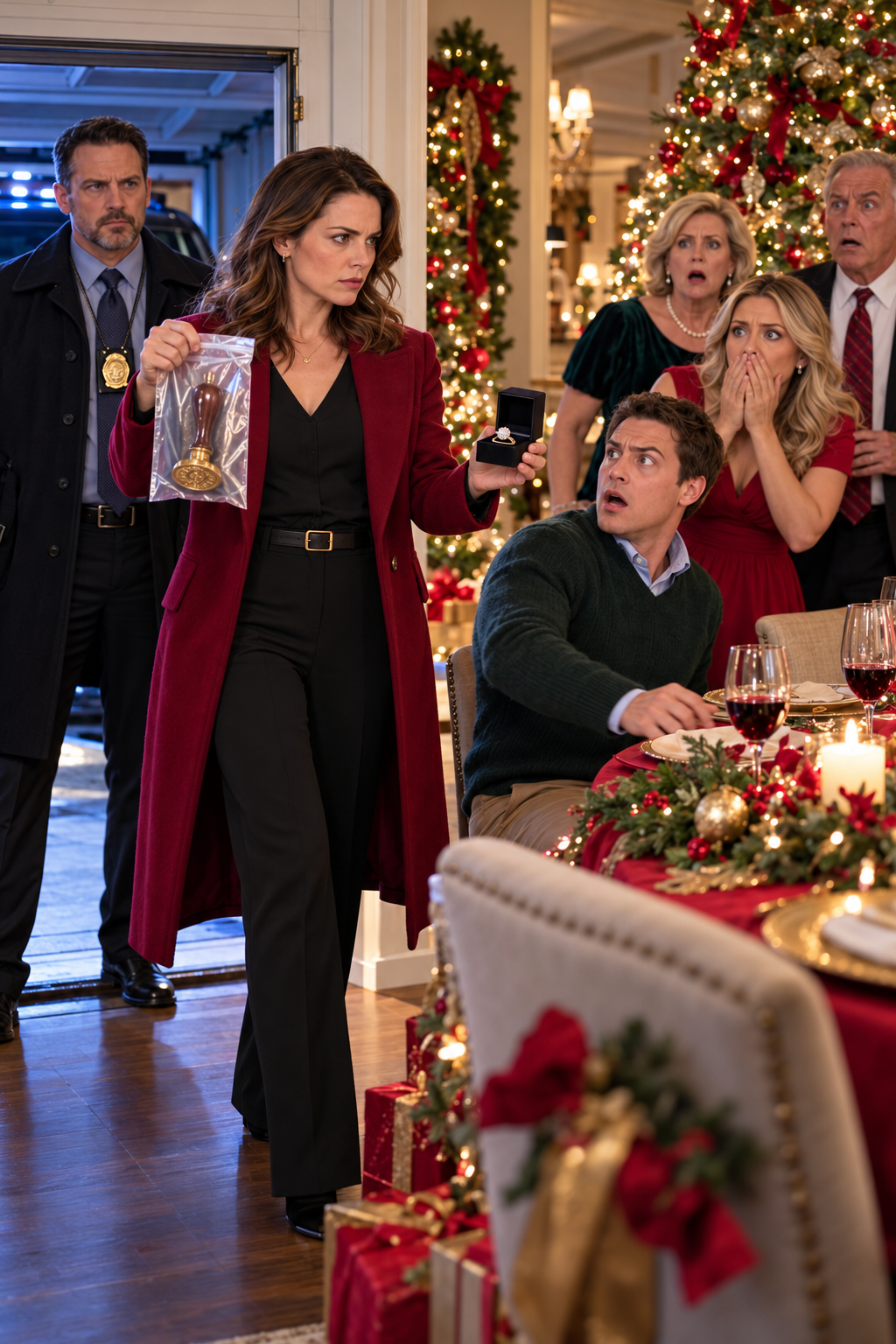
“Some People Just Ruin The Mood.” My Sister’s Fiancé Got Me Uninvited From Christmas. On Christmas Eve, I Walked In Through The Garage With A Dead Man’s Seal, A Stolen Ring, And A Detective.
My mother called while I was inspecting a bridge and told me I wasn’t welcome at Christmas because my sister’s fiancé believed I was ruining everyone’s happiness. My father agreed, and my sister wouldn’t even speak to me. I said, “I understand,” finished my inspection, and went home without arguing. Seventeen days later, I discovered a signature on a financial document that shouldn’t have existed. By Christmas Eve, I knew the dangerous kitchen renovation wasn’t the real reason they’d wanted me gone.
Part 1
The Allegheny River looked almost black beneath the bridge that evening, with patches of yellow light trembling across the water from the highway above. I was standing ankle-deep in gravel, examining a corroded support connection, when my phone started vibrating inside my winter coat. My mother’s name appeared on the screen, and I answered with my flashlight tucked beneath my arm because she had always treated unanswered calls as evidence that something terrible had happened. “Mara, sweetheart,” she said, using the careful voice she reserved for unpleasant conversations, “we need to talk about Christmas.”
I was thirty-four years old, a licensed structural engineer, and the oldest daughter of Walter and Corinne Calder of Pittsburgh, Pennsylvania. Every Christmas Eve of my life had happened in their century-old brick house in Mount Washington, where my father fried fish in the detached garage and my mother made enough pierogies to feed half the neighborhood. Even when I lived in Philadelphia for two years, I drove across the state in sleet to make it home before dinner. So when Mom explained that my younger sister Lena and her fiancé, Miles Rourke, were organizing the celebration, I assumed she wanted me to bring extra folding chairs.
Instead, she said, “After what happened at Thanksgiving, Miles thinks everyone would be more comfortable if you didn’t come this year.” I stared at the rust-colored water running over the stones beneath my boots, certain I had misunderstood her. “Not come to Christmas?” I asked, and she sighed as though I had immediately confirmed every complaint she’d been hearing. “Some people just ruin the mood, Mara,” she said quietly. “Those were Miles’s words, not mine, but your father and Lena think a little distance would be healthy.”
I asked whether Dad was in the room, and I heard the television volume drop before Mom answered that he was. “Does he agree?” I asked, although I already knew he would have interrupted if he didn’t. After a silence long enough for a truck to thunder overhead, she said, “Yes, honey, he does.” I told her I understood, wished her a merry Christmas three weeks early, and hung up before she could hear my voice change.
I finished the bridge inspection because the corrosion was real whether anyone appreciated my finding it or not. Back in my truck, with the heater blowing against my frozen fingers, I opened the photographs I’d taken during Thanksgiving dinner. They showed an unfinished kitchen, several architectural drawings, and a proposed steel beam resting on columns that appeared to have no adequate foundations. I zoomed in on the engineer’s seal printed in the corner of the third drawing and felt the same cold uneasiness I’d experienced when I first saw it.
My parents’ house had been built in 1919, with narrow rooms, plaster ceilings, and a basement that smelled permanently of damp concrete and laundry detergent. The wall separating the kitchen from the dining room carried the floor above it, part of the roof load, and the penciled height measurements my mother had recorded as Lena and I grew up. Dad worked thirty-seven years at a steel-processing plant before retiring with damaged knees, while Mom spent most of her career managing the front office at an elementary school. They had paid off their mortgage six years earlier, and I remembered my father opening a bottle of inexpensive champagne to celebrate the first month in his adult life when nobody owned a piece of his house.
Then Miles arrived in April and started changing things.
Lena met him at a charity fundraiser through someone she worked with at the hospital, and within weeks he had become a permanent fixture at Sunday dinner. He was thirty-six, broad-shouldered, neatly dressed, and extraordinarily skilled at noticing what people wanted to hear. He called my father a craftsman, praised my mother’s cooking as though he had discovered something extraordinary, and told Lena she was the first woman who made him want a permanent home. I initially liked him, partly because Lena had endured two painful relationships and partly because Miles seemed genuinely interested in our family rather than simply tolerating us.
By August he had proposed, and by October he had persuaded my parents to let his company, Rourke Heritage Builders, remodel their kitchen before the wedding. He described it as a family project, insisting that my mother deserved an open floor plan and that my father should finally enjoy the home he’d worked so hard to own. His proposed price was $170,000, an astonishing amount for a kitchen in that house, but he helped my parents arrange a home-equity line of credit and promised to charge only for materials and labor. By Thanksgiving, his company had already received $126,000, although the room contained more exposed wiring and plastic sheeting than finished construction.
Nobody had told me about the loan or the renovation.
When I arrived for Thanksgiving and found half the kitchen dismantled, my mother admitted that Miles had suggested keeping it a surprise. “He knows you worry about everything,” she explained, shifting a bowl of mashed potatoes away from a stack of construction supplies. I asked to see the structural drawings, and Miles produced them after dinner with the confident generosity of someone showing off a wedding album. He spread them across the dining table between coffee cups and leftover pumpkin pie, explaining how the new beam would support the upstairs bedrooms after the wall disappeared.
I studied the sixteen-foot opening, then the proposed steel beam, then the two support columns shown ending directly on the basement slab. The beam’s listed section appeared badly undersized for the loads indicated, and the drawings showed no dedicated footings beneath the columns. Without verified calculations and a proper foundation investigation, I couldn’t responsibly approve the design, but I knew enough to recognize a serious problem. “Miles,” I said, keeping my voice level, “who calculated the loads, and where are the footing details?”
His smile remained in place, but something in his eyes changed.
“You’re making this more complicated than it needs to be,” he said, rolling up the sheets before I finished examining them. I explained that the upstairs bedrooms and a substantial portion of the roof relied on that wall, and that columns placed on a thin slab could crack or settle under concentrated loads. Miles turned toward my family instead of answering, his face settling into an expression of patient disappointment. “Mara, I understand you’re used to being the expert, but maybe you should ask yourself why your sister getting something beautiful makes you so uncomfortable.”
Lena’s cheeks flushed, and Mom whispered my name in warning while Dad stood beside the doorway with his arms folded. I tried to show them the dimensions, but Lena said, “God, Mara, can I have one happy moment without you finding something wrong?” Dad finally spoke, saying, “You’ve spent your career on bridges, honey; Miles builds houses,” and walked back to the football game. I left before dessert was cleared, and nobody followed me onto the porch.
The next morning, I found a message from Lena accusing me of embarrassing Miles in front of his future family. I didn’t answer, partly because I was furious and partly because I had a habit of checking facts before arguing about them. During Thanksgiving, while everyone was watching football, I’d photographed every sheet of those drawings, including the professional engineer’s seal near the bottom. Now, sitting in my truck after Mom’s December phone call, I enlarged that photograph until the name became unmistakable.
Edwin Barlow, P.E.
Edwin had been my first employer, my mentor, and the man who taught me to examine what was underneath a structure before trusting what was visible above it.
He had also been dead since June 2022.
The drawing bearing his professional seal was dated November 17, 2025.
Part 2
I didn’t sleep much that night, although not because I doubted what I’d seen. Edwin Barlow had hired me straight out of Carnegie Mellon, when I was young enough to confuse confidence with competence and eager enough to volunteer for every inspection nobody else wanted. He was a compact, silver-haired man who kept peppermint candies in his desk drawer and refused to approve even the smallest structural change without confirming the load path. He used to tell me, “A building doesn’t care whether the contractor is charming, Mara; it only cares where the weight goes.”
Edwin died suddenly at seventy-one, and I attended his funeral beside engineers who had trusted him for decades. I still owned the small mechanical pencil he gave me after I passed my professional licensing examination, with my initials scratched into its metal barrel. Seeing his name on Miles’s drawings felt more personal than discovering an ordinary technical mistake. Somebody had used a dead man’s professional reputation to make an unsafe renovation appear legitimate, and that person expected my parents to live underneath it.
The following morning, I checked Pennsylvania’s professional licensing records and confirmed that Edwin’s license was inactive following his death. I then called his widow, Ruth, who lived in the same modest colonial house in the South Hills where I had eaten countless Sunday lunches during my first years as an engineer. She invited me over without asking why, and when I arrived, she had coffee brewing and Edwin’s old reading glasses sitting beside the newspaper. I showed her the photograph of the seal, and she studied it for several minutes before saying, “That isn’t possible, Mara; I buried him three years ago.”
Ruth explained that she had sold most of Edwin’s office equipment through an estate liquidation company because she couldn’t bear looking at the empty drafting tables. The official metal embossing seal was locked in her bedroom, but she remembered a wooden box containing old rubber stamps and discarded office supplies. She retrieved the sale records from a filing cabinet and called the auction coordinator while I sat across from her at the kitchen table. The coordinator remembered a contractor who had purchased the entire remaining office lot, including flat files, drafting supplies, and several boxes of old paperwork.
His receipt listed a company called Northline Residential Services of Columbus, Ohio.
The name meant nothing to Ruth, but I remembered hearing about a similarly named company from an old college friend, Imani Brooks. Imani and I had studied engineering together before she moved home to Columbus, where she worked in municipal transportation planning. Three years earlier, she’d called me about a disastrous remodeling job at her parents’ house, after an interior wall was removed and the upstairs floor began sloping toward the staircase. She had described the contractor as a remarkably personable man who stopped answering calls once her parents demanded an independent structural assessment.
I called Imani from Ruth’s driveway, where sleet was ticking against my windshield. “Do you still have the contractor’s information from your parents’ house?” I asked, and her breathing changed when I mentioned the name Northline. “Why are you asking?” she said, so I told her about Miles, my parents’ kitchen, and the dead engineer’s seal. She promised to search her father’s records that night and asked me one question before hanging up: “Has your family already given him money?”
I said yes, and the silence afterward was worse than any answer she could have given.
Meanwhile, I contacted Pittsburgh’s Department of Permits, Licenses, and Inspections, explaining that I had concerns about an unsafe structural design and an apparently unauthorized engineering seal. The inspector assigned to review the complaint was Mateo Silva, a practical man with tired eyes, a heavy winter jacket, and the habit of asking precise questions without wasting words. I met him at his office with photographs, calculations outlining my concerns, Edwin’s obituary, and a copy of the licensing record. After studying the proposed beam and columns, he said the design needed an independent review before any structural demolition could proceed.
He also discovered that Miles’s permit application was still pending, despite Miles having told my parents the city had already approved everything. The application contained drawings supposedly signed by Edwin and a homeowner authorization uploaded electronically several days earlier. Mateo could not determine whether the financial information was legitimate, but he confirmed the permit did not authorize removing the load-bearing wall. With the work already underway and a structural alteration scheduled for December 18, he arranged an inspection and issued a stop-work order the following day.
My mother called less than fifteen minutes after the orange notice appeared on her front door.
“How could you humiliate us like this?” she demanded, and I could hear Lena crying somewhere behind her. I explained that the city had found an unresolved safety problem, that the engineer named on the drawings was dead, and that nobody should remove the wall until the design was checked. Mom interrupted me halfway through and said, “Miles already told us you might do something like this.” When I asked whether she understood what could happen to the bedrooms above that beam, she answered, “I don’t want another lecture about your career.”
Then my father came on the phone, which briefly gave me hope.
“Mara, I know you believe you’re helping,” he said, his voice flat and exhausted. “But this is your mother’s home, and you’ve embarrassed your sister badly enough.” I told him to go into the basement and measure the thickness of the concrete where Miles intended to install the columns. Dad replied that he’d lived in that house longer than I’d been alive, and he wasn’t taking instructions from his daughter about his own basement.
That evening, Lena sent me a message telling me I wasn’t welcome at the wedding either. She said Miles had spent hours comforting Mom and Dad because I apparently couldn’t bear seeing another person accomplish something for them. I stared at her message in the same apartment where she used to sleep on my couch after difficult breakups, and I remembered holding her hand outside an emergency room when our father underwent surgery. Apparently thirty years of sisterhood could be overruled by eight months of convincing conversation.
I cried, washed my face, and opened a new folder on my laptop labeled “Calder House — Structural Concerns.” I saved the drawings, professional licensing information, inspector correspondence, and a timeline of every conversation I’d had about the renovation. I wasn’t assembling evidence to win an argument anymore; I was trying to keep my parents’ bedrooms from ending up in their dining room. Then Imani emailed me a photograph from her father’s security camera, showing a younger Miles standing on a Columbus porch beneath the name Graham Kline.
Below the photograph was a scanned court judgment and a note from Imani.
“Mara, this is the man who nearly destroyed my parents’ house. And the construction loan wasn’t the only thing he took from them.”
Part 3
Imani’s father, Malcolm Brooks, had saved records from every major purchase he had made since retiring from an accounting firm, including the paperwork from the renovation that nearly cost him his home. He and his wife had hired Graham Kline, operating as Northline Residential Services, to open up their kitchen and add a family room. The structural work was defective, their second floor developed serious movement, and the repairs required temporary relocation and extensive foundation reinforcement. They won a civil judgment, but by the time the court ruled, Kline had closed the company and disappeared.
The construction failure hadn’t been his only financial arrangement.
Graham had convinced Malcolm to become an investor in what he described as a modest residential development, promising that Malcolm’s name and experience would give the new company credibility with lenders. The paperwork instead made Malcolm personally responsible for a substantial loan, and the money moved through several company accounts before the project collapsed. Malcolm eventually discovered that invoices for materials included suppliers that had never delivered anything to his property. He had spent years trying to recover the money while his wife took extra shifts at a medical clinic after planning to retire.
I drove to Columbus that weekend and sat at Malcolm’s dining table while he arranged the documents in careful chronological stacks. He was a tall, deliberate man who spoke without exaggeration, and I trusted him more with every detail he admitted he had failed to notice. “He didn’t begin by asking us for a loan,” Malcolm explained, sliding a bank statement toward me. “He began by bringing flowers to my wife, asking about our grandchildren, and telling me I deserved something with my own name on it after forty years of working for other people.”
I thought of my father standing beside Miles at Sunday dinner, discussing how much he’d missed having a useful role since retiring.
Malcolm also showed me copies of the invoices, including one bearing a logo that appeared in the photographs of my parents’ renovation materials. The supplier was listed as a Pennsylvania company with an industrial mailing address, but the payment information traced back to an account controlled by Graham’s former business. It didn’t establish exactly where my parents’ money had gone, but it gave investigators a specific transaction pattern to examine. When I called Imani that evening, she said her mother had seen Graham’s photograph and immediately recognized the man who had once spent Thanksgiving at their house.
On Monday, I met Detective Cassia Reed, who worked financial investigations in Allegheny County. She was in her late forties, wore reading glasses attached to a thin chain, and maintained an office full of paper folders despite having two perfectly functional computer monitors. I brought the structural drawings, the licensing records, Ruth’s statement, the Ohio judgment, the photographs, and the information Malcolm had preserved. Cassia listened without interrupting, then explained that a dangerous renovation and a suspicious financial arrangement required different kinds of evidence.
“Your professional judgment gives us a reason to investigate the drawings,” she said, tapping the folder, “but I still need records showing who submitted them, who received the money, and what representations were made.” I asked whether she could simply speak to my parents, and she explained that they might alert Miles before the financial records were secured. She was already contacting investigators in Ohio and beginning the legal process for obtaining relevant business and banking documents. Her final instruction was direct: “Don’t confront this man, don’t investigate him in person, and don’t try to persuade your sister in a parking lot.”
I obeyed two of those instructions.
Three nights later, I went to the hospital parking garage because Lena’s evening shift ended at seven and I couldn’t stand the thought that she might marry someone who had already hurt another family. I waited beside her silver hatchback, rehearsing a short explanation that wouldn’t sound like an accusation or another engineering lecture. When the elevator doors opened, Lena appeared wearing her winter coat over blue scrubs, with Miles beside her carrying a paper bag from her favorite Thai restaurant. He saw me first, smiled, and rested one hand on her back before she noticed I was there.
“Lena, I need two minutes,” I said, keeping several feet between us. She immediately shook her head, and Miles gently said, “Sweetheart, you don’t have to explain yourself to anybody.” I showed her the photograph on my phone, but she barely glanced at it before telling me Miles had already explained that an angry former customer was spreading stories online. “He said you’d find something because you can’t accept that I have a good life,” she whispered, and her voice carried a kind of certainty I’d never heard from her before.
I wanted to tell her that she was allowed a good life, that I’d spent years hoping she would find one, and that being frightened for her was not the same as resenting her happiness. Instead, I saw her hand tighten around Miles’s sleeve and understood she was listening to me only as another piece of evidence against me. She got into the car without another word, leaving Miles standing beside me in the cold garage. “You really should stop,” he said quietly, with no trace of his usual warmth, before walking away.
I told Cassia about the encounter the following morning, and she reminded me that contact like that could make Lena less willing to cooperate later. I apologized and promised not to repeat it, then spent the rest of the day reviewing the permit documents Mateo had provided. One page contained an electronic signature under my mother’s name authorizing the contractor to represent the owners during permitting. The signature looked unusual, but the detail that caught my attention was the listed email address, which belonged to Miles’s construction company rather than either homeowner.
That night, my father called me for the first time since our argument.
He was standing in the basement with a flashlight, breathing heavily because he’d gone down the steep stairs without his knee brace. “I measured the concrete where he wants those posts,” he said, sounding almost embarrassed. “It’s not quite four inches, and there’s nothing solid underneath except old fill.” I told him not to disturb the floor further, but he interrupted and said Miles had given him something else to think about.
“He’s making me a business partner, Mara,” Dad said, his voice strained. “Kerr and Rourke Development, or something like that. He says he has an apartment project and wants me to sign the financing documents on Christmas Eve, in front of everybody.” I asked how much financing was involved, and he answered, “$280,000, but Miles says the company pays it back.” Then he added the words that made my stomach drop: “He says Mom and I won’t have to put up anything else, because the lender already knows about the house.”
I asked my father to meet me at a diner the next morning and to bring every page Miles had handed him. He hesitated, frightened of upsetting my mother, before finally agreeing to come alone. When we met, I found that the paperwork made him a personal guarantor and listed our family home as proposed additional collateral, subject to lender approval. Dad kept staring at the figures, unable to reconcile the promise of a Christmas gift with the possibility of losing the only substantial asset he’d ever owned.
At the bottom of an attached authorization was another signature, dated four days earlier.
This time, it was my mother’s name.
Dad looked at it for so long that his coffee went cold, then whispered, “Mara, your mother told me she hadn’t signed anything.”
Part 4
My father sat across from me in the diner as rain slid down the windows, holding the papers like they might become less frightening if he read them carefully enough. I explained that the authorization appeared to permit financial disclosures and collateral discussions, although it didn’t prove a valid lien had been created. He insisted my mother would never knowingly risk the house again after they had already borrowed so much for the kitchen. I reminded him that six weeks earlier, he had dismissed my safety concerns without looking at the calculations.
He lowered the paperwork and said, “I know what I did.”
For the first time since Thanksgiving, Dad didn’t defend Miles or tell me I had misunderstood anyone’s intentions. He admitted that he’d enjoyed having another man ask his advice and that the prospect of putting his name on a business had made him feel useful again. When Miles had told him that engineering drawings were unnecessarily complicated, Dad had accepted it because the alternative meant acknowledging that he’d placed his family in danger. He apologized for choosing a stranger’s reassurance over his daughter’s professional judgment, but I told him that an apology would not make the financial papers disappear.
We called Detective Reed from the parking lot, and she asked Dad to come to her office with the original documents. She also contacted the lender’s compliance department through the appropriate investigative channels to determine whether the authorization had been used to advance a loan. My father agreed to postpone signing anything, but Cassia urged him not to alert Miles that the authorities were investigating his financial activity. By the time we left, Dad understood that Christmas Eve was no longer about preserving a surprise for his wife.
Two days later, Cassia called with a detail she had obtained from Ohio investigators. The same company associated with the questionable material invoices in Columbus had received payments linked to my parents’ renovation, and several deposits had moved soon afterward into accounts controlled by Miles. She couldn’t disclose everything the investigators were examining, but she confirmed there was enough concern to expand the investigation beyond the engineering documents. She also warned me that my sister might be pressured to sign additional paperwork if Miles suspected Dad was hesitating.
That evening, Miles came to my apartment building.
I found his black pickup idling beneath the streetlight, its headlights illuminating the wet brick steps outside my entrance. He stepped out when I approached, dressed in an expensive wool coat and wearing the same pleasant expression I’d seen across my parents’ Thanksgiving table. “You’ve caused a lot of unnecessary trouble, Mara,” he said, standing between me and the front steps, “and I think we should clear it up before Christmas.” I kept my phone in my hand and asked him to move so I could enter the building.
Instead, he told me that Lena had been frightened by my behavior and was considering legal measures to keep me away from their wedding. He spoke as though he were offering friendly advice, warning that complaints involving harassment could create unpleasant professional consequences for an engineer. When I said his company had used a deceased engineer’s seal, he smiled and described it as an administrative misunderstanding involving old project templates. Then he leaned closer and said, “Your mother knew it wasn’t necessary to include you, Mara; she wanted one celebration where you couldn’t tell everyone what they were doing wrong.”
I knew my mother had agreed to exclude me, but hearing Miles repeat the language she’d apparently used behind my back made my chest tighten.
“Move,” I said, and this time he did, although he kept speaking as I climbed the steps. “Lena trusts me because I make her feel safe,” he said, almost conversationally. “You keep telling people what could go wrong, and eventually they get tired of listening.” I entered the building without answering, locked the lobby door, and went upstairs to write down the conversation while I could still remember the wording. When I informed Cassia, she asked about the building’s security cameras and arranged for the footage to be preserved.
The next day, my father called again, this time sounding angry rather than frightened.
He had finally confronted Mom about the authorization, and she admitted she had electronically signed something at Miles’s request. She claimed he’d told her it was merely permission to discuss financing and that he would arrange a financial opportunity for Dad without increasing their risk. She hadn’t told her husband because she wanted the announcement on Christmas Eve to be a surprise. When Dad asked why she hadn’t shown me the documents, she answered, “Because Mara would have found a reason to stop it.”
I sat on the edge of my bed afterward, looking at the childhood photographs lined along my bookshelf. For weeks, I’d imagined my parents had simply been misled by an unusually convincing man, and to a considerable extent they had been. But Mom had helped exclude me from decisions affecting her home because she didn’t want inconvenient information. Miles hadn’t created that habit; he had recognized it and used it.
On December 23, I met Cassia, Ruth Barlow, Imani, and Malcolm Brooks at Ruth’s house to discuss what might happen the following evening. Cassia explained that investigators were preparing to take action on the available evidence and would handle any confrontation with Miles directly. She emphasized that nobody should block his exit, threaten him, or attempt to collect evidence through a staged argument. My father had agreed that I could come into the house if Miles presented the financing documents, while Cassia arranged for the responding officers to be nearby if needed.
Ruth insisted on bringing Edwin’s original licensing documents and the metal embossing seal she had kept since his death. Malcolm carried certified copies of the Ohio judgment and several records establishing the connection between Graham Kline and the contractor currently calling himself Miles Rourke. I brought a binder containing the disputed structural design, my engineering assessment, and the original photographs from Thanksgiving. We weren’t planning a performance, and I had no desire to humiliate Lena in front of the relatives, but I knew that Miles was likely to use the presence of family as pressure on my father.
Christmas Eve arrived with wet snow drifting across Pittsburgh’s streets and the smell of wood smoke hanging between the houses. I parked two blocks away from my parents’ home while Ruth, Imani, and Malcolm waited nearby, and I watched neighbors carry casseroles through the front door. Through the dining room window, I could see the Christmas tree, my mother’s embroidered tablecloth, and the unfinished kitchen concealed behind plastic sheeting. The sight made my throat ache, because I’d spent thirty-four years believing I belonged to that room without needing anyone’s permission.
At 6:18, my phone vibrated with a message from Dad.
“He’s starting. Come through the garage.”
I found my father waiting by the back door in his old Christmas apron, his face pale beneath the fluorescent light. He stepped aside and let us enter, then squeezed my shoulder so briefly I might have imagined it. From the living room, Miles was speaking about loyalty, new beginnings, and how certain people struggled when they weren’t the center of attention. A few relatives laughed politely, and I recognized the silence that followed as the sound of everyone waiting to discover who would be embarrassed next.
Then Miles held up the loan documents and said, “Walter, all I need is your signature.”
My father answered, “Before I put my name on anything, I want my other daughter to look at it.”
Part 5
The room fell quiet when I stepped out of the hallway, followed by Ruth, Imani, and Malcolm. Lena was standing near the fireplace in a green sweater, her engagement ring flashing as she gripped a glass of cider, and my mother had both hands pressed against her chest. Miles looked at us, then toward the front door, before forcing his familiar smile. “Mara,” he said, “I thought we’d agreed that tonight wasn’t the time for more family drama.”
“Tonight is exactly the time to examine a $280,000 financial commitment,” I answered, setting my binder on the dining table.
My father took the papers from Miles and placed them beside my engineering photographs. “I won’t sign anything,” he said, his voice carrying across the room, “until somebody explains why our house is mentioned in these documents and why the city stopped the work.” Miles began describing an ordinary administrative dispute, but Malcolm stepped forward and identified himself as the former customer who had obtained a civil judgment against him in Ohio. He placed the certified records on the table, alongside a photograph from his porch camera showing Miles under his former name, Graham Kline. Several relatives leaned closer, recognizing the same face they’d welcomed to Sunday dinners for months.
“That’s an old business disagreement,” Miles said, turning immediately toward Lena rather than addressing the evidence. Malcolm calmly described the structural damage to his home, the personal loan obligations, and the unpaid judgment, while Imani explained how their family had spent years repairing the financial consequences. Then Ruth opened her small velvet box and placed Edwin Barlow’s original seal beside the stamped kitchen drawings. “My husband died in June 2022,” she said, her voice steady, “and he did not approve a structural renovation in November 2025.”
Lena looked from Ruth to the drawings, confusion spreading across her face.
Miles insisted that an employee must have reused the wrong template, but I showed the dimensions of the proposed beam and explained the missing foundations beneath the columns. I wasn’t trying to teach engineering to a room full of relatives; I wanted them to understand that the drawings represented a physical danger, not a disagreement over decorating preferences. Dad confirmed that he had measured the basement slab himself and found no dedicated footings where the columns were intended to stand. For the first time, my mother looked toward the unfinished wall instead of toward Miles for reassurance.
“Is any of it true?” Lena asked him.
He reached for her hand, but she pulled it away before he could touch her.
The front door opened a moment later, and Detective Reed entered with two officers who identified themselves and explained that they had a warrant for Miles’s arrest in connection with the ongoing investigation. They directed everyone to remain clear while they took him into custody, and Miles briefly protested that he had been invited into the home and was simply conducting a legitimate family business transaction. His composure finally cracked when Cassia addressed him by his former name and referenced the Ohio records. He looked toward Lena one last time and said, “Baby, you know I love you.”
Lena removed her engagement ring and put it on the mantel without answering.
As the officers escorted him outside, my mother reached toward me, her face crumpling with shock. “Mara, we didn’t know,” she whispered, and I looked at the dismantled kitchen, the financial documents, and the people who had watched me be dismissed for trying to protect them. “I told you about the wall at Thanksgiving,” I said. “I told you about Edwin’s seal, and you hung up on me because you didn’t want to hear it.”
She began crying, but I wasn’t willing to comfort her through the consequences of a decision she’d helped make.
The Christmas party ended slowly, with relatives collecting coats and untouched food while my father sat beside the darkened tree. Lena followed me onto the porch and asked whether I’d known about Miles’s past for weeks, as though the length of my silence might explain away what she had believed about me. I reminded her that I’d attempted to show her the photograph outside the hospital, and that she’d refused even to look. She said she’d been in love, then stopped when she saw my expression. “I know that doesn’t excuse how I treated you,” she said, and for once I didn’t rush to tell her everything was all right.
The investigation continued long after the Christmas decorations came down.
Records connected Miles’s companies to numerous questionable invoices and financial transfers, including the funds taken from my parents’ renovation credit line. Investigators recovered some money, but much had already been spent or moved beyond immediate reach, and my parents remained responsible for a substantial balance on their home-equity debt. Additional evidence linked him to other renovation complaints, and he eventually entered guilty pleas to several financial and document-related offenses. He received a prison sentence, while separate civil proceedings and the Ohio judgment remained part of the long process of determining what could be recovered.
My parents still had an unfinished kitchen, damaged credit, and a financial obligation that would affect their retirement.
The most painful discovery came several months later, when Mom admitted she’d seen the renovation costs rising and suspected Miles wasn’t paying suppliers promptly. She had kept giving him access to funds because Lena was so happy, and because she believed calling me would turn a manageable problem into a family confrontation. I asked why she considered an uncomfortable conversation more dangerous than putting her home at risk. She couldn’t answer, and I realized she had spent years teaching me that keeping everyone comfortable was more important than being truthful.
Dad apologized without defending himself and gradually began making changes rather than asking me to forget what happened. He hired an independent engineer and a reputable contractor to assess the house, followed the city permitting requirements, and made arrangements to repay the remaining debt without expecting me to provide free professional services. When he asked whether we could go back to our usual Sunday dinners, I told him I wasn’t ready. He nodded and said he’d leave the invitation open without pressuring me.
Lena wrote me a long letter in March, describing how Miles had gradually convinced her that my questions came from jealousy rather than concern. She had started counseling, returned to work, and called off every wedding arrangement, but she admitted that none of those things erased her own choices. I read her letter twice, then replied that I was glad she was rebuilding her life and that I needed distance from her for the foreseeable future. She wrote back, “I understand,” and unlike my mother, I believed she meant it.
During the spring, I helped Ruth inventory Edwin’s remaining technical papers so that she could donate them to a local engineering program. One afternoon, while sorting through a drawer of old calculations, I found a handwritten note he’d tucked inside a folder from an inspection we’d done together years before. It read, “Never let politeness become a substitute for checking the foundation.” I sat at his drafting table for a long time holding that page, remembering how often he’d been willing to disappoint people in order to keep them safe.
By the following December, my life looked different.
I had moved into a small townhouse with a sunny kitchen and a narrow backyard where I planted herbs in raised beds. On Christmas Eve, I invited Ruth, Imani, Malcolm and his wife, and several friends from work for dinner, and we crowded around a table that wasn’t nearly big enough for everyone. Ruth brought lemon bars, Imani burned the first batch of rolls, and Malcolm insisted on washing dishes because he claimed nobody else knew how to load a dishwasher properly. We laughed about ordinary things, without anybody demanding that someone stay silent to preserve the evening.
My father called that afternoon to wish me a merry Christmas. He told me the kitchen renovation had finally passed inspection, that he and Mom were making their scheduled payments, and that Lena would be coming for dinner. He didn’t ask me to come over, and I appreciated that more than another apology. Before hanging up, he said, “I’m proud of the way you handled everything, Mara, even though I made it harder than it had to be.”
“Thank you, Dad,” I said, and meant it.
After dinner, I stepped onto my back porch and watched snow settle on the wooden railing while laughter drifted through the door behind me. For years, I’d believed being a good daughter meant showing up no matter what was said or done to me, absorbing everybody else’s discomfort and making sure the family stayed together. That Christmas, I finally understood that protecting people and allowing them unlimited access to your life were two entirely different things. I had protected my family from a dangerous renovation and a man who wanted to use their trust against them, but I hadn’t agreed to keep paying for their decisions with my peace.
My mother still sends invitations, and my sister occasionally asks whether we might have coffee someday. I don’t answer every message, and I don’t apologize for needing distance, because the people who called my concern poisonous had never been required to live with the silence they imposed on me. I hope they become wiser and kinder, but I no longer consider their emotional comfort my responsibility. Their house may have a new foundation, but rebuilding trust with me is work they cannot assign to someone else.
Inside, Imani called my name because Ruth was telling a story about Edwin that apparently involved a ladder, a stubborn church custodian, and a very angry pigeon. I went back into the warm kitchen, where my friends had already saved me a chair and a slice of pie. Nobody asked me to prove I deserved to be there, nobody treated a difficult question as an act of betrayal, and nobody suggested that safety mattered less than the mood of a holiday party.
I hadn’t ruined Christmas by telling the truth.
I had simply stopped letting other people ruin my life for telling it.
THE END!