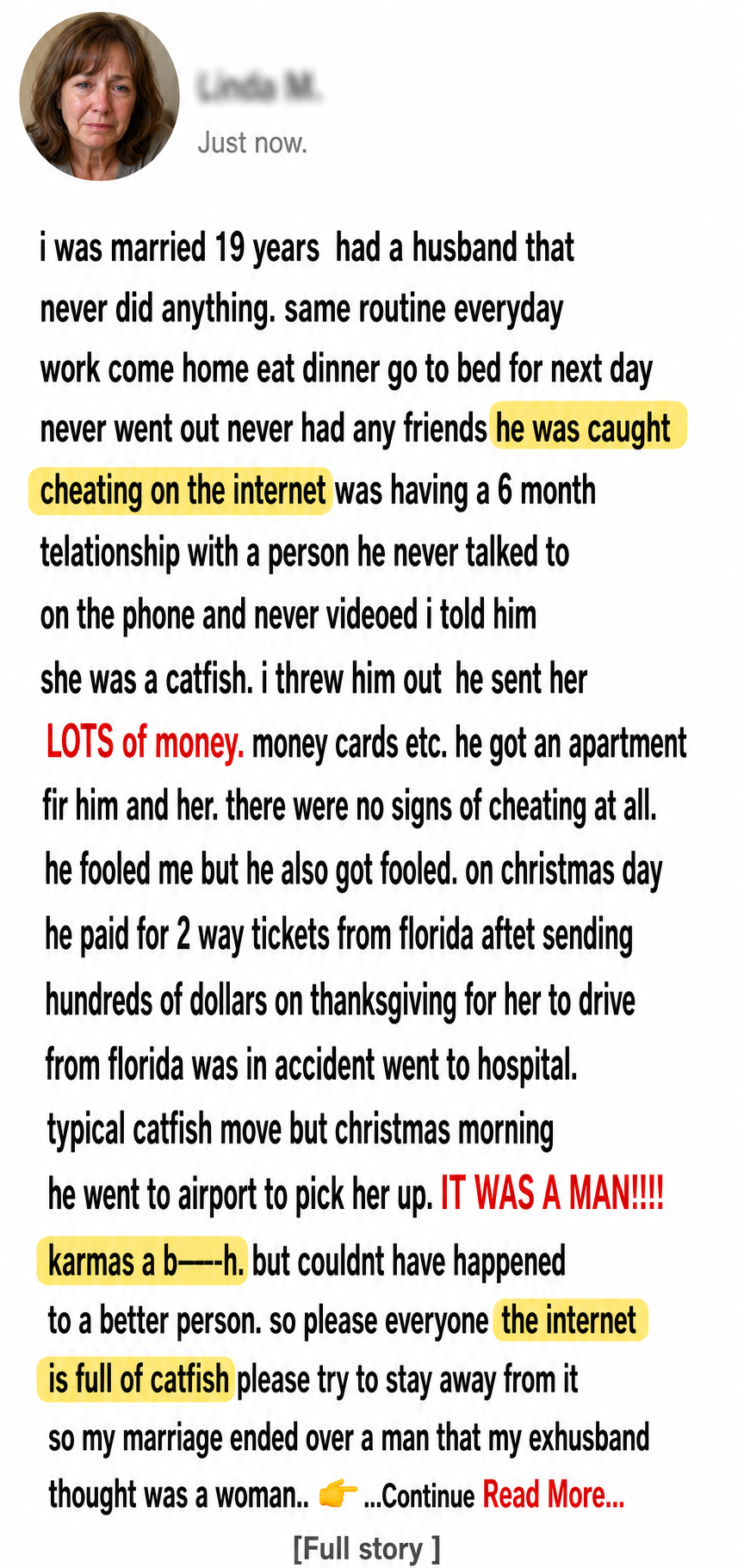
I was married for nineteen years to a man named Eric.
For most of those years, I thought our marriage was boring.
Not bad.
Not abusive.
Not passionate either.
Just… predictable.
Eric woke up every morning at 6:15, drank black coffee, went to work, came home at exactly 5:40, ate dinner in front of the television, showered, and went to bed.
Same routine.
Every single day.
He didn’t go out with friends because he didn’t have any. He hated parties. He barely used social media. He never flirted. Never stayed out late. Never acted suspicious.
If someone had asked me who was least likely to cheat, I would’ve described my husband.
That’s why I ignored the first signs.
About a year before our divorce, Eric became strangely attached to his phone.
Not in an obvious way.
He didn’t hide it.
But he smiled at it.
A lot.
Sometimes I’d walk into the kitchen and catch him staring down at messages with this soft expression I hadn’t seen directed at me in years.
When I asked who he was talking to, he’d shrug.
“Just someone online.”
At first I thought it was harmless.
A gaming group maybe.
Or some Facebook friend.
Then one night, I woke up at 2 a.m. and found him sitting in the dark living room texting.
That cold feeling hit my stomach instantly.
I asked, “Who are you talking to?”
He hesitated too long.
Then finally admitted there was a woman.
Her name was “Samantha.”
According to Eric, she lived in Florida. She was thirty-eight. Divorced. Lonely. “Different” from other women.
I remember laughing.
Not because it was funny.
Because it sounded ridiculous.
My fifty-year-old antisocial husband was suddenly having an online romance with a mysterious woman he had never even met?
I asked if they talked on the phone.
“No.”
Video chat?
“No.”
Had he ever heard her actual voice?
“No.”
That’s when I said the word that would later haunt him:
“Eric… you’re being catfished.”
He became furious immediately.
Defensive in a way I’d never seen before.
“You don’t understand her,” he snapped.
Her.
Not me.
Not us.
Her.
That was the moment I realized my marriage was already dying.
Over the next few months, Eric changed completely.
He started protecting his phone like state secrets.
He smiled more—but never at me.
And worst of all?
He started spending money.
Thousands of dollars.
At first it was gift cards.
Then prepaid debit cards.
Then wire transfers.
When I confronted him, he swore she was just “going through a hard time.”
Her car broke down.
Her rent was late.
Her mother was sick.
Every week there was another emergency.
And every week my husband played hero.
I later discovered he’d drained nearly $40,000 from our savings.
Forty thousand dollars.
Nineteen years of marriage sacrificed for someone he had never even spoken to.
I begged him to stop.
I showed him videos about romance scams.
I printed articles.
I even contacted one of those online fraud groups that explained how catfish operations worked.
Eric refused to believe any of it.
“She loves me,” he kept saying.
I’ll never forget that sentence.
Because he said it with tears in his eyes.
Tears he hadn’t shed when my mother died.
Tears he hadn’t shed during our worst fights.
But somehow this invisible stranger mattered that much.
Eventually I threw him out.
I couldn’t take it anymore.
He rented a small apartment across town and proudly told me Samantha would be moving in with him soon.
That’s when the story became unbelievable.
According to Eric, Samantha planned to drive from Florida to be with him permanently.
But on Thanksgiving, there was suddenly a crisis.
She’d been in a terrible accident on the way.
Hospital bills.
Emergency surgery.
More money needed immediately.
Eric sent hundreds more.
I remember staring at him thinking:
How can someone be this blind?
But loneliness is powerful.
And fantasy is addictive.
Especially for people who feel invisible in real life.
Then came Christmas.
The grand finale.
Eric called me Christmas morning sounding excited like a teenager.
“She’s flying in today,” he said.
He had bought two-way tickets for her.
Round trip.
He cleaned the apartment. Bought champagne. New sheets. Flowers.
This man hadn’t planned a romantic evening for me in fifteen years.
But for a stranger online?
Suddenly he became Prince Charming.
Part of me wanted to stop him.
Another part wanted reality to hit him as hard as possible.
So I said nothing.
Hours later, my phone rang.
I answered and immediately heard breathing.
Heavy breathing.
Silence.
Then Eric whispered:
“Oh my God.”
I sat up slowly.
“What happened?”
Another long silence.
Then he said words I will never forget as long as I live.
“It’s a man.”
I closed my eyes.
Not because I was shocked.
Because I wasn’t.
Airport security eventually had to intervene because Eric started screaming at the person in baggage claim.
The “beautiful woman” from Florida turned out to be a middle-aged man using stolen photos and fake videos.
The accident story?
Fake.
The hospital?
Fake.
The love?
Fake.
Every single thing.
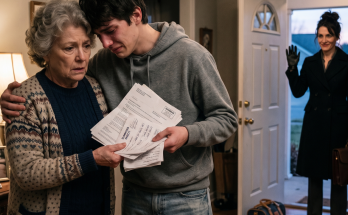
Eric came to my house two days later looking like someone had physically removed his soul.
He cried harder than I had ever seen a grown man cry.
Not because he lost money.
Because he realized he destroyed his entire life for an illusion.
And here’s the part people don’t understand:
I did feel bad for him.
For maybe five minutes.
Then I remembered the lies.
The secrecy.
The money.
The way he chose a fantasy over his actual wife.
Over and over again.
People think betrayal only counts if there’s physical cheating.
They’re wrong.
Emotional betrayal destroys trust just as deeply.
Maybe deeper.
Because it means someone willingly escaped reality to build intimacy somewhere else.
Our divorce finalized eight months later.
And the strangest part?
I wasn’t devastated anymore.
I was relieved.
Because I finally understood something important:
A person doesn’t cheat because you weren’t enough.
They cheat because something inside THEM is broken.
Eric wasn’t stolen by another woman.
He was consumed by loneliness, ego, fantasy, and the desperate need to feel wanted.
And in the end?
The only person he truly deceived was himself.
So if there’s one thing I want people to learn from my story, it’s this:
The internet is full of people pretending to be exactly what lonely hearts want to hear.
Be careful.
Because sometimes the biggest scam isn’t losing money.
It’s losing your real life chasing a fake one.