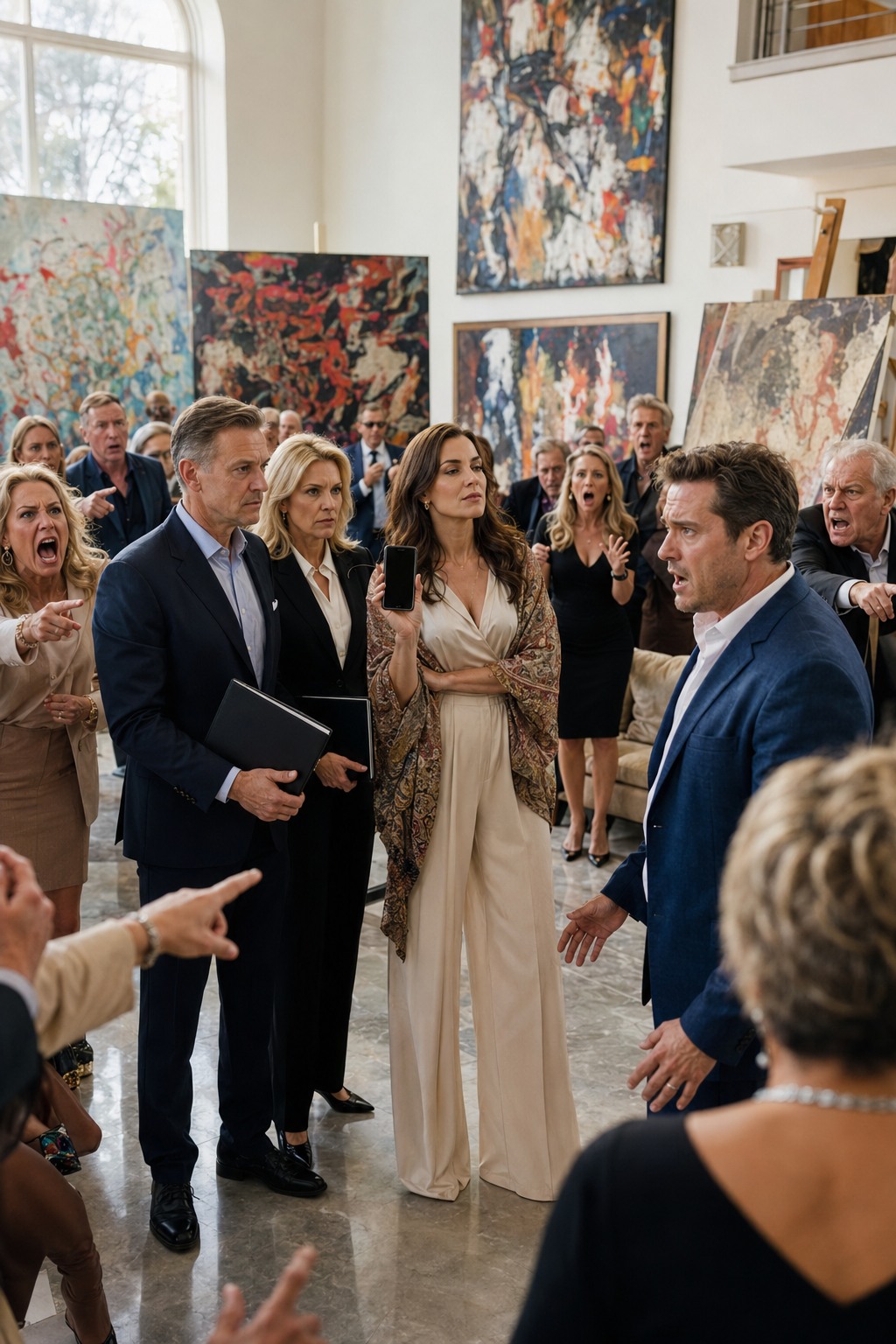
My Brother Texted: “Sold Your Amateur Paintings For $50 Each. You’re Welcome.” I Replied: “Thank You For Letting Me Know.” He Asked: “Aren’t You Mad?” I Wasn’t, Because Those “Amateur Paintings” Were Worth $12 Million Each.
The Buyers Were Actually…
Part 1
Marcus texted me at 3:17 on a rainy Tuesday, right when the radiator in my studio apartment started knocking like someone trapped inside the wall.
Sold your amateur paintings for $50 each. You’re welcome.
A second message followed.
Found them in Mom’s garage. Finally cleared out some space.
Then came the smug little thumbs-up emoji he used whenever he wanted to sound generous and superior at the same time.
I was standing barefoot on a paint-spotted towel, holding a thin brush loaded with a line of white so pale it almost disappeared against the canvas. My coffee sat on the windowsill, gone cold. Outside, delivery trucks hissed over wet asphalt, and a woman in a yellow raincoat dragged a grocery cart through a puddle. Everything looked normal.
My hand did not shake.
That surprised me a little.
I set the brush down, wiped my fingers on an old dishcloth, and read Marcus’s message again. Amateur paintings. Fifty each. Mom’s garage.
Five canvases had been stored there, wrapped in brown paper and labeled with a strip of blue tape. They were not the best work I had ever done. They were not the most polished. But they were the first five pieces from a series I had built in secret, piece by piece, under a name my family had never bothered to learn.
I typed slowly.
Thanks for letting me know.
Marcus called less than ten seconds later.
I let it ring twice, because I knew he wanted me to answer breathless and angry. Marcus loved being the calm one in an emergency, especially when he had caused it.
“Hey, Soph,” he said when I picked up. His voice had that warm, padded sound people use around hospital beds and bad report cards. “I figured you’d be upset.”
“I’m listening.”
“Okay, don’t get weird. Dad and I were cleaning out Mom’s garage. You left those big ugly canvases there forever. We’re trying to get the house ready for appraisal, and they were taking up half a corner.”
“They were wrapped.”
“They were taking up space wrapped.”
Rain tapped against the window. I looked at the painting in front of me, at the thin white line I had almost finished. It curved like a vein under skin.
“Who bought them?” I asked.
“Some art guy. Well, mostly. He had nice shoes, so maybe he knew what he was doing.”
“Mostly?”
Marcus paused.
The radiator knocked twice. I could hear him breathing through his nose.
“There were five, right?” he said. “The art guy took four. Some older lady took one before he got there. Honestly, I don’t know why you care. You got two hundred and fifty bucks for stuff you forgot existed.”
I closed my eyes.
There it was. The small rip in the fabric.
“Did you get her name?”
“Sophie, it was a garage sale, not Sotheby’s.”
I almost laughed. It came up my throat like a cough, dry and sharp.
“Right,” I said. “Of course.”
“Look, I know you’re sensitive about your art. But fifty dollars each is pretty good for student work. You should actually be thankful. Most people were offering twenty.”
Student work.
I stared at the brown paper stacked under my worktable, the invoices hidden inside a locked metal box, the burner phone facedown beside a jar of turpentine. My life had two rooms. Marcus had only ever been allowed into the smallest one.
“Did the art guy leave a card?” I asked.
“Yeah. Dad has it. Some gallery name. Mitchell something.”
My pulse kicked once, hard.
“Can you send me a photo?”
“Sure, but don’t embarrass yourself calling him and demanding the paintings back. He probably bought them to be nice.”
I looked down at my bare feet, at the blue paint dried on my ankle from three days ago. Somewhere in this city, four of those canvases were already being handled by people who knew exactly what they were touching.
But the fifth one was loose.
And the fifth one had something on the back that no collector, critic, or thief was ever supposed to see.
“I won’t embarrass myself,” I said.
Marcus chuckled like he had won.
When we hung up, I stood there listening to the rain and the radiator and my own heartbeat, all of them out of rhythm.
Then my phone buzzed again.
A photo appeared. The card was blurred, but the name was clear enough.
Harrison Mitchell.
Under it, in Marcus’s messy handwriting on the garage-sale ledger, were four check marks and one line that made my stomach turn cold.
Blue painting — sold first. Cash. No receipt.
I had lost the only canvas that could tell my family the truth before I was ready.
And I had no idea who had taken it.
Part 2
Dad’s house still smelled like lemon furniture polish and old carpet, the same smell it had when I was seventeen and told him I wanted to apply to art school.
Back then, he had sat me on the beige couch and explained “economic reality” for ninety minutes while Marcus leaned against the doorway, eating cereal from a mug and grinning like my future was a sitcom. The couch was still there, though one cushion sagged in the middle now. The family photos above it had faded around the edges. Marcus in his MBA gown. Marcus with Jessica in a vineyard. Marcus holding his first baby like a trophy.
Me at college orientation, cropped so you couldn’t see the paint under my fingernails.
Dad opened the door wearing khakis and a quarter-zip sweater, even though he had been retired for three years and had nowhere to dress up for.
“Sophie,” he said, surprised. “Marcus told me he called you.”
“I wanted to pick up the money from the paintings.”
His face softened with relief. Money was a language he understood.
“Of course. Come in.”
The garage-sale leftovers were spread across the dining table: cracked mugs, brass candlesticks, a bread maker still in its box, Mom’s old gardening gloves stiff with dirt. Dad had made a spreadsheet. Of course he had. Each item had a number, a description, and a sale price.
He handed me an envelope with two hundred and fifty dollars inside.
I did not take it.
“Did you write down who bought the blue painting?” I asked.
Dad frowned. “Blue painting?”
“One of the five Marcus sold.”
He adjusted his glasses and looked at the spreadsheet. “There’s no name here. Marcus handled the art. I handled household goods.”
“The painting mattered.”
Dad sighed, not angry exactly, but disappointed in the familiar way. Like I had spilled wine on a tax document.
“Sophie, honey, I understand sentimental value. But you left those canvases in the garage for three years.”
“I asked Mom if I could keep them there.”
“Your mother kept everything.”
That hit harder than I expected.
Mom had been gone fourteen months. Sometimes grief still arrived through side doors: the smell of cinnamon gum in a checkout line, a voicemail I couldn’t delete, the sight of her gardening gloves curled like tired hands on the table.
Dad noticed my face and softened.
“I’m not trying to hurt you,” he said. “Actually, this might be a good moment to talk.”
He pulled out a folder.
My body knew that folder before my mind caught up. Job listings. Career articles. A printout from a community college website. Administrative assistant. Medical billing specialist. Entry-level accounting clerk.
“I’ve been worried,” Dad said. “Marcus too. You’re thirty-two. You live in that tiny apartment. You don’t have a stable income. And now even your paintings are selling for fifty dollars after months of work.”
I sat down because standing suddenly felt theatrical.
Dad spread the papers carefully, like a doctor laying out test results.
“This one has benefits,” he said, tapping a listing. “And this company is hiring immediately.”
The envelope of cash sat between us.
I thought of the studio across town, the one he didn’t know existed. Five thousand square feet of skylights, concrete floors, storage vaults, and twelve-foot canvases drying in controlled humidity. I thought of the security code at the door. I thought of the four paintings Harrison had likely already recovered.
I thought of the missing blue one.
“Did Marcus mention an older woman?” I asked.
Dad’s patience thinned. “Sophie.”
“Please.”
He looked back at the ledger, then at a cardboard box near the wall. “There was a woman from across Maple. Mrs. Alvarez, I think. She bought some frames early in the morning. Maybe a painting too. But Marcus was handling that.”
I knew Mrs. Alvarez. She had lived three houses down when I was a kid. She used to give us oranges from her backyard when she visited her sister in California.
“Did Marcus talk to her after?”
Dad rubbed his temple. “I don’t know. Why are you acting like this is a crime scene?”
Because sometimes a crime scene looked exactly like a suburban dining room with lemon polish in the air.
Before I could answer, the front door opened. Marcus walked in wearing a navy coat and carrying a Starbucks cup, his hair damp from the rain. He stopped when he saw me.
“There she is,” he said. “The starving artist.”
I smiled because he expected me not to.
“Marcus,” I said, “tell me about Mrs. Alvarez.”
His expression flickered for less than a second.
Then he set his coffee down and said, too casually, “Who?”
That was when I knew he remembered everything.
And whatever had happened to the fifth painting, my brother had already decided to lie about it.
Part 3
Marcus had always been better at acting innocent than being innocent.
He pulled out a chair backward, straddled it like we were in some family sitcom, and said, “I don’t remember every person who bought junk from the garage. Why?”
“Because one painting is missing.”
He laughed. “All five are missing. That’s what sold means.”
“Four went to Harrison Mitchell.”
Dad looked between us. “The gallery man?”
Marcus’s jaw tightened. “How do you know his first name?”
“It was on the card.”
“No, the card said H. Mitchell.”
I let the silence sit there.
Rain dragged silver lines down the dining room windows. The house felt too warm. Dad’s old wall clock ticked above the china cabinet, each second neat and accusing.
Marcus took a sip of coffee, then made a face like it was hotter than expected. “Maybe I heard him say it.”
“Maybe.”
Dad cleared his throat. “This is getting strange.”
“Not strange,” Marcus said. “Dramatic. Sophie’s being dramatic because she regrets leaving her stuff here.”
I stood. “I’m going to talk to Mrs. Alvarez.”
Marcus’s hand tightened around the cup. The cardboard bent with a soft crackle.
“Don’t bother that poor woman over a fifty-dollar painting.”
There it was again. Fifty dollars. He kept saying the number like a nail he could hammer the truth under.
I left without the envelope.
My decoy apartment was ten minutes away, close enough for family drop-ins and far enough from my real life. I drove there first, parked in the cracked lot, and watched Marcus’s car pass two minutes later in my rearview mirror.
So he had followed me.
I went upstairs, turned on the lights, moved around where the windows could catch me. I rinsed a mug. I opened the fridge. I played the part of struggling Sophie Chen, who lived with thrift-store chairs and a mattress on a squeaky frame.
Then I took the back stairs down, slipped through the alley, and got into the black town car waiting by the laundromat.
Harrison Mitchell sat inside, wearing a charcoal suit and the expression of a man who had spent the day preventing rich people from panicking.
“Four are secured,” he said before I spoke. “Climate-controlled storage. No damage beyond minor edge wear on Meridian Two.”
“And the fifth?”
“Not with us.”
The car pulled away from the curb.
I watched my apartment shrink in the rain-streaked window.
Harrison handed me a tablet. On the screen were photographs of the four recovered paintings, each one tagged, measured, documented. Meridian One through Four. Early, raw, valuable. Each one worth enough to change a life or destroy a family.
“The blue piece is Meridian Zero,” he said. “Correct?”
I nodded.
He understood immediately why my face looked the way it did.
Most people thought the first Meridian painting had been the red one. Critics loved to argue about it. They wrote essays about fracture, movement, identity, light. They did not know about the blue painting because I had never released it.
It was the piece I painted in the month after Mom found me crying in the garage at two in the morning, covered in paint, terrified that I had wasted my life. She had not understood the work, not really. But she had brought me tea and sat on an upside-down bucket until sunrise.
On the back of the canvas, in my own handwriting, I had written:
For Mom, who saw M. Sterling before the world did. Love, Sophie.
Harrison zoomed in on the missing inventory slot.
“If that canvas gets photographed clearly,” he said, “the anonymity is over.”
My throat felt tight.
“My family can’t know yet.”
“Because of the money?”
“No,” I said. “Because once they know, every cruel thing they ever said will turn into a misunderstanding they expect me to forgive.”
Harrison studied me for a second, then looked away. He was good at giving people privacy even in small spaces.
“What do you want to do?” he asked.
“Find Mrs. Alvarez.”
My phone buzzed before he could answer.
A text from Marcus.
Weird question. What does M. Sterling mean?
The town car rolled through a green light, rain flashing over the windshield.
My brother had found the first loose thread.
And he was already pulling.
Part 4
Mrs. Alvarez’s house had a blue porch, wind chimes shaped like spoons, and a lemon tree in the side yard wrapped in burlap for the cold.
She opened the door in slippers and a purple cardigan, squinting at me through thick glasses. Her living room smelled like coffee, dust, and the vanilla candles people save for company but never light. A game show murmured from the television. On the wall, framed school pictures of grandchildren marched in uneven rows.
“Sophie Chen,” she said, touching my cheek like I was still twelve. “You got tall.”
“I’ve been this height since high school.”
“Then I was short on memory.”
I laughed because I needed to.
She let me in and brought coffee I didn’t want. The mug had a chip shaped like Florida. I held it with both hands.
“I’m looking for a painting you bought from my family’s garage sale,” I said. “Blue. About this wide.”
Her face brightened. “Oh, that one. Beautiful. Sad, but beautiful. Like rain inside a church.”
My chest ached at the description.
“Do you still have it?”
The brightness faded.
“No, honey. Your brother came back for it.”
The mug warmed my palms, but my fingers went cold.
“Marcus?”
“Yes. Same day, maybe an hour after I bought it. He said you were very upset. Said it was personal. I told him I had paid already, but he gave me fifty dollars back and another twenty for trouble.”
I set the mug down carefully.
“Did he take it himself?”
“He wrapped it in a beach towel from his trunk.” She frowned. “I thought it was odd, but family things are family things.”
Outside, wind moved the chimes. Their spoon-bell voices sounded thin and nervous.
“Did he say anything else?”
Mrs. Alvarez pressed her lips together. “He asked why I liked it. I said it looked expensive, not because of money, but because someone had put pain into it. He laughed. Then he asked if there was writing on the back.”
I looked at the carpet, at a brown stain near the couch shaped like a small island.
“Did you see the writing?”
“No. I didn’t turn it over. Should I have?”
“No.”
Her hand came down over mine. Her skin was soft and papery.
“Did he do something wrong?”
That question was too clean for the room.
I could have told her no. I could have protected Marcus out of habit, the same way families protect the loudest person because dealing with them takes too much energy. Instead, I looked at this old woman who had bought my painting because she thought it felt like rain inside a church.
“Yes,” I said. “I think he did.”
On my way out, she touched my sleeve.
“Sophie, when your mother was sick, she told me you had a gift. She said nobody in that house knew what to do with something they couldn’t measure.”
I stood on the porch while the cold air lifted the hair at the back of my neck.
Mom had known something. Maybe not the numbers. Maybe not the galleries or the collectors or the coded wire transfers. But she had known enough to keep those paintings wrapped, enough to let them sit untouched while Dad complained about clutter.
When I got back to the town car, Harrison was on the phone. He looked at my face and ended the call immediately.
“Marcus has it,” I said.
Harrison exhaled through his nose. “Then we need to move before he understands what he has.”
Too late.
My phone rang.
Marcus.
I answered but said nothing.
His voice came through low and excited.
“Soph,” he said, “you and I need to talk about that blue painting.”
In the background, I heard Jessica asking, “Did you tell her we know?”
Part 5
Marcus wanted to meet at a steakhouse near the mall, the kind with dark booths, fake wagon wheels, and portions designed for men who described salad as “rabbit food.”
I chose a coffee shop instead.
He hated that. I could tell from the way he walked in, blinking at the mismatched chairs and the students hunched over laptops. His coat was expensive but worn shiny at the cuffs. His watch looked new. His eyes looked older than they had three days ago.
He sat across from me without ordering.
“You should’ve told me,” he said.
I stirred my coffee. “Told you what?”
“Don’t play dumb.”
A milk steamer shrieked behind the counter. Someone laughed too loudly near the window. The place smelled like burnt espresso and cinnamon syrup.
Marcus leaned forward.
“I looked up Harrison Mitchell.”
I said nothing.
“He doesn’t buy amateur work from garage sales. He represents serious artists. Famous artists.”
“Good for him.”
“Then I looked up M. Sterling.”
My spoon touched the side of the cup with a small click.
Marcus smiled, and for a second I saw the boy who used to hide my sketchbooks before school and tell me artists needed obstacles.
“Pretty mysterious person,” he said. “Anonymous. No interviews. No photos. Paintings selling for insane money.”
“Sounds interesting.”
“It does. Especially because some of their older work looks a lot like yours.”
I took a sip. The coffee was bitter enough to sting.
He watched my face like a gambler watching cards.
“Here’s what I think,” he said. “I think you stumbled into some weird niche. Maybe that Mitchell guy is inflating prices. Maybe you’re not M. Sterling, but your paintings are connected. Either way, that blue one is valuable.”
“Where is it?”
His smile thinned.
“Safe.”
“Marcus.”
“No, listen to me. I’m not the bad guy here. You left those paintings in Mom’s garage for years. Dad and I did the work of cleaning everything out. I found the buyer. I moved the stuff. If it turns out the painting is worth something, then the family deserves a conversation.”
“The family?”
He flinched at my tone, but only for a second.
“Dad’s house needs repairs. Jessica and I have expenses. Mom’s medical bills hit everyone.”
“Mom’s medical bills were covered.”
He looked away.
That was new.
I put my cup down. “How much trouble are you in?”
His jaw moved.
“Don’t do that.”
“Do what?”
“Act like you’re above me.”
“I asked you a question.”
“You live in a shoebox and wear paint-stained jeans. Don’t sit there like you’re my accountant.”
The words landed exactly where he wanted them to. He knew the map of my old bruises.
Then his phone buzzed on the table. A notification lit up before he snatched it away.
Past due.
I saw enough.
Credit card. Large number. Red letters.
The emotional shape of the conversation changed. Marcus wasn’t just curious. He was cornered.
“Give me the painting,” I said. “I’ll pay Mrs. Alvarez properly. I’ll cover the seventy dollars you gave her.”
He laughed once. “Seventy dollars.”
“If you sell it, you’ll regret it.”
“If I sell it, maybe I finally get what everyone else has gotten from your little fantasy.”
“My fantasy?”
His eyes sharpened.
“You got to be special. You got Mom worrying about your feelings, Dad making excuses, everyone tiptoeing around Sophie and her dream. I did everything right. Business school, mortgage, kids, real job. And somehow I’m the one drowning.”
For the first time, I saw it clearly: he did not want help. He wanted the universe corrected.
He stood, pushing the chair back hard enough that a student looked up.
“Tell Mitchell I’m open to offers,” he said.
“Marcus, don’t.”
He leaned close, smelling like mint gum and panic.
“Then tell me what it’s worth.”
I held his stare.
His phone buzzed again.
This time, he did not hide it fast enough.
A message preview flashed across the screen.
Auction guy says photos are enough to start.
My stomach dropped.
Marcus saw my face and smiled.
And I knew he had already shown someone the back of the canvas.
Part 6
I did not chase him out of the coffee shop.
That was the first rule Harrison taught me years ago when collectors started behaving like toddlers with private jets: never chase someone who wants to be chased. It raises their price and lowers your ground.
I went to my real studio instead.
The warehouse sat on a dead-end street between a furniture refinisher and a boxing gym. From outside, it looked abandoned enough to be ignored. Inside, the air held the sweet mineral smell of paint, wood, and cold concrete. Afternoon light poured through the skylights in white squares. Canvases taller than doorways leaned against the walls, their surfaces layered with silver, ash, and deep red.
This was where I could breathe.
Harrison arrived twenty minutes later with Lena Park, my attorney, who looked like she had never once apologized for taking up space. She wore a camel coat, red lipstick, and boots that clicked across the floor like punctuation.
“Tell us exactly what he said,” she said.
I did.
Lena listened without blinking. When I finished, she opened her tablet.
“First, the painting is yours if we can prove storage permission and lack of abandonment. Second, if your brother retrieved it from Mrs. Alvarez under false pretenses, that gives us leverage. Third, if he is circulating images of the back, your anonymity may be compromised within hours.”
Harrison looked at me.
I walked to the far wall, where a new canvas waited unfinished. It showed a dining room table split down the center by a fault line of pale blue.
“I can deny it,” I said.
“You can,” Harrison replied. “For a while.”
“For a while is not nothing.”
Lena’s voice softened by one degree. “Sophie, the art world already wants a face. If your brother leaks this clumsily, the story becomes his. Struggling sister exposed by savvy brother. Hidden fortune. Family betrayal. Lawsuit. Talk shows.”
My skin prickled.
I could see it. Marcus in a navy suit, telling America he always believed in me. Dad beside him, misty-eyed, saying family is complicated. Jessica posting photos from gallery openings she had never attended.
Late love dressing itself up as loyalty.
“No,” I said.
Both of them waited.
“If it comes out, it comes from me.”
Harrison nodded slowly. “A controlled reveal.”
“I’m not ready.”
“No one ever is,” Lena said.
My burner phone rang from the worktable.
Only six people had that number. Marcus was not one of them.
Harrison picked it up, checked the screen, and his face changed.
“It’s Elise from Whitmore.”
I answered.
Elise spoke quickly, the crisp gallery polish stripped from her voice. “We received an inquiry through a secondary-market broker. Someone claims to have an unreleased early M. Sterling canvas. They sent photos.”
“Did they show the back?”
A pause.
“Yes.”
The warehouse seemed to tilt.
“Who sent it?”
“We don’t have a name yet. But there’s something else. In one image, the painting is leaning on a kitchen counter. There’s a school lunch calendar on the refrigerator.”
Lena looked up.
Elise continued. “The calendar says Westbrook Elementary.”
Marcus’s kids went to Westbrook.
I closed my eyes.
Of all the places he could have hidden a twelve-million-dollar painting, my brother had propped it in the same kitchen where his children ate cereal.
Then Elise said, “Sophie, the broker is asking whether M. Sterling will authenticate privately.”
Harrison mouthed, Don’t answer.
But I already knew the real question wasn’t authentication.
It was ransom.
And Marcus had just moved my secret into the open market.
Part 7
Dad called that night while I was sitting on the warehouse floor, eating crackers from a sleeve because I had forgotten dinner existed.
I almost didn’t answer.
Then I thought of the job listings on his dining room table, the way he had called my life a fantasy with concern in his voice, and I picked up.
“Your brother says you threatened him,” Dad said.
No hello. No are you okay. Straight to Marcus’s version.
The cracker turned to paste in my mouth.
“What did he tell you?”
“That you’re trying to take back a painting he legally sold and reacquired. That you’re being secretive. That there may be money involved.”
“There is always money involved when Marcus suddenly believes in art.”
Dad sighed. “Sophie, this is not the time for sarcasm.”
“Then when is?”
A long silence.
I could hear his television in the background. Cable news. The faint clatter of dishes. The ordinary sounds of a house where people believed ordinary rules still applied.
“Come over tomorrow,” he said. “We’ll talk as a family.”
“As a family,” I repeated.
“Yes. Whatever this painting is worth, we can handle it better together.”
There it was. We.
My whole life, success had been mine only until it became useful. Failure belonged to me completely. Embarrassment, rent worries, bad choices, impractical dreams — those were Sophie’s. But if there was money, suddenly a family table appeared.
“I’ll come,” I said.
The next morning, Dad had made coffee in the good pot.
That alone told me he expected a negotiation.
Marcus and Jessica were already there. Jessica wore pearl earrings and the bright, tight expression she used at school fundraisers. Marcus looked like he hadn’t slept. His knee bounced under the table.
Dad placed a yellow legal pad in front of himself.
I almost smiled. Men in my family loved paper. Paper made greed look organized.
“Let’s start with facts,” Dad said.
“Great,” I replied. “Marcus lied to Mrs. Alvarez, took back a painting she bought, photographed it, and contacted brokers.”
Jessica’s mouth opened. “That is not fair.”
“It is exact.”
Marcus slapped his palm on the table. “Because you won’t tell us what’s going on.”
“You sold my work without asking.”
“You abandoned it.”
“I stored it with Mom’s permission.”
“Mom is dead,” he snapped.
The room froze.
For one second, shame crossed his face. Then fear swallowed it.
Dad looked at me. “Sophie, is the painting connected to this M. Sterling artist?”
I watched three people wait for a truth they had never earned.
“Yes,” I said carefully.
Jessica inhaled.
Marcus leaned forward. “How connected?”
“It is an early work.”
“Worth?”
I said nothing.
Dad’s voice grew gentle, which somehow made it worse. “Honey, if we’re talking about a meaningful amount of money, you need guidance. People will take advantage of you.”
“They already did.”
He looked hurt. “We are your family.”
“You keep saying that like it’s proof of innocence.”
Marcus stood so fast his chair scraped the floor. “You think you’re better than us now?”
“No. I think you’re showing me exactly who you are.”
Jessica’s eyes shone with angry tears. “We have children. We have a mortgage. You have no idea what pressure feels like.”
I laughed, softly.
The sound surprised all of us.
“I spent ten years building a life none of you respected,” I said. “Pressure is not new to me just because I didn’t complain at Thanksgiving.”
Dad rubbed his forehead. “Enough. Sophie, what do you want?”
“The painting returned. All images deleted. No more brokers. No more lies.”
Marcus smiled without warmth.
“And what do we get?”
The last small hopeful thing inside me went quiet.
Dad did not correct him.
That was the moment I stopped waiting for my family to become better people.
Then Dad picked up his pen and said, “Maybe we should discuss percentages.”
Part 8
I left Dad’s house without raising my voice.
That felt important. Not noble, not forgiving. Just important. I wanted to remember later that when they finally put a price tag on my trust, I did not beg them to reconsider.
Outside, the sky was flat and white. A neighbor’s sprinkler ticked across a dead lawn even though rain was in the forecast. I sat in my car with both hands on the steering wheel and watched Marcus’s front curtain move.
They were watching me leave.
For thirty-two years, I had mistaken their attention for care.
Back at the warehouse, Lena and Harrison waited with printed screenshots laid across my worktable. Broker emails. Cropped photos. A blurry shot of the blue painting against Jessica’s granite countertop. One image showed the back.
The handwriting was clear enough.
For Mom, who saw M. Sterling before the world did. Love, Sophie.
My secret was now a countdown.
Lena tapped the photo. “We can pursue emergency action, but if this hits the press first, legal control won’t equal narrative control.”
Harrison’s face was grim. “The retrospective opens in six weeks. We could move the announcement up.”
“No,” I said.
They both looked at me.
I walked to the unfinished dining-room painting. The blue fault line down the table looked too polite. I picked up a rag, dipped it in solvent, and dragged it hard through the center. Paint smeared like a bruise.
“I don’t want to be revealed because Marcus panicked,” I said. “And I don’t want to stay hidden because my family trained me to make myself small.”
“So what do you want?” Harrison asked.
I looked around the studio. At the high windows. At the canvases stacked like quiet witnesses. At the life I had built without applause from the people whose applause I had once wanted most.
“I want to tell the truth in my own language.”
The plan came together by midnight.
The Whitmore Gallery would announce a special pre-retrospective installation: Five Works, Fifty Dollars Each. The four recovered Meridian paintings would be displayed publicly for the first time, along with one empty blue-lit space where Meridian Zero should have been. No artist appearance was promised. No identity confirmed.
But the press release included one sentence that changed everything.
M. Sterling will address questions of authorship, ownership, and family myth through a statement at the opening.
Harrison called it elegant.
Lena called it risky.
I called it breathing.
The announcement went live at 8:00 a.m.
By 8:09, my regular phone started vibrating.
Marcus. Dad. Marcus again. Jessica. Dad.
I did not answer.
By noon, art blogs were already circling the story. “Lost early M. Sterling?” “Garage sale rumor tied to upcoming installation.” “Who owns an artist’s past?” The internet did what the internet does: guessed, distorted, obsessed.
At 3:40, a small gossip site posted the side-by-side.
On the left, a college photo of me from Dad’s Facebook page, standing beside a student mural with paint on my cheek.
On the right, a detail from an M. Sterling painting.
Same curve of line. Same layered blue. Same small crescent mark hidden near the bottom corner.
The headline read:
Is M. Sterling Actually Failed Local Artist Sophie Chen?
I stared at the word failed until it blurred.
Then a text from Marcus appeared.
You should’ve made a deal.
My phone buzzed again.
This time it was Harrison.
“Sophie,” he said when I answered, “your brother just arrived at Whitmore with the blue painting.”
Behind him, I heard alarms.
Part 9
Whitmore Gallery had glass doors, limestone floors, and the kind of silence money buys before the public comes in.
When I arrived through the service entrance, the silence was gone.
Security guards stood near the lobby. Harrison was speaking to a man in a wrinkled suit I recognized from one of the broker screenshots. Marcus stood by the reception desk with a canvas wrapped in a beach towel under his arm.
A faded beach towel. Blue stripes. Sunscreen stain near one corner.
For one insane second, I almost laughed.
My twelve-million-dollar painting had arrived dressed for a pool party.
Marcus saw me and lifted his chin.
“You can’t keep me out,” he said. “I own it.”
Lena stepped from behind a column. “That is not established.”
Jessica was there too, clutching her purse. Dad stood a few feet away, pale and stiff, like someone had wheeled him into the wrong surgery.
“Sophie,” Dad said. “Please. Let’s not do this publicly.”
I looked around the lobby. Staff pretending not to listen. Security pretending they might not have to move. A broker sweating through his collar. My brother holding the one painting that still carried my mother’s name.
“This became public when Marcus sent photographs to strangers,” I said.
Marcus’s face reddened. “Because you lied to us for years.”
“No. I was private. There’s a difference.”
“You let us think you were poor.”
“You needed me to be poor.”
That hit him. I saw it land.
Harrison approached carefully. “Marcus, place the painting on the table.”
“No.”
“Improper handling could damage it.”
“Now you care about damage?” Marcus snapped. “You bought four for fifty bucks each.”
“From a seller who misrepresented ownership.”
Marcus looked at me. “You hear that? Your fancy friends think I’m stupid.”
I stepped closer.
“I think you’re desperate.”
His mouth trembled, just once.
“I did everything right,” he said, softer now. “Do you understand that? I did all the things Dad said mattered. And you painted in warehouses and somehow won.”
“This isn’t about winning.”
“Of course it is.”
He shifted the painting under his arm. The towel slipped, revealing a corner of blue so deep the lobby seemed to dim around it.
Dad whispered, “My God.”
It was the first time he had looked at my work like it might be something other than clutter.
Too late.
Lena motioned to security, but I raised my hand. Not yet.
“Marcus,” I said. “Give it back.”
“What do I get?”
The broker looked at the floor.
Jessica touched Marcus’s sleeve. “Maybe we should listen.”
He shook her off.
“What do I get?” he repeated.
I thought of Mrs. Alvarez’s hand over mine. Mom on an upside-down bucket. Dad’s folder of job listings. Marcus’s text: You’re welcome.
“You get the chance not to make this worse.”
He laughed, but it cracked in the middle.
“Then authenticate it.”
“No.”
“Say it’s real.”
“It is real.”
Everyone went still.
The words hung in the air, bright and irreversible.
Marcus’s eyes widened.
Harrison closed his.
Dad gripped the edge of the reception desk.
I stepped toward the painting and said the sentence I had spent years avoiding.
“I painted it.”
The lobby seemed to lose oxygen.
Then Marcus whispered, “You’re M. Sterling.”
Before I could answer, the glass doors opened behind us.
A reporter stepped inside with a camera crew.
And my brother smiled like he had just found a stage.
Part 10
The reporter’s name was Dana Wells, and I knew her because she had once written that M. Sterling’s anonymity was “either genius or cowardice, depending on what the work refused to say.”
Now she stood in the Whitmore lobby with a camera behind her, rain on her trench coat, and the face of a woman who smelled blood in polished air.
Marcus turned toward her before anyone stopped him.
“I’m glad you’re here,” he said.
Lena moved fast. “This is private property.”
Dana lifted both hands. “We received a tip about a disputed M. Sterling painting.”
“From who?” Harrison asked, though we all knew.
Marcus adjusted his coat. “I’m just trying to make sure the truth comes out.”
I almost admired the speed of it. How naturally betrayal could dress as transparency.
The camera light clicked on.
Dad said, “Marcus, don’t.”
But Marcus was already performing.
“My sister has hidden this from our family for years,” he said. “We supported her, worried about her, offered help. Now we find out she may have been sitting on millions while the rest of us struggled.”
The word may was doing a lot of dirty work.
Dana looked at me. “Are you Sophie Chen?”
“Yes.”
“Are you M. Sterling?”
The lobby held its breath.
For years, people had turned that question into myth. M. Sterling was a man in Berlin, a collective in Montreal, a reclusive widow in Santa Fe, an AI-assisted fraud, a dying billionaire, a hoax. No one guessed the woman standing in front of them wearing old jeans and a gray sweater with primer on the cuff.
I looked at Marcus.
He was excited. Terrified, but excited. He thought he had forced my hand.
Maybe he had.
But he had not chosen what I would do with it.
“Yes,” I said. “I am M. Sterling.”
Dana’s eyes flashed.
The camera operator leaned in.
Dad made a sound behind me, small and wounded.
Marcus looked stunned for half a second, then triumphant.
“And the painting?” Dana asked.
“Meridian Zero,” I said. “An early work. It was stored with my mother’s permission and taken from a neighbor under false pretenses after my brother sold it without my consent.”
Marcus shouted, “That’s not true.”
Mrs. Alvarez’s voice came from the doorway.
“It is.”
Everyone turned.
She stood under a black umbrella held by Harrison’s assistant, wearing her purple cardigan and a rain scarf tied under her chin. She looked tiny and immovable.
She pointed at Marcus.
“He told me Sophie was heartbroken and wanted it back. He lied.”
The camera swung toward her.
Marcus’s face drained.
Lena stepped beside me, calm as winter. “We also have written statements, timestamps, broker emails, and images proving Mr. Chen attempted to market the work after learning of its possible value.”
Jessica began crying. Quietly at first, then with both hands over her mouth.
Dad looked at Marcus like he had finally discovered a stain he couldn’t polish out.
Dana turned back to me. “Ms. Chen, what happens now?”
I took the beach towel-wrapped painting from Marcus. He let go because two security guards had moved close enough that even he understood the room had changed.
The canvas was lighter than I remembered.
Or maybe I was stronger.
“Now,” I said, “the work goes home.”
That clip aired within the hour.
By midnight, the world knew my name.
By morning, Marcus had hired a lawyer and told three news outlets that I had betrayed the family.
And Dad left me a voicemail saying we needed to forgive each other.
Part 11
I did not listen to Dad’s voicemail until two days later.
I was in the conservation room at Whitmore, watching a specialist examine Meridian Zero under soft white light. The painting lay flat on padded supports, the beach towel folded in an evidence bag nearby like the world’s saddest punchline.
The blue still held.
That was the thing that broke me a little. After the garage, the towel, Marcus’s kitchen, the broker photos, the lobby scene — the blue still held. It had not become less itself because careless people had touched it.
Maybe I needed to learn from that.
Dad’s voicemail played from my phone on the metal table.
“Sophie, it’s Dad. I don’t know what to say. I’m shocked. I’m proud, of course I’m proud, but I’m hurt too. We’re all hurt. Marcus made mistakes, but he’s your brother. Families survive by forgiving. Your mother would want us together.”
I stopped the message there.
Harrison, standing beside the doorway, said nothing.
I replayed the last sentence.
Your mother would want us together.
People always bring the dead into arguments they can’t win honestly.
That afternoon, Lena forwarded a scanned document Mrs. Alvarez had found in an old Christmas card from Mom. It was not dramatic. No confession. No secret bank account. Just Mom’s slanted handwriting on pale stationery.
Sophie asked to keep five blue/red paintings in the garage. Do not sell, toss, or let Marcus “organize.” They matter to her.
I read it six times.
Do not let Marcus organize.
Even sick, even tired, even underestimated by everyone in that house, Mom had seen the shape of the danger.
Dad had found the card during the cleanup. Mrs. Alvarez remembered him joking about Mom making lists from beyond the grave.
He had ignored it.
Not because he hated me. That would have been easier.
He ignored it because my work mattered only if someone else important said it did.
The next time Dad called, I answered.
He sounded relieved. “Sophie.”
“Did you read Mom’s note?”
Silence.
Then, softly, “Yes.”
“When?”
Another silence.
“The morning of the garage sale.”
I looked out the window at the city, bright and hard under a cold sun.
“Why did you let Marcus sell them?”
“I didn’t think—”
“No. Finish that sentence.”
He breathed in.
“I didn’t think they were important.”
There it was. The whole family history in six words.
I waited for the old pain to rise, hot and wild. Instead I felt something colder and cleaner.
“They were important because they were mine,” I said.
“I know that now.”
“Now is not a time machine.”
His voice broke. “What do you want from me?”
“Nothing.”
That seemed to frighten him more than anger would have.
“Sophie, please don’t say that.”
“I’m not punishing you. I’m telling you the truth. I don’t want your guidance. I don’t want your concern. I don’t want you using Mom as a bridge you burned when she was alive.”
He began to cry then, quietly.
A year ago, that would have undone me.
This time, I let him cry without handing him my pain to make him feel better.
“I’m sorry,” he said.
“I believe you.”
“Can you forgive me?”
I looked at Meridian Zero under the conservation lights, at the words on the back that had survived everyone.
“No,” I said. “Not because I’m angry. Because I’m finished.”
On the other end, my father made a sound like a door closing from far away.
And for the first time in my life, I did not try to reopen it.
Part 12
The exhibition opened three weeks later with a line around the block.
Whitmore had renamed it Fifty Dollars Each, which sounded like a joke until people walked inside and saw the empty blue space glowing at the center of the first room. Meridian Zero was not displayed yet. Lena wanted legal custody issues fully settled, and the conservators wanted more time. I agreed to both.
Absence can be louder than a painting.
The four recovered canvases hung under quiet light. Beside them, instead of a biography, I wrote a statement in plain language.
These works were once dismissed, stored, sold without permission, and valued by my family at fifty dollars each. Their market value is not the lesson. The lesson is that people often call something worthless when recognizing its worth would require them to admit they were wrong.
People stood in front of that wall for a long time.
Some cried. Some took photos. Some looked uncomfortable in expensive shoes.
Dana Wells published a new piece that morning. This time, she called the work “a brutal American fairytale about talent, class performance, family blindness, and the violence of being underestimated at home.”
I didn’t hate that.
Marcus’s lawyer sent three letters in ten days. The first claimed partial ownership. The second claimed emotional damages. The third offered “private family mediation” in exchange for avoiding further press.
Lena answered with receipts.
Storage permission. Mom’s note. Mrs. Alvarez’s statement. Broker emails. Security footage. Metadata.
The letters stopped.
Jessica sent one message from an unknown number.
You destroyed him.
I typed back:
No. I stopped protecting him from what he did.
Then I blocked her.
Dad did not come to the opening.
Marcus did, but not inside. Security saw him across the street near a food cart, wearing sunglasses though the sky was cloudy. He stayed for eleven minutes, then left. I watched from an upstairs window, feeling nothing dramatic enough for a movie. No lightning bolt of grief. No swelling music.
Just a tired little ache where hope used to live.
Mrs. Alvarez came at seven with her granddaughter, who wore a red velvet dress and asked loudly why everyone whispered in museums. I hugged them both. Later, I arranged a private sale bonus for Mrs. Alvarez through the gallery — not hush money, not charity, but a correction. She had seen the painting before any of them had. She had valued it with her heart before the market valued it with commas.
She cried when Harrison explained the trust we set up for her grandchildren.
“I only paid fifty dollars,” she said.
“And you were the only person at that garage sale who understood it was worth more,” I told her.
Near the end of the night, I stood alone in the center room, listening to the low murmur of strangers discussing brushwork, inheritance, betrayal. For once, their opinions did not feel like weather I had to survive. They were just voices.
Harrison came to stand beside me.
“You changed the market again,” he said.
“I didn’t do it for the market.”
“I know.”
Across the room, a little girl pointed at Meridian Two and asked her mother, “Why does it look broken and beautiful?”
Her mother crouched beside her and said, “Maybe those can happen at the same time.”
I turned away before anyone saw my face.
The next morning, a courier delivered an envelope to the gallery.
No return address.
Inside was one of Dad’s old family photos, the one from my college orientation. This time it had not been cropped.
On the back, Marcus had written:
We need to talk. I know what Mom kept from you.
Part 13
For ten minutes, I let myself believe there might be one more secret.
That was the cruel thing about family. Even after you bury the hope, it knows how to scratch.
I sat in the gallery office with the photograph on the desk and stared at Marcus’s handwriting. Harrison offered to call Lena. I said yes, then no, then yes again. My body still remembered being the youngest, being summoned, being told that the adults had information and I had feelings.
Not anymore.
Lena arrived, read the note, and said, “This is bait.”
“I know.”
“Do you?”
I wanted to be offended, but she had earned the question.
So I called Marcus on speaker.
He answered on the first ring.
“Soph,” he said, too softly.
“What did Mom keep from me?”
A pause. Papers rustled. Or maybe he wanted me to imagine papers.
“She knew,” he said. “More than you think. She had clippings. Articles. Stuff about M. Sterling.”
My throat tightened despite myself.
“Send photos.”
“I’d rather meet.”
“No.”
“Sophie, come on.”
“Send photos or this conversation ends.”
His breathing changed. The performance slipped.
“You always do this now,” he snapped. “You talk like a lawyer.”
“I learned from being robbed.”
“I didn’t rob you. I made a mistake.”
“You made a series of decisions.”
Another pause.
Then, in a smaller voice, “I’m losing the house.”
There it was. Not Mom. Not truth. Money.
I closed my eyes.
“I’m sorry your situation is hard,” I said. “I’m not responsible for fixing it.”
“You could write one check and it would mean nothing to you.”
“It would mean I can be purchased after being betrayed.”
“You’re really going to let your niece and nephew suffer?”
That arrow found skin. He knew it would.
But love for children cannot become a hostage note.
“I’ll pay their school tuition directly through a trust if needed,” I said. “You will not touch it. Jessica will not touch it. Dad will not touch it.”
Silence.
He hated that answer because it helped without feeding him.
“You think you’re so much better than us,” he whispered.
“No, Marcus. I think I finally stopped asking you to see me.”
He laughed bitterly. “Must be nice. Having everyone clap now.”
I looked through the office glass at the gallery below. Visitors moved slowly between my paintings. A man stood before Meridian Four with his hands clasped behind his back, like he was praying without wanting anyone to notice.
“They’re not clapping for the version of me you created,” I said. “That’s why it feels unfair to you.”
He said nothing.
So I finished it.
“Do not contact me again unless it’s through Lena. Do not use Mom to bait me. Do not use your children to guilt me. I won’t forgive you just because forgiveness would make your story cleaner.”
“Sophie—”
I hung up.
My hands shook afterward. I let them. Healing did not have to look graceful.
A month later, Meridian Zero took its place in the exhibition.
We displayed it alone in a small blue room with a bench in the center. The back was reproduced on the wall beside it, including the note to Mom. Not hidden anymore. Not dangerous anymore. Just true.
Dad came on a quiet Wednesday afternoon.
Security called upstairs. I almost said no, then went down because avoidance is not the same as freedom.
He stood in front of Meridian Zero, smaller than I remembered, wearing the suit he used for funerals. Tears moved silently down his face.
“I see it now,” he said when I came beside him.
“I know.”
“I’m too late.”
“Yes.”
He nodded like the word physically hurt.
“I love you.”
“I know that too.”
He looked at me then, hopeful and ruined.
But late love is still late. It may be real, but it does not get to rewrite the years when it was absent, careless, or convenient.
“I’m building a life without you in the center of it,” I said. “That’s the only honest thing I can offer.”
Dad closed his eyes.
“I understand.”
Maybe he did. Maybe he only understood that arguing would not work anymore.
After he left, I sat on the bench in the blue room until the gallery closed. The painting glowed softly in front of me, rain and church and survival. Around me, the walls held the proof of everything they had missed.
My brother sold my “worthless” paintings for fifty dollars each.
He did not know they were worth twelve million dollars.
But the price was never the point.
The point was that I had finally stopped letting people who never saw me decide what I was worth.
THE END!