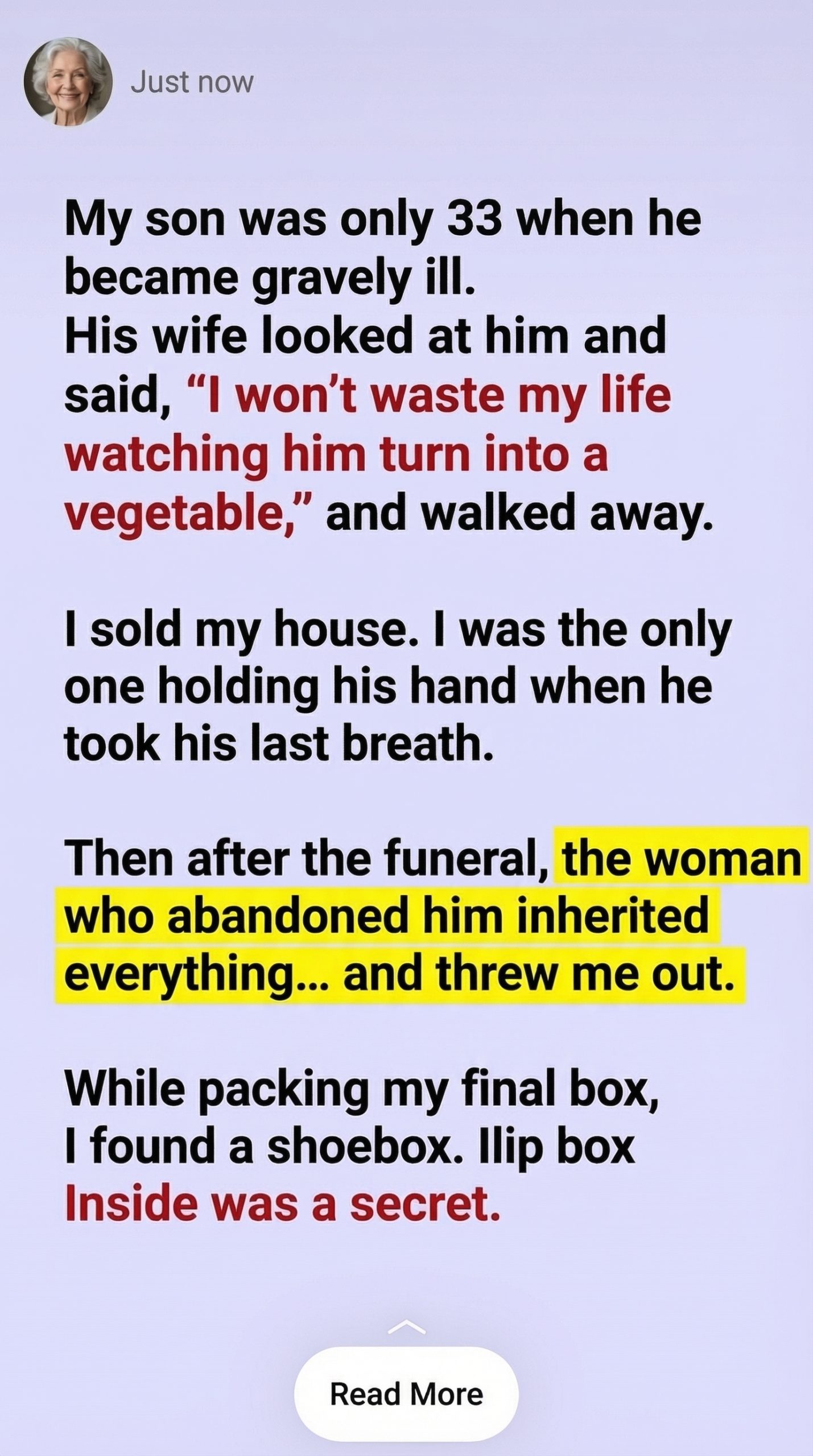
My son, Leo, was only 33 when the tremors started. Within months, the vibrant architect who could sketch a skyscraper from memory was confined to a bed, his body a prison.
His wife, Sarah, didn’t even wait for the final diagnosis. I’ll never forget the coldness in her eyes as she stood in the doorway of his hospital room, clutching her designer handbag.
“I’m thirty-one,” she said, her voice devoid of any tremor. “I won’t waste the best years of my life watching a man turn into a vegetable. This isn’t the life I signed up for.”
She walked out, and three days later, the divorce papers arrived.
I didn’t hesitate. I sold my cottage, the only home I’d known for forty years. I cashed out my meager retirement and moved into a small apartment with Leo. I became his nurse, his cook, his hands, and his voice. For two years, I lifted him, bathed him, and whispered stories of his childhood when the pain stole his sleep. I was the only one holding his hand, feeling the final, faint flutter of his pulse when he took his last breath.
The funeral was small, paid for by the last of my savings. Sarah showed up in a black lace dress that cost more than my car, weeping crocodile tears for the cameras. Because the divorce hadn’t been finalized before he died, she technically inherited everything—his life insurance, his investments, and the house I had spent my life savings to keep afloat.
“You have until tomorrow morning to clear out,” she told me at the cemetery, her voice a sharp contrast to her mourning veil. “I’ve already listed the property. You’re a squatter now, Martha. Get out.”
The next morning, my hands shaking, I was packing the last of my things. I reached under Leo’s old bed to check for stray socks and felt something hard. It was a shoebox, taped shut with heavy-duty silver duct tape.
When I sliced it open, my heart stopped.
Inside wasn’t money. It was a thick stack of legal documents and a small, encrypted digital recorder. I pressed play.
“Mom,” Leo’s voice was weak, recorded just weeks before he lost the ability to speak. “If you’re hearing this, Sarah thinks she’s won. She thinks I didn’t know about the ‘investments’ she was making with her lover using our joint accounts while I was sick. But I’m an architect, Mom. I build things to last. And I built a trap.”
The documents weren’t just a will; they were a Post-Nuptial Agreement Sarah had signed years ago during a brief rough patch—a document she thought she’d destroyed. It had a “Lifestyle and Infidelity Clause” so ironclad it would make a diamond look soft.
But the real shock was a Secret Trust. Leo had spent his final months quietly moving his intellectual property—patents for a new sustainable building material—into a trust in my name only.
I walked into the kitchen where Sarah was hovering, pointing at her watch. I didn’t say a word. I just handed her the “Infidelity Clause” and a copy of the private investigator’s report Leo had commissioned from his bed.
“The house is gone, Sarah,” I said, my voice finally steady. “The insurance is gone. The patents are mine. And according to this agreement you signed, you’re leaving this marriage with exactly what you brought into it: nothing.”
As the color drained from her face, the doorbell rang. It was the movers I had called—not to take my things out, but to change the locks.
I sat on the porch and watched her scream into her phone as she walked down the driveway with nothing but her handbag. For the first time in two years, I took a deep breath. My son hadn’t just left me a secret; he had made sure that even in the dark, he was still taking care of the woman who never let go of his hand.