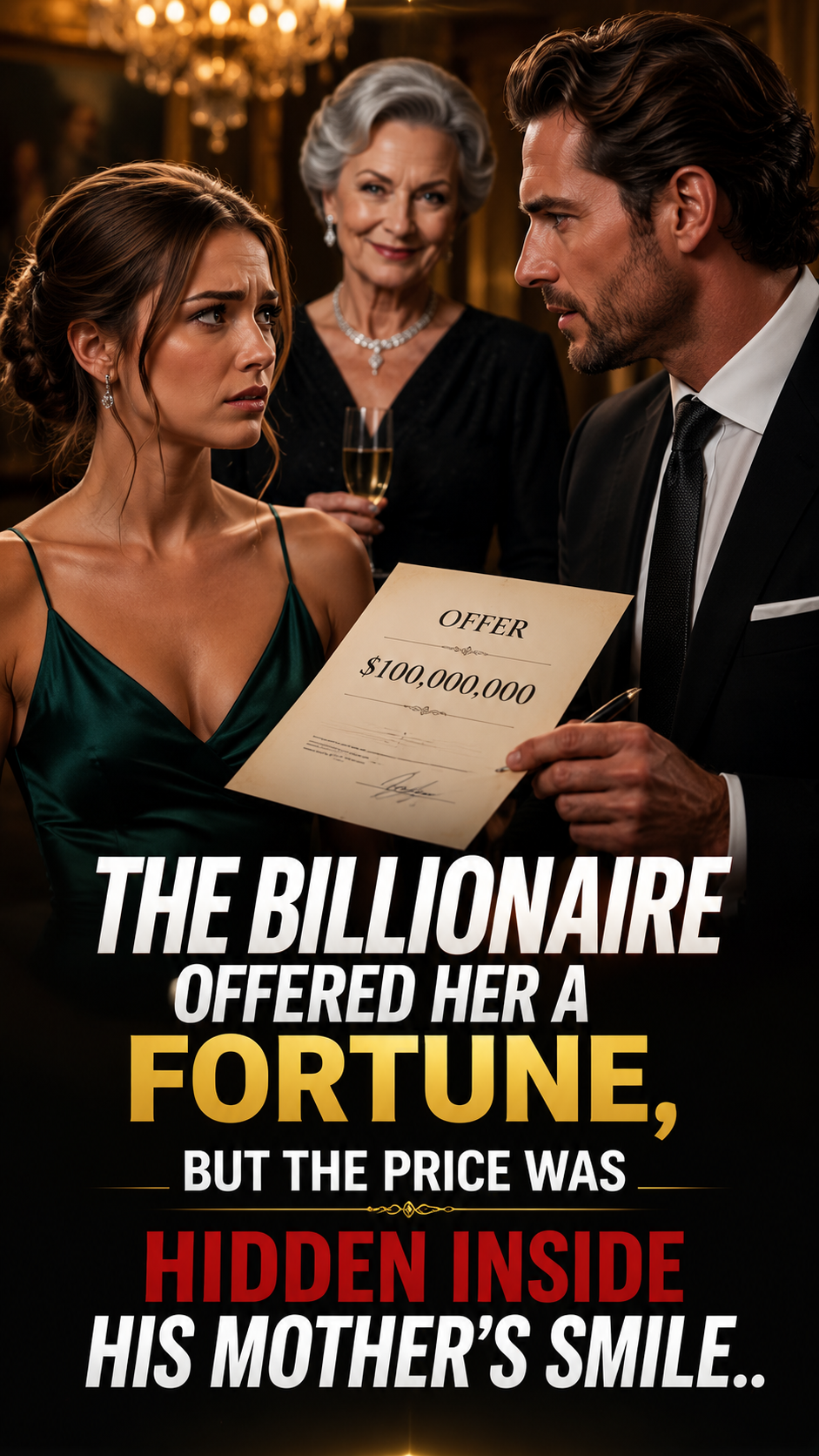
Valeria Cruz did not sleep that night.
She lay on the thin mattress in her small rented room while the city breathed through the cracked window—distant horns, barking dogs, a motorcycle whining somewhere down the avenue, a drunk man singing badly beneath the streetlights. The ceiling above her had a water stain shaped like a broken wing. She stared at it for hours, Alejandro Castañeda’s black business card resting on the plastic crate she used as a nightstand.
Castañeda Group.
The letters were embossed in silver.
Beneath them, an address in one of the richest parts of Querétaro.
Valeria had turned the card over at least a hundred times, as though some explanation might appear on the back. None did.
“I want to offer you something that could change your life forever.”
The words had followed her from the restaurant to her motorcycle, from the motorcycle to the grocery bag dinner she could barely afford, from dinner into the quiet, hungry hours before dawn.
People like Alejandro Castañeda did not enter the lives of women like her by accident.
They bought land. They bought silence. They bought loyalty. They bought beautiful things and placed them behind gates.
Valeria did not know what he wanted to buy from her.
But by six in the morning, when her phone buzzed with a warning from the electric company and her landlord sent a message that read, “Último aviso, Valeria,” she sat up and reached for the card.
By seven-thirty, she was on her motorcycle, hair tied beneath her helmet, wind cutting through her jacket as she rode toward a part of the city where the streets widened, the sidewalks gleamed, and the houses hid behind walls high enough to forget poverty existed.
The address led her to a mansion of pale stone and black iron, surrounded by gardens so perfect they seemed unreal. Two guards stopped her at the gate. One looked at her motorcycle, then at her worn sneakers, then back at the card.
Valeria lifted her chin.
“I was invited.”
The guard made a call.
A minute later, the gates opened.
She drove slowly up the long driveway, feeling suddenly aware of every scuff on her shoes, every threadbare seam of her jacket, every bruise of exhaustion beneath her eyes. At the entrance, a maid in a crisp gray uniform waited without smiling.
“Señorita Cruz?”
“Yes.”
“Don Alejandro is expecting you.”
Inside, the house smelled of polished wood, white roses, and money so old it no longer needed to announce itself. Sunlight poured over marble floors. Paintings watched from the walls. Somewhere, a fountain whispered.
Valeria followed the maid through a hallway and into a wide sitting room where Alejandro stood near the window, speaking quietly into his phone.
He wore a charcoal suit without a wrinkle, his dark hair perfectly controlled, his expression sharp and unreadable. He looked like the kind of man who had never had to check his bank account before buying groceries.
When he saw her, he ended the call.
“Señorita Cruz.”
“Valeria,” she said before she could lose courage.
One eyebrow lifted slightly.
“Valeria, then.”
The maid left. The silence grew expensive.
Alejandro gestured toward a chair. “Please.”
Valeria sat only halfway, ready to stand if needed. “You said you had an offer.”
“I do.”
“Then say it.”
Something almost like amusement passed across his face. “Direct.”
“I have work in two hours.”
“No, you don’t.”
Her stomach tightened. “Excuse me?”
“I spoke with the owner of La Esquina del Laurel. Your shift has been covered.”
Valeria stood. “You had no right to interfere with my job.”
“I compensated him for the inconvenience.”
“That isn’t the point.”
“No,” Alejandro said calmly. “The point is that you are exhausted, underpaid, overdue on rent, and one broken motorcycle part away from losing everything.”
Her face burned. “Did you investigate me?”
“Yes.”
The honesty was so blunt it stole her next breath.
He stepped closer. “I do not enjoy wasting time. Yesterday, you helped my mother without knowing who she was. You did not perform kindness for an audience. You did not ask for anything. You protected her dignity when everyone else pretended not to see her suffering.”
Valeria’s anger faltered.
Alejandro’s voice lowered. “My mother has Parkinson’s disease. It is progressing. She has nurses, therapists, specialists, caretakers. The best money can buy.”
“Then why am I here?”
“Because she hates all of them.”
Valeria blinked.
“For two years,” he continued, “she has dismissed every companion I have hired. She says they treat her like porcelain, like a problem to manage. Yesterday, she asked about you three times on the drive home.”
Valeria looked away, unprepared for the ache those words caused.
Doña Mercedes had reminded her of her grandmother so strongly it had hurt. The same stubborn dignity. The same tremor in the hands. The same quiet shame when the body betrayed the spirit.
Alejandro walked to a desk and picked up a folder.
“I want to hire you as my mother’s personal companion.”
Valeria stared at him.
“You want me to be a nurse?”
“No. She has nurses. I want you to be with her. Talk to her. Eat with her. Help when she asks. Respect her when she refuses.”
“I’m not qualified.”
“She does not need qualifications. She needs patience.”
Valeria laughed once, uncertain and bitter. “And what would this patience pay?”
Alejandro opened the folder and slid a paper across the table.
Valeria looked down.
Then forgot how to breathe.
The monthly salary was more than she made in half a year.
“No,” she whispered.
“No?”
“This is too much.”
“It is appropriate.”
“It’s impossible.”
“It is money, Valeria. Not a miracle.”
“To you, maybe.”
Their eyes met.
For the first time, Alejandro’s expression changed. Not softened exactly, but something behind it shifted, as if her words had struck a place he usually kept locked.
“You would have your own room here if you choose to stay during the week,” he said. “Medical insurance. Paid time off. Your debts settled in advance as a signing bonus.”
Valeria stepped back from the paper.
There it was.
The hook beneath the gold.
“My debts?”
“Yes.”
“You know about those too.”
“I told you I investigated.”
She crossed her arms tightly. “And what do you want in exchange besides my company for your mother?”
Alejandro was silent.
Too silent.
Valeria felt her skin prickle.
“Say it.”
His gaze moved toward the window, where the garden shimmered beneath morning light.
“My family has an annual foundation gala in six weeks. My mother is expected to attend. It will be public. Press, investors, politicians. She refuses to appear because she fears people will see how much her condition has advanced.”
Valeria waited.
“She said she might attend if you were with her.”
“That doesn’t sound terrible.”
“There is more.”
“Of course there is.”
Alejandro turned back.
“My mother has also decided that if I do not marry, she will transfer a significant portion of her shares in Castañeda Group to my cousin, Rodrigo.”
Valeria stared. “What does that have to do with me?”
“She dislikes every woman my family has tried to introduce to me.”
A cold laugh escaped her. “No.”
“You have not heard the proposal.”
“I heard enough.”
“Valeria—”
“No.” She picked up her bag. “I am poor, not stupid.”
Alejandro’s jaw tightened. “I am not asking you to marry me.”
“Good.”
“I am asking you to pretend to be someone important to me.”
She froze.
His words hung there, elegant and poisonous.
“Someone important,” she repeated.
“A relationship. Temporary. Public enough to reassure my mother. Private enough to end quietly after the gala.”
Valeria stared at him as if he had placed a knife beside the contract.
“You want to rent a girlfriend.”
His mouth hardened. “I want to protect my company from my cousin.”
“And lie to your sick mother.”
A flash of anger crossed his face. “Do not speak as though you understand my family.”
“I understand enough.”
“No,” he said, voice sharper now. “You understand hunger, debts, exhaustion. You do not understand boardrooms full of men waiting for one sign of weakness. You do not understand relatives who smile while calculating how quickly your mother must die before her shares become available.”
Valeria went still.
The room quieted around them.
Alejandro inhaled slowly, regaining control. “Rodrigo cannot have those shares. He will destroy everything my father built.”
“And you?”
“I protect what is mine.”
The answer came too quickly.
Valeria looked at the contract again.
Her rent. Her electricity. Her motorcycle repairs. Her grandmother’s old medical bills that still followed her like ghosts. A life raft lay before her, gleaming and dangerous.
“Why me?” she asked. “Really.”
Alejandro’s eyes did not leave hers.
“Because my mother trusts you.”
“That is not enough.”
“No.” His voice dropped. “Because yesterday, when you looked at her, you did not see weakness. You saw a person. That is rarer in my world than you think.”
The sincerity disarmed her.
She hated that.
She hated more that she wanted to believe him.
“What are the rules?” she asked quietly.
Alejandro opened another page. “You will live here Monday through Friday. You may keep outside work on weekends if you insist, though it will not be necessary. You will accompany my mother during meals, appointments, and selected social events. In public, you and I will appear to be in a discreet relationship. No physical intimacy required beyond reasonable appearances.”
Valeria’s cheeks heated. “Reasonable appearances?”
“A hand on my arm. Sitting beside me. Perhaps photographs.”
“No kissing.”
“Not unless circumstances demand it.”
“Circumstances can go to hell.”
A faint smile touched his mouth and vanished. “Noted.”
She looked down at the salary again.
Her pride screamed.
Her reality answered louder.
“I want changes.”
Alejandro’s eyes sharpened. “Such as?”
“My debts are not a signing bonus. They are an advance against salary, written clearly. I do not want to owe you anything personal.”
“Agreed.”
“I keep my room locked.”
“Of course.”
“If your mother asks me directly whether this relationship is real, I won’t lie.”
His expression cooled. “That may become difficult.”
“That is my condition.”
A long silence passed.
Then Alejandro nodded. “Fine.”
“And one more thing.”
“Yes?”
“If at any point I feel your mother is being hurt by this, I leave.”
He studied her for several seconds.
“You negotiate better than some executives I know.”
“I have had more to lose.”
This time, the silence between them changed.
He signed first. Then offered the pen.
Valeria held it, staring at the blank line where her name belonged. She thought of her grandmother’s hands. Of unpaid bills. Of Doña Mercedes smiling with soup on her spoon and tears in her eyes.
Then she signed.
And with one stroke of ink, Valeria Cruz entered a world designed to swallow women like her whole.
Doña Mercedes was waiting in the sunroom.
When Valeria entered, the elderly woman turned from the window, and her face lit with such fragile joy that Valeria’s doubts faltered.
“You came.”
Valeria smiled despite herself. “I did.”
“Did my son frighten you?”
“A little.”
Mercedes waved a trembling hand. “Good. He needs the practice being less terrifying.”
Behind Valeria, Alejandro exhaled in quiet annoyance.
Mercedes noticed and smiled. “Do not stand there like a statue, Alejandro. Bring coffee.”
“I own three factories and a hotel chain.”
“And yet you still know where the coffee is.”
Valeria pressed her lips together to hide a laugh.
Alejandro looked between them, defeated, and left.
The moment he was gone, Mercedes reached for Valeria’s hand. Her fingers trembled, but her gaze was sharp.
“How much did he offer you?”
Valeria’s smile faded.
Mercedes patted her hand. “Do not look so shocked. My son believes secrecy is a personality. It is not.”
“He offered me a job.”
“And something else?”
Valeria said nothing.
Mercedes sighed. “Alejandro thinks he invented sacrifice. He did not. He inherited it.”
There was pain in the old woman’s voice, buried beneath elegance.
Valeria sat beside her. “Doña Mercedes—”
“Mercedes,” she corrected. “If you are to live in my house, you cannot speak to me like a banker.”
Valeria nodded. “Mercedes.”
The woman smiled. Then her eyes moved to the garden.
“My son is not cruel,” she said softly. “But he is trained to survive cruel people. Sometimes that makes the difference hard to see.”
Valeria listened.
“In this family,” Mercedes continued, “love has always been treated like a weakness someone might exploit. My husband believed that. My brother believed it. Rodrigo believes it most of all.”
“Your nephew.”
“My punishment from God,” Mercedes muttered.
Valeria laughed.
Mercedes squeezed her hand. “There. That sound. Bring more of that into this house. It has been too quiet.”
For the next several days, Valeria learned the rhythm of the mansion.
Breakfast at eight, though Mercedes rarely ate much unless Valeria sat with her. Physical therapy at ten, which Mercedes despised but endured if Valeria told stories from the restaurant. Afternoon tea in the garden. Medication alarms. Tremors. Stubborn refusals. Sudden laughter.
And Alejandro.
Always Alejandro.
He appeared in doorways, on phone calls, at the far end of dining tables. Controlled. Watchful. Distant. He worked late, left early, and seemed to carry invisible wars in the set of his shoulders.
Their public performance began with small things.
A photograph leaked from a charity luncheon: Valeria seated beside Alejandro, Mercedes between them, smiling. Online gossip followed within hours.
Who is Alejandro Castañeda’s mystery woman?
Waitress wins billionaire’s heart?
Castañeda heir dating restaurant employee?
At first, Valeria tried not to read the comments.
Then she did.
Gold digger.
Pretty enough, but clearly temporary.
He’ll never marry someone like her.
She threw the phone onto her bed and told herself she did not care.
That evening, Alejandro found her in the hallway outside Mercedes’s room.
“You saw the articles.”
She crossed her arms. “Your world is charming.”
“My public relations team can reduce the coverage.”
“Can they make people less awful?”
“No.”
“Then don’t bother.”
He studied her. “You are angry.”
“I’m tired of people assuming poverty makes a woman available for purchase.”
His expression tightened. “I did not purchase you.”
“No. You hired me to lie convincingly.”
“That is different.”
“Is it?”
Their eyes locked.
For a moment, something raw moved between them—anger, yes, but not only that. Recognition. They were both trapped by money, though from opposite sides of the gate.
Alejandro looked away first.
“My mother is happier,” he said.
Valeria’s anger softened despite herself. “I know.”
“Thank you.”
The words were stiff, almost uncomfortable, as though gratitude did not fit easily in his mouth.
Valeria nodded.
He turned to leave.
“Alejandro.”
He stopped.
“You should have dinner with her more often.”
His back went rigid.
“I’m busy.”
“She misses you.”
“You have known her one week.”
“And I can see it.”
He turned slowly. “My relationship with my mother is not part of your contract.”
“No. But it is part of why she is lonely.”
His eyes darkened. “Be careful.”
Valeria stepped closer. “You hired me because I tell the truth to people everyone else is afraid of. Do not get offended when that includes you.”
For one breath, she thought he might dismiss her.
Instead, he looked toward Mercedes’s closed door, and something in his face changed.
The next night, he came to dinner.
Mercedes pretended not to notice her own happiness, but her hands shook so badly from emotion that soup spilled onto the tablecloth. Valeria reached for a napkin, but Alejandro moved first.
Gently, without a word, he cleaned the spill.
Mercedes stared at him.
His jaw tightened. “What?”
“Nothing,” she whispered.
But her eyes shone.
That was the first crack.
More followed.
Alejandro began appearing for breakfast. Then afternoon tea. Once, Valeria found him in the garden listening as Mercedes told him a story from his childhood. He looked uncomfortable, but he stayed.
With each day, the false relationship became harder to keep neatly false.
At a private dinner with investors, Alejandro placed a hand at the small of Valeria’s back to guide her through a crowd. It was a performance, she told herself. But his palm was warm through the fabric of her dress, and when a banker made a cruel joke about “Cinderella stories,” Alejandro’s smile vanished.
“Careful,” he said quietly.
The banker laughed. “I meant nothing by it.”
“I know exactly what you meant.”
The table went silent.
Valeria felt heat rise in her chest.
Later, on the terrace, she confronted him. “You didn’t have to do that.”
“Yes,” Alejandro said, looking out over the city lights. “I did.”
“Why?”
He was silent long enough that she thought he would not answer.
Then he said, “Because I know what it is to be spoken about like property.”
Valeria looked at him.
He did not turn.
“My father loved the company more than people,” he said. “When I was eight, he introduced me to a room full of executives as his successor. Not his son. His successor.”
His voice remained controlled, but the night around it felt fragile.
“He taught me never to cry in public, never to trust praise, never to enter a room without knowing who wanted something from me.”
“And what did you want?”
He gave a humorless smile. “A father.”
Valeria’s throat tightened.
Below them, Querétaro glittered like a jewel box. From that height, the city looked peaceful. It hid hunger well.
“Alejandro,” she said softly.
He turned then.
The space between them changed again.
Not performance.
Not contract.
Something quieter. More dangerous.
He reached up slowly, as if giving her time to refuse, and brushed a strand of hair from her face.
Valeria should have stepped back.
She did not.
His hand lingered near her cheek.
“Tell me to stop,” he murmured.
Her breath caught.
Before she could answer, the terrace doors opened.
Rodrigo Castañeda walked out smiling.
He was handsome in a polished, poisonous way, with light eyes that seemed amused by everything and warmed by nothing.
“Forgive me,” Rodrigo said. “Am I interrupting a business arrangement or a romance?”
Alejandro’s face closed instantly.
“Leave.”
Rodrigo chuckled. “So protective. How sweet.”
His gaze moved over Valeria like a hand she wanted to slap away.
“You must be Valeria. The famous waitress.”
“Former waitress,” she said.
His smile widened. “Ambitious.”
Alejandro stepped forward. “Rodrigo.”
“What? I admire ambition. Especially when it wears borrowed diamonds.”
Valeria looked down at the necklace Mercedes had insisted she wear.
Before Alejandro could speak, Valeria smiled.
“And I admire honesty,” she said. “Sadly, you are wearing none.”
Rodrigo’s smile froze.
Alejandro’s mouth twitched.
Rodrigo leaned closer. “Careful, querida. In this family, sharp tongues get cut out.”
Valeria held his gaze. “Then you must speak very softly.”
The silence was exquisite.
Rodrigo laughed, but the sound was thin. “I see why Tía Mercedes likes you.”
He turned to Alejandro. “Enjoy your little rebellion while it lasts. The board meeting is in two weeks. After that, love story or not, things will change.”
He left.
Valeria exhaled.
Alejandro looked at her with something close to admiration. “You should not provoke him.”
“He started.”
“He is dangerous.”
“So are you.”
His gaze softened. “Not to you.”
The words were too immediate.
Too sincere.
Valeria felt the ground shift beneath her heart.
That night, she could not sleep again—but for a different reason.
Days folded into weeks.
The gala approached.
Mercedes grew more determined, practicing walking in heels despite Valeria’s protests, choosing gowns, rejecting hairstyles, demanding music from her youth. She also grew weaker. Some mornings her tremors were violent. Some afternoons she sat staring at her hands with fury and grief.
“My body is becoming a house where the lights go out one by one,” she told Valeria once.
Valeria knelt before her. “Then we light candles.”
Mercedes touched her face.
“You are a dangerous girl,” she whispered.
“Why?”
“You make people hope.”
The night of the gala arrived beneath a sky heavy with rain.
The Castañeda Foundation event was held in a restored colonial palace glowing with chandeliers and camera flashes. Valeria wore a deep emerald gown Mercedes had chosen, her hair pinned back, her pulse hammering beneath borrowed jewels.
Alejandro stood beside her in black tie, devastatingly composed.
“You look terrified,” he murmured.
“I am.”
“Good. So is everyone else.”
She almost laughed.
Mercedes arrived last, leaning on Alejandro’s arm on one side and Valeria’s on the other. The cameras erupted.
For a moment, Mercedes trembled.
Not from illness.
From fear.
Valeria leaned close. “Take your time. You don’t have to rush for anyone.”
The same words from the restaurant.
Mercedes turned to her, eyes shining.
Then she lifted her chin and walked forward.
The entire room stood for her.
Applause thundered beneath the painted ceiling. Mercedes smiled, fragile and radiant, while Alejandro’s hand tightened briefly around Valeria’s.
Rodrigo watched from across the room, expression unreadable.
The evening unfolded like a dream balancing on a blade. Speeches. Toasts. Photographs. Whispers. Valeria felt eyes on her everywhere, measuring, judging, doubting.
Then Alejandro took the stage.
He spoke about the foundation’s work, about responsibility, about legacy. His voice was steady, elegant, practiced.
Then he looked at his mother.
“My mother taught me that dignity is not something we give to others,” he said. “It is something we recognize when the world forgets to look.”
His eyes moved to Valeria.
A silence fell.
“And recently,” he continued, “someone reminded me how much I still had to learn.”
Valeria’s heart stopped.
This was not in the plan.
Alejandro stepped down from the stage and walked toward her.
Cameras followed.
Mercedes covered her mouth.
Valeria whispered, “What are you doing?”
Alejandro stood before her.
For the first time since she had met him, he looked uncertain.
Human.
“I began this dishonestly,” he said softly, though the microphone still caught every word. “I thought I was protecting my family. My company. My name.”
Valeria’s eyes widened.
“Alejandro—”
“But somewhere between lies and appearances, I found the one person in this room who never needed my name to stand tall.”
The room held its breath.
He reached into his jacket.
Valeria’s world narrowed to his hand.
A ring box.
No.
No, no, no.
He opened it.
Inside lay a simple diamond ring, elegant and devastating.
Gasps rippled through the hall.
Valeria stared at him, panic and something dangerously close to longing tearing through her at once.
“Valeria Cruz,” Alejandro said, voice rougher now, “I am asking you in front of everyone because I have spent my life hiding what matters behind contracts. I do not want another contract.”
His eyes searched hers.
“Marry me.”
The room exploded in whispers.
Mercedes began to cry.
Valeria could not breathe.
This was impossible. Reckless. Beautiful. Cruel.
She leaned close, lips barely moving. “Is this real?”
Alejandro’s answer came without hesitation.
“Yes.”
That single word broke something open inside her.
All the walls she had built from debt, exhaustion, and caution trembled.
“Alejandro,” she whispered.
Then the lights went out.
Darkness swallowed the ballroom.
A scream cut through the hall.
When emergency lights flickered red, chaos had already begun.
Mercedes was gone.
Her chair overturned.
Her cane lay on the floor.
Alejandro’s face became white with terror.
“Mother!”
Security surged toward the exits. Guests shouted. Cameras flashed blindly. Valeria dropped to her knees and picked up the cane, her hands shaking.
There was a note tied to it with a black ribbon.
Alejandro ripped it open.
His expression changed from fear to murderous rage.
Valeria read over his shoulder.
Give me the shares, or she dies before sunrise.
—Rodrigo
Alejandro turned toward the room, but Rodrigo had vanished.
The proposal. The speech. The public confession.
All of it had become the perfect distraction.
Then Valeria noticed something on the back of the note.
A second line.
Written in Mercedes’s trembling hand.
Do not trust Alejandro.
Valeria looked up slowly.
Alejandro was staring at the same words.
His face was not confused.
It was devastated.
And before Valeria could speak, her phone vibrated.
A video message appeared from an unknown number.
She pressed play.
Mercedes appeared on screen, pale but alive, sitting in the back of a moving car.
“My dear Valeria,” the old woman whispered, tears streaking her face. “Forgive me. I brought you into this house because I needed someone my son could love… and someone brave enough to destroy him.”
The video cut to black.