 I
I
Paid $58,000 for My Son’s Wedding — Then He Sued Me for His Honeymoon
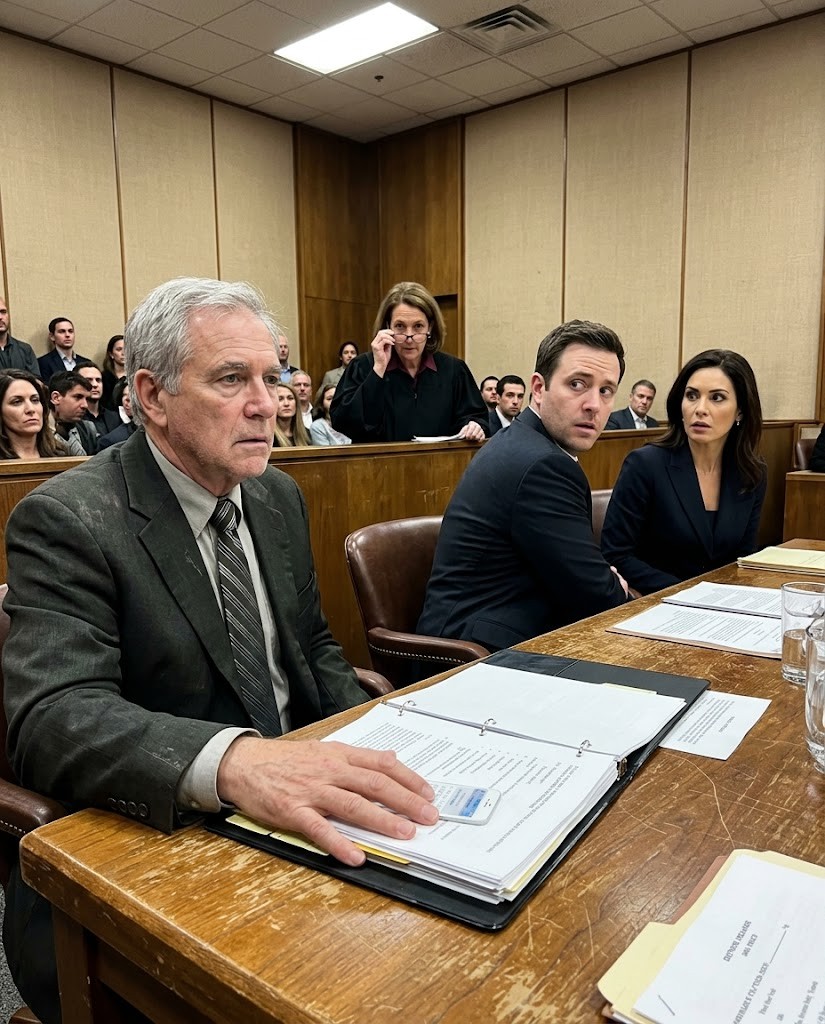
The judge removed her glasses slowly.
Not dramatically. Not angrily.
Carefully.
Like someone handling something fragile and deeply disappointing.
The courtroom had gone silent after she read Nadine’s message aloud for the second time:
“If he pays vendors this easily, hold the honeymoon bookings until after the wedding. He won’t want to look stingy once the pictures are up.”
No one moved.
Not Gareth.
Not Nadine.
Not even their attorney.
The judge folded her hands over the binder and looked directly at them.
“Before this court addresses your demand for honeymoon reimbursement,” she said calmly, “there is something in these communications that fundamentally changes the nature of this case.”
I felt my pulse in my throat.
Not because I was nervous anymore.
Because for the first time in months, somebody else finally saw what I had been living through.
The judge continued.
“These messages do not reflect confusion over financial expectations. They reflect calculated manipulation.”
Nadine’s attorney immediately stood.
“Your Honor, I object to the characterization—”
“Sit down,” the judge interrupted without even raising her voice.
He sat.
The sound of the chair scraping against the floor echoed through the room.
The judge turned another page.
“Mr. Whitfield paid nearly one hundred and fifty-five thousand dollars in cumulative support over several years.” She glanced at Gareth. “And instead of gratitude, these messages repeatedly discuss strategies to pressure him into continued financial compliance.”
Financial compliance.
The words hit Gareth harder than I expected.
His face changed.
For the first time all morning, he looked scared.
Not angry.
Not defensive.
Scared.
Because suddenly this wasn’t about a honeymoon anymore.
It was about what kind of people they appeared to be.
The judge leaned back slightly.
“Frankly,” she said, “this court is struggling to understand how either plaintiff believed this lawsuit would succeed.”
Nadine finally spoke.
Quietly.
“But he promised to help us.”
I almost laughed.
Not because it was funny.
Because after everything, that was still the sentence she chose.
The judge looked at her carefully.
“There is a difference between generosity and obligation,” she said. “And there is certainly a difference between support and entitlement.”
Entitlement.
That word settled over the courtroom like dust.
Gareth stared at the table.
His attorney whispered something urgently to him.
But Gareth looked exhausted now.
Like a man waking up in the middle of a bad dream and realizing he helped build it.
The judge dismissed the claim entirely.
Not partially.
Entirely.
Then she added something unexpected.
“This court strongly encourages the plaintiffs to reflect on the extraordinary level of support they have already received from Mr. Whitfield before confusing parental love with permanent financial responsibility.”
Parental love.
I hadn’t realized until that moment how much those words hurt.
Because that had been the real problem all along.
I loved my son so much that I ignored every warning sign.
I confused helping him with protecting him.
And those are not the same thing.
The hearing ended.
People began standing.
Papers shuffled.
Chairs moved.
But I stayed seated for a moment, staring at the binder in front of me.
Three years of transfers.
Three years of excuses.
Three years of trying to keep my son from struggling because Sylvia’s death had already broken enough things in his life.
I thought helping him would heal us both.
Instead, it taught him that love arrived through bank wires.
As I packed the binder away, Gareth finally approached me.
Alone.
Nadine stayed near the exit with her arms folded tightly across her chest.
For several seconds, Gareth just stood there.
He looked older than thirty-two.
Smaller somehow.
“Dad…”
His voice cracked slightly.
I waited.
He rubbed both hands over his face.
“I didn’t think it would go this far.”
I looked at him quietly.
“That’s because you stopped seeing me as your father,” I said. “You started seeing me as funding.”
He flinched.
Good.
Not because I wanted to hurt him.
Because truth should hurt when you’ve avoided it long enough.
He swallowed hard.
“Nadine thought—”
“No,” I interrupted softly. “You thought it too.”
That was the first moment he actually looked ashamed.
Real shame is quiet.
It doesn’t defend itself.
He sat beside me slowly.
And suddenly, for one brief second, I saw the little boy who used to crawl into bed during thunderstorms because he was afraid the roof would collapse.
After Sylvia died, I had been so terrified of losing him emotionally that I gave him everything materially.
Money became easier than boundaries.
Easier than difficult conversations.
Easier than saying no.
But love without boundaries eventually stops looking like love.
It starts looking like permission.
Gareth stared at the floor.
“She said you’d forgive us eventually.”
I nodded once.
“And what did you think?”
He didn’t answer.
Because he knew.
The worst part wasn’t the lawsuit.
It wasn’t even the humiliation.
It was discovering my son genuinely expected me to absorb it all quietly because that had become normal.
I stood and picked up the binder.
“I’m going home,” I said.
“Dad…”
I paused.
Tears stood in his eyes now.
Not dramatic tears.
Confused tears.
Like someone realizing consequences are real for the first time.
“I don’t know how to fix this.”
I believed him.
And somehow that hurt even more.
“You start,” I said carefully, “by understanding that your mother and I raised you to love people. Not use them.”
Then I walked away.
For the next four months, we barely spoke.
Nadine sent exactly one message after court.
It read:
“I hope you’re happy.”
I never responded.
Because happiness had nothing to do with it.
Peace did.
And peace finally arrived the day I stopped apologizing for having limits.
I sold the large family house six months later.
Not because I needed money.
Because I no longer wanted to live inside rooms filled with ghosts and expectations.
I bought a smaller home near the coast.
Quiet neighborhood.
Blue shutters.
Rosemary bushes again, because Sylvia loved them.
For the first time in years, my phone stopped vibrating every week with emergencies that somehow required my credit card.
Silence returned.
Healthy silence.
Then one rainy November evening, nearly nine months after court, my phone rang at 11:47 p.m.
Gareth.
I almost didn’t answer.
Almost.
But when I did, I heard crying immediately.
Not polite crying.
Not controlled crying.
The kind that breaks out of someone before they can stop it.
“Dad…”
I sat up slowly.
“What happened?”
There was a long silence.
Then he whispered:
“She left.”
I closed my eyes.
Not from surprise.
From sadness.
Apparently Nadine had emptied a joint account two weeks earlier.
She had also apparently been involved with someone else for months.
The marriage collapsed less than a year after the wedding.
Gareth sounded destroyed.
And underneath all that pain, I could hear something else too:
embarrassment.
Because deep down, he finally understood what Sylvia would have seen immediately.
The relationship had never been built on love strong enough to survive hardship.
Only appearances strong enough to impress people.
We spoke for nearly three hours that night.
Really spoke.
For the first time since Sylvia died.
At one point he broke down completely and said:
“I think Mom would be ashamed of me.”
That nearly destroyed me.
Because despite everything, he was still my son.
“No,” I said quietly. “She’d be heartbroken first.”
He cried harder after that.
Healing did not happen overnight.
Trust rarely returns in dramatic movie moments.
It returns slowly.
Awkwardly.
One honest conversation at a time.
Over the next year, Gareth rebuilt his life carefully.
Alone this time.
No luxury condo.
No curated image.
No pretending.
Just work.
Therapy.
Debt repayment.
Humility.
The first check he sent me was for two hundred dollars.
Tiny compared to everything I had spent.
But I nearly cried when I opened the envelope.
Because attached to it was a handwritten note:
“For the first time, I want to become someone who gives back instead of someone who keeps taking.”
I kept that note.
Still have it.
Sometimes people ask if I regret paying for the wedding.
The answer surprises them.
No.
I regret ignoring what the payments were teaching everyone involved.
Especially me.
Money does not save relationships built on disrespect.
It only delays the collapse.
And love without self-respect eventually turns into permission for other people to wound you comfortably.
Sylvia understood that long before I did.
I think about her often now.
Especially on quiet mornings when sunlight hits the kitchen window exactly the way it used to in our old house.
Sometimes I imagine telling her the entire story.
The wedding.
The lawsuit.
The courtroom.
The phone call months later.
And I can already hear what she would say.
Probably something simple.
Something painfully accurate.
“Leonard,” she’d sigh, “you kept trying to buy loyalty from people who were supposed to give it freely.”
And she would have been right.
(Final Ending)
Three years later, Gareth stood in my kitchen holding a pie that looked absolutely terrible.
Burnt crust.
Crooked edges.
Blueberry filling leaking from one side.
He looked nervous carrying it.
Which made absolutely no sense considering he was thirty-five years old and built like a grown man.
But I understood anyway.
Because some apologies take years to finish.
“I tried making Mom’s recipe,” he said awkwardly.
I stared at the pie for a second before laughing harder than I had in months.
“It looks like it survived a car accident.”
To my surprise, Gareth laughed too.
A real laugh.
Not forced.
Not careful.
Just honest.
And in that moment, I realized how long it had been since either of us sounded normal around each other.
He set the pie carefully on the counter while my granddaughter ran through the hallway behind him wearing mismatched socks and carrying crayons.
Yes.
Granddaughter.
That was the part nobody saw coming.
Two years after his divorce, Gareth met Elise.
A middle-school teacher with student-loan debt, messy buns, and absolutely zero interest in pretending to be impressed by money.
The first time I met her, she spilled iced tea on herself and laughed instead of panicking.
I liked her immediately.
The second thing I noticed?
She treated waiters kindly.
The third?
She never once asked about my finances.
Not once.
When Gareth eventually told her everything about the lawsuit, he expected her to judge him.
Instead, she apparently stared at him and said:
“You sued your grieving father… over a honeymoon?”
Then she made him volunteer with her school fundraiser for six straight weekends.
To this day, I’m still not entirely sure whether that counted as punishment or rehabilitation.
Probably both.
But somewhere along the way, Gareth changed.
Really changed.
Not performatively.
Not temporarily.
Fundamentally.
The transformation wasn’t dramatic.
It showed up in small things.
He started paying his own bills without complaining.
Stopped measuring people by status.
Started calling just to ask how I was doing instead of asking for help.
And maybe most importantly…
he learned how to sit with discomfort instead of trying to spend his way out of it.
That mattered.
One evening, after Elise put their daughter Lily to bed, Gareth and I sat on my back porch watching rain roll over the water.
He had been quiet most of the night.
Finally he spoke.
“You know what the worst part is?”
“What?”
“I really believed I was the victim back then.”
I didn’t answer immediately.
Because honesty deserved honesty.
“That’s what entitlement does,” I said quietly. “It convinces people sacrifice is something they deserve automatically.”
He nodded slowly.
Then he looked at me.
“I don’t think I ever thanked you properly for everything after Mom died.”
That sentence nearly broke me.
Not because I needed gratitude.
Because for years I thought he would never understand.
I looked out toward the dark ocean before answering.
“You were grieving,” I said.
“So were you.”
That one landed between us heavily.
Because he was right.
After Sylvia died, everybody focused on Gareth losing his mother.
Very few people noticed I had lost my wife.
My best friend.
My entire future.
And instead of processing any of it, I buried myself in taking care of him financially because money felt easier than pain.
Gareth rubbed his hands together nervously.
“I used you.”
The words came out quietly.
I appreciated that more than denial.
“Yes,” I said gently. “You did.”
He nodded once.
No arguing.
No excuses.
Just truth.
And strangely enough, that was the moment I fully forgave him.
Not when he apologized.
Not when he repaid money.
Not even when the lawsuit ended.
I forgave him when he finally became honest enough to see himself clearly.
People think forgiveness happens suddenly.
It doesn’t.
Forgiveness arrives in layers.
Slowly.
Like winter finally leaving the ground.
A few months later, Gareth invited me to Lily’s preschool graduation.
Tiny chairs.
Paper decorations.
Twenty toddlers screaming randomly while exhausted parents pretended it was adorable.
In other words, chaos.
But halfway through the ceremony, Lily spotted me in the audience and shouted:
“Grandpa Leonard!”
Every parent turned.
Every teacher turned.
Lily waved both arms wildly like she hadn’t seen me in twenty years instead of two days.
And suddenly Gareth looked embarrassed.
I started laughing.
Then, unexpectedly, so did he.
Later that afternoon, while Elise packed leftovers into containers, Gareth handed me a folded envelope.
Inside was the final repayment check.
Every dollar.
Wedding money.
Emergency loans.
Credit card bailouts.
Everything.
Technically he didn’t owe me most of it legally.
But that wasn’t the point.
Attached was another note.
His handwriting was steadier now.
“You once told me love is not measured by what someone pays for you.
I finally understand that now.
Thank you for loving me long enough to let me fail.”
I had to sit down after reading it.
Because sometimes healing arrives so quietly you almost miss it.
That night, after everyone left, I walked alone through my small coastal house.
Past the rosemary bushes.
Past the framed photographs.
Past the old wooden clock Sylvia once insisted was ugly until she cried when I tried replacing it.
Funny how love works like that.
I stopped in front of the picture of Sylvia on the hallway shelf.
Still my favorite photo of her.
Wind blowing through her hair.
Laughing at something outside the frame.
I picked up the picture gently.
“Well,” I whispered softly, “he finally grew up.”
And for the first time in years…
the house no longer felt lonely.