The House They Tried to Steal
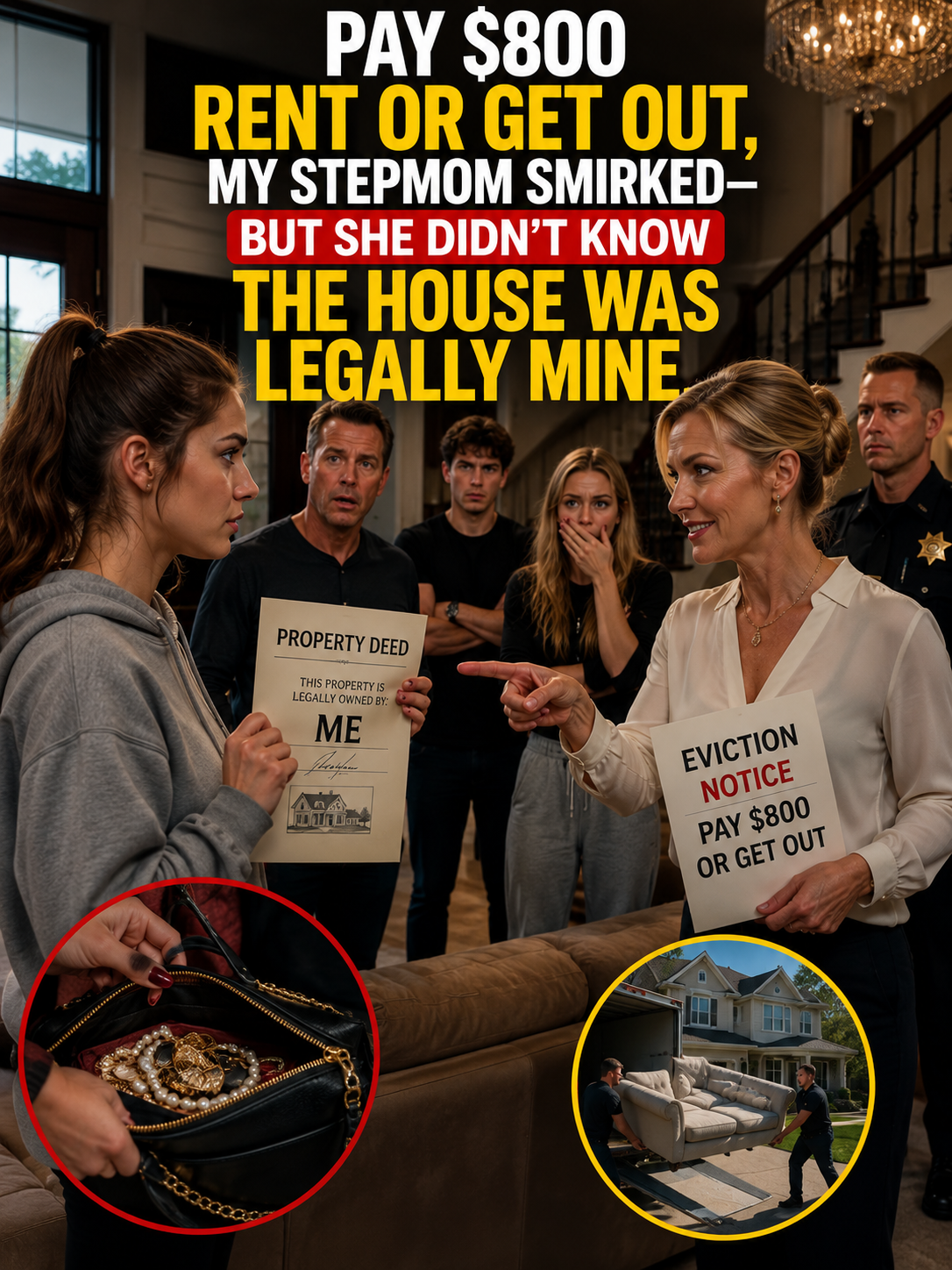
“Pay $800 rent or get out,” my stepmom smirked, while her two adult kids lived free in my $1,200,000 house.
I stayed calm… until she tried to ship me away for college so she could keep the keys.
That night, I played the recording, pulled out the deed my grandparents hid in my name, and served three eviction notices.
She screamed, “That’s illegal.”
The sheriff didn’t care.
Then my cameras caught her stuffing my dead mother’s jewelry into her purse, and the movers arrived mid-meltdown.
I’m 22.
My father is 46.
My stepmother Tracy is 43.
My stepbrother Brandon is 25.
My stepsister Sierra is 21.
Those aren’t their real names, but the nightmare absolutely was real.
My mom died from breast cancer when I was eight years old.
If you’ve never watched a family die slowly before the funeral even happens, it’s hard to explain what cancer does to a home. Everything becomes quiet. People stop laughing normally. Every room smells like medicine, flowers, and fear.
When my mom finally passed, the silence afterward felt worse than the sickness.
My father broke apart emotionally. He still went to work every day and kept his construction company running, but inside the house he became distant, exhausted, hollow.
My grandparents—my mother’s parents—became my real stability.
They cooked meals.
Helped me with homework.
Walked me to school.
Stayed up with me when nightmares hit.
And most importantly…
they protected me in ways I didn’t understand until years later.
A year after Mom died, my grandparents bought a huge four-bedroom colonial home outside Boston. Beautiful neighborhood. Big yard. Hardwood floors. Sunroom. Wraparound porch.
It felt warm.
Safe.
Like the kind of place bad things weren’t supposed to happen.
The agreement was simple: we would all live there together while my father recovered emotionally and rebuilt life for us.
For a while, it worked.
Then my father met Tracy.
He met her at a business conference in Chicago.
According to him, she “made him laugh again.”
That should’ve been my first warning.
Because people who heal you usually move gently.
People who hunt move fast.
Tracy moved fast.
Three months after meeting my father, she was flying across the country every other weekend.
Six months later, they got married.
Eight months later, she and her two children moved into our house.
My grandparents tried to stay polite.
But I heard their conversations late at night.
“She looks at this house like inventory,” my grandfather muttered once.
My grandmother worried Tracy was more interested in security than love.
But my father looked happy again.
So they stayed quiet.
That silence became everyone’s biggest mistake.
At first Tracy only changed small things.
Curtains.
Furniture.
Paint colors.
Then she started removing my mother.
Not literally.
Emotionally.
My mom’s framed art disappeared.
Her quilts vanished from closets.
Her books got boxed up.
One afternoon I came home from school and found Tracy throwing away some of my mother’s holiday decorations because they looked “dated and depressing.”
I remember standing there frozen while she tossed pieces of my childhood into garbage bags.
“You need to stop living in the past,” she told me.
I was eleven.
Then came the chores.
I’m not against chores.
But in our house, “everyone helps” somehow became “I do everything.”
By age twelve, I was:
Cleaning bathrooms.
Doing laundry.
Washing dishes.
Vacuuming.
Cooking dinner twice a week.
Walking Tracy’s dog.
Cleaning Brandon’s disgusting gym clothes.
Meanwhile Brandon and Sierra did almost nothing.
Brandon was “too busy with sports.”
Sierra was “too young.”
Tracy inspected my cleaning like a military officer.
If I missed dust on a shelf, she lectured me.
If I forgot towels in the dryer because of homework, she acted like I’d committed a crime.
Meanwhile Brandon’s room smelled like expired pizza and sweat.
Nothing happened to him.
Ever.
My father noticed pieces of it, but Tracy always twisted things before he could react.
“She’s dramatic.”
“She has attitude lately.”
“She’s lazy.”
“She needs structure.”
And because my father hated conflict, he believed her.
Or maybe believing her was easier than facing what he allowed.
Then my grandparents died.
My grandmother passed first from heart complications.
My grandfather followed three months later.
Losing them felt like losing the last adults who truly saw me.
The house changed after that.
It no longer felt protected.
Tracy became bolder almost immediately.
She started referring to it constantly as “our house.”
Then eventually…
“my house.”
One night at dinner she casually mentioned renovating the upstairs after I “eventually moved out.”
I remember looking at her strangely because she said it with confidence.
Like she already owned everything.
What I didn’t know then was this:
My grandparents saw her clearly long before anyone else did.
And before they died…
they legally transferred the entire house into my name.
Not someday.
Not in a will.
Immediately.
My father knew.
He never told me.
For years, I lived like unpaid staff inside a house that legally belonged to me.
By twenty-two, I was working part-time at Starbucks while taking online business classes.
I paid for my own clothes.
My own phone.
My own textbooks.
Meanwhile my father financed Brandon’s failed influencer career and Sierra’s expensive “business student” lifestyle.
Then came the Tuesday that changed everything.
I’d just gotten home from an opening shift when Tracy called me into the kitchen.
There was a printed paper waiting on the counter.
She slid it toward me like a landlord serving papers.
“Since you’re an adult now,” she smiled, “it’s time you contribute.”
Eight hundred dollars monthly rent.
I stared at the paper.
Then at Brandon eating cereal at noon.
Then at Sierra scrolling TikTok.
I asked if they were paying rent too.
Tracy smirked.
“Brandon is figuring things out.”
“And Sierra is still in school.”
“So am I.”
“Online classes don’t count the same.”
My father walked in halfway through the conversation.
He read the paper.
Rubbed his neck awkwardly.
Then said, “Maybe this is good responsibility.”
Responsibility.
I nearly laughed in his face.
I had spent ten years cleaning up behind people older than me.
But I stayed calm.
Because something about Tracy’s expression bothered me.
This wasn’t about money.
This was about removing me.
Two days later, she showed up outside my room holding brochures for an out-of-state college housing program.
She talked excitedly about dorms.
Campus living.
Independence.
Then she said the sentence that made my stomach turn.
“You’d only need to come back during holidays,” she smiled. “I could hold onto your key while you’re gone.”
My key.
That night I overheard her downstairs on the phone.
I wasn’t spying.
I’d gone downstairs for water.
Then I heard my name.
Tracy laughed softly.
“Once she leaves for campus, this gets so much easier.”
“She’s the only one emotionally attached to the place.”
“Her father never pushes back if I frame it as helping her future.”
“I’ll keep the keys. Brandon can finally take the upstairs room.”
I froze.
Then she said the sentence that changed everything.
“We’ll finally have the whole house.”
The whole house.
Not my father’s house.
Not our house.
The house.
Like ownership already existed in her mind.
That was the moment something inside me snapped awake.
The next morning, I called the attorney whose name I remembered from my grandparents’ paperwork.
When I arrived at his office, he didn’t look surprised.
Almost like he’d been waiting years for this appointment.
He opened a file.
Pulled out documents.
Then slid the deed across the desk.
My name sat there in black ink.
Owner.
I thought I stopped breathing.
Then he handed me a sealed letter from my grandparents.
My grandmother wrote:
We worry that one day this house could become unsafe emotionally for you.
My grandfather wrote:
A child who loses her mother should never lose her home too.
I cried so hard I couldn’t finish reading for several minutes.
Then the attorney looked at me carefully and said:
“This house legally belongs to you.”
Everything changed after that.
He advised me not to act emotionally.
“Document everything,” he said.
So I did.
I started recording conversations.
I asked Tracy again about the rent.
She admitted Brandon and Sierra wouldn’t pay.
I asked about the dorm idea.
She admitted she planned to “manage” the house while I was away.
I installed small cameras in my room because some of my mother’s belongings had mysteriously disappeared before.
Then, with the attorney’s help, I prepared eviction notices.
Three envelopes.
Tracy.
Brandon.
Sierra.
Not my father.
Not yet.
Then came dinner night.
Tracy slid the rent agreement beside my plate again.
“If you don’t agree tonight,” she snapped, “you’ll need to leave within thirty days.”
I stood up quietly.
Connected my phone to the Bluetooth speaker.
And hit play.
Her voice filled the kitchen.
“Once she leaves, this gets easier.”
“I’ll keep the keys.”
“We’ll finally have the whole house.”
Silence.
Absolute silence.
Then I placed the deed on the table.
My father went white instantly.
After that, I laid down the three envelopes.
“You cannot charge me rent in my own house,” I said calmly.
“But I can legally remove everyone trying to force me out.”
Chaos exploded.
Brandon started yelling.
Sierra cried.
Tracy screamed that I forged documents.
My father looked physically ill.
But the deed was real.
The court filings were real.
And for the first time in years…
Tracy lost control.
The next month became war.
Court hearings.
Lawyers.
Accusations.
Tracy claimed I manipulated my dying grandparents.
The judge looked disgusted.
Brandon showed up late wearing a hoodie and chewing gum.
Sierra cried theatrically in hallways about “family betrayal.”
None of it mattered.
Paperwork wins.
Truth wins.
Ownership wins.
The eviction orders held.
Move-out day arrived six weeks later.
And Tracy completely lost her mind.
She screamed at movers.
Argued with deputies.
Insulted neighbors watching outside.
Brandon cursed everyone carrying furniture.
Sierra sobbed dramatically for social media.
Then my phone buzzed.
Motion alert.
Upstairs bedroom camera.
I opened the feed.
And saw Tracy inside my closet stuffing my dead mother’s jewelry into her purse.
My entire body went cold.
I showed the sheriff’s deputy.
He immediately followed me upstairs.
Tracy froze when she saw us.
Then the necklace slipped visibly from her purse.
My father stepped into the hallway just in time to see it.
And everything finally shattered.
“Tracy…” he whispered.
The deputy confiscated the purse.
Inside was nearly every remaining piece of my mother’s jewelry.
My father looked destroyed.
Not angry.
Destroyed.
Because after years of denial…
he finally saw her clearly.
Not the charming version.
The real one.
The greedy one.
The calculating one.
The woman who tried stealing from his dead wife’s daughter while being evicted from a house she tried to take.
The deputy asked if I wanted charges pressed.
Tracy immediately begged.
Not apologized.
Begged.
I looked at her for a long moment.
Then I said quietly:
“I just want them gone.”
By sunset, the trucks had left.
Brandon stormed out furious.
Sierra refused to look at me.
Tracy paused at the doorway and hissed:
“You’ll regret humiliating your family.”
I answered softly:
“You stopped being family when you tried to make me homeless.”
Then I closed the door.
And for the first time in years…
the house felt peaceful again.
Months later, my father came back alone.
No Tracy.
No excuses.
Just regret.
He apologized properly.
Not vaguely.
Not defensively.
Specifically.
For ignoring things.
For failing me.
For choosing comfort over truth.
And slowly…
very slowly…
we rebuilt something.
Not perfectly.
Some scars stay forever.
But life became quiet again.
Good quiet.
I restored my mother’s photos.
Repainted rooms.
Planted roses for my grandparents.
Turned Brandon’s old room into a library.
And one evening, standing inside the sunset glow pouring through the windows…
I realized something.
The greatest thing my grandparents left me wasn’t the house.
It was proof that somebody loved me enough to protect me long after they were gone.