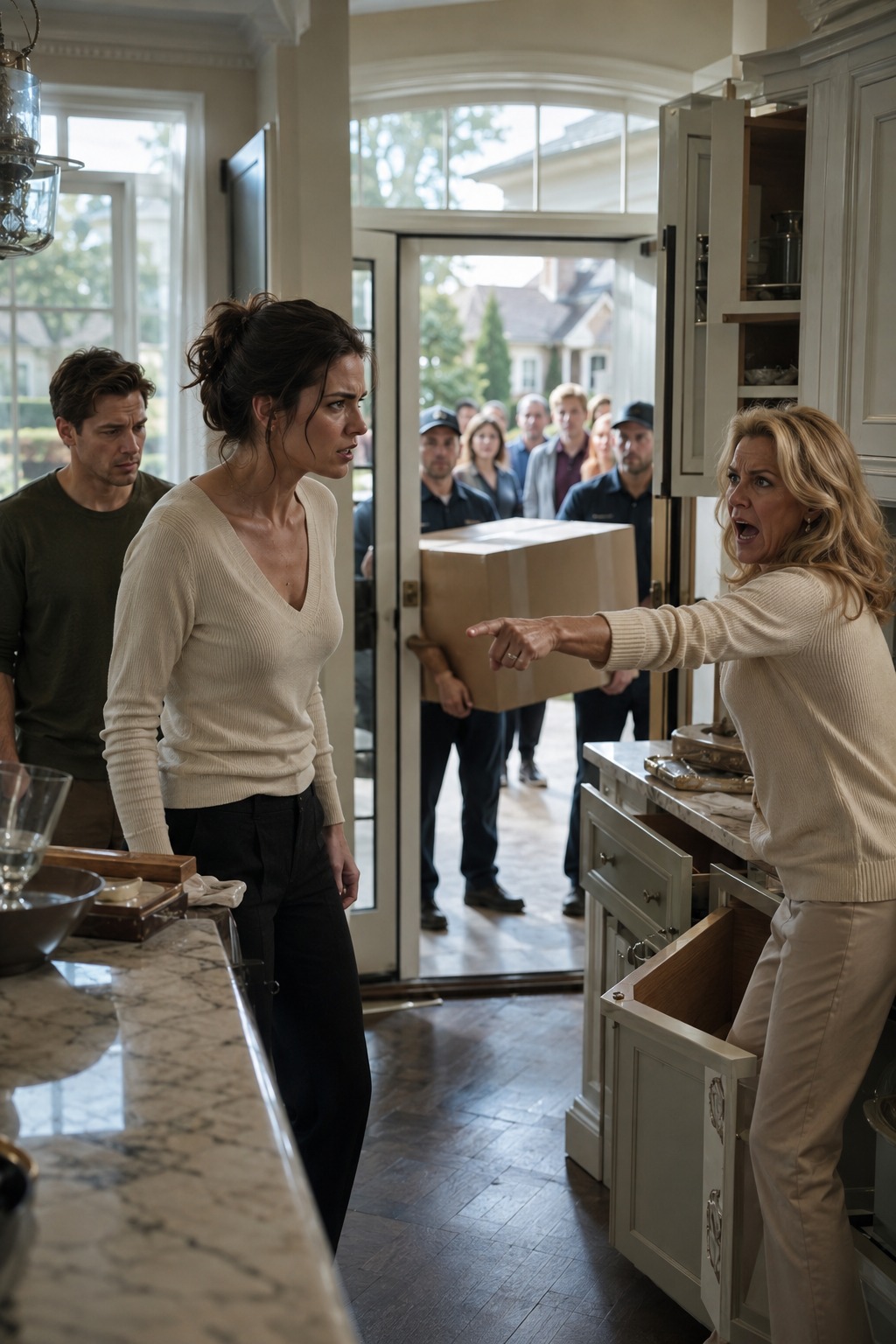
I Trembled With Rage Watching My Mother-In-Law Rearrange My Dream Kitchen Wearing My Clothes. “We’re Staying Indefinitely,” She Announced With A Smirk. My Husband Betrayed Me With Silence. Five Days Of Torture Later, I Disappeared Without A Word. Nobody Expected What Arrived At The Doorstep Next. The Neighbors Still Talk About It. Revenge Delivered, Life Reclaimed.
Part 1
My fingernails dug little half-moons into my palms as I stood in the front hallway, staring at two enormous rolling suitcases parked directly on the runner I had waited four months to buy.
They were not cute weekend bags. They were the kind of suitcases people used when they were leaving a state, a marriage, or both.
One was navy with a cracked plastic corner. The other was maroon, bulging at the zipper like it had been packed by someone who believed folding was a government conspiracy. Beside them sat Glenn’s orthopedic sneakers, angled neatly toward the living room as if he had already claimed the house and was simply waiting for the deed to catch up.
The smell hit me next.
Sandra’s perfume.
Sweet, powdery, aggressive. The kind of smell that didn’t enter a room so much as occupy it. It wrapped around the fresh eucalyptus I kept in a ceramic vase by the door and strangled it. Underneath that came a medicinal menthol odor, probably from Glenn’s back cream, and the buttery salt of microwave popcorn.
From my living room, sports commentary blasted so loudly the glass in the picture frames trembled.
“And there’s the flag! You’ve got to be kidding me!”
I still had grocery bags cutting into the crook of my arm. A carton of eggs pressed cold against my wrist. My keys were in my hand. I remember the metal teeth biting into my palm because I was gripping them too hard.
Sandra appeared from the kitchen wearing my gray linen apron.
My apron.
The one I had bought from a tiny shop in Portland after closing my first major UX contract. It still had a small coffee stain near the pocket from the morning Nolan and I moved into the house and ate cinnamon rolls on the floor because our table hadn’t been delivered yet.
Sandra smiled like she had been expecting me, but her eyes slid over the grocery bags without any intention of helping.
“Hope you don’t mind,” she said. “We thought we’d stay a few nights.”
I stared at her.
She kept smiling.
“Glenn’s back is acting up again,” she added, smoothing the front of my apron like it belonged to her. “And it’s just easier not to drive back and forth.”
I heard my own voice come out thin and strange. “A few nights?”
“Just until Wednesday.” She waved a hand, already bored with my reaction. “Nolan said it was totally fine.”
That was the first crack.
Not the first crack in my marriage. Looking back, those had been there for months, maybe years, hairline fractures hidden under paint and politeness. But that was the first crack I heard clearly.
Nolan said it was totally fine.
Not we discussed it.
Not we hoped it would be okay.
Not can we make this work?
I stepped around the suitcases and carried the groceries into the kitchen. Sandra had moved my fruit bowl from the island to the counter near the stove. My mail was stacked under a ceramic rooster I had never seen before. There was a wet spoon on the walnut cutting board Nolan had sealed by hand.
I set the bags down carefully because if I slammed them, I knew I would start screaming.
Glenn called from the living room, “Liv, you got any more of that ginger ale?”
He didn’t look away from the television.
I stood in my own kitchen, in the house I had spent years dreaming about, and felt myself shrink into the shape of a guest.
Upstairs, a floorboard creaked. Then another.
Someone had already been in the guest room.
My guest room.
The room I had planned to turn into a yoga space once we saved enough for a Murphy bed. I had taped paint swatches to the wall, pale green and warm white, and imagined quiet mornings with sunlight across the floor. Now Sandra’s suitcase blocked the hallway, Glenn’s game rattled the walls, and Nolan had handed over our home without even texting me.
I turned toward Sandra.
“Where’s Nolan?”
She opened the refrigerator and frowned at my oat milk as if it had offended her personally. “He ran to pick up some screws from Home Depot. Something about the garage shelf.”
Of course. He had escaped before I got home.
I looked at the hallway again. At the suitcases. At the shoes. At the coat tossed across my entry bench.
Then Sandra said, almost lightly, “Oh, and I put a load in your washer. I hope that’s all right. Glenn only likes towels washed hot.”
Something in my chest went still.
Not calm. Not peaceful.
Still, the way the air gets still right before a storm folds the sky in half.
I smiled because I had been trained by years of family dinners and office meetings and marriage counseling podcasts to smile before saying anything dangerous.
“Of course,” I said.
Sandra looked satisfied.
But as I climbed the stairs and smelled menthol growing stronger with every step, I saw something else outside the guest room door.
A small cardboard box.
On the side, in Sandra’s handwriting, were the words: bathroom things — leave here.
Not “for the weekend.”
Not “temporary.”
Leave here.
My stomach tightened, and for the first time, I wondered if this wasn’t a visit at all.
### Part 2
I used to think a house could save a person.
Not in the dramatic, movie-trailer way, with rain on windows and a woman rediscovering herself through pottery. I mean in the small American way people understand when they have lived too long in rented spaces with upstairs neighbors who vacuum at midnight and cabinets painted by landlords who gave up halfway through.
For three years, Nolan and I lived in a cramped apartment over a dental office. My desk folded out from the wall in our bedroom. If I pushed my chair back too far, I hit the hamper. If Nolan opened the closet while I was in a Zoom meeting, my clients got a nice view of his sock drawer.
So when we bought the house on Silver Hill Lane, I treated every detail like a promise.
The breakfast nook faced east. In the mornings, sunlight came in honey-colored and soft, making the white oak floors glow. I picked pendant lights with ribbed glass because they looked like something from a clean design blog but still felt warm. Nolan, who worked in construction management, obsessed over the bones of the place: the foundation, the framing, the roofline, the way the back deck met the yard.
He called it “our forever house.”
At the time, I believed him.
The first time Sandra and Glenn came over, I told myself their comments were normal parent stuff.
Glenn walked around with his hands in his pockets, nodding at corners like he was inspecting a hotel room. “Quartz counters,” he said. “Fancy.”
Sandra ran one finger over the kitchen island. “I would’ve gone warmer with the lighting. This feels a little clinical.”
I smiled and poured coffee.
Nolan laughed, kissed his mother on the cheek, and said, “Mom’s got opinions.”
She did.
She had opinions about my backsplash, my pantry labels, my choice of matte black hardware, my habit of buying fresh herbs instead of dried. She asked why our sofa was “so low” and whether our dining chairs were “actually comfortable or just pretty.”
I told myself it was harmless.
Then they came the next Sunday.
And the next.
And the next.
Never with an invitation. Never with a real plan. They would call when they were already five minutes away, or not call at all. I’d hear tires in the driveway and feel my shoulders crawl up toward my ears.
Glenn always went straight for the remote.
Sandra always went straight for the kitchen.
“Don’t get up,” she’d say, while already opening cabinets. “I’m just looking.”
But she was never just looking.
She noticed everything.
“You keep mugs over here?”
“Do you always buy this brand?”
“Olivia, honey, your towels are folded inside out.”
I would laugh politely. “I didn’t realize towels had a correct orientation.”
She would look at me like I had admitted I didn’t know how to use a fork.
Nolan never saw it. Or maybe he saw it and filed it under “women stuff,” the same way he filed the grocery list, the holiday cards, the birthday gifts, the thank-you notes, and the fact that we somehow never ran out of toilet paper.
Every Sunday, I cooked for five instead of two.
Not because they demanded a feast, exactly. That would have been easier to argue with. They just settled in so completely that feeding them became the path of least resistance. Eggs became brunch. Brunch became sandwiches. Sandwiches became dinner because Glenn’s game went into overtime and Sandra didn’t like driving after dark.
One Sunday in March, I had a Monday presentation for a health-tech client. I needed quiet. I needed three uninterrupted hours to polish wireframes and rehearse talking points.
Instead, Glenn fell asleep in the guest room with the door open, snoring so loudly I could hear him through my noise-canceling headphones.
Sandra stood behind me in my office doorway, holding a mug of tea.
“You work a lot,” she said.
“I do.”
“That can be hard on a marriage.”
I looked at my laptop screen. The cursor blinked over a button label I had rewritten twelve times.
“Bills can also be hard on a marriage,” I said.
She made a small sound through her nose. “Nolan works hard too.”
There it was. The comparison. The little needle hidden in velvet.
That evening, after they finally left, I loaded the dishwasher while Nolan scrolled through his phone at the island.
“Maybe next Sunday could just be us,” I said.
He didn’t look up. “What do you mean?”
“I mean no visitors. No football blasting. No commentary on whether I use enough paprika.”
He smiled like I was adorable. “They mean well, Liv.”
“I didn’t say they were evil.”
“You’re overthinking it.”
That word landed like a slap with no sound.
Overthinking.
It became the lid he put on every feeling I had.
I dried my hands on a towel and noticed Sandra had refolded all the others in the drawer.
For a second, I couldn’t breathe.
Then Nolan’s phone buzzed, and he grinned at whatever his mother had sent him.
He turned the screen toward me.
It was a photo of our guest room with the caption: Glenn says this bed is better for his back than ours. Lucky us!
Nolan laughed.
I did not.
Because in the corner of the photo, behind Glenn’s slippers, I could see a small white bottle on the nightstand.
It wasn’t ours.
And nobody brings their preferred prescription cream to a place they don’t plan on returning to.
### Part 3
The first time I tested Nolan, I did it with bell peppers.
It was a Wednesday evening, the kind where the sky outside turned lavender before dinner and the neighbors’ sprinklers ticked softly across lawns. I was making chicken fajita bowls because they were easy, and because chopping vegetables gave my hands something to do when my mind was too loud.
Nolan came in from the garage smelling like sawdust and metal. He kissed the top of my head, grabbed a tortilla chip from the bag, and leaned against the counter.
I kept my tone light.
“I was thinking my parents could come stay next month.”
The knife paused against the red pepper.
Nolan stopped chewing.
“Stay?” he said.
“Just one night. Maybe a weekend. They haven’t seen the house finished.”
He made a face before he could stop himself.
It was fast, almost childish, like someone had put a lemon wedge in his mouth.
“One night,” I repeated.
“Liv…”
There it was. My name stretched into a warning.
“What?”
“No offense, but your dad makes me feel like I’m in a job interview.”
“My dad asks normal questions.”
“He asks follow-up questions.”
“He’s a retired accountant. Follow-up questions are basically his love language.”
Nolan did not laugh. “And your mom is nice, but I have to be on around them.”
I set the knife down, maybe harder than necessary. The blade clicked against the cutting board.
“You have to be on?”
“You know what I mean.”
“I don’t think I do.”
He sighed. “Like polite. Careful. Making conversation. Your family isn’t as easygoing as mine.”
I looked at him for a long moment.
His parents had critiqued my home, eaten my food, used my guest room, rearranged my towels, and turned my Sundays into unpaid hospitality shifts. But his discomfort over one polite overnight visit from my parents was apparently reasonable.
I picked up the knife again.
“My parents raised me to send thank-you cards when someone hosts me,” I said. “Yours raised you to call invasion ‘easygoing.’”
His eyes narrowed. “That’s not fair.”
“No?”
“Don’t twist things.”
I laughed once, but there was no humor in it. “I’ve hosted your parents almost every weekend since January. I cook. I clean. I smile while your mother explains my own linen closet to me. And you’re telling me one night with my parents is too much because you’d have to be polite?”
He stared into the skillet like the onions had answers.
“Liv, come on.”
That was all he said.
Come on.
As if I had stepped outside the invisible fence of what was acceptable.
That night, I didn’t sleep well. The air conditioner clicked on and off. Nolan breathed evenly beside me. Somewhere outside, a dog barked three times and stopped. I stared at the ceiling fan and thought about the phrase “our forever house.”
Our.
Such a soft little word for something people can use like a crowbar.
The next morning, I found Sandra’s reading glasses in the breakfast nook.
I held them in my palm, confused at first. She had left two days earlier. I was sure of it. Then I noticed the little stack beside the glasses: a church bulletin, half a crossword puzzle, and a packet of artificial sweetener tucked under the napkin holder.
A station.
That’s what it looked like.
Not forgotten objects.
A station.
I put everything into a zip-top bag and set it by the door. When Nolan came home, he saw it and frowned.
“What’s that?”
“Your mom’s things.”
“Oh. She texted me. She said just leave them here. She’ll use them Sunday.”
I looked at him.
He took off his boots and avoided my face.
“She asked you to keep her stuff here?”
“It’s a pair of glasses, Liv.”
“And a bulletin. And her crossword. And whatever else is apparently accumulating.”
He rubbed the bridge of his nose. “Why does everything have to become a thing?”
Because things become patterns, I wanted to say. Because patterns become expectations. Because expectations become obligations. Because one day you look around and realize you have been evicted from your own life politely.
Instead, I said, “My parents are coming next month.”
His expression hardened.
“Do we have to decide that now?”
I almost smiled at the honesty of it. His parents required no decision. Mine required a committee hearing.
I went upstairs before I said something too sharp to take back.
In my office, I pulled open the bottom drawer of my filing cabinet, looking for a client contract. A blue folder slid loose and spilled papers across the floor. Closing documents. Insurance forms. Mortgage paperwork. Deed copies.
I gathered them up quickly, annoyed at myself for letting the drawer get messy. Then one document caught my eye.
The title paperwork for the land.
My name sat alone in the ownership line.
Olivia Mae Carter.
Not Nolan Radford.
I knew that, technically. We had structured it that way because the land had been purchased using money from my grandmother’s estate before Nolan’s firm started construction. At the time, it had seemed like a practical detail, boring and harmless.
But now, sitting in my office with Sandra’s reading glasses downstairs waiting for Sunday, it looked different.
It looked like a door I had forgotten was there.
My phone buzzed.
A text from Sandra.
Sweetie, since we’ll be over this weekend, can you make that lemon pasta again? Glenn said the chicken was a little dry last time, but the pasta was wonderful.
I read it twice.
Then a second message appeared.
Also, don’t worry about the guest towels. I showed Nolan where I prefer them.
My hands went cold.
She was not just visiting my house anymore.
She was training my husband to help her take it.
### Part 4
By the time the suitcases appeared in my hallway, the house had already changed shape around me.
Not physically. The walls were still painted Soft Chamois. The kitchen still caught morning light. The backyard still sloped gently toward the row of maples where squirrels chased each other like they owed money.
But the feeling had shifted.
A home has a rhythm, and ours had been overwritten by theirs.
Glenn’s rhythm was volume.
Television before coffee. ESPN before breakfast. Videos on his phone with no headphones. Throat clearing. Cabinet slamming. The squeak of his recliner adjustment in the guest room, which was funny because we didn’t own a recliner.
Sandra’s rhythm was correction.
The dishwasher was loaded wrong. The pantry needed “real organization.” My candles were “a bit much.” My robe was softer than hers, so she borrowed it after her shower without asking.
That first night of their “few days,” I sat at dinner under the pendant lights I had chosen and felt like a waitress at a table nobody tipped.
Sandra had made a salad using my best serving bowl and told me she “rescued” the romaine because it was about to wilt. Glenn chewed with his elbows out, watching highlights on his phone beside his plate.
Nolan ate like this was normal.
“So,” I said carefully, “what’s the plan for Wednesday?”
Sandra glanced at Nolan before answering. It was quick. So quick I might have missed it if I hadn’t been watching.
“Oh, we’ll see,” she said.
My fork stopped halfway to my mouth.
Nolan reached for the salt. “Dad has that appointment Thursday morning now.”
“You said Wednesday.”
“I said probably Wednesday.”
“No,” I said. “Sandra said until Wednesday.”
Sandra’s eyebrows rose.
A tiny performance of injury.
“Well, I’m sorry if I miscommunicated. We’re trying not to be a burden.”
Glenn snorted. “Your stairs are a burden.”
I looked at Nolan.
He still did not look at me.
After dinner, I washed dishes while Sandra hovered close enough for her perfume to crawl up my throat.
“You know,” she said, “when Nolan was little, he hated tension. He’d get stomachaches if people argued around him.”
I rinsed a plate.
“That must have been hard.”
“It was. He’s very sensitive.”
The message arrived with the softness of a silk scarf wrapped around a fist.
Don’t upset my son.
I dried my hands and turned to her. “Sandra, did Nolan invite you to stay, or did you ask?”
She blinked. “What an odd question.”
“It feels normal to ask.”
“Well, Glenn needed rest.”
“That wasn’t my question.”
Her smile thinned. “We’re family, Olivia. Family shouldn’t have to submit applications.”
“No,” I said. “But they should knock.”
For one second, I saw her real face.
Not the church-lady smile. Not the wounded mother act.
Her eyes sharpened like glass.
Then Glenn shouted from the living room, “Sandra, where’s the good blanket?”
She turned away. “Coming.”
The good blanket.
My grandmother’s wool throw.
I went upstairs and closed myself in the bathroom.
The fan hummed overhead. Steam from Sandra’s shower still clung to the mirror. On the counter sat her moisturizer, her hairbrush, and a toothbrush in the cup Nolan and I used for ours.
I picked up the toothbrush and held it like evidence.
In the mirror, my face looked calm, but my eyes didn’t.
Nolan came in ten minutes later.
“We need to talk,” I said.
He leaned against the doorframe. “I know. Mom said you snapped at her.”
A laugh broke out of me before I could stop it.
“I snapped?”
“She feels unwelcome.”
“She is in my robe, using my bathroom, sleeping in my guest room, eating my food, and storing her toothbrush beside mine. I think she’s pretty welcome.”
He lowered his voice. “Can you not do this tonight?”
“Do what?”
“Make everything a fight.”
I stared at him, and the most painful part was not that he was choosing them.
It was that he truly believed I had started the war.
“I need them gone by Friday,” I said.
His jaw tightened. “That’s not reasonable.”
“What is reasonable?”
“They’re my parents.”
“I’m your wife.”
“You’re acting like I’m choosing sides.”
“You are.”
He pushed off the doorframe. “I’m not kicking them out.”
There it was.
Finally.
The sentence underneath every shrug, every smile, every “they mean well.”
He left me standing in the bathroom with the toothbrush in my hand.
Later, in bed, he fell asleep within minutes. I lay awake listening to the muffled drone of the television below, the pipes clicking as someone used hot water, the floor creaking under footsteps that did not belong in my night.
At 1:47 a.m., I picked up my phone.
I typed one message.
Rebecca, do you still have that guest room?
Three gray dots appeared almost immediately.
Then her reply.
Always. How bad is it?
I looked toward the bedroom door.
A shadow shifted in the hallway outside, then stopped.
Someone was standing there, listening.
### Part 5
In the morning, I made coffee the way Nolan liked it.
Extra hot, splash of oat milk, one spoon of brown sugar even though he insisted he didn’t have a sweet tooth. I set the mug beside his phone and watched steam curl into the kitchen light.
Then I made nothing for myself.
It was a small rebellion, almost invisible, but I felt it settle inside me like a match struck in a dark room.
Sandra came in wearing my robe.
Not borrowed. Not draped around her shoulders for warmth. Fully wearing it, tied at the waist, sleeves rolled back like she had been living in it for years.
“Olivia, do you have chamomile that isn’t so flowery?” she asked, opening my tea drawer. “My stomach is off.”
I wanted to say, Maybe it’s guilt.
Instead, I reached past her, took out a plain chamomile packet, and handed it to her.
She studied my face. “You’re quiet today.”
“I have work.”
“Oh, of course. Your computer things.”
My computer things paid for half the life she was currently rearranging.
Glenn shuffled in behind her and turned on the television before saying good morning.
Volume thirty-nine.
The number burned itself into my memory because I walked over and lowered it to twenty-two.
He looked offended. “I was watching that.”
“You can still hear it.”
“I can hear myself breathing at that level.”
“Then you’re welcome.”
Sandra’s mug froze near her lips.
Nolan looked up from his phone.
For a brief, beautiful second, nobody moved.
Then Nolan gave me the look. The one married people know. The public warning look. The “not now” look. The “don’t embarrass me in front of my parents” look.
I smiled at him.
He frowned because I didn’t look sorry.
By Tuesday, the guest room was no longer a guest room.
Sandra had hung three blouses in the closet, “just to let them breathe.” Glenn’s spare golf shoes sat under the bed. A stack of pharmacy bags occupied the nightstand. Their suitcase lids stayed open like mouths.
I tried working from my office, but Sandra had taken over the far corner with a craft project involving ribbon, church donation baskets, and an alarming amount of glitter. Glenn had stored two golf clubs against my bookshelf “so they wouldn’t warp in the garage.”
I sat on the floor beside my bed with my laptop balanced on a pillow, trying to redesign a hospital appointment flow while Sandra folded towels two feet away.
“You should really think about boundaries,” she said.
I looked up.
She shook a towel sharply. “Work-life balance matters. Nolan says you’re always stressed.”
The absurdity of it hit me so hard I almost laughed.
“My work is not what’s invading my personal space, Sandra.”
She folded the towel slowly.
“You know, sarcasm makes people defensive.”
“So does occupation.”
She blinked. “Excuse me?”
“Nothing.”
I finished my mockups at 2:13 a.m. with my back aching and my jaw sore from clenching.
The next day, Nolan texted me at noon.
Taking Mom and Dad to brunch. We’ll bring leftovers if there are any.
No invitation.
No apology.
No acknowledgement that I had been the one cooking for them all week.
I called Rebecca from the driveway because if I stayed inside, I might start throwing things, and I liked my plates.
She answered on the second ring. “Tell me you finally buried someone under the deck.”
“Not yet.”
“Disappointing.”
I leaned against my car. The May air smelled like cut grass and hot asphalt. Somewhere down the street, a kid bounced a basketball with the steady thud-thud-thud of a headache.
“They’ve moved in,” I said.
“Moved in, moved in?”
“Sandra has a toothbrush in my bathroom.”
Rebecca inhaled sharply. “Oh, hell no.”
“And Nolan says he won’t kick them out.”
“Of course he won’t. He has you to absorb the impact.”
The sentence landed cleanly.
That was exactly it.
I was the carpet under everyone’s shoes.
“I don’t know what to do,” I admitted.
Rebecca was quiet for a second. Then her voice changed. It got lower, sharper, the way it did when she was building a strategy at work.
“Okay,” she said. “Then stop absorbing.”
“Meaning?”
“Meaning you don’t ask for space. You create consequences.”
“I’m not trying to be cruel.”
“Cruel is letting your wife become a live-in housekeeper while your parents test the mattress.”
I closed my eyes.
Through the kitchen window, I could see Sandra’s craft ribbon glittering in my office.
Rebecca continued, “Remember my brother’s moving company?”
I opened my eyes.
“Yes.”
“And remember how your in-laws keep saying it’s easier if they stay?”
A slow, dangerous understanding moved through me.
“Rebecca.”
“I’m just saying,” she said. “Maybe we help them experience easier. Fully. Permanently. With labels.”
A car door slammed down the block.
My pulse began to pound, not with panic this time, but with possibility.
“What exactly are you suggesting?”
Rebecca laughed once.
“Olivia, I’m suggesting a special delivery.”
And as she laid out the first part of the plan, I looked through the window and saw Sandra standing in my kitchen, holding my favorite mug, smiling at something Nolan had said.
By the time Rebecca finished, I was smiling too.
### Part 6
Plans, I have learned, do not begin with courage.
They begin with logistics.
Courage is messy and cinematic. Logistics is a spreadsheet at midnight, a calendar invite disguised as a dentist appointment, and a woman in pajamas taking photos of her own pantry like she’s documenting a crime scene.
That night, after everyone went to bed, I walked through the house barefoot with my phone in my hand.
I photographed the guest room: Sandra’s robe on the chair, Glenn’s slippers by the bed, the pharmacy bags, the golf clubs, the open suitcase spilling compression socks.
I photographed the bathroom counter: three toothbrushes where there should have been two.
I photographed the kitchen drawers Sandra had relabeled with sticky notes. Spatulas. Measuring cups. Good towels.
The good towels note nearly made me laugh.
Nearly.
Then I went to my office and opened the blue folder again.
The deed. The mortgage. The construction invoices. The land purchase receipt from my grandmother’s estate. The separation agreement template Rebecca’s lawyer friend had emailed after hearing only half the story and saying, “I’m not giving legal advice over wine, but I am sending you a framework.”
I printed everything.
The printer hummed softly in the dark. Each page slid out warm, smelling faintly of toner. Downstairs, Glenn coughed. Somewhere, a pipe knocked.
I put the papers into a clean folder and wrote one word on the tab.
Options.
The next morning, I told Nolan my aunt in Portland had fallen and fractured her wrist.
It was not true.
I do have an aunt in Portland. She does own too many cats and distrust GPS. But both her wrists were fine, as far as I knew.
Nolan was leaning over the kitchen island eating cereal directly from a mixing bowl because Sandra had decided our everyday bowls were “too shallow.”
“How long?” he asked.
“I’m not sure. A few days.”
Sandra looked up from buttering toast. “Driving or flying?”
“Driving.”
“In that little car?” Glenn said from the living room.
“It’s a sedan, Glenn.”
He grunted like that explained my judgment.
Nolan frowned at his phone. “Can you leave some meals?”
I stared at him.
He looked up. “What?”
“My aunt broke her wrist, and you’re asking if I can meal prep before I go?”
“I just meant, since Mom and Dad—”
“Are adults?”
Sandra set the butter knife down. “Olivia, no one is trying to burden you.”
I looked at the toast crumbs scattered across my island, the open dishwasher, the laundry basket near the hallway, the strangers’ shoes lined beneath my bench.
“No,” I said. “Of course not.”
I packed one duffel bag.
Not a dramatic suitcase. Not the good luggage. Just enough clothes for a week, my laptop, chargers, toiletries, the blue folder, and the small framed photo of my grandmother I kept on my office shelf.
Before leaving, I stood in our bedroom for a long moment.
Nolan’s side of the bed was messy. Mine was made. That seemed too obvious, so I pulled my comforter loose and let it fall unevenly.
Then I placed an envelope on my nightstand.
Inside was one handwritten note.
I’ll be gone for a while. If you need space, now you have it.
Olivia.
I did not write love.
I did not write sorry.
I did not write call me.
When I walked downstairs, Sandra was in the kitchen opening my spice cabinet.
“You’re out of garlic powder,” she said.
“I know.”
“You should keep backup.”
“I’m sure you’ll manage.”
Her eyes flicked toward me, searching for softness and finding none.
Nolan carried my duffel to the car. The afternoon was bright, almost cruelly cheerful. Birds shouted from the maple trees. Across the street, Mrs. Alvarez watered her roses and pretended not to watch.
At the car, Nolan kissed me quickly.
“Drive safe,” he said.
No “I’ll miss you.”
No “We’ll talk.”
No “I know this is hard.”
I nodded.
As I backed out of the driveway, I saw Glenn through the front window, reclined in my living room with one socked foot on my coffee table. Sandra stood behind him, already wearing my apron again.
Nolan lifted one hand.
I lifted mine too.
Then I drove to Rebecca’s apartment, twenty-six minutes away, with the blue folder on the passenger seat and the envelope waiting upstairs like a fuse.
Rebecca opened her door before I knocked.
She had wine on the counter, clean sheets on the guest bed, and the expression of someone who had been waiting years for me to arrive at my own rescue.
“Welcome to witness protection,” she said.
I laughed for the first time in days.
But later that night, while we sat on her couch under a soft yellow lamp, my phone lit up.
Nolan.
I let it ring.
Then a text appeared.
Mom found your note. What does “gone for a while” mean?
Before I could answer, another message arrived.
Also, did you order something?
My heartbeat kicked.
Because the first delivery wasn’t scheduled until Friday.
### Part 7
The thing Nolan thought I had ordered was a bath mat.
Sandra sent me a photo of it sitting on the porch, still wrapped in plastic, with a message that said: Did you want this in the master or guest bath?
I stared at the word master.
Master bath.
Not our bathroom. Not your bathroom. Master.
Rebecca peered over my shoulder. “She’s fast.”
“She’s colonizing the vocabulary now.”
“Language is infrastructure.”
“That sounds like something from your MBA program.”
“It cost me eighty thousand dollars. Let me use it.”
I did not respond to Sandra.
For five days, I lived at Rebecca’s.
Her apartment was small but blessedly quiet. The radiator clicked in the mornings. Her downstairs neighbor played piano badly at six, always the same three songs. The kitchen smelled like coffee, basil, and the citrus cleaner she used on everything. At night, I slept in her guest room under a blue quilt and woke up without hearing anyone else’s shower.
Peace felt physical.
Like unclenching a fist I had forgotten I was making.
Nolan called the first day. I let it go to voicemail.
He called the second day. I texted: Helping Aunt May. Hard to talk.
He called the third day. I sent: Bad service.
He called the fourth day and left a voicemail.
“Liv, this is ridiculous. Mom says she feels like you’re punishing everyone. I get that you needed a break, but you can’t just disappear. Call me.”
Rebecca listened with me, eating takeout noodles straight from the carton.
“Interesting,” she said. “He used five sentences and none of them were an apology.”
On Friday morning, I woke before my alarm.
Rebecca’s brother, Marcus, texted at 8:12.
Truck loaded. You sure?
I stared at the message.
The plan was simple enough.
Marcus owned Sunrise Relocation, a local moving company that did everything from apartment moves to estate cleanouts. Through Rebecca, he had arranged a “residential comfort delivery” to Silver Hill Lane.
Not anything illegal. Not anything stolen. Nothing that would get me arrested on a podcast.
I had paid for it myself.
A full-size mattress. Two dressers. A beige recliner that looked exactly like something Glenn would choose. A stack of moving boxes labeled Radford. Basic cookware. Towels. A shower caddy. A framed print of a lighthouse because Sandra once said my abstract art “needed something recognizable.” A small adhesive mailbox label reading Glenn & Sandra Radford.
The work order listed the delivery recipients as Glenn and Sandra Radford.
The destination: 912 Silver Hill Lane.
Notes: Set up in guest room. Confirm permanent residence placement with household.
It was petty.
It was expensive.
It was also the first time in months that the word “permanent” was going to work in my favor.
I typed back: I’m sure.
Then I put my phone face down and made coffee.
At 10:34, Nolan called.
At 10:35, he called again.
At 10:36, Sandra called.
I let them ring.
At 10:41, a text came from Sandra.
There is a moving truck here.
I said nothing.
At 10:43, Nolan texted.
Olivia. What did you do?
Rebecca sat beside me at the kitchen table with both hands wrapped around her mug.
“You don’t have to reply,” she said.
“I know.”
“Do you want to?”
I did.
Not because I owed him an explanation.
Because I wanted the blade to be clean.
I typed: I arranged for your parents’ stay to be as comfortable as possible.
The dots appeared immediately.
Then disappeared.
Then appeared again.
Then Sandra called.
I answered.
The background noise on her end was delicious chaos: truck beeps, men’s voices, Glenn saying, “Careful with the wall,” and Nolan somewhere farther away asking, “What manifest?”
Sandra’s voice came sharp. No sweetness. No silk.
“Olivia, what is happening?”
“A delivery.”
“These men are bringing furniture into your house.”
“Our house, Sandra. Remember? Family shouldn’t have to submit applications.”
Silence.
Then, tightly, “This is inappropriate.”
“I thought you were staying because it was easier.”
“That’s not the same as moving in.”
“Oh,” I said. “So there is a difference.”
She breathed into the phone.
I could picture her standing in the hallway, my apron maybe still tied around her waist, watching strangers carry a recliner past the bench where her coat had lived all week.
“Nolan is very upset,” she said.
That used to work on me.
It slid right off.
“Nolan can call me when he’s ready to discuss boundaries in writing.”
“In writing?”
“Yes.”
“What does that mean?”
I looked at the blue folder on Rebecca’s table.
“It means I’m done having conversations that get erased.”
I ended the call.
My hands shook afterward, but not from fear.
From release.
Twenty minutes later, Marcus texted a photo.
The guest room had been transformed. Beige recliner by the window. New mattress against the wall. Dressers lined up. Boxes stacked neatly. Glenn’s slippers accidentally visible under the bed.
On the closet door, Marcus had hung a temporary paper sign in block letters.
Radford Suite.
Rebecca burst out laughing.
I did too, until tears came to my eyes.
Then Nolan’s message arrived.
They think you said they could live here.
Under it came another.
Tell them this is a mistake.
I stared at the screen.
For months, Nolan had watched me drown and called it overthinking.
Now the water had reached his ankles, and he wanted rescue.
I replied with one sentence.
Why would I correct them when you never corrected them for me?
Then I turned my phone off.
But in the silence that followed, a darker thought slid in.
What if he still chose them?
### Part 8
He did.
Not all at once. Nolan was never dramatic enough for that.
He chose them in small, spineless increments.
First, he chose not to tell them to leave Friday night because “everyone was too emotional.”
Then he chose not to tell them Saturday morning because Glenn’s back “really was bad after all the commotion.”
Then Sunday arrived, and Sandra had already washed the new towels, arranged her lotions in the bathroom, and put a ceramic dish for keys on the guest dresser.
By Monday, the house had accepted them the way a wound accepts infection.
I turned my phone back on Sunday evening and watched the messages load.
Some were angry.
Some confused.
Some weirdly practical.
Where are the extra trash bags?
Did you change the Wi-Fi password?
Mom says the fridge is freezing lettuce.
Can you call me?
Then, at 11:18 p.m., one that sat apart from the others.
I’m sorry. I didn’t realize how much you were doing.
I read it three times.
The first time, my throat tightened.
The second time, I felt tired.
The third time, I noticed what was missing.
I’m sorry I let them stay.
I’m sorry I dismissed you.
I’m sorry I made you leave your own home.
None of that was there.
Just a vague apology for a vague burden.
At breakfast the next morning, Rebecca watched me stare at my phone.
“Don’t feed it,” she said.
“I’m not.”
“You’re emotionally chewing.”
“That sounds disgusting.”
“It is. Stop.”
I put the phone down.
Work saved me that week. I buried myself in a design sprint for a banking app and spent hours arguing with developers about button states and error messages. It was easier to solve problems where everyone agreed there was a problem.
Meanwhile, the house deteriorated into exactly what I had predicted.
Nolan texted on Tuesday: Where do you keep vacuum bags?
Wednesday: The washer smells weird. Is that normal?
Thursday: Do you know how to reset dishwasher code E24?
Friday: Mom says you use the wrong detergent and that’s why towels feel waxy.
I didn’t answer.
On Saturday, he sent a photo of lasagna.
The top was burned black in one corner and pale in the middle.
Chef Nolan, he wrote.
I stared at it without smiling.
A month earlier, I might have sent back a laughing emoji. I might have called him cute. I might have guided him through where the foil was, what temperature to use, how long to rest it before cutting.
Instead, I deleted the photo.
Sandra called every other day. I ignored most of them.
One afternoon, curiosity beat discipline.
I answered while standing on Rebecca’s balcony, looking down at the parking lot where someone had abandoned a single sneaker near the dumpster.
“Olivia, sweetheart,” Sandra said, too bright. “How is your aunt?”
“She’s managing.”
“That’s good. That’s good.”
A pause.
I listened to wind move through the small potted basil plant beside me.
Sandra cleared her throat. “We were wondering when you planned to come home.”
“We?”
“Well, Nolan misses you.”
“Does he?”
“Of course he does.”
“Funny. He hasn’t said that.”
Another pause.
Then she changed tactics. “Glenn and I don’t want to be in the way.”
“You aren’t in the way, Sandra. You’re exactly where Nolan allowed you to be.”
Her voice cooled. “That’s unfair.”
“Is it?”
“We thought you understood family.”
“I do. That’s why I know family doesn’t take what isn’t offered.”
She inhaled sharply. “You know, marriage requires forgiveness.”
“There it is.”
“What?”
“The part where I’m supposed to clean up the mess and call it love.”
She had no answer to that.
After we hung up, I stood on the balcony until my coffee went cold.
I did miss parts of my old life.
Not the noise. Not the criticism. Not the smell of menthol cream in the hallway.
But I missed the version I had believed in. I missed Sunday mornings before they became appointments. I missed Nolan before his silence started sounding like permission. I missed the house before every room had a witness against me.
That night, Nolan finally sent the message I had been expecting.
Still, they’re my parents. I can’t kick them out.
There it was.
The full shape of him.
I sat in Rebecca’s guest room with the bedside lamp on, the blue folder open beside me, and felt the last thread snap.
Not loudly.
Not dramatically.
Just a quiet internal sound, like scissors through ribbon.
I emailed him the separation agreement at 12:06 a.m.
Subject line: Boundaries in writing.
At 12:09, I sent it to his work email too.
Then I placed my phone on the nightstand and turned off the light.
In the dark, I expected to cry.
Instead, I slept.
The next morning, I woke to seventeen missed calls.
And one voicemail from Nolan that began with my full name.
### Part 9
“Olivia Mae Carter, what the hell is this?”
That was how the voicemail started.
Not “good morning.” Not “can we talk?” Not even “I’m sorry.”
My full government name, delivered in the tone of a man who had discovered consequences in his inbox and decided they were rude.
I played the message once.
Then again, because Rebecca wanted to hear it.
Nolan’s voice filled her tiny kitchen while the coffee maker sputtered like it was judging him.
“You can’t just send legal paperwork like this. We’re married. You don’t get to hide at Rebecca’s and make decisions behind my back. My parents are confused, I’m confused, and frankly this is embarrassing. Call me.”
Rebecca poured coffee into two mugs. “I love when men say ‘we’re married’ only after remembering wives have paperwork access.”
I sat at the table, wrapped in her old college hoodie, staring at the separation agreement on my laptop screen.
It wasn’t divorce. Not yet.
It was a line.
Temporary living arrangements. Financial separation. Property terms. Use of joint accounts. Personal possessions. Communication in writing. No unauthorized guests in shared property without mutual consent.
That last line made me feel almost giddy.
Unauthorized guests.
Such a dry phrase for two people who had turned my sanctuary into a roadside motel with family photos.
Nolan called again at 8:17.
This time, I answered.
His breathing was heavy, like he had been pacing.
“Are you serious?” he demanded.
“Yes.”
“Over my parents staying a few weeks?”
“It was never a few weeks.”
“You arranged movers to humiliate them.”
“I arranged furniture to match the reality you created.”
“That is insane.”
“No, Nolan. Insane is telling your wife she’s overthinking while your mother stores craft supplies in her office.”
He went quiet.
In the background, I heard Sandra’s voice. “Is that her?”
I closed my eyes.
Even our separation call had an audience.
“Nolan,” I said, “go somewhere private.”
“I am private.”
“No, you’re not. Your mother is right there.”
“She’s worried.”
“I don’t care.”
The words surprised both of us.
I heard him inhale.
“You don’t mean that.”
“I do.”
Another silence. Longer this time.
When he spoke again, his voice was lower. “I can’t afford the house alone.”
“I know.”
“That’s cold.”
“No. Cold was watching me lose my home room by room and telling me to be nicer.”
“You’re asking me to kick out my parents.”
“I’m asking you to choose whether you want to be married to me.”
“That’s not fair.”
“Neither was any of this.”
He made a frustrated sound. “Where are they supposed to go?”
“Their home?”
“They gave up the apartment.”
My hand tightened around the phone.
Rebecca looked up sharply.
I sat very still.
“What do you mean they gave up the apartment?”
Nolan didn’t answer quickly enough.
“Nolan.”
“They were having problems with the landlord.”
“When did they give up the apartment?”
“Technically, they didn’t renew.”
“When?”
He exhaled. “End of last month.”
The room narrowed.
End of last month.
Before the suitcases.
Before “just until Wednesday.”
Before Sandra stood in my kitchen wearing my apron and pretended this was about Glenn’s back.
They had known.
Nolan had known.
I looked at the wall across from me, at Rebecca’s crooked framed print that said choose your hard, and felt something inside me turn white-hot.
“You lied to me.”
“No. I didn’t tell you because I knew you’d react like this.”
“That is lying.”
“They needed help.”
“And I didn’t deserve honesty?”
“They’re my parents.”
I laughed, but it came out broken. “You keep saying that like it cancels out everything else.”
“I was trying to avoid a fight.”
“You created one.”
In the background, Sandra said something I couldn’t catch.
Nolan covered the phone badly. “Mom, stop.”
Then Sandra’s voice grew clearer. “Tell her we planned to discuss it.”
Planned.
The word crawled under my skin.
I spoke slowly. “So there was a plan.”
Nolan came back on the line. “Not like that.”
“How exactly was it, then?”
“We thought maybe they could stay a little longer while they figured things out.”
“Who is we?”
No answer.
“Nolan. Who is we?”
He said nothing.
I didn’t need him to.
The emotional reversal wasn’t anger. I was already angry.
It was clarity.
For weeks, I had thought I was fighting intrusions. Annoyances. Boundary problems. A husband too passive to protect me.
But this was not passive.
This had been coordinated behind my back.
I stood up so fast the chair scraped Rebecca’s floor.
“Sign the agreement,” I said.
“Liv—”
“Or have your attorney contact mine.”
“We don’t have attorneys.”
“I do now.”
His breath caught.
Good.
“Olivia, don’t do this.”
“I didn’t. You did.”
I hung up.
Rebecca didn’t speak at first. She just slid my coffee closer.
I picked it up with both hands, but I couldn’t drink.
Because now the story had changed.
They hadn’t invaded because Nolan was weak.
They had invaded because Nolan had opened the door and hoped I wouldn’t notice until it was too late.
And if he could lie about that, I had to wonder what else had already been moved into place without me.
### Part 10
That afternoon, I did something I should have done months earlier.
I logged into every account.
Mortgage portal. Joint checking. Utilities. Home insurance. Credit cards. HOA dashboard. The boring infrastructure of adulthood. The invisible skeleton of a shared life.
Betrayal, I discovered, has passwords.
Some worked. Some didn’t.
The electric bill worked. The water bill worked. The joint checking worked.
The home improvement credit card did not.
I stared at the login screen, my reflection faint in the laptop. Behind me, Rebecca moved quietly around the kitchen, making herself busy in the compassionate way good friends do when you’re trying not to fall apart.
I clicked “forgot password.”
The reset email went to Nolan.
Of course it did.
I opened the statements through an old PDF I had saved and began reading.
At first, it was normal. Lumber. Fixtures. Final landscaping. A garage cabinet system Nolan had sworn was “for us,” though I had never used a single drawer.
Then the charges changed.
Storage unit. Monthly.
Storage unit again.
A furniture warehouse.
A mattress store.
Pharmacy delivery.
I scrolled back.
Dates lined up with the months Sandra’s comments had grown bolder. With the first time she started calling the guest room “the upstairs room.” With the Sunday Glenn brought his own pillow and said, “No point making the back worse.”
My throat tightened.
Nolan hadn’t just known they were leaving their apartment.
He had been preparing.
I called the credit card company, verified my identity, and requested recent statements. My name was on the account. That used to feel like partnership. Now it felt like evidence.
The representative’s voice was cheerful in the flattened way call center voices get after saying the same sentence six thousand times.
“Would you like to remove authorized users?”
“Yes,” I said.
She clicked keys. “I can help with that. Please note that removing an authorized user will prevent future charges but does not remove responsibility for prior balances.”
“I understand.”
“Which authorized user would you like to remove?”
“Nolan Radford.”
The name tasted strange.
Once, it had meant husband.
Now it sounded like a liability.
Next came the joint account.
That one hurt more.
Money is intimate. Not romantic, exactly, but intimate. It shows habits, priorities, appetites, carelessness. Nolan’s spending over the past three weeks told a story he had not bothered to tell me.
Takeout. Hardware store. Gas. Liquor store. More takeout. A grocery charge for $287 that included, according to the digital receipt, three cases of diet soda, frozen dinners, paper plates, a family pack of steaks, and lavender detergent.
Lavender detergent.
The same scent Sandra had claimed made Glenn’s skin itch.
I leaned back and laughed.
Rebecca came over. “Good laugh or felony laugh?”
“Jury’s out.”
Then I saw the overdraft warning.
Pending.
Nolan had paid the moving chaos with our joint card, then tried to cover groceries, a plumber visit, and what looked like a recliner return fee because apparently Glenn hated the beige one.
The account was about to dip below zero.
My paycheck was scheduled to deposit Friday.
No.
I moved it.
Then I froze the joint card.
Not closed. Not emptied. Frozen.
A boundary in banking form.
At 5:52 p.m., Nolan called.
I let it ring.
At 5:54, he texted.
Did you freeze the card?
At 5:55.
Olivia, answer me.
At 5:56.
This is financial abuse.
That one made Rebecca choke on her tea.
“Financial abuse?” she said. “From the man spending your money on parental steaks?”
I typed slowly.
We are separated. I moved my direct deposit. You should do the same.
His reply came fast.
My parents need groceries.
Then buy them.
You froze OUR account.
I protected my income.
You’re being vindictive.
I stared at that word.
Vindictive.
Not protective. Not hurt. Not done.
Vindictive.
It confirmed something I had been afraid to admit.
Nolan did not see my boundaries as responses. He saw them as attacks.
I set the phone down and opened the separation agreement again.
Then I added notes for my attorney.
Unauthorized occupancy.
Misrepresentation.
Joint debt.
Financial separation urgent.
By nine that night, Sandra called from Nolan’s phone.
I almost didn’t answer.
Then I did, because sometimes you need to hear the shape of the monster before you stop checking the closet.
“Olivia,” she said, her voice trembling with outrage disguised as concern. “You have put us all in a terrible position.”
“No, Sandra. You gave up your apartment and moved into my house without telling me.”
“We are family.”
“You are tenants without consent.”
A gasp.
“You would call us tenants?”
“What would you call people living in a house where they don’t own anything and don’t pay rent?”
She went silent.
Then her voice dropped.
“I knew you were selfish from the beginning.”
There it was.
The truth, finally stripped of perfume.
I felt oddly calm.
“Good,” I said.
“Good?”
“Now we don’t have to pretend this was a misunderstanding.”
I hung up while she was still speaking.
That night, I slept badly.
Not because I missed Nolan.
Because now that the house was quiet in my absence, the paperwork was starting to speak.
And every document seemed to ask the same question.
How long had I been married to a man who treated my life like a resource he could allocate?
### Part 11
Two weeks later, the house appeared on Zillow.
I had set alerts for 912 Silver Hill Lane the day after I sent the separation agreement, not because I wanted to buy it back, but because I had learned that Nolan’s version of communication was omission until trapped.
The notification came while I was in line at a coffee shop.
New listing in your saved area.
I opened it without thinking.
There it was.
Our house.
My house.
No, I corrected myself.
A house.
The first photo was supposed to be the hero shot: front elevation, clean siding, black-framed windows, the blue door I had chosen after testing six paint samples in different daylight.
But the porch had two plastic chairs on it now. One sagged in the middle. A pair of Glenn’s sneakers sat beside the doormat. Someone had taped a handwritten sign to the inside of the sidelight window.
Please ring bell hard.
I almost dropped my phone.
The listing title read: Modern Craftsman in desirable Silver Hill neighborhood.
The description said: Motivated seller. Flexible timeline. Minor repairs needed.
Minor repairs.
I swiped through the photos.
Living room: my carefully chosen sofa shoved sideways to make room for Glenn’s foot massager and a folding TV tray. Sports magazines piled on the floor. A blanket I did not recognize draped over the armchair.
Kitchen: sticky notes on cabinet doors. Do not move. Glenn snacks. Sandra baking. A roll of paper towels sat in the middle of the island beside a bottle of antacid.
Breakfast nook: Sandra’s crossword station had multiplied. Pens, pill organizer, church bulletins, a mug with World’s Best Mom in curly letters.
Guest room: no longer guest anything. Radford Suite in full bloom. Beige recliner, mismatched lamp, open dresser drawers, laundry basket visible in the corner.
My office: craft supplies on one side, Nolan’s printer on the other, my framed art removed from the wall.
I stared at that photo the longest.
Not because it was the worst.
Because it was the clearest.
The room I had used to build my career, pay our bills, and design things that helped strangers navigate complicated systems had been reduced to storage for ribbon and toner.
Rebecca met me at a table near the window and found me still scrolling.
“Is it bad?”
I turned the phone toward her.
She took one look and whispered, “Oh, honey.”
That almost broke me.
Not the invasion. Not the listing. Not even the sale.
The pity.
I locked the phone and put it face down.
“I’m fine.”
“You don’t have to be.”
“I know. But I am.”
She didn’t argue.
The emotional reversal came not when I saw the photos, but when I realized I did not want the house back.
That shocked me.
For weeks, I had imagined returning like some suburban warrior queen. Sandra gone. Glenn gone. Nolan contrite or removed. Me standing in the breakfast nook with coffee, reclaiming the sunlight.
But looking at the listing, all I felt was grief for a version of myself that had already left.
The house had been my dream.
Then it became a test.
Now it was evidence.
I didn’t want to live inside evidence.
Nolan called that evening.
“I assume you saw it,” he said.
“Yes.”
His voice was flat. Exhausted. Older somehow.
“We can’t keep it.”
“I know.”
“You could buy me out.”
“I could.”
He paused. “Are you going to?”
“No.”
The silence on the line had weight.
“You said you wanted the option.”
“I wanted the option. I don’t want the house.”
“Then what was all this for?”
I looked around Rebecca’s guest room. My suitcase stood neatly by the closet. A little desk lamp glowed beside my laptop. Outside, rain tapped the window glass in soft, steady fingers.
“All what?”
“The paperwork. The freezing accounts. The moving truck. All of it.”
I almost felt sorry for him.
Almost.
“You still think the goal was the house.”
“What else would it be?”
“My life.”
He said nothing.
I continued, “You can sell it. Under the agreement, I get what I put in and my share of the equity. Your parents are your problem.”
“My problem,” he repeated bitterly.
“Yes.”
“They have nowhere to go.”
“They had an apartment.”
“You know Mom cried when I told her we might have to move.”
“Did she cry when I left?”
Silence.
That answered everything.
The sale moved quickly because Nolan priced it low and the market was hungry. Buyers came through on weekends. Sandra reportedly complained to the agent that people were “opening personal closets,” which Rebecca said proved God had a sense of humor.
One afternoon, Mrs. Alvarez from across the street called me.
I hadn’t spoken to her since leaving, but she had my number from a neighborhood garden club thread I had joined once and never used.
“Olivia,” she said gently, “I hope I’m not intruding.”
The irony nearly made me laugh.
“You’re not.”
“I just thought you should know. There was a loud argument outside today.”
My stomach tightened.
“Between Nolan and me?”
“No. Nolan and his mother.”
I sat up.
“She was shouting that you ruined everything,” Mrs. Alvarez said. “And Nolan shouted back that she had already done that before you left.”
For a moment, the world went very quiet.
It was the first time I had heard of Nolan defending me.
And the terrible part was, it was too late to matter.
### Part 12
The closing happened on a Thursday.
I did not go in person.
My attorney handled the final signatures, and I sat in Rebecca’s kitchen with a cup of coffee, refreshing my email like a person waiting for test results. At 11:42 a.m., the message arrived.
Funds disbursed.
Ownership transferred.
The house on Silver Hill Lane was no longer ours.
No drumroll. No lightning strike. No cinematic music.
Just an email, a PDF, and the sudden absence of a weight I had been carrying so long I had mistaken it for posture.
Rebecca came home from work early with grocery-store flowers and a cake that said Congrats On Not Murdering Anyone in blue icing.
“That was the closest option they had?” I asked.
“I had to explain it to the bakery girl. She was invested by the end.”
We ate cake from paper plates on her couch.
For a while, I felt almost light.
Then, around seven, Nolan texted.
Closed.
I stared at the single word.
Yes, I replied.
A minute later: Mom and Dad are staying with me for now.
I did not answer.
Then: I guess that’s what you wanted.
I set the phone down.
Rebecca, who had been pretending not to watch me, said, “Do you want me to throw it into the sink?”
“No.”
“The balcony?”
“No.”
“The ocean? We are not near the ocean, but I’ll commit.”
I smiled despite myself.
Nolan sent one more message.
I hope someday you understand I was trying to take care of my family.
That one I answered.
I was your family too.
He did not reply.
The divorce filing went in three weeks later.
By then, I had moved into a small rental townhouse on the other side of town. It was not fancy. The kitchen cabinets were builder-grade, the upstairs hallway carpet had a mysterious stain near the linen closet, and the balcony was barely big enough for two chairs and a basil plant.
But the first night I slept there, nobody opened my bedroom door.
Nobody asked where I kept the HDMI cable.
Nobody used my towel and rehung it damp.
I woke up at 8:03 a.m. to sunlight on a blank wall and the distant sound of a lawn mower. For a few seconds, I didn’t know where I was.
Then I remembered.
Mine.
Not forever, maybe. Not perfect.
But mine.
I built routines that had nothing to do with managing other people’s comfort. Saturday farmers market. Wednesday yoga. Sunday brunch once a month with friends who brought food and left before I got tired. I invited my parents over for dinner, and Nolan’s prediction came true in the funniest way possible: my dad asked many follow-up questions.
“How is your attorney?”
“Do you have enough emergency savings?”
“Did you compare renters insurance policies?”
My mom scolded him twice and then cried quietly in my hallway because she said my place felt peaceful.
That word stayed with me.
Peaceful.
Not impressive. Not dream home. Not forever.
Peaceful.
Divorce negotiations were not peaceful.
Nolan dragged his feet, then got angry when dragging his feet became expensive. He wanted credit for construction work his firm had discounted. My attorney wanted documentation. He wanted to split debts “morally.” My attorney wanted statements. He wanted to meet in person.
I declined.
Every conversation went through lawyers or email.
He called that “cold.”
I called it effective.
Sandra tried once too.
She left a voicemail from a number I didn’t recognize.
“Olivia, this is Sandra. I think we should meet for coffee. There has been a lot of hurt on all sides, and I believe healing requires humility.”
I deleted it before she finished the sentence.
Not because I lacked humility.
Because I had finally stopped mistaking access for grace.
A week later, Glenn sent a text from Nolan’s phone by accident.
Tell her your mother says she can keep the dishes but we want the ladder back.
Then, thirty seconds later:
Sorry wrong person.
I laughed so hard I had to sit down.
The ladder was mine.
I kept it.
Six months after I left, I ran into a mutual friend named Kelly at a café near my new place. She looked at me for half a second too long, then smiled.
“Olivia?”
“Hey, Kelly.”
“You look…” She searched for the polite word.
“Divorced?”
She burst out laughing. “I was going to say rested.”
“I’ll take both.”
We ordered coffee and stood near the pickup counter while the espresso machine hissed and milk steamed in silver pitchers.
“How’s Nolan?” I asked, because curiosity is not the same as attachment.
Kelly’s face shifted.
“He’s living in a condo with his parents right now.”
I stirred my coffee.
“That sounds crowded.”
“It is. From what I hear, it’s a lot.”
I looked at her.
She looked back, understanding more than she said.
I nodded. “It always was.”
On my walk home, the air smelled like rain on pavement and roasted coffee clinging to my coat. My phone buzzed.
Unknown number.
For reasons I still can’t explain, I stopped under a maple tree and listened to the voicemail transcription appear.
Olivia, it’s Nolan. I know you don’t want to talk, but I need you to know something about the house sale. There was money from my parents involved, and Mom says you owe—
I stopped reading.
There it was.
Another hook.
Another attempt to turn my peace into a customer service desk.
I blocked the number.
Then I walked home lighter than I had felt in years.
But when I opened my mailbox, there was a thick envelope from Nolan’s attorney waiting inside.
### Part 13
The envelope sat on my kitchen table for two hours before I opened it.
Not because I was afraid.
Because I was tired of paper deciding the emotional weather of my life.
I made tea. I washed a mug. I changed into sweatpants. I stood on my balcony and watched a squirrel try to carry a piece of hamburger bun up a fence, fail, fall, and try again with absolute confidence.
Then I went inside and opened the envelope with a steak knife because I hadn’t unpacked my letter opener.
Inside was a formal request.
Nolan was claiming that his parents had contributed financially to “shared household stability” and that certain expenses should be considered marital support. He was also disputing my reimbursement from the house sale, arguing that his family’s “relocation hardship” had been caused by my “abrupt abandonment.”
I read the phrase three times.
Abrupt abandonment.
It sounded almost elegant.
It also sounded like fiction.
For a moment, anger rose hot and familiar. Then something better arrived.
Preparation.
I opened my laptop.
The photos I had taken. The text messages. The statements. The moving work order. The separation agreement. The call log. The listing photos. The utility bills. The credit card charges. Nolan’s message admitting they were his parents and he couldn’t kick them out. His accidental confession that they had given up the apartment before moving in.
All of it was there.
I sent the envelope to my attorney and attached the evidence folder.
Her reply came the next morning.
This is not strong on their side. Do not engage directly.
I didn’t.
Nolan tried anyway.
Email subject: Please be human.
Olivia, I don’t want this to get uglier. Mom is upset. Dad’s health isn’t good. I know you’re angry, but punishing my parents financially won’t fix anything. We loved each other. Can we please talk like adults?
I read it while eating toast over the sink.
The butter dripped onto my thumb.
We loved each other.
There was the shiny bait.
I thought about answering with paragraphs. I thought about telling him exactly what love had looked like from my side: cooking while exhausted, smiling through insults, swallowing loneliness at a table full of people, asking for help and receiving a shrug.
Instead, I forwarded it to my attorney.
Then I went to work.
By late summer, the divorce moved toward final settlement. Nolan’s attorney withdrew the ridiculous claim after my attorney sent the documentation. The numbers became boring, which was a relief. Boring meant survivable.
The final mediation happened over video.
Nolan appeared on screen in a beige room I didn’t recognize. His hair was longer. He looked tired. Behind him, I heard Sandra’s voice, muffled but unmistakable.
“Make sure they mention the storage fees.”
Nolan closed his eyes.
For the first time in months, I saw him not as a villain, but as a man trapped in the exact life he had chosen.
Not my problem.
The mediator asked if we both understood the terms.
I said yes.
Nolan said yes.
His gaze flicked toward the camera.
“Olivia,” he said, “I really am sorry.”
The room went quiet.
Even through the screen, I could see the hope in his face. Not hope for reconciliation, maybe. Hope that I would soften. Hope that my forgiveness would make him feel like less of a coward.
I took a breath.
Outside my townhouse window, a garbage truck beeped as it backed down the street. Somewhere upstairs, my dryer hummed with only my clothes inside.
“I believe you’re sorry now,” I said.
His eyes filled.
Then I added, “But late love is not love. It’s damage control.”
He flinched.
I felt no satisfaction in it.
Only truth.
“I don’t forgive what you did,” I continued. “And I’m not carrying it so you can feel redeemed. I hope you become better, Nolan. But you will not become better through me.”
The mediator looked down at her notes.
Nolan wiped his face quickly.
Behind him, Sandra said, “What did she say?”
He muted himself.
I signed the final documents electronically that afternoon.
My hands did not shake.
That night, Rebecca came over with Thai food, champagne, and the same blue folder that had once been labeled Options. She had stuck a new label over it.
Closed.
We ate noodles at my little kitchen table while rain tapped against the balcony door.
“Do you regret anything?” she asked.
I looked around the townhouse.
The basil plant on the windowsill. The thrifted lamp. The stack of library books. The quiet.
“Yes,” I said.
She looked concerned.
“I regret not trusting myself sooner.”
She nodded.
We clinked plastic champagne cups because I still hadn’t bought proper glasses.
At 10:14 p.m., my phone buzzed.
A new voicemail.
Unknown number.
I didn’t listen.
I already knew some doors only stay closed if you stop checking whether anyone is knocking.
### Part 14
A year after I left Silver Hill Lane, I drove past it by accident.
At least, that’s what I told myself at first.
I had taken a wrong turn after a client meeting, or maybe I had let muscle memory steer for three blocks longer than it should have. Either way, there I was, rolling slowly beneath the maple trees of my old neighborhood, with late afternoon sunlight flashing through the windshield.
The house looked different.
Not bad.
Different.
The new owners had painted the front door green. They had replaced the plastic porch chairs with a wooden bench and hung a swing from the far beam. There were chalk drawings on the driveway: stars, a crooked rainbow, a dog with six legs. A little girl in pink rain boots crouched near the flower bed, poking dirt with a stick while a man watered hydrangeas.
My chest tightened, but not with jealousy.
With recognition.
The house had become a home again.
Just not mine.
I parked half a block away for less than a minute. The air conditioner hummed. My hands rested lightly on the steering wheel. I waited for the old grief to rise up and flood me.
It didn’t.
Instead, I remembered the first morning Nolan and I had eaten cinnamon rolls on the empty floor. I remembered the hope. I remembered choosing the pendant lights. I remembered loving that house before it became a battleground.
And then I let the memory stay a memory.
My phone buzzed in the cup holder.
Rebecca: Dinner tonight? I found a place with dangerously good fries.
Me: Yes. I’m near Silver Hill.
The typing dots appeared instantly.
Rebecca: Do I need to bring matches?
Me: No. It looks happy.
Rebecca: Good. Houses deserve second chances. Men named Nolan do not.
I laughed out loud.
As I drove away, I realized that was the difference.
I could wish the house well because it had never betrayed me.
People had.
Nolan tried to contact me twice after the divorce.
The first time was through a birthday email, three paragraphs about memories and growth and “the ways we both failed each other.” I deleted it after the first sentence.
The second time was a message from Sandra, sent through a social media account I had forgotten existed.
Olivia, I hope enough time has passed for us to speak with kindness. I miss the family we could have been.
I stared at that one longer.
Not because I was tempted.
Because the sentence was almost beautiful in its audacity.
The family we could have been.
As if she had not walked into my home and treated kindness like an open drawer. As if she had not mistaken my patience for permission. As if she had not helped teach my husband that my boundaries were obstacles instead of information.
I blocked her too.
Peace, I learned, is not a feeling that arrives once and stays.
It is maintenance.
It is changing passwords. Blocking numbers. Saying no without adding an essay. Buying only the groceries you want. Letting the phone ring. Refusing coffee invitations from people who want forgiveness more than accountability.
It is also joy.
Small, almost embarrassing joy.
The first time I hosted brunch in my townhouse, I made lemon pasta because I loved it, not because Glenn had approved of it. My friends brought fruit, pastries, flowers, too much champagne. My mother dried dishes while my father asked Rebecca if her retirement account was diversified. Everyone laughed. Nobody opened a closet without asking.
After they left, I stood in the kitchen surrounded by crumbs and empty glasses and felt tired in the cleanest way.
Tired from being loved well.
Months later, I bought proper champagne flutes.
Then a better sofa.
Then, eventually, a condo with huge windows, a small office, and a balcony wide enough for herbs, two chairs, and a little table where I drank coffee every morning.
The deed had one name.
Mine.
On the day I moved in, Rebecca brought cinnamon rolls. We ate them on the floor because my table had not arrived yet, and for a second the memory twisted hard enough to hurt.
Then Rebecca raised her paper cup of coffee.
“To no uninvited guests,” she said.
I raised mine. “To doors that lock.”
“And women who finally use them.”
We laughed.
That evening, after she left, I walked through each room alone.
The office smelled faintly of fresh paint. The bathroom tile was cool under my bare feet. The bedroom window faced west, and the sunset spread across the wall in orange and rose and gold.
I opened the linen closet and placed the towels inside however I wanted.
Folded wrong.
Stacked unevenly.
Mine.
Then I turned off the lights one by one and stood in the quiet.
No television shaking the frames.
No perfume smothering the air.
No footsteps in the hall.
No husband telling me my discomfort was inconvenient.
Just my own breath, steady and full.
People talk about forgiveness like it is the only clean ending. Like every wound must become a lesson wrapped in softness. Like refusing to forgive means you are still trapped.
I disagree.
Sometimes the clean ending is a locked door.
Sometimes healing is not inviting anyone to sit across from you and explain why they hurt you.
Sometimes peace looks like deleting the voicemail.
Sometimes it sounds like silence.
And sometimes it feels like waking up alone in your own home, stretching under sunlight nobody else has claimed, and realizing you are not waiting for permission to breathe anymore.
THE END!