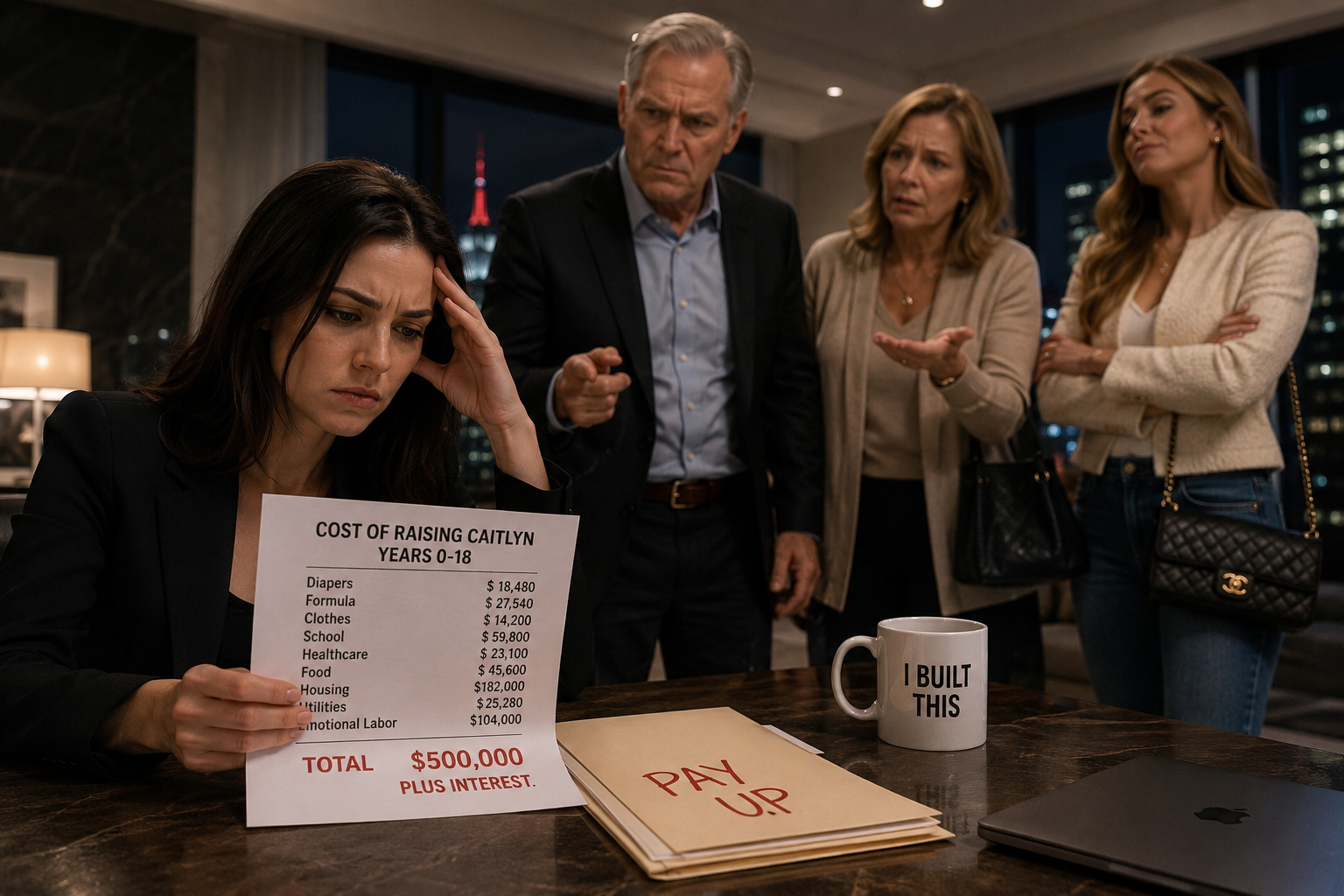
Everything in me went very still.
Not shocked.
Not emotional.
Still.
The kind of stillness that comes right before a wildfire changes direction.
I stared at the three people standing in my penthouse—the people who were supposed to love me unconditionally—and realized something horrifying:
This conversation had been planned.
Not impulsively.
Not emotionally.
Strategically.
The spreadsheet alone proved that.
The formulas.
The itemized costs.
The fake legal phrasing.
Someone had spent weeks building a financial case against their own daughter.
And somehow… that hurt more than the money itself.
My father mistook my silence for weakness.
He always did.
“You don’t need to answer tonight,” he said calmly, lowering himself into one of my dining chairs like he owned the place. “But we strongly suggest you take this seriously before attorneys become involved.”
Attorneys.
Plural.
Like I was some corporation refusing a merger instead of his child.
My mother finally sat down too, smoothing her cardigan dramatically.
“We didn’t want things to become ugly.”
That almost made me laugh.
They had broken into my apartment using an emergency key and handed me an invoice for existing.
Ugly had already arrived.
Karen crossed one leg over the other and glanced around the penthouse again.
God, she hated this place.
Not because it was extravagant.
Because it was mine.
The floor-to-ceiling windows overlooked downtown Chicago in sharp silver lines and city lights. My office sat behind glass walls near the back of the penthouse, filled with awards, strategy boards, product mockups, and campaign drafts.
Everything inside this apartment represented freedom they never expected me to achieve.
And Karen especially couldn’t stand it.
Growing up, she had always been “the easy daughter.”
The pretty one.
The social one.
The one my mother called graceful while describing me as intense.
Karen dated wealthy men and drifted through expensive hobbies while I worked sixteen-hour days building my company from a secondhand laptop.
But the second my business exploded publicly…
something poisonous woke up inside her.
“You think this is normal?” I asked quietly.
My father folded his hands.
“No,” he replied calmly. “I think it’s overdue.”
There it was again.
That tone.
Businesslike.
Measured.
Like he genuinely believed this was reasonable.
“You owe us your success.”
I looked at him carefully.
“No,” I said softly. “I survived you.”
The room went silent.
My mother’s face hardened instantly.
“That’s incredibly cruel.”
Cruel.
Interesting word coming from the woman who once grounded me for crying too loudly after being bullied at school because it was “embarrassing.”
I leaned back slowly in my chair.
“You kept spreadsheets on me?”
My father didn’t blink.
“I kept records.”
“Of toilet flushing?”
“It adds up over eighteen years.”
I stared at him in disbelief.
Then suddenly…
a memory surfaced.
I was eleven years old, sitting at the kitchen table while my father complained about electricity bills because I stayed up late reading.
“Nothing in life is free,” he’d snapped.
At the time, I thought he meant responsibility.
Now I realized he meant me.
For most of my childhood, love in our house came attached to measurable performance.
Good grades earned temporary approval.
Achievements earned attention.
Neediness earned irritation.
And money?
Money was sacred.
My father tracked everything obsessively.
Utility bills.
Groceries.
Gas usage.
Receipts stacked in shoeboxes like holy scripture.
He loved reminding us how expensive children were.
“You have any idea what you cost me this month?”
That sentence practically raised me.
By fourteen, I stopped asking for anything unnecessary.
By sixteen, I had my first freelance web design clients.
By nineteen, I moved out.
And by twenty-four…
I owned one of the fastest-growing digital consumer brands in Chicago.
Without their help.
Without investors.
Without inherited money.
Without connections.
Just relentless work and a terrifying refusal to fail.
But apparently none of that mattered to them.
Because in their minds, my success still belonged to the family account.
Karen stood up and wandered toward my office.
“You know,” she said casually, “Dad thinks your company’s probably worth way more than you admit publicly.”
I didn’t answer.
She smiled faintly.
“That silence usually means yes.”
My stomach tightened.
Because suddenly the entire evening clicked together.
This wasn’t just emotional manipulation.
This was reconnaissance.
They were studying assets.
Evaluating leverage.
Testing pressure points.
And Karen…
Karen had done research beforehand.
That made her the dangerous one.
“What exactly do you think happens here?” I asked calmly.
My father slid a second paper across the table.
A repayment proposal.
Monthly structured transfers.
Equity percentages.
Legal cooperation clauses.
My own father had drafted terms for monetizing my existence.
“You’ll transfer ownership shares gradually,” he explained. “That protects everyone involved.”
Everyone.
Meaning them.
Not me.
“You built your company while benefiting from our sacrifices.”
I stared at him.
“My sacrifices built my company.”
His jaw tightened slightly.
“There’s no reason to become emotional.”
I almost smiled.
Because men who fear losing control always accuse women of emotion the second facts stop favoring them.
Then Karen made the mistake that changed everything.
She walked over to one of my display shelves and picked up an award from a national business conference.
My award.
“Honestly,” she said, examining it carelessly, “I still don’t understand why people think what you do is so impressive. You just sell things online.”
Something inside me finally snapped into absolute clarity.
Not rage.
Not heartbreak.
Clarity.
These people would never celebrate me.
Because acknowledging my success required admitting they were wrong about me all along.
And they would rather destroy me than face that truth.
Karen placed the award down crookedly.
“You always were dramatic,” she muttered.
Then she smiled.
“You know Dad can freeze things legally if this gets messy, right?”
My eyes lifted slowly.
“Excuse me?”
She shrugged casually.
“You’d be surprised what family members can challenge once lawyers start digging into ownership structures.”
My father didn’t correct her.
Didn’t deny it.
And that terrified me more than shouting would have.
Because suddenly I understood:
They weren’t bluffing.
Three days later, my business accounts froze.
Every single one.
Payroll.
Vendor processing.
Advertising spend.
Operating liquidity.
Gone.
At 8:17 a.m.
Three days before Black Friday.
The single biggest sales week of the entire year.
For most companies, it would’ve been catastrophic.
For a direct-to-consumer brand scaling nationally?
It could’ve killed us.
My CFO called me sounding panicked.
“Caitlyn, there’s a hold on everything.”
I was already opening emails.
Already scanning legal notices.
Already understanding exactly what happened.
Fraud claims.
Ownership disputes.
Emergency injunction requests tied to alleged misuse of family-funded startup resources.
Karen’s domain-name comment.
The credit card.
They actually filed.
My mother texted me two minutes later.
“We warned you not to make this ugly.”
I stared at the message for a very long time.
Then finally…
I smiled.
Because my parents had made one fatal mistake.
They forgot who taught me how to weaponize survival.
And they had absolutely no idea what I was about to do next.
At 8:43 a.m., my executive team was gathered inside the glass conference room overlooking downtown Chicago while legal notifications exploded across every screen in front of us.
No one spoke at first.
They were waiting to see me panic.
Honestly?
I understood why.
Our primary operating accounts had been frozen three days before Black Friday—the single most important revenue window of the year.
Warehouse payments stalled.
Marketing campaigns paused mid-launch.
Vendor transfers locked.
Payroll inaccessible.
For most companies, this would’ve been the beginning of collapse.
And technically…
that’s exactly what my parents were counting on.
My CFO, Daniel, rubbed both hands down his face.
“This is bad, Caitlyn.”
I nodded once.
Not because I agreed emotionally.
Because I agreed mathematically.
The injunction filing accused me of building the company using “undisclosed family financial contributions” tied to my mother’s old credit card.
Specifically:
The $247 domain registration fee from when I was sixteen.
A domain I paid back two weeks later.
But apparently my parents believed that microscopic technicality entitled them to ownership claims over a company now valued in the eight figures.
Predatory?
Absolutely.
Ridiculous?
Completely.
Dangerous?
Terrifyingly.
Because courts don’t freeze accounts based on emotional truth.
They freeze them based on procedural risk.
And my parents knew just enough about legal systems to create temporary chaos.
That meant one thing:
This was never about winning.
It was about hurting me.
Daniel looked at me carefully.
“What do we do?”
Everyone in the room watched silently.
I stood slowly and walked toward the window overlooking the city.
Chicago looked cold and metallic beneath gray November skies.
Cars crawled through traffic thirty floors below while my phone vibrated nonstop with incoming alerts.
Customer service issues.
Paused ad campaigns.
Investor concerns.
Legal emails.
Most people think power reveals itself through aggression.
But real power reveals itself through calm during catastrophe.
And suddenly…
I felt very calm.
Because my parents had forgotten something important:
I learned strategy from surviving them.
Growing up in our house required constant adaptation.
You learned how to read moods instantly.
How to prepare for emotional ambushes.
How to protect resources quietly.
How to survive unpredictable attacks without showing fear.
By thirteen, I knew how to hide emergency cash inside old books.
By sixteen, I knew how to duplicate important documents because my father liked “accidentally” throwing things away during arguments.
By nineteen, I understood that security never comes from trust.
It comes from preparation.
And that instinct saved me now.
Because while my operating accounts were frozen…
my real protection existed somewhere else entirely.
I turned back toward my team.
“Move Phase Black immediately.”
The room went silent.
Only Daniel understood what that meant.
His eyes widened slightly.
“You already prepared for this?”
“Not this specifically,” I replied calmly. “But I prepared for sabotage.”
Three years earlier—after my first major acquisition deal—I quietly built layered financial redundancies most executives considered paranoid.
Separate reserve accounts.
International liquidity structures.
Emergency operating entities.
Independent payroll routing systems.
Private capital reserves completely disconnected from the primary business framework.
Because deep down…
I always expected someone to eventually try cornering me.
I just never imagined it would be my own family.
Within two hours, our backup systems activated.
Payroll rerouted.
Vendors paid through secondary entities.
Ad campaigns restored under separate operating structures.
Inventory transfers resumed.
By noon, most employees didn’t even realize anything happened.
Externally, the company looked stable.
Internally?
I was preparing for war.
At 2:17 p.m., my father called.
I let it ring twice before answering.
“Well?” he asked calmly.
Not hello.
Not concern.
Just expectation.
I leaned back in my office chair.
“Well what?”
“You’ve had time to think.”
I almost admired the audacity.
He genuinely believed freezing my business would force obedience.
Like I was still sixteen and financially trapped in his house.
“You committed fraud,” I said quietly.
“No,” he replied smoothly. “We protected our investment.”
Investment.
Again.
Never daughter.
Always asset.
My grip tightened slightly on the phone.
“You filed false ownership claims against my company.”
“You used family resources to build it.”
“A $247 domain purchase?”
“That’s where the company began.”
I laughed softly.
Actually laughed.
Because suddenly the entire situation became absurdly clear.
My father truly believed parenthood functioned like venture capitalism.
Feed child.
Fund child.
Invoice child later.
And somewhere along the way, he convinced himself that love was a transaction.
“You should settle this quietly,” he warned.
“There it is.”
“What?”
“The threat.”
His voice cooled instantly.
“You always were dramatic.”
Interesting.
The same man freezing my accounts before Black Friday wanted to accuse me of drama.
“I’m giving you a chance to avoid embarrassment.”
I stared out at the skyline silently.
Then finally asked the question I should’ve asked years ago.
“Did you ever actually love me?”
The silence on the line lasted too long.
That was answer enough.
Finally he sighed.
“You’re confusing love with obligation.”
No.
He was confusing parenthood with ownership.
And honestly?
That realization hurt more than the financial attack itself.
By evening, my legal team uncovered something unexpected.
Something catastrophic.
Karen had been talking.
A lot.
Emails.
Messages.
Recorded conversations.
Apparently my sister became overconfident after the injunction approval and started bragging privately to friends about “finally forcing Caitlyn to share the empire.”
One message changed everything.
“She’ll fold once payroll pressure hits,” Karen wrote.
Another:
“Dad timed it perfectly before Black Friday so she panics.”
But the worst message came last.
“She cares more about protecting her employees than herself. That’s the leverage point.”
I read that line three times.
Not because it scared me.
Because it confirmed something devastating:
My family knew exactly how to hurt me.
And chose to anyway.
That night, I went home alone.
The penthouse felt eerily quiet.
City lights reflected against the glass walls while legal documents covered my kitchen island in organized stacks.
Near midnight, I opened the old manila folder again.
The childhood invoice.
The emotional labor calculations.
The itemized toilet flushing estimates.
And suddenly I noticed something I missed before.
Several dates didn’t match.
Some expenses overlapped impossibly.
Charges duplicated.
Numbers inflated.
Sloppy greed hiding beneath fake precision.
My father never expected scrutiny.
Because emotionally abusive people often mistake intimidation for intelligence.
I grabbed my laptop instantly.
And within forty minutes…
I found the crack that would destroy all of them.
The original spreadsheet metadata hadn’t been wiped.
Creation dates.
Edit histories.
Source formulas.
Linked financial files.
Everything.
Including hidden revisions showing Karen altered numbers repeatedly after the initial draft.
But buried deeper inside the metadata sat something even worse:
Evidence that my father copied sections from actual business debt collection templates online.
Meaning the “family reimbursement structure” wasn’t emotional desperation.
It was a manufactured extortion framework.
Premeditated.
Structured.
Potentially criminal.
I sat back slowly.
And for the first time since this started…
I realized something important.
They thought they were weaponizing fear.
But fear only works when the target still wants the attackers’ approval.
And I didn’t anymore.
Not even a little.
The next morning, my attorneys filed a countersuit.
Fraudulent interference.
Business sabotage.
Defamation.
Extortion.
Intentional economic harm.
And attached to the filing?
Every single message Karen sent.
Every metadata trail.
Every manipulated document.
Every timestamp.
By lunchtime, the judge overseeing the emergency injunction reviewed the evidence personally.
At 3:42 p.m., the freeze order was dissolved completely.
By 4:10 p.m., my parents’ attorney withdrew representation.
And by sunset…
Karen was crying on voicemail for the first time in her life.
But I didn’t answer.
Because some people only discover family matters after they realize the money is gone.
Karen called nineteen times that night.
Then my mother started.
Then my father.
I answered none of them.
Instead, I sat alone in my office watching Chicago glow outside the glass walls while Black Friday orders flooded across our live sales dashboard faster than the system could refresh.
Every few seconds another notification appeared.
$12,400.
$8,900.
$31,000.
Campaigns that should have died under the account freeze were now outperforming projections by nearly forty percent because customers had started rallying behind the company online after whispers of the lawsuit leaked publicly.
Ironically…
my parents’ attempt to destroy the business had accidentally amplified it.
By midnight, we had crossed seven figures in sales.
And for the first time in my life…
I felt absolutely nothing toward my family.
Not rage.
Not heartbreak.
Just distance.
Cold, clean distance.
The media got hold of the story two days later.
Not all of it.
Just enough.
“A Chicago entrepreneur accused her parents of attempting to seize control of her company through fraudulent ownership claims.”
That headline spread fast.
Especially once anonymous legal sources leaked portions of the “childhood reimbursement spreadsheet.”
The internet exploded.
People couldn’t believe it.
Parents billing their daughter for diapers.
Electricity.
Toilet flushing.
“Emotional labor.”
The phrase alone became a meme within hours.
Late-night podcasts covered it.
Financial influencers dissected it.
Family therapists posted furious reaction videos.
Meanwhile, my inbox filled with thousands of messages from strangers sharing eerily similar stories.
Parents treating children like retirement plans.
Families weaponizing guilt once success appeared.
Love becoming transactional the second money entered the room.
I read hundreds of them at 3 a.m. one night and realized something terrifying:
My story wasn’t rare.
People just rarely survive it loudly enough for others to see.
Three weeks later, my father requested mediation.
Not because he regretted anything.
Because the countersuit terrified him.
Especially after our forensic accountants uncovered additional evidence showing he deliberately timed the injunction to interfere with Black Friday revenue projections.
Premeditated economic sabotage.
A judge would not look kindly on that.
Neither would the IRS after questions emerged about certain “family reimbursements” and undeclared cash transfers tied to Karen.
Funny how fast greed collapses under scrutiny.
The mediation took place downtown in a private legal office overlooking the river.
The room smelled like coffee and expensive carpet cleaner.
My mother cried before anyone even sat down.
Real tears this time.
But even then…
I no longer trusted them.
That’s the cruel thing about repeated manipulation.
Eventually even genuine emotion becomes impossible to separate from strategy.
Karen looked awful.
No makeup.
Dark circles.
Constantly checking her phone.
Apparently several people she bragged to had leaked screenshots online after the story exploded.
Public sympathy vanished quickly once people realized she helped orchestrate everything.
My father still tried maintaining control.
Still sitting straight-backed.
Still pretending this was simply a misunderstanding between rational adults.
Then he saw the settlement proposal my attorneys placed on the table.
And finally…
for the first time in my entire life…
he looked shaken.
Because the document didn’t ask for money.
It asked for surrender.
Full written retraction.
Public withdrawal of ownership claims.
Permanent legal separation from all business interests.
And one final condition:
They would never contact me again voluntarily after settlement completion.
My mother gasped softly when she read it.
Karen stared at me.
“You’re cutting us off?”
I looked at her calmly.
“No,” I said quietly. “You did that yourselves.”
My father finally broke then.
Not loudly.
Not dramatically.
Just suddenly.
Like a building finally collapsing after years of hidden structural damage.
“We gave you everything,” he snapped.
Everything.
That word again.
I leaned forward slowly.
“No,” I said softly. “You gave me survival anxiety, conditional love, and a lifelong fear of depending on anyone.”
Silence swallowed the room.
My father’s face reddened.
“We fed you. Clothed you. Educated you—”
“You raised your child,” I interrupted. “That was your responsibility. Not a business loan.”
His jaw tightened violently.
“You’re ungrateful.”
And there it was.
The favorite weapon of parents who believe children owe them for basic humanity.
I stared directly at him.
“No,” I replied calmly. “I just finally learned the difference between love and debt.”
The settlement finalized ten days later.
My parents withdrew everything publicly.
All ownership claims disappeared.
The countersuit resolved confidentially.
And legally…
our relationship ended.
That sounds dramatic when people hear it later.
But honestly?
It happened emotionally years before paperwork got involved.
Three months later, I changed the penthouse locks completely.
Not because they still had access.
Because healing sometimes requires physical rituals.
I redesigned the entire apartment afterward.
New furniture.
New artwork.
Different lighting.
I removed every object connected to obligation and replaced it with things chosen entirely for peace.
One evening while unpacking boxes, I found the original emergency key I gave my parents years earlier.
Still attached to a faded little label:
JUST IN CASE ❤️
I sat on the floor holding it for a long time.
Crying quietly.
Not because I missed them.
Because I missed the version of myself who believed parents naturally protected their children instead of calculating returns on them.
That grief took longer to heal than anger ever did.
A year later, my company crossed thirty million in annual revenue.
Forbes featured me in their “Women Rebuilding Power” issue.
Investors called constantly.
Expansion deals multiplied.
But the accomplishment that mattered most had nothing to do with money.
For the first time in my life…
I slept peacefully.
No fear of financial ambushes.
No guilt for succeeding.
No pressure to shrink myself so other people could feel comfortable around my ambition.
Just peace.
Real peace.
Then one snowy December afternoon, I saw my father again unexpectedly.
I was leaving a bookstore downtown carrying coffee and holiday gifts when I noticed him sitting alone across the street inside a small diner.
Older.
Smaller somehow.
The kind of smaller that happens when authority finally leaves a person’s body.
For one strange second, our eyes met through the glass.
And suddenly I saw it all at once:
The man who taught me spreadsheets before affection.
The father who counted costs but never consequences.
The parent who spent so long trying to own successful children that he forgot how to simply love them.
He looked away first.
Not me.
For the first time in my life…
he looked ashamed.
And surprisingly?
That didn’t feel satisfying.
It just felt sad.
Because deep down, I think my father genuinely believed control was the same thing as care.
And people raised that way often destroy the very relationships they’re trying to secure.
I stood there another moment before finally turning away.
Not angrily.
Not triumphantly.
Just finished.
That night, back inside my penthouse, snow drifted softly beyond the glass walls while the city glowed gold beneath winter skies.
I poured a glass of wine and sat quietly in the silence I fought so hard to earn.
Then my phone buzzed with a notification from our newest international expansion deal.
Another milestone.
Another success.
Another version of the future my parents once believed I didn’t deserve.
I smiled softly.
Not because I won.
Because I was finally free.
And somewhere out there…
a man who once tried charging his daughter interest for her childhood had to live with the unbearable reality that the most valuable thing he ever had…
walked away owing him absolutely nothing.
THE END .