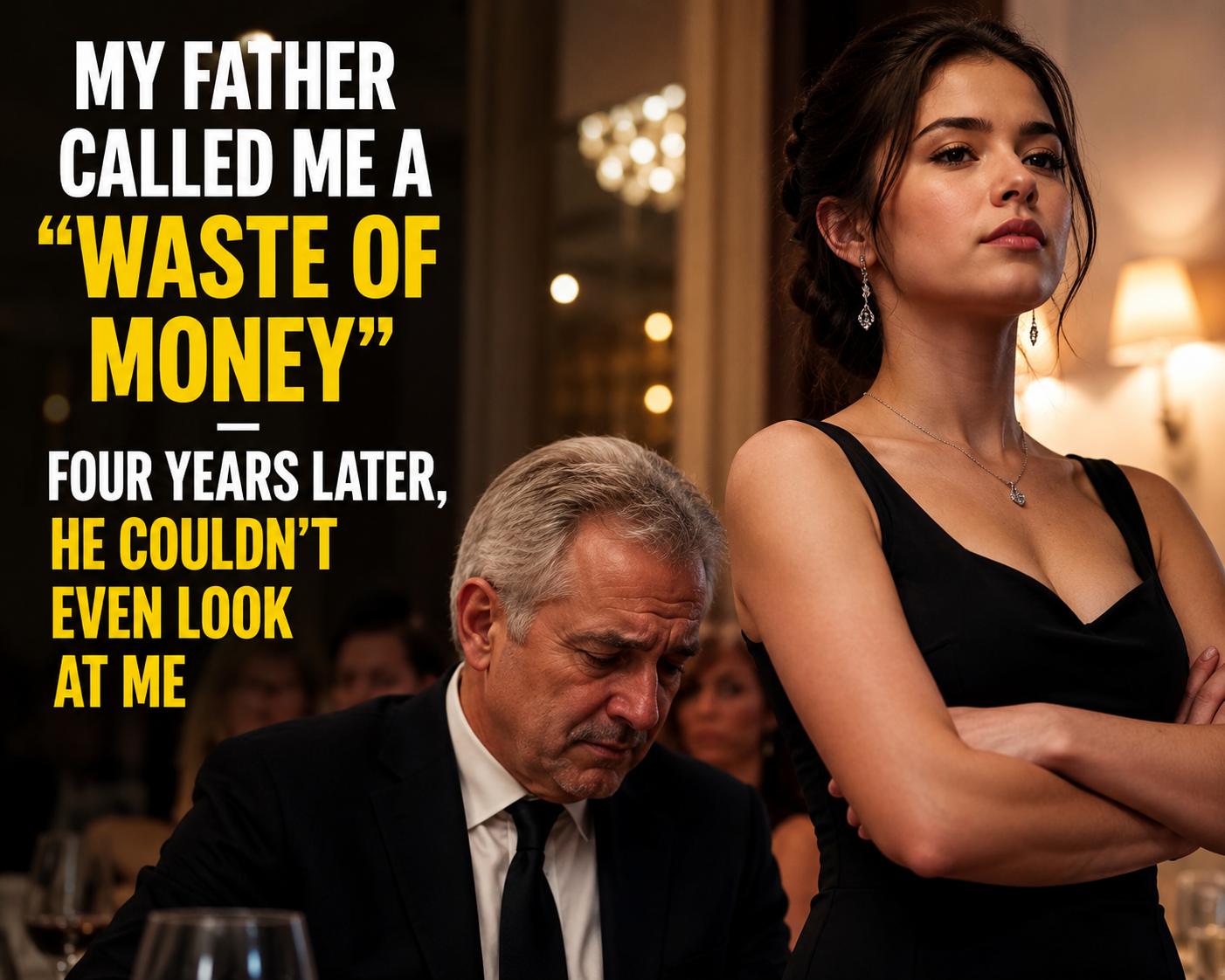
The first time my father called me a “waste of money,” I was fourteen years old.
Not in private.
Not during some heated argument.
He said it across the dinner table while my little brother laughed nervously beside him and my mother stared down at her plate pretending not to hear.
I still remember the exact sound of his fork hitting the ceramic dish before he looked at my report card and sighed like I had personally ruined his life.
“Four B’s?” he scoffed. “After all the tutoring bills I paid?”
I swallowed hard. “I tried—”
“Tried?” he snapped. “Your brother gets straight A’s without half the money you need.”
The room went quiet.
Then came the sentence that stayed with me for years.
“Honestly, sometimes I think investing in you was a complete waste of money.”
I felt something crack inside me that night.
Not loudly.
Not dramatically.
Just quietly.
Like a tiny fracture spreading through glass.
My mother whispered my name softly afterward, but she didn’t defend me.
She never did.
Because in our house, my father’s words became truth whether they were fair or not.
And according to him, I was the disappointing daughter.
The expensive one.
The emotional one.
The failure.
My father worshipped success.
Not happiness.
Not kindness.
Success.
Money was his religion, and achievement was the only language he respected.
He loved introducing my younger brother, Tyler, to people.
“Future surgeon,” he’d proudly announce.
Then he’d gesture toward me almost as an afterthought.
“And this is Lily.”
Just Lily.
No title.
No pride.
No future worth mentioning.
It didn’t matter that I worked part-time after school.
It didn’t matter that I stayed up until two in the morning studying.
It didn’t matter that teachers constantly praised my writing and creativity.
To my father, those things meant nothing because they didn’t fit inside his definition of valuable.
One evening during junior year, I gathered enough courage to tell him I wanted to apply to a journalism program in Chicago.
I had rehearsed the conversation for weeks.
But the second the words left my mouth, he laughed.
Actually laughed.
“You want me to pay thousands of dollars so you can write feelings for a living?”
“It’s not like that,” I said quietly.
“No,” he interrupted coldly. “It’s worse.”
My cheeks burned.
“I can get scholarships—”
“You know what successful people study?” he snapped. “Medicine. Law. Engineering. Not fantasy careers.”
Then he leaned back in his chair and delivered the sentence that would haunt me for years.
“You’re too emotional to survive the real world anyway.”
That night, I cried into my pillow so hard I could barely breathe.
Not because he insulted me.
But because some small broken part of me still desperately wanted him to believe in me.
Things only got worse after Tyler got accepted into one of the best pre-med programs in the state.
My father threw him a huge celebration dinner.
Family came from three different cities.
There were balloons.
Custom cakes.
Champagne.
My father stood during the toast with tears in his eyes.
“To my son,” he said proudly. “The child who made every sacrifice worth it.”
Everyone clapped.
And I sat there smiling while trying not to fall apart.
Because two weeks earlier, I had quietly received acceptance into one of the top journalism schools in Illinois—with a partial scholarship.
No dinner.
No toast.
No congratulations.
When I handed my father the acceptance letter, he barely looked at it before setting it on the counter.
“How much will this still cost me?” he asked.
That was his first question.
Not “Are you happy?”
Not “Are you proud?”
Just numbers.
Always numbers.
I ended up declining the offer.
I told everyone I wanted to stay closer to home.
The truth?
I couldn’t stand hearing my father remind me every day that I wasn’t worth the investment.
So instead, I attended a small local college while working evenings at a grocery store to cover tuition.
And slowly, something inside me changed.
I stopped asking for approval.
Stopped sharing my dreams.
Stopped hoping for warmth that never came.
By twenty-two, I barely spoke to him unless necessary.
And honestly?
I think he preferred it that way.
Then came the night everything exploded.
I had just returned home from work when I overheard my parents arguing in the kitchen.
My father sounded furious.
“You’re babying her,” he barked.
“She’s your daughter,” my mother whispered back.
“She’s twenty-three and still struggling financially! Tyler already has internships lined up at hospitals.”
I froze in the hallway.
Then came the words that changed my life forever.
“She’s draining this family dry for nothing.”
I walked into the kitchen before I could stop myself.
“For nothing?” I repeated.
Both of them turned sharply.
My father’s expression hardened instantly.
“You heard me.”
I stared at him, stunned.
“I pay my own tuition. I work every single day. I barely ask you for anything.”
“And yet somehow,” he said coldly, “you always need help eventually.”
My chest tightened.
“You’ve never once believed in me.”
“Oh please,” he scoffed. “Belief has nothing to do with reality.”
The room spun.
Years of humiliation.
Years of comparison.
Years of feeling small.
All crashed into me at once.
Then finally…
I snapped.
“You know what?” I said, voice shaking. “One day you’re going to look at me and regret every single thing you said.”
He crossed his arms.
“I highly doubt that.”
I’ll never forget the look in his eyes.
Absolute certainty.
Complete dismissal.
Like I was too insignificant to ever prove him wrong.
So I left.
That same night.
Two suitcases.
Three hundred dollars in savings.
And enough heartbreak to last a lifetime.
As I carried my final bag toward the door, my father didn’t stop me.
Didn’t apologize.
Didn’t even stand up.
He simply looked at the television and said:
“Don’t come back asking for money.”
The door closed behind me.
And for the first time in my life…
I realized I was completely on my own.
I spent the first six months sleeping on a mattress on the floor of a tiny studio apartment above a laundromat.
The pipes rattled every night.
The heater barely worked.
And the entire place smelled faintly like detergent and burnt dust.
But for the first time in my life, I could breathe without someone constantly reminding me I wasn’t enough.
Still… freedom didn’t magically erase the damage my father left behind.
Every time I made a mistake at work, I heard his voice in my head.
Waste of money.
Every rejection email felt like proof he had been right about me all along.
I worked three jobs during that first year.
Morning shifts at a coffee shop.
Afternoon classes.
Freelance writing assignments late into the night.
Most days, I survived on instant noodles and caffeine.
Sometimes I cried from exhaustion alone.
But I kept going.
Because failure no longer meant disappointment.
Failure meant proving my father correct.
And I refused to give him that satisfaction.
One rainy Thursday changed everything.
I was twenty-four and working part-time for a tiny local news website that barely paid enough to cover rent.
Most assignments were boring community pieces nobody cared about.
School bake sales.
Parking complaints.
Weather updates.
Then one afternoon, my editor tossed a thin file onto my desk.
“You’re good at emotional stories,” she said. “Go interview this woman before the bigger stations grab it.”
Inside the folder was a short police report about an elderly waitress named Maria Santos who had secretly been feeding homeless children behind her diner for nearly twelve years.
Something about the story hit me immediately.
So I drove two hours through heavy rain to meet her.
And when she opened the diner door, smiling shyly with flour still on her hands, I knew this wasn’t just another assignment.
For three hours, she told me stories about hungry kids sleeping in cars, runaway teenagers, single mothers pretending not to be starving so their children could eat first.
She cried halfway through the interview.
So did I.
That night, I wrote until sunrise.
Not just facts.
Feelings.
Humanity.
Truth.
When the article went live two days later, everything exploded.
Millions of views.
National shares.
Television interviews.
Donation campaigns.
Within weeks, Maria’s diner raised enough money to open an actual shelter kitchen.
And suddenly, people in journalism started noticing my name.
Three months later, I received an email that changed my entire future.
A major digital media company in Chicago offered me a full-time position as a feature writer.
Salary.
Benefits.
Travel opportunities.
Real career growth.
I stared at the email so long my screen blurred from tears.
Because for the first time in my life…
someone saw value in the exact thing my father mocked.
Writing.
Emotion.
Stories.
I almost called him that night.
Isn’t that pathetic?
After everything he said, some small part of me still wanted him to finally be proud.
But I didn’t call.
Because deep down, I already knew what would happen.
He’d minimize it.
Compare it.
Find flaws.
So instead, I packed my life into four boxes and moved to Chicago alone.
And that’s where everything truly began.
Over the next four years, my career skyrocketed faster than anyone expected.
I covered human-interest stories across the country.
Wildfire survivors.
Forgotten veterans.
Children overcoming impossible odds.
People connected to my work because I wrote the way pain actually feels.
Raw.
Messy.
Human.
By twenty-seven, I had won two national journalism awards.
By twenty-eight, I became one of the youngest senior editors at the company.
And by twenty-nine…
my face appeared on magazine covers my father probably kept on waiting room tables.
The irony almost made me laugh.
Meanwhile, Tyler’s “perfect” life started quietly collapsing.
Medical school debt crushed him.
The pressure destroyed his mental health.
And after failing a major licensing exam twice, he spiraled into depression.
I only learned about it because my mother called me crying one night after nearly three years of silence.
“Your brother’s struggling,” she whispered.
Part of me wanted to hang up.
But another part remembered what it felt like when nobody protected me.
So I listened.
That call reopened doors I thought were permanently closed.
Soon my mother started texting occasionally.
Then Tyler.
But never my father.
Not once.
His pride wouldn’t allow it.
Then came the invitation.
My parents’ thirty-fifth wedding anniversary.
A huge formal celebration at one of the most expensive hotels in the city.
I almost didn’t go.
But my mother begged me.
“Please,” she said softly over the phone. “Just come for one night.”
So I did.
And the moment I stepped into that ballroom…
everything changed.
Crystal chandeliers sparkled overhead.
Waiters moved through crowds carrying champagne.
A live pianist played softly near the stage.
Then dozens of heads turned toward me at once.
Whispers spread almost instantly.
Because people recognized me.
Some guests approached asking for photos.
Others complimented my articles.
One woman excitedly told her husband, “That’s Lily Carter! She wrote that wildfire series!”
I noticed my father standing across the room near the bar.
Frozen.
Watching everything.
For the first time in my life…
he looked uncertain around me.
Almost intimidated.
And suddenly, I understood something terrifying:
He had spent decades believing my worth depended on his approval.
Now the entire room respected me without it.
Later that evening, the anniversary speeches began.
My father stood near the stage holding a glass of champagne while thanking everyone for attending.
Then unexpectedly, one of his business partners interrupted with a grin.
“Before you finish,” the man said loudly, “I think we should acknowledge that Richard’s daughter is basically more famous than all of us combined now.”
Laughter filled the ballroom.
Applause followed.
And every eye turned toward my father.
For one long, painful second…
he couldn’t even look at me.
His jaw tightened.
His eyes lowered toward the floor.
Almost like meeting my gaze physically hurt him.
And in that moment, I realized something heartbreaking.
It wasn’t anger in his expression.
It was shame.
Real shame.
The kind that arrives years too late.
After the speeches, I stepped outside onto the balcony for air.
Cold wind swept through the city lights below.
A few minutes later, the balcony door opened behind me.
I already knew it was him before he spoke.
“You’ve done well for yourself.”
His voice sounded older now.
Smaller somehow.
I kept staring at the skyline.
“You seemed surprised.”
He exhaled slowly.
“I was.”
There it was.
Honesty.
Painfully late honesty.
I turned toward him for the first time that night.
“Do you know what hurt the most?” I asked quietly.
He didn’t answer.
“It wasn’t the insults,” I continued. “It was knowing that if Tyler had accomplished everything I did tonight… you would’ve been bragging about him to every person in this building.”
His face collapsed slightly.
“That’s not true.”
“It is.”
Silence stretched between us.
Then finally, in a voice barely above a whisper, he asked:
“Do you hate me?”
The question caught me off guard.
Because for years, I thought I did.
But standing there looking at this aging man who suddenly seemed so much less powerful than my childhood memories…
I felt something sadder than hate.
Grief.
For the father I needed.
For the daughter I used to be.
For all the years we lost trying to win a love that should’ve been unconditional.
“I don’t hate you,” I said softly.
His eyes filled instantly.
“But I’ll probably never forget what you made me believe about myself.”
My father cried that night on the balcony.
Not loudly.
Not dramatically.
Just quietly… like a man finally forced to sit alone with the damage he spent decades pretending he never caused.
“I thought pushing you harder would make you stronger,” he whispered.
I looked at him for a long moment before answering.
“No,” I said softly. “You pushed me because you only knew how to love people you were proud of.”
That sentence hit him harder than shouting ever could.
Because deep down…
he knew it was true.
After the anniversary party, things between us changed—but not in the magical way movies promise.
There was no instant healing.
No tearful reconciliation montage.
Trauma doesn’t disappear because someone finally admits they hurt you.
But slowly… awkwardly… we began trying.
Sometimes he’d send me short texts after my articles were published.
“Good work.”
“Proud of you.”
Simple words most daughters hear their entire lives.
For me, they felt foreign.
Almost uncomfortable.
At first, I didn’t know how to respond.
Part of me still burned with resentment.
Another part desperately mourned all the years I should’ve heard those things when I actually needed them.
Still… I answered.
Because healing isn’t always about forgetting.
Sometimes it’s about deciding whether the future deserves a different ending than the past.
A year later, Tyler finally opened up to me about everything he had hidden.
The panic attacks.
The breakdowns.
The unbearable pressure of spending his whole life trying to remain “the successful child.”
One night, he admitted something that shattered me.
“You know Dad compared me to you too, right?”
I stared at him in disbelief.
“What?”
He laughed bitterly.
“When you started becoming successful, suddenly I wasn’t enough anymore either.”
The room fell silent.
And in that moment, both of us realized the truth:
Our father had never known how to love without conditions.
No achievement was ever enough for long.
No success permanent enough to satisfy him.
He kept moving the finish line because deep down, he was terrified of his own failures.
And we spent our entire childhoods paying the price for wounds he never healed.
Two years later, my mother called me one morning crying so hard I could barely understand her.
“It’s your father,” she whispered.
My stomach dropped instantly.
“He collapsed at work.”
By the time I reached the hospital, he looked smaller than I had ever seen him.
Machines beeped softly around him.
Gray hair spread across the pillow.
His hands trembled slightly beneath the blankets.
Age had finally caught him.
The doctor explained it was his heart.
Stress.
Years of untreated blood pressure.
He would recover…
but things were serious now.
That evening, after everyone else left, I sat beside his bed in silence while rain tapped gently against the hospital window.
Finally, without opening his eyes, he spoke.
“You know what my biggest regret is?”
I didn’t answer.
He swallowed hard.
“That you spent your whole life trying to earn love you should’ve received for free.”
My throat tightened instantly.
His voice cracked.
“I made you believe your worth depended on performance. On achievement. On proving yourself.”
A tear slid down the side of his face.
“And the worst part is… you actually believed me.”
I looked away because suddenly I couldn’t breathe.
All those years.
All those nights questioning my value.
Destroying myself for validation.
Working until exhaustion because rest felt like failure.
It all traced back to one little girl trying desperately not to be a disappointment.
“I’m sorry,” he whispered brokenly. “God… Lily, I’m so sorry.”
And for the first time in my entire life…
I believed him.
My father retired six months later.
The man who once worshipped status suddenly spent his mornings gardening quietly in the backyard and reading books near the kitchen window.
Age softened him.
Regret humbled him.
Sometimes I caught him watching me during family dinners with this strange expression in his eyes.
Like he still couldn’t fully understand how he almost lost me forever.
One evening near Christmas, he handed me a small wrapped box.
Inside was the old acceptance letter to the journalism school I declined years ago.
Perfectly preserved.
I stared at him in shock.
“You kept this?”
He nodded slowly.
“I used to read it sometimes after you moved out.”
“Why?”
His eyes filled with tears instantly.
“Because deep down,” he whispered, “I think I always knew you were extraordinary.”
That sentence should’ve healed everything.
But real life is more complicated than that.
Some wounds close slowly.
Others leave scars forever.
Still…
for the first time, I finally understood something important:
His inability to love me correctly was never proof that I was unworthy.
It was proof that he was broken too.
Three years later, my father passed away quietly in his sleep.
No dramatic final speech.
No perfect cinematic goodbye.
Just peace.
At the funeral, hundreds of people spoke about his discipline, his work ethic, his achievements.
But when it was my turn to speak…
I told the truth.
“My father spent much of his life believing love had to be earned,” I said softly. “And because of that, he hurt people he loved without realizing how deeply.”
The church became silent.
“But near the end of his life, he tried to change. And I think that matters too.”
I paused, fighting tears.
“He once called me a waste of money.”
Several people shifted uncomfortably.
“But the last thing he ever told me was that I was the greatest thing he ever helped create.”
My voice broke completely then.
“And honestly… I think both versions of him were real.”
After the funeral, I visited the old house alone.
Most things were already packed away.
But while cleaning his office, I found a locked drawer key taped beneath the desk.
Inside the drawer sat dozens of folders.
Every article I had ever published.
Printed.
Organized.
Carefully preserved.
Some pages had coffee stains.
Others contained handwritten notes in the margins.
“Brilliant opening.”
“So proud of her here.”
“This made me cry.”
I sat on the floor holding those papers against my chest while years of pain and love crashed together inside me.
And suddenly I understood the cruelest part of life:
Sometimes the people who damage us most…
love us deeply.
They just don’t know how to show it until it’s far too late.
I cried for a long time that afternoon.
For the little girl who thought she was worthless.
For the man who realized his mistakes too late.
For the years we lost.
But when I finally walked out of that house carrying those folders in my arms…
I no longer felt like the unwanted daughter he left broken behind.
I felt like someone who survived him.
And finally…
someone who survived herself too.