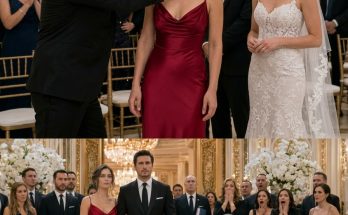
I Was About To Sign The Divorce Papers While I Was Nine Months Pregnant, When Suddenly My Father-In-Law Slapped My Husband Hard In A Crowded Courtroom. Looking At The Judge, He Said: “He Is Not Innocent, But The Real Criminal Is…”
Part 1
The pen felt heavier than it should have.
It was a cheap black courtroom pen, the kind attached to nothing and owned by no one, but in my hand it felt like a stone pulled from the bottom of a river. My fingers were swollen from pregnancy. My wedding ring had been sitting in a little ceramic dish beside my bathroom sink for three weeks because I could no longer get it over my knuckle.
Across the table, my husband sat with his hands folded like he was waiting for a business meeting to end.
Owen Whitaker.
Seven years of marriage, nine years of knowing his coffee order, his tired sigh, the small scar near his eyebrow from falling off a dirt bike at sixteen. Seven years of believing I knew the shape of the man beside me in the dark.
Now he wouldn’t even look at me.
“Nora,” his attorney said gently, as if softness could hide the blade. “Once you sign, we can proceed with the final settlement.”
My name is Nora Whitaker. I was thirty-two years old, nine months pregnant, and sitting in a courtroom in Franklin County, Ohio, with divorce papers spread in front of me like a death certificate for a life I had not agreed to bury.
The courtroom smelled like old wood, floor cleaner, and rain-soaked coats. It had stormed all morning. Every time someone opened the door, a gust of wet air moved through the room, carrying the smell of asphalt and damp wool.
My daughter kicked hard under my ribs.
I pressed one hand to my belly.
“Almost done,” Owen murmured.
Almost done.
Those two words nearly broke me.
Three months earlier, he had painted the nursery a soft green because we agreed yellow was too bright and pink felt too expected. He had stood on a ladder with blue tape on his wrist, humming along to an old country song, and when I walked in barefoot with a bowl of sliced peaches, he had smiled like the sight of me made his whole day easier.
Then something changed.
Not slowly. Not in a way I could ignore.
One week he was rubbing my feet and arguing that our daughter should be named Clara after his grandmother. The next week he was sleeping on the edge of the mattress like touching me would burn him.
His phone was always face down. His shirts came home smelling like hotel soap instead of his office. He started taking calls in the garage. When I asked what was wrong, he said, “Nothing.”
Nothing became the third person in our marriage.
Then, one Tuesday evening, he came home with divorce papers tucked inside a manila envelope.
No fight. No affair confession. No long speech.
Just, “I can’t do this anymore.”
I had stood in our kitchen while the dishwasher hummed and the baby monitor we had bought too early sat unopened on the counter.
“Do what?” I asked.
He stared at the floor.
“This marriage.”
I laughed because I thought I had misheard him. Then I saw his face and realized he had practiced not reacting.
Now here we were, in front of a judge, with my ankles aching and my throat raw from swallowing every question he refused to answer.
Judge Calder adjusted his glasses. “Mrs. Whitaker, do you understand the agreement as presented?”
No.
That was the honest answer.
I understood the words. I understood custody terms for a child not yet born. I understood that Owen wanted the house sold, our accounts separated, and communication handled through lawyers until after the delivery.
What I did not understand was how a man could kiss my stomach goodnight in June and ask me to sign away our marriage in September.
“I understand,” I whispered.
My attorney, Claire Benson, leaned close. “You don’t have to sign today if you’re not ready.”
Owen’s jaw tightened.
That little movement told me everything and nothing. He wanted it over. He needed it over.
But why?
I picked up the pen.
The room seemed to hold its breath.
Then the courtroom doors slammed open.
Everyone turned.
A tall older man stood in the doorway, rain shining on the shoulders of his dark coat. His silver hair was mussed, his face pale except for two spots of angry red high on his cheeks.
Graham Whitaker.
Owen’s father.
The last time I had seen him, he had hugged me carefully because of my belly and said, “You call me when this baby comes, even if my son has lost his mind.”
Now he looked like a man walking into a fire.
“Owen,” he said.
Owen stood so fast his chair scraped the floor.
“Dad, don’t.”
That was the first crack in him all day.
Graham walked down the aisle. His shoes hit the tile with sharp, wet sounds.
The judge frowned. “Sir, this is a closed proceeding. You need to—”
Graham stopped in front of his son.
For one heartbeat, nobody moved.
Then his hand came up.
The slap cracked through the room.
Owen staggered back, one hand flying to his cheek. Gasps burst from the gallery. My attorney stood halfway out of her chair. The bailiff moved forward.
Graham didn’t flinch.
“You coward,” he said.
Owen stared at him, stunned. “What did you do?”
“What you should’ve done months ago.” Graham turned toward the judge, breathing hard. “Your Honor, my son is not innocent. But he is not the one hiding the truth in this courtroom.”
My hand slid from the pen.
For the first time in months, Owen looked truly afraid.
And I realized the divorce papers were not the end of my nightmare.
They were the doorway.
### Part 2
Judge Calder called for order three times before anyone listened.
The bailiff stood between Graham and Owen with one hand raised, not touching either man yet, but ready. Rainwater dripped from Graham’s coat onto the tile. Each drop looked black against the pale floor.
“Mr. Whitaker,” the judge said, voice low and controlled, “you have assaulted a party in my courtroom. You will explain yourself very carefully.”
Graham nodded once. “I will.”
Owen’s cheek had already started to redden. He looked at his father with a kind of panic I had never seen on him before. Not anger. Not embarrassment.
Fear.
“Dad,” he said quietly. “Please don’t do this here.”
That sentence cut through me.
Here.
Not don’t do this because it isn’t true. Not don’t hurt Nora. Not don’t ruin everything.
Here.
I shifted in my chair, and my daughter pressed low in my belly, a heavy ache blooming across my back. Claire noticed immediately.
“Nora?” she whispered.
“I’m fine.”
I was not fine. My body felt like a house with all the lights flickering.
Graham pulled a sealed envelope from inside his coat. It was thick, cream-colored, and bent at one corner like he had gripped it too hard in the car.
“I received this at 7:10 this morning,” he said. “From a retired accountant who used to work for Whitaker Development.”
At the mention of the company, Owen closed his eyes.
Whitaker Development was Graham’s construction and property firm, the kind of family business people in Columbus knew by name. They built suburban neighborhoods, medical office parks, senior living complexes. Owen worked there as vice president, which mostly meant long hours, polished shoes, and too many dinners with men who wore golf shirts under blazers.
I had never cared about the business beyond how tired it made him.
But over the last three months, I had noticed things.
An office key missing from Owen’s ring.
A new password on his laptop.
A late-night argument in our driveway with his mother, Celeste, her pearl earrings flashing under the porch light as she hissed, “You owe this family discretion.”
When I had opened the door, they both stopped talking.
Celeste smiled at me like a candle in a draft.
“Pregnancy makes you such a light sleeper, sweetheart.”
Sweetheart.
She only called me that when she wanted me small.
Now Graham handed the envelope to the bailiff, who brought it to the judge. Judge Calder opened it slowly. The sound of paper sliding free seemed louder than the rain against the windows.
He read the first page.
Then the second.
His eyebrows drew together.
“Mr. Whitaker,” he said, “what exactly am I looking at?”
Graham’s voice roughened. “Proof that my wife has been lying to this court, to my son, and to my daughter-in-law.”
The room shifted.
I heard someone whisper Celeste’s name behind me.
That was when I realized she was there.
I turned carefully.
Celeste Whitaker sat in the second row, three seats from the aisle, wearing a navy dress and a white coat draped over her shoulders. Her blonde hair was pinned at the nape of her neck. Her lips were painted a soft rose. She looked like she belonged at a charity luncheon, not at the center of a courtroom explosion.
Our eyes met.
She smiled.
Not warmly. Not nervously.
Knowingly.
A chill moved over my arms.
“Celeste,” Graham said without looking back, “stand up.”
She didn’t.
Judge Calder looked toward the gallery. “Mrs. Whitaker, are you involved in the matter being presented?”
Celeste folded her gloved hands in her lap. “Your Honor, my husband is emotional. He has been under enormous stress.”
Graham laughed once. It was a broken sound.
“Stress didn’t forge documents.”
My mouth went dry.
Owen gripped the back of his chair.
“What documents?” Claire asked sharply.
Judge Calder continued reading. His face changed in small degrees, the way a sky darkens before a storm finally breaks.
“These appear to include notarized statements, bank records, and correspondence related to marital asset shielding.” He looked at Owen. “Mr. Whitaker, were you aware of these?”
Owen did not answer.
My heart started beating so hard I felt it in my ears.
“Were you?” I asked him.
He turned to me, and for a moment I saw my husband again. Not the cold stranger from the last three months, but the man beneath him. Exhausted. Ashamed. Cornered.
“I didn’t know all of it,” he said.
All of it.
My breath caught.
Graham pointed toward Celeste. “She told him Nora was planning to take the company down in the divorce. She told him there were filings, recordings, threats. She said if he didn’t move first, Nora would ruin him before the baby was born.”
I stared at him.
“What?”
Celeste sighed, almost bored. “This is absurd.”
But her right hand tightened around her purse.
I saw it. A tiny movement. A crack in the marble.
Claire stood fully. “Your Honor, my client has never filed any such claims, nor threatened any business action. We have asked repeatedly for the reason behind this sudden divorce and received none.”
Judge Calder turned a page.
Graham’s voice dropped. “Because there was no reason. Not from Nora.”
Owen sat down hard, like his legs had failed him.
The courtroom blurred at the edges.
For months, I had blamed myself. I had stood in front of mirrors with my belly stretched tight beneath my nightgown and wondered what part of me had become unlovable. I had replayed conversations, meals, doctor visits, the night I cried because the crib delivery was late and Owen barely touched my shoulder.
Now I was hearing that someone had built a cage around my marriage and handed my husband the key.
And he had used it.
“Why?” I asked.
My voice was quiet, but the whole room heard it.
Celeste finally stood.
Her smile disappeared.
“Because you were never supposed to have leverage,” she said.
The word hung in the air.
Leverage.
Not love. Not family. Not marriage.
Leverage.
My daughter kicked again, sharp and sudden, and I looked at Owen’s mother with a fear that tasted like metal.
“What leverage?” I asked.
Celeste looked at my stomach.
Then she looked away.
### Part 3
The judge ordered a recess.
Not because anyone was calm, but because no one was. Chairs scraped, attorneys gathered papers, and the bailiff guided Graham to the side as if he might slap someone else before lunch.
I stood too quickly and pain tightened around my belly like a belt.
Claire caught my elbow. “Slowly.”
“I need air.”
“You need to sit.”
“I need him to tell me what’s going on.”
Across the room, Owen was speaking to his attorney in harsh whispers. His cheek was still red. Every few seconds, he glanced at me, then away, as if my face was a window he couldn’t bear to look through.
I wanted to hate him cleanly.
It would have been easier if there had been another woman. A cheap motel receipt. A lipstick stain. A message on his phone.
Instead, there were documents, family business secrets, and his mother staring at my unborn child like my belly contained a contract.
Claire guided me into the hallway. The air outside the courtroom smelled like coffee from a vending machine and wet umbrellas. People lined the benches: a man in work boots picking at his thumbnail, a woman crying into a tissue, a teenage boy with earbuds staring at the floor.
Normal misery. Ordinary endings.
Mine felt unreal.
Graham came out a minute later with the bailiff behind him. The judge had apparently decided not to arrest him yet, which was generous considering the sound his hand had made against Owen’s face.
He stopped in front of me.
Up close, he looked ten years older than he had at Christmas. His eyes were bloodshot. The collar of his shirt was damp from the rain.
“Nora,” he said, “I’m sorry.”
I almost laughed.
“For the slap?”
“For being late.”
That landed harder.
I folded my arms over my belly. “Late to what?”
His gaze moved to Claire, then back to me. “To telling you what this family did.”
Behind him, Celeste stepped into the hallway.
She did not hurry. Women like Celeste Whitaker never hurried. They made the room adjust to them.
“Owen,” she called.
He emerged from the courtroom like a man being pulled by a chain.
Celeste’s face softened the moment she saw him. “Come here.”
For seven years, I had watched that softness work on him. She could turn him from a grown man into a guilty boy with two syllables. When we first married, I thought it was love. Later, I learned love in that family often came wrapped in obligation.
Owen did not move.
Celeste’s expression sharpened.
“Owen.”
Graham stepped between them. “You don’t get to handle him anymore.”
She let out a small laugh. “Handle him? He is my son.”
“He is thirty-five years old, and you used him like a lockpick.”
Her eyes flashed.
I looked at Owen. “Is that true?”
He rubbed both hands over his face. “I thought I was protecting you.”
That sentence snapped something inside me.
“Do not use me as the excuse.”
His hands dropped.
I felt tears rise, but they were hot now, angry instead of broken.
“You froze me out. You moved into the guest room. You stopped coming to appointments. You let me sit alone while the doctor asked if my support person was parking the car.” My voice shook. “You served me divorce papers while I was packing a hospital bag.”
Owen looked down.
“Look at me,” I said.
He did.
And I saw it then: shame, yes. Regret, yes. But also something worse.
Relief.
He was relieved someone else had finally opened the box he had been sitting on.
That made me hate him more.
“What leverage?” I asked again.
Nobody answered.
A janitor pushed a mop bucket around the corner, then saw us and quickly turned back. The wheels squeaked away.
Graham exhaled. “Nora, before your father died, he invested in a small land partnership with me.”
I blinked. “My father was a high school history teacher.”
“I know.”
“He clipped coupons. He drove a Buick until the doors rusted.”
Graham nodded. “And in 1998, he helped me buy sixty acres outside Dublin when no bank would touch me.”
I stared at him.
My father had died when I was twenty-four. A heart attack in the garage, radio still playing a baseball game. He left behind books, tools, and a coffee can full of old screws. Not investments. Not land.
“My dad never mentioned that.”
“He didn’t want money changing your life before you were ready. That was his wording.” Graham swallowed. “His share was placed in a trust for you.”
The hallway tilted.
Claire’s grip tightened on my arm.
“What trust?” she asked.
Celeste stepped forward. “An irrelevant one.”
Graham turned on her. “It became very relevant when Whitaker Development rezoned that land and built Northpoint Commons.”
I knew Northpoint Commons. Everyone in Columbus knew it. Luxury apartments, medical offices, restaurants with Edison bulbs and twenty-dollar burgers.
Owen whispered, “Dad.”
Graham ignored him.
“Nora,” he said, “your father’s trust owns fifteen percent of that development.”
The sound disappeared from the hallway.
I could see Graham’s mouth moving after that, but for a second I heard nothing except blood rushing in my ears.
Fifteen percent.
My father, who ate peanut butter off a spoon when he graded papers late at night, had left me part of a development worth millions.
Celeste’s voice sliced through the silence.
“And she was never supposed to find out before the divorce.”
The words were quiet.
But this time, everyone heard them.
### Part 4
I did not faint.
I want to make that clear because people love to imagine pregnant women collapsing prettily when life becomes too much.
I stayed standing.
My knees trembled, my palms went cold, and my daughter rolled under my ribs like she was trying to find a way out of the mess adults had made, but I stayed on my feet.
Claire recovered first.
“Mrs. Whitaker,” she said to Celeste, her voice suddenly formal, “did you just admit knowledge of concealed marital and trust assets?”
Celeste looked at her like she was a stain on a tablecloth. “I admitted nothing.”
“You said my client was never supposed to find out.”
“I said people misunderstand things when emotions run high.”
Graham laughed again, bitterly. “You always do that. You say the thing, then rearrange the room around it.”
Owen had gone pale.
I turned to him slowly. “You knew?”
He opened his mouth.
That was answer enough.
My chest tightened so badly I had to breathe through my nose.
“How long?”
“Nora—”
“How long?”
His voice was barely audible. “Six weeks.”
Six weeks.
Six weeks ago, I had been sitting alone in the nursery at midnight, folding tiny white onesies because I couldn’t sleep. Owen had come to the doorway and watched me for almost a full minute. I remembered it clearly because I thought he might finally come in. I thought he might sit beside me and put his hand on my stomach the way he used to.
Instead, he said, “We should sell the house.”
Six weeks.
“You knew I had a trust,” I said, “and you still let me think I was walking into this divorce with nothing but half a savings account and a crib.”
His face twisted. “I didn’t know the value at first.”
“But once you did?”
He looked away.
There it was. The truth wasn’t always a dramatic confession. Sometimes it was a man unable to hold eye contact.
Graham stepped closer. “He came to me. I told him to tell you.”
Celeste snapped, “You told him to destroy this family.”
“No,” Graham said. “I told him to stop destroying his own.”
A door opened behind us. The bailiff said the judge wanted everyone back inside.
The walk to the courtroom felt longer than before. My shoes pinched. My back ached. The fluorescent lights buzzed overhead. I noticed ridiculous things: a scuff mark on the baseboard, a gum wrapper under a bench, the smell of someone’s cinnamon breath mint.
Maybe the brain collects small details when the big ones are too sharp to touch.
Inside, Judge Calder looked like he had aged during the recess too. The documents lay before him in neat stacks.
“Mrs. Whitaker,” he said, “given the information presented, I will not finalize this divorce today.”
My body loosened with relief so sudden it almost hurt.
Then he continued.
“I am ordering a temporary halt to proceedings pending review of trust ownership, disclosure issues, and potential misconduct relating to financial concealment.”
Celeste’s attorney, who had appeared from somewhere during the recess, stood. “Your Honor, my client is not a party to this divorce.”
“She may become relevant to it,” the judge said coolly.
For the first time all day, Celeste’s smile faltered.
Claire stood beside me. “We also request immediate preservation of all records related to Whitaker Development, Northpoint Commons, and any communications regarding my client’s trust.”
“Granted,” the judge said.
Owen’s attorney lowered his head and wrote something quickly.
I watched Owen. He looked destroyed.
A cruel part of me wanted to feel satisfied.
Instead, I felt hollow.
Judge Calder turned to him. “Mr. Whitaker, did you knowingly fail to disclose potential trust assets connected to your wife?”
Owen stood slowly.
Celeste’s head snapped toward him.
“Be careful,” she said.
The judge’s gaze hardened. “Mrs. Whitaker, you will not coach testimony in this courtroom.”
Owen looked at his mother.
Then at his father.
Then at me.
“Yes,” he said.
Celeste closed her eyes.
My breath stopped.
Owen’s voice shook, but he kept going. “I knew there was a trust. I knew my mother had documents. I knew Nora hadn’t been told. I didn’t know the full value until recently, but I knew enough to know she deserved answers.”
Every word landed like a nail.
Claire’s hand brushed mine under the table, steadying me.
Judge Calder asked, “Why did you proceed?”
Owen swallowed.
“My mother told me if Nora found out before the divorce, she would claim I had hidden assets from her and use it to take control of the company. She said she had proof Nora’s attorney was preparing aggressive filings.”
Claire cut in. “That is false.”
“I know that now,” Owen said.
I stared at him.
“Now?”
He flinched.
Graham leaned forward. “Tell the rest.”
Owen looked like he might be sick.
“What rest?” I asked.
Celeste stood abruptly. “This has gone far enough.”
The judge slammed his gavel once. “Sit down.”
She remained standing.
And that was when I noticed something strange.
The cream-colored envelope Graham brought had my father’s handwriting on the back.
Not much. Just two words in faded blue ink.
For Nora.
My throat closed.
My father had left me something.
And for years, everyone in this family had touched it before I did.
### Part 5
The judge allowed me to read the letter in a side room.
Not because it was procedure, but because Claire asked, and because I think even Judge Calder understood that some truths should not be opened under fluorescent lights in front of strangers.
The room was small and smelled like dust, copier toner, and old coffee. There was a square table, four chairs, and one narrow window overlooking the parking lot. Rain slid down the glass in crooked lines.
Claire sat beside me. Graham stood near the door. Owen asked to come in.
I said no.
He looked hurt.
I let him.
The envelope trembled in my hands. My father’s handwriting was exactly as I remembered it: slightly slanted, careful, teacherly. He used to leave notes on the fridge when he worked late.
Nora, soup in the fridge. Don’t drive with the gas light on. Love, Dad.
I ran my thumb over the words For Nora until my eyes blurred.
Then I opened it.
The letter inside was only one page.
My dad had written it twelve years earlier, two years before he died.
My sweet girl,
If you are reading this, then Graham has either kept his promise, or something has gone wrong badly enough that paper has become safer than trust.
That first sentence made Graham turn away.
I kept reading.
Years ago, I invested in land with Graham Whitaker. I did it quietly, partly because I believed in him, partly because I wanted you to have a door in life that no man could close. I know you will say I should have told you. Maybe you are right. But I wanted you to build yourself first, not become something other people chased.
Your share is protected. It is yours before marriage, during marriage, after marriage, always. If anyone tells you otherwise, ask why they are afraid of a woman having her own key.
I stopped there.
A sound came out of me that did not feel human.
Claire put a hand on my shoulder.
I pressed the letter to my chest, right over the ache that had been growing there for months.
My father had not left me rich because he wanted me to feel above anyone.
He had left me protected.
And the family I married into had tried to turn that protection into a weapon against me.
Graham’s voice was rough. “He trusted me.”
I looked at him.
“You failed.”
He nodded. No excuses. No defense.
“Yes.”
That honesty hurt less than Owen’s apologies.
“What happened?” I asked.
He sat heavily across from me. “After your father died, I kept the trust quiet, as he requested. The land grew in value. Northpoint Commons changed everything. Celeste found the old partnership files two years ago.”
“Two years?”
“Yes.”
My stomach tightened.
Two years ago, Celeste had started inviting me to lunch more often. She asked strange questions then. Whether my parents had left debts. Whether I believed spouses should share everything. Whether I had made a will.
I thought she was nosy.
She was measuring the locks.
Graham continued. “She believed your share could complicate a refinancing deal. She wanted you to sign a postnuptial agreement. I refused.”
I remembered that too.
A dinner at Celeste’s house. Roast chicken, lemon candles, white wine I didn’t drink because we were trying to get pregnant. Celeste had joked that modern couples should have “clean paperwork.”
Owen had laughed awkwardly and changed the subject.
My skin went cold.
“She tried before,” I said.
Graham nodded.
“Why didn’t Owen tell me then?”
Graham looked toward the door.
“Because Owen has spent his life confusing obedience with peace.”
The words settled heavily.
I finished the letter.
Trust Graham if he earns it. Trust Owen if he stands beside you when standing costs him something. Trust yourself first.
Love,
Dad
I folded the paper carefully.
For a moment, I was twenty-four again, standing in my father’s garage beside the ambulance lights, unable to understand how a person could be there in the morning and gone by dinner.
Then I was thirty-two again, pregnant, abandoned, and furious.
“I want copies of everything,” I said.
Claire nodded. “Already requested.”
“I want the trust reviewed by someone outside this county.”
“Yes.”
“I want Owen out of my house.”
Graham closed his eyes.
Claire looked at me carefully. “Nora, that may be possible depending on ownership and temporary orders.”
“I don’t care what it takes.”
The door opened before anyone could answer.
Owen stood there.
His tie was loosened. His eyes were red.
“I heard that,” he said.
“Good.”
He stepped inside. “Nora, please.”
That word.
Please.
He had not said please when he handed me divorce papers. He had not said please when I asked him to come to birthing class. He had not said please when I begged him to tell me why he was leaving.
Now he wanted mercy because the truth had teeth.
I stood, one hand on the table.
“You believed lies about me,” I said. “You helped hide my father’s gift from me. You tried to divorce me before our daughter was born because it was easier than being honest.”
He shook his head. “It wasn’t easier.”
“But you still did it.”
He had no answer.
Outside the narrow window, lightning flashed white across the parking lot.
Then, deep in my belly, pain tightened and did not let go right away.
Claire noticed my face.
“Nora?”
I breathed through it.
Owen stepped forward. “Are you okay?”
I looked at him, this man who had once been my safest place.
“No,” I said. “And you don’t get to be the person I lean on anymore.”
### Part 6
I did not go into labor in the courthouse.
That would have been too neat, too dramatic, the kind of thing people tell at family reunions with laughter after enough years have softened the edges.
My body waited until 2:18 the next morning.
I was at my best friend Marisol’s house, sleeping in her guest room beneath a quilt her grandmother made. My hospital bag sat by the door. My father’s letter sat on the nightstand beside a glass of water and two crackers I had been too nauseated to eat.
The contraction woke me like a hand closing around my spine.
At first, I lay still and listened.
Marisol’s old house creaked in the rain. A car passed outside, tires hissing on wet pavement. Somewhere downstairs, her refrigerator clicked on.
Then another contraction came.
Lower. Stronger.
I reached for my phone.
There were seventeen missed calls from Owen.
Five from Graham.
One voicemail from Celeste.
I deleted Celeste’s without listening.
Then I called Marisol.
She answered from across the hall like she had been sleeping with one eye open. “Is it time?”
“I think so.”
She was in my room in twelve seconds, hair wild, glasses crooked, wearing a sweatshirt that said Ohio State Moms even though she had no children and had never attended Ohio State.
“Okay,” she said, clapping once. “We are calm. We are powerful. We are absolutely not answering calls from emotionally stunted men.”
Despite everything, I laughed.
Then I cried because laughing hurt.
At the hospital, the lights were too bright and the hallways smelled like antiseptic, warm blankets, and cafeteria coffee. Nurses moved around me with practiced kindness. Someone put a monitor around my belly. My daughter’s heartbeat filled the room, fast and steady, like a tiny horse running toward me.
For the first time in months, I felt something close to peace.
Then Owen arrived.
I saw him through the glass panel in the door, speaking to the nurse at the desk. He wore the same wrinkled shirt from court, his hair flattened on one side. He looked wrecked.
Marisol saw him too.
“Want me to bite him?”
“No.”
“Want me to calmly explain hospital visitor policy while making him fear God?”
“Maybe.”
The nurse came in. “Nora, your husband is outside. Do you want him in the room?”
The word husband felt outdated already.
I looked at the monitor, at the rise and fall of the line tracking my contractions.
“No,” I said.
The nurse nodded like I had asked for ice chips. No judgment. No surprise. Just respect.
“I’ll let him know.”
A minute later, my phone buzzed.
Owen: Please. I don’t want to miss her birth.
I stared at the message until the letters blurred.
Marisol took the phone gently from my hand. “You don’t owe him a front-row seat to the pain he added to.”
I closed my eyes.
Another contraction rose, fierce and bright.
My daughter was born at 9:41 a.m. with a furious cry and one tiny fist raised near her cheek. They placed her on my chest, slippery and warm, and the world narrowed to the weight of her.
I named her Iris.
Not Clara, not after Owen’s grandmother.
Iris, after the flowers my father planted along our back fence every spring. Purple, stubborn things that came back no matter how hard the winter had been.
When I finally let Owen see her, it was through the nursery glass.
I was too exhausted to fight, too raw to perform cruelty, but I was not confused anymore. There is a difference between keeping someone from a child and keeping them from your bedside.
He stood on the other side of the glass with both hands pressed flat against it. When the nurse pointed to Iris, his face crumpled.
Graham stood several feet behind him.
Celeste was not there.
Good.
On the second day, Claire came to the hospital with a folder and a latte. She held Iris for exactly four minutes before saying, “I love her, but I charge by the hour, so let’s ruin some people.”
She had already filed emergency motions. The trust was real. My father’s share was separate property. Celeste had attempted to pressure Owen into finalizing the divorce before full disclosure could trigger review. There were emails. There were altered summaries. There were recordings Graham had made after he began suspecting his wife was lying.
Owen had known enough to stop.
He had not stopped.
That became the line I could not step over.
On the third day, Owen came to my room alone.
He stood near the door holding a paper cup of coffee like an offering.
“She’s beautiful,” he said.
“Yes.”
“You were amazing.”
“You weren’t there.”
He swallowed. “Because you didn’t let me in.”
“No,” I said quietly. “Because you left long before I locked the door.”
His eyes filled.
“I want to fix this.”
I looked down at Iris sleeping against my chest, her mouth moving in tiny dreams.
“You can be her father,” I said. “You can show up for her, support her, love her, and never make her wonder if she has to earn honesty. But you and I are done.”
He stared at me like I had slapped him this time.
“Nora.”
I touched my daughter’s soft dark hair.
“My father said to trust you if you stood beside me when standing cost you something.” I looked up. “You waited until the cost was your reputation. Not my pain.”
He had no defense.
Outside, a cart rattled down the hallway. A newborn cried in another room.
Life kept moving.
So did I.
### Part 7
Three months later, I sat in a different conference room, at a different table, with different papers in front of me.
This room did not smell like old wood and fear. It smelled like lemon polish, fresh coffee, and the faint vanilla lotion of the trust attorney sitting across from me. Sunlight came through tall windows and spread across the table in clean rectangles.
Iris slept in her carrier beside my chair, wearing yellow socks Marisol said made her look like a cheerful duck.
Across from me sat Owen, Graham, Claire, two accountants, and a woman named Denise Porter, who had the calm, terrifying energy of someone who could find fraud in a church bake sale.
Celeste was absent.
Not by choice.
After the court ordered record preservation, things came apart quickly. The emails were bad. The altered financial summaries were worse. But the worst was a voicemail Graham found on an old phone backup.
Celeste’s voice, crisp and annoyed:
Get the divorce finalized before the delivery. Once the baby is here, Nora becomes sympathetic. Judges love mothers. Do not let sentiment ruin the refinancing.
When I first heard it, I did not cry.
I washed bottles at my kitchen sink while Claire played it on speaker. Warm water ran over my hands. Iris slept in the next room. Outside, a neighbor’s dog barked at the mail truck.
I listened to Celeste discuss my life like a scheduling problem.
Then I turned off the faucet and said, “Play it again.”
Not because I wanted pain.
Because I wanted precision.
That became my new rule: no more fog.
Every fact. Every document. Every signature. Every lie.
The trust was larger than anyone had admitted. My share of Northpoint Commons produced income I had never received directly because distributions had been “reinvested” under terms Graham had approved and Celeste had quietly redirected through management fees.
Graham did not fight the audit.
To his credit, he looked sick through most of it.
Owen cooperated too. Maybe from guilt. Maybe from love. Maybe because his attorney told him prison-adjacent problems were easier to avoid when you stopped lying.
I no longer cared which.
At the conference table, Denise slid a report toward me.
“As of this morning,” she said, “your trust has been fully separated from Whitaker Development management. Future distributions will go directly to your appointed fiduciary. We are also recommending recovery action for misallocated fees.”
I looked at the number on the page.
It was more money than my father had ever made in his lifetime.
My throat tightened.
Graham spoke softly. “Nora, I will support the recovery.”
I nodded.
“Thank you.”
He looked relieved, but I did not comfort him. Gratitude was not absolution. I was learning the difference.
Owen shifted in his chair.
“I signed the custody proposal,” he said.
Claire checked the document. “Alternate weekends after the infant transition period, two weeknight visits, shared medical decisions, child support according to income, no unsupervised contact with Celeste.”
At that, Owen flinched.
Good.
He should.
“My mother won’t like that,” he said.
I looked at him. “Your mother doesn’t have to like anything about my child.”
He nodded slowly. “I know.”
Maybe he did.
Maybe he was finally learning that peace built on silence is just a prettier kind of damage.
After the meeting, Owen walked me to the elevator. He carried Iris’s diaper bag because I let him. Not because I needed help, but because being a father involved carrying things even when nobody applauded.
At the elevator doors, he said, “I moved out of the house.”
“I know.”
“I left the nursery the way it was.”
“I’m changing it.”
Pain crossed his face. “Of course.”
The elevator hummed behind the doors.
He looked at Iris, sleeping with her tiny mouth open.
“I miss you,” he said.
For a moment, the old reflex moved in me. The urge to soften. To say something kind. To make the hard thing easier for him.
Then I remembered sitting in that courtroom with a pen in my hand while he watched me shake.
“I missed you while you were still living in my house,” I said.
His eyes reddened.
The elevator opened.
I stepped inside.
He held the diaper bag out, and I took it.
“Nora,” he said as the doors began to close. “Do you think someday you could forgive me?”
I looked at him through the narrowing gap.
“I think someday I won’t think about you enough to be angry.”
The doors closed before he could answer.
And for the first time, that felt like freedom.
### Part 8
One year after the courtroom slap, I took Iris to Northpoint Commons.
It was a bright October morning, the kind where the sky looked scrubbed clean and the air smelled like leaves, coffee, and someone baking cinnamon rolls nearby. Iris had just learned to walk and insisted on doing it badly, with both arms out like a tiny tightrope walker.
I held her hand as we crossed the plaza.
People sat outside cafés with laptops. A man in a navy suit talked loudly into earbuds. Two women pushed strollers past a fountain where sunlight broke into pieces on the water.
This place had once been a secret.
Now part of it belonged openly to me.
Not to Owen. Not to Celeste. Not to the Whitaker name.
To me, through a door my father had built quietly before I even knew I needed one.
The lawsuit against Celeste was still moving, slow and expensive. Her social circle had done what such circles do: first denied, then whispered, then pretended they had always found her “a little intense.” Graham filed for separation six months after Iris was born. He sold his personal stake in another project to repay part of what had been misdirected from my trust.
He asked to see Iris sometimes.
I allowed it, carefully.
He had failed me, but he did not pretend he hadn’t. There is a certain value in a person who sits in the wreckage and names every broken piece correctly.
Owen saw Iris regularly.
He showed up on time. He packed diapers wrong. He sang off-key. He sent pictures from the park and asked before introducing her to anyone new. He also attended therapy, according to Graham, though I never asked.
Sometimes he looked at me with hope.
I never fed it.
That was my kindness.
False hope is just another locked room.
As for me, I sold the house Owen and I had shared. Not because I was running, but because every room had a ghost. The kitchen where he handed me papers. The nursery where I folded onesies alone. The bedroom where I learned a person can sleep beside you and still abandon you completely.
I bought a smaller house with a red front door, a fenced yard, and enough morning light to make the hardwood floors glow.
Marisol said it looked like a place where women in novels start over and eventually learn pottery.
I told her I had no interest in pottery.
But I did plant irises along the back fence.
Purple, white, yellow.
Stubborn things.
On that October morning, I brought Iris to a bench near the fountain and opened a small paper bag. Inside was a blueberry muffin, her current obsession. She took a piece in her fist and smashed half of it into her jacket before finding her mouth.
A man laughed softly nearby.
I looked over.
He was sitting two benches away with a sketchbook on his knee, maybe late thirties, dark hair, kind eyes, paint on one thumb. He looked familiar in the vague way strangers sometimes do in places you visit often.
“Sorry,” he said. “That was a very determined muffin attack.”
I smiled despite myself. “She believes in total victory.”
“I respect that.”
He returned to his sketchbook. He did not ask my name. He did not lean in. He did not turn a moment of shared humor into a demand.
That, more than anything, made me notice him.
Later, I would learn his name was Daniel, that he designed public gardens, that he had been hired to redesign the courtyard outside the medical offices. Later, we would have coffee. Much later, I would let myself enjoy being seen without being managed.
But that morning, he was only a stranger with paint on his thumb, and I was only a woman sitting in the sun with her daughter.
That was enough.
My phone buzzed.
A message from Owen.
Can I call tonight to say goodnight to Iris?
I typed back: 7:00 works.
A minute later: Thank you.
I put the phone away.
No ache. No shaking hands. No urge to punish him. No urge to save him.
Just quiet.
Iris leaned against my knee, sticky and warm, and pointed toward the fountain.
“Wa-wa,” she said.
“Yes,” I whispered. “Water.”
She looked up at me with my father’s eyes.
That still surprised me sometimes. Biology is a strange little poet.
I thought about the courtroom often in the months after it happened. The slap became the part people wanted to talk about when pieces of the story leaked through town. Graham Whitaker slapping his own son in front of a judge. The gasp. The scandal. The drama.
But the slap did not save me.
The truth did not save me either, not by itself.
Truth is only a door.
You still have to walk through it.
I walked through with swollen feet, a broken heart, a newborn daughter, and a letter from a dead man who had loved me well enough to give me a key.
I did not forgive Owen in the way people wanted.
I did not take him back because he cried beautifully or because regret made him softer. I did not hand my daughter a story where love meant enduring betrayal until the betrayer became lonely enough to change.
He was her father.
He was my past.
Those were separate rooms.
When Iris finished destroying the muffin, I wiped her hands with a napkin and lifted her onto my hip. She smelled like blueberries, baby shampoo, and sunshine.
As we walked back across the plaza, I passed the building directory. Whitaker Development’s name had been removed from the management line weeks earlier. In its place was the name of the independent firm I had chosen.
No drama. No announcement.
Just a clean plate where a lie used to be.
I paused near the irises planted around the fountain. Their petals moved in the wind, delicate but not weak.
My father had once written that he wanted me to have a door no man could close.
He had given me more than that.
He had given me the courage to close one myself.
So I did.
And I never looked back.
THE END!