My Family Summoned Me To A Birthday Dinner And Left Me Seatless While Golden Sister Laughed-Then They Sent Me A $1,750 Bill. I Rejected It And Cut Off Tuition.
My mother invited me to a family birthday dinner and swore it would mean everything if I came, so I arrived carrying a thoughtful gift and hoping, stupidly, that maybe this time I would actually belong. Instead, every chair was taken, my golden-child sister laughed at me in front of everyone, and nobody moved. The next afternoon, Mom sent me a $1,750 payment request for the dinner. What my family didn’t understand was that the woman they’d treated like an ATM for years had finally stopped feeling guilty.
### Part 1
At twenty-six, I should have known better than to get excited when my mother called and said, “Claire, Uncle Grant’s birthday dinner is Saturday. Please come. It would really mean a lot to everyone.” My mother, Diane, didn’t usually say things like that to me; most of her calls started with questions about money, ended with updates about my younger sister Madison, or somehow managed to combine both. Still, I stood in my kitchen with the afternoon sun reflecting off the stainless-steel refrigerator, phone pressed to my ear, and felt that embarrassing little spark of hope I thought I’d outgrown. “Sure,” I said. “I’ll be there.”
Madison was five years younger than me and had been the center of our family since the day she was born. She’d had some respiratory problems as an infant, nothing that followed her past early childhood, but my parents had spent those first few years terrified that every cough meant disaster, and somewhere along the way fear hardened into habit. Madison became the delicate one who needed attention, praise, protection, opportunities, money, second chances, and an audience; I became “the strong one,” which sounded flattering until I learned that in my family it really meant the child nobody had to worry about because nobody intended to.
I could list a hundred moments when I understood the difference, but the one I remember most clearly happened when I was sixteen. I’d won first place in a statewide programming competition against students from expensive private academies, and I came through our front door carrying a trophy almost as tall as my forearm, my heart pounding because for once I thought I’d done something impossible to overlook. Mom glanced at it and said, “That’s nice, sweetheart,” before Dad hurried into the room announcing that Madison had made junior varsity volleyball; forty minutes later, they were driving her out for ice cream while I heated leftover pizza under the harsh kitchen light and stared at my trophy on the counter.
The strange part was that my childhood hadn’t started that way. Before Madison was born, Dad and I used to spend Saturday mornings fishing at a muddy little lake outside town, and he’d let me hand him tools while he worked on the old Mustang he kept promising he’d restore someday. Mom tucked handwritten notes into my lunchbox, read me stories when thunderstorms rattled the windows, and once drove across town because I’d forgotten my science project at home. I sometimes wondered which version hurt more—the idea that my parents had never loved me enough, or the truth that they had once known how and then simply stopped trying.
By middle school, I made my own breakfast, packed my own lunches, rode the city bus to soccer practice, and learned not to ask where my parents were because the answer was usually some version of “Madison needs us.” By college, self-sufficiency had become my entire personality. I earned a full scholarship for computer science, worked evenings in campus IT, graduated without student debt, and landed a job at a small software company that was acquired six months after I joined. When I received a $45,000 retention bonus, I made the single most expensive mistake of my adult life: I mentioned it at Sunday dinner.
Dad waited until dessert disappeared and said, “Your sister needs help with college.” The dining room smelled like coffee and Mom’s cinnamon cake, and I remember Madison sitting across from me scrolling on her phone while he explained that she hadn’t been “as fortunate” as I had, as though my scholarship had fallen from the sky instead of coming from years of studying until two in the morning. I agreed to help with her freshman-year expenses because I had the money and because some foolish part of me still believed generosity might finally make them see me. Then Dad cleared his throat and said, “We were actually hoping you could handle the monthly tuition payment.”
“Eighteen hundred dollars,” Mom said quickly when I asked how much. I almost laughed because it was more than my condo payment at the time, but then came the guilt: Madison deserved the same chance I’d had, I was doing so well, family supported family, and they didn’t know how else they could afford it. Madison looked up from her phone only long enough to say, “It would take a lot of pressure off me,” and I said yes. Three years later, I had sent more than sixty-four thousand dollars toward her education, not counting textbooks, tutoring, emergency fees, and all the little “just this once” expenses that somehow kept arriving.
The payments became so normal that nobody thanked me anymore. Madison posted weekend trips, shopping bags, restaurant photos and concert videos while I worked fifty-hour weeks, and whenever I questioned whether she really needed extra money, Mom told me not to police how my sister lived. When I earned a promotion to senior developer, my parents replied to my message with, “That’s wonderful. By the way, Madison needs help with textbooks.” When I bought my condo, none of them came to help me move because Madison had a cold and apparently required both parents, Uncle Grant and Aunt Elise to check on her.
Uncle Grant was the part that bothered me most, because he had once been mine too. He’d taught me to tie fishing knots, helped me build my first desktop computer from used parts, and once spent an entire afternoon showing me how to change a tire in the rain because he said, “Nobody should be stranded waiting for somebody else to rescue them.” Over time, though, he became Madison’s loudest supporter, attending volleyball games, school performances, award ceremonies, even things she admitted she didn’t care much about. He missed my college graduation because of a supposed work emergency, then appeared smiling in photographs from Madison’s volleyball banquet the following afternoon.
So when Mom called about his birthday dinner, I convinced myself I wasn’t going for my parents or Madison. I was going for the man who’d once taught me that I could take care of myself. I tracked down a boxed set of vintage-style fishing lures similar to the ones Grant used when I was a kid, paid almost two hundred dollars for them, wrapped the box myself, and placed it carefully in the passenger seat Saturday evening.
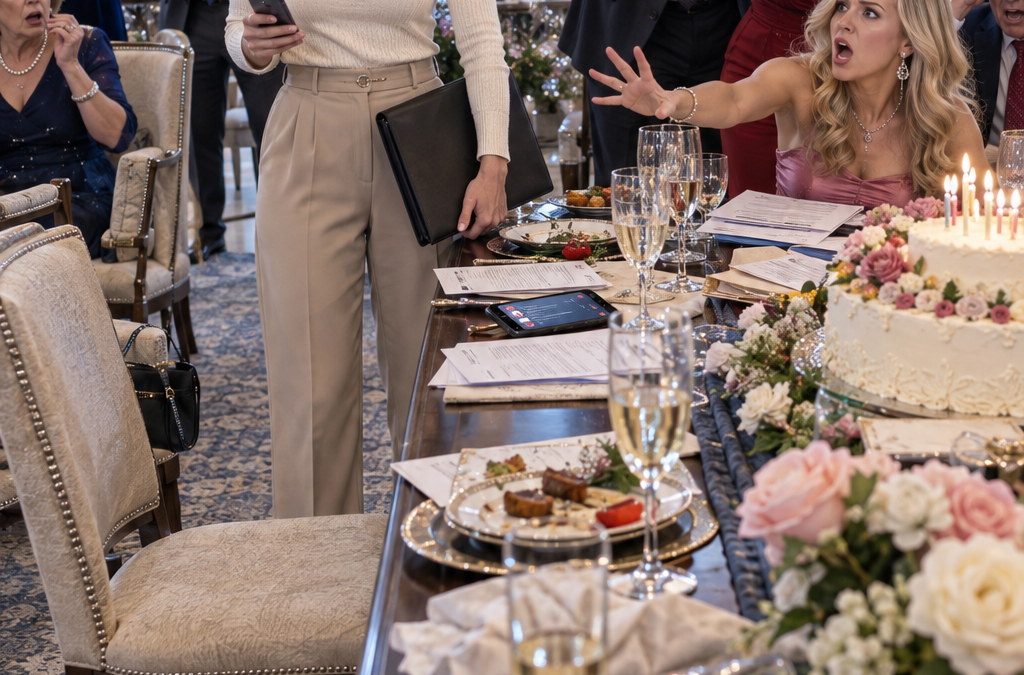
The restaurant was a polished steakhouse downtown, all brass fixtures, dark wood and white tablecloths. I walked through the private-room doors at 6:57 p.m., three minutes before the time Mom had given me, and stopped so abruptly that the hostess nearly ran into my back. There were nearly twenty people packed around one long table, appetizers already half eaten, glasses already filled, decorations everywhere, and every single chair occupied.
Madison looked up first.
Her mouth curved slowly into a smile.
“Oh,” she said loudly enough to quiet half the table. “You actually came.”
And before anyone said another word, I understood something they had apparently assumed I never would.
They had invited my money.
They just hadn’t planned for me.
### Part 2
For several seconds, I stood there holding my purse while the room seemed to sharpen around me: silverware scraping plates, ice clicking against glasses, roasted garlic and steak drifting from the kitchen, the soft instrumental music from speakers overhead. Behind Madison hung decorations for Uncle Grant’s birthday, but right beside them was another display congratulating her on a summer internship she’d recently been offered, because naturally even someone else’s birthday couldn’t survive twenty feet from Madison without becoming partly hers. She leaned back in her chair with that amused expression she always wore when she knew she had an audience and said, “I mean, we weren’t sure you’d really show up.”
I looked at Mom. “You called me three times to make sure I was coming.” She picked up her napkin and folded one corner over another without meeting my eyes. “Well, you’re always so busy, honey.” I scanned the table a second time, hoping there was some hidden place setting I’d overlooked, but every chair had a coat, purse, body or plate in front of it; even two cousins who lived three hours away had seats, while I, the person who had been personally summoned, was standing behind the table like a server waiting for instructions.
“There’s nowhere for me to sit,” I said. Dad glanced around as if this were new information. “We can probably ask them to squeeze in another chair.” The way he said probably made something cold move through my chest, because not one person shifted aside, not one person offered to stand, and Uncle Grant merely gave me an uncomfortable smile from beside the birthday cake before turning back toward Madison.
Madison laughed. “Claire, don’t make this a whole thing. You’re hardly ever at family events anyway.” I stared at her, and she added, “Besides, this dinner is for people who are actually around.” Aunt Elise lowered her glass; Cousin Nora looked down at her plate, visibly embarrassed, but the rest of them either pretended they hadn’t heard or looked at me with the strange irritation people reserve for someone disrupting a comfortable lie.
I said, “You really couldn’t save one chair?” Madison rolled her eyes so dramatically that Uncle Grant chuckled. “See, this is what I mean. She can never just be happy for anyone else.” She turned to the table and said, “When I made the dean’s list last semester, she didn’t even comment on my post. I swear she’s been weird about me doing well forever.”
For one ridiculous second, I almost defended myself by explaining that the semester she made that dean’s list was the same semester I’d paid an extra $2,400 for specialized tutoring because she’d told Mom she was too overwhelmed to keep up without it. Then I realized how pathetic that would sound—not because it wasn’t true, but because I’d be begging people who already knew exactly what I’d done to acknowledge it. Uncle Grant patted Madison’s shoulder and said, “Ignore it, sweetheart. Some people have trouble when the attention isn’t on them.”
That sentence actually made me smile.
When exactly had the attention ever been on me?
Madison apparently mistook my silence for surrender, because she picked up her drink and said casually, “Oh, and Claire, can you make sure tuition goes through earlier next month? I got some annoying late notice this time, and it was embarrassing.” My head snapped toward her. I had never missed a tuition deadline in three years, but the university had recently changed its processing date and a payment had posted one business day after an automated reminder; apparently that qualified as public humiliation worthy of correction in front of nineteen relatives.
“If you’re going to do it,” she continued, twirling a strand of hair around one finger, “could you at least do it right?”
Nobody laughed loudly, but I saw smiles.
Mom studied her fork. Dad suddenly became fascinated by the menu. Uncle Grant took a sip of wine and pretended he hadn’t heard the niece he worshipped speak to the woman funding her degree like an incompetent employee.
I felt the familiar pressure building behind my ribs, the instinct I’d trained for years: don’t make trouble, don’t embarrass Mom, don’t ruin the evening, don’t be jealous, don’t be difficult, don’t make people regret inviting you. Normally I would have swallowed it, helped the hostess drag over a chair, sat half in the aisle and paid for dessert if they asked. Instead I nodded once and said, “Okay.”
Madison’s smile widened because she thought she’d won.
I turned around and walked out.
The hostess asked if everything was all right, and I said, “Perfect,” though my voice sounded strange even to me. I crossed the parking lot under cold white lights, unlocked my car, and saw Uncle Grant’s wrapped gift on the passenger seat. For a moment, my hand hovered over it; then I got behind the wheel, shut the door and drove home with it still beside me.
Nobody followed.
Nobody called.
Nobody even texted to ask whether I’d made it home safely.
Around ten that night, I saw Madison’s photos online. There were smiling relatives squeezed shoulder to shoulder beneath the decorations, Uncle Grant holding his cake, Madison displaying a folder from her internship program, Mom hugging her from behind. Her caption said, “Best night with my real family.”
I stared at those three words longer than I should have.
Then I ordered pizza, opened a soda and started sorting through old photos on my phone without really knowing why. Eventually I landed on my college graduation: me alone in my cap and gown, smiling beside a campus fountain while my roommate took the picture. My parents and Madison had skipped the ceremony because she had a volleyball tournament; Uncle Grant canceled that morning, claiming an emergency at work.
I had told everyone it didn’t matter.
Apparently I had been practicing that lie for years.
I went to bed sometime after midnight, leaving my phone facedown on the nightstand. At 2:06 the following afternoon, it buzzed while I was drinking coffee at my kitchen island. I expected work, maybe Nora, possibly Mom pretending nothing had happened.
Instead, I saw a payment request from my mother.
$1,750.
The description read: “Uncle Grant’s birthday dinner + Madison celebration.”
I looked at the number, then at the request, then back at the number.
They hadn’t saved me a chair.
But they’d remembered to send me the bill.
### Part 3
For the first few minutes, I wasn’t angry. I was almost impressed. There was something so perfectly absurd about being invited to a dinner where nobody expected me to sit, mocked for showing up, watched walking out, and then invoiced the next afternoon that my brain seemed unable to process it as real human behavior. I set my coffee down beside the sink and stared through the window at a woman walking a golden retriever across the courtyard, thinking, So this is it. This is exactly what I am to them.
Five minutes later, Mom called. I answered because suddenly I wanted to hear how she would explain it. “Did you see my payment request?” she asked without hello, apology, or even the courtesy of pretending she cared why I’d left. “I saw it,” I said, and she replied, “Good. The restaurant already charged my card, so when are you sending it?”
“I’m not.”
The silence lasted long enough that I checked the screen to make sure the call hadn’t dropped. “Excuse me?” Mom finally said. “I’m not paying seventeen hundred and fifty dollars for a dinner where you didn’t even have a chair for me.” Her voice sharpened immediately. “Claire, don’t be ridiculous. Of course you were welcome. We invited you.”
“You invited me and didn’t expect me to come?”
“You’re always busy.”
“Then why did you expect me to pay the bill?”
That slowed her down for perhaps two seconds. “You’ve always helped with family expenses, and this was a special occasion.” I leaned against the kitchen counter, watching sunlight move across the tile. “For Uncle Grant or Madison?” I asked. “Because apparently every occasion is a Madison occasion.”
“Don’t be petty. It isn’t attractive.”
I laughed, because that sentence might have worked on me two years earlier. “Know what isn’t attractive? Treating your daughter like an ATM and then acting surprised when she notices.” Mom made an offended noise and launched into her favorite speech about how family helped one another, how successful I’d been, how Madison didn’t have the advantages I did, and how difficult college was now. When she finally paused, I said, “I’ve paid eighteen hundred dollars a month for three years.”
“That’s different.”
“Why?”
“That’s your sister’s education.”
“And whose responsibility is that?”
Another pause.
Mom said, “Your father wants to speak to you.”
I heard muffled voices before Dad came on. “Claire, what’s going on with you?” His tone was stern in the way he’d used when I was seventeen and came home twenty minutes after curfew, except I was now a financially independent adult paying bills he apparently believed belonged to me. “This isn’t like you.”
“Maybe that’s the problem.”
He sighed. “Nobody is taking advantage of you. We’re asking you to contribute to a family celebration.”
“You’re asking me to pay the entire bill.”
“Madison got an incredible internship, and Grant has always been supportive of her. We wanted to recognize both of them.”
“Grant makes more money than either of you. Let him recognize himself.”
“Claire.”
“And while we’re discussing support, it’s interesting that he managed every one of Madison’s volleyball events but somehow had an emergency the day I graduated college.”
“That’s not fair.”
“No, Dad. What’s not fair is paying more than sixty thousand dollars toward Madison’s degree and being treated like an inconvenience when I walk into a dinner you personally invited me to.”
He didn’t answer.
I kept going because once the first stone moved, the rest of the wall seemed ready to collapse. “When I got promoted last year, what did you do?” Silence. “When I bought this condo, who came over?” Silence again. “When was the last time you called me just to ask how I was doing without needing money or wanting to discuss Madison?”
Mom’s voice rose somewhere behind him. “This is unbelievable.”
“No,” I said. “It’s overdue.”
Dad lowered his voice. “We know you’ve been generous with your sister, and we appreciate it.”
“Do you?”
“Of course.”
“Then here’s something you’ll appreciate. I’m done paying.”
I heard movement and then Mom shouted, “What does that mean?”
“It means the tuition payments stop now.”
“You cannot do that.”
“I absolutely can.”
Mom grabbed the phone back. “You’re going to destroy Madison’s education because you’re upset about a chair?”
I looked around my condo—the place I had bought alone, moved into alone, furnished alone. “No. I’m ending a financial arrangement because I’ve finally accepted what it was. I was helping because I thought family helped family, but family doesn’t only remember your name when a bill arrives.”
“You’re abandoning your sister.”
“You’ve been calling me strong and independent since I was a child. I’m giving Madison the same opportunity.”
“That’s cruel.”
“Then you pay.”
She began talking faster, insisting they didn’t have eighteen hundred dollars a month available, that Madison might lose classes, that changing financial arrangements midsemester was irresponsible. I asked why Uncle Grant couldn’t step in, and Mom snapped, “Grant has his own obligations.” Apparently I didn’t.
Dad came back on and said, “Think carefully before you do something permanent. This isn’t just about Saturday.”
“You’re right. It’s about fifteen years.”
His voice softened. “Claire, come on.”
I remembered my graduation picture, the empty chairs at my condo-warming party, the hospital room after emergency surgery the year before when I had spent three nights alone because Madison was stressed about midterms. I’d always rearranged those memories into kinder shapes because the alternative hurt too much. But sitting there with my mother’s $1,750 request still glowing on my screen, I no longer wanted kinder shapes.
I wanted the truth.
“My wallet is closed,” I said. “Permanently.”
Mom’s voice turned cold. “You’ll regret treating your family this way.”
I surprised myself by laughing softly. “When have I ever come running to you because I needed something? I’ve been solving my own problems since I was seventeen.”
“You are being incredibly disrespectful.”
“No. I’m finally matching the level of respect I’ve been given.”
I ended the call.
Within an hour, Madison texted.
Then Uncle Grant.
Then cousins I hadn’t spoken to in months.
By evening, my phone looked like it belonged to someone at the center of a national emergency. Every message used different words, but every person seemed concerned about the same thing: Madison’s future, my parents’ stress, Uncle Grant’s disappointment, the terrible selfishness of withdrawing money everyone had quietly decided belonged to them.
Not one message asked why there had been no chair.
And by bedtime, I realized they weren’t going to address that detail at all.
They were going to make me pay for noticing it.
### Part 4
Madison’s first long message arrived at 8:14 p.m. and began, “I can’t believe you’re willing to ruin my life because you got your feelings hurt.” She wrote that she’d always admired me, which was fascinating considering she’d publicly accused me of jealousy twenty-four hours earlier, and said she couldn’t believe I’d “weaponize money” when she’d worked so hard to build a future. I read the entire thing twice, looking for any version of “I’m sorry,” “thank you,” or even “I shouldn’t have laughed,” but those words apparently hadn’t survived the editing process.
Uncle Grant left a voicemail saying he was disappointed in me. “You’re older than Madison,” he said in the weary voice of a man forced to explain morality to a difficult child. “You’ve always been mature, Claire. Don’t throw away family relationships because of one misunderstanding.” He never mentioned that he’d watched Madison humiliate me; he never mentioned my graduation, the gift he didn’t know was still wrapped in my car, or the fact that his own birthday dinner was now somehow my financial obligation.
Then Mom began sending additional payment requests. The second said, “Family supports family.” The third said, “Please don’t punish Madison.” By the fourth, I blocked payment requests from her completely.
I might have left things there if she hadn’t taken the fight public.
The following afternoon, Nora sent me a screenshot of Mom’s social media post. It was a masterpiece of selective truth: “As a mother, sometimes your heart breaks when your children make choices you cannot understand. Our oldest daughter has always been blessed with incredible success, while our younger daughter has needed extra support to find her way. After a simple misunderstanding at a family dinner, Claire has decided to withdraw financial support for Madison’s college education. We are devastated and trying desperately to prevent her from losing everything she has worked for.”
The comments made my stomach turn. Family friends called me selfish. An old neighbor wrote that success sometimes made people forget where they came from. Someone I hadn’t seen since high school told Mom she was praying that I would “find compassion.” Madison shared the post and added, “Never thought my own sister would sabotage my future because she can’t stand seeing me succeed. Money really changes people.”
I sat at my desk while the late-afternoon sun reflected against my monitor, reading strangers discuss my character based on a story deliberately missing every relevant detail. At first I wanted to close the app and walk away. Then a message came from a family friend saying, “Your poor parents have sacrificed so much for you. How could you do this?”
Something inside me finally went quiet.
I opened my banking records.
Three years of payments were there in neat digital rows: $1,800, $1,800, $1,800. I downloaded statements, found confirmation emails from Madison’s university, and pulled up the messages from Dad after my first bonus: “Your sister needs help with college. You’re doing very well now, and we think this is something you can do for the family.” Another thread showed Mom asking for textbook money two hours after I’d told her about my promotion.
Once I started digging, I couldn’t stop.
There was the invitation to my condo-warming party, followed by Mom’s message that they couldn’t attend because Madison had caught a cold and “really needed us today.” There was the email from my company announcing my promotion to senior developer; Mom’s reply was six words of congratulations followed immediately by a question about tutoring fees. There were photos from my college graduation where every smiling person beside me was a friend or roommate because my family had chosen Madison’s weekend volleyball tournament.
Then I found the hospital texts.
The year before, I’d gone to the emergency room with severe abdominal pain and ended up having surgery. I spent three nights recovering alone, drifting in and out beneath fluorescent lights while nurses checked my blood pressure and my phone remained almost completely silent. Mom had sent, “Hope you’re feeling better soon, honey,” and when I asked if anyone might visit, Dad said, “Madison has midterms this week and she’s extremely stressed. We need to be available for her.”
I hadn’t questioned it then.
Looking at the message now, I couldn’t understand why.
The final piece came from Madison’s own social media archive. The previous spring, Mom had called me frantic because Madison supposedly needed an additional two thousand dollars for “essential school expenses” or risked falling behind. I had transferred the money that evening; eight days later, Madison posted vacation photos from a beach resort with captions joking about how exhausting college life was.
I stared at those pictures for a long time.
Then I wrote one post.
“I’ve paid $1,800 a month toward my sister’s tuition for three years, more than $60,000 total, not including extra requests. Saturday, my family personally invited me to a birthday dinner. When I arrived, every chair was taken. My sister laughed because they didn’t expect me to show up. I left. The next day, my mother requested $1,750 from me to pay for that same dinner.”
I attached the payment records, the original tuition messages, and a few carefully chosen examples of the pattern. I didn’t include private medical details, insult anyone, or exaggerate a single fact. I ended with, “I’m not withdrawing love as punishment. I’m withdrawing money because somewhere along the way my family confused generosity with obligation. They didn’t save me a seat, but they remembered to send me the bill. I won’t be their wallet anymore.”
I hit post.
The reaction changed within hours.
People who’d criticized me began deleting comments. Others asked why Mom had neglected to mention that I’d been paying tuition for years. One family friend wrote, “I owe Claire an apology. This is not the situation we were led to believe.”
Then Nora called me.
“I didn’t know,” she said immediately. “Claire, I swear I didn’t know you were paying all of that.”
I sat on my balcony wrapped in a sweater while traffic hummed below. “Most people didn’t.”
“My mom told me something else too. At the restaurant, apparently your mom told people before you arrived that you probably wouldn’t come but would cover part of the dinner anyway.”
My fingers tightened around the phone.
“What?”
“That’s what Aunt Elise heard.”
Suddenly the missing chair didn’t feel like negligence.
It felt planned.
And for the first time since walking into that restaurant, I wondered whether my invitation had ever been about seeing me at all.
### Part 5
I called Aunt Elise the next morning. She answered on the second ring and sounded tired before I even explained why I was calling. “Nora told you, didn’t she?” she asked, and that sentence was enough to make my stomach drop.
Elise explained that she’d arrived early because she’d helped order the cake. While people were arranging decorations, Mom had apparently said, “Claire’s invited, but honestly she probably won’t stay. She’s always busy. She said she’d help with expenses anyway.” I had never said that. Elise remembered thinking it was strange when the final table count showed no place for me, but because my own mother seemed unconcerned, she’d assumed there had been a change of plans.
“So nobody forgot my chair,” I said.
Elise was quiet.
“I don’t think anyone specifically said, ‘Don’t give Claire a seat,’” she replied carefully. “But nobody planned for you to need one either.”
That was somehow worse.
My mother had invited me while already telling people I probably wouldn’t come, then apparently assumed my financial participation would survive my physical absence. I thanked Elise, ended the call, and sat at my kitchen table listening to the refrigerator hum. For years, I’d wondered whether I was too sensitive, whether I kept a mental scorecard other healthier people would simply forget, whether Madison’s treatment really was as unfair as it felt.
Now there was nothing left to interpret.
Three days after the dinner, I logged into Madison’s university billing portal.
My bank account was still stored as the automatic payment method. I stared at my own routing information on the screen and remembered Dad sitting across from me three years earlier, telling me how much my support would mean. Back then, I imagined Madison graduating someday and hugging me, maybe saying, “I couldn’t have done this without you.”
Instead she’d laughed because there was no chair for me.
I clicked “Remove Payment Method.”
A confirmation box appeared.
I clicked yes.
Another screen asked whether I wanted to end recurring sponsorship.
Yes.
Payment method: none.
Sponsor: none.
My banking information disappeared from the account.
I expected guilt to hit me instantly, but what I felt was physical relief. My shoulders lowered, my jaw unclenched, and I realized I had been carrying financial responsibility for an adult sister as though one missed payment would mean I’d failed as a human being. For three years, everyone around me had depended on that guilt.
By lunchtime, Madison discovered the change.
“WHAT THE HELL?”
Then: “Did you actually cancel everything?”
Then: “They’re saying I have to make payment arrangements by tomorrow.”
Then: “Claire this isn’t funny.”
Then three missed calls.
I ignored them all.
An hour later: “Can you just fix it one last time and we can talk after?”
There it was.
Not “Can we talk?”
“Can you fix it first?”
I put my phone facedown.
Mom left a voicemail accusing me of playing games with Madison’s future. Dad texted, “This is serious. Family doesn’t abandon family.”
I replied to him once.
“You taught me what abandonment looks like.”
Then I blocked his number.
The person I was most curious about, however, was Uncle Grant. He earned excellent money as a partner at a regional law firm, drove a luxury SUV, owned a lake house and had spent years calling Madison “my superstar.” If anyone believed as deeply as he claimed that her education was a sacred family responsibility, surely he could cover the same bill I’d paid for years.
Madison apparently thought so too.
That evening she texted, “Uncle Grant isn’t answering me. Can you please just help this month?”
I laughed so unexpectedly that I scared myself.
The man who lectured me about family had disappeared the second family cost eighteen hundred dollars.
The following day, Nora forwarded me a screenshot from another cousin. Madison had asked three different relatives for loans. One told her she could probably get more hours at work. Madison responded that she didn’t have a job because she needed to focus on school.
For the first time in her adult life, the family safety net had a hole in it.
Uncle Grant finally resurfaced with one message to me: “Hope you’re satisfied with all the drama you’ve caused.”
I wrote back, “You stopped answering Madison faster than you missed my graduation. Impressive.”
Then I blocked him.
A week passed.
Without my payment, Madison had to meet with financial services. She didn’t get thrown onto the street or instantly expelled as my parents had predicted; instead, she arranged a payment plan, reduced her course load slightly and started looking for work near campus. Amazing how many alternatives appeared once everyone stopped pretending I was the only one.
Then Aunt Elise appeared at my condo one rainy Sunday afternoon carrying coffee and a bakery box. We sat near the window while water ran in silver lines down the glass, and after several minutes of small talk she said, “There’s something I probably should have told you years ago.”
I waited.
“Do you remember winning a science competition when you were ten?”
Barely.
“You were so excited at Thanksgiving. You kept trying to show your medal to everyone, and every time you did, your mother redirected the conversation to Madison’s dance recital.”
Something moved painfully in my chest, not because I remembered the exact day but because I remembered the feeling.
Elise continued, “I confronted Diane afterward. I told her she was teaching you that your accomplishments didn’t matter.”
“What did she say?”
Elise looked down at her coffee.
“She said, ‘Claire is strong. She doesn’t need praise the way Madison does.’”
The words landed with eerie familiarity.
Strong.
Independent.
Fine.
Three compliments I’d spent half my life trying to deserve.
Aunt Elise looked at me and said softly, “I should have pushed harder.”
For once, I wasn’t angry.
I just finally understood the trick my parents had played on themselves.
They had mistaken a child learning not to ask for love with a child who didn’t need any.
### Part 6
Once the financial panic passed, my parents changed strategies. The angry calls stopped because I’d blocked them, but vague social media posts began appearing every few days about ungrateful children, family loyalty and the pain of watching success change someone. Mom never used my name after people challenged her original story, yet everyone knew who she meant, and Madison posted cryptic quotes about betrayal while carefully avoiding any mention of the sixty-four thousand dollars she’d already received.
I stopped responding.
That surprised them more than anything.
For most of my life, every family conflict followed the same pattern: someone hurt me, I protested just enough to make everyone uncomfortable, Mom accused me of being dramatic, Dad reminded me Madison had needs I didn’t understand, and I eventually apologized because silence felt worse than surrender. This time, I discovered silence could feel like freedom when you were no longer using it to punish yourself.
The extra eighteen hundred dollars appeared in my budget at the start of the following month, and seeing it there almost embarrassed me. I’d spent years acting as if that money were already spoken for, cutting back on travel, delaying home upgrades and building my life around an obligation nobody had any intention of repaying. I moved part into savings, donated some to a local technology education program, and used the rest to book a trip I’d postponed twice because Madison had needed tuition adjustments.
Japan had been on my list since college.
When the confirmation email arrived, I printed it and stuck it to my refrigerator.
It was a tiny thing, but every time I walked past it, I smiled.
I also began volunteering on Saturdays with a program teaching coding to high-school students. The first week, a sixteen-year-old girl named Maya stayed after class to show me an app she’d built to help her grandmother track household expenses. The interface was messy, half the buttons didn’t work, and she talked so fast explaining it that she barely breathed, but I felt something unexpected when I watched her face light up as I told her which parts were clever.
On the drive home, I thought about my sixteen-year-old self carrying that programming trophy through my parents’ front door.
I wished someone had looked at me the way Maya looked at me when I said, “You should be proud of this.”
That evening, Nora called with an update I hadn’t asked for. Madison had taken a part-time job at a coffee shop near campus and was furious about it. “She keeps saying you’re making her work instead of letting her focus on school,” Nora said.
“I’m not making her do anything.”
“I know.”
I stirred pasta sauce on the stove and listened while Nora explained that Uncle Grant had agreed to help with one smaller payment, then apparently told Madison he couldn’t become responsible for her tuition long term. My parents were contributing what they could but had finally been forced to examine their own spending, including the expensive vacations and renovations they’d somehow afforded while telling me there was no money for college.
“How’s Madison doing?” I asked.
Nora hesitated. “Honestly?”
“Sure.”
“She’s angry. But she’s passing her classes.”
Of course she was.
For years, my family had treated Madison like glass and me like steel. The irony was that neither description had been true. Madison wasn’t incapable of working, budgeting or solving problems; she simply hadn’t needed to develop those skills because someone else always absorbed the consequences.
Two months after the dinner, Mom emailed me.
The subject line said, “Please read.”
Against my better judgment, I did.
The message was longer than anything she’d sent me in years. She wrote that things had “gotten out of hand,” that she hated the public fighting, that she missed me, and that perhaps mistakes had been made on all sides. She said she never intended to make me feel less loved than Madison, that she had always believed I was capable and strong, and that she’d trusted me to understand when my sister required more attention.
Then came the sentence that told me nothing had really changed.
“We also hope, with time, you’ll reconsider helping Madison once emotions settle.”
I read that line twice.
Not “I understand why you stopped.”
Not “We shouldn’t have asked.”
Not “You’ve already given more than enough.”
Reconsider helping.
I closed the email without replying.
Dad tried next, sending a message from a work address I hadn’t blocked. He said he’d been thinking about my question—when was the last time he’d called simply to ask how I was—and admitted he couldn’t remember. For a moment, that honesty reached me; then he wrote, “I hope someday we can move past this and become the family we were before money came between us.”
Money hadn’t come between us.
Money had been the bridge they’d built because they didn’t know how else to reach me.
I replied with one sentence: “The problem existed long before money did.”
He didn’t answer.
A few weeks later, I hosted a barbecue at my condo complex’s shared rooftop terrace. Nora came, so did several friends from work, two former college roommates, and Maya’s program director. Nobody needed me to pay for everything; people arrived carrying salad, drinks, desserts and folding chairs because when normal people are invited somewhere, they think about whether everyone has a place to sit.
At one point, my friend Tessa dropped into the chair beside me and asked, “Do you ever regret cutting them off financially?”
I looked around at people laughing under string lights, plates balanced on their knees, music playing softly behind us.
“No,” I said.
Then I surprised myself.
“My only regret is how long I thought paying for a seat meant I had one.”
### Part 7
By late summer, life became quieter. The Japan trip came and went in a blur of train stations, mountain views, tiny restaurants and the strange happiness of waking each morning with nobody else’s expectations attached to my schedule. I bought myself a ceramic cup from a small shop in Kyoto, and when I returned home, it became my favorite coffee mug—not because it was expensive, but because it represented the first major thing I’d chosen entirely for myself in years.
Madison completed the semester.
That fact alone exposed how exaggerated everyone’s threats had been. She hadn’t been expelled, hadn’t lost her future, hadn’t collapsed beneath the unbearable cruelty of paying part of her own expenses. She worked at the coffee shop, accepted a smaller loan through the school, reduced some unnecessary spending and, according to Nora, complained constantly but adapted.
My parents adapted too.
They stopped eating out as often. Dad delayed replacing his car. Mom took on occasional contract work for an old employer. Uncle Grant, after several months of carefully avoiding responsibility, contributed toward books and then apparently announced that his help had to have limits.
Funny.
Nobody called those limits abandonment.
I continued therapy for several months, mostly because I wanted to understand why I’d tolerated everything for so long. My therapist once asked what I’d hoped the tuition payments would buy me, and I immediately said, “Nothing.” Then I sat there long enough to realize the answer was a lie.
I had wanted gratitude.
Not dramatic gratitude. I didn’t need Madison naming a building after me or my parents throwing a parade. I wanted Dad to call and say he was proud of me, Mom to invite me somewhere because she wanted my company, Madison to look at me once and say, “I know what you’re doing for me, and it matters.”
I had paid sixty-four thousand dollars chasing a sentence that should have been free.
That realization hurt more than the money ever did.
In September, Madison emailed me directly.
Her message was surprisingly calm. She said she’d spent months being furious and still believed I’d handled some things badly, especially posting screenshots publicly, but admitted the dinner had been “messed up.” She said she hadn’t realized until later that nobody had saved me a chair and claimed she’d assumed someone would bring one.
I almost laughed at that.
Then came something closer to accountability.
“I also shouldn’t have said what I said about the tuition. I was used to you paying it and treated it like something you were supposed to do. I know now it wasn’t.”
I read that sentence several times.
For years, I’d imagined that hearing Madison acknowledge the truth would unlock some door in me. Instead, I felt calm.
She continued: “I’m not asking you to pay again. I just don’t want us to hate each other forever.”
I waited two days before replying.
“I don’t hate you. But I’m not interested in pretending the last fifteen years disappear because you’ve finally acknowledged one piece of them. I hope work and school go well. I also need distance.”
Madison responded, “I understand.”
And for once, she didn’t add a request.
Mom was harder.
She sent birthday flowers to my office even though I’d never given her the new address; apparently Dad found it online. The card said, “We love you and hope we can be a family again.” I thanked the receptionist, took the flowers home and eventually donated them to the lobby of a nearby nursing facility.
Love arriving after consequences is complicated.
Maybe my parents loved me in the limited way they knew how. Maybe Mom genuinely believed praising Madison more was an act of protection and that expecting independence from me was a compliment. Maybe Dad convinced himself that because I kept succeeding, I couldn’t possibly be hurting.
None of those explanations changed the outcome.
One October evening, Aunt Elise invited me to dinner. I almost declined when I learned Uncle Grant would be there, but she assured me the invitation wasn’t a setup, so I went with one condition: if anyone started pressuring me to reconcile or pay for anything, I would leave immediately.
Grant looked older than I remembered when I walked into Elise’s dining room. He waited until dessert before saying, “I owe you an apology.”
I set down my fork.
He took a breath. “I was unfair to you at the restaurant. And afterward.”
“Yes.”
He visibly hadn’t expected such a simple answer.
“I should have made sure you had a chair,” he continued. “And I shouldn’t have lectured you about Madison’s tuition when I wasn’t prepared to take it on myself.”
“No, you shouldn’t have.”
Elise hid a tiny smile behind her glass.
Grant glanced down. “I also missed your graduation. I told myself it was work, but the truth is I could’ve rearranged things. I didn’t.”
That confession surprised me.
I said, “Thank you for admitting it.”
He looked hopeful. “Maybe we could go fishing sometime. Like we used to.”
I remembered the gift still sitting unopened in the back of my closet.
For a moment, I saw ten-year-old me beside a lake, watching him tie a lure while morning fog lifted from the water.
Then I looked at the man across the table.
“Maybe someday,” I said. “But not yet.”
And I meant it.
An apology could acknowledge the past.
It didn’t automatically earn access to my future.
### Part 8
A full year after the dinner, I was sitting at my kitchen island drinking coffee from the cup I’d bought in Kyoto when my calendar reminded me it was Uncle Grant’s birthday. The notification made me smile, not because I felt bitter but because I remembered exactly where I’d been twelve months earlier: standing in a restaurant doorway with nowhere to sit, waiting for someone—anyone—to behave as though my presence mattered.
My life looked different now.
I had received another promotion at work, one my parents learned about from Nora rather than from me. I’d started leading the Saturday coding program twice a month, and Maya, the student with the budgeting app, had won a regional student technology award; when she sent me a photo holding her certificate, I called immediately and made such a ridiculous fuss that she laughed and said, “Claire, it’s not that serious.”
“It is serious,” I told her. “You worked hard. Enjoy it.”
I knew exactly why saying that mattered.
Financially, ending Madison’s tuition had changed more than I expected. I increased my retirement contributions, built a larger emergency fund, traveled again and finally replaced the cheap secondhand couch I’d owned since college. The biggest change wasn’t what I bought, though; it was that I no longer checked my phone expecting somebody else’s crisis to become my invoice.
Madison and I had limited contact.
Every few months, she’d send a message about school or work. She’d become a shift supervisor at the coffee shop and, according to her own reluctant admission, had learned more about budgeting in six months than in her first three years of college. She never asked me for money again.
When she graduated the following spring, she sent me an invitation.
I stared at it for several minutes.
There had been a time when I would have interpreted the invitation as proof that everything could return to normal, and I might have shown up with an expensive gift, paid for dinner and accepted the first scraps of affection offered. That version of me didn’t exist anymore.
I attended the ceremony.
I sat beside Nora and Aunt Elise, not my parents.
Afterward, Madison found me outside the auditorium wearing her cap and gown, eyes red from crying. For one strange second, we simply looked at each other while families crowded around us taking photographs.
“You came,” she said.
“You invited me.”
She gave a small, embarrassed laugh. “Yeah. Guess I deserved that.”
I handed her an envelope. Inside was a handwritten congratulations card and nothing else.
No check.
No cash.
No offer to cover loans.
She opened it, read my message and looked back at me.
“Thank you.”
Two words.
Three years late.
Still, I believed her.
Mom and Dad approached a few minutes later. Mom looked like she wanted to hug me, but she stopped herself before stepping into my space. That alone told me someone had finally learned something.
“You look well,” Dad said.
“I am.”
Mom swallowed. “We’re glad you came.”
“I came for Madison.”
Her face changed slightly, but she nodded.
There was no dramatic reconciliation. Nobody collapsed into tears. My parents did not suddenly become the people I’d needed when I was ten, sixteen or twenty-two.
And I did not forgive them simply because enough time had passed.
Forgiveness, I’d learned, was not a toll I owed in exchange for peace.
We stood together for one photograph because Madison asked. Then I congratulated her again and left before the family dinner.
This time, they had saved me a seat.
I simply didn’t want it.
That evening, I met Tessa, Nora and several friends at a small restaurant near my condo. When I arrived, Tessa waved from a long table near the window.
“Claire!” she called. “We saved you a seat.”
Everyone laughed because they knew the story.
I laughed too.
There, between Nora and Maya’s program director, sat an empty chair with my name jokingly written on a folded napkin.
Nobody needed money from me.
Nobody had invited me because they needed a bill paid.
Nobody acted surprised that I showed up.
I sat down, and for the first time I understood how ordinary belonging was supposed to feel.
A few days later, Mom sent me another email. She said seeing me at Madison’s graduation had made her realize how much distance existed between us and asked whether I’d consider family counseling. I thought about it carefully before answering.
“I’m glad you’re reflecting on what happened, and I hope you continue. But I’m not ready to rebuild a close relationship. For most of my life, I was expected to accept being overlooked because I was ‘strong.’ When I finally stopped financing that dynamic, you publicly portrayed me as selfish instead of asking why I’d reached my limit. I don’t hate you, but I won’t return to the relationship we had.”
I hesitated, then added one final sentence.
“Please respect the distance I’ve chosen.”
Mom replied the following day.
“I will.”
Whether she truly would remained to be seen.
But the important difference was that I no longer needed her cooperation to maintain my boundaries.
Uncle Grant and I never became close again, though we occasionally exchanged messages. The vintage fishing lure set remained in my closet until one Saturday when I donated it to a charity auction supporting youth outdoor programs. Someone paid more than I’d originally spent on it.
That felt right.
Madison eventually found a full-time position after graduation and moved into a small apartment with a roommate. Nora told me my sister had become noticeably less demanding, though whether that change would last wasn’t my responsibility to determine.
My parents stayed together, stayed connected to Madison and slowly learned to manage their finances without looking toward me whenever something exceeded their budget.
And me?
I stopped trying to prove I deserved a place in rooms that had repeatedly shown me otherwise.
Sometimes people ask whether I feel guilty that Madison had to work through college because I stopped paying. I don’t. Work didn’t ruin her life. Boundaries didn’t ruin my family.
They revealed it.
The dinner didn’t destroy our relationship either. Neither did the $1,750 request or the canceled tuition payments.
Those things simply forced me to see a relationship that had already been broken for years.
For most of my life, my family praised me for being strong whenever strength saved them the trouble of caring for me. They called me independent whenever independence meant I wouldn’t ask for anything. They called me successful whenever success made my bank account useful.
Now I define those words differently.
Strong means saying no without writing a five-page defense.
Independent means choosing people who value my presence rather than my usefulness.
Successful means building a life I don’t have to purchase admission to.
I still have the screenshot of Mom’s $1,750 request buried somewhere in my phone, though I haven’t looked at it in months. I used to think of it as the most insulting message she’d ever sent me.
Now I think of it differently.
It was the most expensive dinner I never ate.
And the cheapest freedom I ever bought.
THE END!