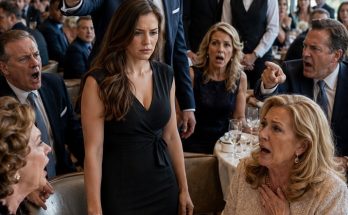
“In This House, The Alpha Makes The Rules!” My Stepfather Sneered, Swinging A Slap To Show Off His Fake Black Belt. He Expected A Helpless Stepdaughter He Could Easily Bully. Blinded By Ego, He Forgot I Was An Army Veteran. Two Seconds Later, I Showed Him What Real Combat Training Looked Like.
### Part 1
“Look at you,” Rick Mercer said, loud enough for everyone in the dojo to hear. “You’re scared of your own shadow.”
His padded glove pressed against the scar in the center of my chest.
Not hard enough to hurt.
Hard enough to humiliate.
The strip-mall dojo smelled like rubber flooring, old sweat, and the lemon disinfectant somebody had sprayed ten minutes earlier without bothering to wipe up. Fluorescent tubes buzzed above the mirrored wall. Twenty students stood in a loose semicircle around us, pretending not to stare.
My stepfather loved every second of it.
Rick was fifty-three, thick through the shoulders, soft around the waist, and absolutely convinced that wearing a black belt made him dangerous.
The belt was fake.
I knew because I had watched him age it in our garage with sandpaper.
He had rubbed the edges until they frayed, then hung it from a nail overnight and told my mother it came from “years of hard training.”
Now he pointed at the blue mat.
“Step up, Claire.”
I didn’t move.
That annoyed him.
“In my house, the strong don’t hide.”
A few people shifted uncomfortably.
Then came the sound that hurt more than anything Rick could have done.
Clapping.
I looked toward the metal bleachers.
My mother, Elaine, sat in the front row smiling.
“Go ahead, honey,” she called. “He’s only trying to help you.”
For half a second, I forgot how to breathe.
Not because of Rick.
Because of her.
I was thirty-five years old. I had spent eleven years in the Army, most of them as a medic. I had crawled through wreckage, held pressure on wounds with both hands, worked until my uniform stiffened with dust and blood, and learned the terrible difference between someone who was screaming and someone who had suddenly stopped.
None of that mattered to my mother anymore.
To Elaine, I was her broken daughter who had come home quiet, thin, sleepless, and inconvenient.
Rick was the strong man who was going to “fix” me.
“Come on,” he said.
He raised his hands.
“I’ll go easy.”
I stared at him.
“I don’t want to fight you.”
That should have ended it.
Instead, his smile changed.
It became smaller.
Meaner.
Rick stepped closer until I could smell peppermint gum under his coffee breath.
“What did the Army teach you?” he whispered. “How to sit in a corner and shake?”
Something inside me went cold.
He didn’t know what he had just touched.
My father did.
Thomas Hale had always known.
Before I enlisted, Dad had stood beside the old screen door in our kitchen with sunlight coming through behind him.
He hadn’t told me to be tough.
He hadn’t told me to win.
He had said, “Use your strength to protect people who don’t have enough of their own.”
Thomas died six years later pulling two people from a burning vehicle on an icy state highway.
Rick never met him.
That didn’t stop him from sitting in Dad’s chair.
Drinking from Dad’s mug.
Calling Dad “an ordinary mechanic” when he thought I wasn’t listening.
And somehow, my mother let him.
Rick tapped my shoulder with his glove.
“You’re embarrassing yourself.”
I heard a chair creak in the bleachers.
Mom was leaning forward.
Waiting.
Expecting me to obey him.
I lowered my voice.
“Rick. Stop.”
He laughed.
Then he swung.
There was nothing controlled about it.
No lesson.
No sparring drill.
Just an angry man trying to strike a woman who had embarrassed him by refusing to play along.
The room seemed to slow.
I moved.
One step.
One turn.
One reflex I had spent more than a decade trying to forget.
Rick suddenly found himself on the mat staring up at the ceiling, his breath gone and his confidence with it.
The entire dojo went silent.
I stood over him, breathing evenly.
His eyes were huge.
For the first time since he had married my mother, Rick Mercer looked at me without contempt.
He looked afraid.
And that terrified me more than his punch had.
Because twenty-four hours earlier, I had promised myself I would do whatever it took to become part of my family again.
I just hadn’t understood that my family had already decided what part they wanted me to play.
### Part 2
The day before the dojo, I had been sitting under another set of fluorescent lights.
Dr. Nathan Bell’s office at the veterans clinic was small enough that I could hear people coughing in the hallway.
A peppermint air freshener hung from the vent.
It didn’t help.
The room still smelled like floor wax and paper.
Dr. Bell slid a worksheet toward me.
“Reconnection,” he said.
I looked at the word.
He kept talking.
He wanted me eating regular meals with my mother. Leaving my bedroom. Joining ordinary activities. Spending time around people who knew me before the Army.
“Your civilian relationships can become anchors,” he said.
The word anchor made me want to laugh.
My mother had spent the last year cutting every rope between us.
But I said nothing.
Arguing was exhausting.
The next morning, Elaine pushed a plate across our kitchen table.
Burned bacon.
Cold eggs.
The fork scraped across the ceramic with a noise that made the back of my neck tighten.
That table had been built by my father.
Solid oak.
Heavy enough that three grown men had struggled to carry it through the front door when I was twelve.
Dad had carved a tiny crooked T underneath one corner because he claimed every craftsman should sign his work.
Rick’s oversized coffee mug sat on Dad’s old place.
The mug said ALPHA MODE.
I wish I were joking.
Mom folded a paper napkin between her fingers.
“Why won’t you try with him?”
“I do try.”
“You barely speak.”
“I don’t have much to say.”
Her mouth tightened.
“Rick says you need structure.”
I stared at my eggs.
“Rick sells welding supplies.”
“He also teaches martial arts.”
“He started teaching eight months ago.”
“He’s disciplined.”
I looked at her then.
She had dyed her hair a lighter brown since marrying him. She wore lipstick to breakfast now because Rick liked women to “make an effort.”
She looked different.
Not happier.
Just rearranged.
“Your father was strong too,” she said.
My stomach turned.
“Don’t.”
“I’m only saying Rick understands men like your father.”
“No, he doesn’t.”
Her eyes filled immediately.
That was Elaine’s favorite weapon.
Tears before accountability.
“I can’t say anything without you attacking me.”
“I asked you not to compare them.”
“Rick is trying to help.”
“Then he can help by leaving me alone.”
She put the napkin down.
“Do you know what it’s like living with you?”
That landed.
I said nothing.
“You don’t sleep. You walk around at night. You jump at noises. You barely eat. Rick says this house feels like a hospital ward.”
I looked toward the hallway.
Dad’s framed photograph used to hang there.
It was gone.
Rick had replaced it with a decorative metal sign that said FAMILY STARTS HERE.
“Where’s Dad’s picture?”
Mom’s eyes moved away.
“Rick thought we should stop living in the past.”
I stood so quickly the chair legs scraped the floor.
“Where is it?”
“In storage.”
“You put Dad in storage?”
Her face hardened.
“This is exactly what I mean.”
I suddenly understood something.
The dojo wasn’t about exercise.
It wasn’t about grounding.
It was about surrender.
Mom wanted me to walk into Rick’s world, accept his authority, smile when he spoke, and prove that our family had successfully replaced Thomas Hale.
She reached for my wrist.
“Just attend one class.”
I pulled away.
“One.”
“Please.”
The word sounded tired this time.
Real.
For one foolish second, I saw the woman who had packed my lunches in middle school and slept beside my hospital bed when I broke my wrist at fourteen.
So I made the mistake people make when they still love someone who keeps hurting them.
I gave her one more chance.
“Fine.”
Her whole face brightened.
“You’ll see. Rick will be so happy.”
I carried my plate to the sink.
Cold water ran across the scars on my hands.
Behind me, Mom was already texting him.
I heard the soft tapping of her nails against the screen.
Then she laughed.
That should have warned me.
But I still believed the worst thing waiting at that dojo would be humiliation.
I had no idea Rick had been telling people an entirely different story about me.
### Part 3
Rick introduced me as his “special project.”
I found that out fifteen minutes after we arrived.
He gathered the class in a circle and rested one hand on my shoulder like we were close.
“This is Claire,” he announced. “My wife’s daughter.”
Not my stepdaughter.
Not a veteran.
Not a former Army medic.
My wife’s daughter.
“She’s had some trouble adjusting to real life.”
A few people looked down.
One older man coughed into his fist.
Rick squeezed my shoulder.
“I told Elaine I’d toughen her up.”
I stepped away from his hand.
His smile flickered.
That was the first crack.
The second came when he chose a sixteen-year-old named Noah Price to demonstrate “pressure.”
Noah was tall and painfully skinny, with narrow shoulders and a habit of looking at the floor when adults spoke to him.
Rick told him to throw a punch.
Noah hesitated.
“Come on,” Rick barked. “Stop thinking.”
The boy moved.
Rick knocked his arm aside and shoved him down much harder than necessary.
Noah hit the mat with a flat slap.
The room tightened.
Nobody said anything.
That bothered me more than the fall.
Rick stood above the boy.
“That’s what happens when you hesitate.”
Noah rolled to one side coughing.
I watched his mother near the water cooler take a step forward.
Then stop.
She was afraid of embarrassing her son.
I knew that kind of silence.
It was the silence toxic people survive on.
Rick pulled Noah upright and patted him roughly between the shoulders.
“Shake it off.”
Noah nodded.
His face was red.
I wanted to leave.
I actually moved toward the door.
Then Mom noticed.
“Claire.”
She said my name like a warning.
Rick turned.
And saw an opportunity.
He pointed at me.
“Get up here.”
That was how I ended up standing in front of him while everyone watched.
I refused twice.
He pushed.
I warned him.
He insulted me.
Then he swung.
Years of training took over before my mind caught up.
I didn’t hit him.
I redirected him, trapped his balance, and put him down.
Fast.
Clean.
Nothing flashy.
No movie nonsense.
One second he was attacking.
The next his back hit the mat.
I followed him down just long enough to make sure he couldn’t keep swinging.
Then something awful happened.
For one heartbeat, I didn’t want to let go.
I looked into Rick’s terrified face and felt all the rage I had buried since coming home.
Every photograph my mother removed.
Every joke about me being fragile.
Every time Rick told me my father had spoiled me.
Every night I woke convinced I could still hear someone calling for me.
The anger became quiet.
That was the dangerous part.
Then Mom screamed.
“Claire!”
I released Rick immediately.
I stood.
My knee popped.
Pain shot up my leg.
Rick rolled away coughing.
Mom rushed to him.
Not me.
Him.
She touched his face.
“Are you okay?”
I stared at her.
Rick had attacked me in front of twenty witnesses.
She had seen it.
But when she looked up, she looked at me like I had committed some unforgivable act.
“What is wrong with you?”
I almost laughed.
Instead I said, “He tried to hit me.”
“He was demonstrating.”
“No, Elaine.”
I called her Elaine because suddenly Mom felt too generous.
“He lost his temper.”
Rick pushed himself onto one elbow.
“You attacked me.”
A man near the mirrored wall said, “That’s not what happened.”
Rick’s face changed.
The man continued.
“You swung first.”
Another voice joined him.
“I saw it too.”
Then Noah’s mother spoke.
“So did I.”
For the first time, Rick realized the audience belonged to him only when they were afraid to contradict him.
He staggered upright.
His face was burning red.
People whispered.
Someone laughed under their breath.
Rick heard it.
I turned toward the lockers.
I had done what Dr. Bell asked.
I had shown up.
I had tried.
Now I wanted my keys.
Behind me, Mom said, “Rick, forget it.”
There was a scraping noise.
I looked into the long mirror.
Rick had grabbed a folding chair.
And he was coming at me from behind.
### Part 4
“Mercer!”
The voice cracked across the room.
“Put it down.”
Everything stopped.
Rick froze with the chair raised.
A man stepped from the office near the back wall.
I had noticed him earlier through the half-open door but assumed he was maintenance.
He was in his early sixties, broad, gray-haired, wearing work boots and a dark flannel shirt.
He walked with a limp.
A serious one.
Rick lowered the chair halfway.
“Mr. Dalton—”
“Down.”
Rick obeyed.
The man crossed the mat, took the chair from his hands, and tossed it aside.
Plastic cracked against concrete.
Then he looked at me.
Really looked.
His gaze moved from my stance to my hands to the way I favored my knee.
Something in his expression changed.
“Claire Hale?”
I frowned.
“How do you know my name?”
He ignored the question and turned toward Rick.
“You’re done.”
Rick blinked.
“What?”
“You’re done teaching here.”
“You can’t—”
“I own the building.”
The room went very still.
Apparently Rick had neglected to mention that his great martial arts empire was rented by the hour.
The owner’s name was Daniel Dalton.
Rick began talking fast.
“She came in here unstable. Elaine told me she has issues. I was trying to teach her discipline.”
Daniel stared at him.
“You swung at her.”
“She embarrassed me.”
There it was.
The truth.
Simple.
Ugly.
Mom stepped forward.
“Daniel, please. Rick has worked so hard on this program.”
Daniel looked at her.
“Elaine, your husband just tried to hit your daughter with a chair from behind.”
Her lips trembled.
“She provoked him.”
I felt something inside me finally tear.
Not explosively.
Quietly.
Like fabric splitting along an old seam.
Daniel looked almost disgusted.
Then he said my father’s name.
“Thomas would be ashamed of this.”
Mom went pale.
I stopped breathing.
“You knew my dad?”
Daniel’s eyes came back to me.
“He saved my life.”
The room seemed to tilt.
He told me it happened twenty-three years earlier.
Winter.
Black ice.
A pickup overturned near a creek.
Daniel had been trapped inside while fuel leaked across the road.
My father had been driving home from a late shift.
He stopped.
He crawled into the wreck.
He dragged Daniel out before the engine caught fire.
Dad never told me.
That was exactly like him.
He could save someone’s life and come home complaining that the grocery store had charged too much for tomatoes.
Daniel looked at Rick.
“Thomas Hale didn’t need a belt to prove he was strong.”
Rick’s jaw tightened.
Daniel continued.
“He didn’t need an audience either.”
Nobody laughed this time.
That was worse.
Rick grabbed his duffel bag.
Mom followed him.
At the door she turned toward me.
For one tiny second, I expected something.
An apology.
A question.
Maybe even my name.
Instead she said, “I hope you’re happy.”
Then she left with him.
I stood in the middle of the mat.
Happy?
I had almost lost control.
My mother had watched her husband attack me and chosen him anyway.
Nothing about that felt like victory.
Daniel waited until the room emptied.
Then he approached me carrying a small white card.
“Tuesday and Thursday,” he said.
I looked down.
There was an address printed on it.
“Five in the morning.”
“What is it?”
“Veterans group.”
I almost handed it back.
“I don’t do groups.”
“Neither do they.”
That got my attention.
He gave me a tired smile.
“Mostly people hitting heavy bags, drinking terrible coffee, and pretending they didn’t come because they needed anybody.”
I rubbed the rough edge of the card with my thumb.
“No fluorescent lights?”
“Barely any lights at all.”
I slipped it into my pocket.
Outside, cold Ohio air hit my face.
I sat in my car with both hands on the steering wheel, waiting for the shaking to start.
It didn’t.
For the first time in months, my head was silent.
Then my phone lit up.
MOM.
One message.
DON’T COME HOME TONIGHT.
A second message appeared before I could breathe.
RICK SAYS YOU’RE DANGEROUS.
And finally:
WE CHANGED THE LOCKS.
I stared at the screen.
The house she had just locked me out of was still partly mine.
Dad had made sure of that before he died.
### Part 5
I slept in a motel that night.
Room 214.
The heater rattled every three minutes like somebody shaking coins in a metal can.
The blanket smelled faintly of bleach.
There was a brown water stain above the shower.
I sat on the edge of the bed wearing the same gray hoodie, staring at my father’s last will on my phone.
I hadn’t looked at it in years.
Dad had left the house to Mom with one condition buried in the estate paperwork: if it was ever sold, transferred, or refinanced, half of the equity belonged to me.
He had also left me a small ownership interest outright.
Not enough to control the property.
Enough that I couldn’t legally be treated like a stranger.
At two in the morning, I found something else.
An email from the county.
A property notification.
A refinancing application had been filed three weeks earlier.
I sat up.
My name appeared on one page.
Next to a signature.
My signature.
Except I had never signed it.
I stared until my eyes hurt.
Then I remembered Rick standing in our dining room a month earlier holding a folder.
He had asked me to sign “insurance paperwork.”
I refused because I was tired.
He joked that I didn’t trust family.
At the time, I forgot about it.
Now I wondered what else he had been doing.
I didn’t confront them.
That was one lesson the Army had burned into me deeply enough to keep.
You don’t announce what you know before you understand the whole situation.
At eight the next morning, I called an attorney.
Her name was Megan Cross.
She specialized in property and estate disputes.
I expected skepticism.
Instead, after ten minutes, she said, “Do not sign anything. Do not return to the property alone. Send me every document you have.”
“What about my things?”
“Make a list.”
“My father’s tools are there.”
“List them.”
“Photographs.”
“List them.”
“My uniforms.”
“Everything.”
I looked around the motel.
My entire life suddenly seemed reduced to a legal inventory.
Megan’s voice softened.
“Claire, are you safe?”
The question almost undid me.
Not because I wasn’t.
Because nobody in my family had asked.
“Yes.”
“Good. Stay that way.”
That afternoon, Mom called eleven times.
I ignored ten.
On the eleventh, I answered.
“What?”
She was crying.
“Rick says you’re trying to steal the house.”
I closed my eyes.
“I haven’t spoken to Rick.”
“He says you’re talking to lawyers.”
“How would he know?”
Silence.
That told me enough.
“Elaine.”
“Don’t call me that.”
“Did Rick refinance Dad’s house?”
“It’s our house.”
“That wasn’t my question.”
“He needed money for the dojo.”
My fingers tightened around the phone.
“How much?”
“He said it was an investment.”
“How much?”
“I don’t know.”
“You signed something without knowing the amount?”
“He handles finances.”
I laughed once.
No humor in it.
“Did he use my name?”
“I don’t know.”
“You do know.”
“He said it was necessary.”
There it was.
Not denial.
Justification.
I stood and walked to the motel window.
Rain had started.
Cars hissed along the highway below.
“Did you sign my name?”
Mom began sobbing harder.
“After everything I’ve done for you—”
“Did you?”
“You’re making this ugly.”
“No. I’m discovering how ugly it already was.”
She hung up.
An hour later, Megan called.
Her voice had changed.
Sharper.
“Claire, we found the loan amount.”
I sat down.
“How much?”
She told me.
I stared at the wall.
Rick hadn’t borrowed enough to improve a dojo.
He had borrowed enough to bury a house.
And according to the application, part of the money had already been transferred somewhere my mother claimed she knew nothing about.
### Part 6
The next week was the strangest of my life.
I did not go home.
I did not answer Rick.
I barely spoke to Mom.
Instead, every morning before sunrise, I drove to the address Daniel had given me.
The building looked abandoned.
Brick basement.
Fogged windows.
One yellow light over a steel door.
The first morning, I stood outside for five full minutes before going in.
Daniel was already there.
So were seven other people.
Nobody asked what happened to me.
Nobody said “thank you for your service.”
Nobody told me to heal.
A woman named Tessa handed me coffee.
It was awful.
I drank it anyway.
Then somebody turned on an old radio.
Low volume.
Classic rock.
People worked quietly.
Heavy bags swayed.
A treadmill squeaked.
Someone cursed at a rowing machine.
It was the first room I had entered since coming home where silence did not feel like judgment.
Afterward, Daniel sat beside me on a bench.
“Better?”
“No.”
He nodded.
“Good answer.”
I almost smiled.
Megan kept digging.
The refinance had been signed electronically.
The lender possessed identification documents that should have been in the locked desk in my old bedroom.
Copies of my license.
My military records.
My father’s probate documents.
Rick had access because Mom gave it to him.
Then came the second surprise.
His black belt story was exactly as fake as I thought.
Daniel had checked.
Rick held no recognized instructor certification through the organizations he claimed to represent.
Worse, parents from his class began contacting Daniel after the dojo incident.
Noah’s mother filed a complaint.
Another student reported being injured during one of Rick’s “discipline drills.”
The legend Rick had built around himself collapsed quickly once one person stopped pretending.
That person had been me.
But I didn’t feel triumphant.
Mostly, I felt tired.
Then Mom showed up at my motel.
I opened the door and found her standing under the buzzing walkway light.
She looked smaller.
No makeup.
Hair unbrushed.
She held a cardboard box.
“Can I come in?”
I should have said no.
Instead, I stepped aside.
She placed the box on the little table.
Inside were photographs.
Dad.
Me.
Our old family.
The picture Rick had removed from the hallway sat on top.
For one dangerous second, my heart softened.
Mom saw it.
“I made mistakes.”
I said nothing.
“I just wanted a normal life.”
“With Rick.”
“With someone.”
Rain tapped against the window.
She rubbed her hands together.
“I was lonely after your father died.”
“I know.”
“And then you came home, and you were…”
She stopped.
“Say it.”
“Different.”
That word hurt more than broken.
“You looked at me like I reminded you of everything you wanted to forget.”
“That isn’t true.”
“It felt true.”
I leaned back against the dresser.
“So you replaced Dad.”
“No.”
“You removed his pictures.”
“Rick felt compared to him.”
“He should have.”
She flinched.
I continued.
“You gave him my documents.”
Her face changed.
There it was.
The real reason she came.
“Claire…”
“Did you?”
“He said the lender needed proof.”
“You knew I hadn’t agreed.”
“I thought if the dojo succeeded—”
“You thought you could explain it afterward.”
She began crying.
Again.
This time I didn’t hate her for it.
I just didn’t let the tears change the facts.
“Megan says the loan can be challenged.”
Mom stared at me.
“You hired a lawyer?”
“Yes.”
“If you challenge it, Rick could be in serious trouble.”
I looked at her for several seconds.
“You came here because you’re worried about Rick.”
“No.”
“Yes.”
“I’m worried about all of us.”
“There is no all of us.”
The words came out quietly.
Final.
She covered her mouth.
I picked up Dad’s photograph.
“This stays with me.”
“Claire, please.”
“You chose him when he attacked me. Then you chose him again when you helped use my name.”
“I was scared.”
“So was I.”
She left twenty minutes later.
I did not hug her.
The next morning, Megan called before sunrise.
Rick had disappeared.
And so had most of the money.
### Part 7
Rick made it three states away.
That was what Megan eventually learned.
He didn’t vanish in some dramatic international escape.
He drove south.
Checked into roadside motels.
Used cash when he could.
Apparently fake martial arts expertise did not translate into criminal genius.
The lender froze the remaining funds.
The disputed refinance was placed under review.
Mom claimed she had no idea where Rick had gone.
For once, I believed her.
He had taken her savings too.
That was the part people expected me to enjoy.
I didn’t.
Watching someone face the consequences of betraying you is not always satisfying.
Sometimes it is just sad.
Mom called me from the house two weeks later.
“He left me.”
I sat in my car outside the veterans group.
Morning frost coated the windshield.
“I know.”
“He took everything.”
“Not everything.”
“It feels like everything.”
I thought about telling her Dad had once lost nearly all his retirement savings in a bad investment and never treated us like the world had ended.
Instead I stayed quiet.
Mom began to cry.
“Can I see you?”
“No.”
“Claire.”
“No.”
“I’m your mother.”
“Yes.”
That was exactly why the betrayal had mattered.
“If a stranger did what you did, I could forget them. You’re my mother. You watched him humiliate me. You helped him take my identity. Then you came to my motel asking me to protect him.”
“I said I was sorry.”
“No. You said you made mistakes.”
“What difference does that make?”
“A lot.”
Silence.
I watched Daniel unlock the basement door across the parking lot.
People began arriving.
Tessa carried two cups of coffee.
One for herself.
One for me.
Mom whispered, “What do you want me to do?”
“For once?”
“Yes.”
“Live with what you did without asking me to make you feel better.”
She started crying harder.
I felt grief.
I felt anger.
I even felt love.
But none of those feelings required reconciliation.
“I hope you get help,” I said. “I mean that.”
“Will you ever forgive me?”
I watched frost melt slowly along the bottom edge of the windshield.
“I don’t know.”
That was more generous than she deserved.
“But forgiveness won’t give you the same place in my life.”
She didn’t understand at first.
“What does that mean?”
“It means I’m done being the daughter you use to stabilize whatever relationship you’re in.”
“Claire—”
“I’m done.”
I ended the call.
Then I went downstairs.
Months passed.
The legal mess untangled slowly.
Rick returned after realizing running made everything worse.
There were investigations.
Lawyers.
Statements.
Meetings.
I attended only what was necessary.
I never spoke to him privately.
The last time I saw him, he was sitting across a conference room table wearing a cheap gray suit.
Without the black belt and the barking voice, he looked ordinary.
That surprised me.
For so long he had seemed enormous because Mom arranged the whole house around his moods.
Now he was just a tired middle-aged man staring at a stack of documents.
He wouldn’t meet my eyes.
Before I left, he finally muttered, “You ruined my life.”
I stopped at the door.
“No.”
He looked up.
“You built your life on people being too afraid to call you out.”
His face hardened.
“You think you’re better than me?”
I thought about the mat.
About that moment when anger nearly pulled me somewhere I never wanted to go.
“No,” I said. “I think I’m responsible for what I do next.”
Then I walked away.
That sentence became more important than I expected.
Because surviving Rick was not the same as rebuilding myself.
And once the legal fight ended, I had to decide what kind of life I actually wanted when I was no longer living in reaction to someone else.
### Part 8
A year after the dojo incident, I stood in my father’s garage with the door open.
Spring rain had just stopped.
Wet pavement smelled like earth and motor oil.
Sunlight broke through the clouds and landed across Dad’s old workbench.
The house had been sold.
Not taken.
Not stolen.
Sold properly.
After the disputed loan was resolved and the financial damage sorted out, Mom agreed to the sale.
My share was enough for a small condo.
Nothing fancy.
Two bedrooms.
A narrow balcony.
A kitchen with cabinets that didn’t quite close right.
I loved it.
The first thing I put on the wall was Dad’s photograph.
Not because I wanted to live in the past.
Because I was finally allowed to remember him without someone treating his memory like competition.
Mom moved into an apartment twenty minutes away.
We did not rebuild our old relationship.
There wasn’t one to rebuild.
She sent birthday cards.
I acknowledged them.
She texted at Christmas.
I replied, “Merry Christmas.”
She asked me to dinner twice.
I declined twice.
Eventually she stopped pushing.
Maybe she understood.
Maybe she didn’t.
It no longer controlled my life.
Rick disappeared from my daily world completely.
That was the greatest consequence I could give him.
Not revenge.
Irrelevance.
The dojo closed for a while, then Daniel reopened the space under a different instructor.
No alpha speeches.
No fake belts.
No teenagers being thrown around to make adults feel powerful.
Noah still trained there.
The first time I saw him months later, he stood straighter.
His mother told me he had started wrestling at school.
I smiled.
“Good for him.”
She hesitated.
“Good for you too.”
I wasn’t sure what she meant.
Maybe she wasn’t either.
The veterans group became part of my life.
Not a cure.
I stopped believing in cures for things that permanently change you.
But there were mornings when I could breathe.
Then afternoons.
Eventually whole days.
Dr. Bell noticed.
“You seem different,” he said during one appointment.
I laughed.
“You’re the second person who has told me that.”
“What does it mean to you?”
I looked around his little office.
Same peppermint air freshener.
Same buzzing lights.
Different me.
“It means I stopped trying to become the person everyone remembers.”
He waited.
“I’m not twenty-four anymore. I’m not the daughter my mom lost when I enlisted. I’m not the medic I was overseas. I’m not the wreck who came home either.”
“So who are you?”
I smiled.
“Still working on that.”
He smiled back.
“That sounds healthy.”
I eventually took a job with a community emergency-response training program.
Not combat.
Not heroics.
Preparedness.
First aid.
Disaster response.
I taught people how to stay useful when everything around them became chaotic.
The irony wasn’t lost on me.
I was good at it.
One Saturday morning, Daniel came to a class.
Afterward, he leaned against the doorway with a paper cup in one hand.
“Your dad would like this.”
I packed bandages into a supply bin.
“I hope so.”
“He would.”
I looked at him.
“You know what I remember most about him?”
“What?”
“He never acted impressed with himself.”
Daniel laughed.
“That was Thomas.”
I closed the bin.
“For years I thought strength meant being able to walk into the worst moment of someone’s life and stay calm.”
“And now?”
I looked across the room.
A mother was practicing bandaging her son’s arm while they both laughed because she had wrapped it completely wrong.
A retired teacher was asking questions.
Two college students were stacking chairs.
Ordinary people learning to help other ordinary people.
“Now I think strength is knowing when you don’t have to fight.”
Daniel nodded.
That night I drove home with the windows cracked.
The air was warm.
My condo was quiet when I walked in.
I kicked off my shoes.
Put leftovers in the microwave.
Turned on a lamp.
Nothing dramatic happened.
That was the point.
For years, I had lived from emergency to emergency.
Then I came home and let my mother convince me that love meant tolerating whatever happened inside the walls of a family home.
It didn’t.
Love without respect was just another way to keep someone trapped.
Mom never got the daughter she wanted back.
Rick never got his punching bag.
And I never became the person I had been before the Army.
I became someone else.
Someone who could miss her mother without calling her.
Someone who could remember her father without collapsing.
Someone who understood that walking away was not surrender.
Some people believe forgiveness means opening the door again.
I don’t.
Maybe I forgave Mom eventually.
Maybe I simply stopped carrying her choices around with me.
Either way, the door stayed closed.
One evening, while sorting through Dad’s old toolbox, I found the little crooked T he used to carve into everything he built.
It was scratched into the wooden handle of an old hammer.
I ran my thumb over it and heard his voice as clearly as if he were standing behind me.
Use your strength to protect people who don’t have enough of their own.
I smiled.
For years I thought he had meant everyone else.
It took me a long time to understand that sometimes the person you have to protect is yourself.
THE END!