Karen stared at the photograph as though it had changed shape in her hands. “What mistake?” Nobody answered. Her father, Charles, stood near the front door with his expensive wool coat still buttoned.
For the first time since I had known him, the man looked small. Dad sat back down. “Tell her, Charlie.” Charles swallowed. “This has nothing to do with Thanksgiving.” Dad almost laughed. “No.”
His voice was quiet.
“It has everything to do with Thanksgiving.”
Karen looked between them.
“Dad?”
Charles reached for the photograph.
“Give me that.”
Karen pulled it away.
“No.”
“Katherine.”
She flinched.
Charles only called her Katherine when he wanted obedience.
Usually, it worked.
Not this time.
“What did you ask Jack to hide?”
Charles looked at me.
“This is family business.”
I stared at him.
“You came into my father’s house.”
His jaw tightened.
“And apparently whatever you’re hiding has been sitting in that box for thirty-seven years.”
Dad opened the folded legal document.
Karen moved closer.
“What is that?”
“A promissory note.”
Charles closed his eyes.
Karen frowned.
“For what?”
Dad looked at Charles.
“Twenty-eight thousand dollars.”
I stared at him.
Thirty-seven years ago, that was serious money.
Karen looked confused.
“You loaned my father money?”
Dad nodded.
“More than once.”
Charles suddenly snapped.
“That’s enough.”
Dad looked up.
“No.”
Something in his voice changed.
For seventy-four years, my father had never needed many words.
When he finally decided to use them, they landed heavily.
“You’ve spent years looking down your nose at me.”
He tapped the document.
“You’re going to stand there for five minutes and remember who you used to be.”
Karen slowly sat down.
Her father remained standing.
I leaned against the kitchen counter.
Dad took the photograph from Karen.
It showed two young men standing outside a small repair garage.
One was unmistakably Dad.
Thicker hair.
Narrower waist.
Same stubborn expression.
The other was Charles.
Except he wasn’t wearing a tailored coat.
He wore stained jeans.
A work shirt.
And his hands were black with grease.
Karen whispered:
“That isn’t possible.”
Charles looked at her.
“What isn’t?”
“You told us you worked in finance after college.”
“I did.”
“When?”
“Eventually.”
Dad answered.
“Not then.”
Karen looked at him.
Dad continued.
“Charlie dropped out.”
Charles snapped:
“For one semester.”
“Three.”
“That is irrelevant.”
“No.”
Dad shook his head.
“What’s irrelevant is pretending you came out of the womb wearing cuff links.”
I almost smiled.
Karen didn’t.
She was still staring at the photograph.
“What happened?”
Dad leaned back.
“Your father got into trouble.”
Charles turned toward the window.
“What kind?”
Dad waited.
Charles said nothing.
So Dad answered.
“Debt.”
Karen looked at Charles.
“You?”
Her disbelief almost made me angry.
Not because Charles had once struggled.
Because apparently she had inherited his belief that struggling was something shameful.
Charles whispered:
“I made some mistakes.”
Dad snorted.
“There’s an understatement.”
“Jack.”
“You want me to lie now?”
“I want you to show some discretion.”
Dad stared at him.
“Like you showed my son?”
Charles stopped.
Dad pointed toward me.
“Like your daughter showed me?”
Silence.
Then Dad said:
“You don’t get discretion after walking into my house and calling my son childish for defending me.”
Charles had been twenty-seven.
Newly married.
Karen had been an infant.
His first attempt at starting a business had failed.
He owed money to suppliers.
Credit cards.
A private lender.
And according to Dad, one man who did not ask politely when payments were late.
Charles had known Dad from high school.
Not closely.
But enough.
One freezing night, he appeared at Dad’s garage.
“Your father was crying,” Dad told Karen.
Charles turned.
“Enough.”
“No.”
Dad’s voice softened.
“He had you in the car.”
Karen froze.
“What?”
“You were a baby.”
Dad looked at her.
“Your mother was at her sister’s. Charlie had nowhere else to go.”
Charles sat down.
It seemed his legs had stopped cooperating.
Dad continued.
“He asked me for help.”
“How much?”
“The first time?”
Karen stared.
“There was more than once?”
Dad nodded.
“First was nine thousand.”
“Why would you have that?”
“I didn’t.”
That sounded like Dad.
He almost smiled.
“I had four thousand.”
“What did you do?”
“Borrowed against my truck.”
My chest tightened.
I had never heard this story.
Dad looked at me.
“Don’t give me that face.”
“You borrowed against your truck for him?”
“He had a baby.”
He said it as if that explained everything.
To Dad, apparently it did.
Karen began crying.
Charles looked away.
Dad continued.
“Later, he needed more. Then more.”
“Twenty-eight thousand?”
“Altogether.”
Karen looked at the promissory note.
“Did he repay you?”
Dad smiled.
“Eventually.”
Charles suddenly looked up.
“I repaid every cent.”
“You did.”
Dad nodded.
“With interest.”
Karen seemed relieved.
Then Dad added:
“That wasn’t the secret.”
Her face fell again.
“What was?”
Dad reached into the lockbox.
He removed another envelope.
Charles stood.
“No.”
Dad looked at him.
“You knew this day might come.”
“You promised me.”
“I promised I wouldn’t embarrass you with your children over being poor.”
Dad’s expression hardened.
“I didn’t promise to let you teach them that poor people are beneath you.”
Charles stared at him.
Dad opened the envelope.
Inside was another photograph.
A building.
Small.
Brick.
A faded sign over the entrance.
DALTON & REEVES AUTO SERVICE.
I frowned.
“Dad?”
He handed me the picture.
“I owned half.”
“I thought you worked at GM your whole life.”
“Almost.”
“What happened?”
He looked at Charles.
“I sold it.”
Karen whispered:
“To help Dad?”
My father nodded.
Charles covered his face.
Dad had owned the garage with a friend.
When Charles’s debts became dangerous, twenty-eight thousand dollars wasn’t enough.
His creditors were preparing to seize what little he had.
He needed capital.
More than Dad could loan him.
So Dad sold his half of the garage.
He used part of the money to help Charles settle his debts.
The rest he put aside.
Charles started over.
Finance classes at night.
An entry-level position.
Then another.
Then another.
He became successful.
Very successful.
Dad went to GM.
Raised me.
Worked shifts.
Fixed cars on weekends.
Never mentioned the garage again.
I stared at him.
“You gave up your business?”
He shrugged.
“Things happen.”
“No.”
I shook my head.
“You gave up your business for him.”
Dad looked uncomfortable.
“I liked the plant.”
“That isn’t the point.”
“It paid steady.”
“Dad.”
He looked at me.
Then away.
“Charlie had a kid.”
Again.
As if that explained everything.
Karen was sobbing now.
Charles looked like a man being forced to watch his younger self walk into the room.
“I repaid you,” he whispered.
Dad nodded.
“The money.”
Charles looked up.
“What else did I owe you?”
Dad’s face softened.
“Nothing.”
That answer hurt Charles more than anger would have.
Karen wiped her cheeks.
“Why didn’t you ever tell me?”
Charles stared at the table.
“I was ashamed.”
“Of needing help?”
“Yes.”
“From Jack?”
Silence.
That was the real answer.
Karen understood.
Her expression changed.
“You were ashamed that someone like Jack helped you.”
Charles closed his eyes.
“No.”
“Yes.”
“No.”
“You spent years making jokes about his clothes.”
“I never—”
“You called him grease monkey at our anniversary dinner.”
My jaw tightened.
I remembered.
Dad had laughed.
I had laughed too.
Because keeping peace had become a habit.
Karen continued.
“You complained when he parked his truck in front of our house.”
Charles said nothing.
“You told Mom he looked inappropriate at Lauren’s wedding.”
Dad stared at the table.
I hadn’t known that one.
Karen’s voice broke.
“And he gave up his business to help you?”
Charles whispered:
“I was a different man.”
Dad looked at him.
“No, Charlie.”
Charles met his eyes.
“You were the same man.”
Silence.
“You just didn’t have money yet.”
That sentence seemed to hollow out the room.
Charles removed his coat.
Slowly.
He draped it over the chair.
Then he sat across from Dad.
For once, there was no expensive fabric between them.
No posture.
No performance.
Just two old men.
Charles whispered:
“I hated remembering.”
Dad nodded.
“I know.”
“I hated knowing where I came from.”
“I know.”
“And every time I saw you…”
“You remembered.”
Charles covered his face.
“Yes.”
Dad waited.
Charles’s shoulders began shaking.
“I am sorry.”
Dad said nothing.
Charles looked up.
“I mean it.”
“I know.”
“I treated you terribly.”
“Sometimes.”
“More than sometimes.”
Dad nodded.
“Yeah.”
Charles almost laughed through tears.
Then he looked at me.
“And I taught my daughter to do the same.”
Karen closed her eyes.
“No.”
He turned toward her.
“I did.”
“Dad—”
“You watched me.”
His voice cracked.
“Children always watch.”
Karen looked at me.
For the first time since she arrived, the anger left her face.
In its place was something worse.
Shame.
“Rick.”
I didn’t answer.
She stood.
“Can we talk?”
“We are talking.”
“Alone.”
Dad said:
“Go.”
I looked at him.
“You sure?”
“I’ve got pie.”
That was Dad.
I followed Karen onto the porch.
Cold air hit us.
The sun was already dropping.
Across the street, someone had hung Christmas lights too early.
Karen wrapped her arms around herself.
“You took all the food.”
“Yes.”
“My mother arrived with Aunt Susan and the Millers.”
“I know.”
“There was nothing on the table.”
“There were dishes.”
She glared.
I couldn’t help it.
A tiny smile escaped.
“Not funny.”
“A little.”
She almost smiled too.
Then her expression collapsed.
“Why didn’t you yell at me?”
“What?”
“When I told you about Jack.”
I looked toward the window.
Dad and Charles sat at the table.
“Because I suddenly realized yelling wasn’t the problem.”
“What was?”
“Me.”
She frowned.
“I had let it happen.”
“Rick—”
“For years.”
I looked at her.
“Your father made comments.”
“You made comments.”
“Your mother made comments.”
“And I kept saying Dad didn’t care.”
Karen looked down.
“He always laughed.”
“He laughs when he’s uncomfortable.”
“I didn’t know.”
“I did.”
That silenced her.
“I knew.”
My voice cracked.
“And I let it happen because confronting you seemed harder than asking him to tolerate it.”
Tears filled my eyes.
“That makes me worse than I wanted to admit.”
Karen whispered:
“You’re not worse.”
“I failed him.”
“No.”
“I did.”
I looked through the window.
“That man worked fifty years.”
“When Mom died, he barely slept for months, but he still drove over every Saturday because our furnace was acting up and I couldn’t afford a new one.”
Karen wiped her face.
“He fixed our cars.”
“Yes.”
“He helped with the basement.”
“Yes.”
“He built Emily’s crib.”
“Yes.”
Our daughter was grown now.
Living in Indianapolis.
Dad had built her crib by hand.
Karen started crying harder.
“I excluded him from Thanksgiving.”
“Yes.”
“Because of his jacket.”
“No.”
She looked at me.
“You excluded him because you were embarrassed by what his jacket represented.”
She didn’t argue.
That mattered.
Karen sat on the porch step.
I sat beside her.
For a while, neither of us spoke.
Then she whispered:
“I called him last night.”
“I know.”
“I told him the table was crowded.”
“I know.”
“He said he understood.”
“I know.”
Her voice broke.
“He apologized to me.”
I looked at her.
“For what?”
“For making things difficult.”
That nearly broke me.
Of course he had.
Dad had been uninvited from Thanksgiving and somehow apologized for the inconvenience.
Karen covered her face.
“Oh God.”
I stared into the yard.
“I can’t make you respect him.”
“I know.”
“But I won’t participate in disrespecting him anymore.”
She nodded.
“If that creates a problem in our marriage, then we have a problem in our marriage.”
She looked at me.
“Are you leaving me?”
“I don’t know.”
Her face crumpled.
That was the truth.
I loved my wife.
Twenty-six years.
Children.
Mortgages.
Illnesses.
Vacations.
Arguments.
Ordinary Tuesday nights.
A marriage doesn’t disappear because of one cruel sentence.
But sometimes one cruel sentence illuminates things that have been growing in darkness for years.
“I need to know something.”
She nodded.
“If your father hadn’t been exposed today, would you still think excluding Dad was acceptable?”
She opened her mouth.
Then stopped.
That was answer enough.
I stood.
“Rick.”
“I need time.”
She began crying.
“I’m sorry.”
“I believe you.”
That surprised her.
“But sorry isn’t the same as changed.”
When we went inside, Dad had reheated the mashed potatoes.
Charles was carving turkey.
I stopped in the doorway.
There was something almost absurd about it.
The two men had apparently spent twenty minutes dismantling thirty-seven years of pride and were now arguing about gravy.
“You’re making it too thick,” Dad said.
Charles frowned.
“You always made terrible gravy.”
“You ate three helpings.”
“I was broke.”
Dad looked at me.
“See what I put up with?”
I laughed.
Karen didn’t.
She walked toward Dad.
“Jack.”
He turned.
She started crying before she could speak.
Dad looked immediately uncomfortable.
He could rebuild a transmission.
Tears terrified him.
“Now, don’t start all that.”
“I’m sorry.”
He looked down.
“It’s Thanksgiving.”
“That doesn’t fix it.”
“No.”
“I called you.”
“Yep.”
“I uninvited you.”
“Yep.”
“Because I was ashamed of you.”
Dad’s face changed.
Karen forced herself to continue.
“And I need you to know that wasn’t because of anything you did.”
Dad said nothing.
“It was because of something ugly in me.”
Charles looked down.
Karen continued.
“I learned to judge people by the way they looked, what they earned, where they worked.”
Her voice shook.
“And then I convinced myself I was just being particular.”
Dad nodded slowly.
“I hurt you.”
“Yes.”
She flinched.
He wasn’t going to rescue her from the truth.
Good.
“I am sorry.”
Dad looked at her for a long moment.
Then he said:
“Okay.”
Karen blinked.
“Okay?”
“That’s what apologies are for.”
She cried harder.
“But.”
Dad raised one finger.
“There was a but.”
“I knew it.”
He looked at her.
“You don’t get to apologize once and expect everybody else to forget.”
She nodded.
“I understand.”
“Good.”
Then Dad pointed at the counter.
“Grab plates.”
Karen stared.
“What?”
“Food’s getting cold.”
That was how our real Thanksgiving began.
Four people around Dad’s scratched kitchen table.
Turkey in foil trays.
Mashed potatoes reheated twice.
Green beans softer than they had any right to be.
No centerpiece.
No matching dishes.
No crystal.
Dad drank iced tea from an old Colts cup.
Charles rolled up his expensive shirtsleeves.
Karen served Dad first.
He noticed.
He didn’t say anything.
Halfway through dinner, a car pulled into the driveway.
Then another.
I looked through the window.
Karen’s mother.
Aunt Susan.
Her brother David.
Then my daughter Emily.
I turned toward Karen.
“What did you do?”
She looked confused.
“Nothing.”
My phone buzzed.
Emily.
Grandpa told me what happened. We’re coming to Jack’s.
I stared at Dad.
“You called Emily?”
“No.”
Charles raised his hand.
“I did.”
Dad glared.
“Snitch.”
Charles almost smiled.
The doorbell rang.
Then suddenly Dad’s little house was full.
Emily hugged him.
“Grandpa Jack.”
“Hey, kiddo.”
“You got kicked out of Thanksgiving?”
“I prefer relocated.”
She glared at her mother.
Karen looked ashamed.
“Mom?”
“I know.”
“Do you?”
“Yes.”
Emily stared at her.
Then hugged her.
That surprised everyone.
“We’ll talk later.”
Karen nodded.
“I deserve that.”
Dad whispered to me:
“She’s terrifying.”
“She gets it from you.”
“Probably.”
Karen’s mother, Margaret, discovered the photograph.
She stared at Charles.
“You told them?”
Charles nodded.
Her face softened.
“Finally.”
Karen turned.
“You knew?”
Margaret sighed.
“Of course I knew.”
“You never told us.”
“It wasn’t my story.”
She looked at Charles.
“Although I told your father twenty years ago that pretending he had never struggled was making him insufferable.”
Dad slapped the table.
“I always liked you, Margaret.”
She smiled.
“I know, Jack.”
Charles groaned.
Within an hour, people were sitting everywhere.
Couch.
Kitchen chairs.
Folding chairs from Dad’s basement.
Emily sat on the floor.
Nobody complained.
Nobody asked whether Dad’s house was large enough.
Nobody cared that his jacket hung by the door smelling faintly of motor oil.
We ate.
We talked.
Dad told stories.
Charles corrected half of them.
Dad accused him of lying.
Margaret confirmed Dad’s versions were usually closer.
For the first time I could remember, Karen’s parents and my father weren’t performing some invisible class competition.
They were simply old people remembering when they were young.
It was the best Thanksgiving we’d had in years.
And it almost didn’t happen.
But the story didn’t end with dinner.
Real change rarely arrives before dessert and stays forever.
The next few months were difficult.
Karen and I went to counseling.
Not because I wanted to punish her.
Because I didn’t trust my own habit of silence anymore.
Our counselor asked me:
“Why didn’t you defend your father earlier?”
I hated the question.
“I thought I was keeping peace.”
“Whose peace?”
I didn’t have an answer.
Eventually, I did.
Karen’s.
Her parents’.
Mine.
Everyone except Dad.
That realization changed me.
I began saying things sooner.
Small things.
“Don’t talk about him that way.”
“No, we’re not doing that.”
“That joke isn’t funny.”
It felt unnatural at first.
Then freeing.
Karen changed too.
Not instantly.
But genuinely.
She visited Dad alone.
At first, I suspected guilt.
Then one Saturday, I drove by and saw her car outside.
She hadn’t told me she was going.
I walked in.
Dad was underneath the kitchen sink.
Karen was holding a flashlight.
“You’re terrible at this,” he complained.
“You told me to point it there.”
“Not directly into my eyeball.”
I stood in the doorway.
Neither had noticed me.
Karen laughed.
“Maybe hire a plumber.”
Dad looked personally offended.
“In my house?”
“Fine.”
She adjusted the flashlight.
“How’s that?”
“Better.”
I left before they saw me.
Some moments don’t need witnesses.
Charles changed differently.
One afternoon, he showed up at Dad’s wearing jeans.
Dad stared at him.
“What happened to you?”
Charles looked down.
“What?”
“You dressed yourself?”
“Yes.”
“Without supervision?”
Charles rolled his eyes.
“I need help.”
Dad grinned.
“Now this feels familiar.”
Charles had purchased an old 1968 Camaro.
Not because he needed another car.
Because it was similar to the one he had owned before his life fell apart.
He wanted to restore it.
Dad agreed to help.
Every Wednesday, two seventy-something men worked in Dad’s garage.
One smelled like oil because he always had.
The other started smelling like oil because he finally stopped being afraid of it.
One evening, Charles asked me to come by.
Dad wasn’t there yet.
The Camaro sat on jack stands.
Charles handed me a beer.
“I owe you an apology.”
I leaned against the workbench.
“For what?”
“More than I can list.”
“Start somewhere.”
He nodded.
“I judged you too.”
I looked at him.
“You work HVAC.”
“Yes.”
“I used to describe it as though you had settled.”
“I know.”
“You supervise twelve people.”
“Fourteen now.”
“You make a good living.”
“I do.”
He shook his head.
“That shouldn’t matter.”
“No.”
“What matters is that you work hard.”
“Also true.”
He stared at the car.
“I spent half my life running from the man I used to be.”
I waited.
“And then I punished anyone who reminded me of him.”
My father.
Me.
Mechanics.
Tradesmen.
People with dirty hands.
“I thought respectability meant nobody could ever look down on me again.”
He laughed sadly.
“Instead, I became the person looking down.”
That was the most honest thing Charles had ever said to me.
I nodded.
“Dad forgave you.”
“I know.”
“Doesn’t mean you have to forgive yourself immediately.”
He looked at me.
“Jack said almost the same thing.”
“Unfortunately, I’m becoming him.”
Charles smiled.
“There are worse things.”
For once, I agreed.
Dad turned seventy-five the following summer.
Karen planned a barbecue.
At Dad’s house.
His rules.
No caterer.
No dress code.
No fancy invitations.
Charles arrived wearing an old GM shirt Dad had given him as a joke.
Dad laughed for five straight minutes.
Karen hugged him.
No hesitation.
No checking whether his shirt was clean.
No embarrassment.
Just family.
At one point, Dad pulled me aside.
“You did good.”
“With what?”
“Her.”
I looked toward Karen.
“She did the work.”
“So did you.”
I shook my head.
“I should’ve done it sooner.”
Dad looked at me.
“You’re fifty-two.”
“Thanks for reminding me.”
“You’re still learning.”
He shrugged.
“I’m seventy-five. So am I.”
That was Dad.
Wisdom delivered like an insult.
A year later, Dad’s health began to change.
Nothing dramatic.
Just age.
A knee replacement.
Blood pressure medication.
Then one winter, pneumonia put him in the hospital.
Karen stayed beside him while I worked.
I arrived one evening and found her asleep in the chair.
Dad was awake.
He looked at her.
“She snores.”
“So do you.”
“Lies.”
I smiled.
He became quiet.
“She turned out alright.”
“She always had good in her.”
“Most people do.”
Dad stared toward the window.
“They just get scared.”
“Of what?”
“Being less than somebody else.”
He nodded toward Karen.
“Her dad got scared of being poor.”
Then at himself.
“I got scared of being useless when I retired.”
Then me.
“You got scared of conflict.”
I sighed.
“Are we doing therapy now?”
“Costs too much.”
I laughed.
Then he said:
“Don’t waste your life proving you’re better than people.”
I looked at him.
“You never did.”
“No.”
He smiled.
“I already knew I was.”
I laughed so loudly a nurse looked through the door.
Dad recovered.
He made it to eighty.
Then eighty-one.
He slowed down.
The garage became quieter.
The old jackets remained on their hooks.
Charles still came every Wednesday.
Sometimes they worked.
Sometimes they sat.
Sometimes that was enough.
One Thanksgiving, eight years after the one that changed everything, Dad sat at the head of our table.
Not because anyone assigned him the seat.
Because everybody else refused to take it.
Karen placed turkey in front of him.
“Jack, you carve.”
He looked horrified.
“Why?”
“Tradition.”
“You don’t want me near sharp objects.”
Emily laughed.
Charles said:
“Give it here.”
Dad pulled the platter away.
“Absolutely not. You couldn’t handle a socket wrench until I taught you.”
Karen smiled.
Nobody flinched at the reference anymore.
The secret had lost its shame.
Charles grinned.
“You loaned me money. You didn’t teach me mechanics.”
“I did both.”
“You barely taught yourself.”
“Still better than you.”
They argued for ten minutes.
It was wonderful.
After dinner, Karen brought out an old photograph.
The one from the lockbox.
Young Jack.
Young Charles.
Grease on both of them.
Standing outside the garage.
She had framed it.
Charles stared.
“Where did you get that?”
“Jack gave me a copy.”
Dad looked innocent.
Karen placed it on the mantel.
Her father frowned.
“You’re displaying that?”
“Yes.”
“Why?”
She looked at him.
“Because that’s you.”
Charles became quiet.
“And I’m not ashamed of him.”
His eyes filled.
Neither were mine.
Dad died the following spring.
Eighty-two years old.
At home.
In his own bed.
His jacket hanging by the door.
Tools exactly where he had left them.
I was with him.
So was Karen.
His final week was quiet.
On the last afternoon, he asked me:
“Turkey any good?”
I stared.
“What?”
“Thanksgiving.”
“Dad, it’s April.”
“I know.”
“You’re asking about Thanksgiving?”
“Just checking.”
I laughed through tears.
“It was good.”
“Better at my house.”
“Yes.”
He smiled.
Then whispered:
“Don’t let people make you ashamed of work.”
“I won’t.”
“Or me.”
That broke me.
I took his hand.
“Never.”
He squeezed mine weakly.
“Good.”
Then, because he was Dad, he added:
“Your truck needs brakes.”
I laughed and cried at the same time.
“Of course it does.”
“Don’t buy cheap pads.”
“I know.”
“You always buy cheap—”
“I know, Dad.”
He smiled.
Those were nearly his last words.
Not some grand speech.
Brake pads.
Perfect.
At the funeral, Charles wore an old work shirt beneath his jacket.
I noticed.
He noticed me noticing.
“Jack would’ve complained about the suit.”
“He would.”
Karen stood beside me.
When people came through the receiving line, she didn’t introduce him as “Rick’s father.”
She said:
“This was my father-in-law, Jack.”
Proudly.
That mattered more than she knew.
Dad left me the metal lockbox.
Inside were the photographs.
The old promissory note.
A few letters.
His GM badge.
A wrench he apparently believed deserved legal protection.
And one handwritten note.
Rick,
If you’re reading this, I finally kicked the bucket.
I laughed immediately.
Karen cried.
I continued.
Don’t get dramatic. Everybody dies.
Typical.
You spent too much of your life worrying about keeping everybody happy. Stop that.
I swallowed.
Be kind, but don’t confuse kindness with letting people disrespect you.
My hands shook.
And take care of Karen. She made a bad call. So have you. So have I. People aren’t the worst thing they’ve ever done if they’re willing to become better afterward.
Karen covered her mouth.
I kept reading.
Tell Charlie he still owes me for the terrible gravy.
Charles laughed through tears.
Then the final line.
Love you, son. You already knew that.
I did.
Dad had never said it often.
He never needed to.
It had been in every repaired bicycle.
Every oil change.
Every early-morning drive.
Every call answered.
Every time he showed up.
Years later, I still host Thanksgiving.
At my house.
Karen and I are still married.
Not because what happened didn’t matter.
Because it did.
Enough to change us.
She apologized.
Then she lived the apology.
That was the difference.
Charles became one of Dad’s closest friends during those final years.
The irony never stopped amusing them.
The Camaro they restored still belongs to Charles.
On the dashboard is a small photograph.
Two young men outside a garage.
Neither looks wealthy.
Neither looks important.
Both have grease on their hands.
Charles says it’s his favorite picture now.
And every Thanksgiving, before we eat, I put Dad’s old Colts cup beside my plate.
Nobody uses it.
It simply sits there.
A reminder.
Not of the argument.
Not even of Dad.
Of what I learned that afternoon.
I had spent years believing keeping peace was an act of love.
Sometimes it is.
Sometimes it is cowardice wearing nicer clothes.
Peace that requires one person to swallow humiliation isn’t peace.
It’s permission.
I had given too much permission.
That Thanksgiving, I finally stopped.
I didn’t scream.
I didn’t threaten.
I didn’t insult Karen’s parents.
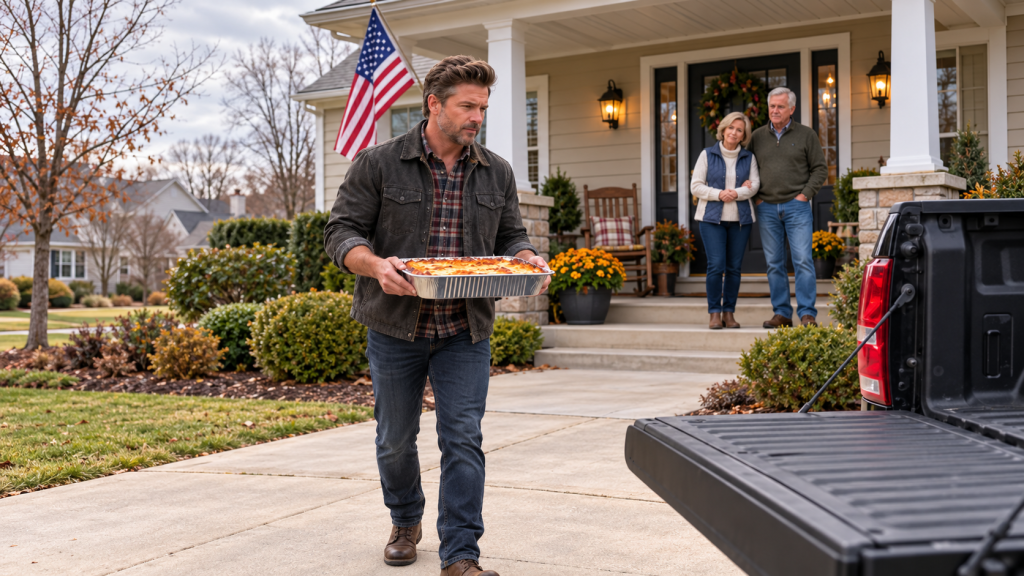
I packed turkey into foil trays.
Stuffing.
Potatoes.
Green beans.
Rolls.
Pie.
Then I drove to my father’s house.
It looked petty from the outside.
Maybe part of it was.
But beneath the anger was something much simpler.
A son finally choosing the man who had spent his entire life choosing him.
Karen once asked me whether I regretted taking the food.
I thought about it.
“No.”
“All of it?”
“All of it.”
“Even the pie?”
“Especially the pie.”
She laughed.
Then she asked:
“What if my dad hadn’t followed us?”
I looked at her.
“We still would’ve had Thanksgiving.”
“With Jack?”
“Yes.”
She nodded.
“Good.”
Then she became quiet.
“I’m glad you left.”
That surprised me.
“You are?”
“Yes.”
“Why?”
“Because if you hadn’t, I might still think I was right.”
There wasn’t much to say after that.
So I kissed her forehead.
And we kept setting the table.
Sometimes the people we love need forgiveness.
Sometimes they need boundaries.
Usually, they need both.
Karen needed to understand that loving her did not require me to tolerate contempt for my father.
Charles needed to remember that success did not erase the frightened young man who once stood in Jack Dalton’s garage asking for help.
I needed to understand that avoiding conflict had never protected Dad.
And Dad?
Dad didn’t need any of us to rescue his dignity.
He had never lost it.
We were simply late recognizing it.
I think about the sentence Karen said sometimes.
“My parents are not spending the afternoon across from a mechanic who smells like a repair shop.”
Funny.
Years later, after Dad died, Karen took one of his old jackets.
She keeps it in a garment bag in our hall closet.
She has never washed it.
Once I asked why.
She opened the bag.
Touched the worn sleeve.
Then smiled sadly.
“It still smells like Jack.”
Oil.
Metal.
Old fabric.
A lifetime of work.
The smell she once considered embarrassing became something she couldn’t bear to lose.
Life has a strange way of teaching lessons like that.
My father spent almost fifty years working with his hands.
He fixed machines.
Cars.
Furnaces when I called him even though HVAC was supposed to be my profession.
Cabinet hinges.
Leaking faucets.
Broken toys.
He fixed almost anything people put in front of him.
But that Thanksgiving, without intending to, Dad helped fix something bigger.
A marriage that had grown too comfortable with silence.
A daughter-in-law who had confused status with worth.
An old friend who had spent decades ashamed of his own beginnings.
And a son who needed to remember that keeping peace should never mean standing quietly while someone you love is pushed away from the table.
Dad didn’t fix those things with tools.
He just opened an old metal box.
Then he told the truth.
So every year, when the turkey comes out of the oven and the house fills with that familiar smell of butter and sage, I remember the Thanksgiving dinner I packed into foil trays.
I remember Karen standing in the doorway.
I remember driving through the cold Indiana afternoon.
I remember Dad opening his front door in that old flannel shirt.
And I remember the surprise in his eyes when he realized I had chosen to spend Thanksgiving with him.
If I could return to that moment, I would change only one thing.
When he asked:
“Rick, what did you do?”
I wouldn’t say:
“Changed the guest list.”
I’d tell him the truth.
“I finally remembered who taught me what family means.”
Because Dad had been teaching me all along.
Family isn’t the person with the cleanest clothes.
The biggest house.
The nicest car.
The best job title.
Family is the person who answers when you call.
The person who shows up.
The person who sees you struggling and helps without making your struggle your identity.
The person who can smell like oil, carry fifty years of work in his hands, and still possess more dignity than everyone seated at the polished table that excluded him.
That was Jack Dalton.
Mechanic.
Factory worker.
Father.
Friend.
The man my wife once thought wasn’t respectable enough for Thanksgiving.
And the man whose empty chair, years later, became the one chair every person in our family wished we could fill again.