Vanessa’s husband stopped breathing. At least, that was what it looked like. Daniel Cole had been sitting beside my sister all evening with one arm draped casually across the back of her chair, laughing whenever someone made a joke at my expense.
Now his arm dropped. His champagne glass remained suspended halfway to his mouth. Vanessa stared at the photograph. Then at Daniel. Then at Dad. “What does she mean?” Daniel slowly placed his glass on the table.
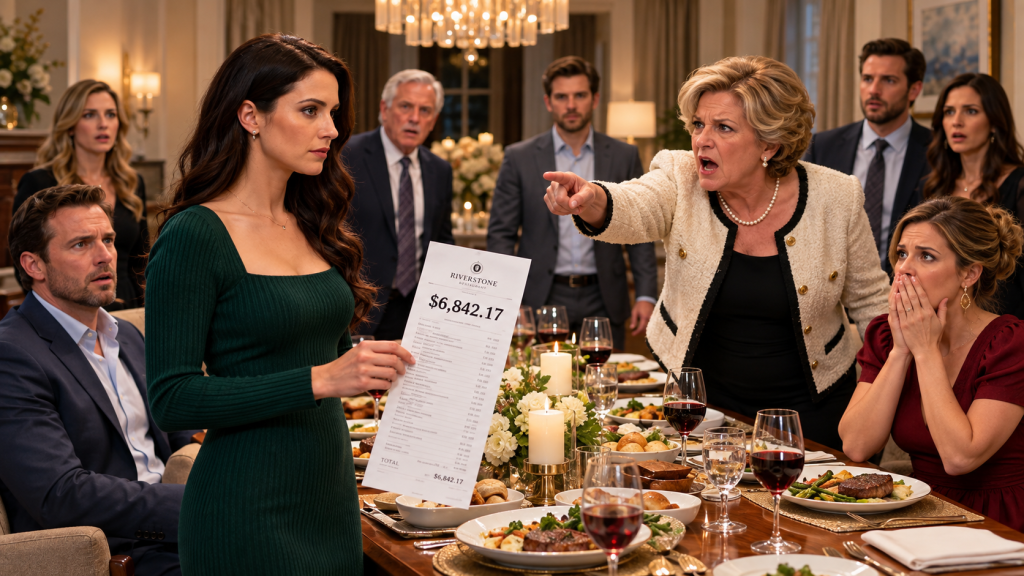
“Vanessa—”
“No.”
Her voice sharpened.
“What does she mean?”
Dad slammed his palm against the table.
“This dinner is over.”
Martin Graves didn’t move.
Neither did I.
Dad looked around at our relatives.
“Everyone leave.”
Nobody stood.
Interesting.
Apparently humiliation was entertainment until the person being humiliated changed.
Dad pointed toward the door.
“I said leave.”
My cousin Andrew looked down at his dessert.
Aunt Melissa suddenly became fascinated by her napkin.
Vanessa remained frozen.
Then she lifted the photograph.
“Daniel.”
Her voice was quieter now.
That made it worse.
“Why are you in this picture?”
Daniel swallowed.
“I can explain.”
“Then explain.”
“Not here.”
Vanessa laughed once.
It was a hollow sound.
“Ten minutes ago, you were perfectly comfortable watching my father throw a seven-thousand-dollar bill at my sister in front of everyone.”
She pushed the photograph toward him.
“So I think here is just fine.”
Daniel looked at Dad.
That glance told me everything.
Vanessa saw it too.
Her face changed.
“Why are you looking at him?”
“I’m not.”
“You are.”
“Vanessa—”
“What did you do?”
Dad stepped between them.
“Enough.”
I leaned back in my chair.
“No, Dad.”
His eyes snapped toward me.
“We’re just getting started.”
Martin opened the folder.
Daniel stood.
“I don’t have to sit here for this.”
“No,” Martin said calmly.
“You don’t.”
Daniel looked relieved.
Then Martin added:
“But considering the documents have already been preserved and provided to outside counsel, leaving won’t make them disappear.”
Daniel stopped.
Dad’s face darkened.
“You had no authority to investigate private company transactions.”
I looked at him.
“I own voting shares.”
“You own a minority interest.”
“A minority interest large enough to exercise the inspection rights Grandpa gave me.”
Dad’s jaw tightened.
“You abandoned this company.”
“No.”
I shook my head.
“I declined to work for you.”
“There is no difference.”
“There is a very big difference.”
Vanessa suddenly slapped the photograph onto the table.
“Will somebody tell me what Daniel did?”
Martin looked at me.
I nodded.
He removed a spreadsheet.
“Northstar Consulting received approximately $2.3 million from Harrington Supply Group over four years.”
Vanessa stared at the numbers.
“For what?”
“Consulting.”
“What consulting?”
Martin looked at Daniel.
“Perhaps Mr. Cole can answer.”
Daniel sat back down.
His forehead was shining with sweat.
“Operational strategy.”
I almost admired the audacity.
Vanessa blinked.
“You?”
Daniel straightened.
“I have business experience.”
“You sell medical equipment.”
“I’ve advised companies before.”
“Which companies?”
“Vanessa—”
“WHICH COMPANIES?”
Several people jumped.
Daniel lowered his voice.
“This isn’t the place.”
She stared at him.
“Then apparently there isn’t a place.”
Martin continued.
“Northstar has no employees.”
Vanessa looked at him.
“What?”
“No office.”
Daniel said:
“It’s a consulting entity.”
“No payroll.”
“That isn’t unusual.”
“No documented deliverables.”
Silence.
Martin turned another page.
“No reports.”
Another.
“No project plans.”
Another.
“No correspondence supporting the invoiced services.”
Daniel’s face tightened.
“That’s not true.”
“Then you can provide them.”
“I don’t have them with me.”
Martin nodded.
“Of course.”
Vanessa whispered:
“Who owns Northstar?”
Nobody answered.
She looked at me.
“Claire?”
I held her gaze.
“You do.”
She stared at me.
“What?”
“Technically.”
Daniel closed his eyes.
Dad muttered something under his breath.
Vanessa looked from one man to the other.
“What does she mean technically?”
Martin answered.
“Northstar Consulting was formed using a holding company.”
“And?”
“The beneficial ownership documentation lists a trust.”
“What trust?”
“The Vanessa Harrington Cole Family Trust.”
My sister went completely still.
“I don’t have a trust.”
“Yes,” Martin said.
“You do.”
She turned toward Daniel.
“You created a trust in my name?”
Daniel’s voice cracked.
“It was for tax planning.”
“When?”
“Vanessa—”
“When?”
“Four years ago.”
“Did I sign it?”
Silence.
Vanessa’s eyes widened.
“Did I sign it?”
Daniel whispered:
“There were documents.”
“That wasn’t my question.”
He looked at Dad.
Again.
That was his mistake.
Vanessa saw it.
She turned toward our father.
“Did you know?”
Dad didn’t answer.
“Dad.”
“This is complicated.”
She laughed.
There was no humor in it.
“Of course.”
Then she looked at me.
“Keep going.”
For the first time that night, she wasn’t smirking.
She wasn’t my father’s favored daughter.
She wasn’t the vice president.
She was simply a woman beginning to understand that the two men she trusted most had built something behind her back.
I almost felt sorry for her.
Almost.
Martin slid another document toward her.
“These are copies of the trust paperwork.”
Vanessa read.
Her face changed.
“That isn’t my signature.”
Nobody spoke.
She looked at Daniel.
“That isn’t my signature.”
Daniel leaned closer.
“It looks like—”
“I KNOW MY SIGNATURE.”
A server standing near the wall quietly stepped outside.
Vanessa pointed at the page.
“Who signed this?”
Daniel said nothing.
Dad finally sat down.
That frightened Vanessa more than his anger had.
She looked at him.
“Dad?”
He rubbed his forehead.
“Your husband made mistakes.”
Daniel’s head snapped toward him.
“My mistakes?”
Dad glared.
“Don’t.”
Daniel laughed bitterly.
“Oh, now you want me quiet?”
Martin calmly closed one section of the folder.
Dad noticed.
“What else do you have?”
Martin didn’t answer him.
He answered me.
“Enough.”
Dad’s chair scraped backward.
“I want you out.”
“This isn’t your house,” I said.
“It is my dinner.”
I glanced at the check.
“Apparently it’s mine.”
One cousin coughed to hide a laugh.
Dad looked ready to explode.
Then Daniel said:
“Tell her, Richard.”
Dad turned.
“Shut your mouth.”
“Tell her.”
“I said shut up.”
Vanessa stood.
“Tell me what?”
Daniel stared at Dad.
“You’re going to let me take all of this?”
Dad’s expression became terrifyingly calm.
“You accepted every payment.”
“Because you told me it was temporary!”
Vanessa gripped the table.
“What was temporary?”
Daniel looked at her.
“The transfers.”
“What transfers?”
“Daniel,” Dad warned.
But Daniel had crossed whatever line fear had held him behind.
“You said we’d reverse everything after the refinancing.”
Dad lunged toward him.
Martin stepped between them.
“Richard.”
Dad stopped.
For the first time, I saw something I had never seen in my father.
Fear.
Not embarrassment.
Not anger.
Fear.
I looked at Daniel.
“What refinancing?”
Daniel’s mouth opened.
Dad shouted:
“Do not answer her!”
And suddenly I knew.
There was another layer.
There was always another layer.
I had begun investigating Harrington Supply Group because of a number that didn’t belong.
$184,000.
It appeared in a quarterly report as “warehouse modernization.”
But I knew the warehouse.
Grandpa had taken Vanessa and me there as children.
I remembered the concrete floor.
The smell of lumber.
The giant orange forklifts.
When I checked property records, I discovered the warehouse listed in the report had been sold eighteen months earlier.
Yet Harrington Supply continued reporting expenses for it.
That led me to another property.
Then another.
Then Northstar.
At first, I thought Dad was hiding expenses.
Then I thought he was stealing.
By the third month, I realized something stranger was happening.
Money wasn’t only leaving Harrington Supply.
Some of it was coming back.
Through different entities.
At different times.
In carefully divided amounts.
It looked less like simple theft and more like someone was trying to make the company appear healthier than it was.
I asked Daniel:
“Were the Northstar payments being returned?”
His face answered before his mouth did.
Vanessa looked at me.
“Returned?”
I nodded.
“Some of them.”
Dad whispered:
“Claire.”
I ignored him.
“Money went from Harrington Supply to Northstar. Then portions moved through other entities before returning as what appeared to be outside revenue.”
Vanessa frowned.
“Why?”
Martin answered.
“To improve the appearance of cash flow.”
She stared at Dad.
“Why would we need to do that?”
Nobody answered.
I felt the final piece settle into place.
I looked at Martin.
He nodded.
He had reached the same conclusion.
I turned to Dad.
“How bad is it?”
He said nothing.
“How much debt does the company have?”
Vanessa looked confused.
“We’re profitable.”
I turned toward her.
“No, you’re not.”
Her face changed.
“What?”
“Vanessa, the company has been losing money for at least three years.”
“No.”
“Yes.”
“I see the quarterly reports.”
“The reports are false.”
She looked at Dad.
He wouldn’t meet her eyes.
“Dad?”
Nothing.
“Dad!”
He whispered:
“We had a difficult period.”
Martin removed another document.
“Harrington Supply currently carries approximately eleven million dollars in secured and unsecured obligations.”
Vanessa sat down.
“No.”
Her voice sounded childlike.
I hated hearing it.
“How?”
Dad rubbed both hands across his face.
“Expansion.”
“You told me the expansion was profitable.”
“It was supposed to be.”
“You said we had record revenue.”
“We did.”
Martin corrected him.
“You reported record revenue.”
Dad glared.
Vanessa stared at the table.
“And the refinancing?”
Martin answered.
“A lender was reviewing a new credit facility.”
“How much?”
“Eight million.”
She looked at Dad.
“And you needed the company to look stronger.”
Silence.
“So you created fake revenue?”
Daniel interrupted.
“He did.”
Dad turned.
“You participated.”
“You designed it!”
“You signed invoices!”
“You told me it was legal!”
Dad laughed bitterly.
“Don’t insult everyone here.”
Daniel stood.
“You said Northstar would be paid for legitimate consulting later!”
“You knew exactly what you were doing.”
“I knew you wanted cash moved!”
“And you took a fee every time!”
Vanessa looked at her husband.
“A fee?”
Daniel froze.
“What fee?”
He said nothing.
Vanessa repeated:
“What fee?”
Martin placed another page in front of her.
Daniel had received $312,000 personally.
My sister stared at the number.
Then at him.
“You told me your commissions were good.”
Daniel whispered:
“They were.”
“You bought me the car with this money?”
No answer.
“Our anniversary trip?”
No answer.
“The kitchen renovation?”
“Vanessa—”
She slapped him.
The room gasped.
Daniel staggered backward.
I stood.
“Vanessa.”
She turned toward me.
Her eyes were full of tears.
“Don’t.”
I stopped.
“You don’t get to comfort me.”
Fair.
She looked around the table.
Seventeen relatives who had laughed at me.
Now nobody could look at anyone.
Vanessa grabbed her purse.
Then stopped.
She looked at Dad.
“You made me vice president.”
Dad closed his eyes.
“You made me stand in front of employees and repeat numbers you knew were false.”
“I protected you.”
“No.”
She shook her head.
“You used me.”
“Vanessa.”
“You made me the face.”
That was when I understood another piece.
Dad had not favored Vanessa simply because she was loyal.
He had positioned her.
If everything collapsed, the vice president who signed presentations, approved internal budgets, and spoke to vendors would be standing close to the wreckage.
I looked at Martin.
He saw it too.
Vanessa saw my face.
“What?”
I didn’t want to say it.
“What, Claire?”
I looked at Dad.
“Who signed the internal certifications?”
Vanessa stopped breathing.
Dad said:
“Don’t.”
I looked at her.
“You did, didn’t you?”
She whispered:
“Dad told me they were routine.”
My chest hurt.
For years, I had resented her.
Her office.
Her title.
Her praise.
Her smug smile whenever Dad compared us.
Now I realized the crown he had placed on her head might have been made of paper soaked in gasoline.
Dad pointed at me.
“You think you’re better than us?”
“No.”
“You walked away.”
“Yes.”
“You abandoned what your grandfather built.”
“No.”
“I spent thirty years keeping that company alive!”
“Then why is it eleven million dollars in debt?”
His face twisted.
“You have no idea what it takes.”
“Then tell me.”
“Payroll.”
He slammed his hand down.
“Insurance.”
Another.
“Fuel.”
“Materials.”
“Interest.”
“Competition.”
His voice cracked.
“You sit behind a desk and examine numbers after the fact. I had three hundred families depending on me.”
The room went quiet.
There it was.
The part of the truth that made everything harder.
Dad wasn’t wrong about everything.
Harrington Supply employed hundreds of people.
Grandpa had built it from one yard and two trucks.
Dad had expanded it.
For years, successfully.
Then a national chain moved aggressively into our market.
Margins shrank.
Two large contractors defaulted.
A warehouse expansion ran over budget.
Interest rates climbed.
Dad borrowed.
Then borrowed again.
Then he hid losses.
Then he manipulated numbers.
Then he moved money.
One compromise became another.
A man trying to save a company eventually became a man willing to endanger it.
I asked:
“Why didn’t you tell us?”
“Because I could fix it.”
“By falsifying financials?”
“By buying time.”
“That’s what people always call it.”
His eyes flashed.
“You know nothing about responsibility.”
That hurt.
It was designed to.
I let it.
Then I said:
“Grandpa taught me something about responsibility.”
Dad stiffened.
“What?”
“That when numbers become ugly, you look at them harder.”
I pointed toward the documents.
“You didn’t.”
Martin’s phone vibrated.
He checked it.
Then looked at me.
“They’re downstairs.”
Dad stared at him.
“Who?”
I didn’t answer.
Vanessa did.
“Claire?”
I looked toward the door.
“Outside counsel and two members of the board.”
Dad laughed.
“The board answers to me.”
“Not tonight.”
His expression changed.
I removed the folded document from beside the dinner bill.
Grandpa’s trust.
“The voting shares Grandpa placed in trust don’t simply give me inspection rights.”
Dad stared at it.
I continued.
“They give the trustee power to suspend executive authority if there is credible evidence of fraud or material financial misconduct.”
“You’re not the trustee.”
“No.”
Dad looked at Martin.
Martin shook his head.
“Neither am I.”
The door opened.
An elderly woman entered.
My father sat down.
Vanessa whispered:
“Aunt Evelyn?”
Evelyn Harrington was Grandpa’s younger sister.
Seventy-eight.
Five feet three.
White hair.
Pearls.
A cane she mostly carried because she liked hitting furniture with it when people irritated her.
Dad looked like he had seen a ghost.
“You.”
She walked toward him.
“Apparently that’s the word of the evening.”
I almost smiled.
Aunt Evelyn looked at the dinner table.
Then at the check.
Then at me.
“Did they actually try to make you pay this?”
“Yes.”
She picked up the bill.
“Six thousand eight hundred forty-two dollars?”
“And seventeen cents.”
She stared at Dad.
“Richard, your father would crawl out of his grave just to slap you.”
Dad looked away.
Evelyn placed the check back down.
Then she removed a document from her handbag.
“As trustee of the Harrington Family Voting Trust, I am temporarily suspending Richard Harrington’s executive authority pending an independent investigation.”
Nobody breathed.
Dad looked at me.
“You planned this.”
I nodded.
“How long?”
“Long enough.”
“The dinner?”
“No.”
I glanced at the bill.
“That was your contribution.”
The restaurant manager entered a few minutes later.
Dad had apparently forgotten him.
“Ms. Harrington?”
I looked up.
“Yes?”
“There is still the matter of payment.”
Seventeen relatives suddenly rediscovered me.
Vanessa looked embarrassed.
Dad said:
“Put it on the company account.”
Martin and I spoke simultaneously.
“No.”
The manager blinked.
Dad glared at me.
“You wanted to embarrass me?”
“No.”
I slid the bill toward him.
“I want the people who ordered dinner to pay for dinner.”
Dad laughed.
“You have plenty of money.”
There it was.
The sentence underneath everything.
I leaned back.
“How do you know?”
He stopped.
Vanessa looked at him.
Dad said:
“You’re an accountant.”
I smiled.
“You’ve spent fifteen years telling everyone I’m unsuccessful.”
“You’re doing fine.”
“Fine?”
I looked around the table.
“Would anyone like to tell Dad what I do?”
Nobody knew.
Of course.
Aunt Evelyn did.
She smiled.
“Tell them.”
So I did.
“I don’t do little accounting jobs.”
Vanessa stared.
“I’m a partner at a forensic accounting and corporate risk firm.”
Dad’s expression changed.
“We advise lenders, private equity firms, boards, and companies dealing with financial misconduct.”
Vanessa whispered:
“You’re a partner?”
“Yes.”
“How long?”
“Four years.”
“What do you make?”
I smiled.
“Enough to pay this bill.”
Dad’s mouth curved slightly.
Then I finished.
“But I’m not going to.”
His smile disappeared.
I stood.
“You invited me because you wanted a wallet.”
I pushed my chair in.
“So tonight, you’ll learn the difference between being able to pay and being obligated to pay.”
Aunt Evelyn laughed.
The manager looked uncomfortable.
“I can divide the check.”
“Please do.”
Vanessa stared at me.
“You knew?”
“What?”
“That Dad planned to make you pay?”
“No.”
“Then why did you tell the waiter to call Martin?”
“Because I knew Dad would be here.”
I looked toward him.
“And I was tired of waiting until Monday.”
The bill was divided seventeen ways.
My portion was $402.48.
I paid it.
With tip.
Dad stared.
“You’re really doing this?”
“Yes.”
Several relatives began complaining.
One cousin said he hadn’t ordered wine.
Aunt Melissa insisted she only ate salad.
Uncle Peter suddenly remembered he had not touched the lobster tower.
It was astonishing how quickly people discovered financial principles when their own cards came out.
Aunt Evelyn paid her share without complaint.
Then she tipped the waiter another hundred dollars.
“For surviving these people.”
The waiter smiled.
“Thank you, ma’am.”
I left.
Vanessa followed.
“Claire.”
I kept walking.
“Claire!”
I stopped in the lobby.
She stood behind me.
Mascara had begun running beneath her eyes.
“I didn’t know.”
“About what?”
“Any of it.”
“I know.”
She looked shocked.
“You believe me?”
“I believe you didn’t know about Northstar.”
Her shoulders dropped.
“But you still treated me like garbage.”
She flinched.
“Yes.”
“That wasn’t Dad.”
“I know.”
“That wasn’t Daniel.”
“I know.”
“That was you.”
Tears filled her eyes.
“I know.”
For years, I had imagined what it would feel like if Vanessa finally admitted it.
I expected satisfaction.
There wasn’t any.
Only exhaustion.
She whispered:
“I thought you looked down on me.”
I frowned.
“What?”
“Because you left.”
“I left Dad.”
“You left us.”
“No.”
“You barely came around.”
“Every time I came around, you mocked my job, my clothes, my apartment, my relationships.”
“Because you acted like you didn’t care.”
“I stopped defending myself.”
She looked down.
“I thought that meant you thought you were better.”
“No.”
I swallowed.
“It meant I got tired.”
That landed.
She cried quietly.
“I’m sorry.”
I nodded.
Not forgiveness.
Not yet.
But acknowledgment.
Then the restaurant doors opened.
Daniel came out.
“Vanessa.”
She turned.
“Don’t.”
“We need to talk.”
“No.”
“Please.”
“You forged my signature.”
“It wasn’t—”
She laughed.
“Choose your next sentence very carefully.”
Daniel stopped.
She removed her wedding ring.
I stared.
So did he.
“Vanessa.”
She placed it in his hand.
“Get a lawyer.”
Then she walked away.
The independent investigation lasted five months.
It was uglier than dinner.
But also less dramatic.
Real consequences usually are.
No one was handcuffed beside the birthday cake.
No federal agents burst through the restaurant doors.
Instead, there were interviews.
Subpoenas.
Auditors.
Lawyers.
Bank meetings.
Board meetings.
Boxes of records.
Thousands of emails.
And silence.
Lots of silence.
The investigation confirmed that financial statements provided to lenders contained material misrepresentations.
Northstar had been used to move funds.
Daniel had personally benefited.
Dad had approved transactions and directed others.
Vanessa had signed documents containing inaccurate information, but investigators also found substantial evidence that key financial information had been concealed from her.
That distinction mattered.
It didn’t make her innocent of every bad decision.
But it mattered.
Dad resigned.
Daniel and Vanessa divorced.
Daniel’s conduct became part of broader legal proceedings connected to the financial scheme.
I won’t pretend I celebrated.
Watching people face consequences is very different from fantasizing about revenge.
There were employees involved.
Retirees.
Vendors.
Families.
The goal became saving what could be saved.
Harrington Supply survived.
Barely.
We sold two underperforming locations.
Renegotiated debt.
Closed one warehouse.
Replaced senior financial leadership.
Brought in an outside chief executive.
It hurt.
But three hundred jobs became two hundred forty-seven jobs instead of zero.
Dad hated me for that.
At least at first.
“You dismantled my company.”
I met him in his attorney’s office three months after his resignation.
“No.”
“You sold half of what I built.”
“Grandpa built it.”
His face hardened.
“I expanded it.”
“And nearly buried it.”
He looked older.
For the first time in my life, my father seemed small.
Not weak.
Human.
That was harder to hate.
He stared through the window.
“I was trying to save it.”
“I know.”
He turned.
“You believe that?”
“Yes.”
“Then why did you do this to me?”
I shook my head.
“I didn’t do this to you.”
His eyes narrowed.
“I found it.”
He looked away.
“There is a difference.”
Silence.
Then he whispered:
“When did you stop loving me?”
The question hurt more than everything else.
I sat down.
“I didn’t.”
He looked at me.
“That was the problem.”
His eyes filled.
“I spent years hoping you’d ask what I did.”
He said nothing.
“Not because I needed praise.”
My voice cracked.
“I wanted you to know me.”
Dad looked down.
“I knew you.”
“No.”
“You knew the daughter you decided I was.”
That silenced him.
“You called my career little.”
“I didn’t understand it.”
“You never asked.”
“I thought—”
“I know.”
I smiled sadly.
“You thought Vanessa was loyal because she stayed.”
His face tightened.
“And you thought I rejected you because I left.”
“Yes.”
“I left because every room with you became a competition I couldn’t win.”
He stared at me.
“You compared us constantly.”
“I was motivating you.”
“No.”
I shook my head.
“You were teaching us that there could only be one daughter worth respecting.”
He closed his eyes.
“And Vanessa believed she had to beat me.”
My voice softened.
“I believed there was no point trying.”
For a long time, he said nothing.
Then:
“I was a terrible father.”
I didn’t answer.
He looked at me.
“Say it.”
“No.”
“Why?”
“Because I’m not going to reduce thirty years of a relationship to one sentence.”
His eyes filled.
“You hurt me.”
I swallowed.
“A lot.”
He nodded.
“And I still love you.”
A tear slipped down his cheek.
Both things were true.
That was adulthood.
Learning that love and damage can occupy the same room.
Vanessa came to my apartment six months after the dinner.
She carried a bottle of cheap wine.
I looked at it.
“Seriously?”
She shrugged.
“I’m unemployed.”
I laughed.
So did she.
It was awkward.
But real.
She sat on my couch.
“I got an offer.”
“Where?”
“A construction distributor in Milwaukee.”
“Position?”
“Regional operations director.”
I smiled.
“That’s good.”
“Less money.”
“Still good.”
She nodded.
“They know everything.”
“Better.”
“I told them during the interview.”
I looked at her.
“I’m proud of you.”
Her face changed.
“Don’t.”
“What?”
“I’m already emotional.”
“Fine.”
“You’ve become annoyingly mature.”
“I always was.”
“Absolutely not.”
We laughed.
Then she became quiet.
“I found something.”
She reached into her purse.
An old letter.
Grandpa’s handwriting.
I recognized it immediately.
“Where?”
“Dad’s office.”
I opened it.
It was addressed to both of us.
Vanessa and Claire,
If either of you ever believes this company matters more than your relationship with each other, sell the damned company.
I laughed.
Then cried.
Vanessa cried too.
Grandpa continued.
Businesses are tools. Family is the reason you build anything worth having. Never confuse the two.
Vanessa leaned against me.
For the first time since we were teenagers, I put my arm around my sister.
“Grandpa would be furious.”
She laughed through tears.
“At Dad?”
“At all of us.”
“Mostly Dad.”
“Definitely mostly Dad.”
A year after the dinner, Harrington Supply posted a modest profit.
Nothing spectacular.
But real.
No fake revenue.
No hidden transfers.
No shell companies.
Just numbers.
Honest numbers.
I attended the board meeting.
Vanessa attended remotely from Milwaukee.
Dad did not attend.
He no longer had an executive role.
But he still owned shares.
After the meeting, I found him waiting outside.
“Good quarter,” he said.
I stared at him.
“You read the report?”
“Twice.”
“What did you think?”
He shrugged.
“Conservative.”
I smiled.
“That’s the idea.”
He almost smiled too.
Then he handed me an envelope.
I froze.
“What?”
“Dinner.”
I opened it.
Inside was a check.
$402.48.
I looked at him.
“You’re reimbursing my share?”
“Yes.”
“Why?”
“Because you shouldn’t have paid anything.”
My throat tightened.
“Dad.”
“I invited you.”
He looked ashamed.
“I knew you were doing well.”
I frowned.
“You said you didn’t know.”
“I didn’t know exactly.”
“Then why the dinner?”
He stared at the floor.
“Vanessa’s birthday was expensive.”
I waited.
“I wanted to impress everyone.”
“With my money?”
“Yes.”
“Why?”
He looked at me.
“Because some part of me wanted to prove you would still do what I told you.”
That was painfully honest.
“I was angry you left.”
“I know.”
“And every year you became more independent.”
“Yes.”
“I hated that.”
“Why?”
His voice broke.
“Because I couldn’t take credit for it.”
I stared at him.
There it was.
The truth.
Not accounting.
Not money.
Not the company.
Control.
Dad had understood Vanessa because she remained close enough for him to shape.
I had built something beyond him.
He interpreted independence as rejection.
“I’m sorry.”
I looked at the check.
Then tore it in half.
His eyes widened.
“What are you doing?”
“I don’t need $402.48.”
“That isn’t the point.”
“I know.”
I smiled.
“The apology is enough.”
Two years later, Dad retired for real.
Not resigned.
Retired.
There was a difference.
We held a small dinner.
Six people.
Not seventeen.
No Wagyu.
No champagne towers.
No private room.
Just an Italian restaurant Dad loved.
At the end, the waiter placed the bill in the center.
Everyone froze.
Then Vanessa looked at me.
I looked at her.
Dad looked confused.
“What?”
Vanessa grinned.
“Claire, you want this one?”
I stared at the bill.
Then at Dad.
He understood.
“Oh, shut up.”
We started laughing.
Even Dad.
I picked up the check.
$287.
I paid it.
Voluntarily.
That difference mattered.
Dad looked at me.
“You don’t have to.”
“I know.”
“You sure?”
“Yes.”
Vanessa leaned toward him.
“Be grateful she gave you a seat.”
Dad groaned.
“You two are never letting that go?”
“No.”
“Absolutely not.”
For once, the joke belonged to us.
Not against us.
Years passed.
Harrington Supply never became the empire Dad imagined.
It became something better.
Stable.
Boring.
Honest.
Vanessa eventually returned to Chicago.
Not as vice president.
She refused the title.
She joined the board after rebuilding her career elsewhere.
I remained involved as a shareholder but never ran the company.
That surprised Dad.
“You could take over.”
“I don’t want to.”
“Why?”
“Because Grandpa gave me shares, not a destiny.”
He thought about that.
Then nodded.
“I wish I’d understood that sooner.”
“So do I.”
Martin Graves retired.
At his retirement party, he approached me holding a glass of sparkling water.
“Still getting stuck with family dinner bills?”
“Only under five hundred.”
“Good policy.”
I smiled.
“You know, you terrified my father that night.”
“I know.”
“You enjoyed it.”
Martin considered this.
“Professionally.”
I laughed.
Then he became serious.
“You did the right thing.”
“I almost waited.”
“But you didn’t.”
“I almost paid the bill too.”
“That would have been the real tragedy.”
I laughed again.
I kept the original restaurant receipt.
$6,842.17.
It sits inside the same file as Grandpa’s trust documents.
Not because of the amount.
Not because I enjoy remembering my family laughing at me.
And not because it was the night Dad lost control of his company.
I keep it because that bill represents the last time I allowed my family to decide what my silence meant.
For years, they mistook quiet for weakness.
They thought because I didn’t brag about my career, I had nothing to brag about.
Because I didn’t fight every insult, I couldn’t defend myself.
Because I left the family company, I had failed.
Because I didn’t demand respect, they were free to withhold it.
They were wrong.
But I had been wrong too.
I thought protecting my peace meant never confronting anyone.
Sometimes peace requires confrontation.
Sometimes love requires boundaries.
Sometimes the kindest thing you can do for a family is refuse to help them continue lying to themselves.
One Sunday afternoon, Dad came to my house.
He was carrying a cardboard box.
“What is that?”
“Your grandfather’s things.”
Inside were old photographs.
Invoices.
A pocket watch.
Several letters.
At the bottom was a photograph of Vanessa and me as children.
I was seven.
She was eleven.
We were standing outside Grandpa’s first lumber yard wearing oversized yellow hard hats.
Vanessa had one arm around me.
We were laughing.
I showed her later.
She stared at it for a long time.
“We liked each other.”
“We did.”
“What happened?”
“Adults.”
She laughed.
Then sighed.
“Competition.”
“Yeah.”
She touched the photograph.
“I’m sorry I became like Dad.”
I shook my head.
“You became yourself.”
“Not always a good thing.”
“No.”
I smiled.
“But at least now you know who that is.”
She looked at me.
“So do you.”
Dad changed too.
Slowly.
Imperfectly.
He still interrupted.
Still gave advice nobody requested.
Still believed most restaurants were overpriced.
The irony was not lost on us.
But he stopped comparing us.
That mattered.
One Christmas, Vanessa told him about a promotion.
He congratulated her.
Then he looked at me.
For one horrible second, I thought he was going to ask what I had accomplished.
Instead, he said:
“Claire, would you pass the potatoes?”
I smiled.
“Gladly.”
That was growth.
Small.
Ordinary.
Beautiful.
Five years after the Bellamy House dinner, Grandpa’s company celebrated its sixtieth anniversary.
Employees gathered inside the original warehouse.
Dad was invited to speak.
He stood behind a small podium.
I expected stories about growth.
Revenue.
Expansion.
Instead, he looked at Vanessa.
Then me.
“My father built this company.”
He paused.
“I almost destroyed it.”
The room went silent.
Dad continued.
“Not because I didn’t work hard.”
His voice shook.
“I worked too hard to admit hard work wasn’t enough.”
He looked at the employees.
“I confused protecting this company with controlling it.”
Then at Vanessa.
“I put one daughter too close to my mistakes.”
Then at me.
“And pushed the other so far away that I stopped knowing who she had become.”
My eyes filled.
Dad swallowed.
“The company survived because people told the truth when I didn’t want to hear it.”
He looked directly at me.
“Especially Claire.”
I had spent half my life wanting my father to say he was proud of me.
Strangely, when he finally did, I no longer needed it.
But I was grateful anyway.
He stepped away from the podium.
I hugged him.
Vanessa joined us.
Someone took a photograph.
Three Harringtons.
No competition.
No favorite.
No disappointing daughter.
Just family.
Damaged.
Changed.
Still standing.
Later that night, Dad and I sat outside the warehouse.
“You remember Bellamy House?” he asked.
I stared at him.
“Do I remember the night you threw a $6,842 bill at me?”
“Yeah.”
“Vaguely.”
He laughed.
“I deserved what happened.”
I considered that.
“You deserved consequences.”
“Difference?”
“Big one.”
He nodded.
“Claire?”
“Yeah?”
“Why didn’t you just pay it?”
I smiled.
“I could have.”
“I know.”
“That was why I didn’t.”
He frowned.
I looked toward the warehouse Grandpa had built.
“For years, all of you thought generosity meant access.”
Dad became quiet.
“You thought because I had something, family was entitled to it.”
“Money.”
“Time.”
“Respect.”
“Silence.”
I looked at him.
“I needed you to understand that loving someone doesn’t mean handing them whatever they demand.”
He nodded slowly.
“I understand now.”
I smiled.
“Good.”
He stood.
Then stopped.
“For what it’s worth…”
“What?”
“I’m glad you called Martin.”
I laughed.
“No, you’re not.”
Dad smiled.
“No.”
He walked toward the parking lot.
“I’m really not.”
I stayed behind another minute.
The warehouse lights glowed through the windows.
Grandpa’s company was still alive.
My relationship with Vanessa was alive.
Dad was alive.
Not everything survived unchanged.
It shouldn’t have.
Some things need to break before they can be rebuilt honestly.
That night at Bellamy House, seventeen people had watched my father throw a bill at me.
They expected me to lower my eyes.
Open my purse.
Pay.
Smile.
Accept my place.
Instead, a waiter leaned down and whispered that Martin had arrived.
Dad turned pale because he thought Martin was there to destroy him.
But Martin didn’t destroy my father.
Neither did I.
The truth simply removed the protection Dad had built around his choices.
What happened afterward belonged to him.
Just as what happened afterward belonged to Vanessa.
To Daniel.
To me.
We all had choices.
Some cost money.
Some cost marriages.
Some cost careers.
Some cost pride.
But the most important choice I made that night cost nothing.
I closed my purse.
That was it.
A tiny movement.
Almost invisible.
I stopped paying for the privilege of being mistreated.
And strangely, once I stopped doing that, my family finally began to see me.
Not as the disappointing daughter.
Not as the quiet sister.
Not as the relative who could afford the bill.
As Claire.
The woman Grandpa had trusted with shares nobody knew mattered.
The accountant Dad had mocked who understood his company better than he realized.
The sister Vanessa had spent years competing against when neither of us should have been competing at all.
The daughter who loved her father enough to refuse to help him hide what he had done.
And years later, when Dad occasionally complains that dinner is too expensive, Vanessa and I still exchange the same look.
Then one of us inevitably says:
“Don’t worry, Dad. Claire has her wallet.”
He groans.
We laugh.
And sometimes, when nobody else is watching, he laughs too.
Because the $6,842.17 dinner bill was never really about dinner.
It was about what happens when people mistake kindness for weakness, silence for ignorance, and family for an unlimited line of credit.
My father thought throwing that check at me would remind everyone where I belonged.
Instead, it exposed everything he had spent years hiding.
And when the truth finally arrived at our table carrying a leather folder, I didn’t have to shout.
I didn’t have to threaten anyone.
I didn’t even have to reach for my wallet.
I simply let the numbers speak.
And for once, my family finally listened.