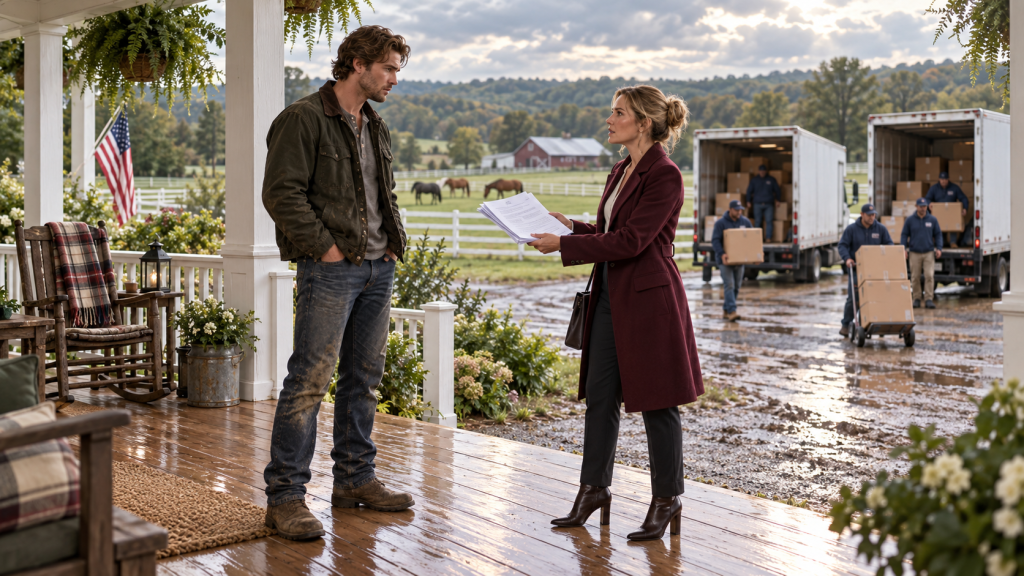
For the first time since the moving trucks rolled through my gate, Clare looked genuinely frightened. Not angry. Not offended. Frightened. She slowly turned toward her fiancé.
“Ryan?” Ryan Mercer stood several feet behind her, one hand still tucked into the pocket of his charcoal coat. The rain had darkened his shoulders. He looked at Daniel. Then at the county deputy.
Then at me.
Finally, he looked at Clare.
“What is he talking about?”
Daniel didn’t blink.
“I think you know.”
Ryan laughed.
It was the wrong kind of laugh.
Too quick.
Too loud.
The laugh of a man trying to make everyone else feel ridiculous before they had enough time to realize he was terrified.
“This is absurd.”
Daniel opened the folder.
“Is it?”
“Yes.”
“Then perhaps you can explain why your electronic signature appears on the deed submission.”
Ryan’s face changed.
Only slightly.
But I saw it.
So did Clare.
She stepped toward him.
“You told me Jacob signed the transfer.”
“He did.”
“No, I didn’t,” I said.
Ryan pointed at me.
“You signed documents months ago.”
“Which documents?”
“The estate paperwork.”
“What paperwork?”
He opened his mouth.
Nothing came out.
Daniel answered for him.
“We reviewed every document Jacob signed during probate.”
He lifted a second folder.
“None transferred the ranch to Clare.”
Clare stared at Ryan.
“But you showed me the deed.”
“Yes.”
“You said Jacob finally agreed.”
“He did.”
“No.”
Her voice dropped.
“You said you personally watched him sign.”
Ryan’s eyes moved toward the deputy.
That was when I understood something.
Clare had done terrible things.
She had tried to pressure me.
She had recorded me.
She had dragged relatives into the dispute.
She had shown up at my home with moving trucks.
But the fear on her face was real.
There was a part of this she hadn’t known.
“Ryan.”
Her voice trembled.
“Did Jacob sign that deed?”
Ryan said nothing.
Clare stepped closer.
“Answer me.”
“Not here.”
Her face went white.
“Oh my God.”
“Clare—”
“You lied to me.”
“I was trying to help you.”
Daniel calmly said:
“Mr. Mercer, I recommend you stop talking until you’ve obtained legal counsel.”
Ryan glared at him.
“You don’t represent me.”
“No.”
Daniel closed the folder.
“Which is precisely why I’m recommending it.”
The deputy stepped forward.
“Everybody needs to remain calm.”
Clare ignored him.
She was staring at Ryan as if she had never seen him before.
“You told me the transfer had already happened.”
“I thought it had.”
“You told me Jacob’s signature was legitimate.”
“I said the paperwork was handled.”
“You told me the title company approved everything.”
Ryan lowered his voice.
“Clare, not here.”
She laughed.
A broken, disbelieving sound.
“You brought moving trucks to my brother’s house!”
“You brought them.”
“Because you told me I owned it!”
Ryan looked around.
The movers had stopped pretending not to listen.
One driver leaned against his truck with his arms folded.
Rainwater ran along the brim of his cap.
Clare looked humiliated.
Then Daniel spoke.
“There’s something else you should know.”
Ryan’s eyes snapped toward him.
Daniel turned to me.
“Jacob, may I?”
I nodded.
He removed another document.
“The questionable deed wasn’t the only filing connected to this property.”
Clare stared at him.
“What does that mean?”
Daniel handed her a copy.
“Three weeks after the attempted transfer, an application was submitted for a development loan secured against the ranch.”
My stomach tightened.
I knew about the document Daniel had mentioned that morning.
But I had not known the amount.
Clare looked at the first page.
Her hands began shaking.
“Four million dollars?”
Ryan said:
“Clare—”
She turned on him.
“Four million dollars?”
“It wasn’t finalized.”
“You applied for a four-million-dollar loan against my parents’ ranch?”
“Our ranch.”
“No.”
Her voice sharpened.
“My family’s ranch.”
Ryan took a step toward her.
“We talked about development.”
“We talked about possibilities!”
“You wanted to sell.”
“Eventually!”
“And I found investors.”
“You found investors?”
Clare looked at me.
Then back at him.
“What investors?”
Daniel answered.
“Mercer Development Holdings.”
Clare froze.
I had never heard the name.
Apparently, neither had she.
“What’s Mercer Development Holdings?”
Ryan’s face had gone gray.
Daniel looked directly at him.
“A company registered eighteen months ago.”
He turned back to Clare.
“Mr. Mercer owns seventy percent.”
The rain seemed louder.
“And the other thirty?” I asked.
Daniel’s expression changed.
“That is where this becomes interesting.”
He handed me the paper.
I read the second name.
My stomach dropped.
THOMAS BENNETT.
I looked at Clare.
She looked at me.
Neither of us spoke.
Thomas Bennett was our uncle.
Our father’s younger brother.
The same uncle who had signed a statement supporting Clare’s claim.
The same uncle who had hugged me at Dad’s funeral.
The same uncle who had told me:
“Your father would be proud you’re keeping the ranch alive.”
Clare whispered:
“Uncle Tom?”
Daniel nodded.
“He owns thirty percent of the development company.”
Something inside me went cold.
This was no longer a fight between two grieving siblings.
It had become something else.
Something planned.
Something older.
Clare looked sick.
“No.”
Daniel said nothing.
“No, Uncle Tom wouldn’t…”
She stopped.
Because even she no longer believed herself.
I thought back to Thanksgiving.
Uncle Tom sitting beside Clare.
Telling everyone that Dad had “probably made the will too quickly.”
My cousins agreeing.
People I loved suddenly discussing my inheritance as though I had stolen it.
It hadn’t been spontaneous resentment.
Someone had been feeding it.
Someone had needed the family divided.
Ryan reached for Clare’s arm.
She jerked away.
“Don’t touch me.”
“Listen to me.”
“No.”
“Clare.”
She slapped him.
The sound cracked through the rain.
Everyone went silent.
Ryan stared at her.
The deputy stepped between them.
“That’s enough.”
Clare backed away.
Tears streamed down her face.
Then she looked at me.
For once, there was no smugness.
No superiority.
No victory.
Just shock.
“Jacob…”
I didn’t answer.
“I didn’t know.”
Part of me wanted to laugh.
She had brought movers to throw me out.
She had recorded my private conversation.
She had tried to raise imaginary rent on a home I owned.
She had gathered relatives against me.
Whether she knew about the forged deed almost felt irrelevant.
“You knew enough.”
She flinched.
“I thought Dad cheated me.”
“And that made this okay?”
“No.”
“Then why did you do it?”
Her lips trembled.
“I was angry.”
“So was I.”
“You got everything.”
“I got the ranch.”
“The ranch was everything!”
“No, Clare.”
My voice cracked.
“Mom’s jewelry went to you.”
She looked away.
“The investment account was divided.”
Silence.
“You received Dad’s life-insurance distribution.”
Silence.
“You got almost three hundred thousand dollars in liquid assets.”
“But you got this.”
She gestured toward the fields.
There it was.
The wound underneath everything.
“You think I got a million-dollar gift.”
“You did.”
“No.”
I stepped toward her.
“I got eighty acres of fences that break.”
I pointed toward the barn.
“A roof that leaks.”
Toward the pasture.
“Animals that eat whether I’m sick or tired or grieving.”
My voice rose.
“I got property taxes.”
“Insurance.”
“Equipment repairs.”
“Sixteen-hour days.”
“I got Dad’s debts attached to the operating side of the ranch.”
Clare stared at me.
“I got the responsibility he knew I had already been carrying for eight years.”
Her eyes filled.
“And I wanted it.”
I touched my chest.
“I still want it.”
“But don’t stand here and pretend Dad handed me a suitcase containing $1.2 million.”
She said nothing.
“The ranch is worth that on paper.”
I looked toward the pasture.
“To me, it isn’t money.”
Rain ran down my face.
“It’s home.”
For a moment, nobody spoke.
Then the deputy addressed the movers.
“Gentlemen, no property is being removed today.”
One of the drivers nodded immediately.
“We’re good with that.”
Clare closed her eyes.
The moving trucks eventually backed out through the gate.
Ryan left separately after the deputy took down his information.
Clare remained.
Standing in the rain.
Alone.
I started toward the house.
“Jacob.”
I stopped.
She whispered:
“What happens now?”
I looked at her.
“You call your own attorney.”
Her face crumpled.
“Are you going after me?”
“I don’t know.”
“I’m your sister.”
I almost laughed.
“So was I your brother when you brought moving trucks?”
She looked down.
I immediately regretted saying it.
Not because it wasn’t true.
Because Dad would have hated seeing us like this.
But Dad wasn’t here.
That was part of the problem.
He had been the bridge between us for years.
And after he died, we discovered neither of us knew how to cross the distance alone.
“I need you to leave.”
Clare nodded.
Then walked toward her car.
She opened the door.
Paused.
And looked back at the ranch.
For the first time, she didn’t look like someone imagining what she could do with it.
She looked like someone remembering where she came from.
Then she drove away.
The following morning, Daniel called at 6:42.
“Are you awake?”
“I run a ranch.”
“Right. Stupid question.”
“What happened?”
“We found the investor agreement.”
I sat up.
“What investor agreement?”
“The one between Ryan and your uncle.”
My stomach tightened.
“How bad?”
“Bad enough that you should come to my office.”
“Daniel.”
He sighed.
“They planned to subdivide the ranch.”
I closed my eyes.
“How much?”
“All of it.”
The words landed like a punch.
“What do you mean all of it?”
“Residential development.”
I couldn’t speak.
“Jacob?”
“I’m here.”
“According to the preliminary plan, they wanted sixty-two residential lots.”
I got out of bed.
Walked to the window.
The sun was beginning to rise over the pasture.
Sixty-two lots.
Sixty-two houses.
Roads.
Concrete.
Streetlights.
The field where Dad taught me to ride would become somebody’s cul-de-sac.
The hill where Mom scattered wildflower seeds every spring would become backyards.
The barn might become a clubhouse.
I felt physically sick.
“Why?”
“Money.”
“How much?”
“If rezoning succeeded?”
Daniel paused.
“Potentially eight to eleven million in gross sales over several years.”
Now I understood.
The ranch wasn’t worth $1.2 million to them.
Not really.
It was worth what they could turn it into.
“And Clare?”
“Her name isn’t on the development company.”
I frowned.
“What?”
“Ryan apparently intended to use her ownership claim to gain control of the property.”
My grip tightened around the phone.
“Then what?”
“That’s what we don’t know yet.”
But I knew.
Or at least I suspected.
Clare had never been the partner.
She had been the doorway.
I called her.
She answered on the fourth ring.
“What?”
Her voice sounded exhausted.
“Did Ryan ever show you the development agreement?”
Silence.
“What agreement?”
“Sixty-two houses.”
She stopped breathing.
“Jacob…”
“Did you know?”
“No.”
“Tell me the truth.”
“I swear to God.”
I believed her.
Not because trust had magically returned.
Because her horror sounded too immediate.
She whispered:
“He told me we could renovate the house.”
I waited.
“Maybe open an event venue.”
“What else?”
“Horseback tours.”
Her voice cracked.
“A small vineyard.”
I closed my eyes.
Those were the plans she had been imagining.
Annoying.
Entitled.
But not destruction.
“He never told you he wanted to subdivide?”
“No.”
“Uncle Tom?”
“No.”
Then she said:
“Jacob, I need to tell you something.”
“What?”
“Ryan has copies of Dad’s financial records.”
I froze.
“How?”
“I gave them to him.”
My anger returned instantly.
“Why would you do that?”
“Because he told me we needed them to challenge probate.”
“You gave someone outside the family Dad’s private records?”
“He was going to be my husband!”
“That doesn’t make him Dad’s son!”
“I know!”
She began crying.
“I know, okay?”
I stopped.
There are moments when anger reaches its limit.
Not because the person deserves mercy.
Because shouting cannot undo anything.
“What records?”
“Tax returns.”
“What else?”
“Estate valuations.”
“Clare.”
“Bank statements.”
I closed my eyes.
“Anything with signatures?”
Silence.
My heart sank.
“Clare.”
“Old contracts.”
There it was.
Examples of Dad’s signature.
My signature might have appeared on probate acknowledgments too.
Ryan had everything he needed to create convincing paperwork.
“Send Daniel a list of everything.”
“I will.”
“And Clare?”
“Yes?”
“Do not contact Ryan.”
“He’s been calling all night.”
“Don’t answer.”
She went quiet.
Then whispered:
“I’m scared.”
For one second, she sounded twelve years old.
I remembered her climbing into my bed during thunderstorms when we were children.
She used to pretend she was checking whether I was scared.
I always knew better.
“Get an attorney.”
“I have one.”
“Not the attorney you brought to the ranch.”
Silence.
“Why?”
“Because Daniel found something.”
“What?”
“The attorney who came with you has represented Ryan’s development company.”
Clare stopped breathing.
“Oh my God.”
“You were surrounded by his people.”
I heard her begin to cry.
And despite everything she had done, I felt something I didn’t want to feel.
Protective.
She was still my sister.
Anger does not erase blood as efficiently as we sometimes wish it would.
“Clare.”
“Yes?”
“Lock your door.”
“Jacob…”
“Call Daniel.”
“Will he help me?”
“He’ll help you find someone independent.”
“Why are you helping me?”
I looked across the ranch.
“Because I don’t want you destroyed.”
I paused.
“But don’t confuse that with me forgetting what you did.”
“I won’t.”
The next twist arrived that afternoon.
It came from Dad.
Not literally.
But close enough that I had to sit down.
Daniel found a sealed envelope in the estate attorney’s archived files.
It was marked:
To be opened only if ownership of Hawthorne Ranch is contested by either child.
Dad had prepared it six years before he died.
Six years.
Long before the fight.
Long before the LLC.
Long before moving trucks.
I stared at the envelope in Daniel’s office.
“Did you know about this?”
“No.”
“Did Clare?”
“No.”
“Who did?”
“Your parents’ estate attorney.”
My hands trembled as I opened it.
Dad’s handwriting filled four pages.
The first line broke me.
Jacob and Clare, if you’re reading this together, then your mother and I apparently failed at one of the things we cared about most: teaching you that land is easier to divide than family.
I laughed through tears.
That sounded like him.
Blunt even from the grave.
I continued.
Clare, I know there may come a day when you look at the appraised value of the ranch and believe your brother received more. On paper, you may be right. But inheritance is not always arithmetic.
My throat tightened.
Jacob has worked this land beside me since he was seventeen. He has taken smaller paychecks than he could have earned elsewhere. He stayed when my back failed. He stayed when your mother became sick. He stayed when the east pasture flooded and when we nearly lost the herd during the drought.
I had to stop reading.
I remembered every one.
Dad’s back surgery.
Mom’s cancer scare.
The flood.
The drought.
Clare hadn’t abandoned us.
She had built a career.
She called.
Visited.
Sent money occasionally.
But she hadn’t lived the ranch.
Dad continued.
Clare, that does not mean I love you less. Your mother and I are proud of the life you built. That is precisely why we are leaving you assets that can travel with you, while leaving Jacob the responsibility he already chose.
Clare wasn’t there to hear it.
But eventually she would.
Then I reached the next paragraph.
There is one condition I never placed directly into the will because I did not want the ranch trapped by restrictions forever. I am instead asking you as my children: if either of you ever considers selling, give the other the first opportunity to preserve it. Do not let strangers make enemies of you for profit.
My eyes closed.
Strangers had done exactly that.
Ryan wasn’t family yet.
But he had come close enough to learn where every crack was.
Then the final lines:
The ranch is dirt, timber, wire, water, sweat and memory. It can be sold. You cannot. Whatever happens, remember that you had each other before you had any of this.
I put the letter down.
Daniel said nothing.
I cried.
For Dad.
For Mom.
For myself.
And, unexpectedly, for Clare.
Because I realized something painful.
She had not simply wanted money.
She had wanted proof.
Proof that our parents valued her equally.
And Ryan had found that insecurity and fed it until it became greed.
That did not excuse her.
But it explained why his manipulation worked.
Clare came to Daniel’s office that evening.
She had no makeup on.
Her hair was pulled into a messy knot.
She looked exhausted.
I handed her Dad’s letter.
She read silently.
At first, her expression remained hard.
Then her lips began trembling.
When she reached the paragraph addressed to her, she covered her mouth.
“Oh.”
She whispered it like a child.
Then she read the rest.
When she finished, she pressed the letter against her chest and cried.
Not elegant tears.
Not movie tears.
The kind that distort your face and make breathing difficult.
“I thought he loved you more.”
The confession was so quiet I nearly missed it.
“He didn’t.”
“He left you everything he loved.”
“No.”
I pointed toward the letter.
“He left me the thing I loved.”
She looked at me.
“There’s a difference.”
Her eyes filled again.
“I hated you for getting it.”
“I know.”
“I told myself you manipulated him.”
“I didn’t.”
“I know.”
She looked down.
“Now I know.”
Then she said:
“Ryan told me Dad had probably left the ranch to you because you pressured him when he was sick.”
My jaw tightened.
“He said that?”
“Yes.”
“And you believed him?”
“I wanted to.”
At least she was honest.
“Why?”
“Because otherwise I had to accept that Dad made the decision deliberately.”
She wiped her face.
“And if he made it deliberately, I thought it meant he chose you.”
I sat across from her.
“He chose both of us.”
“Not equally.”
“Maybe not equally in property.”
I looked at her.
“But equal doesn’t always mean identical.”
She stared at Dad’s handwriting.
“I was horrible to you.”
“Yes.”
She almost laughed through her tears.
“You could soften that.”
“I’ve spent months being told I’m too soft.”
That actually made her laugh.
For about three seconds, we sounded like siblings again.
Then reality returned.
“What happens to Ryan?”
“I don’t know.”
“Uncle Tom?”
“I don’t know.”
“What happens to me?”
That question was harder.
“I don’t know.”
She nodded.
Fair enough.
Then she pushed a folder toward me.
“What is this?”
“Everything I have.”
Emails.
Texts.
Contracts.
Screenshots.
Messages between Ryan and Uncle Tom.
One caught my attention.
Ryan:
Once Clare has title, she’ll sign whatever I put in front of her.
I looked at my sister.
She had already seen it.
Her eyes were red.
Another:
She thinks we’re keeping the house. Let her. We need the rezoning application approved before she understands the scale.
My stomach turned.
Then Uncle Tom:
What about Jacob?
Ryan:
Pressure him until he leaves. The family statements help. If he fights, make occupancy expensive enough that he gives up.
The fake rent notices.
Property managers.
Inspections.
It had all been designed to exhaust me.
Then came the message that silenced both of us.
Uncle Tom:
And after the wedding?
Ryan:
If Clare becomes difficult, marital property gives me leverage. One problem at a time.
Clare stared at the floor.
“He wasn’t going to marry me because he loved me.”
I didn’t know what to say.
Maybe he had loved her in some distorted way.
Maybe not.
But this was not the moment for uncertainty.
I reached across the table.
For a second, my hand stopped.
Then I placed it over hers.
She started crying again.
“I am so stupid.”
“No.”
She looked at me.
“You were wrong.”
I paused.
“Very wrong.”
She laughed through tears.
“But being manipulated doesn’t make you stupid.”
“I helped him hurt you.”
“Yes.”
Her face crumpled.
“And that’s something you’ll have to live with.”
She nodded.
“I know.”
It was not forgiveness.
But it was the first honest conversation we’d had since our parents died.
Uncle Tom denied everything.
At first.
Then Daniel showed his attorney the messages.
His story changed.
He claimed Ryan had misled him.
Then more documents surfaced.
Tom had invested $180,000 into Mercer Development Holdings.
He expected a return of nearly $1.4 million if the subdivision succeeded.
Suddenly, all those Thanksgiving conversations made sense.
He hadn’t been defending Clare.
He had been protecting an investment.
The cousins who signed statements?
Most had been told Clare was merely seeking a fair appraisal.
They did not know their statements would be attached to an attempt to take possession.
One by one, they withdrew them.
My cousin Emily called me crying.
“Jacob, I’m so sorry.”
“You signed it.”
“Uncle Tom told me it was just about mediation.”
“Did you read it?”
Silence.
That was answer enough.
“I’m sorry.”
I sighed.
“Next time someone asks you to sign something involving another person’s home, read it.”
“I know.”
It wasn’t dramatic.
But boundaries rarely are.
Sometimes they are just one sentence delivered without shouting.
Ryan’s plan collapsed quickly once everyone stopped cooperating.
The disputed deed was challenged.
The LLC ownership records held.
The attempted loan never funded.
The development company’s investors began asking questions.
Then another landowner contacted Daniel.
An elderly man named Mr. Alvarez.
Ryan had tried something similar with his family two years earlier.
Not identical.
But close.
He had inserted himself into an inheritance dispute, promised one sibling enormous development profits, and attempted to secure control of the property before the family understood the transaction.
That discovery changed everything.
This wasn’t improvisation.
It was a pattern.
Clare had not been Ryan’s partner.
She had been his newest opportunity.
Again, that did not make her innocent.
But it made the picture clearer.
Three months later, Clare returned to the ranch.
No attorney.
No fiancé.
No moving trucks.
She parked at the gate and called me.
“Can I come in?”
That mattered.
She asked.
“Yes.”
She walked up the driveway.
The pasture was turning green.
Spring had finally arrived.
I was repairing a section of fence.
She stopped beside me.
“Need help?”
I looked at her black boots.
“They won’t survive.”
She looked down.
“I have others in the car.”
“You brought ranch boots?”
“Don’t make it emotional.”
I laughed.
Ten minutes later, she returned wearing the ugliest rubber boots I had ever seen.
“Those are terrible.”
“They were on sale.”
“Mom would have burned them.”
“She would have borrowed them.”
That was true.
We worked.
Poorly, in Clare’s case.
She hit her thumb with the hammer twice.
Complained about mud.
Nearly stepped in manure.
I laughed harder than I had in months.
Finally she threw the hammer down.
“I went to law school for a reason.”
“What reason?”
“So I could pay other people to do this.”
“There she is.”
She smiled.
Then the smile faded.
“I withdrew my ownership challenge today.”
I stopped.
“What?”
“Completely.”
I stared at her.
“You didn’t have to come here to tell me.”
“I know.”
She looked across the pasture.
“I wanted to.”
Silence.
Then:
“The ranch is yours.”
I waited.
“And I don’t mean because the LLC says so.”
Her eyes filled.
“Dad wanted you to have it.”
I looked away.
She continued.
“I was angry at him.”
“I know.”
“And I punished you for a decision he made.”
“Yes.”
“I’m sorry.”
I nodded.
She waited.
Maybe for forgiveness.
I wasn’t ready.
“Thank you.”
Her face fell slightly.
But she accepted it.
That mattered too.
Healing was slower than the legal case.
People think reconciliation happens during one dramatic conversation.
It doesn’t.
It happens in smaller moments.
Clare calling before visiting.
Me answering.
Her asking whether she could bring friends.
Me saying yes.
Her not rearranging my furniture.
That one was particularly impressive.
At Christmas, she came early and helped cook.
We burned Mom’s pecan pie.
Both of us blamed the oven.
Neither believed the other.
At dinner, Dad’s chair remained empty.
For years, I had avoided sitting in it.
That Christmas, Clare looked at me.
“Sit there.”
I shook my head.
“You.”
“Why me?”
“You live here.”
“So?”
“So stop acting like Dad’s ghost needs a chair.”
I laughed.
Then sat.
It felt strange.
Then comfortable.
Maybe that’s what grief becomes eventually.
Not absence disappearing.
Just absence finding a place at the table.
Ryan eventually faced serious legal consequences related to the disputed filings and financial representations.
I didn’t attend every proceeding.
I didn’t need to.
Revenge had never been my goal.
Keeping the ranch was.
Keeping myself was.
Clare testified truthfully about what she knew and what she had done.
That cost her professionally.
Her firm placed her on leave while they reviewed her involvement.
She later left voluntarily.
For someone who had built her identity around being the successful lawyer in the family, it devastated her.
One evening she sat on my porch.
“I don’t know who I am anymore.”
I handed her a beer.
“You’re Clare.”
“That’s not a career.”
“Probably for the best. You were becoming unbearable.”
She glared at me.
Then laughed.
“Jerk.”
“Property thief.”
She stopped laughing.
I immediately regretted it.
“Sorry.”
“No.”
She looked at me.
“Don’t apologize.”
Her eyes filled.
“I did try to take your property.”
I sat beside her.
“Yeah.”
“I hate remembering who I became.”
“Then don’t become her again.”
She looked at me.
“That simple?”
“No.”
I took a drink.
“But the sentence is.”
The greatest surprise came almost a year later.
Clare had started working for a nonprofit providing legal help to older landowners facing predatory contracts and inheritance disputes.
When she told me, I thought she was joking.
“You?”
“Yes.”
“The woman who brought moving trucks to my ranch?”
She rolled her eyes.
“They know.”
“You told them?”
“I told them everything.”
“Why?”
“Because hiding it would mean I learned nothing.”
That impressed me.
I didn’t tell her immediately.
Sibling rules.
Eventually I said:
“Dad would be proud.”
Her eyes filled instantly.
“Don’t.”
“What?”
“Say things like that when I’m wearing mascara.”
“You’re standing in a barn.”
“Still.”
I hugged her.
It was the first time I had hugged my sister since our parents’ funeral.
She held on tightly.
Neither of us spoke.
Some apologies need words.
Some forgiveness does too.
But sometimes there comes a moment after all the talking when two people simply need to recognize each other again.
Brother.
Sister.
Still here.
Two years after the moving trucks arrived, I received an offer for the ranch.
$3.6 million.
A legitimate developer.
No tricks.
No forged signatures.
No family manipulation.
Just a real offer.
It was far more than Dad ever imagined the place would be worth.
I sat at the kitchen table staring at the number.
Three point six million.
I could sell.
Invest conservatively.
Never repair another fence.
Never wake at four during calving season.
Never worry about drought.
Never crawl under a tractor.
Never smell like horses before breakfast.
For the first time, selling didn’t feel like betrayal.
That surprised me.
Maybe because now it would be my decision.
I called Clare.
She arrived that evening.
I slid the offer across the table.
She read it.
Her eyes widened.
“Wow.”
“Yeah.”
“What are you going to do?”
“I don’t know.”
She looked at me carefully.
“You want my opinion?”
“Yes.”
She folded the paper.
“Do you still love it here?”
I looked toward the kitchen window.
Mom’s window.
Beyond it, the pasture glowed beneath the setting sun.
“Yes.”
“Then don’t sell.”
I smiled.
“That’s your legal advice?”
“No.”
She handed the paper back.
“That’s my sister advice.”
“What if it reaches five million?”
“Ask me again.”
“Ten?”
“I’ll personally pack your bags.”
I laughed.
Then she became serious.
“Jacob, Dad didn’t leave you a prison.”
I looked at her.
“He left you a choice.”
That sentence stayed with me.
She was right.
Protecting the ranch did not mean chaining myself to it.
Legacy isn’t obedience to the dead.
It is receiving what they gave you and deciding responsibly what comes next.
I rejected the offer.
Not because Dad would have.
Because I wanted to.
That difference meant everything.
Several months later, Clare came to me with an idea.
“What if we protect part of it permanently?”
I frowned.
“What do you mean?”
“Conservation easement.”
I stared at her.
“You want legal restrictions on the ranch?”
“Not all of it.”
She spread maps across the kitchen table.
“The creek.”
“The north pasture.”
“The wooded section Mom loved.”
I looked at her.
“Why?”
“So no Ryan can ever turn it into sixty-two houses.”
I smiled.
“You really hate subdivisions now.”
“Deeply.”
We worked with professionals.
Slowly.
Carefully.
I read every document.
Twice.
Clare laughed the first time.
“Still don’t trust lawyers?”
“Especially ones related to me.”
“Fair.”
Eventually, a substantial portion of the land received long-term conservation protection while leaving the working ranch viable.
I kept flexibility around the house, barn and operating areas.
For the first time, Clare and I worked on the property together without fighting over who owned it.
We were simply trying to leave something intact.
Mom’s wildflower hill.
Dad’s creek.
The old cottonwoods.
Some things are valuable because they can be sold.
Others are valuable because someone chooses not to.
On the third anniversary of Dad’s death, Clare and I walked to the hill behind the barn.
We carried his letter.
The original.
She sat in the grass.
“Read it.”
“You’ve read it a hundred times.”
“So have you.”
I opened it.
When I reached:
The ranch is dirt, timber, wire, water, sweat and memory. It can be sold. You cannot.
Clare started crying.
Again.
“You always cry there.”
“Shut up.”
“You do.”
“So do you.”
“I have allergies.”
“To Dad?”
“Seasonal.”
She laughed.
Then rested her head against my shoulder.
“I almost lost you over this place.”
I looked across the land.
“No.”
“You did.”
“We almost lost each other because we stopped believing the other person loved us.”
She lifted her head.
I continued.
“You thought Mom and Dad loved me more.”
She nodded.
“And I started believing you cared more about money than family.”
“I gave you reasons.”
“Yes.”
I looked at her.
“But both things were bigger than the truth.”
“What was the truth?”
“You were hurt.”
She waited.
“And I was stubborn.”
“You’re still stubborn.”
“Genetic.”
“Dad.”
“Definitely Dad.”
We smiled.
Then she whispered:
“Do you forgive me?”
Three years earlier, I couldn’t have answered.
Two years earlier, I would have avoided it.
Now I knew.
“Yes.”
Her face crumpled.
I held up a finger.
“But.”
She laughed through tears.
“Of course there’s a but.”
“Forgiving you doesn’t mean what happened becomes okay.”
“I know.”
“It doesn’t mean I’d sign anything you put in front of me.”
“I hope you never do.”
“It doesn’t mean trust magically resets.”
“I know.”
I looked at her.
“It means I don’t need you to keep suffering for me to feel safe.”
She covered her mouth.
Then hugged me.
Hard.
“I love you.”
“I love you too.”
“And I’m sorry.”
“I know.”
We sat there until sunset.
Five years after the day the moving trucks came, the ranch looked mostly the same.
The barn roof was new.
One section of fence was replaced.
I had added solar panels Dad would have complained about for six months before bragging about them to everyone in town.
Clare married eventually.
Not quickly.
And not to anyone remotely like Ryan.
His name was Ben.
A middle-school science teacher.
The first time she brought him to the ranch, he asked before opening the refrigerator.
I immediately liked him.
At their wedding, Clare asked me to walk her down the aisle.
I stared at her.
“What?”
“You heard me.”
“Dad should do that.”
Her eyes filled.
“I know.”
My throat tightened.
“Clare…”
“Please.”
So I did.
Before we entered, she whispered:
“Don’t let me fall.”
I smiled.
“Never.”
Then added:
“Unless you try to steal my ranch again.”
She elbowed me so hard I nearly dropped her.
“You’re horrible.”
“You started it.”
We walked down the aisle laughing and crying.
Dad wasn’t there.
Mom wasn’t there.
But somehow they were woven into everything.
The way Clare squeezed my arm.
The way I tried not to cry.
The old family song playing softly.
Memory is strange.
The people we lose stop occupying rooms, but they keep occupying moments.
Years later, I found Dad’s old chair still sitting in the living room.
The same chair I had been sitting in when Clare first announced:
“The deed is in my name now.”
I ran my hand across the worn leather.
Then I laughed.
That sentence had once terrified me.
Not because I believed her.
Because it proved how far apart we had become.
Clare entered carrying groceries.
“Why are you staring at the chair?”
“Remember when you told me you owned my house?”
She groaned.
“We agreed to stop bringing that up.”
“No, you agreed.”
“Jacob.”
“You had moving trucks.”
“I know.”
“Two.”
“I know.”
“You recorded me.”
“I KNOW.”
I laughed.
She threw a loaf of bread at me.
I caught it.
Ben walked in behind her.
“Should I ask?”
“No,” we said simultaneously.
He nodded.
“Excellent.”
That evening, we ate dinner on the porch.
Clare’s daughter, Emma, ran through the yard chasing fireflies.
She was six.
Dad would have adored her.
At one point, she stopped and pointed across the pasture.
“Uncle Jacob?”
“Yes?”
“Is all that yours?”
Clare and I looked at each other.
I smiled.
“For now.”
Emma frowned.
“What does that mean?”
“It means I’m taking care of it.”
“For who?”
I looked toward the fields.
For Dad.
For Mom.
For myself.
For whatever came after me.
Maybe one day for Emma.
Maybe for someone not yet born.
“I don’t know yet.”
She accepted that immediately.
Children are sometimes better at uncertainty than adults.
Then she asked:
“Can I have a horse?”
Clare nearly choked.
“No.”
I said:
“Absolutely.”
“Jacob!”
Emma screamed with joy.
I grinned.
“Family legacy.”
“You’re buying it food.”
“Fine.”
“And veterinary bills.”
“Fine.”
“And when she gets bored—”
“I won’t get bored!” Emma shouted.
Clare pointed at me.
“This is how generational conflict begins.”
I laughed so hard my sides hurt.
After everyone left, I remained on the porch.
The ranch was quiet.
Crickets.
Wind.
A horse shifting somewhere near the barn.
The same sounds I had heard most of my life.
I thought about that rainy afternoon.
Clare.
Ryan.
Moving trucks.
The forged deed.
The deputy.
Daniel carrying the folder.
At the time, I thought winning meant proving the ranch belonged to me.
I was wrong.
That was only the legal victory.
The harder victory was refusing to let the fight turn me into someone who valued property more than people.
I could have spent the rest of my life hating Clare.
Nobody would have blamed me.
But being justified in bitterness does not make bitterness light to carry.
She had to change.
She did.
She had to tell the truth.
She did.
She had to accept consequences without demanding instant forgiveness.
She did.
And eventually, I had a choice too.
Not whether to trust blindly.
Never again.
Whether to leave the door permanently closed.
I chose not to.
That didn’t make me weak.
It made me free.
The old deed dispute remained in a folder in my office.
So did the fake rent notice.
The recording transcript.
The development plan.
Sixty-two little lots drawn across my parents’ land.
I kept them.
Not because I enjoyed remembering.
Because memory can protect you when nostalgia starts rewriting history.
People sometimes think forgiveness requires throwing away evidence.
It doesn’t.
You can forgive someone and still remember exactly why boundaries exist.
Beside those documents, I kept Dad’s letter.
That was the paper that mattered most.
Not the deed.
Not the LLC filing.
Not the court documents.
Four pages from a father who knew his children well enough to predict the wound but couldn’t prevent it.
Maybe parents never can.
They give us values.
Warnings.
Memories.
Then eventually we have to decide what to do with them.
One autumn morning, I walked out before sunrise.
The pasture was silver with frost.
My breath hung in the air.
I leaned against the fence Dad and I had repaired countless times.
One post was leaning again.
Of course.
I laughed.
“Couldn’t stay straight for one more year, could you?”
I went to the barn.
Grabbed tools.
Started working.
Half an hour later, a truck pulled up.
Clare climbed out.
She was wearing those ridiculous rubber boots.
“What are you doing here?”
“Helping.”
“At six-thirty in the morning?”
“Ben snores.”
“Divorce him.”
“Tempting.”
She picked up another tool.
I stared at her.
“What?”
“You know how to use that?”
“No.”
“Then why are you holding it?”
“Moral support.”
I shook my head.
We repaired the fence together.
Badly at first.
Then better.
The sun rose behind us.
At one point, Clare wiped dirt across her forehead and said:
“Dad would be laughing.”
“No.”
“He’d be yelling.”
“True.”
We laughed.
Then she looked across the pasture.
“Beautiful morning.”
“Yeah.”
“Worth 1.2 million?”
I smiled.
“More.”
“Three?”
“Stop.”
“Five?”
“Clare.”
“Just checking whether you’ve learned anything.”
I threw a work glove at her.
She ducked.
And there, standing beside the same fence our father had repaired with me for years, I finally understood what he meant.
The ranch could be sold.
We could not.
Not for money.
Not for pride.
Not for an inheritance.
Not if we could help it.
That afternoon, I drove to Mom and Dad’s graves.
I brought no flowers.
Mom preferred living plants.
Dad thought flowers were a waste of money.
Instead, I brought two small stones from the creek.
I placed one on each headstone.
“Still here,” I said.
Wind moved through the trees.
“The ranch too.”
I smiled.
“Clare nearly stole it.”
Then I looked at Mom’s stone.
“You probably know.”
I sat between them.
“I was angry with you for a while, Dad.”
Saying it aloud felt strange.
“For leaving me the responsibility.”
I looked down.
“And I was angry that you didn’t explain it to Clare better.”
Then I remembered the letter.
Maybe he had tried.
Maybe there are explanations people cannot hear until pain makes them ready.
“She gets it now.”
My eyes filled.
“So do I.”
I sat quietly.
Then whispered:
“You didn’t leave me $1.2 million.”
I smiled.
“You left me work.”
A bird called somewhere above me.
“You left me responsibility.”
My throat tightened.
“You left me a place where I knew who I was.”
I wiped my eyes.
“And somehow, after nearly losing my sister over it…”
I laughed softly.
“You gave her back to me too.”
I stood.
Before leaving, I touched Dad’s headstone.
“Fence is leaning again.”
I could almost hear him:
Then why are you standing here talking to me? Fix it.
I laughed.
“Yeah, yeah.”
I walked back toward my truck.
That evening, the sun disappeared behind the western pasture.
Emma rode her new pony inside the training ring while Clare shouted unnecessary instructions from outside the fence.
“Hold on!”
“I am holding on!”
“Not too fast!”
“Mom!”
I leaned against the gate laughing.
Ben stood beside me.
“She’s going to have a heart attack.”
“Probably.”
“You bought the pony specifically to torment her, didn’t you?”
“Partially.”
He nodded.
“Respect.”
Clare glared at both of us.
“I can hear you!”
Emma laughed.
The pony trotted.
The barn lights came on.
And for one perfect moment, the ranch wasn’t an inheritance.
It wasn’t an asset.
It wasn’t evidence.
It wasn’t the center of a lawsuit.
It wasn’t $1.2 million.
It wasn’t sixty-two potential building lots.
It was simply home.
A child laughing.
A sister complaining.
A fence needing repair.
Horses waiting to be fed.
Dinner getting cold inside.
Memories behind us.
Life ahead.
I thought about Clare standing on my porch years earlier.
The property belongs to me now. You have to leave.
Back then, my answer had been:
Good luck with that.
I smiled at the memory.
She had been wrong about the deed.
Wrong about Dad.
Wrong about me.
But I had been wrong about something too.
For a while, I believed protecting the ranch meant protecting it from Clare.
Eventually, I understood I had to protect something else as well.
The part of us that existed before money.
Before lawyers.
Before wills.
Before appraisals.
Before grief convinced two siblings that love could be measured in acreage.
Dad had left me the ranch.
But he had left both of us a family.
One inheritance had required legal documents to protect.
The other required something harder.
Truth.
Accountability.
Time.
And eventually, forgiveness.
Emma rode past us again.
“Look, Uncle Jacob!”
“I’m looking!”
“No hands!”
“EMMA!” Clare screamed.
I burst out laughing.
“Put your hands back!”
Emma grabbed the reins.
Clare pointed at me.
“This is your fault.”
“How?”
“You bought the horse.”
“You wanted the ranch.”
“That was five years ago!”
“Still relevant.”
She tried not to smile.
Failed.
Then she came and stood beside me.
For a while, we watched her daughter ride beneath the evening sky.
Clare leaned her shoulder against mine.
“Jacob?”
“Yeah?”
“Thanks for not giving up on me.”
I looked at her.
“You made it difficult.”
“I know.”
“Extremely difficult.”
“I know.”
“Moving-truck difficult.”
She groaned.
“You had to ruin it.”
I laughed.
Then I put my arm around my sister.
“You’re welcome.”
The sun slipped below the horizon.
The fields darkened.
The ranch remained.
So did we.
And in the end, that was the inheritance worth fighting for.