For several seconds, I could hear nothing except my son breathing through the phone. Marcus was still talking. “Mom? Are you there?” I stared at the document lying across Julian’s desk.
My name was printed neatly at the top. My date of birth. My address. My Social Security information. Even the name of the orthopedic surgeon who had operated on my hip.
And beneath all of it was a signature that looked so much like mine that, for one horrifying second, I wondered whether I had signed something during my weeks in the hospital and simply forgotten.
Then I looked closer.
The final loop in the E was wrong.
Arthur always teased me about that loop.
“You sign your name like you’re trying to lasso somebody,” he used to say.
This signature had no loop.
It was close.
But it wasn’t mine.
“Mom?”
Marcus’s voice came through the phone again.
Sweeter now.
Concerned.
Almost loving.
I felt physically sick.
Yesterday, I had been a burden he couldn’t allow through his front door.
Today, less than an hour after someone attempted to gain access to Arthur’s trust, I was suddenly his mother again.
Julian silently pointed toward the speaker button.
I pressed it.
“I’m here,” I said.
“Where are you?”
There it was.
Not How are you?
Not Are you safe?
Where are you?
I looked at Julian.
He shook his head.
“Why?” I asked.
Marcus laughed softly.
“No reason. I thought maybe I could pick you up.”
“You couldn’t let me through your door yesterday.”
“Mom, come on.”
His voice dropped into that patient tone he had used with me increasingly since Arthur died.
The tone people use when they have decided your age has made your thoughts less important.
“Sarah and I talked about it,” he continued. “We both feel terrible.”
“Do you?”
“Of course.”
“What changed?”
“Nothing changed.”
I looked at the forged signature.
Something inside me became very still.
It wasn’t anger.
Not yet.
It was worse.
Clarity.
“Then why today?”
Marcus went silent.
Only for a second.
But mothers know their children’s silences.
I had heard Marcus lie when he was seven and broke a neighbor’s window.
When he was sixteen and came home smelling like cigarettes.
When he was twenty-three and claimed he needed $4,000 for graduate-school expenses that turned out to be gambling debt.
His lies had matured with him.
But the silence before them never changed.
“Because I’ve been thinking,” he finally said.
“About what?”
“About Dad.”
My fingers tightened around the phone.
“What about him?”
Another pause.
“He wouldn’t want you alone.”
Yesterday, Marcus had been perfectly comfortable with me being alone.
I looked at Julian.
His expression remained professional, but his eyes told me everything.
Keep him talking.
So I did.
“You’re right,” I said.
Marcus relaxed immediately.
“I knew you’d understand.”
“Did your father ever talk to you about what he wanted after he died?”
The line became very quiet.
“No.”
Too fast.
The answer came too fast.
I leaned back in my wheelchair.
“Never?”
“No. Dad didn’t talk about money.”
That was almost funny.
Arthur had spent forty years talking about money.
Not wealth.
Money.
Interest rates.
Mortgages.
Taxes.
Retirement.
Debt.
He once gave Marcus a twenty-minute lecture because the boy bought a $90 pair of sneakers on a credit card.
“What about his accounts?” I asked.
“Mom, why are you asking me this?”
“I found some paperwork.”
Julian’s eyes sharpened.
Marcus stopped breathing.
I heard it.
“What kind of paperwork?”
“Old things.”
“From Dad’s office?”
“Yes.”
“What things?”
His voice had changed completely.
The warmth disappeared.
Now he sounded alert.
Hungry.
“I don’t really understand them.”
“Don’t touch anything.”
The command came instantly.
I looked at Julian.
“Why not?”
“Because Dad’s finances were complicated.”
“You just told me he never discussed them with you.”
Silence.
I waited.
Marcus finally said, “I mean generally.”
“Generally?”
“Yes.”
“How generally?”
“Mom, this isn’t an interrogation.”
“No.”
I stared at the forged document.
“It isn’t.”
Then he said something that made Julian sit straighter.
“Did you find a Vanguard Heritage card?”
My heart stopped.
I had never mentioned the card.
Not to Marcus.
Not to Sarah.
Not to anyone except the bank.
Julian reached for a notepad and wrote one word.
HOW?
I swallowed.
“What card?”
Marcus immediately backtracked.
“I don’t know. Dad had lots of cards.”
“You specifically said Vanguard Heritage.”
“I was guessing.”
“No, you weren’t.”
“Mom—”
“How do you know about that bank?”
His breathing changed.
“Dad mentioned it once.”
“When?”
“I don’t remember.”
“Try.”
“Years ago.”
“What did he say?”
“For God’s sake, Mom, I don’t know!”
There he was.
The real Marcus.
Impatience replacing tenderness the moment tenderness stopped working.
Then Sarah’s voice appeared faintly in the background.
“Ask her if she’s already gone there.”
My blood went cold.
Marcus must have covered the phone because her next words were muffled.
But not enough.
“Marcus,” I said.
Nothing.
“Marcus.”
“I’m here.”
“Sarah wants to know whether I’ve already gone where?”
“Nowhere.”
“I heard her.”
“She wasn’t talking about you.”
“Yes, she was.”
“Mom, you’re confused.”
Those four words hurt more than I expected.
Not because I believed them.
Because I finally understood how useful my injury had become to him.
I was sixty-nine.
Widowed.
In a wheelchair.
Taking prescription pain medication.
Living alone.
How convenient it would be if I became “confused.”
I looked at Julian.
He had heard it too.
Something hardened in his face.
“Marcus,” I said quietly, “I have to go.”
“Wait.”
“I’ll call you later.”
“Where are you?”
“I told you. I’m handling some things.”
“What things?”
“Goodbye.”
“Mom, don’t sign anything!”
I froze.
Julian froze.
Marcus realized his mistake.
I whispered, “Why would I be signing anything?”
“I’m just saying, if somebody contacts you about Dad’s estate, talk to me first.”
“Why?”
“Because I’m your son.”
Yesterday, those words might have broken me.
Today they merely sounded like a credential he had not earned.
I disconnected the call.
The office became silent.
Julian slowly removed his glasses.
“Mrs. Bennett.”
“Yes?”
“I believe we need to involve our fraud department immediately.”
I looked again at my son’s name.
“Do it.”
It was the hardest two-word sentence I had ever spoken.
Because no matter how old your child becomes, there remains a small part of you that remembers holding him for the first time.
Marcus had been seven pounds and four ounces.
He had dark hair plastered against his tiny head.
Arthur had cried so hard the nurse brought him tissues.
I remembered Marcus wrapping his entire hand around one of my fingers.
I remembered his first fever.
His first day of kindergarten.
The Halloween he dressed as Superman and refused to remove the cape for three days.
I remembered teaching him to drive.
I remembered dancing with him at his wedding.
And now I was sitting in a bank office authorizing an investigation into whether that same child had forged my signature.
Life does not warn you when a memory is about to become painful.
It simply takes something beautiful from the past and places it beside something ugly in the present.
Julian must have seen my face.
“You can take a moment.”
“No.”
“Mrs. Bennett—”
“If I take a moment, I might start making excuses for him.”
I looked at the document.
“I have spent thirty-eight years making excuses for Marcus.”
Julian said nothing.
“He was tired.”
I counted them almost automatically.
“He was young.”
“He was under pressure.”
“His business was struggling.”
“He had children.”
“Sarah wanted a bigger house.”
“He needed one more chance.”
My voice cracked.
“Arthur always said I confused helping Marcus with protecting him from consequences.”
A tear slid down my cheek.
“I used to get angry when he said that.”
Julian quietly handed me a tissue.
“Maybe Arthur was right.”
I wiped my face.
Then Julian said something unexpected.
“Your husband anticipated that you might say that.”
I looked at him.
“What?”
He stood and crossed to a secure cabinet.
From inside, he removed another envelope.
This one was thicker.
“He left several letters.”
My heart thudded.
“How many?”
“Six.”
“Six?”
“Each tied to a different provision of the trust.”
I stared at the envelope.
“What provision is this one?”
Julian read the small notation.
“Family coercion.”
My stomach tightened.
He handed it to me.
Arthur’s handwriting was on the front.
For Evie, if Marcus makes you doubt yourself.
Evie.
Nobody else called me that.
My hands shook as I opened it.
Inside were three handwritten pages.
The first sentence destroyed me.
My darling Evie, if you’re reading this, then I was right about something I desperately hoped I was wrong about.
I stopped.
The words blurred.
Julian turned toward the window, giving me privacy without leaving me alone.
I continued.
Marcus is our son, and I love him. Nothing I write here changes that. But love does not require blindness. For years, I have watched him discover that your kindness has no bottom. Whenever he falls, you catch him. Whenever he wastes money, you replace it. Whenever he lies, you search for the frightened little boy beneath the grown man’s choices. That tenderness is one of the reasons I loved you for forty-three years. It is also the thing I fear Marcus may someday use against you.
I covered my mouth.
Arthur knew me too well.
Even from the grave, he knew exactly what I would be doing.
Searching for the frightened little boy.
I kept reading.
If Marcus has come asking about this money, do not make any decision while afraid, lonely, guilty, injured, or grieving. Those are temporary conditions. A permanent financial decision should not be made to soothe a temporary pain.
I laughed through my tears.
That sounded exactly like Arthur.
Practical even from beyond the grave.
Then I reached the final paragraph.
And Evie, if our boy has crossed a line you cannot excuse, remember this: consequences are not cruelty. Sometimes refusing to rescue someone is the last honest form of love you can offer them.
I lowered the letter.
For a long time, I simply cried.
Not because Arthur had hidden millions.
Not because Marcus had betrayed me.
Because for eight months I had missed my husband so fiercely that sometimes I woke expecting to hear him snoring beside me.
And suddenly, through ink on paper, Arthur had spoken to me again.
Julian eventually returned to his desk.
“There is something else we need to discuss.”
I folded the letter carefully.
“What?”
“The access request.”
My stomach tightened.
“What about it?”
“It wasn’t submitted this morning.”
I frowned.
“You said forty-three minutes ago.”
“The final authorization request was submitted forty-three minutes ago.”
He turned the screen.
“The underlying application was created eleven days ago.”
I stared at him.
Eleven days ago.
Before I went to Marcus’s house.
Before he closed the door in my face.
Before I found Arthur’s card.
“What does that mean?”
“It means whoever initiated this already knew the trust existed.”
I thought of Marcus asking whether I had found the card.
“He knew.”
“Yes.”
“But how?”
“We’re investigating.”
Then Julian scrolled farther.
His expression changed.
“What?”
He didn’t answer.
“Julian.”
He turned the monitor away slightly.
That frightened me more than anything.
“What did you find?”
“I need to verify something.”
“Tell me.”
He hesitated.
Then he said:
“The original application includes a competency declaration.”
I stared at him.
“A what?”
“A statement alleging that you may no longer be capable of independently managing financial affairs.”
The room seemed to tilt.
“Who filed it?”
He looked at me.
“Marcus.”
I couldn’t speak.
“And supporting witness?”
Julian’s jaw tightened.
“Sarah Bennett.”
I stared at my son’s name.
Then my daughter-in-law’s.
The door they had closed in my face suddenly looked different.
It had never been about the guest room.
It had never been about school schedules.
It had never been about Sarah working from home.
They needed me isolated.
Helpless.
Struggling.
Because the worse I looked, the stronger their argument became that I could not care for myself.
I whispered:
“They wanted me to fail.”
Julian did not answer.
He didn’t need to.
My phone rang again.
This time it was Sarah.
I stared at her name.
Then I answered.
“Hello?”
“Evelyn!”
Her voice was almost painfully cheerful.
“I’ve been thinking about you all morning.”
I nearly laughed.
“Have you?”
“Of course. Marcus told me you were upset.”
“I’m not upset.”
“Well, yesterday got emotional.”
“No, Sarah. Yesterday was actually very clear.”
Silence.
Then she softened her voice.
“We want you here.”
“Why?”
“Because we’re family.”
I closed my eyes.
There are words that become ugly when spoken dishonestly.
Family was one of them.
“Is the guest room finished being renovated?”
Silence.
Julian looked at me.
Sarah cleared her throat.
“We moved some things around.”
“That quickly?”
“Yes.”
“Impressive.”
“Evelyn, there’s no need for sarcasm.”
“There’s also no need to lie about an imaginary renovation.”
Her voice hardened.
“I was trying to protect your feelings.”
“From what?”
“From feeling unwanted.”
I almost admired the audacity.
“You closed the door while Chloe was trying to hug me.”
“That was a misunderstanding.”
“No.”
I looked out across Chicago.
“It wasn’t.”
Sarah sighed.
“Marcus is worried about you.”
“So worried he filed paperwork saying I’m mentally incompetent?”
The silence on the other end was absolute.
Julian looked at me sharply.
Perhaps he had not expected me to reveal that.
I didn’t care.
“Who told you?” Sarah whispered.
Not What are you talking about?
Not We never did that.
Who told you?
I felt the final fragment of doubt disappear.
“Thank you,” I said.
“For what?”
“For answering the question.”
I hung up.
Julian stared at me.
“That was remarkably effective.”
“My husband taught me something about negotiations.”
“What?”
“When someone is lying, don’t argue with the lie.”
I placed the phone on his desk.
“Give them room to confirm it.”
For the first time that day, Julian smiled.
“I think I would have liked Arthur.”
“You would have.”
Then his smile faded.
“Mrs. Bennett, I strongly recommend you not return home alone tonight.”
“Why?”
“Because if Marcus and Sarah know you’ve discovered the trust, we don’t know what documents they may attempt to obtain from you.”
A coldness moved through me.
“My house.”
“What about it?”
“Arthur’s office contains everything.”
“Then we should secure it.”
I nodded.
“I want to go home.”
“I can arrange—”
“No.”
I straightened in my wheelchair.
“I want to go home.”
Not because I was fearless.
I wasn’t.
I was terrified.
But that house had been mine for thirty-six years.
Arthur had carried me across its threshold when we bought it.
Marcus had learned to walk in its hallway.
We had celebrated birthdays there.
Christmases.
Graduations.
Anniversaries.
Arthur had died in our bedroom.
I would not be frightened out of my own home by the child I had raised inside it.
Julian made several calls.
By late afternoon, the bank had arranged a temporary security consultant and an attorney specializing in trusts and elder financial exploitation.
Her name was Rebecca Shaw.
She was fifty-something, sharply dressed, and spoke with the calm precision of someone who had spent decades watching families tear themselves apart over money.
She reviewed the documents.
Then she looked at me.
“Mrs. Bennett, I’m going to ask you something difficult.”
“Go ahead.”
“Do you want to protect your son from the consequences of this?”
I looked at Arthur’s letter.
Then at my forged signature.
“No.”
It hurt to say.
But it didn’t break me.
Rebecca nodded.
“Good. Then we proceed carefully and factually.”
“What happens?”
“We preserve evidence first.”
“And then?”
“We determine exactly what Marcus and Sarah attempted.”
“And if it was illegal?”
“Then that question belongs to the appropriate authorities.”
I looked toward the window.
“I’m not trying to send my son to prison.”
Rebecca’s expression softened.
“You don’t have to decide an outcome.”
“What do I decide?”
“Whether you tell the truth.”
That stayed with me.
Not punishment.
Truth.
Maybe that was all I had to control.
When I arrived home that evening, the front door was open.
My heart stopped.
The security consultant immediately stepped ahead of me.
“Stay in the vehicle.”
“My house—”
“Please.”
I watched from the van.
Two minutes later, he returned.
“Someone has been inside.”
My stomach dropped.
Arthur’s office.
I knew before anyone said it.
When I finally entered, desk drawers were hanging open.
Papers covered the floor.
The filing cabinet had been forced.
The little wooden box where Arthur kept old tax records was gone.
But whoever searched the room had missed something.
Arthur had always been suspicious of obvious hiding places.
When Marcus was a teenager, Arthur used to hide Christmas money inside an ancient encyclopedia because, as he joked, “No child voluntarily opens one of those.”
I wheeled toward the bookcase.
The old World Book set was still there.
Volume B.
I pulled it free.
Something fell behind it.
A flash drive.
Taped to the back.
On it, Arthur had written:
EVELYN ONLY.
My heart began hammering.
Rebecca inserted the drive into a secured laptop.
There were eleven files.
Bank records.
Loan agreements.
Emails.
Scanned documents.
And one video.
Arthur.
I stopped breathing.
There he was.
Sitting behind his desk.
Alive.
Wearing his blue cardigan.
The cardigan I had donated three months after his funeral because I couldn’t bear seeing it hanging in the closet.
Rebecca looked at me.
“Do you want privacy?”
“No.”
I pressed play.
Arthur looked directly into the camera.
“If you’re watching this, Evie, then someone has gone looking for paperwork they shouldn’t be looking for.”
Even Rebecca inhaled sharply.
Arthur continued.
“I hope I’m being paranoid.”
He smiled faintly.
“You always said I was.”
I began crying.
“But I’ve spent my career watching good families become strange when money enters the room.”
Then his expression changed.
“And I’ve watched Marcus become increasingly desperate.”
I leaned closer.
“His business is not merely struggling.”
Arthur paused.
“It is insolvent.”
I stared at the screen.
“Marcus owes more money than he has admitted to either of us.”
Rebecca immediately began taking notes.
Arthur continued.
“Three years ago, I discovered he had used documents related to our financial support as collateral representations to obtain private financing.”
My stomach turned.
“He claimed future family assets would eventually cover his obligations.”
Rebecca whispered:
“Oh, no.”
Arthur looked almost tired on the recording.
“I confronted him.”
My heart stopped.
Marcus had lied.
He told me Arthur knew nothing about his business problems.
Arthur knew everything.
“He promised me he would correct it.”
The video continued.
“I gave him one final loan under strict conditions.”
Arthur leaned toward the camera.
“He violated every one of them.”
I closed my eyes.
“That’s why the trust exists as it does.”
Then Arthur said:
“Evie, there is something I never told you because I knew you would sell everything we owned to save him.”
He smiled sadly.
“And I couldn’t let you do that.”
I was sobbing now.
“He doesn’t owe six hundred and forty thousand dollars.”
Rebecca stopped writing.
Arthur looked straight into the camera.
“He owes approximately two point three million.”
The room became silent.
I whispered:
“What?”
Arthur explained.
Loans.
Guarantees.
Emergency capital.
A failed commercial property project.
Private debt Arthur had purchased from one of Marcus’s creditors to prevent his son’s business from collapsing publicly.
Two point three million dollars.
And Marcus had never told me.
Arthur had protected me.
And perhaps protected Marcus too much.
Then came the sentence that changed everything.
“If Marcus is trying to access the trust, he is not doing it because he wants an inheritance.”
Arthur paused.
“He is doing it because someone is coming to collect.”
The video ended.
Nobody spoke.
Then my phone buzzed.
A text from Marcus.
Mom, please call me. This is serious.
Another arrived.
You don’t understand what’s happening.
Then:
Dad caused this.
I stared at those words.
And for the first time since Arthur died, I became angry.
Not wounded.
Not frightened.
Angry.
I called Marcus.
He answered immediately.
“Mom.”
“Come home.”
“What?”
“My house.”
“Are you there?”
“Yes.”
“I’m coming.”
“Alone.”
Silence.
“Why?”
“Because if you bring Sarah, I won’t open the door.”
“Mom—”
“Alone.”
I hung up.
Rebecca stared at me.
“You’re sure?”
“No.”
I looked toward Arthur’s empty chair.
“But I need to hear him tell me the truth.”
Marcus arrived forty minutes later.
He walked into the living room and stopped when he saw Rebecca.
“Who’s she?”
“My attorney.”
His face changed.
“Attorney?”
“Yes.”
“Mom, what the hell is happening?”
I pointed toward the sofa.
“Sit.”
“I’m not a child.”
“No.”
I looked at him.
“You’re not.”
Something in my voice made him sit.
For a moment, I simply studied my son.
He looked exhausted.
There were gray streaks in his hair I hadn’t noticed before.
Dark circles under his eyes.
He had lost weight.
Part of me wanted to ask whether he had eaten.
That is the curse and miracle of motherhood.
Even when your child wounds you, some ancient part of your body still remembers feeding him.
But Arthur’s letter sat beside me.
Consequences are not cruelty.
I began.
“Did you forge my signature?”
“No.”
Rebecca said nothing.
Marcus looked at her.
Then at me.
“Absolutely not.”
“Did Sarah?”
“No.”
“Did you submit an application claiming I was incompetent?”
His jaw tightened.
“We were advised to.”
“By whom?”
“A lawyer.”
“Name.”
“I don’t remember.”
Rebecca almost smiled.
Marcus noticed.
“What?”
She said calmly:
“People generally remember the names of attorneys advising them to seek control of their mother’s multimillion-dollar trust.”
Marcus went white.
There.
The number.
He hadn’t known whether I knew.
Now he did.
He looked at me.
“So you found it.”
“Yes.”
“How much?”
“That is none of your business.”
“I’m your only child.”
“And?”
His face twisted.
“And Dad told me that money would eventually come to me.”
“Did he?”
“Yes.”
I reached for the laptop.
“Then you should hear what else your father said.”
I played the video.
Marcus watched.
At first, he looked angry.
Then frightened.
Then ashamed.
When Arthur said two point three million, Marcus closed his eyes.
When the video ended, nobody spoke.
Finally, I asked:
“Is it true?”
Marcus stared at the floor.
“Yes.”
The word nearly broke me.
“Why didn’t you tell me?”
“What would you have done?”
“Helped you.”
“Exactly!”
He stood.
“That was the problem!”
I stared at him.
He began pacing.
“You don’t understand what Dad was like.”
I almost laughed.
“I was married to him for forty-three years.”
“Not in business.”
“No.”
“He controlled everything.”
“Arthur repeatedly rescued you.”
“He controlled the terms!”
“Because it was his money!”
Marcus turned away.
Then he slammed his hand against the wall.
“I was trying to build something!”
“With other people’s money.”
He looked at me.
“You sound exactly like him.”
“Maybe because he was right.”
That stopped him.
I had never said those words to Marcus before.
He slowly sat down again.
“I owe people money.”
“I know.”
“Dangerous people?”
Rebecca asked.
Marcus shook his head.
“Not criminals.”
He laughed bitterly.
“Worse. Investors with lawyers.”
“How much?”
He hesitated.
“Three point eight million.”
My stomach dropped.
Even Arthur hadn’t known everything.
“Sarah knows?”
“Yes.”
“Is that why you tried to get control of my trust?”
Marcus looked at me.
Tears filled his eyes.
“I was going to put it back.”
I closed my eyes.
There it was.
The sentence spoken by every person who takes money they have no right to take.
“I just needed access temporarily.”
“You declared me incompetent.”
“The lawyer said it would be easier.”
“You forged my signature.”
“I didn’t!”
“Then who did?”
Silence.
“Marcus.”
He looked toward the hallway.
“Sarah.”
I felt sick.
“She signed my name?”
“She handled the documents.”
“And you allowed it?”
“I didn’t know she would actually—”
“Stop.”
My voice echoed through the room.
“No more half-truths.”
He looked at me.
“You knew.”
He began crying.
“Yes.”
I nodded.
Something inside me finally settled.
“Thank you.”
“For what?”
“For telling me the truth once.”
He covered his face.
“I’m sorry.”
I watched him cry.
My son.
My only child.
And I loved him.
God help me, I loved him.
But for the first time in my life, loving him did not make me want to rescue him.
“What happens now?” he asked.
“You go home.”
He looked up.
“What?”
“You go home.”
“Mom, I could lose everything.”
“Yes.”
“My business.”
“Yes.”
“The house.”
“Possibly.”
“Sarah and I could be ruined.”
I thought of myself sitting in the rain at the bottom of his driveway.
My wheelchair wet.
My suitcase beside me.
Chloe calling, “Grandma?”
And the door closing.
I didn’t smile.
I didn’t feel triumphant.
I simply said:
“You told me yesterday that sometimes we have to be realistic.”
His face crumpled.
“Mom.”
“You were right.”
He left.
I cried for nearly an hour afterward.
Consequences did not feel powerful.
They felt awful.
That was something nobody tells you.
Setting a boundary with someone you love can hurt almost as much as being betrayed by them.
But pain is not always evidence that you’ve made the wrong choice.
Sometimes it is simply the price of finally making a different one.
The investigation unfolded over the following weeks.
Sarah had forged my signature.
Marcus had supplied the financial information.
Both had participated in the competency filing.
The attempted trust access failed.
The bank froze every unauthorized request.
Their attorney withdrew.
Marcus’s business creditors moved forward.
The sprawling house—the one Arthur and I had helped buy—was eventually sold.
Not because I demanded it.
Because Marcus could no longer afford it.
The irony was painful.
The guest room they could not spare for me disappeared along with five other bedrooms.
Sarah blamed me.
She called once.
“You destroyed our family.”
I listened.
Then I said:
“No, Sarah.”
My voice was calm.
“I refused to finance the destruction.”
She hung up.
We did not speak again for almost a year.
But the grandchildren were different.
Chloe was twelve.
Her younger brother, Ethan, was nine.
They had done nothing wrong.
I would not punish children for the failures of adults.
With Marcus’s agreement, I remained part of their lives.
The first time Chloe visited after everything happened, she ran toward my wheelchair and wrapped her arms around me.
“I tried to come outside that day.”
My heart cracked.
“I know, sweetheart.”
“Mom wouldn’t let me.”
“I know.”
“I thought you were mad at me.”
I pulled her closer.
“Never.”
She cried against my shoulder.
Children often carry guilt adults never realize they handed them.
I held her until she stopped.
Then Ethan appeared with a board game.
“Grandma, can you still play Monopoly if you’re rich?”
I stared at him.
Then burst out laughing.
“Especially if I’m rich.”
Chloe gasped.
“Dad said we’re not supposed to talk about Grandma’s money.”
I smiled.
“Your father is correct.”
Ethan nodded solemnly.
Then asked:
“Can I be the race car?”
And somehow life continued.
My hip healed slowly.
Money did not make rehabilitation painless.
It did not restore Arthur.
It did not erase loneliness.
But it gave me choices.
And choice, I discovered, is one of the quietest forms of dignity.
I sold the old two-story house.
That decision hurt more than I expected.
On my final evening there, I sat alone in Arthur’s office.
The room was empty except for his desk.
I ran my fingers across the wood.
“You ridiculous man,” I whispered.
“You could have told me.”
I imagined his answer.
You would have worried.
“Yes,” I said aloud. “I would have.”
The room remained silent.
“I miss you.”
That silence was harder.
I put Arthur’s emergency card inside my purse.
Not because I needed it anymore.
Because it had become the last unexpected gift he gave me.
Then I left the house where we had spent thirty-six years together.
I bought a single-level condominium overlooking Lake Michigan.
Wide doors.
Accessible bathroom.
No stairs.
Morning light.
And, because Arthur wasn’t there to complain about it, an absurdly expensive coffee machine.
The first cup cost roughly six dollars when I calculated the machine’s price.
I raised it toward the empty chair opposite me.
“Don’t say a word.”
I could almost hear him complaining.
That made me smile.
Six months later, Julian called.
“There is one final trust provision.”
I groaned.
“Arthur really enjoyed dramatic paperwork.”
Julian laughed.
“I believe he did.”
“What is it?”
“A charitable allocation.”
Arthur had reserved five hundred thousand dollars for a purpose I would choose.
I knew immediately what I wanted.
Not a hospital wing.
Not my name on a building.
I remembered the weeks after surgery.
The fear.
The inaccessible house.
The humiliation of needing help.
The terror of realizing how quickly illness can turn independence into dependence.
So I created a small foundation.
The Arthur and Evelyn Bennett Home Recovery Fund.
It provided temporary accessible housing, transportation, and home modifications for older adults recovering from major surgery.
The first recipient was a seventy-four-year-old retired teacher named Dorothy.
Her daughter lived across the country.
Her apartment had three flights of stairs.
She needed six weeks somewhere safe.
When I told her the fund would cover it, she began crying.
“I don’t know how to thank you.”
I thought of Arthur.
“Get better.”
That was enough.
Marcus and I did not repair our relationship quickly.
I refused to buy a fake happy ending simply because I could afford one.
For almost a year, we spoke mostly about the children.
Then one Tuesday morning, he called.
“Can I see you?”
“Why?”
“I need to apologize.”
“You’ve apologized.”
“No.”
He paused.
“I’ve said I’m sorry because I wanted you to make things better.”
That was true.
“I want to apologize without asking for anything.”
I agreed.
He arrived at my condominium alone.
No suit.
No expensive watch.
No polished shoes.
He was working for another property company now.
Not as an owner.
As an employee.
He sat across from me.
“I blamed Dad for everything.”
I listened.
“Then I blamed Sarah.”
He rubbed his hands together.
“Then I blamed you.”
I said nothing.
“But eventually there was nobody left.”
He looked at me.
“I did it.”
My eyes filled.
“I kept borrowing because I believed one successful project would erase every bad decision.”
He swallowed.
“And whenever I failed, you and Dad saved me.”
I looked down.
“We thought we were helping.”
“I know.”
He nodded.
“But after a while, I stopped being afraid of falling because I assumed somebody would always catch me.”
Arthur’s words returned.
Consequences are not cruelty.
Marcus continued.
“When Dad stopped catching me, I hated him.”
His voice cracked.
“And when you wouldn’t catch me, I hated you too.”
He wiped his eyes.
“But losing everything was the first time I had to look at what I had actually done.”
I reached across the table.
Not to give him money.
Not to promise anything.
I simply placed my hand over his.
“You hurt me.”
“I know.”
“You used my injury.”
His face crumpled.
“I know.”
“You tried to take away my right to make decisions for myself.”
“I know.”
“I don’t know whether I will ever completely trust you again.”
He cried silently.
“I understand.”
That mattered.
The old Marcus would have argued.
The old Marcus would have explained.
The old Marcus would have told me why my feelings were unfair.
This Marcus simply accepted them.
Then he whispered:
“I don’t want your money.”
I smiled sadly.
“That’s fortunate.”
He laughed through his tears.
So did I.
It wasn’t forgiveness.
Not yet.
But it was the first honest conversation we had had in years.
And sometimes reconciliation does not begin with an embrace.
Sometimes it begins when nobody asks the other person to pretend.
Two years passed.
I learned to walk again.
First with a walker.
Then a cane.
Then, eventually, with nothing at all.
The day my physical therapist told me I no longer needed assistance, I sat in my car and cried.
Not because walking was extraordinary.
Because I had learned how extraordinary ordinary things are after losing them.
Standing.
Showering without help.
Opening your own front door.
Making coffee.
Driving.
Walking across a room because you want something on the other side.
We treat independence like air.
Invisible until we cannot breathe.
On the third anniversary of Arthur’s death, Marcus asked me to dinner.
At his apartment.
Not a mansion.
A modest two-bedroom rental.
Sarah and Marcus had separated the year before.
I never asked Marcus to explain every detail.
Some consequences belonged to their marriage, not to me.
Chloe opened the door.
“Grandma!”
This time nobody stopped her.
She ran into my arms.
Ethan came behind her.
“Grandma, Dad burned the potatoes.”
“I did not burn them,” Marcus shouted from the kitchen.
“They’re black!”
“Caramelized!”
“Potatoes don’t caramelize!”
I laughed.
And suddenly I had to grip the doorway.
Because for one second, I could see Arthur.
Not literally.
But in the shape of the evening.
Family arguing over dinner.
Children laughing.
Something burning in the kitchen.
Imperfect.
Ordinary.
Alive.
Marcus came out carrying a dish towel.
He looked at me.
“You okay?”
I nodded.
“Your father would have mocked those potatoes for the rest of your life.”
Marcus laughed.
Then his eyes became wet.
“I miss him.”
“So do I.”
We stood there together.
No millions between us.
No lawyers.
No accusations.
Just two people missing the same man.
Marcus whispered:
“I wish I could tell him I understand now.”
I touched his arm.
“Maybe becoming someone he’d be proud of is another way of telling him.”
Marcus looked down.
“I’ve got work to do.”
“Yes.”
I smiled.
“We all do.”
After dinner, Marcus handed me an envelope.
My body immediately tensed.
He noticed.
“It’s nothing bad.”
I opened it.
Inside was a check.
$500.
I frowned.
“What is this?”
“Loan repayment.”
I almost laughed.
“Marcus, you owe the trust more than two million dollars.”
“I know.”
“So five hundred dollars—”
“Is five hundred more than yesterday.”
I looked at him.
He shrugged.
“I can’t fix it all.”
“No.”
“But I can stop pretending I don’t owe it.”
I stared at the check.
Then at my son.
And for reasons I couldn’t explain, that five-hundred-dollar check meant more to me than the twelve million dollars I had discovered on Julian’s computer screen.
Because the millions represented what Arthur had built.
The five hundred represented what Marcus was trying to rebuild.
Himself.
I deposited it.
Every month after that, another payment arrived.
Sometimes five hundred.
Sometimes three hundred.
Once only seventy-five.
He never missed completely.
I never reminded him.
Four years after the rainy afternoon when my son closed his door in my face, Chloe graduated from high school.
The ceremony was outdoors.
I sat beside Marcus.
Sarah sat several seats away.
Our relationship remained polite and distant.
Some wounds heal into scars.
Scars do not mean failure.
They simply mean the body remembers where it had to repair itself.
When Chloe’s name was called, Marcus stood and shouted so loudly everyone turned.
I laughed.
Then Chloe crossed the stage.
She found us in the crowd.
And waved.
At all of us.
For a moment, I thought about inheritance.
Not money.
Not houses.
Not trusts.
The other inheritance.
The things children receive by watching us.
How we treat weakness.
How we use power.
Whether we apologize.
Whether we forgive.
Whether we confuse forgiveness with permission.
Whether we believe love means saying yes.
I hoped Chloe had learned something from us.
Even from our failures.
Especially from our failures.
That evening, she sat beside me at the graduation party.
“Grandma?”
“Yes?”
“Dad told me something.”
I smiled.
“That sounds dangerous.”
She laughed.
“He told me about the day you came to the house.”
My smile faded.
“Oh.”
“He told me everything.”
I looked across the yard.
Marcus was talking to Ethan.
“He said it was the worst thing he’s ever done.”
I didn’t answer.
Chloe took my hand.
“I remember you sitting in the driveway.”
“So do I.”
“I wanted to run outside.”
“I know.”
“I thought grown-ups always knew what they were doing.”
I laughed softly.
“That illusion eventually disappears.”
She smiled.
Then she became serious.
“Dad said you could have destroyed him.”
“No.”
I shook my head.
“He did that himself.”
“But you could have kept him out of your life forever.”
“Yes.”
“Why didn’t you?”
I thought for a long moment.
“Because eventually he stopped asking me to pretend it hadn’t happened.”
She frowned.
I continued.
“Forgiveness isn’t forgetting, sweetheart.”
I squeezed her hand.
“And it isn’t restoring someone to the exact place they had before they hurt you.”
“What is it?”
“For me?”
I looked across the yard at my son.
“It was deciding I didn’t want his worst decision to become the only thing I ever saw when I looked at him.”
Chloe rested her head on my shoulder.
I kissed her hair.
“But remember something.”
“What?”
“You never owe forgiveness to someone who is still hurting you.”
She nodded.
“And you don’t have to destroy yourself to prove you love somebody.”
She looked at me.
“Did Grandpa teach you that?”
I smiled.
“Eventually.”
On my seventy-fifth birthday, my family surprised me.
Marcus brought everyone to the lakefront.
There was a picnic.
A cake.
Too many candles.
Ethan complained that lighting them constituted a fire hazard.
Sarah even came.
She handed me a small gift.
Inside was a framed photograph.
Arthur and me.
Our fortieth anniversary.
I looked at her.
“Where did you find this?”
“Marcus had it.”
She hesitated.
Then said:
“Evelyn, I owe you something.”
I knew immediately.
“Sarah.”
“Please.”
She sat beside me.
“I’ve apologized before.”
“Yes.”
“But I always included an explanation.”
I almost smiled.
That was true.
I was stressed.
We were scared.
Marcus told me.
The lawyer advised us.
There was always something after I’m sorry.
Sarah took a breath.
“So this time I’m not going to explain.”
She looked directly at me.
“I forged your signature.”
I waited.
“I helped file documents questioning your competence when I knew you were mentally capable.”
Her eyes filled.
“And when you came to our house injured and frightened, I treated you like an inconvenience.”
Tears rolled down her cheeks.
“It was cruel.”
I felt my own eyes fill.
“Yes.”
She nodded.
“I am sorry.”
Nothing followed.
No but.
No because.
No excuse.
Just sorry.
I reached for her hand.
“I accept your apology.”
She began crying harder.
It did not erase what happened.
It did not make us mother and daughter.
It did not magically restore trust.
But it was enough for that moment.
And sometimes enough is enough.
Later, after everyone left, Marcus remained behind to help me clean up.
We stood near the lake.
He looked older.
So did I.
Life had softened some things and sharpened others.
“Mom?”
“Yes?”
“What are you going to do with all the money?”
I laughed.
“You waited four years to ask that.”
“I’ve been practicing restraint.”
“I’m impressed.”
He smiled.
Then I looked across the water.
“Some goes to the foundation.”
He nodded.
“Some will go to Chloe and Ethan eventually.”
He looked at me.
“And me?”
There was no greed in the question.
Only curiosity.
I smiled.
“You’ll get something.”
“How much?”
“Enough.”
He laughed.
“That sounds like Dad.”
“I’m taking it as a compliment.”
“It was.”
We watched the water.
Then Marcus said:
“Can I tell you something awful?”
“Those are always promising openings.”
“The day you came to my house…”
I looked at him.
“I knew the guest room was empty.”
“I know.”
“I saw your wheelchair.”
I waited.
“And for about five seconds, I wanted to tell Sarah I didn’t care what she thought. I wanted to bring you inside.”
My throat tightened.
“Why didn’t you?”
“Because I was scared.”
“Of Sarah?”
“Of everything.”
He looked down.
“Creditors were calling. The business was collapsing. I knew Dad had hidden assets somewhere. Sarah and I had already started the competency paperwork.”
He swallowed.
“And when I saw you in that chair, I thought…”
He couldn’t finish.
“What?”
His eyes filled.
“I thought you looked vulnerable enough that the paperwork might work.”
There are truths that hurt even after the wound has scarred.
That was one.
I looked away.
“I’m sorry,” he whispered.
I breathed slowly.
Then I turned back.
“Thank you for finally telling me.”
He nodded.
“I hate who I was that day.”
I thought of Arthur’s letter.
“Then don’t be him tomorrow.”
Marcus began crying.
I hugged my son.
Not the frightened little boy I had spent decades trying to find beneath every mistake.
The grown man.
Responsible for what he had done.
Capable of becoming something else.
That distinction had taken me most of my life to understand.
Years later, after the foundation had helped more than six hundred families, Julian invited me to speak at an anniversary event.
I hated public speaking.
Arthur had loved it.
So naturally, I agreed.
I stood behind a podium with a cane resting beside me—not because I needed it often anymore, but because long evenings made my hip ache.
I looked across the room.
Doctors.
Social workers.
Donors.
Families.
Marcus sat in the front row.
Chloe beside him.
Ethan beside her.
I had prepared a speech.
I abandoned it.
Instead, I told them about the rain.
The grocery store.
The fall.
The surgeries.
The couch.
The wheelchair.
The driveway.
I did not tell them every ugly detail.
Some family stories belong to families.
But I told them this:
“There was a moment when I believed needing help had made me less valuable.”
The room became silent.
“I believed dependence had turned me into a burden.”
I looked toward Marcus.
His eyes filled.
“And then I discovered something.”
I paused.
“A person’s dignity does not disappear when their independence does.”
Several people began clapping.
I raised my hand.
“Please.”
They stopped.
“I was fortunate.”
I continued.
“I discovered financial resources I did not know existed.”
A few people smiled.
“But the greatest thing those resources bought me was not luxury.”
I thought of my accessible condominium.
My rehabilitation.
The foundation.
“It was choice.”
My voice trembled.
“The choice to recover safely.”
“The choice to remain in my community.”
“The choice not to beg someone who didn’t want me in their home.”
Marcus lowered his head.
I continued.
“And eventually, the choice to forgive without surrendering my boundaries.”
When I finished, the room stood.
I looked at the empty chair beside Marcus.
For just one second, I imagined Arthur sitting there.
Blue cardigan.
Arms folded.
Trying not to look proud.
I smiled.
That night, back home, I opened the little safe in my bedroom.
Inside were important documents.
Arthur’s letters.
The emergency card.
And Marcus’s first $500 repayment check.
I had deposited it electronically but kept the original after the bank returned an image copy.
Three pieces of paper.
Three different kinds of wealth.
Arthur’s letter represented love.
The bank card represented security.
Marcus’s check represented accountability.
I no longer knew which was worth the most.
Maybe that was the point.
Money is powerful.
But its greatest power is not what it buys.
It reveals.
Give someone nothing and you may learn whether they love you without benefit.
Give someone everything and you may learn whether they know when enough is enough.
Take money away and you may discover what they were depending on.
Put millions within reach and you may discover what they are willing to sacrifice to touch it.
Arthur understood that.
Perhaps too well.
I picked up his final letter.
By then I had read it dozens of times.
But one line remained my favorite.
Spend enough to live, give enough to matter, and keep enough that nobody gets to decide your life because you cannot afford to say no.
I laughed every time.
“Bossy old man.”
I placed the letter back.
Then my phone rang.
Marcus.
I answered.
“Hello?”
“Mom.”
“What happened?”
“Nothing.”
“Then why are you calling at ten-thirty?”
He laughed.
“I just wanted to tell you something.”
“What?”
“I made the final payment today.”
I went still.
“What final payment?”
“The debt.”
I sat down.
“Marcus, that’s impossible.”
Not the entire two million.
Arthur’s trust attorneys had restructured part of it after the business liquidation.
Still, the remaining obligation had been substantial.
“I sold my partnership stake.”
I stared toward the window.
“You had finally built that.”
“I know.”
“Why sell it?”
“Because I wanted to finish what I started.”
My eyes filled.
“How much do you have left?”
“Enough.”
I laughed through my tears.
“You sound like me.”
“No.”
He paused.
“I sound like Dad.”
That broke me.
I covered my mouth.
“Mom?”
“I’m here.”
“I know paying it back doesn’t erase anything.”
“No.”
“I know.”
He was silent.
Then:
“But I wanted you to know.”
“I’m proud of you.”
The words came naturally.
Marcus stopped breathing.
For a moment, neither of us spoke.
Then I heard my grown son begin to cry.
“Dad never got to say that.”
I closed my eyes.
“I think he would have.”
“You don’t know that.”
“No.”
I smiled through tears.
“But I knew your father.”
We stayed on the phone for another hour.
Talking about nothing important.
And perhaps that was what made it important.
The following Sunday, Marcus came for breakfast.
He brought terrible supermarket coffee.
I made my expensive coffee instead.
He took one sip.
“This machine is ridiculous.”
I stared at him.
Then started laughing.
“What?”
“You sound exactly like your father.”
Marcus smiled.
“Poor guy.”
“Poor me.”
We carried our cups onto the balcony.
Lake Michigan shimmered beneath the morning sun.
For a while, neither of us spoke.
Then Marcus said:
“Do you ever wish you hadn’t found the card?”
I thought about it.
If I had not found Arthur’s card, perhaps I would have entered a state-funded facility.
Perhaps Marcus and Sarah would have succeeded in having me declared incompetent.
Perhaps the trust would eventually have been drained.
Perhaps the family would have remained superficially intact while everything underneath continued rotting.
“No.”
“Even after everything?”
“Especially after everything.”
Marcus nodded.
I looked at him.
“Do you?”
He smiled sadly.
“I used to.”
“And now?”
“No.”
“Why?”
“Because I think Dad left me something too.”
I frowned.
“What?”
“Consequences.”
I stared at him.
Then laughed.
“Oh, Arthur would love that.”
“I know.”
We sat together as the city woke below us.
My hip still ached when rain was coming.
I still missed Arthur every day.
Marcus and I still had moments when old wounds surfaced.
Sarah and I never became close.
The trust did not turn my life into a fairy tale.
Money cannot do that.
Nothing can.
But my life became mine again.
And that was more valuable than the number Julian had shown me on his monitor all those years ago.
On what would have been Arthur’s eighty-first birthday, I went to the cemetery alone.
I brought no flowers.
Arthur hated cut flowers.
“Expensive plants already halfway dead,” he used to complain.
Instead, I brought two cups of coffee.
One cheap.
One expensive.
I placed the cheap one beside his headstone.
“Don’t say I never gave you anything.”
I sat on the bench.
His name was carved into the granite.
ARTHUR JAMES BENNETT
BELOVED HUSBAND, FATHER, GRANDFATHER
I traced the letters.
“You were right about Marcus.”
Wind moved through the trees.
“I hate admitting that.”
A bird landed several feet away.
“But you were wrong about something too.”
I smiled.
“You thought I needed the money to survive.”
My eyes filled.
“I didn’t.”
I touched the stone.
“I needed to remember I could still choose.”
I told him about Marcus repaying the debt.
About Chloe.
About Ethan.
About the foundation.
About the six hundred families.
About my ridiculous coffee machine.
I told him everything I wished I could have told him at our kitchen table.
Then I sat quietly.
Finally, I whispered:
“I think we’re going to be okay.”
Not I.
We.
Because even though Arthur was gone, pieces of him remained everywhere.
In Marcus’s stubbornness.
In Chloe’s dry humor.
In Ethan’s obsession with numbers.
In the foundation.
In six handwritten letters.
In one old bank card.
And in me.
I stood carefully.
No wheelchair.
No walker.
No hand reaching down to pull me up.
Just my own two feet beneath me.
Before leaving, I turned toward the headstone one final time.
“You know something, Arthur?”
I smiled.
“That emergency account saved me.”
Then I shook my head.
“No.”
I finally understood.
“The money didn’t save me.”
I touched my hand to my heart.
“You reminded me to save myself.”
I walked toward the cemetery gates.
Slowly.
My hip still wasn’t perfect.
Neither was my family.
Neither was I.
But perfection had never been the same thing as healing.
Behind me was the man I had loved for forty-three years.
Ahead of me were children and grandchildren who were still learning what love required.
And beneath all of it was a lesson I wished I had understood much earlier:
Helping someone does not mean surrendering yourself to them.
Forgiving someone does not mean pretending they never hurt you.
Being a mother does not mean spending the rest of your life paying for your grown child’s mistakes.
And growing older does not make your dignity negotiable.
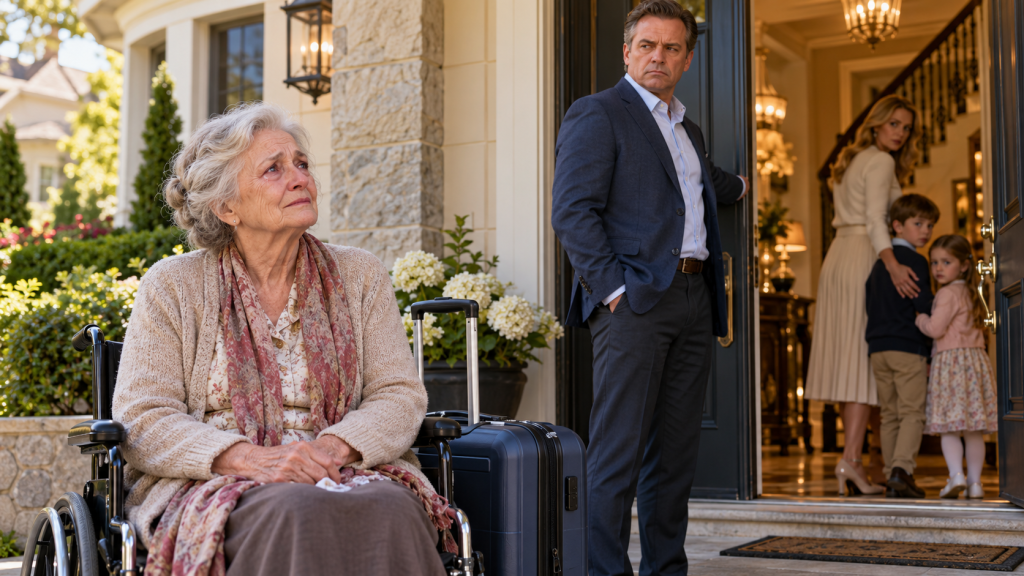
Eight years earlier, I had sat helplessly at the bottom of my son’s driveway believing I had nowhere left to go.
The door had closed before my grandchildren could hug me.
At the time, I thought it was the cruelest thing Marcus had ever done.
Maybe it was.
But sometimes a closed door forces you to stop begging to enter a place where you are not being valued.
Sometimes it makes you turn around.
Sometimes it sends you home.
Sometimes it leads you into an old office.
Toward a forgotten desk.
Behind a stack of bills.
To a small card carrying four handwritten words.
Emergency access only.
Arthur thought those words referred to money.
For years, I thought so too.
But standing beneath the autumn trees, I understood them differently.
The emergency was never simply my shattered hip.
It wasn’t the medical bills.
It wasn’t even Marcus abandoning me.
The emergency was that grief, loneliness, and fear had convinced me I was powerless.
Arthur had left behind millions to protect me from financial desperation.
But the greater inheritance was hidden inside the conditions he attached to it.
He wanted me to recognize the moment when love became exploitation.
He wanted me to know that family did not have the right to erase my boundaries.
He wanted me to understand that being needed and being loved were not always the same thing.
Most of all, he wanted me to remember something I had forgotten after he died.
I still had a life.
My own life.
I reached my car.
Before getting inside, I looked back once.
Sunlight fell across Arthur’s headstone.
For a second, I could almost imagine him standing there in that ridiculous blue cardigan, checking his watch and complaining that cemetery parking was probably overpriced.
I laughed.
Then I drove home.
Not to the old drafty house.
Not to Marcus’s guest room.
Not to a place somebody had reluctantly allowed me to occupy.
Home.
Mine.
That evening, Chloe came over with Ethan and Marcus.
Marcus carried groceries.
Ethan carried a board game.
Chloe carried a chocolate cake.
“What’s this for?” I asked.
“No reason,” she said.
“People don’t bring cakes for no reason.”
“We do.”
Marcus walked into the kitchen.
“Mom, where do you keep the coffee?”
“Which coffee?”
“The normal kind.”
“I don’t own normal coffee anymore.”
He groaned.
“Dad would be horrified.”
“I know.”
Chloe laughed.
Ethan opened the board game across my dining table.
Marcus began arguing with him about the rules.
I watched them.
My family.
Not repaired into what it had once been.
Something different.
Something more honest.
There were cracks.
There would always be cracks.
But light has a strange habit of entering through places that have been broken open.
Chloe cut the cake.
Marcus poured the coffee.
Ethan accused everyone of cheating before the game had even started.
And I sat at the head of my own table.
Nobody had given me permission to be there.
Nobody had granted me a room.
Nobody was tolerating my presence.
I belonged.
Not because I had twelve million dollars.
Not because Arthur had protected me.
Not because Marcus had finally changed.
I belonged because my worth had never depended on whether somebody else had space for me.
That was the lesson money could never buy.
Arthur had simply left me enough freedom to discover it.
Marcus handed me a cup of coffee.
“Mom?”
“Yes?”
“You okay?”
I looked around the table.
At my son.
At my grandchildren.
At the empty chair I still sometimes imagined Arthur occupying.
And this time, when I answered, there was no fear behind the words.
No pretending.
No loneliness.
“I’m more than okay.”
Marcus smiled.
Outside, rain began tapping softly against the windows.
The same kind of rain that had once changed my life.
I listened to it for a moment.
Then Chloe laughed.
Ethan shouted that Marcus was cheating.
Marcus protested.
And I laughed with them.
The storm outside grew louder.
But for the first time in a very long while, I was not afraid of falling.
Because I had finally learned that strength was never about never needing help.
It was knowing the difference between the hands that lift you…
and the hands that reach for what belongs to you.
And once you learn that difference, you never forget it.
THE END STORIES! THANK YOU FOR READING GOOD LUCK !❤️