My neighbor ripped out my disabled daughter’s wheelchair ramp and stacked the boards against our front door. “Move if you don’t like it,” he said. My daughter looked at the pile of lumber and said, “Mom, I can’t get inside.” I started recording, filed a permit request…..
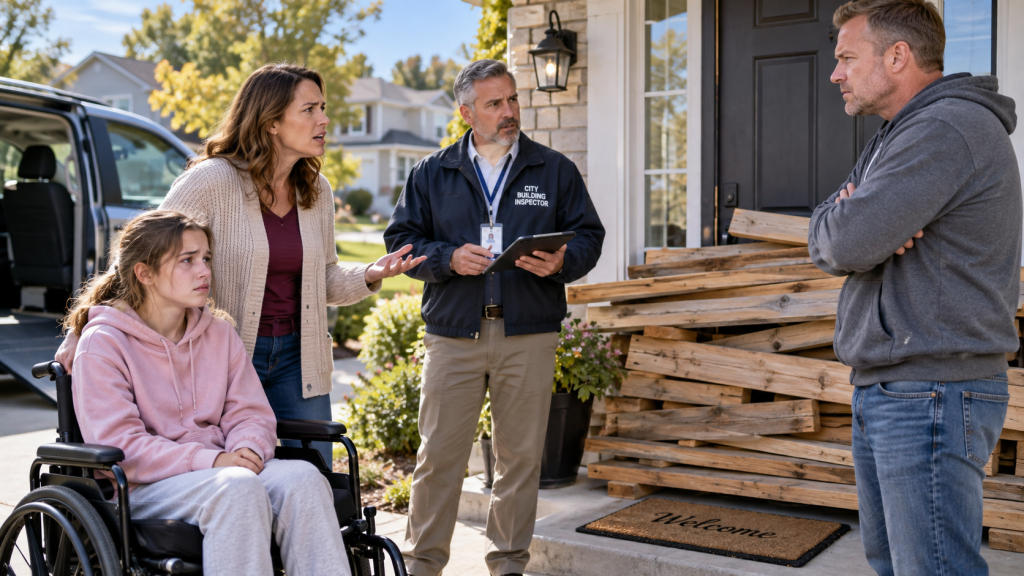
My neighbor ripped out my disabled daughter’s wheelchair ramp and stacked the boards against our front door like firewood. I came home from a physical therapy appointment with Emma, saw the splintered lumber blocking the entrance,

and for a few seconds I genuinely thought I had pulled up to the wrong house. Then Emma looked at the pile, looked at me, and said quietly, “Mom, I can’t get inside.” That sentence did something to me. Not because she sounded angry. Emma rarely gets angry. She sounded embarrassed, as if somebody else’s cruelty had somehow become her inconvenience to apologize for. I got out of the van and found Greg, our next-door neighbor, standing beside his driveway with a cordless drill in one hand. “What happened to the ramp?” I asked. He didn’t even pretend not to know. “I removed it.” “You removed my daughter’s wheelchair ramp?” He shrugged. “Part of it crosses too close to my property.” “It’s been there four years.” “And I’ve tolerated it for four years.” I stared at him. Greg had moved in eleven months earlier and had spent nearly every week since then finding something wrong with our existence. Emma’s accessible van was “too big.” The delivery truck bringing her medical equipment “blocked the street.” The little concrete pad beside our driveway was apparently “ugly.” At first I tried to be polite. Then I tried to ignore him. Neither worked. “You had no right to touch it,” I said. Greg pointed toward the boards. “Move if you don’t like it.” Emma was still sitting in the van behind me, watching through the windshield. I felt heat rise into my face, but instead of yelling, I took out my phone and started recording. “Would you mind repeating that?” His expression changed slightly. “Turn that off.” “You removed an accessibility ramp from my property and blocked my front door. I’d like to make sure I understood you correctly.” He walked away, muttering something about lawyers. I kept recording. Then I called the city. I expected bureaucracy. Forms. Waiting. Instead, when I explained that the ramp had been removed and my daughter could no longer enter her own home safely, the woman on the phone became very serious. She told me to submit an emergency accessibility permit request and not to move anything until an inspector documented it. Emma and I waited in the van for nearly two hours. She tried to make jokes. “At least we have snacks.” I smiled because she needed me to, but inside I was shaking. I had spent ten years fighting insurance companies, inaccessible buildings, broken elevators, strangers who parked in disabled spaces “just for five minutes,” and every other small indignity that teaches a child the world was built without imagining her in it. Home was supposed to be the one place she never had to fight. By noon, a white city truck pulled up. The inspector introduced himself as Mr. Alvarez. He carried a measuring wheel, folding ruler, tablet, and the kind of expression that suggested he had already decided not to waste anyone’s time. He photographed the boards, measured the ramp footings, then asked me for the original permit. I handed him the folder I kept with Emma’s medical records. Greg came outside almost immediately. “Finally,” he said. “Maybe you can explain to her that the ramp is over my property line.” Mr. Alvarez didn’t answer. He measured once. Then again. He checked the subdivision map on his tablet. “Interesting,” he murmured. Greg crossed his arms. “What?” The inspector walked toward the boundary between our lots and placed a small marker in the grass. Then another. The line was nowhere near Emma’s ramp. It ran nearly three feet farther onto Greg’s side than either of us expected. “Your ramp is completely inside your parcel,” Mr. Alvarez told me. Relief hit me first. Then I noticed he wasn’t finished. He looked past Greg toward the brand-new detached garage sitting beside his house. Greg had spent the entire spring building it, boasting about the custom doors, heated floor, workshop, and loft storage. Mr. Alvarez stared at it for a long moment. “When was that constructed?” he asked. Greg’s confidence flickered. “Couple months ago.” “Permit number?” “My contractor handled that.” “Name?” Greg hesitated. Mr. Alvarez started walking. He measured from the property marker to the side wall of the garage. Then he measured again. Greg followed him. “What are you doing?” The inspector ignored him, pulled a can of orange marking paint from his truck, and sprayed a bright line across Greg’s pristine concrete driveway. Then another line ran directly beneath the corner of the garage. Greg’s face changed. “What is that?” Mr. Alvarez looked down at his tablet. “According to the recorded plat, your structure extends four feet beyond the required setback.” “That’s impossible.” “And approximately eighteen inches of the foundation appears to cross onto her parcel.” Silence. I looked at the orange line, then at Greg. His mouth opened, but nothing came out. Mr. Alvarez took several photographs and typed something into his tablet. Greg finally snapped, “You can’t seriously make an issue out of eighteen inches.” The inspector looked at him. “You made an issue out of a wheelchair ramp that wasn’t on your property at all.” Greg’s face reddened. “So what happens now?” Mr. Alvarez walked to the garage door, placed an orange notice against it, and said four words in a calm, almost bored voice. “This structure comes down.” Greg laughed, but nobody else did. “Very funny.” “I’m not joking.” The inspector explained that the garage had no valid permit on file, violated setback requirements, and appeared to encroach on my property. Until a survey and permit review were completed, construction use was suspended. If the encroachment was confirmed, removal or major reconstruction would be required. Greg turned toward me. “You did this.” I almost couldn’t believe what I was hearing. “I asked you to leave my daughter’s ramp alone.” His expression hardened. “You’re going to regret this.” Mr. Alvarez immediately looked up. “Was that a threat?” Greg went silent. The inspector turned to me and quietly told me to keep every recording. Then he looked at Emma, still waiting in the van, and said, “We’re getting your ramp restored today.” By three o’clock, a city-contracted accessibility crew had temporarily rebuilt the entrance while the original boards were kept as evidence. Emma rolled up the new ramp slowly. When she reached the porch, she turned toward me and smiled. “Guess I can get inside now.” I laughed and cried at the same time. But across the lawn, Greg stood beside his garage staring at the orange notice as if hatred alone might erase it. That evening, just after sunset, someone slipped an envelope beneath my front door. There was no name on it. Inside was a copy of an old property survey, a photograph of Greg shaking hands with the contractor who built the garage, and one handwritten sentence: “Ask the inspector who approved the first plans.” At the bottom was a name I recognized immediately. It belonged to Greg’s brother-in-law—the deputy director of the city building department.
PART 2 — THE LINE HE NEEDED ME TO MOVE
I read the sentence three times.
Ask the inspector who approved the first plans.
Then I looked at the name written beneath it.
Daniel Mercer.
Not my Mercer.
Not family.
Daniel Mercer was Greg’s brother-in-law.
And, more importantly, deputy director of the city building department.
I knew the name because Greg had used it before.
Not often.
Just enough.
The first time was when he complained about our accessible van.
He had stood at the edge of my driveway and said:
“My brother-in-law works for the city. If that thing violates anything, I’ll find out.”
The second time was when I put a temporary storage pod beside the house during a bathroom renovation.
He had smiled and said:
“You’d be surprised how fast code enforcement moves when you know the right people.”
I had assumed it was bluster.
The kind of small-town name-dropping people use when they want power to seem closer than it is.
Now I was holding a survey and a photograph of Greg shaking hands with that same brother-in-law beside the garage that apparently had no valid permit on file.
My stomach tightened.
Emma rolled into the hallway.
“Mom?”
I quickly lowered the papers.
Too late.
“What’s that?”
“Something somebody left under the door.”
“About Greg?”
“Yes.”
She groaned.
“Of course it is.”
Then she looked at my face.
“How bad?”
“I don’t know.”
That was the truth.
And I was becoming very protective of the truth.
Not:
Corruption.
Not:
Fraud.
Not:
City conspiracy.
An envelope.
A photograph.
A name.
Questions.
That was all.
For now.
I called Mr. Alvarez the next morning.
Not his private number.
The city inspection office.
I left a message saying I had received information that might relate to the garage review.
He called back twenty-three minutes later.
“What information?”
I described the envelope.
He became very quiet.
Then:
“Do not email the documents yet.”
That surprised me.
“Why?”
“I want them logged properly.”
My pulse changed.
“Is Daniel Mercer involved?”
“I can’t answer that.”
“Do you know he’s Greg’s brother-in-law?”
Another pause.
“Yes.”
“Did he approve the garage?”
“I said I can’t answer that yet.”
His tone was not defensive.
Careful.
Good.
Then:
“Bring the envelope to the municipal office at ten.”
“Who will be there?”
“Me.”
“And someone from compliance.”
Compliance.
That word did not feel comforting.
It felt serious.
Before I left, I checked the new ramp twice.
Not because anything was wrong with it.
Because after seeing splintered boards against my front door, I had developed a habit of looking.
Emma noticed.
“You know it’s still there.”
“I know.”
“Mom.”
“What?”
“You checked it last night.”
“I know.”
She smiled sadly.
“Greg really messed you up.”
That sentence stopped me.
Not because I disagreed.
Because she said it without self-pity.
I looked at her.
“He scared me.”
“Me too.”
“I’m sorry.”
Her eyebrows drew together.
“For what?”
“For making home feel unsafe.”
She stared at me.
“Mom.”
“I know it wasn’t my fault.”
“Good.”
Then:
“Because if you apologize for Greg again, I’m charging you five dollars.”
I laughed.
“Extortion.”
“Accessibility fee.”
“Illegal.”
“Take it up with the city.”
Dark humor.
Teenage medicine.
I kissed her forehead.
She pretended to hate it.
Normal.
Good.
At the municipal office, Mr. Alvarez met me beside a woman named Renee Cho from the city’s compliance and ethics unit.
She was small, sharply dressed, and carried no visible patience for dramatic conclusions.
Excellent.
I handed her the envelope.
She photographed it.
Logged the contents.
Asked whether I knew who delivered it.
“No.”
“Any camera?”
“My doorbell camera caught a hooded person, but the face isn’t visible.”
“Time?”
“7:42 p.m.”
“Keep the original video.”
“I already downloaded it.”
Mr. Alvarez almost smiled.
“Good.”
Apparently I was becoming everyone’s favorite paranoid homeowner.
Renee looked at the old survey.
It appeared legitimate.
Recorded nine years earlier when the previous owner refinanced.
The boundary line matched the plat Mr. Alvarez had used the day before.
Then she looked at the photograph.
Greg.
His contractor.
Daniel Mercer.
Standing near the beginning of the new garage foundation.
Date printed in the lower corner.
Three months earlier.
“Do you recognize the contractor?”
she asked.
“No.”
Mr. Alvarez did.
“Blake Fenner.”
Renee wrote the name down.
“Licensed?”
“Currently.”
“Any open complaints?”
Alvarez hesitated.
“One unrelated permit issue last year.”
Nothing dramatic.
Then Renee looked at me.
“You understand this photograph does not establish that Mr. Mercer improperly approved anything.”
“Yes.”
“And being related to an applicant does not automatically mean a violation occurred.”
“Yes.”
“And the survey may have been supplied for legitimate reasons.”
“Yes.”
She nodded.
“I appreciate you not making my job harder.”
“I have a sixteen-year-old who depends on a ramp to enter her own home.”
My voice shook.
“I’m past wanting a scandal.”
“I want people to stop touching our property.”
Renee’s expression softened.
“Fair.”
She asked us to wait.
Twenty minutes became forty.
Then an hour.
Eventually she returned carrying a thin folder.
Not the full permit file.
A working copy.
She sat.
“Here is what I can tell you today.”
My heartbeat climbed.
“There was an application for the detached garage.”
Greg had technically told the truth about that.
“My contractor handled it.”
Sort of.
“The first application was submitted in February.”
“Okay.”
“It was rejected for zoning corrections.”
“Why?”
Renee looked at Alvarez.
He answered.
“Setback.”
My skin went cold.
“Already?”
“Yes.”
The first site plan showed the proposed garage too close to the property boundary.
Not necessarily across it.
But well inside the required setback.
The zoning technician returned the plans with a note:
REVISE LOCATION OR PROVIDE APPROVED VARIANCE / BOUNDARY DOCUMENTATION.
I stared.
“So Greg knew?”
Renee corrected immediately.
“The application contact received the notice.”
“Who was the contact?”
“His contractor.”
“Did Greg receive it?”
“We don’t know yet.”
Good.
Evidence first.
A second plan was submitted eleven days later.
This one looked different.
The garage had not moved.
The drawn property line had.
I leaned closer.
“What am I looking at?”
Mr. Alvarez pointed.
On the original plan, the lot boundary ran roughly where yesterday’s orange line had been painted.
On the revised plan, the boundary shifted toward my house by almost three feet.
Exactly enough to make the garage look compliant.
My stomach tightened.
“Can they just do that?”
“No.”
Alvarez’s answer was immediate.
“A site plan can be corrected if the first boundary was wrong.”
“But a recorded property line does not move because somebody redraws it.”
“So what supported the new line?”
Renee turned one page.
A survey sketch.
Not the old recorded survey from my envelope.
A newer one.
Unsigned.
No surveyor’s seal.
No recording information.
Just measurements.
The line had been shifted.
I stared.
“Who made that?”
“We are determining that.”
Then came the approval history.
A junior zoning analyst had flagged the unsigned sketch.
She wrote:
Boundary revision unsupported. Need recorded survey or licensed survey confirmation.
Two days later, the flag disappeared.
The application moved forward.
“Who cleared it?”
I asked.
Renee did not answer immediately.
Then she slid the page toward me.
Internal user log:
D. MERCER — SUPERVISORY OVERRIDE
My mouth went dry.
Daniel.
Greg’s brother-in-law.
“He approved it?”
Renee lifted one finger.
“He overrode the documentation hold.”
“Does that mean he personally approved the garage?”
“No.”
Good.
She continued.
“Final approval involved several workflow steps.”
“But he intervened in a file involving his brother-in-law?”
“Apparently.”
“Is that allowed?”
“City conflict rules would normally require disclosure and recusal from a matter involving immediate family or closely related household interests.”
“Did he disclose?”
“We have not found a disclosure yet.”
There.
Not proof of a criminal scheme.
Enough for an internal problem.
Mr. Alvarez looked genuinely angry.
Not theatrical.
Professional anger.
The kind that tightens the mouth.
He said:
“That explains the permit number.”
“What about it?”
“When I looked yesterday, there was no valid permit showing under the address.”
“But there was an application.”
“Yes.”
“Why couldn’t you see it?”
He glanced at Renee.
She answered.
“Because the permit was never fully issued through the normal public-facing record.”
I stared.
“What does that mean?”
“The file reached an internal conditional status.”
“Then a temporary construction authorization appears to have been generated.”
“By whom?”
Again.
Internal user history.
Daniel Mercer.
My stomach turned.
“What is temporary construction authorization?”
I asked.
Alvarez explained.
In some limited circumstances, the department could allow preliminary work while certain non-safety documents were being resolved.
Excavation.
Site preparation.
Sometimes foundations.
But not a free pass to complete an entire structure.
Greg’s garage had gone far beyond preliminary work.
Walls.
Roof.
Doors.
Electrical.
Heated slab.
Loft.
Finished exterior.
“What inspections did it pass?”
I asked.
Silence.
Then Alvarez said:
“None are recorded.”
I stared at him.
“How does someone build an entire garage without inspections?”
He looked embarrassed on behalf of his profession.
“Sometimes they don’t call.”
That simple.
No secret tunnel under city hall.
A contractor keeps building.
An owner keeps paying.
No inspector arrives because no inspection gets scheduled.
And if somebody has enough confidence that paperwork can be fixed later, a structure can become very real before the system catches up.
Renee closed the folder.
“This now becomes an internal investigation.”
“What happens to Greg?”
“Separate question.”
“The garage remains under stop-work and no-use orders.”
“What about my land?”
“A licensed survey will be required.”
“The city survey?”
“Independent surveyor.”
“Who pays?”
“That may ultimately be assigned depending on findings.”
“I’m hiring my own.”
She nodded.
“Reasonable.”
I had learned enough.
When property lines enter a family story, hire someone whose paycheck does not depend on anybody’s brother-in-law.
I called a surveyor that afternoon.
His name was Thomas Greene.
Sixty-two.
Sunburned.
Extremely unimpressed by orange spray paint.
He spent most of the next day locating pins, checking recorded documents, measuring both parcels, and muttering to himself.
Emma watched through the front window.
At one point she said:
“I feel like we’re on the world’s most boring detective show.”
I handed her popcorn.
“Property Line Unit.”
She nodded solemnly.
“Dun dun.”
I laughed.
Again.
Normal mattered.
Thomas finished at four.
He came inside because Greg had been standing near the edge of his driveway watching us.
Thomas put a map on my dining table.
“The recorded boundary is where the city inspector marked it.”
My stomach loosened.
“And the garage?”
“Foundation crosses approximately seventeen to nineteen inches onto your parcel along the rear portion.”
“So Alvarez was right.”
“Close enough for field work.”
“And the setback?”
“Substantially violated even if we pretend the encroachment doesn’t exist.”
“How substantially?”
“Enough that they cannot fix this with a decorative shrub.”
I almost smiled.
Then:
“What about my ramp?”
“Fully inside your property.”
“Distance?”
“At its closest point, more than two and a half feet from the boundary.”
Greg had ripped apart a ramp nowhere near his land.
And built a garage on mine.
Reality had a dark sense of humor.
Thomas also found something else.
A metal boundary pin near the garage had been disturbed.
Not removed.
Bent and partially buried beneath fresh landscaping.
“Could construction do that?”
I asked.
“Absolutely.”
“Could someone do it intentionally?”
“Also absolutely.”
“Can you tell which?”
“No.”
Good.
No invented certainty.
He marked it in his report.
Documented the condition.
Moved on.
Greg knocked on my door that evening.
I did not answer.
He knocked again.
Then rang the bell.
My new camera recorded everything.
“Come on.”
he called.
“We need to talk.”
Emma looked at me from the living room.
“Nope.”
I agreed.
“Nope.”
Greg knocked harder.
“I know you’re home.”
I picked up my phone.
Not recording secretly.
The doorbell camera already was.
I spoke through it.
“Please leave.”
“This is ridiculous.”
“Please leave.”
“You’re destroying my property over a few inches.”
“My property is the part your garage is sitting on.”
Silence.
Then:
“You know what I mean.”
No.
I was beginning to hate that phrase.
People say it when the literal meaning is too embarrassing.
Greg lowered his voice.
“We can solve this.”
“How?”
“Open the door.”
“No.”
He looked toward the camera.
Then:
“Sign a simple boundary adjustment.”
My entire body went still.
There.
He had not said:
Survey again.
Challenge the line.
Appeal.
He went straight to:
Sign.
“What boundary adjustment?”
“Give me two feet along that side.”
Emma stared at me.
I stared back.
“Give you?”
“We can work something out.”
“You ripped out my daughter’s ramp yesterday because you claimed it was on your property.”
He looked away.
“That was before we knew.”
No.
Before I knew.
He apparently knew exactly what he needed.
I said:
“Put any proposal through an attorney.”
His face hardened.
“You don’t need an attorney.”
There are very few sentences that make me want an attorney more than:
You don’t need an attorney.
“Good night, Greg.”
He stepped closer to the camera.
“You think the city’s going to tear down a hundred-thousand-dollar garage over eighteen inches?”
“I think you should leave my porch.”
Then I called the non-emergency police line.
He left before anyone arrived.
Fine.
The recording remained.
The next day, I hired an attorney.
Her name was Marisol Vega.
Property disputes.
Municipal issues.
ADA-access-adjacent housing work, though she was careful not to promise which accessibility laws applied to every fact.
She reviewed everything.
Ramp permit.
Survey.
Videos.
Greg’s threat.
The anonymous envelope.
City notices.
Then she said:
“First, do not negotiate directly.”
“Done.”
“Second, do not agree to a boundary adjustment simply because demolition would be expensive for him.”
“Also done.”
“Third, the garage encroachment is a civil property issue separate from whatever the city does about permits.”
“So even if the city lets him keep it?”
“You still have rights regarding your land.”
“And the ramp?”
“Separate again.”
I groaned.
“How many separate things can one man create in forty-eight hours?”
Marisol smiled.
“Property law rewards categories.”
Terrible system.
Useful attorney.
She sent Greg a preservation letter and notice that all future communication should go through counsel.
Then something unexpected happened.
Greg’s contractor called her.
Blake Fenner.
He wanted to cooperate.
Not with me directly.
Through attorneys.
His license was now under review too, and apparently self-preservation had finally become more powerful than loyalty.
Marisol met with him three days later.
I attended.
Blake looked exhausted.
Not like a criminal mastermind.
Like a contractor who had made several increasingly stupid decisions because a client kept saying:
“My brother-in-law has it handled.”
That phrase appeared often.
Blake brought emails.
Texts.
Plan copies.
Invoices.
And, most importantly, his own rejected plans.
The first set matched the city file.
Boundary correct.
Garage too close.
Blake had emailed Greg:
Zoning kicked it back. Need move garage about 6 feet or pursue variance. Current layout won’t pass.
Greg replied:
Don’t redesign yet. Daniel can fix setback.
My stomach tightened.
Daniel.
Again.
Blake wrote:
Setback maybe. Property line can’t be fixed. Survey looks tight.
Greg:
Neighbor’s ramp already crosses over anyway. We can adjust line.
I stopped breathing.
Date:
February.
Five months before Greg tore out the ramp.
He had been talking about my ramp as leverage before the garage foundation was poured.
I looked at Blake.
“Did the ramp cross?”
“No.”
“Did you know?”
He hesitated.
“I never surveyed it.”
“Did Greg?”
“I assumed he had some reason for saying it.”
Marisol leaned forward.
“What happened next?”
Blake showed another email.
He had recommended moving the garage.
Cost of redesign:
Annoying but manageable.
Greg refused because he wanted the workshop aligned with the driveway and did not want to lose yard space on the other side.
Then came a message:
Daniel says revised site sketch will go through. Build foundation where marked.
Blake did.
That was his problem.
He knew zoning had questioned the line.
Yet he built on an unsealed revision.
His attorney would later have a very long conversation about that.
“Why did construction continue without inspections?”
Marisol asked.
Blake rubbed his forehead.
“Greg said Daniel was handling interim authorization.”
“Did you verify?”
“I saw the temporary letter.”
“The one from the city system?”
“Yes.”
“Did it authorize the full build?”
“No.”
Silence.
There.
His part.
Not innocent.
Not architect.
A contractor who saw enough warning signs and chose progress anyway.
He continued:
“I thought we’d catch inspections up.”
Alvarez would later call that sentence “how buildings become evidence.”
I liked him more every day.
Then Blake pulled out a folder.
“This is why I called.”
Inside was a draft agreement.
Title:
BOUNDARY LINE ADJUSTMENT AND MUTUAL ACCESS AGREEMENT
My name appeared at the top.
I had never seen it.
I read slowly.
The draft proposed shifting the boundary between our properties approximately thirty inches toward my house for part of the side yard.
In exchange, Greg would grant me a permanent “access easement” for the existing wheelchair ramp.
I stared.
He was offering me legal permission to keep a ramp already entirely on my own property.
In exchange for land he needed to save his garage.
My stomach turned.
“This is insane.”
Marisol remained calm.
“Who prepared it?”
Blake pointed.
A filename in the footer.
Mercer_Draft3
Daniel’s surname.
Could be coincidence.
Could be Daniel.
Needed proof.
“Did Greg ask you to give this to me?”
“No.”
“When was it created?”
“First version in March.”
Months before he touched the ramp.
There were three versions.
Draft one:
Simple boundary adjustment.
Draft two:
Added ramp easement.
Draft three:
Added a clause saying the parties “acknowledge historical uncertainty regarding the true boundary and resolve all prior encroachments.”
That sentence made Marisol sit up.
“Historical uncertainty.”
“Yes.”
“What prior encroachments?”
Blake looked at me.
“Greg kept saying the ramp crossed.”
“But it didn’t.”
“I know that now.”
Marisol looked at the clause again.
If I had signed it, I might have been acknowledging a boundary dispute that, according to the recorded survey, did not actually exist.
Not automatically surrendering every right.
But muddying the history.
Creating language Greg could later point to.
He did not need to prove the ramp had crossed.
He needed me to sign something saying we both agreed the line had been uncertain.
That was the plan.
I felt sick.
“He ripped out the ramp to make this look real.”
Marisol raised one hand.
“We do not know that yet.”
Right.
I breathed.
“What do we know?”
“We know a draft agreement existed months ago.”
“We know it offered you an easement for a ramp that does not appear to require one.”
“We know Greg had been told the garage faced setback and possibly boundary problems.”
“We know he later removed the ramp claiming it crossed his property.”
“And we know he asked you yesterday to sign a boundary adjustment.”
Enough.
Not motive proven.
Pattern emerging.
Then Blake said:
“There’s a text.”
My heart dropped.
He unlocked his phone.
His attorney had already preserved and exported the relevant messages.
Good.
No screenshots invented in a kitchen.
Chain.
Metadata.
Actual records.
He found a conversation from six days before Greg removed the ramp.
Greg:
City still dragging final. Need neighbor issue resolved.
Blake:
Have her lawyer review boundary agreement.
Greg:
She won’t lawyer up. She hates conflict.
I stared.
Emma had once said almost exactly that about me.
Mom hates conflict.
True.
Or had been.
Then Blake:
Just ask her. Don’t create a problem.
Greg:
The ramp is the problem. Once she sees it’s over line, she’ll sign.
My hands went cold.
Blake replied:
It’s not over line on old survey.
Greg:
Daniel says old survey doesn’t control new adjustment.
Marisol’s eyes narrowed.
That statement made no legal sense by itself.
A future adjustment does not retroactively change where the line was.
But perhaps Greg believed it.
Or wanted others to.
Then the final text:
I’ll deal with ramp Thursday.
Thursday.
The day I came home from Emma’s physical therapy appointment.
The day the boards were stacked against our front door.
I stopped breathing.
There it was.
Not:
He got angry that morning.
Not:
Spontaneous property dispute.
I’ll deal with ramp Thursday.
Planned.
Days ahead.
Marisol asked Blake:
“What did you understand that to mean?”
He shook his head.
“I thought he was going to talk to her.”
“Did he say remove it?”
“No.”
“Did you help remove it?”
“No.”
“Did Daniel?”
“I don’t know.”
Good.
No stretching.
I stared at the text.
Greg had planned something involving the ramp.
Whether he had planned demolition specifically, the message did not say.
But by Thursday, he was outside with a drill.
And my daughter could not enter her own house.
Then Blake produced one more email.
From Greg to Daniel Mercer.
Blake had been copied accidentally, apparently because Greg reused an old thread.
Subject:
Line issue
Message:
Need this done before Alvarez or anyone else gets nosy. If she signs adjustment, garage is clean enough for final. I can lean on ramp encroachment if needed.
My stomach turned.
Date:
Two weeks before demolition.
Daniel replied twelve minutes later:
Do not put anything about the ramp in city email. Handle neighbor privately.
The room went silent.
I looked at Marisol.
She did not react dramatically.
That frightened me more.
“Is that bad?”
She answered carefully.
“It raises significant questions.”
“Did Daniel know the ramp wasn’t over the line?”
“We don’t know.”
“Did he know Greg wanted to use it as leverage?”
“This email suggests he knew Greg was considering raising a ramp encroachment issue privately.”
“Is that corruption?”
“No conclusion yet.”
Again.
Precision.
But Renee Cho was going to care.
A lot.
We provided the documents to the city through formal channels.
Not social media.
Not neighborhood Facebook.
Formal.
Renee called the next morning.
Her voice was colder than before.
“We’ve placed Deputy Director Mercer on administrative leave pending investigation.”
My stomach dropped.
Not fired.
Not arrested.
Leave.
Right.
“What about Greg?”
“Code and property enforcement continue separately.”
“And the garage?”
“An engineering and zoning review has concluded the current structure cannot be approved as built.”
My pulse climbed.
“What does that mean?”
“It must be brought into compliance.”
“How?”
“Potential options include removal, substantial reconstruction, or a lawful property solution if all affected owners voluntarily agree and zoning requirements can also be satisfied.”
There it was.
Voluntarily.
My land was not a city repair kit for Greg’s mistake.
“Can they force me to sell him the strip?”
“No.”
Immediate.
Good.
“Can he force an easement because the garage is already there?”
“That is a question for your attorney and civil court if he pursues such a theory.”
Again.
Separate systems.
I hated categories slightly less now.
Then Renee added:
“The city will not approve a boundary-dependent remedy based on coerced consent.”
I thought of the splintered ramp.
“Good.”
Greg changed tactics.
Of course.
His attorney contacted Marisol.
The first offer:
Greg would rebuild my permanent ramp at his expense, pay for landscaping, and give me $5,000 if I signed the boundary adjustment.
I laughed.
Not because $5,000 was small.
Because he was offering to rebuild something he had already destroyed.
Marisol said:
“Do not respond emotionally.”
I said:
“My emotional response is ten feet long.”
“That is why I’m responding.”
Good.
We declined.
Second offer:
$15,000.
Boundary shift reduced slightly.
Permanent ramp easement.
Again, an easement I did not need.
Declined.
Third:
$30,000.
Plus fence replacement.
Declined.
Greg eventually came outside when he saw me collecting mail.
“You’re being unreasonable.”
I stopped at my porch.
Camera overhead.
“What would reasonable look like?”
“You have land you don’t use.”
I looked at the narrow strip beside my driveway.
Grass.
Part of Emma’s accessible turning area.
Storm drainage.
Space.
My land.
“It’s mine.”
“It’s eighteen inches.”
“Then why do you need it so badly?”
He went red.
“Because tearing down that garage could bankrupt me.”
There.
Finally.
Fear.
Not entitlement alone.
Fear.
For one second, I saw the person underneath the aggression.
A man who had spent too much.
Built wrong.
Trusted a relative’s power.
Now faced a consequence large enough to terrify him.
I almost felt sorry for him.
Then I remembered Emma saying:
Mom, I can’t get inside.
Compassion did not require surrender.
I said:
“You had choices before the foundation was poured.”
His face hardened.
“Blake told you.”
That surprised him.
“Move the garage.”
“Apply properly.”
“Get a real survey.”
“Ask me respectfully whether I would consider selling land before building on it.”
“You didn’t.”
He stared.
“You would have said no.”
“Maybe.”
“And that gave you the right to build first?”
Silence.
There.
The logic of entitlement exposed itself.
He assumed my no would be inconvenient.
So he tried to make yes unavoidable.
“I didn’t mean for Emma to be stuck outside.”
he muttered.
That angered me more than denial.
“What did you think would happen when you removed the ramp?”
“She could use the back.”
“No.”
He blinked.
“What?”
“The back entrance has stairs.”
He looked genuinely confused.
Of course.
He had spent eleven months complaining about Emma’s equipment without learning the simplest fact about her mobility.
The front ramp was not decorative.
It was access.
I said:
“You were so busy treating accessibility like an inconvenience that you never bothered to understand what it was for.”
Greg looked away.
I walked inside.
Emma had heard through the open window.
She was quiet.
Then:
“He really thought I could use the back?”
“Yes.”
She laughed.
Not funny.
“I love when people hate accommodations they don’t understand.”
I sat beside her.
“I’m sorry.”
“Five dollars.”
Right.
I smiled.
“No apology.”
“Good.”
Then she became serious.
“Are you going to sell him the land?”
I looked at her.
“What do you think?”
“It’s your land.”
“Our home.”
She nodded.
Then:
“If you want to, I don’t care.”
That surprised me.
“Really?”
“Yes.”
“I care about the ramp.”
“The strip of grass doesn’t have feelings.”
I laughed.
Wise child.
Then she continued.
“But don’t do it because he made things scary.”
My chest tightened.
There.
Consent.
Even at sixteen, she understood the difference between choosing and yielding.
“I won’t.”
The internal city investigation lasted weeks.
Rumors spread anyway.
Greg told neighbors I had “weaponized Emma’s disability.”
That phrase reached me through someone down the street.
I almost went nuclear.
Marisol stopped me.
“Silence.”
“I hate silence.”
“No.”
“You hate not controlling what everyone thinks.”
Annoying attorney.
Correct.
We documented.
Waited.
Daniel Mercer’s situation became clearer.
He had not forged an entire permit.
He had not secretly changed the recorded plat.
Again, reality was more mundane.
And more believable.
He used supervisory authority to override a documentation hold involving his brother-in-law’s project without disclosing the conflict.
He generated a limited construction authorization that was then treated by Greg and Blake as permission to keep building far beyond its intended scope.
He discouraged Greg from discussing the ramp issue in city email.
He participated in conversations about resolving the boundary after construction was already underway.
Investigators found no proof he personally created the unsigned survey sketch.
That question remained unresolved.
But his involvement was enough for serious employment consequences.
The city terminated him after its review.
Professional licensing questions related to his role were referred where appropriate.
No dramatic police raid.
No federal conspiracy.
A career ended because he used a public position to help a relative bypass controls designed to protect everyone.
Including relatives from themselves.
Blake’s contractor license was disciplined too.
He had warnings.
He continued building.
His cooperation mattered.
So did his conduct.
He paid penalties, faced restrictions, and had to address code and professional requirements.
He later told Marisol:
“I kept thinking Greg’s connection would fix it.”
That sentence could have been the motto for the entire garage.
Connection instead of compliance.
Then came the garage order.
Official.
Not Mr. Alvarez theatrically declaring:
“This structure comes down.”
His first statement had been directionally right but procedurally incomplete.
The formal process took longer.
Engineering review concluded the portion crossing onto my parcel could not remain without my consent.
Zoning concluded the garage also violated setback even if the property issue were resolved.
The city denied Greg’s request to legalize it as built.
He could appeal.
He did.
Lost.
Then had two practical options.
Remove the garage.
Or reconstruct it substantially within his lawful building envelope.
He chose reconstruction.
Probably because demolition of the entire structure would have cost even more.
One side of the garage had to be dismantled.
Part of the foundation removed.
The building narrowed and shifted through significant structural work under permits, inspections, engineering, and actual adult supervision.
It took months.
Cost a fortune.
I did not celebrate.
I did watch every inspection truck arrive.
I am human.
Before work began, Greg’s attorney asked one final time whether I would sell the strip.
The number was much higher now.
Enough to make me sit quietly for a while.
Money mattered.
Emma’s future medical expenses mattered.
College.
Accessible vehicles.
Home modifications.
I would be lying if I said principle made the decision easy.
So I did something Greg never gave me the chance to do.
I considered freely.
Survey.
Drainage.
Ramp clearance.
Future resale.
Emma’s turning radius.
Legal implications.
I spoke with Marisol.
Thomas Greene.
An accessibility contractor.
Then I said no.
Not because Greg deserved punishment.
Because the strip was useful to us.
And because once all the pressure was removed, no remained my actual answer.
That difference gave me peace.
Greg did not speak to us for nearly three months.
Fine.
Then one afternoon, as crews were cutting concrete from the garage foundation, he came to the edge of my driveway.
Did not cross.
Good.
“Can I talk to you?”
I looked at the camera.
Then at him.
“From there.”
He nodded.
For once, no complaint.
No drill.
No smirk.
“I was wrong.”
I waited.
He swallowed.
“About the line.”
“About the ramp.”
“About… all of it.”
I said nothing.
He looked toward the front porch.
“The day I took it out, I thought if I could make you believe the boundary was disputed, you’d agree to the adjustment.”
There.
Finally.
Not inferred.
Admitted.
My chest tightened.
“You knew it might not be over the line.”
“Yes.”
“Did you know it wasn’t?”
He hesitated.
“I knew the old survey showed it wasn’t.”
Precise enough.
“And you removed it anyway.”
“Yes.”
“Why stack it against the door?”
His face changed.
Shame.
“I was angry.”
“At what?”
“That you wouldn’t stay out of it.”
I almost laughed.
“My land.”
“I know.”
“My daughter’s entrance.”
“I know.”
“My home.”
“I know.”
Silence.
Then:
“I wanted you upset enough to talk to me.”
That sentence made me cold.
He had created the emergency, then expected distress to become leverage.
People do that more often than they admit.
“Emma was trapped outside.”
“I know.”
“No.”
I shook my head.
“You know now.”
He looked at me.
“If you had understood then, you wouldn’t have done it.”
I hoped.
Maybe.
He said:
“I’m sorry.”
I studied him.
Did I believe he regretted it?
Yes.
Did I trust him?
No.
Those things could coexist.
“I hear you.”
Not forgiveness.
Not friendship.
Acknowledgment.
Enough.
Then:
“Do not touch anything on my property again.”
“I won’t.”
Good.
He kept that promise.
At least so far.
The anonymous envelope remained a mystery.
For months.
Then one day, Renee Cho called.
“We know who delivered it.”
My stomach tightened.
“Who?”
“A former permit technician.”
Her name was Leah Bowman.
She had worked beneath Daniel Mercer.
She had seen the first zoning rejection.
Seen the override.
Seen the unsigned sketch.
Then watched the garage appear anyway.
She resigned for unrelated reasons two months later.
When she saw Mr. Alvarez’s orange notice from the sidewalk on the day the ramp was removed, she realized the file had finally surfaced.
“Why anonymous?”
I asked.
“She was afraid of becoming part of the dispute.”
“Then why leave anything?”
“Because she thought the city might bury it.”
That hurt Renee.
I could hear it.
“Did they?”
“No.”
“Good.”
Then Renee said:
“But she did not know who she could trust.”
There it was.
Institutions do not lose trust only when they act wrongly.
Sometimes they lose it because people cannot tell whether they will act rightly.
The city changed several conflict-disclosure procedures afterward.
Supervisory overrides involving relatives required independent review.
Temporary construction authorizations became easier for field inspectors to see.
Permit histories more transparent.
Boring fixes.
Important ones.
Emma’s ramp was rebuilt permanently that fall.
Not just temporary lumber.
A contractor designed a stronger version with better drainage and a turning platform that made winter access safer.
Who paid?
Greg covered the documented cost of restoring what he had removed as part of the civil resolution.
I paid separately for upgrades beyond the original configuration.
Again.
Precision.
He did not buy Emma a luxury ramp as punishment.
He restored the access he destroyed.
We improved it because we wanted to.
The city inspected it.
Mr. Alvarez himself came.
Of course.
Emma rolled up and down once.
Then said:
“Can we stop making my ramp a government event?”
He laughed.
“Absolutely.”
She liked him.
The original boards stayed in evidence longer than expected.
When they were finally released, I was asked whether I wanted them.
I almost said no.
Then changed my mind.
We kept one.
Just one.
A scarred piece of wood with screw holes and a splintered edge.
Not framed.
Not displayed.
It sits behind the shelves in my garage.
Sometimes Emma threatens to turn it into a sign.
WELCOME. PLEASE VERIFY YOUR PROPERTY LINE BEFORE BEING A JERK.
I told her absolutely not.
She is still considering it.
The rest of the boards went away.
Good.
I did not want our home surrounded by relics of someone else’s cruelty.
A ramp should be used.
Not memorialized.
Greg’s garage eventually became smaller.
Still nice.
Still heated.
Still more expensive than any reasonable person needed.
But inside his property.
Inside setback.
Inspected.
Legal.
Strangely, after the reconstruction, he stopped bragging about it.
Consequences can humble architecture.
He also stopped complaining about Emma’s van.
The medical deliveries.
The concrete pad.
Everything.
For a while I thought that was fear of another complaint.
Maybe partly.
Then one winter morning, after heavy snow, I opened the door and found the sidewalk between our driveway and the ramp already shoveled.
Greg was clearing his own side.
I looked at him.
“Did you do this?”
He nodded.
I braced for symbolism.
He simply said:
“Snow was there.”
Then went back to shoveling.
I did not thank him extravagantly.
Did not declare redemption.
“Thanks.”
He nodded.
Sometimes changed behavior should be allowed to remain boring.
That is how you know it might be real.
Emma did not become his friend.
Neither did I.
We exchanged polite hellos.
Nothing more.
He was not invited inside.
No neighborhood reconciliation barbecue.
Boundaries can survive apology.
That is not cruelty.
It is memory doing its job.
The civil case ended through settlement.
Greg compensated us for the destroyed ramp, temporary access expenses, and other documented losses connected to his actions.
No lottery.
No giant punitive fortune.
Enough to restore what should never have been damaged and address actual costs.
The property line was formally confirmed through recorded survey documents so nobody could pretend it was uncertain again.
Marisol made sure the agreement contained no language suggesting my ramp had ever encroached.
I loved her for that.
Facts matter even after money changes hands.
The city also reimbursed certain emergency accessibility work it had undertaken under its own procedures, then handled recovery and responsibility internally.
I did not become wealthy from government mistakes.
I became tired.
Then less tired.
That was the real settlement.
Emma returned to physical therapy.
Of course.
Her life had never actually been about Greg.
That became important too.
For weeks, strangers around the neighborhood treated her as:
“The girl whose ramp got torn out.”
She hated it.
At therapy one day, another parent said:
“You’re the wheelchair ramp girl!”
Emma smiled tightly.
Then answered:
“I’m Emma.”
I nearly cried.
That sentence contained the entire story.
Not wheelchair.
Not ramp.
Not victim.
Emma.
We stopped discussing Greg at dinner.
That was deliberate.
For months, every meal had become:
City called.
Attorney emailed.
Garage appeal.
Survey result.
Permit hearing.
Emma finally said:
“Can we have one conversation where my accessibility isn’t the family plot?”
Fair.
So we created a rule.
Greg talk only if something required action.
Otherwise:
School.
Movies.
Therapy gossip.
Bad television.
Life.
The conflict got smaller when we stopped feeding it every room in the house.
A year later, Emma started driving lessons in an adapted vehicle.
Terrifying.
For me.
She loved it.
The first time she backed into the driveway by herself, she nearly clipped the mailbox.
I screamed.
She rolled down the window.
“You are damaging my confidence.”
“You are damaging municipal property.”
“It’s our mailbox.”
“Exactly.”
We laughed.
Greg, standing across the lawn, laughed too.
Then seemed unsure whether he was allowed.
Emma looked at him.
“Don’t get comfortable.”
He raised both hands.
Fair.
The anonymous note stayed in my files.
Ask the inspector who approved the first plans.
At first, I thought it meant there was some enormous hidden conspiracy.
There wasn’t.
Something worse in a quieter way.
A public official willing to bend process for family.
A contractor willing to keep building because he assumed the connection would protect him.
A homeowner willing to pressure a neighbor because changing someone else’s property felt easier than correcting his own mistake.
Small compromises.
Stacked.
Like boards against a door.
Eventually, someone cannot get through.
That is how systems fail more often than people realize.
Not one cinematic act.
A series of people saying:
It’ll probably be fine.
Mr. Alvarez retired two years later.
Emma sent him a card.
On the front she wrote:
THANKS FOR FINDING THE ACTUAL LINE.
Inside:
Also thanks for getting me home.
He sent back a photograph of the card sitting on his desk.
Then wrote:
That was the important line.
He was right.
For a long time, I thought the property boundary was the center of the story.
It wasn’t.
The real boundary was simpler.
Greg believed the inconvenience created by his choices could be moved onto us.
His garage crossed the line.
So he tried to move the line.
His permit had problems.
So he tried to move the problem.
I might say no.
So he tried to make no expensive.
Then inconvenient.
Then frightening.
He did not understand that a boundary is not merely where a surveyor places a marker.
Sometimes a boundary is the moment another person says:
Your emergency is not my obligation to solve.
Your mistake is not my land to surrender.
Your anger does not give you access to my home.
And my child’s dignity is not leverage.
Emma understood that before I did.
The day Greg came to apologize, she asked me later:
“Do you forgive him?”
“I don’t know.”
She thought.
“I think I do.”
That surprised me.
“Really?”
“Kind of.”
“Why?”
“Because I don’t want to spend energy hating him.”
Then:
“That doesn’t mean he gets my ramp.”
I laughed.
Exactly.
Forgiveness and access are not the same thing.
My daughter had learned property law spiritually.
Years later, the ramp needed repairs.
Normal ones.
Wood ages.
Fasteners loosen.
Weather wins.
When the contractor removed two worn boards, I felt panic rise unexpectedly.
For half a second, I saw that pile against the door again.
Emma noticed.
“Mom.”
“I’m okay.”
“True okay?”
I breathed.
Then:
“Almost.”
She rolled beside me.
“This time we hired him.”
I laughed.
“Yes.”
“This time I can still get inside through the temporary platform.”
“Yes.”
“This time nobody is stealing the house.”
“Technically nobody stole it last time.”
“Mom.”
“Sorry.”
She smiled.
My body relaxed.
Same sound of drills.
Different meaning.
That is healing.
Not never remembering.
Remembering accurately.
The new boards went down.
Smooth.
Strong.
Level.
The contractor asked whether we wanted the old section hauled away.
Emma said:
“Yes.”
Immediately.
I looked at her.
She shrugged.
“I don’t need souvenirs.”
Good.
Neither did I.
That evening, she rolled up the ramp, opened the front door, and disappeared inside without thinking about it.
No pause.
No joke.
No inspection.
She just went home.
I stood outside for a moment.
Looking at the ramp.
The boundary markers.
Greg’s smaller garage.
The strip of grass that remained ours.
Then I remembered the sentence that had started everything.
“Mom, I can’t get inside.”
That was the part I never wanted to hear again.
Not from Emma.
Not from anyone.
Because home should not require a child to negotiate with another person’s ego.
Access is not decoration.
It is not generosity.
It is not a favor granted by whoever finds it aesthetically acceptable.
For Emma, that ramp was simply how the front door became a front door.
Greg saw lumber.
The city saw a permitted structure.
The surveyor saw measurements.
The lawyer saw property rights.
I saw all of those eventually.
But Emma had seen the simplest truth from the beginning.
It was her way home.
And that is how the story ended.
Not with Greg homeless.
Not with his garage pulverized into dust while the neighborhood applauded.
Not with his brother-in-law dragged away in handcuffs.
Not with me winning a fortune because somebody touched the wrong ramp.
The garage was reconstructed lawfully.
Daniel lost his city job after the evidence showed he had crossed ethical and procedural lines.
Blake answered for the construction decisions he made.
The city tightened its processes.
Greg paid for the harm he actually caused.
Our property line was recorded clearly.
Emma got permanent access restored.
And eventually, the neighborhood became boring again.
I learned to love boring.
Boring means no inspector at breakfast.
No attorney voicemail.
No orange paint.
No anonymous envelope.
Just a daughter rolling through her own front door without asking permission.
People sometimes tell me:
“Greg picked the wrong family.”
I dislike that.
He did not pick the wrong family because we had a good lawyer.
Or a meticulous inspector.
Or a survey proving he was wrong.
He did the wrong thing.
Those are different.
If Emma’s ramp had been an inch closer to the line, he still should not have ripped it out himself and blocked a disabled child’s entrance.
If his garage had been perfectly legal, he still would not have earned the right to humiliate her.
The survey did not create her dignity.
It only made his excuse collapse faster.
I keep thinking about that first afternoon.
Emma in the van.
Me standing in the driveway.
Greg holding his drill.
Boards stacked against our door.
He looked so confident.
Because he thought possession was the same as permission.
He thought knowing somebody at city hall meant rules became flexible.
He thought inconvenience would make me agree.
He thought Emma’s accessibility was negotiable because he never needed it himself.
Then Mr. Alvarez arrived with a ruler.
Sometimes justice begins with something that ordinary.
A measurement.
A photograph.
A recorded plat.
A question:
Where, exactly, is the line?
And sometimes the answer reaches far beyond property.
Greg found his line.
The city found its line.
I found mine.
Emma already knew hers.
And after everything was measured, reviewed, rebuilt, paid for, and finally left behind, the most important thing remained exactly where it had always belonged.
My daughter.
At home.
On her side of the line.
With a clear path to the door.
PART 3 — THE DOOR SHE CHOSE TO WALK AWAY FROM
For almost a year after Greg tore out Emma’s ramp, I could not hear a cordless drill without looking toward the front door.
It did not matter where I was.
Hardware store.
Physical therapy clinic.
A neighbor’s yard.
Somebody repairing a fence three streets away.
The high mechanical whine would start, and my body would remember before my mind did.
Splintered wood.
Orange paint.
Emma waiting in the van.
Mom, I can’t get inside.
I hated that one sentence had become attached to the sound of power tools.
I hated even more that Emma noticed.
One Saturday morning, a contractor came to replace two loose porch boards.
The drill started.
I walked to the window automatically.
Emma was at the kitchen table doing homework.
She did not look up.
“You know he’s the guy you hired, right?”
“I know.”
“You checked his truck.”
“I did not.”
She turned.
I had.
She could see it on my face.
“Mom.”
“Fine.”
I went back to making coffee.
The drill started again.
I stayed where I was.
That sounds small.
It was not.
Recovery rarely announces itself with trumpets.
Sometimes it is just refusing to look out a window.
The city investigation into Daniel Mercer ended four months after Greg began rebuilding the garage.
By then, the story had already moved through the neighborhood in every possible version.
According to one neighbor, Daniel had forged twenty permits.
False.
According to another, the FBI had taken boxes from city hall.
Also false.
Someone told Emma that Greg’s garage was being demolished because “your mom sued the mayor.”
Completely imaginary.
Emma came home from school that afternoon, rolled into the kitchen, and said:
“Apparently you run the government now.”
“Finally.”
“Can I have Friday off?”
“No.”
“Then what’s the point?”
Rumors had become ridiculous enough that she could laugh.
That helped.
The actual findings were much less cinematic.
Daniel had used his supervisory position on a matter involving his brother-in-law without properly disclosing the conflict.
He had overridden a documentation hold.
He had issued a limited construction authorization that should never have been treated as permission for a completed garage.
He had discouraged discussion of the boundary problem through official channels.
And he had participated in conversations designed to solve Greg’s construction problem after the building was already standing where it should not have been.
The city terminated him.
He appealed.
The termination was upheld.
No criminal conspiracy was proven.
No secret account existed.
No dramatic prosecution followed.
Daniel lost his job because he had treated public authority like a family favor.
That was enough.
At first, I thought I wanted something worse.
Prison.
Charges.
Public humiliation.
Something with the emotional weight of the afternoon Emma sat outside her own home.
Then I imagined myself spending years checking court dockets, waiting for punishment to feel equal to one terrible moment.
There is no equal.
Not really.
You can only assign responsibility as accurately as possible and then decide whether you are willing to let your life continue without waiting for the universe to balance a scale it never promised to balance.
Daniel lost a career he had spent years building.
Greg paid for the ramp he destroyed and the other documented losses.
His garage had to be reconstructed at enormous cost.
Blake faced licensing discipline.
The city changed its procedures.
Our property line was recorded clearly.
Emma could enter the house.
At some point I had to decide whether that was accountability or whether I needed everyone involved to suffer enough that I felt avenged.
I chose accountability.
Mostly.
I am not a saint.
There were days I looked at the smaller garage and felt excellent.
Greg became quiet.
For the first few months after reconstruction, he behaved like the lawn itself might testify against him.
No complaints about the van.
No comments about deliveries.
No measuring tape near the property line.
No remarks when Emma’s physical therapist parked partly in front of our mailbox.
He mowed his lawn.
We lived.
That was the relationship.
Then winter came.
One February morning, snow fell all night.
Heavy, wet snow.
The kind that turns every walkway into work before breakfast.
I woke at six and began dressing to clear the ramp before Emma’s appointment.
When I opened the door, the ramp was already shoveled.
Not half done.
Completely.
The porch.
The turning platform.
A path to the van.
Greg was across the yard finishing his own driveway.
I stood there in my coat.
He glanced over.
“Morning.”
“Did you do this?”
“Yes.”
“Why?”
He looked at the snow.
“It was there.”
That was all.
No speech.
No redemption scene.
No:
I finally understand disability.
He had a shovel.
There was snow.
He removed it.
“Thank you.”
He nodded.
I closed the door.
Emma rolled out ten minutes later.
Stopped.
Looked at the cleared ramp.
Then at Greg.
Then at me.
“Did he?”
“Yes.”
She considered.
“Okay.”
Not forgiveness.
Not friendship.
Just one useful act allowed to remain one useful act.
I liked that.
People do not have to become entirely good before a good choice counts.
They also do not get their history erased because they made one.
The city created a formal conflict-review requirement after Daniel’s case.
If a permitting employee had a close family relationship with an applicant or contractor, the file had to be reassigned and the recusal recorded.
Supervisory overrides became visible to field inspectors.
Temporary construction authorizations were made more explicit about what they did and did not permit.
And after Mr. Alvarez argued for it, the city added an emergency pathway for accessibility barriers affecting a resident’s ability to enter or leave a home.
That last one mattered to me most.
Not because it carried Emma’s name.
It did not.
Thank God.
She did not need a municipal policy named after the worst afternoon of her adolescence.
But months later, Mr. Alvarez told us another family had used the new emergency process after a landlord’s repair crew accidentally blocked a wheelchair-accessible entrance.
The city responded the same day.
Emma listened.
Then said:
“So at least something useful came out of all that paperwork.”
Mr. Alvarez smiled.
“Paperwork is underrated.”
She groaned.
“I liked you better when you had orange spray paint.”
Leah Bowman, the former permit technician who had slipped the anonymous envelope under our door, eventually agreed to meet me.
Not publicly.
A coffee shop.
Her request.
I recognized her as soon as she walked in.
Early thirties.
Nervous.
She kept looking toward the window as though Daniel might appear despite the investigation being over.
“I’m sorry I did it anonymously.”
she said before sitting down.
“You don’t owe me an apology.”
“I should’ve taken it directly to compliance.”
“Why didn’t you?”
She stared at her coffee.
“I had already left the department.”
“That doesn’t answer the question.”
She smiled faintly.
Fair.
Then:
“Daniel had a reputation.”
“What kind?”
“Nothing dramatic.”
That phrase had become familiar.
“He remembered who challenged him.”
“He didn’t threaten people.”
“He just made work harder.”
Schedules.
Assignments.
Reviews.
Small things.
The sort of retaliation difficult to prove because each individual decision can look reasonable.
“I kept thinking maybe I had misunderstood the file.”
she said.
“Then I drove past your house and saw the ramp boards.”
My stomach tightened.
“You saw Emma?”
“No.”
She looked relieved.
“I only saw the boards and the inspector.”
“Then I saw the stop-work notice on Greg’s garage.”
“And I thought, if anyone checks the original file, they need to know where to look.”
“Why not trust Mr. Alvarez?”
“I didn’t know him.”
That sentence hurt more than I expected.
Leah had worked inside the city and still did not know which part of the city was safe to trust.
“Do you regret leaving the envelope?”
“No.”
“Do you regret not speaking sooner?”
She thought.
“Yes.”
Honest.
I nodded.
“Me too.”
She looked surprised.
“About what?”
“About a hundred things.”
We sat there quietly.
Two women replaying old decisions with new information.
Then I said:
“I’m trying to stop judging past people with future knowledge.”
She smiled.
“Let me know if you figure out how.”
I have not.
Emma was seventeen when she announced she wanted to go to college three hours away.
I said no.
Immediately.
Not thoughtfully.
Not gracefully.
“No.”
She stared at me across the kitchen table.
“I wasn’t asking if college exists.”
“Emma.”
“It has accessible dorms.”
“No.”
“It has one of the best programs I’ve looked at.”
“No.”
“It’s three hours.”
“Exactly.”
She leaned back.
“Mom.”
“No.”
“Okay.”
That should have warned me.
Emma never said okay that calmly when she meant okay.
She rolled away.
Five minutes later, my sister called.
“You’re being insane.”
“Did Emma call you?”
“Of course.”
“She wants to move three hours away.”
“She is seventeen.”
“Exactly.”
“And going to become eighteen.”
“Unnecessary.”
My sister laughed.
I hung up.
Very mature.
That night, I checked the college’s accessibility website.
Then hated myself for checking it.
Accessible dorm rooms.
Automatic doors.
Roll-in showers.
Shuttle system with lifts.
Emergency maintenance line.
Campus accessibility office.
Backup elevator procedures.
Everything looked responsible.
That somehow made me angrier.
I wanted a reason to say no that did not sound like:
Once a man tore out your ramp, so now you must live within driving distance of my panic forever.
I did not find one.
Emma found me at midnight.
Laptop open.
“What are you doing?”
“Nothing.”
“That’s my college.”
“I’m gathering evidence against it.”
She rolled beside me.
I closed the screen.
She opened it again.
Then said quietly:
“You know I have to leave someday.”
My throat tightened.
“No.”
“Yes.”
“Not legally.”
She smiled.
Then grew serious.
“Mom.”
I looked at her.
“I love this house.”
“I know.”
“I love my ramp.”
“I know.”
“I love knowing you’re here.”
My chest hurt.
Then she said:
“But home can’t be the only place I can get inside.”
The sentence hit me as hard as the one in the driveway had.
Years earlier:
Mom, I can’t get inside.
Now:
Home can’t be the only place I can get inside.
There it was.
The thing I had almost missed while trying so hard to keep her safe.
Access was supposed to expand her world.
Not turn our house into a fortress she was afraid to leave.
I started crying.
Emma groaned.
“Oh no.”
“Shut up.”
“You’re doing the mom face.”
“What mom face?”
“The one where you’re about to say something meaningful and ruin my evening.”
I laughed.
Then:
“I’m scared.”
She stopped teasing.
“I know.”
“What if an elevator breaks?”
“I call maintenance.”
“What if they take too long?”
“I use the backup building route.”
“What if a door fails?”
“Accessibility office.”
“What if—”
“Mom.”
I stopped.
She reached for my hand.
“What if something happens here?”
I stared.
“What?”
“A ramp can be torn out here.”
Of course.
“The van can break here.”
“An elevator can fail three hours away.”
“A storm can happen anywhere.”
She squeezed my fingers.
“I don’t want the lesson from Greg to be that I was safest because you were always standing between me and the world.”
My eyes filled.
“What do you want it to be?”
“That we knew what to do when something went wrong.”
There.
Not invulnerability.
Systems.
Backups.
People.
Phones.
Documentation.
A mother who would always answer but did not need to live in the room next door.
I nodded.
“Apply.”
Her face lit.
“I already did.”
Of course she had.
Emma was accepted.
She celebrated for exactly six minutes.
Then started making a spreadsheet.
Dorm measurements.
Door widths.
Bed clearance.
Desk height.
Bathroom turning radius.
Accessible transportation.
Nearest pharmacy.
Nearest repair shop for her chair.
Battery backup.
She had learned something from Mr. Alvarez after all.
Measure first.
Assume less.
The housing office sent us floor plans.
Emma emailed questions I would not have thought to ask.
Not because Greg had made her paranoid.
Because living with a disability had made her practical.
There is a difference.
People often call disabled people inspiring for navigating barriers that should not exist.
I learned to admire something else.
Competence.
She knew what she needed.
She asked.
If someone said:
“That should work,”
Emma answered:
“What are the actual measurements?”
I almost applauded every time.
Move-in day nearly destroyed me.
Her dorm was on the second floor.
I hated that.
“Accessible elevator.”
Emma reminded me.
“I know.”
“Backup elevator in the connected building.”
“I know.”
“Emergency evacuation chair and trained staff.”
“I know.”
“Do you know anything?”
“Apparently nothing.”
She smiled.
Her room was smaller than ours.
Bright window.
Wide doorway.
Bathroom shared with another accessible room.
Desk adjusted properly.
Everything worked.
I checked.
Twice.
Fine.
Three times.
Emma watched.
Then:
“Mom.”
“I’m done.”
“You checked the bathroom door three times.”
“Manufacturing tolerance.”
She rolled her eyes.
When it was time to leave, I could not.
Not literally.
I stood beside the door holding my keys.
Emma’s roommate had gone to dinner with her parents.
The hallway was quiet.
I looked at my daughter.
She looked suddenly young.
Then older than I wanted.
“Call me.”
“I will.”
“Every night.”
“No.”
“Emma.”
“Three times a week.”
“Five.”
“Four.”
“Fine.”
“Text when you’re in for the night.”
“Absolutely not.”
We negotiated like diplomats.
Finally she said:
“Mom.”
“Yes?”
“Go.”
That word hurt.
I smiled anyway.
“Okay.”
I leaned down.
She hugged me.
Long.
Then whispered:
“You built a good home.”
My eyes closed.
“Thank you.”
“But I’m allowed to leave it.”
There it was.
A boundary.
Not Greg’s.
Hers.
“Yes.”
I whispered.
“You are.”
I cried for an hour on the drive home.
Then stopped at a gas station and bought terrible coffee.
Then cried again.
Grief and pride are cousins.
No one warns you.
When I got home, the ramp was empty.
That was the strangest part.
For years, the ramp meant Emma.
Every morning.
Every appointment.
Every return.
Now it sat there doing nothing.
I walked up it instead of the stairs.
For no reason.
At the top, I turned.
Looked across the lawn.
Greg was taking out his trash.
He saw me.
Then glanced toward our driveway.
“No Emma?”
“College.”
He stopped.
“Already?”
“Yes.”
“Three hours away?”
I stared.
“How do you know?”
“Neighborhood.”
Of course.
He nodded slowly.
“Good for her.”
I waited for something else.
Nothing came.
Then:
“You okay?”
I almost laughed.
“Ask me next year.”
He smiled faintly.
“Fair.”
That was our entire conversation.
Enough.
Emma’s first semester went well.
Then badly.
Then well again.
Real life.
Her chair developed an electrical fault during midterms.
Not catastrophic.
Terrible timing.
Campus maintenance could not repair it.
The manufacturer’s authorized technician was two hours away.
Emma called me.
My entire body activated.
“I’m coming.”
“No.”
“I’m already getting my coat.”
“Mom.”
“I can be there in three hours.”
“No.”
She sounded irritated.
Good sign.
“What do you need?”
I asked.
She paused.
Better question.
“The loaner chair from disability services is awful.”
“Okay.”
“But it works.”
“Okay.”
“The technician comes tomorrow.”
“Okay.”
“I need you to complain about the company with me for ten minutes.”
I smiled.
“That I can do.”
We complained.
Extensively.
Then she went to class in the terrible loaner chair.
I stayed home.
That was one of the hardest parenting achievements of my life.
Doing nothing because nothing was what she needed.
The dorm elevator did break once.
At 11:30 at night.
Emma was downstairs.
Could not reach her room.
She called campus security and accessibility services.
The backup route through the connected building was unlocked.
It took twenty-six minutes.
She got upstairs.
Then texted me the next morning.
elevator broke last night. survived civilization.
I called immediately.
Wrong.
She answered.
“Why are you like this?”
“You couldn’t get to your room.”
“For twenty-six minutes.”
“That’s unacceptable.”
“Yes.”
“Did you file a complaint?”
“Obviously.”
There she was.
My daughter.
Not embarrassed.
Not apologizing.
Not saying:
Sorry I’m inconvenient.
She had learned that one.
If a building failed her, she no longer translated that failure into shame about her body.
That may have been the most important victory in the whole story.
At Thanksgiving, she came home.
Rolled up the ramp.
Stopped halfway.
“What?”
I asked.
She looked down.
“This feels steeper.”
“It is not.”
“Did you modify it?”
“No.”
“Are you sure?”
I almost laughed.
“Emma.”
“Okay.”
Then she smiled.
“I think campus spoiled me.”
Good.
Accessible design had raised her standards.
Exactly as it should.
She eventually graduated.
Not with some degree chosen because of Greg.
I am grateful for that.
She studied communications and history because she liked stories and archives and arguing about what people choose to remember.
She worked part-time for the campus radio station.
Changed her hair color twice.
Dated a philosophy major I disliked on principle.
Travelled with friends.
Got stranded in an airport because an airline damaged part of her chair.
Filed a complaint herself.
Got reimbursed after six weeks.
Called me only after she had already solved most of it.
Annoying.
Healthy.
When she was twenty-three, she took a job in another state.
That nearly killed me again.
“Six hours?”
“By car.”
“Why specify?”
“Plane is faster.”
“No.”
She laughed.
The job had nothing to do with disability advocacy.
She worked for a museum organization coordinating educational programs.
Later she became very good at accessibility in exhibits because of course she noticed when things were badly designed.
But she refused to let disability become her only professional qualification.
When a coworker once introduced her at a conference as:
“Emma, who has an inspiring personal connection to accessibility,”
she interrupted.
“My connection is that I use the building.”
I nearly stood and applauded when she told me.
She rented an apartment.
Accessible.
Not perfect.
She measured.
Of course.
I helped move.
At the entrance was a concrete ramp built into the walkway.
No lumber.
No screws.
Nothing anybody could casually remove with a cordless drill.
I loved it.
Emma caught me staring.
“You okay?”
“Yes.”
“True yes?”
I smiled.
“True yes.”
Then:
“Maybe photograph the ramp.”
“Mom.”
“For insurance.”
“Leave.”
Fair.
Years passed.
My house changed too.
Without Emma living there full-time, the ramp remained.
Some people asked why I did not remove it.
Why would I?
It worked.
Friends used it after knee surgery.
Delivery workers used it.
My mother used it when arthritis made stairs difficult.
A neighbor pushed a stroller up it.
One day Greg’s elderly father visited and used a walker.
Greg guided him up our ramp because it was safer than his own front steps.
He asked first.
That mattered.
“Would you mind?”
I looked at him.
Then at his father.
“No.”
Greg helped the older man up.
For one strange second, I remembered him holding the drill.
Then the moment passed.
A ramp is infrastructure.
It does not keep a list of who deserves it.
Greg eventually sold his house.
Nine years after the original dispute.
His children were grown.
He and his wife wanted something smaller.
The day the moving truck arrived, I was trimming shrubs near the property line.
The real one.
Recorded.
Undisputed.
He walked over.
Stopped on his side.
Always his side now.
“I guess this is goodbye.”
“Looks like it.”
He glanced at the garage.
Still standing.
Smaller.
Legal.
A little ridiculous.
“You know,” he said, “I think that thing cost me almost twice what it would’ve cost if I’d just moved it on the first plan.”
I smiled.
“Expensive eighteen inches.”
He laughed.
Then grew serious.
“I was an ass.”
“Yes.”
No point pretending.
“I’m glad Emma’s doing well.”
“Me too.”
He looked toward the ramp.
“I still think about that day.”
“So do I.”
“I really am sorry.”
This time, years had removed the urgency.
No court.
No negotiation.
No garage to save.
Nothing he needed from me.
That made the apology different.
“I know.”
I thought.
Then:
“I forgive you.”
His eyes widened.
Maybe mine did too.
I had not planned to say it.
It was simply true by then.
He nodded.
“Thank you.”
I added:
“But I’m still glad Alvarez painted that line across your driveway.”
Greg laughed so hard he had to look away.
“Fair.”
Then he left.
Forgiving him did not turn the story into something good.
I want to be clear about that.
Emma did not need Greg’s cruelty in order to become strong.
The city did not need corruption to learn better procedures.
I did not need fear to learn boundaries.
We could have learned all of those things more gently.
People like to turn harm into destiny because it makes suffering sound efficient.
It isn’t.
Greg’s choice was unnecessary.
The lessons were simply what we salvaged afterward.
That is different.
Mr. Alvarez died several years after retirement.
Heart attack.
Sudden.
Emma called me when she heard.
We both cried.
His family invited us to a memorial.
On a table near the back were photographs from his career.
Road work.
New schools.
Flood inspections.
Construction sites.
Then one photo made Emma stop.
Mr. Alvarez standing beside his white city truck.
Orange paint can in one hand.
I laughed through tears.
Emma whispered:
“He loved that stupid paint.”
We signed the guest book.
Emma wrote:
Thank you for knowing that access was an emergency.
I could not improve on that.
When I eventually sold our house, I almost backed out.
Not because of the bedrooms.
Not the kitchen.
The ramp.
The buyer was a young couple expecting their first child.
Neither used a wheelchair.
During inspection, the husband asked:
“Would you remove the ramp before closing?”
My entire body tightened.
I knew the question was ordinary.
Maybe they preferred stairs.
Maybe aesthetics.
Maybe nothing.
Still, I heard a drill in my memory.
I said:
“No.”
He looked surprised.
Then I caught myself.
The ramp was part of the property now.
Once sold, it would be their house.
Their decision.
I took a breath.
“Sorry.”
I explained.
Briefly.
Not the entire story.
Just that the ramp had mattered deeply to my daughter and removing it before closing was not something I wanted to do.
He nodded.
“Then don’t.”
His wife looked at the ramp.
Actually looked.
Then said:
“Honestly, stroller.”
He pointed.
“Good point.”
They kept it.
Years later, I drove past once.
Still there.
Different railing color.
Covered in autumn leaves.
Ordinary.
Perfect.
Emma helped me move into a smaller house.
One level.
No ramp needed.
She rolled through the front door and looked around.
“Wow.”
“What?”
“You finally bought a house where I don’t need a civil engineer to visit.”
“Very funny.”
Then she disappeared into the kitchen.
I followed.
She opened drawers.
“Where are the glasses?”
“Second cabinet.”
“Terrible placement.”
“It’s my house.”
“Accessibility complaint incoming.”
Some things never change.
The one splintered board we had kept from the original ramp surfaced during the move.
I found it behind the garage shelves.
Long.
Scarred.
Dusty.
Screw holes still visible.
I carried it inside.
Emma stared.
“You kept that?”
“One piece.”
“Why?”
“I don’t know.”
She rolled closer.
Touched the rough edge.
For a moment, we were both back there.
Van idling.
Boards against the door.
Greg with the drill.
Then she said:
“Burn it.”
I blinked.
“What?”
“Fire pit.”
“You want to burn it?”
“Mom, it’s garbage.”
I laughed.
She was right.
Of course.
That evening, we put the board in the fire pit.
No ceremony.
No speech.
It took a while to catch because the wood was old and damp in places.
Emma became impatient.
“This metaphor is badly engineered.”
“Everything is a joke to you.”
“Everything becomes a joke eventually if you’re committed.”
Finally the board burned.
Not dramatically.
Just wood becoming heat.
We sat there until the fire went down.
Then went inside because it was cold.
That was all.
Some memories do not need preservation.
You are allowed to know what happened without keeping the splinters.
Emma is thirty now.
Yes.
Thirty.
I still find that offensive.
She lives five hours away.
Has her own apartment.
Her own job.
Her own friends.
A ridiculous rescue dog named Newton who is somehow frightened of cardboard boxes.
She visits when she can.
I visit her.
Sometimes she needs help.
Sometimes I do.
That reversal arrived so gradually I almost missed it.
Last year I had knee surgery.
Emma came for four days.
On the second morning, I tried to carry laundry.
She glared.
“Sit.”
“I can do it.”
“Sit.”
“You sound bossy.”
“Good for the baby.”
I stared.
Then both of us froze.
Sylvia? Wrong story—can’t. Oops. We cannot have that line from different story! Need correct. Remove. Let’s fix. User story no Sylvia. Instead Emma could say “It’s good for your recovery.” Better.
She glared.
“Sit.”
“I can do it.”
“Mom, for once in your life, let someone else carry the laundry.”
I sat.
She grinned.
“Growth.”
I hated her.
Lovingly.
One afternoon during that visit, we talked about Greg.
Not because anything had happened.
Because memory wanders when you are stuck on a couch.
Emma asked:
“Do you think he hated disabled people?”
I thought.
“No.”
She looked surprised.
“Really?”
“I think he hated inconvenience.”
She waited.
“And because your needs were unfamiliar to him, he interpreted them as inconveniences.”
She nodded slowly.
“That might be worse.”
“Maybe.”
I continued.
“He wanted his driveway easy.”
“His garage easy.”
“His property problem easy.”
“And every time your accessibility made him adjust something, he treated the adjustment as unfair.”
Emma stared at the ceiling.
Then:
“People like equality until it changes where they park.”
I laughed.
“Something like that.”
She became quiet.
“I’m glad you recorded him.”
“So am I.”
“I’m glad Alvarez came.”
“So am I.”
Then:
“I’m glad you didn’t sell him the land.”
I looked at her.
“I thought you didn’t care.”
“I didn’t care about the grass.”
“What changed?”
She smiled.
“Nothing.”
“I cared that you got to choose.”
There.
Years later, she still understood the story better than I did.
The land had never been the point.
Choice.
Consent.
Home.
Access.
The right to say no before somebody creates a crisis designed to make yes easier.
I think about that often now.
Greg’s garage problem was expensive.
Moving it would have cost money.
Redesigning it would have disappointed him.
Asking me for land risked refusal.
So he tried to create a world where my refusal felt unreasonable.
First:
Your ramp is too close.
Then:
Your ramp is the problem.
Then:
I removed the problem.
Then:
You can solve this if you give me what I need.
That pattern appears in more places than property disputes.
People create pressure.
Then call your surrender cooperation.
They create inconvenience.
Then accuse you of making things difficult.
They cross a line.
Then ask why you care about eighteen inches.
I learned to care about eighteen inches.
Not because every inch is sacred.
Because people who respect you ask before crossing.
Emma taught me something else.
Accessibility is not a special kindness.
I used to feel grateful every time someone made room.
A restaurant had an actual accessible restroom?
Thank you.
A theater kept wheelchair seating open instead of filling it with equipment?
Thank you.
A school answered an elevator complaint promptly?
Thank you.
Gratitude is fine.
But Emma stopped performing gratitude for access she was entitled to expect.
She could appreciate kindness without treating basic inclusion like charity.
That distinction changed me.
She was not lucky somebody built a ramp.
The building was better because she could enter it.
That is a different sentence.
The last time Emma visited my old neighborhood before I sold the house, she rolled to the end of the driveway and looked toward Greg’s former property.
New owners.
Children’s bicycles.
Garage open.
Someone working on a lawn mower inside.
No one knew the history.
The orange paint was long gone.
The reconstructed wall looked ordinary.
Emma said:
“Do you think they know?”
“Know what?”
“About the garage.”
“Probably disclosure paperwork.”
“No.”
She smiled.
“About the drama.”
“God, I hope not.”
She laughed.
Then turned toward our house.
The ramp was still there.
Front door open.
No boards.
No obstacle.
No inspector.
No attorney.
No neighbor standing with a drill.
Just an entrance.
She rolled toward it.
Then stopped halfway.
Looked at me.
“Remember what I said?”
I did.
Of course I did.
Mom, I can’t get inside.
I nodded.
Emma looked at the open door.
Then back at me.
“I spent years thinking that was the worst thing about that day.”
“What was?”
“That I couldn’t get into my own house.”
“And now?”
She thought.
“The worst thing was that I felt embarrassed.”
My chest tightened.
She continued.
“Like I was the problem because I needed the ramp.”
I swallowed.
“I remember.”
“I don’t feel that anymore.”
I smiled.
“No?”
“No.”
Then she laughed.
“If somebody blocks my access now, they’re going to have a very long afternoon.”
That was my girl.
She rolled up the rest of the ramp.
Crossed the porch.
Went inside.
No hesitation.
And suddenly I understood the ending.
I had spent years believing our victory was restoring the ramp.
Then proving the property line.
Then making Greg pay.
Then getting the garage corrected.
Then seeing the city change its rules.
All important.
None final.
The final victory was Emma no longer apologizing for needing access.
It was her going to college.
Getting stranded by elevators and calling the right people.
Filing complaints.
Travelling.
Working.
Moving away.
Coming back.
Leaving again.
Her life expanding far beyond the front door I once thought I had to defend forever.
Home had done its job.
It gave her somewhere safe enough to leave.
That was the part I had not understood when she was sixteen.
So when people hear the story and say:
“Your neighbor picked the wrong mother,”
I smile.
Maybe.
But that is not how I tell it.
Greg did not lose because I was unusually fierce.
He lost because the ramp was on our land.
Because surveys existed.
Because records existed.
Because an inspector measured before assuming.
Because a contractor eventually produced messages.
Because a city employee left an envelope.
Because lawyers separated anger from evidence.
Because systems, when people actually use them, can sometimes correct themselves.
And because Emma’s right to enter her home never depended on whether Greg considered her needs reasonable.
That matters more than any clever revenge.
I am glad Mr. Alvarez found the encroachment.
I am glad Greg’s garage had to be rebuilt.
I am glad Daniel lost the position he misused.
I am glad the city changed.
But if I could rewrite one thing, I would not make the punishment bigger.
I would make the first afternoon smaller.
I would have us come home from physical therapy.
Emma would complain she was hungry.
I would park.
She would roll up the ramp.
We would go inside.
No boards.
No drill.
No orange line.
No story.
That would have been better.
The absence of harm is better than a satisfying consequence.
Every time.
But we do not get to rewrite.
We only get to decide what the past is allowed to keep controlling.
Greg took apart a ramp.
He did not get Emma’s independence.
He did not get our home.
He did not get the property line.
He did not get years of hatred from us either.
Eventually, he did not even get the story.
Emma moved on.
So did I.
The city maps still show the boundary.
Somewhere in an archive sits a permit file full of corrections.
Somewhere another inspector can see a supervisory override because procedures changed.
And somewhere, maybe, a family will get a faster response when their accessible entrance is blocked because one afternoon a girl sat in a van and waited two hours to enter her own house.
That is enough legacy.
The ramp is gone from my life now.
Different house.
Different chapter.
But I still notice ramps everywhere.
Good ones.
Bad ones.
Too steep.
Poorly maintained.
Blocked by trash cans.
Designed beautifully into the architecture so nobody has to choose a separate entrance.
I notice because Emma taught me to.
Not Greg.
Emma.
That distinction matters too.
He created one bad day.
She taught me how to see the world differently.
I know which influence deserves more space.
And whenever she comes to visit now, I hear her van outside.
A moment later, the front door opens.
My new house is level-entry.
No ramp.
No stairs.
She lets herself in because she has a key.
Usually without knocking.
“Mom?”
“In here.”
Sometimes she brings groceries.
Sometimes laundry.
Sometimes Newton, who immediately tries to eat something he should not.
Nothing dramatic.
Exactly what I want.
Then she leaves again when she chooses.
That may be the part I love most.
No one keeps her out.
And no one keeps her in.
The door belongs to her in both directions.
Years ago, somebody stacked boards against our front entrance and made my daughter feel as though needing access was an inconvenience she had caused.
They were wrong.
Home was never supposed to teach Emma gratitude for being allowed inside.
Home was supposed to teach her something much simpler:
You belong here.
You may enter.
You may leave.
You may come back.
And no one else gets to move the line just because your existence makes their plans less convenient.
THE END STORIES! THANK YOU FOR READING GOOD LUCK !