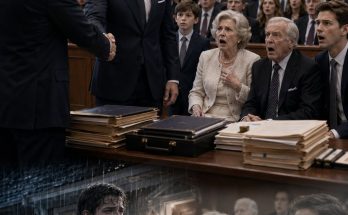
The Vanity He Didn’t Want
The thing taped behind the drawer was an envelope.
Not a beautiful envelope.
Not one of those thick cream-colored envelopes people use for wedding invitations or important legal documents.
It was a plain, yellowed envelope, flattened almost completely from years of pressure, with a strip of old transparent tape running across its back.
For several seconds, I just stared at it.
My hand was still inside the narrow gap behind the drawer.
The vanity smelled faintly of cedar, dust, and the strange sweet scent old furniture sometimes develops after sitting in the same room for decades.
I pulled the envelope loose.
The tape made a soft ripping sound.
I expected money.
Maybe an old photograph.
Maybe some forgotten family letter.
Something sentimental.
Something worth keeping, perhaps, but nothing that would change my life.
I was wrong.
Because written across the front of the envelope, in faded blue ink, were seven words:
FOR ELENA. ONLY AFTER THE DIVORCE.
I stopped breathing.
Elena.
My name.
I looked toward the bedroom door as though someone might be standing there.
Nobody was.
The house was quiet.
My house.
At least technically, it was still mine.
That was one of the strange things about divorce.
You spend years calling somewhere our home, then suddenly lawyers begin using phrases like marital property, equitable distribution, and exclusive possession.
For months, my husband, Daniel, had fought me over nearly everything.
The house.
The two cars.
The camper.
Furniture.
Savings.
Even a set of patio chairs he had complained about for years.
But he hadn’t wanted the vanity.
He had laughed when the movers carried it away.
“You can have the ugly thing,” he’d said.
“Nobody wants it.”
I remembered the exact expression on his face.
Not sadness.
Not nostalgia.
Relief.
Almost amusement.
At the time, I had assumed he was simply being cruel.
Now I wasn’t so sure.
I carried the envelope to my kitchen table.
My hands were trembling.
I sat down.
Then I looked at those seven words again.
FOR ELENA. ONLY AFTER THE DIVORCE.
I knew that handwriting.
It belonged to Daniel’s grandmother.
Margaret Whitmore.
Everyone had called her Grandma Maggie.
She had died eleven years earlier.
I had met her only a handful of times.
She had always been polite to me, but distant.
At our wedding, she had squeezed my hand and said, “You’re kinder than you realize.”
I had laughed because I didn’t understand what she meant.
She’d simply smiled.
Then she’d looked over my shoulder toward Daniel.
There had been something in her expression I couldn’t identify.
Concern, maybe.
Or disappointment.
At the time, I didn’t think much of it.
Now I couldn’t stop thinking about it.
I turned the envelope over.
There was no return address.
No stamp.
Nothing else.
My heart began beating faster.
I opened it.
Inside was a single folded sheet of paper.
The handwriting covered both sides.
I read the first line.
And then I read it again.
Dear Elena,
If you are reading this, then my grandson has finally lost the right to decide what you know.
I sat completely still.
Outside, a car passed on the street.
Somewhere in the neighborhood, a dog barked.
My entire world seemed to narrow to the paper in my hands.
I kept reading.
Margaret explained that the vanity had belonged to her mother before her.
It had been purchased in 1948 from a furniture maker in town.
But the vanity itself wasn’t important.
What mattered was what had been hidden inside it.
Margaret wrote that shortly after marrying her husband, Harold, she discovered that he had been quietly diverting money from a family business.
At first she believed it was simple dishonesty.
Then she discovered something much worse.
He had been using company funds to acquire property through a separate corporation.
The corporation wasn’t officially connected to the family.
But it was controlled by him.
Margaret had kept copies of the records.
She had hidden them.
She hadn’t trusted banks.
She hadn’t trusted lawyers.
And she hadn’t trusted Harold.
So she placed everything she had in a compartment behind the vanity’s middle drawer.
Then came the sentence that made my stomach drop.
Harold did not know I kept the final document.
The final document, she explained, proved that one of the properties had never legally belonged to Harold or the family business.
It belonged to her.
And Margaret had placed it in a trust for a future granddaughter-in-law.
I stopped.
I read that sentence again.
A future granddaughter-in-law.
Not a granddaughter.
Not a grandson.
A granddaughter-in-law.
Me?
I continued.
Margaret said that years later, she discovered Daniel had learned pieces of the story.
He became interested in the property.
She warned him never to touch it.
He promised.
But she didn’t believe him.
Then she wrote something that made my skin go cold.
Daniel has always believed the property will eventually belong to him. It will not.
I dropped the paper onto the table.
For several seconds, I couldn’t move.
Then I picked it up again.
At the bottom, Margaret had written:
Elena, if you and Daniel ever divorce, do not sell the vanity. Do not show him this letter. Take the documents to an attorney who has no connection to the Whitmore family.
Under that was an address.
And one final sentence.
You have been given something Daniel cannot take from you.
I stared at the address.
It was in the next county.
A law office.
I had never heard of it.
For the first time in almost a year, I wondered if my divorce hadn’t been the story I thought it was.
Maybe it had only been the beginning.
The next morning, I called the law office.
The receptionist told me they couldn’t discuss anything without an appointment.
I booked one for that afternoon.
Before leaving, I looked at the vanity.
It stood in my spare room exactly where the movers had dropped it.
Dark wood.
Cloudy mirror.
One chipped corner.
The brass handles were tarnished.
It looked worthless.
Completely ordinary.
I suddenly understood why Margaret had chosen it.
Nobody looks closely at ugly furniture.
I opened the middle drawer again.
Nothing.
I checked underneath it.
Nothing.
I pulled it completely out.
Behind it was only the thin wooden backing.
But Margaret had said documents.
Where were they?
I inspected the drawer.
The bottom looked slightly thicker than the others.
I pressed my fingers against it.
Nothing.
Then I remembered the envelope.
It had been taped behind the drawer, not inside it.
I crouched down.
There were tiny holes in the back panel.
Three of them.
Almost perfectly aligned.
I pushed my fingernail into the middle one.
The wood moved.
A section of the panel shifted inward.
My heart jumped.
I grabbed a butter knife from the kitchen and gently worked it into the seam.
The panel opened.
Behind it was a narrow compartment.
And inside that compartment was a metal box.
I stared at it.
Then I laughed.
Not because anything was funny.
Because sometimes fear comes out sounding like laughter.
The box was small enough to fit in both hands.
There was no lock.
I opened it.
Inside were documents.
Dozens of them.
Old property deeds.
Bank statements.
Tax records.
Letters.
Photocopies.
And one photograph.
I picked it up.
It showed Margaret standing beside a younger man.
Daniel’s father.
On the back was written:
1989 — First purchase.
I looked through the documents.
One name appeared repeatedly.
Whitmore Holdings.
Another name appeared even more often.
Northbridge Development.
Then I found a document dated 1992.
It was a property transfer.
I read the legal description.
My hands went cold.
It was the property my house sat on.
I didn’t go to the attorney that afternoon.
I went straight there.
The office was small and old-fashioned.
A woman in her sixties met me in the lobby.
“Ms. Carter?”
“Yes.”
“I’m Judith Hale.”
She shook my hand.
Her grip was firm.
She looked at the envelope I carried.
Then at the metal box.
Her expression changed.
“You found it.”
I froze.
“You knew about this?”
Judith closed the office door.
“Your name is Elena Carter?”
“Yes.”
“And you were married to Daniel Whitmore?”
“I was.”
She nodded slowly.
“Then Margaret’s instructions were correct.”
My mouth went dry.
“You knew my grandmother-in-law?”
“I was her attorney for nearly twenty years.”
I stared at her.
“Why didn’t you ever tell me?”
“Because she specifically told me not to.”
“Why?”
“Because she believed Daniel would try to get this property if he discovered what she had done.”
I sat down.
Judith opened the metal box.
She went through the documents one by one.
Finally, she pulled out a folder.
“This is the document Margaret cared about most.”
I looked at it.
It was a trust agreement.
My name was typed on the second page.
Beneficiary: Elena Marie Carter.
I couldn’t speak.
Judith continued.
“The trust was established twelve years before you married Daniel.”
“Twelve?”
“Yes.”
“But she’d never met me.”
“Correct.”
“Then how could my name be here?”
Judith smiled sadly.
“It wasn’t.”
She pointed to the document.
“The beneficiary was originally listed as ‘the future spouse of Daniel Whitmore, provided such person is not acting under coercion and is not knowingly participating in financial misconduct against the Whitmore family trust.'”
I stared at the page.
“So…”
“When you married Daniel, the condition was satisfied.”
My heart hammered.
“How much?”
Judith hesitated.
“The property is worth considerably more now than when Margaret created the trust.”
“How much?”
“Approximately four million dollars.”
I almost fell out of the chair.
“Four million?”
“That’s the current estimated value of the land and associated development rights.”
I looked down at my hands.
Daniel had fought me over a used camper.
He had argued over a thirteen-year-old SUV.
He had demanded half the furniture.
He had threatened to take the house.
But there was a property worth millions sitting underneath everything.
And Margaret had left it to me.
Not him.
Me.
Judith wasn’t finished.
“There’s another issue.”
“What?”
She pulled out a second file.
“Daniel knew about the trust.”
My stomach dropped.
“How?”
“Margaret told him.”
“When?”
“Three years before your wedding.”
“Why?”
“She wanted him to understand that he would never control it.”
I stared at her.
“Did he know I was the beneficiary?”
“No. Not at first.”
“Then how did he know?”
“Because he attempted to challenge the trust.”
My entire body went still.
“When?”
“Shortly before your marriage.”
“Why wasn’t I told?”
“Because the challenge failed.”
Judith slid a document toward me.
It was a letter from Daniel.
I recognized his handwriting immediately.
He had written:
Grandmother’s intentions are unreasonable. The property should remain within the family. Any future spouse should understand that this is a family asset, not a personal inheritance.
I read the sentence twice.
My hands started shaking.
“Did Margaret answer?”
Judith gave me another letter.
No.
Just one word.
Written in blue ink.
Underneath it:
If Elena is ever his wife, she is family. But if he treats her like property, she is free to walk away with everything I protected for her.
I covered my mouth.
For almost ten years, I had believed Margaret barely tolerated me.
I had been wrong.
She had been watching.
That night I went home and sat in front of the vanity.
I couldn’t sleep.
Every memory of my marriage looked different now.
Daniel insisting we refinance the house.
Daniel suddenly becoming interested in property values.
Daniel asking whether I had ever received anything from his grandmother.
Daniel joking that Grandma Maggie had “hidden money everywhere.”
Daniel wanting me to sign documents I didn’t fully understand.
And, most importantly, Daniel’s behavior during the divorce.
He had fought for everything.
Everything except the vanity.
I whispered to the empty room:
“You knew.”
The words sounded ridiculous.
But somehow they didn’t feel ridiculous.
I opened the middle drawer.
For the first time, I noticed a faint scratch along the bottom.
Three initials.
M.W.
Margaret Whitmore.
Below them was another message.
Tiny.
Almost invisible.
Truth survives.
I touched the words.
Then my phone rang.
It was my divorce attorney.
“Elena, where are you?”
“Home.”
“Are you alone?”
“Yes.”
“Good. Don’t contact Daniel tonight.”
My stomach tightened.
“Why?”
“Because his attorney just filed an emergency motion.”
“For what?”
“To reopen the property settlement.”
I stood.
“What?”
“He claims he discovered newly relevant information regarding marital property.”
I laughed bitterly.
“Of course he did.”
There was silence.
Then my attorney said:
“Elena, there’s something else.”
“What?”
“The filing mentions a property interest connected to Margaret Whitmore.”
My blood went cold.
“He knows.”
The next morning, Daniel showed up at my house.
He stood on the porch wearing the same navy coat he’d worn to court.
He looked tired.
But not defeated.
“Can we talk?”
“No.”
“Elena.”
“You need to leave.”
“I know about the property.”
I said nothing.
He looked past me.
Toward the spare room.
“The vanity.”
I felt my heart pound.
“What about it?”
His face changed.
For the first time since the divorce began, I saw something I’d never seen in him before.
Fear.
“Did you open it?”
I didn’t answer.
“Elena, please.”
“Did you know?”
He looked down.
“About what?”
“Don’t do that.”
His jaw tightened.
“You don’t understand.”
“Then explain.”
He stepped closer.
I stepped back.
“Grandmother left you something,” he said.
“Yes.”
“She wanted to punish me.”
“By giving me something?”
“She hated what I became.”
That sentence surprised me.
Daniel looked away.
“She thought I was like my father.”
“Are you?”
He didn’t answer.
That was answer enough.
I crossed my arms.
“Why did you fight me over the house?”
“Because I thought it was part of the trust.”
“You knew?”
“Not everything.”
“Why didn’t you tell me?”
“Because I was afraid.”
“Afraid of what?”
He finally looked at me.
“That you’d find out what I had done.”
My chest tightened.
“What did you do?”
He sat down on the porch step.
For the first time, he looked like the man I had married.
Not the arrogant man from court.
Not the man who had fought over every dollar.
Just Daniel.
Exhausted.
Scared.
Human.
“I borrowed money from the company.”
“What company?”
“Whitmore Development.”
“Why?”
He rubbed his face.
“To cover losses.”
“What losses?”
“Investments.”
“How much?”
“About eight hundred thousand.”
I stared at him.
“You stole eight hundred thousand dollars?”
“I intended to replace it.”
“That’s not an answer.”
“I know.”
He looked at the ground.
“The property was supposed to save me.”
“What property?”
“The one Margaret left you.”
I felt sick.
“So that’s why.”
“Yes.”
“You married me knowing this?”
“No.”
“Then when did you find out?”
“After we were married.”
I didn’t believe him.
He saw it.
“I swear.”
“Why should I believe anything you say?”
“Because if I’d known before, I would’ve never married you.”
The sentence hurt more than I expected.
He immediately realized it.
“That’s not what I meant.”
But it was too late.
I stared at him.
“Go home, Daniel.”
He stood.
“Elena…”
“Go.”
He walked down the steps.
Before getting into his car, he turned around.
“Grandmother wasn’t protecting you from me.”
I waited.
“She was protecting you from my father.”
Then he drove away.
I spent the next two days going through Margaret’s documents.
Judith helped me.
What we discovered was bigger than the property.
Much bigger.
Margaret’s husband, Harold, had built a network of shell companies decades earlier.
His goal had been simple.
Move assets out of the family business.
Hide ownership.
Then reclaim everything once the paperwork became too complicated for anyone to trace.
Margaret discovered it.
She began collecting evidence.
But she couldn’t stop him.
Instead, she protected certain assets by transferring them into a trust.
The property beneath my house was one of them.
There were other properties too.
Warehouses.
Commercial lots.
A parcel near the river.
And one piece of land that had become extraordinarily valuable because the city had approved a future transit project nearby.
Together, the assets were worth millions.
Daniel’s father had spent years trying to regain control.
Margaret had refused.
After her death, Daniel apparently became obsessed with the trust.
He believed he could convince me to transfer the property.
But I had never known it existed.
Then I remembered something.
Three years into our marriage, Daniel had asked me to sign a document.
He’d said it was “routine.”
I had been busy.
I signed.
I suddenly felt cold.
“Judith?”
“Yes?”
“Can you check whether there was a transfer document?”
She searched the files.
Twenty minutes later, she found it.
My signature was on the last page.
But the document was incomplete.
A transfer of interest.
It would have transferred my rights to a company.
I stared at it.
“I never knew what this was.”
“I believe you.”
“Could it have been used?”
“No.”
“Why?”
“Because the trust prohibited transfer without independent legal counsel.”
I looked at her.
“Did Daniel know that?”
“Yes.”
“So he tried anyway.”
“Yes.”
I closed my eyes.
All those years.
All those conversations.
All those little moments I had dismissed as ordinary marriage disagreements.
He hadn’t wanted me to understand.
He wanted me to sign.
Then we found the missing piece.
A letter from Margaret to Daniel.
Dated six months before she died.
It said:
Daniel,
You have asked me three times to give you access to the property documents. I have refused three times. You say you need the assets to protect the company. I do not believe you.
Your father taught you that family means ownership. I tried to teach you that family means responsibility.
If you continue down this path, you will lose more than money.
One day you may have a wife. If she is a good woman, she will deserve better than this family has given you.
Do not make her pay for your mistakes.
The letter ended:
I have made arrangements. She will know when she needs to know.
There was no name.
But I knew.
Me.
I cried.
Not because of the money.
Because someone who had known me only briefly had believed I deserved protection.
While the man I had spent nine years beside had apparently been planning how to control what I didn’t even know I owned.
The divorce hearing was scheduled for the following Monday.
Daniel’s attorney tried to argue that the property should be considered marital.
My attorney presented the trust.
The judge reviewed it.
Then he asked Daniel directly:
“Mr. Whitmore, did you know about this trust before your marriage?”
Daniel’s attorney objected.
The judge overruled him.
Daniel hesitated.
“Yes.”
The courtroom went silent.
I looked at him.
He didn’t look back.
The judge continued.
“Did you ever disclose the trust to your wife?”
“No.”
“Why not?”
Daniel swallowed.
“I was afraid she’d leave.”
I almost laughed.
The irony was almost unbearable.
He had spent months fighting to keep me from leaving.
When the truth came out, it was because he’d been afraid I would leave if I knew.
The judge reviewed the documents.
Then he asked:
“Did you attempt to have the beneficiary sign a transfer?”
Daniel closed his eyes.
“Yes.”
“Was independent counsel provided?”
“No.”
“Then the attempted transfer is void.”
The judge turned to my attorney.
“Any further claims?”
“There are concerns about financial misconduct involving Whitmore Development.”
Daniel’s face went pale.
His attorney immediately stood.
“We object to the introduction of unrelated business matters.”
The judge looked at the documents.
“I don’t believe they’re unrelated.”
That was the moment everything changed.
An audit was ordered.
Not just of Daniel.
Of the company.
The audit lasted four months.
During that time, I moved out of the house.
Not because I had to.
Because I needed distance.
I rented a small apartment near the river.
It wasn’t fancy.
There was one bedroom, a tiny kitchen, and a balcony overlooking a parking lot.
But it was mine.
For the first time in years, I slept without wondering what Daniel was hiding.
The vanity came with me.
I refused to sell it.
I had a furniture restorer repair the damaged wood and polish the brass.
But I left the mirror cloudy.
I wanted to remember what it had looked like when I found it.
Ugly.
Forgotten.
Unwanted.
Yet holding a truth that had survived decades.
One afternoon, Judith called.
“We found something.”
My stomach tightened.
“What?”
“Your house.”
“What about it?”
“The land was only part of the trust.”
I sat down.
“What do you mean?”
“There is a development easement attached to the property.”
“Meaning?”
“Your property sits along a future transit corridor.”
I remembered the city announcements.
A new rail station had been proposed near our neighborhood.
Property values had already started rising.
Judith continued.
“Your land is strategically important.”
“How important?”
“Important enough that three developers have been trying to purchase neighboring parcels.”
I thought about Daniel.
His sudden interest in refinancing.
His insistence that we sell.
His frustration when I refused.
Then I understood.
He hadn’t wanted the house.
He wanted the land.
The audit eventually revealed that Daniel had diverted money from Whitmore Development.
But there was more.
He hadn’t been the only one.
His father had created a system years earlier.
Daniel inherited it.
At first, Daniel tried to keep it running.
Then the losses became too large.
He borrowed from one account to cover another.
He sold assets prematurely.
He forged internal approvals.
But he hadn’t stolen everything for himself.
Some money had gone to pay company debts.
Some had gone to employees.
Some had gone to prevent layoffs.
And some had gone into investments that failed.
It didn’t excuse what he did.
But it explained why his behavior had become increasingly desperate.
The final report concluded that the company had been insolvent for years.
Daniel was facing serious legal consequences.
Then, unexpectedly, he called me.
“I want to apologize.”
I almost hung up.
He continued.
“Not to get anything.”
“Then why?”
“Because I should have told you.”
I said nothing.
“I thought if I fixed everything before you found out, nobody would ever have to know.”
“You almost lost everything.”
“I know.”
“You lied to me.”
“I know.”
“You tried to get me to sign away something that wasn’t yours.”
“I know.”
His voice broke.
“I’m sorry.”
I looked at the vanity across the room.
“Did you ever love me?”
There was a long silence.
“Yes.”
“Then why did you treat me like that?”
“I don’t know.”
“That’s not good enough.”
“I know.”
I ended the call.
Not because I hated him.
Because I finally understood that love and trust weren’t the same thing.
You could love someone and still destroy what they gave you.
Months passed.
The divorce became final.
I kept the house.
The cars were divided.
The camper went to Daniel.
I didn’t care.
The settlement was surprisingly simple after the trust was excluded.
The property belonged to me independently.
So did the assets protected by Margaret’s trust.
Daniel had to surrender his remaining interests in the company.
He eventually agreed to cooperate with investigators.
His father had died years earlier, so there was nobody left to confront.
Except the past.
And the past had a long memory.
One Saturday morning, I was cleaning the vanity when I noticed something I hadn’t seen before.
The cloudy mirror had a tiny seam along the bottom.
I touched it.
It moved.
I called Judith.
She came over that afternoon.
Together we examined it.
Behind the mirror was another compartment.
Inside was a photograph.
And a key.
The photograph showed Margaret as a young woman.
Beside her was another woman.
I didn’t recognize her.
On the back:
Margaret and Clara — 1951.
Judith stared at the photograph.
“Oh.”
“What?”
“That’s Clara Whitmore.”
“Who?”
“Harold’s sister.”
“What happened to her?”
Judith shook her head.
“She disappeared from the family records.”
“Why?”
Judith looked at the key.
“I think we’re about to find out.”
The key had a number stamped on it.
317.
Judith searched her records.
Then she smiled.
“There was a safety deposit box.”
“Where?”
“At First National.”
My heart started pounding.
We went there the next morning.
The box had been inactive for more than fifty years.
But Margaret had maintained access.
Inside was a notebook.
Letters.
And one final legal document.
Clara had owned a substantial portion of the original Whitmore business.
Harold had manipulated her into signing away her interest.
Margaret had discovered it.
She had tried to reverse it.
But Clara had disappeared before the case could be completed.
The final document restored Clara’s ownership rights.
And because Clara had no children, the rights eventually passed through her estate.
Judith looked at me.
“Do you know what this means?”
“No.”
“Some of the company’s most valuable assets may never have belonged to Harold.”
I stared at the documents.
“So who owns them?”
Judith smiled faintly.
“According to this…”
She paused.
“You.”
I laughed.
“No.”
“Yes.”
I shook my head.
“This is impossible.”
“Margaret was very thorough.”
“How much?”
Judith gave me a number.
I couldn’t process it.
The total value was far beyond anything I had imagined.
Not tens of millions.
But enough that I would never again have to worry about money.
I sat silently.
Then I thought about Margaret.
She had hidden everything in an ugly vanity.
Not because she wanted to make me rich.
Because she wanted the truth to survive.
I decided not to keep all of it.
I established a foundation.
The first project was an accessibility program.
I remembered something from my childhood.
My mother had once told me that the smallest changes could make a person’s life easier.
A ramp.
A doorway.
A safe bathroom.
A little dignity.
So the foundation funded accessibility improvements for families who couldn’t afford them.
Ramps.
Wheelchair lifts.
Modified entrances.
Transportation assistance.
It wasn’t about charity.
It was about making sure nobody had to fight as hard as I had fought for basic fairness.
The second project was a legal assistance fund for people dealing with complicated family property disputes.
Judith helped establish it.
She became a close friend.
One afternoon, she asked me:
“Do you ever wonder what Margaret would think of all this?”
I looked at the vanity.
“Every day.”
“What do you think she’d say?”
I smiled.
“Probably that I took too long to open the drawer.”
Judith laughed.
A year after the divorce, I received a letter.
It was from Daniel.
I almost threw it away.
Instead, I opened it.
He didn’t ask for money.
He didn’t ask for forgiveness.
He simply wrote:
Elena,
I used to think my grandmother was trying to punish me.
Now I understand she was trying to save me from becoming my father.
She failed.
But she saved you.
I don’t expect you to respond.
I only wanted you to know that I’m finally telling the truth.
I am sorry for every time I made you question yourself.
You were never the problem.
I folded the letter.
I didn’t respond.
But I didn’t destroy it either.
Some apologies don’t restore relationships.
They simply close doors that should have been closed years earlier.
Two years after I found the envelope, I finally decided to sell the vanity.
Not because I no longer valued it.
Because I had learned what it had come to teach me.
I hired a professional antique dealer.
He examined it carefully.
“Do you know what this is worth?”
“Not really.”
He gave me a number.
It was much higher than I’d expected.
I smiled.
“Sell it.”
He looked surprised.
“Are you sure?”
“Yes.”
“What will you do with the money?”
I looked at the cloudy mirror.
“Something appropriate.”
The vanity was sold.
The money went into the accessibility foundation.
I kept only one thing.
The little brass handle from the middle drawer.
I had it mounted in a frame.
Beside it, I placed a photograph of Margaret.
Underneath, I wrote:
Truth survives.
Years later, I visited the neighborhood where Daniel and I had lived.
The house was still there.
The front garden had changed.
The porch had been repainted.
A family with two young children lived there now.
I didn’t know them.
I didn’t need to.
I stood across the street for a moment.
I thought about the woman I had been when I first moved in.
Young.
Hopeful.
Certain that love meant honesty.
Certain that marriage meant partnership.
Certain that if you gave everything to someone, they’d eventually give everything back.
I had been wrong about that.
But I wasn’t bitter.
Because the woman who left that house knew something the woman who entered it didn’t.
She knew that losing a relationship wasn’t the same thing as losing yourself.
She knew that being deceived didn’t mean you were foolish.
And she knew that sometimes the thing people dismiss as worthless is the very thing carrying the truth.
I walked away.
My phone buzzed.
It was a message from Judith.
Found another letter from Margaret. Want to see it?
I stopped.
I smiled.
Then I typed:
Of course.
A minute later, Judith sent a photograph.
It was a letter dated only weeks before Margaret died.
The first line read:
Dear Elena,
And beneath it:
If you’re reading this, you’ve already learned the most important lesson.
Never let someone else’s fear convince you that you deserve less than the truth.
I read the rest.
Then I looked up at the sky.
For years, I had wondered why Margaret had chosen me.
Why she’d trusted someone she’d barely known.
Why she’d hidden everything inside that terrible old vanity.
Now I understood.
She hadn’t chosen me because she knew exactly who I would become.
She had chosen me because she believed I deserved the chance to choose for myself.
And perhaps that was the greatest inheritance of all.
Not the property.
Not the money.
Not the documents.
Freedom.
The freedom to know the truth.
The freedom to walk away.
And the freedom to build something better from what someone else tried to break.
I put my phone away and continued walking.
Behind me, the house disappeared around the corner.
I never looked back.
Because sometimes the best ending isn’t getting revenge.
It isn’t watching the person who hurt you lose everything.
It isn’t even discovering that you were secretly worth millions all along.
Sometimes the best ending is much quieter.
It’s waking up one morning and realizing you no longer need an explanation from the person who betrayed you.
You no longer need them to admit what they did.
You no longer need them to understand what they lost.
You simply know who you are.
And you know what you will never accept again.
I spent years believing that ugly old vanity was the one thing my husband didn’t want.
I was wrong.
It was the one thing he couldn’t afford for me to find.
And the moment I opened that drawer, I didn’t just discover Margaret’s secret.
I discovered mine.
I had survived a marriage that taught me to doubt myself.
I had walked away from a man who fought for every possession except the truth.
And somewhere along the way, I stopped asking what I had lost.
Because I finally understood what I had gained.
My life.
My name.
My choices.
My future.
And the truth.
The truth had been waiting quietly behind a stubborn drawer for more than half a century.
It had survived every lie.
Every sale.
Every argument.
Every generation.
And when the time finally came, it found its way into my hands.
Exactly as Margaret had promised.
Truth survives.
THE END