My husband left his phone on the kitchen counter while he showered. It buzzed. I glanced at it. A text from “Mike from work” said, “Last night was amazing. Can’t wait to see you again, babe.” My husband doesn’t work with anyone named Mike…..
My husband left his phone on the kitchen counter while he showered, and if that message had arrived thirty seconds later, I might never have seen it. The screen lit up beside the coffee maker while I was slicing strawberries for breakfast. I wasn’t snooping.

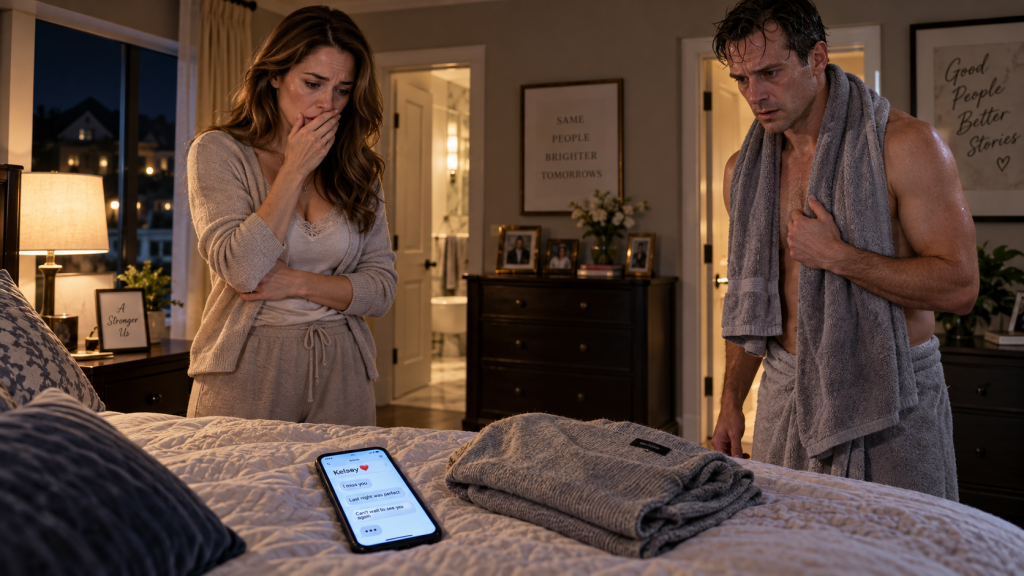
I wasn’t suspicious. I simply glanced over because the buzzing startled me. The message preview read: “Last night was amazing. Can’t wait to see you again, babe.” The sender’s name was “Mike from work.” For a few seconds, I just stood there holding the knife while the entire kitchen seemed to tilt around me. My husband, Jason, had worked at the same insurance company for nine years. I knew most of his coworkers. There was no Mike. Not in his department. Not at the Christmas parties. Not in the stories he brought home over dinner. My first instinct was to grab the phone and demand answers the second he walked downstairs. Instead, something quieter took over. Maybe it was shock. Maybe it was the part of me that already knew one message could be explained away if I gave him enough warning to invent the explanation. So I finished breakfast. I scrambled his eggs, poured his coffee, packed his usual turkey sandwich, and kissed him goodbye. “Have a good day,” I said. He smiled, kissed my forehead, and walked out carrying the lunch I had packed with the same hands that were still trembling. The moment his car disappeared, I sat at the kitchen table and stared at nothing for almost ten minutes. Jason and I had been married fourteen years. We had two children, a mortgage, a dog that slept between us whenever thunderstorms rolled through, and the kind of ordinary life I had believed was solid precisely because it was ordinary. Lately, he had been staying late at work more often. He had started taking his phone into the bathroom. He had bought new shirts without asking me whether they looked good. I had noticed all of it and explained every detail away because love makes you generous with doubt until suddenly doubt becomes evidence. At eleven-thirty, I packed sandwiches for six people and drove to his office. The receptionist, Karen, recognized me immediately. “Surprise lunch?” she asked. I smiled. “Something like that.” Then I leaned closer. “Is Mike here? Jason talks about him all the time.” Her expression changed. “Mike?” “Mike from work.” “There’s no Mike in Jason’s department.” “Maybe another floor?” Karen checked the directory. I watched her scroll through names. Michael. Miguel. Mitchell. Nobody called Mike anywhere in the building. “Sorry,” she said. “No Mike.” I smiled so naturally it scared me. “I must have gotten the name wrong.” I left the sandwiches anyway and drove home. I spent the afternoon noticing things. A restaurant receipt in Jason’s jacket from the night before, even though he had told me he worked late and ate vending-machine chips. Two glasses of wine. One steak. One seafood entrée. In the laundry basket, I found a dark gray sweater that wasn’t his. Smaller. Softer. Expensive. It smelled faintly of perfume. I sat on the bedroom floor holding it and felt something inside me go strangely calm. By the time Jason came home, dinner was ready. The kids talked about school. Jason complained about traffic. I listened to him describe a meeting that probably never happened and wondered how many times a person could lie across a dinner table before the furniture itself should start objecting. After the children went upstairs, Jason showered. I placed his phone on his pillow, screen facing up. Beside it, I folded the gray sweater. When he walked into the bedroom, towel around his shoulders, he stopped. “What’s that?” he asked. I looked at him. “Mike called.” Every bit of color left his face. “What?” “He wants his sweater back.” Jason’s eyes moved from the phone to the sweater and then to me. His mouth opened, but no words came. That silence told me everything. “How long?” I asked. He sat on the edge of the bed. “It’s not what you think.” I laughed once. “You should know that sentence has never improved any situation in human history.” “I can explain.” “Then explain why ‘Mike from work’ called you babe.” Jason covered his face. For several seconds, he said nothing. Then he looked up at me, and what I saw wasn’t guilt alone. It was fear. Real fear. “There is no Mike,” he whispered. “I know.” “The contact is fake.” “I figured that out around lunchtime.” His hands started shaking. “You went to my office?” “Yes.” Jason stood abruptly and locked the bedroom door. That frightened me more than anything else. “Why are you locking the door?” He lowered his voice. “Because the kids cannot hear what I’m about to tell you.” My stomach tightened. “Who sent the message?” Jason stared at the sweater. “Her name is Emily.” The room seemed to narrow. “How long have you been sleeping with Emily?” “I’m not.” “I saw the message.” “I know.” “I found her sweater.” “I know.” “Then stop insulting me.” Jason’s eyes filled with tears. “Emily is my sister.” I stared at him. “You don’t have a sister.” “That’s what I was told too.” I almost laughed, but his face stopped me. He opened his phone, entered the passcode, and pulled up the hidden message thread. There were photographs. Jason beside a woman who looked around thirty. Same dark eyes. Same crooked smile. Family resemblance so strong I felt cold. “She contacted me three months ago,” he said. “She said our father had another family before he married Mom.” My anger faltered. “Then why save her as Mike? Why the message?” Jason swallowed. “Because Emily isn’t really the one texting me.” A chill moved down my back. “What does that mean?” He handed me the phone. “Read the earlier messages.” I scrolled upward. At first, they looked harmless. Meeting locations. Questions about family history. Then the tone changed. Send the money. Don’t tell your wife. We know where your children go to school. My hands went numb. “Jason…” He pointed to the final photo in the thread. It had been sent two days earlier. It showed our daughter walking out of school. “Emily came to me because the people who raised her are trying to blackmail Dad’s old family,” Jason whispered. “They want money. A lot of it.” I looked at him. “And ‘last night was amazing’?” His face tightened. “A signal. It means they know I met Emily again.” “The sweater?” “She left it in my car by accident.” I struggled to breathe. “Why didn’t you tell me?” “Because they said if I involved you, they’d come here.” Before I could answer, his phone buzzed between us. Another message from “Mike from work.” This time there was no flirtation. Just a photograph of our house taken from across the street. Under it were seven words: “Your wife knows now. Open the door.”
PART 2 — THE PERSON WHO ALREADY KNEW OUR FAMILY
For a few seconds, neither Jason nor I moved.
His phone lay between us on the bed.
The photograph filled the screen.
Our house.
Our porch light.
The maple tree near the driveway.
And across the bottom, seven words:
Your wife knows now. Open the door.
My first instinct was exactly what the message wanted.
Go downstairs.
Look through the window.
Find whoever was standing outside.
Jason caught my wrist before I made it two steps.
“No.”
I turned.
“They’re outside.”
“I know.”
“Our kids are upstairs.”
“I know.”
“Then let go of me.”
“No.”
His voice broke.
“We are not opening that door.”
For the first time since I had found the message that morning, Jason did something that made sense.
He grabbed his phone.
Called 911.
Put the call on speaker.
Then unlocked the bedroom door.
“Get the kids.”
I did not argue.
Our daughter Sophie was eleven.
Our son Noah was eight.
They were in Sophie’s room arguing about whether Noah had cheated at a card game.
Ordinary.
Thank God.
I stepped inside.
“Both of you, shoes on.”
Sophie looked up.
“Why?”
“Now.”
Something in my face made her stop asking.
Noah reached for his sneakers.
“Are we going somewhere?”
“Maybe.”
“Where?”
“I don’t know yet.”
That frightened him.
I saw it immediately.
So I knelt.
“There’s something happening outside.”
“Dad and I are handling it.”
“You are safe.”
That last sentence mattered.
Even if I was not entirely sure it was true.
Children should not have to become brave because adults are terrified.
I helped Noah with his laces because his fingers were shaking.
Then led them into our bedroom.
Jason was still speaking with the dispatcher.
He had closed the curtains.
Turned off the lights.
Locked the downstairs doors through the security app.
The dispatcher asked whether we could see anyone outside.
“No.”
Jason said.
“Do not look.”
I whispered.
He nodded.
Finally.
We agreed on something.
The message sender sent another photograph.
This one was closer.
Our front steps.
Then:
We only want to talk.
Jason showed it to the dispatcher.
She told him not to respond.
Then another:
You have five minutes.
My stomach turned.
Sophie saw my face.
“Mom?”
I slipped the phone screen-down.
“What’s happening?”
I looked at Jason.
He looked back.
We had spent fourteen years thinking good parenting meant giving our children the same answers.
That night, we did not have answers.
So I gave them only what was necessary.
“Someone is bothering Dad.”
“Police are coming.”
“We’re staying together until they get here.”
Sophie’s eyes widened.
“Is Dad in trouble?”
Jason’s face crumpled.
“No.”
Then he hesitated.
That hesitation frightened me.
Maybe Sophie too.
The police arrived four minutes later.
It felt like forty.
Blue light washed across the bedroom curtains.
Jason’s phone buzzed one final time.
Coward.
Then nothing.
No knock.
No broken window.
No dramatic confrontation.
Whoever had been watching the house disappeared before officers reached the street.
One officer checked the property.
Another spoke with us upstairs.
A third drove the surrounding blocks.
They found no one.
No parked car matching a description because we did not have one.
No obvious footprints.
No damaged doors.
Just photographs.
Messages.
And a family suddenly afraid of its own front windows.
The officer speaking with us was named Sergeant Hayes.
She was in her late forties.
Calm.
Direct.
She looked at Jason.
“How long have these threats been happening?”
Jason glanced at me.
That was the moment I realized I still did not know.
“Three months.”
he said.
I stared.
Sergeant Hayes continued writing.
“How much money have you sent?”
Jason stopped breathing.
I turned toward him.
“Money?”
He closed his eyes.
“How much?”
I asked.
“Jason.”
“Forty thousand.”
The room went silent.
Even Sergeant Hayes looked up.
I felt the floor shift.
“You sent them forty thousand dollars?”
“Not all at once.”
That was apparently the wrong thing to say.
I laughed.
A terrible sound.
“Oh, well, thank God.”
Jason rubbed both hands over his face.
“I was trying to make them stop.”
“Using whose money?”
“Our savings.”
My stomach dropped.
“How much of our savings?”
He did not answer.
I knew.
Enough.
“Jason.”
“Thirty from the emergency account.”
“Ten from my bonus.”
I felt physically sick.
Our emergency account.
The fund we had built slowly.
Roof repairs.
Medical bills.
Job loss.
The money that let ordinary people sleep better.
Gone because my husband had decided fear was a financial decision he could make alone.
Sergeant Hayes let the silence settle.
Then said:
“I need both of you to understand something.”
We looked at her.
“You are not to pay anyone else.”
Jason nodded.
“You preserve every message.”
“Yes.”
“Every account record.”
“Yes.”
“Every email.”
“Yes.”
“And if they contact you again, do not negotiate independently.”
Jason swallowed.
“Okay.”
She looked at me.
“Has anyone approached your children directly?”
“No.”
“At school?”
“Not that I know of.”
“Any notes?”
“No.”
“Unfamiliar vehicles?”
I thought.
Then remembered something.
Three weeks earlier, Sophie had told me a woman was sitting in a car across from the school.
At the time, Sophie mentioned it only because the woman had a tiny dog on her lap.
Blue sedan.
I looked at Jason.
His face changed.
“What?”
I asked.
He stared at me.
“Emily drives a blue sedan.”
The room went cold.
Sergeant Hayes asked:
“Who is Emily?”
And for the first time, Jason had to explain the entire story to someone who did not love him enough to accept shortcuts.
His father.
Thomas Bennett.
Dead seven years.
His mother, Carol.
Still living two states away.
No sister.
At least none Jason had ever known.
Then Emily contacted him three months earlier.
She said she was thirty-two.
Her mother’s name had been Rebecca Lane.
Rebecca died four years ago.
According to Emily, Thomas had dated Rebecca before marrying Carol.
Possibly during the early months of his relationship with Carol.
Dates unclear.
Emily had spent most of her childhood believing her father was a man named Dale Mercer.
Dale raised her.
Dale died the previous year.
While settling his estate, Emily found old letters.
Thomas’s name appeared repeatedly.
Then photographs.
Then a birth certificate amendment.
Then a box containing correspondence Rebecca had apparently hidden.
One letter had Thomas’s handwriting.
Jason recognized it.
So did Carol when Jason quietly showed her a cropped photograph of the page.
That detail caught me.
“Your mother knows?”
Jason looked down.
“Yes.”
My body went still.
“When did you tell her?”
“About six weeks ago.”
I stared.
“So your mother knew before I did.”
Jason’s eyes filled.
“Yes.”
That hurt more than I wanted it to.
Not because Carol owed me the truth first.
Because Jason had built an entire emergency committee around our marriage while leaving me outside it.
Emily.
Carol.
Who else?
Sergeant Hayes asked:
“Was paternity ever verified?”
Jason shook his head.
“Not yet.”
“Why not?”
“Emily didn’t want to do a commercial DNA test.”
“Why?”
“She said the people threatening her had access to her accounts.”
Sergeant Hayes looked unconvinced.
“Medical testing can be arranged privately.”
“I know.”
“Did you?”
“No.”
There.
One more thing.
Jason had been paying blackmail based on a family relationship no one had medically confirmed.
I stared at him.
“You sent forty thousand dollars without even confirming she’s your sister?”
“She looks like me.”
“That is not a DNA test.”
“She had Dad’s letters.”
“That is not a DNA test either.”
He looked wounded.
I almost hated myself for sounding cold.
Then I remembered the photograph of Sophie outside school.
I was allowed to be cold.
Sergeant Hayes asked to see the message thread.
Jason unlocked it.
She read quietly.
The early messages really did look different.
Emily’s number had originally been separate.
Her name plainly saved.
Then, about six weeks later, the messages became less personal.
Shorter.
Instructions.
A new number appeared.
Jason saved it as “Mike from work” because he did not want me seeing an unknown contact repeatedly.
I looked at him.
“So ‘Mike’ was never Emily’s contact.”
“No.”
“You said she wasn’t really the one texting you.”
“I meant the blackmailers were using that account.”
“Why did you make it sound like they had her phone?”
Jason’s shoulders fell.
“I was trying to explain fast.”
Or trying to make the story less ugly.
I could no longer tell.
That terrified me.
Sergeant Hayes asked:
“Did you meet Emily last night?”
“Yes.”
“Where?”
“A hotel bar.”
My chest tightened.
Of course.
The restaurant receipt.
The steak.
Seafood.
Two glasses of wine.
“You told me you were working.”
Jason closed his eyes.
“Yes.”
“Did you rent a room?”
“No.”
“Can you prove that?”
He stared at me.
Then slowly:
“Yes.”
Good.
That mattered.
The affair explanation might have been false.
The lying was not.
“What happened at the hotel?”
Sergeant Hayes asked.
Jason said Emily had received another threat.
This one demanded fifty thousand dollars.
She wanted to stop paying.
She wanted to go to police.
Jason argued that the blackmailers had photographs of our children.
Emily said continuing to pay would never end it.
They fought.
She cried.
Jason drove her back to a rental apartment.
Her sweater remained in his car.
Then, sometime after midnight, the blackmailer sent Jason:
Last night was amazing. Can’t wait to see you again, babe.
A deliberately intimate message.
Designed to be misunderstood if I saw it.
I felt cold.
“They wanted me to think he was cheating.”
Sergeant Hayes said:
“Possibly.”
“Why?”
“To create instability.”
“Or to punish him.”
“Or to pressure him.”
“Or because the sender knew his family situation well enough to predict how a spouse would interpret it.”
That sentence remained in the room.
Knew his family situation.
Not just his father’s past.
Our marriage.
Our habits.
Our children.
The children eventually went downstairs with another officer.
They were given hot chocolate.
Noah thought this made the evening almost worth it.
Sophie did not.
She watched Jason with the suspicious concentration of a child old enough to know adults were lying by omission.
After the police left, she cornered me in the hallway.
“Is Dad cheating?”
My heart stopped.
“What?”
“I heard you ask about a hotel.”
I closed my eyes.
Of course she had.
Walls do not protect children from everything adults imagine they do.
“No.”
I said carefully.
“I do not believe Dad is having an affair.”
“Then why are you mad?”
Because he lied.
Because he hid threats.
Because he spent family money.
Because somebody photographed her outside school.
Because I no longer knew whether the worst danger was outside our house or sleeping beside me.
I could not say all that.
“Dad made some decisions without telling me.”
She frowned.
“Bad ones?”
“Yes.”
“Is he going to jail?”
“No.”
“I don’t think so.”
Good God.
This was childhood now.
We did not sleep at home.
The police recommended we stay somewhere else temporarily if we had a safe alternative.
So at one in the morning, we packed.
Noah carried the dog’s blanket.
Sophie packed three books and no socks.
I took passports.
Birth certificates.
Medication.
Laptops.
Jason stared at me when he saw the document folder.
“You already had those together?”
“I keep them together.”
He looked relieved.
Then ashamed.
Maybe because somewhere in the last twenty-four hours he had realized I was not fragile.
I was simply uninformed.
Those are different things.
We stayed at my sister Hannah’s house.
Jason slept downstairs.
I slept with Sophie beside me and Noah on an air mattress near the bed.
At three in the morning, I woke because the dog barked at the heater.
My entire body flooded with adrenaline.
That was when I understood fear had entered my nervous system.
Not as panic.
As expectation.
I lay awake until sunrise.
Then went downstairs.
Jason was sitting at the kitchen table.
Still dressed.
He looked twenty years older.
I sat across from him.
“Start over.”
He looked up.
“What?”
“Everything.”
“From the first message.”
“No shortcuts.”
“No protecting me.”
“No deciding what I can handle.”
His face tightened.
Then he nodded.
And this time, Jason told me the part he had been most ashamed to admit.
Emily had not contacted him directly first.
She had contacted Carol.
His mother.
Two weeks before Jason knew anything.
My stomach tightened.
“Why?”
“She found Mom’s address through old property records.”
“What did she say?”
“That she thought Thomas was her father.”
“How did your mother react?”
Jason rubbed his forehead.
“Badly.”
“What does badly mean?”
“She told Emily never to contact her again.”
I stared.
“Why?”
“Because she knew Rebecca’s name.”
There it was.
The hidden history growing another layer.
“Your mother knew about her?”
“Rebecca.”
“Not Emily.”
Jason continued.
Thomas and Carol had been engaged when Thomas disappeared for three weeks.
He claimed he needed space.
Years later, Carol learned he had spent at least part of that time with Rebecca.
She nearly ended the engagement.
Thomas swore Rebecca was out of his life.
Carol married him anyway.
She never heard Rebecca’s name again.
Until Emily contacted her.
“Did your father know Rebecca was pregnant?”
Jason said:
“We don’t know.”
“Did your mother?”
“No.”
“Are you sure?”
He stared.
Then:
“That’s what she says.”
The answer had changed.
Not certainty.
Reported fact.
Good.
I was beginning to demand better language from all of us.
Emily sent Carol scans of the letters.
Carol called Jason.
That was how he learned.
He met Emily in a coffee shop.
She brought originals.
Photographs of Thomas in his twenties.
One showed him holding a newborn baby.
Emily.
That photograph shook Jason.
He could not deny the resemblance.
For two weeks, their conversations were almost entirely about family history.
Then Emily told him about the threats.
They had started months earlier.
Someone had contacted her after Dale died.
The message:
Your mother kept more than letters. Thomas Bennett’s family can afford silence.
The sender demanded money.
Emily paid five thousand dollars.
Then another ten.
Jason stopped.
“You knew she had already paid fifteen?”
“Yes.”
“From where?”
“Dale left her some money.”
“How much?”
“I don’t know.”
“You never asked?”
“No.”
My mind snagged.
Something about that bothered me.
But I let him continue.
The blackmailer claimed to possess evidence Thomas had maintained financial arrangements with Rebecca.
Payments.
Property.
Possibly a trust.
Evidence that could create scandal around Thomas’s estate.
That made no sense to me.
“Your father wasn’t famous.”
“No.”
“He owned a hardware business.”
“Yes.”
“Why would anyone pay that much to hide an affair from thirty years ago?”
Jason stared at the table.
“Because Dad’s estate wasn’t as small as you think.”
There it was.
Another secret.
“How much?”
“About four million.”
I stared.
“What?”
“Mostly property.”
“My mother inherited almost everything.”
I laughed once.
Not because it was funny.
Because I had been married to this man fourteen years and apparently had learned more about his family in one night than in the previous decade.
“You told me your father left your mother comfortable.”
“She is.”
“Four million is more than comfortable.”
“I didn’t think it was my money.”
“That isn’t the point.”
He looked down.
“No.”
It wasn’t.
The point was that secrecy seemed to be a family language.
Jason simply spoke it more fluently than I knew.
Thomas had owned land.
Three rental buildings.
A stake in the hardware company.
Investment accounts.
Carol controlled most of it now.
If Emily were Thomas’s biological daughter, Jason feared she might challenge parts of the estate depending on what documents existed and what Thomas had acknowledged.
Whether such a challenge would succeed was unclear.
What mattered was that somebody believed the possibility was worth exploiting.
I asked:
“Did Emily threaten to contest the estate?”
“No.”
“Did she ask for money?”
“Never.”
“Then who started the blackmail?”
“She doesn’t know.”
“Who knew what was in Dale’s house after he died?”
Jason went quiet.
“That’s what we were trying to figure out.”
Emily had lived with Dale until his death.
Afterward, she hired an estate-sale company.
A probate attorney.
A cleaning service.
Dale’s nephew helped for two weeks.
Rebecca’s sister visited once.
Several people had access to old boxes.
Too many.
Then something else emerged.
A month before Emily contacted Carol, someone had already requested copies of archived property records connected to Thomas.
Public records.
Old addresses.
Business filings.
Nothing illegal.
But deliberate.
Jason had hired a private investigator.
I stared.
“You hired a private investigator?”
“Yes.”
“With what money?”
“My personal account.”
“How much?”
“About six thousand.”
I closed my eyes.
Forty thousand.
Six thousand.
Three months of secret crisis management.
And I had been comparing cereal prices at the grocery store.
“Who?”
I asked.
“The investigator.”
“Mark Delaney.”
“Recommendation?”
Jason hesitated.
“Mom’s attorney.”
My head lifted.
“Your mother’s attorney recommended him.”
“Yes.”
“When?”
“About five weeks ago.”
The timing bothered me.
“Before or after your mother knew about the blackmail?”
“After.”
“And Mark investigated Emily?”
“Yes.”
“What did he find?”
Jason unlocked his phone.
Opened an encrypted PDF.
I read.
Emily Lane Mercer.
Thirty-two.
Nurse practitioner.
No criminal record.
Modest mortgage.
Dale Mercer deceased.
Rebecca Lane deceased.
Employment stable.
No obvious litigation.
No extraordinary debt.
Nothing screamed extortionist.
“What about paternity?”
“Unconfirmed.”
I looked up.
“So why did the investigator stop there?”
Jason’s face tightened.
“He didn’t.”
There was another page.
A photograph.
A man entering Emily’s apartment building.
Older.
Baseball cap.
Side view only.
No identification.
The investigator believed he had followed Emily twice.
Then disappeared.
A vehicle associated with him was registered to a shell company.
I frowned.
“What shell company?”
Jason swallowed.
“Bennett Property Services.”
The name hit strangely.
“Your family?”
“Not exactly.”
“What does that mean?”
“Dad used to have a company with that name.”
My entire body went still.
“What?”
“It was dissolved twelve years ago.”
“Then why is a current car registered to it?”
Jason looked at me.
“We don’t know.”
By seven in the morning, Hannah was awake.
She came downstairs.
Saw our faces.
Made coffee without speaking.
Sometimes sisters are better than therapists because they understand when silence is the useful service.
I kept reading.
The shell company had been reinstated eight months earlier.
Different registered agent.
Same old name.
Mailing address at a commercial service.
The registered agent was a lawyer named Philip Ross.
I stared at the name.
“Who is Philip Ross?”
Jason went pale.
That was enough.
“Jason.”
“My mother’s estate attorney.”
The kitchen went silent.
Hannah stopped pouring coffee.
I stared.
“Your mother’s attorney.”
“Yes.”
“The same attorney who recommended the private investigator?”
Jason looked sick.
“Yes.”
My skin prickled.
“Did you tell police this?”
“No.”
“Why not?”
“I just realized it.”
I looked at him.
Then at the file.
How had he not?
Because fear narrows attention.
Because Jason had been looking for a stranger.
And trusted names rarely look dangerous until someone asks why they keep appearing.
We called Sergeant Hayes.
She came to Hannah’s house before noon.
This time, Jason gave her everything.
The investigator report.
Philip Ross’s name.
The shell company.
Bank transfers.
Messages.
Emily’s contact.
Carol’s address.
All of it.
Then Sergeant Hayes asked one question.
“Who knew where your children go to school?”
I answered first.
“Family.”
“Friends.”
“School parents.”
“Jason’s coworkers maybe.”
She looked at Jason.
“Your mother?”
“Yes.”
“Her attorney?”
Jason frowned.
“I don’t know.”
Then he remembered.
“When Mom updated her estate plan last year, she listed the kids as contingent beneficiaries.”
My stomach tightened.
“The lawyer would have their information?”
“Names.”
“Birth dates.”
“Addresses.”
“Possibly school information if Mom included emergency-contact records.”
I stared.
Why would an estate attorney need school information?
Maybe he didn’t.
Maybe Carol had simply overshared.
Families do.
Still.
The circle tightened.
Sergeant Hayes cautioned us again.
A connection was not proof.
Philip Ross’s role could have an innocent explanation.
Old company name might have been legitimately reused.
Someone else could be using it.
The investigator could be genuine.
Emily could be involved.
Carol could be hiding more.
Nothing was settled.
That discipline frustrated me.
I wanted the villain.
One face.
One explanation.
Fear loves simplicity.
Evidence rarely provides it quickly.
Then Sergeant Hayes asked:
“Can I speak with Emily?”
Jason looked at me.
I almost laughed.
“Why are you looking at me?”
“I don’t know.”
“No.”
I said.
“You do not need my permission to cooperate with police.”
He nodded.
Another habit we were going to have to unlearn.
He called Emily.
She answered on the second ring.
Her voice came through speaker.
“Jason?”
“We told the police.”
Silence.
Then:
“Finally.”
I stared.
Not fear.
Relief.
Jason introduced Sergeant Hayes.
Emily agreed to come in.
Then I spoke.
“Emily.”
Silence.
She had never heard my voice before.
“Hi.”
she said softly.
“I’m Rachel.”
I had not even realized my own name had been absent from the story until then.
“Jason’s wife.”
“I know.”
Of course she did.
“I’m sorry.”
she said.
“For what?”
“For the messages.”
“The photos.”
“For dragging you into this.”
I looked at Jason.
Then:
“You didn’t drag me in.”
“You warned my husband.”
“He decided not to tell me.”
Jason flinched.
Good.
Truth does not need cushioning simply because police are present.
Emily went quiet.
Then:
“You’re right.”
I liked her slightly for that.
We met Emily that afternoon at the police station.
I knew immediately she probably was Jason’s sister.
Not because of science.
Because her face made my body recognize him before my mind caught up.
Same eyes.
Same left eyebrow lifting when nervous.
Same habit of pressing lips together before saying something difficult.
She was shorter than me.
Dark hair.
The gray sweater I had found belonged to her.
She looked embarrassed when I mentioned it.
“I wondered where that went.”
I almost laughed.
The absurdity was useful.
For one second, we were simply two women talking about misplaced clothing.
Then reality returned.
Emily handed police a box of original letters.
Photographs.
A bank book.
And something she had never shown Jason.
A ledger.
Jason stared.
“What is that?”
Emily looked ashamed.
“I found it last week.”
“Why didn’t you tell me?”
“Because I didn’t know if I could trust you.”
The sentence landed.
Jason looked wounded.
Then nodded.
Fair.
Emily opened the ledger.
Rebecca’s handwriting.
Dates.
Amounts.
Initials.
Some entries from thirty years ago.
Some much later.
One recurring notation:
P.R.
My eyes moved toward Jason.
Philip Ross.
Maybe.
Maybe not.
Sergeant Hayes said nothing.
Good.
No one should build a case from initials alone.
Then Emily turned to the final pages.
Entries continued after Thomas supposedly ended contact with Rebecca.
Twenty-eight years ago.
Twenty-five.
Twenty.
Fifteen.
Ten.
Then stopped seven years ago.
The year Thomas died.
Jason whispered:
“Dad was paying her.”
Emily looked at him.
“Maybe.”
Amounts varied.
Five hundred.
A thousand.
Sometimes five thousand.
Never regular enough to look like formal child support.
But enough to suggest connection.
Then Sergeant Hayes asked:
“Where did you find this?”
Emily said:
“In Dale’s attic.”
“Who had access before you?”
“Estate workers.”
“My cousin Aaron.”
“My aunt.”
“The cleaning company.”
Then she hesitated.
“And Philip Ross.”
Every person in the room went still.
Jason stared.
“What?”
Emily looked at him.
“He came to the house after Dale died.”
“Why?”
“He said he represented someone who had historical business with Rebecca.”
Jason’s face drained.
“When?”
“Two weeks after the funeral.”
“Before you contacted Mom?”
“Yes.”
There.
The timeline shifted completely.
Philip Ross knew about Emily before Carol claimed she did.
Or at least knew something about Rebecca.
“What did he want?”
Sergeant Hayes asked.
“Old records.”
“Did you give him any?”
“No.”
“He offered to buy boxes.”
“For how much?”
“Ten thousand dollars.”
My stomach turned.
“Just for boxes?”
“He said they might contain business papers belonging to a client.”
“Did you ask which client?”
“He wouldn’t say.”
“Did he threaten you?”
“Not then.”
Emily stared at the ledger.
“But the first blackmail message arrived twelve days later.”
The room went silent.
Jason looked physically ill.
“My mother trusts him.”
Emily’s eyes shifted.
“Maybe she shouldn’t.”
I watched Jason.
He had spent three months believing he was protecting his mother’s family from strangers.
Now it was possible the danger had entered through the person managing that family’s secrets.
Possible.
Not proven.
Still enough to make my hands cold.
Police took copies.
The originals were secured.
Emily agreed to formal paternity testing through a documented process.
Not because she needed DNA to justify being frightened.
Because if the family relationship mattered to the blackmail motive, facts mattered.
Jason agreed too.
The test would not be immediate.
Truth rarely arrives at the speed fear demands.
By evening, we were exhausted.
The children remained with Hannah.
Jason and I sat in the police-station parking lot.
Emily had already left with an officer escorting her to retrieve belongings from her apartment.
For the first time in twenty-four hours, Jason and I were alone.
No children.
No police.
No sister.
No messages.
Just us.
I looked at him.
“Why didn’t you tell me?”
He closed his eyes.
“I told you.”
“No.”
“You told me they threatened the kids.”
“That is why you were afraid.”
“It is not why you decided I had no right to know.”
He stared.
I continued.
“You told your mother.”
“Emily knew.”
“An investigator knew.”
“Your mother’s lawyer knew pieces.”
“You sent forty thousand dollars.”
“You lied about working late.”
“You met someone in secret.”
“You let me believe our savings were intact.”
“And then you came home every night and asked me what was for dinner.”
His eyes filled.
“I thought I was protecting you.”
“No.”
I said.
“You were protecting your ability to control the situation.”
He flinched.
That was different.
And true.
“I didn’t want you scared.”
“I was already living in the house they were photographing.”
He looked down.
“I didn’t want you to take the kids and leave.”
There.
Finally.
The ugly truth.
I went still.
“You thought I would leave.”
“Yes.”
“If I knew someone was photographing Sophie.”
“Yes.”
“And you wanted us to stay in the house because…”
He could barely say it.
“Because if you left, I wouldn’t know where you were.”
I stared.
“That is not protection.”
“I know.”
“No.”
I shook my head.
“You were afraid.”
“You wanted everyone where you could see them.”
“You wanted information going through you.”
“You wanted to be the person managing the danger.”
“But you never asked whether the rest of us agreed to live inside your plan.”
Jason started crying.
“I know.”
This time the words were not enough.
Maybe they never would be.
Then I asked:
“If the message hadn’t popped up beside the coffee maker, when were you going to tell me?”
He said nothing.
My throat closed.
“Jason.”
“I don’t know.”
There.
That hurt more than a date would have.
Not tonight.
Not tomorrow.
Not after one more payment.
He had no plan to restore my agency.
Only a plan to keep danger quiet.
I stood.
He looked up.
“Where are you going?”
“Back to Hannah’s.”
“Rachel.”
“What?”
His voice cracked.
“Are you leaving me?”
I looked at my husband.
Fourteen years.
Two children.
A mortgage.
A dog who slept between us during storms.
No affair.
Yet somehow the marriage still felt cracked open.
“I don’t know.”
His face collapsed.
“I need you to understand that.”
I said.
“I am relieved you were not sleeping with Emily.”
“I am terrified by what actually happened.”
“And I am furious that you let me wake up every morning inside a threat I didn’t know existed.”
He cried silently.
“I cannot decide what our marriage means tonight.”
“But you will not decide it for me again.”
He nodded.
I walked away.
For the next week, our life moved into procedures.
School pickup changes.
Temporary address confidentiality.
Security cameras checked.
Passwords replaced.
Bank fraud alerts.
Children instructed not to leave school with anyone unexpected.
No dramatic speeches.
Just the exhausting work of making ordinary life safer.
The blackmail number went silent.
That scared me more than the messages had.
Silence from a threatening person is not peace.
Sometimes it means they know they are being watched too.
Then the DNA result arrived.
Jason called me.
I was sitting in Hannah’s kitchen.
“Rachel.”
His voice shook.
“What?”
“She’s my sister.”
I closed my eyes.
“Confirmed?”
“Yes.”
The lab reported a relationship consistent with half-siblings.
Thomas was almost certainly Emily’s biological father.
I exhaled slowly.
Somewhere, beneath blackmail and lies, one human truth settled into place.
Emily had spent thirty-two years not knowing where half her face came from.
Now she did.
No money changed that.
No investigation.
No estate.
She had a brother.
And Jason had a sister.
That should have been beautiful.
Instead, it had arrived surrounded by fear.
Carol did not take the result well.
She called Jason.
I heard only his side.
“No, Mom.”
“No.”
“She didn’t fake anything.”
“The test is independent.”
Long pause.
Then:
“Because she is Dad’s daughter whether you like what that means or not.”
I looked at him.
Something in my chest loosened.
Jason was learning to tell uncomfortable truth upward.
Not just hide it downward.
Good.
Two days later, Sergeant Hayes called.
She asked both of us to come in.
Jason and I arrived separately.
That detail mattered to me.
We were still married.
Still co-parenting.
But I had not returned home.
At the station, Sergeant Hayes was waiting with a detective from the financial-crimes unit.
A folder sat between them.
My stomach tightened.
“What happened?”
Detective Monroe opened the file.
“We subpoenaed records connected to Bennett Property Services.”
Jason leaned forward.
“And?”
“The vehicle photographed near Emily’s apartment was leased through the company.”
“Yes.”
“We knew that.”
“What you didn’t know is who funded the company.”
He slid over a page.
The account had received money from a trust.
Jason stared at the name.
Then went completely still.
I looked.
CAROL BENNETT FAMILY TRUST.
My stomach dropped.
Jason whispered:
“No.”
Detective Monroe raised a hand.
“This does not establish your mother authorized threats.”
Jason looked pale.
“But her trust funded the company?”
“Yes.”
“Through whom?”
The detective turned a page.
“Philip Ross had transactional authority.”
There.
Possible explanation.
Still.
Jason’s hands shook.
“So Ross used Mom’s trust?”
“Maybe.”
“We are investigating.”
“What does Mom say?”
“She says she authorized Ross to reactivate an old property entity for estate-administration purposes.”
“Did she know about the vehicle?”
“She says no.”
“Did she know Ross contacted Emily after Dale died?”
“She says no.”
Jason covered his face.
Every answer produced another door.
Then Detective Monroe said:
“There’s something else.”
I almost laughed.
Of course.
He slid another page toward us.
Phone records.
One number highlighted.
The blackmail number had contacted Philip Ross repeatedly.
Not direct proof of authorship.
But contact.
Then another number.
Jason stared.
“Whose is that?”
Detective Monroe looked at him.
“Mark Delaney.”
The private investigator.
The man Ross had recommended to Jason.
My entire body went cold.
Jason whispered:
“No.”
The detective continued.
“Delaney and Ross spoke seventeen times in the month after Jason hired him.”
Sergeant Hayes said:
“Far more than would be expected for a simple referral.”
Jason looked sick.
“He was supposed to be investigating them.”
“Possibly.”
Detective Monroe said.
“Or possibly reporting back.”
The room went silent.
I remembered everything Mark’s report had shown us.
Emily’s apartment.
The blue sedan.
The mysterious man.
The shell company.
What if the investigator had not been uncovering the blackmailer?
What if he had been designing the version Jason would believe?
I felt physically cold.
Jason looked at the detective.
“Was the man in the baseball cap real?”
“Yes.”
“Who?”
“We identified him.”
Jason leaned forward.
“Who?”
Detective Monroe hesitated.
Then:
“Dale Mercer’s nephew.”
Emily’s cousin Aaron.
My breath caught.
“Is he involved?”
“We don’t know yet.”
Evidence.
Always evidence.
Then the detective added:
“But Aaron worked for Mark Delaney’s investigative firm for eleven months.”
The room disappeared.
Jason stared.
“Emily never told me that.”
“She may not know.”
Sergeant Hayes said.
“When?”
“Three years ago.”
Before Dale died.
Before blackmail.
Before Emily found the letters.
The connection had existed long before anyone supposedly knew the family secret.
My skin prickled.
Detective Monroe continued.
“We also reviewed the first photograph sent of Sophie.”
My heart stopped.
“What about it?”
“The metadata was stripped.”
“Expected.”
“Yes.”
“But the angle helped.”
He opened a map.
“The image was taken from the visitor parking area across from the school.”
I swallowed.
“Anyone could park there.”
“Yes.”
“However…”
He turned another page.
“We requested the school’s visitor logs for that week.”
Jason’s face tightened.
“And?”
“One name appears the day before the photo was sent.”
My chest went cold.
“Who?”
Detective Monroe looked at Jason.
“Philip Ross.”
Silence.
Absolute.
Jason whispered:
“Why would my mother’s estate attorney be at my daughter’s school?”
Sergeant Hayes answered carefully.
“That is what we intend to ask him.”
I could hear my own heartbeat.
Then the detective slid one final paper across the table.
Visitor reason:
Family estate documentation — beneficiary information update.
My stomach turned.
Sophie was a contingent beneficiary of Carol’s trust.
Ross had a legitimate-looking reason to ask the school office for verification of contact details.
Whether the school had actually given him anything improper was still being reviewed.
But he had been there.
At my daughter’s school.
One day before the blackmailer sent Jason a photograph of her walking out.
Jason looked at me.
His face had no color left.
“I brought him into this.”
I shook my head.
“Your mother did.”
Then stopped.
No.
That was too easy.
I corrected myself.
“Ross was already in your family’s affairs.”
Jason stared.
That was worse.
The blackmailers had not found our family from the outside.
Someone had been close enough to know the estate.
The old company.
The beneficiaries.
Carol.
Emily.
Our children.
Maybe even the fact that Jason had a wife he would desperately try to keep uninvolved.
And suddenly the most frightening part was no longer the photograph of our house.
It was realizing whoever had taken it may not have needed to search for our address at all.
They may already have had it in a file.
When we left the station, Jason stopped me in the parking lot.
“Rachel.”
I turned.
He looked broken.
“What?”
“I thought I was protecting everyone from strangers.”
I stared.
“I know.”
He swallowed.
“But they weren’t strangers.”
“Maybe not.”
He covered his face.
“And I gave them money.”
“Yes.”
“I hired the investigator they wanted me to hire.”
“Maybe.”
“I kept you in the dark.”
“Yes.”
His voice cracked.
“I did exactly what made me easiest to manipulate.”
There it was.
Not weakness.
Isolation.
Secrecy.
Control.
He had tried to become the single point through which every decision flowed.
And someone had used that against him.
Maybe that was why real protection requires other people.
Not because fear makes us stupid.
Because fear makes one perspective dangerously small.
That night, another message arrived.
Not from “Mike.”
That number had gone dead.
This one came to my phone.
My personal number.
Unknown sender.
I was at Hannah’s table when the screen lit.
My blood went cold before I even read it.
There was no photograph.
No threat.
Just one sentence.
Ask Carol what she signed the week Thomas died.
I stared.
Jason read over my shoulder.
His face changed.
“What does that mean?”
I looked at him.
“I don’t know.”
Then a second message arrived.
A photograph.
Not of our house.
Not of Sophie.
A document.
Old.
Dated seven years earlier.
Three days before Thomas Bennett died.
At the top:
CONFIDENTIAL FAMILY SETTLEMENT AGREEMENT
Jason grabbed the chair.
“What is that?”
The image showed only the first page.
But four names were visible near the bottom.
Thomas Bennett.
Carol Bennett.
Philip Ross.
And one I had never seen before.
Rebecca Lane.
Emily’s mother.
Jason stopped breathing.
“Rebecca died four years ago.”
“Yes.”
“This was signed three years before she died.”
“Yes.”
He stared at the date.
Then whispered:
“My mother told me she never heard Rebecca’s name again after Dad and Mom got married.”
I looked at him.
That lie suddenly became enormous.
The phone buzzed a third time.
One final message.
Your mother didn’t discover Emily six weeks ago.
Then:
She paid to keep her hidden seven years ago.
Jason sank into the chair.
I stood beside him.
Neither of us spoke.
Because the blackmail investigation had just changed again.
Philip Ross might still be part of it.
The investigator might have been compromised.
The threats might still be connected to money.
But now there was a document tying Jason’s mother directly to Emily’s mother before Thomas died.
And for the first time, the question was no longer simply:
Who is blackmailing the Bennett family?
It was:
What had the Bennett family already paid to hide before the blackmail ever began?
PART 3 — THE SECRET THEY PAID TO KEEP
Jason reached for my phone.
I pulled it away.
Not because I thought he was trying to delete anything.
Because for three months, every piece of dangerous information had passed through his hands first.
Not anymore.
The photograph of the old settlement agreement remained on my screen.
CONFIDENTIAL FAMILY SETTLEMENT AGREEMENT
Thomas Bennett.
Carol Bennett.
Philip Ross.
Rebecca Lane.
Dated three days before Thomas died.
Then the message beneath it:
Your mother didn’t discover Emily six weeks ago. She paid to keep her hidden seven years ago.
Jason looked as though someone had removed the floor beneath him.
“My mother lied to me.”
I stared at him.
For one second, anger almost made me say:
Now you know how it feels.
I didn’t.
Pain did not become more useful because I could return it.
Instead I said:
“We call the police.”
Jason looked up.
“You don’t want to call Mom?”
“No.”
“Rachel—”
“No.”
My voice came out sharper.
“Whoever sent this wants a reaction.”
“They want us frightened enough to start confronting people before we know what is real.”
“We are done doing what fear tells us to do.”
Jason went silent.
Then nodded.
That small nod mattered.
A week earlier, he would have called his mother first.
Then the lawyer.
Then somebody else.
Then eventually, if he decided I could handle it, me.
That night, for once, we took the information somewhere neither of us controlled.
Sergeant Hayes arrived at Hannah’s house before midnight.
She took photographs of my screen.
Had the original messages preserved.
Asked me not to forward the document to anyone.
Then she looked at Jason.
“Do not contact your mother tonight.”
His jaw tightened.
“That agreement has her signature.”
“Maybe.”
“It looks like it.”
“Yes.”
“But until someone verifies the document, you have a photograph sent anonymously by someone who has already threatened this family.”
That stopped him.
Evidence.
Again.
The discipline of not knowing.
I was beginning to understand how much harder uncertainty is than accusation.
Accusation gives fear a face.
Uncertainty makes you wait.
The agreement was verified the following afternoon.
Not every claim made by the anonymous sender.
Just the document.
It was real.
A copy had existed for seven years in the archived files of Philip Ross’s law office.
Another copy had been stored with Thomas Bennett’s estate materials.
Carol’s signature was genuine.
So was Thomas’s.
So was Rebecca Lane’s.
The document had been notarized.
Properly.
Legally.
Quietly.
The next question was what it actually said.
That took longer.
Jason was not entitled to the entire confidential file merely because Thomas had been his father.
Neither was I.
Emily, however, was directly affected.
With independent counsel, she obtained a copy.
Two days later, she called us.
Her voice trembled.
“My mother knew.”
Jason closed his eyes.
“What did she know?”
“That Thomas was my biological father.”
The room went still.
There it was.
Not suspicion.
Not resemblance.
Acknowledgment.
Thomas Bennett had known Emily existed.
The agreement did not say that Carol had bought a child’s silence.
Reality was more complicated.
Thomas had been seriously ill during his final year.
Jason knew that part.
His father had been dying from pancreatic cancer.
What Jason had never known was that six weeks before Thomas died, Rebecca contacted him.
Emily was twenty-five then.
Rebecca had apparently carried the secret for decades.
She told Thomas that Emily had begun asking questions about her biological father after Dale developed health problems.
Rebecca wanted medical history.
She also wanted Thomas to acknowledge, privately at least, that Emily was his daughter.
Thomas initially refused.
Then agreed to meet.
Once.
Then several times.
He told Carol.
Their marriage nearly broke apart in the last month of his life.
That sentence hurt me in a strange way.
A dying man.
A wife confronting a thirty-year-old betrayal.
A daughter who still knew none of it.
Everyone protecting themselves from truth while time ran out.
Apparently secrecy was not something Jason had invented.
He inherited the language.
The settlement came three days before Thomas died.
It contained several things.
A written acknowledgment by Thomas that he believed himself to be Emily’s biological father.
An agreement to provide Rebecca with $275,000 from Thomas’s separate investment assets.
A release by Rebecca of any personal financial claims she might assert against Thomas or his estate.
Confidentiality provisions covering Rebecca, Thomas, Carol, and the attorneys involved.
And language stating explicitly that the agreement did not determine or waive any independent legal rights Emily herself might have.
That mattered.
Rebecca could settle her own claims.
She could not sign away an adult daughter’s rights without the daughter participating.
Philip Ross knew that.
Everyone did.
Which meant the agreement had never eliminated all risk.
It had only hidden it.
“What happened to the money?”
Jason asked.
Emily’s answer surprised us.
“Mom got it.”
“All of it?”
“Yes.”
“Did you?”
“No.”
She paused.
“Not directly.”
Rebecca used part of the money to pay off the remaining mortgage on the house she shared with Dale.
Some went into savings.
Some helped with Dale’s medical expenses years later.
When Rebecca died, what remained passed through her estate.
Eventually, part of it had become money Emily inherited after Dale died.
The same money from which she had paid the first blackmail demands.
I felt sick.
Thomas’s secret money had traveled through seven years of ordinary life and eventually become the money extortionists demanded back.
Not exactly back.
But close enough to feel cruel.
Jason whispered:
“Mom knew Emily was his daughter.”
“Yes.”
Emily sounded tired.
“Or at least knew Thomas acknowledged me.”
“And she told me six weeks ago that she’d only heard Rebecca’s name once before they married.”
“Yes.”
Jason covered his face.
I watched him.
The anger was arriving.
I recognized it.
The outrage of realizing someone you love edited your reality because they feared what you would do with the complete version.
He looked at me.
Then looked away.
Good.
He understood the mirror.
Carol agreed to meet with police and her own new attorney.
Not Philip Ross.
That alone told us something had shifted.
We did not attend the first interview.
Later, Jason spoke with her.
He asked me to come.
I almost refused.
Then I decided I wanted to hear Carol without allowing Jason to summarize her afterward.
We met at Hannah’s dining table.
Carol looked smaller than I remembered.
Seventy-two.
Perfectly set silver hair.
A woman who had spent decades making fear look like composure.
Jason did not hug her.
He sat across from her.
I sat beside him.
Not because our marriage had been repaired.
Because this conversation affected both of us.
Jason began with one question.
“Did you know about Emily seven years ago?”
Carol started crying immediately.
“Yes.”
Jason closed his eyes.
No shouting.
Some betrayals are too old for shouting.
“Did you know Dad believed she was his daughter?”
“Yes.”
“Did you meet her?”
“No.”
“Did you try?”
“No.”
“Why?”
Carol wiped her face.
“Because I was furious.”
“At Emily?”
“No.”
The answer came quickly.
“At your father.”
Then she added:
“And at Rebecca.”
There.
Less flattering.
Probably more honest.
Carol told us Thomas confessed after Rebecca contacted him.
For thirty-eight years of marriage, Carol had believed the old affair ended before their wedding.
Then she learned not only that Rebecca had given birth months later, but that Thomas had suspected the child might be his.
He never followed up.
Never told Carol.
Never told Jason.
Never told anyone.
When Rebecca returned, Thomas was dying.
Carol felt robbed of every option.
She could not leave him and rebuild a life without looking cruel to everyone around them.
She could stay and feel foolish.
She chose to stay.
Then she focused on protecting the estate.
Not because Emily had demanded money.
Emily did not even know.
Because Carol feared what would happen if Thomas died and Rebecca appeared publicly with letters, photographs, and a possible daughter.
“I thought I was preserving what was left.”
Carol whispered.
Jason stared at her.
“What was left of what?”
“My marriage.”
“Dad was dying.”
“I know.”
“What did silence preserve?”
Carol looked down.
“Maybe only the story I had told myself about it.”
That was painfully honest.
“Why did you lie to me six weeks ago?”
Jason asked.
Carol started crying harder.
“Because when you said Emily had contacted you, I panicked.”
“You already knew her name?”
“I knew Thomas’s daughter was named Emily.”
“So yes.”
“Yes.”
“You let me sit in your house and show you a picture of my sister as though it was the first time you had heard she existed.”
Carol covered her mouth.
“Yes.”
Jason stood.
Walked to the window.
I could see his shoulders shaking.
Then he turned.
“You watched me think I was discovering Dad’s secret.”
“Yes.”
“You knew I was rediscovering yours.”
Carol’s face collapsed.
“Yes.”
The sentence settled between them.
Jason looked at me.
This time, he did not look away.
“I did the same thing to you.”
I said nothing.
He did not need absolution because he had finally recognized the shape.
Carol swore she had nothing to do with the blackmail.
At first, I did not know whether to believe her.
Neither did police.
But facts slowly separated themselves.
Philip Ross had managed portions of the Bennett family trust for years.
After Thomas died, Carol relied on him more heavily.
He knew the settlement existed.
He knew Rebecca’s name.
He knew Thomas had acknowledged Emily.
He knew exactly how much money had changed hands.
He knew the confidentiality provisions.
He knew the weakness in them.
And because he handled Carol’s estate planning, he knew Jason’s address.
Our children’s names.
Birth dates.
The fact that Sophie and Noah were contingent beneficiaries.
He had access to almost every detail an extortionist would otherwise have to search for.
The old Bennett Property Services company became important too.
Carol had authorized Ross to reactivate it for legitimate estate-administration reasons.
She thought it would be used to manage repairs and expenses connected to several rental properties.
She gave Ross transactional authority within limits.
He took advantage of that authority.
Funds from the trust passed through the company.
Some paid legitimate bills.
Some did not.
The surveillance vehicle was leased through it.
Private-investigation invoices were paid through it.
Carol claimed she never reviewed individual charges because Ross handled them.
Bank records supported that she had delegated heavily.
Whether that was wise was another question.
It was not proof she ordered anyone followed.
Investigators eventually found no evidence that she knew Sophie had been photographed.
Or that our house had been watched.
That distinction mattered.
Carol had hidden Emily.
She had lied to Jason.
She had entrusted too much power to Ross.
Those were hers.
The blackmail was not.
Responsibility again needed the correct address.
Mark Delaney, the private investigator Ross recommended to Jason, had known Ross for years.
Their relationship was much deeper than a professional referral.
Ross sent Delaney clients.
Delaney did discreet work for Ross.
Some legitimate.
Some questionable.
When Emily contacted Carol, Ross learned about it almost immediately because Carol called him.
That was six weeks before Jason believed the attorney knew.
But Ross had known about Emily even earlier.
Much earlier.
Because he had drafted the settlement seven years before.
The moment Dale Mercer died and portions of the old family papers became vulnerable, Ross began trying to locate the original correspondence.
That was why he visited Dale’s house claiming to represent a historical business client.
He wanted the boxes.
Not simply because the letters could embarrass the Bennetts.
Because the documents could reveal how much Ross himself knew.
And, as investigators later discovered, how much money he had billed to the Bennett estate over the years for “confidential dispute management” connected to a matter everyone believed had been closed.
The secret had become profitable.
Ross had been charging for protecting it long after there was anything left to protect.
Then Dale’s nephew Aaron entered the story.
The man in the baseball cap.
The person we had all suspected.
Aaron had worked briefly for Delaney’s investigative firm three years earlier.
After Dale died, Delaney contacted him.
He knew Aaron had access to the house.
At first, Aaron thought he was helping identify business documents.
He photographed boxes.
Sent titles.
Reported when Emily began going through the attic.
That was wrong.
But not yet blackmail.
Then Delaney asked him to follow Emily.
Photograph meetings.
Record who she contacted.
Aaron did.
For money.
When Jason appeared, Delaney knew.
When Carol became involved, Ross knew.
When Jason hired Delaney to investigate the very people threatening him, Ross and Delaney found themselves in the perfect position.
They could shape what Jason saw.
A report that contained enough truth to feel real.
A mysterious vehicle.
A shell company.
An unidentified man.
They were not just hiding from the investigation.
They were partly writing it.
The first demands to Emily came from accounts later connected to Delaney-controlled devices.
The payments were routed through intermediaries.
Ross’s connection required more work to prove.
But messages between the men eventually revealed enough.
They believed the Bennett family would pay because Carol had paid before.
Not blackmail before.
A settlement.
But to them, the distinction became opportunity.
A family that had once spent hundreds of thousands making the subject disappear might spend more to make it disappear again.
Except this time, Emily had not asked for silence.
She wanted truth.
So Ross and Delaney manufactured fear around her.
Then around Jason.
Then around us.
The photographs of Sophie were the point where Aaron broke.
He had followed Emily.
He had photographed Jason once.
He had helped Delaney identify school routines from publicly and privately available information.
Then Delaney told him to photograph Sophie leaving school.
Aaron did it.
Once.
He said he told himself it was surveillance.
Nothing would happen to her.
Just a picture.
But then he saw a draft message Delaney planned to send Jason:
We know where your children go to school.
That was when Aaron understood what the photograph was for.
Not information.
Fear.
He quit.
Delaney threatened him.
Aaron stayed silent for weeks.
Cowardly.
Human.
Then he learned about the photograph of our house and the message telling us to open the door.
That was the night he sent me the anonymous tip about Carol’s settlement.
He had seen an old copy in Delaney’s files.
He thought if we knew the original secret, we might finally stop looking in the direction Ross wanted.
The anonymous messages after that were Aaron.
Not because he was brave from the beginning.
Because he became brave late.
Late still mattered.
I met him once.
Months later.
At his lawyer’s office.
He asked to apologize.
I nearly refused.
Then agreed.
Aaron was thirty-five.
Thin.
Nervous.
Nothing about him looked like the monster I had built in my imagination when I saw the photograph of Sophie.
That disturbed me.
Danger rarely wears the face fear designs for it.
He sat across from me.
“I took the school photo.”
he said.
No euphemism.
Good.
“I’m sorry.”
I stared at him.
“You frightened my daughter without her ever knowing your name.”
His eyes filled.
“I know.”
“No.”
I shook my head.
“You frightened me every time she walked through a school door afterward.”
He started crying.
“I know.”
I let the silence punish him more effectively than shouting could.
Then:
“Why should I forgive you?”
“You shouldn’t.”
Good answer.
“I just wanted you to know I’m cooperating.”
“That helps the case.”
“Yes.”
“It does not repair what you did to us.”
“No.”
He nodded.
“I understand.”
I never promised forgiveness.
He eventually received reduced consequences because of his cooperation, but not none.
That felt right.
Late honesty should matter.
It should not erase the price of earlier choices.
Ross and Delaney were eventually charged with offenses connected to extortion, conspiracy, misuse of funds, and fraudulent communications.
I learned quickly not to repeat every accusation as though it had already been proven.
Luca’s voice lived in my head even though he was not my lawyer:
Charges are allegations.
Evidence must be tested.
Intent matters.
Both men ultimately resolved the cases differently.
Delaney pleaded guilty to several charges and lost his investigative license.
Ross fought longer.
Eventually he too was convicted on some counts and acquitted on others.
He lost his license to practice law after separate disciplinary proceedings.
Carol’s trust obtained a civil judgment for funds improperly taken or used.
Not every dollar came back.
That is another thing fiction often lies about.
Money disappears.
Legal fees consume recovery.
Restitution is slow.
But enough was traced that the truth became financially visible.
The forty thousand Jason sent was not magically returned the next morning.
Some of it was recovered.
Some never was.
That mattered to me.
Because Jason’s secrecy had a real cost.
Not just emotional.
We had to rebuild our emergency fund.
He sold the motorcycle he almost never rode.
Canceled a planned golf trip.
Redirected bonuses.
Not punishment.
Responsibility.
I refused to let him empty retirement accounts dramatically or perform financial martyrdom.
We made a plan.
Slow.
Boring.
Adult.
He had secretly removed money from our family.
He helped put it back.
Carol’s relationship with Emily was harder than any prosecution.
You cannot subpoena affection.
Carol requested a meeting.
Emily said no.
Then, three months later, changed her mind.
They met with a family therapist present.
Jason went.
I did not.
It was not my history to supervise.
Later, Emily told me what happened.
Carol apologized.
Not beautifully at first.
She said:
“I was protecting my marriage.”
Emily replied:
“From me?”
Carol cried.
“No.”
Then corrected herself.
“Yes.”
That mattered.
Because the polite version would have been:
From the scandal.
From the past.
From uncertainty.
But in practice, Emily was the person made invisible.
Carol finally said:
“I treated your existence like evidence against my husband instead of recognizing you were a person who had never done anything to me.”
Emily cried.
Then asked:
“Did you ever want to meet me?”
Carol said:
“No.”
That answer hurt.
It was also the truth.
Then:
“I wish I had been someone who did.”
That was different.
No fake history.
No sentimental rewrite.
Just regret.
Emily did not sue Carol for Thomas’s estate.
Not because Carol asked her not to.
Independent counsel reviewed the will, the settlement, applicable inheritance law, deadlines, and what claims might realistically exist.
The answer was complicated enough that I stopped pretending I understood it.
Emily eventually decided she did not want years of litigation over a father she had never known.
That was her choice.
Carol, separately and without requiring any release or reconciliation, gave Emily copies of Thomas’s letters, photographs, and medical records.
Later, she amended her own estate plan to include a modest bequest to Emily.
Not as back payment for being hidden.
Not equalization.
An acknowledgment.
Emily told Carol:
“You don’t have to buy me into the family.”
Carol answered:
“I know.”
Good.
They never became mother and daughter.
They became something smaller.
A difficult relationship between two women connected by one dead man’s secret.
Small can be honest.
Jason and Emily became siblings slowly.
There was no instant family montage.
No matching Christmas pajamas.
At first, they met for coffee.
Then dinner.
Then Emily came to Hannah’s house to meet Sophie and Noah.
Sophie stared at her for almost a minute.
Then asked:
“Are you the sweater lady?”
I nearly died.
Emily laughed so hard she cried.
“Yes.”
“The gray one?”
“Yes.”
“You have good sweaters.”
“Thank you.”
That broke the tension.
Noah asked whether she was technically his aunt.
Jason said yes.
Noah immediately asked whether that meant she was obligated to buy birthday presents.
Emily said:
“Apparently this family relationship is already becoming expensive.”
For the first time since the whole nightmare began, the word family made Jason smile without fear.
My marriage took longer.
Much longer.
For four months, Jason remained at Hannah’s guest apartment nearby while I lived with the children at home after police believed returning was reasonably safe.
We attended counseling.
Not because I had decided to stay.
Because we had fourteen years and two children worth understanding.
Jason wanted to come home almost immediately.
I said no.
He stopped asking.
That mattered.
He gave me full access to the financial picture.
Not his phone password as some symbolic proof.
I already knew passwords do not create honesty.
He showed me bank statements.
Blackmail transfers.
Investigator payments.
Emails with Carol.
Meetings with Emily.
Everything.
When I asked a question, he answered.
When he did not know, he said:
“I don’t know.”
That phrase became strangely comforting.
It meant he was no longer filling uncertainty with whatever answer made him look safest.
One evening in counseling, I asked:
“What did you think would happen if you told me the first day?”
Jason looked at me.
“You would be scared.”
“Yes.”
“You might take the kids somewhere else.”
“Yes.”
“You might insist we go to police.”
“Yes.”
“I thought that would make them angry.”
“Maybe.”
He swallowed.
“So I decided none of those choices were available to you.”
The room went quiet.
There.
He finally understood.
His therapist asked:
“And what do you call that?”
Jason’s eyes filled.
“Control.”
Not protection.
Control.
I cried.
Because for months, I had been afraid that if I stayed, I would be saying his behavior was acceptable.
But accountability is not measured only by leaving.
Sometimes it is measured by whether the person who caused harm can name it without demanding that love rename it for them.
I did not forgive him immediately.
I did not trust him because he cried.
I watched what happened when fear returned.
That was the real test.
Six months later, Carol received an anonymous legal demand connected to a completely unrelated property dispute.
Nothing criminal.
Nothing dangerous.
Jason found out first.
The old Jason would have handled it quietly.
Called three people.
Protected everyone.
Told me later.
Instead he came home—he had begun spending some evenings with us by then—and placed the letter on the kitchen table.
“I don’t think this is serious.”
he said.
“But I don’t want to decide that for you.”
I looked at him.
Ordinary paper.
Ordinary kitchen.
No threatening photograph.
Still, my eyes filled.
“Thank you.”
That was trust rebuilding.
Not grand declarations.
Information arriving before the crisis was solved.
Jason moved home eleven months after the message beside the coffee maker.
Not because exactly enough time had passed.
Because I asked him.
The first night was strange.
The dog immediately climbed between us.
Jason laughed.
Then cried.
I did too.
There was no dramatic lovemaking scene.
No perfect reconciliation.
We lay in the dark with a Labrador crushing both our legs.
After a while, Jason whispered:
“Are you sure?”
I thought.
“Yes.”
Then:
“But not because what happened is finished.”
“I know.”
“I’m choosing the marriage we build next.”
He turned toward me.
“I know.”
Then caught himself.
“I hope I understand.”
I smiled in the dark.
Better.
Sophie eventually learned an age-appropriate version.
Someone had tried to frighten Dad for money.
Dad had hidden the problem because he thought he could fix it alone.
That had been wrong.
Police helped.
The danger ended.
Emily was Dad’s sister.
That last part fascinated Sophie far more than financial extortion.
“Grandma had an aunt secret?”
she asked.
I laughed despite myself.
“Something like that.”
As she got older, she learned more.
Not all at once.
Truth does not require dumping adult history into a child’s lap.
It requires not building their life on a lie.
That difference became important to our family.
Years passed.
Ross became a name from an old nightmare.
Delaney too.
Carol grew quieter.
Emily became Aunt Emily without anyone officially announcing it.
The emergency fund returned to where it had been.
Then grew.
Jason changed jobs eventually—not because his insurance company had done anything wrong, but because the office reminded him too much of the months when he had invented late meetings to hide fear.
The joke about “Mike from work” was never funny.
Not for years.
Then one morning, maybe six years later, Jason left his phone beside the coffee maker again.
I was slicing strawberries.
Exactly like that morning.
The screen lit up.
My body reacted before my mind.
A little jolt.
A memory living inside muscle.
Jason noticed from the doorway.
He stopped.
For one second, both of us knew where we were.
Then he walked over.
Did not grab the phone.
Did not explain.
Just stood beside me.
The message preview read:
Emily: Don’t forget Mom’s appointment Thursday. Also Sophie says you still owe her twenty bucks.
I laughed.
Then unexpectedly cried.
Jason touched my arm.
“Rachel?”
“I’m okay.”
And I was.
Not because his phone was safe.
Phones are objects.
Messages can lie.
People can lie.
Trust had never been about believing betrayal was impossible.
It was about knowing what happened when truth became inconvenient.
Jason had once chosen secrecy.
Then spent years learning not to.
That was why we survived.
Carol died much later.
Peacefully.
Emily attended the funeral.
She sat beside Jason.
No one whispered about who she was.
No one introduced her as a family secret.
She was simply Emily Bennett-Mercer, Thomas Bennett’s daughter and Jason’s sister.
Carol had requested that in writing before she died.
Not a dramatic confession.
Just one sentence in her funeral instructions:
Emily is family. Please do not make her explain why she belongs.
When Jason read it, he cried for ten minutes.
Emily cried longer.
People are complicated enough to do harm and grow.
Sometimes not enough.
Sometimes just enough to leave the next generation less burdened.
After the funeral, Emily handed me something.
The old gray sweater.
I stared.
“You kept this?”
She smiled.
“You had it first.”
“I thought you wanted it back.”
“I did.”
Then:
“But it feels like evidence now.”
“Of what?”
She thought.
“That the worst misunderstanding in your marriage accidentally led us to the truth.”
I laughed.
“Please don’t romanticize that sweater.”
“Fine.”
She pulled it back.
“It was expensive.”
“There she is.”
We both laughed.
Then hugged.
I still think about the message sometimes.
Last night was amazing. Can’t wait to see you again, babe.
Whoever wrote it wanted one thing.
Division.
They understood something ugly but useful:
If I believed Jason was cheating, I might confront him emotionally.
He might panic.
We might turn against each other.
Maybe I would leave.
Maybe he would pay more money to keep me from learning what was really happening.
The blackmailers did not merely exploit family secrets.
They exploited the belief that secrecy isolates people into manageable pieces.
Jason made their work easier.
That is the truth he lives with.
And the truth I had to decide whether I could forgive.
I did forgive him.
Not because he had been trying to protect us.
That explanation stopped being enough a long time ago.
I forgave him because he eventually understood that good intentions do not restore choices you take away from another person.
He apologized specifically.
For the money.
For the lies.
For the false late meetings.
For letting me sleep in a house he knew someone was watching.
For believing being a husband gave him the right to decide how frightened I was allowed to be.
And then he spent years behaving differently.
That mattered more than the apology.
If there is one thing I learned from all of it, it is that families are often damaged less by one terrible secret than by the generations of people who believe they are protecting someone by keeping it.
Thomas hid Emily.
Rebecca hid Thomas.
Carol hid the settlement.
Ross monetized the hiding.
Jason hid the blackmail.
And every layer made the next lie easier.
Until one morning, a phone lit up beside a coffee maker.
I looked over.
That was all.
No detective.
No grand intuition.
One glance.
And fourteen years of marriage opened into a history none of us knew how to carry.
At first, I thought the worst possible truth was that my husband had another woman.
Then I thought it was that someone was watching our children.
Then that his mother had hidden a daughter.
Then that the family attorney had turned a decades-old secret into a business.
But the lesson underneath all of them was simpler.
You cannot protect a family by deciding who deserves the truth.
You protect a family by making truth safe enough to tell before fear turns it into leverage.
The night the message said:
Your wife knows now. Open the door.
we did not open it.
That may have been the smartest thing Jason and I did during the entire nightmare.
We locked the doors.
Called the police.
Held our children close.
And refused to give an unknown person the confrontation they wanted.
But something else opened that night.
Something that should have opened years earlier.
The door between Jason’s fear and my right to know.
Once that opened, everything hidden behind it had to come through.
The money.
Emily.
Carol.
Thomas.
Ross.
The lies.
The shame.
All of it.
Some truths nearly ended our marriage.
One ultimately saved it.
Jason could not protect me by keeping me outside reality.
And I could not love him by pretending that was what protection looked like.
So we learned another way.
When something frightened one of us, we said it.
Before solving it.
Before minimizing it.
Before deciding what the other person could handle.
We said it while it was still ugly and unfinished.
Especially then.
And years later, if you had walked into our kitchen on an ordinary Saturday morning, you would have seen nothing remarkable.
Jason making coffee.
Me slicing strawberries.
The dog waiting hopefully beneath the counter.
Our children arguing upstairs.
A phone lying face-up beside the coffee maker.
Just an ordinary life.
But I no longer believed ordinary meant nothing dangerous could ever reach us.
I knew better.
Ordinary meant something much more precious.
There were no hidden rooms left inside it.
And when Jason’s phone buzzed, neither of us needed to be afraid of what the other person was allowed to see.
That was not the marriage I thought I had before the message arrived.
It was better.
Because this one was not protected by silence.
It was protected by truth.
THE END STORIES! THANK YOU FOR READING GOOD LUCK !