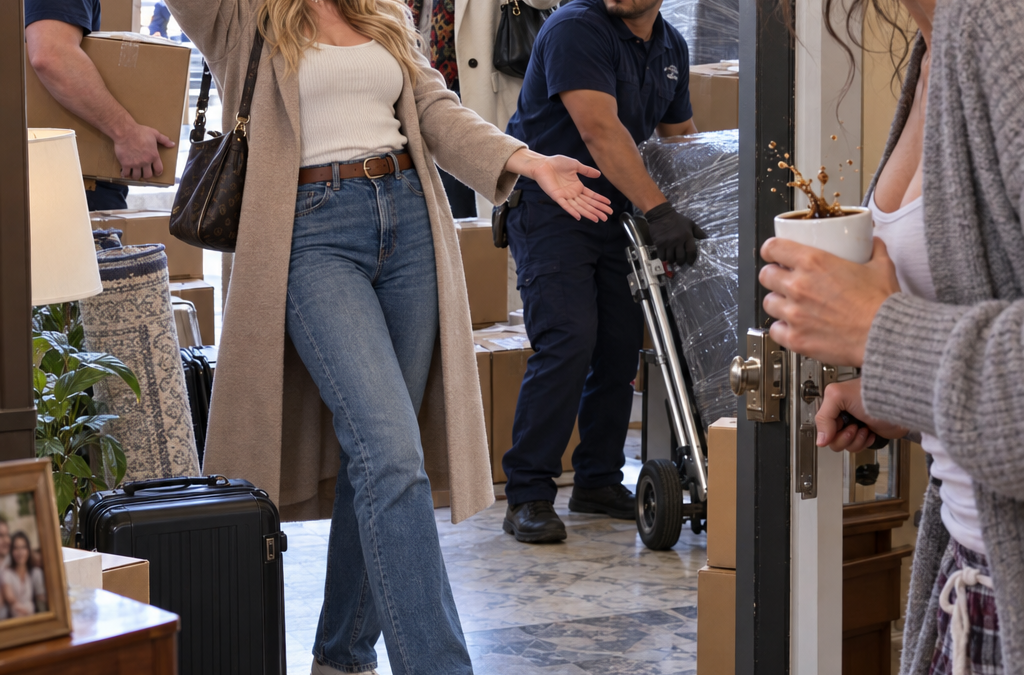
My Sister Announced At Thanksgiving, “Mom Says You’re Giving Me Your Apartment!” I Replied, “Then Mom Can Give You Hers.” Everyone Called Me Selfish. So I Left. The Next Morning, I Found A Moving Truck Outside My Apartment… And My Sister Holding A Set Of Keys.
My sister stood up in the middle of Thanksgiving dinner and announced that our mother had promised her my apartment. I thought humiliation in front of 11 relatives was the worst part—until the next morning, when a moving truck appeared outside my building and someone used my spare key on the lock. What followed exposed years of quiet family entitlement, my sister’s hidden debt, my father’s silence, and the unsettling truth about what my mother believed she owned simply because I had always been the daughter who said yes.
### Part 1
The green bean casserole weighed maybe 6 pounds, but by the time my younger sister Madison stood up at Thanksgiving dinner and announced that Mom had given her my apartment, the Pyrex dish felt like a cinder block in my hands. I was halfway between the china cabinet and Grandma Evelyn’s chair, balancing the casserole against my sweater, when Madison lifted her wineglass and said, “Mom says you’re giving me your apartment.” The crispy onions on top trembled when I stopped walking. For a second, nobody moved—not Dad with the carving knife, not Aunt Cheryl with her fork halfway to her mouth, not Mom pretending to check the gravy.
My parents lived in a brick two-story house outside Dayton, Ohio, on one of those streets where every lawn looked professionally combed and every mailbox matched. Mom had been squeezing too many relatives around the same dining table since I was in middle school, which meant Thanksgiving always felt like a game of human Tetris involving folding chairs, hot plates, and somebody’s elbow in the butter. The muted football game flickered from the living room while the house smelled of sage, turkey skin, cinnamon candles, and dinner rolls Mom had forgotten in the oven for approximately 90 seconds too long. Under normal circumstances, I loved that smell because it meant home.
That afternoon, it suddenly smelled like a trap.
I looked at Mom. Diane Bennett, neighborhood volunteer, church bake-sale champion, and undisputed queen of saying outrageous things in the same tone most people used to discuss the weather, stood at the stove with a dish towel hanging over her shoulder. The towel was her tell. Whenever Mom wanted something but didn’t want to admit she was asking, she cleaned something that was already clean and spoke as if the decision had been made by a committee I simply hadn’t attended. “We were going to talk to you after dessert,” she said.
“About my apartment?”
“Nora, don’t make this bigger than it needs to be.” She finally turned around, wooden spoon in hand. “Madison needs somewhere stable. You have that cute little place in Columbus, and you’re single, you’re barely home during the week, and you could stay here for a while. You’d save money. Everybody wins.”
I set the casserole down because my arms had begun to shake. My apartment wasn’t a spare room above somebody’s garage. Four years earlier, after turning 26, I’d found that third-floor walk-up in Victorian Village with squeaky hardwood floors, radiators that clanked at 2:00 a.m., and a narrow kitchen window that caught the sunset between two maple trees. I had signed the lease alone, paid the deposit alone, hauled a secondhand sofa up three flights with my best friend Lauren, and spent an entire Saturday painting the kitchen a soft yellow because I wanted one room in my life chosen entirely by me.
“Then you can give Madison your house,” I said.
I didn’t shout. That detail matters because, in every version Aunt Cheryl later repeated, I became a screaming lunatic who ruined Thanksgiving over “a misunderstanding.” In reality, I said it quietly while folding my arms across my chest. Madison’s expression wasn’t smug like I’d expected. Her mouth opened slightly, and something uneasy passed over her face, almost like she’d been handed a birthday gift and had just realized the tag belonged to somebody else.
Aunt Cheryl put down her fork. “That’s pretty selfish, Nora.”
“Family helps family,” Uncle Dennis added, nodding as though he’d just delivered constitutional law.
Mom’s eyes immediately filled. She could summon tears faster than anyone I’d ever met. “After everything I’ve done for you, I just thought you would want to help your sister.”
Dad studied his turkey.
That was Robert Bennett’s specialty. In 33 years of marriage, my father had perfected the ability to become deeply interested in potatoes whenever his wife crossed a line. He didn’t agree with her exactly; he simply disappeared while remaining seated three feet away. I looked toward him anyway, because some ridiculous part of me still believed there were moments so absurd that even Dad would have to speak.
He didn’t.
Grandma Evelyn caught my eye from the far corner. She was 82, sharp as a tack, wearing her good pearl earrings and eating the cranberry-orange relish nobody else touched. She gave me the smallest shake of her head. I couldn’t tell whether she was warning me not to fight or telling me I wasn’t crazy, but either way, she was the only person who acknowledged something had gone badly wrong.
“Happy Thanksgiving,” I said.
I picked up my purse and left.
Nobody followed me at first. That hurt more than the apartment conversation itself. I walked through the cold toward my car while laughter from another family’s house drifted across the street, and I kept waiting for our front door to open behind me. Dad could have come out. Madison could have come out. Mom could have come out and said she’d pushed too far.
Instead, the porch light stayed behind me.
I had just put my key in the ignition when Grandma Evelyn appeared at the end of the driveway, moving carefully in church shoes and carrying a paper plate wrapped in aluminum foil. “Pumpkin pie,” she said, handing it through the open window. “Nobody should leave Thanksgiving without pie.”
“Grandma—”
“And you didn’t do anything wrong in there.”
That stopped me.
She leaned closer. “I heard your mother talking to Madison 2 weeks ago. She told her your apartment was basically settled.”
My stomach tightened. “Settled how?”
“She said you’d complain, then come around because you always do.” Grandma’s lips pressed into a thin line. “I should have told you.”
I drove toward Columbus with the radio off. Somewhere past Springfield, I began arguing with Mom even though she wasn’t there, saying all the sharp, perfect sentences people only invent after the moment has passed. By the time the highway opened into that long dark stretch toward Columbus, one thought had crawled underneath all the others: in my family, being dependable had slowly become the same thing as being available for use.
At 19, I’d covered one of Madison’s dance-team fees from the money I earned bagging groceries. At 22, I’d delayed replacing my dying laptop because Mom needed help with an insurance deductible. At 25, I’d taken 3 vacation days to handle Grandma’s appointments because everybody else was “swamped.” Nobody had ever called those things sacrifices. They were just things Nora handled.
Then I remembered the spare key.
Mom had asked for one after I moved in. “Emergencies only,” she’d said. I had attached it to a scarlet Ohio State key tag and handed it over without thinking twice.
I didn’t sleep much that night.
At 7:42 the next morning, I woke to the electronic beep-beep-beep of a truck backing through the alley below my bedroom window. I pulled the curtain aside and saw an orange-and-white moving truck parked in the loading zone, hazard lights blinking against the wet pavement. Madison’s boyfriend, Ethan, stood beside it drinking gas-station coffee.
Then metal scraped inside my front-door lock.
I froze.
The deadbolt turned.
The door opened 4 inches and slammed against the security chain.
“Nora?” Madison’s voice came through the gap.
I walked into the hallway barefoot and stared at my sister’s pale face between the door and the frame. Her hair was twisted into a claw clip, her eyes were red, and hanging from her fingers was a ring of keys.
The scarlet Ohio State tag swung from it.
### Part 2
For several seconds, neither of us spoke. I could hear the moving truck idling below, the furnace clicking on somewhere in the building, and a dog barking on the first floor. Madison finally lifted the keys as though they explained everything. “Mom said you’d calm down after you slept.”
I stared at her. “You brought a moving truck to my apartment.”
“She said you already agreed.”
“When?”
Madison blinked. “Before Thanksgiving.”
Something cold moved through me. “I didn’t even know about this before Thanksgiving.”
“She said last night was you being dramatic because people were there.” Madison swallowed. “She said once I showed you I was serious, you’d stop making it emotional.”
The door across the hall opened. Mrs. Whitaker from 3B appeared in a purple bathrobe holding her phone upright. She was a retired middle-school principal in her 70s who knew every package, plumber, argument, and unauthorized bicycle that crossed our floor. “I’ve been recording since somebody started putting a key into Nora’s door,” she announced. “And before anyone asks, no, I am not deleting it.”
Madison nearly dropped the keys.
“Mrs. Whitaker, it’s okay,” I said automatically.
“No,” she replied. “It is currently not okay. It may become okay after coffee.”
I almost laughed, which made me angrier because I didn’t want anything about that morning to be funny. I unhooked the chain but kept myself planted in the doorway. Madison stepped backward immediately, and that tiny movement told me more than her explanation had. She knew, at least now, that she had crossed into something different from a family disagreement.
Downstairs, my building manager, Frank Morales, was waiting on the front porch wearing sweatpants and a Columbus Crew jacket. The second he saw me, he raised both hands. “Nora, I didn’t authorize this. I swear.”
“Authorize what?”
Frank glanced toward Madison. “Your mother called Wednesday.”
Two days before Thanksgiving.
“She told me you were moving back to Dayton and your sister would be taking your unit. She knew your rent amount and the lease-renewal month, so at first I thought maybe you’d talked about it. I told her nothing changes without your written notice and the owner’s approval.” He scratched his jaw. “She called again Thursday morning.”
“What did she say then?”
“That you were busy with work but had agreed.”
Madison slowly sat on the porch step.
Frank continued, “I told her if you were leaving, you needed to contact me yourself. She got irritated. Said family arrangements weren’t my business.”
My pulse was pounding in my ears now. Thanksgiving hadn’t been Mom asking me. It had been Mom informing me after she’d already started trying to make it real.
Ethan walked over from the truck, coffee forgotten in his hand. “For what it’s worth, I told Maddie this seemed weird.” He looked genuinely embarrassed. “I kept asking, ‘Has Nora actually said yes?’”
Madison covered her face. “I know.”
“You knew?”
“I knew something felt wrong.” Her voice broke. “I didn’t know she hadn’t even asked you.”
The anger I’d been holding suddenly had nowhere clean to go. I wanted to be furious at Madison because she was physically sitting beside a moving truck intended to carry her belongings into my home. I also saw my little sister at 9 years old, sitting on my bedroom floor while I braided her hair because Mom was mad that she’d lost her recital tights. Both versions existed at the same time, and I hated that.
“I didn’t want your apartment,” she whispered. “Not like this.”
“Then why are you here?”
Her chin trembled. “Because I need somewhere to live.”
Ethan returned the truck, which cost them $147 after mileage, fuel, and what he called “the humiliation surcharge.” I made Madison give me the key before we went anywhere. She slid it off the ring and placed it in my palm. The metal was warm.
We walked 3 blocks to Cooper’s Diner, where the booths had cracked red vinyl and the coffee tasted like every Midwestern morning I’d ever survived. Lauren arrived 15 minutes later wearing pajama pants under a wool coat because my text had consisted of six words: “Madison tried moving into my apartment.” She slid into the booth beside me, pointed across the table, and said, “I am sitting on Nora’s side.”
Madison sniffed. “Fair.”
It took 2 cups of coffee before the truth began coming out.
Madison had lost her job at a bridal boutique in May after the business cut staff. She hadn’t told me because she was embarrassed. She had almost $8,400 spread across two credit cards, mostly rent, groceries, car repairs, and several months of pretending she was financially fine when she wasn’t. Mom had been covering her minimum payments since July.
“Why didn’t you call me?” I asked.
“Because you’d tell me the truth.”
Lauren stopped stirring her coffee.
Madison looked down at the napkin she was shredding into tiny squares. “Mom told me not to worry. At first she said she’d help until I found something. Then every time I mentioned an apartment, she said I couldn’t afford it. When I said Ethan and I might move in together, she said that would be a mistake.”
Ethan’s parents apparently lived in Indiana, and Mom disliked the idea of Madison moving farther away. That part sounded exactly like her.
“So she offered you mine,” I said.
Madison nodded miserably. “She said you were hardly there anyway. She said you make good money. She said you wouldn’t mind once you thought about it.”
I stared through the diner window at people carrying shopping bags down the sidewalk. “Did you ever ask why I was supposedly moving out?”
“She said you’d stay with them for a year and save for a house.”
I laughed once because the alternative was throwing my coffee cup.
Lauren leaned forward. “Madison, listen carefully. Did your mother tell you Nora explicitly agreed?”
Madison hesitated.
Then she pulled out her phone.
“There are texts.”
She opened the thread and pushed the phone across the table.
Most of it was exactly what I expected: Mom telling her not to panic, promising everything would work out, saying I’d “get over myself.” Then I reached a message sent Wednesday afternoon.
Mom: Frank has been contacted. Nora already handled the paperwork side months ago. Don’t bother her about details. She’s sensitive about feeling pushed.
My skin prickled.
I read it twice.
“What paperwork?” Lauren asked.
“I have no idea.”
Madison scrolled farther.
Another message appeared.
Mom: The transfer isn’t the problem. Getting Nora to stop making everything about independence is the problem.
I stopped breathing for a second.
Because suddenly, the moving truck was no longer the most disturbing thing about that morning.
### Part 3
On Monday afternoon, instead of eating lunch at my desk, I sat inside a small law office on High Street between a tax-preparation business and a phone-repair shop. The attorney, Rachel Kim, wore tortoiseshell glasses and drank coffee from a faded Cleveland Browns mug. She read my lease without interrupting except for an occasional “Hmm,” which somehow made me more nervous than if she’d gasped.
When she finished, she placed the lease flat on the desk. “You are the tenant. You haven’t signed an assignment, transfer, sublease, surrender, or notice to vacate. Your mother cannot give anyone this apartment.”
“I know that logically.”
“Good. Sometimes people need to hear the obvious from somebody charging by the hour.”
That made me smile.
Rachel explained that a spare key given for emergencies wasn’t blanket permission to enter my home, and it certainly wasn’t authority to move another person in. She advised me to change the locks with the landlord’s permission, document what had happened, and send one calm written message stating that nobody had permission to access the apartment or communicate with management on my behalf. “You don’t need to write an essay,” she said. “Boundaries usually get weaker when we explain them 15 different ways.”
I stared at the lease. “My mother told my sister I’d handled paperwork months ago.”
“Did you sign anything involving your apartment?”
“No.”
“Did you sign anything unrelated that might have been misunderstood?”
I started to say no, then remembered something.
The previous spring, Mom had brought a folder to brunch containing documents related to Grandma Evelyn’s emergency-contact information. Grandma had fallen in her garden—not badly, but enough to scare everyone—and Mom had suddenly become obsessed with making sure every family form was “organized.” I had signed a page confirming my phone number, address, and willingness to be contacted if Grandma needed help. Nothing had involved my lease.
Rachel saw my expression change. “What are you thinking?”
“Probably nothing.”
“Those are famous last words.”
I called Frank as soon as I left. He met me at the building office, an old converted dining room downstairs with a desk piled in contractor invoices and spare smoke detectors. When I asked whether Mom had sent anything in writing, he hesitated. “She emailed me something Thursday morning.”
My stomach tightened.
He turned his monitor toward me.
The email itself said that I had authorized Diane Bennett to “coordinate transition details” because of my work schedule. Attached underneath was a photograph of the emergency-contact page I’d signed months earlier. My signature sat near the bottom beneath my Columbus address.
“She told me this showed you had given her authority,” Frank said. “It obviously didn’t. That’s why I told her to have you contact me directly.”
The document hadn’t been forged. In some ways, that made it worse. Mom had taken something legitimate, stripped away the context, and relied on confidence to do the rest.
“What did she say when you refused?”
Frank gave me a tired look. “She asked how long I’d been managing apartments because apparently she thought that was relevant.”
I laughed despite myself.
He changed my lock that afternoon.
When Frank handed me three new keys, I felt ridiculous for nearly crying. They were just keys—silver, ordinary, machine-cut pieces of metal lying in my palm. But for the first time since Thanksgiving, I felt something click back into place inside me.
All three keys went home with me.
That evening, I wrote Mom a text and deleted it 12 times. Version one was furious. Version five was 4 paragraphs explaining everything she’d done wrong since 2007. Version nine contained the phrase “weaponized maternal guilt,” which Lauren said was accurate but perhaps too much for a first message.
Eventually, I sent six sentences.
Mom, I love you, but I am not giving Madison my apartment. You did not have permission to contact my building manager or use an unrelated document to imply that you were authorized to act for me. No one has permission to enter my home without my approval. Please do not contact my landlord again. I am willing to talk when you’re ready to discuss what actually happened.
The message showed “Delivered.”
No response came.
The silence lasted 4 days before Aunt Cheryl texted me instead.
Your mother is devastated. You could have handled this privately.
I stared at the message for a full minute before replying.
I tried. She sent a moving truck.
Aunt Cheryl did not respond.
The family machinery started anyway. Uncle Dennis left me a voicemail saying Mom had “only been trying to solve a problem.” A cousin I spoke to twice a year sent a heart emoji and said, “Life is short.” Someone apparently told people I had threatened legal action, which I hadn’t. By the following weekend, I had become both ungrateful and litigious.
Madison, meanwhile, did something I didn’t expect.
She found a room.
A woman named Kayla, who worked with her at the temporary administrative job she’d just started, needed a roommate in Beavercreek. The place was modest, the carpet was beige, and the kitchen had exactly 14 inches of usable counter space, but when Madison video-called me from the empty bedroom, she looked nervous and proud.
“I’m scared,” she said.
“Good.”
She frowned. “Good?”
“It means you know it’s yours to figure out.”
I helped her build a budget spreadsheet at my yellow kitchen table the following Sunday. I did not pay her deposit. I did not co-sign the lease. I did not offer to consolidate her debt, fix her car, or call anyone on her behalf.
It was one of the hardest helpful things I’d ever done.
Three weeks after Thanksgiving, Grandma Evelyn called.
She spent 30 minutes discussing her neighbor’s leaves, grocery prices, and a church raffle before suddenly saying, “Your mother isn’t speaking to you because she thinks silence makes people come back.”
“I figured.”
“She learned that from her own mother.”
I leaned against the counter. “Grandma?”
There was a pause.
“I should have stopped some things years ago,” she said quietly. “With you. With Madison. Even with your father.”
“What things?”
Another pause.
Then Grandma said something that made my stomach drop.
“You know that savings account you had after high school?”
### Part 4
I had thought about that savings account exactly once in 10 years. I’d worked summers at a grocery store starting at 16, pushing carts in July heat and bagging produce while the same classic-rock playlist repeated every 4 hours. By the time I was 19, I’d saved a little over $3,000, which seemed like a fortune to me then.
“You remember that?” I asked Grandma.
“I remember your mother coming here crying because Madison’s dance expenses had gotten out of hand and your father was worried about the credit card.”
I sat down.
The story I’d always been told was that I had “offered” part of my savings to help the family through a temporary rough patch. I remembered Mom sitting on my bed saying everyone had to pull together. I remembered signing something at the bank because the account had originally been opened jointly when I was a minor.
I also remembered never seeing most of that money again.
“Your mother told us you insisted,” Grandma continued. “I believed her.”
“I didn’t insist.”
“I know that now.”
A dull ache spread across my chest—not because of the money itself, but because of how familiar the pattern suddenly looked. Mom didn’t steal from purses or forge signatures in dark rooms. She created a story in which saying yes was already assumed, then positioned disagreement as a moral failure.
At 19, she’d told the family I wanted to help.
At 30, she told Madison I wanted to move out.
The technique hadn’t changed. Only the size of the thing being taken had.
When Mom finally called on the 23rd day of silence, I was in the produce section of Kroger comparing avocados. Her name appeared on my screen, and my entire body reacted like somebody had pulled a fire alarm.
I answered anyway. “Hi, Mom.”
“Well,” she said, “I hope you’re happy.”
Not hello.
I put the avocados down. “About what?”
“Madison is living with some stranger.”
“She has a roommate.”
“You know what I mean.”
“No, actually.”
Mom exhaled sharply. “I was trying to keep your sister safe. Forgive me for caring.”
There it was, the door she always built. Any criticism of her actions became criticism of her love.
“You used a document I signed for Grandma to make my landlord think you had authority over my home.”
“I didn’t make him think anything. I gave him information.”
“You told Madison I’d agreed.”
“I knew you would eventually.”
I closed my eyes.
A shopping cart squeaked past me.
“Mom, listen to what you just said.”
“I know you, Nora.”
“No. You know what you’ve trained me to tolerate.”
She went silent.
For one second, I thought I’d reached her.
Then her voice went cold. “I have spent my entire life sacrificing for my children, and now I’m being treated like some kind of criminal because I tried to help both of you.”
“How did giving away my apartment help me?”
“You’re 30 years old and renting a place with radiators that sound like farm equipment. Maybe coming home for a year would have forced you to finally save for something permanent.”
I almost laughed. “You don’t know what I have saved.”
“Apparently not, since you’ve become very secretive.”
That sentence stayed with me after the call.
Secretive.
I had started keeping more of my financial life private around 27, after noticing that every raise or bonus seemed to create a new reason someone in the family needed help. I hadn’t consciously decided to stop telling Mom numbers. I had just learned that information could become expectation.
Christmas Eve arrived beneath a thin layer of snow.
I almost skipped my parents’ house entirely, but Grandma asked me to come, and Madison said she didn’t want to face the family alone. So I stood on the porch holding a pie from a bakery and reminded myself that showing up was not the same as surrendering.
Mom opened the door.
She looked me over. “You’re too thin.”
That was all.
No apology. No mention of Thanksgiving. Just the familiar translation: I still want to be your mother, but I refuse to acknowledge what I did.
Dinner was stiff but civil. Aunt Cheryl barely spoke to me. Uncle Dennis asked about my car. Madison sat beside me and kept her phone face down, something she never did.
Afterward, Dad found me in the garage looking for folding chairs.
“Nora.”
I turned.
He stood beside the shelves of old paint cans, hands in his pockets. My father looked older under the fluorescent light than he had at Thanksgiving.
“I should have said something,” he murmured.
“At dinner?”
“Before dinner.”
I stopped.
Dad stared at the concrete floor.
“I knew she called your building.”
Every sound in the garage seemed to disappear.
“You knew?”
“She told me Wednesday night. I said it sounded like a bad idea.”
“But you didn’t call me.”
His face tightened. “Your mother said it was handled.”
I felt something inside me settle rather than explode.
That was the moment I stopped seeing Dad as an innocent bystander.
He hadn’t been powerless.
He’d simply decided my discomfort was easier to live with than Mom’s anger.
### Part 5
Dad reached for my shoulder, but I stepped back. The movement was small, yet his face registered it immediately. “Nora, I wasn’t trying to hurt you.”
“I know.”
That was almost worse.
People imagine betrayal always comes from somebody choosing cruelty. Sometimes it comes from somebody repeatedly choosing convenience, assuming you’ll absorb the damage because you always have.
“I should’ve called,” he said.
“Yes.”
“I’m sorry.”
I believed him.
I also didn’t rescue him from feeling bad about it.
That was new.
Madison and I left Christmas dinner together and sat in our cars for a few minutes under the white glow of the garage light. She had been quieter all evening, twisting the ring on her finger. When I asked what was wrong, she unlocked her phone.
“Mom offered to pay off one of my cards.”
My stomach tightened. “What’s the condition?”
Madison gave me a tired smile. “I’m learning.”
Mom wanted her to sign what she called a “family repayment agreement.” It wasn’t legally sophisticated—just a typed document listing money Mom had paid toward Madison’s credit cards, car insurance, phone bill, and various expenses over the previous year. At the bottom was a paragraph saying Madison agreed to consult Mom before “major financial or residential decisions” until the balance was repaid.
I stared at the screen.
“She wants veto power over where you live.”
“Basically.”
“Are you signing?”
“No.”
I looked at my sister.
Six weeks earlier, she’d shown up at my apartment with a moving truck.
Now she was saying no.
“I told her I’d repay what I can after I get my cards under control,” Madison said. “But I’m not signing my life over.”
A burst of pride caught me off guard.
“Good.”
Her eyes filled. “You’re not mad at me anymore?”
The honest answer was complicated.
“I am mad.”
She looked down.
“But I’m not only mad.”
Madison nodded slowly.
That distinction became the foundation of our relationship.
Over the next several months, we learned how to talk without Mom translating between us. I discovered Madison had believed for years that I looked down on her because I was “the successful one.” She discovered Mom had told me for years that Madison was “too sensitive” for direct conversations about money or responsibility. Neither of us could identify a single moment when we’d actually said those things to each other.
Mom had become the central switchboard of our family.
Every message passed through her until we no longer knew which opinions were real.
By February, Madison had picked up extra weekend shifts doing reception work at a dental office. She taped a debt-payoff chart inside her closet and colored in one square every $100. I knew because she sent me photos whenever she hit another $500.
I cheered.
I did not send money.
That part mattered.
One Saturday afternoon, Dad called and asked whether he could drive to Columbus for coffee. We met at a place near Goodale Park where the windows fogged from the cold and somebody kept grinding espresso beans loudly enough to interrupt conversation.
Dad looked uncomfortable before he’d even removed his coat.
“Your mother doesn’t know I’m here.”
“That’s healthy.”
He winced. “Probably deserved.”
For a while, we talked about work and Grandma’s furnace. Then Dad rubbed both hands over his coffee cup and said, “There’s something you don’t know about why she pushed the apartment.”
I waited.
He glanced toward the window.
“Madison had been talking about moving to Indianapolis with Ethan.”
I knew that.
“What I didn’t know,” Dad continued, “was how strongly your mother opposed it. She thought if Madison moved in with Ethan, she’d lose control of the situation.”
“Control?”
Dad immediately corrected himself. “Influence.”
“No. You said control.”
He sighed.
According to him, Mom had spent months trying to persuade Madison not to move. When Madison’s finances got worse, Mom saw an opportunity. If Madison moved into my Columbus apartment and I came home to Kettering, both daughters would suddenly be within driving distance and, more importantly, financially entangled with her.
I sat back.
“So this was never just about helping Madison.”
Dad shook his head.
“She wanted both of us closer.”
“She worries.”
“She manipulates.”
Dad looked down.
There was another silence.
Then he said, “She’s always been terrified of people leaving.”
That explained something.
It excused nothing.
Mom’s own father had disappeared when she was a teenager. Grandma had worked two jobs afterward, and Mom spent much of high school caring for younger siblings. She had grown into the kind of adult who confused being needed with being loved.
I understood the origin.
I still refused the outcome.
Before Dad left, he handed me a small cardboard box.
“Your mother told me to bring this.”
Inside were childhood photographs, school certificates, a softball trophy, birthday cards, and the ceramic handprint I’d made in kindergarten.
“Why?”
Dad’s expression tightened.
“She said if you want to be independent, you can take your things.”
I stared at him.
That was Mom’s message.
Independence wasn’t adulthood.
It was rejection.
And she wanted me to feel the price of choosing it.
### Part 6
I left the box unopened in my hallway for 3 days. Every time I walked past it, I felt 8 years old again, standing in the kitchen while Mom gave me the silent treatment because I’d chosen to sleep at a friend’s house instead of attending one of Aunt Cheryl’s family dinners. She had always been generous with affection when the family moved in the direction she wanted.
The withdrawal was the punishment.
On Tuesday night, I finally carried the box to my kitchen table.
Under the photographs and school papers was a blue spiral notebook.
I almost missed it because it looked like one of Dad’s old hardware-store notebooks. Inside, though, was Mom’s handwriting.
Dates.
Amounts.
Names.
Nora—college groceries, $140.
Madison—dance costumes, $385.
Nora—car insurance shortage, $212.
Madison—braces payment, $600.
Nora—moving boxes, $42.
Some entries went back more than a decade.
At first, I thought it was a household budget.
Then I saw the notes in the margins.
Nora paid back $100.
Maddie promised to help with Christmas.
Nora owes family time after skipping Easter.
I stared at that last line until the words blurred.
Mom had not merely remembered favors.
She had kept score.
Even emotional obligations had balances.
I photographed several pages and texted Dad.
Did Mom mean to send this?
His response came 20 minutes later.
What notebook?
I called him.
He went silent when I described it.
“I think that was supposed to stay in the desk.”
“Why does she have a ledger about us?”
“Nora—”
“Don’t.”
He exhaled.
“She writes things down when she’s upset.”
“Dad, there are entries from 2009.”
He didn’t answer.
The notebook clarified more than any apology could have.
Mom saw family as an economy.
Help created debt.
Debt created access.
Access created authority.
That was why she believed my apartment could be redistributed. In her mind, she’d spent decades investing in me, and I was refusing to provide a return.
I mailed the notebook back.
No note.
No accusation.
Just tracking information and her name on the package.
Three days later, she drove to Columbus.
I saw her from my kitchen window getting out of her SUV while sleet streaked the glass. I hadn’t invited her, and for a moment, I considered pretending I wasn’t home. Then she looked up and saw me.
Mom buzzed from downstairs.
I answered through the intercom. “Why are you here?”
“We need to stop this nonsense.”
I almost told her to leave.
Instead, I went downstairs because I wanted one conversation with no relatives, no turkey, no moving truck, no father studying potatoes.
We sat in the building’s front room.
Mom kept her coat buttoned.
“You went through my private things,” she said.
“You put them in a box and sent them to me.”
“That notebook wasn’t meant for you.”
“I understand that.”
Her jaw tightened. “People keep track of money.”
“You wrote that I owed family time because I missed Easter.”
“That wasn’t literal.”
“Then why write it?”
She looked away.
I waited.
For once, I didn’t fill the silence for her.
Finally, Mom said, “Do you know how much I have done for everyone?”
“Yes.”
“No, you don’t.” Her voice rose. “I was 17 when my father left. Your grandmother fell apart. I raised half that house. Then I got married, had children, took care of everybody again. People leave unless you keep the family together.”
The words came out fast now.
I understood something I hadn’t before.
Mom wasn’t pretending she had no fear.
She had built an entire system around it.
“If Madison moved away with Ethan, what did you think would happen?” I asked.
“She’d struggle.”
“She is struggling.”
“And you think that makes you right?”
“No.”
Mom stared at me.
“That’s the difference between us.”
Her face hardened.
I continued, “You think love gives you the right to make decisions before other people make them. You think helping someone means they owe you obedience.”
“I never said that.”
“You didn’t have to.”
She stood.
“You’ve changed.”
It was meant as an insult.
I realized I was glad it was true.
Before leaving, Mom paused beside the door. “One day, you’ll need your family.”
“I already need my family.”
She looked back.
“I just don’t need them to own me.”
Mom left without another word.
I watched her SUV disappear around the corner and felt sad rather than victorious.
Then my phone buzzed.
It was Madison.
Mom just called me.
I typed, What happened?
Three dots appeared.
Then her message came.
She told me I have to choose.
### Part 7
The choice was brutally simple.
Mom told Madison that if she continued spending time with me while “taking my side,” Mom would stop helping with her phone plan and car insurance. Six months earlier, that threat would have terrified my sister. Now she called her insurance company, asked what it would cost to move onto her own policy, and discovered independence had a number.
“It’ll hurt,” Madison told me over FaceTime.
“Can you afford it?”
“Barely.”
“Then make a budget.”
“You’re not going to offer to pay?”
“No.”
She grinned. “Good.”
Madison moved her phone to a prepaid plan the next week and picked up 2 extra Saturday shifts each month. Ethan helped her compare insurance quotes, but he didn’t pay the bill either. For the first time in her adult life, every essential service she used was attached to her own name.
Mom stopped speaking to her.
That lasted 17 days.
Then Grandma Evelyn’s 83rd birthday arrived.
Grandma refused restaurants because she considered paying $14 for pasta “a personal insult,” so Aunt Cheryl hosted everyone at her house. Madison and I almost didn’t go, but Grandma called us separately and said, “I am too old to spend my birthday managing the emotional development of people in their 50s.”
We went.
The party smelled like coffee, lemon cake, and Aunt Cheryl’s vanilla room spray. Children chased each other through the basement, Uncle Dennis argued about football, and Dad hovered near the vegetable tray like it offered legal immunity.
Mom arrived last.
She hugged Grandma, kissed Aunt Cheryl, greeted Dad, and walked past Madison and me without looking in our direction.
Fine.
I had discovered that silence only works as punishment when you’re desperate to end it.
Halfway through cake, Aunt Cheryl tried to force the issue.
“It’s a shame,” she said loudly, “that this family has gotten so divided over one apartment.”
I put down my fork.
Before I could speak, Madison did.
“It wasn’t over an apartment.”
The room quieted.
Aunt Cheryl blinked.
Madison’s hands trembled, but she kept going. “Mom told me Nora had agreed to give it to me when she hadn’t. She gave me Nora’s emergency key. She contacted Nora’s manager. I showed up with a moving truck because I believed her.”
Mom’s face drained.
“Madison,” she warned.
“No.”
I’d never heard my sister say the word to our mother like that.
Everyone else apparently hadn’t either.
Madison looked around the table. “I did something wrong too. I should have called Nora before I ever got in that truck. I didn’t because I wanted what Mom promised. That’s on me.”
Mom stood.
“This is inappropriate.”
Grandma Evelyn took another bite of cake.
“I think it’s going pretty well,” she said.
Dad coughed into his napkin.
Mom looked at me. “Are you enjoying this?”
“No.”
That answer seemed to confuse her.
I stood slowly.
“I don’t want you humiliated. I wanted you to stop telling everyone a version where I randomly became selfish at Thanksgiving.”
“You abandoned your sister.”
Madison’s chair scraped backward.
“She didn’t abandon me.”
Mom turned toward her.
Madison’s eyes were wet.
“She helped me without taking over my life.”
The sentence landed harder than anything I could have said.
For several seconds, Mom looked genuinely wounded.
Then she whispered, “So I’m the villain now.”
“No,” I said. “You’re our mother. That’s why this mattered so much.”
Something shifted in her expression.
Not surrender.
Not quite understanding.
But the first crack in certainty.
Dad finally stood beside her.
“Diane.”
She looked at him.
He swallowed.
“I should’ve stopped you.”
The room became so quiet I heard the refrigerator compressor click on.
Dad continued before he lost his nerve. “I knew you called Nora’s building. I knew she hadn’t agreed. I let you do it because I didn’t want another fight.”
Mom stared at him like he’d slapped the table.
“You’re blaming me too?”
“I’m blaming myself.”
Nobody spoke.
Then Grandma Evelyn reached for her coffee.
“Good,” she said. “Perhaps we’re finally getting somewhere.”
Mom left the party 10 minutes later.
Dad followed eventually, but not immediately.
That mattered.
I didn’t chase either of them.
Outside, Madison and I stood beside our cars under a pale March sky.
“Do you think she’ll ever apologize?” Madison asked.
“Maybe.”
“Would that fix it?”
I looked back through the window at our relatives clearing plates.
“No.”
Madison nodded.
Neither of us sounded sad about that.
Because by then, we’d learned something important.
An apology might change the future.
It couldn’t rewrite what had already happened.
### Part 8
A year after the Thanksgiving moving truck, I renewed my lease.
Frank slid the paperwork across his desk and grinned. “Planning to stay?”
“For now.”
The apartment still had loud radiators, uneven floors, and a kitchen drawer that only opened if you lifted it slightly to the left. The porch still groaned beneath my weight. The yellow paint in the kitchen had chipped near the baseboard where Lauren once dropped a wine opener.
I loved every imperfect inch.
Madison came over the Sunday after Thanksgiving—not on Thanksgiving itself, because we’d both decided one giant family gathering per holiday season was enough personal growth for anybody. She carried Thai takeout upstairs and complained about my building’s lack of an elevator.
“You were ready to steal this place,” I reminded her.
“I was emotionally unwell.”
“You had a moving truck.”
“I have apologized.”
“You have.”
She had also changed.
Her credit-card balance was down by more than half. She’d been promoted to office coordinator at the dental practice and finally ended the cycle of putting normal expenses on credit. She and Ethan were still together, but they hadn’t rushed into living together just because doing so might save money.
Most importantly, Madison had learned the difference between accepting help and surrendering authority.
So had I.
Dad and I talked about once a week now.
Our relationship wasn’t magically healed. For months, I couldn’t ask his opinion without hearing the silence from Thanksgiving underneath his answer. But he had started doing something he’d almost never done before: disagreeing with Mom out loud.
The first time it happened, he called me afterward like he’d survived a tornado.
“I told her no,” he whispered.
“To what?”
“She wanted me to call Madison’s insurance company because she thinks her rate is too high.”
I laughed so hard I had to sit down.
Mom and I existed in a different category.
We were not estranged.
We were not close.
She sent birthday cards. I called on Mother’s Day. Sometimes we spoke for 20 minutes about Grandma, work, neighborhood gossip, and whether tomatoes tasted worse than they did 20 years ago.
We did not discuss my finances.
She did not have a key.
She had never given me the apology I once imagined I needed.
The closest she came happened in late summer when she visited Columbus with Dad. We met at a coffee shop rather than my apartment.
After Dad went to the counter, Mom stirred her tea and said, “I honestly thought you would say yes.”
“I know.”
She stared into the cup.
“That was the problem, wasn’t it?”
I looked at her.
It wasn’t “I’m sorry.”
It wasn’t enough to restore trust.
But it was the first time she’d named the truth without turning it into my fault.
“Yes,” I said. “That was the problem.”
She nodded once.
We moved on.
I used to believe forgiveness meant rebuilding a relationship until it looked the way it had before. Now I think that’s sometimes the worst thing you can do. The relationship I had with Mom before Thanksgiving depended on me accepting things I no longer accepted.
I didn’t want it back.
Grandma Evelyn approved.
She visited me one Saturday in October and sat in my yellow kitchen drinking tea while the radiator knocked like somebody trapped in the wall. At 83, Grandma had become even less interested in diplomacy.
“You know what your mother’s mistake was?” she asked.
“I’m sure you’re going to tell me.”
“She confused your patience with permission.”
I smiled.
“That sounds like something you’ve been waiting months to say.”
“Years.”
She reached over and squeezed my wrist.
“I should have spoken sooner when you girls were younger.”
“You speak now.”
“Sometimes that’s all old people can fix.”
After she left, I stood in the doorway and looked at the small ceramic bowl where I kept my keys.
There were three.
One for me.
One spare sealed in an envelope in my desk.
One I’d eventually given to Lauren because she lived 12 minutes away and understood that “emergency” meant leaking pipes, smoke alarms, or unconsciousness—not reorganizing my life.
None belonged to Mom.
That evening, Madison called.
“I have news.”
“You’re pregnant?”
“What? No.”
“Engaged?”
“No!”
“Arrested?”
“Nora.”
I laughed.
She had paid off her first credit card.
The balance was zero.
“I wanted you to be the first person I told,” she said.
Pride rose in my throat.
“I’m proud of you.”
“I kept waiting for it to feel more dramatic.”
“Financial stability is mostly disappointingly boring.”
She laughed.
Then she grew quiet.
“You know I really am sorry about the truck.”
“I know.”
“I still think about your face when you saw the key.”
“So do I.”
“I believed Mom because believing her meant I didn’t have to solve my own problem.”
There it was.
Maybe that was the most honest thing any of us had said since Thanksgiving.
“I spent years saying yes,” I replied, “because saying yes meant I didn’t have to deal with everyone being mad when I said no.”
Neither of us spoke for a moment.
Then Madison said, “We’re kind of a messed-up family.”
“Statistically average, probably.”
She snorted.
After we hung up, I opened the kitchen window a few inches despite the cold. Columbus traffic hummed in the distance. Somewhere downstairs, somebody was playing music softly, and the smell of onions frying drifted from another apartment.
My life wasn’t glamorous.
I rented instead of owned.
I wasn’t married.
I hadn’t magically become somebody who enjoyed conflict.
But I no longer confused peace with surrender.
That Thanksgiving, when Mom announced that my apartment belonged to my sister, I thought the argument was about a lease, a key, and a moving truck. It took me months to understand that the real argument was over something less visible.
Who got to decide what belonged to me?
For years, my family had treated reliability like a communal resource. The daughter who rarely needed rescuing became the daughter everyone felt comfortable borrowing from—her time, her savings, her patience, eventually even her home.
I had helped create that pattern every time I said yes because refusing felt cruel.
Changing it didn’t require a dramatic revenge plan.
I didn’t sue my mother.
I didn’t cut off my entire family.
I didn’t make Madison homeless to teach her a lesson.
I simply stopped paying for everyone else’s comfort with pieces of my own life.
Madison and I became closer because I stopped rescuing her. Dad and I became more honest because I stopped pretending his silence was neutral. Mom and I became more distant because the version of closeness she wanted required access I was no longer willing to give.
That distance was painful.
It was also peaceful.
The following Thanksgiving, I brought green bean casserole to Grandma Evelyn’s house. Madison was already there when I arrived, setting the table.
She looked at the dish in my hands and grinned.
“Careful with that.”
“Why?”
“Historically, green bean casserole has been dangerous for this family.”
Grandma laughed from the kitchen.
Even Dad smiled.
Mom didn’t.
But she handed me a serving spoon without comment.
That was enough.
Not forgiveness.
Not forgetting.
Just proof that everyone in the room understood the rules had changed.
Later that night, I drove back to Columbus alone beneath a cold, clear sky. When I reached my building, I climbed the familiar three flights, unlocked my door, and stepped into the yellow kitchen.
The radiator clanked.
The floor creaked.
Everything was exactly where I had left it.
I locked the deadbolt behind me and placed my key in the little ceramic bowl.
Nobody had given me that life.
Nobody else had the authority to give it away.
And for the first time, being the dependable daughter no longer meant being the daughter everyone could take from.
It simply meant I could depend on myself.
THE END!