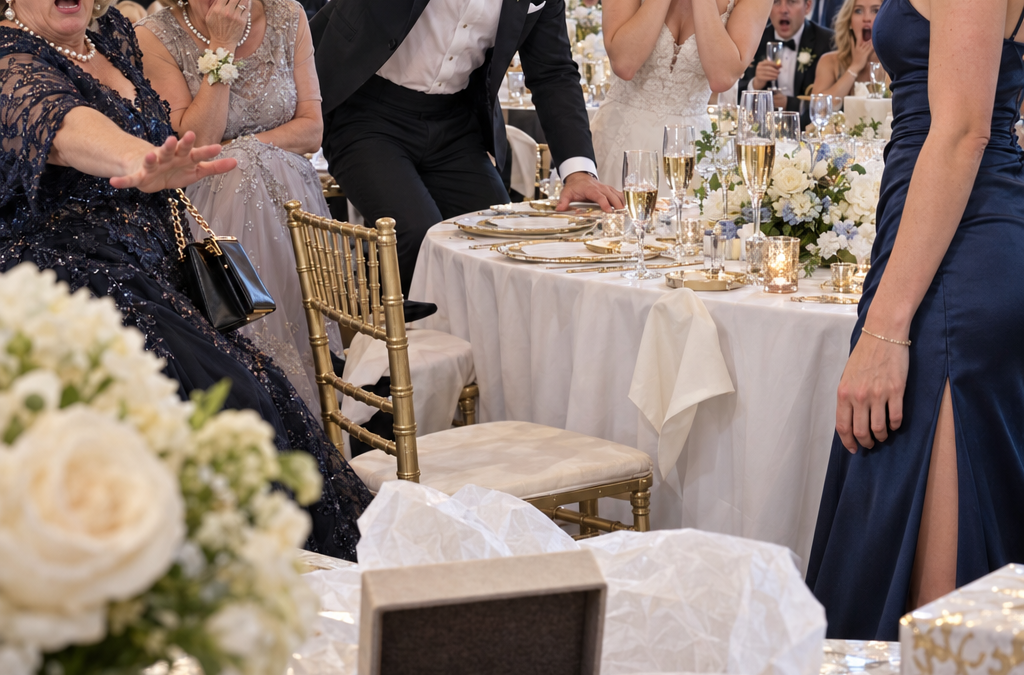
“Return The Wedding Gift. You Can’t Even Afford A Decent One,” My Sister’s Mother-In-Law Whispered While Mom Looked Away, Ashamed Of My Small Box. The Groom Opened It Anyway, Then Screamed, Because Inside Was The Key To The Penthouse He’d Been Dreaming About For Years. But Now It’s All Gone…
At my little sister’s wedding, her new mother-in-law looked at my tiny brown-paper package and whispered, “Return it before you embarrass yourself.” She thought I was the broke older sister driving an ancient Subaru and clipping grocery coupons. I smiled and let her believe it. Then the groom opened my gift, saw a brass key, and screamed in front of 120 guests. What he found underneath it exposed a lie his wealthy family had been hiding for years.
### Part 1
My aunt Ruth did not gossip. She read public records out loud and let everyone else decide how scandalous they were. That distinction mattered to her, especially on Sundays when she sat at my mother’s kitchen table with reading glasses halfway down her nose, buttering a dinner roll as if she were discussing the weather instead of somebody’s impending financial ruin.
“One of the Mercer properties crossed my desk this week,” she said one Sunday in March. My mother, Janet, stopped slicing the pot roast and gave her the look she usually reserved for people who brought politics to Thanksgiving. “Ruth.” My aunt shrugged. “It’s public. The notice will be printed Friday.”
I was halfway through pouring iced tea when something in my chest tightened. My younger sister, Megan, was marrying Evan Mercer in September, and there were plenty of Mercer properties scattered across Boulder County. His grandfather had made his fortune developing office buildings, apartment complexes, and shopping centers, which meant the family name appeared on construction signs often enough that people assumed Mercers owned half the Front Range.
“Which property?” I asked.
Ruth looked at me over her glasses. “The penthouse at the Alder.”
The pitcher stopped in my hand.
Of course it was the Alder. Evan had been talking about that place since the first Christmas Megan brought him home, long before he proposed. The Alder was only five stories tall because Boulder was not interested in letting anyone block the mountains, but its top-floor corner residence had floor-to-ceiling windows facing the Flatirons on one side and the plains on the other. Evan’s grandfather had lived there for years, and according to Evan, the apartment had been placed into a family trust for him.
“When Megan and I move into the Alder,” Evan would say whenever rent came up. He always said when, never if. Megan would roll her eyes and laugh because she thought it was part family legend, part childhood dream, but Evan never laughed when he said it.
I set down the tea. “What exactly crossed your desk?”
Ruth glanced toward my mother, who sighed and returned to the roast. “Notice of election and demand. Missed payments. Enough of them that the lender has started the foreclosure process.” She paused. “There’s a sale date.”
My mother lowered the knife again. “Does Evan know?”
“That,” Ruth said, “is not in the public record.”
I barely tasted dinner after that. My mother and Ruth moved on to a story about somebody’s fence dispute, but my mind stayed on the Alder, on Evan pointing at its top windows whenever we drove down Pearl Street, and on Megan believing she was marrying into a family whose money was old enough to be permanent. Evan was not a bad man; he was cheerful, generous, maddeningly trusting, a golden retriever raised in a house full of wolves who had convinced him meat appeared in the bowl because that was simply how the universe worked.
The problem was that I had already tried to ask him about the penthouse.
At their engagement dinner two months earlier, the Mercers had hosted both families at their stone house on Mapleton Hill. Diane Mercer had hired a caterer, a bartender, and a woman whose only apparent job was to light candles before guests noticed they needed lighting. During dessert, I casually asked Evan whether the Alder plan was still happening after the wedding.
His face had brightened. “Absolutely. Dad’s getting some trust paperwork cleaned up first.”
Before I could ask what that meant, Diane placed one manicured hand on my forearm. “Camille, honey, family trusts can be very complicated.”
The way she said complicated made it sound like a language spoken only by rich people.
“I understand trusts,” I said.
Diane gave me the patient smile people use with children describing dinosaurs. “I’m sure you understand some of them.”
Across the table, Megan’s shoulders stiffened. I dropped the subject because it was her engagement dinner and because my mother had taught us never to start a fire in somebody else’s house unless we were prepared to put it out.
Outside afterward, however, Megan followed me into the driveway while Evan was saying goodbye to relatives. Snow crunched beneath our shoes, and her breath came out in white clouds.
“Cam, please.”
“Please what?”
“Just be happy for me.”
“I am happy for you.”
“Then stop interrogating his family like you’re auditing them.”
That stung more than I wanted her to know. “I asked one question.”
“You always ask one question that turns into six.”
She was right about that. I made my living noticing inconsistencies, though nobody in my family really understood how much of a living it had become. I studied Megan’s face for a moment, saw that she was tired rather than angry, and lifted both hands.
“Fine. No more questions.”
She hugged me immediately. “Thank you.”
I kept my promise. I stopped asking questions.
Instead, I started doing math.
The foreclosure notice gave me numbers, dates, lender information, and eventually a scheduled public sale. None of it made sense beside the life the Mercers were still displaying. Diane was planning a wedding that probably cost more than my first house. Thomas Mercer had recently arrived at brunch in a new Range Rover. Their Mapleton Hill property alone looked like something photographed for a luxury real estate magazine.
People who were genuinely that wealthy did not usually lose a cherished family property because they forgot a few payments.
That meant the Alder was not the problem.
It was evidence of the problem.
Two weeks later, I drove past the Mercer house and saw a man photographing it from the sidewalk. He wore khakis, carried a clipboard, and moved from the front gate to the side of the property with the methodical patience of someone being paid by the hour.
He was not a tourist.
When I slowed at the stop sign, he turned just enough for me to see the logo on his folder.
Property valuation services.
I drove home with both hands locked around the steering wheel.
For the first time, I wondered whether the penthouse was only the first thing the Mercers were about to lose.
### Part 2
There was something important about me that Diane Mercer did not know, and I had worked very hard to keep it that way.
Six years earlier, after getting sick of arriving at mountain-bike trails only to find them destroyed by overnight rain, I had built a simple app called Trailwise. It combined weather reports, soil conditions, ranger updates, and user reports to estimate whether a trail was actually rideable. I thought maybe a few thousand Colorado cyclists would use it.
I was wrong.
Cyclists in Oregon wanted it. Then Washington. Then Utah, Arizona, California, and eventually enough places that I quit my job and hired four people from a rented office above a plumbing supply store. Three years later, an outdoor technology company from Portland bought Trailwise for a number that made my lawyer stop speaking for almost ten seconds.
The contract included confidentiality provisions, retention bonuses, and several layers of financial planning I did not discuss with my family. When my mother asked whether the sale had gone well, I said, “Pretty well.” To Mom, pretty well meant I had paid off my student loans and maybe upgraded from generic cereal.
I encouraged that interpretation.
I still drove my 2009 Subaru with the cracked dashboard because it ran fine. I still shopped at King Soopers because I knew where everything was. I lived in a comfortable house, invested carefully, and never posted pictures from the occasional expensive vacation because I had watched money distort people long before I ever had any.
My father died when I was seventeen, leaving my mother with two daughters, an electrician’s life insurance policy, and a mortgage that did not care that she was grieving. For twenty-two years she worked at Rosie’s Diner on Arapahoe, often taking double shifts until her ankles swelled above her shoes. Megan and I spent so much time there as kids that I could still remember which booth had a loose spring.
One afternoon when I was twelve, I sat in the back doing algebra while a man with a watch the size of a hockey puck snapped his fingers at Mom every time he wanted coffee. He left twenty dollars on a nine-dollar check and looked pleased with himself. Mom thanked him politely.
Ten minutes later Hector, the dishwasher, came out for his break. Mom already had a slice of pecan pie waiting beside a clean fork.
“Why are you nicer to Hector than the guy who tipped you twenty dollars?” I asked after Hector went back to work.
Mom kept wiping the counter. “Watch how people treat somebody who can’t do anything for them, Cami.”
I frowned.
“The tip is just the tip.”
I carried those words for years.
Diane Mercer had been giving me useful information since the day we met.
She corrected waiters who pronounced French words differently from the way she did. She once handed a valet five dollars and then complained for ten minutes because he had adjusted her seat. When my mother mentioned buying her dress for Megan’s engagement party on clearance, Diane smiled and said, “I love people who can make inexpensive things work.”
She was never openly vicious. That would have been easier.
She specialized in tiny cuts made with a soft voice.
By April, I knew the Alder foreclosure was real. By May, I knew the lender intended to proceed. I still considered warning Megan directly, but every time I rehearsed the conversation, I heard her in the driveway asking me to be happy for her.
So I waited for evidence I could not be accused of inventing.
It came at the end of May.
Evan invited me to lunch because he wanted help planning a surprise for Megan’s birthday. He suggested an expensive steakhouse, and when the check came, his card was declined.
He stared at the server. “That’s weird.”
He tried another.
Declined.
His ears turned red. “Bank fraud alert, probably.”
I put down my card before he could try a third.
“Don’t worry about it,” I said.
“I’ll send you the money.”
“You don’t have to.”
“I will.”
He did, two hours later.
That should have reassured me, but it did the opposite. Evan had money. Whatever was happening had not reached him yet, which meant his parents were controlling the information.
The following week, I called Aunt Ruth.
“Any other Mercer filings?”
There was a pause. “Cami.”
“It’s public.”
“I am starting to regret teaching you that phrase.”
“Anything?”
She sighed. “Not under Evan’s name.”
That was not the answer I had asked for.
“Under Thomas?”
Another pause.
“What did you find?”
“I didn’t say I found anything.”
“Ruth.”
“Come over.”
I arrived at her condo twenty minutes later. She had a folder waiting on the kitchen table but would not hand it to me.
“I’m not using my office access to dig into private records,” she said. “Everything in here is publicly available, and I printed instructions showing where you can verify it yourself.”
“Fine.”
She finally slid the folder across.
Property liens. A second mortgage. A commercial filing connected to Mercer Development Holdings. Nothing by itself proved disaster, but together they formed a picture I recognized from business.
The Mercers were feeding one obligation with another.
I looked up. “How bad?”
“You’re asking the wrong question.”
“What’s the right one?”
“How long can they keep pretending?”
On June 18, the Alder penthouse went to public sale.
The Mercer family did not save it.
The lender took possession.
That same evening, Diane posted a photo from a country club dinner, smiling beneath crystal chandeliers with a caption about celebrating exciting things ahead.
I stared at the image for a long time.
Then I opened my laptop and searched for the lender’s asset-disposition department.
If the Mercers were willing to let Evan walk into marriage believing a foreclosed home still belonged to him, I wanted to know exactly how far that lie went.
### Part 3
The Alder appeared on the market in July.
I saw the listing at 6:12 on a Tuesday morning while drinking coffee in my kitchen. The photographs showed the same west-facing windows Evan had pointed at for years, but the rooms were empty now, the hardwood floors dusty, the walls stripped of the paintings that had once belonged to his grandfather. The price had been reduced enough to attract attention but not enough to explain why the family had let it go.
At 8:01, I called a realtor.
By noon, I was standing inside.
The place smelled like dust, old wood, and the faint chemical sharpness of fresh paint. My realtor, Melissa, kept apologizing for the condition, but I hardly heard her. Through the windows, the Flatirons rose against a cloudless blue sky so clearly they looked close enough to touch.
I imagined Megan there after a hospital shift.
My sister was a pediatric nurse, the kind who came home with raw hands from washing them a hundred times but still answered calls from frightened parents because she could hear panic in a voice before most people noticed it. She had never cared about family names, country clubs, or expensive cars. She loved Evan because he remembered every nurse on her floor and brought enough coffee for all of them.
I also imagined what could happen if she married into a financial collapse she did not understand.
“Can I see the disclosures?” I asked.
Melissa handed me the packet.
I read everything.
Then I made an offer.
I would love to claim I bought the penthouse entirely as some brilliant strategic maneuver. The truth was simpler. I could afford it, I loved my sister, and I wanted at least one thing in her future that nobody could refinance, gamble, leverage, or quietly lose while telling her everything was fine.
My offer was accepted nine days later.
I did not tell Megan.
Instead, I called Noah Blake, an attorney I had worked with after selling Trailwise. His office occupied a converted Victorian on Walnut Street, and every floorboard complained when you crossed it.
“You want to give your sister a penthouse as a wedding present,” he said after hearing me out.
“Yes.”
“Worth seven figures.”
“Yes.”
“And you don’t want her future husband to own any part of it.”
“Correct.”
Noah leaned back. “You realize that may create an interesting wedding day.”
“I am not planning to announce the legal structure during the first dance.”
He removed his glasses. “Camille.”
“If the Mercers are drowning, I am not tying Megan to the anchor.”
He studied me for a moment, then nodded. “Separate property. Her name only. We’ll make the documentation as clean as possible.”
“Good.”
“And she should speak with her own attorney afterward.”
“Also good.”
He reached for his keyboard. “You are either the best sister in Colorado or the beginning of a very expensive family argument.”
“Possibly both.”
The legal work took several weeks.
During that time, the wedding machine became impossible to escape. Diane called my mother constantly about centerpieces, seating charts, linens, transportation, and whether Megan’s side of the family understood that cocktail attire did not mean casual. Mom absorbed every slight with the calm expression of someone who had survived the breakfast rush after church for two decades.
One afternoon I found her altering the lavender dress she planned to wear to the wedding.
“You could buy another one,” I said.
She looked offended. “Why?”
“Because you’ve taken that hem apart twice.”
“Because the first time I did it wrong.”
“You know I’d buy you one.”
Mom threaded the needle. “And I know I don’t need you to.”
That ended the discussion.
Two weeks before the wedding, Diane held a bridal luncheon at a hotel downtown. I arrived ten minutes late because my Subaru refused to start on the first try.
Diane noticed the car through the window.
“You’re still driving that?” she asked.
“It still drives me.”
“You should let Evan’s father’s dealership contact get you into something safer.”
“It has airbags.”
She laughed, but I was not joking.
Later, while gifts were being discussed, Diane mentioned that someone had purchased Megan and Evan the Le Creuset set on their registry.
“I’m sure whatever you give them will be very meaningful,” she said to me.
My mother looked down at her coffee.
There it was again.
Not an insult anyone could quote afterward, just the suggestion that meaningful was what poor people called inexpensive things.
I smiled. “I hope so.”
The closing happened six days before the wedding.
When Melissa handed me the key, it hung from a small brass fob stamped with the outline of an alder leaf. The original grandfather’s key fob had somehow remained with the unit through the foreclosure process.
That made me hesitate.
For the first time, I wondered what Evan would feel when he saw it.
Not gratitude.
Loss.
The penthouse had been part of the story his parents had told him about who he was. Giving it to Megan might force him to understand that the story had been false.
I almost changed the plan.
Then, two nights before the wedding, Evan called me.
“Cami, quick question. Megan wants to know if we should start forwarding mail to the Alder after the honeymoon or wait until Dad finishes the paperwork.”
I went completely still.
“What did your father tell you?”
“That everything should transfer by October.”
October.
The property already belonged to me.
“Did he tell you that this week?”
“Yesterday. Why?”
I looked across my kitchen at the folder containing Megan’s deed.
My last doubt disappeared.
“No reason,” I said.
After we hung up, I drove to my mother’s house.
She was sitting at the kitchen table addressing a final wedding card.
I placed the brass key in front of her.
She looked at it, then at me.
“What did you do?”
“I bought the Alder.”
My mother’s mouth opened.
I told her everything.
When I finished, she sat silently for nearly a minute.
Then she touched the key with one finger.
“You put it in Megan’s name?”
“Only Megan’s.”
Mom nodded once.
“Good.”
That was when I understood she had been worried too.
### Part 4
The morning of Megan’s wedding arrived bright and painfully beautiful.
Flatirons Ridge Lodge sat against the foothills beneath a Colorado sky so blue it looked artificial. The ceremony space opened toward the mountains, and by noon the air smelled of pine, cut flowers, and expensive perfume. Diane had spent months making sure every detail suggested effortless wealth.
Nothing about it was effortless.
My gift sat in the passenger seat of my Subaru on the drive up. I had wrapped the deed and key in brown craft paper and tied the package with kitchen twine, exactly the way my mother had wrapped our Christmas presents when we were children and actual wrapping paper seemed like an unnecessary luxury.
Mom saw it when we parked.
She touched the twine and smiled. “Your father used to save that stuff.”
“I know.”
“He’d have reused the paper too.”
“I know.”
For a moment, neither of us spoke.
Then Mom wiped beneath one eye before her mascara could run and said, “Let’s go marry off your sister.”
Megan looked radiant.
When I entered the bridal suite, she was standing near the window in her dress while two bridesmaids adjusted the train. The second she saw me, her carefully composed wedding face disappeared.
“Oh my God,” she said. “You clean up.”
“I considered wearing the Subaru.”
She laughed and hugged me.
Holding my little sister in that room nearly broke my resolve. She was so happy. I wanted to protect that happiness, but I also knew protection built on silence was exactly what the Mercers had been giving Evan.
“Meg.”
Something in my voice made her pull back.
“What?”
I almost told her everything.
Then Diane swept into the room announcing that photographs needed to begin immediately, and the moment vanished.
The ceremony went perfectly.
Evan cried before Megan reached him. Megan laughed at him for crying and then cried herself. My mother sobbed openly. Even I had to look away when they exchanged vows because I suddenly remembered Megan at six years old following me through the house in plastic princess shoes.
For forty-five minutes, I forgot the foreclosure, the lies, and the deed hidden inside brown paper.
Then came the reception.
The gift table looked like a department-store display. Designer cookware, crystal, expensive luggage, boxes wrapped in metallic paper, and envelopes thick enough to announce what was inside them.
My package looked like somebody had accidentally left lunch on the table.
I was speaking with Aunt Ruth when Diane approached.
She carried a champagne flute and wore a silver-blue dress that probably cost more than my first car. Her perfume smelled like gardenias, and her smile disappeared as soon as she was close enough that nobody else could easily hear.
Her eyes dropped to my package.
“Is that yours?”
“Yes.”
She stared at it.
Then she leaned closer.
“Return it.”
For a second, I genuinely thought I had misheard her.
“Excuse me?”
“You don’t have to embarrass yourself.”
Her voice was low, gentle, almost compassionate.
“You can tell Megan it was delayed. I’ll make sure nobody notices.”
I looked at her.
She glanced at the expensive gifts surrounding mine.
“Really, Camille. You can’t even afford decent wrapping.”
A laugh almost escaped me.
Not because it was funny.
Because the universe occasionally has a sense of timing so precise it becomes absurd.
I was about to answer when I realized my mother stood only a few feet away.
She had heard everything.
Mom looked at the little brown package, then at the floor. She folded her hands right over left, thumbs tucked in, the same way she did whenever she was trying not to show emotion.
That hurt more than Diane’s insult.
For one irrational second, I wondered whether Mom was ashamed of me too.
“Already wrapped,” I said.
Diane’s eyes narrowed.
“And I think Megan will like it.”
She gave me a small, pitying smile. “Of course.”
Then she walked away.
I watched my mother turn toward the windows overlooking the foothills.
“Mom?”
“I’m fine.”
“You heard her.”
“I said I’m fine.”
That meant she was not.
Before I could press, the wedding coordinator tapped a spoon against a glass and announced that the couple would open one gift from each side of the family before the toasts.
I had forgotten that part.
My stomach dropped.
“No,” I whispered.
Aunt Ruth appeared beside me. “Oh, yes.”
“I thought they were opening gifts tomorrow.”
“Apparently rich people schedule spontaneity.”
The coordinator selected a box from the Mercer side.
It contained a luxury espresso machine.
Guests applauded.
Then Megan reached for my package.
Diane’s head snapped toward the table.
“Honey,” she called. “Maybe save that one for later.”
Megan paused.
Evan looked from Diane to me.
Something changed in his expression.
“Nope,” he said cheerfully. “I want to see what Cami got us.”
Diane stood up.
“Evan.”
But he was already pulling the twine.
The brown paper came loose.
Megan lifted the envelope inside.
The brass key fell into Evan’s palm.
He stopped breathing.
I knew the exact second he recognized it.
All the color disappeared from his face.
His fingers closed around the alder-leaf fob, then opened again as if the metal had burned him.
“Where did you get this?”
The room went quiet.
Megan looked at me.
I did not answer.
Evan turned the key over.
“This is Grandpa’s.”
His voice cracked.
“This is the Alder key.”
Then he opened the envelope beneath it.
And screamed.
### Part 5
It was not a word.
It was a raw sound, loud and involuntary, as if something inside Evan had snapped before his mind could stop it. One hundred twenty guests flinched at once. The string quartet near the windows lost the rhythm, and somewhere behind me a champagne glass hit the floor.
Megan grabbed Evan’s arm. “What?”
He stared at the deed.
His lips moved as he read.
Then he looked at me.
“How?”
I stood slowly.
Diane was already pushing through the tables.
“Give me that,” she said.
Evan jerked the papers away from her.
“No.”
Everyone heard that word.
Diane stopped.
I had never seen Evan openly defy his mother before.
He looked down again, reading the document from the beginning. “Grantor, Camille Hayes. Grantee, Megan Hayes.”
Megan blinked.
“What?”
Evan kept reading.
“Sole and separate property.”
Now Megan stared at me.
“Cam.”
“The penthouse belongs to you,” I said.
The room disappeared into whispers.
Megan shook her head. “What do you mean, belongs to me?”
“I bought it after the foreclosure.”
Silence returned.
Not ordinary silence.
The kind that lands when an entire room realizes it has been standing next to a bomb.
Evan turned toward his parents.
“You said it was in the trust.”
Diane’s face froze.
Thomas Mercer placed his champagne glass on the table so carefully it might have contained explosives.
“Evan,” he said. “Not here.”
“You said the paperwork was being transferred.”
“Son.”
“You told me two days ago.”
Diane reached for him. “Sweetheart, this is complicated.”
He stepped away.
I almost laughed at the word.
“Is the Alder gone?” Evan asked.
Thomas looked around the room.
Every person he had spent thirty years impressing was now watching him.
“Evan, your wedding is not the place.”
“Is it gone?”
Thomas did not answer.
Evan lifted the deed.
“Camille bought it from the bank. The bank cannot sell something we own.”
His father closed his eyes.
And that was the answer.
Megan let go of Evan’s arm.
The movement was tiny, but I saw him notice it.
“How long?” she asked.
Diane turned toward her. “Megan, please do not make this bigger than it is.”
That was the wrong sentence.
My sister’s face changed.
She had spent eight years working in pediatric medicine. She had comforted parents while doctors delivered impossible news, dealt with frightened people becoming angry because anger felt easier than fear, and learned to recognize the exact instant someone stopped asking for reassurance and started demanding facts.
“Bigger than what?” Megan asked.
Thomas rubbed one hand over his mouth.
Evan stared at him.
“Dad?”
Thomas sat down.
“The Alder isn’t the only property we lost.”
Diane whispered, “Thomas.”
He ignored her.
“The Granby lake house sold in April.”
Evan’s eyes widened.
“You told me it was being renovated.”
“It needed to be sold.”
“What else?”
Thomas looked at the tablecloth.
“The Mapleton house is heavily mortgaged.”
Diane sat down as if her knees had stopped working.
Thomas continued.
“Mercer Development has had liquidity problems.”
“How bad?”
“We missed payroll twice.”
Several guests shifted uncomfortably.
Evan seemed unable to process the words. “You missed payroll?”
“We made it up.”
“That isn’t what I asked.”
Thomas’s jaw tightened.
I recognized the reflex. A man accustomed to controlling rooms was discovering that authority disappeared quickly once people stopped pretending.
Evan pointed toward the reception around us.
“What about this wedding?”
Diane inhaled sharply.
Thomas said nothing.
Megan looked between them.
“What about the wedding?”
Finally Thomas answered.
“It’s on a credit line.”
Evan stared.
Diane snapped, “Which will be paid.”
“With what?” he demanded.
Nobody answered.
That was the moment the Mercer name collapsed.
Not when the penthouse was foreclosed.
Not when the lake house sold.
Not when payroll was missed.
It collapsed when everyone realized the image had outlived the money.
Diane turned toward me.
Her shock hardened into rage.
“You.”
I did not move.
“You did this.”
“No.”
“You waited. You watched us struggle and then stole our family home.”
“I bought a bank-owned property listed publicly for sale.”
“You vulture.”
My mother stood.
“Diane.”
I had never heard Mom use that tone outside the diner.
Diane ignored her.
“You sat at our table.”
“I did.”
“You smiled in my house while planning this.”
“I wasn’t planning your foreclosure.”
“You knew.”
“Yes.”
“You could have told us.”
I almost answered gently.
Then I remembered her whisper beside the gift table.
Return it before you embarrass yourself.
So I told the truth.
“I tried asking about the Alder months ago. You put your hand on my arm and explained that trusts were too complicated for me.”
A few people looked away.
Diane’s cheeks went red.
“I paid the asking price,” I continued. “The bank accepted my offer. I transferred the property to my sister.”
“You had no right.”
“The county disagrees.”
Aunt Ruth made a choking sound behind me that might have been laughter.
Megan stepped between us.
“Stop.”
Everyone stopped.
She held the key in one hand and the deed in the other.
Then she looked at Evan.
“Did you know?”
“No.”
“Think before you answer.”
“I didn’t know.”
His voice broke.
“Megan, I swear to you. I thought the Alder was mine. I thought Dad had some refinancing issue with the company. I had no idea about the foreclosure.”
She studied him for several seconds.
I watched my sister do what she did with frightened parents every day: separate emotion from information.
Finally she nodded.
“I believe you.”
Evan sagged.
“But we’re not going on our honeymoon tomorrow.”
His head lifted.
“We’re going home, and you are showing me everything. Every account. Every debt. Every credit card. Every promise your parents made that has money attached to it.”
“Yes.”
“If I find one lie from you, one thing you knew and decided not to tell me, we’re done.”
“Yes.”
She closed her fingers around the Alder key.
“And this?”
Evan looked at it.
For the first time that evening, something like humor returned to his face.
“That’s yours.”
“Correct.”
“I can visit?”
“One dollar rent.”
Several people laughed.
The tension cracked.
Megan pointed at him.
“And dishes.”
“Extortion.”
“Sign the lease.”
Aunt Ruth laughed so loudly half the room joined her.
The wedding coordinator, a woman named Claire who deserved hazard pay, picked up the microphone.
“Well,” she said, “the cake is fully paid for.”
More laughter.
“So unless anybody has foreclosed on dessert, I suggest we eat.”
People began breathing again.
But my mother did not laugh.
She crossed the room toward me.
I prepared for questions.
Instead, she took my face in both hands.
Her eyes were wet.
“I thought I failed you.”
I frowned.
“What?”
“When Diane said you couldn’t afford a proper gift.” Mom swallowed. “I looked at that little package, and for one awful second I thought maybe I hadn’t given you girls enough.”
My throat tightened.
“Mom.”
“I spent my whole life stretching everything.”
“You taught me how.”
She shook her head.
I touched her wrists.
“You taught me to wrap presents with grocery bags and save the ribbon.”
Her mouth trembled.
“You taught me to judge people by how they treat someone who cannot help them.”
She stared at me.
“That bought more than the penthouse.”
Mom started crying.
So did I.
Behind us, Diane Mercer stood alone beside a table covered in gifts expensive enough to fill a magazine spread.
Nobody was looking at them anymore.
### Part 6
Real life does not cut to credits after the dramatic wedding scene.
It sends you home with leftover cake.
At 11:40 that night, I was barefoot in my kitchen eating frosting directly from a cardboard box when Megan called. I answered immediately.
“Are you okay?”
“No.”
I put down the fork.
“What happened?”
“We’re at the hotel.”
“And?”
“Evan is showing me everything.”
Her voice sounded exhausted.
I waited.
“Cam, he really didn’t know.”
Relief came first.
Then caution.
“You’re sure?”
“I’ve seen his accounts. He has savings, some investments, normal credit cards, no secret loans. He isn’t tied to his father’s company except for a small stock interest his grandfather gave him.”
“That’s good.”
“It gets worse for his parents.”
Of course it did.
Thomas had finally given Evan access to financial documents after the reception. Mercer Development had expanded too aggressively, borrowed against appreciating properties, and assumed several projects would sell before interest costs became dangerous. When two deals stalled, Thomas borrowed again rather than reduce spending.
Then he lied.
Not on legal documents, according to Megan, but everywhere else.
He told lenders deals were close.
He told employees payroll delays were administrative.
He told friends the family was shifting assets.
He told Evan the Alder remained protected.
And Diane kept spending because stopping would announce to everyone that something was wrong.
“How much do they owe?” I asked.
Megan gave me the number.
I sat down.
“That much?”
“Apparently.”
“What’s the Mapleton house worth?”
“Less than the debt attached to everything if the company collapses.”
I looked at the cake.
Suddenly I was no longer hungry.
“What are you going to do?”
“I don’t know.”
That was unusual.
Megan always knew her next step, even if it was only to make a list.
“Do you still love him?”
“Yes.”
“Do you trust him?”
A long pause.
“I trust that he didn’t lie to me.”
“That isn’t the same question.”
“I know.”
She started crying quietly.
“I hate that his parents made me question whether my husband was involved in this on our wedding night.”
“I know.”
“He keeps apologizing for things he didn’t do.”
“That’s fear.”
“I know.”
“And what do you want?”
She breathed slowly.
“I want him to stop being their child when money is involved.”
That was the real problem.
Evan had never needed to investigate anything because his parents had trained him to believe financial questions were disrespectful. They had not stolen from him. They had created something more subtle: dependence disguised as privilege.
“Then tell him.”
“I did.”
“What did he say?”
“He gave me his phone and told me to call an attorney.”
I smiled.
“That’s promising.”
The next morning, Evan called me himself.
“Can we talk?”
“Yes.”
“I’m angry at you.”
“I assumed.”
“But not for buying the apartment.”
That surprised me.
“What are you angry about?”
“You knew months ago.”
I leaned against the kitchen counter.
“I knew the foreclosure process had started.”
“You could have told me.”
“I tried asking you.”
“You asked whether the trust was being transferred.”
“And your mother told me I didn’t understand trusts.”
“You could have pulled me aside.”
“You’re right.”
Silence.
I did not enjoy admitting it, but he was right.
“I should have tried harder,” I said. “Megan asked me to stop interfering, and I used that as permission to keep my distance.”
“Why?”
“Because I was afraid she’d think I was trying to ruin her engagement.”
Evan exhaled.
“I probably would’ve thought that too.”
“Probably.”
Another silence.
Then he said, “Thank you.”
“For what?”
“For making it hers.”
I closed my eyes.
“If I’d owned part of it, Dad could have asked me to borrow against it.”
“Yes.”
“And six months ago, I might have done it.”
“I know.”
That was why I had structured the gift the way I did.
Not because I believed Evan was dishonest.
Because honest people make terrible decisions when people they love are drowning.
Two weeks later, Thomas Mercer began restructuring the company.
He sold vehicles.
He canceled club memberships.
He listed equipment.
Several projects were transferred to creditors.
The Mapleton Hill house went on the market in October.
Diane blamed me for weeks.
According to Evan, she told anyone who would listen that I had “ambushed the family” at the wedding. She never mentioned whispering that I should return my cheap gift beforehand.
I did not defend myself.
People who needed to believe her could believe her.
Meanwhile, Evan did something I did not expect.
He got a job.
Not at a Mercer company.
Not through one of Thomas’s friends.
He called a mid-sized contractor in Longmont, disclosed his family connection, and applied for a junior project-management position.
They offered him less money than he expected.
He accepted anyway.
Three days later, he sold the Range Rover his father had leased for him.
Then he bought a used Ford pickup.
Megan sent me a photograph of him staring at the owner’s manual.
I replied, DOES HE KNOW CARS NEED OIL?
She wrote, WE ARE DISCOVERING MANY THINGS.
By November, they had moved into the Alder.
Megan paid no mortgage because there wasn’t one.
Evan insisted on contributing money anyway.
She refused.
They compromised.
He paid one dollar per month in rent and covered groceries, utilities, maintenance, and household expenses based on an amount they agreed was fair.
They also created something neither Mercer household had apparently possessed before.
A spreadsheet.
Every Thursday evening they reviewed their accounts together.
Romantic?
Not particularly.
Useful?
Extremely.
I thought the crisis was finally settling.
Then, three days before Thanksgiving, my mother called.
“Cami.”
Her voice was strange.
“What happened?”
“Diane called me.”
I straightened.
“Why?”
“She lost the apartment.”
“What apartment?”
“The one she moved into after Mapleton sold.”
I stared at the wall.
“What does she want?”
My mother hesitated.
Then she said the last thing I expected.
“She wants to come to Thanksgiving.”
### Part 7
My immediate answer was no.
Not because I believed people were incapable of changing. I believed they could.
I simply did not believe change automatically entitled them to access.
“Mom, she humiliated you.”
“She humiliated you.”
“She tried.”
“She succeeded with me.”
That stopped me.
Mom was quiet for a moment.
“Cami, I want to see what happens when nobody has anything she wants.”
I almost laughed.
Of course that was what my mother wanted to know.
Watch how people treat someone who cannot do anything for them.
Even after all these years, she was still running the test.
Diane had moved into a two-bedroom apartment in Louisville after the Mapleton property sold. Thomas was renting a small townhouse closer to Longmont while he worked as an estimator for another contractor, and for the first time in their adult lives they were apparently living separately.
Not divorced.
Just exhausted.
Diane’s apartment problem turned out not to be another financial catastrophe. The owner had decided to sell, and her lease was ending.
“She is not moving in with anyone,” I said.
Mom laughed. “Good Lord, no.”
“And nobody is lending her money.”
“I didn’t say that.”
“I’m saying it.”
Mom sighed.
“I invited her to dinner, Cami. I did not add her to the will.”
Thanksgiving at Mom’s house had never been elegant.
The dining room barely fit eight people comfortably, which meant ten of us had to rearrange furniture and eat with our elbows tucked in. The turkey always finished later than planned. Somebody always spilled cranberry sauce.
That year, Diane arrived carrying a pie.
A store-bought pecan pie.
She stood on the porch in a camel coat, looking smaller than I remembered.
“Happy Thanksgiving,” she said.
“Happy Thanksgiving.”
Neither of us moved.
Finally she lifted the pie.
“I brought dessert.”
“My mother already made three.”
“Of course she did.”
I stepped aside.
That was the extent of my welcome.
I did not hug her.
I did not tell her the past was forgotten.
It was not.
Inside, Evan looked genuinely terrified when he saw us in the same room.
“Everybody behave,” he whispered.
Megan elbowed him.
Dinner began awkwardly.
Then something surprising happened.
Nothing.
Diane did not criticize the plates.
She did not mention that Mom’s dining chairs did not match.
She did not correct anyone.
When my cousin spilled gravy near her sleeve, she helped clean it.
When Thomas arrived late from work wearing jeans and apologized, Diane simply moved her chair so he could sit down.
I watched all of it without trusting any of it.
After dinner, I helped Megan pack leftovers while Mom cleared dishes.
Diane disappeared into the kitchen.
Ten minutes later, I followed.
She was standing at the sink.
Her expensive cashmere sweater had its sleeves shoved above her elbows, and she was washing Mom’s cheap ceramic plates by hand.
Nobody had asked her to.
She did not know I was watching.
That mattered.
Mom appeared in the doorway behind me.
She saw Diane at the sink.
Then she crossed to the counter, cut a slice of pecan pie, placed a fork on a folded napkin, and set it beside Diane’s elbow.
Diane looked down.
Mom said, “Eat before Evan finishes it.”
For several seconds, Diane did not speak.
Then she turned off the water.
“Janet.”
Mom waited.
“I was horrible to your daughter.”
“Yes.”
I nearly choked.
Diane blinked.
Mom continued.
“You were horrible to me too, sometimes.”
“I know.”
“Do you?”
Diane looked at the pie.
“Yes.”
Mom nodded.
“Then eat.”
That was my mother’s version of forgiveness.
Not forgetting.
Not pretending.
A piece of pie.
Diane looked toward me.
I knew what she wanted.
I also knew I was not ready to give it.
“Camille.”
I waited.
“I owe you an apology.”
“Yes.”
Her mouth tightened.
“I was cruel because I thought money gave me the right to decide whose choices were respectable.”
I said nothing.
“And when we started losing ours, I became worse because every ordinary thing felt like evidence.”
Still nothing.
“I looked at your car, your clothes, that package, and I thought I knew what your life was worth.”
“You didn’t.”
“No.”
“You also lied by omission every time you let Evan talk about the Alder.”
Pain crossed her face.
“Yes.”
“That hurt him more than losing the property.”
“I know.”
“Does he know you know?”
She nodded.
I studied her.
“I’m not forgiving you tonight.”
Diane swallowed.
“I understand.”
“I’m not promising we’ll be friends.”
“I understand.”
“And if you ever speak to my mother the way you used to—”
“I won’t.”
I believed she intended not to.
Whether she would succeed was another question.
But intention was more than she had possessed before.
I turned to leave.
“Camille?”
I looked back.
“Thank you for protecting Megan.”
That was the apology that mattered.
I nodded once.
Nothing more.
Later that night, after everyone had gone, Mom and I sat at the table drinking coffee.
“You didn’t forgive her,” Mom said.
“No.”
“Good.”
I stared at her.
“You gave her pie.”
“Pie is not absolution.”
I laughed so hard coffee nearly came out my nose.
Mom smiled.
Then her expression softened.
“People confuse kindness with surrender.”
I stopped laughing.
“They’re not the same thing,” she said.
I looked toward the sink where Diane had stood washing dishes when she believed nobody was watching.
“No,” I said. “They’re not.”
### Part 8
A year after the wedding, the Alder looked completely different.
Megan filled it with plants, books, cheap framed photographs, and furniture collected from places Diane would once have considered unacceptable. Evan built a dining table himself after learning enough carpentry to become dangerous with power tools. One corner of the tabletop was slightly uneven.
Megan refused to let him fix it.
“It has character,” she said.
“It has a measurement error.”
“Character.”
Their marriage survived.
Not because love conquered everything.
Because they did the boring work people skip when they want love to feel magical.
They talked about money.
They reviewed accounts.
They argued openly.
They apologized specifically.
They created boundaries with both families, including me.
Megan once told me, “I appreciate what you did, but if you ever buy real estate involving my marriage without telling me again, I will personally throw you off the balcony.”
“Fair.”
“Good.”
“We’re only five floors up.”
“Cam.”
“Understood.”
Evan eventually earned a promotion with the contractor in Longmont. He learned estimating, scheduling, procurement, and the painful truth that construction projects did not care what your grandfather’s last name had been.
He also learned humility.
The first winter after the wedding, a pipe in the Alder building froze and flooded part of another unit. Evan spent an entire Saturday helping the maintenance crew carry equipment through hallways.
When I teased him about becoming useful, he grinned.
“Turns out nobody salutes you because your grandfather built something thirty years ago.”
“Tragic.”
“I’m coping.”
Thomas stabilized enough of Mercer Development to sell what remained instead of losing all of it. He never returned to the level of wealth he had displayed before, but he found work he was good at and, according to Evan, seemed strangely happier once he stopped trying to convince everyone he was rich.
Diane struggled more.
Money had not only funded her life.
It had organized her identity.
Without the house, clubs, committees, events, and endless social obligations, she did not know who she was.
For a while she tried to rebuild the appearance.
Then something shifted.
She began volunteering twice a week with an organization that furnished apartments for families moving out of temporary housing. The first time Megan told me, I assumed Diane had chosen it because rich donors would be there.
Six months later, she was still showing up.
Apparently she was very good at organizing donated furniture.
Of course she was.
My relationship with her remained cautious.
She apologized again, privately, without asking me to forgive her.
Eventually I accepted the apology.
That did not mean I restored the relationship to something it had never been.
We became civil.
Sometimes warm.
Never close.
I was comfortable with that.
Forgiveness, when I finally gave part of it, did not mean pretending the wedding insult had never happened. It meant I no longer needed to carry the anger everywhere I went.
My mother handled the whole thing differently.
She and Diane became something resembling friends.
Not the lunch-and-shopping kind.
The kind who traded casserole dishes and occasionally sat together without performing.
One afternoon I stopped at Mom’s house and found Diane at the kitchen table drinking coffee from the mug with the chipped handle.
Years earlier, she would have asked for a different cup.
That day she did not seem to notice.
Aunt Ruth noticed everything, of course.
“You know what I like most about this story?” she asked during the second Thanksgiving after the wedding.
“What?”
“Nobody learned the lesson they thought they were going to learn.”
I raised an eyebrow.
“Evan thought he was inheriting a penthouse. He inherited financial literacy.”
I laughed.
“Megan thought she was marrying into security. She learned how to build her own.”
“Continue.”
“Thomas thought admitting failure would destroy him. Turns out hiding it nearly did.”
“And Diane?”
Ruth smiled.
“She thought expensive things were evidence of value.”
Mom placed a slice of pecan pie in front of her.
“And me?”
Ruth considered me.
“You thought buying an apartment would solve the problem.”
That hit closer than I expected.
“It didn’t?”
“It solved a property problem.”
She tapped one finger against the table.
“People problems take longer.”
She was right.
Buying the Alder had been easy.
Money is remarkably good at solving problems with dollar signs attached.
It is less useful with shame.
Trust.
Fear.
Pride.
Those require conversation, boundaries, consequences, and time.
My quiet fortune also stopped being completely secret after the wedding. Once 120 people watched me give away a penthouse, pretending the Trailwise sale had merely “worked out okay” became difficult.
My mother was furious.
Not because I had money.
Because I had let her keep using grocery coupons she thought I needed.
“They expire,” I argued.
“That is not the point.”
“They save money.”
“You bought a penthouse.”
“And thirty percent off yogurt is still thirty percent.”
She threw a dish towel at me.
Eventually I convinced her to let me pay off the small remaining balance on her house.
She resisted for three months.
Then she agreed under one condition.
“No fancy renovation.”
“Define fancy.”
“If a refrigerator has Wi-Fi, I don’t want it.”
“Reasonable.”
“And I am keeping my counters.”
“They’re from 1997.”
“They work.”
So did my Subaru.
I kept that too.
One morning, almost exactly two years after Megan’s wedding, I parked it outside the Alder and rode the elevator to the fifth floor.
Evan opened the door wearing paint-splattered jeans.
“We have news.”
My stomach jumped.
Megan appeared behind him holding a folder.
“Before you panic, nobody is losing a house.”
“Excellent opening.”
She handed me the folder.
Inside were plans for a nursery.
I looked up.
She was smiling.
I started crying before she even said the words.
Months later, when their daughter was born, Megan asked Mom what family tradition she thought we should keep.
Mom considered it carefully.
“Pecan pie.”
Megan laughed.
“That’s not profound.”
“I’m seventy-one. I’ve earned the right not to be profound.”
Then Mom looked at me.
“And brown paper.”
I knew immediately what she meant.
At the baby’s first Christmas, every expensive toy from grandparents, aunts, friends, and coworkers sat beneath the tree.
Mine was wrapped in plain brown craft paper and kitchen twine.
Diane saw it.
Our eyes met.
For one dangerous second, everyone went quiet.
Then she laughed.
Actually laughed.
“Oh, God,” she said. “Should we prepare for another property transfer?”
“No.”
“Vehicle?”
“No.”
“College fund?”
I shrugged.
“I said no questions.”
Megan groaned.
“Camille.”
The truth was that the box contained a children’s book my mother had read to us when we were small.
The college account existed separately.
Some habits die hard.
That evening, while everyone talked around the tree, I stood near the window and looked west toward the mountains.
The Alder had once represented everything the Mercers thought they were.
Status.
Inheritance.
Permanence.
But property is only property.
Names can disappear from buildings.
Fortunes can collapse.
Cars can be repossessed.
Homes can be sold.
A bank statement is not character, and an expensive gift cannot prove love.
My mother had taught me the better test when I was twelve years old.
Watch how people treat someone who can do nothing for them.
That lesson had exposed Diane long before her money disappeared.
It had also allowed me to recognize when she began changing.
I never regretted buying the Alder.
I never regretted protecting Megan.
But the most valuable thing I gave my sister on her wedding day was not the penthouse.
It was the truth.
Truth had ruined the reception for about twenty minutes.
It had embarrassed a powerful family.
It had forced a groom to question everything he had been taught about his own life.
But it also gave Megan the chance to enter her marriage with open eyes instead of borrowed illusions.
That was worth more than any view of the Flatirons.
And whenever someone later asked about the famous wedding where the groom screamed after opening his gift, I never explained the app sale, the foreclosure records, the trust, or the deed.
I just smiled.
“It was a key,” I said.
Because technically, that was all it was.
A small brass key inside a cheap brown-paper package.
What made everyone scream was discovering what it unlocked.
THE END!