4 Years Ago, My Husband Divorced Me Because I “Couldn’t Give Him Children.” Then He Invited Me To His New Wife’s Baby Shower. He Raised His Glass. “I Wasted Seven Years Waiting For Her To Make Me A Father.” I Turned To Leave. Then Two Little Boys Ran In Yelling, “Mommy!” His Mother Saw Their Faces And Dropped Her Glass.
Four years after Mark divorced me because I “couldn’t make him a father,” he invited me to his new wife’s baby shower just to watch me see what I had supposedly failed to give him. He even wrote the insult on the invitation himself. I planned to stay 20 minutes and leave with my dignity intact. Then my twin boys came running through the lobby yelling, “Mommy!” Mark’s mother dropped her glass the moment she saw their faces—and suddenly everyone was asking the question Mark should have answered years ago.
### Part 1
The invitation arrived on a Thursday afternoon between an electricity bill and a grocery flyer, which felt almost insulting in its ordinariness. I was standing at my kitchen counter in Westerville while my three-year-old twins argued six feet away about whether a dinosaur could defeat a fire engine. Luke insisted the fire engine had a ladder, while Owen calmly explained that dinosaurs could bite ladders, apparently ending the debate.
I almost threw the pale pink envelope into the recycling bin without opening it. Then I recognized the handwriting.
Mark.
My ex-husband had always written like he was filling out an insurance form, every letter neat, controlled, and slightly too careful. Inside was an expensive invitation announcing a baby shower for his wife, Emily, on Saturday afternoon at a private event room in Dublin. At the bottom, beneath the printed details, Mark had added one sentence in blue ink.
“Come see what you could never give me.”
I read it twice.
Not because I misunderstood it.
I simply couldn’t believe a 45-year-old man had taken the time to write it.
Luke crashed his plastic fire truck against the kitchen chair. “Mommy, Owen broke the road.”
“The road is carpet,” Owen said.
I laughed, but the sound came out sharper than I expected. Four years earlier, Mark probably would have told me I was being too emotional.
We had been married for seven years, and for most of them we had wanted children. In the beginning there had been hope, private jokes about baby names, weekend trips where we wandered through stores and looked at cribs we had no reason to buy yet. Then months became years, romance became scheduling, and our bedroom slowly turned into an extension of a medical office.
There were thermometers on the nightstand, calendars on the refrigerator, blood tests before work, procedures scheduled around meetings, and waiting rooms where couples stared at magazines without turning pages. No doctor ever looked at me and said, “Claire, you cannot have children.” What we received instead was a collection of numbers, possibilities, probabilities, and eventually the phrase everyone hates because it explains absolutely nothing.
Unexplained infertility.
My ovarian reserve was somewhat low for my age. Mark’s results weren’t perfect either, though he rarely mentioned that part. Whenever doctors explained that fertility problems could involve both partners, Mark nodded politely in the office and somehow remembered a completely different conversation once we reached the parking lot.
At first he blamed timing.
Then stress.
Then me.
“My brother and his wife barely had to try,” he said one night after another failed treatment.
I remember standing beside the sink washing out a coffee mug. “I’m not your brother’s wife.”
“I didn’t say you were.”
“You didn’t have to.”
By the final year of our marriage, disappointment had hardened into resentment. Mark stopped attending some appointments because he said he was tired of hospitals, as if I had been going there recreationally. When another treatment failed, he spent two days barely speaking to me, and somehow I found myself apologizing.
The worst moment happened at Thanksgiving.
His mother, Diane, had made enough food for thirty people even though there were only eleven of us. Halfway through dinner, Mark raised his wineglass and smiled around the table.
“To family,” he said, “and to people who know how to build one.”
Nobody laughed.
He looked at me only after taking his first sip.
Diane gave me a soft expression from across the table. Not anger. Not cruelty.
Pity.
I would have preferred cruelty.
Three months later Mark told me our marriage was over.
“I can’t spend the rest of my life waiting for your body to cooperate,” he said.
I didn’t cry until later because I was too stunned by the efficiency of that sentence. Seven years of marriage reduced to a malfunctioning body. A partnership turned into a failed product he wanted to return.
Our divorce itself was almost embarrassingly quiet. We sold the house, divided furniture, signed papers, and spoke through attorneys when speaking directly felt too exhausting.
Then, three weeks after everything became official, Mark came to my apartment for two boxes he’d left behind.
We argued.
Then we stopped arguing.
And somewhere between grief, anger, familiarity, and loneliness, we made the kind of mistake divorced people are warned about because part of your body can remember intimacy long after the rest of you understands the relationship is dead.
The next morning Mark buttoned his shirt near my front door.
“Last night doesn’t change anything.”
I stared at him.
“Thank God you cleared that up.”
His jaw tightened. “Claire.”
“I know, Mark.”
He left.
Five weeks later, the smell of someone’s breakfast sausage in the office microwave sent me running to the restroom. I blamed stress until my older sister, Megan, arrived at my apartment that evening carrying a pharmacy bag.
“You’re taking this.”
“I’m forty.”
“You’re also throwing up because Mrs. Alvarez heated sausage.”
“Everyone should throw up because Mrs. Alvarez heated sausage.”
Megan pushed the box toward me.
Ten minutes later, I stood inside the bathroom staring at two lines.
After years of doctors.
After treatments.
After Mark left because I couldn’t give him children.
I was pregnant.
My first ultrasound gave life one final opportunity to make the situation even more absurd.
The technician moved the wand, paused, and became unusually quiet.
My fingers tightened around the paper sheet beneath me.
“What’s wrong?”
Her face softened. “Nothing.”
Then she turned the monitor.
“There are two.”
I stared at her.
“Two what?”
She laughed.
“Babies.”
I cried for almost forty minutes afterward in the parking garage.
I cried because I was happy.
I cried because I was terrified.
And underneath both emotions was a name I didn’t want to think about.
Mark.
I called him that afternoon.
Voicemail.
I called again the next morning.
Nothing.
I left two messages saying I needed to speak to him about something important.
He never responded.
Eventually I wrote a letter. I explained the pregnancy, explained the timing, and said I believed the babies were his. I mailed it certified to the address listed during our divorce.
Three weeks later, it came back.
Unopened.
Across the front was a red postal stamp.
REFUSED.
I kept the envelope.
For years I told myself I didn’t know why.
Standing in my kitchen four years later with Mark’s baby-shower invitation in one hand, I finally understood.
One envelope contained the truth I had tried to give him.
The other contained the lie he still believed about me.
And Saturday morning, for reasons I didn’t fully understand yet, I put both of them into my purse.
### Part 2
Megan thought attending the shower was a terrible idea.
She told me that Friday night, repeated it Saturday morning, and then announced it a third time while standing in my driveway with her arms crossed.
“What exactly are you trying to prove?”
“That I’m capable of attending a baby shower.”
“You hate baby showers.”
“I hate games involving melted candy bars in diapers.”
“Claire.”
I sighed. “I’m staying twenty minutes.”
Behind Megan, Owen appeared on the porch carrying one sneaker.
“Mommy?”
“Yes?”
“How many is twenty?”
“Not very many.”
He considered this carefully.
“Twenty is too many.”
Megan pointed at him. “Listen to the child.”
Luke came running behind his brother with his red fire truck tucked under one arm.
“Can we come?”
“Nope.”
“Is there cake?”
“Probably.”
His expression suggested adults had designed civilization incorrectly.
I kissed both boys, promised I would return quickly, and drove toward Dublin before Megan could stage an intervention. The entire way there I told myself I wasn’t going for Mark.
I was going for me.
For four years, I had built a life that did not require anyone’s approval. I had raised premature twins, survived hospital nights, learned which fever required urgent care and which one required fluids and cartoons, bought a modest house with a maple tree that covered my backyard with approximately fourteen million leaves each October, and continued working full-time in payroll because 412 employees expected their money every other Friday.
I had built something good.
Mark’s handwriting should not have been powerful enough to send me hiding.
That was what I told myself.
The event room was attached to an upscale restaurant near Bridge Park. Pink and cream balloons surrounded the entrance, flower arrangements covered the tables, and a gold sign displayed Emily’s name near a mountain of wrapped gifts.
I stopped outside.
I could have turned around.
Nobody knew I was there yet.
Instead, I pushed open the door.
Occupational habit made me count the room automatically.
Forty-three guests.
Mostly women, several couples, a few relatives I recognized from my marriage. Diane stood near the front talking to Mark’s cousin, and two women from our old neighborhood were beside the gift table.
Then I saw Mark.
He was standing next to Emily with one arm around her waist.
Four years had changed him slightly. There was gray near his temples and a softness around his middle that hadn’t been there before, but I still knew the shape of his smile.
For half a second my body remembered him before my mind did.
Then he saw me.
His expression barely changed, but I knew Mark well enough to notice.
Satisfaction.
Emily saw me a moment later and walked toward me.
“Claire?”
“Yes.”
“I’m Emily.”
She took my hand with both of hers.
“Thank you for coming.”
That surprised me enough that I almost forgot the speech I’d prepared.
“I brought you something.”
“You didn’t have to.”
“I wanted to.”
She smiled.
And immediately something became clear.
Whatever existed between Mark and me had nothing to do with her.
She hadn’t ended our marriage.
She hadn’t refused my letter.
And unless she had secretly mastered Mark’s handwriting, she hadn’t written the sentence on my invitation.
So I congratulated her sincerely.
While Emily asked about my drive, Mark remained across the room talking loudly with an older man I vaguely remembered.
“We’ve been incredibly blessed,” he said.
Five minutes later I heard him say it again.
Then again.
By the time I finished half my iced tea, I had counted six versions of the word blessed.
On number seven, he was looking directly at me.
“Some things are worth waiting for.”
That was when I understood why I had been invited.
Not reconciliation.
Not closure.
An audience.
Mark wanted me to watch him win.
He wanted me to stand in a decorated room filled with people who remembered our marriage and see another woman carrying the child he believed I had denied him.
I should have left immediately.
Instead, I stayed because leaving the moment he started performing would have felt exactly like the reaction he wanted.
Emily stood beside me examining the gift I’d brought.
“You still live in Westerville?”
“I do.”
“Mark said you two used to be closer to Worthington.”
“We were.”
“I love that neighborhood.”
Across the room, Mark watched us.
A moment later he walked over.
“You two met.”
Emily smiled. “We managed.”
Then one of her friends called her toward the gift table.
As soon as she walked away, Mark lowered his voice.
“You actually came.”
“You mailed me an invitation.”
“I wasn’t sure you would.”
“Well, here I am.”
His eyes traveled over my face.
“You look good.”
“Thank you.”
“I mean it.”
“So do I.”
His mouth tightened slightly.
Mark always preferred compliments that created debt.
He lifted his champagne glass.
“I hope the invitation didn’t make you uncomfortable.”
I looked at him.
“You wrote on it.”
His mouth twitched.
“So you noticed.”
“It was blue ink, Mark.”
He glanced toward Emily.
“Don’t make this weird.”
For several seconds I simply stared at him.
He had invited his ex-wife to his pregnant wife’s baby shower, written an insult beneath her name, and now apparently my responsibility was maintaining normalcy.
“I brought Emily a gift,” I said. “I’m going to finish my tea and leave.”
“Still running when things get uncomfortable?”
There it was.
The old Mark.
The man who could start a fire and criticize you for leaving the burning room.
I looked at him.
“Enjoy your shower.”
Then I walked away.
I spoke briefly to Diane before leaving.
She hugged me awkwardly.
“Claire. My goodness.”
“Hello, Diane.”
“You look wonderful.”
“So do you.”
She didn’t, really. She looked thinner, older, and tired around the eyes, but baby showers weren’t the appropriate venue for brutal honesty.
“I was surprised when Mark said you’d be here.”
“So was I.”
Her gaze lingered on my face.
“I hope you’re doing well.”
“I am.”
I meant it.
That seemed to bother her more than if I had complained.
Emily started opening presents, and I watched long enough to see a stroller, several blankets, tiny dresses, and a machine that warmed baby wipes. Apparently modern infants had acquired better amenities than most working adults.
Then I checked the time.
Thirty-two minutes.
I had already broken my promise to Megan.
I picked up my purse.
That was when Mark tapped a spoon against his champagne glass.
“Can I have everyone’s attention?”
Something inside me tightened before he even began speaking.
He stood beside Emily and wrapped one arm around her shoulders.
He thanked everyone for coming.
He talked about their daughter and their families.
Then his eyes found mine.
“Life has a funny way of giving you second chances.”
Emily’s smile faded slightly.
Mark continued.
“There was a time when I thought fatherhood simply wasn’t in the cards for me.”
My purse was already over my shoulder.
I should have walked.
“Some of you remember that time,” he said.
A few people shifted uncomfortably.
Then he smiled directly at me.
“And some of you remember my ex-wife.”
Emily whispered, “Mark.”
He ignored her.
“This is Claire.”
Several heads turned.
Mark raised his glass.
“I spent seven years waiting for her to make me a father.”
Silence swallowed the room.
Four years earlier I would have defended myself.
I would have explained blood tests, appointments, his own imperfect results, every procedure I had endured while he complained about how exhausting fertility treatment was for him.
Instead, I looked at Emily.
Her face was bright red with anger.
Not at me.
At him.
“Congratulations, Emily,” I said quietly.
Then I walked out.
Behind me, Mark called my name.
I kept going.
I had almost reached the front doors when I heard footsteps.
“Claire.”
I turned.
Mark had followed me.
And from the expression on his face, humiliating me in front of forty-three people had somehow left him feeling like the injured party.
### Part 3
“Where are you going?”
“Home.”
“I wasn’t finished.”
“That was the problem.”
Mark stopped a few feet away.
“You came here. Don’t act offended.”
“I came to a baby shower.”
“You knew what this was.”
“Yes. A baby shower.”
He gave a short laugh.
“A family celebration.”
Mark said family the way some people say ownership.
The ballroom door opened behind him. Emily stepped into the lobby, followed by Diane, Mark’s cousin Natalie, and two guests who clearly understood that privacy had already left the building.
“Mark,” Emily said. “Let her go.”
He didn’t look at her.
Instead, he stared at me.
“You show up after four years looking like everything’s perfect and I’m supposed to pretend nothing happened?”
That was the moment I finally understood the invitation.
Mark wasn’t celebrating because he was happy.
Happy people didn’t need witnesses that badly.
“I didn’t come here to fight with you.”
“Then why come?”
“Because you invited me.”
He laughed again.
“You always do that.”
“Do what?”
“Act innocent.”
I almost answered.
Then the restaurant’s front door opened behind me.
“Claire!”
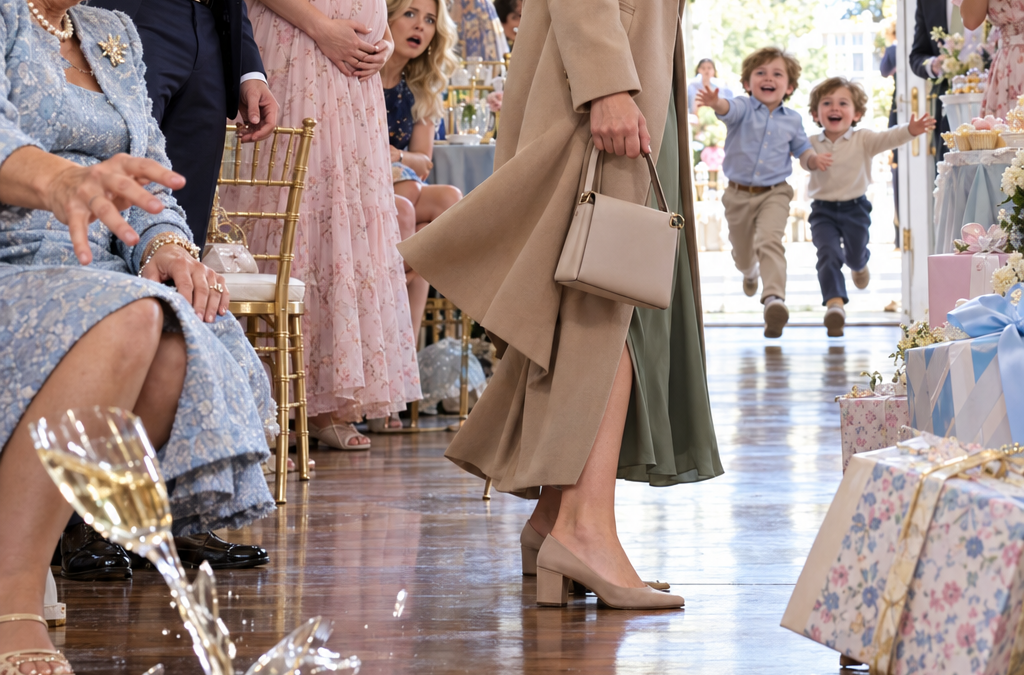
Megan marched into the lobby holding Owen’s hand. Luke followed with his red plastic fire truck tucked under one arm.
She looked furious.
“Your phone is apparently decorative.”
For one ridiculous second, my only thought was that I’d promised twenty minutes.
I glanced toward the lobby clock.
Forty-seven.
Of course I counted.
“Mommy!”
Luke spotted me and ran before Megan could grab him.
Owen followed.
They hit me at knee level, and I crouched automatically while both boys began talking at once.
“Aunt Megan said twenty minutes.”
“I know.”
“It was more than twenty,” Owen announced.
“Thank you, sweetheart.”
Then the lobby became silent.
Not quiet.
Silent.
I stood with one hand on each boy.
Megan finally noticed Mark.
Then Emily.
Then Diane.
Her expression changed.
“Oh.”
That single syllable contained several chapters.
Mark hadn’t moved.
He was staring at my sons.
Diane saw it first.
Luke turned toward her, his truck pressed against his chest.
At three years old, Mark had looked nearly identical to him.
I knew because I had seen the family photographs. Same dark eyes, same square little chin, same crooked dimple on the left cheek.
Diane had seen those photographs too.
She had taken most of them.
Her champagne glass slipped from her fingers.
It struck the tile with a sharp crack.
Luke jumped.
Diane never looked down.
“Mark.”
He slowly turned toward his mother.
She pointed toward the boys with a trembling hand.
“How old are they?”
I rested my palm on Luke’s hair.
“Three.”
Mark went completely still.
Diane stepped closer.
“How old exactly?”
“Three years and four months.”
Mark’s face changed.
I watched him do the math.
There was only one night that equation could lead to.
“No.”
The word came out quietly.
Then louder.
“No.”
Luke pressed against my leg.
Owen, who had already lost interest in the adults, leaned toward the broken glass.
I pulled him backward.
“Don’t touch that, sweetheart.”
Mark stared at the boys again.
Then at me.
“What is this?”
Not who are they.
What is this.
As though I had arranged an elaborate prank involving preschoolers and his mother’s champagne.
“They’re my sons.”
“I can see that.”
His voice sharpened.
Luke wrapped one arm around my thigh.
Diane looked from Luke to Owen.
Then she covered her mouth.
Owen was biting his lower lip.
Mark was doing the same thing.
“Oh my God.”
Mark turned toward me.
“Are they mine?”
I had imagined that question more times than I wanted to admit.
Sometimes in those imaginary conversations I screamed.
Sometimes I stayed cold and calm.
Once, during a night when both boys had stomach flu and I had slept approximately eleven minutes, my fantasy response involved vocabulary my mother would have strongly disapproved of.
But standing in that lobby, none of those speeches mattered.
“Yes.”
Mark stepped backward.
Emily stood behind him, pale and motionless.
“Both?”
“Yes, Mark. Both.”
His shock lasted perhaps three seconds.
Then it became anger.
Because Mark had always preferred anger to fear.
“You had my children.”
I felt my body tighten.
“They’re not something I had at you.”
“For three years?”
“Yes.”
“And you never told me?”
“I tried.”
“No.”
His answer was immediate.
“You didn’t.”
I reached into my purse.
Megan knew what I was looking for.
Mark didn’t.
The old envelope was soft around the edges now, yellowed slightly with a crease near the corner. I held it toward him.
“What is that?”
“The letter I sent you.”
He didn’t take it immediately.
Then his eyes landed on his name written across the front in my handwriting.
He reached for it.
The seal was still intact.
The postmark was nearly four years old.
Across the front, in faded red letters, was the word REFUSED.
“You sent me this?”
“I called you three times. I left two messages. Then I sent that.”
“I never got it.”
“You refused it.”
“I didn’t know what was inside.”
That was true.
I wasn’t going to rewrite history simply because the truth finally favored me.
“No,” I said. “You didn’t.”
He turned the envelope over.
“You could have called my office.”
“I could have.”
“You could have contacted my attorney.”
“Yes.”
“You could have tried harder.”
That sentence did what the baby-shower insult hadn’t.
It made me angry.
Not loud.
Not wild.
Just clear.
For seven years I had endured appointments, procedures, blood draws, calendars, disappointment, and the constant feeling that my marriage depended on my body producing something on command. I had listened to Mark complain about how difficult treatment was for him while I was the one lying under fluorescent lights.
“I spent seven years trying harder.”
Nobody spoke.
I pointed toward the envelope.
“I tried one more time after you left. You wouldn’t even open it.”
His jaw tightened.
“So that’s it? One returned letter and you decide I don’t deserve to know my children?”
“I didn’t say I handled everything perfectly.”
“How convenient.”
“No. Convenient would have been answering the phone.”
Megan looked away quickly.
I knew my sister.
She was hiding a smile.
Mark looked toward her.
Then back at the boys.
His anger suddenly found a new target.
“You brought them here.”
“What?”
“This was planned.”
I stared at him.
“You kept the letter for years. You came to the shower. Then suddenly your children walk through the door.”
Emily flinched at the words your children.
Mark didn’t notice.
“You wanted to humiliate me.”
Megan stepped forward.
“Actually, this part is my fault.”
Mark turned.
Megan pointed at me.
“She told me twenty minutes.”
Owen raised his hand.
“It was more.”
Megan nodded.
“Thank you, official timekeeper.”
Someone near the ballroom doors laughed nervously.
“She didn’t answer her phone,” Megan continued. “Luke was asking for her. Owen was getting upset. So I brought them here.”
“You expect me to believe that?”
“I don’t particularly care what you believe.”
“Megan,” I warned.
She lifted both hands.
“I’m behaving.”
Emily suddenly turned and walked back into the ballroom.
A moment later the music stopped.
Her voice carried through the open doors.
“Everyone, thank you very much for coming. We’re going to end a little early.”
Chairs moved.
Bags rustled.
A few minutes later Emily returned.
She wasn’t crying.
Somehow that made her anger more frightening.
She stopped beside Mark.
“Did you know?”
“Know what?”
“That Claire was pregnant.”
“No.”
Emily pointed at the unopened envelope.
“She sent you a certified letter.”
“I didn’t know what was in it.”
“You told me she never contacted you after your divorce.”
“She didn’t. Not really.”
I closed my eyes.
Emily stared at him.
“A certified letter isn’t really contact?”
“You don’t understand.”
“No,” she said quietly. “I don’t.”
Then Diane spoke.
“Mark told us Claire stopped treatment.”
I looked at her.
“He said you didn’t want to keep trying.”
Mark turned.
“Mom.”
Diane ignored him.
“He said you wouldn’t consider adoption either.”
“That isn’t what happened.”
Her face fell.
I expected satisfaction.
Instead, I felt exhausted.
Then Mark said the words that changed the entire conversation.
“I want a DNA test.”
Megan inhaled sharply.
I touched her arm.
“Fine.”
Mark blinked.
“What?”
“Do it.”
He seemed almost disappointed that I hadn’t fought him.
“I want one too,” I said. “Because my sons are not spending the next fifteen years hearing different versions of this story.”
Luke had gotten bored and was sitting on the floor rolling his fire truck through pink confetti.
Mark stared at him.
Then Luke looked up.
“Mommy?”
“Yes?”
He pointed at Mark.
“Who is that man?”
For the first time that afternoon, Mark had absolutely nothing to say.
### Part 4
The DNA test happened twelve days later.
I had already spent enough of my life waiting for medical results because of Mark, so perhaps it was fitting that our next chapter began inside another beige clinic with artificial plants and daytime television nobody was watching. Mark arrived before me and sat at the far end of a row of chairs, three empty seats separating him from an elderly man reading a newspaper.
I sat opposite him.
Neither of us said hello.
The television showed a woman explaining how to roast chicken with rosemary.
After several minutes, Mark finally spoke.
“You didn’t bring them?”
“They’re at preschool.”
He nodded.
Then silence returned.
I noticed his hand.
He was rubbing the side of his thumbnail repeatedly with his index finger.
Owen did exactly the same thing when nervous.
Before vaccinations.
On his first day of preschool.
Once when he thought he had broken my television.
I looked away.
The obvious similarities hadn’t disturbed me as much as that tiny habit did.
Eyes were genetics.
A nervous gesture felt personal.
“What are they like?” Mark asked.
I looked at him.
It was the first question he’d asked about the boys that wasn’t secretly about himself.
“Different.”
“How?”
“Luke talks first and thinks afterward.”
Mark’s mouth almost curved.
“Owen thinks so long you start wondering whether he’s forgotten the question.”
That time Mark actually smiled.
It disappeared quickly.
The nurse called our names.
Several days later my attorney phoned while I was folding tiny socks beside the washing machine.
The test confirmed Mark was the biological father of both boys.
There was no dramatic music.
No champagne glass.
No room full of stunned relatives.
I simply sat on top of my dryer holding one of Owen’s socks and thought, Now what?
That was the problem with truth.
Everyone imagined revelation was an ending.
Usually it was paperwork.
Mark requested contact with the twins immediately. Once paternity was legally established, we weren’t dealing with baby-shower drama anymore; we were dealing with two children who had never known him and a man who had suddenly discovered he’d been a father for more than three years.
I contacted a family counselor.
To Mark’s credit, he agreed.
Our first proper meeting happened in a family center with a playroom full of worn puzzles, plastic trucks, stuffed animals, and washable markers.
Mark arrived fifteen minutes early.
He brought four enormous shopping bags.
I stared at them.
“What is all that?”
“Things for the boys.”
Inside were remote-control trucks, stuffed bears, building sets made for older children, superhero costumes, and enough candy to destabilize a preschool.
“They’re three, Mark. Not shareholders.”
He looked down at the bags.
“I didn’t know what they liked.”
“Then ask.”
For once, that shut him up.
Megan brought Luke and Owen because the counselor suggested I arrive separately so the boys wouldn’t immediately cling to me. Luke walked into the playroom first.
Owen stayed half hidden behind Megan’s leg.
Mark stood too quickly.
Owen stepped backward.
“Sit down,” I said quietly.
Mark sat.
Luke studied him.
Then looked at me.
“Is this Mommy’s old husband?”
I inhaled coffee at precisely the wrong moment.
Megan turned toward the window.
Her shoulders shook.
Mark looked horrified.
“Yes,” I said after I stopped coughing. “Mark and I used to be married.”
Luke considered that information.
Then Owen asked, “Why doesn’t he live at our house?”
Mark looked at me.
I wasn’t saving him.
He lowered himself onto the carpet.
“Because your mom and I don’t live together anymore.”
“Why?”
There it was.
The most dangerous word in the English language when spoken by a toddler.
“Sometimes grown-ups decide they’re better living in different houses.”
“Did you fight?”
Mark glanced at me.
“Sometimes.”
Owen nodded seriously.
“Mommy says yelling doesn’t fix things.”
Megan made a choking sound near the window.
Mark nodded.
“Your mommy is right.”
I decided not to debate historical accuracy in front of the children.
For the first ten minutes Mark tried too hard.
“What color do you like?”
“What food do you like?”
“What cartoons do you watch?”
Luke finally stopped answering and began pushing his familiar red fire truck across the carpet.
Mark became quiet.
A few minutes later Luke rolled the truck toward him.
Mark rolled it back.
That was all.
No instant bond.
No miraculous transformation.
Just a plastic truck traveling six feet across cheap carpet.
Twenty minutes later Owen picked up a blue toy car and held it toward Mark.
Mark accepted it.
I had to look away.
Because underneath my anger was a thought I hated.
What if Mark became good at this?
Not immediately.
Not perfectly.
But eventually.
What if he could have loved them from the beginning?
That night I told Megan what I was thinking while we cleaned macaroni from beneath my kitchen table.
“You tried to tell him,” she said.
“I could have tried harder.”
“Yes.”
I looked at her.
She shrugged.
“You want me to lie?”
“No.”
“You made a decision while you were hurt. He made decisions while he was cruel. Both things can be true.”
I hated how much sense she made.
“Stop trying to carry both sets of mistakes,” she added.
A week later Diane called.
She asked me to meet her alone.
Her kitchen looked exactly as I remembered it—oak cabinets, round wooden table, loud wall clock. She poured coffee neither of us drank.
“I owe you an apology.”
I waited.
“I believed Mark.”
“I know.”
“He told us you stopped treatment. He said you didn’t want adoption. That you had given up.”
“I didn’t.”
“I know that now.”
Her eyes filled.
“I looked at you like there was something wrong with you.”
I held her gaze.
“I remember.”
She began crying quietly.
For a moment I was back at Thanksgiving four years earlier, watching her pity me while Mark raised his glass.
“I believed him because he was my son.”
“So did I.”
That stopped her.
The clock kept ticking.
Eventually Diane asked, “Can I see the boys?”
“Yes.”
Relief crossed her face.
“But slowly.”
She nodded immediately.
“They don’t know you. You don’t get to become Grandma because biology says so.”
“Whatever you think is best.”
When I reached the front door, Diane asked one final question.
“Claire, why did you keep that returned letter all these years?”
I thought about it.
“I think I needed proof.”
“Proof of what?”
“That I didn’t imagine how hard I tried.”
I drove home understanding something I hadn’t before.
For years I had treated that envelope as evidence of Mark rejecting the truth.
Maybe it was also evidence that I had reached out.
What happened afterward belonged to both of us.
But what Mark did next would determine whether being their biological father ever turned into something more.
### Part 5
The first few months were awkward.
Mark approached fatherhood the same way he’d approached his career: if something wasn’t working, throw more resources at it. Every visit involved expensive toys, tickets, elaborate outings, and carefully planned entertainment that would have exhausted professional athletes.
The boys didn’t care.
Luke wanted Mark to sit on the floor and race cars.
Owen wanted someone to read the same book seventeen times.
Once Mark took them to an indoor amusement center for almost six hours. He returned Owen to me so overstimulated that the child burst into tears because his banana broke in half.
Mark stared at the two pieces.
“I can get him another banana.”
“That isn’t the point.”
“Then what is the point?”
“He’s three.”
Mark stared at me.
I stared back.
Some parenting lessons couldn’t be explained.
You simply survived them.
Slowly, however, he changed.
He learned Luke hated socks with thick seams near the toes.
He learned Owen didn’t like ketchup touching anything else on his plate.
He learned that purchasing two identical toys did not prevent arguments because each twin immediately became convinced the other identical toy was superior.
Most importantly, Mark stopped trying to make every visit memorable.
Sometimes they went to a park.
Sometimes they colored.
Sometimes they watched cartoons while Mark sat between them looking astonished that two children weighing less than forty pounds could occupy an entire couch.
I noticed.
I never confused improvement with innocence.
That distinction mattered.
Mark becoming a better father did not erase the man who humiliated me at Thanksgiving, blamed my body for our infertility, refused my letter, and invited me to his wife’s baby shower as emotional entertainment.
But my children did not exist to punish him for what he had done to me.
So I allowed their relationship to grow.
Slowly.
Under boundaries.
Meanwhile, Emily gave birth to a healthy baby girl named Sophie.
I sent flowers.
Not because Mark deserved kindness.
Because Emily hadn’t done anything to me.
Two weeks later, she called.
I almost didn’t answer.
“Claire?”
“Hi.”
“I hope I’m not bothering you.”
“You aren’t.”
The baby made a small sound in the background.
Emily hesitated.
“I wanted to thank you for the flowers.”
“You’re welcome.”
Another pause.
Then she said, “I didn’t know.”
I understood exactly what she meant.
“I know.”
“Mark told me your marriage ended because you decided you were done trying for children.”
My grip tightened around the phone.
“That wasn’t true.”
“I know that now.”
I heard Sophie fuss.
Emily whispered something soothing before continuing.
“He told me you disappeared after the divorce.”
“I called him three times.”
“I know.”
“And wrote him.”
“I saw the envelope.”
Silence.
Then Emily said something that surprised me.
“I think part of why he loved being with me was because I didn’t know him before.”
I sat down.
She continued.
“He could tell me who he had been, and I had no way to compare it with reality.”
I didn’t know what to say.
Emily laughed softly, but there was no humor in it.
“You’re probably the last person I should be telling this.”
“Probably.”
“That was fair.”
I almost smiled.
“Emily, whatever happens between you and Mark isn’t my business.”
“I know.”
“But don’t let him turn me into the reason for problems that existed before you met me.”
She was quiet.
“Thank you.”
That conversation stayed with me.
Mark had always been talented at editing.
Not lying exactly.
Editing.
He removed context until the remaining facts supported whichever version made him most comfortable.
I had stopped fertility treatment—after our marriage was collapsing and he told me he no longer wanted to continue it with me.
I had stopped contacting him—after calls, messages, and a refused certified letter.
I had kept his children from him—after he made it extraordinarily clear that any communication from me was unwanted.
Each edited statement contained enough truth to sound convincing.
That was what made it dangerous.
Three months later we attended a meeting with the family counselor to discuss expanding Mark’s time with the boys.
The counselor asked him how the transition felt.
“Good.”
She waited.
Mark hated silence almost as much as he hated uncertainty.
“Hard,” he added.
“In what way?”
He looked at me.
“I missed everything.”
I didn’t react.
“First words. First steps. First birthdays.”
The counselor nodded.
“What feelings come up when you think about that?”
“Anger.”
“At whom?”
His answer came slower this time.
“Claire.”
There it was.
I had expected it.
The counselor turned toward me.
“How does that feel to hear?”
“Familiar.”
Mark’s jaw tightened.
I continued.
“I understand why he’s angry. I could have contacted his office or attorney after the letter came back.”
Mark nodded immediately.
“But he doesn’t get to begin the story there.”
His expression changed.
I looked directly at him.
“The story begins before the boys existed. It begins with years of being blamed. It includes you refusing my calls. It includes the letter. It includes you deciding not to open something I considered important enough to send certified.”
Mark looked away.
The counselor asked, “What would you need from Mark before you could move forward?”
I thought about the question.
“Nothing for me.”
He looked back.
“I don’t need closure from him.”
That surprised even me.
“I need consistency for Luke and Owen.”
After the session Mark followed me to the parking lot.
“Claire.”
I stopped beside my car.
“You really don’t need anything from me?”
“No.”
He looked almost hurt.
For years I would have interpreted that look as responsibility.
Now I recognized it as discomfort.
“I thought maybe someday we could talk about us.”
“There isn’t an us.”
“I mean the past.”
“We’re talking about the past every time we fill out custody paperwork.”
“You know what I mean.”
“Yes.”
I opened my car door.
“Mark, I spent years wanting you to understand what you did to me. I’m not spending more years waiting for it.”
I drove away before he could answer.
That evening, Luke and Owen were in the backyard running through a sprinkler. Megan sat beside me on the porch eating potato chips directly from the bag.
“You look happy,” she said.
“I am.”
“That’s suspicious.”
I laughed.
For the first time since Mark’s invitation arrived, I realized something important.
His regret was no longer necessary for my recovery.
And that made whatever came next much easier.
### Part 6
Eight months after the baby shower, Luke and Owen turned four.
Their birthday party took place in my backyard with grocery-store cake, paper plates, one borrowed folding table, and six balloons tied to the fence. By noon, one balloon had popped and two were trapped in the maple tree.
The boys considered this excellent.
Mark arrived seven minutes late.
I knew because I worked in payroll and apparently punctuality had permanently occupied unnecessary space in my brain.
Seven minutes was an improvement.
He carried one reasonably sized gift.
“No pony?” I asked.
Mark looked offended.
“I considered one.”
“I believe you.”
He smiled.
Things between us had become easier once neither of us pretended they were good.
Emily arrived later carrying baby Sophie.
I hadn’t expected her.
She looked tired but genuinely happy when Diane immediately took the baby from her arms.
“Mark said the invitation included families.”
“It did.”
“I can leave if it’s strange.”
“Emily, everything about this family is already strange.”
She laughed.
That was the first time we spoke without Mark’s history sitting directly between us.
Luke and Owen became obsessed with Sophie instantly.
Luke announced she had “tiny fingers like a squirrel.”
Owen stared at her for almost a full minute before asking whether she would eventually grow teeth.
Emily promised him she probably would.
By midafternoon the backyard looked like a small daycare had experienced a weather event.
Cake frosting was on the table, the grass, Mark’s sleeve, and somehow behind Luke’s ear. Diane had followed every boundary I’d given her, never demanding affection or insisting on being called anything.
For months the boys had called her Diane.
Then Owen heard Mark call her Mom.
A few weeks later, without discussion or ceremony, she became Grandma Diane.
Children had little interest in adult politics.
They mostly cared who remembered their favorite cups.
I was collecting empty paper plates when I heard Luke talking to Mark near the fence.
“Grandma Diane said you didn’t know us before.”
I stopped moving.
Mark did too.
Diane was across the yard helping Owen open a toy.
She hadn’t heard.
Mark crouched beside Luke.
“That’s true.”
“How come?”
No accusation.
No drama.
Just a four-year-old asking the question adults had spent months avoiding.
Mark looked toward me.
I didn’t move.
“Because I didn’t listen when I should have.”
Luke frowned.
“To Mommy?”
Mark paused.
“Yes.”
“Did she tell you?”
The question landed harder.
“Yes.”
That answer was different from anything Mark would have given eight months earlier.
No explanation.
No qualification.
No sentence beginning with but.
Luke thought about it for approximately two seconds.
Then he grabbed a cupcake from the table.
“Do you want this?”
Half the frosting had already been licked away.
Mark stared at it.
“Sure.”
Luke handed him the damaged cupcake and ran off.
Apparently forgiveness at four years old was simple.
You received defective dessert and moved forward.
Mine wasn’t.
After everyone left, Mark stayed to help carry folding chairs into the garage. The boys were running through the sprinkler despite the fact that I’d announced the party was over three times.
Mark stopped in the driveway.
“I remember what I wrote.”
I knew immediately.
“The invitation.”
He nodded.
“Come see what you could never give me.”
I said nothing.
“That may be the ugliest thing I’ve ever written.”
“Probably.”
He gave me a sideways look.
“You could pretend to think about it.”
“I’ve had eight months.”
That earned a quiet laugh.
Then he became serious.
“Why did you come?”
I leaned against the garage frame.
“I’ve asked myself that.”
“And?”
“At first I thought I wanted to prove I didn’t care.”
He looked down.
“I did care.”
He looked up again.
“I hated what you wrote. I hated that after four years you could still make me feel like I was defective.”
His face tightened.
I continued.
“But mostly I was tired of behaving like I had something to be ashamed of.”
Mark nodded.
“I thought you brought the boys intentionally.”
“I know.”
“I don’t believe that anymore.”
“Megan brought them because apparently I don’t understand how phones work.”
He smiled.
Then his expression shifted.
“What were the chances?”
I looked across the yard.
Luke had stolen the hose from Owen.
Owen was chasing him while screaming.
Diane tried to protect her blouse and failed.
“I think that’s why it’s funny.”
Mark laughed.
A real laugh.
Then he carried the final chair into the garage.
Before leaving, he stopped beside his car.
“I am sorry, Claire.”
There it was.
The sentence I once believed I needed.
I waited for relief.
For vindication.
For something dramatic to crack open inside me.
Instead, I felt calm.
“I believe you.”
He searched my face.
“But?”
“There isn’t a but.”
His shoulders relaxed slightly.
Then I finished.
“I’m still not forgiving what happened.”
His expression changed.
“I thought—”
“You thought apology and forgiveness were a transaction.”
“No.”
“Yes.”
I kept my voice gentle.
“I can believe you’re sorry. I can respect the father you’re trying to become. I can even hope you become better.”
He looked toward the backyard.
“But?”
“This one has a but.”
Despite himself, he almost smiled.
“I don’t owe you a clean version of our history just because you’re uncomfortable carrying the real one.”
Mark nodded slowly.
I could tell it hurt.
That was no longer my emergency.
That night, after the boys were asleep, I opened the bottom drawer of the little desk beside my kitchen.
Both envelopes were still there.
The letter I had sent.
The invitation Mark had sent.
For years I’d imagined justice would mean watching him lose something.
His pride.
His reputation.
Maybe even his marriage.
But Mark’s apology taught me something unexpected.
Justice was not him suffering enough to balance my pain.
Justice was reaching the point where his opinion no longer decided whether I slept peacefully.
I returned the envelopes to the drawer.
Then I turned off the kitchen light and went upstairs.
### Part 7
A year after the baby shower, our lives had settled into a pattern that nobody would have predicted.
Mark had regular parenting time with Luke and Owen. Diane attended school events without trying to dominate them, Emily occasionally sent photos of Sophie with ridiculous captions about “surviving three brothers,” and Megan remained aggressively satisfied that she had accidentally detonated the truth by refusing to respect my twenty-minute estimate.
Mark and Emily’s marriage survived, although not unchanged.
I knew very little about the details because I refused to become involved.
The one time Emily began explaining an argument, I stopped her.
“You should have someone you can talk to.”
She gave me a tired smile.
“Just not my husband’s ex-wife?”
“Especially not your husband’s ex-wife.”
“Fair.”
She found a therapist instead.
Good.
Meanwhile, my own life changed in ways that had nothing to do with Mark.
I was promoted to payroll operations manager after my boss retired. The raise was enough for me to replace the ancient furnace that had been threatening mutiny for two winters and finally take the boys to the beach for a week.
I expected Luke and Owen to love the ocean.
Luke did.
Owen stood ankle-deep in the water for thirty seconds, announced that the Atlantic was “too aggressive,” and returned to the sand.
On our third day, I met a man named Ben at the hotel coffee shop.
He was not mysterious.
Not wealthy.
Not secretly connected to Mark.
He was a divorced elementary-school librarian from Indiana traveling with his teenage daughter.
We started talking because he accidentally took my coffee.
“You ordered the vanilla latte?”
“No.”
He looked at the cup.
“Then apparently I have stolen from you.”
“My children have prepared me for property disputes.”
That made him laugh.
We saw each other twice more during the trip.
Nothing happened.
No cinematic kiss under moonlight.
No dramatic declaration.
We exchanged numbers.
Back home we began texting occasionally.
Then regularly.
Three months later Ben drove to Ohio for a weekend, and we had dinner while Megan watched the boys.
I nearly canceled twice.
Dating after Mark felt less romantic than terrifying.
I had spent years rebuilding a life where nobody could threaten my peace by withdrawing affection.
Inviting another person into that peace felt dangerous.
Ben seemed to understand.
He didn’t rush.
He didn’t ask to meet the boys immediately.
He didn’t behave as though my caution was an insult.
One evening, after we’d been seeing each other for several months, he asked about my marriage.
I gave him the short version.
Then the longer version.
When I told him about the baby shower, he stared at me across the restaurant table.
“He wrote that on the invitation?”
“Yes.”
“With a pen?”
I laughed.
“Yes, Ben. Handwritten cruelty.”
“I just wanted to confirm there wasn’t some misunderstanding involving printing.”
“Nope.”
He shook his head.
“What did you do?”
“I went.”
“Of course you did.”
“What does that mean?”
“You don’t seem like someone who enjoys letting other people decide where you’re allowed to stand.”
That sentence stayed with me.
Mark once believed strength meant winning.
I had learned strength could mean showing up without needing to destroy anyone.
Several weeks later, Mark noticed I was dating someone.
He arrived to pick up the boys on Friday and saw Ben’s car outside.
His expression changed instantly.
“Who’s here?”
“A friend.”
“What friend?”
I looked at him.
Mark caught himself.
“Sorry.”
“Yes.”
He glanced toward the house.
“Is he around the boys?”
“No.”
“I should probably know if—”
“You will know if it becomes relevant to them.”
He nodded.
The old Mark would have pushed.
This version didn’t.
Six months later, when Ben and I became serious, I introduced him to Luke and Owen during lunch at a park.
Mark knew beforehand.
He disliked it.
That wasn’t the same as having veto power.
The twins accepted Ben with the cautious indifference children reserve for adults who aren’t offering dessert.
Then he mentioned he worked in a library.
Owen’s eyes widened.
“You own all the books?”
“Not exactly.”
“Do you have dinosaur books?”
“Hundreds.”
That settled the matter.
Mark struggled more than the boys did.
A week later, after a custody exchange, he remained beside my driveway.
“Is it serious?”
“Yes.”
He looked toward the house.
“Are you going to marry him?”
“I have no idea.”
He rubbed his jaw.
“I know it’s none of my business.”
“Correct.”
“I just…”
He stopped.
I waited.
“I think part of me assumed we’d always have this connection.”
“We do.”
He looked at me.
“We have Luke and Owen.”
“You know what I mean.”
I did.
For years Mark had believed that because he had hurt me deeply, some part of me would always orbit around what he’d done.
His regret had become another way to imagine himself at the center of my life.
“Mark, you’re their father.”
He nodded.
“You’re part of my life because of them.”
Another nod.
“But you aren’t the unfinished love story.”
That landed.
I didn’t say it cruelly.
I didn’t need to.
He looked down.
“I understand.”
And I believed him.
Later that year Luke’s kindergarten class held a family breakfast.
Mark came.
Diane came.
Megan came.
Ben came because Luke had invited him personally with a handmade card containing three backward letters and a drawing that might have been a dinosaur or a lawn mower.
We all stood in the same school cafeteria eating pancakes from paper plates.
Nobody fought.
Nobody made speeches.
Mark and Ben even discussed baseball for several minutes.
At one point I stepped into the hallway alone.
Through the open doorway I could see my strange collection of people.
My sister.
My sons.
Their father.
Their grandmother.
The man I was slowly learning to trust.
For years I’d imagined healing as restoring what had been broken.
I finally understood that sometimes healing meant building something completely different and discovering you didn’t want the old thing back.
### Part 8
Two years after the baby shower, I finally threw away the invitation.
Not because it stopped mattering.
Because it had stopped hurting.
I found it while cleaning the desk before replacing it with a larger one for the boys’ homework. The paper was faded at the edges, but Mark’s handwriting remained painfully neat.
“Come see what you could never give me.”
I stared at the sentence.
Then I laughed.
Not the bitter laugh from the night the invitation arrived.
A real one.
Luke and Owen were upstairs arguing about whether they could build a blanket fort across the hallway. Ben was in the backyard attempting to repair a loose fence board after insisting he absolutely knew what he was doing.
The banging suggested otherwise.
I no longer saw Mark’s sentence as an accusation.
It was evidence of how little he had understood.
He believed children were something a woman gave a man.
He believed fertility determined worth.
He believed my inability to become pregnant during our marriage meant I had failed him.
Then biology handed both of us a truth neither expected.
But the deepest lesson had nothing to do with twins.
Mark had once convinced me that I was the defective part of our marriage because blaming me was easier than facing uncertainty.
For years after our divorce, some small part of me continued living inside that accusation.
Even becoming a mother didn’t erase it immediately.
The boys could prove I wasn’t infertile.
They couldn’t prove I deserved respect.
I had to learn that separately.
Mark arrived that afternoon to pick up the twins.
Luke thundered downstairs carrying a backpack that appeared capable of sustaining a week-long expedition.
Owen followed more slowly.
“Mom, Luke packed twelve cars.”
“They’re important.”
“You’re staying two nights.”
“They might need choices.”
Mark looked at me.
I shrugged.
“Your weekend.”
He sighed.
“Great.”
The boys ran outside.
Mark remained near the doorway.
“Can I ask you something?”
“You just did.”
He smiled.
“You’ve been spending too much time with Megan.”
“Impossible.”
His expression became serious.
“Diane told me you’re getting engaged.”
I stared at him.
“My mother.”
“Yes.”
“She learned that from Owen.”
Mark closed his eyes.
“Of course she did.”
Ben hadn’t officially proposed.
Owen had overheard us discussing the possibility of moving in together someday and apparently converted that information into a family announcement.
“Nothing’s decided.”
Mark nodded.
Then he looked toward his car where Luke was explaining something to Owen with dramatic hand gestures.
“I hope you’re happy.”
“I am.”
“I mean it.”
“I know.”
Several years earlier, those words might have opened a door.
Now they simply existed.
Mark took a breath.
“I used to think someday you’d forgive me.”
I leaned against the doorframe.
“Maybe I have, depending on what you mean by forgive.”
His eyes narrowed slightly.
“I thought you said you wouldn’t.”
“I said I wouldn’t erase it.”
He waited.
“I don’t wake up angry anymore. I don’t want revenge. I don’t hope your life falls apart.”
Mark nodded.
“But that doesn’t mean what happened stopped mattering.”
“I know.”
“And forgiveness doesn’t mean access.”
His face changed.
There it was.
The sentence I had learned much too late.
You could stop hating someone without inviting them back into the place where they hurt you.
You could wish them well from the other side of a boundary.
You could acknowledge their growth without rewriting their history.
Mark glanced toward the boys.
“I wish I’d known them from the beginning.”
“I know.”
“I wish I’d opened the letter.”
“I know.”
“Sometimes I think about that day at the shower.”
“So do I.”
He smiled faintly.
“Mom still can’t use champagne glasses without somebody mentioning it.”
I laughed.
“Good.”
He opened the door.
Then stopped.
“Claire?”
“Yes?”
“For what it’s worth, you didn’t fail me.”
I looked at him.
“No.”
His expression shifted, perhaps expecting something more.
“I didn’t.”
For once, I didn’t need him to be the person who confirmed it.
He left with the boys.
That evening I returned to the desk.
I held the baby-shower invitation over the trash.
Then I opened the drawer and took out the other envelope.
The certified letter.
The one Mark had refused.
I didn’t throw that one away.
Not yet.
For years I believed I kept it because it proved Mark rejected me.
Later I thought it proved I had tried.
Now I understood that it represented something else entirely.
Inside that sealed envelope was a version of me who was forty years old, pregnant, frightened, alone, and still trying to do the right thing after the man she loved had made her feel worthless.
I didn’t need to punish that woman for not trying harder.
She had done enough.
I placed the letter inside a small storage box with the twins’ hospital bracelets, their first preschool drawings, and a photograph of Megan holding both newborns while looking terrified.
The invitation went into the trash.
A month later, Ben proposed in my kitchen.
There were no candles.
No photographer hidden behind furniture.
Luke was eating cereal even though it was almost eight at night, and Owen interrupted halfway through to ask whether marriage meant Ben would receive his own drawer in the bathroom.
Ben looked at me and laughed.
“This seems like an important logistical consideration.”
I said yes.
Not because I needed a replacement husband.
Not because marrying someone kind somehow proved Mark had lost.
I said yes because Ben had never asked me to shrink myself so he could feel bigger.
We married the following spring in a small ceremony.
Mark wasn’t invited.
Neither of us thought that was cruel.
Some relationships could become respectful without becoming friendship.
Some boundaries were not punishment.
They were architecture.
Luke and Owen carried the rings.
Sophie threw flower petals and then attempted to pick them back up because apparently she objected to littering.
Megan cried before I did.
Diane sent flowers.
Mark sent a simple text.
“Congratulations. I hope you have a beautiful life.”
I read it once.
Then I put my phone away.
Years earlier Mark had invited me to witness what I could never give him.
Instead, he discovered two sons he’d never bothered to ask about.
But that wasn’t the ending.
The ending was quieter.
Mark learned to become their father.
Diane learned that loyalty to her son didn’t require believing every version he told.
Emily learned that loving someone didn’t mean accepting his edited history.
And I learned that the worst thing somebody says about you can become dangerous only when you begin repeating it to yourself.
I never went back to Mark.
I never wished I had.
The love that arrived after years of blame was not proof that I had finally become worthy.
I had always been worthy.
Mark simply hadn’t known how to see it.
Sometimes I still think about that champagne glass hitting the lobby floor.
For a long time, I considered it the moment the truth exploded.
Now I think the real turning point happened much earlier.
It happened when I received a cruel invitation and decided I would no longer hide because somebody else had rewritten my story.
Mark wanted me to see what I could never give him.
What he saw instead were two little boys running across a lobby yelling, “Mommy.”
And what I eventually saw was even more important.
A life I had built without his permission.
A family that did not require his approval.
A future that didn’t depend on his regret.
The truth never destroyed Mark.
It simply stopped protecting him.
And once it stopped controlling me too, I was finally free.
THE END!