After 15 Years Of Night Shifts, I Bought My First House—Just Me And My Kids. Week One, Mom Called, “Your Brother’s Baby Shower Is At Your Place. 37 Guests. Take The Kids To A Motel.” Dad Added, “Then They’re Moving In.” I Hung Up. Saturday, The Party Bus Pulled Up. Mom Took One Look And Screamed.
Six days after I bought the first home I had ever owned, my mother called and informed me that my brother’s baby shower would be held there. Thirty-seven guests were already invited, she said, and my children and I could spend the weekend at a motel. Then my father casually added that my brother and his pregnant fiancée would be moving in afterward. I didn’t argue. I simply hung up, made three phone calls, and waited for Saturday. When the party bus finally stopped in front of my porch, my mother looked at my house and screamed.
### Part 1
The first thing I heard after my mother hung up was the dryer.
It kept turning in the laundry room, steady and indifferent, while I stood in my kitchen holding a phone that suddenly felt much heavier than it had five minutes earlier. I had lived in that house for six days. Six days after fifteen years of night shifts, double shifts, canceled vacations, secondhand cars, rented apartments, and envelopes marked HOUSE FUND that I refused to touch no matter how bad things got.
My name is Mara Ellison. I was thirty-seven years old, the mother of two children, and for the first time in my adult life, the deed under my roof had my name on it.
My son, Noah, was sixteen and working a summer job at a grocery store. My daughter, Lily, was ten and spending that Tuesday morning at a reading program at the public library. I had finished a twelve-hour shift at the rehabilitation center where I worked as a licensed practical nurse, come home smelling faintly of antiseptic and burnt coffee, started a load of scrubs, and reheated yesterday’s coffee when my phone lit up with one word.
Mom.
I wish I could say I felt nothing when I saw it. Instead, something embarrassing happened inside my chest—the same hopeful little lift I had felt since childhood whenever my parents gave me unexpected attention. I had posted a picture of my new keys six days earlier. Maybe, I thought, she was finally calling to say congratulations.
“Mara, honey,” Diane Ellison said when I answered. “Your father and I have been discussing your house.”
The microwave beeped behind me.
I smiled before I knew better. “Oh?”
“Ethan’s baby shower will be there Saturday. One o’clock. Thirty-seven people. Mostly women from church, plus Tessa’s family. You and the kids should get a motel room Friday night so we can set everything up properly.”
I stared at the microwave.
“What?”
She continued as though I had asked about napkin colors. “We’ll use the backyard for the food tables. I already told everyone. Ethan arranged a bus because parking is terrible on those older streets.”
My brother had arranged transportation before anyone had bothered asking whether I wanted a party at my house.
Then I heard my father in the background.
“Put me on speaker.”
There was a rustle, followed by Russell Ellison’s voice.
“And after the shower, Ethan and Tessa are staying there.”
I actually looked behind me, as though perhaps another person had entered my kitchen and could confirm I had heard correctly.
“Staying here?”
“They can’t bring a newborn back to our place,” Dad said. “Our community has age restrictions. Management already warned us about Ethan being there. It makes sense for them to use your house.”
Use.
Not rent. Not visit. Use.
Mom jumped back in. “Noah can move into Lily’s room. Ethan and Tessa will take his. It’s only temporary until they’re stable.”
“How temporary?”
“Oh, Mara.”
That tone. Two syllables carrying thirty years of accusation.
“You always make everything difficult when someone needs help.”
I didn’t answer.
My father interpreted my silence as surrender. “You’re working nights anyway. Half the time you’re asleep during the day. You won’t even notice.”
Something in my jaw clicked.
Fifteen years in nursing teaches you how to remain calm while families yell, threaten, bargain, cry, and blame you because a human body is doing something none of you can control. I knew how to slow my breathing while a room exploded around me.
So I didn’t shout.
I pressed the red button.
The call disappeared.
The dryer kept turning.
For several seconds, I stared at my phone. Then I placed it facedown on the counter.
The word that stayed behind was motel.
It had always been motel.
When I was twenty-two, I had stood in another kitchen with a toddler on my hip while my father taped cardboard boxes shut. My grandmother had been dead four months. The little white house where she had allowed me and my baby to live had been sold, and my parents had informed me that I needed to be gone before the buyer arrived.
“Where am I supposed to go?” I had asked.
My mother had handed me the address of a weekly-rate motel.
Fifteen years later, she was giving my children the same word.
I walked through my new house slowly.
The living room still had unpacked boxes against one wall. Noah’s room contained a mattress, a desk, three posters, and exactly one laundry basket he was apparently determined never to empty. Lily’s room had glow-in-the-dark stars on the ceiling because the first thing she asked when we moved in was whether she was finally allowed to stick things to walls.
“We own these walls?” she had asked.
I had laughed.
“The bank and I do.”
“So mostly us?”
“Mostly us.”
She had hugged me so hard I nearly dropped the paint roller.
I stood outside her bedroom now and imagined explaining that Grandma Diane had decided she should surrender it.
No.
That answer arrived quietly.
Not furious. Not theatrical.
No.
I returned to the kitchen and opened a drawer where I kept a cheap spiral notebook. At work, if something matters, you chart it. Time, event, words spoken, people present. Memories shift. Written records don’t.
Tuesday, 9:11 a.m.
Mom stated Ethan’s shower would be held here Saturday. Thirty-seven guests. Told me to take children to motel.
Dad stated Ethan and Tessa would move in afterward.
Noah to share Lily’s room.
No permission requested.
I capped the pen.
Then I opened the hall closet.
On the highest shelf sat a faded cardboard box I had carried through three apartments and one duplex without opening.
Inside it was the last piece of my grandmother I had never learned how to throw away.
I reached toward it, stopped, and closed the closet again.
Not yet.
By Wednesday afternoon, my mother had left three voicemails.
By Thursday, there were seven missed calls, two messages from my father, and one text from Ethan.
Thanks for doing this, sis. Means a lot to Tessa.
No question mark.
Of course there wasn’t.
That evening Noah came home still wearing his green grocery-store apron.
He stood inside the kitchen doorway longer than usual.
“Mom?”
I looked up from the notebook.
“I need to tell you something.”
His face told me he had been rehearsing it all the way home.
“What happened?”
“Uncle Ethan texted me yesterday.”
I waited.
“He asked for our address.”
A cold little understanding moved through me.
“What did you tell him?”
“The address. Grandma said you weren’t answering anybody and they needed it for a housewarming card.” His eyes dropped. “I didn’t know.”
I closed the notebook.
“You didn’t do anything wrong.”
His head came up immediately.
“Why are you writing stuff down?”
I considered lying.
Then I remembered how many lies adults had told me at sixteen because they assumed children were easier to control when they understood less.
“Grandma wants to have Uncle Ethan’s baby shower here Saturday.”
His eyebrows rose. “Here?”
“And she told me you, Lily, and I should stay at a motel.”
The expression on his face changed.
He knew enough of my history to understand that word.
“Are we?”
“No.”
“Are they coming anyway?”
“Yes.”
“What are we going to do?”
I pulled out the chair across from me.
“We’re going to live in our house.”
He sat down slowly.
“That’s it?”
“That’s it.”
Friday morning, after my last scheduled shift before the shower, I made three phone calls.
The first went to the police department’s non-emergency number.
The second went to work.
The third went to an eighty-one-year-old man living outside Tulsa.
That third call was the reason my mother would scream when the bus arrived.
### Part 2
The house stood on a tree-lined street of Craftsman homes built nearly a century earlier, where porches were close enough to the sidewalk that neighbors knew whether you drank coffee or tea before they knew your last name.
My parents knew the street.
What they didn’t know was the number.
That distinction mattered.
When I was fifteen, my parents had moved me into my grandmother Evelyn Ellison’s house because my younger brother’s travel baseball schedule had taken over our family. That was how they explained it, anyway. Grandma was getting older. I could “help her.” Ethan needed stability because tournaments, private coaching, and weekend travel required so much attention.
In reality, Grandma Evelyn needed less help than anyone I knew.
She had silver hair she cut herself, a voice that could stop an argument from three rooms away, and two rosebushes beside her mailbox that she spoke to every morning.
“You don’t grow better because someone ignores you,” she used to tell me.
At fifteen, I thought she was talking about flowers.
At thirty-seven, I knew better.
Living with her saved me.
My parents had always treated Ethan’s needs like emergencies and mine like inconveniences. At Grandma’s house, I had a bedroom nobody threatened to repurpose, dinner at the same time each evening, and one adult who noticed when I walked into a room.
When I became pregnant at twenty, my mother’s response was immediate.
“You’re not bringing a baby into our house.”
Grandma Evelyn heard about it and gave her answer at Easter dinner in front of everyone.
“She won’t have to.”
My father stopped carving the ham.
Grandma looked straight at him.
“Mara and the baby can stay with me.”
“Mom,” Dad warned.
“I’m not finished.”
Nobody spoke.
“This house is for Mara and that baby. Someday, when I’m gone, this is where they belong.”
My father’s knife remained suspended above the cutting board.
“Do you understand me, Russell?”
“Yes, Mom.”
That should have been enough for me.
It wasn’t.
My son Noah was born that August. His father, Grant, was a long-haul truck driver who loved us but spent most of his life measuring distance in interstate exits. Grandma adored Noah from the moment I brought him through her front door.
For eighteen months, the three of us lived there.
Then Grandma’s heart began failing.
She refused a hospital during the final week. She wanted her window open so she could hear traffic, children on bicycles, lawn mowers, dogs, and church bells.
She died on a Thursday morning before sunrise.
I was sitting beside her.
My father inherited the house under her old will.
Four months later, he sold it.
I found out after the contract had already been signed.
“You can’t sell it,” I said.
Dad kept taping boxes.
“Mara, don’t start.”
“She said this house was for me and Noah.”
“She said a lot of things.”
My mother stood near the counter holding a piece of paper.
“We found somewhere you can stay until you get yourself together.”
She handed it to me.
A motel address.
Weekly rates.
Room 118.
That motel had an ice machine directly outside my door. Every eleven minutes it groaned and rattled before dropping another load of cubes into its metal bin.
Noah learned to sleep through that sound.
I learned to hate it.
I filled out the application for my first nursing-home job sitting on a bedspread patterned with brown flowers while my toddler slept against my leg. I started as a nursing assistant on nights because night shift paid a little more and let me spend daytime hours with my son.
A month later, I met with a legal-aid attorney.
I brought him a Christmas card Grandma had mailed me the year before she died.
Inside, she had written:
Mara, this house is meant for you and Noah. I’ve told your father. Don’t ever let anyone tell you different.
The lawyer was kind.
Kindness sometimes hurts worse than cruelty.
He explained that the card proved what Grandma wanted, but wanting something and placing it properly in a legal instrument were different matters. Challenging the estate would cost money I didn’t have, and there was no guarantee I would win.
So I put the card into a cardboard box.
Then I went to work.
Year one became year three.
Nursing assistant became medication technician, then licensed practical nurse. A one-bedroom apartment became a duplex. Grant eventually came off the road long enough for us to build something resembling a normal life, and Lily was born.
When she was two, Grant died in a highway accident outside Oklahoma City.
After that, there was only me.
Me, Noah, Lily, bills, work, and the savings account I secretly labeled SOUTH STREET even though I had no reason to believe I would ever live there again.
For fifteen years, I drove past Grandma’s old house every Christmas.
I never stopped.
Then, five months before my mother’s phone call, my cell rang while I was charting medications at 4:40 in the morning.
“Mara?”
The voice was older than I remembered.
“This is Walter Pierce.”
I knew the name immediately.
He was the widower who had purchased Grandma’s house from my father.
“I don’t know if you remember,” he said, “but when I bought this place, you came by.”
I remembered.
I had pushed Noah there in a stroller from the motel during our first winter.
Walter had opened the door, recognized me, and looked uncomfortable.
“I’m sorry,” I had said. “I don’t want anything. I just wanted cuttings from the roses.”
He had stared at me.
Then he went inside and returned with pruning shears.
I took two cuttings from Grandma’s bushes.
Both died in Styrofoam cups on the motel windowsill.
Before leaving, I made one request.
“If you ever sell, could you call me first?”
Walter had promised.
Fifteen years later, he kept it.
“I’m moving near my daughter,” he told me over the phone. “You said first.”
I bought the house at fair market value.
No secret discount. No charity. Every dollar I had saved became the down payment.
Six days after closing, my mother claimed it for Ethan.
The irony was almost too clean.
Friday afternoon, I finally opened the cardboard box and took out Grandma’s Christmas card.
Then I called Walter.
“I need one favor.”
He listened without interrupting.
When I finished, he was quiet.
Finally he said, “What time?”
“One.”
“I’ll be there before twelve thirty.”
Saturday morning I told Lily we were having one guest.
“Is Grandma coming?” she asked.
“No.”
“Uncle Ethan?”
“No.”
“Then who?”
“Someone who knew this house before us.”
At 12:21 p.m., a silver sedan stopped at the curb.
Walter’s daughter helped him out.
He was thinner than I remembered and leaned on a cane, but his eyes were sharp.
Lily opened the door before I could reach it.
“Are you the party?”
Walter laughed.
“No, ma’am.”
He looked past her at me.
“I’m what happened before the party.”
At 12:56, Noah stood at the front window.
“Mom.”
I already knew.
“There’s a bus.”
I stepped onto the porch.
A long white party bus rolled slowly down the street.
Through the windshield, I saw my father leaning toward the glass, looking for numbers.
My mother sat behind the driver with a rolled banner across her knees.
The bus stopped.
The door folded open.
My mother looked at the porch.
Then she saw the two rosebushes beside the mailbox.
Her hand froze on the rail.
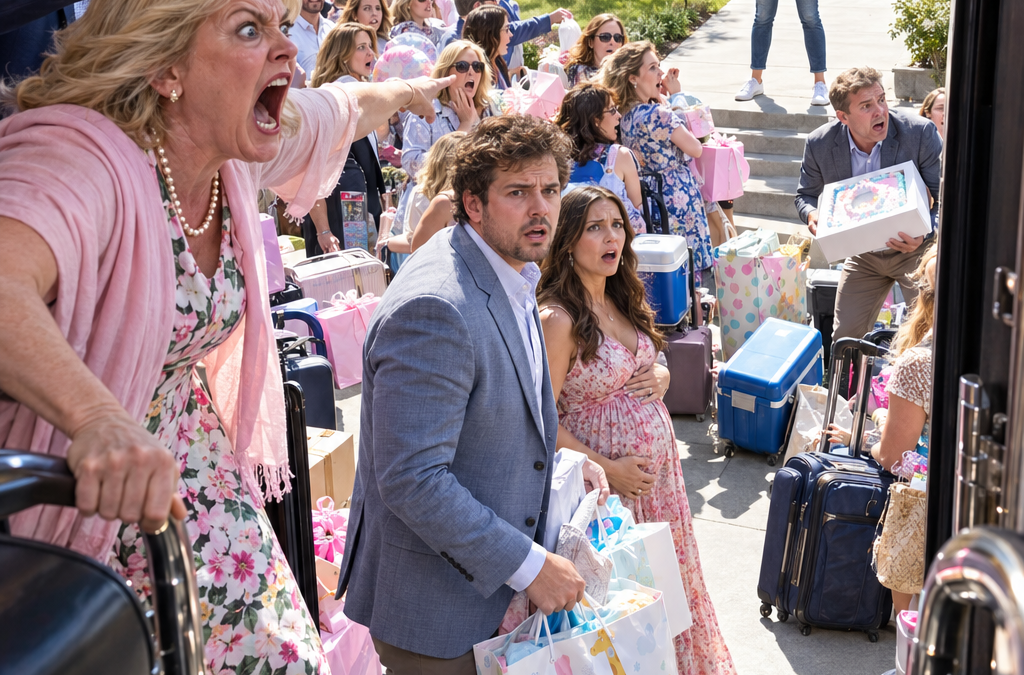
And she screamed.
### Part 3
Thirty-seven conversations stopped at once.
I could see heads turning behind the tinted windows. The driver glanced back. My father looked from my mother to the house, and the color drained from his face so quickly that for a moment I wondered whether I was about to end up providing medical care at my own family confrontation.
Mom remained halfway out of the bus.
“Oh my God.”
It was barely audible.
Then she looked at me.
“Mara.”
I folded my arms loosely.
“Hi, Mom.”
“What did you do?”
That sentence told me everything.
Not how did you buy this? Not is this really Grandma’s house?
What did you do?
“I bought a house,” I said. “You called me about it Tuesday.”
Behind her, people were beginning to recognize the property.
Most of the guests belonged to the same Baptist congregation where Grandma Evelyn had taught Sunday school for decades. Several were old enough to have drunk sweet tea in her living room. At least three had attended the Easter dinner when she publicly said the house should someday belong to me and Noah.
A small woman near the front pressed her face closer to the glass.
“That’s Evelyn’s place.”
A murmur moved down the aisle.
My mother heard it.
I watched her recover.
If Diane Ellison had one great talent, it was turning disaster into presentation.
She descended the steps, adjusted her blouse, and smiled at everyone.
“Well,” she announced brightly, “isn’t this something? Mara went and brought Evelyn’s house back into the family.”
Into the family.
Not bought for herself.
Brought back into the family.
My father came off the bus behind her and immediately opened the luggage compartment.
Two folding tables appeared.
Then a large cooler.
Then cake boxes, decorations, paper plates, bags of gifts.
And finally three suitcases.
Noah saw them through the screen door.
“Mom.”
“I see them.”
Behind the suitcases sat a boxed portable crib.
Nobody brings luggage and a crib to a four-hour baby shower.
My mother turned toward the guests.
“This is perfect, actually. A new generation coming home to Evelyn’s house. She would have loved it.”
I almost admired the speed of the lie.
Almost.
The women began stepping off the bus, but nobody approached my gate.
One of them, Mrs. Parker, whom I had known since childhood, looked from my mother to me.
“Did Mara know we were coming?”
Mom laughed.
“Oh, you know family. We don’t need formal invitations.”
Mrs. Parker’s expression didn’t change.
“That wasn’t what I asked.”
Mom ignored her and reached for my gate.
My hand settled on the latch from the inside.
I didn’t slam it.
I didn’t lock it.
I simply stood there.
“Nobody is coming onto the property.”
Mom’s smile remained, but everything behind it vanished.
“Mara.”
“You heard me.”
“Don’t embarrass yourself.”
“I’m not embarrassed.”
She lowered her voice.
“Tessa is eight months pregnant. People have traveled here. There’s food. Gifts. We are not doing this on the sidewalk.”
“We aren’t doing it in my yard either.”
Dad dropped one folding table onto the curb.
“For God’s sake, Mara. Grow up.”
I looked at him.
“I own this property.”
“You think owning a little house suddenly makes you better than everybody?”
“No.”
I nodded toward the luggage compartment.
“It means you don’t move people into it without asking.”
The sidewalk went quiet.
My brother appeared at the top of the bus steps.
Ethan was twenty-eight, broad-shouldered, exhausted, and confused.
Behind him stood Tessa, one hand supporting her lower back.
“What’s going on?” he asked.
Mom turned quickly.
“Nothing. Your sister’s overwhelmed.”
I looked at Ethan.
“Did you bring those suitcases?”
He frowned.
“Yeah.”
“Why?”
Another pause.
“Because Mom said you offered to let us stay here.”
There it was.
For the first time that afternoon, I believed someone besides me genuinely hadn’t understood the plan.
“Did she tell you I offered?”
“Yes.”
“Ask her when.”
Mom snapped, “Mara, stop.”
Ethan looked at her.
“When did Mara offer?”
“We discussed the arrangement.”
“With her?”
Mom’s eyes hardened.
“Ethan.”
“With Mara?”
Dad stepped forward.
“Son, this isn’t the time.”
Ethan looked back at me.
“You didn’t say yes?”
“No one asked me.”
Tessa closed her eyes briefly.
Then she came slowly down the bus steps.
“I’m sorry.”
Her voice was quiet.
“I swear I thought you knew.”
“I believe you.”
My mother stared at me as though I had betrayed her by refusing to punish Tessa.
Tessa touched the fence.
“I wouldn’t have agreed to this if I knew.”
“It’s ninety degrees,” I said. “Come sit on the porch.”
Mom’s head snapped toward me.
“You’ll let her in?”
“She’s invited.”
I opened the gate wide enough for Tessa.
Only Tessa.
She walked past my mother without looking at her and lowered herself into Grandma’s old wicker chair, the one I had found in an antique shop and bought because it reminded me of the original.
Then she pulled out her phone.
I saw her type something.
Years later, I would remember that tiny movement as the first crack in my mother’s control over Ethan’s new family.
At the gate, my father’s face had grown red.
“After everything we’ve done for you.”
I almost laughed.
“Which part?”
He pointed at the house.
“We gave you a roof when you needed one. Your grandmother took you in because we arranged it. We kept you included after you got pregnant. We sold this place to cover her care.”
Several older women exchanged looks.
There it was.
The old story.
The version my parents had repeated for fifteen years.
I reached into my pocket and took out my phone.
Mom recognized the movement.
“Mara.”
I opened the first voicemail.
Then I turned on the speaker.
My mother’s recorded voice floated across the sidewalk.
“It’s one night in a motel, Mara. You’ve lived in one before. The kids will be fine.”
Nobody moved.
The words seemed louder outdoors.
Mrs. Parker’s mouth fell slightly open.
Mom whispered, “Turn that off.”
I let it finish.
Then I played the second recording.
“You should be happy an Ellison baby is coming home there. Ethan and Tessa need the space more than you do.”
When the message ended, I lowered the phone.
My mother’s face had changed.
“That was private.”
“It was sent to me.”
“You’re humiliating us.”
“No.”
I looked at the thirty-seven people she had brought to my house.
“You brought the audience.”
For one second, nobody spoke.
Then an elderly woman named Alma Jennings stepped forward with both hands on her cane.
She looked at my mother.
“Diane, did Evelyn know Mara was put in a motel after the house was sold?”
My father answered before Mom could.
“We had expenses.”
Mrs. Jennings looked at him.
“What expenses?”
“Evelyn’s care.”
I felt something settle inside me.
The moment had arrived.
“There was no long-term care.”
Dad looked at me.
“Don’t.”
“She died here.”
My voice remained even.
“I was sitting beside her. Six days from the first serious decline to the funeral home coming through that door.”
Several women nodded.
They remembered.
Dad’s jaw tightened.
“There were other bills.”
“Then tell us what they were.”
He looked at me as though I had broken some lifelong rule.
Children were not supposed to ask their parents for evidence.
Ethan came to the gate.
“Dad.”
Russell turned.
“What?”
“Where did the money from Grandma’s house go?”
Dad’s answer came immediately.
“To this family.”
Ethan frowned.
“Where?”
Silence.
I reached into my back pocket.
The Christmas card had softened at the edges after fifteen years.
I held it across the gate toward my brother.
Mom moved first.
“Ethan, don’t.”
He froze.
I didn’t.
“Grandma sent that to me the Christmas before she died.”
My brother looked at our mother.
Then at the card.
He took it.
“What does it say?”
“Read it.”
### Part 4
Ethan opened the card carefully.
The front showed a red cardinal on a snowy fence, the kind of Christmas card sold in drugstores by the box. I had stared at that bird through fifteen years of apartments, bad months, better months, holidays, rent increases, Grant’s funeral, nursing exams, and nights when I thought I would never own anything more permanent than the cardboard box holding it.
My brother read Grandma’s handwriting silently.
Then again.
His mouth tightened.
“What does it say?” my father asked.
Ethan looked up.
“You know what it says.”
Dad’s face hardened.
“Read it if you’re going to make a spectacle.”
So Ethan did.
“Mara, this house is meant for you and Noah. I’ve told your father. Don’t ever let anyone tell you different. Love, Grandma.”
The street seemed to shrink around us.
Mom recovered first.
“That isn’t a will.”
“I know,” I said.
“She was old.”
“She was seventy-four.”
“She had heart problems. People say things when they’re sick.”
Mrs. Jennings spoke from near the bus.
“She said it when she was healthy too.”
Mom turned.
Alma continued.
“She told our class more than once that Mara and that baby were staying here.”
Another woman nodded.
“So did I.”
Then another.
My father’s face shifted from anger to something uglier.
Cornered calculation.
“She left the house to me legally.”
“Yes,” I said.
“I had every right to sell it.”
“Yes.”
He hesitated.
That wasn’t the answer he expected.
I continued.
“You had the legal right. That was never my argument.”
Mom stepped closer.
“Then what exactly are you trying to prove?”
“That you knew what she wanted.”
My voice stayed calm.
“And you told everyone you sold the house for medical expenses that barely existed.”
My brother looked at Dad again.
“Where did the money go?”
“To our family.”
“You keep saying that.”
“Because it’s true.”
“Where?”
My father’s temper finally snapped.
“The baseball academy, for one thing.”
Mom closed her eyes.
It was almost funny.
Fifteen years of protecting a lie, and Dad destroyed it because he couldn’t tolerate being questioned twice.
Ethan stared at him.
“My academy?”
“Yes.”
“You said a sponsor helped.”
“There were costs.”
“What else?”
“Tournaments. Coaching. Travel. The truck business was struggling.”
My brother’s expression emptied.
“So you sold Grandma’s house.”
“We used an asset that belonged to me.”
“And Mara went to a motel.”
Dad threw up both hands.
“You were thirteen years old, Ethan! What was I supposed to do? Tell you we couldn’t afford the opportunities you had?”
Ethan took one step backward.
“You told me Grandma’s medical bills took everything.”
“I was trying to protect you.”
“No.”
His voice cracked.
“You were protecting yourself.”
Mom rushed in.
“Enough. None of this helps anybody today. We have a baby coming. That should be our priority.”
There it was again.
The baby as an eraser.
I looked at Tessa.
She was sitting rigidly on the porch, one hand over her mouth.
She looked mortified.
Then the screen door opened.
Walter Pierce stepped outside.
Lily followed him carrying a pitcher of iced tea as though she were assisting with an ordinary afternoon visit.
Walter placed one hand on the porch rail.
“Afternoon.”
Dad stared at him.
Mom whispered, “Who is that?”
Walter smiled without warmth.
“The man your husband sold this house to.”
Every older woman on the sidewalk seemed to lean forward at once.
Walter walked down one step.
“I bought it fifteen years ago.”
My father said nothing.
Walter continued.
“About four months after I moved in, Mara walked here from the motel with that boy in a stroller.”
He nodded toward Noah, who was watching from behind the screen.
“She didn’t ask me for money. Didn’t ask me for the house. She asked for two cuttings from the rosebushes.”
Mrs. Jennings covered her mouth.
Walter pointed toward the mailbox.
“Those two.”
Mom looked at the roses.
For the first time all afternoon, she appeared truly ashamed.
Walter wasn’t finished.
“She asked me for one other thing. Said if I ever sold the house, would I call her first.”
“And you did?” Tessa asked softly.
“Fifteen years later.”
He looked at me.
“I did.”
Lily smiled.
“He kept the roses too.”
Walter glanced at her.
“Your mother never asked me to.”
“Why did you?”
The old man considered the question.
“My wife liked roses.”
Then he looked toward me.
“And because sometimes you see somebody lose something they shouldn’t have lost, and you can’t fix it. But you can keep one small piece alive.”
I had survived my grandmother’s death.
I had survived the motel.
I had survived Grant dying.
I had survived years of being the family member expected to absorb every inconvenience quietly.
But that sentence almost undid me.
I looked at the roses until my throat loosened.
My brother folded Grandma’s card.
Carefully.
Then he put it into the pocket of his shirt.
Mom noticed.
“That belongs to Mara.”
“No,” I said.
“He can keep it.”
Ethan looked at me.
“Why?”
“Because you need it more than I do now.”
His eyes reddened.
Then he turned toward our parents.
“We’re not moving in here.”
Mom moved toward him.
“Ethan—”
“And we’re not staying at your place anymore.”
Her face went blank.
“Where will you go?”
“We’ll figure it out.”
“You have a baby due in weeks.”
“I know.”
“You don’t have enough saved.”
“I know.”
“Your sister has three bedrooms!”
Tessa spoke from the porch.
“Diane.”
Everyone looked at her.
“My mother is coming to get me.”
Ethan turned.
“What?”
Tessa held up her phone.
“I texted her.”
Mom stared.
“Why?”
Tessa’s expression was tired rather than angry.
“Because every conversation today has shown me that decisions about my baby are being made by people who never asked me.”
That landed harder than anything I had said.
Ethan looked at Tessa.
Then at me.
Then at our mother.
Something in him seemed to collapse and straighten at the same time.
He came toward the porch.
“Mara.”
I lifted one hand.
“Not today.”
He stopped.
“I need to say—”
“Take care of Tessa.”
He closed his mouth.
I nodded toward her.
“That’s what matters today.”
He nodded.
For once, my brother obeyed a boundary without treating it as an insult.
My mother saw it too.
She turned toward me, desperate now.
“You’d put your own brother’s baby on the street over a house?”
There it was.
The accusation she had been saving.
My children were behind me.
My brother’s unborn child was in front of me.
My mother believed that arrangement made the answer obvious.
I looked toward the screen door.
Noah was standing there.
Sixteen years old.
Old enough to understand exactly what his grandmother thought his bedroom was worth.
“My son slept in a motel when he was two so your son could have baseball.”
Mom went pale.
“My daughter spent ten years in rented rooms where I asked landlords before changing paint.”
I looked back at her.
“They are sleeping in their own rooms tonight.”
“Mara—”
“Not in a motel.”
My father stepped around her.
“This is insane.”
Then he picked up one of the folding tables.
He walked through my open gate.
And he set it up on my lawn.
### Part 5
“We’re having the shower,” Dad announced.
Not to me.
Not really to anyone.
He said it to the folding table, the grass, the bus, the universe—any audience willing to accept that Russell Ellison could still decide what happened next.
I stared at him.
“Pick it up.”
He ignored me.
“It’s a yard, Mara. We’ll be gone by six.”
“Pick it up.”
He turned toward the bus to retrieve the second table.
My mother grabbed his arm.
“Russell.”
He shook her off.
For the first time all afternoon, she sounded frightened.
“Stop.”
He looked at her as though she had changed teams.
“What?”
She glanced toward the corner.
A police cruiser was turning onto the street.
That had been my first call Friday morning.
I hadn’t asked anyone to arrest my family. I had simply explained that people who did not have permission to enter my property had announced plans to arrive in a group, and I wanted to know my options. The dispatcher had told me I could refuse entry and request a formal trespass warning if anyone refused to leave.
I asked whether a patrol car could pass the street around one.
Apparently, someone had written it down.
The cruiser stopped behind the bus.
An officer stepped out.
My mother immediately walked toward him.
“Officer, thank goodness.”
I almost smiled.
Of course.
She used the same bright church voice she had used when the bus doors opened.
“This is a family baby shower. My daughter has become overwhelmed by the attention, and there’s been some misunderstanding.”
The officer listened.
Then he looked at the folding table on my lawn.
“Who owns the property?”
“I do,” I said.
He walked toward me.
“Ma’am, do you want anyone here removed from your property?”
“Yes.”
Dad scoffed.
“This is my daughter.”
The officer looked at him.
“Sir, are you the owner?”
“No, but—”
“Then I’m speaking to her.”
I had never seen my father told to wait in so few words.
The officer faced me again.
“Do you want everyone removed, or specific individuals?”
“The guests can stay on the public sidewalk if they want. Tessa and Walter are invited onto the property.”
I looked at my parents.
“Diane and Russell Ellison are not.”
Mom’s face changed.
“You’re calling the police on your parents?”
“No. I called yesterday.”
That silenced her for half a second.
The officer nodded toward Dad.
“Sir, please remove the table and step off the property.”
Dad planted both hands on his hips.
“This is ridiculous.”
“Maybe.”
The officer’s voice remained neutral.
“But it’s still her property.”
Dad didn’t move.
The officer asked me one more question.
“Would you like formal trespass warnings issued?”
My mother whispered, “Mara, don’t.”
I thought about Grandma’s kitchen.
The tape gun.
A toddler on my hip.
My mother holding a motel address.
I thought about fifteen years of Christmas dinners during which everyone pretended our history was an unfortunate misunderstanding rather than a series of deliberate choices.
“Yes.”
The word surprised me with how ordinary it sounded.
The officer took out a notepad.
Mom shook her head.
“No. Absolutely not.”
The officer wrote anyway.
He explained that the warning meant my parents could not enter the property again without my permission. Refusing to sign did not invalidate it.
Dad took the pen.
He signed so hard I could hear the tip scratch paper.
Then he folded the table, carried it back through the gate, and shoved it beneath the bus.
Mom refused the pen.
“I am not signing a piece of paper that says I’m forbidden from my daughter’s home.”
The officer calmly wrote REFUSED.
“I’m her mother.”
“Yes, ma’am.”
He returned the paper to his folder.
“And she’s the homeowner.”
A gray SUV pulled up behind the police cruiser.
A woman stepped out who looked so much like Tessa that I knew immediately who she was.
Tessa’s mother walked straight toward my porch.
She didn’t yell.
She didn’t demand explanations.
She simply hugged her daughter.
That quiet support embarrassed my family more than a speech would have.
Ethan unloaded their suitcases and portable crib from the party bus.
Mom watched him.
“Where are you going?”
“Tessa’s parents’ place tonight.”
“They don’t have room.”
“We’ll manage.”
“You could stay with us.”
“Our HOA already warned you.”
“Then we’ll work something out.”
“We are.”
Mom stared at him.
For years Ethan had been the one person in the family who never challenged her because there had never been a reason. Most roads were already cleared for him before he knew an obstacle existed.
Now he was seeing the cost of all that clearing.
Mrs. Jennings was the last church guest to board the bus.
She stopped near my gate.
Her eyes were wet.
“I’m sorry, Mara.”
“You didn’t do this.”
“No.”
She looked at my mother.
“But I believed the story because it was easier than asking questions.”
That sentence seemed meant for more than one person.
She touched the top of one rosebush.
“Evelyn would be glad you’re here.”
Then she climbed onto the bus.
The banner my mother had brought had partially unrolled near the steps.
WELCOME BABY ELLISON.
The driver picked it up.
For one hopeful second, Mom reached toward it.
He tossed it inside without handing it to her.
Ethan loaded the final suitcase into Tessa’s mother’s SUV.
Before getting in, he approached my gate.
Grandma’s Christmas card was still in his shirt pocket.
“I’m sorry.”
I looked at him.
He swallowed.
“I didn’t know what they did.”
“I believe you.”
“I should’ve known more.”
“Yes.”
The answer surprised him.
I wasn’t going to comfort him by rewriting his responsibility.
Ethan had not sold Grandma’s house. He had not put me in a motel. He had been a child when most of it happened.
But he had been an adult for ten years.
He had never once asked why my life had always been harder than his.
He nodded.
“That’s fair.”
I looked toward Tessa.
“Go.”
He did.
The SUV left first.
Walter’s daughter came out of my house and helped him back into their sedan. Before leaving, Walter shook my hand.
“You kept your word,” I told him.
“So did you.”
“What word?”
“You came back.”
He smiled.
Then he left.
The police cruiser followed.
That left the party bus.
My father was already sitting in the front row, staring through the windshield.
My mother remained on the sidewalk.
The guests had returned to their seats, but no one was talking.
The church voice was gone now.
So was the smile.
Mom walked slowly toward my gate.
She stopped on the other side.
Her fingers touched the latch.
This time, she didn’t open it.
“We’re your parents.”
Her voice was low enough that the people on the bus couldn’t hear.
“You don’t do this to your parents.”
I looked at her hand.
“You were my parents when you sent me to a motel.”
“Mara.”
“You were my parents when you told everyone Grandma’s house paid for medical care.”
“Your father handled the finances.”
“You knew.”
Her eyes flickered.
That was enough.
I continued.
“You were my mother Tuesday when you told me to take my children out of their home so Ethan could move in.”
“I was trying to help your brother.”
“That has always been your answer.”
“He needs us.”
“So did I.”
She looked away.
For a moment I saw something almost human and almost regretful cross her face.
Then the old pattern returned.
“Let me come inside.”
“No.”
“We need to talk privately.”
“We’ve had fifteen years.”
“Mara, please.”
I had waited my entire life to hear that word from her.
Please.
It felt much smaller than I had imagined.
“That was the last phone call you make telling me what happens in my house.”
“I’m still your mother.”
“You’re my mother.”
I nodded.
“But that doesn’t make you my authority.”
Her fingers tightened around the latch.
“You’ll regret this when we’re gone.”
“No.”
I knew it instantly.
“I regret what happened before today.”
The bus driver started the engine.
Mom’s eyes filled.
Then she reached for the only weapon she thought remained.
“Fine. Maybe you’ll never see Ethan’s baby.”
“That’s Ethan and Tessa’s decision.”
“You think they’ll choose you?”
“I’m not asking them to.”
Her face hardened.
That was the piece she couldn’t understand.
Not everything had to end with somebody winning possession of another person.
The driver called through the open door.
“Ma’am, we need to leave.”
I stepped backward.
“Get on the bus, Mom.”
Her hand remained on the latch another second.
Then she released it.
For the first time in my life, my mother stood at a boundary I created and did not cross it.
### Part 6
The party bus was too long to turn around on our narrow street.
It had to reverse toward the corner, making a mechanical beeping sound while neighbors stood on porches watching. My mother sat behind the driver, my father in front of her, and neither looked toward the house as the bus backed past Grandma’s roses.
When it disappeared, I went inside.
Noah held the screen door open.
Lily stood in the hallway.
“Are they gone?”
“Yes.”
“Forever?”
Children ask questions adults spend entire lifetimes learning not to answer too quickly.
“I don’t know.”
She thought about it.
“Can I still paint my room?”
“Yes.”
“What color?”
“Any color except black.”
“Why?”
“Because I’m still your mother.”
She grinned.
The tension broke.
Noah followed me into the kitchen.
“Are we having dinner?”
I stared at him.
“Why wouldn’t we?”
He shrugged.
“I thought after all that…”
I opened the refrigerator.
“We live here.”
The words came out before I could stop them.
Something changed in his face.
“We live here.”
I repeated it.
I took my shoes off, reheated leftover pasta, and the three of us ate at our kitchen table while the house clicked and settled around us.
No one called.
Sunday passed quietly.
Then Monday morning my phone began filling with messages.
Some were from church members apologizing.
Some were from distant relatives demanding I forgive my parents because “family disputes should remain private.”
That one made me laugh.
My mother had sent thirty-seven witnesses to my address, but apparently I was the person who had made things public.
I blocked three numbers before breakfast.
Ethan didn’t call for four days.
When he finally did, I let it ring twice.
“Hello?”
“Hey.”
His voice sounded different.
Less certain.
“How’s Tessa?”
“Okay.”
“The baby?”
“Still inside.”
I almost smiled.
“Good.”
Silence stretched.
“We found an apartment.”
“That was fast.”
“Tessa’s dad knows a property manager. Small place. Two bedrooms.”
“Congratulations.”
“Yeah.”
Another silence.
“Mara, I went through some of Dad’s old paperwork.”
I stopped wiping the counter.
“Why?”
“I wanted to know.”
That mattered.
Not enough to erase anything.
But it mattered.
“He used almost all the house money within two years. Academy fees, tournament travel, debt from the dealership, credit cards.”
“Okay.”
“He took another loan after that.”
“Okay.”
“He told me all my sports were covered by scholarships.”
“I know.”
“You knew?”
“No.”
I looked through the kitchen window toward the rosebushes.
“But that sounds like him.”
Ethan exhaled.
“I keep thinking about Noah in that motel.”
“He was two.”
“I barely remember him being that little.”
“I do.”
Another silence.
“I’m sorry.”
“I heard you Saturday.”
“I know. I just…”
He struggled.
“I need you to know I’m not asking you to forgive me.”
That surprised me.
“Good.”
He laughed once, without humor.
“You really aren’t going to make this easy.”
“I spent fifteen years making things easy for everybody.”
“Yeah.”
Then he said something I never expected.
“I think that’s why none of us learned anything.”
We ended the call without saying we loved each other.
That felt more honest than forcing it.
My parents reacted differently.
Dad sent one text.
You have humiliated your mother beyond repair.
I replied:
Do not contact me about Saturday again.
He didn’t.
Mom sent twelve messages over three days.
The first were angry.
You have destroyed your family over property.
Then came explanations.
We were under terrible financial pressure after Evelyn died.
Then revision.
No one threw you out. We helped you find affordable housing.
Then guilt.
I barely sleep.
Then blame.
Ethan barely speaks to us because of what you did.
Then religion.
I hope one day God softens your heart.
The final message was the closest she came to accountability.
Maybe some things could have been handled differently.
Could have been.
Not I handled them wrongly.
I blocked her number.
For the first week, I checked the block list repeatedly.
By the second, I checked twice.
By the third, not at all.
It was strange how quickly peace began occupying spaces where anxiety had lived.
Noah painted one wall of his room dark green.
Lily chose pale blue.
I worked nights.
On my mornings off, I sat on the porch drinking coffee while Lily watered the roses under instructions Walter had given her.
“Morning only,” she would recite.
“Why?”
“Because Mr. Walter said.”
“Excellent scientific reasoning.”
“You’re not the rose expert.”
Fair enough.
Six weeks after the bus incident, Mrs. Jennings came by.
She carried a cardboard box.
I didn’t invite her inside immediately.
Not because I distrusted her personally.
I simply discovered I liked deciding.
That feeling was new.
“What’s in the box?”
“Things from Evelyn’s Sunday school class.”
She opened it.
Inside were photographs.
Grandma holding Christmas baskets.
Grandma standing beside her roses.
Grandma at church picnics.
Grandma with me at sixteen, both of us squinting into sunlight.
“We thought these belonged here.”
I touched the photograph.
“Thank you.”
Mrs. Jennings hesitated.
“Your mother resigned from the women’s ministry.”
I looked up.
“She said it was for health reasons.”
“Is she sick?”
“Not that I know.”
I nodded.
That was enough.
I didn’t want Mom ruined.
That surprised people when I said it.
They assumed boundaries were revenge.
They weren’t.
Revenge would have required me to keep watching her.
I wanted the opposite.
I wanted a life that no longer depended on what happened to Diane and Russell Ellison.
Two weeks later, on a Sunday morning after my shift, Noah was mowing the front strip and Lily was watering roses when a familiar pickup turned onto the street.
Every muscle in my body tightened.
Then relaxed.
It wasn’t my parents.
Ethan was driving.
Tessa sat beside him.
And in her arms was a newborn wrapped in yellow.
My niece.
### Part 7
Ethan parked at the curb but didn’t get out immediately.
That alone told me something had changed.
Old Ethan would have walked straight through the gate, assumed welcome, and apologized afterward if necessary. New Ethan sat behind the wheel until I set down my coffee and looked directly at him.
Then he got out.
He carried a cardboard box.
Tessa remained inside the truck with the baby.
“Mara.”
I stood.
“Morning.”
“These are Grandma’s.”
He placed the box on the sidewalk outside the gate.
I didn’t move toward it yet.
“What are they?”
“Photo albums. Some letters. Dad had them in the garage.”
My chest tightened.
“I didn’t know they existed.”
“Neither did I.”
He looked toward the porch.
“I took them when I moved the last of my stuff out.”
“You moved everything?”
“Yeah.”
“How are Mom and Dad?”
It felt strange asking.
Not painful.
Just strange.
“Dad barely speaks to me.”
“And Mom?”
“She speaks enough for both of them.”
That sounded right.
He rubbed the back of his neck.
“She wants me to convince you to unblock her.”
“No.”
“I told her I wouldn’t.”
I studied him.
“Thank you.”
He nodded.
Then Lily abandoned the hose.
“Is that the baby?”
Tessa lowered the window.
“Yes.”
Lily practically vibrated.
“Can I see?”
I looked at Tessa.
She smiled.
“If your mom says it’s okay.”
Lily immediately looked at me.
“Can I?”
“Yes.”
She raced toward the truck, stopped herself before getting too close, and clasped her hands behind her back.
“What’s her name?”
Tessa looked at Ethan.
My brother looked at me.
“Evelyn.”
I didn’t speak.
Tessa lifted the bundle slightly.
“Evie.”
My eyes burned.
I walked toward the truck.
My niece had dark hair, wrinkled cheeks, and the deeply unimpressed expression of newborns who have recently discovered gravity and clothing.
“She’s beautiful.”
Tessa smiled.
“She screams between two and five every morning.”
“Still beautiful.”
“Come take night shift.”
“Call me when you need a nurse.”
Tessa’s expression softened.
“Not when I need a house?”
She remembered.
I smiled slightly.
“Definitely not when you need a house.”
She laughed.
Ethan sat on the curb.
He didn’t ask to come inside.
That mattered more than most apologies.
After a while, I opened the gate.
“You can bring the box to the porch.”
He lifted it.
“Inside?”
“No.”
He nodded.
“Okay.”
No argument.
He carried it to the bottom step.
I sat in the wicker chair. He sat on the step below me.
For several minutes we watched Lily talk to Tessa through the truck window while Noah pretended to mow the same patch of grass four times so he could listen.
“I was mad at you,” Ethan said.
“For Saturday?”
“For years.”
I turned toward him.
“Why?”
“Because you always acted like you didn’t need us.”
I almost laughed.
“You mean the people who told me not to need them?”
“I know that now.”
He rubbed his hands together.
“Mom always said you were proud. Difficult. Independent to a fault.”
“She trained me to be independent and then resented the result.”
“Yeah.”
He looked at the roses.
“I believed her.”
“I know.”
“I thought you left the family. I didn’t realize they kept pushing until leaving was the only way you could breathe.”
That sentence was better than “sorry.”
It meant he had thought.
“I don’t hate you,” I said.
His eyes lifted.
“But?”
“But I don’t trust you yet.”
He nodded.
“Fair.”
“And I’m not interested in pretending Saturday fixed everything.”
“Fair.”
“You benefited from what happened to me.”
His jaw tightened.
“I know.”
“You didn’t choose that when you were a kid.”
“No.”
“But when you got older, you never looked behind you.”
He looked down.
“No.”
That was enough for that day.
Ten minutes later, he stood.
“Can I bring Evie by again sometime?”
“You can ask.”
A small smile appeared.
“Right.”
He started toward the truck.
“Ethan.”
He turned.
“Grandma would have liked the name.”
His face tightened.
“Yeah.”
Then he left.
I carried the box inside.
For the next two hours, I sat on the living room floor going through my grandmother’s life.
Birthday cards.
Church programs.
Photographs.
Receipts tucked into envelopes for no obvious reason.
At the bottom was an album labeled MARA.
I had never seen it.
Inside were pictures of me from fifteen to twenty-two.
Graduation.
My first car.
Pregnant with Noah.
Noah asleep on Grandma’s chest.
One photo had been taken in the front yard.
Grandma stood behind me with one hand on my shoulder.
The rosebushes were visible over my left side.
On the back, in her handwriting, were six words.
She finally knows where she belongs.
I sat there crying for a while.
Not because I wished Grandma had somehow prevented everything.
She couldn’t.
Not because the photograph repaired my relationship with my parents.
It didn’t.
I cried because for fifteen years, I had believed I was fighting to reclaim a house.
I finally understood that wasn’t what I had bought back.
The house was wood.
Plaster.
Roof shingles.
Pipes.
Taxes.
Insurance.
The thing I reclaimed was the right to decide who crossed my threshold.
That evening, after the children were asleep, I returned the album to the box.
My phone buzzed.
Unknown number.
I nearly ignored it.
Then I answered.
“Hello?”
My mother’s voice came through.
She had used another phone.
“Mara.”
I closed my eyes.
“I blocked you for a reason.”
“Please don’t hang up.”
“You have thirty seconds.”
She inhaled sharply.
“I want to apologize.”
I waited.
“For everything.”
Still I waited.
She continued.
“We were under pressure back then. Your father’s business was failing. Ethan had opportunities. Your grandmother didn’t understand how expensive everything was. We thought you were stronger.”
There it was.
The apology that wanted to become justification before reaching the period.
“You have ten seconds.”
“Mara, I said I’m sorry.”
“No. You said circumstances were difficult.”
“What do you want from me?”
The question was angry now.
I smiled sadly.
“Nothing.”
And for my mother, that was the worst possible answer.
### Part 8
“You don’t mean that.”
Mom’s voice had sharpened.
“I do.”
“You want me to crawl.”
“No.”
“You want me to admit I was a terrible mother.”
“No.”
“Then what?”
I leaned back against the kitchen counter.
Outside, rain touched the windows softly. The house smelled faintly of the lavender detergent Lily had insisted we buy because our old brand was “boring.”
“I wanted you to care when I needed you.”
Silence.
“That was fifteen years ago.”
“I know.”
“We can’t change it.”
“I know.”
“Then why keep punishing us?”
“I’m not.”
I realized that was true.
For years, I imagined that if I ever confronted my parents, it would feel like revenge.
Instead, it felt administrative.
A chart being corrected.
A door being closed.
“I’m not asking the church to shun you. I’m not calling your friends. I’m not trying to turn Ethan against you. I’m simply not giving you access to me anymore.”
“I’m your mother.”
“Yes.”
“That should mean something.”
“It does.”
My voice softened.
“That’s why it hurt so much.”
She began crying.
Maybe the tears were genuine.
Probably they were.
People can hurt you deeply and still genuinely hurt themselves when consequences arrive.
I no longer needed to decide which pain was more legitimate.
“I love you,” she whispered.
The words would once have destroyed me.
Now they landed gently and stopped.
“I hope you’re okay, Mom.”
“Mara—”
“I mean that.”
I looked toward the hallway where my children slept.
“But loving someone doesn’t mean giving them another room to damage.”
I ended the call.
Then I blocked the number.
That was the last direct conversation I had with my mother for a long time.
Dad never apologized.
Six months after the party bus incident, he mailed me an envelope containing one sentence.
Your grandmother would hate what this family has become.
I read it twice.
Then I wrote beneath it:
She hated what it was becoming while she was alive.
I never mailed it.
I threw both pages away.
Not every statement deserves delivery.
Ethan and I built something smaller than the relationship people expected siblings to have, but more honest than the one we had before.
He visited occasionally.
Always after asking.
Sometimes he came alone.
Sometimes with Tessa and Evie.
For the first year, he never entered farther than the living room.
Not because I forbade him forever.
Because he understood that trust was built differently than entitlement.
You didn’t announce arrival.
You knocked.
You waited.
You listened for an answer.
Tessa became someone I genuinely liked.
She and Ethan struggled financially during Evie’s first year, but they never asked for my house.
Once, when their water heater broke, Ethan called.
“I need advice.”
I laughed.
“Who are you and what have you done with my brother?”
“Very funny.”
He told me the problem.
I gave him the name of a reliable plumber.
That was it.
No rescue.
No resentment.
No hidden debt.
It turns out adults become adults much faster when nobody keeps rearranging the world beneath their feet.
Noah graduated high school two years later.
At his graduation party, I stood on Grandma’s porch watching him take pictures with friends beneath the maple tree.
My parents were not invited.
I expected grief.
What I felt instead was clarity.
Noah never once asked why they weren’t there.
He already knew.
Children notice who protects their peace.
Lily turned twelve and took over responsibility for the roses with a seriousness normally associated with surgeons.
Walter visited twice before his health declined enough that travel became difficult.
The second time, he stood beside the mailbox for a long time.
“You kept them alive,” I said.
“Your grandmother did the hard part.”
“You never met her.”
“No.”
He smiled.
“But people leave instructions without meeting you.”
Walter died the following winter.
His daughter invited us to the funeral.
Lily brought one rose from Grandma’s bush and placed it beside his photograph.
That felt right.
My career changed too.
After years of nights, I accepted a daytime supervisory position.
The first month felt unnatural.
I kept waking at two in the morning convinced I had missed a medication round.
Then my body remembered sunlight.
For the first time since I was twenty-two, I ate dinner with my children almost every night.
One evening, Noah asked whether I regretted buying the house.
“Why would I?”
“Because of everything that happened.”
I looked around the kitchen.
The refrigerator was covered with Lily’s drawings and college brochures Noah pretended not to be nervous about.
“No.”
“Even though Grandma intended it for you and Dad sold it?”
“That’s exactly why I don’t regret it.”
“But you had to buy it.”
“Yes.”
He frowned.
“That still seems unfair.”
“It was.”
I reached across the table.
“But unfair doesn’t mean ruined.”
He considered that.
Then he nodded.
The distinction took me years to learn.
My parents had taken something that should have come to me easily.
That did not mean I was required to spend the rest of my life measuring every good thing against how hard I had fought for it.
Some things are worth enjoying after the fight ends.
Three years after the party bus, Evie was running around my yard during a Sunday afternoon cookout.
Ethan stood near the grill.
Tessa was talking to Noah about college.
Lily was yelling at Evie not to pull petals off the roses.
For one strange second, I saw the family my mother had always claimed she wanted.
The difference was that nobody owned it.
Nobody had been ordered there.
Nobody had surrendered a bedroom to earn their place.
Ethan noticed me watching.
“What?”
“Nothing.”
“You’re making the nurse face.”
“What nurse face?”
“The one where you’re thinking something and judging all of us.”
“I am always judging all of you.”
He laughed.
Then his expression changed.
“Mom asks about you.”
I looked back toward the yard.
“I figured.”
“Do you want me to stop telling you?”
“Yes.”
“Okay.”
He accepted the answer immediately.
That was how I knew our relationship had become real.
Not because he understood every boundary.
Because he respected boundaries he didn’t understand.
My mother and father never returned to South Street.
The trespass warning eventually became nothing more than an old piece of paper filed somewhere, but they stayed away.
I heard Dad sold his truck business.
I heard Mom joined another church across town.
I heard versions of their story through relatives who couldn’t resist delivering updates.
Eventually, I stopped listening.
That was the freedom I had never understood when I was younger.
Freedom wasn’t winning the argument.
It was no longer needing to know whether the other person admitted you were right.
One summer morning, I sat on the porch before work.
Lily, now thirteen, was watering the roses.
Noah was home from college and complaining that our coffee was terrible.
I reminded him he was welcome to buy better coffee with his own money.
He reminded me that college students were poor.
Life continued.
Cars passed.
Porch doors opened.
Somewhere down the block, a lawn mower started.
I looked at the gate where my mother had once stood with one hand on the latch demanding to be let inside because she was my mother.
For years, I thought the most important moment of that day was when the police told her the house belonged to me.
It wasn’t.
The important moment came later.
She released the latch.
And I let her walk away.
My parents had spent years teaching me that family meant surrender.
Surrender the room.
Surrender the money.
Surrender the house.
Surrender the hurt.
Surrender the truth so everyone could sit comfortably at Christmas dinner.
I taught my children something different.
Family could knock.
Family could apologize.
Family could be told no.
Family could leave and return differently.
And sometimes family could remain outside the gate forever.
The house was never magical.
Buying it did not restore Grandma.
It did not restore the years I lost.
It did not turn my brother into the sibling I should have had or transform my parents into people capable of loving me the way I once needed.
It gave me something simpler.
A front door.
A lock.
A key.
And the right to decide.
Fifteen years earlier, my mother had placed a motel address into my hand and told me to go.
On that Tuesday morning, she tried to hand the same word to my children.
But this time, I was standing in my own kitchen.
This time, my name was on the deed.
This time, when somebody told us to leave, I finally knew the answer.
“No.”
And we stayed.
THE END!