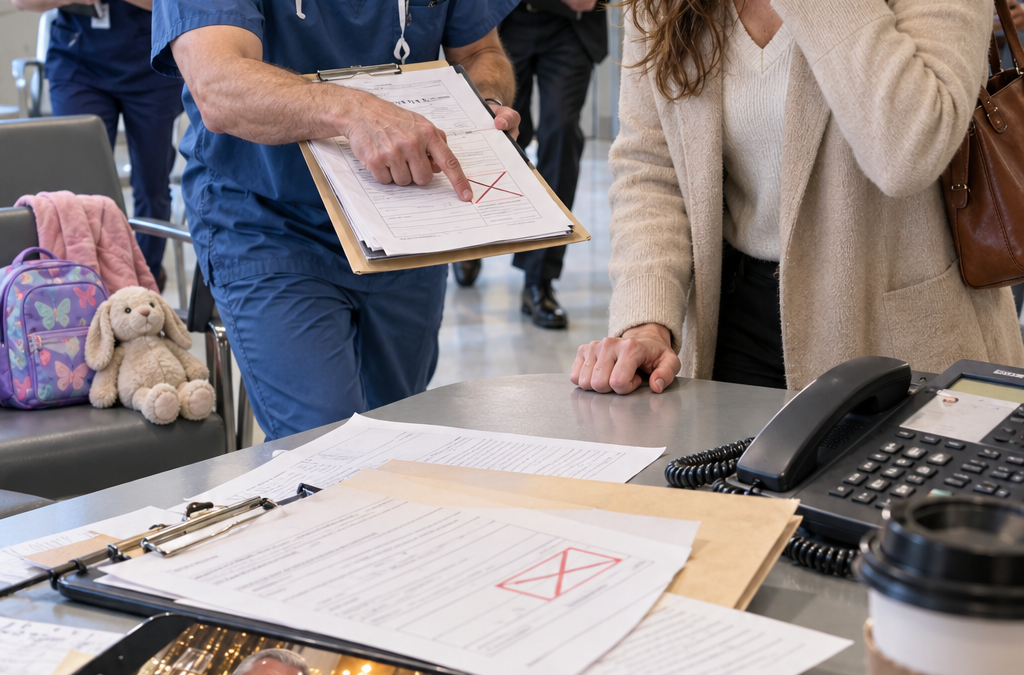
My Daughter Was In Emergency Surgery, But My Parents Chose My Sister’s Party! Then The Surgeon Called Me At 2:17 A.M. And Said, “You Need To Know What Someone Tried To Do…” They Didn’t Just Skip The Surgery… They Tried To Stop It!
“She’s already at the hospital. What difference would we make?” my mother asked while my 10-year-old daughter was being prepared for emergency surgery. My parents refused to leave my sister’s baby shower, and I stopped begging them to come. At 2:17 a.m., the surgeon called with good news, followed by something that made my hands go numb. Someone had tried to delay my daughter’s operation. Two weeks later, my sister showed me a message that explained why my parents had really done it.
Part 1
The last ordinary thing my daughter did that Saturday was complain about the shoes I wanted her to wear to her aunt’s baby shower. Lily was sitting cross-legged on her bedroom carpet, surrounded by mismatched socks and discarded sneakers, arguing that the little white flats my mother had purchased looked like something a flower girl would wear. I told her she could wear her blue sneakers as long as she changed out of the soccer shorts she’d slept in. She gave me a dramatic sigh, rolled her eyes, and said, “Fine, but I’m not playing any games where people have to guess what’s inside a diaper.”
I was 37 years old, married to my husband, Ben, for 12 years, and reasonably convinced that our biggest problem that weekend would be surviving my younger sister’s elaborate baby shower without offending my mother. We lived outside Columbus, Ohio, in a four-bedroom house that always smelled faintly of laundry detergent and the cinnamon candles Lily insisted we light every fall. I worked in payroll administration for a regional transportation company, while Ben supervised municipal construction projects that occasionally pulled him away on weekends. Neither of us had particularly glamorous lives, but we had a good marriage, a daughter who loved soccer and grilled cheese sandwiches, and enough stability that I rarely thought about how quickly everything could change.
My sister, Paige, was 34 and expecting her first baby after several difficult years of hoping to become a mother. She and her husband, Josh, were thrilled, and so was I, although the pregnancy had transformed my mother, Marlene Collins, into something resembling the manager of a presidential inauguration. She had rented a private event room, hired a caterer, ordered flowers from an expensive florist, and spent 3 weeks arguing with the bakery about whether the icing should be ivory or pale pink. My father, Frank, had been assigned a toast, and approximately 50 relatives and friends were expected to attend.
My mother had always believed that family milestones belonged exclusively to the person being celebrated. She called it her “one person, one day” rule, and when we were younger, I understood the reasoning behind it. You didn’t announce an engagement at somebody else’s wedding, and you didn’t turn a birthday dinner into a conversation about your promotion. Unfortunately, as Paige and I grew older, my mother began treating almost anything that happened to me as an interruption of something important happening to my sister.
When I received a promotion during Paige’s college graduation week, Mom asked me not to mention it until afterward. When Ben and I bought our house, she complained that discussing the closing during Paige’s engagement preparations was insensitive. Those incidents seemed too small to fight about, especially because Paige wasn’t usually the one making the demands. I developed the habit of telling my mother less and explaining my decisions only after I’d already made them.
Ben left that Saturday morning for an emergency repair at a water treatment facility more than 2 hours away. Before leaving, he kissed Lily on the forehead and promised to bring her the doughnuts she liked from a bakery near the job site. I planned to take Lily to Paige’s shower around 5:30, stay long enough for dinner and gifts, and escape before my mother started organizing group photographs. At 2:46 that afternoon, Lily came downstairs holding her stomach and asked whether she could skip the party because she didn’t feel well.
I checked her forehead and asked what she’d eaten, assuming she’d overdone it with the leftover pizza from Friday night. She said the pain felt strange, like somebody was twisting something inside her, but she couldn’t tell me exactly where it hurt. I settled her on the couch with a blanket and a glass of water, then texted Paige that we might be late. Twenty minutes later, Lily began vomiting, and by 4:00, she was crying whenever she tried to stand upright.
Her fever rose, and something about the way she held her body frightened me more than the vomiting. Lily wasn’t a child who complained easily; she’d once finished a soccer game with a badly sprained ankle because she didn’t want to disappoint her teammates. Now she was bent forward, breathing in shallow little bursts, and asking me not to touch her stomach. I grabbed my purse, helped her into the car, and drove straight to the pediatric emergency department.
Ben answered my call before the second ring, and I explained what was happening while navigating through heavy Saturday traffic. I could hear machinery shutting down behind him as he told somebody else to take over the repair. “I’m leaving right now,” he said, his voice suddenly all business. “Whatever the doctors tell you she needs, do it, Erin. Don’t wait for me just because I can’t get there fast enough.”
That conversation lasted less than 2 minutes, but I would remember every word of it for months.
At the hospital, a nurse took one look at Lily’s posture and brought us into an examination room. Blood was drawn, fluids were started, and the medical team ordered imaging while I answered questions about allergies, previous illnesses, and when the pain had begun. Lily lay very still beneath a thin hospital blanket, her eyelashes damp with tears, occasionally turning her head toward the door whenever somebody passed. I sat beside her, rubbing the part of her arm that wasn’t covered by medical tape, trying to make my voice sound steadier than I felt.
Shortly after 8:00, a pediatric surgeon named Dr. Rebecca Chen entered the room carrying a tablet. She pulled a chair beside me rather than speaking from the doorway, and I immediately understood that she wasn’t bringing the kind of news I wanted. “Lily’s appendix has perforated,” she explained. “There’s infection in her abdomen, and we need to operate tonight.”
For a moment, I could hear only the hum of the overhead lights and a cart rattling past outside. I asked whether antibiotics could fix the problem, whether the infection was dangerous, and whether there was any possibility of waiting until Ben arrived. Dr. Chen explained the treatment plan carefully, including the importance of avoiding an unnecessary delay, and she never made me feel foolish for asking. When I finally said, “Then do what you need to do,” she nodded and told me the team would begin preparing Lily.
I signed the consent forms with a hand that wouldn’t stop trembling. Then I stepped into the hallway and called my mother because, despite everything, I still believed she would want to know that her granddaughter was facing emergency surgery. The phone rang 4 times before she answered, and I heard music, laughter, and somebody calling for another bottle of sparkling water. “Erin, sweetheart,” she said. “We’re right in the middle of the gift games. Is Lily feeling better?”
“No, Mom. Her appendix ruptured. They’re taking her into surgery tonight.”
There was a pause, followed by the scrape of what sounded like a chair. Instead of asking about Lily, my mother asked where Ben was and whether he had reached the hospital yet. I explained that he was driving back, but the surgeon had specifically advised against waiting for him. Mom lowered her voice and said, “Shouldn’t a decision like that be made when both parents are there?”
“I’ve already spoken to Ben,” I told her. “He knows what’s happening, and he agrees with the surgeon. Mom, I need you and Dad to come.”
She sighed, and I heard her move somewhere quieter. “Honey, Lily is already at the hospital with doctors and nurses. You’re there with her, and Ben’s coming. What would your father and I actually accomplish by sitting in a waiting room?”
I stared through the glass at my daughter, who was watching a nurse adjust the blanket around her legs. “You’d be here because she’s your granddaughter, Mom. She’s 10 years old, and she’s scared.”
My father took the phone. He said the shower was running later than expected, that guests had driven in from several states, and that he was supposed to give a speech before dessert. When I suggested that at least one of them could leave, he became irritated and told me I was letting fear interfere with my judgment. My mother took the phone back and said, “Please don’t make us feel guilty for celebrating Paige when there’s nothing we can do at the hospital.”
I didn’t argue anymore. I told her I had to go back to Lily, and she replied, “Call us when she’s out, okay?” before hanging up.
When I returned to the examination room, Lily was staring at the door. “Is Grandma coming?” she asked, and I found myself unable to answer immediately. I told her that Dad was on his way and that I would be waiting right outside until she woke up. She took my hand and whispered, “Promise you won’t let them forget about me.”
I promised her.
As the nurses began preparing to move her, one of them stopped beside me with a question that seemed oddly specific at the time.
“Mrs. Walsh, is there anyone else who might dispute your authority to authorize Lily’s surgery?”
I blinked at her. “No. Why would there be?”
She glanced toward the nurses’ station before answering. “We just want to make sure everything is clear.”
I thought she was asking a routine administrative question. I had no reason to suspect that, somewhere across town, my mother was already trying to turn my husband’s absence into a reason to stop the operation.
Part 2
The operating room doors closed behind Lily at 9:38 that night, and I remember the exact time because I looked at the clock immediately afterward. One minute she was squeezing my fingers and asking whether she’d be allowed to eat ice cream when she woke up, and the next she was disappearing down a corridor beneath fluorescent lights. A nurse assured me that somebody would provide updates, then directed me toward a family waiting area where the television was playing a college football game with the sound turned off. I sat in a vinyl chair beneath a window overlooking the parking garage and realized I was still carrying the little white flats Lily had refused to wear.
I had put them into my purse that afternoon, thinking she might change her mind once we reached the shower. Now their tiny buckles were tangled around my phone charger, and looking at them made my throat close. I pulled out my phone to call Ben, but before I could dial, I noticed 3 messages from Paige. The first had arrived at 6:12, asking whether Lily was feeling better, and the second said Mom had told her we were getting some tests done.
The third message, sent just 18 minutes earlier, read, “Hope everything’s okay. Mom says Ben is coming and you’re just waiting for some answers. Love you both.”
I stared at the words until they stopped making sense. Paige believed we were still waiting for test results, even though I’d told our parents more than an hour earlier that Lily’s appendix had perforated and she needed surgery immediately. I considered calling her, but a nurse came through the waiting room with an update, and I shoved the phone into my pocket. Lily was under anesthesia, her vital signs were being closely monitored, and the surgical team had begun working.
I thanked the nurse and asked whether anything had changed about the plan. She hesitated for a fraction of a second before saying, “No, ma’am. Everything is proceeding as authorized.” The wording struck me as formal, but I was too frightened to ask why she had chosen it. Once she left, I called Ben and told him that Lily was in surgery.
He was driving through the rain somewhere west of Columbus, and I could hear the tires passing over wet pavement. “You did the right thing,” he said when I admitted that I’d asked whether the doctors could wait for him. I told him what my parents had said, including my father’s question about what their presence would accomplish. Ben was quiet for several seconds before answering, “We’ll deal with them later. Right now I just want to get to you.”
That was one of the reasons I’d married him. Ben rarely offered reassuring speeches when there was something practical he could do instead, and he had a way of separating a problem that needed immediate attention from one that could wait. He asked whether I’d eaten anything, whether I had somewhere comfortable to sit, and whether the surgeon had explained what recovery might involve. Before hanging up, he told me to find something with actual calories in it and promised he’d call again when he got closer.
I walked down to a vending machine near the elevators and bought a packet of peanut butter crackers that tasted like cardboard. While I was standing there, my mother’s name appeared on my screen. For one hopeful second, I thought she was calling to say she’d changed her mind and was on her way. Instead, she asked whether Lily had gone into surgery yet and whether I knew how long it would take.
“She’s already in the operating room,” I said.
Mom made a small disapproving sound. “So they really wouldn’t wait for Ben?”
“The surgeon told me it wasn’t safe to delay, Mom.”
“Well, I just hope everybody understands what they’re doing.”
I asked again whether she and Dad were coming. She explained that they were about to cut the cake, that Paige’s in-laws were waiting for photographs, and that Dad hadn’t delivered his toast yet. Then she said something I didn’t fully appreciate until much later: “There’s no sense upsetting everybody when we don’t even know how things are going to turn out.”
I hung up without saying goodbye.
At 11:46, my cousin Melissa posted a photograph from the shower in our family group chat. Paige stood in the center of the frame, one hand resting on her belly, while Mom and Dad smiled on either side of her beneath an elaborate arrangement of pink and white flowers. My mother was holding a champagne flute, and my father had his arm around Paige’s shoulders. Beneath the picture, Melissa had written, “The sweetest night celebrating our newest family member!”
I wasn’t angry at Paige when I saw it. I knew how much she’d wanted a baby, and I knew she’d spent years wondering whether she’d ever get to experience the kind of celebration other women took for granted. What hurt was seeing my parents looking completely relaxed, as though nothing serious had happened to anybody they loved. I’d spent the previous 2 hours imagining every possible complication while they stood smiling for photographs.
I started typing a message explaining where Lily was, then deleted it. The last thing I wanted was to turn my daughter’s surgery into a public argument in a group chat full of relatives who didn’t have all the facts. I placed my phone facedown beside the crackers and tried to concentrate on what the surgeon had told me. Her appendix had perforated, the infection needed to be addressed, and the team was doing everything possible to help her recover.
The waiting room gradually emptied. A couple whose teenage son had broken his wrist left with discharge papers, and a grandmother who had been sitting beside the coffee machine fell asleep beneath her coat. A cleaning employee pushed a yellow mop bucket past the doorway, leaving behind the sharp smell of disinfectant. Every time footsteps approached, I straightened in my chair, only to discover that the person walking past had nothing to do with Lily.
Ben arrived shortly after 1:00 a.m., wearing mud-stained work boots and the gray jacket he’d left in that morning. He looked exhausted, with rain darkening his hair and a red mark across his forehead where his safety helmet had pressed against his skin. The moment he saw me, he dropped his bag and wrapped both arms around me. I’d held myself together for almost 9 hours, but standing there with my face against his jacket, I finally began to cry.
He asked whether we’d heard anything new, and I told him the surgery was taking longer than I’d expected. We sat together while he held my hand beneath his coat, neither of us pretending we weren’t terrified. Eventually, he asked whether my parents had called again. I shook my head, and he didn’t ask anything else.
At 2:17 a.m., my phone rang.
Dr. Chen’s name appeared on the screen, and I answered before the first ring had finished. She told me Lily was out of surgery, that the operation had been more complicated than a routine appendectomy because of the infection, but that the team had successfully completed the procedure. Lily was stable and would need continued treatment and monitoring over the following days.
Ben covered his face with both hands. I pressed my palm against my mouth, afraid that if I tried to speak, something between a laugh and a sob would come out instead. Dr. Chen explained what would happen next, but I was concentrating on one word.
Stable.
Then she paused.
“Mrs. Walsh, before we finish, there’s another matter I think you and your husband should know about.”
Her voice had changed, becoming measured and unusually careful.
“Before Lily went into surgery, our team received a phone call from someone identifying herself as her grandmother. She made a statement about your husband’s wishes that raised a concern we needed to clarify.”
Ben lifted his head.
Dr. Chen continued, “The caller said Lily’s father did not agree with proceeding before he arrived, and she asked us to postpone the operation.”
My hand tightened around the phone.
I finally understood why that nurse had asked whether anybody might dispute my authority to sign the consent forms.
Part 3
For several seconds, I couldn’t say anything. Ben moved closer so he could hear the conversation, and I put the phone on speaker because my hands were shaking too badly to hold it properly. Dr. Chen waited without rushing me, then carefully explained that the caller had claimed to be Lily’s maternal grandmother and had questioned whether I should authorize surgery while frightened and without my husband present. The caller had specifically asked the hospital to wait until Ben arrived.
“That’s not true,” Ben said immediately. “I told Erin not to wait for me. I told her to follow whatever treatment the doctors recommended.”
Dr. Chen said she understood and assured us the call hadn’t changed Lily’s treatment. The unit had documented the conversation, checked the relevant information, and confirmed that I had already provided valid consent as Lily’s parent. There had been no legal reason to delay the operation, and the team had proceeded according to the medical plan. She emphasized that Lily’s care had remained the priority throughout.
I asked whether my mother had actually spoken to the surgical team. Dr. Chen explained that the initial call had been handled through the hospital’s communication channels and passed along to staff who could evaluate the concern, but that the caller had not been permitted to direct Lily’s care. She couldn’t confirm the caller’s identity beyond what the person had reported, although the details were consistent with what my mother knew. If we wanted more information, she said, patient relations could help us review the documented incident after Lily was settled in recovery.
Ben leaned forward, his expression hardening. “So somebody tried to interfere with an emergency operation by telling you I didn’t agree to it?”
“Someone asked us to delay it based on that claim,” Dr. Chen answered. “We verified the situation before making any decisions, and there was no delay in Lily’s surgery.”
I appreciated her precision, even though I wanted to scream. There was a difference between trying to stop an operation and successfully stopping one, and Dr. Chen was making it clear that the second thing had never happened. But my mother had been told directly that waiting wasn’t safe, and she had called anyway. Worse, she’d used my husband’s supposed disagreement to make it appear that the decision we’d already made together was somehow questionable.
I thanked Dr. Chen, asked when we could see Lily, and ended the call after she assured us someone from recovery would speak with us shortly. For a long time, Ben and I sat without moving. The television above us was showing a late-night advertisement for kitchen countertops, and the cheerful voice of the announcer seemed bizarrely out of place. Finally, Ben said, “I want to know exactly what your mother told them.”
“So do I.”
“She doesn’t get to claim I disagreed with you. Not about our daughter.”
I could hear how angry he was, and I understood because I felt it too. But beneath the anger was something more unsettling: the realization that my mother hadn’t simply refused to show up when we needed her. She had taken information about Lily’s medical emergency and tried to use it to influence people who were responsible for keeping her safe. I wondered whether she genuinely believed she knew better than the surgeon or whether she had found a reason to make the party seem more important than it was.
Ben took out his phone and offered to call my parents immediately. I almost agreed, picturing Mom answering from her kitchen after returning home, ready with some explanation about how she was only worried. Instead, I told him no. Our daughter was recovering from major surgery, and I wasn’t going to spend the first moments after hearing she was safe arguing with people who had already consumed far too much of our attention.
A nurse came for us shortly afterward. Lily was still asleep when we entered the recovery area, her face pale against the pillow, her hair flattened beneath a surgical cap that had been pushed back. There were monitors, tubing, and a chair tucked beside the bed, but all I saw was the gentle rise and fall of her chest. Ben stood on the opposite side, resting his fingers against her hand, and neither of us spoke until she stirred and opened her eyes.
“Dad?” she whispered.
“Right here, peanut,” he said, his voice breaking slightly. “I made it.”
She seemed satisfied with that answer and drifted back to sleep. I stood watching her for several minutes, trying to memorize the fact that she was breathing comfortably and that the awful uncertainty of the night was finally behind us. Whatever came next with my parents, at least we would face it with Lily beside us.
Around 4:00 a.m., after Lily had been moved to a pediatric room, I checked the messages I’d ignored. Mom had sent one just before midnight saying, “Hope everything went okay. We’re exhausted after tonight. Call in the morning.” Dad had written, “Let us know when she’s out,” followed by a thumbs-up emoji. Neither message mentioned contacting the hospital, and neither contained anything resembling an apology.
Then I opened Paige’s conversation.
Her most recent message said, “Mom told me they’re still figuring out whether it’s appendicitis. I wish you could’ve been here, but I understand if Lily isn’t feeling good. Please call me tomorrow.”
I read it twice.
Paige thought Lily had been undergoing tests while my daughter was lying unconscious on an operating table. My mother had known the diagnosis, understood that surgery was necessary, and somehow managed to keep Paige believing the situation was uncertain. For the first time, I wondered whether my sister had actually chosen to stay at her party or whether she’d been prevented from understanding what was happening.
I scrolled farther up our conversation, looking at messages from the previous month. Paige had asked me to help choose invitations, complained about swollen ankles, and sent pictures of two ridiculously expensive rocking chairs she was considering for the nursery. Our relationship wasn’t perfect, but it wasn’t cold either. We talked regularly, made jokes about Mom’s obsession with matching decorations, and occasionally met for lunch without telling our parents because it was easier that way.
That thought brought back an uncomfortable memory from 2 years earlier. When Ben and I had renewed our wedding vows at a small backyard gathering, Paige had arrived late, looking embarrassed, and explained that Mom had told her the ceremony wasn’t starting until 6:00. I’d been annoyed, assuming Paige hadn’t paid attention to the invitation. Mom had dismissed the mix-up as confusion over the schedule, and we’d all moved on without discussing it again.
At the time, it seemed like an ordinary mistake. Now I found myself wondering how many ordinary mistakes had involved my mother speaking for one of us without our knowledge. The question bothered me because it was easier to understand one terrible decision than to reconsider years of family conversations. I didn’t want a single frightening night to rewrite my entire childhood, but I also couldn’t ignore what had happened.
I spent the next few hours alternating between watching Lily sleep and checking her temperature whenever a nurse entered the room. Ben dozed in the recliner after nearly 24 hours without proper rest, and I finally ate half a turkey sandwich somebody from the hospital cafeteria brought upstairs. At 7:15, Lily woke long enough to ask whether she could have water, then complained that her throat felt scratchy. Hearing her make an ordinary complaint was almost enough to make me cry again.
At 8:06, I called Paige.
She answered on the first ring, sounding tired but cheerful. “Hey, I was just going to call you. How’s Lily? Did they figure out what was wrong?”
I closed my eyes.
“Paige, Lily had emergency surgery last night. Her appendix perforated.”
There was a long silence. I could hear a faucet running somewhere behind her, followed by a sharp clatter as she apparently set something down.
“What do you mean, emergency surgery?”
“Exactly what I said. The surgeon told me before 8:30. She was in the operating room most of the night.”
Paige’s breathing changed.
“Erin, Mom told me they were checking her because you thought she might have appendicitis. She said nothing had been decided yet.”
I looked at Lily sleeping beneath her blanket.
“Mom knew,” I said. “Dad knew too.”
Paige asked me to repeat what I’d just said, and I did, slowly, giving her the diagnosis, the timing, and the surgeon’s instructions. When I finished, she sounded as though she’d been crying. Then she said something that made the entire night feel different.
“Erin, I asked Mom whether we should stop the party. She told me you specifically didn’t want anybody making a big deal out of it.”
I sat very still.
“I never said that.”
“I know that now.”
Then Paige added, “There’s something else. Last night, I heard Dad tell Mom that if she was going to call the hospital, she needed to be careful about what she said.”
Part 4
I asked Paige what she’d heard, and she told me the conversation had happened sometime after dinner, when Mom and Dad stepped into a hallway near the event room. Paige had gone looking for the diaper bag that contained her phone charger and overheard Dad saying something about making sure the hospital understood both parents weren’t present. She hadn’t known anyone was talking about Lily’s surgery because Mom had described the situation as a possible appendix problem that was still being investigated. When she asked what was happening, Mom told her they were simply checking that everything was under control.
“Did you know she actually called?” I asked.
“No. I thought they were talking about calling you again.” Paige stopped, then said, “I remember Mom looking annoyed afterward, though. She told Dad the hospital staff were being difficult and wouldn’t discuss anything with her.”
I told Paige exactly what Dr. Chen had reported, including the false statement about Ben disagreeing with surgery. She became so quiet that I checked whether we’d lost the connection. Finally, she asked whether Lily’s surgery had been delayed. I explained that the hospital had checked the concern, confirmed my authority to consent, and continued with the treatment plan.
“Thank God,” Paige whispered.
I could hear Josh asking something in the background, and Paige repeated the story to him in broken sentences. He’d known Lily was at the hospital but had been told the doctors were managing a suspected infection and that Ben was coming home. Neither of them had understood that the situation was life-threatening enough to require emergency surgery. Paige began crying in earnest when she realized she’d been celebrating less than 20 minutes away while her niece was in the operating room.
“I would have left,” she said. “I don’t care how many people were there.”
“I believe you.”
“I would’ve told everyone what was happening and gone straight to the hospital.”
I believed that too, which surprised me. For years I’d quietly resented the way our parents built family events around Paige, and some part of me had assumed she enjoyed being protected from other people’s problems. Hearing her sound genuinely devastated made me realize I’d been treating Mom’s version of Paige as though it were Paige herself. There was a difference between receiving preferential treatment and knowing what that treatment cost somebody else.
Paige asked whether she could visit Lily that afternoon. I told her to come after lunch, when the medical team expected Lily to be more awake, and asked her not to bring our parents. She agreed without hesitation, then said she was going to talk to Mom first. I warned her that Mom already knew what she’d done and would probably try to turn the conversation into an argument about intentions.
“I don’t care what she intended,” Paige answered. “She lied to me about my niece.”
After hanging up, I felt relief for the first time that morning, followed almost immediately by exhaustion. Ben had gone downstairs for coffee, and I was sitting beside Lily when she opened her eyes and asked why the room smelled like somebody had cleaned a swimming pool. I explained that hospitals used strong disinfectants, adjusted her pillow, and helped her take a small drink of water. She looked toward the empty visitor chair and asked whether Grandma and Grandpa had come while she was sleeping.
I told her they hadn’t been there yet. Lily considered that for a moment, then turned toward the window and asked whether they knew she was sick. I answered that they did, but I didn’t explain anything about the telephone call or the party. Those were adult decisions with adult consequences, and I refused to make a recovering child responsible for carrying them.
Around noon, Mom called Ben instead of me. He answered in the hallway while I was helping Lily choose something from the hospital menu, and when he returned, his coffee was untouched. Mom had apparently told him she’d been unable to sleep because she was worried about Lily and had only contacted the hospital to make sure nobody overlooked his parental rights. She also said I was understandably emotional and might not be remembering their conversation accurately.
Ben told her that he remembered his own conversation with me perfectly. He’d authorized me to follow the medical team’s recommendations, and nobody had asked my mother to intervene on his behalf. When she insisted that a grandparent had the right to ask questions, he explained that asking questions was different from making a false claim about another parent’s wishes. According to Ben, Mom ended the call by saying she hoped we weren’t going to punish the whole family over a misunderstanding.
That word stayed with me.
Misunderstanding.
It was the same word Mom used whenever she told one person something different from what she’d told another. If Paige missed an invitation, it was a misunderstanding. If Dad promised me something without consulting Mom, it was a misunderstanding. If somebody questioned her version of events, she described the disagreement as confusion rather than admitting that she’d made a decision she didn’t want to defend.
Paige arrived at 2:30 carrying a stuffed penguin, a soft blanket, and a small paper bag from Lily’s favorite bookstore. She looked nothing like the smiling woman in the shower photographs; her eyes were swollen, her hair was pulled into a careless knot, and she wore old sneakers beneath a loose maternity dress. Lily brightened when she saw her, and Paige sat beside the bed for nearly an hour listening to her describe the hospital food, the uncomfortable mattress, and her determination to eat grilled cheese sandwiches as soon as she got home.
When Lily fell asleep, Paige followed me into the hallway. She said Mom had admitted making the call but insisted she was simply trying to ensure both parents participated in the decision. Paige had asked why Mom hadn’t told her the truth about Lily’s condition, and Mom answered that she hadn’t wanted to destroy such an important milestone. Then, according to Paige, she’d added that I had a history of becoming upset when attention wasn’t focused on me.
I laughed, not because it was funny, but because I’d heard variations of that accusation since childhood. Paige didn’t laugh. She reached into her purse and pulled out her phone, showing me a string of messages Mom had sent throughout the evening. Several were ordinary reminders about photographs and gifts, but one, sent after Lily had already been taken toward surgery, made my stomach tighten.
“Please stay focused on your guests. Erin is dealing with a family medical situation, but she has a tendency to make everything sound more dramatic when she’s frightened. Dad and I are handling it.”
Paige watched me read it.
“I didn’t see that message until this morning,” she said. “My phone was in my bag most of the night.”
I handed it back without speaking.
“Erin, there’s something I’ve been wondering since I talked to Mom. Remember when you renewed your vows and I arrived late?”
I nodded.
“Mom told me you didn’t want me standing beside you because I was still dealing with everything around trying to get pregnant. She said you thought I’d make the day uncomfortable.”
For a moment, I couldn’t understand what she was saying.
I’d wanted Paige standing beside me. I’d bought her a matching bracelet to wear during the ceremony, and I’d spent the first half hour wondering why she hadn’t arrived.
As Paige looked at me, I realized our mother hadn’t invented her habit of controlling the story on the night Lily went to the hospital.
She had simply taken it somewhere neither of us could ignore anymore.
Part 5
Lily spent 5 days in the hospital. Her recovery wasn’t a straight line, and there were moments when her temperature worried the medical team or her stomach pain made her unwilling to get out of bed. The nurses encouraged her to walk short distances as she improved, and Ben turned those trips into imaginary missions, pretending the hallway was a maze we needed to navigate without getting caught by the cleaning carts. By the fourth day, Lily was strong enough to complain that the stuffed penguin Paige had brought looked judgmental, which was the closest thing to normal we’d heard from her all week.
During those days, our parents sent flowers, balloons, and messages asking for updates. I allowed Ben to reply with brief information about Lily’s recovery, but I didn’t speak to either of them. When Mom asked if she could come visit, I said Lily needed rest and that we would arrange something later. I knew she would interpret that as a punishment, but I couldn’t imagine standing beside my daughter’s hospital bed while my mother explained that everything she’d done had been motivated by concern.
Patient relations contacted us after Ben requested a review of the telephone incident. A representative named Daniel Price met with us in a small conference room near the pediatric ward and walked us through what could be confirmed. The caller had identified herself as Lily’s grandmother, stated that Ben objected to surgery proceeding without him, and asked whether the operation could be postponed until he arrived. The hospital had not shared confidential medical information with her or accepted her account as authority to change the treatment plan.
Daniel explained that the call had been entered into the record because staff needed to resolve the concern about parental consent. The team verified there was no legal complication and confirmed that my authorization remained valid, so the operation proceeded without an administrative hold. He offered to help us request the relevant records and explained how we could document concerns about future unwanted contact. His manner was calm and professional, which I appreciated because I was beginning to feel as though every family conversation required me to defend the reality of what had happened.
“What would have happened if someone hadn’t checked?” I asked.
He didn’t speculate about a hypothetical outcome. Instead, he explained that the hospital’s procedures existed precisely to prevent unsupported statements from interfering with a patient’s care. Lily’s medical team had recognized the urgency and acted accordingly. I understood what he was saying, but I also understood that having a competent hospital staff wasn’t a reason to minimize what my mother had attempted.
When we brought Lily home, she went straight to the couch beneath the living room window and requested grilled cheese, tomato soup, and the movie she’d watched approximately 40 times that summer. Ben slept for nearly 11 hours that night, and I woke twice because I’d grown accustomed to nurses entering Lily’s room to check on her. The house felt strangely quiet without the steady beeping of hospital monitors. I thought ordinary life might finally be returning.
Then my aunt Denise called.
She said my mother was devastated that we were keeping her away from Lily. According to Aunt Denise, Mom had explained that she’d been concerned about surgery happening before both parents were present and had asked the hospital whether waiting might be possible. She had also told several relatives that Paige’s baby shower was already underway when we decided to go to the emergency room, making it sound as though we expected everyone to abandon a gathering because Lily had become sick.
I listened until Aunt Denise finished. Then I explained that our daughter had a perforated appendix, her surgeon had advised against delay, and my mother had falsely claimed Ben opposed the operation. My aunt was silent for a long moment. Finally, she said, “Marlene didn’t tell me any of that.”
“That’s becoming a familiar sentence,” I answered.
Aunt Denise apologized and asked whether Lily needed anything. I told her a card would be lovely, and she sent one with a photograph of the two of them baking Christmas cookies the previous year. I appreciated that she hadn’t demanded another explanation or asked me to forgive anybody. But the conversation showed me that Mom was already constructing a version of the incident in which her judgment was reasonable and my boundaries were excessive.
Over the next week, Paige and I talked more than we had in years. We compared memories of missed celebrations, forgotten invitations, and conversations that had left each of us believing the other was selfish. One disagreement involved Paige’s engagement dinner, when Mom told me Paige wanted only married couples sitting at the head table, even though Paige had specifically asked me to sit beside her. Another involved my promotion, which Paige said she hadn’t heard about until weeks later because Mom had claimed I’d asked everyone to keep it quiet.
The details weren’t dramatic individually. Together, they revealed a pattern in which our mother decided what information we received, then used our reactions to reinforce her own explanations. When I was hurt, she told Paige I was jealous; when Paige was confused, she told me Paige was too sensitive to hear the truth. Neither of us had challenged her consistently because the incidents seemed too minor to justify a family argument.
Paige began asking our father questions that Mom couldn’t answer for him. She wanted to know what he’d understood about Lily’s condition, whether he’d encouraged Mom to contact the hospital, and why neither of them had told her emergency surgery was underway. Dad initially said he didn’t remember the exact sequence of events, then admitted he’d suggested calling the hospital because he thought the surgical team might not understand Ben was still traveling. When Paige asked why he hadn’t simply called Ben directly, he said Mom had been convinced she knew what needed to happen.
That answer bothered Paige enough that she asked him to put everything he remembered into a message. She explained that she didn’t want another conversation where everyone later disagreed about what had been said. Dad reluctantly agreed, though he insisted that reopening the subject would only upset our mother. Paige replied that avoiding an uncomfortable conversation was exactly how they’d ended up in this situation.
Two weeks after Lily’s surgery, Paige arrived at our house while Lily was upstairs taking an afternoon nap. She sat at the kitchen table, placed her phone between us, and told me Dad had forwarded part of his conversation with Mom from the night of the shower. He’d apparently sent it to support his claim that they were both concerned about Ben’s absence. What he hadn’t realized was that the earlier messages in the exchange revealed an entirely different concern.
The first message was from Mom, sent shortly after 8:30 that evening.
“If we tell Paige they’re operating, she’s going to leave, and the whole shower will end before the speeches. I’ve spent months making tonight special for her.”
Dad had replied, “Erin says the surgeon won’t wait. Maybe one of us should go.”
Mom’s next message was the one Paige had wanted me to see.
“Then find out whether they’ll wait until Ben arrives. If we can buy a couple of hours, everyone can finish the celebration, and nobody has to make a scene.”
I read it again, my fingers going cold.
For 2 weeks, I’d been trying to understand why my mother thought she should question a surgeon’s decision. Now I realized she’d been trying to make my daughter’s medical emergency fit around the schedule of a party.
Part 6
I didn’t confront Mom immediately after reading the messages. Paige wanted to call her right then, but I asked her to wait until Ben and I could decide what we needed from the conversation. Lily was home, recovering, and beginning to move around without wincing every time she laughed. I wasn’t going to bring another argument into her life simply because my mother had finally supplied proof of what I’d suspected.
For several days, I thought about the message whenever the house became quiet. If we can buy a couple of hours. Those words stayed with me because they stripped away every explanation Mom had offered about wanting both parents present or making sure I wasn’t acting out of fear. She had known the surgeon wouldn’t recommend waiting, and she’d looked for another way to make waiting happen.
Ben read the messages once and set my phone on the table. “She was willing to have Lily stay sick longer so nobody had to leave the shower,” he said. He wasn’t shouting, which somehow made the statement worse. I told him we needed to hear what my parents had to say, but that I wasn’t interested in debating whether our daughter’s medical care should have taken priority over dessert and speeches.
We arranged to meet them at our house 3 weeks after the surgery, while Lily spent the afternoon with Ben’s sister, Andrea. Paige came too, and Josh drove her because she had been feeling uncomfortable late in her pregnancy. Mom arrived carrying a homemade casserole, as though we were gathering for an ordinary Sunday dinner. I asked her to leave it in the kitchen, then invited everyone into the living room.
My father looked tired. He’d been calling every few days, asking about Lily, but he hadn’t pushed when I told him we weren’t ready for visitors. Mom, on the other hand, had sent increasingly emotional messages about how painful it was to be excluded from her granddaughter’s recovery. The difference between their approaches didn’t mean Dad was innocent, but it told me he was beginning to understand that the problem wasn’t going away.
Mom sat on the edge of the couch and began before anyone else spoke. She said she’d spent sleepless nights imagining what might have happened to Lily and that she wished the entire evening had gone differently. I asked whether she regretted staying at the shower or contacting the hospital. She looked surprised by the distinction.
“Both, obviously,” she said. “But I was worried about you making such a serious decision alone.”
“You knew Ben supported the surgery,” I answered. “I told you that before you called.”
“I knew what you said he wanted.”
Ben leaned forward. “Marlene, I told Erin not to wait for me. You could have called me and asked.”
Mom looked uncomfortable. She said she’d assumed he would want to be present for something so serious, then turned toward Dad as though expecting him to defend her. Frank rubbed his forehead and admitted that he’d suggested contacting the hospital but hadn’t believed Mom would claim Ben disagreed. He said he should have called us directly instead of letting her speak for everyone.
I showed them the messages Paige had brought me. Mom stared at the screen, then looked at my father with an expression that briefly reminded me of a furious school principal. She wanted to know why he’d shared private conversations with Paige. I told her that was an interesting question, considering she’d attempted to involve hospital staff in a medical decision that wasn’t hers.
“Those messages are out of context,” she said.
“Then explain the context,” Paige replied.
Mom folded her arms and began talking about how much the shower had meant to Paige after years of disappointment. She described the money spent, the relatives who’d traveled, and how upsetting it would have been to end everything abruptly. Listening to her, I realized she still believed those details made the decision more understandable. She wasn’t denying that she’d tried to delay the surgery; she was explaining why she’d found the delay acceptable.
Paige interrupted her. “I didn’t need another photograph of myself opening baby blankets, Mom. I needed to know my niece was in surgery.”
“You would’ve been devastated.”
“I would’ve gone to the hospital.”
“And then everybody would’ve followed you,” Mom said, losing patience. “The whole evening would’ve collapsed.”
The room went quiet. Dad looked down at his hands, and Josh reached for Paige’s arm. I watched Mom realize that she’d finally said aloud what she’d been trying to disguise for 3 weeks. She had treated Paige’s celebration as something that needed to be protected from reality, even when that reality involved a frightened child facing emergency surgery.
I asked one question. “If you genuinely believed I wasn’t thinking clearly, why didn’t you come to the hospital and talk to the doctors yourself?”
Mom opened her mouth but didn’t answer. Dad finally admitted that they’d been afraid Paige would discover how serious Lily’s condition was and insist on leaving. He said they’d convinced themselves there wasn’t much they could do and that the hospital wouldn’t really need them if things were urgent. The more he spoke, the clearer it became that their reasoning had followed the decision they wanted to make rather than the other way around.
I told them I’d already removed both of their names from Lily’s school pickup authorization and emergency contact forms. Andrea and our neighbor, Michelle, had agreed to be backup contacts, and Ben and I had updated the emergency information with Lily’s pediatrician. For the foreseeable future, there would be no unsupervised visits, overnight stays, or situations where my parents might be expected to make decisions about her care.
Mom’s face changed. “You think we’d hurt our own granddaughter?”
“I think you made a false statement about Ben to influence her medical treatment,” I answered. “I think you ignored what her surgeon said because it interfered with something you wanted. I can’t trust you to follow our decisions if you disagree with them.”
Dad asked whether the restrictions were permanent. I told him I didn’t know what the future would look like, but that trust wouldn’t return simply because enough time passed. Mom began crying and said she felt as though she was losing her family over one terrible mistake. Paige stood up and told her that the mistake had been a choice, followed by several opportunities to tell the truth, and that none of those opportunities had been taken.
When my parents left, Mom took the casserole with her. Dad paused on the front step and told me he was sorry he’d allowed things to go so far. I thanked him for saying it, but I didn’t offer reassurance. Through the window, I watched them walk to their car, and for the first time in my adult life, I didn’t feel responsible for making my mother feel better.
Paige remained at the house after they left. We sat together in the kitchen while Ben made tea, and she told me she’d been thinking about how differently our family might have been if Mom hadn’t spent years interpreting our feelings for us. Then she rested one hand on her stomach and said, “I don’t want my daughter growing up thinking love means letting somebody else decide what’s important.”
Neither did I.
Part 7
Changing the emergency contacts took less than half an hour. I logged into Lily’s school portal, removed my parents’ names, added Andrea and Michelle, and confirmed the updates with the school office. I also revised the medical authorization information we’d previously given the people who sometimes cared for Lily while we worked. The paperwork was ordinary, almost boring, but I felt a strange heaviness when I realized how automatically I’d relied on my parents simply because they were her grandparents.
Before the surgery, I’d never questioned whether Mom and Dad should be allowed to pick Lily up from school or stay with her when Ben and I were away. They had watched her dozens of times, taken her to the zoo, attended soccer games, and helped us through illnesses and difficult work schedules. Those memories were real, and I wasn’t trying to erase them. But none of them changed what Mom had done when she believed her judgment mattered more than ours.
Lily returned to school gradually, first attending half days and then staying for the full schedule as her energy improved. Her teachers sent home assignments she could complete without much pressure, and her soccer coach arranged for her to sit with the team until she was cleared to play again. She grew impatient with everybody asking how she felt, especially when classmates wanted to hear about her hospital stay. One afternoon, she announced that she would happily live the rest of her life without another adult asking whether her stomach hurt.
The question I’d been dreading came a few evenings later while we were folding laundry together. Lily wanted to know why Grandma and Grandpa hadn’t visited since she’d come home. I sat beside her on the bed and explained that they had made a decision during her hospitalization that Ben and I didn’t agree with, and that we needed some time before allowing them to care for her again. I kept the details simple because she was a child, not a judge in an argument between adults.
“Are they mad at me?” she asked.
“No, sweetheart. You didn’t do anything wrong.”
“Is it because I missed Aunt Paige’s party?”
I felt my chest tighten.
“No. You were sick, and getting help was the only thing that mattered. You never have to feel guilty for needing someone to take care of you.”
She thought about that, then asked whether she would still be allowed to see Grandpa at her soccer games. I told her we’d figure out visits in ways that felt comfortable and safe. She seemed satisfied and returned to folding towels, although she insisted on arranging them by color in a way that made absolutely no sense. I let her, grateful that the conversation hadn’t placed an adult burden on her shoulders.
My mother reacted to the boundaries with a familiar combination of hurt feelings and carefully worded complaints. She told relatives she respected our choices, then sent messages reminding me that family relationships couldn’t survive without forgiveness. She asked whether we’d forgotten everything she’d done for Lily over the years and suggested that Ben was encouraging me to hold a grudge. I stopped responding to messages that debated our decision and answered only those containing a genuine question about Lily’s well-being.
Dad handled things differently, though not perfectly. About a month after our meeting, he asked if he could take Ben and me out for coffee without Mom. We met at a quiet diner near his office, and he arrived carrying a notebook in which he’d written down what he wanted to say. He told us he had encouraged the hospital call, had known Mom was worried about ending Paige’s shower, and had failed to challenge her when she began turning that concern into an excuse for delaying treatment.
“I should’ve left the party,” he said. “And I should’ve told Marlene not to make that call. I knew enough to understand that I had no business questioning what the surgeon told you.”
There was no request for immediate forgiveness attached to his apology. He didn’t say we were overreacting, or that Lily was fine now, or that the situation had been misunderstood. He admitted he had chosen the easier path because disagreeing with Mom would have created conflict in front of the guests. I appreciated that he was finally taking responsibility for his own choices instead of presenting himself as someone who’d merely followed instructions.
I told him I wasn’t ready to restore his place on the emergency contact list. He nodded and said he understood, although I could see the disappointment in his face. We discussed the possibility of brief visits at our house when Lily felt ready, with Ben or me present. He accepted those terms without argument, which was the first indication that he might eventually become someone we could trust in a limited way.
Mom wasn’t willing to accept the same arrangement. When Dad told her about our conversation, she sent a long message accusing me of turning him against her. She wrote that she’d been the person everyone depended on for years and that I was now pretending she’d never been reliable. I didn’t reply, but her message made me think about how often I’d mistaken someone’s willingness to take charge for their ability to make good decisions.
Meanwhile, Paige was changing the way she dealt with our mother. She stopped allowing Mom to organize every detail of her pregnancy and began sharing information directly with the people she wanted involved. When Mom offered to contact the hospital about Paige’s delivery preferences, Paige declined and explained that she and Josh would handle those arrangements themselves. She also asked Mom to stop forwarding updates about me and Lily, especially when those updates contained assumptions rather than facts.
Our relationship wasn’t suddenly effortless. We still disagreed about family traditions, and Paige occasionally said something that revealed how differently we’d experienced growing up in the same house. But we no longer let Mom serve as the interpreter between us. If Paige had a question, she called me, and if I was upset about something she’d done, I told her directly rather than waiting for a family gathering where everybody would pretend nothing was wrong.
One Saturday in November, we met at a neighborhood café while Ben took Lily shopping for a winter coat. Paige was 8 months pregnant and struggling to reach her shoes, and we spent 15 minutes laughing about how Josh had installed the nursery shelves at completely different heights. Eventually, she became serious and told me she was nervous about giving birth. She wasn’t afraid of becoming a mother, she said, so much as being surrounded by people who would treat her as incapable of making decisions.
I knew who she meant.
“Have you talked to Mom about it?” I asked.
“Yes. She thinks she should be in the delivery room because she’s my mother.”
“What do you want?”
Paige looked down at her coffee, then back at me.
“I want Josh there. And if I need somebody else, I want it to be you.”
I reached across the table and took her hand. For years, our mother had behaved as though supporting one daughter required diminishing the other. Now Paige was offering me a place in one of the most important moments of her life without asking anyone else’s permission.
I told her I’d be there if she needed me.
Two weeks later, when my phone rang before sunrise and Paige’s name appeared on the screen, I answered immediately. She sounded breathless, and I could hear Josh moving around in the background.
“Erin,” she said, “we’re going to the hospital. I think it’s time.”
Part 8
I was dressed and downstairs within 10 minutes of Paige’s call. Ben came into the kitchen rubbing his eyes, took one look at my expression, and asked whether something had happened to Lily. When I explained that Paige was in labor, he smiled and told me to go while he handled breakfast and the school run. I grabbed my coat, drove through the nearly empty streets, and arrived at the hospital just as Josh was helping Paige through the entrance.
She looked frightened but determined. I stayed with them through the early hours, fetching water, helping Paige get comfortable, and stepping aside whenever the medical staff needed to examine her. At one point, she squeezed my hand and asked whether Mom had called me. I told her I hadn’t heard from our parents, and she relaxed against her pillow.
Later that morning, Mom texted asking whether I knew where Paige was. Apparently, Josh had told her they were at the hospital but hadn’t provided further details. I replied that Paige was receiving appropriate care and that she and Josh would contact everyone when they were ready. Mom immediately asked whether I was in the delivery room.
I glanced at Paige, who was talking quietly with a nurse, then typed, “I’m here because Paige asked me to be.”
Mom didn’t respond for nearly an hour. When she finally did, the message was short: “I suppose I know where I stand.”
For once, I didn’t feel compelled to explain that nobody was trying to humiliate her. Paige had made a decision about her own experience, and my responsibility was to respect it. If Mom felt excluded, she would have to examine the reasons herself rather than expecting one of her daughters to manage her disappointment.
Paige’s daughter, Emma, was born that afternoon, healthy and furious at the world, with a remarkable amount of dark hair. Josh cried openly when the nurse placed her in his arms, and Paige laughed through her exhaustion as she watched him struggle to find words. I took a few photographs, kissed my sister on the forehead, and stepped outside so the new parents could have time together. Sitting in the hallway afterward, I realized I felt none of the resentment that had colored so many family celebrations.
I was happy for Paige. Completely, uncomplicatedly happy.
Our mother met Emma 2 days later, after Paige and Josh had settled at home and were ready for visitors. Paige told me the visit was pleasant at first, although Mom repeatedly brought up her disappointment at not being included in the birth. When Paige explained that she hadn’t wanted anyone else in the room, Mom said she’d always imagined being there for her first grandchild’s arrival on Paige’s side of the family. Paige answered that becoming a grandmother was important, but it didn’t make her the person who got to decide how someone else gave birth.
Hearing Paige tell that story made me proud of her. Not because she’d rejected our mother, but because she had finally stopped apologizing for making ordinary decisions about her own life. She also understood something I’d spent years struggling to accept: setting a boundary didn’t require proving that the person on the other side was completely terrible. It was enough to know what you were comfortable allowing.
Christmas came and went with fewer family gatherings than usual. Ben, Lily, and I spent the holiday morning at home, then visited his sister for dinner, where Lily helped decorate cookies and insisted on making a separate plate for the dog. My parents sent presents, and I allowed Lily to call and thank them. Dad asked about school and soccer, while Mom sounded emotional and told Lily how much she missed seeing her.
I stayed nearby during the call but didn’t interrupt. Afterward, Lily told me Grandma seemed sad, and I explained that adults sometimes felt sad when relationships changed. I assured her that she didn’t have to make anybody feel better or choose sides. She nodded, considered that answer, and asked whether we had any more marshmallows for hot chocolate.
That was how I wanted her childhood to continue. She could love people without being responsible for repairing their mistakes.
In January, Dad began visiting occasionally for dinner, always when Ben and I were home. He helped Lily build a complicated model of the solar system for school, listened to her complain about math homework, and never asked to take her somewhere alone. We didn’t discuss the hospital every time he came over, but neither did we pretend it hadn’t happened. The boundaries remained in place, and Dad gradually stopped treating them as temporary obstacles he needed to overcome.
Mom took longer to adjust. Her first apologies were mostly expressions of how much the distance hurt her and how difficult it had been to feel excluded from family decisions. I told her more than once that I understood she was unhappy, but that her unhappiness wasn’t the reason we’d restricted her access to Lily. The reason was a choice she’d made when our daughter needed urgent medical care, followed by repeated attempts to justify that choice.
Eventually, Mom asked to meet me for coffee. I agreed because I wanted to hear what she had to say without Dad speaking for her or Paige trying to keep the peace. We met on a gray Saturday morning at a small café near the library, where the windows were fogged from the difference between the cold air outside and the warmth inside. Mom looked older than she had at the baby shower, although I suspected some of that came from seeing her without the confidence she usually carried into every room.
She told me she’d been thinking about the messages Paige had discovered. She admitted that she’d wanted the shower to continue and that she’d convinced herself delaying Lily’s surgery was reasonable because she couldn’t bear the thought of another family celebration collapsing. She said she had told herself the doctors were being overly cautious, even though she had no medical knowledge that justified questioning their recommendation. Then she said something I hadn’t expected.
“I think I’ve spent so long organizing everyone’s lives that I started believing I knew what was best for all of you.”
I waited.
“I knew Paige would leave if she understood what was happening,” Mom continued. “And I knew you were frightened. Instead of helping either of you, I tried to control what happened next.”
For the first time, her explanation didn’t require me to accept that I’d misunderstood her. She wasn’t claiming the call had been harmless or that the hospital had overreacted. She acknowledged that she’d lied about Ben’s wishes because she thought doing so might produce the delay she wanted. She also admitted she’d concealed information from Paige because she didn’t trust her to make the decision Mom preferred.
I appreciated hearing that. It was more honesty than I’d received from her in months.
But appreciation wasn’t the same as forgiveness.
“Mom, I believe you love Lily,” I said. “I’ve never questioned whether you care about her. What I can’t accept is that when her surgeon told me waiting wasn’t safe, you decided your judgment mattered more than his and mine.”
She began crying, but I continued.
“If the hospital had accepted what you said without checking, the delay you wanted could have put her in greater danger. You can’t erase that because the doctors handled it correctly.”
Mom nodded and wiped her eyes with a napkin. She asked whether there was anything she could do to make things right. I told her the only thing she could do was respect our decisions consistently, even when she disagreed with them, and accept that I might never feel comfortable leaving Lily in her care again.
“I don’t know how long that will take,” I said. “And I’m not promising it will happen.”
She looked devastated, but she didn’t argue.
We finished our coffee without another confrontation. When we stood to leave, she asked whether she could hug me. I let her, though the embrace felt unfamiliar, as if we were both trying to find a relationship that no longer existed in its old form. She didn’t ask to see Lily that afternoon, and I didn’t invite her.
I drove home feeling sadder than I’d expected. Part of me had imagined that hearing Mom take responsibility would bring some enormous sense of relief, as though a satisfactory apology could restore everything we’d lost. Instead, I understood that accepting the truth didn’t obligate me to return to the arrangement that had made the betrayal possible. I could recognize her regret without giving her back the authority she’d misused.
By spring, Lily was playing soccer again. Her doctor had cleared her to return gradually, and after weeks of complaining about missing practice, she threw herself into the first game with the enthusiasm of a child who’d discovered how much she missed running around a muddy field. Ben and I stood along the sideline with coffee while Paige watched nearby, bouncing Emma gently against her shoulder. When Lily scored her first goal of the season, she turned toward us with both arms raised and a smile so enormous that I forgot everything else for a moment.
Dad was there too, standing a few feet away. He clapped until his hands turned red, then asked whether he could take a photograph with Lily after the game. I agreed, and Lily posed beside him in her muddy uniform, holding up one finger to celebrate the goal. We were still a family in some ways, but the relationships existed on different terms now.
Mom occasionally joined us for public events, and she was polite, although a certain distance remained. She hadn’t returned to Lily’s emergency contact list, and we hadn’t resumed overnight visits or unsupervised babysitting. I no longer provided her with every detail of our schedules or allowed her to coordinate family plans on our behalf. Those changes made our relationship smaller, but they also made it more honest.
Paige and I continued meeting for lunch, sometimes with Emma, sometimes without her. We learned how to talk about our childhood without competing over who had been treated worse, and we made a point of asking each other directly about anything important. There were still awkward moments, especially when Mom complained about feeling excluded, but we stopped treating her disappointment as a problem we were obligated to solve. Our children would grow up knowing each other without needing their grandmother to arrange every interaction.
One evening, almost 8 months after Lily’s surgery, I found the little white flats at the back of her closet. They were still spotless, with the price tag tucked beneath one sole, and Lily had already grown enough that they would never fit her. I sat on her bedroom floor holding them for a moment, remembering the ordinary argument we’d had on the morning everything changed. Then I placed them in a donation bag with the other clothes she’d outgrown.
Lily came in carrying her soccer cleats and asked why I looked sad. I told her I was thinking about how quickly she’d grown, which was true, even if it wasn’t the whole truth. She dropped beside me, leaned against my shoulder, and started telling me about a classmate who’d brought a frog to school in a lunch container. Within minutes, I was laughing hard enough that she had to repeat the ending.
That night, after Lily went to bed, Ben and I sat together on the back porch. The air smelled of freshly cut grass, and somewhere down the street a neighbor was running a lawn sprinkler. We talked about summer plans, Lily’s upcoming birthday, and whether we could afford a short trip to the lake. Eventually, Ben asked whether I regretted how things had turned out with my parents.
I thought about the hospital waiting room, the photograph from the shower, and the message asking whether somebody could buy a couple of hours. I thought about Mom’s apology, Dad’s efforts to rebuild a relationship, and the strange new friendship I’d developed with my sister. Most of all, I thought about Lily lying in that hospital bed, asking whether her grandparents knew she was sick.
“I regret that they made those choices,” I answered. “I don’t regret what we did afterward.”
Ben nodded and reached for my hand.
I still believe my parents loved my daughter. I believe my father sincerely regrets what he did, and I believe my mother finally understands why her actions were wrong. But understanding arrived after the danger had passed, when somebody else had already protected Lily from the consequences of the delay my mother wanted.
I didn’t need to spend the rest of my life hating my parents, and I didn’t need to pretend they were incapable of doing anything kind. I simply stopped allowing their good intentions to outweigh their actual decisions. Their love could remain part of Lily’s life in carefully chosen ways, but it would never again serve as automatic permission to overrule us.
My daughter survived the night because her medical team acted when action was needed, and because Ben and I trusted the people responsible for her care.
My parents wanted everyone to finish a celebration before facing an emergency. In trying to arrange that, they revealed a problem our family had ignored for years: they were accustomed to deciding what everyone else was allowed to know, feel, and do.
I couldn’t change the choices they’d made. I could only make sure they no longer had the power to make those choices for us.
And when Lily needed me again, I knew exactly where I would be.
THE END!