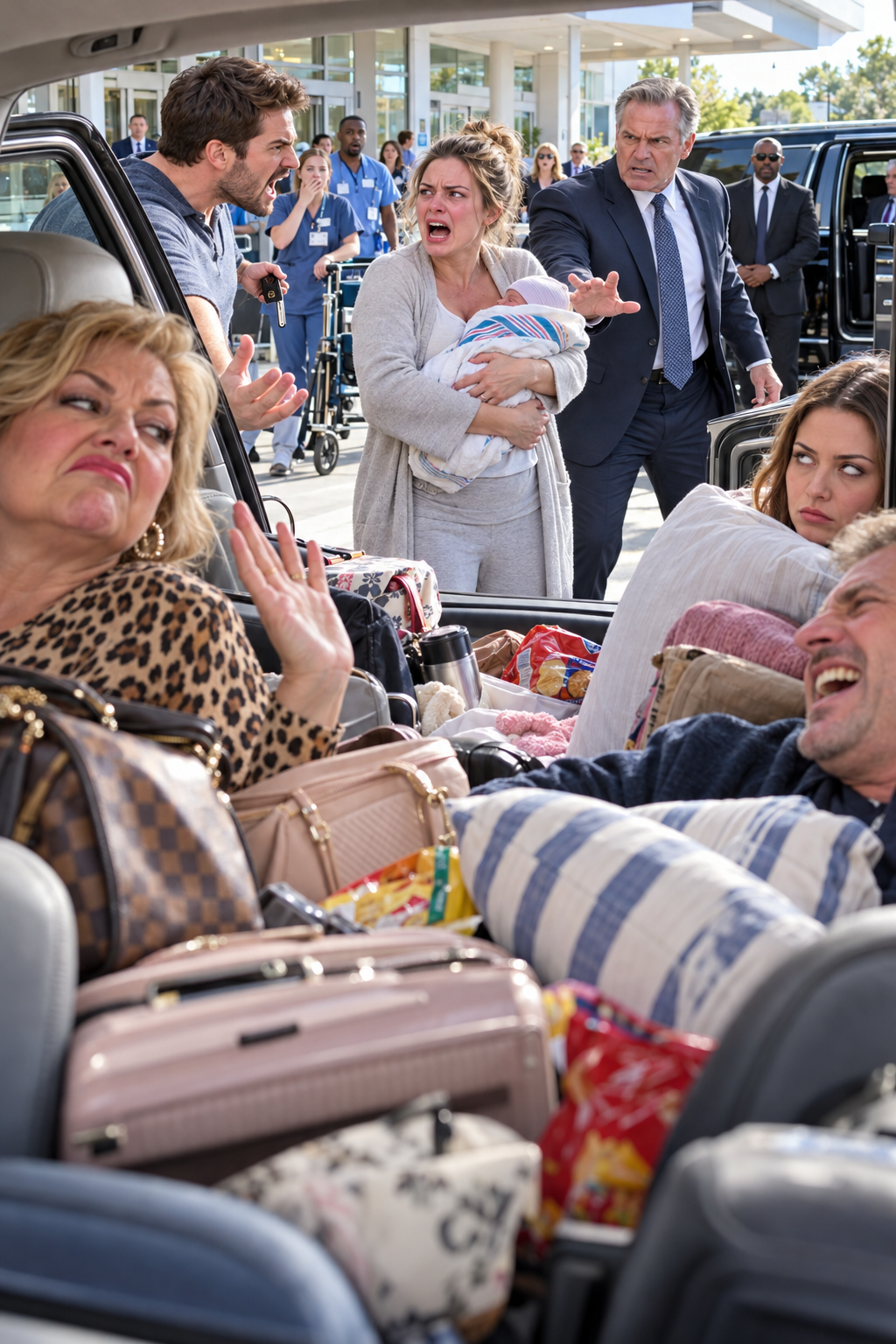
“Where Are You Going, Idiot? Can’t You See There’s No Room?” My Husband Sneered. I Had Just Left The Maternity Hospital And Found His Family Packed Into My Car. Then My Father Appeared—My Husband Had No Idea A Surprise Was Waiting For Him.
The morning I was supposed to take my newborn daughter home, I discovered my husband had handed my SUV to his family and planned to make me sign it over while I was exhausted from childbirth. His mother called me selfish, his sisters laughed, and my husband stayed silent until I calmly told them the car would be waiting at the hospital. Twenty-four hours later, my father arrived carrying an old notebook—and one recording proved the stolen car was only the smallest part of what they had planned.
Part 1
My phone buzzed before sunrise while my daughter Avery slept against my chest, her tiny mouth slightly open, one fist tucked beneath her cheek. I expected another message from a nurse or maybe my mother asking if I needed anything, but instead the security app for my SUV flashed across the screen: Engine started. A second alert followed less than a minute later, telling me the vehicle had left the geofenced area around my condo.
I opened the map with one hand and watched the little blue marker crawl through empty streets toward the east side of Columbus. My husband, Nolan, had told me the SUV had not moved since I went into labor three days earlier, yet the marker stopped outside the apartment building where his mother, Diane Mercer, lived with Nolan’s younger sister Lily. I waited until the vehicle stopped before calling him because years of working as an independent collision appraiser had taught me that liars often told you more in the first five seconds than they did during the next five minutes.
Nolan answered in his smooth dealership voice. “Claire, sweetheart, why are you awake? Is the baby okay?”
“Avery is fine,” I said. “Why is my SUV outside your mother’s apartment?”
There was a pause. Not long enough to seem suspicious to anyone who didn’t spend her life listening to drivers explain why damage on the left side of a car supposedly came from something that hit the right side. Then Nolan rushed out an explanation about Diane having a medical appointment, his older sister Paige needing to drive her, and him lending them my spare key because he did not want to bother me while I was recovering.
“Send me a picture of my spare key hanging in our kitchen by tonight,” I said.
“Claire, come on. You know I would never—”
I ended the call. I did not accuse him, scream, or threaten divorce because I already knew the first part of the truth: he was lying, and whatever his family wanted with my SUV mattered enough for him to lie to me while I was holding our three-day-old daughter.
The SUV had been mine for five years, purchased before I married Nolan with money I earned crawling around wrecking yards, photographing crushed quarter panels, and arguing with repair shops over whether a suspiciously smooth patch of paint hid an old repair. My father, Walter Bennett, went with me the day I bought it, arriving at the dealership in his ancient green pickup that smelled permanently of beeswax, hay, and machine oil. He had walked around my new SUV once, tapped a wheel with his boot, and told the salesman, “She knows what she’s buying. Don’t sell past the customer.”
Dad dressed like a retired mechanic because, in many ways, that was what he considered himself. Nolan’s family believed he kept bees, repaired tractors for neighbors, and lived modestly with my mother, June, on a small farm outside town. What they did not know was that Walter Bennett had started with one tow truck at twenty-three and now owned Bennett Automotive Holdings, a statewide network of dealerships, collision centers, impound facilities, and fleet-service companies.
Dad deliberately lived beneath his means. He liked his old pickup, my mother liked her vegetable garden, and both of them distrusted people who became warmer when they smelled money. When I was sixteen, Dad told me, “If somebody thinks you’re ordinary and still treats you well, you’ve learned something useful. If they think you’re ordinary and treat you like dirt, you’ve learned something even more useful.”
I met Nolan at one of the dealerships Dad’s company eventually acquired, though Nolan did not know the connection. I was there inspecting a trade-in sedan that had enough filler under its hood paint to qualify as sculpture, and Nolan, then a sales manager, tried to convince me the uneven surface came from the factory. When I showed him the paint-depth readings, he laughed, admitted defeat, and bought me coffee.
He was charming without seeming polished, attentive without being clingy, and for almost two years I genuinely believed I had found a man who liked me because I was difficult to impress. He remembered how I took my coffee, came to pick me up after late inspections, and once changed a flat tire with me during a freezing rainstorm instead of sitting in the car while I did it myself. I married him because life with him felt easier, not because I expected anything from his family.
Then I met Diane.
At our first Sunday dinner, she complimented my work, my hair, and my engagement ring before casually asking whether my SUV was leased, financed, or paid off. When I told her it was mine outright, something sharpened behind her smile, and Paige immediately asked if she could borrow it for a weekend trip. I laughed because I assumed she was joking.
She wasn’t.
My first real fight with them came the summer after Nolan and I married, when Paige became engaged to a wealthy furniture-store heir named Grant Holloway. She wanted engagement photos that looked expensive, and although she had rented a country house and designer dress, she apparently decided my silver SUV would complete the illusion. Diane arrived at my condo carrying a supermarket cake and told me lending the vehicle was “the least family could do.”
“No,” I said.
Nolan sat beside me at the table, staring at his plate. Diane stopped smiling, and Paige later posted engagement photographs beside a rented luxury SUV while pretending Grant had bought it for her.
That should have been the end of it. Instead, it became a pattern.
When I became pregnant, Diane attempted to move into my condo “to help,” arriving with two giant suitcases and no invitation. I rolled both bags back into the hallway and told her I would call when I needed assistance. Nolan unexpectedly backed me up, and for several hours I thought something in him had finally changed.
That night, I heard him whispering to Diane through the bathroom door.
“She’s pregnant, Mom. Don’t push her right now,” he said. “After the baby comes, she’ll be exhausted. It’ll be easier then.”
I opened the door before he could hang up. “What exactly becomes easier when I’m exhausted?”
Nolan turned white and insisted I had misunderstood. He said he only meant Diane would be easier to reason with after the stress of the pregnancy ended, but his explanation changed twice before he finished it.
I gave him one warning. “If you are waiting for childbirth to make me easier to control, start looking for somewhere else to live.”
For the rest of my pregnancy he became nearly perfect, which should have scared me more than open hostility would have. He cooked, attended appointments, rubbed my swollen feet, assembled half the nursery, and stopped mentioning my SUV. Meanwhile, he received the opportunity of his career: acting general manager at one of Bennett Automotive’s largest dealerships.
He had no idea my father owned it.
The final promotion required board approval, and Nolan talked endlessly about the mysterious owner who supposedly appeared in meetings only as the initials W.B. He told my father at dinner that corporate success was about knowing how to dominate a room, then joked that Dad probably wouldn’t understand because beekeeping was “a slower kind of business.”
Dad merely smiled and made a note in the small black notebook he always carried in his shirt pocket.
Two weeks before Avery was born, Dad called me late one night. His voice sounded different.
“Has Nolan ever told you what he thinks of me?”
“Not really. Why?”
Dad was quiet for a moment. “He forgot to mute himself after a management presentation today.”
“What did he say?”
“We’ll talk after you have the baby.”
“Dad.”
“Claire, listen to me. If that man does something that makes your stomach turn before we talk, don’t explain it away because you just had a child with him.”
My contractions began four nights later during a thunderstorm. Nolan was at a corporate mixer and did not answer six calls, so an Uber driver named Marcus carried my bag into labor and delivery while apologizing every thirty seconds for taking corners too fast. Avery was born shortly before dawn, furious and healthy, and Nolan finally arrived almost seven hours later smelling of bourbon, rain, and expensive cologne.
He cried when he saw her.
That was the worst part, because the tears looked real.
For a few hours I let myself believe they were.
Then, the evening before my discharge, Nolan asked where I had hidden the spare key to my SUV.
Part 2
Nolan claimed the parking lot at our condo was being repaved and said the vehicle needed to be moved before it got towed. I told him to let it get towed, because paying an impound fee sounded cheaper than having another conversation about my keys. He laughed awkwardly, kissed my forehead, and left the hospital without asking again.
At the time, I thought he had given up. What I failed to remember was that the spare key was hidden inside the metal toolbox in my utility closet, and Nolan had the condo to himself while I was in the hospital.
By the morning of my discharge, my tracking app showed the SUV leaving Diane’s apartment and stopping at a beauty salon, a florist, and finally a bridal-decoration shop. I opened Paige’s social-media account and found the explanation before I could even finish my hospital coffee. There was my silver SUV, wrapped in enormous white ribbons, with my infant car seat still visible through the rear window.
Paige sat behind the wheel wearing sunglasses. The caption read: Finally got my dream ride. Best family ever.
Diane sat in the passenger seat waving at the camera.
I watched the video twice, not because I needed to understand it, but because I wanted to make sure exhaustion had not turned me stupid. Then I set my phone on the bed, looked at Avery’s sleeping face, and felt the anger inside me settle into something colder and much more useful.
I revoked Nolan’s digital access to the SUV. I did not remotely shut the vehicle down because I had no idea where they were driving, and causing an immobilization in traffic would have endangered innocent people. Then I called my mother.
“I saw Paige’s video,” Mom said before I could speak. Her voice, usually soft enough to calm a barking dog, sounded like steel dragged across concrete. “I already called a locksmith.”
“Mom?”
“Nolan’s things will be packed by the time you get home.”
I laughed because it was either laugh or start crying. “When did you become organized crime?”
“I grow tomatoes, Claire. I don’t live under one.”
My next call went to Roy Maddox, a tow operator who had worked with Dad since I was a child. I asked him to bring a flatbed to the hospital the following morning and park near the maintenance entrance where nobody could see him. He said, “Got it,” and hung up without asking a single question.
Then Diane called.
Her voice dripped sweetness. She said the entire family planned to pick me up and take me to the Grand Hawthorne Country Club for a “welcome-home celebration.” When I asked why Paige had announced to the internet that my SUV belonged to her, Diane stopped pretending almost immediately.
“You’re on maternity leave,” she said. “You don’t need a fancy vehicle right now. Paige is marrying into the Holloways. Those people notice things.”
“So you stole my car because Paige wants to impress her fiancé’s parents?”
“Stole? Don’t be dramatic. Nolan agreed. He has papers ready so everything can be transferred properly. You’ll sign tomorrow while you’re doing the rest of the hospital paperwork.”
I stared through the window at the pale morning sky. “No.”
A silence followed.
Then Diane laughed. “You just gave birth, Claire. Don’t turn this into some hormonal tantrum.”
I ended the call after telling her the ribbons would be removed before I drove home.
A woman named Tasha, recovering in the room across from mine after delivering her fourth child, had apparently heard most of the conversation through my open door. She appeared holding an orange and said, “I don’t know you well enough to say this politely, so I’ll just say it. Your mother-in-law sounds insane.”
“That’s becoming difficult to dispute.”
“If you need a witness tomorrow, call me. I haven’t slept in three days and I’m looking for entertainment.”
That afternoon my father finally returned my call. I told him about the car, the fake medical appointment, and Diane’s claim that Nolan had paperwork waiting for me.
Dad sighed. “Then tomorrow sounds like a good day for me to meet your husband at work.”
“We’ll be at the hospital.”
“So will I.”
“What did he say in that meeting?”
Dad’s answer was quiet. “Bring Avery home safely first. Then he’ll hear his own words.”
Before I could press him, another call came in from Nolan. He wanted to know why the SUV app suddenly told him his access had been revoked.
“It isn’t a glitch,” I said.
In the background I could hear Paige complaining that one of the ribbons sat crooked.
Nolan lowered his voice. “Claire, I was going to explain.”
“Do it now.”
He hesitated, and for one breath I hoped he might choose honesty. Then Diane shouted his name somewhere behind him.
“We’ll talk tomorrow,” he said. “Everybody is emotional right now.”
“No, Nolan. Everybody is not emotional. Some people are committing crimes.”
He hung up.
That evening he texted me a photograph of white roses with the message: Tomorrow is going to be beautiful. Trust me.
I did not answer.
The following morning, Mom sent me a photograph from our condo. Nolan’s clothes had been packed into neat cardboard boxes and labeled in her gardening-marker handwriting: shirts, shoes, toiletries, ridiculous suits purchased on credit. Roy texted me that he was parked behind the hospital’s service building.
Dad sent nothing.
That reassured me more than anything else.
Just before discharge, Nolan arrived carrying flowers and accompanied by a twenty-something videographer named Evan who ran a local lifestyle account. Nolan announced loudly that he wanted to film “our family’s first journey home together,” while Evan shoved a phone toward my face.
“Turn that away from my daughter,” I said.
Nolan’s smile stiffened. “Claire, don’t start.”
Then he pulled a plastic folder from inside his jacket. “One tiny thing. Baby insurance. Sign here and we’re done.”
I opened the folder.
The document inside was not related to health insurance.
It was the title to my SUV.
My name appeared as seller. Paige Mercer’s name appeared as buyer. The stated sale price was one dollar.
At the bottom, beside the empty signature line, somebody had made a small pencil check mark.
“Nolan,” I said, “you brought me a vehicle transfer form.”
His face changed instantly. “Mom mixed up the papers.”
I folded it and put it into my bag.
He reached for it. “Give me that.”
“No.”
“Claire, people are waiting downstairs.”
“So?”
“Don’t embarrass me.”
I lifted Avery from the hospital bassinet and looked him in the eye. “You prepared paperwork to transfer property you don’t own, disguised it as hospital paperwork, and brought a camera because you thought I wouldn’t refuse on video. If you’re embarrassed, that’s useful information.”
Evan slowly lifted his phone again.
This time Nolan noticed.
“Stop recording.”
Evan shrugged. “You hired me to record.”
The elevator ride downstairs was almost silent until Nolan’s phone rang. I recognized the human-resources director’s voice leaking through the speaker because she had once handled paperwork for a claim investigation I’d done at the dealership. She told Nolan the board had moved his promotion meeting forward and that the owner of Bennett Automotive would be meeting him personally that afternoon.
Nolan’s entire posture changed.
When he hung up, his fear disappeared beneath triumph. “You heard that? The owner never meets managers. He’s coming for me.”
“Congratulations.”
“So stop fighting me. Sign the car over. I’ll buy you something better once my salary goes up.”
“Paige already listed my SUV for sale online.”
He froze.
I had not known that ten minutes earlier.
A nurse had forwarded me screenshots after recognizing Paige’s post, including a message claiming a cash deposit had already been accepted from a private buyer.
“Nolan,” I continued, “your sister sold a vehicle she does not own, and you tried to obtain my signature afterward to make the sale look legitimate.”
The elevator doors opened.
His face hardened.
“You always have to make everything difficult.”
Then he walked toward the lobby.
I followed him carrying our daughter, and the first thing I heard was a saxophone.
Part 3
Diane had turned the hospital lobby into something between a wedding reception and a shopping-mall opening. She wore a leopard-print blazer, Paige held pink balloons, two musicians played badly near the entrance, and three relatives I barely knew stood beside gift bags while Diane live-streamed the whole spectacle. Lily, Nolan’s twenty-two-year-old younger sister, stayed near the back in a gray sweatshirt, looking as if she wished the marble floor would swallow her.
“There she is!” Diane shouted when the elevator opened. “Our exhausted new mommy!”
I kept walking.
Nolan stepped in front of me and lifted Avery from my arms without asking so Evan could film him holding her. My body reacted before my thoughts did, and I took my daughter back immediately, supporting her neck while Nolan stood with both hands empty.
“Do not use her as a prop,” I said quietly.
Diane laughed toward her live stream. “First-time mothers. So protective.”
“That isn’t going away.”
As I passed, Diane leaned toward my ear. “You will sign that transfer at the country club. Grant’s parents are watching this stream, and you are not humiliating us in front of them.”
Paige’s phone rang.
She looked at the screen, declined the call, and shoved the phone into her purse. I caught only two words on the caller ID: SUV Buyer.
Outside, bright spring sunlight reflected off the hospital windows. My SUV stood at the curb decorated with ribbons and a giant bow, but the infant seat was gone. Before I could ask where it was, Diane climbed into the passenger seat, Paige and two relatives squeezed into the second row, and Nolan sat behind the wheel.
There was no seat left for me.
No seat left for my newborn daughter either.
I stood beside the rear passenger door holding Avery while Nolan lowered the driver’s window.
“What are you doing?” I asked.
“We’re going to the country club,” he said.
“Where am I sitting?”
He looked around as if the answer were an inconvenience created by physics. “Ride with your parents or something.”
“My car seat is missing.”
“Paige needed the room.”
For a second the entire scene became absurdly clear: I had just been discharged after giving birth, and my husband’s family had filled every seat in my vehicle while expecting me to find alternate transportation.
Then a familiar voice came from behind my shoulder.
“Hello, Nolan.”
My father walked past me wearing his faded brown jacket, holding wildflowers in one hand and a gray folder in the other. He stopped at the driver’s window and looked at Nolan with the same expression he used when inspecting a vehicle somebody was trying too hard to sell.
Dad opened the black notebook from his chest pocket.
Then he read.
“My father-in-law is a broke beekeeper. My wife’s soft when she’s emotional, and after the baby comes she’ll be exhausted enough that I can finally get her under control. My sister wants the SUV, so Claire will sign it over whether she likes it or not. You just have to catch women when they’re tired.”
Nolan stopped breathing.
Dad closed the notebook.
“Sound familiar?”
Nobody spoke.
Nolan’s face lost color in stages.
Dad continued. “You said that after your quarterly presentation when you forgot your microphone was still live.”
Diane leaned across the center console. “Who do you think you are?”
Dad turned toward her.
“Walter Bennett.”
She rolled her eyes.
He handed Nolan the gray folder through the window. “Founder and majority owner of Bennett Automotive Holdings. Nolan knows the initials.”
Nolan stared at him.
Then at the folder.
Then back at him.
“No.”
“Yes.”
Diane’s expression collapsed as she slowly understood that the shabby beekeeper she had mocked for years owned the company where her son expected to become general manager.
Nolan pushed the folder away. “Mr. Bennett, what I said was a joke.”
“It wasn’t your joke that ended your promotion.”
Dad nodded toward the papers.
“Your acting-manager assignment is terminated effective today. Corporate compliance also opened an investigation this morning into unauthorized use of dealership demo vehicles.”
Paige stopped moving.
Dad noticed.
“The white Range Rover in your engagement photographs last summer belonged to our dealership. Nolan signed it out under a fictional customer test drive.”
Nolan swallowed hard.
Dad continued. “Then he did the same thing twice more. Once for your aunt’s birthday and once for a family weekend at the lake. Compliance pulled the logs after I heard his meeting comments.”
That mattered more than learning Dad was wealthy.
Dad had not manufactured Nolan’s downfall. Nolan had created it himself one dishonest choice at a time.
I took out my phone.
“Everybody out of my SUV.”
Diane crossed her arms. “This is a family vehicle.”
“No. It isn’t.”
“We’re going to the country club.”
“Not in my car.”
She laughed because she still believed numbers could win an argument, and there were five of them sitting inside the vehicle while I stood outside holding a newborn.
I raised my hand.
Roy’s orange flatbed rolled around the corner.
The family inside my SUV went silent.
Roy backed toward us, lowered his window, and called, “Claire, this the one?”
“This is the one.”
He climbed out and looked through the glass at the passengers. “Company policy says I can’t load occupied vehicles. Technically.”
Lily opened her door first.
She stepped onto the pavement, walked past Diane without speaking, and came to stand near me.
An older aunt followed. Paige resisted until Roy started lowering the steel bed, then jumped out complaining that her shoes were being ruined. Diane lasted another ten seconds before exiting with the offended dignity of a queen removed from a restaurant for refusing to pay.
Nolan stayed behind the wheel.
Roy tapped the window.
“Sir, vehicle owner asked you to exit.”
Nolan climbed out holding Dad’s termination packet.
He turned toward me. “Claire, please. My mother pressured me.”
“No.”
“I wasn’t actually going to make you sign.”
“You brought the paper into my hospital room.”
“I was going to explain.”
“You disguised it as insurance.”
His eyes filled with panic. “We have a daughter.”
“Yes. Which is why you’re not coming home.”
I told him his possessions were waiting with the building manager and that I would file for divorce. He would have appropriate access to Avery through a court-ordered schedule, but Diane would not be involved, and there would be no cameras.
Diane exploded.
“This was a setup! Your father hired Nolan so he could spy on him!”
Dad looked almost bored.
“My human-resources director hired Nolan without knowing he was my son-in-law. He earned the job, Diane. Then he earned everything that happened afterward.”
Roy hooked the SUV to the winch.
As the decorated vehicle slowly climbed the flatbed, Paige’s phone began ringing again. She declined the call.
Diane’s phone rang next.
The screen displayed the name Marianne Holloway.
Nobody answered.
Dad put his hand on my shoulder and guided me toward his old green pickup, where a brand-new infant seat had already been installed.
I expected leaving the hospital to feel triumphant.
Instead, halfway home, I started crying.
Not because Nolan lost his job.
Not because Diane had stolen my car.
I cried because I remembered Nolan crying at the nursery window, and I hated that I had believed those tears meant he would choose us.
Dad drove for several minutes before speaking.
“You didn’t make him fail, Claire.”
“I know.”
“No. You know it up here.” He tapped his forehead. “You need to know it down here too.”
He touched his chest.
When we reached my condo, Mom met us at the elevator and took Avery while Dad carried my bag. The apartment smelled like bread and lavender, Nolan’s boxes were gone, and Mom had finished assembling the crib he had been promising to build for months.
For the first time in days, I sat down.
Then Mom’s phone buzzed.
Her face changed as she stared at the screen.
Diane had posted a new video.
And according to her version, my father and I had just kidnapped her granddaughter.
Part 4
Diane’s edited video showed me taking Avery away from Nolan, my SUV being dragged onto a tow truck, and Diane standing on the pavement looking devastated. It conveniently omitted the fraudulent title form, Dad reading Nolan’s own words, the unauthorized dealership vehicles, and the fact that my newborn had not even had a seat in the car they planned to drive away in. Her caption said her wealthy, vindictive daughter-in-law had used family money to destroy an innocent husband and separate a loving grandmother from her first grandchild.
By dinner, strangers were calling me cruel.
By eight that evening, one of the insurance companies that supplied almost half my appraisal assignments called to suspend my work because their public-relations department had seen Diane’s video. The claims director, Arthur Webb, spoke in the solemn tone of a man trying to fire someone without using the word fire.
“Just temporarily,” he said. “Until this calms down.”
“Have you watched the unedited recording from the hospital?”
He paused.
“I’ll send it.”
“Claire—”
“Watch it before you decide which person presents the reputational risk.”
After I hung up, exhaustion hit me harder than labor had. I was sore, sleep-deprived, leaking milk through a nursing pad, and now I was defending my career because my mother-in-law had discovered video editing. Mom made soup while Dad watched Diane’s clip twice without saying anything.
Then Lily arrived carrying my missing infant seat.
She looked as if she had been crying.
“Paige dumped this in Mom’s hallway yesterday,” she said. “She said it ruined the look of the car.”
I took a slow breath.
Lily continued before I could respond. “Grant ended the engagement.”
Apparently Grant Holloway’s mother had watched enough of the hospital live stream to realize Paige had lied for more than a year about owning my SUV. Worse, the buyer who had sent Paige a deposit was threatening to go to the police because she could not return his money. She had already spent most of it on a custom wedding gown.
“How much?”
Lily told me.
It was more money than some people earned in three months.
“Diane knew?”
“Yes.”
“Nolan?”
Lily nodded.
Then she looked at her hands. “Mom is bringing everybody here tomorrow at noon. She’s contacted a newspaper reporter and this big local video guy named Trent Russo. They’re going to protest outside until you let Nolan take Avery and give Paige the car.”
Mom stopped stirring soup.
Dad removed his glasses.
“What did Nolan say?” I asked.
“He agreed.”
That hurt less than I expected.
Maybe something inside me had already finished breaking.
My phone rang from an unknown number. The man introduced himself as Frank Dalton and explained that he was the buyer who had paid Paige the deposit.
“I’d like my money back,” he said, “but I’d also like to know whether you ever authorized the sale.”
“No.”
“Thought so.”
“Come to my building tomorrow at noon.”
He was silent briefly.
Then he laughed. “Walter Bennett going to be there?”
I looked at Dad.
“Yes.”
“Tell him Frank from Dawson’s old salvage yard says hello.”
Dad actually smiled when I delivered the message. Thirty years earlier, he explained, Frank had helped him find transmissions and body panels when neither of them could afford new parts. Frank now owned three independent repair garages.
That night, Nolan left a voicemail.
At first he sounded broken. He apologized, told me he had been sleeping at Diane’s, and asked whether he could see Avery. Then his tone changed midway through the message, becoming sharper and more rehearsed.
“If you don’t give Paige that vehicle tomorrow, I’m telling the press what you’ve been hiding. You lied to me about your father for our entire marriage.”
I texted one sentence.
Tell them.
Then I blocked him.
Before bed I checked the SUV, now parked beneath the streetlight outside my building. Behind the rearview mirror, a small green light blinked.
The dash camera.
I had installed it years earlier for work because clients sometimes disputed conversations that happened during inspections. It recorded audio whenever the vehicle operated and uploaded files automatically to encrypted cloud storage.
There were nine new recordings.
I did not listen that night.
At seven the next morning, a woman from child protective services called.
Her name was Evelyn Price.
She informed me that an emergency complaint had been filed alleging unsafe conditions, violent postpartum behavior, and deliberate isolation of my newborn from her father. My knees nearly gave out when she said Avery’s name.
Internet gossip was one thing.
Someone putting the government between me and my daughter was another.
Dad saw my face and stood immediately.
Mom reached for Avery.
I forced myself to breathe. “Come whenever you need to.”
Evelyn arrived less than an hour later wearing a gray suit and carrying a leather portfolio. She inspected the nursery, refrigerator, medicine cabinet, sleeping arrangements, diapers, formula we kept for emergencies, and discharge papers.
Then she sat at my kitchen table.
“The reporting party is Diane Mercer,” she said.
“Of course.”
“She claims you physically attacked the child’s father at the hospital.”
“I took my newborn back after he removed her from my arms for a video.”
“I watched that footage.”
That surprised me.
Evelyn adjusted her glasses. “I watch source material before I write reports.”
I liked her immediately.
I explained the attempted car transfer, the stolen key, the missing infant seat, and Diane’s planned protest. Evelyn made notes without changing expression.
“They’re coming here at noon?”
“Yes.”
She looked at her watch.
“I think I’ll finish my field notes later.”
While Mom made coffee, I opened the dash-cam files.
Diane’s voice filled my earbuds.
The recording began while they were driving toward the hospital.
“Nolan will put the paper in front of her before she has time to think,” Diane said. “If she refuses, we destroy her reputation. Call her job. Call child services. Tell everybody she’s unstable. Women are mush after childbirth.”
Then Paige complained about already spending the buyer’s money.
Then Nolan said, “Just keep Claire busy at the country club. Once she signs, none of this matters.”
I stopped playback.
For several seconds, I could not move.
The false CPS report had not been an angry reaction after the hospital confrontation.
It had been planned in advance.
That distinction changed everything.
I loaded the recording onto a rugged Bluetooth speaker from my work bag.
At eleven fifty-five, I looked through the window.
Diane had arrived carrying a red-lettered sign.
Nolan stood beside her.
So did cameras.
This time, I knew exactly what they were going to hear.
Part 5
By noon the courtyard below my building resembled a campaign event organized by people who had never run a campaign. Diane held a sign demanding grandparents’ rights, Paige wore enormous sunglasses and carried one accusing me of having no shame, and Nolan stood near the dumpsters smoking even though he had quit years earlier. A local video commentator named Trent Russo paced between them with a camera operator while a reporter from the city newspaper watched from the side.
Several neighbors gathered because nothing attracts attention in a condo building like a family argument with professional microphones. Mrs. Alvarez from the second floor whispered that she had heard I was keeping Nolan’s baby from him, while Mr. Benson from the third-floor balcony sat in a folding chair with a cup of coffee. Evelyn Price remained inside my apartment with Dad until Diane began speaking, then calmly followed us downstairs.
I left Avery with Mom.
My daughter would never become scenery in somebody else’s performance.
When Dad and I stepped outside, Diane pointed directly at me.
“There she is!”
Trent swung the camera toward us.
Diane launched into a speech about sacrificing her entire life for her children and watching a rich daughter-in-law destroy her son. She claimed Dad had secretly placed Nolan inside his own company to humiliate him and said I had hidden my family’s money so I could laugh at the Mercers behind their backs.
Then Trent asked Nolan to speak.
Nolan looked miserable, but once the camera centered on him, his salesman’s instincts returned.
“My wife lied to me about who she was,” he said. “For our entire marriage, I thought she was a normal working woman. Her father is worth millions. She let me struggle while knowing he owned the company where I worked.”
From the third-floor balcony, Mr. Benson leaned over the railing.
“Son, are you complaining that your wife didn’t tell you she was rich?”
A few people laughed.
Nolan’s face reddened.
Mr. Benson continued. “Would you have treated her better if you knew?”
More laughter.
Diane shouted at him to stay out of family business.
I stepped forward before the gathering could turn into a circus.
“You invited these people because you wanted them to hear what happened,” I said. “So they should hear it.”
I pulled the speaker from my bag.
Diane’s eyes dropped immediately toward the SUV parked near the entrance.
She saw the dash camera.
For the first time that day, she looked frightened.
I pressed play.
Her own voice rolled across the courtyard.
“If she won’t sign, call child services. Say she’s unstable. We’ll call her job too. By the time we’re finished, she’ll hand Paige the keys just to make us stop.”
Nobody moved.
The recording continued.
Paige complained that the buyer had already paid a deposit and that her wedding dress could not be returned. Nolan said I would eventually give in because I hated public scenes.
Then came Diane again.
“New mothers are tired. That’s when you push.”
I paused the recording.
Trent’s camera slowly turned from me toward Diane.
Evelyn stepped forward.
“Mrs. Mercer.”
Diane backed up.
Evelyn opened her portfolio and removed the complaint Diane had filed.
“You stated yesterday that your granddaughter was in immediate danger and that your daughter-in-law presented an active threat to the child. I completed a welfare inspection this morning. The infant is healthy, properly housed, and receiving appropriate care.”
Diane’s face tightened.
Evelyn continued. “I have now heard evidence indicating you discussed making the report as leverage before the child even left the hospital. That will be documented.”
“She edited that recording,” Paige shouted. “It’s fake.”
A dark red sedan turned into the courtyard.
Frank Dalton stepped out wearing work boots and a flannel shirt, wiping one hand with a shop rag. He greeted Dad with a hug before turning toward Paige.
“There you are.”
Paige went rigid.
Frank held up his phone.
“You offered me that silver SUV online. I sent you a deposit after you provided what you claimed was proof the owner approved the sale.”
Trent moved closer.
The newspaper reporter began writing much faster.
Frank looked at Paige. “I want my money back today. If I don’t have it by five, I’m giving your messages, listing, and fake paperwork to the police.”
“I don’t have it.”
“That’s your problem.”
“I spent it.”
“Also your problem.”
Paige grabbed Diane’s arm.
“Mom.”
Something happened to Diane’s expression then. The performance disappeared, and suddenly she was no longer a glamorous, furious matriarch but an aging woman who had spent decades believing money could protect her children from humiliation.
She opened her purse.
From a hidden compartment in an old wallet, she removed a debit card wrapped in plastic.
“I saved that money for thirty years,” she said.
Lily stepped forward. “Mom, no.”
Diane shoved the card at Paige.
“Pay him.”
I expected satisfaction.
I felt none.
Diane had grown up poor enough to reuse winter coats until the cuffs split. Somewhere along the way, fear of ever looking poor again had turned into obsession with appearances, and now the daughter she had taught to chase status was using her emergency savings to repay money taken through fraud.
Consequences did not need my help.
They were already eating the family alive.
Frank waited beside his car until the transfer arrived. When it did, he nodded to me, shook Dad’s hand, and left without another word.
Paige turned on Lily immediately.
“You little rat. You told her everything.”
Lily’s face went pale, but she did not step backward.
“No. You stole Claire’s car. You took money for something you didn’t own. Your wedding ended because of you.”
Paige lifted her sign as if she might swing it.
Dad moved one step.
Paige lowered it.
Then Nolan walked toward me.
The crowd went quiet again.
He stopped a few feet away, and for the first time since I had known him, there was no performance left in his face.
“I’m sorry.”
I said nothing.
“I lost my job. Grant’s family hates us. Paige lost her wedding. Mom lost her savings. I lost my home.” His voice cracked. “Please don’t make me lose Avery.”
“I’m not taking Avery from you.”
Hope flashed across his face.
“The court will decide a visitation schedule. You will follow it. Diane will not attend. Cameras will not attend. If you want to be her father, be her father.”
“What about us?”
“There is no us.”
“Claire—”
“You had chances before the hospital. You had another chance when you took my spare key. Another when Paige listed my car. Another when you prepared the title form. Another when you filled every seat in my vehicle and told your wife, carrying your newborn, to find another ride.”
His eyes dropped.
“The last one was today. You came here with a camera to destroy my reputation.”
He did not answer.
I turned toward the entrance.
Behind me, Trent asked Diane whether she still believed I had kidnapped Avery.
The newspaper reporter asked Evelyn about false reporting.
Paige was crying.
Lily stood alone near the curb.
Nolan did not follow me.
When the elevator doors closed, I realized my hands were shaking.
Not from fear.
From the strange weightlessness that comes after finally putting down something heavy you carried so long you forgot it was there.
Part 6
The internet reversed itself almost as quickly as it had turned against me. Trent posted the full courtyard confrontation, somebody located Evan’s original hospital footage, and viewers began comparing Diane’s edited clip with what had actually happened. By evening, the same strangers who had called me heartless were sharing screenshots of Nolan’s one-dollar vehicle transfer and making jokes about the giant wedding bow riding away on Roy’s flatbed.
I disliked both versions of public attention. Being praised by people who had insulted me twelve hours earlier did not feel like justice; it felt like weather. It changed direction because something more interesting blew in.
Arthur Webb called the following morning.
His company wanted to restore my assignments immediately and offer me an exclusive contract at a higher rate.
“I’m on maternity leave,” I told him.
“Of course. Whenever you’re ready.”
“And Arthur?”
“Yes?”
“The next time someone edits a sixty-second video about one of your contractors, investigate before you suspend a ten-year professional relationship.”
There was a pause.
“Understood.”
That mattered to me more than the money.
Diane came to the building alone three days later.
She wore a plain raincoat instead of the leopard blazer, and without her heavy makeup she looked exhausted. The building manager called upstairs and asked whether I wanted security.
“No. I’ll meet her in the lobby.”
I did not invite Diane past the mailboxes.
“Let me see Avery,” she said.
“No.”
“Through the window, then.”
“No.”
Her mouth tightened. “I’m her grandmother.”
“You filed a false report that could have taken her from me.”
“I was angry.”
“You planned it before we reached the hospital.”
She looked down.
“I wanted my children to have things I never had.”
“Then you should have taught them how to earn those things.”
Her eyes filled, but I did not soften.
Diane said, “People used to laugh at my family because we were poor.”
“And you laughed at my father because you thought he was poor.”
That landed harder than anything else I could have said.
I stepped toward the elevator.
“Goodbye, Diane.”
She did not ask again.
A week later Lily arrived carrying a backpack and the crooked-eared knitted rabbit she had made for Avery. She had moved out of Diane’s apartment after Paige blamed her for everything and said she had rented a room from an elderly woman near campus.
“I quit accounting,” she told me.
“Because you hated it?”
“Because Mom wanted me to do it.”
“What do you want?”
She looked genuinely terrified by the question.
“I take photographs. I remember license plates. That’s about it.”
Dad happened to be sitting at the table drinking coffee.
He lowered his newspaper.
“You remember plates?”
“Almost all of them.”
“We need an intake assistant at the south impound yard. Photograph incoming vehicles, log plates, document damage. Boring work. Decent pay.”
Lily stared at him.
“I’m not qualified.”
“You know how to use a camera?”
“Yes.”
“You can read?”
She almost smiled. “Yes.”
“Then you’ll learn the rest.”
She started the following Monday.
Nolan’s employment investigation went far beyond the unauthorized Range Rover. Compliance found that he had routinely bypassed normal demo-car procedures for friends and relatives and once altered mileage records in an internal checkout system to hide how far a vehicle had traveled over a weekend. Nothing was serious enough by itself to explain his entire downfall, but together they showed a pattern that made termination inevitable even without the comments he made about me.
Dad did not blackball him.
That surprised Nolan’s lawyer when the divorce proceedings began.
“If another dealership hires him,” Dad told me, “that’s their decision. I’m not ruining his life. I’m removing him from mine.”
Our divorce was simpler than our marriage had been.
The condo and SUV were mine from before the wedding, Nolan had little reason to contest either, and his attorney apparently convinced him that making fraud allegations part of the court record would not improve his position. He accepted a structured custody plan beginning with supervised visits at a family café.
The first time he saw Avery after the separation, he arrived fifteen minutes early carrying a stuffed giraffe.
No camera.
No Diane.
No salesman’s suit.
He sat across from the stroller in a plain jacket and stared at his daughter as though she were something too fragile to deserve his hands.
“Can I hold her?”
“Yes.”
I showed him how to support her neck.
Avery wrapped her fingers around one of his.
Nolan’s eyes filled.
I remembered the hospital nursery and waited to feel something.
Nothing came.
That absence was not cruelty.
It was freedom.
“I got a job,” he said. “Used-car lot on the west side.”
“Good.”
“Small place.”
“Work is work.”
He glanced at me. “Do you hate me?”
“I don’t spend enough time thinking about you to hate you.”
He absorbed that quietly.
We finished the visit without discussing our marriage again.
Over the following months Nolan followed the custody schedule almost perfectly. He paid support on time, stopped asking for reconciliation, rented a small apartment, and learned to change diapers without acting as if somebody owed him applause. I never forgot what he had done, and I never considered taking him back, but I was relieved Avery might someday know a father who had at least learned that love was not the same thing as possession.
Paige’s life changed much faster.
Grant never resumed the engagement. She sold the designer wedding dress online for less than a third of what she had paid, and the cruel irony was impossible to miss: the same marketplace she had used to sell my SUV became the place where she had to unload the dress purchased with the stolen deposit.
Diane barely spoke to her afterward.
I heard most updates through Lily, though I eventually asked her to stop bringing me details unless they affected Avery.
“They’re not my story anymore,” I said.
Lily understood.
By late summer, she had become one of Dad’s best intake photographers. She could look at a parking lot and remember half the plates twenty minutes later, and one afternoon she noticed a number on an incoming sedan did not match the partial VIN visible through the windshield.
The senior inspector checked.
The vehicle had been stolen and re-tagged.
Dad gave Lily a fluorescent safety jacket reserved for experienced yard staff.
She wore it to my house that evening.
“I know this is stupid,” she said, grinning, “but I’ve never been proud of a jacket before.”
“It isn’t stupid.”
Avery grabbed the reflective stripe and refused to let go.
For the first time since the hospital, I looked around my living room and realized that the family created by the disaster was not the one I had married into.
It was the one still standing after everybody had been forced to choose who they wanted to become.
Part 7
Dad waited until August to show me the second gray folder.
We were at the farm beneath the old apple tree while Mom spread enough food across a picnic blanket to feed a construction crew. Avery lay on her back watching sunlight flicker through leaves, and Dad returned from the house holding the same kind of folder he had carried to the hospital.
My stomach tightened automatically.
“Relax,” he said. “Nobody’s getting fired.”
“That’s exactly what somebody holding one of those folders would say.”
He laughed and handed it to me.
Inside was an appointment proposal.
General Manager, Bennett Automotive—North Columbus Center.
The dealership Nolan had expected to run.
I closed the folder.
“No.”
Dad did not react.
“I’m serious. I just had a baby. I’m getting divorced. I already have work.”
“Then say no.”
“You aren’t going to argue?”
“Nope.”
That irritated me more than an argument would have.
He scratched his beard. “I offered you a job because the dealership needs somebody who understands cars, documentation, customers, and the difference between a polished story and an honest repair. You can start in six months, a year, or never.”
“You know people will say you gave it to me because I’m your daughter.”
“They will.”
“And some of them will be right.”
“They will.”
I stared at him.
Dad shrugged. “Nepotism isn’t pretending family relationships don’t exist. It’s giving family jobs they can’t perform and protecting them when they fail. If you take this job and you’re terrible, the board will remove you.”
That sounded exactly like him.
“What would I actually be allowed to change?”
“Anything within budget and compliance.”
I opened the folder again.
The dealership had suffered weak internal controls for years. Demo vehicles disappeared for personal events, managers approved discounts inconsistently, salespeople manipulated add-on packages, and customer complaints often died inside departmental inboxes instead of reaching senior leadership.
Nolan had not created the environment.
He had learned how to exploit it.
That was the deeper problem underneath everything.
The system had rewarded smooth talkers and tolerated small abuses until somebody finally pushed too far.
“I want full audit access,” I said.
Dad smiled.
“And authority over demo-key policy.”
“Obviously.”
“And no family member gets special treatment.”
His smile widened.
“Especially mine.”
“I was hoping you’d say that.”
I accepted three weeks later with a delayed start date in October.
Before my first day, I spent mornings at home with Avery and afternoons reviewing dealership records. What I found annoyed me more than anything Nolan had personally done: employees had borrowed demo cars for weddings, prom nights, airport pickups, and vacations while managers treated the logbook like a suggestion.
Nobody thought they were stealing.
They thought the rules were flexible because somebody above them had always looked away.
On my first morning as general manager, the sales floor went strangely silent when I entered.
I recognized several people from Evan’s hospital video and Trent’s courtyard recording. They recognized me too.
The HR director dropped an entire stack of résumés when she saw me.
“I’m sorry,” she said, crouching to gather papers.
“For what?”
She turned red. “We watched the livestream in the break room.”
“Did you at least sell cars afterward?”
She laughed nervously.
At the first staff meeting, I placed the demo logbook on the conference table.
“I’ve reviewed twelve months.”
Nobody moved.
“Starting Monday, vehicle keys require electronic checkout tied to employee identification. Mileage and fuel are logged automatically. Personal use requires a rental agreement like any other customer.”
A senior salesperson raised his hand.
“What about weddings?”
“Rent the car.”
“Prom pictures?”
“Rent the car.”
“Charity galas?”
“Submit the request and get written approval.”
He nodded.
Nobody resigned.
Nobody rioted.
The world continued spinning.
Within two months, unauthorized mileage on demo inventory dropped by almost ninety percent. Customer complaints also fell after I required every unresolved issue to remain visible on a shared dashboard instead of disappearing into managers’ private inboxes.
I discovered something I had not expected.
I loved the job.
Not the title.
Not the office.
The work.
I liked solving problems while they were still small, before somebody felt forced to scream. I liked walking the service floor and asking technicians what salespeople promised customers without checking. I liked opening records and discovering where a process had failed instead of immediately searching for a person to blame.
Every Friday I still went on one appraisal with Roy.
He complained if I tried crawling beneath damaged vehicles.
“You run a dealership now.”
“I’m still an appraiser.”
“You’re also still incapable of listening.”
“Correct.”
Lily sometimes joined us.
Her eye for detail became so good that Dad offered to pay for evening classes in forensic photography and vehicle identification. She refused the tuition unless the company treated it as formal job training available to other employees too.
Dad called me afterward.
“You hearing this?”
“She learned something.”
“Apparently.”
Diane remained outside our lives.
She mailed Avery a birthday card but did not ask to visit. Nolan told me once, during a custody exchange, that she had started attending counseling through a community center and had taken a part-time job managing inventory at a discount store.
I did not ask for more details.
People sometimes confuse boundaries with punishment.
I did not need Diane miserable.
I needed her away from my daughter until I believed she understood why weaponizing a child-protection agency made her unsafe.
Those were different things.
On Avery’s first birthday, a small package appeared outside my door.
Inside was a pair of knitted mittens.
They were crooked.
One thumb was longer than the other.
Underneath them sat a box of expensive chocolates, the same brand Diane used to bring whenever she wanted something from me.
There was no note.
I showed the mittens to Lily.
She stared at them.
“My mother has never knitted anything in her life.”
“Apparently she started.”
“Are you going to call her?”
“No.”
“Ever?”
“I don’t know.”
I put the mittens on Avery.
They fit perfectly.
Forgiveness, I was learning, was not a door somebody else could knock on until I became tired enough to open it.
Sometimes the door stayed closed.
Sometimes that was the healthiest answer available.
Part 8
The following spring, Dad invited us to the farm on a Sunday afternoon. Avery had started walking in the unstable, determined way toddlers do, charging toward destinations her legs had not fully agreed to reach. She wandered between Mom’s blackberry bushes while Dad followed three feet behind pretending not to be terrified she would fall.
His old black notebook was still in his pocket.
I had seen that notebook record dealership numbers, dishonest managers, useful mechanics, suspicious purchases, and every rude thing Nolan’s family ever said when they thought Dad did not matter. For years I imagined it as some secret ledger of grudges.
That afternoon Dad sat beside me near the hives and opened it.
Several pages were filled with Nolan.
Quotes from the muted corporate meeting.
Unauthorized demo-car dates.
Diane’s comments.
The Range Rover mileage.
Dad read none of them.
He tore the pages out.
“What are you doing?”
“They did their job.”
He rolled the papers together and tucked them into the chamber of his bee smoker. Then he lit them.
Gray smoke drifted over the grass.
“Keeping old anger forever is like keeping rusted parts from a car you sold,” Dad said. “Eventually you can’t move around the garage.”
“You waited a year to become philosophical?”
“I’ve been philosophical for decades. Nobody listens because of the jacket.”
I laughed.
Dad opened the notebook to a clean page.
He wrote: Avery Bennett. Tries to eat blackberries before they are ripe. Laughs at bees. Thinks every truck belongs to Grandpa.
Mom read over his shoulder.
“Add that she throws peas.”
Dad wrote it down.
“And hates socks.”
He added that too.
I watched them argue about whether refusing socks qualified as personality or criminal behavior, and I understood what he meant about clearing space.
I did not need to forget Nolan.
I needed the memory to stop occupying every room inside me.
My life became ordinary again in ways I treasured.
I drove Avery to daycare three mornings a week. I ran the dealership. I performed occasional appraisals because I still enjoyed putting a meter against suspicious paint and watching a seller suddenly become nervous.
Nolan saw Avery on his schedule.
He became a good salesman at a modest used-car lot owned by a married couple nearing retirement. His charm remained powerful, but for once it served a business where he had no family connection, no hidden advantage, and nobody above him quietly hoping he would succeed.
One afternoon during a custody exchange, he handed Avery back to me and said, “They offered me assistant manager.”
“Congratulations.”
“I almost called your dad.”
“For what?”
“A recommendation.”
I raised an eyebrow.
He laughed at himself.
“Yeah. That’s why I didn’t.”
For the first time since our marriage ended, I smiled at him without effort.
“Good choice.”
He looked at Avery, then at me.
“I know you don’t owe me anything, but I need you to know I understand why you left.”
“I hope you do.”
“I kept thinking the worst thing I did was take the car.”
“It wasn’t.”
“I know.”
That was enough.
Paige eventually moved to another city. Lily heard she worked at an event-rental company and rarely came home. We never became friends again because we had never really been friends to begin with, but she sent Avery a birthday card once with twenty dollars inside and signed only her name.
Diane remained more complicated.
Two years after the hospital, she asked Nolan to pass along a letter.
I almost refused it.
Instead, I read it once.
She did not ask for forgiveness.
She described growing up in a two-bedroom apartment with five siblings, hiding holes in her shoes at school, and promising herself her children would never be laughed at for looking poor. Then she wrote one sentence that mattered more than everything else.
I taught them to fear looking poor more than I taught them to fear becoming dishonest.
I folded the letter.
Six months later, after discussing it with my attorney and Avery’s therapist, I allowed Diane one supervised visit in a public park.
She arrived early.
No gold jewelry.
No social media.
No presents except a small jar of homemade cookies.
Avery did not remember her.
Diane knew that immediately.
She sat on a bench and cried quietly while Avery played with gravel near my shoes.
I did not comfort her.
But I did not leave.
Eventually Avery wandered over, stared at Diane, and offered her a yellow plastic shovel.
Diane accepted it with both hands.
“Thank you.”
That was all.
There was no dramatic reunion.
No instant forgiveness.
No return to family dinners.
Diane saw Avery occasionally under boundaries I controlled, and if those boundaries ever became inconvenient to her, she never complained to me.
Some relationships do not heal back into what they were.
They heal into something smaller and safer.
My dealership became the strongest-performing location in our northern region the following year, but I was prouder of a different number: employee complaints involving favoritism and vehicle misuse dropped to almost zero. We created a written family-use policy, whistleblower reporting that bypassed local management, and automatic tracking for demo inventory.
One morning, a young salesperson named Tyler came into my office looking terrified.
His brother needed a luxury sedan for wedding photographs.
“I know the policy,” he said. “I brought my credit card.”
I stared at him for a second.
Then I laughed.
“Employee rate is twenty percent off.”
He looked relieved.
That tiny conversation told me the dealership had changed.
People did not need powerful relatives or secret rules.
They needed rules that meant the same thing for everyone.
Dad eventually stepped back from daily operations. He still joined board calls but spent more time with his bees, and the mysterious W.B. initials disappeared from company mythology once employees discovered the feared owner was usually wearing muddy boots somewhere near a blackberry patch.
He never bought a luxury car.
He did finally replace his old green pickup after the transmission failed for the third time.
Then he purchased another old green pickup.
Mom refused to discuss it.
As for my silver SUV, I kept it long past the point when I could easily afford something newer. Roy removed the last residue from Paige’s wedding decal, but he rolled the giant white bow into a tube and placed it in my garage.
“Souvenir,” he said.
“For what?”
“For the day everybody learned not to borrow Claire Bennett’s tools.”
Years later, Avery found that ribbon while helping me clean the garage.
“Mom, what’s this?”
I looked at the faded satin in her hands.
For a moment I saw the hospital steps again: Nolan behind the wheel, Diane in my passenger seat, Paige squeezed into the back, no room left for me or my newborn daughter.
Then I remembered what happened afterward.
Not Dad revealing his company.
Not the cameras.
Not strangers cheering when the tow truck arrived.
I remembered Mom changing my locks.
Roy waiting behind the maintenance building.
Lily bringing back the car seat.
Evelyn watching the full video instead of believing the loudest person.
Frank demanding accountability instead of revenge.
Dad giving Nolan every chance to expose his own character.
And me standing outside that SUV with Avery in my arms, understanding for the first time that keeping peace and surrendering were not the same thing.
“It came with a lesson,” I told her.
“What lesson?”
I took the ribbon and rolled it around my hand.
“If someone keeps telling you that loving them requires you to give up your boundaries, they’re asking for obedience, not love.”
Avery considered this with the seriousness of a child deciding whether an adult had said something useful.
Then she pointed toward my SUV.
“Can I drive it when I’m sixteen?”
I laughed.
“We’ll discuss it when you’re sixteen.”
“Grandpa says I’ll be a good driver.”
“Grandpa also let you steer a tractor when you were six.”
“He says I have natural talent.”
“He says a lot of things.”
She ran toward the house laughing, leaving me alone in the garage.
My phone buzzed.
A message from Dad.
Sunday dinner. Bring Avery. She promised to help with honey jars.
I looked at my SUV parked in the afternoon light.
Avery’s old infant seat was long gone, replaced over the years by toddler seats, booster seats, soccer bags, school projects, muddy boots, and the ordinary clutter of a life moving forward.
The driver’s seat was empty.
So was the passenger seat.
Nobody had claimed them for me.
Nobody needed to.
I climbed behind the wheel, started the engine, and listened to the familiar chime.
Then I drove home.
THE END!