I was standing in the back of Sanders Theatre when my sister began to mourn me in front of twelve hundred people.
Not metaphorically. Not in the vague, sentimental way families sometimes turn absence into mythology. Sloan Mortensson stood at the polished wooden podium in her black Harvard Law robe, chin lifted, voice trembling at exactly the right places, and spoke about me as though I had been buried six years earlier beneath some nameless Las Vegas dust. She told judges, professors, donors, classmates, parents, and camera crews that I was the tragedy that had shaped her life. She told them my death had made her brave. She told them every case she hoped to argue, every client she hoped to defend, every courtroom she hoped to enter, would be entered in my memory.
And I sat alive in row fourteen, breathing quietly through my nose, with a locked burgundy folder resting on my lap.
The folder was heavy enough to leave a line across my thighs. On its cover, a white label bore one word in neat black letters: Mortensson. The handwriting belonged to Theodora Brennan, the woman scheduled to give the keynote address after Sloan finished turning my stolen life into applause. The combination lock on the spine had four digits. I knew them by heart because Theo had asked me to choose them, and I had chosen 0228, the birthday Sloan and I shared. Same month, same day, same year. Sloan came first by eight minutes, a fact she had treated as a title deed from the time we were old enough to know what birthdays meant.
Onstage, my sister paused. She had always understood pauses. Even as a child, she knew the power of silence in a room where people were already waiting to admire her. She lowered her eyes, let one hand rest against the side of the podium, and drew a breath soft enough to be caught by the microphone.
“My sister Arlene,” she said, “was the brilliant one.”
A rustle moved through the audience like wind disturbing dry leaves. Beside the aisle in row two, my mother pressed a white handkerchief beneath her left eye. It had a curling embroidered S in the corner, for Sloan, not Helena. My mother’s name was Helena. She had carried that handkerchief for years, a prop she loved because it suggested tenderness without requiring any. My father sat beside her with both hands folded over the program, shoulders stiff beneath a navy suit he had probably bought for this day and would never wear again. He stared at Sloan the way people stare at monuments they helped commission.
“She was the one who loved books before she could read them,” Sloan continued. “She was the one who believed justice was not just an idea but a duty. When we were seventeen, before everything changed, she told me that the law mattered most when nobody powerful wanted it to matter.”
I almost laughed.
At seventeen, I had not said anything so polished. At seventeen, I had said things like, “Sloan, give me back my calculator,” and “Mom, did any other mail come?” and, later, in a voice so small it embarrassed me now, “I got in too.”
But Sloan had always been better at improving reality after she stole it.
She stood beneath the crimson Harvard banners as though she had grown there, as though the school had been built around her grief, as though every old oak panel and high arched window had been waiting for her version of the truth. Her hair was twisted into a high knot at the crown of her head, the same knot I had worn all through high school because it kept my curls out of my face when I studied. She wore pearl earrings and a small gold pendant that caught the stage lights whenever she turned her head three degrees to the left. I knew that angle. I had seen it in thirty-eight Instagram posts, in interviews for student publications, in scholarship announcements bearing my name, in photographs where Sloan smiled beside professors who believed they were standing next to courage.
The room was warm. May sunlight pushed through the tall windows and broke into bars across the balcony. The air smelled of old wood, wool robes, perfume, and the faint metallic heat of too many bodies gathered under lights. Somewhere behind me, a man coughed into his fist. Somewhere ahead, a woman sniffed. The dean sat behind Sloan with his program folded in half, expression soft with institutional pride.
And behind him sat Theo Brennan.
Theo was sixty-one, white-haired, slender, straight-backed, and calm in the unnerving way of people who have already decided what they will burn down and are only waiting for the match. Her robe fell in black folds around her knees. Her hands were folded loosely in her lap. She did not watch Sloan the way everyone else watched her. She watched me.
I kept my hands flat on the folder.
Sloan’s voice deepened. “I stand here today because Arlene cannot.”
I looked down at my own hands. A faint scar crossed my right thumb, left from a broken vial during my second year as a nurse. My fingernails were short, clean, unpolished. I had come straight from a life Sloan never bothered to imagine for me: twelve-hour shifts, ventilators, family meetings in windowless rooms, the hush after a monitor was turned off, the harsh fluorescent tenderness of an intensive care unit at three in the morning. I was twenty-four years old. I was an ICU nurse at Massachusetts General Hospital. I paid rent in Somerville. I remembered my patients’ allergies better than I remembered my own childhood bedroom. I was tired in a way expensive sorrow could never imitate.
And I was alive.
The first time Sloan buried me, she did it with an envelope.
It was late March of 2018, in Greenwich, Connecticut, and the mailbox at 19 Maple Lane stood at the curb like a small black sentry. It was one of those decorative metal boxes my mother had chosen because it looked more expensive than it was, with white numbers screwed onto the side and a little red flag she wiped clean after storms. There were three keys. My father had one. My mother had one. Sloan had one on a bumblebee keychain with chipped yellow enamel. I had asked for a key when I was eleven, and my mother had looked at me over the rim of her coffee cup and said, “You lose things, Arlene.”
I did not lose things. I kept them. Receipts. Notes. Bus tickets. Hospital badges. Scraps of paper with handwriting I missed. But in our house, facts mattered less than assignments. Sloan was responsible. I was forgetful. Sloan was sensitive. I was difficult. Sloan was ambitious. I was intense. Sloan was the kind of girl strangers praised after three minutes. I was the kind of girl adults described as having potential only when they thought I could not hear them.
That Wednesday, I came home from school with my backpack heavy against one shoulder and my phone hot in my hand from refreshing the Harvard applicant portal every fifteen minutes. The portal had not changed. The mailbox door stood open. Sloan had already brought the mail inside.
I knew decisions were coming. Everyone knew. Our guidance counselor had spent the week speaking in lowered tones, as if college admissions were a medical diagnosis. I had applied to Harvard because my grandmother told me I should apply where I wanted to go, not where my parents expected to pay. I had a 4.0 GPA, perfect scores in math, a summer program at MIT, three recommendation letters, and an essay about my grandmother teaching me how to read by placing one finger under each line and another in the margin, as though every page were a path and the two of us were walking it together. I had not thought admission was guaranteed. I was not foolish. But I had allowed myself, secretly, dangerously, to believe it was possible.
That night, there was a sign in the kitchen.
Welcome to Harvard, Sloan!
My mother had made lasagna in her red ceramic dish. My father had bought sparkling wine and poured it into four flutes even though Sloan and I were seventeen and he still liked pretending rules bent elegantly around our family. The kitchen smelled of tomato sauce, basil, and the expensive lemon candle my mother lit whenever guests might stop by. No guests had come. The celebration was private, which made it worse. It meant the cruelty did not need witnesses.
Sloan stood beside the island holding her acceptance letter between both hands. Her hair fell loose over one shoulder. She had already cried once, prettily. My mother had cried more. My father kept saying, “Harvard,” under his breath, testing the word as if it belonged to him.
I stood in the doorway and asked, “Did any other mail come?”
My mother turned just enough to show me her profile. “Sweetie,” she said, “not everyone gets in.”
“I know that. I just asked if—”
“Don’t make this about you.”
Sloan lowered her eyes. That was one of her favorite gestures. It made people think she was sparing me.
My father lifted his glass. “To the future.”
Everyone drank except me.
I went upstairs because staying would have made me beg, and some part of me, even then, knew begging in that house only gave people better aim. Sloan’s bedroom door was open. Her room was always cleaner than mine, not because she was neater but because she liked surfaces that displayed her life properly: SAT books stacked by color, framed debate trophies, a whiteboard calendar filled with deadlines she had already met. I went in to take back my calculator. I had lent it to her two days earlier, and she had not returned it.
The calculator was on her desk beside a stack of test prep books. One of them, a thick Kaplan guide with an uncracked spine, sat slightly crooked. When I lifted it, an envelope slipped out and landed at my feet.
Crimson seal.
My name.
Arlene C. Mortensson.
The envelope had been opened with care. Sloan had slid a thumb under the flap and broken the glue cleanly. Inside was a letter dated March 28, 2018. The first line began, “We are pleased to inform you…”
Someone had circled those words in blue ink. Pressed hard. Tight little loop. Not celebration. Possession.
For a moment, the room went silent in a way I can still feel under my skin. The hallway sounds dimmed. My parents’ laughter downstairs faded into something distant and underwater. I read the letter once. Twice. Three times. I checked the date. I checked the address. I checked my own name as if there might be some other Arlene C. Mortensson living in our house, some other girl whose future had fallen between the pages of Sloan’s unopened test prep book.
Then I took the letter downstairs.
Sloan was laughing at something my father had said. She turned when I entered, saw the letter in my hand, and did not look surprised.
That was the first wound. Not that she had stolen it. That she had already finished being afraid of being caught.
I placed the letter face up on the granite island. “I got in too.”
My mother set down her glass. Her mouth tightened, not in shock, but annoyance. “Where did you get that?”
“In Sloan’s room.”
Sloan made a small wounded sound. “Why were you in my room?”
“Why was my Harvard letter in your room?”
My father picked up the page and frowned as though it were a bill from a restaurant he did not remember visiting. “This needs to be verified.”
“It’s real,” I said. “It came with Sloan’s.”
Sloan tilted her head. “I thought you didn’t apply.”
I stared at her. We had sat in the same college counselor’s office. We had discussed essays at the same dinner table. She had borrowed my laptop the week applications were due because hers was updating. She knew.
My mother put a hand to her temple. “Even if it’s real, we can’t pay for two.”
“I can apply for financial aid.”
“No,” my father said.
The word landed harder than shouting would have.
“No?” I repeated.
“Sloan is going to need our full support,” he said. “Our attention. Our presence. We cannot split everything down the middle because you suddenly want the same thing.”
“Suddenly?”
Sloan touched his arm. “Dad…”
He did not look at her. He looked somewhere past me, toward the glass doors and the dark lawn beyond them, as if what he was about to say were written outside. “We’re paying for your sister. She has a future. You don’t.”
There are sentences that do not end when people stop speaking them. They keep going inside you for years, changing pitch, changing meaning, changing the shape of every room you enter. That sentence followed me to bus stations, dormitories, hospital elevators, courtrooms, subway platforms. It followed me even after I stopped believing it. Especially then.
My mother nodded once. Not sadly. Efficiently.
Sloan said softly, “Arlene always figures things out.”
My father drank.
On the counter beside the lasagna was a spreadsheet my mother had printed on thick paper. I remember the columns because later, when memory became evidence, I trained myself not to soften details. Tuition. Room. Board. Books. Travel. Spring break visits. Projected increases. Total: $237,000. Sloan, Harvard cost of attendance, 2018–2022.
There was no second sheet.
I took my letter upstairs. I folded it once and slid it beneath my keyboard because I did not yet understand that stolen things must be hidden from thieves twice. When I came back an hour later, it was gone.
I searched my room until midnight. Desk drawers, closet shelves, laundry hamper, under the mattress, between books, inside pillowcases. I knew who had taken it. I knew everyone downstairs knew. But knowledge without power is just another locked door.
At one in the morning, I went to the basement and called my grandmother from the landline.
Eleanor Halverson lived in Mystic, Connecticut, in a white house that smelled of cedar, lemon oil, old books, and the sea. Everyone else called her Nellie, except my mother, who called her Mother in the voice people use for unpaid debts. My grandmother had Parkinson’s, early stage then. Her hands trembled only when she was tired. Her voice did not tremble at all.
I told her everything. The envelope. Sloan’s room. The party. The spreadsheet. My father’s sentence. The missing letter.
She listened without interrupting. When I finished, there was a long quiet. Then she said, “Get on the next bus.”
“Grandma—”
“No arguments. No begging them. No explaining. They heard you. They chose what they heard. Come here. I have a room.”
“I don’t have money.”
“You have enough to leave. I’ll send the rest.”
“They’ll be angry.”
“Honey,” she said, “they are already angry. They just prefer you nearby when they use it.”
Three days later, I packed a navy Jansport backpack with two pairs of jeans, five shirts, a toothbrush, a Susan Sontag paperback my grandmother had given me, my driver’s license, and forty-three dollars in babysitting cash. I bought a Greyhound ticket from Bridgeport to Boston with a debit card I had opened at sixteen using a librarian as my adult reference because some part of me had been preparing to escape before I admitted escape was the word.
I left at dawn.
My father did not come downstairs. Sloan’s bedroom door stayed closed. My mother stood behind the glass front door in her robe, one hand around a mug, watching me drag my backpack down the driveway. I kept waiting for her to open the door, to call my name, to say something wild and impossible like, Wait, or I’m sorry, or You are my daughter too.
She closed the curtain before I reached the street.
Three weeks later, my grandmother died.
I was eleven hours late. The bus from Boston had been rerouted after an accident on I-91, and by the time I reached Mystic, the house was already full of murmured voices and casserole dishes. My mother stood in the kitchen arranging other people’s sympathy into labeled containers. Sloan was in my grandmother’s bedroom going through dresser drawers. My father was on the phone in the hallway, saying words like arrangements and estate.
No one embraced me.
I walked through the house until I reached the porch. On the rocker was a folded flannel shirt, blue and green, one of my grandmother’s. She had left it there for me. It still smelled like her: lavender soap, wool, and the faint salt dampness of the coast. I sat in the dark with that shirt in my lap while people inside discussed flowers.
The next morning, my mother said, “You can’t stay here indefinitely.”
“I’m not asking to.”
“Good,” she said. “Because Sloan starts school soon, and we need things to be peaceful.”
I looked at her then, really looked. She was wearing pearl earrings and had slept enough to apply eyeliner. Her grief was organized. Mine was sitting on the porch wearing my grandmother’s shirt because I had nowhere else to put it.
I returned to Boston with the flannel, thirty-six dollars, and no apartment.
Three days before she died, my grandmother had wired me three hundred dollars through Western Union. I picked it up at a Stop & Shop on Massachusetts Avenue. The cashier slid the money beneath the glass with a printed receipt. On the bottom, in my grandmother’s unmistakable handwriting, were three words: Don’t go home.
I kept that receipt. Years later, it would sit in a fireproof box beside photographs, hospital badges, letters, and photocopies of crimes. It was the first piece of evidence I preserved before I knew evidence was what my life would require.
I stayed one night at the YWCA because one night was all I could afford. Then I slept on a futon in the Allston apartment of a girl from a scholarship forum who said I could stay for a week and forgot to make me leave for almost a year. I enrolled in a certified nursing assistant program at Bunker Hill Community College in January 2019 because it was short, practical, and did not ask me to pretend I had anyone behind me. Six weeks of coursework. Clinical placement. State exam. Badge.
Arlene Mortensson, CNA.
Nineteen dollars an hour on night shift at Mount Auburn Hospital.
The first time I cleaned a stranger’s body, I went into the supply closet afterward and shook for five minutes. The second time, I shook for two. By the tenth, I understood that dignity was not an idea. It was warm water, fresh sheets, a hand under someone’s shoulder, a voice saying, “I’m right here,” even when they could not answer.
I worked seven nights on, two off. I learned to sleep in daylight while roommates cooked, fought, laughed, and lived on the other side of a thin wall. I learned which vending machine sandwiches were least terrible. I learned that grief could be postponed by exhaustion but never cured by it. I learned to stand upright when my feet hurt. I learned to chart accurately when I wanted to disappear. I learned that patients rarely asked if you had a future. They asked for water. They asked whether the pain would stop. They asked if their daughter had called. They asked if they were dying.
And sometimes they asked nothing because they already were.
In the fall of 2019, I began nursing school at UMass Boston with grants, federal loans, and a schedule that looked less like ambition than punishment. CNA nights. Math tutoring. Weekend phlebotomy. Classes. Clinicals. Four hours of sleep on weekdays. Eight on Sundays if nobody called out sick.
Above my desk, taped to the wall, was a sentence my grandmother had underlined in blue ink in the Susan Sontag paperback: Courage is as contagious as fear.
I read it every morning before sleep and every evening before work.
I did not call home. My mother called once during my first semester, left no voicemail, and never called again. Sloan’s life came to me only through accidents. A mention from an old classmate. A photograph someone reposted. Harvard yard in autumn. Sloan in a crimson scarf. Sloan at debate society. Sloan beside my parents under a banner. Everyone smiling into a version of history where I had chosen absence instead of being pushed into it.
I graduated summa cum laude in May 2022. There was one person in the audience for me: Bridget O’Shea, a Mount Auburn nurse with kind eyes, sharp elbows, and no patience for self-pity. She had found me crying in a linen closet during my first month and said, “You don’t sleep, Mortensson. When did you last eat something that didn’t come from a machine?” After that, she brought me sandwiches wrapped in foil and insulted me until I ate them.
At graduation, Bridget wore a blue dress and her good shoes. She brought carnations because roses were overpriced and, in her words, “too dramatic for a woman who survived nursing school on coffee and spite.”
No one from Greenwich came.
I looked for them anyway.
That was the humiliation nobody warns you about. Even after you know better, some childish organ inside the body keeps turning toward the door.
In July 2022, I started in the Surgical ICU at Massachusetts General. The first week, I thought I had made a terrible mistake. ICU nursing is not like the shows. It is not heroic lighting and urgent music. It is alarms, numbers, tubes, drips, calculations done twice because a decimal can kill someone, families staring at you as if you personally know whether God is still considering the case. It is the body reduced to systems and yet never only a body. It is holding a dying man’s hand while adjusting a vasopressor with the other. It is learning that silence can be compassionate or cowardly, depending on what truth it avoids.
I wanted that kind of nursing. I wanted the kind of work where looking away had consequences.
In November 2022, Theodora Brennan came to my unit after a stroke.
She arrived on her third hospital day, transferred from neuro step-down because her blood pressure kept climbing and her mental status fluctuated. Sixty-one years old. Partner at a Boston law firm. Found by her husband on the floor of her home office at five in the morning. White hair. Strong bones. A face that looked stern even unconscious.
I was assigned to her for nine consecutive night shifts.
On the seventh night, just after two in the morning, she opened her eyes while I was checking the line in her left arm. Her gaze moved slowly, sharpened, found my badge.
“What’s your name, dear?” she whispered.
“Arlene,” I said. “Arlene Mortensson. I’m your nurse.”
Her pupils moved from the badge to my face. For one strange second, the monitor betrayed her. Heart rate up. Blood pressure rising. Then she closed her eyes.
“Mortensson,” she said.
“Yes.”
“Are you related to Sloan Mortensson?”
The name made the room tilt half an inch.
“She’s my sister,” I said.
Theo kept her eyes closed for so long I thought she had drifted off. Then she murmured, “I see.”
She asked nothing else that night. But over the next two shifts, she watched me with an attention that made me uneasy. She asked my middle initial. She asked where I grew up. She asked whether I had family in Connecticut. She asked if I knew an Eleanor Halverson.
I said, “She was my grandmother.”
Theo turned her face toward the window. Outside, Boston glittered in the cold. “Was,” she repeated softly.
When she was discharged, she asked the nurse manager for permission to send me a thank-you note. Hospital rules being what they were, she sent it through the unit, sealed in thick cream paper. Her handwriting was precise.
Dear Arlene,
There are forms of care that cannot be taught because they arise from attention. Thank you for yours.
T. Brennan
We exchanged Christmas cards. Then, in spring 2023, she invited me for coffee at the Charles Hotel. I assumed she was a grateful former patient who liked staying in touch. She asked about my work. She asked about school. She asked whether I had ever considered law.
I laughed. “My sister is the lawyer.”
Theo stirred her coffee once, though she had not added sugar. “That is not an answer.”
“No,” I said. “I haven’t considered it.”
“Consider it,” she said.
I thought she was being kind.
She did not tell me the truth that day. Later, I understood why. Lawyers like Theo do not make accusations they cannot prove. Survivors like me do not easily survive half-truths. She needed documents. I needed to be strong enough to read them.
The thing that finally opened the grave Sloan had dug for me was a dead girl in my ICU.
It was November 2024, almost two years after Theo’s stroke. A twenty-two-year-old came in at three in the morning after a fentanyl overdose. Her roommate had found her blue on the bathroom floor. We worked for ninety minutes. Compressions. Medications. Airway. Lines. The choreography of refusal. Her body refused us anyway.
Afterward, I did the postmortem care. I cleaned her face. I smoothed her hair. I called her mother because the resident’s voice broke after the first sentence, and someone had to keep speaking. I went home at dawn wearing scrubs that did not feel like mine.
My studio in Somerville was cold. I sat on the edge of my bed and, for reasons I still cannot fully explain, opened Instagram for the first time in six years.
Maybe death makes us look for ghosts. Maybe the girl’s mother sobbing into the phone had torn open some sealed room in me. Maybe I wanted proof that Sloan existed somewhere far away, unchanged, because hatred without a current object becomes a haunting.
The app still remembered me.
The first suggested profile was Sloan Mortensson.
Harvard Law ’25. Future litigator. Sister to an angel.
My thumb hovered. Then I tapped.
The pinned post was a black-and-white photograph of me.
I knew it before the image fully loaded. Sixteen-year-old me on my grandmother’s porch in Mystic, sitting sideways on the rail in her flannel shirt, laughing at something outside the frame. My grandmother had taken it with an old film camera in July 2017. She had developed the photograph herself. I had a copy in my fireproof box.
Sloan had turned it black and white.
The caption read: Six years without you, Arlene. I carry you into every classroom. Apply for the Arlene Mortensson Memorial Scholarship in my bio.
Eleven thousand four hundred likes.
Eight hundred ninety-three comments.
You are so strong.
Your sister would be so proud.
This is why I donated.
You honor her every day.
I sat there in my cold apartment with my dead patient still under my fingernails and read strangers praising my sister for surviving me.
My body went very still. Not calm. Not numb. Something sharper. The kind of stillness an animal has when it has heard a branch break in the dark.
I scrolled.
Sloan at Langdell Hall: I’m here for both of us.
Sloan in a navy suit outside Suffolk County Courthouse: Every argument begins with love and loss.
Sloan at a gala: Grief taught me advocacy.
Sloan holding a scholarship certificate with my name printed in serif font.
There were thirty-eight posts in six years. Thirty-eight separate uses of my face, my name, my supposed death. A memorial scholarship. Donor links. Essays. Speeches. Interviews. A personal brand built on the black-and-white image of a girl who had simply left home after being told she had no future.
I screenshotted everything.
Not because I had a plan yet. Because I had learned to keep things.
When the sun came up, I pulled the banker’s box down from the cabinet above my refrigerator. Theo had given it to me months earlier, saying only that it contained some of my grandmother’s papers that had been preserved and that I could read them when I was ready. I had not been ready. That morning, readiness did not feel like courage. It felt like rage with hands.
On top was a kraft envelope with my name in my grandmother’s handwriting.
Inside was the original photograph from Sloan’s post and a note on monogrammed stationery.
If you ever read this, something has gone wrong. Trust Theo Brennan. The folder she has is yours.
I sat on the kitchen floor until my legs went numb.
At nine o’clock, I called Theo.
“My grandmother wrote your name on a piece of paper,” I said when she answered. “I need to know why.”
There was a pause. Then Theo said, “Come to my office at three. Bring nothing. I have everything.”
Brennan, Ashford & Vance occupied the twenty-sixth floor of a glass tower on State Street, high enough above Boston that the harbor looked almost decorative. Theo’s name was on the door now, in silver letters beneath the firm’s. She met me herself in reception. She wore a charcoal suit, no jewelry except a wedding band, and the expression of a doctor walking toward a family with results.
Her corner office had shelves of law books, framed degrees, and one small watercolor of the Charles River in winter. She closed the door. She did not sit behind her desk. She sat across from me at a low table and placed a tan folder between us.
On its label, in handwriting I now recognized, were the words Halverson/Mortensson — incomplete.
“I have kept this for six years,” she said. “That is not a confession of virtue. It is a confession of failure.”
I said nothing.
“In 2017, your grandmother came to this firm to create a trust for you. The amount was three hundred eighty-nine thousand dollars, proceeds from the sale of her second house in Mystic. The trust was to be distributed to you upon enrollment in higher education or when you turned twenty-one, whichever came first.”
My mouth had gone dry.
“She named me executor,” Theo continued. “I was younger then. Not as powerful inside the firm as I should have been for the responsibility. She told me she wanted you protected. Specifically you.”
I looked at the folder. “Protected from whom?”
Theo’s gaze did not move. “Your family.”
There it was. Not suspicion. Not bitterness. A legal answer.
Theo opened the folder.
She showed me the trust agreement first. Eleanor Halverson’s signature. June 12, 2017. My name printed again and again in formal language that made love look like architecture. Beneficiary: Arlene C. Mortensson.
Then she showed me the contingency clause.
If Arlene C. Mortensson predeceases distribution or cannot be located after reasonable search, balance to Sloan M. Mortensson.
“My grandmother wrote that?”
“She added it because the law required a contingency. She was not happy about it. I remember her exact words. She said, ‘I am not adding this because I trust the other one. I am adding it because I refuse to leave the line blank.’”
The room seemed to narrow.
Theo placed another document on the table. “On March 21, 2019, Sloan filed an affidavit in Suffolk County Probate and Family Court declaring you dead.”
I stared at the page.
My name sat at the top of the form like a body on a table.
Arlene C. Mortensson. Date of death: February 27, 2019. Location: Las Vegas, Nevada. Cause: apparent fentanyl overdose.
I heard the dead girl’s mother sobbing into the phone. I heard Sloan’s commencement voice before I had ever heard it. I heard my father in the kitchen: You don’t.
I said, “I’ve never been to Las Vegas.”
“I know.”
Theo slid over the attachment: a printout from a memorial website. LegacyTributes.org. Forty-dollar online obituary. No funeral home. No death certificate. No photograph. Just my name and a lie.
“Sloan created the page,” Theo said. “We have platform records. Her iCloud email. Her debit card.”
“We?”
“I began investigating after I met you in the ICU. Quietly at first. Then formally.”
“Why didn’t you tell me?”
“Because telling you without proof would have been another harm.” Her voice tightened. “And because I was ashamed.”
I looked up.
She did not look away.
“In 2019, when the affidavit came through, I flagged it. No death certificate. No firsthand witness. No body. No police report. An online obituary was not enough. I wrote a memo recommending that we require a presumption of death proceeding with proper notice and search. My senior partner overrode me. He said the family was unanimous and the court had accepted the filing.”
“My family signed?”
Theo placed two declarations in front of me. Helena Mortensson. Garrett Mortensson. Each stating they had no contact with their daughter and had reason to believe she had passed.
The signatures looked ordinary. That made them worse.
“My father signed this?”
“Yes.”
“Did he know?”
“That is for him to answer. But he signed.”
“And my mother?”
Theo’s silence answered before she did. “Your mother exchanged texts with Sloan. I have them.”
She handed me a printout but kept her fingertips on the corner. “You do not have to read this now.”
“Summarize.”
Theo inhaled. “Your mother wrote, ‘Are you sure this is the only way?’ Sloan replied, ‘It’s not stealing if she was never going to ask for it.’”
The sentence entered me cleanly, like a needle.
It’s not stealing if she was never going to ask for it.
All those years I had thought they forgot me, discarded me, replaced me with silence. But forgetting would have been kinder. Forgetting is passive. This had paperwork.
Theo continued because mercy, in that moment, meant finishing. “On May 14, 2019, Wells Fargo Trust wired three hundred eighty-nine thousand dollars into Sloan’s Bank of America checking account.”
She showed me the wire confirmation. Account ending 4302. Sloan M. Mortensson. Memo: Halverson Trust Distribution.
Three hundred eighty-nine thousand dollars.
My grandmother’s house. My education. My safety. My one person’s final act of faith in me.
Sloan had spent part of it on Beacon Hill rent. Part on a summer in Europe. Part on LSAT prep. Part on Harvard Law. Part on handbags, sunglasses, watches, and one Saint Laurent coat.
“She wore coats paid for with my death,” I said.
Theo closed her eyes briefly. “Yes.”
The folder also contained the Harvard acceptance letter I had lost. Not my missing copy, but a copy subpoenaed from admissions. March 28, 2018. Addressed to me. A delivery confirmation card showed the letter had reached our house. Signed for by S. Mortensson.
I touched the copy with one finger.
For years, I had known. Knowing had not helped. Here was the strange cruelty of proof: it gave me back the right to believe myself, and forced me to relive why I had needed that right at all.
Theo showed me a handwriting analysis of a document Sloan had filed purporting to bear my signature declining any claim to the trust. The expert concluded it was a non-genuine simulation. She showed me a statement from the notary who had notarized Sloan’s probate paperwork remotely, illegally under Massachusetts law at the time. She showed me certifications from Las Vegas police, Clark County records, the medical examiner: no death record, no unidentified body, no report.
Then she placed one final page on the table.
An email from Harvard Law School’s commencement office.
Student speaker: Sloan M. Mortensson.
Keynote speaker: Theodora E. Brennan.
May 22, 2025.
Theo folded her hands. “We can file immediately. Civil complaint. Referral to the district attorney. Bar character and fitness. Harvard disciplinary process. All of that can begin tomorrow.”
“Or?”
“Or we wait until commencement.”
I looked at her.
She said, “Sloan has built six years of reputation on a lie. She has used your name in public. She has used your face. She has accepted sympathy, donations, awards, fellowships, and opportunities arising from the narrative that you died and she endured. A private lawsuit will correct the record legally. A public correction will correct it socially.”
“You want to expose her onstage.”
“I want you to choose where your name returns.”
For a long time, neither of us spoke. Outside the window, Boston moved in miniature: cars sliding through intersections, people crossing streets, the harbor flashing in winter light. I thought of my grandmother on the porch. My mother behind glass. Sloan’s blue ink around “We are pleased to inform you.” The girl in my ICU whose real death had sent me searching for my fake one. I thought of all the years I had spent becoming solid without witnesses.
Finally, I said, “Reserve me row fourteen.”
Preparing to be resurrected in public is not as dramatic as people might think. It involves meetings. Binders. Timelines. Affidavits. Chain-of-custody records. Media strategy. Security coordination. University counsel. A therapist Theo insisted I see and paid for until I threatened to add it to her billable hours in revenge. It involves waking up at four in the morning convinced you imagined the documents, then opening a secure drive and seeing your own death affidavit again.
I worked through most of it.
In the ICU, people kept dying and living with no regard for my family scandal. A man after a motorcycle crash squeezed my fingers for the first time on the same day Theo confirmed the FBI might become interested in wire fraud. A woman waiting for a lung transplant asked me to braid her hair the night I reviewed Sloan’s scholarship donor list. A teenager recovering from sepsis told me I looked tired and offered me his Jell-O.
I did not tell anyone at work except Bridget.
She listened in her kitchen with both hands around a mug of tea she never drank. When I finished, she said, “I would like to say something mature.”
“Please don’t.”
“She’s a goblin in pearls.”
I laughed so hard I cried, then cried so hard Bridget moved to sit beside me and put one arm around my shoulders.
“You don’t have to do the public thing,” she said after a while.
“I know.”
“Do you?”
“I think so.”
“Because revenge feels clean in advance. Afterwards, it can leave a mess.”
“It’s not revenge.”
Bridget gave me a look over the rim of her mug.
“It’s not only revenge,” I amended.
“That I believe.”
I asked if she thought my grandmother would approve.
Bridget said, “Your grandmother hid legal explosives in a trust and told you to find Theo. I think Nellie came prepared.”
By May 2025, Sloan had become the kind of student universities love to display. Her story had been polished in interviews: twin sister lost to addiction, family grief, law as service, scholarship in Arlene’s memory. She had a summer associate position waiting at a New York firm, an engagement ring from Connor Whitlock, who had gone to Harvard Business School and wore loafers without socks even in winter, and a following large enough that strangers recognized her in coffee shops near campus.
I watched from a distance. Not obsessively. Carefully.
Theo and I had agreed that I would not contact Sloan. Not once. No warning. No confrontation that could become a performance. Sloan had spent a lifetime controlling rooms. We would let her enter one room she could not control.
The night before commencement, I slept for two hours. At dawn, I made coffee and did not drink it. I wore a navy dress, low heels, and my grandmother’s flannel folded inside my tote bag like a relic. I took the Red Line to Harvard Square. Students in robes moved along the sidewalks in clusters. Parents held flowers. Vendors sold water bottles and umbrellas. The air had the soft brightness of late May, when Boston briefly convinces everyone winter was a rumor.
I walked past Langdell Hall and stopped.
There were photographs on the steps. Graduates laughing. Families arranging themselves. Mothers fixing collars. Fathers taking too many pictures. I saw Sloan near the entrance, surrounded by classmates. She wore her robe open enough to show a cream dress beneath. Connor stood beside her, one hand at the small of her back. My parents hovered nearby, my mother already emotional, my father smiling with the startled pride of a man who had bet everything on the right horse.
Sloan turned slightly.
For half a second, I thought she saw me.
But her gaze slid past. I had become unrecognizable not because my face had changed, but because she had converted it into a memorial object. Living people move differently than photographs. Living people age. Living people stand where they are not supposed to.
I entered Sanders Theatre through the guest entrance. The usher checked my badge twice. Guest of speaker T. Brennan. His eyes moved from the badge to my face, then back. Recognition flickered, but training conquered curiosity. He led me to row fourteen, aisle seat.
The burgundy folder was already there.
I sat. I placed it on my lap. I counted the tabs inside without opening it. Acceptance letter. Delivery receipt. Probate affidavit. Las Vegas certifications. Wire records. Instagram archive. Trust agreement. Text messages. Handwriting report. Notary statement. My life, tabbed and indexed.
Row two filled fifteen minutes later. My parents sat close together but not touching. My mother wore pale blue. My father wore navy. They looked older than I expected. That angered me. I wanted them preserved exactly as they had been in the kitchen, powerful and well-lit. Instead, time had had the nerve to visit them too.
My mother dabbed her eye with the Sloan handkerchief.
My father clapped too early for the first procession.
Neither saw me.
When Sloan walked onto the stage, the applause changed. It lifted, warmed. People liked her before she spoke. She had always been easy to like from a distance.
She waved at my parents. She paused for photographers. She placed her notes on the podium but barely looked at them. Her grief had been memorized.
“Thank you, Dean Crawford,” she began. “Class of 2025, families, faculty, friends. I am here today because I lost someone I loved before I was old enough to understand what loss would ask of me.”
The room softened around her.
I felt something inside my chest fold shut. Not break. I had broken already, years ago, and healed crooked but strong. This was different. A closing. A decision made by the body before the mind could decorate it.
She spoke for six minutes and forty seconds.
She described a sister who loved justice. A sister who had been smarter. A sister whose death had taught her that institutions fail the vulnerable. A sister whose absence had sent her to law school. She said my name fourteen times. Each time, it sounded less like mine.
She told a story about us reading together under a blanket with flashlights. That had been me and my grandmother.
She told a story about me wanting to become a public defender. I had wanted to become a doctor until money taught me triage.
She said our parents would have given anything to save me.
My mother covered her face.
My father stared at the stage.
Sloan’s voice broke on the final line. “Every brief I write, I write for two.”
The audience rose.
Twelve hundred people applauded my erasure.
I did not stand.
After fourteen seconds, Sloan stepped back from the podium. She bowed her head modestly, as if applause embarrassed her but service required she endure it. She returned to her seat near the front of the stage.
Dean Crawford approached the lectern. “It is now my privilege to introduce our keynote speaker, Theodora E. Brennan, class of 1995, partner at Brennan, Ashford & Vance, and one of the great litigators of her generation.”
Theo stood.
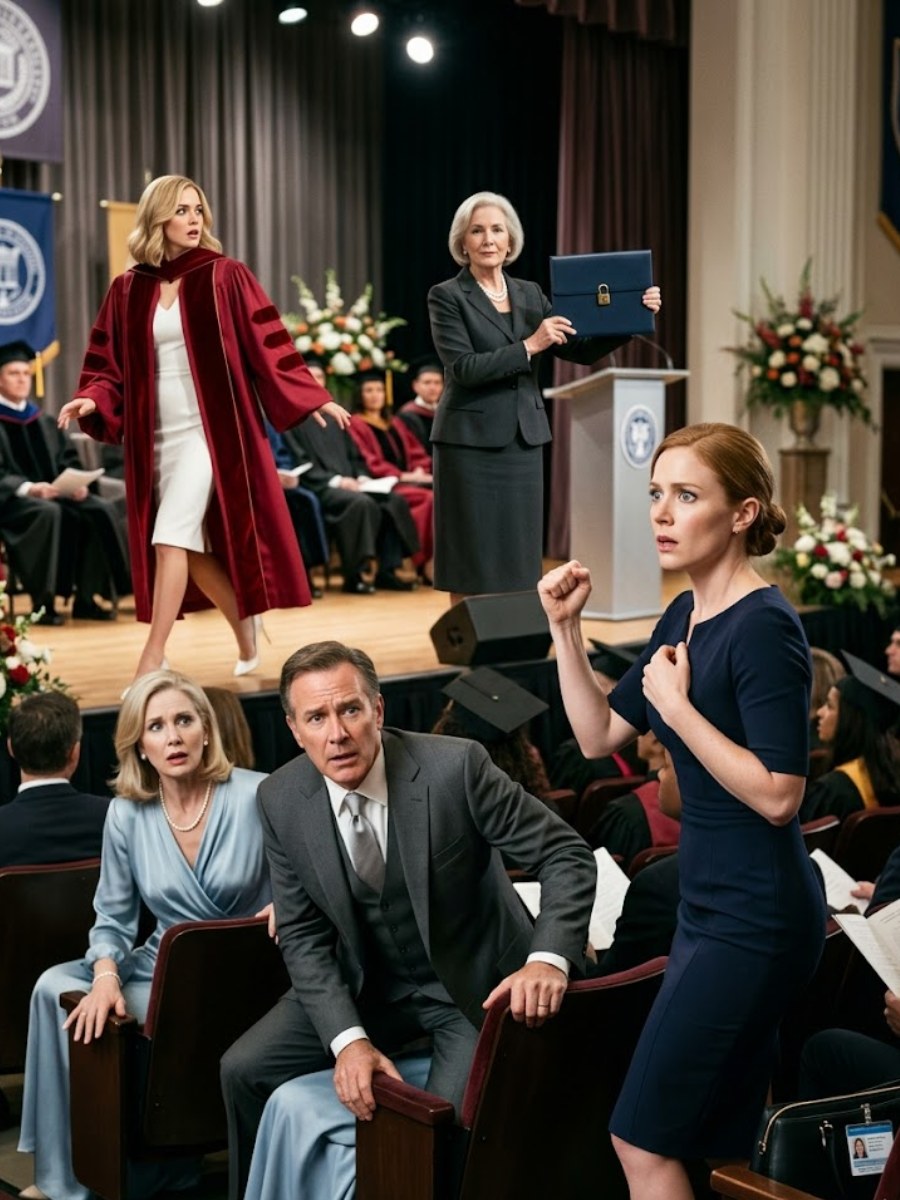
The applause was respectful, strong, ordinary. She walked to the podium carrying nothing but the burgundy folder’s twin, identical to the one on my lap. She set it down. The sound of it touching wood traveled through the microphone: a soft, final thud.
She did not open it.
She looked at Sloan.
Silence gathered.
At first, the audience thought it was ceremonial. A seasoned speaker letting the room settle. Then four seconds became seven. Seven became ten. People shifted. Someone coughed. Dean Crawford leaned forward slightly.
Sloan’s smile faltered.
At eleven seconds, she understood something was wrong.
Not everything. Not yet. But enough.
Her face did not go pale all at once. The color drained in layers. Cheeks first. Then lips. Then the small triangle of skin at her throat.
Theo turned to the audience.
“Thank you, Dean Crawford. Members of the faculty, graduates, families.” Her voice was even. Clear. Not loud. “Before I begin my keynote address, I need to correct the record.”
The room changed temperature.
“Today’s student speaker has just offered you a moving tribute to her late twin sister, Arlene C. Mortensson. According to records filed in Suffolk County Probate and Family Court, file number SUF-P-19-0882, Arlene Mortensson died in February 2019 of an apparent fentanyl overdose in Las Vegas, Nevada.”
She paused.
“That record is false.”
The screen behind her lit up.
My Harvard acceptance letter appeared twelve feet tall.
There was a sound from the audience that was not a gasp exactly. It was larger than that. A collective intake, a room discovering it had been placed inside a sentence before knowing its ending.
“This is a Harvard College admission letter dated March 28, 2018,” Theo said. “It is addressed to Arlene C. Mortensson. It was issued the same year Sloan Mortensson was admitted.”
The first paragraph, “We are pleased to inform you,” was visible. The blue circle remained around it, Sloan’s pressure marks magnified into evidence.
“Delivery records show the letter reached the Mortensson residence in Greenwich, Connecticut.” Slide change. “The person who signed for that delivery was not Arlene.”
USPS form. Signature: S. Mortensson.
Sloan rose halfway from her chair.
Dean Crawford turned toward her. “Ms. Mortensson.”
“This is—” Sloan’s voice was thin. There was no microphone near her, but the room was so silent that everyone heard. “There’s been some mistake.”
Theo did not look at her. “On March 21, 2019, Sloan M. Mortensson filed a sworn affidavit declaring Arlene dead.”
Slide three. The affidavit. Sloan’s signature.
My mother made a sound in row two. My father looked down at his program as though it might contain instructions for surviving the next minute.
“The affidavit was filed under penalty of perjury,” Theo said. “It asserted that Arlene died in Las Vegas. There is no death certificate. No police report. No medical examiner record. No record from Las Vegas Metro Police. No record from Clark County. No unidentified decedent matching her description. The death did not occur.”
Slide four showed the certifications. Beside them appeared my Mass General employment badge.
Arlene C. Mortensson, RN.
Hire date: July 2022.
“While the probate court had been told Arlene was dead, the Internal Revenue Service, the Commonwealth of Massachusetts, and Massachusetts General Hospital all had evidence that she was alive, employed, and paying taxes.”
A laugh broke from somewhere high in the balcony. Not amusement. Shock with nowhere to go.
Sloan sat motionless now. Connor, in the guest section, had turned completely toward her. His face looked emptied.
Theo continued. “On May 14, 2019, three hundred eighty-nine thousand dollars from a trust established by Eleanor Halverson for Arlene Mortensson was wired to Sloan Mortensson’s checking account.”
Slide five.
Wire confirmation. Amount: $389,000.
My grandmother’s love enlarged until no one could pretend not to see it.
“The funds were distributed based on the false affidavit you have just seen. Those funds were later used for rent, travel, test preparation, Harvard Law expenses, and luxury purchases.”
Slide six listed the transactions.
Beacon Hill rent.
Summer in Europe.
LSAT course.
Harvard Law deposit.
Saint Laurent coat.
Handbags. Watches. Sunglasses.
In row five, a woman closed her eyes. Later, Theo told me she was Sloan’s faculty adviser.
“In addition,” Theo said, “Sloan Mortensson used Arlene’s name, image, and supposed death to promote a memorial scholarship and public narrative of personal loss.”
Slide seven: my original photograph, in color, from my grandmother’s porch.
Slide eight: Sloan’s black-and-white Instagram post.
Six years without you, Arlene.
The audience read it in terrible silence.
Then Theo said, “Arlene Mortensson is here today. She is seated in row fourteen.”
Every head turned.
There is no preparing for twelve hundred people looking at you as proof of a crime.
For a second, I was seventeen again at the kitchen island, holding a letter no one wanted me to have. Then my hand moved to the folder on my lap. My thumb found the lock. 0-2-2-8. It opened with a small click.
I stood.
The room seemed to tilt toward me.
My mother saw me first. The handkerchief fell from her hand into her lap. Her mouth opened. No sound came out.
My father turned more slowly. His eyes found my face, lost it, found it again. He looked as though he had been struck but could not locate the wound.
Sloan stared.
For the first time in my life, I saw her without performance. No practiced humility. No beautiful sorrow. No quick calculation fast enough to save her. Just terror, naked and young.
Theo looked at me. “Arlene, would you like to come up?”
I walked.
The aisle stretched longer than it had any right to. Shoes shifted as I passed. Programs rustled. Someone whispered, “Oh my God,” so softly it sounded like prayer. I kept my eyes on the stage steps. In the ICU, you learn not to hurry unless speed helps. Panic wastes motion.
I climbed the riser. Theo stepped aside.
I placed both hands on the podium.
The microphone caught my breath.
I looked at Sloan. Then at my mother. Then at my father. Finally, at the audience.
“My name is Arlene Mortensson,” I said. “I am twenty-four years old. I am a registered nurse at Massachusetts General Hospital. I was admitted to Harvard in 2018. My acceptance letter was hidden from me. My parents told me they were paying for my sister because she had a future and I did not.”
My father flinched.
“My grandmother left me a trust. After she died, my sister filed documents stating that I had died of an overdose in Las Vegas. That was false. I was in Boston. I was working. I was going to school. I was alive.”
The room did not move.
“For six years, my sister used my name and photograph to build a story about grief. She accepted sympathy for surviving me. She accepted money in my name. She stood here today and mourned me to people she hoped would admire her.”
Sloan began crying. This time, the tears arrived wrong. Uneven. Unphotogenic. Human, perhaps, but not absolving.
“Arlene,” she whispered. “Please.”
I did not answer her.
“I did not come here to ask my family for an apology,” I said. “I came here to be on the record.”
My father stood.
For a moment, I thought he might speak. Instead, he turned and walked down the aisle toward the rear doors. Every head followed him. He did not look left or right. At the back, he pushed through into the sunlight and vanished.
My mother remained seated, both hands over her face.
Two Harvard University police officers had moved quietly to either side of Sloan’s chair.
I stepped back from the microphone. Theo touched my elbow once, lightly. It was not comfort exactly. It was confirmation. Done.
We left through the rear of the stage and into a corridor where the air smelled of dust and electrical cables. The door closed behind us, muffling the first roar of the room finally breaking open.
Outside, in the courtyard, May sunlight hit my face.
I did not feel triumphant.
People imagine exposure as a lightning strike, as if truth descends and the world is cleansed. It is not like that. Truth is a door opening onto a room full of work. The air after is not pure. It is full of dust.
Theo handed me the burgundy folder. “Do you want to go somewhere private?”
I shook my head. “I want to stand here for a minute.”
So we stood.
Students crossed the courtyard laughing, unaware that in the building behind us a future had just collapsed. A photographer hurried past us toward the entrance. Someone’s little brother chased a pigeon. Bells sounded from somewhere beyond the square.
Theo said, “You did well.”
“I said twelve sentences.”
“Sometimes that is more than enough.”
Within seventy-two hours, Sloan’s life rearranged itself with the speed of institutions protecting themselves.
Harvard Law placed her degree on hold pending review. The language was careful, procedural, bloodless. Character and fitness concerns. Possible academic and professional misconduct. Referral to appropriate authorities. She would not be certified for any bar examination while the matter remained unresolved, and the matter had no reason to resolve in her favor.
The Globe published the story two days later. The headline was less dramatic than the facts: Keynote Reveals Probate Fraud Allegations at Harvard Law Commencement. The article included the affidavit, the wire transfer, the Las Vegas certifications, the Instagram posts, and a statement from Theo Brennan. It did not include a photograph of me. That was my condition. I had spent six years as Sloan’s image. I was not giving the internet my face as a replacement toy.
By evening, the article had spread everywhere.
Sloan deleted her Instagram three hours after publication. Too late. Screenshots multiplied. Legal commentators dissected the probate filing. Former classmates posted long paragraphs about feeling deceived. Donors to the memorial scholarship demanded refunds. The clinical program removed the scholarship page. The nonprofit board that had awarded Sloan a fellowship issued a statement about integrity. Her New York firm rescinded her summer associate position before lunch on Monday.
Connor ended the engagement on June 3.
I learned that from a forwarded article, not from him. His family released a statement through a publicist: They wished Sloan well and would not be commenting further. It was the kind of sentence wealthy people use to close a gate.
The Suffolk County District Attorney’s Office opened a review. The FBI became interested because the trust transfer crossed state lines. Words like probate fraud, wire fraud, perjury, identity misuse, and forged instrument began to orbit Sloan’s name. Theo warned me that criminal cases move slowly. Eighteen months. Thirty. Maybe longer. She said this as if time could scare me. I had spent six years alive in a file marked dead. I understood slow.
Civil court moved faster.
On May 30, Theo filed Mortensson v. Mortensson et al. in Suffolk Superior Court. Defendants: Sloan M. Mortensson, Helena Mortensson, Garrett Mortensson. Claims: conversion, fraud, unjust enrichment, intentional infliction of emotional distress, violation of right of publicity, and other phrases that made betrayal sound almost elegant.
Theo did not bill me.
When I objected, she said, “Your grandmother already paid me in shame.”
“That is not currency.”
“It has been for lawyers since Rome.”
My father called on June 2.
I watched his name appear on my phone and felt nothing at first. Then too much. Then nothing again. I let it go to voicemail.
His message lasted forty-one seconds.
“Arlene. I signed the paper in 2019. I did not read it. Your mother told me to sign it, and I signed. That is not a defense. I know that. I have been a coward for most of my life, and you paid for it. I am sorry. I am going to repay what I can. You do not have to call me back. I just wanted to say I know you were alive. Somewhere inside me, I knew. And I chose not to know enough.”
I listened once.
Then again.
Then I saved it to the drive labeled Evidence, because forgiveness is optional but documentation is not.
My mother called twenty-three times in nine days.
On the tenth day, I agreed to meet her in the lobby of the Cambridge Marriott at eleven in the morning. Public place. Neutral ground. Theo knew where I was. Bridget knew where I was. I arrived ten minutes late because part of me still wanted to make my mother wait.
She sat in a leather chair near the windows wearing beige linen and sunglasses pushed into her hair. She looked smaller. I hated that too. I wanted all villains to remain large.
When she saw me, she stood too quickly. “Arlene.”
I sat in the chair across from her. “You have fifteen minutes.”
Her face collapsed. “I didn’t know she was going to go that far.”
I said nothing.
“I knew there was confusion with the trust, but I didn’t know about Las Vegas. I didn’t know about the obituary. Sloan handled things. She said there were forms. I thought—”
“You signed a declaration saying you believed I was dead.”
Tears filled her eyes. “We hadn’t heard from you.”
“You told me not to bother Sloan.”
“I was angry.”
“You locked the door behind me.”
Her mouth trembled. “I am your mother.”
There it was. The last card. The first card. The only card she ever believed she needed.
I opened my folder and removed a copy of my Harvard acceptance letter. I placed it on the table between us.
She looked down.
“You knew enough in 2018,” I said, “to choose her before any affidavit existed. Everything after that was paperwork.”
“Arlene, please.”
“No.”
“I love you.”
I studied her face. Once, I had wanted those words so badly I would have rebuilt myself around even a counterfeit version. Now they arrived too late, under fluorescent lobby lights, surrounded by business travelers and rolling suitcases.
“No,” I said again, more gently. “You love being my mother when it costs you nothing.”
She sobbed then. A real sob, I think. But I had learned that real pain in the person who harmed you does not become your obligation just because it is real.
I stood.
“Will you forgive me?” she called after me.
People turned.
I kept walking.
Outside, traffic moved along Broadway. A cyclist rang his bell at a tourist stepping off the curb. The world did not pause for the worst thing that had ever happened to my mother, just as it had not paused for me. I found that strangely fair.
The settlement came in August.
Sloan consented to judgment for the principal amount of the trust, interest, damages, and a permanent injunction prohibiting her from using my name, image, likeness, or story for commercial, promotional, charitable, academic, or professional purposes without my written consent. The number was large enough to require liquidation of everything she had built on me. She sold the Beacon Hill apartment. My parents sold 19 Maple Lane.
The real estate listing appeared online on a Friday.
I should not have looked.
Of course I looked.
The kitchen island seemed smaller. The cabinets had been painted white. The room where I found my Harvard letter in Sloan’s Kaplan book was staged as a home office with a vase of fake eucalyptus on the desk. My bedroom had become a guest room. The mailbox appeared in one exterior shot, black with white numbers, still at the curb.
I stared at that mailbox for longer than I stared at anything else.
Such a small thing, to not have a key.
By Tuesday, the house was under contract. A family with two children and a Labrador bought it. I hoped the children both had mailbox keys. I hoped the dog peed on the hydrangeas.
In June, while the legal machinery was still grinding, I received an email from Harvard Law admissions.
I had applied in December 2024 without telling Theo, Bridget, or anyone else. I had written my essay not about Sloan, not about my stolen trust, not about being declared dead, but about the twenty-two-year-old overdose patient whose real death had led me to discover my false one. I wrote about records and bodies, about how systems decide who counts, about what a nurse owes to someone who cannot speak, and what the law owes to someone whose silence has been manufactured.
The email began with my name.
Dear Arlene,
We have reviewed your application and are pleased to offer you admission to the Harvard Law School Class of 2028.
I read it in my studio at the same small table where I had screenshotted Sloan’s Instagram posts. The room was quiet except for the refrigerator clicking on.
I waited for triumph.
Instead, I felt grief rise so suddenly I had to sit down.
Not grief for Sloan. Not for my parents. For the seventeen-year-old girl who had once held an acceptance letter in a kitchen and thought the future could be lost because three people refused to see it. For my grandmother, who had tried to leave me a bridge and died before she could walk me across. For all the years between then and now, years I was proud of and would never give back, but which had cost more than they should have.
I called Bridget first.
She screamed so loudly I had to move the phone away from my ear. Then she cried. Then she said, “You absolute menace, you applied to Harvard Law in secret?”
“I didn’t want to tell anyone in case I didn’t get in.”
“You were declared dead by probate court and came back during commencement. I think you could have survived a rejection letter.”
“I wasn’t sure.”
That made her quiet. “I know, honey.”
Then I called Theo.
She answered on the second ring. “Please tell me this is good news. I have had quite enough of the other kind.”
“I got in.”
Silence.
“Theo?”
“I am composing myself.”
“Are you crying?”
“No.”
“You are.”
“I had a stroke. My eyes do things.”
I laughed.
“You earned this,” she said, voice rough. “Not because of what happened to you. Because of what you did after.”
I accepted that afternoon.
I worked my last shift at Mass General on August 28, 2025. Bridget brought a sheet cake with Congratulations Traitor written in blue icing because she said leaving nursing for law was “joining the paperwork enemy.” The nurses signed a card. A respiratory therapist drew a ventilator waving goodbye. One of the residents hugged me and then apologized for hugging me, which was very on brand for him.
My last patient was an eighty-one-year-old man recovering from bypass surgery. Near the end of my shift, while I adjusted his blanket, he looked up and said, “You’re a good nurse. Your parents must be proud.”
I smiled. “Rest now.”
I did not correct him.
In the locker room, I took off my badge and held it for a long time.
Arlene C. Mortensson, RN.
That badge had been proof of life before the law caught up. It had opened doors in the hospital while court records closed them elsewhere. It had hung against my chest while I titrated medications, called families, cleaned blood, held hands, and became someone no one in Greenwich had imagined.
Bridget found me staring at it.
“You can keep it, you know,” she said.
“I know.”
“You should.”
“I will.”
She hugged me hard enough to hurt. “Go sue bad people.”
“I have to pass Civil Procedure first.”
“Fine. Go procedurally threaten bad people.”
Orientation at Harvard Law began in early September.
The first morning, I walked through Harvard Yard with my casebooks against my chest and my grandmother’s flannel in my bag. Students passed in clusters, laughing too loudly, pretending not to be afraid. Someone asked me where Austin Hall was. Someone else spilled coffee on a torts syllabus. The ordinary chaos of new beginnings surrounded me so completely that for a moment I could almost believe I had arrived the usual way.
But there is no usual way back from the dead.
Langdell Hall smelled of paper, polish, and ambition. I climbed the steps slowly. At the entrance, I stopped and looked back across the yard. Years earlier, Sloan had walked here wearing my inheritance. She had walked past these walls carrying a lie so large it should have made noise. But lies often move quietly when everyone has reason to admire them.
Inside, the registrar’s office had hung photographs along the wall: alumni, judges, firsts, old classes in black and white. I paused before one image of a woman in a 1970s suit, chin lifted, eyes direct. I did not know her story yet. I only knew she looked like someone who had entered rooms not built for her and remained anyway.
During orientation, a dean welcomed us and spoke about integrity. I felt several students glance at me. They knew. Of course they knew. The story had not disappeared. My name had traveled ahead of me, stripped now not by Sloan but by headlines, podcasts, commentary threads, and the awful appetite people have for spectacular betrayal.
At lunch, a woman from my section sat across from me with a tray of salad and said, “I’m sorry, I know everyone probably asks you about it, and I don’t want to be weird.”
“That sentence usually becomes weird.”
She winced. “Fair.”
I smiled despite myself.
She said, “I just wanted to say my brother lied about me to our parents for years. Not like… that. But enough that I stopped trusting my own memory. Seeing what you did made me call him on it.”
I did not know what to say.
She rescued me by stabbing a cucumber with her fork. “Also, do you understand the Pennoyer case? Because I read it twice and now I believe the Supreme Court was invented as a prank.”
We became friends.
That was the unexpected gift of public truth. It did not only expose Sloan. It made certain people brave enough to tell me their smaller, quieter versions. A classmate whose parents had hidden financial aid forms. Another whose sister used her illness for attention. A man whose family told relatives he had moved abroad because they were ashamed he had dropped out of medical school. Not all betrayals are crimes. Some are just rooms where the truth is not allowed to sit down. But the body knows the difference between love and management. It always knows.
The criminal investigation moved slowly, as Theo promised. Sloan’s lawyers issued careful statements. They denied intent. They suggested confusion. They implied trauma. They argued that family estrangement had created genuine uncertainty, that Sloan believed I might have died, that the funds had been distributed through legal channels, that social media posts were expressions of grief based on information available at the time.
Theo read one filing aloud in her office and removed her glasses halfway through. “I have seen raccoons in dumpsters with more persuasive legal theories.”
“What happens if they drag it out?”
“Then they drag it out against documents. Documents are patient.”
Sloan tried once to contact me directly.
It was a letter, handwritten on cream paper, forwarded through her attorney because the injunction prevented other forms of contact. Theo advised me not to read it. Bridget told me to burn it. My therapist asked what I wanted.
I read it alone.
Dear Arlene,
There are no words for what I did.
This was untrue. There were many words: fraud, perjury, theft, forgery, exploitation, cruelty.
Sloan wrote that she had been afraid. That when I left, the family fractured. That our grandmother’s trust felt like proof I was loved more, and she panicked. That the first lie made the second easier. That when people began responding to the story of my death, she felt trapped inside it. That she thought of telling the truth many times but did not know how to return from what she had become.
She wrote: You have to understand, everyone already expected me to be extraordinary. I didn’t know who I was without that.
I stopped reading there for a while.
Because that, perhaps, was the closest Sloan had ever come to honesty. She had been worshipped into emptiness. My parents had fed her admiration until hunger became her only self. She stole not because she had nothing, but because what she had could never be enough. A future handed to her did not satisfy her. She needed mine too. She needed to stand over my absence and receive applause for surviving it.
I finished the letter.
She asked forgiveness. She asked for a conversation. She said she missed her sister.
I placed the letter in the evidence box, not because I needed it legally, but because some documents belong with the dead things they created.
I did not reply.
My father sent monthly payments after the settlement, though the judgment had technically resolved his portion through the house sale. Small checks at first. Then larger. He included no notes after the first one, only the memo line: Restitution. I deposited them into the Eleanor Halverson Memorial Fund.
My mother sent nothing.
I heard through an aunt I had not spoken to in years that Helena had moved to a condo in Stamford and told people she had suffered “a complicated family trauma.” I admired the efficiency of that phrase. It made the crime sound like weather.
The fund began with two hundred thousand dollars from my settlement. Theo, Bridget, and I formed the board. We named it the Eleanor Halverson Memorial Fund because my grandmother had understood something long before I did: when a family erases you, money is not just money. It is mobility. It is shelter. It is proof that someone planned for your survival.
Our mission statement was one sentence: For students whose families chose silence over them, we choose your name back.
The first recipient was Maeve Donnelly from Hartford. Seventeen. Brilliant. Twin sister admitted to Yale. Parents paying full tuition for the sister while telling Maeve to attend community college and “be realistic.” When Theo read me the application, I had to stand up and walk around the room.
Maeve’s essay did not ask for pity. It described hiding acceptance emails in a library account because her parents monitored the family computer. It described working at a grocery store and saving tips in a coffee tin. It described wanting to study biomedical engineering because her little brother had a congenital heart condition and she wanted machines to be kinder.
We paid her first year at Boston University. Then we promised, in writing, to pay the rest.
When I called to tell her, she did not speak for almost thirty seconds. Then she said, “Does this mean I can go?”
I looked at my grandmother’s photograph on my desk.
“Yes,” I said. “It means you can go.”
That night, I dreamed of the kitchen at 19 Maple Lane. In the dream, I was seventeen again, standing before the island while my family looked through me. But this time, when my father said, “She has a future. You don’t,” my grandmother entered through the back door carrying a stack of documents and said, “Actually, Garrett, sit down.”
I woke up laughing.
Law school did not heal me. That is not what institutions do. Healing came in smaller forms: a study group that saved me a chair, Bridget texting reminders to eat, Theo teaching me how to cross-examine a lie without becoming cruel, Maeve sending a photograph from her dorm room with her textbooks stacked on the bed. Healing was walking through Harvard Yard and not looking for Sloan. Healing was learning that the place she stole from me had not remained frozen in 2018. It was just a place. Old buildings. Bad coffee. Brilliant people. Insufferable people. Too many acronyms. A library where everyone pretended not to panic.
One rainy October afternoon, I found myself in the admissions office for a panel about nontraditional students. A staff member recognized my name and hesitated.
“I was here in 2018,” she said softly. “In a different role. I remember the duplicate admission issue after the fact. Your file closed because there was no response.”
“I know.”
“I’m sorry.”
It was not her fault. I knew that. Still, something in me loosened at the apology because it came from the building itself, from one small human part of the machine that had moved on without me.
“Thank you,” I said.
After the panel, I walked to the Yard. Rain darkened the bricks. Students hurried under umbrellas. I stood beneath a tree and called no one. There are moments too quiet to share immediately. You have to let them enter you first.
In November, the district attorney announced indictments.
Sloan was charged with perjury, forgery, larceny over $1,200, probate fraud, and identity-related offenses. The federal wire fraud inquiry remained separate. My mother was charged with false statements connected to the probate declaration. My father entered into a cooperation agreement after providing testimony and documents. Theo explained each development carefully, never promising outcomes. Criminal law, she reminded me, is not moral theater. It is elements, burdens, evidence, procedure.
Still, when Sloan’s mugshot appeared online, I closed my laptop.
I did not need to see her reduced. I had needed the truth restored. Those were not the same hunger.
People expected me to hate her cleanly. Some days I did. Other days, memories intruded without permission: Sloan at six, asleep with her hand under her cheek; Sloan at ten, teaching me a clapping game; Sloan at thirteen, crying after a boy called her ordinary; Sloan at seventeen, watching me hold my acceptance letter with no surprise on her face. The mind does not organize betrayal into convenient drawers. Love rots when it is abused, but it does not always disappear. Sometimes it becomes a smell in the walls.
I told my therapist that forgiving Sloan felt impossible, but hating her forever felt like renting her a room in my head.
My therapist said, “Then perhaps the goal is eviction, not forgiveness.”
I liked that.
By December, I had survived my first semester exams. Barely, in one case. Civil Procedure humbled everyone equally, which I found democratic. On the last day before break, Theo invited me to her office. Snow fell in wet clumps against the windows. She had two cups of coffee waiting and a red envelope on her desk.
“What is that?” I asked.
“Open it.”
Inside was a photocopy of my grandmother’s original trust letter to Theo, one I had not seen.
Dear Ms. Brennan,
My granddaughter Arlene is not the loud one. This may cause foolish people to underestimate her. Do not be among them.
I had to sit.
Theo looked out the window, giving me privacy without leaving.
My grandmother’s handwriting continued across two pages. She wrote that I noticed things. That I stayed with questions longer than was comfortable. That I had been taught to doubt my own deserving and would need documents because sometimes love, in our family, would not be allowed to testify. She wrote: I cannot make the world fair for her. I can only leave evidence that someone tried.
I pressed the letter to my chest like a child.
“She knew,” I said.
Theo nodded. “She knew enough.”
The following May, one year after Sloan’s commencement collapsed, Harvard held another graduation. I did not attend the law ceremony. I had no reason to. Instead, I went to Mystic.
My grandmother’s house had been sold years before, but the porch remained in my memory so vividly that the street itself seemed haunted by it. I stood on the sidewalk across from the property. The new owners had painted the door green. There were children’s bicycles near the steps. A wind chime moved in the breeze.
I carried a copy of the photograph, the color one, not Sloan’s black-and-white theft.
In it, sixteen-year-old me laughed from the porch rail, wearing my grandmother’s flannel, face turned toward someone outside the frame. For years, I had thought the person outside the frame was my grandmother. Only now did I understand it was also me, older, walking back into the picture with proof.
I did not knock. I did not need the house back.
I drove to the water and sat on a bench overlooking the harbor. Boats shifted against their lines. The sky was bright, hard blue. I took out the photograph and wrote on the back beneath my grandmother’s date: Still here.
Then I placed it in my wallet.
Not every ending announces itself. Some arrive as a change in what you no longer need. I no longer needed my mother to admit she chose wrong. I no longer needed my father to become brave in retrospect. I no longer needed Sloan to understand the full shape of what she had stolen. I no longer needed Harvard to be the shining proof of my worth. I had carried bodies through nights Sloan spent composing captions. I had earned a degree with no one clapping. I had built a life in the space where my family wrote death.
What Sloan stole mattered. I will never pretend it did not. Money matters. Opportunity matters. Time matters. A name matters. A future delayed is not the same as a future untouched.
But she did not steal all of me.
That was her miscalculation.
She thought if she took the letter, I would become the girl without Harvard. She thought if she took the trust, I would become the girl without money. She thought if she took my name and attached death to it, I would become a ghost she could carry for sympathy. She thought absence was emptiness.
She did not understand that absence can also be cover.
While she built a monument to my death, I became difficult to kill. While she told strangers I was gone, I learned to stand beside beds where life balanced on numbers and not flinch. While she spent my inheritance, I learned the price of everything and the value of myself. While she practiced grief, I practiced survival until survival became skill, then discipline, then evidence.
Now, when I enter a courtroom for clinic work, I still feel a flicker of the old kitchen. Granite island. Lasagna. Spreadsheet. My father’s voice. But the memory no longer orders me around. It rises, and I let it rise. Then I open my folder.
I have become fond of folders.
They are humble things. Paper. Tabs. Labels. But inside them, lies lose oxygen. Inside them, the dead return. Inside them, a grandmother’s love can wait six years and still arrive on time.
The last time I saw Sloan in person was not at court. It was accidental, or as accidental as anything can be in a city that keeps folding past and present onto the same streets.
I was leaving a legal aid clinic in downtown Boston in early spring. Rain had just stopped, and the pavement shone. I turned onto Tremont Street and saw her across the intersection.
No cameras. No pearls. No law school crowd. Her hair was loose under a gray hood. She looked thinner, older, ordinary in a way she had spent her whole life fearing. For a moment, traffic held us apart.
She saw me.
Her mouth moved around my name.
I did not cross. Neither did she.
The light changed. People stepped off the curb between us, umbrellas lifting, wheels hissing through puddles. When the crowd cleared, Sloan was still there.
I thought I would feel rage. Instead, I felt distance. Not indifference exactly. Something earned. Something wide.
She raised one hand, not quite a wave, not quite a plea.
I turned and walked toward the train.
That evening, I went home to my apartment, made tea, and reviewed Maeve’s latest scholarship update. She had earned an A in calculus and joined a robotics lab. Bridget texted to ask whether lawyers were still annoying. Theo emailed a draft motion with the subject line: Please admire footnote 7. My life, stubborn and specific, waited for me.
On my desk sat three photographs.
My grandmother at thirty, laughing on a beach.
Me at nursing graduation with Bridget’s carnations.
The Harvard Law class photo, third row, my face among hundreds, not memorialized, not stolen, not alone.
Sometimes people ask what happened to the Arlene Mortensson Memorial Scholarship Sloan created. The answer is simple: it died when I refused to.
In its place, the Eleanor Halverson Memorial Fund has now paid tuition for four students. Maeve sends postcards. Another recipient, Jordan, wrote that our grant meant he could leave a house where his stepfather opened his mail. Priya, whose parents tried to force her to decline MIT because her brother had not gotten in, sent a photograph of her dorm key in her palm. Luis, who had been told college was selfish because his family needed his wages, wrote in his first update, “I did not know strangers could believe me faster than my own mother.”
I keep that sentence near my desk.
I know exactly what it costs to need strangers to believe you.
I also know the grace of finding out some will.
On the anniversary of the commencement, Theo and I returned to Sanders Theatre. Not for an event. She had arranged access through someone who owed her a favor, which, with Theo, seemed to include half of Boston and one retired federal judge in Maine. The theatre was empty when we entered. Afternoon light fell through the high windows. The stage looked smaller without robes and applause.
I walked to row fourteen.
The seat was just a seat. Wood and red upholstery. No plaque. No scorch mark where my old life burned away. I sat and rested my hands on my knees.
Theo sat beside me.
“Do you regret it?” she asked.
I knew what she meant. The public exposure. The spectacle. The irreversible violence of truth delivered in a room built for honor.
“No,” I said.
After a moment, I added, “Sometimes I regret that it was necessary.”
Theo nodded. “That is different.”
We sat in silence.
Then I walked onto the stage again. The podium was gone, stored somewhere. I stood where Sloan had stood, where Theo had stood, where I had spoken my twelve sentences. The room watched without watching.
I thought of seventeen-year-old me. If I could have reached her, I would not have told her everything would be fine. That would have been insulting. Everything would not be fine. She would sleep in cheap rooms, work until her bones ached, miss her grandmother with a pain so physical it felt like illness, and carry a sentence from her father like glass under the skin. She would learn that some mothers close doors quietly. She would discover that her sister’s envy had teeth. She would be declared dead by a court that never saw her face.
But I would tell her this:
Keep the receipt.
Keep the note.
Keep your name.
Leave when the house becomes a grave.
Trust the woman your grandmother told you to trust.
And when the room finally turns to look at you, stand.
I did stand.
That is the part no one stole.
My name is Arlene Mortensson. I am not the sister Sloan lost. I am the sister she tried to erase. I am the daughter my parents chose not to fund, the beneficiary my family declared dead, the nurse who signed charts while probate records buried her, the law student who walked into the school that once received her silence and answered it with her own voice.
I do not call betrayal family anymore.
I call it by its proper name.
Then I call it over.