My brother saw the stone pillars first.
That was what he told me later, though at the time he did not say anything at all. He just slowed his black sedan at the end of my gravel drive, tires whispering over the road shoulder, his face turning toward the entrance the way people look when something familiar appears in a place where it has no right to be. The pillars were new, built from fieldstone I had pulled out of the collapsed pasture wall during our first summer on the property. I had stacked each stone myself after work, hands split open, back aching, headlamp shining into the dark because daylight belonged to paying clients and I could only afford to build my own life after everyone else’s invoices had been earned. Between the pillars hung a simple iron sign, black against the green rise of the hill: Mercer Custom Builds.
Kyle recognized my last name before he recognized me.
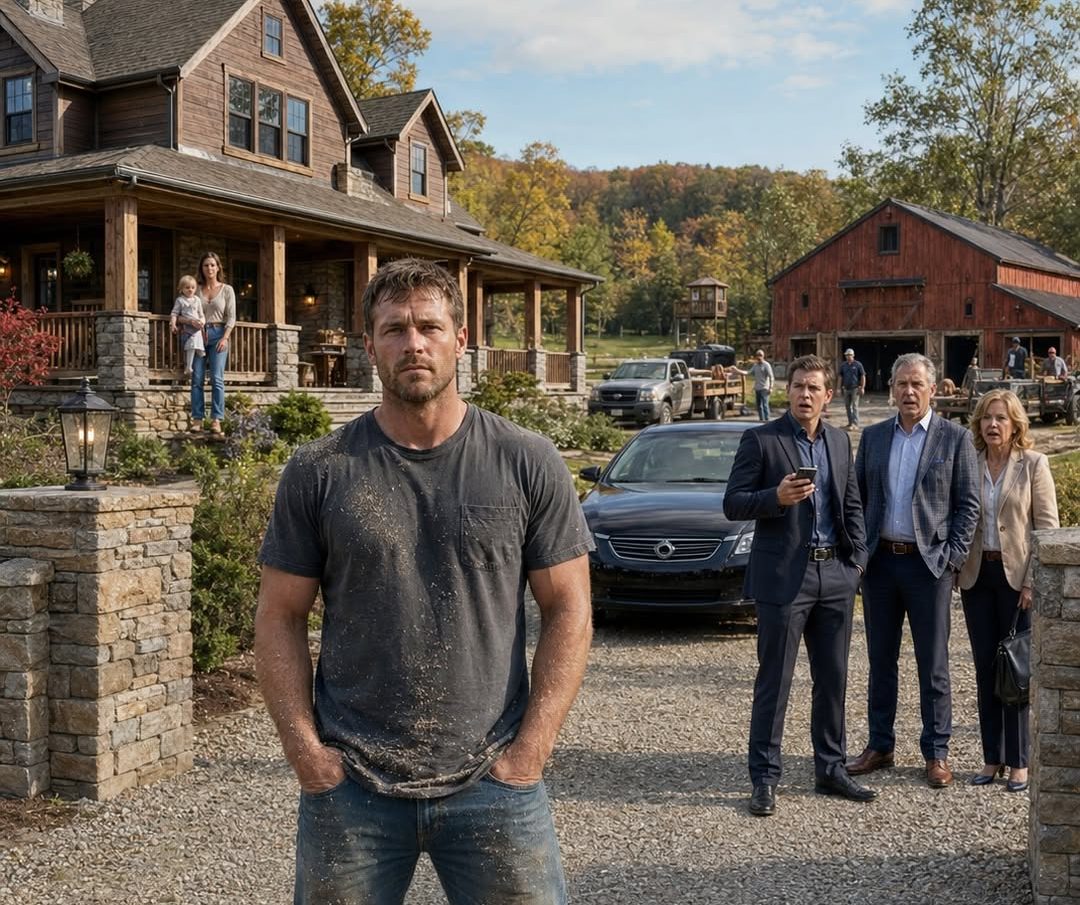
He drove past, stopped, backed up, and sat there with his turn signal clicking even though he was not turning anywhere. I watched from the side of the barn where I was standing on a ladder, fastening iron sconces beside the new carriage doors. The restored barn rose behind me in dark cedar and black steel, with wide windows, a standing seam roof, and a stone foundation I had rebuilt one freezing November with two crew members, a rented mixer, and more stubbornness than good sense. Beyond the barn, the farmhouse sat on the hill in the afternoon light, all cedar, limestone, copper gutters, and a wraparound porch Melissa had sketched on graph paper after a twelve-hour hospital shift while I sat beside her half-asleep at the kitchen table. The pasture fence ran clean and straight along the lower field. Young maples lined the drive. Three company trucks were parked near the workshop, each one lettered with the logo I used to draw on napkins before I had the money to put it on anything real.
Kyle got out slowly.
For a few seconds, he did not see me. He looked at the house first, then the barn, then the drive, then the trucks, like his brain kept trying to file each thing under someone else’s life and failing. His sunglasses were pushed up on his head. His shirt was expensive, pale blue, sleeves rolled with careless precision. He looked older than he had the last time I saw him, but not much. Kyle had always aged as if someone else were responsible for making sure time did not inconvenience him.
Then his eyes landed on me.
I was standing in a dust-covered shirt, jeans streaked with sawdust, work boots planted in the gravel. My hair needed a cut. My hands were black from iron hardware and oil. I probably looked exactly like the version of me my parents had spent years using as a warning.
Except I was standing in front of something they could not dismiss.
Kyle stared. His mouth parted slightly, then closed. He looked at the sign again, as if the name might change if he read it twice.
“Alton?” he called.
I climbed down from the ladder without rushing. By then Melissa had stepped onto the porch, one hand resting on the railing, her dark hair pulled into a loose knot, wearing one of my old flannels over leggings because she had been staining shelves in the mudroom before the car slowed down. Our dog, Copper, stood beside her with his ears up, suspicious of anyone in a sedan. Melissa did not wave. She just watched, calm and still, the way she had learned to be when my family appeared in a story.
“Kyle,” I said.
He looked from me to Melissa, then back at the house. “This is yours?”
There are moments when life offers you a line so perfect it feels written by someone with a sense of humor. I could have said many things. I could have asked what he was doing there. I could have lied and said it was a client property, just to see if relief softened his face. I could have named every insult he had let pass in silence, every dinner where he accepted my parents’ praise like oxygen while I sat at the other end of the table learning how invisible a person could be while still having a chair.
Instead, I wiped my hands on a rag and said, “Yes.”
Kyle did not answer.
The silence between us filled with two years of no contact and thirty-four years of history. Then he reached for his phone so fast he nearly dropped it. He turned away from me, but not far enough. I heard him clearly.
“Dad,” he said, voice sharp and cracking with disbelief. “You need to see this. Right now.”
Twenty minutes later, my parents’ car came over the hill.
I knew the sound of my father’s car before I saw it, though that made no sense after two years. Some sounds live in the body. The low, expensive engine. The confident crunch of tires on gravel. The brief pause before the door opened, as if even arrival needed to be performed. My father stepped out first, wearing dark slacks and a navy quilted jacket, his silver hair combed back, his face set in the expression he used when he intended to correct a contractor, a waiter, a teller, a son. My mother got out more slowly from the passenger side. Elaine Mercer had always dressed for the life she wanted people to believe she had: cream sweater, gold earrings, leather handbag tucked over her arm. She looked toward the house, then the barn, then the trucks, and something in her face flickered so quickly I would have missed it if I had not spent childhood studying her moods to know where it was safe to stand.
My father did not speak at first.
That alone was worth more than any apology he had never given me.
He walked a few steps up the drive, taking everything in: the stone pillars, the long gravel road, the restored farmhouse, the workshop, the crews finishing trim near the barn, the copper lanterns waiting to be wired, the clean black fencing, the land unfolding behind us in twelve acres of field, orchard, and woods. He had called me a failure two years earlier over dessert while my mother folded her napkin in her lap and my brother looked down into his wine. Now failure stood before him with employees, contracts, land, and a home built by hands he had spent a lifetime disrespecting.
“Alton,” he said finally.
Not son. Not how are you. Not I haven’t seen you in two years. Just my name, spoken like an item he had found in the wrong column of a report.
“Richard,” I said.
My mother flinched slightly. I had never called my father by his first name before. Not to his face. Melissa’s hand tightened around the porch rail, but she said nothing.
Kyle stood beside my parents, still holding his phone, his gaze moving over the property again and again. He seemed less angry than stunned, and that almost made it harder to look at him. Anger I could have used. Stunned silence felt too close to the boy who once climbed into my treehouse with stolen snacks and asked me how I knew which boards would hold.
My father cleared his throat. “What exactly is this?”
“A property,” I said.
His jaw tightened. “Don’t be clever.”
“I wasn’t.”
My mother took a cautious step forward. “Alton, is this where you’re living?”
“Yes.”
“With Melissa?”
“Yes.”
She looked toward Melissa, who remained on the porch. My wife did not move down to greet them, did not smile politely, did not soften the situation for their comfort. Two years earlier, she had scraped her chair back from my parents’ dining table and said the words I had never been able to say for myself. The only people too blind to see Alton’s worth are the two people who should have loved him without conditions. Then she had taken my hand and led me out before I could do what I had done my entire life, which was stay too long in a room that had already made its verdict.
My mother looked away first.
Kyle found his voice. “You built this?”
“Most of it.”
“Most of it?” my father repeated, as if that was the detail he could attack.
“I had crews for parts of it,” I said. “Electrical, plumbing, roofing when the weather turned. The structure, design, restoration, project management, finish work, all mine. Melissa designed the kitchen and mudroom layout. I built them.”
My mother blinked. “You designed this?”
Melissa answered from the porch. “He did.”
Her voice was even, but I knew the steel under it. She had worked night shifts at Pittsburgh Children’s, come home with red eyes and aching feet, and still stood beside me in half-demolished rooms holding flashlights while I traced load-bearing walls. She had eaten sandwiches on overturned buckets with me, laughed when raccoons got into our insulation, learned to stain wood because she saw I was one person trying to become ten. This house was mine, yes. But it was also ours in every way that mattered.
My father’s eyes went to the trucks. “And the company?”
“Mine.”
“How many crews?”
“Four now. Five by spring if the commercial contract closes.”
I had not meant to say that much. Not because it was secret, but because I knew my father. Give him a number, and he would measure it. Give him a success, and he would look for the weakness hidden underneath.
“Commercial contract?” he asked.
I almost smiled. There it was. The loan officer in him waking up, sniffing for value.
“Hospitality group,” I said. “Restoring three historic inns outside Lancaster. Custom millwork, structural repairs, interior build-outs.”
Kyle’s eyebrows rose. “That’s a big job.”
“It is.”
My father looked at me then, really looked, and for the first time I saw the question he was too proud to ask plainly. How? How had the son he dismissed, the son he refused to help, the son he called failure in his own dining room, built something large enough to make his favored child call him in a panic from the roadside?
The answer was long, and it began long before the house.
I grew up outside Pittsburgh in a brick colonial with a perfect lawn, white shutters, and a front walk my father power-washed every spring as if mildew were a moral failure. Appearance was not just important in our house. It was the family religion. My father, Richard Mercer, was a senior loan officer at a regional bank, the kind of man who believed numbers revealed character unless the numbers belonged to someone he loved. My mother sold real estate and had a talent for making other people’s homes sound like dreams while our own felt staged, cold, and full of invisible rules. The dishes had to be polished. The lawn edged. The car washed before anyone visited. We did not argue where neighbors might hear. We did not look messy in photographs. We did not discuss disappointment unless it could be aimed at me.
In that house, there were only two sons. Kyle, the promise. Me, the problem.
Kyle was three years younger and somehow born understanding the kind of success my parents admired. He aced tests without visible effort. He had the clean-cut charm adults trust too quickly. Debate team. Math club. Varsity tennis. Princeton brochures in a neat stack on his desk. Teachers called him impressive. My mother repeated the word like a prayer. My father introduced him to clients at country club brunches and watched their eyebrows lift when they heard “Princeton track.” Kyle made them look like the kind of parents they wanted to be.
I made them nervous.
Not because I was bad. I wasn’t reckless, cruel, lazy, or stupid. I just did not shine where they pointed the lights. I worked twice as hard for grades that landed somewhere in the respectable middle. I read slowly but remembered every mechanical system I had ever seen. I struggled to write essays about symbolism but could rebuild a lawnmower carburetor after watching one tutorial and taking notes on a napkin. I could listen to a loose hinge, a knocking pipe, a jammed latch, and know where the stress was sitting. Broken things made sense to me. People rarely did.
When I was ten, I took apart my mother’s jammed kitchen drawer while she was on the phone and fixed the swollen runner with sandpaper and a candle stub. She scolded me for making a mess, then used the drawer for another eight years without ever mentioning it again. When I was twelve, I repaired a neighbor’s bike chain and refused payment because I liked the way the gears clicked smooth afterward. When I was fourteen, I built the treehouse.
It started as a platform. That was all I meant it to be. A few boards between two thick oaks behind our property, a place to sit where the house could not see me. But then Mr. Donnelly, a retired carpenter two streets over, saw me hauling scrap lumber and asked what I was building. I showed him my notebook. He stared at the crooked sketches, then at me, and said, “You know those joists need better support, right?”
That was the first adult besides a teacher who ever spoke to me as if my ideas were unfinished rather than foolish.
He brought me scrap two-by-sixes the next day. A contractor down the road gave me leftover windows from a renovation. A roofer let me take shingles from a torn bundle. I scavenged, measured, studied, rebuilt. For three months, I spent every afternoon in those woods, coming home with sawdust in my hair and blisters on my hands. The platform became walls. The walls became a second level. The second level got a trapdoor, a small deck, and windows that opened outward. I learned about bracing, weight distribution, flashing, and what happened when you ignored level because “close enough” felt tempting.
Neighbors stopped to look. Mr. Phelps, a retired architect, stood in our yard one Saturday with lemonade and spent twenty minutes explaining load paths. He looked at my treehouse and said, “You have an eye.”
I remember that sentence because no one in my house had ever said anything like it to me.
The day I finished, I brought my parents outside. I was sweating through my shirt, hands raw, chest so full of nervous pride I could barely breathe. Kyle came too, grinning because he had already claimed one corner of the treehouse for comic books.
My father looked up for maybe ten seconds. Then he checked his watch.
“Well,” he said, “I hope you’re done playing with wood now. Summer is almost over. Focus on your grades.”
My mother tilted her head. “It’s cute. But college applications are only a few years away. Kyle is already doing AP prep.”
Cute.
That night, I heard them in the kitchen.
“The Jenkins boy is taking college courses already,” my father said, “and ours spent three months hammering together a glorified playhouse.”
I stood in the hallway with one hand against the wall because it felt like I had been struck somewhere no bruise would show.
High school sharpened the division. Kyle got professional tennis lessons after one good season. I asked for basic tools and was told they were too expensive. Kyle got the den turned into a dedicated study room. I asked for one corner of the garage to set up a workbench, and my mother said, “Too noisy. It will distract Kyle.” Kyle’s debate trips were investments. My construction club dues were unnecessary. Kyle’s SAT tutor was preparation. My weekend job bagging groceries was character-building.
When the construction club helped build a wheelchair ramp for a community center, the local paper ran a small photo. I was in the background, kneeling with a drill in my hand, smiling like I had done something that mattered. I cut out the clipping and left it on the kitchen counter.
My father glanced at it while pouring coffee. “Community service is fine,” he said. “But don’t let this distract you from real goals.”
Real goals.
I began to understand that my parents did not dislike work. They disliked work that showed. Work with sweat in it. Work with calluses. Work that reminded them comfort had foundations built by people they did not invite to dinner.
The strange thing was, I did not hate Kyle. Not then. Not even later, though there were years when I wanted to. When we were alone, he was not the polished son from my parents’ stories. He was just my brother. He climbed into the treehouse with snacks hidden under his hoodie. He complained about tennis, confessed he hated debate sometimes, and asked me whether I thought Princeton would be full of people smarter than him. I told him yes, because that seemed funny, and he threw a chip at my head.
We were brothers in those moments, real ones. But downstairs, under our parents’ eyes, we became symbols again. He learned to accept praise as his atmosphere. I learned to survive without it.
When Kyle got into Princeton early decision, my parents threw a party so large it felt less like a celebration than a press release. My father stood in the living room with one arm around Kyle, saying “our Princeton man” to anyone who would listen. My mother ordered catered appetizers and had a cake made with orange and black frosting. Neighbors came. Clients came. People who had never once asked what either of us wanted from life came and shook Kyle’s hand.
I stood near the kitchen holding a paper plate and watched my brother glow beneath all that reflected pride.
No one asked about my plans.
When I told my parents I had been accepted into a technical college with a respected construction management program, my mother flinched as if I had announced a contagious illness.
“Trade school?” she said.
“It’s a construction management degree,” I replied. “They have strong placement. Project management, estimating, structural systems, business—”
My father put down the brochure without reading past the first page. “Construction management is not a real degree.”
“It is.”
“We did not raise our son to work with his hands,” my mother said.
That sentence stayed with me longer than the word failure ever would. Because she said it sincerely. She believed work done by hand lowered me. She did not understand that the most honest things in my life had been made that way.
I went anyway.
No financial help. No moving money. No proud family drop-off. I worked evenings and weekends at a hardware store and learned every aisle like scripture. Fasteners. Sealants. Lumber grades. Plumbing fittings. Electrical boxes. People came in holding broken parts, cracked photos, rough measurements, and vague descriptions of sounds their houses made at night. I learned how to ask the right questions. I learned how to solve problems quickly because people trusted you more when you could see past their panic.
At school, something remarkable happened.
I stopped feeling stupid.
The work made sense. Plans, materials, scheduling, site safety, estimating, framing systems, contracts. My brain, which had always felt out of rhythm in classrooms built for Kyle, suddenly moved like it had been waiting for the right language. My professors noticed. One of them, Hal Brenner, stayed late with me one evening after I had corrected an error in a framing detail nobody else caught.
“You’ve got something rare, Alton,” he said, tapping the plans with one thick finger. “Most people understand either the craft or the business. You understand how one punishes the other if you ignore it.”
I graduated at the top of my class.
My parents did not come.
Kyle had a tennis tournament, though by then he was at Princeton and barely even played seriously anymore. My mother said they could not be in two places at once. My father said, “You understand.”
I did understand. That was the problem.
I understood completely.
After graduation, I got hired by a respected renovation firm near Pittsburgh. The pay was modest, the hours long, and the learning curve brutal. I loved it. I loved job sites before sunrise, loved the smell of cut lumber and wet concrete, loved walking into a neglected house and seeing not decay but possibility. I learned from electricians, masons, cabinetmakers, roofers, plumbers, inspectors, clients with too much money and no patience, and old foremen who could detect incompetence from fifty yards away.
That was where I met Melissa.
She came into the office one afternoon carrying lunch for her uncle, who ran one of our masonry crews. I was rushing between the printer and the conference room with a coffee in one hand and a stack of change orders in the other. Someone opened the door too fast. I turned. Coffee went down the front of my shirt in a hot brown wave.
I swore. Loudly.
Melissa burst out laughing.
Not cruelly. Just honestly, like the universe had delivered slapstick and she respected it.
Then she grabbed napkins and helped me blot my shirt while I stood there trying to decide whether pain or embarrassment was winning.
“Rough day?” she asked.
“Only the parts with witnesses.”
She smiled. “Then it’s going great. Most disasters need documentation.”
She was a nursing student then, working evenings and weekends, always tired, always moving, always carrying more than she admitted. On our first date, we ate burgers at a place with cracked vinyl booths and terrible lighting. I told her I wanted to build custom homes one day, not giant developments, not soulless boxes, but places where details mattered. I expected the familiar pause, the polite smile, the subtle downgrade in someone’s estimation.
Melissa leaned forward and asked, “What would make them different?”
No one had ever asked me that.
So I told her.
I told her about old houses, proper joinery, natural light, porches that invited people outside, kitchens built for actual cooking, staircases that felt solid underfoot, mudrooms designed by people who had actually been muddy. I talked too long, probably. She listened anyway.
When I stopped, embarrassed, she said, “You light up when you talk about this.”
“I do?”
“Yeah,” she said. “You should build that life.”
So I tried.
By twenty-eight, I started my own company with savings, a used truck, secondhand tools, borrowed confidence, and fear so constant it felt like weather. The first year was brutal. I estimated jobs at midnight, handled labor during the day, chased invoices in the evening, filed permits on lunch breaks, and woke at three in the morning calculating payroll in my head. I made mistakes that cost money I did not have. I took jobs I should have refused because empty calendars scared me. I learned that being good at building did not automatically make a person good at business, so I became good at business the same way I had become good at everything else: by refusing to stop when humiliation would have been easier.
Melissa carried us harder than she should have had to.
By then she was an RN at Pittsburgh Children’s, working shifts that left marks on her face. She came home exhausted and still asked what needed doing. She helped me label receipts, proofread proposals, organize invoices, and talk me down when a client delayed payment and I convinced myself the whole company was about to collapse. She learned enough construction language to insult bad tile work accurately. I learned enough medical language to understand when her day had been too heavy for questions.
We got married in a park with thirty-two people, folding chairs, simple flowers, and a cake Melissa’s cousin made at cost. My parents came. My mother wore pale blue and looked uncomfortable with the informality. My father shook my hand after the ceremony and said, “Good luck.” Kyle skipped it for a networking event in Manhattan and sent a text with two exclamation points.
Melissa danced with me under string lights while my parents left before dessert.
“Don’t look at the parking lot,” she whispered when I noticed their car pulling away.
“I’m not.”
“You are.”
“I know.”
She put her hand on my jaw and turned my face back to hers. “Look here.”
So I did.
For a while, that was enough. The business grew slowly. A bathroom renovation led to a kitchen. A kitchen led to a whole-house remodel. A surgeon hired me after seeing custom built-ins I had done for a neighbor. Then another doctor. Then a retired judge. I found my niche in high-end custom renovations where precision mattered and clients paid for people who could deliver without excuses. I hired one employee, then two. I bought a better truck. I opened a business account that no longer made me nauseous to check.
Kyle graduated with honors from Princeton and got a finance job in Manhattan. My parents treated it like the moon landing. They visited his apartment, took photos on rooftop bars, and spoke of “the city” as if Kyle had personally improved it by moving there.
Then came the dinner.
It was supposed to be a normal family meal, though normal in my parents’ house always meant sitting under a chandelier too formal for the room while my mother served food from dishes no one was allowed to scrape with silverware. Melissa and I had been married less than a year. My company was still fragile, but growing. We were renting a cramped townhouse with thin walls and a landlord who raised rent every chance he got. Buying a home felt impossible. Self-employment made lenders suspicious, and every decent place near Pittsburgh seemed to move out of reach the moment we saved enough to imagine it.
Dessert plates had barely hit the table when my father lifted his wineglass.
“We have news,” he said.
My mother smiled toward Kyle, who sat across from me in a gray sweater that probably cost more than my work boots.
“We’ve decided to help Kyle purchase a place in Manhattan,” my father said. “A proper foothold. We’re giving him one hundred and twenty thousand dollars toward the down payment.”
My fork stopped halfway to the plate.
One hundred and twenty thousand dollars.
I waited for the rest. I waited for my father to say they understood Melissa and I were also trying to build a life. I waited for my mother to mention fairness, even symbolically. I waited for Kyle to look uncomfortable. I waited for anything that suggested I existed in the same family economy.
There was nothing.
My mother dabbed her mouth with a napkin. “It’s important for Kyle to be in the right neighborhood. Connections matter at this level.”
“At this level,” Melissa repeated quietly.
My father either did not hear the warning in her voice or chose to ignore it. “Exactly.”
Melissa set her fork down. “What about Alton?”
The room changed.
It was subtle but immediate. My mother’s smile froze. Kyle looked into his wineglass. My father lowered his own glass slowly, as if Melissa had said something impolite.
“What about him?” he asked.
Melissa sat very still. “Are you planning to help us too?”
My mother gave a soft little laugh. “Melissa, sweetheart, this is different.”
“How?”
“Kyle has a real career trajectory,” my father said. “He needs to live where opportunities are. Manhattan real estate is expensive, and he’s made the kind of choices that justify investment.”
I felt Melissa’s knee press against mine under the table.
“And I haven’t?” I asked.
My father looked at me then. Not with anger at first. With disappointment. That was worse.
“You chose an alternative path,” he said.
“I own a business.”
“A small contracting outfit.”
“A growing company.”
My mother sighed. “Alton, nobody is saying you don’t work hard.”
That sentence always means somebody is about to say your hard work does not matter.
“You do work hard,” she continued. “But hard work and smart decisions are not the same thing.”
Melissa’s chair scraped slightly as she shifted.
I looked at my father. “So there’s nothing? Not even a small amount? Advice? Help with a lender? Anything?”
He put his glass down.
“Why would we reward failure?”
The word did not explode. It landed quietly, which somehow made it worse. It moved across the table, past the wineglasses and dessert plates, past my mother’s polished silence, past my brother’s lowered eyes, and entered me like a nail.
Failure.
My father leaned back. “Kyle made something of himself. You chose to work with your hands rather than your mind. You made your bed. Now lie in it.”
Melissa stood so fast her chair scraped the floor like a warning shot.
“No,” she said.
My mother blinked. “Excuse me?”
Melissa’s hands were shaking, but her voice was not. “The only failure at this table is the way you two have treated your son. Alton has built a company from nothing. He works harder than anyone I know. He has more integrity in one callused hand than either of you have shown in this entire conversation.”
“Melissa,” I said quietly, not because she was wrong, but because some old trained part of me still wanted to stop the bleeding before the carpet stained.
She looked at me, and her eyes softened for half a second. Then she turned back to my parents.
“You don’t have to give us money,” she said. “But you don’t get to sit here and call him a failure because he stopped begging you to respect him.”
Kyle whispered, “Mel—”
She cut him off without looking at him. “And you can say something, Kyle. Anytime.”
Kyle said nothing.
That silence became one of the last memories I carried of him for two years.
We left. In the car, Melissa drove because I did not trust my hands. For ten minutes, neither of us spoke. The city lights moved across the windshield. My chest felt hollowed out, not with surprise exactly, but with the final collapse of an old, stupid hope.
Finally Melissa said, “I’m done watching them do this to you.”
“I know.”
“No,” she said. “I mean it. I’m done. And I think you need to be done too.”
I wanted to be. God, I wanted to be. But family wounds have roots in foolish places. Some bruised part of me still thought maybe my mother would call the next morning. Maybe she would say my father had gone too far. Maybe Kyle would text. Maybe someone would recognize that a line had been crossed.
So the next day, I met my mother for coffee.
She chose a café near her office, bright and tastefully rustic, with reclaimed wood tables that men like me installed for people like her. She arrived wearing a camel coat and concern arranged carefully on her face.
“Your father was harsh,” she said after we sat.
I exhaled slowly.
“But not entirely inaccurate,” she added.
There it was.
She explained it gently, which made it crueler. Kyle’s future had a clear return on investment. Mine was uncertain. Construction was volatile. Small businesses failed all the time. Helping me financially might encourage me to keep thinking small instead of pushing myself toward something more stable. She said she loved me. She said she worried about me. She said she hoped I would not make the family uncomfortable by turning this into drama.
I looked at her hands wrapped around her coffee cup. Manicured nails. Wedding ring bright. Hands that had clapped at Kyle’s debates, written checks for his tutors, smoothed his hair before ceremonies, waved goodbye as he left for Princeton. Hands that had never once held one of my business cards with pride.
“You’re more worried about awkward holidays than what Dad said to me,” I said.
Her eyes narrowed. “That’s unfair.”
“No,” I replied. “It’s just uncomfortable.”
I paid for both coffees because I did not want her leaving even three dollars on the table and calling it kindness.
At the door, I turned back. “Don’t contact me again.”
She looked startled. “Alton.”
“I mean it.”
And for the first time, I did.
I blocked their numbers. My father. My mother. Kyle. I blocked emails. I stopped checking social media. I stopped asking relatives about them, stopped letting holidays become emotional weather reports, stopped driving past their neighborhood when a job took me nearby. The first Thanksgiving hurt. The first Christmas hurt worse. My birthday passed like a pulled tooth my tongue kept searching for. But then something unexpected happened.
The silence got lighter.
Not easy. Not clean. Just lighter. Without their voices, I began to hear my own life more clearly.
At the same time, Melissa and I were being squeezed from every side. Rent rose again. Lenders treated my self-employment like a character flaw. We toured houses we could not afford and houses we could afford only if we wanted mold, structural nightmares, or neighbors who collected broken appliances in the yard. Every conventional path closed a little tighter.
Then one Saturday, driving back from a client meeting north of Pittsburgh, we passed the property.
Twelve acres, maybe more, though at first it looked like abandonment with a mailbox. The farmhouse sat back from the road, sagging under the weight of neglect. The bank barn leaned visibly to one side. The fields were choked with weeds, thornbrush, and rusted fencing. The driveway had almost disappeared under gravel and grass. A faded foreclosure notice was stapled crookedly to a post near the road.
Most people would have seen rot.
I saw bones.
I slowed the truck.
Melissa looked at me. “Don’t do that.”
“Do what?”
“That face.”
“What face?”
“The I-can-fix-her face.”
I laughed, but my hands tightened on the wheel.
We pulled into the drive. The truck bounced over ruts. Rain had pooled in the low spots. The farmhouse had broken shutters, peeling paint, and a porch with one corner dipping like a tired shoulder. Inside, the floors were warped, the plaster cracked, and raccoon evidence suggested we were not the first couple to consider moving in. The barn was worse. Beautiful timber frame beneath years of neglect. Stone foundation compromised in two corners. Roof failing. Siding gone soft. It should have scared me away.
Instead, I stood in the center of that old barn with sunlight cutting through gaps in the boards and felt something in my chest unlock.
Melissa walked in behind me, her shoes crunching on debris. “Alton.”
“I know.”
“You’re not allowed to say I know unless you know this is insane.”
“It is insane.”
“Thank you.”
“But look at the beams.”
She closed her eyes. “I married a man who flirts with structural problems.”
“We could live in the house while I restore it.”
“We could die in the house while you restore it.”
“Only in winter.”
She tried not to smile and failed.
We bought it with every dollar we had, a terrifying loan from a local credit union that cared more about collateral and plans than prestige, and pure stubbornness. Our realtor said we were brave. The inspector said we were optimistic. One contractor friend walked through the barn and said, “Brother, you either see something I don’t or you’ve finally snapped.”
Maybe both were true.
For months, we lived like lunatics. I worked client jobs all day and came home to my own wreck at night. Melissa worked twelve-hour shifts and still held flashlights, sorted salvaged hardware, painted trim, brought sandwiches, kept spreadsheets, and reminded me to sleep when I started making mistakes with sharp tools. We showered under a temporary rig for three weeks. We cooked on a hot plate. We slept in the one room where the ceiling did not leak. In the winter, we wore hats inside and joked that we were pioneers with Wi-Fi.
But slowly, the property changed.
The barn became my workshop first because the business needed it. We stabilized the frame, rebuilt the foundation corners, repaired the roof, installed radiant heat in the slab, added office space along the south wall, and kept the old beams exposed. I built a conference table from salvaged oak and steel. Clients came out for estimates, expecting a contractor in a dusty truck, and found a restored barn that proved I could see potential where others saw cost.
Then the farmhouse.
I stripped it to the bones and rebuilt with respect for what remained. Cedar siding. Fieldstone chimney. New windows that still looked like they belonged there. A wraparound porch because Melissa said any house on land deserved a place to sit and look at it. Hand-hewn beams in the kitchen. Built-in shelves in the living room. A mudroom designed for boots, dogs, coats, and real life. Melissa sketched the kitchen layout after a night shift, half asleep, insisting on deep drawers, a long island, and a window over the sink facing the maples we had not planted yet.
“You want to look at trees while washing dishes?” I asked.
“I want to look at something that grows,” she said.
So I planted maples.
We laid fieldstone paths. Cleared brush. Regraded drainage. Built fences. Turned the lower pasture from thorn-choked mess into open grass. Put in a small orchard because Melissa wanted apples and I wanted an excuse to build something that would take years to pay us back.
The business grew alongside the property. Clients came for consultations and walked the grounds with their eyes wide. “Who did your home?” they asked. When I said I did, their posture changed. Trust is easier when people can touch the evidence. One surgeon referred me to another. A developer brought me into a restoration project. A designer began recommending my crews for custom interior work. We built a reputation slowly, then all at once. By the end of the second year, Mercer Custom Builds had four crews, a six-month waiting list, and a workshop full of men and women who took pride in doing things right because I paid them fairly and did not tolerate sloppy shortcuts.
I was too busy building my future to keep rehearsing my past.
Then Kyle drove by.
And my parents came.
Standing there in the gravel, facing the three of them after two years of silence, I realized I was not afraid in the way I used to be. My body remembered fear. My chest tightened. My pulse changed. But beneath it was something stronger, anchored in the land under my boots and the house behind me.
My father walked closer to the barn, eyeing the stonework, the doors, the lighting. He reached out as if to touch one of the cedar boards, then stopped himself.
“What did this cost?” he asked.
There it was. Not “It’s beautiful.” Not “I’m proud of you.” Not “I was wrong.” Cost. Value. Numbers. His native language.
“Everything we had,” I said.
“And now?”
I studied him. “Now it’s worth more.”
“How much more?”
Melissa came down the porch steps then. Copper followed at her heel. She crossed the gravel and stood beside me, close enough that her shoulder brushed my arm.
“Enough,” she said.
My mother looked at her. “Melissa.”
“Elaine.”
That one word held two years of silence and one ruined dinner.
Kyle shifted uneasily. “I didn’t know,” he said.
I looked at him. “Didn’t know what?”
“That you were doing all this.”
“You didn’t ask.”
He flinched.
My father frowned. “You cut us off.”
“I did.”
“You made it impossible to know anything.”
“No,” Melissa said. “He made it impossible for you to keep hurting him while pretending it was concern.”
My mother’s eyes filled, but I no longer trusted tears as evidence of remorse. Tears had appeared in my childhood whenever my mother wanted the room to soften around her. She looked at the house again, then at the trucks.
“Kyle thought maybe this was a client site,” she said quietly.
“I thought that too,” Kyle admitted.
“Of course you did,” I said.
He looked down.
My father’s voice sharpened. “That’s not fair.”
I laughed once. Not loudly. “You came here because Kyle saw my name on a sign and couldn’t reconcile it with the version of me you’ve been using for thirty-four years.”
My father’s face darkened. “Watch your tone.”
Something in me almost obeyed.
Almost.
Then Melissa reached for my hand, not to restrain me, but to remind me where I was.
“No,” I said. “I spent my whole life watching my tone so you didn’t have to watch your words. I’m done.”
The gravel yard went silent except for the distant sound of a nail gun from the far side of the barn, where one of my crew was finishing trim and pretending very hard not to overhear.
My father looked stunned. Truly stunned. As if the possibility that I could refuse him had never fully occurred to him until that second.
Kyle cleared his throat. “Dad, maybe we should—”
“No,” my father snapped. Then he turned back to me. “You think a nice property erases what you are?”
Melissa inhaled sharply.
I held up a hand, not to silence her, but because I wanted the answer to be mine.
“What am I?” I asked.
My father’s mouth tightened. He had walked himself to the edge of the old word, but now the ground beneath it had changed. Failure did not fit easily in a gravel drive lined with company trucks and restored stone. He knew it. We all did.
He chose another route. “You’re still the same stubborn boy who refused to listen.”
I nodded slowly. “Good.”
That confused him.
“If I had listened,” I said, “I would have spent my life trying to become someone you could brag about instead of someone I could live with.”
My mother closed her eyes.
Kyle stared at me, and something in his face shifted again. Not shock now. Recognition, maybe. Or regret. It was hard to tell because regret was not an expression any of us had seen much in our family.
A white pickup came up the drive then, saving everyone from the next sentence. It was one of my project managers, Teresa, arriving with rolled plans and coffee for the afternoon meeting. She slowed when she saw the group, then parked near the barn and stepped out carefully.
“Bad time?” she asked.
“No,” I said. “You’re fine.”
She looked at my parents, then at Melissa, then back at me with the quick intelligence of someone who could read job-site tension from a mile away. “The Lancaster group called. They signed. Full package.”
I heard Melissa’s breath catch.
I turned to Teresa. “All three inns?”
“All three. They want phase one mobilized in six weeks. Contract is in your inbox. Deposit clears Friday.”
For a second, I forgot my parents were standing there.
Melissa grabbed my arm. “Alton.”
I looked at her, and the joy broke through before I could stop it. Not polished joy. Not restrained. The real kind. The kind that makes you laugh because your body needs a place for relief to go.
“We got it,” she whispered.
“We got it.”
She threw her arms around me right there in the gravel, and I held her so tight Copper barked because he thought something exciting had happened and wanted credit. Teresa grinned. One of my guys whooped from inside the barn. Another shouted, “Does this mean the new planer’s approved?”
“Don’t push your luck,” I called back, laughing.
Then I remembered my family.
They had just watched me receive a contract bigger than anything I could have imagined the night I walked out of their dining room with the word failure lodged behind my ribs.
My father understood enough. I saw it in his eyes. The numbers were assembling in his head despite his pride. Multiple historic inns. Full package. Mobilization. Deposit. Crews. Growth. The thing he had dismissed was no longer small enough to insult comfortably.
Kyle understood too, but differently. His face had gone quiet, almost sad.
My mother wiped beneath one eye. “Alton,” she said softly. “That’s wonderful.”
I looked at her.
Two years earlier, I would have lived a month on that sentence. Wonderful. From her, about something I built. I would have taken it home like a scrap of warmth and turned it over until it frayed.
Now it arrived too late to feed the boy who had starved for it.
“Thank you,” I said.
Polite. Nothing more.
My father seemed to hear the distance. His face tightened.
“How did you finance all of this?” he asked.
Melissa made a sound of disbelief. “Richard.”
“No,” I said. “It’s fine.”
I turned to my father. “Local credit union. Sweat equity. Reinvested profits. A private bridge loan for the barn conversion, paid off early. We leveraged contracts carefully, kept debt manageable, and built value as we went.”
His eyebrows lifted despite himself. He could not help respecting the structure. That was almost funny. My father could dismiss the man, but not the balance sheet.
“You managed that yourself?”
“Yes.”
“No advisor?”
“I learned.”
He looked toward the house. “Property must appraise high now.”
“It does.”
“How high?”
I smiled faintly. “More than Kyle’s down payment.”
Kyle winced, but he did not look angry. My father did.
“That was unnecessary,” he said.
“So was calling me a failure.”
The words landed between us.
My mother whispered, “Your father shouldn’t have said that.”
I turned to her. “But he did. And you told me the next day he wasn’t inaccurate.”
Her face crumpled.
Kyle looked at her sharply. “You said that?”
She did not answer.
I almost felt sorry for her. Not because she didn’t deserve the moment, but because people like my mother depend on separate rooms. They survive by saying one thing at dinner, another over coffee, another to neighbors, another to themselves. It is painful when walls collapse and all those versions have to stand in the same place.
My father took a step back. “We made decisions based on what we knew at the time.”
“No,” I said. “You made decisions based on what you valued.”
He opened his mouth, but no words came.
I looked at Kyle. “Did the money help?”
He looked startled. “What?”
“The one hundred and twenty thousand. Did it help?”
My father stiffened. “That is not your business.”
Kyle stared down the drive for a moment. Then he said, “Not the way they thought.”
My mother turned to him. “Kyle.”
“No,” he said, and his voice was tired in a way I had never heard. “It got me into a place I couldn’t really afford to maintain. The co-op fees went up. The job wasn’t what I thought. I was making good money, but I was bleeding it everywhere. Dad kept saying it was an investment in my future, but sometimes it felt like an investment in the version of me he wanted to show people.”
My father’s face flushed. “We helped you.”
“I know,” Kyle said. “And I’m grateful. But help can still be heavy.”
That sentence surprised me so much I forgot to protect my face.
Kyle saw it. His mouth pulled into something that was not a smile.
“I should have called,” he said to me.
“Yes,” I said.
“At the dinner. After.”
“Yes.”
“I didn’t know what to say.”
“You could have started with ‘Dad, don’t call my brother a failure.’”
He closed his eyes briefly. “I know.”
It was not enough. Not after years. Not after silence. But it was the first honest thing he had said since stepping out of the sedan.
My father looked at Kyle like betrayal had taken human form. “So now you’re blaming us for helping you?”
Kyle turned to him. “No. I’m saying you didn’t help Alton because helping him didn’t make you feel important.”
The gravel yard went utterly still.
My father’s face changed. I had seen him angry many times. I had seen him disappointed, dismissive, smug, impatient. But I had never seen him exposed by the son he trusted to reflect him well.
“You don’t know what you’re talking about,” he said.
Kyle’s voice was quiet. “I think I do.”
My mother was crying now, silently, one hand pressed to her mouth.
I felt no triumph. That was the strangest part. For years I had imagined my parents seeing me clearly and feeling devastated by their mistake. I thought vindication would arrive like lightning, bright and hot and cleansing. Instead, standing there on the property Melissa and I had built from weeds and rot, watching my family fracture under the weight of truth, I mostly felt tired.
Victories over people you once needed to love you are never as clean as you hope.
Teresa shifted near the barn. “I can come back later.”
“No,” I said. “Give us ten minutes, then we’ll meet inside.”
She nodded and disappeared into the workshop.
My father looked toward the open barn door. “You have employees waiting.”
“Yes.”
“And a meeting.”
“Yes.”
He seemed offended by the evidence that my life had continued without him.
My mother took a step forward. “Can we talk inside?”
Melissa answered before I did. “No.”
My mother looked at her.
Melissa’s voice stayed calm. “That house is our home. You don’t get to walk into it today because curiosity finally caught up with you.”
For one brief second, anger flashed across my mother’s face. Then it faded into shame.
I squeezed Melissa’s hand.
My father straightened. Pride reassembled itself around him like armor. “We didn’t come here to be insulted.”
“You came because Kyle called you in shock,” I said. “Let’s not pretend it was concern.”
He looked toward the road, then back at me. “What do you want, Alton? An apology?”
I thought about that.
I thought about the treehouse. The newspaper clipping. The garage corner I never got. The technical college brochure lying unread on the table. My empty graduation seats. My wedding reception with their car pulling away early. The dinner. Failure. The coffee with my mother. Two years of silence becoming easier to breathe inside.
“Yes,” I said finally. “But not one you’re capable of giving today.”
My mother whispered my name.
I looked at her. “I’m not saying that to punish you. I’m saying it because I know you. An apology right now would be about making this moment less uncomfortable. It wouldn’t be about understanding what you did.”
She lowered her eyes.
My father scoffed. “So this is your revenge.”
I looked around the property. At the barn I had restored, the house Melissa and I had shaped room by room, the trucks, the crews, the land, the maples catching afternoon light. Then I looked back at him.
“No,” I said. “This is my life. The fact that it bothers you is not the reason I built it.”
For the first time, he had no answer.
Kyle turned toward me. “Can I come back sometime? Alone?”
My first instinct was no. Not because I hated him, but because the property felt suddenly vulnerable under his gaze. Then I remembered two boys in a treehouse, passing chips back and forth, talking about nothing because nothing was safer than home.
“Maybe,” I said.
He nodded. “That’s fair.”
My father looked disgusted. “Kyle.”
Kyle ignored him. “I mean it, Alton. I’m sorry.”
I held his gaze. “I know.”
And I did know. Not fully. Not enough to heal anything. But enough to mark a beginning that might or might not survive.
My mother took one more step forward, stopping at the invisible boundary Melissa had drawn when she said they could not come inside.
“I missed your life,” she said.
It was not an apology. It was not enough. But it was true, and truth deserved acknowledgment even when it arrived late.
“Yes,” I said. “You did.”
Her tears spilled then. She did not wipe them quickly enough to hide them. “I don’t know how to fix that.”
“You don’t fix it by showing up once because the house impressed you.”
She nodded, crying harder.
“You start by understanding that the house is not the point,” I said. “The money is not the point. The contract is not the point. The point is, I was always worth knowing before any of this existed.”
My mother covered her face.
My father looked away.
Kyle stared at the ground.
That was the harder thing they had come to learn. Not that I had built something valuable. Not that the son they dismissed owned a property worth more than they expected or ran a company clients respected. The thing that hit harder was the realization that success had not created my worth. It had only made my worth visible in a language they understood.
I had been their son before the trucks. Before the stone pillars. Before the restored barn and signed contracts and appraised value. I had been their son when I built a treehouse and waited for them to look up long enough to see me.
They had not.
A truck horn sounded from the road below, one of my suppliers arriving early. Life, real life, pressed forward.
“I have a meeting,” I said.
My father’s mouth tightened, but he nodded once, stiffly.
My mother looked as if she wanted to touch my arm and knew she should not. “Can I write to you?”
“You can write,” I said. “I don’t promise I’ll answer.”
She accepted that with a small, broken nod.
Kyle walked to his car first. He paused before getting in and looked back at the property, not with envy now, but with something quieter. Maybe respect. Maybe regret. Maybe both. My mother followed, then my father. At his car door, my father stopped.
He turned.
For one second, I thought he might say it. Not everything. Not enough. Just the beginning. I was wrong. I’m sorry. I should have seen you.
Instead, he said, “You did well.”
It was a small sentence. Too small for the damage. Too formal for the blood between us. It was the kind of praise he might give an employee whose quarterly numbers exceeded expectations.
But I saw what it cost him.
Two years earlier, I would have grabbed it like bread.
Now I let it sit between us.
“I know,” I said.
His face tightened, perhaps because he expected gratitude and received certainty. Then he got into the car.
They drove away slowly, down the gravel drive, between the stone pillars, past the iron sign with my name on it. I watched until they disappeared over the hill.
Melissa stood beside me in silence for a long moment.
Then she exhaled. “Well.”
I laughed, suddenly and helplessly.
She looked at me. “Are you okay?”
“No.”
“Good. That would have been weird.”
I pulled her into me, and she wrapped her arms around my waist. For a while we stood there in the gravel, surrounded by the smell of cedar, iron, earth, and sawdust, while the life we built carried on around us. Someone unloaded materials. Copper chased a leaf. The barn lights clicked on. The house waited on the hill, warm in the late sun.
“I’m proud of you,” Melissa said into my shirt.
I closed my eyes.
That sentence still reached places in me nothing else could. But from her, it had never been conditional. She had said it when we had nothing but debt and a leaking roof. She had said it when I lost bids, when I undercharged, when I came home too tired to speak, when I was still half-convinced my father had been right. She had said it before there was proof.
That was why it mattered.
“I’m proud of us,” I said.
She leaned back and smiled. “Good answer.”
The meeting went late. The Lancaster contract was real, enormous, and terrifying in the way every next level of life seems designed to test whether you meant what you asked for. We spread plans across the conference table in the restored barn. Teresa outlined staffing. My lead carpenter argued about timelines. I approved the new planer. Everyone cheered like children. For three hours, I was not a rejected son, not a family disappointment, not the subject of anyone’s surprise. I was what I had made myself: a builder, a business owner, a man with responsibilities and people depending on him.
After everyone left, I walked alone through the barn.
The sconces I had installed earlier were glowing now, warm light against cedar boards. Tools hung in clean rows. The conference room smelled faintly of coffee and fresh paper. Outside, the pasture had gone dark, and the farmhouse windows shone gold up the hill. Melissa was inside, probably feeding Copper, probably pretending not to wait up because she knew I needed a few minutes with the place.
I thought about the treehouse.
Not the humiliation that followed it, but the structure itself. Two stories between the oaks. Crooked in places. Strong where it mattered. Built by a boy who did not yet know he was teaching himself how to survive. My father had called it a glorified playhouse. But maybe it had been the first draft of everything. A place above the noise. A thing made from scraps. Proof that my hands knew how to create shelter long before my heart knew how badly I needed it.
My phone buzzed.
For a second, I thought it might be my mother already. It was Kyle.
I let the message sit unopened for a minute. Then I tapped it.
I drove by because I had a meeting in Cranberry and took the wrong road back. I don’t know what to say except I’m sorry I didn’t see it sooner. Not the house. You. I should have been a better brother. I don’t expect you to answer. But if you ever want to talk, I’ll show up.
I read it twice.
Then I typed: Maybe someday.
I stared at those words, then sent them.
In the house, Melissa had left the porch light on.
I walked up the fieldstone path we had laid piece by piece over one long, miserable spring weekend when it rained both days and we kept working anyway because rented equipment had to be returned Monday. The maples along the drive moved in the wind. The copper gutters caught the last trace of moonlight. The porch boards were smooth under my boots because I had sanded and sealed them myself. Through the kitchen window, I could see Melissa at the sink, hair loose now, sleeves rolled up, warm light around her.
This was not revenge.
Revenge would have kept my parents at the center of it. Revenge would have built every beam as an argument, every room as evidence, every invoice as a shouted answer to failure. There had been days, especially early on, when anger helped. I will not pretend it didn’t. Anger cleared brush. Anger swung hammers. Anger kept me awake through cold nights when the pipes froze and the bank account looked like a dare.
But anger did not design the kitchen window for Melissa’s maples. Anger did not teach my crew’s youngest apprentice how to cut crown molding without rushing. Anger did not plant the orchard. Anger did not sit with me over spreadsheets, learning how to grow without becoming the kind of boss I used to hate. Anger did not turn a half-dead farm into a home.
Love did that.
Need did that.
Craft did that.
The stubborn belief that broken things deserved a second look did that.
I stepped onto the porch, and Melissa opened the door before I reached for the handle.
“You coming in?” she asked.
I looked back once toward the dark road where my family had disappeared.
Then I looked at her.
“Yeah,” I said. “I’m home.”
Inside, the house smelled of roasted chicken, cedar, and the faint mineral scent of stone cooling after sun. Copper pressed his head against my leg. Melissa had set two plates on the island and left the contract folder at the far end, weighted with a mug so it wouldn’t curl. Our life was everywhere: her nursing bag by the mudroom bench, my jacket over a chair, sketches pinned near the pantry, boots lined up in imperfect rows, a small crack in one tile I still had not fixed because it reminded me the house was allowed to be lived in.
We ate standing at the island because we were too tired to pretend otherwise.
Halfway through dinner, Melissa said, “Your dad looked like he swallowed a nail.”
“He kind of complimented me.”
“I heard.”
“It was terrible.”
“It was.”
“I didn’t hate it.”
“I know.”
I looked at her. She smiled softly, not teasing now.
“You’re allowed to want things from them,” she said. “Even if they don’t deserve the wanting.”
That was the thing about Melissa. She never asked me to become stone. She never confused healing with indifference. She understood that cutting off contact had saved me, but it had not erased the child who still remembered waiting at the edge of every room.
“I don’t know what happens next,” I said.
“With them?”
“Yeah.”
She reached across the island and took my hand. “Nothing has to happen next tonight.”
So nothing did.
That night, after she went upstairs, I stayed in the kitchen and looked out at the dark property. The barn lights were off. The trucks sat in a neat row. The land was quiet. I could see my reflection faintly in the glass: older than the boy in the hallway, stronger than the man at the dinner table two years ago, still carrying both.
Failure.
The word was still there somewhere. I won’t lie and say it vanished because my parents saw the house. Words like that don’t disappear all at once. They get buried under truer things. Payroll met. Contracts signed. Crew hired. Roof raised. Wife loved. Home built. Morning after morning of getting up and doing the work until the insult lost its authority.
My father had given Kyle one hundred and twenty thousand dollars.
He had given me nothing.
For years, I thought that was the wound.
But standing in my own kitchen, in the house I built with the woman who saw me clearly before the world had reason to, I understood something different. The money had only revealed the wound. The wound was all the years before it. All the times love came itemized. All the ways praise was rationed according to prestige. All the moments I had mistaken their inability to value me for proof that I lacked value.
They had not made me a failure.
They had simply failed to see what I was building.
The next morning, I woke before sunrise. Melissa was still asleep, one hand tucked under her cheek, Copper snoring shamelessly at the foot of the bed. I dressed quietly and walked outside with coffee.
Mist lay low over the pasture. The barn emerged from it slowly, dark and solid. The maples along the drive were just beginning to turn at the edges. Somewhere in the woods, a bird called once, then again. I stood on the porch and watched the light come over the property, touching stone, cedar, glass, and field.
There had been a time when I would have imagined my father seeing this sunrise and finally understanding me.
Now I saw it myself.
That was enough.
My phone buzzed in my pocket. A message from an unknown number. I opened it and recognized my mother’s careful punctuation immediately.
Alton, I don’t know how to apologize for years in a text message. I know I failed you. I know your father and I hurt you. I would like to write you a letter if you are willing to receive it. I am not asking to visit. I just need to begin somewhere.
I read it three times.
Then I put the phone facedown on the porch rail and let the morning continue without answering.
Maybe I would let her write. Maybe I would read it. Maybe I would not. The difference now was that my life no longer waited on their next sentence.
Behind me, the front door opened, and Melissa stepped out wrapped in a blanket, hair messy, eyes half-closed.
“You’re up early,” she said.
“Couldn’t sleep.”
She leaned against me. “Thinking?”
“Some.”
“Dangerous hobby.”
I kissed the top of her head. We stood together as the sun cleared the hill, lighting the barn, the drive, the workshop, the orchard, the life that had grown from the place everyone else dismissed.
Down by the road, the iron sign moved slightly in the breeze.
Mercer Custom Builds.
My name. My work. My proof, though proof was not the point anymore.
I took a sip of coffee and felt the warmth settle in my chest.
Nobody had come to help me. That was true.
But I had not built alone.
I had built with Melissa’s faith beside me, with the lessons of every craftsman who had ever taken me seriously, with crews who trusted me, with clients who saw quality, with the stubborn boy in the treehouse who refused to believe a thing was worthless just because other people did not understand how it stood.
My parents had given my brother one hundred and twenty thousand dollars to buy a place in the right neighborhood.
I had taken every absence they gave me and built a home on land they never thought to look at twice.
And when they finally drove up the hill and saw what being written off had made possible, I realized I did not need them to call it success.
I was already living inside it.