“The baby is AB positive, Mrs. Davis,” the specialist said, looking at me with a pity that made my stomach turn. “And your husband is type O. Scientifically, he cannot be the father.” I stood there, my hand gripping my seven-month pregnant belly, because my brain genuinely stopped working for a second. I had never cheated. Not once in our 11 years together.
Mark was the only man I had ever loved. We met in college, got married in a small backyard ceremony, and spent a decade building a quiet life in Fort Wayne. We saved our money, drove used cars, and planted tomatoes in our small backyard. This pregnancy was our miracle. We had tried for five years, and when the test finally turned positive, we cried in each other’s arms on the kitchen floor.
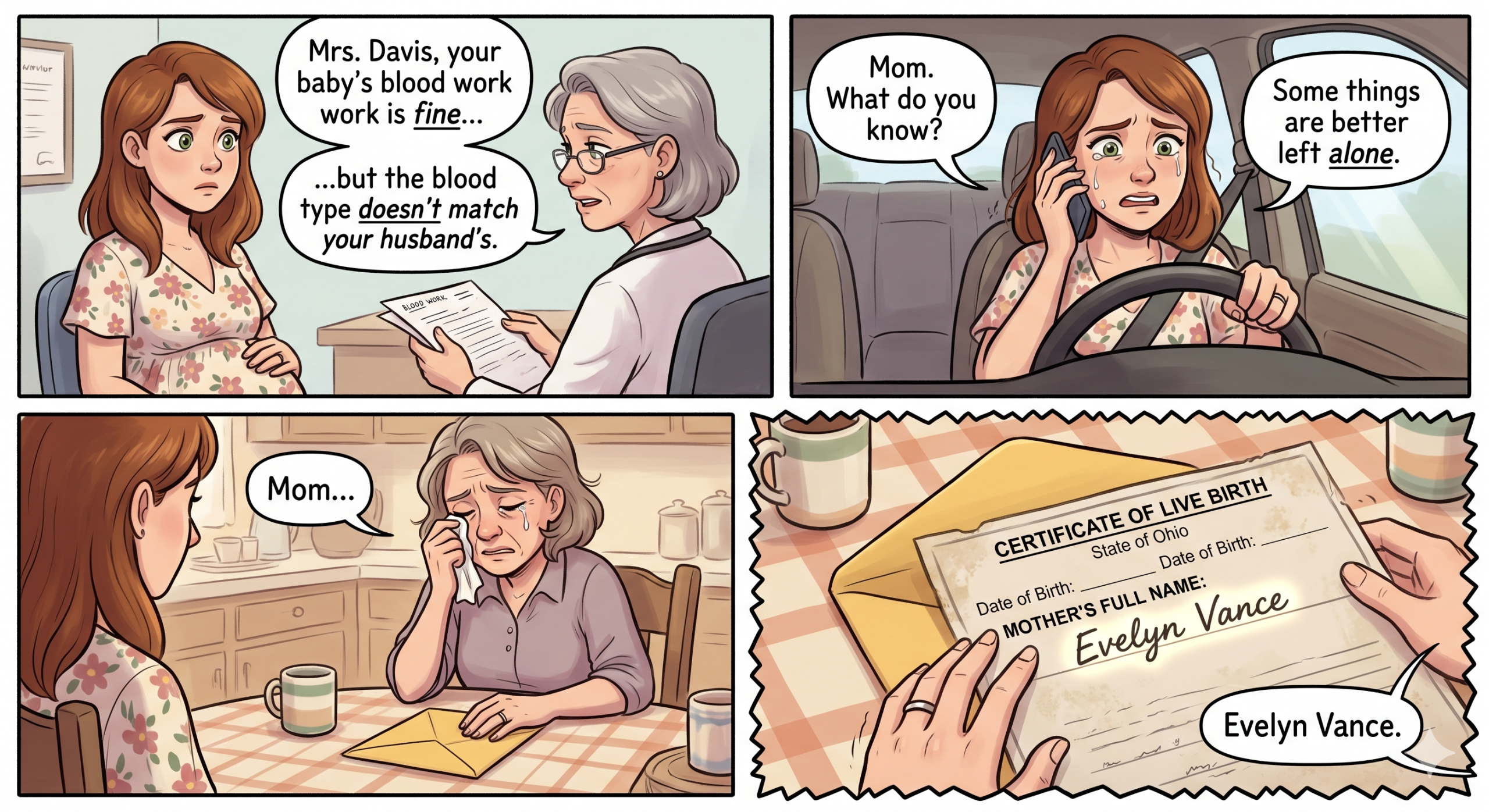
But now, sitting in this cold clinic room, the world felt like it was spinning out of control. The specialist, Dr. Vance, was adjusting his glasses and looking at a printout of my blood work. He had run $8,400 in advanced prenatal genetic testing because of a minor scare during my last ultrasound. The baby was perfectly healthy, but the blood markers didn’t make sense.
“Are you absolutely certain about your husband’s blood type, Clara?” Dr. Vance asked. His voice was too gentle, the way people talk to you when they are about to deliver bad news.
“Yes,” I whispered. My throat felt so dry I could barely swallow. “Mark is type O. He gives blood at the red cross every spring. He has the little card in his wallet. And I am type A. I’ve always been type A.”
Dr. Vance sighed, leaning back in his leather chair. “An O parent and an A parent can only have a child who is type A or type O. It is a biological impossibility for you to have an AB positive baby together. The baby must have inherited the B allele from the biological father. I’m sorry, Clara.”
I didn’t scream. I didn’t cry. I just sat there while my jaw locked up and my hands started to tremble. The silence in the room felt heavy and suffocating. I wanted to tell him he was wrong. I wanted to shake him and tell him that Mark was the only man who had ever touched me. But the numbers on the page didn’t care about my loyalty.
I walked out of the clinic and got into my Buick. The steering wheel felt freezing under my hands. I sat in the parking lot for fifteen minutes, just staring at the gray brick wall of the medical center. My mind was racing, trying to find a loophole, a mistake, anything. I was so desperate that I picked up my phone and called my mother.
My mother, Evelyn, had raised me in a strict, loving household in Toledo. She was a retired school secretary, a woman who kept her kitchen spotless and her bible on the nightstand. She was my rock. When she answered, I broke down.
“Mom,” I sobbed, resting my forehead against the cold glass of the steering wheel. “The doctor says the baby’s blood type doesn’t match Mark’s. He says it’s impossible. But I swear to you, Mom, I’ve never been with anyone else.
I don’t understand what’s happening. My blood is A, and Mark is O.”
There was a long pause on the other end of the line. I expected her to gasping, to tell me the lab made a mistake, to defend my honor. But she didn’t. I could hear her breathing, slow and heavy.
“Mom?” I asked, my heart hammering against my ribs.
“Some things are better left alone, Clara,” she whispered. Her voice sounded incredibly old, and completely hollow.
“What do you mean?” I demanded, my panic rising. “What does that mean, Mom?”
“Don’t dig into this,” she said. And then, she hung up.
I stared at the screen of my phone. I called her back, but it went straight to voicemail.
I didn’t even think. I started the car, pulled out of the parking lot, and drove the 45 minutes to her house. The drive is a blur. I remember the windshield wipers beating a steady rhythm against the light rain, and I remember feeling a cold, sick weight settling deep in my stomach.
When I pulled into her driveway, her old sedan was parked there. I walked up to the porch and pounded on the door. It took her a long time to answer.
When she finally opened it, she looked like she had aged ten years. Her eyes were red, her gray hair was messy, and she was holding a yellow envelope.
She didn’t invite me in. She just walked back to the kitchen, leaving the door open. I followed her inside. On the wooden kitchen table, next to her half-empty cup of chamomile tea, was my childhood baby book. The one with the faded blue ribbon that she had kept in her cedar chest for thirty years.
“Sit down, Clara,” she said, not looking at me. She sat down and slid the yellow envelope across the table.
My hands shook as I opened the metal clasp. Inside was a birth certificate. It looked old, the paper slightly yellowed at the edges. But as I read the words, my breath caught in my throat. This wasn’t the birth certificate from my baby book. This was from a small hospital in southern Ohio.
And under the line for “Mother,” it didn’t say Evelyn Davis. It said Sarah Jean Vance.
“Who is Sarah?” I asked, my voice barely a squeak.
My mother put her face in her hands and began to cry. It was a horrible, weeping sound. “She was your biological mother, Clara. She was my cousin. She died three hours after you were born. She didn’t have anyone else, so your father and I took you. We brought you home, and we never told a soul. We wanted you to be ours. Just ours.”
I sat there, staring at the woman who had raised me, feeling like my entire existence had been erased and rewritten in a single second. “I’m adopted?” I whispered.
She nodded, her shoulders shaking. “We got a lawyer. We sealed the records.
We made a new birth certificate. We did everything we could to protect you. I thought if you knew, you wouldn’t love us the same way. I was so scared of losing you, Clara.”
I didn’t feel angry at her. I just felt numb. But then, my brain, still trying to process the medical nightmare from earlier, started putting the pieces together.
“Wait,” I said, leaning forward. “If Sarah was my mother… what was her blood type?”
My mother wiped her eyes with a crumpled tissue. “I don’t know, honey.
I don’t remember. But your biological father… he was a man Sarah met in college. He was a B positive. I remember that because Sarah had a rare antibody issue during her pregnancy.”
My mind was working fast now. If my biological father was type B, and my biological mother was whatever she was, then I wasn’t genetically type A. Or maybe I was, but my genetics were different than what I had believed. I looked down at my own medical records. I had always been typed as A positive.
But wait. Even if I was type A, and my adoptive parents’ blood types didn’t matter because I was adopted, it still didn’t solve the main problem. The baby inside me was AB positive. He had an A allele and a B allele.
I was the mother. I carrying this baby. So I passed on either A or B. Since my blood type was A, I passed on the A allele.
That meant the baby’s father *must* have passed on the B allele.
But Mark was type O. Mark only had O alleles. He couldn’t pass on a B allele. It was still biologically impossible for Mark to be the father, even if I was adopted.
I felt a cold wave of despair wash over me. The adoption secret explained why my blood type didn’t match my parents, but it did absolutely nothing to save my marriage. To the rest of the world, and to Mark, I was still a cheating wife.
I drove back to Fort Wayne in complete silence. The rain had stopped, but the sky was a dark, bruised purple. When I walked through our front door, Mark was standing in the kitchen. He had made dinner, but the plates were untouched on the counter. He looked at my face, and he knew.
“Clara,” he said, his voice cracking. “What did the doctor say?”
I walked over to the kitchen table and laid out both birth certificates. The fake one from my baby book, and the real one from the yellow envelope. I told him everything. I told him about Sarah, about my adoption, about my biological parents. He listened in silence, his eyes wide, his hands gripped tightly around his coffee mug.
When I finished, I looked him straight in the eyes. “Mark, I swear to you on my life, and on our baby’s life, I have never been with another man. I don’t know why the baby is AB.
I don’t know how. But you are the only father this baby has.”
Mark didn’t yell. He didn’t accuse me. He just stared at the old birth certificate of Sarah Jean Vance.
“I believe you, Clara,” he said softly. “I know you. We’ve been together for eleven years. You don’t have a bone in your body that could do that to me. There has to be another explanation.”
He stood up and pulled me into his arms. I buried my face in his shoulder and finally let the tears fall.
We held each other in the quiet kitchen for a long time, the shadow of the lab results still hanging over us, but the trust between us unbroken.
The next morning, Mark called his own mother, Helen. He asked her a simple question: “Mom, do you have my medical records from when I was a kid?”
Helen was quiet for a second. “Why, Mark? Is everything okay?”
“We just need them, Mom. Please.”
Two hours later, Helen drove over and handed us a thick manila folder.
Mark had leukemia when he was five years old. It was a dark chapter in his family’s history, something they rarely talked about because it was so painful. He had survived because of a bone marrow transplant.
We took the folder straight to Dr. Vance’s office. We didn’t have an appointment, but we refused to leave until he saw us. When he finally called us back, Mark laid the childhood medical records on his desk.
“Dr. Vance, look at this,” Mark said, pointing to the yellowed hospital papers from 1994. “I had a bone marrow transplant when I was five. My donor was an anonymous man from Germany.”
Dr. Vance’s eyes narrowed as he flipped through the pages. He read the transplant summary, and then he stopped. He stared at a single line on the third page, his mouth opening slightly.
“Oh,” Dr. Vance whispered. “Oh, my word.”
“What is it?” I asked, gripping Mark’s hand so tightly my knuckles were white.
Dr. Vance looked up at us, his face a mixture of shock and profound relief. “Mark, your bone marrow donor was type B positive. When you received his marrow, your blood-producing stem cells were replaced by his. That means your blood type changed to B positive. For your entire adult life, your blood has tested as B because of that transplant.”
“But my donor card says I’m O,” Mark said, confused.
“Sometimes, over decades, the donor cells can co-exist, or a minor typing error happens during routine blood drives because they don’t do deep genetic matching for simple donations,” Dr. Vance explained. “But here is the key: a bone marrow transplant changes your blood, but it does *not* change your DNA in your reproductive cells. Your sperm still carries your original DNA.”
“And what was my original DNA?” Mark asked.
Dr. Vance smiled, a genuine, warm smile. “Before your transplant, according to these records, your blood type was AB. You carried both the A and the B alleles in your genetic makeup.
Your sperm still carries those alleles. You passed the B allele to your baby, and Clara passed the A. The baby is yours, Mark. Biologically, genetically, 100% yours.”
I let out a breath I felt like I had been holding for days. I leaned against Mark, my eyes stinging with tears of pure relief. The science that had condemned me had finally set me free.
We walked out of the clinic into the bright afternoon sun. It felt like a weight had been lifted from our chest.
We didn’t care about the secrets, or the old lies, or the panic of the last 48 hours. We only cared about the little boy who was kicking gently against my ribs.
Two months later, our son, Leo, was born. He had a thick shock of dark hair and his father’s eyes. My mother was there, sitting in the hospital chair, holding her grandson with tears in her eyes. I had forgiven her. She had kept a secret to protect her love for me, and now, looking at my own son, I finally understood how fierce a mother’s love can be.
Mark sat on the edge of the bed, holding my hand as Leo slept in his arms. He looked tired, but he had the biggest smile on his face.
“He has your nose, Clara,” Mark whispered, leaning down to kiss the baby’s forehead.
“And he has your genetic mystery,” I laughed softly, wiping a tear from my cheek.
We had been through a storm, but we had come out on the other side stronger than ever. Our family wasn’t perfect, and our history was messy, but as I watched my husband rock our son to sleep, I knew that love was the only thing that was truly inherited.