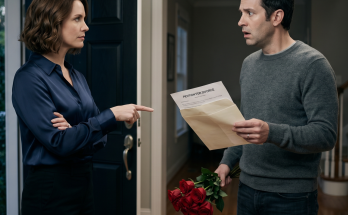
The first voice note came while I was shaking hands with a man who wanted me to sign a forty-million-dollar contract.
Rain ran down the windows of the private dining room in silver lines. Outside, Manhattan was blurred by storm and headlights. Inside, everything smelled like truffle butter, red wine, expensive cologne, and men pretending they were not desperate to close a deal before midnight.
My phone buzzed once against the tablecloth.
I glanced down.
Sophia.
My daughter was eight. She sent me voice notes when she lost a tooth, when she made pancakes with too much salt, when our old golden retriever sneezed in his sleep. Her messages usually began with, “Daddy, guess what.”
This one did not.
I tapped it under the table, holding the phone close to my ear so nobody else could hear.
“Daddy…” Her voice trembled. “I’m so cold.”
The room around me changed.
The laughter at the table stretched thin. A fork clicked against a plate. My business partner leaned toward a banker, still talking numbers, but I was no longer there with them.
Another voice note arrived.
“Rachel says I can’t change until I learn. But my socks are wet, Daddy. I didn’t mean to leave the garage door open.”
I stood up.
The banker across from me looked surprised. “Javier?”
“One minute.”
I walked out into the hallway, where the music from the dining room softened behind the closed door. The carpet was thick under my shoes. A waiter passed carrying a tray of champagne glasses, and the smell of citrus garnish turned my stomach.
I called home.
No answer.
I called Rachel.
No answer.
Third voice note.
“Daddy, please don’t be mad. I tried to be quiet, but she keeps crying downstairs.”
My heart stopped in my chest.
She.
I pressed call again. Nothing.
Fourth voice note.
“Rachel said if I tell you, you’ll send me away too. But I’m really cold. My hands hurt.”
I was already moving toward the elevator.
Michael, my assistant, appeared from the dining room behind me, tie loosened, tablet in his hand. “Sir? They’re asking for you.”
“Get my car.”
He saw my face and stopped asking questions.
The elevator doors opened too slowly. I hit the lobby button three times as if that could change physics. My phone buzzed again in my palm.
Fifth voice note.
For one second, I almost didn’t press play. I didn’t know why. Maybe because some part of me understood that once I heard whatever came next, my life would split into before and after.
I played it.
Sophia’s breathing came first. Shallow. Uneven. Too tired.
“Daddy, I’m sorry. I’m so sleepy. Rachel took the blanket because I gave one to Lucy. I didn’t mean to be bad. Please come home.”
Lucy.
I knew every child in Sophia’s class. Every cousin. Every neighbor’s kid who came to birthday parties and left glitter in my rugs.
There was no Lucy.
The elevator doors opened into the lobby. Rain hammered the glass entrance so hard it sounded like applause from an angry crowd. Michael was already outside under the awning, waving the car forward.
I ran into the storm without an umbrella.
By the time I reached the back seat, my suit was soaked across the shoulders. My driver looked at me in the mirror.
“Home,” I said. “Fast.”
I called 911, then stopped before pressing send.
What would I say?
My daughter says she is cold.
My wife is not answering.
There may be a girl named Lucy.
There is crying downstairs in a house I own but apparently do not know.
I pressed call anyway.
As the dispatcher answered, a sixth message appeared.
Not a voice note.
A text from Rachel.
Stop frightening yourself. Sophia is being dramatic.
I stared at those five words while rain exploded against the windshield.
Then my phone lit up with a live camera alert from the playroom.
Motion detected.
I opened it.
The screen was mostly dark. Then Sophia’s small face appeared near the camera, pale and wet, lips trembling.
Behind her, from somewhere lower in the house, came a muffled thud.
Sophia looked toward the sound and whispered, “I’m sorry, Lucy.”
Then the screen went black.
The ride home took twenty-two minutes.
It should have taken forty.
I remember almost none of the streets. Only fragments. Yellow cab lights smeared by rain. Steam rising from manhole covers. My driver muttering under his breath as we cut across lanes. My phone in my hand, wet from my sleeve, still showing the black screen where the playroom camera had gone dead.
The dispatcher stayed with me for the first few minutes.
I gave her the address. Upper East Side. Five-story townhouse. My daughter possibly exposed to cold. Possible second child in the residence. Wife unreachable.
Possible.
That word made me want to punch the window.
Everything in my life had been certain until that night. Contracts. Schedules. Security systems. Staff calendars. School tuition. Pediatricians. Housekeepers. Chauffeurs. Everything arranged so Sophia could have what I called the best.
And still my daughter had whispered that she was freezing in her own home.
When we pulled up, the house looked perfect.
That was the first thing that made me sick.
Warm stone facade. Black iron railing. White curtains drawn neatly behind tall windows. Two planters by the steps. The brass numbers polished. Rain slid down the front door in shining threads, and the porch light glowed like nothing inside could be wrong.
I ran up the steps and fumbled my keys so badly they fell.
My driver picked them up and handed them to me without speaking.
Inside, the air hit me like a cellar.
Cold.
Not chilly. Not drafty. Cold enough that my breath came out visible in the foyer light.
“Sophia!”
My voice echoed through the house.
No answer.
The marble floor was slick near the service hallway, dotted with muddy little footprints. One of Sophia’s pink sneakers lay on its side by the stairs. A wet school cardigan had been thrown over the banister. The central heating panel beside the hall showed OFF.
Not malfunctioning.
Off.
“Sophia!”
I heard something then.
A tiny sound from the playroom.
The playroom was at the back of the house, past the kitchen and the breakfast nook Rachel had redesigned twice because she said the morning light deserved better furniture. The room smelled like damp wool and crayons. Board games were stacked crookedly against one wall. A dollhouse stood open. A glass of water had tipped over near the rug.
Sophia lay curled beneath the window.
She was wearing her school uniform. Her tights were soaked. Her hair clung to her cheeks. Her lips had gone bluish. One hand was tucked under her chin, fingers stiff.
For a moment, my body refused to move because my brain refused the image.
Then I was on my knees.
“Sophia. Baby. Wake up.”
Her eyelids fluttered but did not open.
I touched her cheek.
Ice.
I pulled off my suit jacket, wrapped it around her, then grabbed the throw blanket from the couch. It was damp too. I shouted for towels, though nobody came.
From upstairs, I heard a door open.
Rachel appeared on the landing in a silk robe, hair loose, face soft with sleep or performance. She blinked down at us.
“Javier?”
“What did you do?”
She descended slowly, one hand on the railing. “What are you talking about?”
“She’s freezing.”
Rachel’s eyes moved to Sophia, then away. Not quickly enough.
“She refused to change,” she said.
“She’s eight.”
“She had a tantrum. She left the garage open. The rain blew in. I told her there are consequences.”
I stared at my wife.
Rachel Van Holt Morales. Charity board member. Magazine profile subject. The woman who posted photos captioned “blessed stepmama life.” The woman who kissed Sophia’s forehead in public and complained in private that my daughter needed structure.
“You turned off the heat.”
“No, I lowered it.”
“It’s off.”
She looked irritated now. “Javier, she knows how to make you panic. She has always done this with you.”
Sophia made a faint sound against my chest.
I leaned close. “I’m here, sweetheart.”
Her eyes cracked open.
“Daddy?”
“Yes. I’m here.”
“Don’t let Rachel lock it again.”
Rachel’s face changed.
Not fear.
Calculation.
“What did she say?” I asked.
Sophia’s teeth chattered. “The gray door.”
Behind me, Rachel said, too sharply, “She’s confused.”
The ambulance siren grew louder outside.
But before the paramedics reached the door, Michael rushed in soaked from the rain, laptop bag under one arm.
“Sir, the camera backup,” he said. “You told me last month to mirror everything after the nanny quit. It’s still syncing.”
Rachel turned toward him.
For the first time that night, she looked afraid.
Michael opened the laptop on the kitchen counter. His fingers moved fast. A file appeared. Playroom audio. Time-stamped thirty minutes earlier.
He pressed play.
Rachel’s voice came through the speakers, low and venomous.
“If you tell your father about the girl in the basement, I swear to God you’re going to end up just like her.”
The house went silent around us.
And in that silence, I realized I did not know my wife at all.
“What girl?” I asked.
Rachel looked at the laptop as if hatred alone could erase the file.
“There is no girl.”
Sophia shifted weakly in my arms. “There is, Daddy.”
Rachel’s head snapped toward her. “Shut up.”
I stood so fast the blanket nearly slipped from Sophia’s shoulder. I stepped between them, holding my daughter against me.
“Speak to her like that again,” I said, “and I will make sure every officer in this city hears it from my mouth.”
Rachel laughed once. It was thin and ugly. “You’re losing your mind. She’s delirious.”
“No,” I said. “She’s hypothermic. You’re exposed.”
The doorbell rang hard, followed by pounding.
Michael ran to open it.
Two paramedics entered, rain dripping from their jackets, gear bags swinging at their sides. The moment they saw Sophia, their faces changed from routine to urgent.
“How long has she been exposed?” one asked.
“I don’t know.”
Rachel said, “Not long.”
I turned on her. “You don’t answer for her.”
The paramedic took Sophia’s temperature. The other checked her pulse, hands, lips, breathing. They moved quickly, professionally, without wasting horror on what needed action.
“She needs transport now,” one said. “Possible hypothermia.”
Sophia’s fingers curled around my sleeve.
“Daddy…”
“I’m here.”
“Don’t leave Lucy.”
The paramedic looked at me.
I looked at Rachel.
Her eyes moved, just once, toward the basement stairs.
That was enough.
I dialed 911 again and put the phone on speaker.
“This is Javier Morales at the same Upper East Side address. My daughter reports a child locked in the basement. There is security audio of my wife threatening her. I need police and child protective services immediately.”
Rachel stepped backward. “You’re ruining our lives.”
“No,” I said. “You did that in the dark.”
The paramedics loaded Sophia onto a stretcher. She cried weakly when they lifted her, not because of pain but because her eyes were fixed on the hallway leading down.
“The gray door,” she whispered. “Behind the shelves.”
“I heard you,” I said. “I promise.”
Michael stood by the laptop, pale and rigid. “Sir, I’m uploading the backups now.”
“Do it. Cloud, external drive, everything. Don’t let anyone touch the system.”
Rachel moved toward the stairs.
I blocked her.
“Move,” she snapped.
“You don’t go anywhere.”
“This is my house too.”
“It’s a crime scene now.”
She slapped me.
The sound cracked through the kitchen.
The paramedics froze for half a second. Michael did not move, but his face hardened.
I tasted blood where my teeth caught the inside of my cheek. Strangely, I was grateful. The pain kept me steady.
Rachel realized too late what she had done in front of witnesses.
“Javier,” she said, voice suddenly soft. “I’m scared.”
“Good.”
Police arrived before she could find another mask.
Two officers entered with rain on their shoulders and hands near their belts. I gave them the shortest version I could. Daughter found hypothermic. Wife threatened her. Possible hidden minor in basement. Audio preserved.
One officer stayed upstairs with Rachel, Michael, and the paramedics. The other, Officer Laird, went downstairs with me.
The basement smelled normal at first.
That was almost worse.
Lemon cleaner. Old stone. Wine corks. Dust. Rachel had made sure the first room looked like storage from a design magazine. Labeled Christmas boxes. Framed art wrapped in plastic. Shelves of imported wine. A treadmill I had bought and never used.
But under it was another smell.
Damp fabric.
Stale air.
Something human trying not to be noticed.
At the back, behind a row of metal shelves, stood the gray door.
I had seen it before and never asked.
That fact would later keep me awake more nights than I can count.
Rachel had told me it was a utility room. I believed her because I was busy, because she was my wife, because wealthy men like me are trained to assume the house works as long as someone else manages the rooms we don’t enter.
Officer Laird shone his flashlight over the lock.
Brand-new padlock.
“Do you have a key?” he asked.
“No.”
My voice sounded like it belonged to someone else.
I grabbed a crowbar from the wall rack and struck the lock.
Once.
Twice.
On the third hit, the metal gave.
The door opened inward.
The smell came out first.
Fear has a smell when it has nowhere to go.
Officer Laird raised his flashlight.
At first, I saw a mattress. A plastic bottle. A small pile of folded napkins. A paper plate with crumbs. A dirty blanket.
Then the light found two eyes in the corner.
A child curled against the wall, knees to chest, hair tangled around her face.
She lifted one arm as if expecting to be hit.
“Please,” she whispered. “I didn’t make noise.”
My knees nearly failed.
I did not rush toward her.
Every instinct in me wanted to, but she was trembling so hard that even the flashlight seemed to frighten her. Officer Laird lowered his voice and radioed for backup, another ambulance, and child welfare.
The girl pressed herself tighter into the corner.
She was small. Maybe seven. Maybe eight. It was hard to tell because hunger and fear had taken the softness from her face. Her hair was black and matted at the ends. She wore leggings, one sock, and a sweater too thin for a basement.
“My name is Javier,” I said carefully. “I’m Sophia’s father.”
Her eyes changed.
Not trust.
Recognition.
“Sophia’s daddy?”
“Yes.”
“She said you were nice.”
My chest broke open in a place too deep for sound.
“She talked about me?”
The girl nodded slightly. “She said you buy the good cookies. The round ones with chocolate.”
Sophia loved those cookies. She hid them in her desk drawer because Rachel said sugar made her unfocused.
“What’s your name?” Officer Laird asked gently.
The girl looked at him, then at me. “Lucy.”
“Lucy what?”
Her mouth trembled. “Lucy Rivera.”
I knew that name.
Not well. Not enough.
But somewhere in the back of my mind, a memory stirred: a missing child poster near a community center Rachel supported, a little girl with dark hair and serious eyes, a mother begging on local news while reporters treated her grief like background noise.
I crouched lower, keeping distance.
“Lucy, are you hurt?”
She looked down. “I’m cold.”
The words were simple.
They destroyed me.
Upstairs, a shout echoed.
Rachel.
Then Michael’s voice, sharp for the first time since I had known him. “You are not leaving.”
Officer Laird moved toward the stairs, then stopped when his radio crackled. Another officer was on the way down.
I stayed with Lucy.
Sophia had been freezing upstairs because she gave a blanket to this child. My daughter had been punished for mercy.
“Lucy,” I said, “an ambulance is coming. We’re going to take you to doctors.”
Her breathing quickened. “No doctors. Rachel said doctors send bad girls away.”
“Rachel lied.”
“Rachel said my mom didn’t want me.”
“Rachel lied.”
Her face crumpled, but no tears came. Some children cry when they are afraid. Some go dry because fear has taken even that.
The second ambulance arrived ten minutes later. It felt like an hour. Specialized child welfare personnel came with the police, along with a woman named Dana Shaw who wore a navy raincoat and spoke to Lucy like every word had been chosen not to break her further.
They wrapped her in a blanket.
Lucy flinched when the fabric touched her shoulders, then gripped it with both hands.
As they carried her upstairs, I followed.
The foyer had turned into a scene from someone else’s nightmare. Police lights flashed red and blue through the rain-streaked windows. Sophia’s stretcher waited near the open front door. Rachel stood by the service hallway with an officer beside her, her hair now brushed, her coat on, a handbag over one shoulder.
At her feet sat a small suitcase.
Michael held another bag he had taken from her. Inside, I could see passports, cash, jewelry, and what looked like a burner phone still in plastic packaging.
She had not been going for help.
She had been going.
When Lucy came into the foyer, Rachel’s face emptied.
No panic. No tears. No denial.
Just fury.
“You stupid little thing,” she hissed.
Lucy recoiled so violently that Dana stepped between them.
I moved before I thought. Officer Laird caught my arm, not roughly, just enough to remind me that if I touched Rachel, she could make even that about herself.
I looked at my wife.
“You will never speak to either of them again.”
Rachel smiled without warmth. “You have no idea what you’re doing.”
“For the first time in my life, I do.”
Sophia turned her head on the stretcher. Her eyes were barely open.
“Lucy?”
Lucy, wrapped in the blanket, looked toward her.
“I’m here,” Lucy whispered.
Sophia’s face softened.
The girls stared at each other across the foyer, two children who had survived a private war inside my beautiful house.
No one else spoke.
They loaded Sophia first. I climbed into the ambulance with her, one hand holding hers, the other gripping the side rail so hard my knuckles hurt.
As the doors closed, I saw Rachel through the rain, standing between two officers.
She was no longer pretending to cry.
She was watching Sophia with hatred.
And I understood then that this had never been an accident, never been discipline, never been a stepmother losing patience.
It had been punishment.
For Sophia knowing the truth.
Hospitals at night have a brightness that feels almost violent.
White floors. White walls. White lights. Machines beeping from rooms you cannot see. Nurses walking fast with tired eyes. Parents hunched over forms. Children crying in voices that make every adult in the hallway look ashamed of being unable to fix the world faster.
They took Sophia from me at the emergency entrance.
I tried to follow, but a nurse put a hand on my chest.
“Sir, we need space to treat her.”
“I’m her father.”
“I know. Let us help her.”
That sentence stopped me because help was exactly what I had failed to be.
They wheeled Lucy past a few minutes later. Dana walked beside her, speaking softly. Lucy’s eyes searched the hallway until they found mine.
“Is Sophia okay?”
“They’re helping her,” I said.
She nodded once, like that was the only answer she could afford.
The next hours came in pieces.
Hypothermia.
Prolonged cold exposure.
Acute stress.
Mild dehydration.
Observation.
Specialists.
Statements.
Police.
Child protective services.
Words entered me and stayed there.
I signed forms. I answered questions. I gave my contact information to the same people twice because my hands were shaking too badly the first time to write clearly. Michael arrived with a dry coat, a laptop, two backup drives, and the face of a man who had seen more than his job description ever promised.
“The files are safe,” he said.
“Everything?”
“Everything. Playroom audio. Hallway camera. Basement stairwell camera. Door sensors. Rachel’s attempts to access the system after we called police.”
I looked at him.
“She tried?”
He nodded. “Three times.”
“Send everything to the detectives.”
“Already done.”
I sat down in a plastic chair that creaked under me. My suit was still damp. My shoes smelled like rainwater. My hands smelled faintly of basement dust no matter how many times I washed them.
A doctor finally came out just before dawn.
Sophia was stable.
Not fine.
Stable.
That word became the first plank under my feet.
When I saw her, she looked smaller than eight. Tubes, monitors, thermal blankets, her hair brushed back from her forehead by a nurse kinder than I deserved. Her cheeks had some color again. Her hands were warm enough that when I touched one, I did not feel ice.
Her eyes opened.
“Daddy?”
“I’m here.”
“Are you mad about the garage?”
My throat closed.
“No, my love.”
“Rachel said you’d be mad.”
“Rachel lied.”
Her eyes filled with tears. “She said you’d choose her because I make everything hard.”
I pulled the chair closer and took her hand carefully, afraid even my love might be too heavy.
“I choose you. Not tonight. Not only because something terrible happened. I should have made sure you knew that every day. I choose you, Sophia. Always.”
A tear slid into her hairline.
“Lucy?”
“They found her. She’s alive.”
Sophia’s mouth trembled. “I gave her crackers.”
“I know.”
“I wasn’t allowed.”
“I know.”
“I did it anyway.”
The pride and grief that filled me almost made me unable to breathe.
“Yes,” I whispered. “You did.”
At sunrise, the hospital doors opened to a woman running in a soaked sweatshirt and mismatched shoes.
She had dark hair pulled into a messy knot, no coat, and eyes so red they looked painful. A social worker guided her down the hall.
Marisol Rivera.
Lucy’s mother.
They had found her through an old missing persons report that had been filed, under-prioritized, and nearly buried under newer cases. A working mother. A rented apartment. No famous friends. No foundation board members. No Upper East Side influence. Just grief nobody had treated as urgent enough.
When Marisol saw Lucy, she made a sound I will never forget.
Not a scream.
Not a sob.
A mother’s body recognizing the missing part of itself.
“My baby,” she cried, falling to her knees beside the bed.
Lucy stared for half a second, as if hope itself frightened her.
Then she screamed, “Mommy!”
The nurses stepped back.
Dana wiped her eyes.
I turned away, because that reunion did not belong to me. I had no right to stand in the center of it.
But Marisol saw me anyway.
“You,” she said.
I faced her.
Her arms stayed locked around Lucy. Her face was wet, furious, exhausted, alive.
“You own that house?”
The question entered like a blade.
“Yes.”
Her mouth tightened. “My daughter was under your floor.”
There was no defense.
No sentence beginning with I didn’t know that did not sound like another injury.
“Yes,” I said. “And I am sorry in a way that will never be enough.”
She stared at me for a long moment.
Then she turned back to Lucy.
That was the correct punishment.
Not shouting.
Not forgiveness.
Just the refusal to make my guilt more important than her child.
Rachel came into our lives wearing white.
That is what I remembered while sitting outside Sophia’s hospital room with cold coffee in my hand and a detective asking me how long I had known my wife.
White dress. White coat. White smile.
It was three years earlier at a charity luncheon for children’s literacy. Rachel Van Holt sat on the stage beneath soft lights and spoke about “lifting invisible children into view.” She was elegant, articulate, precise. She knew how to pause before emotional words. She knew how to make donors lean forward.
I had been a widower for two years by then.
Sophia’s mother, Elena, had died from an aneurysm on an ordinary Wednesday morning after packing Sophia’s lunch. There are losses that explode and losses that remove the roof from the world. Elena’s death did both.
For two years, I worked.
I told myself I was building stability. I signed deals. I expanded the firm. I bought Sophia private school, tutoring, therapy, piano lessons, a safer car, a better security system, a house with enough space for grief to move around.
Rachel appeared at the right time.
She did not rush Sophia. Not at first. She brought books instead of toys. She remembered school events. She praised Elena in front of me. She said she knew better than to replace a mother.
That sentence undid me.
A person who says they are not trying to replace someone sounds safe to a man terrified of replacing memory with convenience.
We married after eighteen months.
Sophia was six.
She wore a pale blue dress and held my hand through the ceremony. Rachel knelt afterward and gave her a bracelet with a tiny silver star.
“Whenever you feel lost,” Rachel said, “remember we’re a family.”
Everyone cried.
Even me.
The red flags came later, small enough to dismiss if you wanted peace more than truth.
Sophia stopped running to the door when I came home. Rachel said she was growing independent.
Sophia began asking if she could eat in her room. Rachel said she was moody.
Sophia lost sweaters, then started wearing layers even in warm weather. Rachel said children go through phases.
One afternoon, Sophia asked if every house had basements. I laughed and said no, not every house. She asked if people could hear you from a basement. I told her of course, if you shouted loud enough.
Rachel walked into the room then and changed the subject so smoothly I forgot the question.
Until the hospital.
The detectives listened without interrupting. One was named Alvarez, short and solid, with a notebook full of careful block letters. The other, Detective Mercer, barely spoke but watched my face the way accountants watch numbers that do not add up.
“When did Rachel start the foundation project?” Alvarez asked.
“Two years ago.”
“Open Horizons?”
“Yes.”
The name tasted poisonous now.
Rachel’s foundation had claimed to support underserved children. School supplies. Scholarships. Mentorship programs. Donor dinners in rooms full of orchids and champagne. I had written checks without reading every line item because I trusted my wife and liked feeling that our money did something decent.
Detective Mercer placed a photo on the table.
Lucy’s missing poster.
“Do you recognize her?”
I rubbed both hands over my face. “I saw the poster once. At a community center Rachel supported.”
“Did your wife ever mention her?”
“No.”
“Did Sophia?”
I thought of crackers. Blankets. The voice notes.
“No. But I think she tried.”
The detective opened a folder.
“We recovered files from Rachel’s office. Phrases like ‘before and after rescue narrative,’ ‘controlled exposure campaign,’ ‘child ambassador prototype.’ Do those mean anything to you?”
I stared at the words.
Child ambassador prototype.
Not girl.
Not Lucy.
Prototype.
I stood up so fast the chair scraped the floor.
“She was going to use her?”
Alvarez did not soften the answer.
“It appears Rachel intended to present Lucy later as a child she had personally rescued, likely tied to fundraising. We are still confirming details.”
I thought of Rachel on stage in white.
Invisible children.
Lifted into view.
Except she had made Lucy invisible first.
My phone buzzed.
Michael.
Sir, police found a locked cabinet in Rachel’s office. There are printed photos of Sophia near the basement stairs.
Then another message appeared.
And one folder labeled Compliance Training.
I looked down the hallway toward Sophia’s room.
For the first time since finding Lucy, fear returned sharper than before.
Because Rachel had not only hidden a child.
She had been training mine to stay silent.
The folder labeled Compliance Training contained twelve pages.
I did not read them all at once. I couldn’t.
Detective Alvarez summarized the first pieces while I sat in a hospital conference room with Michael on one side and a child welfare attorney on speakerphone.
Rachel had documented Sophia’s behavior like a project.
Refuses bedtime correction.
Asks about basement sounds.
Shows misplaced empathy.
Attempts to hoard snacks.
Responds strongly to isolation.
Father attachment remains primary obstacle.
Father attachment.
Me.
I sat there while those words tore through whatever remained of my pride.
Rachel had not been jealous of Sophia in the ordinary stepmother way people write about in cheap novels. This was colder. More organized. She saw my daughter’s love for me as a barrier to control.
And I had handed her access.
“She wrote this?” Michael asked, voice low.
Alvarez nodded.
“There are notes going back months.”
Months.
I thought of every business trip. Every gala. Every late dinner where Rachel texted, Sophia’s asleep, don’t worry. Every morning when my daughter looked tired and I blamed school, growth spurts, grief.
“What are the photos?” I asked.
Detective Mercer spread them on the table.
Sophia in the hallway near the basement stairs.
Sophia leaving a bottle of water behind a stack of towels.
Sophia hiding crackers in her pajama sleeve.
Sophia standing outside the gray door with one hand pressed against it.
The dates stretched back almost five months.
Five months.
Lucy had been under my roof for nearly five months.
I walked to the trash can and threw up.
No one commented.
When I returned to the table, Michael had tears in his eyes.
“Sir, I should have noticed system irregularities.”
“No.”
“I managed the house accounts. Security subscriptions. Staff—”
“No,” I said again, because I knew that road. Guilt spreads fast when the real guilty person has no shame. “This is Rachel.”
But the second sentence stayed in my head.
And I should have been present enough to see it.
Rachel was detained that afternoon after trying to claim she had been “temporarily sheltering” Lucy from an unsafe home. Her attorneys arrived before some detectives had finished processing the basement. That told me she had planned for collapse. People like Rachel always prepare an escape route and call it strategy.
She asked to see me the next day.
I went.
Not for closure. Not for answers. Not because I believed there was a person inside her capable of remorse.
I went because I wanted to look at the door closing.
She sat behind glass in a beige jumpsuit, hair pulled back, face bare of makeup. Without the pearls and lipstick, she looked less beautiful but no less dangerous. The smile still came at the right angle.
“Javier,” she said through the phone. “This has gotten completely out of hand.”
I looked at her.
No rage rose in me. Only disgust.
“You locked a child in our basement.”
“I was going to help her.”
“You locked a child in our basement.”
“She was safer with us than with that woman.”
“Her mother searched for her.”
Rachel’s nostrils flared. “Her mother lived in a one-bedroom apartment above a laundromat.”
“She loved her.”
“Love isn’t enough.”
I leaned toward the glass. “You gave her a mattress on a concrete floor and called yourself a savior.”
For the first time, her expression cracked.
“You were never home,” she snapped. “Do you know how easy it was to run that house? To manage everything? You gave me your daughter, your staff, your money, your reputation, and now you want to play horrified because I made decisions?”
The truth inside the accusation hit me hard.
I had given her too much.
But not permission for evil.
“I failed to see you,” I said. “That does not make you less guilty.”
She smiled again, sharp now. “Sophia was always going to become a problem.”
My hand tightened around the phone.
“What did you say?”
“She watched everything. Quiet little thing. Always Elena’s eyes on me. Judging. Sneaking. Whispering. Feeding that girl like some tiny martyr.”
I stood.
Rachel pressed closer to the glass.
“You think Sophia is sweet? She lied to you every day too.”
I looked at the woman I had married, and every memory of her turned gray at the edges.
“She lied because you taught her truth was dangerous.”
Rachel slammed her palm against the glass.
“You won’t be able to do this alone.”
I put the phone back on its cradle.
Then I said loudly enough for the guard to hear, “I already am.”
As I turned to leave, Rachel shouted through the glass.
“You’ll come back when she becomes too much!”
I did not turn around.
Because the only person who had ever been too much was the woman screaming behind me.
Sophia refused to go home.
The first time the hospital psychologist asked where she felt safe, my daughter looked at the floor and said, “Not the house with the basement.”
So I did not take her there.
The police still had the townhouse sealed anyway, but even if they had returned it spotless, even if every wall had been repainted and every lock removed, I knew we would never live there again. A house can be worth twenty million dollars and still become uninhabitable from one truth.
I rented an apartment in Brooklyn Heights.
Small compared to what we had. Only three bedrooms. Old floors. Tall windows. A terrace just wide enough for plants and two chairs. The kitchen had blue tiles and a stubborn cabinet that didn’t close unless you lifted it first. The building smelled like coffee, laundry detergent, and somebody’s garlic dinner every evening at six.
Sophia stood in the doorway the first day and asked, “Is there a basement?”
“No.”
“Are you sure?”
“We’ll check together.”
We checked.
Closets. Bathroom. Pantry. Storage room. Under beds. Behind curtains. Inside the little utility closet with the water heater. I opened every door and let her touch the walls, the shelves, the locks. I did not tell her she was being silly because hurt children are not silly when they ask to see proof.
That night, she chose a yellow blanket from a shop near Atlantic Avenue. Bright yellow, almost too cheerful. She wrapped herself in it like armor.
“Can the heat stay on?” she asked.
“Yes.”
“All night?”
“All night.”
“What if it gets too hot?”
“We’ll open a window together.”
She slept with the light on and my hand on the edge of her mattress. At three in the morning, rain hit the windows and she woke up screaming.
I was on my feet before my brain understood.
“Daddy!”
“I’m here.”
“She’s going downstairs.”
“No one is downstairs.”
“Lucy is cold.”
“No, my love. Lucy is with her mom.”
Sophia sobbed so hard she hiccupped.
I lay on the floor beside her bed because she did not want me in the bed but did not want me far away. The hardwood was cold under my cheek. I stared at the underside of her nightstand while she cried herself back into sleep.
The next morning, I canceled a trip to London.
Then Chicago.
Then Singapore.
Michael handled calls. I handled breakfast.
I burned eggs the first week. I packed lunches badly. I learned that Sophia hated blueberries in oatmeal but liked them beside oatmeal. I learned her math teacher was named Ms. Bennett, her favorite hoodie had a missing drawstring, and she still kept an old photo of Elena inside the back cover of a fairy-tale book.
These were not small things.
They were the map I had been too absent to read.
One afternoon, while we sat on the terrace wrapped in sweaters, Sophia asked, “Are you going to listen to the voice notes?”
“I already did.”
“All of them?”
I swallowed. “Not all the way through again.”
“Why?”
“Because they hurt.”
She watched a pigeon land on the railing. “They hurt me too.”
“I know.”
“No.” She turned to me. “I mean when I made them. I thought maybe you’d hear them after I went to sleep and then you’d know I tried.”
Something inside me folded.
I knelt in front of her chair.
“You never have to prove you tried to survive.”
She looked at me with Elena’s eyes.
“The first time I fed Lucy wasn’t that night.”
I stayed very still.
“When was it?”
Sophia picked at the edge of the yellow blanket.
“October.”
It was April now.
Six months.
“She was there in October?”
Sophia nodded.
“I heard crying through the vent after Halloween. Rachel said it was pipes. But pipes don’t say mommy.”
I could not speak.
Sophia looked toward the apartment door, as if afraid Rachel might still hear through walls.
“I thought if I told you, Rachel would make Lucy disappear.”
That was the moment I understood that my daughter had been carrying not only fear, but responsibility.
A child had believed another child’s life depended on her silence.
And for six months, while I signed contracts and shook hands, Sophia had been the only adult in my house.
Lucy’s story came out slowly because nobody decent forced it out all at once.
Marisol told me parts in hospital waiting rooms, courthouse hallways, and one long afternoon in a social worker’s office while Lucy drew houses with no doors.
She and Lucy had lived in Queens, above a laundromat. Marisol cleaned offices at night and worked mornings at a bakery. Lucy went everywhere with her when school was closed because childcare cost more than rent some weeks.
Rachel met them at an Open Horizons supply drive.
There were photographs from that day. Rachel kneeling beside Lucy, one hand on the girl’s shoulder. Marisol standing nearby, cautious but hopeful. Tables stacked with backpacks and folders. A banner behind them reading Every Child Deserves a Doorway to Opportunity.
Doorway.
I hated that word now.
Rachel offered help. School uniforms. A scholarship contact. A pediatric referral. She learned Marisol’s schedule, her worries, her lack of backup. She became useful first. That was how predators like Rachel worked. They did not enter as monsters. They entered as solutions.
One rainy afternoon, Rachel offered to take Lucy to choose a winter coat while Marisol finished a shift.
Lucy never came back.
Rachel told Marisol the girl had run from the shop.
Marisol called police. Filed reports. Posted flyers. Went to shelters. Walked streets until her feet blistered. She accused Rachel, but Rachel had receipts, reputation, security footage edited to show Lucy near an exit, and friends who used words like unstable and overwhelmed when describing a frantic poor mother.
“People heard my accent and saw my uniform,” Marisol told me. “They looked at her pearls and chose.”
I had no answer.
What answer could there be?
Meanwhile, in my house, Lucy learned the rules of Rachel’s private world.
Don’t cry loudly.
Don’t scratch the door.
Don’t say mommy.
Don’t answer if the man is home.
Don’t talk to Sophia.
Sophia broke the last rule first.
She passed notes through a vent using folded notebook paper and a pencil tied to dental floss. She learned Lucy liked apple slices and hated peanut butter. She left water bottles inside a laundry basket near the basement stairs. She hid crackers in socks. She brought one of her own sweaters down the day Rachel forgot to lock the upper basement door.
That was when Rachel started watching Sophia closely.
The legal case grew larger than one house.
Rachel’s foundation was audited. Donors panicked. Board members resigned with statements full of shock and sadness. The same magazines that once photographed Rachel in soft light now used harsher words: abduction, fraud, child endangerment, abuse.
Her attorneys fought everything.
They said Lucy was confused.
They said Sophia had trauma from losing her mother and invented stories.
They said Marisol wanted money.
They said I was framing Rachel to avoid an expensive divorce.
I learned then that evidence is not just truth. Evidence is truth that survives money.
Michael’s backups mattered. So did the padlock. The basement door sensors. The camera of Rachel carrying food downstairs when she thought the system was offline. The audio of threats. The fake foundation documents. The bag by the service door. The passports.
And the voice notes.
Those five small files from my daughter.
I kept them in three places. Phone. Cloud. External drive locked in a safe.
I did not listen to them unless required.
The fourth one still entered my sleep sometimes.
Daddy, please don’t be mad.
Children should not apologize for needing warmth.
One afternoon, Detective Alvarez asked me to come to the DA’s office to review newly recovered footage. I thought I had seen the worst.
I was wrong.
The clip came from the hallway outside the coat closet. Sophia stood soaked and trembling, still in her school uniform. Rachel held the yellow blanket Sophia had tried to take downstairs before we bought the new one.
Rachel bent close to her face.
The audio was clear.
“You want to act like a little savior? Then freeze like one.”
I stopped the video.
The room around me disappeared for a moment.
When it returned, Alvarez was watching me carefully.
“There’s more,” he said.
I shook my head.
He said, “Mr. Morales, you need to know this before court. Rachel’s defense is going to claim Sophia was punished for lying about Lucy. But this video shows Rachel knew Lucy was real and Sophia was punished for helping her.”
I looked at the paused screen.
My daughter’s wet hair. Rachel’s hand holding the blanket.
“Play it,” I said.
By the end of the video, I no longer wanted justice to feel clean.
I wanted it to be exact.
Sophia gave her statement in a room painted with clouds.
Not a courtroom. Not a police station. A child advocacy center with soft chairs, shelves of stuffed animals, and windows covered by pale curtains. There were crayons on the table, though Sophia did not touch them. She held her yellow blanket in both hands and looked at the interviewer with the steady seriousness of a child who had learned adults can be dangerous.
I was not allowed in the room.
That was correct.
It still felt like being punished with my own helplessness.
I waited in the hallway with Marisol. She had one knee bouncing, hands clasped so tightly her knuckles had gone white. Lucy was in another room with a therapist, drawing again. Houses, Dana told us. Still no doors. But now there were windows.
That counted as progress.
“Does it get easier?” Marisol asked me.
I looked at her. “I was going to ask you.”
She almost smiled.
The hallway smelled like disinfectant and washable markers. Somewhere behind a closed door, a child laughed. The sound felt impossible and necessary.
When Sophia came out forty-five minutes later, she ran straight into my arms.
I lifted her even though she was getting too big. She buried her face in my neck.
“I told the truth,” she said.
“I know.”
“Do I have to tell it again?”
“Not like that. Not unless you choose to.”
“I want hot chocolate.”
So we got hot chocolate.
We sat in a café where the windows fogged from steam and people came in shaking rain from umbrellas. Sophia drank hers with both hands around the cup. She had whipped cream on her upper lip. For a few minutes, she looked eight.
That became my new religion.
Minutes where she looked eight.
The custody hearing for Sophia came first. Rachel’s lawyers tried to suggest I had been negligent, absent, emotionally unavailable, and therefore unfit to have sole decision-making authority. The awful part was that not every word was false.
I had been absent.
But Rachel had been dangerous.
There is a difference between failure and malice, and the judge understood it.
I testified for two hours.
Not like a businessman. Not like a man protecting his image. I told the truth because Sophia deserved at least one adult in that room who did not polish the edges.
I said I worked too much.
I said I trusted the wrong person.
I said I missed signs.
I said I would live with that for the rest of my life, but Rachel would never be allowed near my daughter again if I had anything to do with it.
The judge granted me full custody and a permanent protective order.
Rachel did not look at me when it happened.
She looked at Sophia’s empty chair.
That told me everything.
The criminal case took longer. There were motions, delays, experts, sealed hearings for the children’s statements, and headlines that made my stomach turn. Some days, I wanted to move to another country with Sophia and never hear Rachel’s name again.
But Lucy and Marisol did not have the luxury of disappearing from the truth.
So we stayed.
Marisol and I developed a strange, careful alliance. We were not friends at first. Friendship would have been too easy a word. I was the owner of the house where her daughter had been held. She was the mother whose pain revealed my blindness. We spoke respectfully. We disagreed sometimes. She refused any help that smelled like pity.
“I don’t want your guilt money,” she told me once.
“It’s not guilt money.”
She looked at me until I corrected myself.
“Some of it is,” I admitted. “But I want to help without making you small.”
“Then ask what we need. Don’t decide.”
So I asked.
Therapy. Legal expenses. Safe housing. School transition. Transportation. Privacy.
No galas. No photos. No foundation dinners. No donor language. No white dresses on stages.
Just help.
The trial began in November.
On the first day, Rachel entered the courtroom in a gray suit, hair smooth, face composed. She looked at the jury with quiet sadness, as if she had wandered there by mistake.
Then prosecutors played Sophia’s first voice note.
Daddy, I’m so cold.
Rachel’s face did not change.
That was the moment the jury began to understand her.
The courtroom was too warm.
That bothered me more than I expected.
Every day, I sat there in a suit while heat hummed through the vents and remembered Sophia on the playroom floor, lips blue, asking if I was angry about the garage. I watched jurors take notes. I watched Rachel’s attorneys object. I watched reporters write down words that had once lived only inside my house.
Evidence came in layers.
The security audio.
The basement photos.
The medical reports.
The padlock.
The packed suitcase.
The false foundation documents.
The emails where Rachel described Lucy as “high-impact narrative potential.”
The edited footage she used to cast suspicion on Marisol.
The notes about Sophia.
The voice notes.
Rachel’s defense tried to make the world muddy.
They suggested Lucy had run away from a troubled home and Rachel had panicked while trying to protect her. They suggested Sophia misunderstood discipline because I spoiled her after Elena died. They suggested Marisol was angry at wealth. They suggested I turned on Rachel only when scandal threatened my business.
Then Marisol testified.
She wore a dark blue dress and no jewelry. Her hair was pulled back. She held herself like a woman who had survived by refusing to collapse in public.
Rachel’s attorney asked whether she had ever struggled financially.
“Yes,” Marisol said.
“Whether she had ever left Lucy with neighbors while working?”
“Yes.”
“Whether she had sometimes accepted charity?”
Marisol looked at the jury.
“Yes. But poverty is not permission to steal a child.”
The courtroom went silent.
Rachel looked down.
Not with shame.
With irritation.
Lucy did not testify in open court. Neither did Sophia. Their recorded specialist interviews were played under strict protections. I watched the jurors’ faces as Sophia explained the crackers, the vent, the blanket, the gray door.
My daughter’s voice was small but clear.
“I thought if I was good, Rachel would let Lucy go home. But then I learned being good only made Rachel make new rules.”
One juror wiped her eyes.
I pressed my fist against my mouth.
On the last day of evidence, prosecutors played the fifth voice note.
I had avoided hearing it all the way through since that night.
Now the courtroom speakers made it unavoidable.
Sophia breathed softly, too tired.
“Daddy, I’m sorry. I’m so sleepy. Rachel took the blanket because I gave one to Lucy. I didn’t mean to be bad. Please come home.”
There was a pause.
Then, almost too quiet:
“If I don’t wake up, please find her.”
That was where I broke.
Not loudly. I did not sob. I bent forward with my hands over my face and felt Michael’s hand on my shoulder, steady and warm.
Sophia had believed she might die.
And her last thought had been another child.
The verdict came after two days.
Guilty on the major counts.
Guilty on the ones involving Lucy.
Guilty on the ones involving Sophia.
Guilty on fraud tied to the foundation.
Guilty on obstruction.
Rachel stood still as each word entered the record. Her jaw tightened. Her eyes searched the room, perhaps for sympathy, perhaps for some weak spot she could still press.
She found none.
At sentencing, she asked to speak.
The judge allowed it.
Rachel stood, turned slightly toward the gallery, and began with the same voice she once used at charity events.
“I made mistakes while trying to help a child who had been failed by society.”
Marisol let out a sound like a wounded animal.
The judge held up a hand.
Rachel continued. “My husband was absent. The household was unstable after his first wife’s death. I was overwhelmed and unsupported.”
I felt Sophia’s hand slip into mine. She had chosen to attend only the sentencing, from a protected area, after her therapist agreed.
Rachel looked at us.
For one second, her mask slipped.
“Sophia always resented me,” she said.
The judge stopped her there.
“No,” the judge said, voice cold. “This court will not allow you to blame a child for surviving you.”
The sentence was long.
Long enough that Rachel’s face finally changed.
When she was led away, she looked back once.
Not at me.
At Sophia.
Sophia did not hide.
She held my hand, lifted her chin, and watched Rachel disappear through the side door.
Afterward, outside the courthouse, rain began falling lightly over the steps.
Sophia looked up at the gray sky.
“Can we go home now?”
I knew she did not mean the townhouse.
“Yes,” I said.
And for the first time in months, the word home did not sound like a lie.
The night Rachel was sentenced, Sophia stood by the apartment window and listened to rain.
Brooklyn rain sounded different from Upper East Side rain. Less hollow. Less trapped between stone walls. It tapped the glass softly and ran down the brick across the street. Somewhere below, a car hissed through a puddle. Someone laughed under an umbrella.
“Do you want me to close the blinds?” I asked.
Sophia shook her head.
She wore the yellow blanket around her shoulders. It dragged behind her like a cape.
“I want to hear it.”
So we listened.
For a while, neither of us spoke.
Then she said, “Why do some people pretend to love?”
There are questions children ask that no adult can answer without lying a little.
I sat on the floor beside her.
“Because real love means taking care of someone even when no one is watching,” I said. “Some people only want to look loving when other people can see.”
Sophia thought about that.
“Did Rachel ever love me?”
I wanted to say no immediately. I wanted to cut Rachel out of every emotional possibility and make the world simple enough for my daughter to sleep.
But children can feel when adults choose easy answers.
“I don’t think Rachel knew how to love anyone more than she loved control.”
Sophia nodded slowly, as if this matched something she had already learned.
“Do you love me when nobody sees?”
The question pierced straight through me.
“Yes,” I said.
She looked at me.
I corrected myself.
“I am learning how to show it when nobody sees.”
That answer satisfied her more than a perfect one would have.
“Learn fast,” she said.
I laughed, but my eyes burned. “Yes, boss.”
We sold the townhouse the following spring.
I went back only once, with police clearance and a realtor. The house smelled different after months sealed and cleaned, but I could still feel what had happened there. The marble foyer. The playroom window. The basement stairs. The gray door removed from its hinges.
I walked through each room with my hands in my pockets and felt nothing like nostalgia.
Only recognition.
A house is not guilty. But some walls learn too much.
The sale money sat in an account for a while because I did not want to touch it. Then Marisol called me one afternoon.
“I have an idea,” she said.
We met at a small Dominican restaurant in Queens. Lucy sat beside her eating rice slowly, still careful with food, still glancing at doors. Sophia came too, with a backpack full of cookies she no longer had to hide.
Marisol said, “You want to help children like Lucy and Sophia?”
“Yes.”
“No galas.”
“No galas.”
“No photos of crying mothers.”
“No.”
“No rich people clapping for themselves.”
“Definitely no.”
She leaned back, studying me.
“Then make it boring.”
I blinked. “Boring?”
“Rent assistance. Emergency childcare. Legal help. Therapy. Hot meals. Transportation. Locks changed. Phones replaced. Things that actually open doors.”
Open doors.
The phrase landed softly, then stayed.
So we created a fund.
Quietly.
No names on plaques. No champagne. No photographers. Michael helped structure it. Marisol advised on what families actually needed. Dana connected us with legitimate organizations. I wrote checks and stayed out of pictures.
We called it Open Doors.
Not because I wanted redemption.
Redemption sounded too clean.
We called it that because a locked door had almost taken Lucy, and a child brave enough to whisper through fear had opened mine.
Sophia and Lucy saw each other sometimes.
At first, they sat in the same room without talking. Then they drew together. Then they shared snacks. Then one day in Central Park, Sophia handed Lucy a pack of cookies and said, “These aren’t hidden. We can eat them slow.”
Lucy smiled.
A tiny smile.
Marisol turned away to wipe her face before Lucy saw.
The park smelled like wet grass, hot dogs, and horse carriages. Ducks cut through the lake in small, bossy lines. Tourists took photos. Children shouted near the rocks. The world, impossibly, kept being beautiful.
I watched Sophia watch Lucy.
My daughter had nearly frozen because she refused to stop being kind.
That truth would haunt me forever.
It would also guide me.
Sophia turned nine on a Saturday with crooked balloons and too much chocolate cake.
I inflated the balloons myself because she asked me to, and I was terrible at it. Half came out small and stubborn, two popped in my face, and one drifted into a ceiling corner where it stayed all afternoon like it had chosen independence.
Sophia laughed so hard she had to sit down.
That sound became my favorite thing in the world.
We did not host a large party. Sophia didn’t want one. She wanted tacos, fruit punch, cake, Lucy, Marisol, Michael, Ms. Bennett from school, and our neighbor Mrs. Chen, who had become Sophia’s unofficial dumpling supplier.
The apartment filled slowly with safe people.
I noticed that now. Safe people entered differently. They asked before hugging. They did not comment on Sophia’s weight, mood, quietness, appetite, or blanket. They let her be happy without demanding she perform recovery.
Lucy arrived wearing a purple sweater and carrying a handmade card.
She still stayed close to Marisol at first, but she no longer glued herself to her mother’s side. When Sophia opened the card, Lucy whispered, “I drew windows.”
The card showed two houses side by side.
Both had doors.
I had to walk into the kitchen for a minute.
Michael followed me.
“You okay, sir?”
I wiped my eyes with a paper towel. “No.”
He smiled gently. “Good party though.”
“Terrible balloons.”
“Historically bad balloons.”
I laughed.
That was new too. Laughing without feeling like betrayal.
When it was time for candles, Sophia stood on a chair because she wanted to be taller than everyone. The chocolate cake leaned slightly to the left. The candles dripped wax before we finished singing. Lucy sang softly. Marisol sang loudly enough for both of them.
Sophia closed her eyes before blowing out the candles.
She kept them closed a long time.
Afterward, I asked, “What did you wish for?”
She looked over at Lucy, who was licking frosting from her thumb.
“Can’t say.”
“Fair.”
“But it already started,” Sophia said.
I understood.
Later, after everyone left and the apartment smelled like sugar, salsa, and extinguished candles, Sophia helped me collect paper plates. She moved slowly, tired but peaceful. Her yellow blanket was folded on the couch instead of wrapped around her shoulders.
That mattered.
At bedtime, she asked for the rain sound machine.
For months, rain had been a trigger. Then a test. Now, sometimes, a choice.
I turned it on low.
She climbed into bed and looked at me seriously.
“Do you still have the voice notes?”
“Yes.”
“Do you listen to them?”
“Not all the way.”
“Why keep them?”
I sat on the edge of the bed.
I had asked myself that many times.
Because I deserved to remember.
Because they were evidence.
Because deleting them felt like pretending.
Because my daughter’s voice had been the alarm I ignored until almost too late.
“They remind me to come when you call,” I said.
Sophia considered this.
“Even if I’m not crying?”
“Especially then.”
“Even if you’re in a meeting?”
“Yes.”
“Even if it’s with the president?”
“I don’t meet with the president.”
“But if you did?”
“I’d leave.”
That made her smile.
I brushed her hair back from her forehead.
“Do they make you sad?” she asked.
“Yes.”
“Good sad or bad sad?”
“Promise sad.”
She seemed to understand that better than I expected.
“Okay,” she said. “Keep them.”
She fell asleep with the rain sound playing and the night-light glowing near the door.
I sat beside her longer than necessary, watching her breathe.
Parents say that often, watching them breathe. Before all this, I thought it was sentimental. Now I knew it was practical. Breathing is proof. Warmth is proof. A sleeping child in a safe room is not ordinary after you have seen how close the world can come to stealing it.
My phone buzzed once.
A news alert.
Rachel’s appeal denied.
I read it twice.
Then I deleted the alert.
Sophia shifted in her sleep but did not wake.
For the first time, Rachel’s name felt smaller than the room we had built without her.
I still keep the five voice notes.
They are stored in a folder labeled Sophia, but I know exactly what they are without opening it. I have copies in a safe, in the cloud, and on a drive Michael keeps sealed in our legal archive. Evidence, yes. But more than that.
They are my alarm system.
Not because I expect another Rachel.
Because I know now that danger does not always enter with a broken window and a weapon. Sometimes it wears silk. Sometimes it organizes charity luncheons. Sometimes it says, “I only want what’s best for her,” while a child goes quiet in the next room.
The first voice note reminds me that my daughter asked for warmth.
The second reminds me that abuse often calls itself a lesson.
The third reminds me that children will apologize for pain they did not cause.
The fourth reminds me that fear can make truth sound like disobedience.
The fifth reminds me that Sophia, freezing and half-conscious, still begged me to save Lucy too.
I will never be worthy of that kind of courage.
But I can spend my life responding to it.
A year after Rachel’s sentencing, Sophia and I moved again—not far, just three blocks away to a slightly larger apartment with better light and a roof garden. She chose her room by testing the windows and opening every closet. I waited in the hallway with a tape measure and did not rush her.
“No basement?” she asked.
“No basement.”
“Storage room?”
“On the roof level. We’ll check it.”
We checked.
She nodded. “Okay. This one.”
That was how we chose a home.
Not by square footage, not by school district, not by resale value.
By doors that opened.
My life changed in unglamorous ways.
I stopped attending dinners I did not need to attend. I kept three afternoons a week blocked on my calendar for Sophia. I learned to cook five decent meals and two terrible ones she still requested because they made her laugh. I met teachers before there was a problem. I answered every message.
Every single one.
Sometimes she sent photos of pigeons. Sometimes voice notes about homework. Sometimes just, “Daddy, are you there?”
I always answered.
I’m here.
Lucy and Marisol rebuilt too, though rebuilding is not the same as returning. Lucy feared closed doors for a long time. She stored snacks under her pillow until Marisol gently helped her move them to a kitchen basket labeled Always Here. She attended therapy. She changed schools. She began sleeping through most nights.
One summer afternoon, Open Doors funded emergency housing for a mother and son leaving a violent apartment. Marisol called me afterward.
“This one worked,” she said.
“What worked?”
“The boring help.”
I smiled. “Good.”
“Don’t get proud.”
“I wouldn’t dare.”
But I was proud. Quietly. Not of money. Money is easy when you have it. I was proud that no one had to stand on a stage and tell their pain to strangers in order to receive help.
Rachel had wanted applause.
Open Doors avoided rooms where applause could become the point.
The last time I saw Rachel was not in person.
It was a photo in a legal update, taken during a prison transfer. No makeup. No pearls. No soft lighting. She looked directly at the camera with the same cold entitlement I had once mistaken for confidence.
I felt nothing romantic. No longing. No confusion. No late compassion trying to dress itself as forgiveness.
Some betrayals do not deserve reunion.
Some apologies, even if they come, arrive after the child has already learned to check closets.
Rachel never gave a real apology anyway. Her letters, when they came through attorneys, were full of passive sentences and careful suffering.
Mistakes were made.
The situation escalated.
Sophia misunderstood.
Lucy was failed by many systems.
I returned every letter unopened.
Late remorse, if that is even what it was, meant nothing to me.
A year and a half after the night of the storm, Sophia asked to visit the old block.
Not the house. Just the block.
We parked across the street. The townhouse had new owners. Different curtains. Different planters. A blue scooter leaned near the steps. Someone had painted the front door green.
Sophia sat beside me in silence.
“You okay?” I asked.
She nodded.
“It looks smaller.”
“It does.”
“Was I really brave?”
I looked at her.
She was ten now. Taller. Hair shorter because she had wanted a change. Still carried the yellow blanket sometimes, though less and less.
“Yes.”
“I was scared the whole time.”
“That’s what made it brave.”
She looked at the house once more.
“I don’t want Rachel to live in my head forever.”
“No.”
“How do I make her leave?”
I wished I had an answer I could hand her like a key.
“Maybe every time you tell the truth, she gets less space.”
Sophia thought about that.
Then she rolled down the car window just a little and said, clearly, toward the house, “You don’t get to keep me.”
The words floated into the mild afternoon air.
No thunder. No dramatic music. A delivery bike passed. A dog barked. Somewhere, a child laughed from an open window.
But I felt something shift.
Sophia rolled the window back up.
“Can we get hot chocolate?”
“Always.”
As I started the car, she reached over and squeezed my hand.
Not because she was freezing.
Not because she was afraid.
Just because she wanted to.
That is the ending I choose to remember when the old guilt wakes me.
Not Rachel behind glass.
Not the basement.
Not the voice notes trembling in the dark.
I remember my daughter’s warm hand in mine, the city moving around us, and a road leading away from the house where I learned the hardest truth of my life.
Providing is not the same as protecting.
Luxury is not the same as safety.
Love is not real because it looks beautiful from the outside.
Love is the door you open.
The message you answer.
The room you check twice because your child asked you to.
The meeting you leave.
The blanket you bring.
The truth you believe before it becomes evidence.
And every time it rains now, I still wake for a second and listen.
Not because I am afraid of the storm.
Because once, in the middle of one, my daughter called for me.
And I came too late to be innocent.
But not too late to keep my promise.
Never again.