The White Rose and the Toolbox
I always thought my husband and I had the kind of marriage other people envied. We met in college, married at twenty-three, and built a beautiful, comfortable life together over twenty-seven years.
We never had children of our own—we tried for a long time, went through years of grueling fertility treatments, and eventually just accepted that it was meant to be just the two of us. He was my rock through all of it. He wiped my tears, held my hand through the doctor’s appointments, and promised me that I was more than enough for him.
He was a regional sales director, which meant he traveled frequently. Mostly up and down the West Coast.
I was used to the routine. He would pack his garment bag on Sunday night, kiss me goodbye on Monday morning, and be home by Thursday evening. We had a rhythm. It was a good life.
That all changed on a very ordinary Tuesday in October. I was in the kitchen chopping vegetables for a stew when I saw a police cruiser pull slowly into my driveway. The officers walking up my front steps had that specific, heavy posture that brings bad news.
They told me there had been a massive pile-up on Interstate 5. My husband’s rental car had been crushed between a commercial truck and the median. He was killed instantly.
The immediate aftermath of sudden death is incredibly strange. You don’t process it. You just float through the logistics. I remember picking out his casket. I remember choosing his favorite navy blue suit. I remember standing in our kitchen at 3 AM, staring at his coffee mug on the counter, waiting to wake up from the nightmare.
The funeral was held on a gray, overcast Saturday. The church was overflowing with people. I stood near the front, acting as the grieving widow, shaking hands and accepting quiet condolences. The air was thick with the smell of lilies and floor wax.
Towards the end of the viewing line, a woman stepped forward. She stood out immediately. She didn’t look at me. She didn’t offer her condolences. She was dressed in a simple black trench coat, her eyes red-rimmed and swollen. She walked right past where I was standing with my sister and approached the casket. From inside her coat, she produced a single, flawless white rose. She laid it delicately on his chest. Then, she leaned down, her lips brushing the edge of the mahogany wood, and whispered, “I’ll take care of them. I promise.”
It wasn’t meant for my ears, but the church was quiet. I heard every single syllable.
A visceral, primitive reaction took over my body. I reached out and clamped my hand around her arm. I squeezed hard enough that she gasped. “Take care of who?” I demanded, my voice cracking through the silence of the church.
She looked at me, and I will never forget her expression. It wasn’t anger. It was a mix of sheer panic and deep, devastating sorrow. She forcefully yanked her arm away from me, stumbled backward, and practically ran down the center aisle, pushing past the heavy oak doors of the sanctuary.
My family tried to calm me down. They told me she was probably just a confused coworker, or someone who had wandered into the wrong service. But you know when something is wrong. You feel it in your bones.
After the burial, after the somber reception at my house, after the last neighbor finally took their casserole dish and left, I was entirely alone. It was almost midnight. I walked out to the garage. It was his sanctuary, smelling of motor oil and sawdust. I don’t even know what I was looking for. A clue. A piece of him. I started tearing through his things. I opened every cabinet, every drawer.
Then I got to his heavy, red Craftsman workbench. In the very bottom drawer, hidden beneath a pile of old shop rags, there was a false bottom. I lifted it up.
Sitting there was a second smartphone.
It was plugged into a heavy-duty portable power bank, completely charged. My hands shook as I picked it up. The screen lit up, asking for a passcode. I tried his birthdate. Incorrect. I tried our anniversary. Incorrect. Finally, I tried the year we met and the year we married. The phone unlocked.
What I saw on that screen systematically dismantled twenty-seven years of my reality.
There were thousands of messages. Text threads going back fourteen years. The most recent one was from the morning he died.
“Boarding the plane now, baby. Can’t wait to see you and the kids tonight. I love you.”
I opened the photo gallery. It was a digital scrapbook of a life I wasn’t part of. There he was, my husband, carving a pumpkin with a dark-haired teenage boy.
There he was, smiling on a beach, holding a little girl with missing front teeth. There he was in a hospital room, holding a newborn baby, kissing the sweaty forehead of the woman from the funeral.
Three children. Fourteen years.
I sat on the freezing concrete floor and scrolled until my thumbs cramped. I found an email folder labeled “Finances.” Inside were mortgage documents for a stunning four-bedroom house in a quiet suburb of Portland. He bought it in 2016 for $890,000.
It was fully paid off. The deed had two names on it: his, and Sarah Jenkins.
The ultimate knife to the chest was the youngest child. A little boy, bright-eyed and curly-haired. The photos showed his recent fourth birthday party. I sat there in the dark and did the math. Working backward from his birth date, I realized exactly when that child was conceived.
It was during our 20th wedding anniversary trip to Maui. I remembered that trip vividly. On the third day, my husband came down with what he claimed was severe food poisoning.
He insisted I go out and enjoy the island while he rested in the hotel room. I spent two days snorkeling and exploring by myself, checking in on him every few hours. While I was down at the beach feeling sorry for my sick husband, he was in our anniversary suite, face-timing his other family.
I didn’t sleep. I didn’t cry. I had moved completely past grief into a state of clinical, terrifying clarity.
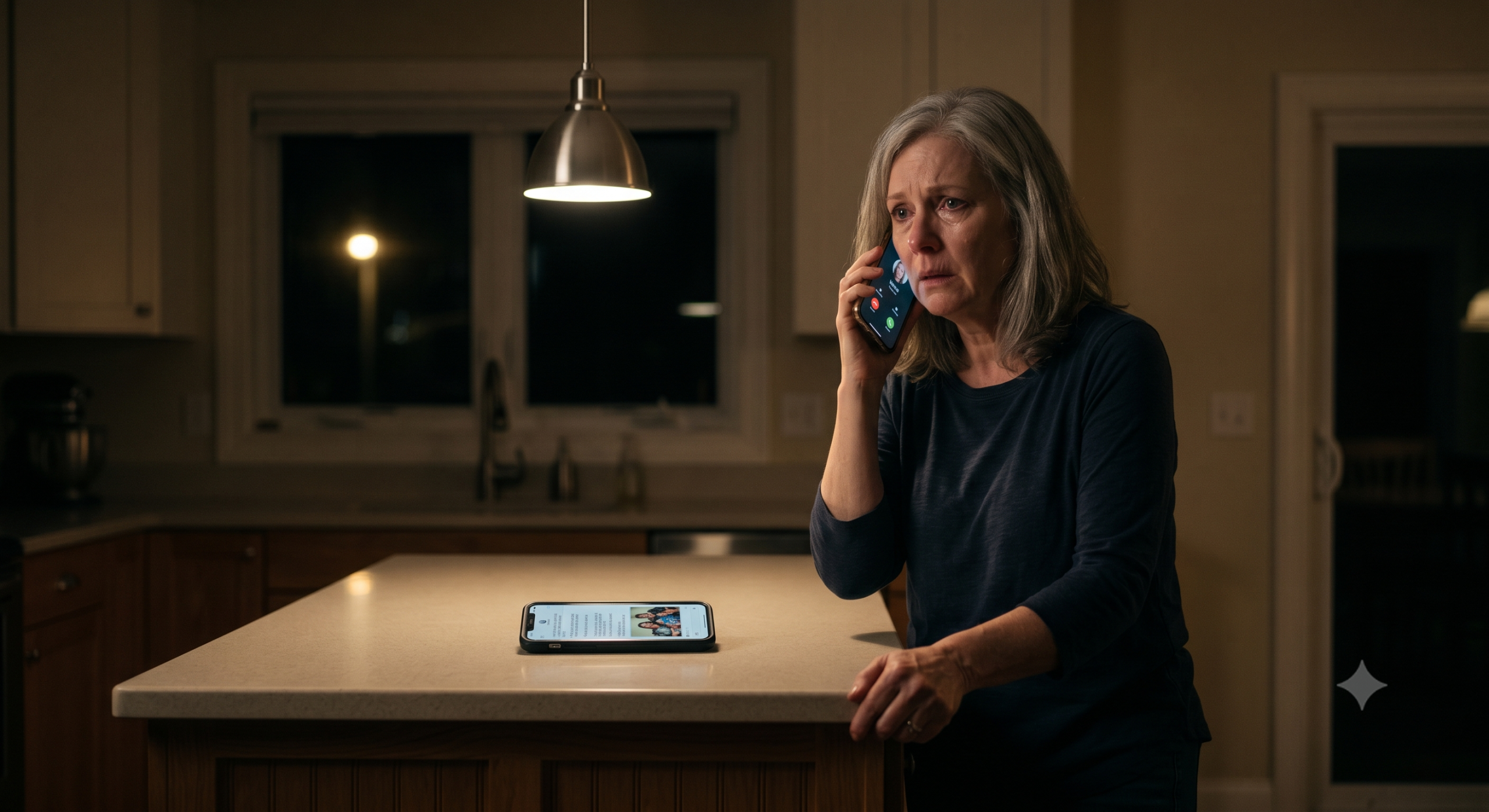
At 6:00 AM, I found her contact in his phone. She was simply saved as “Home.”
I pressed dial and put the phone to my ear. It rang exactly one time before she picked up.
“Hello?” Her voice was shattered. She had been crying all night, too.
“Sarah,” I said. My voice was eerily calm. “My name is Claire. I am the woman whose arm you pulled away from yesterday at the funeral.”
There was a silence so profound I could hear her breathing shaking on the other end of the line. The quiet stretched on for what felt like an eternity. I could hear the faint sound of cartoons playing in the background. Her children. His children.
Finally, she took a ragged, wet breath.
“He told me you were in a permanent care facility,” she whispered.
I closed my eyes. “What?”
“He told me you had early-onset dementia,” Sarah sobbed, the dam finally breaking. “He told me he met you when you were young, and that you got sick a decade ago. He said you didn’t know who he was anymore. He said you were living in a high-end memory care unit in Seattle, and that he only stayed legally married to you so your medical bills would be covered by his corporate insurance.
He told me he couldn’t abandon you, even though you were gone.”
The sheer sociopathic brilliance of the lie took my breath away. It explained his travels. It explained why she never pushed for a legal marriage. It made him look like a tragic, noble hero, selflessly caring for an ailing wife while trying to build a new life with her.
“I didn’t know,” Sarah cried into the phone. “I swear to God, Claire, I thought you were locked away in a hospital room with no memory of your life.
When I saw you standing by the casket, so young and healthy… I didn’t understand. I just wanted to say goodbye to the father of my children.”
We stayed on the phone for three hours. Two widows, piecing together the ghost of a man we both loved. We compared timelines, finances, and holidays. He had told me his company restructured his territory, requiring him to spend four days a week in the Pacific Northwest. He told her his company required him to travel to California three days a week. He maintained separate bank accounts, separate wardrobes, and an entirely separate emotional existence.
The man I buried wasn’t real. He was an actor playing two roles on two different stages, and he played them flawlessly until the day he died.
The legal fallout has been a nightmare. Because we were legally married, his life insurance and his primary estate defaulted to me. But the Portland house was structured in a way that protected her and the children.
I could have fought it in court. My lawyers told me I had a strong case to drain their assets based on marital fraud and the misuse of our joint funds to maintain his second life.
But I didn’t.
I looked at the photos of those three kids. They lost their father in a horrific accident. They didn’t ask to be born into a web of deceit. Punishing them wouldn’t give me my twenty-seven years back. It wouldn’t erase the betrayal.
I signed away any claim I had to the Portland house. I split his life insurance policy down the middle and wired half of it into a trust for the children’s college education.
Sarah and I don’t speak anymore. It’s too painful for both of us to be reminded of the other’s existence. I sold the house with the garage and the red Craftsman toolbox. I moved across the country to start over. People tell me I was too generous, that I should have destroyed her.
But the only person who deserved to be destroyed was the man in the mahogany casket, and he was already gone.