“Ava learned to read without a mother,” she said. She was standing in the doorway of my apartment, her wet coat dripping onto the gray rug I’d bought at a garage sale three years ago.
She was nineteen. She had my chin, the same slight crook in her nose, and her hair was tied back with a cheap yellow band.
She didn’t offer a hug. She didn’t cry. Her voice was just flat, like she was reading a list of ingredients from the back of a cereal box.
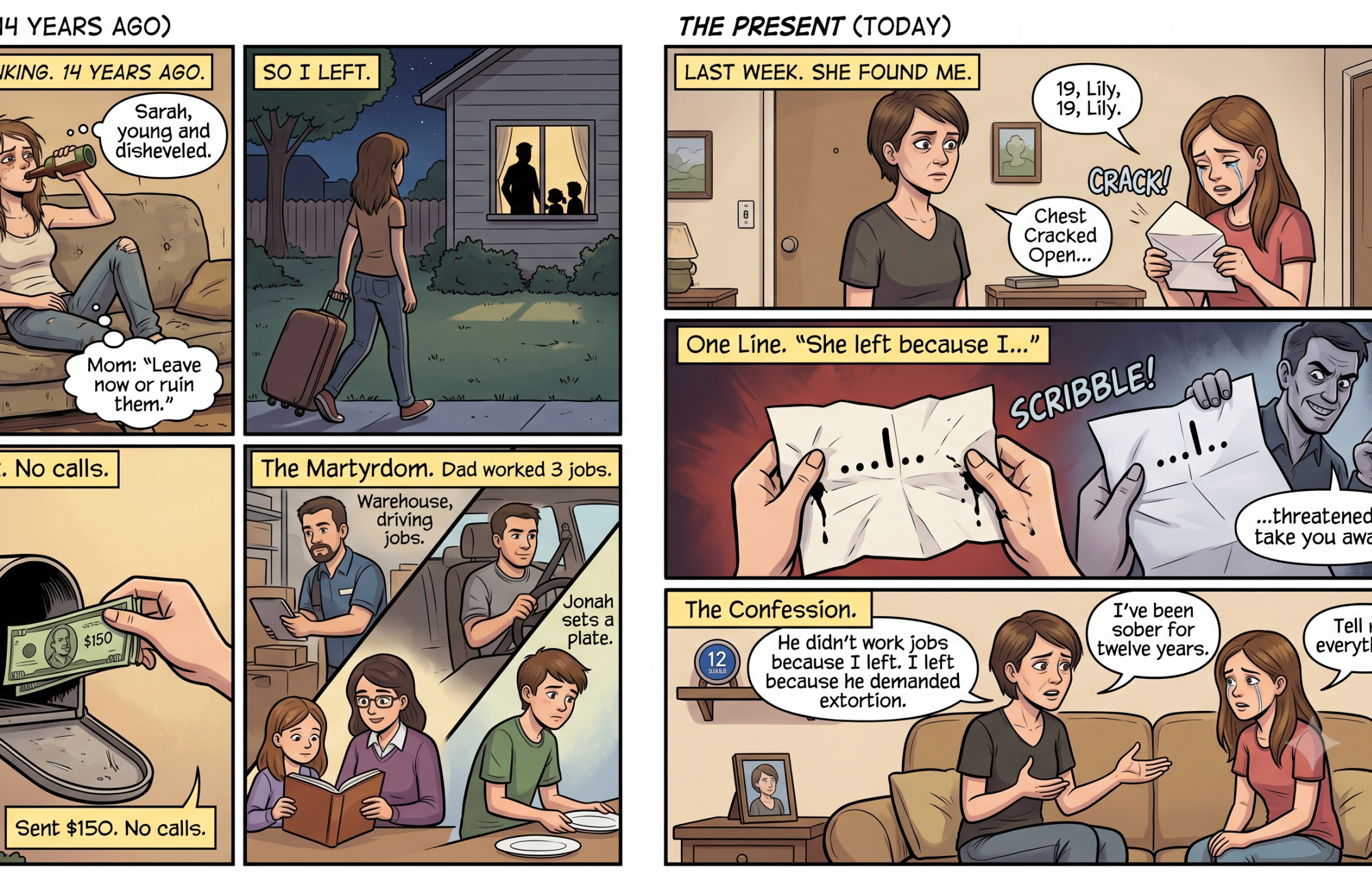
“Jonah still sets a plate for you at dinner,” she added. “He’s sixteen. He’s been doing it since he was eight because he thinks you’re just late.”
My chest tighted up so hard I couldn’t draw a full breath. I stood there, holding a blue ceramic mug with a chipped handle, feeling the heat of the tea seep into my palm. I didn’t know what to do with my hands. I didn’t know if I had the right to speak her name.
“Chloe,” I whispered.
She looked around my small kitchen. It was neat, but it was cheap. There was a single plate in the drying rack and a box of generic tea bags on the counter.
She seemed to be taking notes with her eyes, comparing this poor place to whatever life she had lived without me.
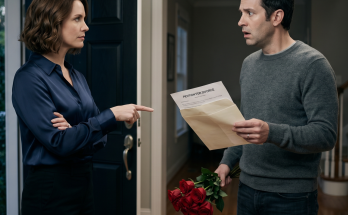
Then she reached into her pocket. She pulled out a small, yellowed envelope. The edges were slightly frayed, and her name was written on the front in a faded blue ink I recognized immediately.
“Dad wrote this the night you left,” she said. Her fingers lingered on the paper for a second before she dropped it onto the laminate table. “He gave it to me on my eighteenth birthday. He said I should only give it to you if I ever found you, and if I was ready to hear your side of things.”
I looked at the handwriting. It was Dan’s. He always made his capital letters too large, a habit from his days drafting layout plans for the machine shop. Seeing those letters made my mouth taste like iron.
I need to back up for a second. I know how this sounds.
When I was twenty-three, I was a disaster. We had three kids under five, and we were living in a drafty two-bedroom rental near the train tracks in Toledo. The babies cried in shifts. The laundry was always damp. Dan worked twelve-hour shifts at the shop, and when he came home, he was too tired to look at me.
I started drinking. It wasn’t social drinking. It was a desperate, quiet attempt to turn down the volume of the world. I’d hide cheap vodka behind the flour bin in the pantry. I thought I was being clever, but looking back, I was about as subtle as a car alarm.
My mother came over one rainy Tuesday when Dan was at work. She took one look at my eyes, then at Ava crying in her playpen with a dirty diaper, and she sat me down. She didn’t raise her voice. She just said, “You are going to ruin them, Clara. Leave now, get yourself right, or I will call the county myself.”
I believed her. I was terrified of the state taking my babies. I was terrified of myself.
That night, I packed a single duffel bag. I didn’t even take my winter coat. I took twenty dollars from the jar on the fridge and drove my old Buick across the state line to Indiana.
I want to tell you that I cried the whole way. I did. But the worst part, the part I have never said out loud to another living soul, is that when I crossed the state line, I felt a tiny spark of relief. I felt like I could breathe. I hate myself for that brief moment of freedom more than anything else I’ve ever done.
I got a job at a commercial laundry facility in Gary. The heat was brutal, and the smell of bleach made my eyes water, but it kept me busy.
Every month, without fail, I went to the grocery store and bought a one-hundred-and-fifty-dollar money order. I mailed it to the post office box Dan kept for his business.
I never called. I was told that calling would only confuse them, that they needed stability. Dan’s mother had told me that in a brief, cold phone call two months after I left. “They think you’re gone, Clara. Let them keep thinking that. It’s cleaner.”
So I lived in the quiet.
For fourteen years, my life was a cycle of hot steam, gray sheets, and the quiet walk back to my rented room.
I stopped drinking within a year of leaving, but the sobriety didn’t bring peace. It just made the memories sharper.
Not on Thanksgiving. Not on Christmas. Not when Ava turned five. I lived through every milestone by staring at the wall, wondering if they hated me, or if they’d simply forgotten the sound of my voice.
The ladies at my local church in Gary thought I was a quiet, respectable widow. They’d praise me for my work ethic. Every time they did, I felt like a thief.
Now, my nineteen-year-old daughter was standing in my kitchen, her boots leaving small puddles on my floor.
“Are you going to open it?” she asked.
My hands shook as I picked up the envelope. The paper was dry and stiff. I slid my thumb under the flap, tearing it unevenly. Inside was a single page of lined yellow paper, folded into three.
I unfolded it. The ink had faded to a dull gray, but the words were clear.
“She didn’t leave because she stopped loving you,” the letter began. “She left because I made her believe she was a danger to you. I told her the police were waiting to take her to jail for neglect if she didn’t get on the highway that night. I paid her mother five hundred dollars to back me up on it.”
I stopped reading. My eyes blurred. I had to squint to see the next line.
“The truth is, Clara was sick, but she wasn’t a monster. I just couldn’t stand the shame of a wife who couldn’t keep her head above water. I wanted to be the hero. I wanted you kids to look at me and see a saint who did it all alone.
I kept every money order she sent. They’re in the gray tin in the attic. I never spent a dime of them because using her money would make me feel like I owed her something. If you’re reading this, it means I’m gone, or you’ve grown up enough to realize your father is a liar.”
I let the paper drop to the table. It slid right next to Chloe’s wet purse.
“He’s not dead,” Chloe said. Her voice was still quiet, but there was a sharp edge to it now. “He’s living in Toledo.
He’s engaged to a woman who works at the bank. He still tells everyone at church about how he raised three kids on his own after his wife ran off with another life.”
I looked at her. “Chloe, I… I sent those money orders. I have the receipts in a shoebox under my bed. I kept every single one of them because I wanted to prove to myself that I was still trying.”
“I know,” she said. “I found the tin in the attic last week.
I was looking for old Christmas decorations, and I found the gray box. There were over a hundred money orders in there, Clara. All made out to him. All signed with your name.”
She finally sat down. She chose the chair with the loose leg, sitting on the very edge of it. She didn’t look at me; she looked at the letter.
“I confronted him,” she said. She reached down and touched the frayed edge of her sleeve. “He tried to say it was a long time ago. He said he did it to protect our childhood, so we wouldn’t have to grow up with a mother who was always in and out of rehab. He actually smiled when he said it. He said, ‘Look how well you all turned out.’”
That was the part that hurt the most. The wrong logic of a man who believed his cruelty was just a form of parenting. He had spent fourteen years building a monument to his own martyrdom, using our children as the bricks.
“What did you do?” I asked.
“I packed my car,” she said. She looked up, and for the first time, her eyes looked wet. “Ava’s fifteen now. She’s quiet. Jonah is the one who still waits. I told them both I was going on a trip. I didn’t tell him where I was going, but I think he knew when he saw the empty shelf in the attic.”
She looked at my small, cheap kitchen again. “It’s really quiet here.”
“It is,” I said. “It’s too quiet.”
We sat there for a long time. The tea in my mug went completely cold. I wanted to reach across the table and take her hand, but I didn’t have the courage. Fourteen years of absence is a wall you can’t just climb over in an afternoon. Every inch of space between us felt earned.
“Are you hungry?” I asked. It was a stupid question, but it was the only one I could find.
She shrugged. “I haven’t eaten since Ohio.”
I stood up and checked my fridge. There was some leftover chicken, a block of cheddar, and three eggs.
It wasn’t enough for a proper dinner, certainly not for a daughter you haven’t seen in over a decade.
“There’s a diner down the street,” I said. “They have decent pie. It’s warm inside.”
Chloe stood up, shaking her coat out. “Okay. Let’s go there.”
We walked out into the cold Indiana rain. The streetlights were just turning on, casting long, yellow reflections on the wet asphalt. We walked side by side, but we didn’t touch. We didn’t talk about Dan, or the money orders, or the fourteen years of dinners I had missed.
But as we reached the corner, she didn’t walk faster to stay ahead of me. She kept her pace matched to mine.
When we got to the diner, the bell above the door jingled. It was loud and warm inside, smelling of grease and burnt coffee. The waitress pointed us to a booth in the back near the kitchen.
Chloe slid into the vinyl seat. She took off her wet band, letting her dark hair fall around her shoulders. She looked so much like me it made my ribs ache.
“Jonah has a football game on Friday,” she said, staring at the laminated menu. “He plays defense. He’s not very good, but he likes the helmet.”
I swallowed the lump in my throat. “Does he?”
“Yeah,” she said. She looked up from the menu, her eyes steady. “It’s a six-hour drive. But the traffic isn’t bad if you leave after three.”
I looked at the salt shaker on the table, then back at her. The win didn’t fix the fourteen years. The letter didn’t make me a mother again, and it didn’t wash away the smell of the cheap vodka from my twenty-third year. But as the waitress came over with two glasses of water, I realized the door wasn’t locked anymore.
“I can leave by two,” I said.
Chloe nodded once, a small, tight movement of her chin. “Two is better. The bridge near the state line always gets backed up after four.”