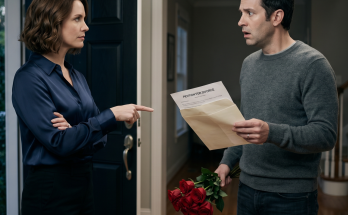
“There must be some kind of misunderstanding, Sarah,” the teacher said, her voice unusually quiet as she slid a piece of wide-ruled notebook paper across the desk.
I sat in the tiny, cramped classroom chair at Batavia Elementary, my coat still zipped up.
The room smelled of floor wax and stale crayons. My hands were shaking so badly I had to tuck them under my thighs to keep the teacher from seeing.
The paper she had slid toward me was Emma’s latest English assignment. The prompt at the top of the page read: My Hero.
My 10-year-old daughter had always been a quiet child, especially after her father, David, died in a construction accident three years ago. I worked ten-hour days at the Clermont County water billing department to keep our small home, which meant I relied on family more than I liked to admit.
I expected her to write about her father. Or maybe about me, since I spent every Sunday making her favorite pancakes and trying to make up for the hours I lost at my desk.
Instead, Emma’s messy cursive described a woman named Maeve.
“My hero is Maeve,” the essay began. “She works at the Sunoco on Route 4. She gives me turkey sandwiches when my belly is empty. She hugs me tight when the big trucks make a loud noise outside.
She lets me sit in the back room by the warm heater until I see my mom’s blue Buick drive past at 5:30.”
I stared at the page. My brain literally stopped working for a second. I read the words three times, but they wouldn’t settle in my head.
“Sarah,” Mrs. Gable said gently, leaning forward. “Does Emma go to the gas station after school?”
“No,” I whispered, my voice cracking. “She gets off the bus at 3:15 at my mother-in-law’s house. Brenda’s house is right at the corner of Route 4. She’s supposed to be watching her. I pay her $50 every single Friday.”
Mrs. Gable’s face went completely pale. She didn’t say anything, and honestly, that felt worse than if she had started yelling.
I stood up so fast my knees hit the underside of the small desk, rattling a cup of pencils. I didn’t even say goodbye. I grabbed the essay, ran out to my Buick, and sat in the driver’s seat with the engine idling.
I called Brenda immediately. My chest felt tight, like a band of metal was wrapping around my ribs.
Brenda answered on the fourth ring. I could hear the loud, obnoxious theme music of her afternoon game shows blasting in the background.
“Brenda, where is Emma?” I demanded, gripping the steering wheel.
“She’s fine, Sarah,” Brenda sighed, sounding incredibly annoyed that I had interrupted her program. “She’s sitting right here on the carpet eating her crackers. Honestly, you call me every single afternoon. You need to get your nerves checked.”
“Put her on the phone,” I said. My voice was dangerously flat.
“Oh, she’s in the middle of a show, Sarah. Don’t be ridiculous. I’ll see you at 5:30.”
She hung up.
I stared at the black screen of my phone. I didn’t drive back to the billing office.
Instead, I drove straight down Route 4, my tires throwing up slush from the gravel shoulder.
The Sunoco sat on a lonely stretch of highway, surrounded by dead cornfields and gray Ohio winter sky. It was a run-down place with rusty pumps and a flickering neon sign.
I parked near the door, my heart pounding in my throat. I had passed this station every single evening on my way home from work, never once realizing my child was inside.
I walked through the door, and the little bell chimed. The store smelled of stale coffee, diesel fuel, and floor cleaner.
Behind the counter stood an older woman with silver-gray hair pulled back in a messy bun. She was wearing a faded red Sunoco apron over a thick gray sweatshirt. Her eyes were kind, but they looked incredibly tired.
On the counter sat a small wire rack of cheap three-dollar sandwiches.
“Can I help you?” she asked, her voice soft and gravelly.
I walked up to the counter. I pulled the purple plastic lunchbox out of my bag and set it on the laminate surface.
It was the purple lunchbox I packed for Emma every single morning at 6:00 AM. I always put a ham sandwich, an apple, and a juice box inside.
“Do you know who owns this?” I asked, my voice trembling.
The woman’s eyes fixed on the purple plastic. Her expression changed instantly. The professional smile vanished, replaced by a deep, aching pity.
“Are you Emma’s mom?” she asked quietly.
I nodded. I couldn’t speak. My throat felt completely blocked.
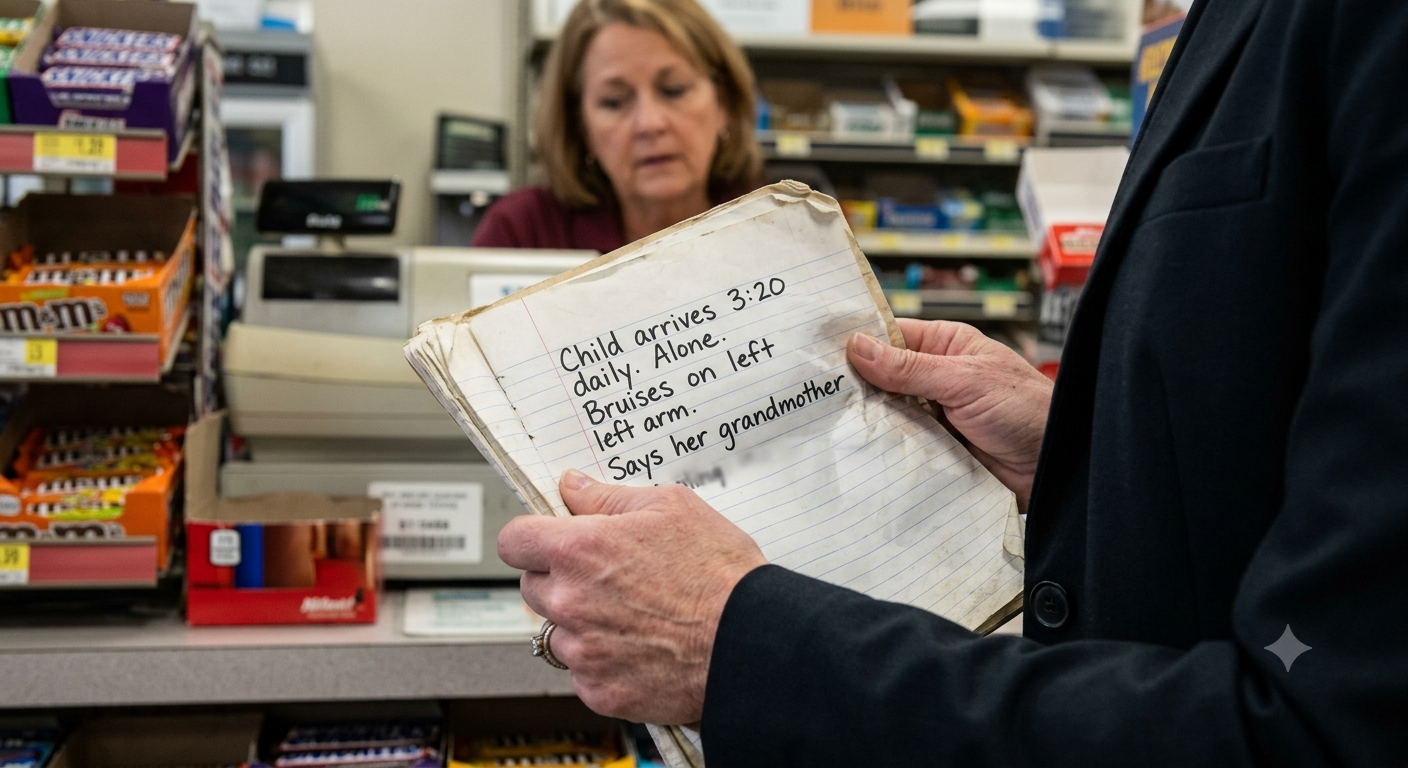
She reached under the counter, past the rolls of lottery tickets and the register tape. She pulled out a blue spiral notebook with a yellow puppy sticker on the front. The edges of the cover were frayed and worn.
“My name is Maeve,” she said, sliding the notebook toward me. “I’ve been waiting for you to come in. I didn’t want to call child services yet because I was afraid of what it would do to Emma. But I started keeping track. Just in case.”
I opened the cover. The first page was dated October 14.
“Child arrived at 3:22 PM,” the entry read in neat, blue ink. “No coat. Temperature is 42 degrees outside. She was sitting on the concrete curb behind the ice machine. Said her grandmother’s car wasn’t in the driveway and the house was locked. Brought her inside. Gave her half of my turkey sandwich and a cup of warm water.”
I felt sick to my stomach. My vision blurred as I turned the pages.
There were 47 entries.
Forty-seven days of my child being left out in the cold. Forty-seven days of my mother-in-law pocketing my hard-earned money while leaving my daughter to wander along a busy state highway.
“November 3,” I read, my hands shaking so badly the paper rustled. “Emma has a large, dark bruise on her left upper arm.
She was very quiet today. When I asked her about it, she started crying. She said her grandmother grabbed her by the shoulder and threw her out of the house because she was making too much noise while her grandmother was on the phone with her friends from church.”
I stopped breathing. I remembered that bruise. Emma had told me she fell on the school playground. I had believed her because I was too tired, too distracted by bills, too busy trying to keep our heads above water.
“She’s a good kid, Sarah,” Maeve said, reaching across the counter to touch my hand. “She never asks for anything. She just sits in the back office on an old milk crate and reads her library books. But last week, when the temperature dropped to twenty degrees, her grandmother wasn’t even home. I drove by the house myself. The lights were out. The car was gone. She was at the casino in Indiana. I know she goes there on Thursdays.”
An older, steadier anger rose inside my chest. It wasn’t the kind of anger that makes you scream. It was cold. It was absolute.
“Thank you, Maeve,” I said quietly. I took the blue spiral notebook and tucked it into my bag.
“What are you going to do?” Maeve asked, her eyes full of concern.
“I’m going to end this,” I said.
I walked out to my Buick and called the Clermont County Sheriff’s Department. I didn’t shed a single tear. I told the dispatcher exactly what was happening, gave them the address of the Sunoco, and then drove the three miles to Brenda’s yellow ranch house on Route 4.
When I pulled into the gravel driveway, Brenda’s silver sedan was parked in its usual spot. The television was blaring so loudly I could hear it from the porch.
I didn’t knock. I opened the door and walked right into the living room.
Brenda was sitting in her plush recliner, a bowl of buttered popcorn in her lap, watching a game show. She didn’t even look up when I walked in.
“Sarah, you’re early,” she grumbled, her eyes glued to the screen. “I told you, Emma is fine. She’s down in the basement playing.”
“Emma isn’t in the basement, Brenda,” I said. My voice was dangerously calm.
Brenda finally looked at me, her expression turning smug. “Of course she is. Don’t start with your drama, Sarah. You’ve been high-strung ever since David died.”
Just then, a knock sounded at the front door. I opened it, and Deputy Miller walked in, his heavy boots thudding against Brenda’s linoleum floor.
Brenda’s face instantly lost its color. She stood up from her chair, the bowl of popcorn slipping from her lap and spilling across the carpet. “What is the meaning of this? Sarah, what have you done?”
Deputy Miller didn’t waste any time. He looked at Brenda, his jaw set. “Ma’am, we received a report of child neglect and endangerment. We have security footage from the Sunoco station down the street showing your granddaughter arriving there unsupervised every afternoon for the last two months.”
“That’s a lie!” Brenda shrieked, her voice cracking as she pointed a trembling finger at me. “She wanders off! She’s a difficult child! I tell her to stay in the yard, but she doesn’t listen to me! Sarah is just trying to ruin my reputation because she’s greedy!”
I stepped forward and pulled the blue spiral notebook from my bag. I laid it on the coffee table right next to her half-empty glass of sweet tea.
“This is Maeve’s notebook, Brenda,” I said, staring directly into her cold, panicked eyes. “There are 47 entries in here. Every date. Every time you locked her out. Every bruise you gave her. Maeve took photos of the bruises too. The deputy has them now.”
Brenda opened her mouth to speak, but nothing came out. The smugness was completely gone. She looked small, old, and incredibly pathetic.
Deputy Miller stepped behind her. “Brenda Vance, you are under arrest for child endangerment and battery on a minor.”
The handcuffs clicked in the quiet living room. Brenda didn’t scream anymore. She just stared at the floor as the deputy led her out the front door, past the neighbors who had gathered on their lawns to watch.
I stood in her quiet house for a second, looking at the spilled popcorn on the rug. I should have felt some massive wave of triumph. I keep waiting to.
Mostly, I just felt a deep, heavy exhaustion.
I drove back to the Sunoco. Emma was sitting on the milk crate in the back office, eating a turkey sandwich and reading a chapter book. When she saw me, her eyes went wide.
“Mom?” she asked, looking down at her purple lunchbox. “Am I in trouble?”
I walked over, knelt in the dust of the supply room, and pulled her into my arms. I held her so tight I could hear her tiny heart beating against my collarbone.
“No, sweetie,” I whispered into her hair. “You’re not in trouble. We’re going home.”
Maeve stood in the doorway, her hands tucked into her red apron. She gave me a quiet, knowing nod.
That was three months ago.
Brenda’s trial is next month, and her lawyer tried to ask for a plea deal, but the prosecutor refused. The 47 entries in the blue notebook were too detailed, too undeniable. She won’t be setting foot near my daughter ever again.
As for us, things are different now. I moved my hours at the county office so I can pick Emma up from school myself at 3:15 PM.
Every Thursday, we stop by the Sunoco on Route 4. Maeve doesn’t work the register anymore because I helped her get a job at the school library where she has dental insurance and regular hours.
Yesterday, Emma slid her new essay across our kitchen table. The title at the top read: My Family.
There were three drawings on the page. Me, Emma, and Maeve holding a blue notebook with a yellow puppy sticker.
I smiled, and for the first time in three years, the knot in my stomach was completely gone.