Inside, the shed smelled of dry peat moss, iron, and old fertilizer. Marie’s green plastic seed box was sitting on the wooden workbench, covered in a thin layer of gray dust.
I blew the dust off the lid and flipped the metal latches. The inside of the box was dry and clean.
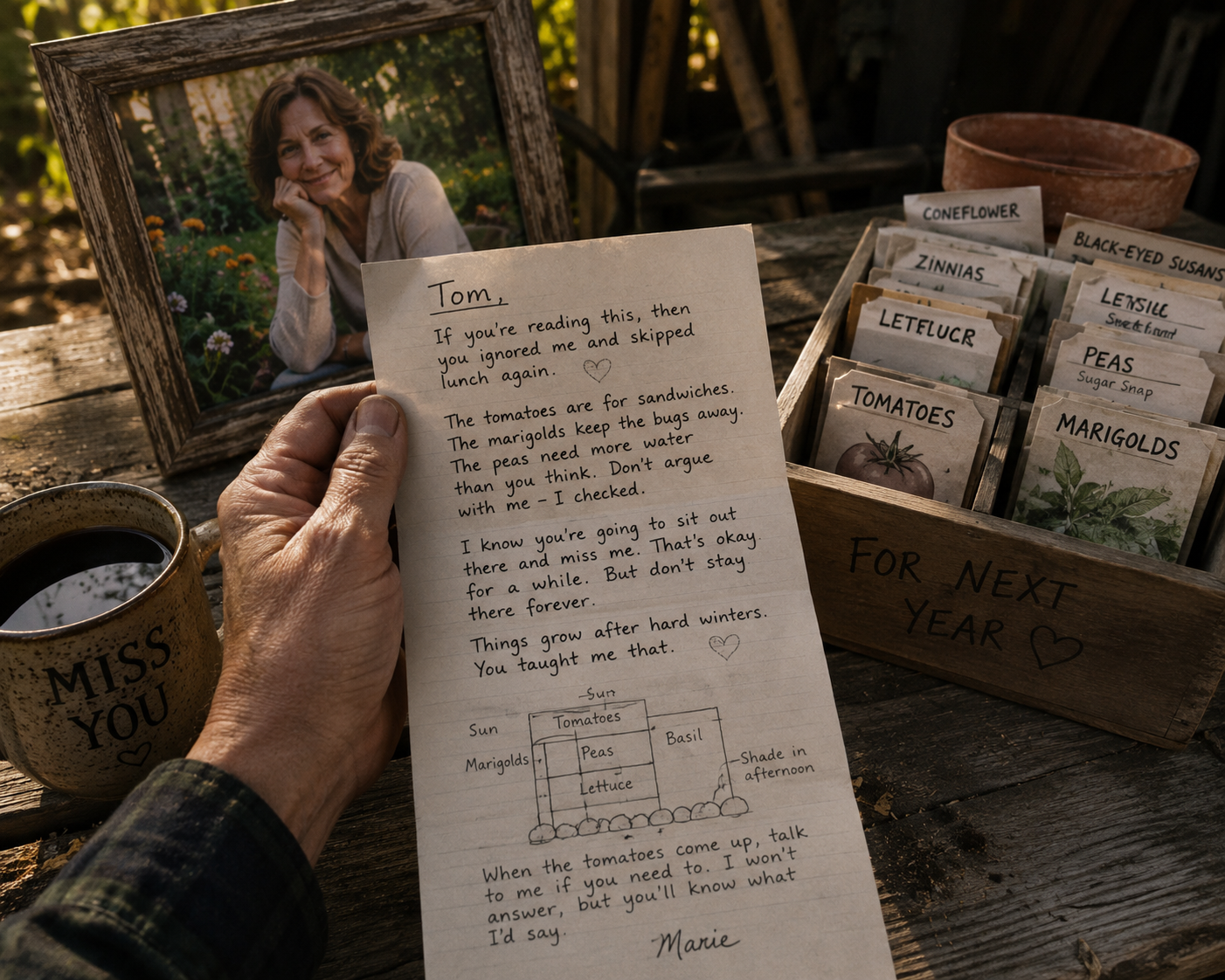
There were dozens of paper packets, each one organized by planting date, just like she had done for forty years. But as I began to lift them out, I noticed her handwriting was different on the newer envelopes.
It was looser. A bit shaky.
On the envelope labeled “Beefsteak – Bed 2,” she had written: “Ray’s favorite. Plant deep. He likes them with salt right off the vine.”
I could feel the heat rising in my face. I kept digging.
At the very bottom of the box, underneath the packets of green beans and yellow squash, there was a folded piece of yellow notebook paper. My name was written on the outside in her neat cursive.
My hands shook so badly the paper rustled like dry leaves in the quiet shed.
I unfolded it, and the first line was written in her shaky, loose cursive.
It said: “Ray, if you are reading this, it means the early tomatoes came up by themselves, just like I knew they would, and you are probably sitting in the dirt crying instead of working.”
I let out a wet, ragged breath and leaned against the dusty workbench.
The letter was three pages long, written on the yellow legal pads she used to bring home from the county courthouse.
“I need to tell you the truth, Ray,” the letter continued. “And I need you to promise me you won’t be mad.”
She went on to write that she had known about the cancer three months before she ever took me to the hospital. She had gone to the clinic by herself back in July, while I was busy fixing the roof on the garage.
The doctor had told her then that the treatments would not give her much more time, maybe a year at best, and that she would spend most of that year in hospital beds if she chose to fight it.
“I knew what you would do, Ray,” she wrote. “You would have stopped living. You would have sat by my bed and watched me fade, and you would have died right along with me. I could not let you do that.”
So she chose to keep the secret. She spent her last summer making sure every single bed was prepped, adding extra compost to the soil, and leaving enough seeds to last me for five years.
She planned a garden for me. She mapped out every bed on the back page of the letter, drawing little circles and squares with her blue ballpoint pen.
“I bought the seeds ahead of time, Ray. They are already paid for. You don’t have to spend a dime of the savings. But you have to put them in the ground.
If you don’t, they will rot, and you know how I hate waste.”
I stood there in the quiet shed, holding those yellow pages, and I realized how much love she had packed into that little green box.
She had carried that heavy secret all through the hot days of August and September, humming her little hymns while her body was failing, just to buy me a few more months of peace.
She had planned my survival while she was preparing to die.
I walked back to the house, carrying the green box under my arm like it was made of solid gold.
I went to her old sewing cabinet in the hallway, the one with the sticky bottom drawer I had avoided for months.
I pulled it open.
Inside, resting on top of her extra spools of green thread, was her old pair of leather gardening gloves.
They were still molded to the shape of her hands, with dark dirt dried into the leather knuckles.
I picked them up and put them on. They were too small for me, the leather tight across my palms, but they felt warm.
I took her small hand shovel from the drawer, the one with the wooden handle she had wrapped in green electrical tape to keep from getting splinters.
I went back out to the garden.
I did not care about my slippers or my old cardigan. I got down on my knees in the dirt, and I started clearing away the dead, tangled vines of the past winter.
By three o’clock that afternoon, the north bed was clean. My hands were dirty, and my back was sore, but I felt lighter than I had in months.
My daughter Sarah drove up the gravel driveway around four. The door of her car slammed in the quiet afternoon, and she walked around the corner of the house.
She stopped dead in her tracks.
I was standing there in the middle of the yard, her mother’s green gloves on my hands, holding a tray of her early girl seedlings.
“Dad?” she said, her voice shaking just a little.
“The north bed needs some extra lime, Sarah,” I said, wiping my forehead with the back of my hand. “Your mother said so in her letter.”
Sarah did not say anything for a second and honestly that felt worse. Then her face softened, and she set her purse down on the grass.
She walked over and took the other side of the seedling tray. We worked until the sun went behind the neighbor’s garage, putting the small green plants into the warm earth.
My back was sore, and my knees were aching, but for the first time since October, the air in my lungs tasted clean.
As we were walking back to the porch, a little bluebird landed on the wire tomato cage and let out a quick, sweet whistle.
It was not a whole song. Just three or four notes.
I stopped and listened for a second, and I did not feel the tears this time.
I just looked down at the dark, fresh dirt, and I knew we were going to be just fine.
End of story.