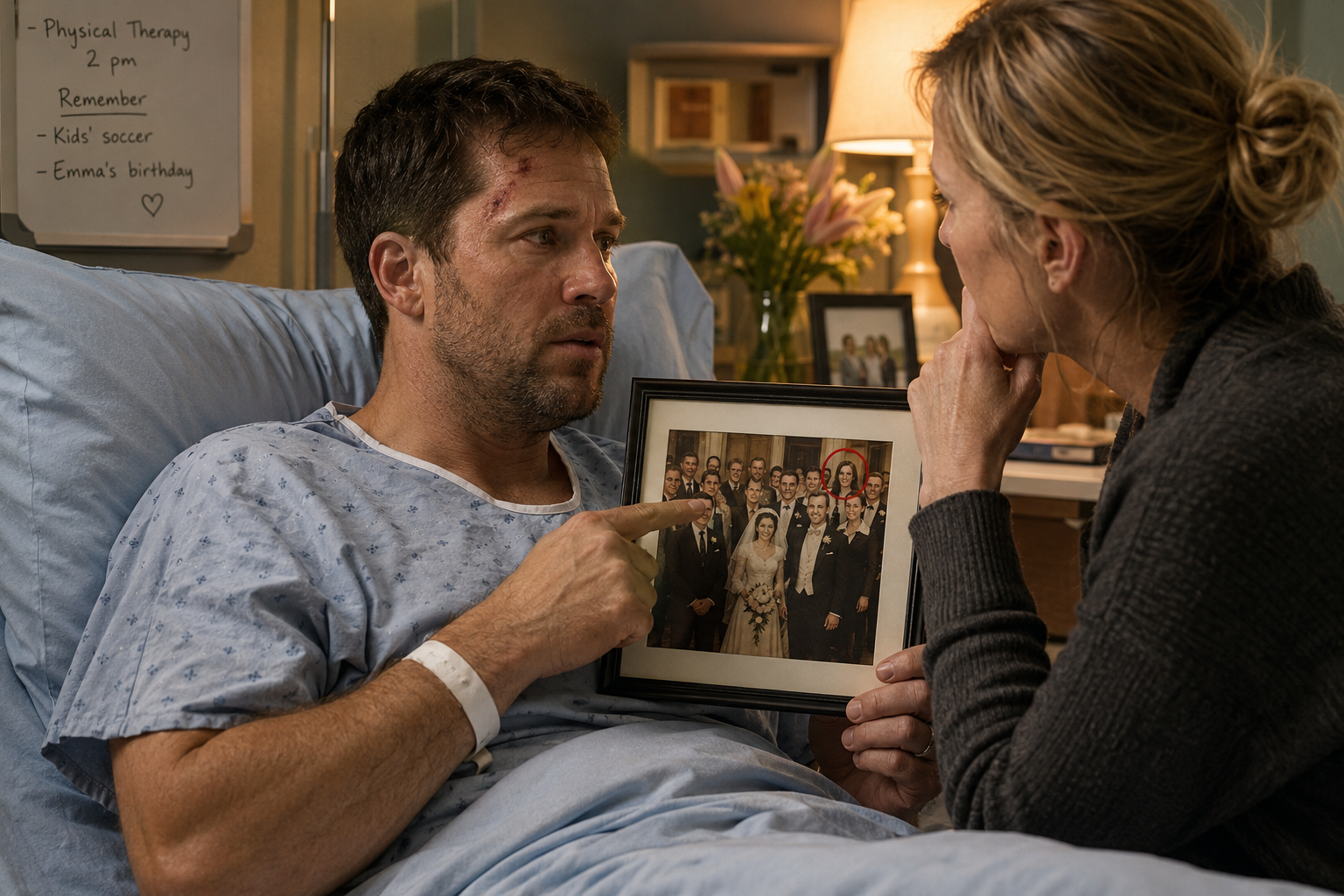
“Who is that woman in the back row?” David asked, his voice rough and dry, like gravel sliding around in a tin can.
He was pointing his pale, trembling finger at the silver frame sitting on the hospital nightstand.
It was our wedding photo.
We had been married for 24 years, and that photo had sat on our mantelpiece through three different house moves, two pregnancies, and decades of dust.
But right then, in Room 412 of the county hospital, it felt like a cold hand had reached out of the frame and grabbed me by the throat.
David had been out of his coma for exactly two weeks after a terrible car cr*sh on Route 4.
He didn’t know my name. He didn’t know our house. He had looked at our teenage kids, Bobby and Clara, like they were two polite strangers who had wandered into the wrong room.
But he was staring at that photo with a terrifying intensity.
I leaned closer, my eyes straining to see what he was looking at.
There, in the very back row of our outdoor wedding reception, standing just behind my cousin’s shoulder, was a woman.
Her face was slightly out of focus, blurred by the cheap lens of our budget photographer. She had dark hair, and she was wearing a yellow dress.
I had never noticed her. Not once. In 24 years, I had never looked past the smiling faces of our immediate family.
“David, I don’t know,” I whispered, my voice shaking. “Maybe she was one of my mother’s friends from church? Or a plus-one? Why?”
He looked up at me, and for the first time since he woke up, there was actual emotion in his eyes. It wasn’t warmth. It was pure, unadulterated terror.
“She visited me,” he said. He had to stop to swallow, his throat clicking. “Every night. As soon as the sun went down. Right after you went down to the basement cafeteria to get that terrible coffee.”
My stomach dropped. I stopped breathing. I actually felt the room spin for a second, and I had to grab the edge of his bed rail to keep my balance.
“David, that’s impossible,” I said, trying to keep my voice calm for his sake. “No one is allowed in ICU after 8 PM. The nurses are right there at the desk. I only leave for fifteen minutes to get a cup of tea and a gelatin cup from the vending machine.”
“She was there,” he insisted, his voice rising, becoming thin and frantic. “She held my hand. Her hand was cold, but she held it tight. She told me things, Clara.”
He used my name.
My heart did a strange, painful leap. He had forgotten my name for two months, but now, in his panic, it just slipped out.
“What did she tell you?” I whispered, leaning in so close I could smell the antiseptic hospital soap on his skin.
“She said she isn’t a stranger,” David said, staring at the blurred woman in the yellow dress. “She said she’s my twin sister. And she said the cr*sh wasn’t an acc*dent.”
I need to back up for a second. I know how insane this sounds.
If you had told me three months ago that I would be sitting in a hospital room listening to my brain-injured husband spin a conspiracy theory about a secret twin, I would have laughed.
We were normal people. David worked at his family’s construction business with his older brother, Mark. I worked as a receptionist at a local pediatric dental office.
We lived in a modest ranch house in Ohio, clipped coupons, drove old Buicks until the rust ate the quarter panels, and spent our weekends taking our kids to soccer games.
We had bills. Oh, god, we had bills. The hospital ledger was already sitting at $187,000, and my insurance company was already sending me those complicated, terrifying forms that basically said they were looking for any excuse not to pay.
I was exhausted. I had been sleeping on a cracked blue vinyl chair in David’s room for three weeks straight while he was in the coma.
My back felt like a solid sheet of pain, and my hair was permanently tied back in a messy bun because I didn’t have the energy to wash it.
David’s brother, Mark, had been our rock. Or, at least, that’s what I thought at the time.
Mark had been coming over to the house every single evening. He would sit at our kitchen table, drink our instant coffee, and help me sort through the stacks of medical bills.
“Don’t worry about the money, Clara,” Mark would say, patting my hand with his big, calloused fingers. “We’ll figure it out. The business has some cash reserves. But we might need to restructure things. You know, since David might not be able to come back to work for a long time. Maybe ever.”
I was so grateful for him. I remember thinking, thank god for family. I actually defended Mark to my sister when she said he was acting a little too eager to look through our financial papers.
I feel so incredibly stupid when I look back on that now. But at the time, when you are drowning in debt and your husband is hooked up to a machine that breathes for him, you grasp at any hand that is offered to you.
But now, sitting in the quiet room with David, looking at that silver frame, those sweet memories of Mark’s support began to curdle.
“David,” I said, my voice barely a squeak. “You don’t have a sister. Your parents only had you and Mark. You know that. We’ve been together since we were twenty.”
“My parents lied,” David said. He looked exhausted now, his head sinking back into the flat hospital pillow. “She told me they adopted me. She said she was given to another family because our biological mother couldn’t afford two babies.
She said she found me online three years ago, but she was too afraid to reach out until she saw the news about the cr*sh.”
I stared at him. “And the cr*sh? Why would she say it wasn’t an acc*dent?”
David closed his eyes. “She said Mark knew. She said our adoptive father left a secret trust fund that only activates if both of us are alive, or if one of us… d*es.
Mark found out. He wanted the whole construction business, Clara. He knew if I found out about the adoption, the business would have to be split three ways instead of two.”
It was too much. My brain was rejecting the information like a bad organ transplant.
It sounded like a cheap daytime soap opera. Secret twins? Tampered brakes? Trust funds? We were normal people from Ohio. This didn’t happen to us.
But then I remembered the day of the cr*sh.
David had been driving his favorite old Chevy truck down the steep hill on Miller Road. The police report said the brake lines had ruptured due to “corrosion and wear.” It was an old truck, after all.
But Mark had been the one who did the oil change on that truck the weekend before. He had offered to do it in our driveway to save us twenty dollars.
I stood up from the vinyl chair. My knees felt weak, like they were made of water.
“I’ll be right back,” I told David. He didn’t answer. He was already drifting back to sleep, his breathing heavy and uneven.
I walked out of Room 412 and straight to the nurse’s station.
Nurse Linda was there, typing on her computer. She was a nice older woman who had smuggled extra blankets to me on my cold nights in the ICU.
“Linda,” I said, leaning over the high counter. “I need to ask you something. It’s going to sound weird.”
She looked up, her reading glasses sliding down her nose. “What’s on your mind, sweetie?”
“Has anyone else been visiting David? At night? When I go down to get coffee?”
Linda frowned. She looked at her computer screen, then tapped a few keys. “No, Clara. Only you and his brother, Mark. Mark usually comes by in the afternoons, and you’re here all night.”
“Are you sure?” I pressed, my heart hammering against my ribs. “No one else? No woman?”
“Well,” Linda paused, her brow furrowing. “Now that you mention it, there was a woman who came by last week during the evening shift change. Around 8:15 PM. She said she was a cousin from out of town.
I told her visiting hours were over, but she looked so desperate. I might have let her slip in for five minutes while I was doing my charting. I didn’t think it would hurt anyone.”
My jaw tightened. “Did she have dark hair? Was she wearing a dark coat?”
“Yes,” Linda said, looking a little guilty now. “I’m sorry, Clara. Did she cause trouble?”
“No,” I whispered. “No trouble.”
I walked down to the basement cafeteria. I didn’t get coffee. I just sat at one of the sticky laminate tables under the harsh fluorescent lights and stared at my hands.
They were shaking.
I took out my phone and dialed our family lawyer, a man named Bob who had handled my father’s estate. We had known him for years.
“Bob,” I said as soon as he answered. “I need you to look up David’s father’s will. The original one from 1998. And I need to know if there’s any mention of a trust or an adoption.”
Bob sounded confused. “Clara, what is this about? David’s father passed fifteen years ago.”
“Just please look,” I begged, my voice breaking. “I have a really bad feeling about this.”
He sighed. “Okay. Give me an hour. I’ll have my secretary pull the archive files from the basement.”
I didn’t go back to David’s room right away. I went to the hospital chapel, a tiny, windowless room with two wooden pews and a fake stained-glass lamp. I sat there in the silence, trying to make the pieces fit.
Mark had been so eager to help with the bills. He kept asking me to sign a power of attorney so he could “handle the business accounts.” He said it would take the pressure off me.
I had almost signed it. I had the paper sitting in my purse right now.
Forty-five minutes later, my phone buzzed. It was Bob.
“Clara,” his voice was different now. The casual, friendly tone was completely gone. It was sharp, professional, and very quiet. “Are you in a safe place to talk?”
“Yes,” I said, clutching the phone to my ear. “What did you find?”
“There is a rider attached to the original partnership agreement of the construction company,” Bob said. “It was drafted by David’s father before he d*ed. It states that if David is ever deemed legally incompetent or if he… passes away without biological heirs, his entire fifty-percent share of the company assets reverts immediately to Mark. But there’s also a secondary file. An adoption disclosure. David was adopted in 1974. From a private clinic in Cleveland. And Clara… there was a twin sister listed on the original surrender documents. A girl named Sarah.”
I felt a cold, hard knot form in my chest.
It was all true.
Mark didn’t want to help me with the bills. He wanted me to sign that power of attorney so he could declare David incompetent and take the entire business. He had probably been planning this for months.
And the cr*sh… the cr*sh was his way of making sure David never found out about his real identity.
I didn’t cry. I didn’t scream. Something older and steadier rose up inside me.
“Bob,” I said calmly. “Don’t do anything yet. I’m going to call the sheriff’s office. And I need you to meet me at the hospital tomorrow morning.”
The next afternoon, Mark showed up at the hospital. He was wearing his work boots and his heavy flannel shirt, carrying a cardboard tray with two coffees.
“Hey, Clara,” he said, smiling his warm, easy smile as he walked into Room 412. “How’s our boy doing today? Any changes?”
David was sitting up in bed. He looked pale, but his eyes were clear.
I was standing by the window. Bob was sitting in the vinyl chair, holding a manila folder.
And standing in the corner of the room, behind the privacy curtain, was a woman with dark hair.
She was wearing a simple yellow sweater. She looked so much like David it made my breath hitch.
Mark stopped in his tracks. The cardboard coffee tray slipped from his hand, spilling hot liquid all over the linoleum floor.
He looked at the woman in the corner. His face went from healthy, outdoorsy red to a pale, sickly gray in three seconds flat.
“Who… who is this?” Mark stammered, his voice cracking.
“You know who she is, Mark,” I said, stepping away from the window. “This is Sarah. David’s sister.”
Mark tried to laugh, but it sounded like a choke. “Clara, what is this nonsense? David doesn’t have a sister. You’re losing your mind from the stress. Let’s go home. Let’s get you some rest.”
“We found the surrender documents, Mark,” Bob said, opening the manila folder. “And we also found the email exchanges on your work computer. The ones where you paid a mechanic named Carl three thousand dollars to ‘inspect’ David’s truck the night before the cr*sh.”
Mark’s mouth opened and closed. He looked like a fish gasping for air. He looked at David, then at Sarah, then at the door.
Two sheriff’s deputies stepped out of the hallway, blocking his exit.
“Mark,” Deputy Miller said, stepping into the room. “We need you to come down to the station for some questions regarding a vehicular assault investigation.”
Mark didn’t say a word. He didn’t yell. He didn’t defend himself. He just looked at the floor, his shoulders slumping, and let the deputy lead him out of the room.
I stood there for a long time, listening to the squeak of their boots fading down the corridor.
Sarah walked over to David’s bedside. She reached out and took his hand. It was a little awkward. They were strangers, really. They had fifty years of missed birthdays and empty dinners between them.
But David didn’t pull away. He held her hand tight.
He looked up at me, and his eyes were still patchy, still filled with the fog of the brain injury. He still didn’t remember our daughter’s middle name, or the color of our kitchen cabinets, or the trip we took to Niagara Falls for our tenth anniversary.
But he knew I was his wife.
“Clara,” he said softly. “I’m sorry.”
“It’s okay, David,” I said, sitting on the edge of the mattress and taking his other hand. “We’re going to figure it out.”
We didn’t get a perfect, happy ending. The construction company went into temporary receivership while the legal mess was sorted out, and we are still struggling to pay off those massive hospital bills.
Mark is currently awaiting trial, and his mother refuses to speak to us because she says we ruined her family.
But yesterday, Sarah came over to our house for dinner.
She brought a batch of homemade peach cobbler. It was a little burnt on the edges, but nobody cared.
David sat at the head of the table. He got confused twice during dinner, calling Bobby by his brother’s name, but we just laughed and corrected him.
We are building something new. It’s messy, and it’s complicated, and some days I still feel like crying when I look at our bank account.
But we are moving forward. And that’s basically where things are now. I still don’t really know how to feel about any of it, but at least we are finally telling the truth.