Rose and I walked every morning for fifty-two years.
Two housecoats at dawn, down to the corner and back, through four presidents I liked and several I didn’t.
We buried husbands and raised each other’s grandchildren and never once ran out of things to say.
She died in January, on a Tuesday, the kind of cold morning we’d have skipped anyway.
I still walk.
I won’t pretend it’s the same.
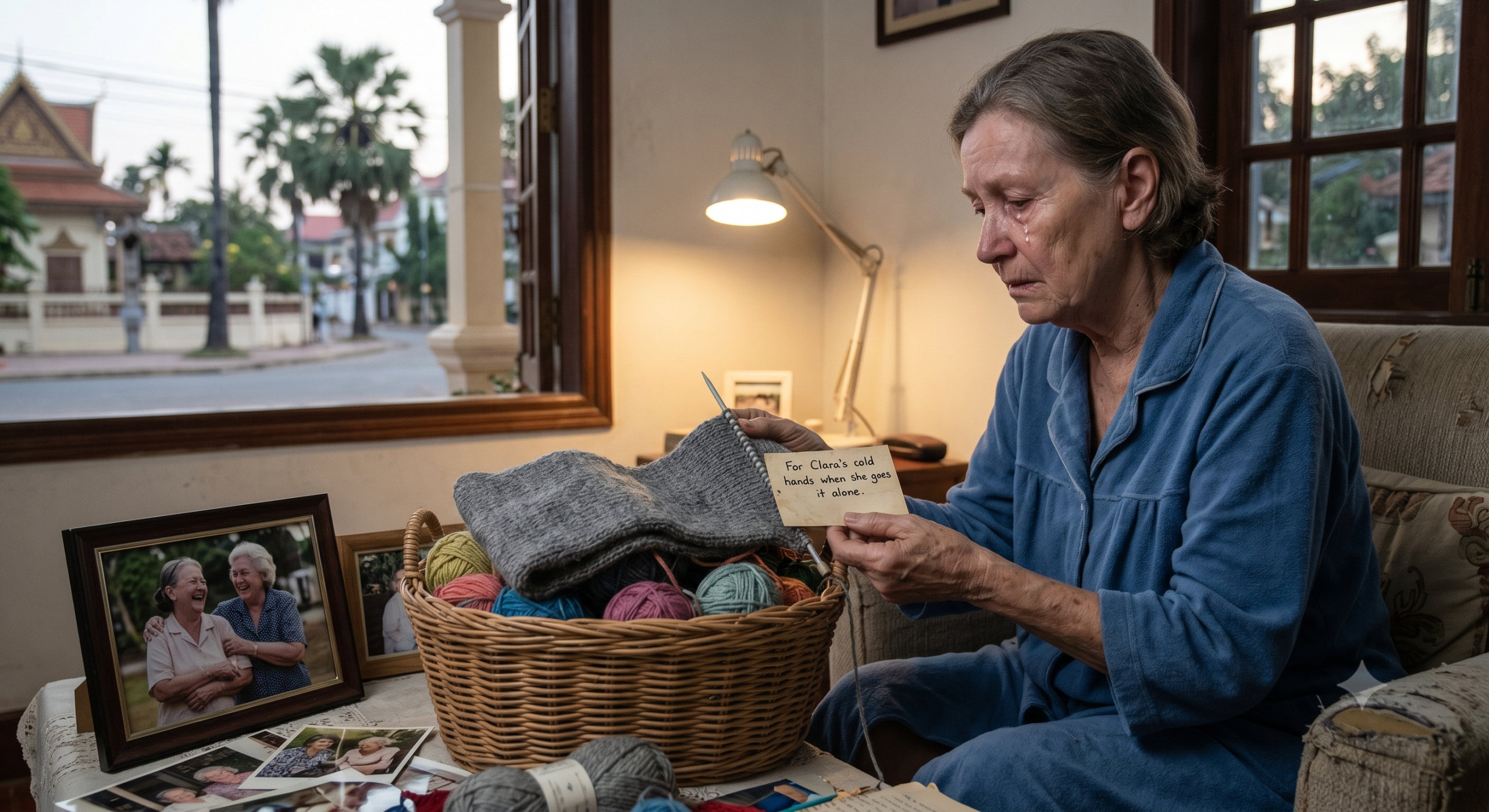
Last week her daughter came by with a basket of Rose’s knitting because, she said, her mother would haunt her if it went to the church sale unsorted.
At the bottom was something half-finished, soft gray wool, my size.
Pinned to it was a little paper tag in Rose’s handwriting.
My hands started shaking before I even read it.
Rose had beautiful handwriting. Neat. Careful. The kind they don’t teach anymore.
The tag said:
“For Evelyn. Finish before next winter.”
I laughed.
Then I cried.
Because Rose wasn’t the one who ran out of time.
I was.
There was a knitting needle still threaded through the last row.
A pair of reading glasses tucked into the basket.
And beneath the scarf was a small notebook I’d never seen before.
“What’s this?” I asked.
Her daughter frowned.
“I don’t know. Mom never showed it to me.”
I opened it.
The first page read:
WALKING NOTES
Below that were dates.
Hundreds of them.
Years’ worth.
Every few pages there’d be a short entry.
“Evelyn finally bought a new pair of shoes.”
“Evelyn swears she doesn’t like chocolate cake. She is lying.”
“Evelyn laughed so hard today she snorted tea.”
I couldn’t stop smiling.
Rose had been keeping notes about our walks.
About me.
About us.
Then I reached an entry from three months before she died.
The smile vanished.
Written in careful blue ink were the words:
“Doctor says the treatment isn’t working anymore. Haven’t told Evelyn yet.”
I froze.
The next line made my heart sink even further.
“There are things she doesn’t know. Things I’ve carried for fifty-two years.”
And underneath that:
“If I don’t get the chance to tell her myself, the letter in the blue envelope must be given to her.”
I looked up at Rose’s daughter.
“Did you find a blue envelope?” I whispered.
Her face went pale.
Slowly, she nodded.
“Yes,” she said.
“It’s still sealed.”
I stared at her.
For a moment, neither of us spoke.
The notebook trembled in my hands.
“Where is it?” I finally asked.
Rose’s daughter walked to the basket and reached underneath the unfinished scarf.
From the very bottom, she pulled out a blue envelope.
My name was written across the front.
Evelyn.
Just seeing her handwriting again made my eyes fill with tears.
“I haven’t opened it,” her daughter said softly.
“I know.”
The seal was still intact.
Rose had trusted me to read it.
And suddenly I wasn’t sure I wanted to.
Because as long as the envelope stayed closed, whatever secret was inside still belonged to the future.
Once I opened it, everything would change.
My fingers slid beneath the flap.
I unfolded the letter.
The first line nearly stopped my heart.
“Before you read any further, know this: I loved you every single day of my life.”
I smiled through tears.
That sounded exactly like Rose.
Direct.
No nonsense.
Then I continued.
“The hardest thing I’ve ever done was keep this secret from you.”
My stomach tightened.
The next sentence made the room spin.
“Evelyn, your husband didn’t die the way everyone believes he did.”
I stopped breathing.
My husband, Thomas, had died forty-one years earlier in a highway accident during a snowstorm.
Or at least that’s what I’d always been told.
I read on.
“For years I convinced myself I was protecting you. Then I convinced myself it was too late to tell you. Neither excuse was good enough.”
My hands shook so badly I could barely hold the paper.
Across from me, Rose’s daughter looked frightened.
“What is it?” she asked.
I couldn’t answer.
I kept reading.
“The night Thomas died, he wasn’t traveling alone.”
The words blurred.
No.
No, no, no.
“There was another woman in the car.”
The room went silent.
Forty-one years.
Forty-one years of grief.
Forty-one years of believing I’d known everything.
And now Rose was telling me I hadn’t known the truth at all.
I turned the page.
Beneath it was an old photograph.
Faded.
Creased.
Taken decades ago.
In it stood Thomas.
Young.
Smiling.
His arm wrapped around a woman I’d never seen before.
And written on the back, in Rose’s handwriting, were four words that made my knees weak:
“She’s not who you think.”
My hands were trembling so badly I almost dropped the photograph.
The woman looked familiar.
Not because I’d ever met her.
Because I’d seen her before.
Years ago.
In one of Thomas’s old work pictures.
A name floated back into my memory.
Clara.
I remembered asking about her once.
Thomas had smiled and said, “Just someone from the office.”
That was all.
I looked back at Rose’s letter.
The next line shattered every assumption I’d carried for four decades.
“Clara wasn’t Thomas’s lover.”
I blinked.
Read it again.
Then a third time.
Rose continued:
“She was his sister.”
My breath caught.
Thomas had told me he was an only child.
That’s what everyone believed.
Even his parents.
Even me.
The letter explained everything.
Years before I met him, Thomas’s father had an affair.
A child was born.
Clara.
The family hid her existence from everyone.
When Thomas became an adult, he tracked her down.
They built a relationship in secret.
Not because they were ashamed of each other.
Because exposing the truth would have destroyed his mother.
The night of the accident, Thomas wasn’t running away with another woman.
He was driving Clara home after she’d received devastating medical news.
The snowstorm hit.
Neither survived.
Tears streamed down my face.
Forty-one years.
Forty-one years of questions.
Of wondering why he’d never mentioned her.
Why certain pieces of his life never quite fit together.
Rose had known because Thomas told her shortly before his death.
He’d asked her to keep the secret.
Then came the final paragraph.
“I promised him I would tell you one day. I waited too long. I’m sorry.”
I folded the letter carefully.
The room was silent.
Then Rose’s daughter quietly handed me another envelope.
I stared at it.
“What’s this?”
She smiled sadly.
“Mom told me to give it to you after you finished the first one.”
My heart sank.
There was more.
On the front were six words written in Rose’s familiar handwriting:
“For the day you forgive me.”
And for the first time, I realized the biggest secret wasn’t about Thomas.
It was about Rose.
I stared at the second envelope for a long time before opening it.
Part of me didn’t want another surprise.
Not after Thomas.
Not after forty-one years of carrying a story that wasn’t true.
But Rose had never asked much from me.
So I opened it.
Inside was a single sheet of paper.
The first line read:
“You are going to be angry with me.”
I laughed despite myself.
That sounded exactly like Rose.
Then I kept reading.
“After Thomas died, you stopped living for a while. You breathed. You worked. You raised your children. But you stopped living.”
My eyes filled with tears.
Because she was right.
The next paragraph hit even harder.
“Three years after he died, a man named Walter asked me if he could take you to dinner.”
I froze.
Walter.
I remembered him.
Kind eyes.
Always brought extra pie to church suppers.
I’d always assumed he was just friendly.
Rose continued.
“I told him no.”
I sat bolt upright.
No.
She hadn’t.
But she had.
“I told him you weren’t ready. Then a year later he asked again. I told him no again. The truth is, Evelyn, you probably were ready. I wasn’t.”
The words blurred.
Rose admitted that after losing her own husband, she had become afraid.
Afraid that if I found happiness again, our lives would drift apart.
Afraid of being left behind.
So she convinced herself she was protecting me.
When really, she was protecting herself.
I felt a flash of anger.
Real anger.
The first I’d ever felt toward Rose.
Then I reached the final pages.
“I was selfish.”
“I stole possibilities that should have been yours to choose.”
“If Walter had made you happy, I took that chance away.”
A tear landed on the paper.
Then another.
And another.
The last paragraph was written shakily, clearly near the end of her life.
“But if I know you at all, you’re sitting there trying to decide whether to forgive me.”
I smiled through my tears.
Because she knew me perfectly.
The final line said:
“Fifty-two years of friendship is too beautiful to be buried by one mistake. If you can, remember me for the walks.”
I folded the letter and sat quietly.
Hours passed.
The sun began to set.
Finally, I looked at Rose’s daughter.
“Did Walter ever marry?”
She blinked.
Then laughed.
“He never did.”
“What happened to him?”
She smiled.
“He lives two streets over.”
The next morning, before sunrise, I put on my coat.
I wrapped Rose’s unfinished gray scarf around my neck.
Then I walked.
Past the corner.
Past the route Rose and I always took.
Two streets farther than I’d ever gone.
A man was watering flowers on his porch.
Older now.
Gray-haired.
But unmistakably Walter.
He looked up.
Our eyes met.
For a second neither of us spoke.
Then he smiled.
“You’re late,” he said.
I laughed so hard I cried.
And for the first time in a very long time, it felt like Rose was walking beside me.
Not holding me back.
Not keeping secrets.
Just smiling.
Watching two old fools get a second chance.
And somewhere, I imagined her humming:
“About time.” ❤️