“That’s not for sale, lady,” the young man behind the folding table said, reaching to grab the cardboard box from my hands.
But my fingers had already closed around the cold, heavy silver of the pocket watch.
I didn’t care about the old rusty tools, the chipped canning jars, or the dusty books stacked around the yard. This was an estate sale two counties over in Ovid, a place where I didn’t know a single soul. Yet, in my palm, I was holding a piece of my own ghost.
I turned the watch over. The back was scratched to pieces, but there they were. The initials A.E. were carved into the silver with the unsteady hand of a man who worked with iron.
And right on the side, near the winding stem, was that deep, flat dent.
I knew that dent. I had watched my father make it back in the summer of 1962 when he dropped the watch into the gear assembly of our old New Holland hay baler. He had laughed, wiped the grease off on his overalls, and told me that silver was like a good family: it might take a beating, but it kept on ticking.
That was before everything went dark.
My father, Arthur Evans, walked out on us in March of 1969. That was the story my mother told my sister and me. She sat us down at the oilcloth kitchen table, her face as hard as a granite tombstone, and said he had packed his single cardboard suitcase and left because he didn’t want the dirt of a Michigan farm on his boots anymore.
In our house, you didn’t ask questions. My mother was a proud, bitter woman who ruled with a raised wooden spoon and a cold silence that could freeze a room in July. If you mentioned his name, the woodstove got stoked a little harder, the doors got slammed, and you went to bed without supper. So, we learned to stop asking. We learned to bury him.
For nearly fifty years, I believed he had simply tired of us. I believed he had looked at his two little girls and decided we weren’t worth the price of a mortgage.
But as I stood in that dusty yard in Ovid, the sun beating down on my sixty-six-year-old neck, I pried open the back casing of the watch with my thumbnail. I don’t know why I did it. Maybe I wanted to see if the gears were still there.
Inside, tucked neatly under the silver lid, was a tiny, yellowed slip of paper. It was a repair ticket from Miller’s Watches in Lansing.
The date stamped on the faded blue ink was October 12, 1974.
I stood there, the dry grass crunching under my orthotic shoes, and my brain simply refused to work. 1974. That was five years after he supposedly ran off to California or wherever my mother claimed he went.
Five years during which my mother had worked us to the bone, telling us we had to double our chores because our father had left us with nothing.
I paid the young man five dollars for the watch. He looked at me like I was a bit soft in the head, paying that much for a non-working piece of scrap silver, but I didn’t care. I got into my old Buick, my hands shaking so badly I could barely get the key into the ignition.
The drive to Lansing was long, the gray autumn sky hanging low over the soybean fields. I kept the watch on the passenger seat, staring at it every time I hit a red light. I felt like a little girl again, guilty for looking at something I wasn’t supposed to touch.
Miller’s Watches was still where it had been forty years ago, nestled between a dry cleaner and an old bakery on Grand River Avenue.
The neon sign in the window was dim, but the door gave a familiar brass chime when I pushed it open.
A young man with a neat beard and a jeweler’s loupe pushed up on his forehead looked up from his bench. “Can I help you, ma’am?”
I laid the silver watch on the black velvet pad. “I found this,” I said, my voice cracking more than I wanted it to. “There was a repair ticket inside from 1974. I know it’s a foolish question, but do you keep your old records?”
The young man, Greg, smiled. It was a kind, patient smile. “My grandfather started this shop,” he said. “He didn’t throw away a single scrap of paper. They’re all in the basement in the leather ledgers. Give me a few minutes.”
I waited in that quiet shop, the rhythmic ticking of a dozen grandfather clocks sounding like a chorus of tiny, metal hearts. It was a peaceful sound, but my chest felt so tight I could barely draw a breath.
When Greg came back up the narrow wooden stairs, he was carrying a thick, heavy ledger with corners eaten by mice. He laid it open on the counter, the pages yellowed and smelling of old oil. He turned the pages back, his finger tracing the columns of elegant, Spencerian handwriting.
“Here it is,” Greg said, tapping the page. “October 1974. Arthur Evans. Paid three dollars for a mainspring replacement.”
My breath hitched. “Is that the only one?” I asked.
Greg looked at me, then turned the page. He started flipping forward, his eyes scanning the name Evans. “Well, look at this,” he murmured. “He came back. Every spring. Usually in April or May. 1975, 1976, 1977. He brought this same Elgin watch in for a cleaning and oiling. Every single year.”
“For how long?” I whispered, my fingers digging into the edge of the glass counter.
“The last entry under his name is May of 2003,” Greg said quietly. “He paid cash.
Thirty years of service. He left a mailing address here for the return shipping, just in case he couldn’t pick it up. It’s a rural route up by Higgins Lake.”
I looked down at the address written in the old man’s ledger. My father had been alive. He had been in Michigan, just three hours north of our farm, while we grew up believing he had died or forgotten us.
The anger that rose in my throat was hot and thick, but beneath it was something else. A quiet, terrifying hope.
I didn’t go back to the farm that night. I drove straight up north, the headlights of my Buick cutting through the dark pine forests of the lower peninsula. I stayed at a cheap motel near the highway, sleeping in my clothes because my head was spinning too fast to rest.
On Saturday morning, the air was crisp and smelled of damp oak leaves. I followed the gravel roads around the back of the lake, where the cottages got smaller and the woods got thicker.
The address led me to a small, green-painted cabin with a tin roof. A line of wash was flapping in the morning breeze: three flannel shirts and a pair of blue jeans. An old black hound dog was sleeping on the porch, his muzzle gray with age. He didn’t even bark when I pulled into the dirt driveway. He just thumped his tail twice against the floorboards.
I got out of the car, my legs feeling like lead. I walked up the three wooden steps, my eyes fixed on the screen door. My hand was shaking so hard I could barely knock on the wood frame.
The inner door opened.
An older woman, maybe seventy, stood there. She was wearing a faded denim apron over a sweatshirt, her silver hair pulled back in a practical clip. She had a blue kitchen towel in her hand, and when she looked at my face, she stopped. The towel slipped from her fingers and hit the linoleum floor.
We stood there for what felt like a whole minute, the only sound being the wind through the pines.
“Ruth?” she whispered.
My jaw locked. “How do you know my name?”
“You have his forehead,” she said, her eyes filling with tears that didn’t spill over. “And his chin. He had a picture of you and your sister from the county fair in 1968. It was the only thing he kept on his dresser. I’m Clara. I was his wife. For twenty-four years, up here.”
I felt like the ground was tilting beneath my feet. “He married you?” I asked, my voice flat, empty of anything but shock. “While we were down there?”
Clara unlatched the screen door and pushed it open. “Come inside, child. Please. You need to hear the truth. It’s been waiting for you for a very long time.”
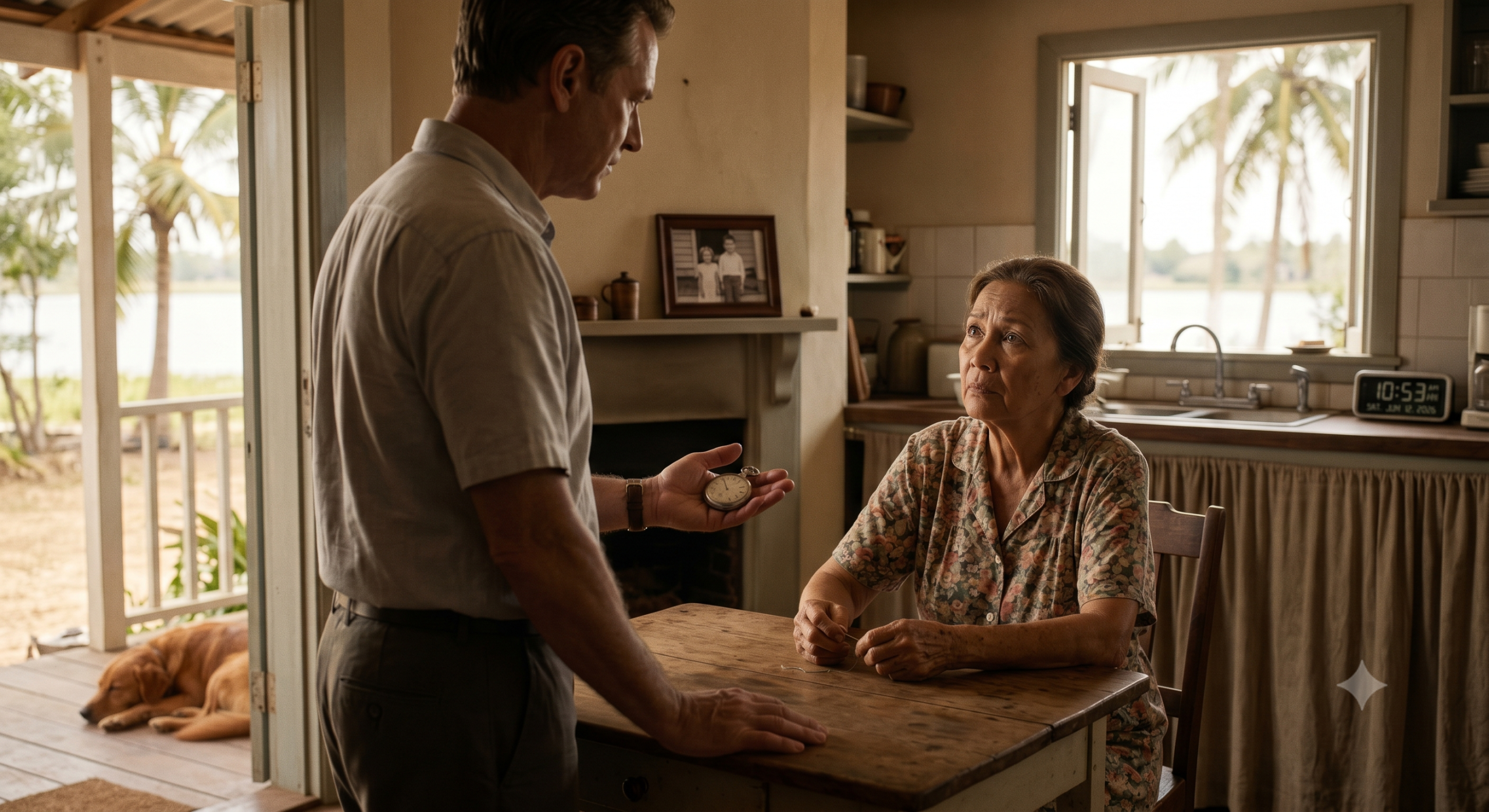
I followed her into the small kitchen. It was warm, heated by a small wood heater in the corner, and smelled of chicory coffee.
She poured me a mug without asking, her hands steady but her eyes never leaving my face.
“He didn’t run, Ruth,” Clara said, sitting down across from me at the pine table. “Your mother threw him out. She found out about… well, she was a very difficult woman, as I’m sure you know. When he lost his left index finger in that baler accident, he couldn’t work the fields the same way.
Your mother told him he was half a man and a drain on the household. She told him if he didn’t pack his bag and leave, she would go to the county court and tell them he was abusive. Back then, the courts believed the mother. He was terrified of losing you girls forever, of having you put in a home.”
I stared into my black coffee. “So he just left us with her? To starve?”
“No,” Clara said fiercely, reaching across the table to lay her hand near mine. “He didn’t. He went to work in the timber mills up here. He lived on cabbage and slept in a shack for ten years. Every single month, he took his wages to old Mr. Miller at the watch shop in Lansing. Old Miller was his cousin’s husband.”
She paused, letting the words sink in. My mind tried to connect the pieces, but the picture was too big, too different from the one I had carried for fifty years.
“Miller would write a check to your mother,” Clara explained. “He told her it was a special state agricultural subsidy for families with historical land grants. Your mother was too proud to accept charity, but she accepted that ‘subsidy’ every single month until you turned eighteen. It was Arthur’s money. All of it. He sent every dime he had, keeping just enough for rent and potatoes. That pocket watch was his collateral. He left it with Miller every spring to prove he would keep coming back with the cash. It was the only thing of value he owned.”
My chest felt like it was cracking open. All those years of cabbage soup and my mother’s bitter rants about our “worthless father,” while he was up here, freezing in the woods, working double shifts with a mangled hand to pay for the roof over our heads.
“Why didn’t he tell us?” I choked out, the tears finally burning my eyes. “Why did he let us hate him?”
“Because your mother made him sign an agreement,” Clara said softly. “If he ever contacted you, she would stop taking the money and she would take you girls out of state where he’d never find you.
He chose your security over his own heart. He thought you’d hate him, but at least you’d be fed.”
Clara stood up and walked over to a small cedar chest in the corner of the living room. She unlocked it with a small brass key she kept on a string around her neck. She came back to the table carrying a heavy cardboard shoe box, the lid secured with three thick rubber bands.
She laid it in front of me.
“He passed away in 2005,” Clara said, her voice softening. “Cancer. Before he went, he made me promise to keep this. He said you’d find the watch eventually. He knew you loved the estate sales, just like he did. He said you’d see it.”
I pulled the rubber bands off the box. Inside were dozens of small envelopes. Each one had a date written on it in his thick, blocky handwriting.
I opened the first one. It was a letter addressed to me, dated June 14, 1972.
“Dear Ruthie,” it began. “You are twelve today. I wonder if you still have that little blue bicycle. I saved five dollars this month to put toward your college fund. Mr. Miller is keeping it safe for you. Don’t think I forgot you. I’m looking at the lake right now, and I’m wishing I could show you the deer that come down to the water…”
Underneath the letters were neat stacks of savings bonds, all made out in my name and my sister’s name. It was thirty thousand dollars. Money he had saved, dollar by dollar, from the overtime he worked when the mills were failing.
I sat at that kitchen table for three hours, reading those letters while the old hound dog came inside and laid his heavy head on my knee.
I didn’t feel a great rush of triumph. My mother had been dead for ten years, buried in the churchyard under a marble stone we could barely afford. I couldn’t scream at her. I couldn’t demand to know why she had poisoned our childhood with her pride.
The truth was here, but it didn’t change the fact that I had grown up without a father.
But as I looked at Clara, who was watching me with a quiet, hopeful smile, I realized something else. The cold, heavy stone I had carried in my chest for fifty years—the belief that I was unlovable, that my own blood had discarded me—was gone. It had turned to dust.
I stood up and put the silver pocket watch in my purse. I looked out the kitchen window at the sun shining through the birch trees, reflecting off the quiet blue of the lake.
“Clara,” I said, wiping my face with the back of my hand. “Do you need any help with that wash on the line?”
She smiled, her eyes crinkling at the corners. “I’d love some, Ruth. The wind is starting to pick up.”
We walked out onto the porch together. The air was cold, but the sun felt warm on my face. I still had to drive back home, and I still had to tell my sister about the box in my trunk. We had a lot of years to talk about, and a lot of tears to cry. But for the first time in my life, I wasn’t driving into the dark. I was walking toward the light.