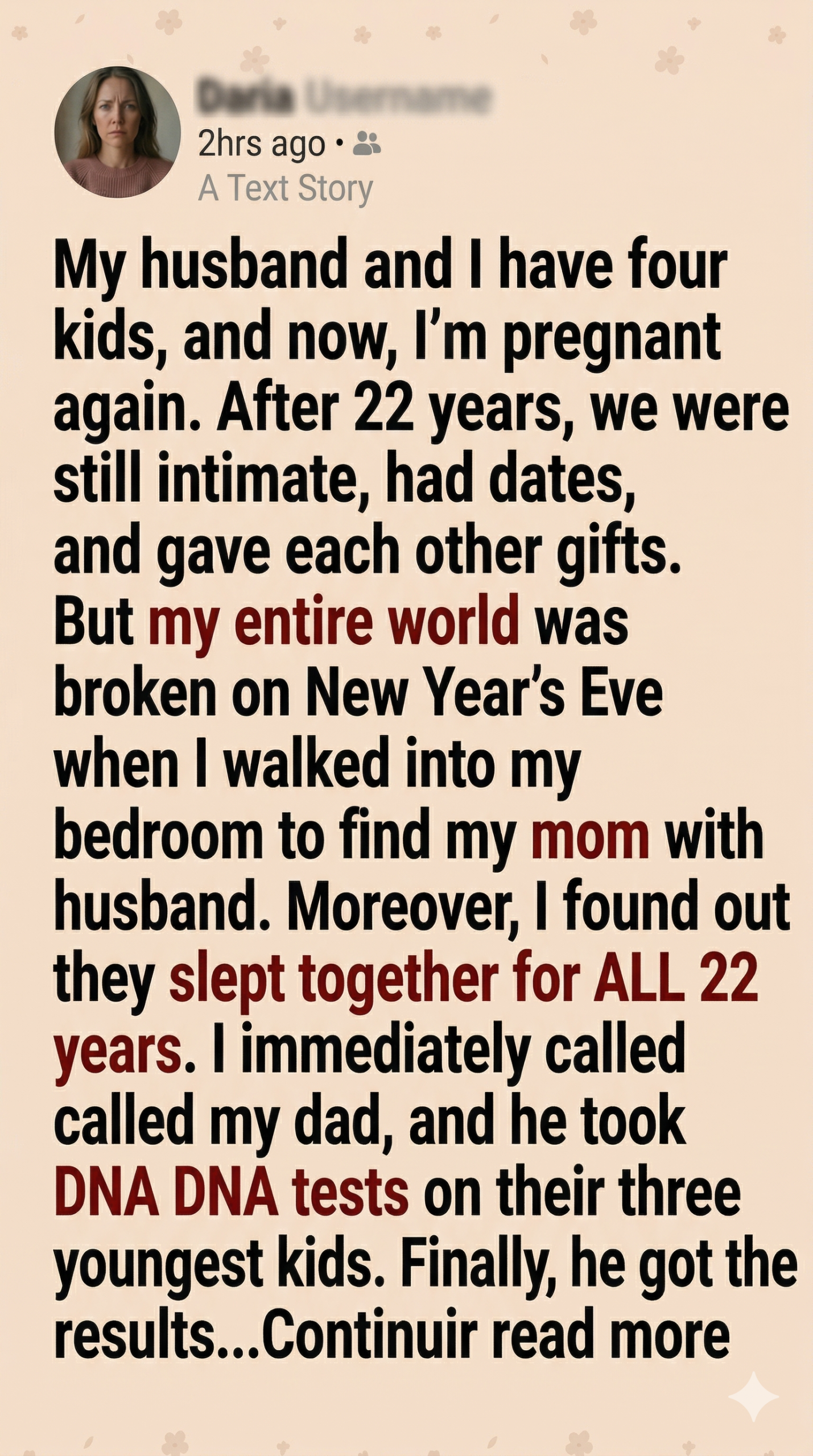
I was thirty-nine years old, four children deep into motherhood, and standing in my bathroom on Christmas morning with a pregnancy test in my shaking hand when I saw the second pink line appear.
Again.
I stared at it so long my coffee went cold on the sink.
Four kids. A mortgage. A body that already felt tired in places I never admitted out loud. And still, underneath the panic, there was something else too: a strange, tender joy. My husband, Daniel, and I had built a life together over twenty-two years. Not a perfect one, but a real one. We still kissed in the kitchen. We still snuck away for little date nights when we could. He still bought me my favorite dark chocolate when I’d had a hard week, and I still folded his socks the way he liked even though I teased him for caring.
We were still us.
Or so I thought.
When I told Daniel that evening, he blinked twice, then smiled so wide I laughed from pure relief. He lifted me off the floor and spun me around like we were twenty again.
“A baby?” he whispered, pressing his forehead to mine. “After all this time?”
I nodded, crying and laughing all at once.
And for a few days, I let myself believe that the surprise pregnancy was some kind of miracle. A wild, messy, beautiful final chapter to a love story that had survived everything.
I had no idea that my life was already rotting underneath me.
New Year’s Eve was supposed to be simple.
The kids were sleeping over at my father’s house so Daniel and I could have one quiet evening together before the chaos of school and work started again. I made his favorite dinner. He opened wine. We danced in the kitchen, barefoot, while an old playlist hummed from my phone on the counter.
At one point he wrapped both arms around me from behind, kissed the side of my neck, and rested his hand over my stomach.
“Looks like we’re starting over,” he murmured.
I smiled.
I remember that moment so clearly now that it makes me sick.
Around eleven-thirty, I realized I’d left my earrings upstairs in the bedroom. I laughed and told him not to drink all the wine while I was gone.
He grinned from the kitchen. “No promises.”
I walked up the stairs smiling.
And then I pushed open our bedroom door.
At first, my brain refused to understand what I was seeing.
My mother’s blouse was on the floor.
Daniel was half-undressed.
My mother—my own mother—was on my bed, her hair loose over my pillow, turning toward me with a gasp that sounded more annoyed than ashamed.
I didn’t scream.
That’s the part people always expect when I tell this story now. They imagine some dramatic explosion. But the truth is worse.
I went completely silent.
The kind of silence that happens when something is so monstrous your body can’t process it quickly enough to react.
Daniel said my name first.
Then my mother did.
Then both of them started talking at once.
“Please let me explain—”
“It’s not what you think—”
Which is absurd, because it was exactly what I thought.
I remember backing away until I hit the doorframe. I remember shaking so hard I couldn’t feel my hands. I remember staring at my mother’s face and noticing how calm she was trying to look, like she still believed she could talk her way out of this.
Finally I found my voice.
“How long?” I asked.
Daniel stepped forward. “Listen to me—”
“How long?”
My mother sat up slowly and pulled the sheet around herself. Then she looked me right in the eyes and said something that split my life in two.
“It started before your first child was born.”
The room tilted.
I think I grabbed the dresser to keep from falling.
Before our first child.
Our oldest was twenty-one.
I heard myself whisper, “No.”
Daniel looked furious—not at her, but at being exposed. “Marianne, stop.”
But she kept going.
Maybe because the lie was already dead. Maybe because she had spent so many years getting away with it that she no longer understood horror.
“It wasn’t always constant,” she said coldly. “There were breaks. But yes. It’s been going on for most of your marriage.”
Most.
Twenty-two years.
I was choking on my own breath now.
The dates. The holidays. The family dinners. The times she held my newborns. The birthdays she toasted with us. The way she always complimented Daniel just a little too warmly and I had brushed it off because who on earth suspects their own mother?
I looked at him.
My husband.
My best friend.
The father of my children.
The man with whom I had shared a bed, a body, a life.
He couldn’t even meet my eyes.
That told me everything.
I left the room before I fainted.
I don’t remember grabbing my coat. I don’t remember my car keys. I just remember sitting in the driver’s seat outside my house, my chest heaving, while fireworks started popping faintly in the distance.
Happy New Year.
My fingers moved before my mind did.
I called my father.
He answered on the second ring, sleepy but cheerful at first. “Everything okay?”
I made a sound I had never made in my life.
He went silent instantly.
“What happened?”
I could barely force the words out. “Dad… he’s with Mom. In my bed.”
There was a long pause.
Then my father said, very quietly, “Stay where you are.”
I heard a rustle, a drawer opening, keys, movement. His voice changed into something cold and hard and unfamiliar.
“Don’t go back inside. I’m coming.”
My father had been divorced from my mother for years. Their marriage had ended bitterly, and I had always believed the bitterness came from ordinary things: incompatibility, resentment, disappointment. Now, sitting in my freezing car on New Year’s Eve, I began to understand that maybe the story I’d been told all my life was not the real one.
He arrived in twenty minutes.
Twenty minutes in which I vomited in the hydrangeas, cried until my throat burned, and nearly drove away three separate times.
When my father pulled up, he got out, took one look at my face, and didn’t ask for proof.
He simply opened his arms.
I broke apart in them.
He let me cry until I could stand. Then he held me by the shoulders and asked one question.
“How long?”
I swallowed. “Mom said… since before my first child.”
He closed his eyes.
Not in surprise.
In confirmation.
That chilled me more than the winter air.
“You knew?” I whispered.
He hesitated just long enough to answer me.
“I suspected,” he said.
The betrayal of that hit almost as hard as the first one.
“You suspected?” I said. “For years?”
He looked shattered. “Not like this. Not for certain. But there were things that didn’t add up. Timing. Lies. Gaps. I confronted her more than once. She always turned it back on me, made me sound paranoid.”
I stepped away from him. “And you never told me?”
“You were already in love with him,” he said. “Then you were pregnant. Then you were building your family. Every year I told myself I needed proof before I blew up your life.”
I laughed then—a terrible, broken laugh.
“Looks like my life got blown up anyway.”
He drove me to his house. The kids were asleep in the guest rooms upstairs, safe and oblivious. I sat at his kitchen table in stunned silence while he made tea neither of us drank.
Around three in the morning, after I had repeated the story twice and stared blankly at the wall for long stretches, my father said something that made my stomach turn.
“We need DNA tests.”
I looked at him.
He looked older than I had ever seen him.
“If this started that early,” he said, “we need to know the truth.”
I understood immediately.
The three youngest children.
Not our oldest—my first child had been born just before some of my father’s suspicions began, and the timeline there was clear enough. But the younger three… every one of them now sat inside a question I had never imagined asking.
Who was their father?
Who was mine, in this story? Who was anyone?
I wanted to refuse. I wanted to slam my hands over my ears and say no, no, no, because some truths feel less like answers and more like knives.
But the knife was already in.
So I nodded.
The next few weeks were a blur of lawyers, lies, panic, and humiliation.
Daniel begged.
That was the maddening part.
He begged.
He cried. He called. He sent messages saying he loved me, that it had “never meant anything,” that my mother was manipulative, that it had started when he was young and stupid and then “got out of control.” He said I was the love of his life. He said he never meant to hurt me.
As if hurt were some accidental spill to be wiped off the floor.
My mother was worse.
She alternated between coldness and outrage. One day she called me sobbing, claiming she had “always been jealous” of my life and had made “terrible choices.” The next day she was furious that I wasn’t answering her and said I was “trying to punish everyone” by cutting contact.
Punish everyone.
As though I were the one who had slept with my daughter’s husband for over two decades.
I stopped taking her calls.
I filed for divorce.
I told only two close friends the truth, because the shame felt so huge I could barely carry it. One of them sat with me during the ultrasound appointment when I was too numb to be excited about the baby growing inside me. The technician showed me the tiny flicker of a heartbeat and smiled, and I cried so hard she had to stop the scan for a minute.
Not because I didn’t want my child.
Because I no longer knew what world I was bringing that child into.
The DNA test kits arrived in plain packaging.
My father laid them on the kitchen table like explosives.
My three youngest children thought it was a game at first—swabs, labels, signatures. I had to excuse myself twice so they wouldn’t see me cry. My father did most of the explaining in a voice so steady it broke my heart. He was trying to protect them while preparing for the possibility that they might not biologically be his grandchildren… or Daniel’s children… or the children I thought I had raised inside one version of reality.
And then we waited.
Waiting for medical results when your whole life may change is its own kind of torture.
Every ring of my phone made me jump. Every email notification made my chest tighten. I couldn’t sleep. I couldn’t eat. I kept replaying memories, re-labeling them in my mind.
My mother at the hospital after each birth.
Daniel stepping out to “run errands.”
The strange tension between my parents at holidays.
The way my mother and husband sometimes avoided each other too carefully, which now seemed more suspicious than closeness would have.
One afternoon, while folding baby clothes a neighbor had dropped off, I caught myself wondering whether the child I was carrying even belonged to Daniel.
I sat down on the laundry room floor and sobbed until I scared myself.
Finally, the results came.
My father drove over instead of calling.
That was when I knew at least one answer was going to hurt.
He came in holding a large envelope. His face was pale and fixed, and for a second I couldn’t breathe.
We sat at the kitchen table together—the same table where we had once decorated cookies with my kids, where I had helped them with homework, where life had once felt ordinary.
My father put the envelope down between us.
“Are you sure you want to do this now?” he asked.
No.
But I nodded anyway.
My hands shook so violently he had to open it for me.
He read the first page, stopped, inhaled sharply, then looked up.
His eyes were wet.
“What?” I whispered. “Dad, please.”
He slid the papers toward me.
I read them once.
Then again.
Then a third time because my brain refused to accept the words.
The three youngest children were not Daniel’s.
None of them.
The room went silent except for the sound of my own breathing.
I looked at my father, horrified.
But he wasn’t looking horrified in the way I expected.
He was looking wrecked.
I looked back down.
Then I saw the second section of the report.
The one I hadn’t noticed because my vision was blurring.
My father had submitted his own sample too.
I stared at the results.
Then I understood.
My three youngest children were biologically my father’s.
Not Daniel’s.
My father’s.
I think I stopped breathing.
The paper slipped from my hand and fluttered to the floor.
“No,” I whispered. “No. That’s impossible.”
But it wasn’t.
Because the math was right there.
Because my mother had not only betrayed me with my husband.
She had betrayed my father too.
For decades.
My children were my father’s biological children.
Their biological father was my own father.
Which meant my mother had been sleeping with both my husband and my father across overlapping years, shattering one family in more directions than I can fully explain.
I wish I could tell you that was the final twist.
It wasn’t.
My father broke then.
Not loudly. Not dramatically. He just put his face in his hands and said, in the quietest voice I have ever heard from a grown man, “I’m so sorry.”
I reached for him automatically even though I was the one whose life had just detonated. That’s what grief does. It confuses directions. It makes everyone bleeding reach for everyone else.
He lifted his head and said words I will never forget.
“I stayed with her longer than I should have because every time I tried to leave, she used you against me. Then later she used the children. I kept thinking I could keep the family together somehow. I never imagined… this.”
The truth began rearranging everything I knew about my childhood, my parents’ divorce, my marriage, and my children’s place in all of it.
The legal fallout was savage.
My divorce became public in the family almost overnight. My mother tried to deny the DNA results until my father threatened court action over fraud and property matters. Daniel, cornered and exposed, finally admitted enough to destroy any last shred of defense. He swore he had believed at least one of the younger children was his. He claimed my mother manipulated him from the start, that she seduced him, blackmailed him, kept pulling him back in.
Maybe some of that was true.
I don’t care.
At some point, grown people stop getting to explain their cruelty as helplessness.
I cut them both off.
Completely.
People ask the hardest question in hushed voices, as if they’re afraid saying it aloud will make it more monstrous:
What about the children?
What do you tell them?
The answer is: not everything at once.
You tell them what is necessary for their age.
You find therapists.
You protect their sense of safety before their sense of scandal.
You remind them, over and over, that none of this is their fault.
You keep loving them exactly the same.
Because DNA can destroy illusions, but it does not erase bedtime stories, scraped knees, soccer games, lullabies, fevers, and the thousand invisible threads that make a family.
Those children are mine.
That never changed for a second.
Months later, when I was far enough along to feel the baby kick, I sat alone in my new apartment one evening with a hand over my stomach and realized I had survived the kind of truth that kills something in people.
It killed something in me too.
My innocence. My certainty. My blind trust in blood and vows and roles.
But it did not kill all of me.
I gave birth to my fifth child in late summer.
A beautiful girl.
And before anyone asks: yes, I ordered the test.
I needed one honest answer in a life that had become a maze of lies.
She was Daniel’s.
I almost laughed when I found out. Not because it was funny, but because after everything, truth had become so absurd I barely knew how else to greet it.
Daniel never met her.
He asked. He pleaded. He wrote letters.
I left them unopened for a long time.
My mother kept trying too, mostly through relatives, mostly painting herself as tragic and misunderstood. I heard that story secondhand and felt nothing. Some betrayals are too deep for anger. They pass straight into absence.
As for my father, he remained.
Not because things were simple—nothing was simple anymore—but because he chose to remain. He showed up to therapy appointments. School concerts. Grocery runs. Doctor visits. He sat on the floor and played board games with the children even when they didn’t fully understand why the adults looked tired all the time.
He became, in the ruins, the one person who never looked away.
Years from now, my children may ask for every detail. They may rage. They may mourn. They may choose relationships I would never choose. That will be their right.
But this is the truth as I have come to understand it:
On New Year’s Eve, I thought I caught my husband betraying me.
What I actually uncovered was a twenty-two-year web of deception so twisted it poisoned generations.
I lost my marriage.
I lost my mother.
I lost the story I had told myself about my life.
But I did not lose my children.
And I did not lose myself.
Because after the DNA results, after the divorce papers, after the scandal and the grief and the humiliation, I stood in front of the bathroom mirror one night holding my newborn daughter and looked at the woman staring back at me.
She looked older.
Sadder.
Harder in certain places.
But she was still there.
And for the first time in a very long time, she was standing in the truth.
Even if it had come wrapped in ruin.