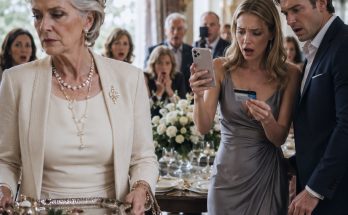
My Sister Broke Into My Cabin For Her Honeymoon. So I Called The Police…
My Sister Snapped, “You Called The Police On Your Own Family?” After Showing Up At My Cabin For Her “Unforgettable” Honeymoon Without My Permission. So I Responded, “No. I Called The Police On Trespassers!”
### Part 1
The Thanksgiving table looked like a magazine photo, which was exactly the kind of thing my mother, Celandine Vale, lived for.
There were twelve place settings, pressed linen napkins folded into little fans, a turkey glazed so perfectly it looked fake, three kinds of pie lined up on the sideboard, and a centerpiece made of orange roses, eucalyptus, and tiny white pumpkins. The dining room smelled like butter, cinnamon, roasted garlic, and the pine candle Mom always lit when she wanted the house to feel expensive.
My sister, Maribel, sat at my father’s right hand like a queen waiting for her crown. Her fiancé, Callen, sat beside her in a navy sweater, smiling at everybody like he had already been accepted into the family fortune. Aunt Veda was there, Uncle Orson, a couple of cousins I barely recognized, and me at the far end of the table, next to the radiator that clicked every few minutes like it was counting down to something.
That had always been my seat.
Not because anyone said, “Juniper, you belong down there.”
They didn’t have to.
Dad stood before anyone took a bite. His wine glass caught the chandelier light, throwing a red shimmer across the wall.
“Before we eat, I have an announcement.”
Maribel clasped her hands beneath her chin. Mom smiled at her in that soft, glowing way she never looked at me.
“As everyone knows,” Dad said, “Maribel and Callen are getting married in June.”
Everyone applauded. Maribel made a tiny squeal, like she had not been talking about the wedding nonstop for eleven months.
“They found the perfect venue,” Dad continued. “The stone lodge up in Willow Ridge. Mountain views, private lake, full-service reception hall. It’s beautiful.”
“It’s magical,” Maribel breathed.
“It’s also expensive,” Dad said, chuckling like expensive things were charming when Maribel wanted them. “Seventy-eight thousand dollars for the weekend package, and that doesn’t include the upgraded flowers, the band, or the honeymoon.”
I set my fork down carefully, though I had not picked it up yet.
Mom glanced toward me.
That was the first clue.
I noticed it because I had spent thirty-one years noticing the shape of trouble before it reached me.
Dad cleared his throat.
“But your mother and I have been thinking. Family should come together for once-in-a-lifetime moments. And we believe we have a solution.”
Maribel’s eyes shone. Callen put one hand over hers.
“We’re going to use the Aspen Hollow cabin.”
The room warmed with approving sounds.
Aunt Veda said, “Oh, that place?”
Uncle Orson whistled. “Haven’t been there in years.”
My stomach tightened, but I kept my face still.
Dad smiled bigger, encouraged by the room. “We’ll rent it out for the winter and spring season to cover wedding deposits, then reserve it for Maribel and Callen’s honeymoon. A private cabin for two weeks after the wedding. Free lodging. Beautiful setting. Very romantic.”
Maribel turned toward me with the soft, fake sympathy she used whenever she was about to take something.
“I know you go there sometimes, June, but it’s family property. And honestly, it’s wasted sitting empty most of the year.”
The fork in my hand felt cold.
The cabin did not sit empty. I spent half my weekends there fixing pipes, sealing windows, replacing deck boards, chopping kindling, deep-cleaning after short-term guests, and sitting on the porch at sunrise with coffee that tasted faintly of smoke from the woodstove.
It was not “family property.”
It was mine.
Dad reached beneath his chair and pulled out a folder.
That was the second clue.
A prepared folder at Thanksgiving meant he had not misunderstood. He had planned this.
“I already spoke with a rental manager in Willow Ridge,” he said, opening the folder as if he were presenting quarterly profits. “She said the cabin could bring in at least thirty-two thousand dollars between December and May if we stage it properly. Maybe more if we market it as a luxury mountain retreat.”
Mom nodded. “We’ll have to move your things out, Juniper. Not everything. Just the personal clutter.”
“The old quilts,” Maribel added. “The scratched mugs. The weird books.”
“My books?” I asked.
She laughed lightly. “Don’t look at me like that. You know what I mean. It needs to look upscale.”
I looked at Dad. “You spoke with a rental manager about my cabin?”
His expression hardened at one corner.
“Our cabin,” he said.
The air shifted.
Someone’s knife scraped against a plate.
I could hear rain tapping the dining room windows, soft and steady, turning the yard outside into black glass.
“Dad,” I said, keeping my voice low, “whose name do you think is on the deed?”
Mom sighed like I had embarrassed her in front of guests.
“Juniper, don’t start.”
“I’m asking a simple question.”
Dad closed the folder halfway. “It belonged to your grandfather.”
“No,” I said. “Grandpa Arlen owned a hunting parcel near Cedar Pike. He sold it before I was born. The Aspen Hollow cabin was never his.”
Maribel blinked. “What are you talking about?”
I turned to her. “I bought it five years ago.”
A beat of silence passed over the table.
Then Dad laughed.
Not a real laugh.
A warning.
“You bought a cabin.”
“Yes.”
“With what money?”
I looked down at the table. The cranberry sauce had a spoon resting in it. The turkey steam curled beneath the chandelier. My mother’s wedding china gleamed under everyone’s staring faces.
“With my money,” I said.
Maribel let out a sharp little breath. “June, you manage donations at a community arts center.”
“I’m the operations director,” I said. “And I consult for three grant-writing firms on contract. I also own two short-term rentals and a duplex in Larkspur County.”
Uncle Orson coughed into his napkin.
Mom’s smile disappeared.
Dad’s face went still in a way I recognized from childhood. It was the expression he wore before telling me I had remembered something wrong.
“You never told us that,” he said.
“You never asked.”
Maribel laughed again, but this time it cracked in the middle. “So you’re saying you secretly own a cabin and just let everyone think it was Grandpa’s?”
“I never said it was Grandpa’s. I said I was going up to the cabin. You decided what that meant.”
Dad pushed the folder across the table toward me. “Don’t be difficult. The rental manager is coming out next week to inspect it.”
“No,” I said.
Mom’s voice sharpened. “Your sister is getting married.”
“And I hope she has a beautiful wedding.”
“Then help her.”
“Breaking into my financial life is not asking for help.”
Maribel’s eyes filled instantly. She had always been able to cry on command, the way some people could whistle.
“It’s my honeymoon, Juniper.”
I stared at her glossy face, her perfect hair, the diamond on her finger throwing tiny sparks onto the tablecloth.
And for the first time that night, I felt something colder than hurt.
I felt the old, familiar click of a lock inside me.
“Then plan a honeymoon you can afford.”
Dad stood so fast his chair legs scraped the floor.
“Watch your tone.”
My phone buzzed against my thigh.
I pulled it out and saw an alert from my cabin security system.
Front Door Sensor Triggered.
Aspen Hollow Cabin.
I frowned.
A second alert appeared.
Interior Motion Detected.
Then a third.
Living Room Camera Offline.
The room kept staring at me, waiting for me to fold.
But I was no longer listening to them.
Someone was inside my cabin.
And every person at that table suddenly looked like a suspect.
### Part 2
At first, I thought it was a mistake.
Mountain weather did strange things to electronics. A hard wind could rattle a door sensor. Snow could knock out Wi-Fi. The cabin sat forty minutes outside Willow Ridge, tucked into a slope of fir trees and granite, where storms rolled in fast and power flickered whenever the sky sneezed.
But then my phone buzzed again.
Kitchen Window Sensor Open.
My mouth went dry.
I opened the security app under the table. The thumbnail from the driveway camera showed darkness, rain, and the faint silver blur of headlights reflecting off wet gravel. Then the image refreshed.
A white SUV sat beside my cabin.
Not my SUV.
Maribel leaned toward me. “Are you even listening?”
I looked up.
Dad was still standing. Mom’s cheeks were pink with humiliation. Callen had his mouth pressed into a line, like he was trying to decide whether I was an obstacle or a bank account.
“I need to leave,” I said.
Mom blinked. “Excuse me?”
“There’s an issue at the cabin.”
Maribel’s face changed too quickly. The tears vanished. For half a second, her eyes flicked toward Callen.
That was the third clue.
It was small.
Too small for anyone else to notice.
But I noticed.
“What kind of issue?” Uncle Orson asked.
“My security system says someone entered.”
Dad scoffed. “Probably a raccoon.”
“A raccoon opened the kitchen window?”
The table went quiet again.
Maribel picked up her water glass and took a sip. Her hand was steady, but Callen’s wasn’t. His thumb rubbed the stem of his wine glass over and over.
“Maybe the rental manager stopped by early,” Mom said.
“She doesn’t have access.”
Dad said, “This is ridiculous. Sit down.”
“No.”
I stood and picked up my purse from the back of my chair.
Dad’s voice dropped. “Juniper, don’t make a scene.”
The laugh that left my mouth surprised me. It was soft, tired, and nothing like humor.
“You made a Thanksgiving slideshow about renting out my cabin for Maribel’s wedding, and I’m the one making a scene?”
“It’s not your cabin,” he snapped.
I stared at him.
Rain tapped the windows. The radiator clicked. Somewhere in the kitchen, the oven timer beeped twice before Mom’s fancy smart oven silenced itself.
“I have the deed,” I said.
“I don’t care what paperwork you think you have.”
That was new.
Not confusion. Not assumption.
Refusal.
Aunt Veda set her napkin down. “Dorian, if it’s in her name—”
Dad cut her off. “Stay out of it.”
Mom’s hand flew to her chest. “We are not fighting in front of guests.”
“Then stop trying to steal from me in front of guests.”
Maribel stood up so dramatically her chair bumped the wall.
“Nobody is stealing from you. You always do this. You hoard things, then act like a victim when family needs you.”
I looked at her. “What did you do?”
Her lips parted.
“I didn’t do anything.”
“What did you do, Maribel?”
Callen shifted in his chair.
Dad pointed toward the hallway. “That’s enough.”
I unlocked my phone, pulled up the driveway camera again, and turned the screen toward the table.
The white SUV was still there.
The license plate was clear.
Maribel’s SUV.
Aunt Veda whispered, “Oh, honey.”
Maribel’s face went pale under her makeup.
Callen muttered, “Mar.”
Dad stared at the screen, then at Maribel, then back at me.
Mom said, “There must be an explanation.”
I laughed again. This time, it had an edge.
“There usually is.”
Maribel’s chin lifted. “Fine. We went earlier.”
“We?”
She folded her arms. “Me and Callen. We drove up before dinner.”
“Why?”
“To look at it.”
“You broke into my cabin to look at it?”
“The spare key was under the old birdhouse.”
My pulse thudded once, hard.
The spare key had not been under the birdhouse in two years. I had moved it after a guest accidentally locked herself out and posted about it in a review.
So someone had told Maribel old information.
I turned to Dad.
He didn’t blink.
“You gave her the key location.”
He said nothing.
Mom said quickly, “It wasn’t supposed to be a big deal. Your father remembered you used to keep one there.”
“I don’t.”
Maribel shrugged, defensive now. “The window was loose.”
“You opened a window.”
“It was already loose.”
“You broke into my cabin.”
“Don’t say it like that.”
“That is what it is.”
Callen finally spoke. “Juniper, we weren’t taking anything. We just wanted to see the place because your dad said it would be available after the wedding.”
“My dad doesn’t own it.”
“We know that now,” he said quietly.
Maribel shot him a look.
I pressed the bridge of my nose.
On my phone, another alert flashed.
Bedroom Motion Detected.
Then another.
Back Door Open.
I opened the live camera feed from the porch.
At first, it was only rain and darkness. Then a figure crossed the porch carrying something bulky wrapped in plastic.
My quilts.
My grandmother’s cedar chest sat under the bedroom window. Inside were hand-stitched quilts from Mom’s mother, old photographs, letters from my grandfather, and the wool blanket I had used when I slept on the cabin floor during renovations because I could not afford furniture yet.
The figure disappeared toward the SUV.
My voice came out flat.
“Are your friends there?”
Maribel swallowed.
No tears now.
“Just two bridesmaids. They were helping.”
“Helping with what?”
Mom said, “Juniper—”
I held up my hand.
The table froze, maybe because I had never done that before.
“Helping with what?”
Maribel looked away.
Callen answered, barely above a whisper.
“Clearing out personal stuff.”
I felt the room tilt.
Not because of the money. Not because of the property.
Because five years of my life were being dragged through rain by strangers who thought my memories were clutter.
I looked at my father.
“You planned this before Thanksgiving.”
His jaw tightened.
“You were going to announce it, pressure me in front of everyone, and while I was here, Maribel would empty the cabin.”
“No,” Mom said, too fast.
I looked at her.
Her eyes filled, but they were not guilty tears.
They were cornered tears.
“You all knew.”
Aunt Veda covered her mouth.
Uncle Orson stared at his plate.
I grabbed my coat.
Dad moved toward the hallway, blocking the way.
“Where do you think you’re going?”
“To call the police.”
Maribel gasped. “You wouldn’t.”
I looked at my sister, her white sweater, her perfect engagement ring, her stunned belief that consequences were something other people got.
“Yes,” I said. “I would.”
And when I stepped around my father, I saw real fear enter her eyes for the first time.
### Part 3
I called 911 from my car because I did not trust myself to stand in that dining room one more second.
The rain had turned hard, slapping against my windshield and blurring the warm yellow windows of my parents’ house behind me. Inside, I could still see shapes moving in the dining room. Dad’s tall shadow. Mom’s fluttering hands. Maribel pacing like an actress waiting for her next scene.
The dispatcher’s voice was calm.
“What is the address of the emergency?”
I gave her the cabin address in Aspen Hollow and explained as clearly as I could.
“This is my private property. My security system shows people entered through a window. They are removing items. I know at least some of them. I did not give permission.”
“Are you at the property now?”
“No. I’m about forty-five minutes away.”
“Are there weapons in the home?”
“No.”
“Is anyone supposed to be there?”
“No.”
She asked for descriptions. I gave Maribel’s SUV plate number, her name, Callen’s name, and the names of the bridesmaids I knew from Instagram because Maribel had tagged them in enough engagement-party photos to build a case file.
Then I started driving.
My phone kept buzzing in the cup holder.
Mom.
Dad.
Mom again.
Maribel.
Unknown number.
Callen.
I ignored all of them.
The highway out of town was slick and black. Grocery stores glowed under the rain. Gas stations hummed with tired travelers. Families were probably driving home full of turkey and pie, complaining about politics or football or who forgot the whipped cream.
I gripped the steering wheel until my knuckles ached.
Halfway up the mountain, my phone rang through the car speakers.
Aunt Veda.
I answered.
“June, honey, where are you?”
“On my way to the cabin.”
“Your father is losing his mind.”
“That sounds uncomfortable for him.”
She gave a sad little laugh, then sighed. “He says you’re overreacting.”
“Of course he does.”
“Maribel is crying.”
“Of course she is.”
“Callen looks sick.”
That made me pause.
“He should.”
“I don’t think he knew everything.”
“Maybe not. But he knew enough to sit at that table while Dad announced my property was being used for his honeymoon.”
Silence.
Rain hissed under my tires.
Aunt Veda said, “Your mother is telling everyone you gave permission weeks ago.”
I almost laughed, but it died in my throat.
“I didn’t.”
“I know. I told her that didn’t sound like you.”
The road narrowed after the Willow Ridge exit. Fir trees rose on both sides, black against the gray sky. The higher I drove, the more the rain mixed with wet snow. My headlights caught flakes turning to silver.
Aunt Veda lowered her voice.
“Your father said something strange.”
“What?”
“He said, ‘She owes us that cabin after what we covered for her.’”
My stomach clenched.
“What does that mean?”
“I don’t know. Your mother told him to shut up.”
That was the fourth clue.
I had expected entitlement. I had expected anger.
But “covered for her” was different.
That sounded like history had been rewritten around a secret I did not know I was part of.
I thanked Aunt Veda and hung up.
Ten minutes later, blue and red lights flickered through the trees ahead.
Two sheriff’s SUVs sat in my gravel driveway. Maribel’s white SUV was parked sideways near the porch, its rear hatch open. Rain soaked the cardboard boxes stacked behind it. One box had split at the corner, spilling my winter linens into the mud.
My grandmother’s blue quilt lay half out of a trash bag.
I parked hard enough that gravel jumped under my tires.
A deputy stepped toward me, hand raised in a stopping gesture. He was broad-shouldered, maybe late forties, with rain shining on the brim of his hat.
“Ma’am, are you the owner?”
“Yes. Juniper Vale.”
“Do you have ID?”
I handed it over with shaking fingers.
Behind him, under the porch light, Maribel stood wrapped in a cream-colored coat that probably cost more than my first month of mortgage payments. Her mascara had run slightly. She looked furious, not scared.
Callen stood beside her, wet hair stuck to his forehead, face pale.
Two women I recognized as bridesmaids sat in the back of one sheriff’s vehicle, arms folded, looking deeply offended by the inconvenience of being caught.
The deputy checked my ID and nodded.
“We’re still sorting things out. They claim they had family permission to access the property.”
“Family permission from people who do not own it.”
“That’s what we’re verifying.”
I opened my phone and pulled up the deed, tax records, insurance policy, and LLC documents. I had them because I trusted clouds more than I trusted family.
“This is mine,” I said. “Only mine.”
He scanned the documents, then looked toward the porch.
Maribel shouted, “Tell him we’re allowed to be here, June.”
I stared at her.
Allowed.
Not sorry.
Not, “I panicked.”
Not, “I misunderstood.”
Allowed.
The deputy turned. “Ma’am, please stay quiet while I speak with the property owner.”
Maribel’s mouth opened.
For once, nothing came out.
I walked toward the porch. The front door stood open, wet footprints crossing the entry rug. The living room smelled like rain, cold ashes from the fireplace, and the faint vanilla cedar oil I used on the old furniture.
Boxes were everywhere.
My books had been stacked near the door. My framed photos were wrapped in dish towels. The wool blanket from the reading chair had been shoved into a contractor bag.
In the bedroom, drawers stood open.
The cedar chest was empty.
For a second, I could not breathe.
I had bought that cabin when I was twenty-six, after ten years of being treated like the practical daughter, the quiet daughter, the one who would not need much. I had painted these walls myself. I had sanded the floors until my palms blistered. I had saved every spare dollar while Maribel took trips to Scottsdale and posted beach photos with captions about “choosing joy.”
This cabin had been the first place in my life that did not ask me to shrink.
And they had walked in like it was a storage unit.
Callen appeared in the hallway behind me.
“Juniper,” he said quietly, “I’m sorry.”
I turned.
His face looked different without the dinner-table performance. Younger. Ashamed.
“Did you know they planned to empty it tonight?”
He looked down.
“My answer depends on how much of a coward I want to be.”
“At least try honesty.”
He swallowed.
“I knew Maribel wanted to move some things out before the inspection. Your dad said you were emotional about the cabin and might make it difficult, but that legally it belonged to your parents because they had paid taxes on it.”
“They never paid a cent.”
“I know that now.”
I looked past him toward the bedroom.
“Where are my things?”
“In the SUV. Some in the truck.”
“What truck?”
He closed his eyes.
That was the fifth clue.
Outside, another set of headlights swept across the windows and slowed at the driveway entrance.
A black pickup rolled into view.
My father’s truck.
And when he stepped out into the rain, he was carrying another folder.
### Part 4
My father did not walk toward the deputies like a man arriving at a crime scene.
He walked toward them like a man arriving late to a meeting he expected to control.
Rain darkened the shoulders of his wool coat. Mom climbed down from the passenger side, clutching her purse against her chest, her face pale beneath the porch light. She looked at Maribel first, then at me, then at the open cabin door.
Not at the boxes.
Not at the quilt in the mud.
At the door.
As if the real tragedy was that I had made this public.
Dad lifted his folder. “Officer, I can explain.”
The deputy, whose name tag read Harlan, held up one hand.
“Sir, are you the property owner?”
“I’m her father.”
“That wasn’t my question.”
Dad’s jaw shifted.
“This cabin has been used by our family for years.”
Deputy Harlan nodded with professional patience. “Are you the legal owner?”
“No, but—”
“Then please wait over there.”
For a second, I thought Dad might actually argue with a uniformed officer on my porch. His eyes flashed. His mouth tightened. Then Mom touched his sleeve and whispered something. He stepped back, but not far.
Maribel saw him and immediately started crying again.
“Dad, tell them.”
Dad pointed at me. “This has gone far enough.”
The deputy’s expression changed slightly. “Sir.”
Dad lowered his hand.
I walked outside into the rain because I did not want my cabin walls to hear the next part.
“What is in the folder?” I asked.
Dad looked at me like I was ten years old and had interrupted adults talking.
“Proof.”
“Of what?”
“That this family has a claim.”
I held out my hand.
He hesitated.
That hesitation told me more than the folder would.
Then he slapped it into my palm.
Inside were printed tax records, old utility bills, and a handwritten note from three years ago that made my skin go cold.
It was not my handwriting.
The note read like a permission agreement. It said I acknowledged the cabin was “maintained by family resources” and that my parents had “use discretion” for family needs.
At the bottom was my name.
Not signed well.
But signed.
I stared at the page.
The rain hit the plastic folder cover with tiny sharp taps.
“You forged my signature.”
Mom made a choked sound. “Don’t say that.”
Dad said, “We did what was necessary.”
The whole driveway seemed to still.
Even Maribel stopped crying.
Deputy Harlan looked up from where he had been speaking to another officer.
“Sir, did you just say you signed her name?”
Dad’s face changed as he realized he had spoken too plainly.
“No. I mean—”
“He forged my signature,” I said.
Mom stepped toward me. “Juniper, your father was trying to protect the family.”
“From what? Me owning something?”
Dad’s eyes burned. “From your selfishness.”
There it was.
The word that had followed me since childhood.
Selfish when I hid Halloween candy so Maribel would not take all the peanut butter cups. Selfish when I used my graduation money for textbooks instead of helping Mom buy Maribel a prom dress. Selfish when I moved into my own apartment and stopped being available for every emergency they created with their spending.
“Dad,” Callen said softly, “you told me she had already agreed.”
Dad rounded on him. “Stay out of this.”
Maribel whispered, “You said it was handled.”
I looked at her.
Handled.
Not legal.
Not right.
Handled.
Deputy Harlan came over. “Miss Vale, do you want to press charges for unlawful entry and theft of property?”
Mom gasped. “Theft? They were family belongings.”
“They were in my house,” I said. “In boxes. Being loaded into vehicles.”
“We weren’t stealing,” Maribel sobbed. “We were staging.”
“Staging is what you do after permission.”
Dad pointed at the folder. “She gave permission.”
“With a forged signature.”
His eyes snapped to mine.
“It is not forgery when family understands what someone should do.”
The deputy went very quiet.
So did I.
Because that sentence opened a door in my mind.
A little door.
Behind it were other moments.
The scholarship refund check that vanished when I was nineteen, which Mom said I must have spent. The credit card opened in my name when I was twenty-one, which Dad said was “a banking mistake” after I found it. The time Maribel borrowed my car and returned it with a dent, only for Dad to tell the insurance company I had been driving.
Covered for her.
Aunt Veda’s words came back.
“She owes us that cabin after what we covered for her.”
My stomach turned.
“What else did you sign?” I asked.
Dad looked away.
Mom whispered, “Juniper, not here.”
“What else did you sign?”
Maribel wiped her face with her sleeve. “Why are you making everything dramatic?”
I almost smiled.
She was standing on my porch in the rain beside boxes of my stolen belongings, and I was dramatic.
Deputy Harlan spoke. “Miss Vale, we can discuss documentation separately, but right now I need your decision on the entry and removal of items.”
I looked at Maribel.
Her face folded into panic.
“June, please. I can’t have an arrest on my record. The wedding—”
“The wedding,” I repeated.
“It’ll ruin everything.”
I looked at the quilt in the mud.
My grandmother had stitched tiny blue stars along its border. When I was little, I used to trace them while she told me stories about women who survived bad marriages, bad winters, and bad luck by refusing to hand over the last warm thing they owned.
I turned to Deputy Harlan.
“Yes,” I said. “I want to press charges.”
Mom made a sound like I had slapped her.
Dad lunged one step forward, but the second deputy moved between us.
Maribel screamed my name.
Callen closed his eyes.
I expected to feel guilty.
Instead, I felt the first clean breath I had taken all night.
Then Deputy Harlan looked at the forged paper in my hand and said, “You may want to call a lawyer tonight.”
I already was.
And by morning, the cabin was no longer the biggest problem my family had.
### Part 5
I did not sleep that night.
After the deputies finished photographing the boxes, the window, the muddy footprints, and the mess in the bedroom, I sat at the kitchen table with every light on. The cabin hummed around me in its winter way: refrigerator buzzing, pipes ticking, wind pressing against the glass, rain changing slowly into snow.
My grandmother’s quilt lay across two chairs, damp and stained. I had rinsed the mud from one corner, then stopped because my hands were shaking too hard.
At 1:17 a.m., my lawyer answered.
Her name was Ione Mercer, and she had the kind of calm voice that made panicked people straighten their backs.
“Juniper,” she said, “send me everything. Deed, insurance, camera footage, police case number, the folder your father brought, and any old records involving your name.”
“Old records?”
“If he forged one document, we should assume there may be others.”
That sentence made the cabin feel colder.
I scanned the forged note first. Then I pulled up old emails, tax filings, credit reports, bank statements, and the dusty folder in my closet labeled “Things Dad Said Were Mistakes.”
I had kept it out of habit.
Quiet daughters keep receipts because no one believes them the first time.
At 3:42 a.m., I found the first thing.
A scanned copy of an old personal loan application from when I was twenty-two. I remembered the loan because I had not applied for it. It appeared on my credit report for two months, then vanished after Dad “called someone at the bank.”
The signature looked like mine if you had only seen my name written on a Christmas gift tag.
The mailing address was my parents’ house.
The emergency contact was Maribel.
At 4:10 a.m., I found the second thing.
A notarized statement saying I had approved my parents using a small investment account Grandpa had left me “for urgent family expenses.”
I had never seen it before.
The account had been emptied when I was twenty-three.
At the time, Mom cried and said the market crashed.
It had not crashed.
At 5:03 a.m., I walked onto the porch wrapped in my coat and watched the snow settle on the railing.
The sky above the trees had turned the dull blue-gray of old steel. The world smelled like wet pine and cold ash. Maribel’s SUV was gone. Dad’s truck was gone. The sheriff had allowed them to leave after statements, but not before making it clear that the case was not over.
My phone buzzed nonstop.
Mom: “Please call me. Your sister is devastated.”
Dad: “You have no idea what you’re doing.”
Maribel: “I hope you’re happy.”
Callen: “I’m sorry. I told the deputy the truth.”
That last one made me sit back.
At 7:30, Ione called.
“I reviewed the first batch,” she said. “The forged cabin agreement is crude. The older documents are more serious.”
“How serious?”
“Potential identity theft. Fraud. Misappropriation. Possibly civil claims, depending on statutes and records. We need a forensic review.”
I pressed my fingers against my eyes.
“I just wanted them to stay out of my cabin.”
“I know.”
“I don’t want this to become my whole life.”
“It already affected your life. The question is whether you let them keep controlling the story.”
Controlling the story.
That was what my family did best.
By noon, the first version had already spread.
Cousin Elian texted: “Did you really have Maribel arrested over a misunderstanding?”
Aunt Veda called: “Your mother says you set them up.”
Uncle Orson left a voicemail: “Your dad says he has legal paperwork and you’re unstable.”
Unstable.
That word hit harder than selfish.
Selfish was old.
Unstable was new.
Unstable meant they were preparing the ground.
At 2 p.m., I drove back into town with the forged folder on the passenger seat and the ruined quilt in a plastic bin behind me. I did not go to my parents’ house. I went to Ione’s office.
Her building was downtown above an old pharmacy, with creaky stairs, green carpet, and windows looking over a street full of wet leaves. Her conference room smelled like coffee and printer toner.
She sat across from me and spread the documents carefully.
“This is not just about the cabin,” she said.
“I know.”
“Your parents appear to have used your name or assets multiple times without authorization.”
The room tilted, but I kept both hands flat on the table.
“How much?”
“I don’t know yet. But enough that we should notify the bank, freeze your credit, file formal identity theft reports, and demand records.”
I laughed once, dry and empty. “Happy Thanksgiving.”
Ione’s expression softened. “Families often count on embarrassment to keep people quiet.”
That sentence stayed with me.
Embarrassment.
That was the leash.
The fear of being rude. The fear of making holidays awkward. The fear of being the daughter who called the police. The fear of explaining to people why you did not go home for Christmas.
My parents had trained me to feel shame when they crossed my boundaries.
I signed the paperwork.
Credit freeze. Records request. Civil preservation letter. Notice to the rental manager that no one but me had authority over the cabin. Demand letter to Dad and Mom to preserve documents and stop representing any ownership interest.
When I walked out, my phone rang.
Maribel.
I almost ignored it.
Then I answered.
She was crying so hard her words blurred. “June, please. Please make this stop.”
I stood under the pharmacy awning while cars hissed through puddles.
“Did you break into my cabin?”
“I thought Dad handled it.”
“Did you load my things into boxes?”
“I was stressed. The wedding has been so much.”
“Did you know I had not agreed?”
Silence.
A long silence.
Then, softer, “You never help me without making me feel small.”
There it was.
The truth, twisted until it pointed at me.
“I offered you three thousand dollars for your venue deposit in September,” I said. “You said it was insulting.”
“It was.”
“Then we’re done.”
Her breathing sharpened.
“You’re really going to ruin my life over a cabin?”
I looked at the ruined quilt in my back seat.
“No, Maribel. You risked your life over a cabin that was never yours.”
I hung up.
That night, I changed every lock at Aspen Hollow.
And two days later, someone tried to use an old key.
### Part 6
The second attempted entry happened at 6:12 on Sunday morning.
I was asleep on the couch because I still could not bring myself to use the bedroom after seeing my drawers open and my cedar chest emptied. The fire had burned down to red coals. Pale morning light pressed against the curtains. Snow slid from the roof in heavy sighs.
Then the security alarm shrieked.
I jolted upright so fast my neck cramped.
My phone flashed.
Side Door Tamper Alert.
I opened the camera feed with shaking hands.
A man stood outside the side entrance in a dark jacket, hood up, breath fogging in the cold. He had one gloved hand on the lockbox mounted near the propane tank.
The old lockbox.
The one I no longer used.
He punched in numbers.
Once.
Twice.
Then he looked straight at the camera.
My father.
For a second, I was a child again, caught awake past bedtime, waiting for the disappointment in his voice.
Then he raised his fist and banged on the door.
“Juniper.”
His voice came through the camera speaker, tinny and harsh.
“I know you’re in there.”
I did not answer.
He banged again.
“Open the door.”
I called the sheriff’s office.
While I waited, Dad paced in the snow, muttering. Then he looked toward the driveway camera and held up another envelope like proof mattered more if he waved it angrily.
“You’re forcing my hand,” he shouted.
The phrase made my blood run cold.
When Deputy Harlan arrived, Dad tried to smile.
“Just checking on my daughter.”
“At 6 a.m. after a reported break-in at this same property?” Harlan asked.
“My family is having a misunderstanding.”
“Sir, step away from the door.”
Dad looked toward the cabin.
For the first time, I did not open the door for him.
He had to talk to the deputy outside in the snow.
I watched through the side window as his confidence slipped by inches. First the squared shoulders dropped. Then the folder lowered. Then his mouth stopped moving.
Deputy Harlan took the envelope.
Dad pointed at the cabin.
Harlan shook his head.
My phone buzzed.
Ione: “Do not engage. Record everything.”
I did.
After twenty minutes, Dad left.
He did not look back.
Later that afternoon, Ione called.
“Your father brought another document.”
“Forged?”
“Likely. It claims you transferred partial cabin use rights to him as repayment for money he spent raising you.”
I closed my eyes.
“Is that even a thing?”
“No.”
I laughed because the alternative was breaking something.
She continued, “Juniper, I need to ask you something uncomfortable. Did your parents ever have access to your Social Security card, birth certificate, old IDs, or financial passwords?”
“They kept my documents in their safe until I moved out.”
“How old were you?”
“Twenty-four.”
The silence on her end was answer enough.
That week became a slow excavation.
Every day, some new piece of my past came up from the dirt.
A utility account opened in my name at a lake condo my parents rented for Maribel’s college graduation weekend.
A department-store card I had supposedly authorized for “family purchases.”
A notarized document from a man I had never met, validating a signature I had never written.
Ione sent each item to a forensic document examiner.
The examiner’s report used careful words.
“Probable simulation.”
“Highly inconsistent.”
“Evidence of traced signature.”
My family used different words.
“Betrayal.”
“Drama.”
“Ungrateful.”
“Jealous.”
Maribel posted a photo on social media of her engagement ring beside a mug of tea. The caption read, “Learning that not everyone wants to see you happy, but love wins.”
Three cousins liked it.
Aunt Veda did not.
Callen did not.
That mattered more than I expected.
A few days later, Callen asked to meet me at a diner near Ione’s office. I almost said no, but curiosity got the better of me.
The diner was narrow and warm, smelling of coffee, bacon grease, and wet wool coats. Christmas garland hung over the counter. Callen sat in a booth near the back, both hands wrapped around a mug.
He looked exhausted.
“I ended the engagement,” he said before I even sat down.
I froze.
“What?”
“I ended it yesterday.”
I slid into the booth slowly.
He looked down at his coffee. “Maribel wanted me to lie in my statement. She said if I loved her, I’d say you told us we could go there.”
My fingers tightened around the edge of the table.
“I’m sorry.”
“She said your dad could fix it. That he had done stuff like this before and people always calmed down.”
The diner noise blurred for a second.
“What else did she say?”
Callen swallowed.
“She said the cabin was supposed to be hers eventually anyway because your parents promised her you’d be taken care of another way.”
I stared at him.
“What other way?”
“I don’t know.”
He reached into his jacket pocket and pulled out a folded piece of paper.
“I found this in Maribel’s wedding binder.”
I opened it.
It was a list in my mother’s handwriting.
Cabin transfer.
Juniper’s accounts.
Power of attorney?
After June.
My skin went cold.
And suddenly the break-in did not feel like the beginning.
It felt like a rehearsal.
### Part 7
I sat in Ione’s office the next morning while she read my mother’s list.
She did not react at first. Lawyers have a way of going still when something is worse than they expected. I watched her eyes move over each line, then return to the words “Power of attorney?” with a question mark, like that punctuation made it less obscene.
Finally, she set the paper down.
“Where did Callen get this?”
“Maribel’s wedding binder.”
“Did he give permission to use it?”
“Yes. He’ll sign a statement.”
“Good.”
I rubbed my palms against my jeans. “What does it mean?”
“It means we act fast.”
By noon, I had signed more documents than I had signed when I bought the cabin. I revoked any alleged authorization my parents might try to claim. I notified banks, county offices, insurance companies, and credit bureaus. I updated beneficiary forms. I removed my parents as emergency contacts from everything. I filed identity theft reports.
By 3 p.m., Ione filed for a protective order preventing my parents and Maribel from entering or attempting to access Aspen Hollow or my financial records.
By 5 p.m., my mother called nineteen times.
I answered the twentieth.
Not because I wanted to.
Because I wanted to hear what kind of lie came next.
Her voice was small.
“Juniper, sweetheart.”
I stood in the cabin kitchen, watching snow fall through the window. The counters smelled like lemon cleaner because I had scrubbed them twice that morning just to feel like I owned my own air again.
“What?”
“We need to talk like adults.”
“Adults don’t forge signatures.”
She inhaled sharply. “Your father made mistakes.”
“You helped.”
“I was trying to keep the family together.”
“No. You were trying to keep Maribel comfortable.”
A silence.
Then the small voice disappeared.
“You have always been hard,” Mom said.
There she was.
The real one.
“Maribel feels things deeply. She needs support. You never did.”
I stared at my reflection in the dark kitchen window.
“You never checked.”
“We knew you were capable.”
“So you took from me because I could survive it?”
“You make everything sound cruel.”
“It was cruel.”
Mom’s breath trembled, but I knew now that her tears were tools, not weather.
“Your sister’s wedding is gone. Callen left. Your father may face charges. Are you proud?”
I thought about that.
The old me would have rushed to say no. To soften it. To reassure her I was not proud, not happy, not cruel.
But the old me had left a spare key under the birdhouse and believed family would never use it against her.
“I’m relieved,” I said.
Mom went silent.
I continued, “I’m relieved Callen told the truth. I’m relieved the sheriff came. I’m relieved I found out before you got further.”
“How can you say that to your mother?”
“Because my mother tried to put ‘power of attorney’ in a wedding binder.”
She made a sound like I had stabbed her with the words.
“That was not what you think.”
“What was it?”
“You work too much. You live alone in the woods half the time. Your father worries you don’t make good decisions.”
I almost laughed.
There it was.
The setup.
Paint me unstable. Paint me isolated. Paint me incapable. Then “help” me by taking control.
“I’m hanging up now.”
“Juniper, if you do this, there is no going back.”
I looked around the cabin.
The old green couch. The repaired stone hearth. The shelves of books Maribel had called weird. The window seat I built crooked, then rebuilt straight. The little brass lamp from a thrift store in Willow Ridge. The mug with a chip in the handle that fit my thumb perfectly.
There was no going back.
That was the best part.
“Good,” I said.
Then I blocked her.
The hearing happened two weeks before Christmas.
The courtroom was small, beige, overheated, and smelled faintly of old paper and burnt coffee. My parents sat on one side with a lawyer who looked like he regretted taking the case. Maribel sat behind them in a black coat, eyes swollen, ring missing from her finger.
I sat beside Ione.
Callen sat two rows back, alone.
When the judge reviewed the security footage, Maribel stared at the table. When he read the forged cabin note, Dad claimed he had misunderstood. When the judge asked whether he signed my name, Dad said, “I signed in the spirit of family agreement.”
The judge took off his glasses.
“Sir, that is not a legal concept.”
Aunt Veda made a tiny choking noise behind me.
The protective order was granted.
The criminal case moved forward separately. The financial investigation continued. My parents were ordered to stop contacting rental managers, county offices, banks, and anyone else while claiming authority over my assets.
Maribel tried to speak as we left the courtroom.
“June.”
I turned.
She looked smaller than I had ever seen her. For a second, I saw the little girl who used to crawl into my bed during thunderstorms. The one I used to protect.
Then she said, “Was it worth it?”
Not “I’m sorry.”
Not “I hurt you.”
“Was it worth it?”
I looked at her until her eyes dropped.
“Yes,” I said.
And I walked out into the cold December sun feeling lonely, heartbroken, and completely free.
### Part 8
I spent Christmas at Aspen Hollow.
Aunt Veda came up on Christmas Eve with a cooler full of food, two bottles of sparkling cider, and a wreath she had made herself from cedar branches and dried orange slices. Uncle Orson carried firewood onto the porch and pretended not to notice when I cried over the repaired quilt folded across the couch.
The cabin smelled like cinnamon, pine smoke, and the roast chicken Aunt Veda insisted was better than turkey.
Snow covered the deck railing in soft white layers. The lake below the ridge had frozen along the edges. In the afternoon, sunlight poured through the front windows, bright and clean, making the old wood floors glow.
For the first time in years, Christmas felt quiet instead of heavy.
No one asked me to transfer money.
No one told me I remembered things wrong.
No one handed me a problem and called it love.
We ate at the small pine table I had refinished myself. Aunt Veda told stories about my grandfather Arlen, the real ones, not the rewritten family versions. Uncle Orson admitted he had always suspected Dad had taken more from me than anyone knew.
“Why didn’t you say anything?” I asked.
He looked ashamed. “Because your father made it seem like you knew. And because silence is easy when the damage isn’t happening to you.”
It was the most honest apology I received from anyone in my family.
So I accepted it.
Not because it fixed everything.
Because it did not pretend to.
By February, the financial investigation had uncovered enough that Dad’s lawyer started using words like “settlement” and “avoid escalation.” Ione handled all communication. I did not speak to my parents directly. I did not unblock Maribel.
The cabin case ended with restitution for damaged property, legal fees, and a formal written admission that neither my parents nor Maribel had any ownership interest in Aspen Hollow. The identity theft issues took longer, but the old accounts were cleared from my name one by one.
Dad lost his job after his employer found out he was under investigation for document fraud.
Mom sent a letter through Aunt Veda.
I did not open it for three days.
When I finally did, it was six pages of beautiful handwriting and almost no accountability.
“We made mistakes.”
“We were under stress.”
“We thought you would understand.”
“Your sister was fragile.”
“Your father was scared.”
Near the end, she wrote, “I hope one day you remember that we are still your family.”
I folded the letter and placed it in a drawer.
Family.
People used that word like a master key.
They expected it to open your home, your bank account, your forgiveness, your silence.
But a word is not a deed.
A shared last name is not a title document.
Love without respect is just a pretty cover for control.
In March, Maribel showed up at the cabin.
She did not make it past the driveway because the new gate had a camera, a keypad, and a sign that said private property. She stood outside in a tan coat, arms wrapped around herself, hair whipping in the wind.
I watched from the porch.
She looked up at the camera and said, “I just want to talk.”
I pressed the speaker button.
“You can talk to Ione.”
Her face crumpled.
“I’m your sister.”
“I know.”
“That should mean something.”
“It did. That’s why it hurt.”
She wiped her face. For once, I believed the tears were real. That did not make them my responsibility.
“Callen won’t speak to me,” she said. “Mom and Dad blame me. Everyone looks at me like I’m some horrible person.”
I stood very still.
“What do you want from me?”
She looked straight at the camera.
“I want you to tell them I’m not.”
The wind moved through the fir trees with a long, rushing sound.
There it was again.
Not forgiveness.
Not remorse.
Rescue.
She wanted me to climb back into my old role and carry her out of the consequences she had helped create.
“No,” I said.
Her mouth trembled. “That’s it?”
“That’s it.”
“You’re cold.”
“No. I’m finished.”
I disconnected the speaker.
She stood there for another five minutes. Then she got into her car and drove away.
I cried afterward.
Not because I regretted it.
Because grief still comes even when you make the right choice.
By summer, Aspen Hollow was fully booked most weekends. I hosted artists, hikers, couples celebrating anniversaries, and once, a retired schoolteacher who left me a note saying the cabin made her feel brave enough to start over.
I taped that note inside the pantry door.
On the anniversary of the break-in, I drove up before sunrise with coffee and a box of new brass keys. Not hidden keys. Not emergency keys under birdhouses. Just keys that belonged to me and stayed with people I trusted.
I sat on the porch as the sky turned pink over the ridge.
The cabin was quiet behind me.
Mine.
Not because I had fought for it in court, though I had.
Not because my name was on the deed, though it was.
Mine because I had built a life there with my own sore hands, my own careful money, my own stubborn hope.
My sister broke into my cabin for her honeymoon.
So I called the police.
People said that like it was the cruel part.
They were wrong.
The cruel part was everything that made the call necessary.
And the strongest thing I ever did was stop explaining my locks to people who only wanted another key.
THE END!