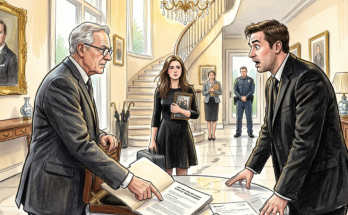
“Who Said You Could Speak?” My Father Snapped In Front Of His Commanding Admiral. Every Officer Watched Me Go Still. I Said, “Apologies, Sir.” The Admiral Wasn’t Looking At My Father Anymore. He Was Looking At Me. The Color Drained From His Face. He Knew Exactly Who I Was.
### Part 1
“Who said you could speak?”
My father’s voice cut across the dining room so sharply that even the ice in my sister-in-law’s glass seemed to stop moving.
I was standing beside the sideboard with a porcelain serving dish warm against my palms. The smell of roasted garlic and coffee hung in the room, mixed with the faint salt air drifting through the cracked windows of my parents’ house near the Chesapeake.
Across the table sat Rear Admiral Thomas Weller, retired.
Two stars.
A man my father had admired for more than forty years.
And suddenly, Admiral Weller was no longer looking at him.
He was looking at me.
My father, retired Navy Captain Richard Mercer, didn’t notice.
Not yet.
He was too busy staring at me with the expression I had known since childhood—the one that meant I had stepped outside the narrow box he had built for me.
“Claire,” he said, lower now. “I asked you to let the adults talk.”
I was forty-one years old.
I almost laughed.
Almost.
Instead I lowered my eyes to the plate because that was what thirty years of practice had trained me to do.
“Apologies, sir.”
The words came automatically.
But something about the way I said them changed Admiral Weller’s expression.
His fingers stopped around the handle of his coffee cup.
Then, slowly, he set it into the saucer.
Click.
That tiny sound was louder than my father’s entire speech.
“Young lady,” Admiral Weller said quietly, “where exactly did you serve?”
My father gave a dismissive chuckle.
“Tom, don’t encourage her. Claire’s been doing administrative work for years. Shore-side stuff. She moves around too much, but that’s always been Claire.”
My brother Ethan smiled faintly.
His wife, Lauren, reached for her wine.
My mother, Margaret, stood near the kitchen doorway with one hand wrapped around a dish towel.
I looked at her.
She wasn’t smiling.
She wasn’t surprised, either.
That bothered me more than anything else.
Admiral Weller ignored my father.
“Claire,” he repeated, “where did you serve?”
I had two choices.
I could tell the truth.
Or I could do what I had done since I was eleven years old.
Shrink.
The first time I remember shrinking for my father, I was sitting cross-legged on the living room carpet watching a Navy carrier return from deployment.
Sailors in white uniforms lined the deck.
Families crowded the pier.
Children waved signs.
A sailor came down the brow and lifted a little girl into his arms, and I remember something inside me tightening with certainty.
“I’m going to do that someday,” I said.
My father was sitting behind me reading.
He didn’t lower the newspaper.
“They let anybody stand on a flight deck these days.”
A page turned.
That was it.
I was twelve.
Old enough to understand the insult.
Young enough to still believe I could earn my way out of it.
So I tried.
I learned every ship class I could.
I memorized signal flags.
I read battered naval histories from my father’s shelves and traced Pacific routes on folded maps until the creases tore.
I thought loving what he loved would make him proud of me.
Instead, it irritated him.
The Navy belonged to him.
The sea belonged to him.
Ambition belonged to men who looked like him.
I was apparently trespassing.
At eighteen, I received a Navy scholarship.
I told my parents over Sunday breakfast.
My mother was slicing peaches at the counter.
My father looked at me over his coffee.
“Supply, I hope.”
“No.”
“Medical?”
“No.”
His eyebrows tightened.
“What, then?”
“I want to go to sea.”
My mother stopped cutting.
Just for a second.
My father leaned back.
“Claire, don’t build fantasies around things you’re not suited for.”
There are sentences that hurt when they’re said.
Then there are sentences that move into your bones and begin making decisions for you.
That one stayed.
I went to sea anyway.
I simply stopped bringing the sea home.
Years passed.
I became good at things my family never understood.
Standing watch on a black bridge at three in the morning while the ship cut through rough water.
Reading radar.
Reading weather.
Reading the tension in a junior sailor’s shoulders before she admitted she was overwhelmed.
Making decisions while tired enough to feel hollow.
Learning that the ocean did not care whether my father approved of me.
The ocean only cared whether I was competent.
For the first time in my life, that felt merciful.
At home, though, I remained “Claire with the desk job.”
My father told guests I had “done something with ships.”
Ethan became the family success.
He went into corporate consulting, bought a large house, made partner, wore expensive watches, and spoke the language my father understood: titles, deals, numbers.
At Thanksgiving, I once tried to tell them I had qualified for one of the most demanding warfare watch positions of my career.
My father paused carving the turkey.
I remember how the knife caught the chandelier light.
For one stupid second, I thought he was impressed.
Then he asked, “Is that the little gold pin?”
I nodded.
He turned toward Ethan.
“So what happened with that merger?”
That night, I decided something.
I would never again hand my father anything important enough for him to break.
He could have the version of me he preferred.
Quiet.
Average.
Administrative.
Safe.
He did not know that years later, I would stand on the bridge of a United States warship with hundreds of people waiting for my next order.
He did not know about the afternoon in the strait.
He did not know what I had done there.
And sitting at his dinner table that night, staring into Admiral Weller’s suddenly sharpened eyes, I realized my father had just criticized that very operation.
He had called the destroyer’s commander slow.
The problem was simple.
I knew she hadn’t been slow.
Because I had been standing on her bridge.
And the seven seconds my father mocked had been mine.
### Part 2
The dinner had been planned like a military exercise.
My father had been nervous for an entire week.
That alone told me how much Admiral Thomas Weller mattered to him.
Dad had retired as a Navy captain, a rank he had worked his entire adult life to earn. But the command he wanted most—the sea command he believed would define him—had never come.
He carried that disappointment like a private injury.
Growing up, I heard countless versions of the same story.
A superior had favored someone else.
Politics had interfered.
Timing had been wrong.
A promotion board had misunderstood him.
A ship had gone to another officer who supposedly deserved it less.
And at the center of those stories was always Thomas Weller.
Weller had been one of my father’s senior officers when Dad was young, back when his entire career still looked like an open horizon.
My father worshiped the memory of having once impressed him.
So when Admiral Weller announced he would be nearby for several days and accepted my father’s dinner invitation, Dad transformed.
He polished silver.
He bought wine he normally would have called overpriced.
He rehearsed old stories at the breakfast table.
Watching him, I felt something dangerously close to pity.
He was seventy-one years old, and he still wanted one man to look across a room and tell him he had mattered.
I understood that hunger.
I had inherited it from him.
Only mine had always pointed in his direction.
I happened to be home on leave when the dinner was scheduled. I had come mostly to see Mom and enjoy several nights in a bed that didn’t move under me.
When Dad learned I would be there, he cornered me in the kitchen.
“Thomas is serious,” he said.
“I know.”
“This isn’t an evening for your little service anecdotes.”
I stared at him.
“My little service anecdotes.”
“You know what I mean.”
Unfortunately, I did.
“Help your mother. Keep things pleasant. Let me steer the conversation.”
Then he added the word that turned the whole exchange into something from my childhood.
“Understood?”
I should have refused.
Instead, I said, “Understood.”
The habit was that deep.
Admiral Weller arrived exactly at five.
He was tall, silver-haired, and carried himself with the calm stillness of someone who had once been responsible for thousands of people and no longer needed to demonstrate authority.
He greeted my father warmly.
Dad practically glowed.
Ethan came next.
Then me.
“This is my daughter, Claire,” Dad said.
Nothing else.
Not my rank.
Not my service.
Not even “she’s also Navy.”
Just Claire.
Admiral Weller looked at me a second longer than necessary.
I assumed he was being polite.
Dinner moved exactly the way my father wanted.
He told old sea stories.
Weller listened.
Ethan talked about business.
Lauren praised Mom’s china.
I carried dishes.
Twice Admiral Weller tried to bring me into the conversation.
The first time he asked whether I had traveled far.
Dad answered before I could.
“She’s always coming and going. Never learned to stay put.”
The second time Weller asked, “And what do you do in the Navy, Claire?”
Dad put his hand over mine.
“Administrative work, mostly.”
I can still remember the weight of his palm.
Not affectionate.
Possessive.
A correction without words.
I let it go.
Then came coffee.
That was when Admiral Weller mentioned the strait.
The incident had made national news the previous spring.
A carrier strike group had been transiting contested waters when a coordinated threat developed—multiple inbound missiles combined with fast attack craft.
Public reporting had been incomplete, which was normal.
The sea keeps its secrets because distance helps it.
Most civilians saw grainy maps, unnamed officials, and statements written by public affairs officers.
My father saw just enough information to become an expert.
He started explaining the engagement.
Weller listened politely.
“The destroyer screen almost reacted too late,” Dad said. “That was the real danger. They were slow getting into position.”
My hand stopped over the serving dish.
Slow.
I could hear the bridge again.
The clipped voices.
The alarms.
The steady hum of ventilation that somehow became more noticeable when everything else in your body narrowed to a single problem.
I remembered the tactical display.
The carrier.
Our assigned station.
The threat axis.
The shrinking clock.
Seven seconds.
Dad continued.
“Another few moments and that captain could’ve created a disaster.”
Something inside me moved before my caution could stop it.
“It wasn’t late.”
My father froze.
Every eye turned toward me.
I should have stopped there.
Instead I said, “The destroyer maneuvered first because screening the carrier took priority over the shot. She had to close the geometry before engaging.”
That was when Dad snapped.
“Who said you could speak?”
No one moved.
Lauren stared into her water glass.
Ethan shifted in his chair.
My mother gripped the towel harder.
I apologized.
Then Admiral Weller asked where I had served.
Dad dismissed me again.
And suddenly I saw the situation differently.
This was no longer about defending myself.
My father was rewriting the actions of my crew.
He was criticizing sailors who had done everything asked of them.
He was reducing a decision made under fire into something he could mock over expensive coffee.
I could tolerate him making me small.
I had done it for decades.
But I was not going to let him make my crew small.
Admiral Weller watched me.
He knew something.
I could see it now.
Recognition was gathering behind his eyes.
But he was waiting for me to say it.
And for the first time in thirty years, I realized silence would not protect anything worth protecting.
### Part 3
People imagine dangerous decisions feel dramatic while you’re making them.
Mine didn’t.
The strait had been hot, bright, and almost offensively ordinary before everything changed.
Sunlight flashed off the water.
Coffee had gone cold beside someone’s console.
A junior officer was discussing a routine contact.
Then the warning came.
Multiple threats.
Fast.
Low.
Closing.
The entire bridge changed in one breath.
Voices flattened.
Bodies moved.
Nobody screamed.
Professionals rarely scream when the thing they trained for finally arrives.
My air-defense officer’s voice came over communications crisp enough to cut glass.
I looked at the tactical picture.
There was the carrier.
There was my destroyer.
There was the threat.
And between them was a decision.
We had an assigned position.
The safest thing professionally was to remain where doctrine had placed us and execute exactly as planned.
The correct thing was somewhere else.
I knew it immediately.
That is the terrifying part of command people don’t talk about.
Sometimes you don’t struggle to know what to do.
Sometimes you know instantly.
And then you have to live with being the person who knew.
I ordered the turn.
My ship responded.
Thousands of tons of steel moved hard across the water as sailors in engineering spaces, combat spaces, and passageways felt the deck shift under their boots.
We repositioned ourselves between the incoming threat and the carrier.
The ship everyone would target first if we succeeded.
The ship no one would thank if we failed.
Seven seconds had passed between the first warning and my order.
Seven.
My father later called that delay.
I called it the longest breath of my life.
We brought our defensive systems to bear.
The engagement unfolded in violent bursts of information.
Tracks disappeared.
New ones appeared.
Reports stacked over each other.
The carrier remained behind us.
That was the point.
There was a nineteen-year-old petty officer aboard my ship named Elena Ruiz.
She worked deep inside the hull in a space without windows.
During the engagement she could not see the sea, the carrier, or the threats.
She knew the battle through data on a screen and the vibration of the deck.
Months later, at her reenlistment ceremony, she told me something I never forgot.
“When the ship turned, Captain, I knew you’d already decided.”
“Decided what?”
“That we weren’t running.”
That mattered more to me than the medal.
Because command is not metal on your chest.
It is other people feeling the ship move and trusting the person who ordered it.
The attack ended.
The carrier remained untouched.
Our formation held.
My crew did everything they had trained to do.
No captain wins something like that alone.
Anyone who claims otherwise should never have worn command.
My executive officer was brilliant.
My chiefs were better.
My combat systems team performed with frightening precision.
My command master chief, Daniel Reyes, somehow remained calm enough afterward to complain about the coffee.
That was his method.
If Reyes was complaining about coffee, everyone knew the world had not ended.
But the movement of the ship had been mine.
No committee.
No father.
No admiral.
No one to ask.
That was command.
And that was why, months later at my father’s dining table, something finally refused to bend.
Admiral Weller was still waiting.
“Where did you serve?” he asked.
Dad laughed again.
“Tom, honestly. She’s shore-side now. Claire, take the dishes into the kitchen.”
There it was.
His entire relationship with me in one sentence.
Go away.
Let the important people talk.
I looked at my father.
He genuinely believed he was helping.
That was the strangest thing.
He wasn’t trying to humiliate me for sport.
He had spent so many years believing I was lesser that reducing me had become automatic.
Like correcting posture.
Like moving a glass away from the edge of a table.
And I had spent just as many years cooperating.
My reflex was to disappear.
His reflex was to erase me.
For once, I decided only one of us was going to follow habit.
I placed the serving dish on the sideboard.
The porcelain tapped softly against the wood.
I turned toward Admiral Weller.
My shoulders settled.
Something in me changed posture without permission.
Not daughter.
Not disappointment.
Commanding officer.
“Commander Claire Mercer, United States Navy, sir.”
My father stared.
I continued.
“I had command of the destroyer during the strait transit.”
Silence.
Ethan looked from me to Dad.
Lauren’s lips parted.
My mother shut her eyes for half a second.
But Admiral Weller did something no one expected.
He stood.
Slowly.
Deliberately.
My father began to rise automatically, decades of conditioning making him respond to a senior flag officer before his mind had caught up.
Weller lifted one hand.
Dad stopped.
Then the admiral turned toward him.
“Richard.”
My father’s face had lost its color.
“Do you know who has been carrying plates around your table all evening?”
Dad frowned.
“Thomas, I—”
“No.”
Weller’s voice stayed calm.
That made it worse.
He pointed toward me.
“Do you know who your daughter is?”
My father actually looked annoyed.
“Of course I know who my daughter is.”
Admiral Weller held his gaze.
“No,” he said. “I don’t think you do.”
Then he said words that split my family history into a before and an after.
“Your daughter commanded the destroyer that screened my carrier.”
Dad stopped breathing.
And Admiral Weller wasn’t finished.
### Part 4
Admiral Weller did not raise his voice.
He didn’t need to.
“Last spring,” he said, “that destroyer moved into the threat axis and placed itself between a coordinated attack and the carrier.”
My father’s eyes went to me.
Then back to Weller.
I watched disbelief fight with calculation.
He wanted an explanation that would preserve the old world.
A misunderstanding.
A different Mercer.
Some technical distinction that would let him keep believing I was a clerical officer who occasionally visited ships.
There wasn’t one.
“Her maneuver bought the formation time,” Weller continued. “Her crew performed exactly as required.”
Dad’s lips moved.
“She never told us.”
“I know,” I said.
He looked at me sharply.
Weller continued.
“That carrier had thousands of sailors aboard. I was responsible for them. Claire’s ship accepted the most dangerous position in the formation because somebody had to make that decision.”
The hallway clock ticked.
For years I had barely noticed it.
That night every second landed like a hammer.
Then Weller said, “She received a major valor award for her actions.”
Ethan whispered, “What?”
Lauren covered her mouth.
Dad stared at me.
“You have a decoration?”
That question almost made me smile.
Not because it was funny.
Because even then, his mind reached first for the visible thing.
The medal.
The proof.
The object he could rank.
Not the sailors.
Not the decision.
Not the years.
Admiral Weller seemed to understand the same thing.
“The decoration is not the point, Richard.”
My father flinched.
“I didn’t say it was.”
“You spent half this dinner describing her as someone who works behind a desk.”
“I was simplifying.”
“No,” Weller said. “You were diminishing.”
The word landed cleanly.
Dad’s jaw tightened.
I had seen that expression when I was a child and knew what came next.
A counterattack.
A correction.
A reason the other person was technically wrong.
But this time the man across from him was Thomas Weller.
His old mentor.
The man whose approval my father had chased for most of his adult life.
Dad had nowhere to go.
Weller turned toward me.
“I’ve read the operational summaries.”
I nodded.
“Yes, sir.”
“I have wanted to meet the commanding officer responsible for that maneuver.”
Something tightened in my chest.
“Sir, my crew—”
“I know.”
He gave the slightest smile.
“Good captains always say that first.”
My throat hurt unexpectedly.
He held out his hand.
“Commander.”
I crossed the room and shook it.
His grip was firm and warm.
Then he used both hands around mine.
“Thank you.”
Those two words almost broke me.
Not because they came from an admiral.
Because they were so simple.
No qualification.
No correction.
No question about whether someone else had done better.
Just thank you.
I had wanted that kind of sentence from my father since I was twelve.
Receiving it from another man did not repair the missing years.
It only showed me how little the sentence would have cost.
Dad stared at us.
Ethan stared at me.
My mother stared at the floor.
The dinner ended soon afterward.
Weller thanked Mom personally for the meal.
At the front door he turned to me.
“Bring me the whole story someday.”
“Sir?”
“The maneuver.”
His eyes flicked toward the dining room.
“Preferably somewhere no one tells you when you’re allowed to speak.”
I laughed before I could stop myself.
He smiled.
Then he left.
The moment the door closed, Dad rounded on me.
“You embarrassed me.”
There it was.
Not congratulations.
Not why didn’t you tell me?
Not are you okay?
You embarrassed me.
“In my own house,” he continued. “In front of Thomas Weller.”
I leaned against the dining room chair.
I felt suddenly exhausted.
“You still think tonight happened to you.”
His face hardened.
“What is that supposed to mean?”
“You spent the evening lying about me.”
“I did not lie.”
“You told him I worked behind a desk.”
“You told us that.”
“I told you I had been reassigned. You created everything else because it was the version you preferred.”
His cheeks flushed.
“You could have corrected me years ago.”
“I tried.”
“When?”
I laughed once.
There was no humor in it.
“The scholarship. My first ship. My warfare qualification. My department head tour. Thanksgiving. Christmas. Every time I came home until I finally learned not to.”
“I don’t remember that.”
“I do.”
That silenced him.
Not long.
But long enough.
Then he said, “You should have told me about the medal.”
And suddenly the entire conversation became clear.
He still wanted an achievement he could understand.
Something shiny enough to make the daughter valuable.
I shook my head.
“No.”
His eyebrows rose.
“No?”
“You don’t get to demand access to the parts of my life you trained me to hide.”
Ethan appeared in the doorway.
“Claire—”
I turned.
He looked pale.
“I really didn’t know.”
“I know.”
“Why didn’t you tell me?”
“Because you laughed too.”
His face changed.
That one hurt him.
Good.
Some truths should.
Before anyone could answer, my mother touched my elbow.
“Claire.”
I looked at her.
Her eyes were red.
“Come upstairs.”
I almost refused.
Then she said, “There’s something I should have shown you twenty years ago.”
In her voice I heard something I had never heard before.
Fear.
Not fear of my father.
Fear of me walking away.
I followed her upstairs.
She opened the spare-room closet.
Reached to the highest shelf.
And took down an old shoe box.
The cardboard corners were worn almost white.
“Open it,” she whispered.
I lifted the lid.
And everything I believed about my mother collapsed.
### Part 5
The box was full of my life.
Not memories Mom and I had shared.
Memories I did not know she possessed.
The first thing I saw was a newspaper clipping.
My ship.
A photograph taken from the pier.
Below it was another clipping.
Then another.
Dates.
Announcements.
Small Navy publications.
A photograph of me in dress uniform I had never sent home.
I lifted it carefully.
“Where did you get this?”
“Online.”
“You don’t use social media.”
“I learned enough.”
I looked at her.
Mom gave a tiny, embarrassed shrug.
“I had help.”
I kept digging.
There was a program from my first change-of-command ceremony.
My fingers stopped.
I remembered that morning perfectly.
White uniforms.
Salt wind.
A brass bell.
My new crew standing at attention.
The orders being read.
The moment I took command.
I had never invited my parents.
I had told them I was moving to a different assignment.
That was all.
“How did you get this?”
“I called the base.”
“You called the base?”
“They transferred me several times.”
Despite everything, I could picture it.
My quiet mother, sitting at her kitchen table, navigating Navy offices until someone finally understood what she wanted.
“They mailed me one afterward.”
The paper had been unfolded so many times the crease felt soft.
Then I found the citation.
My breath caught.
Not because of what it said.
I knew the words.
I had stood on a pier while they were read aloud.
I had hated every second of it because medals make something communal look individual, and I knew exactly how many sailors had earned every sentence with me.
What destroyed me was the paper itself.
The fold lines were nearly white.
My mother had read it again and again.
“Mom.”
“I know.”
I stared at her.
“You knew?”
Her mouth trembled.
“About the strait?”
She nodded.
“Before the decoration?”
“I saw the first reports. They didn’t give names.”
She sat on the edge of the bed.
“Then one article mentioned the commanding officer.”
She swallowed.
“I read your name and sat down on the stairs.”
I couldn’t speak.
She reached deeper into the box and removed a cheap spiral notebook.
Blue cover.
Bent corners.
She placed it in my hands.
I opened it.
USS Hamilton — first division tour.
Naples.
Yokosuka.
Bahrain.
Department head.
Promotion.
Command selection.
Dates.
Ships.
Ports.
Everything I had mentioned in passing during twenty years of abbreviated conversations.
My mother had written it down.
She had been listening.
All those dinners where I thought my words disappeared while Dad turned toward Ethan—
she had heard them.
All those Christmases where she remained silent—
she had remembered.
I looked at her.
“Why?”
Her face broke.
Not dramatically.
My mother never did anything dramatically.
Her chin simply began to shake.
“Because I was proud of you.”
“Then why didn’t you say it?”
There it was.
The real question.
Not Dad.
Not Weller.
Not the medal.
Her.
“Why did you let me think you agreed with him?”
She covered her mouth.
I waited.
For once, I would not rescue anyone from an uncomfortable silence.
Finally she said, “Because I was afraid.”
“Of Dad?”
“Of the house.”
I frowned.
She looked toward the door.
“For forty years, Richard decided what could be celebrated and what had to be minimized. Every disagreement became an argument. Every argument became a week of coldness. I told myself keeping quiet was peace.”
Her eyes filled.
“It wasn’t peace.”
“No.”
“It was surrender.”
I looked down at the notebook.
She continued.
“I watched him make you smaller. I watched Ethan learn from him. And I kept thinking I would speak the next time.”
A tear slid down her cheek.
“Then the next time came and I didn’t.”
I could barely breathe.
“You let me leave this house believing you weren’t proud of me.”
“I know.”
“You let me believe that for decades.”
“I know.”
Her answer mattered.
No defense.
No “your father loves you.”
No excuse.
Just acknowledgment.
“I am ashamed of it,” she said. “And I don’t expect you to erase what it cost you.”
That was the first real apology anyone in my family had ever given me.
Because it did not ask me to make the person giving it feel better.
She touched the notebook.
“I kept what I could.”
I looked at the worn pages.
“Secretly.”
“Yes.”
“That hurt too.”
“I know.”
I closed the notebook.
For a long time neither of us spoke.
I loved her.
That was true.
I was angry.
That was also true.
Both facts had to be allowed in the room.
Finally I said, “I can’t pretend this fixes everything.”
“I don’t want you to.”
“And I’m not going back to the way things were.”
“I don’t want that either.”
I looked toward the hallway.
“Then if we have a relationship, it happens directly. You call me. I call you. Dad doesn’t translate me. He doesn’t edit me. He doesn’t decide what you’re allowed to say.”
Mom nodded immediately.
“Yes.”
“And if he starts diminishing me in front of you again?”
She wiped her face.
“I speak.”
“You understand I’m going to remember whether you do.”
“I do.”
For the first time in my life, my mother didn’t ask me to forgive the past.
She asked for a chance to behave differently in the future.
I didn’t forgive her that night.
But I left the door unlocked.
My father was another matter.
When I came downstairs, he was waiting in his study.
On his desk was the old photograph of himself as a young lieutenant at sea.
For the first time, I noticed something I had never noticed before.
He wasn’t looking at the camera.
He was looking beyond it.
Toward a future he believed the Navy owed him.
And I finally understood why my life had always angered him.
I had become the future he thought should have belonged to him.
### Part 6
Dad did not apologize that night.
He tried to explain.
That was different.
“You have to understand how I was raised.”
“No.”
He blinked.
We were in his study.
Dark wood.
Ship models.
Framed certificates.
Everything in the room was evidence of the life he wanted people to recognize.
“No?” he repeated.
“I understand plenty.”
“Then you know standards were different.”
“Standards didn’t make you mock me.”
“I never mocked you.”
“The little pin?”
He looked away.
I continued.
“The boat thing?”
“Lauren said that.”
“You laughed.”
His jaw tightened.
“I thought you were choosing smaller assignments than you were capable of.”
“You never asked what assignments I had.”
He had no response.
“So you invented them.”
“I assumed—”
“Exactly.”
I stood.
“I’m done discussing what you assumed about me.”
“Claire.”
I moved toward the door.
He spoke faster.
“You kept things from us too.”
I turned.
“Yes.”
He clearly had not expected me to agree.
“I did.”
“Then this isn’t all on me.”
“No. The secrecy is mine.”
That seemed to relieve him.
Only briefly.
“But I became secretive because telling you the truth felt like handing you ammunition.”
His relief disappeared.
“You made home the one place where I could not bring anything I loved without watching you inspect it for weakness.”
He stared at his desk.
“I never knew you felt that way.”
“You didn’t want to know.”
That was the closest we came to honesty.
I left the next morning.
Mom hugged me in the driveway.
Dad stood inside the doorway.
He lifted one hand.
I drove away.
Three weeks later, a letter arrived.
Handwritten.
Dad almost never wrote letters.
The first paragraph discussed weather.
The second discussed a porch repair.
The third mentioned Mom’s garden.
Then one sentence stopped me.
I understand now that commanding a destroyer is not merely an assignment but responsibility for the entire ship and everyone aboard her.
I read it four times.
Not because it was profound.
Because it was accurate.
He had looked something up.
Or asked someone.
For the first time, my father had done work to understand my world rather than require my world to explain itself in terms he already respected.
I folded the letter and put it in a drawer.
I did not call him.
I did not forgive him.
Those are different decisions.
Mom called every Sunday.
At first our conversations were awkward.
She overcorrected.
Asked too many questions.
Wrote down things while I was talking until I heard the pen scratching through the phone.
“Mom.”
“What?”
“You don’t have to take notes anymore.”
A pause.
“I like taking notes.”
I smiled.
“Okay.”
She started saying things aloud.
“I’m proud of you.”
The first time, I almost changed the subject.
Praise still felt like a trap.
The second time, I managed, “Thank you.”
The third time, I believed she meant it without needing evidence.
Dad wrote twice more.
Short letters.
No apology.
No acknowledgment of specific harm.
Facts about my career appeared in them like small signal flags.
Correct terminology.
Correct ship type.
A mention of deployment cycles.
He was learning.
That was his choice.
Forgiveness was mine.
I was not ready to give it.
Maybe I never would.
Command Master Chief Daniel Reyes called one afternoon after I told him what had happened.
He had retired by then to a little place near the water.
He listened without interrupting.
Finally he said, “So the mother you thought wasn’t watching had a whole archive?”
“Pretty much.”
“And the old man?”
“Learning vocabulary.”
Reyes grunted.
“That must be painful for him.”
I laughed.
“You sound sympathetic.”
“I’m sympathetic to dental surgery too. Doesn’t mean I want to watch.”
Then he became quiet.
“Skipper, you know what certainty is?”
“Here we go.”
“It’s a story that feels like a fact.”
I leaned back.
He continued.
“You were sure your mother didn’t care.”
“She didn’t show it.”
“That matters.”
“Yes.”
“But you were wrong about what was inside her.”
“Yes.”
“And you were sure your father’s approval was the thing missing from your life.”
I stared out the window.
Reyes knew me too well.
“Maybe.”
“No maybe.”
I heard his chair creak.
“You built a whole cathedral around one man’s opinion. Then you got busy enough commanding ships that you forgot to keep attending services.”
I smiled despite myself.
“So what’s your point?”
“My point is you won before Admiral Weller stood up.”
That stayed with me.
Because he was right.
The dinner had revealed something.
It had not created it.
I had spent decades believing the final scene would be my father discovering who I really was.
But there had been hundreds of nights before that.
Bridge watches.
Storms.
Inspections.
Deployments.
Sailors trusting me.
Hard decisions made when nobody at home was watching.
My father’s recognition was only late information.
My worth had already happened.
That summer I received orders for a major command.
A larger responsibility.
A career milestone I once would have hidden automatically.
Instead I called Mom.
“Got my orders.”
She was silent.
Then she started crying.
Not quietly.
Actually crying.
“What?”
“Major command.”
“Oh, Claire.”
I heard her pull in a shaky breath.
“I am so proud of you.”
No whisper.
No closed spare-room door.
No shoe box.
Out loud.
I stood in my kitchen holding the phone and closed my eyes.
“Thank you, Mom.”
Then she asked the question I had avoided thinking about.
“Will you invite your father to the ceremony?”
I looked at the old handwritten letter in my desk drawer.
I knew my answer immediately.
“Yes.”
She exhaled.
“But Mom?”
“Yes?”
“I’m inviting him to witness my life.”
I looked out at the afternoon light.
“I’m not inviting him back into control of it.”
### Part 7
The morning of my major change-of-command ceremony was painfully bright.
The kind of coastal morning where every line looked sharpened.
Water flat.
Flags snapping.
Dress uniforms almost glowing in the sun.
My crew stood in formation on the pier.
The bell sounded.
Side boys waited.
Families gathered in rows of folding chairs.
Mom sat in the front row.
She had dressed carefully and brought the old shoe box with her.
Not the whole thing.
Just a few items tucked inside her large handbag.
When I spotted her, she raised one hand and pressed it to her heart.
I nodded.
Dad stood near the back.
Good jacket.
Polished shoes.
Hands clasped behind him.
He looked strangely smaller outside his own house.
Not weak.
Just proportionate.
That morning belonged to a system larger than his opinion.
No one asked what he thought my authority should be.
The Navy already knew.
Admiral Weller came too.
When I saw him take his seat, I laughed under my breath.
After the dinner he and I had exchanged occasional messages.
He never became some substitute father.
I would have hated that.
He was simply a respected senior officer who had recognized another officer and refused to sit through a lie.
That was enough.
The ceremony began.
Orders were read.
My name carried across the pier.
My authority was stated plainly.
No one interrupted.
No one corrected.
No one called anything “little.”
I thought of being twelve.
The living room carpet rough against my knees.
A carrier returning on television.
My father’s newspaper turning behind me.
They let anybody stand on a flight deck now.
I had spent years trying to prove that girl deserved the sea.
Standing on that pier, I finally understood she had never needed permission.
When the ceremony ended, Admiral Weller came through the receiving line.
He shook my hand with both of his.
“You still owe me that story.”
I smiled.
“The maneuver?”
“The entire thing.”
“You already read the reports.”
“Reports are written by committees. I want the captain’s version.”
I laughed.
“Then dinner’s on me.”
“Good.”
He glanced toward my father in the distance.
“Choose the table carefully.”
I nearly choked laughing.
Mom came next.
She hugged me.
Not the restrained family hug I grew up with.
A full embrace.
Then she pulled the old program from my first command ceremony out of her bag.
“I want you to have this.”
I touched the worn edge.
“You found this years ago.”
“I did.”
“You should keep it.”
She shook her head.
“No. That one belonged to the version of us where I watched from a distance.”
Her eyes shone.
“I was here for this one.”
I took it.
That sentence was worth more than the paper.
Dad waited until the crowd thinned.
I saw him approaching.
For a moment my body reacted before my mind did.
Shoulders tight.
Jaw ready.
A forty-one-year-old commanding officer becoming eighteen in half a second.
Then I let the reaction pass.
He stopped in front of me.
“Claire.”
“Dad.”
He looked toward the ship.
My ship.
His mouth moved once before he managed the words.
“Tell me about her.”
I knew exactly what he meant.
Still, I made him say it.
“About what?”
His eyes returned to mine.
“The ship.”
For thirty years I had waited for that question.
It arrived so late that the person who needed it had already disappeared.
I looked toward the gray hull.
“She’s demanding.”
He nodded.
I continued.
“Fast when she needs to be. Temperamental in heavy weather. Better crew than any captain deserves.”
He listened.
Actually listened.
I told him about the chiefs.
About watch rotations.
About how a ship sounds different at night.
About the smell of machinery and salt that gets into your uniform.
I told him what command feels like when the pier disappears behind you and every person aboard becomes your responsibility.
He did not interrupt once.
When I finished, he looked at me.
“I should have asked years ago.”
There it was.
Not enough.
But true.
“Yes.”
He swallowed.
“I was wrong.”
My chest tightened.
I had imagined those words so many times.
In childhood fantasies, they fixed everything.
In reality they could not touch the years already gone.
“I know.”
He looked almost startled.
Maybe he expected me to tell him it was okay.
I didn’t.
He asked, “Can you forgive me?”
The water slapped softly against the pier.
For the first time, I did not answer as the daughter who wanted something.
I answered as myself.
“No.”
His face changed.
I continued before he could speak.
“I believe you regret it. I believe you’re trying to understand now.”
He looked down.
“But forgiveness isn’t a reward for finally noticing damage after decades.”
“Claire—”
“I’m not punishing you.”
My voice stayed calm.
“I’m just not going to lie to make this easier.”
He stood very still.
“What does that mean for us?”
“It means we can speak if you can speak to me as I am.”
“And if I can’t?”
“Then we don’t.”
Pain crossed his face.
I felt it.
I did not enjoy it.
But I did not rescue him from it either.
For the first time, the consequences belonged to the person who had created them.
Dad looked at the ship again.
Then he nodded.
“Fair.”
It was not reconciliation.
It was not redemption.
It was a boundary.
And I walked back toward my crew feeling lighter than I had after any apology I had ever imagined.
### Part 8
Over the next two years, my relationship with my family became simpler.
Not perfect.
Simpler.
Mom kept calling.
She visited once during a port period and stood on the pier staring up at the ship as though someone had handed her a cathedral.
I took her aboard.
Showed her the bridge.
Let her sit in my chair while we were in port.
She immediately stood up again.
“I don’t think I’m allowed.”
“You’re fine.”
“It feels illegal.”
I laughed so hard my executive officer looked over from the other side of the bridge.
Mom laughed too.
That sound did more healing than tears ever had.
She never stopped apologizing through action.
That mattered.
Dad and I spoke occasionally.
He learned to ask questions without correcting the answers.
Sometimes he failed.
When he did, I ended the conversation.
No fight.
No lecture.
“Dad, we’re done for today.”
At first he protested.
Eventually he learned.
Consequences teach what arguments cannot.
Ethan changed more than I expected.
One evening he called.
“No joke this time,” he said immediately.
“That’s promising.”
He exhaled.
“I’ve been thinking about what you said.”
“Which part?”
“That I laughed too.”
I waited.
“I did.”
“Yes.”
“I liked being Dad’s success.”
“I know.”
“And I think part of me needed you to be less successful so that position felt secure.”
That admission surprised me.
“That’s probably true.”
“I’m sorry.”
I leaned against my kitchen counter.
“I appreciate you saying it.”
“Do you forgive me?”
Apparently my family had discovered a new favorite question.
“I don’t know yet.”
“Fair.”
Unlike Dad, Ethan didn’t argue.
We started again slowly.
Not as children trapped in our father’s ranking system.
As two adults learning how little we actually knew about each other.
There was no dramatic family reunion.
No Christmas where everyone cried and promised the past was gone.
The past never goes.
It just stops being in charge if you are lucky and disciplined enough to refuse its orders.
Admiral Weller eventually got his dinner.
At his table, nobody interrupted.
I told him about the strait.
Not the polished version.
The real one.
The uncertainty.
The seven seconds.
The way my hands shook hours afterward when no one could see.
The way Chief Reyes left coffee outside my cabin without saying anything.
The way Elena Ruiz told me she knew from the turn that we had already chosen our position.
Weller listened.
When I finished, he said, “That sounds about right.”
“What does?”
“The shaking afterward.”
I looked at him.
He smiled faintly.
“People think courage means fear never arrives. Usually it just arrives late.”
I carried that sentence with me.
My father had spent his life chasing recognition.
For years I thought I was different.
I wasn’t.
I had been chasing his.
That was the cruel inheritance.
Not ambition.
Dependency.
The belief that achievement only became real when the right person acknowledged it.
But here is what I know now.
Recognition and peace are not the same thing.
Recognition is borrowed.
Someone can give it.
Someone can withhold it.
Someone can change their mind.
Peace is built.
Watch by watch.
Decision by decision.
Boundary by boundary.
I once believed the great victory of my life would be my father finally seeing me.
It wasn’t.
He saw me eventually.
Admiral Weller forced him to look, and reality did the rest.
But by the time my father asked, “Tell me about your ship,” I no longer needed the question.
That was the victory.
Not humiliating him.
Not making him jealous.
Not standing over his collapsed pride.
I wanted none of those things.
I simply stopped handing him the authority to decide my size.
I never forgave my father in the way people often expect daughters to forgive.
I did not erase what he did.
I did not call three decades of dismissal a misunderstanding because he became gentler when he grew old.
We developed something quieter.
Limited.
Civil.
Occasionally meaningful.
He was allowed into the parts of my life he treated with respect.
Nothing more.
I loved him in the complicated way you can love someone while refusing to let them hurt you again.
And I stopped confusing love with access.
Mom and I got more time.
Real time.
Loud pride instead of hidden clippings.
Phone calls instead of notebooks.
She kept the shoe box, though.
When she visited me after another promotion, she brought it again.
“You know,” I told her, “most people use cloud storage.”
She looked offended.
“This survived thirty years.”
“Fair point.”
She added the new ceremony program.
I watched her smooth it flat.
Then I realized something.
For most of my life, I thought my story was about proving myself.
It wasn’t.
The Navy had never needed proof beyond performance.
My crew had known me.
My chiefs had known me.
The sailors whose lives rested inside decisions I made had known me.
My mother had known, even when fear made her too quiet to deserve credit for it.
The only person who insisted I remain small was the person whose approval I valued most.
So I had mistaken his blindness for darkness.
There had been light everywhere.
I just kept staring at the one closed window.
If you have someone like that in your life, someone whose approval has become a verdict, learn from the years I wasted.
Do not spend your life shrinking until they finally decide you are safe enough to celebrate.
Do not keep your best parts hidden just because one person knows how to bruise them.
And if they come back decades later asking for access to the person they refused to know, remember this:
An apology can be accepted without restoring the old relationship.
Regret can be real without becoming forgiveness.
Love can exist beside a locked door.
You are allowed to decide who gets a key.
The last time my father asked about my ship, we were standing on a pier at sunset.
He had become quieter with age.
He pointed toward the water.
“Do you ever get tired of it?”
“The sea?”
He nodded.
I watched the tide move between the pilings.
“No.”
He gave a small smile.
“I figured.”
Thirty years earlier, that answer would have been a plea.
See me.
Please.
This time it was only the truth.
I looked at him.
He looked at the ship.
And neither of us tried to change what the other person had already become.
Then someone called my name from the brow.
“Captain!”
I turned automatically.
Duty waiting.
A ship waiting.
A life that had never needed my father’s permission.
I walked toward it at my full height.
And I did not look back.
THE END!